53 307 résultats
6353Two fine folding engraved plates. 9 leaves; 20 pp. one leaf of "Nota." Two parts in one vol. Small 4to modern wrappers. Stuttgart: J.G. Zubrodt 1681 the date is given in an anagram. First edition of this scarce observation of the famous comet of 1680-81; according to WorldCat we find no copy in North America. Apart from its brightness this comet is notable as the first to be observed using a telescope by Gottfried Kirch in Coburg. Other well-known observers included Robert Hooke Flamsteed Newton and John Evelyn. Zimmermann 1642-93 mathematician astronomer millenarian and theologian studied theology at the University of Tübingen and became a Lutheran minister at Bietigheim in Baden. A follower of Jakob Böhme Zimmermann's millenarian views caused him to be removed from his ministry. He attracted like-minded dissenters and in 1693 a group of about 40 people led by Zimmermann left Hamburg for Pennsylvania. Zimmermann died en route in Rotterdam. The remainder of the group established a religious community near the Wissahickon Creek. Zimmermann in his varied life was a professor of mathematics at Heidelberg. He wrote several notable and influential books on comets and was an active observer of the 1680-81 comet noted by Kronk see below on p. 372. Newton mentioned Zimmerman in the first edition of the Principia as an observer of this comet. The first plate depicts the comet's path. The early chapters deal with the comet's movements through the heavens and this is followed by a series of careful computations as to its exact positions at different moments in its progress. Fine copy and scarce. ❧ Kronk Cometography I pp. 369-73. Poggendorff II col. 1411. unknown books
1300A La Haye: Chez la veuve d'Abraham Troyel 1711. Hardcover. Good. Duodecimo. xxiv 200 viii 38 iipp. 12 A12-K12 L4. First edition of author's first book. Contemporary mottled calf spine gilt. Top of spine chipped. With 78 diagrams on 32 folding plates. <br/> <br/> A La Haye: Chez la veuve d'Abraham Troyel, 1711. hardcover
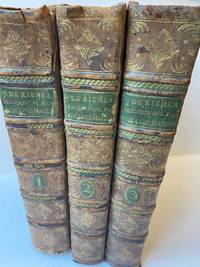
25051Delft Boitet 1730-1739. 2 parts in 3 volumes. Good complete copy. Richly decorated half leather with green shields. Spine of volume 1 damaged at the ends. All volumes rubbed at the edges. Name 'H. van Hall' in ink on first free end paper. 38 946 52 12 520 78 20 pag. Illustrated with 60 engravings a.o. the large bird's eye view of The Hague. Several engravings have creases. B407. hardcover
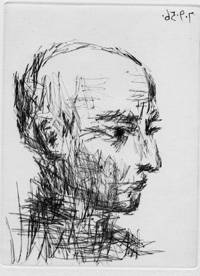
1956WRCLIT61619Paris: Louis Broder 1956. Small quarto. Stiff lithographically decorated wrappers. Lithographed three panel frontis replicating the slipcase decoration and three original full-plate dry-point etchings. Textual illustrations. Fine but see below in glassine chemise and shelfworn slipcase. First edition. One of 150 numbered copies on Vergé de Montval from a total edition of 180 numbered copies all signed on the justification by Pablo Picasso who contributed the three dry-points two of them portraits of Jacob and the lithographs. The textual illustrations are original woodcuts by Georges Aubert after drawings by Picasso. This collection of Jacob's essays was published as a tribute to him on what would have been the occasion of his 80th birthday. In this copy either in error or by action of a previous owner the title-leaf bifolium has in its place the 4pp prospectus with the upper panel replicating the title-page. ARTIST & THE BOOK 238. MONOD 6297. GOEPPERT 78. BLOCH 743-745 802-804. Louis Broder unknown books
248513Kiøbenhavn Trykt paa Gyldendals Forlag hos Johan Rudolph Thiele 1786. 16 293 4 s. 1 foldet kobberstukket kart Sillejord Præstegield i Øvre Tellemarken. 1 foldet kobberstukket plansje Den Norske Prim-stav eller Messedags Staven. Originalt kartonert bind med ny rygg med gammelt grønt skinn tittelfelt. Bordyre i gull på for- og bakperm. Kartet med rift riften diskre forsterket med tape. Hjørner litt oppskrapet ellers et meget fint eksemplar på skrivepapir. Skougaards eksemplar. . unknown
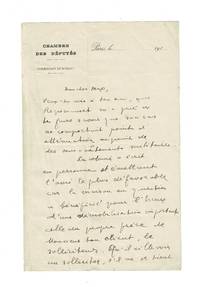
191875931Paris 1918. Fine. Paris s. d. ca 1918 13.30 x 21 cm 2 pages sur un feuillet Unpublished autograph letter signed by Guillaume Apollinaire addressed to Max Jacob. Two pages written in black ink on a sheet with the letterhead of the Chamber of Deputies. Folds inherent to mailing. Unpublished letter concerning the deputy Charles Régismanset then Director at the Ministry of Colonies: ""Veux-tu dire à ton ami que Régismanset m'a prié de te faire savoir que son cas ne comportait point d'atténuation au point de vue des sous-vêtements militaires."" ""La colonie a écrit en personne et émettant l'avis le plus défavorable car la maison en question a bénéficié pour l'heure d'une démobilisation importante."" ""These 'colonies' are hardly distant. He is seconded to Rue Oudinot to the office of Minister Henri Simon who was pleased to be able to assist a poet he had long admired. His duties are rather vague. Assigned to the Press Service he oversees the Bulletin d'Informations coloniales et étrangères occasionally contributing discreetly a task that leaves him sufficient freedom for his own work. His direct superior Charles Régismanset himself a writer calls upon him whenever a 'bushman' passing through might provide information on Bambara customs or Guinean witch doctors."" Pierre-Marcel Adéma Guillaume Apollinaire ""Viens tout de même me voir dirait le père Janvier qui doit pour le moins parler aussi bien que le père de Victor Hugo surtout viens avant janvier et toujours plus haut Excelsior viens j'ai quelque chose d'éditorial à te dire."" unknown
#[25112]Delft Boitet 1730-1739. 2 parts in 3 volumes. Complete copy with broken bindings. 19th century half leather spines and covers loose but intact. Owner's mark cut out of all the end papers of all three volumes. 3894652125207820 pag. Illustrated with 60 engravings a.o. the large bird's eye view of The Hague. B0468. hardcover
#[42477]4° 744 pp. cont. vellum binding. Illustrated with 33 wood engravings of which 6 full-page in the text and an angraving depicting child-birth on the titlepage all after Jos Amman. In the front and in the back several blank pages bound together with 11 pages with notes in cont. handwriting amongst which 12 prescriptions against after-effects and notes from 1658 stating that the book is the property of "onse suster Heijnderijckijen Claes Jans dochter wonende aen de Odijker steegh' signed in The Hague by "mijn Frederick Jaenen sieckentrooster in 's Gravenhage en Maria Klaes Jans dochter mijne huijsvrouwe'. Further notes from A. Wingelaar dated 1680 at the end of the book. Very rare. B0944. hardcover
1817880761817. THE FIRST BOTANICAL WORK PUBLISHED IN AMERICA BIGELOW Jacob. AMERICAN MEDICAL BOTANY BEING A COLLECTION OF THE NATIVE MEDICINAL PLANTS OF THE UNITED STATES CONTAINING THEIR BOTANICAL HISTORY AND CHEMICAL ANALYSIS AND PRPOERTIES AND USES IN MEDICINE DIET AND THE ARTS WITH COLOURED ENGRAVINGS. Boston: Cummings and Hilliard 1817-1820. First edition. 60 color plates most with tissue guards: 10 hand-colored copper engravings and 50 plates printed in color a la poupee probably from an etched stone with some plates finished by hand. Six parts bound in three volumes. Octavo in fours nineteenth-century quarter calf bindings with marbled boards red morocco label and horizontal double-rules in gilt to spines. Ex library: each volume has a bookplate and ink stamp on front pastedown a perforated stamp to title-leaf with an ink stamp on verso a perforated stamp in top margin of first text leaf and an ink stamp on p. 51. Plates are unmarked. Bindings are worn and scuffed with joints tender some starting. Plates are clean for the most part though some have offset on versos from text leaves or slight toning from tissue guards. Text is clean. "This is the first botanical work published in America. Bigelow originally planned to use hand-colored copper plate engravings which are employed in the first half of the first volume. This method proving too expensive and laborious he sought a method of printing color rather than applying it by hand. Richard Wolfe who has made an exhaustive study of the work believes that the rest of the plates the book was issued in six parts over a three-year period were made by etching a stone block then applying the colors to the stone 'a la poupee'. The stone inked with multiple colors was then printed in a single impression. This is the only use of such a process an American color plate book." - Reese 19th Century American Color Plates Books #10. Bennett p. n11 Nissen 164 Pritzel 773 Staflue & Cowan 514 Sabin 5294. unknown books
19271707351927. CHERNIKHOV Y.G. Iskusstvo nachertania The Art of Graphic Representation. 77 3 pp. with black & white illustration throughout. 8vo 170 x 130 mm bound in publisher's white wrappers in a new green cloth folding box. Leningrad: Knigoizdate'stvo Akademii khudozhetsv 1927. First edition of Yakov Chernikhov's extremely rare first book. Chernikhov 1889-1951 was an artistic visionary best known for his elaborate architectural fantasies in his later works. The present book is an instructional for neophyte art students encouraging them to depict beauty and movement through abstract representations. Although a considerably more humble publication than his subsequent books its fragile format has rendered it quite scarce. Neat ink ownership inscription on the cover and title page dated 1930. Spine a little worn a near fine copy. Not listed on OCLC. hardcover
1528870011528. MANLIUS DEL BOSCO Johannes Jacobus et al. LUMINARE MAIUS. Opus eximium quod Luminare Maius dicitur Medicis et Aromatariis perquam necessarium A Greater Lamp for Physicians and Apothecaries. Lyons: Printed by Antonio Blanchard for Louis Martin 1528. Quarto. 1-8 I-LXILXII -LXIV; I-XXVI; I-XXX I ff. This volume contains three separate works: The first Luminare Maius A Greater Lamp for Physicians by J.J Manlius del Bosco contains 11 sections on concocting different forms of medication: pills unguents plasters oils etc. 8 LXIV ff. It was first published in Milan 1494. The second Lumen Apothecariorum A Light for Apothecaries by Quiricus de Augustis of Tortona XXVI ff. intended for the use of pharmacists was first published in Turin in 1492. The third Thesaurus Aromaticum by Paul Suardo. I-XXXI ff. Originally printed in Milan in 1496 it lists medical substances alphabetically. All three Italian treatises from the 1490s are conveniently gathered together and beautifully printed here in one volume. Title-page in red and black with ornamental woodcut border and framed printer's device of two unicorns. Woodcut capital showing Saint Lawrence and foliate woodcut capitals throughout. Internally fine in 19th Century half-morocco showing only a few spots of rubbing. Wellcome I 4017. Rare. unknown books
2968Several woodcuts & extensive tables in the text. 24 p.l. 501 1 pp. Large 4to cont. polished speckled calf initials on upper cover "F.G.Z.S.H.v.W. 1739" spine finely gilt red morocco lettering piece on spine. Nuremberg: J.M. Seitz & C.C. Zell 1739. First edition and a very fine copy from the library of Karl Friedrich Graf zu Sayn Hohenstein und Wittgenstein 1708-56 with his initials on the upper cover one sees books from his library on the market from time-to-time. It must have been a fine and handsome collection. Schuebler 1689-1741 was a prominent Nuremberg mathematician architect and artist who wrote many standard works on the design of houses public buildings and gardens. He was also engaged in various fields of applied mathematics and became a member of the Royal Prussian Academy of Sciences in 1735. The present work is a practical introduction to all aspects of calculation including multiplication division trigonometry with references to Napier arithmetical and geometrical progressions etc. A very fine copy and rare with no copy in the U.S. according to OCLC. ❧ Poggendorff II 853. unknown books
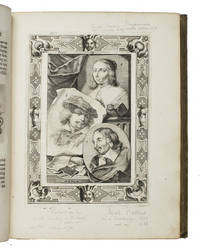
1729ABC_45605The Hague widow of E. Boucquet H. Scheurleer F. Boucquet J. de Jongh 1729 vols. 1-3; 1729. 4to. Dordrecht Ab Blussé & son 1769 vol. 4. Contemporary blind-tooled vellum with manuscript titles on spines. Sprinkled edges. With an engraved frontispiece title pages in red and black and with engraved vignettes a folding portrait of Willem Karel Hendrik Friso 1711-1751 Prince of Orange and from 1747 hereditary Stadtholder Willem IV a portrait of the author 40 engraved plates by Houbraken with multiple portraits of artists on each plate 1 plate with a night scene 1 mezzotint and 118 engraved vignettes. 4 volumes. 16 412 6; 4 412 6 4 446 4. First edition of richly illustrated biographies of more than 100 Dutch painters male and female still of interest for the history of Dutch art. The author Jacob Campo Weyerman 1677-1747 was one of the foremost Dutch authors of the Enlightenment and was known for his merry style. For this history of Dutch art he leans on Houbraken's De groote schouburgh der Neder-lantsche konstschilders en schilderessen 1718-1721.The first three parts were all published in 1729; the fourth - 40 years later - is mainly devoted to the painters from the Art Academy at The Hague. All 40 plates with artists' portraits the frontispiece 2 other portraits and the night scene are in the first 3 volumes the later volume 4 has no plates. The lavish vignettes throughout the volumes are worth mentioning as well mostly executed by Picart and apparently made for the present publication.The plates seem to be from a rare early state avant la lettre: all other copies we have seen have lettering on the plates but the present copy has the information written on the plates in ink. The title-page lettering seems to be very slightly moved compared to other copies but positions of the quire signatures all match. Perhaps this was a first impression or proof.From the library of Belgian artist/curator Philippe Jacques van Brée 1786-1871 with his owner's inscription on the front paste-down of each volume: "P.J. van Bréé". He was curator of the Royal Museum of Fine Art in Brussels from 1831-1861.With a few neat annotations in pencil in the margins of the plates and a small tear in the foot margin of a text page. Vellum slightly thumbed. Otherwise in very good condition.l Kunst op schrift 243-245; Arntzen/ Rainwater H129. ABE CAT Art History hardcover
171652920<p>London printed by J. N. Assignee of Edw. Sayer for D. Brown et al. 1716. FIFTH EDITION OF PLEAS OF THE CROWN 1716 INCLUDING THE SECOND ISSUE OF THE TRYAL OF WITCHES AT THE ASSIZES HELD AT BURY ST. EDMUNDS 1716. 3 title pages at front and each part has a separate title page; 1 Pleas of the Crown 2 A Short Treatise touching Sheriffs Accompts 3 A Tryal of Witches at the Assizes held at Bury St Edmunds for the Country of SUFFOLK on the Tenth Day of March 1664 pages 5 78-104; 4 A Discourse touching Provision for the Poor 5 Pleas of the Crown The Second Part by Giles Jacob. 8vo approximately 190 x 115 mm 7½ x 4½ inches pages: 22 1-272 8; 4 5-143 1; 2 1-121. Bound in full contemporary calf gilt lettered label to spine. Age-browning to margins of first General title page heavy age-browning to pastedowns and endpapers occasional pale age-browning to text a very good tight copy. "The publication A Tryal of Witches related to the 1662 Bury St. Edmunds witch trial first published in 1682 and was used by the magistrates at Salem when looking for a precedent in allowing spectral evidence. Since the jurist Sir Matthew Hale had permitted this evidence supported by the eminent philosopher physician and author Thomas Browne to be used in the Bury St Edmunds witch trial and the accusations against two Lowestoft women the colonial magistrates also accepted its validity and their trials proceeded." Wikipedia under the headings "Salem witch trials Spectral Evidence". See: Geoffrey Keynes A Bibliography of Sir Thomas Browne pages 197-99: "The sheets of the Tryal of Witches whole volume were reissued in 1716 pages 5 78-104 and were added to Hale's Pleas of the Crown"; Diana and Jeremy Norman The Haskell F. Norman Library of Science and Medicine Volume 1 page 352 No. 966 listing the first edition of 1683; Leslie F. Maxwell A Bibliography of English Law 1651-1800 Volume 2 page 54 No. 4. MORE IMAGES ATTACHED TO THIS LISTING ALL ZOOMABLE FURTHER IMAGES ON REQUEST. POSTAGE AT COST.</p> London, printed by J. N. Assignee of Edw. Sayer for D. Brown et al., 1716. hardcover
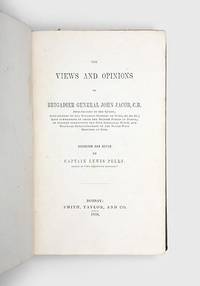
1858175736Bombay: Smith Taylor and Co. 1858. The thoughts of an influential British administrator in India on British policy in the east First edition of this important collection of Jacob's often controversial views; a London edition followed in the same year. The book covers general and civil administration military matters the North-West Frontier the Anglo-Persian War and Jacob's proposals for reorganizing India's civil and military administration. John Jacob 1812-1858 travelled to India in 1828 as a second lieutenant in the Bombay Artillery. He served in Gujarat before joining the Bombay column in the First Anglo-Afghan War. He was placed in charge of ordnance stores at Fort Bukkur and later appointed to command the Sind Irregular Horse under Sir James Outram. In this role he suppressed raiding in Sind and Kachhi though his support for Outram in a dispute with Charles Napier damaged his career prospects. Despite this Napier authorized him in 1846 to expand his force to 1600 horsemen. He successfully led campaigns against Bugti Baloch tribesmen and as political superintendent of Upper Sind developed frontier defences roads and canals. He also negotiated a treaty with the khan of Kalat. Promoted brigadier-general during the Persian War 1856 he commanded British forces in Persia after the fall of Muhammarah. He died of brain fever in Jacobabad in 1858 mourned by an estimated 10000 residents. The editor Lewis Pelly 1825-1892 a Bombay Army captain joined Jacob as aide-de-camp in Persia in 1857 and became brigade major of the Sind Frontier Force. After Jacob's death Pelly's career flourished under Sir Bartle Frere's patronage. He became chargé d'affaires at Tehran 1859 political agent and consul at Zanzibar 1861 and in 1863 replaced J. Felix Jones as British Resident in the Persian Gulf. Pelly relocated the residency from Bushire to Muscat expanding British influence in the Gulf. His impact is noted in Saudi Arabia's Memorial on the Muscat-Abu Dhabi territorial dispute: "Lieutenant Colonel Lewis Pelly became the British Resident in the Persian Gulf in 1863 and for the next nine years he played an important part in events there. Pelly came to the Gulf after a long association with General John Jacob whose forthright views on the position of the British in the East he admired to the point of collecting and publishing them in a volume for the enlightenment of the British public" Memorial p. 230. This first edition is scarce WorldCat showing six locations only plus the Oriental and India Office Collection British Library. We trace only a single copy of the London edition at auction. The book reflects both Jacob's strategic vision and Pelly's commitment to shaping British policy in the Gulf. Provenance: Charles Waddington 1796-1858 with his ownership inscription on the front free endpaper dated "Kurachee Karachi 19th Feby. 1858". Waddington served in the Bombay Engineers from 1813 and was superintending engineer for Bombay and southern southern provinces. He was ADC to Napier at Miani 1843 and in October 1847 was appointed superintending and executive engineer at Aden altered to chief engineer in April 1851. In 1854 he was appointed chief engineer in the public works department Bombay and "his services in preparing the Persian expedition received official acknowledgement. In November 1857 he was appointed to the command in Sind" ODNB; in September 1858 he left India due to ill health and died in London on 22 November. With the armorial bookplate of his son Horace Waddington 1834-1930to front pastedown. Octavo. Tables to the text 4 engraved plates on 2 leaves. Original green morocco-grain cloth gilt lettered on the spine embossed arabesque panels to the covers. A little rubbed neatly rebacked with majority of original spine laid down 3 letters partially replaced on the underlying cloth endpapers browned contents with pale toning and occasional light foxing overall a well-preserved copy very good. Memorial of the Government of Saudi Arabia 1955. hardcover
1699210071699. Ed. secunda. - Genf Chouet & Ritter 1699 Folio 28 124 1072 pp. 2 1233 pp. mit vielen Holzschnitten u. 124 davon 9 doppelseitig u. gefalt ganzseitigen Kupfertafeln Pergamenteinband d.Zt.; etwas gebräunt wie üblich. Second Edition! This edition contains significant additions and revisions to this "extraordinary storehouse of seventeenth century anatomical works" Russell 524 which was first published in 1685. The impressive collection with its striking engraved title and 124 plates based on original sources gathers in a single work the most important discoveries of the seventeenth century the period which laid the foundation for modern anatomy and physiology. ALL THE BST IN SEVENTEENTH CENTURY OF MEDICINE - "Here are Harvey's important embryological work 'De generatione animalium' 1551 as well as his treatise on the circulation of the blood with the four figures and also Malpighi's discovery 1651 of the capillary anastomosis in the lungs which supplied the missing link in Harvey's demonstration; . Olof Rudbeck's work on the lymphatics illustrated with nineteen figures on three folio plates; and the works of Pecquet and Bartholin. Here is given s short list of some of the more important works: Asseli discovery of the lacteal vessels 1617 Thomas Wharton's description of the duct of the submaxillary salivary gland Wharton's duct Zambeccari's proof that the spleen is not essential to life; Borelli's 'De moti animallium' 1680 on the application of mechanics to the motion of the limbs of animals Niels Stensen's papers on the muscular mechanics and his account of the excretory duct of the parotid gland Stensen's duct John Mayow's classic on the physiology of respiration 1674 DuVerney's account of the structure function and diseases of the ear and Schelhammer's account of the physiology of hearing Thomas Willi's on the circle of Willis; Richard lower treatise on the heart 1669 and the first blood transfulsion Francis Glisson's first accurate description of the capsulae of the liver Glisson's capsule Regnier de Graaf's detailed description of the male and female reproductive system including the first account of 'Grafiaan follicle' and his work on pancreatic secretion Malpighi's and Swammerdam's many excellent discoveries whit microscope to name but a few. Jean Jacques Manget 1652-1742 practised in Geneva with great success. In 1699 the Elector of Brandenburg made him his first physician. His literary work in which he was assisted by Daniel Le Clerc 1652-1728 chiefly consisted of collecting and reprinting in large volumes important treatises on medicine anatomy and chemistry. Le Clerc is sometimes called the "Father of the History of Medicine" because he wrote the first large history of medicine. That valuable and still consulted work was first published in 1696. Waller 5663; Haller Bibl. Anatomica I 803-04; Keynes Harvey no.45; Neu 2263; Hahn & Dumaitre 218; Osler 3192; Hahn & Dumaitre 218 describing the Baroque engraved title and reproducing it 226; Parkinson-Lumb 1422 lists complete content unknown
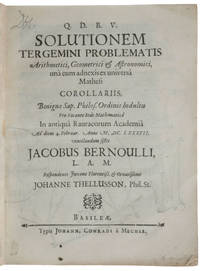
16875601Basel: Mechel 1687. First edition. First edition exceptionally rare of this dissertation which Bernoulli 1655-1705 submitted in order to secure the chair of mathematics at the University of Basel. This was the beginning of a remarkable career in mathematics in which he "greatly advanced algebra the infinitesimal calculus the calculus of variations mechanics the theory of series and the theory of probability and was one of the most significant promoters of the formal methods of higher analysis" DSB. EXCEPTIONALLY RARE DISSERTATION BY JACOB BERNOULLI. <p>First edition exceptionally rare of this dissertation which Bernoulli 1655-1705 submitted in order to secure the chair of mathematics at the University of Basel. This was the beginning of a remarkable career in mathematics in which he "greatly advanced algebra the infinitesimal calculus the calculus of variations mechanics the theory of series and the theory of probability and was one of the most significant promoters of the formal methods of higher analysis" DSB. The dissertation 'The solution of a triplet of problems arithmetical geometrical and astronomical together with corollaries from general mathematics' treats three elementary problems in number theory one arising from arithmetic one from geometry and one from astronomy/navigation. "Jacob Bernoulli's research on elementary mathematics taken as a whole constitutes a work of no mean importance very diverse in content lacking organic unity to be sure but also of exceptional historic interest. Indeed only from very few of the mathematicians who have left a lasting mark do we have the documentation which allows us to examine carefully the process of their scientific education . However in contrast from Jacob Bernoulli we actually possess some 'exercises' that he wrote beginning during the early years of his education. This is how we might characterize some of his Meditationes which he worked on with great diligence and singular ability. The interest of these exercises lies not only in their relationship to the general state of mathematics of the time but also and perhaps more in the way in which they represent an almost complete psychological picture of the formation of a great mathematician - which he certainly was - toward the end of the XVIIth century" Werke 2 p. 15. These Meditationes remained unpublished until the twentieth century except for the three published with much additional detail in the present pamphlet. On the last page of the dissertation is a list of 'Corollaries' one of which concerns the values of expectations in a lottery and is of particular interest in view of Bernoulli's posthumously-published Ars conjectandi 1713 the founding work of mathematical probability. "The academic dissertation Solutionem tergemini problematis arithmetici geometrici et astronomici which was presented at the University of Basel 4.2.1687 secured him the desired teaching post. Therefore this paper has particular biographical interest" ibid. p. 18. OCLC lists only 5 copies worldwide Yale only in US; not on COPAC.</p> <br /> <p>"Let us recall briefly what we know of Jacob Bernoulli's education before he obtained at the age of34 the chair in mathematics in his hometown Basel. Jacob was born in this city on December27th 1654 according to the old calendar in a protestant family of spice traders who had fled theSpanish low lands after the fall of the Duke of Alba. Complying with the wish of his father NicolasBernoulli a state adviser and magistrate Jacob studied philosophy and then theology until 1676. Aswas common at the time he chose a motto. His came from Phaeton who drew the solar carriageInvito patre sidera verso which may be translated by 'Despite my father I am among thestars'. Rather than exaggerated modesty this motto was a proud affirmation of superiority.</p> <br /> <p>"The young Jacob fully benefited from what Daniel Roche calls 'culture de la mobilité' promoted in the second half of the XVII century by new institutions which facilitated the movement of individuals and the spread of knowledge. Starting in August 1676 he traveled by horse to Geneva where he remained for twenty months preaching instructing a blind young girl Elisabeth von Waldkirch and serving as an opponent during the theological disputations. He relates his experience teaching mathematics to the blind in an article published in the Journal des Savants in 1685. This article is probably a reaction to an account by Spon published in the same journal in 1680 in which the author attributes to the father of the blind girl the writing system that was in fact developed by Jacob. It is here that Jacob meets Nicolas Fatio de Duillier a life long friend who recalled in a letter dating from July 22nd 1700 that he had seen Jacob play court tennis in Geneva a game on which Jacob later wrote a famous letter . </p> <br /> <p>"In June 1678 Jacob continues his extensive traveling in France residing in the Limousin in Nède with the marquis de Lostanges where he constructs two sundials in the castle courtyard then in Bordeaux and a few weeks in Paris. During this journey he begins in 1677 to write his mathematical journal Meditationes annotationes animadversiones theologicae et philosophicae which contains 236 articles . The journal is a precious testimony from this early phase of Jacob's scientific training which only really began when he encountered the Cartesian environment initially in France later mainly in the Netherlands Amsterdam and Leiden and in England during a second journey April 1681- October 1682. In August 1682 Jacob attended a meeting of the Royal Society in London. Jacob started out by acquainting himself with the Cartesian philosophy of nature after which he turned to geometry .</p> <br /> <p>"After his return to Basel in 1682 Jacob gave up the idea of a career in the clergy and decided to devote himself to mathematics. At the University of Basel he gave courses in experimental physics as can be gathered by a pamphlet printed in Basel in 1686. From 1682 on he also submitted short articles to the Journal des Savants - reactions to the works of others that he presented or criticized - initially in the area of natural philosophy machines for breathing under water to elevate water to weigh air oscillation center then from 1685 in mathematics .</p> <br /> <p>"Jacob slowly acquired a knowledge of mathematics at first through his readings of the second Latin edition of Descartes' Géométrie 1659-61 later that of Arnauld and his Logique Malebranche and Prestet . Jacob is confronted with precise problems often stemming from the area of applied mathematics. Solving these leads him to discover general methods. He begins by a thorough study of previous works which will serve him as a springboard to make further headway and produce new results. On several occasions Jacob voices the opinion that it is necessary to base one's own progress on the knowledge of what has been done in the past. Accordingly in the memoir entitled Solutionem tergemini problematis arithmetici geometrici et astronomici offered here presented on February 4th 1687 in order to obtain the mathematics chair in Basel he describes his own way of proceeding in the following way: 'In reality he who embraces a career as a mathematician is not the one who copies the inventions of others remembers them and recites them on occasion but the one who is truly innovative and is able to invent by using the divine algebra and thus to revolutionize what has been studied by others'" Peiffer.</p> <br /> <p>"Like other graduates of the University of Basel in the seventeenth century Bernoulli had a broad if not deep knowledge of all the disciplines of the liberal arts - an education he would draw on in writing Ars conjectandi 1713. The university at this time had a small faculty of philosophy including only nine chairs in logic rhetoric eloquence Greek mathematics physics history ethics and Hebrew. So although he had only an elementary education in mathematics as an undergraduate Bernoulli had a knowledge of Greek logic rhetoric and other subjects and was able to write polished Latin.</p> <br /> <p>"It was not uncommon at this time for a man to take a university post in a less desirable discipline if the chair he would have preferred was not available. He would then move if the opportunity arose to the preferred discipline without having to do everything required of a new applicant for a university position such as paying to print lists of theses to be defended in a disputation . The lists of theses that Jacob Bernoulli proposed to defend publicly in the years after his return to Basel in October 1682 reflect this list of open positions. Thus in January 1684 of the 100 theses that Bernoulli proposed to defend 34 were logical and 18 oratorical . Again in September 1685 and in February 1686 Bernoulli's theses were heavily logical. Finally after the death of the professor of mathematics in 1686 Bernoulli applied for disputed and won the chair" Sylla pp. 6-7.</p> <br /> <p>The first of the three problems treated by Bernoulli in his Solutionem tergemini problematis is: 'to find without the aid of algebra with the help of numerical arithmetic alone a number such that if we divide it into the numbers 12 and 36 and then add 8 to each of these numbers the resulting sums are in the ratio of 3 to 5.' The problem is generalized to arbitrary sets of given numbers.</p> <br /> <p>The second problem is more challenging. It "calls for the construction of a quadrilateral inscribed in a semi-circle with sides and diagonals of rational lengths in other words commensurable to the radius" Werke 2 p. 18.</p> <br /> <p>The third problem is one which could arise in navigation: 'It is observed somewhere at the sixth hour of the sun that it has an altitude of 12 degrees above the horizon and that one hour and 12 minutes after the moment of this observation the sun sets. The question is at what latitude and at what time of the year was the observation made'</p> <br /> <p>On the last page of text under 'Corollaria' Bernoulli lists some of his other Meditationes - problems dealing with logic physics meteorology geometry referring to Propositions 55-57 of Euclid Book X stereometry mechanics perpetual motion machines dioptrics perspective referring to Bosse and Desargues gnomonics referring to Münster and Sturm ballistics 'ars conjecturandi' probability and figurate numbers giving the very large example 1580972.</p> <br /> <p>The problem on probability "concerned the slowness with which the values of expectations in a lottery increase as more and more blank slips are drawn out of the urn. In an urn containing 16000 slips if it initially cost 7½ to participate 1000 blank slips in a row would have to be drawn out before the person could sell his expectation to someone else for 8" Sylla p. 27.</p> <br /> <p>Peiffer 'Jacob Bernoulli teacher and rival of his brother Johann' Electronic Journal for History of Probability and Statistics 2 2006. Sylla tr. Jacob Bernoulli. The Art of Conjecturing 2006.</p> <br/> <br/> Small 4to 198 x 156 mm pp. 16 including a full page of geometrical diagrams printed on title verso. Contemporary marbled wrappers. Mechel unknown
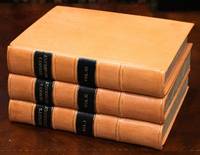
1775919London: T. Payne 1775. Second Edition. Fine Leather Large Quarto 11.75"x10" Bindings Bound by A.B. Buck. Near Fine. A New System or An Analysis of Ancient Mythology by Jacob Bryant – 3 Volume Set Second Edition 1775<br /> Author: Jacob Bryant<br /> Publisher: London: Printed for T. Payne P. Elmsly B. White and J. Walter<br /> Publication Date: 1775 MDCCLXXV<br /> Edition: Second Edition<br /> Format: 3 Volumes Quarto 11.75"x10".<br /> Description:<br /> Presenting a striking and complete three-volume set of Jacob Bryant’s magnum opus A New System or An Analysis of Ancient Mythology. In this highly influential 18th-century work Bryant attempted to trace the mythologies and traditions of ancient civilizations—including the Greeks Romans Egyptians and Babylonians—back to a common origin heavily linking them to the events of Genesis and the dispersal of nations following the Tower of Babel.<br /> This set is profusely illustrated with 32 striking copperplate engravings including detailed folding maps ancient coins architectural ruins and intricate depictions of mythological figures and symbols such as serpents and temple rites. Notably the renowned artist and poet William Blake was an apprentice to James Basire the principal engraver for this work and scholars frequently attribute several of the engravings in this edition to a young Blake.<br /> The set is masterfully bound in pristine full tan leather. The spines feature classic raised bands with contrasting dual black morocco labels elegantly tooled with gilt lettering indicating the title "BRYANT'S MYTHOLOGY" and volume numbers. The text blocks are solid and the pages remain wonderfully crisp pages with some light sporadic foxing pages overall are bright and clean showcasing the impressive typography and detailed plates that make this work so desirable.<br /> The immaculate condition of the binding makes this a stunning presentation piece perfect for an advanced collector of mythology early anthropology or 18th-century antiquarian works. T. Payne unknown
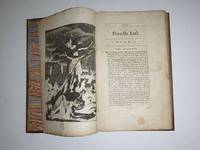
51-5780London: Printed by Miles Flesher for Jacob Tonson at the Judge's-Head in Chancery-lane near Fleet-street . Folio. 23 x 37cm. Contemporary calf cover with moonscape mottling and new goatskin spine by the artisan binder Sasha Mosalov.4 219 1 219-250 151-196 mispagination but complete 297-343 7 pages 13 leaves of plates. Lacking the frontispiece.Condition report: pages with light toning and foxing marginalia occasional stain or soiling occasional small losses or chips not impacting text; damp staining throughout at upper half small wormhole that runs through most of volume with additional tiny wormholes at inner and outer margin small losses at margins small loss in 2L1 Book II plate cut short at outer margin several pages partially detached; lacking portrait frontispiece with 2 additional pages of manuscript.Twelve full-page engraved illustrations one for each book. Ten are signed by Michael Burghers or Burghese one of the subscribers; these are from designs of Medina . The fourth is by Peter.Paul. Bouche from the design of B. Lens Sr. The eighth plate . is anonymous."--Pforzheimer p. 730"The names of the nobility and gentry that encourag'd by subscription the printing this edition of Milton's Paradise Lost" Zz2r-²Aa2v.Wickenheiser p. 159; ESTC 15589; USTC 3113387Wickenheiser p. 159; ESTC 15589; USTC 3113387; OCLC Number / Unique Identifier:228722671. London: Printed by Miles Flesher, for Jacob Tonson, at the Judge's-Head in Chancery-lane near Fleet-street, unknown
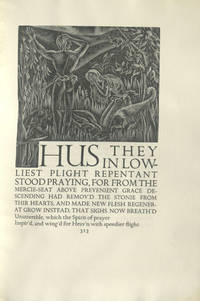
1937008386The Golden Cockerel Press 1937. 1st Edition . Hardcover. Good. Folio - over 12 - 15" tall. GROOM Mary 1903-1958. A celebrated edition of Miltons epic renowned as much for its artistry as for the literary stature of the text itself. A Limited Edition in the publishers black half morocco over red marbled boards gilt tooling. Spine raised bands gilt tooling & titles. Internally 6 5-378 pp 1 1 limitation 30 wood engravings various sizes by Mary Groom wood engraved titles by Robert Gibbings an edition limited to 200 numbered copies bound by Zaehnsdorf with their stamp to fep a few marks lower corners worn cloth sides were hand-marbled by Sydney Cockerell boards a little bowed a few cloth ripples light damp marks to first & last few leaves top edge gilt remainder uncut. Signature: 3 b-3b4. 334236 mm. Pertelote 119. This edition is a reprint of the first impression but includes the Argument and Explanation of the Verse which were added in later 1668 issues. <br/> <br/> The Golden Cockerel Press hardcover
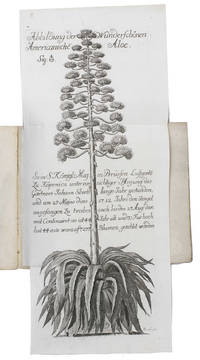
1727ABC_49435Nuremberg 1727. Oblong 4to ca. 16.7 x 21.2 cm. Bey Wolfg. Moritz Endters seel. Erben und Jul. Arn. Engelbrecht. Gedruckt bey Joh. Ernst Adelbulner Contemporary brown sprinkled paper wrappers. With a full-page engraved plate with 6 figures an additional engraved folding plate by Busch 2 decorated woodcut initials a woodcut headpiece and a woodcut tailpiece. 36 1 1 blank pp. First and only edition of a treatise on the American Aloe Agave Americana with a very rare additional plate not present in any other copies of the work. This plate drawn by Busch who we have not been able to identify shows the spectacular blooming American aloe from the gardens of Köpenick Palace which was the largest American aloe in any royal garden at the time. It caused a sensation when it finally bloomed in 1712 after 44 years; even Tsar Peter the Great paid a visit to admire it. The present plate is not only one of the few contemporary images of the so-called "wunderaloe" miracle aloe but also one of the very few illustrations of any part of the Köpenick Palace gardens of the time.The present work is a comprehensive study of the American aloe. It was written by the German physician and botanist Christoph Jacob Trew 1695-1769 after observing a blooming aloe in Nuremberg in 1726. His treatise offers explanations for the plant's unusual growth as well as descriptions of its medicinal use. It is partly based on his own observations but also compiles the findings of other studies on the plant. The work contains meteorological tables in which Trew attempts to forecast the natural conditions for growing ripe Aloe seeds and an engraved plate with detailed illustrations of the flowers and seeds. The present copy also includes the final leaf with a note to page 8 which is not mentioned in the reference works.Trew studied medicine at the University of Altdorf graduating in 1717. He wrote his dissertation under the supervision of the surgeon and botanist Lorenz Heister 1683-1758. He became a physician in Nuremberg and also supervised the Hortus Medicus the medical university garden. After thorougkly studying the plants with the help of students he published several richly illustrated botanical works including Hortus nitidissimis omnem per annuum superbiens floribus 1750-1786 Plantae selectae quarum imagines ad exemplaria Londini 1750-1773 and Plantae rariores quas maximam partem ipse in horte domestico colui 1763. He also had his own garden in which he was able to successfully cultivate many exotic plants including 32 species of aloe.The wrappers are scuffed the spine shows traces of use with two small tears that extend into the front and back wrapper. The work is slightly browned throughout with an additional plate not present in other copies. Otherwise in good condition.l Pritzel 9497 does not record the final leaf or additional plate; Stafleu & Cowan 15.129 does not record the final leaf or additional plate; VD18 11388935; WorldCat 889555595 311430074 24 copies of which none with the additional plate. unknown
61561Regensburg 1766. 4to. 144 pp. Engraved portrait. 135 handcoloured edgraved plates. Modern calf over wooden boards. Title-page a little soiled. Engraved portrait with minor stain in lower margin. Last leaf a little stained. Latin and German parallel text. . hardcover
1917113145London: Constable & Co Ltd 1917. Rare with the extra signed plate Signed limited edition number 505 of 525 copies signed by the artist here retaining the rare extra plate signed by Rackham still in the original envelope. The signed plate was issued in all copies loosely inserted for which reason it is often found wanting. It duplicates the plate facing page 178 "He hurried away with long strides". A review in The Bookman noted that "Here is an ideal conjunction of author and artist - the fairy and folk tales of the Brothers Grimm could not have a more fitting illustrator than Arthur Rackham nor he more suitable authors to illustrate." Quarto. Colour frontispiece and 12 colour plates mounted on heavy white paper with loose tissue guards black and white illustrations in the text by Rackham. Original grey cloth spine lettered in gilt pictorial gilt titles on a white ground to front board pictorial endpapers top edge gilt others untrimmed. Presentation inscription dated 1941 on verso of front free endpaper; old pale stain on back cover light rubbing to extremities head and tail of spine only slightly bumped short closed-tear into margin at p. 209 light offsetting from tissue guards yet still an excellent copy. Latimore & Haskell pp. 46-47; Riall p. 129. hardcover
1758016251Philadelphia: William Bradford 1758. First Edition. Hardcover. Title page with a few repaired tears hinged with following Preface page; two adjoining leaves pages 441-444 of text lacking and supplied with facsimiles. Contents Very Good binding about Fine. Folio 7-1/4" x 11-1/2" bound in contemporary calf leather with a decorative blindstamped border recently rebacked with a new gilt-lettered and decorated spine preserving original paste-downs and free endpapers; 4 763 pages. Title within rule border decorative woodcut head- and tail-pieces. An important compilation of the fundamental New Jersey charters and session laws of the proprietary period 1664 to 1702 up to Lord Cornbury's commission and instructions as Royal Governor when New Jersey became a crown colony under Queen Anne. Publication was ordered by the New Jersey Assembly in 1752 but two years were required to collect the documents to be included while the typesetting and printing took Bradford an additional three. By the date of publication some 170 copies had been subscribed. This title was the largest volume issued from Bradford's press and one of the largest from any eighteenth-century American press. Evans 8205; Sabin 39527. Early owner name on the title page and early twentieth century names on the front pastedown. <br/><br/> W[illiam] Bradford hardcover
178010913Leiden: for H. Mostert 1780. Contemporary Dutch red-dyed pigskin backed marbled paper boards rubbed front panel with paper loss UNCUT. Schultens' collection contained over twelve thousand titles and rivaled the University library in size. Three quarters of his books dealt with the Abrahamic religions systematic theology biblical commentary church history philology and ancient history including INCUNABLES ILLUMINATED VELLUM COPIES AND ONE HUNDRED ARABIC HEBREW PERSIAN AND TURKISH MANUSCRIPTS. Leiden University acquired eighty of the manuscripts its largest single manuscript purchase in more than a century.     THIS COPY IS PRICED THROUGHOUT by Leiden printer and bookseller Dirk II Haak 1754-18-- who signed the title. In good condition foxed two quires heavily last leaves dampstained in the lower margin.¶Vrolijk & Leeuwen Arabic Studies in the Netherlands 79-82; Blogie Répertoire des catalogues de ventes IV: 30; STCN 241214483. for H. Mostert unknown books