53 307 résultats
169141859Leipzig Grosse & Gleditsch 1691. 4to. Contemp. full vellum. Faint handwritten title on spine. a small stamp on titlepage. In: "Acta Eruditorum Anno MDCLXXXXI". 85906 pp. and 13 of 15 folded engraved plates. The 2 first plates lacks but they do not belong to the papers listed.Leibniz' papers: pp.277-281 a. 1 plate pp. 435-439. Johann Bernoulli: pp. 274-276 a. 1 plate. Huygens: pp. 281-282. - Jacob Bernoulli: pp. 282-290 a. 1 plate. <br/><br/><em>All papers first apperance. All 5 of extreme importence in the development of the Calculus. Leibniz' 2 papers on the catenary curve paper 1-2 offered here was written at the instigation of Jacques Bernoulli. Following the example of Blaise Pascal who had initiated in 1658 a contest for the construction of the cycloid Leibniz also provoked the geometers of his time by challenging them to submit at the fixed date of mid-1691 their geometric method for the construction of the catenary curve. Leibniz later provided the answer followed by Johann Bernoulli and Huygens.'These two papers are a historical account of the origin of the study of this transcendental curve and at the same time the first physical-geometric construction showing the species-relationship between the catenary and the logarithmic curves as two companion curves; one arithmetic the other geometric. All of the differentials of the catenary curve are arithmetic means of corresponding differentials of the logarithmic curve; and all of the differentials of the logarithmic curve are geometric means of the catenary.'"The Catenary is the form of a hanging fully flexible rope or chain the name comes from "catena" which means 'chain' suspended on two points. The interest in this curve originated with Galileo who thought that is was a parabola. Young Christiaan Huygens proved in 1646 that this cannot be the case. What the actual form was remained an open question till 1691 when Leibniz Johann Bernoulli and the then much older Huygens sent solutions to the problem to the "Acta" Jakob Bernoulli 1690 Johann Bernoulli 1691 Huygens 1691 and Leibniz 1691 - these 4 1691-papers offered here - in which the previous year Jakob Bernoulli had challenged mathematicians to solve it. As published the solutions did not reveal the methods but through later publications of manuscripts these methods have been known. Huygens applied with great paper 4 virtuosity the by then classical methods of 17th century infinitesimal mathematics and he needed all his ingenuity to reach a satisfactory solution. Leibniz the papers 1-2 and Bernoulli paper 3 applying the new Calculus found the solutions in a much direct way. In fact the catenary was a test-case between the old and the new style in the study of curves and only because the champion of the old style was a giant like Huygens the test-case can formally be considered as ending in a draw." Grattan-Guiness in "From the Calculus to Set Theory 1630-1910.".The paper by JACOB BERNOULLI no. 5 offered here is a milestone papers as it marks the invention of the "SYSTEM OF POLAR COORDINATES" with points located by reference to a fixed point and a line through that point. Although newton had earlier also devised such a coordinate system in 1671 his work was not known so that the credit for the discovery generally goes to Bernoulli. Parkinson Breakthroughs 1691.Further papers contained in this volume of Acta Eruditorum:DENYS PAPIN: Mecanicorum de Viribus Motricibus sententia asserta a D. Papino adversius C.G.G. L. Leibniz objectiones. pp. 6-13. The plate lacks. - and Dion. Papini Observationes quaedam circa materias ad Hydraulicam spectantes. Pp. 208-213 a. 1 plate. This importent paper is part of the LEIBNIZ-PAPIN-CONTROVERSY.JACOB BERNOULLI: Specimen Calculi Differentialis in dimensione Parabolæ helicoidis ubi de flexuris curvarum in genere carundem evolutionibus. Pp. 13-22. The plate lacks. - and J.B. Demonstratio Centri Oscillationis ex Natura Vectis reperta occassione eorum quæ super hac materia in Historia Literaria Roterodamensi recensentur articulo.Pp.317-321.LEIBNIZ: O.V.E. Additio ad Schediasma de Medii Resistentia publicatum in Actis mensis Febr. 1889. Pp. 177-178. and O.V.E. Quadratura Arithmetica Communis Sectionum Conicarum quæ centrum babent.Pp. 178-182 a. 1 plate.TSCHIRNHAUS: Singularia Effecta Vitri Caustici bipedalis quod omnia magno sumtu hactenus constructa specula ustoria virtute superat per D.T. Pp. 517-520 </em> hardcover
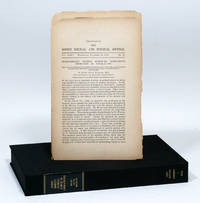
18472758Boston 1847. 1st Edition. Original Wrappers. Very Good. FIRST EDITION OFFPRINT of the first announcement of the successful use of anesthesia during surgical operations one of the greatest discoveries of nineteenth-century medicine. A visitor to Boston Massachusetts would be well advised to take a stroll to the Ether Dome at Massachusetts General Hospital to see the amphitheater where surgery without pain began. On October 16 1846 dentist William T.G. Morton publicly performed a painless surgery through the use of general anesthesia thereby transforming surgical medicine and marking one of the greatest advances in medicine one that not only liberated patients from pain but enabled surgeons to perform more extensive operations. <br /> <br /> Offered here is the first edition offprint of the first announcement of Morton's seminal achievement as reported by Henry Jacob Bigelow in the November 18 1846 issue of The Boston Medical and Surgical Journal Vol. XXXV No. 16 pp. 309-316. Interestingly the offprint omits the last seven paragraphs from the journal article critical of the patent-holders: Drs. Morton and Charles T. Jackson. The redacted paragraphs likely indicates the offprint was issued shortly after the journal. <br /> <br /> Offprint from: The Boston Medical and Surgical Journal vol. XXXV No. 16. 8 pages. As issued without wrappers. Paper uniformly toned. First and last leaves detached from stitching. Small closed tear in margin of last leaf edges rough. Presented in a handsome custom box. RARE. unknown
15801011220071Georg Rabe for Sigismund Feyerabend 1580 1580. Hardcover. Good. Quarto. Reprint of 2nd edition of 1559. Bound contemporary vellum. Front stamped "AVB" and "1587." Numerous woodcut illustrations. 6 100 leaves; lacks A3 with large woodcut of childbirth scene on recto repeated on G4v. Restored binding. Cracking and chip loss to vellum boards. Some foxing. Stains to margins. Extensive early notation and marginalia. Three small worming holes in blank outer margins throughout do not affect text or engravings. Opening leaves frayed restored along edges. Front free endpaper lacking. Lawrence I. Feinberg copy. Adams R 868; Hellman Early Obstetrical Books 31; Waller 8302; VD16 R3583; Durling 3982; vgl. Garrison-Morton 6141; Hagelin Womans Booke 19; Bird 2101<br><br> Georg Rabe for Sigismund Feyerabend, 1580 hardcover
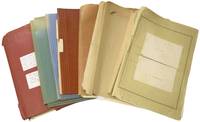
745931920s-1960s. Author's archive A series of nine manila folders containing writings photographs and elements of publishing history from Jacob's career. Folders are as follows: I Tan folder 34 x 25cm containing typed drafts of Jacob's post-WWII articles on Italy which she compiled after moving from her English wartime residence back to her permanent home in Lake Garda. With pieces on recreational subjects such as Italian cookery travel and topography but also more political topics such as life after the war and Italy's relationship with other countries. II Beige folder 35 x 25cm containing a list of eligible British magazines for Jacob send material to compiled by either her or her editor. Following are numerous copies of a letter dated 1946/1947 asking each of these publications whether they would consider taking Jacob's articles on Italy 'in view of the importance of the present and future relationship between England and this country.' Stapled to these copies are the magazines' responses which is frequently a 'no' due to limited space and shortage of paper. Many would only consider apolitical work on subjects such as Italian cookery/gardening. A fascinating glimpse into the lasting effects of war. III Beige folder titled 'B.B.C. Book Me - Philosophically' 34 x 24cm containing typed drafts of chapters for a book Jacob was writing based on some talks she did for the BBC about her opinions on the human condition. With chapter headings such as 'Gossip' 'Growing Old' 'Education' and 'Difficult Days' many inked annotations penned by either Jacob or her editor. IV Light beige folder titled 'Raccoglitore Benaco' 34 x 24cm containing more typed drafts of chapters for 'Me - Philosophically.' With topics such as 'Being Ill' 'Clothes' and 'Children.' Copious inked notes from Jacob or her editor. 'Me - Philosophically' is not listed in Jacob's bibliography so it was either unfinished or its title was changed. V Beige folder with pink pencil to front 35 x 23cm containing other miscellaneous work from Jacob. Includes drafts of blurbs for her novels an advertisement for Foyles' Book Club she wrote at the behest of Christina Foyle and a eulogy for fellow queer poet Radclyffe Hall. VI Red folder 35 x 26cm containing British and Italian theatre memorabilia including a Teatro Reale dell'Opera programme from 1938-1939 and some British theatrical programs circa 1920s when Jacob was regularly acting onstage. Also includes the typescript of her one-act play 'The Ace' and an Italian house-plan. VII Green folder 36 x 28cm containing personal photographs of Jacob and her friends/family/pets as well as numerous copies of a portrait picture used for her author photo in various books. VIII Blue folder 33 x 27cm containing clippings of a few of Jacob's published magazine articles. Includes an Italian travel article a short story for the Daily Sketch a piece for the Evening Standard's 'Did it Happen' series and a critical discussion of Jacob in Lilliput Magazine. IX Russet folder 33 x 27cm posthumous material relating to Jacob including various newspaper obituaries and bank statements dated shortly before her death on August 27 1964. X Loose pen and ink illustration of the Unicorn Hotel Ripon which used to be owned by Jacob's grandfather Robert Ellington Collinson he was also mayor. The drawing is by Yorkshire artist George Jackson. Moderate edgewear and sunning to folders some minor ageing and edgewear to contents but largely fine. Naomi Jacob was a popular novelist columnist actor and socialite of her day. Born in Ripon Yorkshire she began her career as a teacher but soon pivoted to acting starring in both plays and films. She wrote many of her novels whilst living in Sirmione Lake Garda the warm clime a necessity for her lifelong battle with tuberculosis. She was also a suffragette a socialist and queer - delightfully ahead of her time. 1920s-1960s unknown
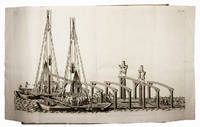
1757A2DFNA01U79OAmsterdam: Petrus Schenk II & son vol. II: Petrus Schenk III 1757. Red half sheepskin blue-grey paper sides ca. 1800. Imperial folio 50 x 34 cm. With 2 title pages in red and black each with the same engraved allegorical device a double-page engraved dedication plate with 2 large cartouches showing the arms of the Beemster polder and of the 9 members of its water authority and 41 double-page and 7 larger folding engraved illustration plates the folding plates numbered as 2 to give plates I-XXV vol. I I-XXIV and I-VI vol. II. Further with 1 woodcut tailpiece and bands of cast fleurons. Second edition of both volumes of a remarkably detailed set of scale construction drawings plans sections elevations perspective views etc. including many detail drawings of individual parts of 18th-century Dutch waterworks with the accompanying letterpress descriptions and notes. It includes locks sluices bridges pumps pile drivers an ice-breaker an elaborate water-bailing mill and more. Most of the plates measure about 45 x 54 cm with the folding ones about 52 x 76 cm. At least most of the plates depict existing works and the text occasionally gives some historical information. The drawings are so detailed and give such a clear picture of how the mechanisms functioned that one could use them to reconstruct the works shown.A fine copy nearly untrimmed with only some false folds in the half-title and an occasional minor defect in the paper. Plate 23 in volume 1 has no number but it may have been trimmed off at the head. The inside front hinge has partly separated from the book-block but the binding is otherwise good. A fine copy of a magnificent display of Dutch hydraulic engineering.l Bierens de Haan 3818.5 & 4839.5 vol. II only with later ed. of vol. I; STCN 2 & 4 copies of the 2 volumes; not in Berlin Kat.; Roberts & Trent Bibl. Mechanica. Petrus Schenk [II] & son (vol. II: Petrus Schenk [III]), unknown
15163256Oppenheim Germany 1516. Paper binding. paper cover- 36 pp good condition - https://librarywwuedu/node/17464 unknown
17740000222Leipzig: Bernhard Christoph Breitkopfs und Sohn 1774. Second edition. Contemporary calf. Very Good. 2nd edition. Folio Contemporary full calf with some ware and loss to ends of spine . Collation: 12 1-184 4p. with 51 copper-engraved plates. Internally this is a clean and bright copy with only minor spotting. <br/><br/>Leupold unlike his contemporary Newton was a designerand builder of instruments. In this work Leupold provides information and illustration of numerous devices that he built that were useful in handling water. This is a posthumous reprinting of his earlier edition in 1724which was the 2nd volume of his larger work Theatrum machinarum. Bernhard Christoph Breitkopfs und Sohn unknown books
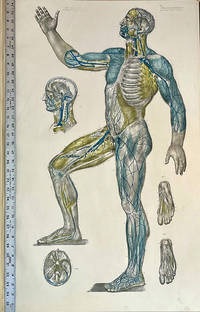
185451129Brussels: Comptoir des éditeurs 1854. <p>Bourgery Jean-Baptiste Marc 1797-1849 and Nicolas Henri Jacob 1782-1871. Anatomie élémentaire en vingt planches representant chacune un sujet dans son entier à la proportion de demi-nature . . . Atlas only. Elephant folio. Title-leaf and 20 lithographed plates most hand-colored. Brussels: Meline Cans et Cie; Comptoir des Éditeurs 1854. 888 x 600 mm. 20th-century quarter morocco boards slight wear. A few marginal tears repaired minor dampstaining but very good.</p> <p> Later edition first published in both Paris and Brussels in 1836 of this set of very large anatomical plates that were intended to be mounted on the walls of dissection rooms. All editions are extremely rare-OCLC does not cite any copies of the 1854 edition. This is the only copy of any edition of this work that we have handled in over 50 years of trading. The work was originally accompanied by a small 20-page pamphlet of text that is not present here.</p> <p> The impressive plates in this atlas reproduce the illustrations in Bourgery and Jacob's Traité complet d'anatomie at a much larger scale than their counterparts in the Traité-roughly half life-size. Some plates were lithographed in Paris; others in Brussels. Plates I and II are devoted to osteology and syndesmology; plates III - VIII to myology and aponeurology; plates IX-XIV to angiology; plates XV-XVII to neurology; plates XVIII-XIX to the digestive system; and plate XX to the reproductive organs. The plates were originally sold separately; uncolored versions were priced at 6 francs and colored versions at 12 francs. Currently two uncolored plates from this series are on the market for about $1300.</p> . Comptoir des éditeurs unknown
197692951Andre Sauret. New. 1976. Hardcover. FREE UPGRADE to Courier/Priority Shipping Upon Request - IN STOCK AND IMMEDIATELY AVAILABLE FOR SHIPMENT - Flawless copy brand new pristine never opened -- Text in French. 166 pages; 97 illustrations including 28 in color. Catalogue Raisonne Catalog Raisonné Complete Works La Vie et L'uvre Oeuvre Raisonnee -- with a bonus offer . Andre Sauret hardcover
1756elala1110Paris: l'Imprimerie Royale 1756. 1756. 12mo. pp. viii 275. full modern mottled calf a few scattered stains. First Duodecimo Edition. Published the same year as the first edition in quarto. This is the French reply to an English memorial addressed to the courts of Europe stating their position on the war on the Ohio justifying their actions and setting forth their claims to the region west of the Alleghenies. Accusing the English of unprovoked aggression and foul play the French sought to demonstrate that it was Washington's 'assassination' of Jumonville in the Fort Necessity campaign among other offensive actions which had sparked the war. Most of the text is composed of 'pièces justificatives' comprising documents and letters written between 1749 and 1755 by La Jonquière Governor of New France Albemarle Rouillé General Braddock Contrecoeur Villiers Sir William Johnson George Washington and Robert Stobo an engineer with Washington who had planned Fort Necessity. Among the more important papers are translations of the instructions given to Braddock by the British Crown letters to and from Braddock and Sir William Johnson and various officials two of Johnson's 'harangues' to the Indians and the first printing although in French translation of extracts from the journal kept by George Washington in the 1754 expedition to fortify the forks of the Ohio that ended with the British surrender to the French at Fort Necessity in July 1754 pp. 109-146. This is quite distinct from Washington's first journal of his mission for Governor Dinwiddie late in 1753 printed at Williamsburg in 1754. Most of these British papers were seized by the French following the capitulation at Fort Necessity. An early work on the French and Indian War described by Lawrence Wroth in his John Carter Brown Library report for 1945-46' as "one of the most important documents in American colonial history." Dionne II 548. JCB I 1123. Lande 657. Sabin 47511. TPL 250. Vlach 549. cfHowes M-787 different pag. cfGagnon II 1369 & cfStreeter II 1013 first in 4to. Wroth American Bookshelf p. 22. 1st Edition. Soft cover. Paris: l'Imprimerie Royale, 1756. Paperback
18371206921837. First Edition. WHEELER Jacob D. A Practical Treatise on the Law of Slavery. Being a Compilation of all the Decisions Made on that Subject in the Several Courts of the United States and State Courts. New York and New Orleans: Allan Pollock Jr. and Benjamin Levy 1837. Octavo modern half brown sheep burgundy morocco spine label. $3600.First edition of this important work on the legal aspects of slavery in the United States one of the earliest digests on the subject.Wheeler's Practical Treatise is one of the earliest digests of virtually all American court decisions on slavery including cases from both the North and South. This book was initially intended for use by slaveholders and other interested parties but it became an important tool of abolitionists who used it for its incidental descriptions of slavery and its attendant cruelty. ""The work bears marks of haste in its preparation but it is a valuable compilation of decisions on practical questions arising under the Law of Slavery in the United States. It will be serviceable to the Profession as a comprehensive digest of authorities on this branch of law and it will afford much instruction to philanthropists and statesmen interested in reconciling the welfare of slaves with the integrity and just operation of Constitutional Law"" Marvin 729. Harvard Law Catalogue 908. Cohen 9883. Work 344. Light to moderate foxing to text a few spots of soiling to edges of text block binding attractive. An extremely good copy. unknown
16576Paris, Louis Broder, 1956. In-8, 122 pp., en feuilles, sous couverture originale illustrée, chemise et étui illustrés originaux (petits frottements et minuscules taches à la chemise et l'étui).
197034102Coffret doublé de velour rouge à l'intérieur et de toile noire à l'extérieur. Couverture rempliée illustrée de signes du zodiaque par ERNI. Ces pages de Max Jacobs accompagnées d'extraits du livre d'Arcandam sont illustrées de lithographies originales de Hans ERNI et sont présentées et éditées pour le moulin de Vauboyen par Pierre de Tartas.
423914° 8 224 pp. Bound in 19th-century half-vellum. Last page repaired. Tear on p. 6 repaired with tape. Light browning throughout and staining to page edges especially pp. 1-25 but does not affect the text. A good copy.A very rare first edition copy of the English-language translation of Jakob Boehme's 1575-1642 <em>Signatura rerum</em> 1622. The writings of Boehme a German mystic and theosopher inspired the 17th-century Christian movement known as Behmenism. Controversial for its religious heterodoxy Boehme's mysticism nevertheless attracted a great number of followers across continental Europe and England.This first-edition English-language translation was published precisely during the height of Boehme's popularity in England during the years of the Interregnum 1649-1660. A period of political turbulence people turned increasingly to astrology mysticism and the occult. This text the <em>Signatura rerum</em> discusses how God bestowed every object at creation with a ""signature"" that connects the material and spiritual worlds and that can be decoded and intepreted as part of the natural order. The publication of this edition contributed to a larger project undertaken from 1645-1662 by John Ellistone John Sparrow Ellistone's cousin Humphrey Blunden and Giles Calvert to translate and publish Boehme's oeuvre in England.B0859Mystiek - occultisme - astrologie - Boehmenisme - Behmenism also Behemenism or Boehmenism is the English-language designation for a 17th-century Christian movement based on the teachings of German mystic and theosopher Jakob Böhme 1575-1624. The term was not usually applied by followers of Böhme's theosophy to themselves but rather was used by some opponents of Böhme's thought as a polemical term. The origins of the term date back to the German literature of the 1620s when opponents of Böhme's thought such as the Thuringian antinomian Esajas Stiefel the Lutheran theologian Peter Widmann and others denounced the writings of Böhme and the Böhmisten. When his writings began to appear in England in the 1640s Böhme's surname was irretrievably corrupted to the form ""Behmen"" or ""Behemen"" whence the term ""Behmenism"" developed. A follower of Böhme's theosophy is a ""Behmenist"". hardcover
17124343Rome: Francesco Gonzaga 1712. Extremely rare first edition of this luxuriously illustrated anthology of extracts from papal sermons delivered between 1703-09 in Latin prose and facing Italian verse: an unusual example of Baroque ecclesiastical culture from the pontificate of Clement XI. On the basis of extreme rarity and contents the volume numbers among those commemorative and honorific volumes which were never sold in the trade but offered as a ceremonial gift to cardinals ambassadors and other important personagescorroborated by the ownership inscription in the present volume by a monsignor during Clements papacy. The volume is singular in our experience for its contents. Latin extracts of Clements sermons generally rather brief are printed on the left side of the page then freely and somewhat copiously versified in Italian by the poet Guidi. The sparsity of the elegantly printed text leaves positively wasteful margins! Each sermon is preceded by a full-page engraving on the subject of the sermon the Holy Family adoring the Christ Child for Christmas the Resurrection for Easter etc. designed by Pietro Leone Ghezzi one of the principal artists in Clements retinue and engraved by Roman engravers generally also associated with Clementine projects Frey van Westerhout etc. The designs were made expressly for the present volume and are echoed as it were in a series of initials and vignettes devoted to the same theme; as such they must have been engraved for the present volume and not simply taken from the printers stock. If somewhat overshadowed by Maratti in his lifetime and by his epoch-making role as the first professional caricaturist Ghezzi 1674-1755 was nonetheless an important painter of religious subjects who worked on Albanis most prestigious public projects. The surfaces of Ghezzis paintings were considerably less finished than those of Maratti and he seems more receptive to Venetian color and unfinishednessthus showing a different aspect of Albani taste. Ghezzi was commissioned in 1712 the year this book was published to paint The Election of St. Fabian for the Albani Chapel in S. Sebastiano fuori le Mura. Within the next decade he helped paint the frescos the ancient basilica of S. Clemente and the nave decoration of St. John Lateran. His portraits including one of Clement XI are unusually informal and realistic possibly due to Ghezzis experience at caricature. Alessandro Guidi 1650-1712 who translated the sermons was a prolific Arcadian poet. OCLC records a single copy Berkeley and we locate no additional American copies. Large 4to. 28 x 20.5 cm engraved portrait of Clement XI xvi pp. full-page engraving 213 pp. including 5 full-page engravings paginated with text. 18th-c. vellum over boards spine with 5 raised bands and red morocco label gilt-stamped; covers with large blind-tooled central ornament blind-tooled filets and ornaments. Short tears at head and foot of spine and a few nicks there. Early inscription on front pastedown mentions Monsignor Bianchini Prelato Domestico e Camerario segreto di S. Santita Papa Clem. XI. Mild finger-soiling in margins of title and a little foxing on some text leaves but overall a very fine attractive copy. Francesco Gonzaga hardcover
1817044454Boston: Cummings and Hillard 1817. First Edition. Hardcover Full Leather. Very Good Condition. Three volumes in one bound in contemporary paneled calf with an embossed eagle motif. Wear at corners and spine ends with a bit of loss to leather rehinged with inner joint strengthened with cloth. Old Yale library plate with a note that it was purchased from Yale as a duplicate in 1882. Modest foxing to text and plates heavier in spots fairly clean overall. 60 engraved plates colored a la poupee some finished by hand. In addition to being the first proper US botanical book Bigelow's Botany is the first US book printed in color. Remarkably two decades before the invention of chromolithography a method for printing in color was invented to print the plates for American Medical Botany. Sabin 5294 xi 1 18-197 1 195-197 1; xvi i.e. xiv 15-199 1; x 11-193 1. Pp. 195-198 of volume three bound at the end of volume one. Size: Quarto 4to. Quantity Available: 1. Shipped Weight: 2-3 kilos. Category: Science & Technology; Botany; Americana. Inventory No: 044454. <br/><br/> Cummings and Hillard hardcover books
17124343Rome: Francesco Gonzaga 1712. Extremely rare first edition of this luxuriously illustrated anthology of extracts from papal sermons delivered between 1703-09 in Latin prose and facing Italian verse: an unusual example of Baroque ecclesiastical culture from the pontificate of Clement XI. On the basis of extreme rarity and contents the volume numbers among those commemorative and honorific volumes which were never sold in the trade but offered as a ceremonial gift to cardinals ambassadors and other important personagescorroborated by the ownership inscription in the present volume by a monsignor during Clements papacy. The volume is singular in our experience for its contents. Latin extracts of Clements sermons generally rather brief are printed on the left side of the page then freely and somewhat copiously versified in Italian by the poet Guidi. The sparsity of the elegantly printed text leaves positively wasteful margins! Each sermon is preceded by a full-page engraving on the subject of the sermon the Holy Family adoring the Christ Child for Christmas the Resurrection for Easter etc. designed by Pietro Leone Ghezzi one of the principal artists in Clements retinue and engraved by Roman engravers generally also associated with Clementine projects Frey van Westerhout etc. The designs were made expressly for the present volume and are echoed as it were in a series of initials and vignettes devoted to the same theme; as such they must have been engraved for the present volume and not simply taken from the printers stock. If somewhat overshadowed by Maratti in his lifetime and by his epoch-making role as the first professional caricaturist Ghezzi 1674-1755 was nonetheless an important painter of religious subjects who worked on Albanis most prestigious public projects. The surfaces of Ghezzis paintings were considerably less finished than those of Maratti and he seems more receptive to Venetian color and unfinishednessthus showing a different aspect of Albani taste. Ghezzi was commissioned in 1712 the year this book was published to paint The Election of St. Fabian for the Albani Chapel in S. Sebastiano fuori le Mura. Within the next decade he helped paint the frescos the ancient basilica of S. Clemente and the nave decoration of St. John Lateran. His portraits including one of Clement XI are unusually informal and realistic possibly due to Ghezzis experience at caricature. Alessandro Guidi 1650-1712 who translated the sermons was a prolific Arcadian poet. OCLC records a single copy Berkeley and we locate no additional American copies. Large 4to. 28 x 20.5 cm engraved portrait of Clement XI xvi pp. full-page engraving 213 pp. including 5 full-page engravings paginated with text. 18th-c. vellum over boards spine with 5 raised bands and red morocco label gilt-stamped; covers with large blind-tooled central ornament blind-tooled filets and ornaments. Short tears at head and foot of spine and a few nicks there. Early inscription on front pastedown mentions Monsignor Bianchini Prelato Domestico e Camerario segreto di S. Santita Papa Clem. XI. Mild finger-soiling in margins of title and a little foxing on some text leaves but overall a very fine attractive copy. Francesco Gonzaga hardcover books
1826WRCAM36095Cumberland Md.: Printed for the Author by J.M. Buchanan 1826. 1231pp. 12mo. Contemporary three-quarter roan and marbled boards spine gilt. Boards lightly rubbed and shelfworn. Early ownership signature on front free endpaper. Light tanning scattered foxing old light dampstain in lower third of final five leaves of text. About very good. In a burgundy half morocco and cloth slipcase spine gilt and folding cloth chemise. First edition of this biography of Captain Cresap defending him against charges that he slaughtered Indians before the beginning of the Revolutionary War. In particular Cresap became infamous in the case of the Indian Logan and the murder of his defenseless family in 1774. "This biography of Cresap was written to refute Jefferson's account in NOTES ON VIRGINIA.The immediate occasion for this now rare book written by the revolutionary officer later clergyman who had married Cresap's widow was the reopening of old sores by Joseph Doddridge in his then recently published NOTES ON THE SETTLEMENT AND INDIAN WARS OF THE WESTERN PARTS OF VIRGINIA & PENNSYLVANIA FROM THE YEAR 1763 UNTIL THE YEAR 1783 INCLUSIVE of 1824. The defense is complete and the biography is of absorbing interest" - Streeter. <br> <br> The Streeter copy was bought by Sessler for $650 in 1968. HOWES J32 "b." SABIN 35488. STREETER SALE 1335. FIELD 769. THOMSON 640. AMERICAN IMPRINTS 24967. DAB IV p.538 Cresap. Printed for the Author, by J.M. Buchanan hardcover books
20313The Limited Editions Club. Fine. 1983. Hardcover. Signed by Hersey Penn and Lawrence. Limited edition of 1500 copies this being copy #869. Black aniline leather cover is sunned on spine else fine. Boards and spine are straight. Binding is tight. Publisher's notes laid-in. Pages are clean and pristine. 8 beautiful color silk screens. Slipcase has a couple of faint modest scuffs else fine. ; Signed by Author . The Limited Editions Club hardcover
1833262<p>Lansing Alfred A. Alexander Anderson Jacob Maas Milton F. Harrison <i>Galaxy of Comicalities</i> Philadelphia: Printed by Lesher & Shelly No. 303 Callowhill St. at $1.25 per annum in advance 1833. Twelve Issues: Volume 1: Nos. 1 – 12. These are twelve issues of only forty printed between October 2 1833 and July 5 1834. Galaxy of Comicalities is said to be the first illustrated comic periodical printed in America. Issue 11 December 11 1833 contains a review of <i>Sketches and Eccentricities of Colonel David Crockett of East </i>sic<i> Tennessee</i>. Crockett 1786 – 1836 a consummate self-promoter was the subject of numerous books. <i>Life and Adventures of Colonel David Crockett of West Tennessee</i> a spurious biography not authorized by Crockett was published in 1833 and reprinted later in the same year under the more accurate title of <i>Sketches and Eccentricities of Colonel David Crockett of West Tennessee</i>. <i>Galaxy of Comicalities</i> was a racist publication characteristic of humor during the Andrew Jackson administration. Mocking people of color during their "days off" writing in racial dialect and making sexist jokes about women this short-lived publication was intended for a semi-literate reader or listener sympathetic to the publishers' racist views. The editorial standard is as execrable as the spelling and views expressed. Illustrated with woodcuts of a similarly pejorative nature. </p><p>Condition of this rare worn and dis-bound surviving set: Issue 1 old repairs to page edges tear repair to page 1 slight text loss on p. 2; issue 2 repair to worn margins; issue 3 old tear repair to title-page margin repairs with text loss repair patch with text from another source p. 10; issue 4 margin repairs significant text loss; issue 5 good condition no repairs; issue 6 good condition no repairs; issue 7 text loss of a few words to three lines of one page; issue 8 good condition; issue 9 good condition; issue 10 margin repairs loss of few words on one page; issue 11 margin repairs text loss of a few letters on one page; issue 12 old tear repair. All twelve copies have browned with some spotting to the laid paper.</p>Housed in a folder with the ownership tag of Richard S. Wormser. Mr. Wormser a former president of the International League of Antiquarian Book Sellers and the Antiquarian Book Sellers Association of America was a member of the Grolier Club the American Antiquarian Society of Worcester Mass. the Club of Odd Volumes of Boston and the Old Book Table of New York. Lesher & Shelly, No. 303 Callowhill St. books
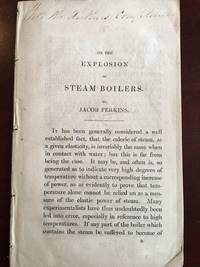
182730<p><b>AN EXTRAORDINARY EARLY AMERICAN INVENTOR AND ENGINEER</b></p><p><b>"THE THEORY OF THIS INGENIOUS METHOD OF ABSTRACTING HEAT"</b></p><p><b>PERKINS Jacob. </b><i>On the Explosion of Steam Boilers. </i>caption-title. 8vo disbound pp. 18 folding plate. N.p. n.d. i.e. London: 1827. <br /></p><p>First Edition. Rare. "In 1823 at fifty-seven years of age Perkins started an entirely new type of activity new to him and almost entirely new to science. This was his experimental work with steam of high pressure."-Dirk J. Struik <b>Yankee Science in the Making </b>1948 p. 69. Our copy is exactly like the BL copy without formal title-page and beginning on sig. "B"1. Inscribed on title: "With the Author's Compliments" and with a single correction in ink on p. 16. In 1823 Perkins invented super heated steam in an experiment called a "flash boiler" one thousand shots per minute using 900psi steam. This steam was later used in nuclear power plants to turn the steam turbines and small flash boilers were used on some steam automobiles and provided quick acceleration. In flash boilers water is delivered to preheated tubes and vaporizes almost immediately. "The theory of this ingenious method of abstracting heat was described by Perkins in a small printed pamphlet published in 1827 entitled <i>On the Explosion of Steam Boilers…</i>This pamphlet consists of eighteen pages and a folding plate engraved with a diagram showing the relationship of the piston and the crank at various pressures. Perkins was very chary of distributing copies of his pamphlet before his patent of March 22 1827 was finally sealed for fear that it might prematurely reveal the nature of his invention. A copy is in the author's possession Perkins has written on the margin of the first page: 'With the author's compliments. Confidential."-Greville Bathe & Dorothy Bathe <b>Jacob Perkins: His Inventions His Times & His Contemporaries </b>1943 p. 123 & note. Perkins says in a long letter to his friend and one-time-partner Dr. Thomas P. Jones in Philadelphia that he is sending him a copy of the pamphlet and that he gave copies to Dr. Wollaston and Michael Faraday "and to several engineers whom I could trust and who all agree that it assigns the true cause of explosions."-<b>Barthe</b> p. 125. Born in 1766 in Newburyport Massachusetts Perkins 1766-1849 was a gifted and prolific inventor running a goldsmith business by age 15! By 21 the state of Massachusetts commissioned him to make the dies for the State's copper coins. At 31 he invented a machine for heading and pointing nails and tacks in a single operation a remarkable invention for its day. He moved to New York later to Philadelphia where he developed probably the first steel plates for banknote engraving a system of preventing banknote forgery. Unable to get financial backing in this country he moved to England in 1819 taking his sons and a group of craftsmen with him. "America's loss was Britain's gain…He started a successful banknote business and went on to develop instruments for measuring ships' speeds for determining diving depths and a score of other devices. When he turned his attention to steam development this amazing man really hit his stride…Then he invented his steam gun. The Duke of Wellington became very interested in this Perkins gun…" and its military uses were explored then spurned by the British government. <i>The London Mechanics Register</i> of Nov. 6 1824 said "If Mr. Perkin's steam guns were introduced into general use there would be but very short wars; since no fecundity could provide population for its attacks." See W. H. B. Smith <b>Mr. Perkin's Extraordinary Steam Gun of 1824</b><i> </i>original published in 1957 and reprinted in <b>Lateral Science: A plethora of science & engineering subjects both real & virtual</b> 8 July 2012. The <b>DAB </b>calls his experiments with high-pressure steam "unique" saying "He received recognition in various countries particularly in England but he was a hundred years ahead of his time." In all Perkins created over 21 inventions and between 1819 and 1836 patented 19 of them. His biography in <b>ODNB </b>is included in the biography of his son Angier March Perkins and in fact gets the longest treatment there. Another useful biography is at <b>madehow.com</b>. For all things Perkins see <b>Baker Perkins Historical Society</b> online. <b>OCLC </b>locates two copies National Library of Sweden & Swarthmore College. <b>NUC </b>adds Univ. of Illinois. First Edition not in <b>COPAC.</b> </p><p><b><br /></b></p><p><b><br /></b></p><br /><p><br /></p>
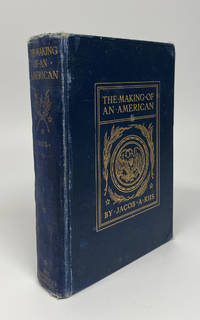
190311143New York: Macmillan 1903. Later printing. Hardcover. Fair. Octavo 443pp. illustrated. A worn copy in fair condition with the inner hinges cracked and corners worn but internally clean. A singificant association copy SIGNED by Riis on the front free endpaper and INSCRIBED to Danish-American pianist and interpreter of Scandinavian music Inga Hoegsbro Christensen before she took her married name: "Inga Hoegsbro from her friend Jacob A Riis." Laid-in are two postcards from Riis to Hoegsbro one dated in December 1913 and another whose date is unclear. The first postcard with a new year's theme reads: "A Happy New Year to you and may we both steer clear of illness in 1914. was sick nearly all summer. Let us hope it was the darkness before the dawn and that all will be O. K. with the lengthening days. Sincerely yours Jacob A. Riis." A bittersweet and foreboding note as Riis would die that following May just six months after this letter was mailed. Hoegsbro has added a note in ink on the postcard which reads "Always keep from my dear old Papa Jacob Riis. A friend in need for years." The other postcard's front depicts the St. Joseph Sanitarium & Bath House in Mt. Clemens Michigan where Riis was staying during the end of December 1913 after feeling ill for most of the autumn. The small blank area on the front of the card is entirely covered in Riis's writing and as it is in Danish and a rather difficult hand we are unable to reproduce or translate it here. On the verso next to where Riis had inked Hoegsbro's address Hoegsbro has written: "Last card from dear Papa Jacob Riis." The book's endleaves are covered in news clippings related to Riis and a few Danish poems. On the rear endpaper is a typed document written by Christensen entitled "A Tribute to Jacob Riis. Paid by Inga Hoegsbro-Christensen on the Occasion of the Golden Anniversary of the Founding of the Jacob Riis Settlement on Henry Street." Praising Riis for his help in her early career she concludes her remarks by noting: "When I begged from time to time to be allowed to repay Riis for his goodness to me his answer was always the same: Would I help some of his friends among the poor with my music I do not need to add how happy I was to be always at his service as pianist and inscructor in his settlement work." Accompanying the book and these postcards is an inscribed copy to one Frank Burton of Inga Hoegsbro Christensen's autobiography "Inga.Play." In it she mentions Riis several dozen times describing him as "Papa Jacob" the figure who helped her get settled in the United States and who introduced her to the influential New Yorkers who would help her achieve fame and success as a musician and interpreter of Scandinavian music. Altogether despite the book's regrettable condition a fantastic association copy of Riis's memoir which sheds great light on his identity as a Danish-American and a friend to struggling artists of all backgrounds. Macmillan hardcover
194651729St. Ottilien/ Munich: Rabbinical Representative by Central Committee of Liberated Jews in the American Occupied Zone sic 1946. First edition. Hardcover. vg- to vg. Elephant folios.<br /> <br /> Keddushin: 192 32 28pp. Rebound in modern tan soft leather with blind-stamped star of David on the front cover. Blind-stamped tooling and gilt lettering lettering on the spine. Raised bands. Decorative endpapers.<br /> <br /> Nedarim: 206 32pp. Rebound in modern tan soft leather with blind-stamped star of David on the front cover. Blind-stamped tooling and black lettering on the spine. Raised bands. Decorative endpapers.<br /> <br /> Title pages illustrated in yellow and black depict both the suffering and the hope for redemption of the Jewish people. The bottom shows life in the concentration camp and the top shows the yearning for a new Jerusalem. The images are attributed to the artist Grisha Rosenkranz who was active in the DP camps. Text in Hebrew states: "As afflicted prisoners there we sat learned and prayed in secret."<br /> <br /> These individual volumes were the precursors to the famous full 19-volume set known as the "Survivors' Talmud" or the "US Army Talmud" so-called because it was the first complete Talmud printed in Europe after the Holocaust. At the end of the war Jewish survivors and residents of the DP camps had few or no books. The efforts to provide resources to Jews without access to Talmud study in the direct aftermath of the war fell primarily upon the shoulders of two Lithuanian Rabbis Samuel Abba Sneig chief rabbi of the US occupied zone and Samuel Jacob Rose both survivors of Dachau. <br /> <br /> Utilizing two odd volumes of the 1886 Romm edition of the Talmud printed in Vilna tractates Keddushin and Nedarim found at the monastery in St. Ottillien they began their endeavor. Printing plates from these volumes were created using a photomechanical offset process. It should be noted that when the full set of the Talmud was eventually published it was derived from the later Vilna editions which contain additional rabbinic commentary not found in the earlier editions.<br /> <br /> The rabbis' intent from the very beginning was to print a complete set of the Talmud however these two tractates were the only ones found in good enough to reproduce. Later with the assistance of Rabbis Philip S. Bernstein and Abraham Klausner they were able to print a complete set in Heidelberg in 1948 The Survivors' Talmud. <br /> <br /> Bindings with some minor to light instances of scratches stains scuffing and/or smudges to the covers. Interior of Keddushin with pages age toned and a bit brittle with a few closed tears to the edges throughout and a few instances of minor to light stains in the margins. The first few leaves including the title page foxed and stained in the margins. Interior of Nedarim mostly clean with some staining and rippling along the top of pages from about p.120 onward and a few other sporadic light stains throughout with text mostly unaffected. Ink stamps and handwritten names of previous owners of the Nedarim volume located in the top and bottom margins of the title page and in the bottom margin of the final page. Bindings in very good- to very good interiors in very good- condition overall. Alternate title: Survivors' Talmud<br /> <br /> Grisha Rosenkranz aka Gregory Rosenkranz was a Lithuanian-born Jewish artist and Hebrew teacher. In addition to his work on the illustrations for these volumes of the Talmud he was an active artist in the DP camps after the war and was known to have designed a theater sets for a play produced in the camps. Later he emigrated to the United States eventually settling in Miami where he taught Hebrew Jewish studies and art. He also created art for the PBS tv program 'Living Hebrew'.<br /> <br /> With thanks to Jackie Ben Efraim for her research on these Talmuds. See her illustrated presentation ’Survivors’ Talmud' on YouTube. Rabbinical Representative by Central Committee of Liberated Jews in the American Occupied Zone [sic] hardcover
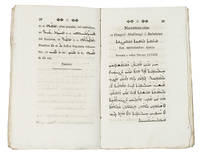
1784ABC_47839Altona 1784. 8vo. Johann David Adam Eckhardt Early 19th-century blue marbled paper wrappers. With a woodcut vignette on the title-page and typographical ornaments at the head of every page. The text is set in Roman and Syriac type. 64 1 1 blank pp. First edition of a Syriac grammar for beginners written by Jakob Georg Christian Adler 1756-1834. It starts with a short introduction to Syriac grammar and is followed by excerpts from works by two important Syrian Christian authors: Gregory Bar Hebraeus 1226-1286 a prominent writer and church figure and Jacob of Edessa 640-708 the bishop of Edessa and one of the most important scholars of the Christian-Aramean tradition.Adler was an Orientalist and Syriac language professor at the University of Copenhagen. He was also a Lutheran theologian and became the head of the Bible society in Schleswig-Holstein. He has written multiple works on Syriac and Arabic. With a paper label mounted at the head of the front wrapper and an annotation at the foot of page 17. The edges and corners of the wrapper show some signs of wear with some loss of material at the foot of the spine. With a tear in the lower margin of page 43 without affecting the text. Overall in good condition.l VD18 1437708X. unknown
1719ABC_48566Leiden: ex officina Boutesteiniana 1719. Contemporary vellum with the manuscript title on the spine red and blue sprinkled edges. 4to. With a general title page printed in red and black 7 engravings 1 folding 5 full-page 1 in the text divisional titles for each part with an engraved vignette 18 decorated woodcut initials 13 woodcut headpieces and 12 woodcut tailpieces. 4 parts in 1 volume. Including: 2 ALPINUS Prosper. De balsamo dialogus.Leiden Cornelis Boutesteyn 1718.3 BONTIUS Jacobus. De medicina Indorum.Leiden Cornelis Boutesteyn 1718.4 ALPINUS Prosper. De rhapontico.Leiden ex officina Boutesteiniana 1718. Early Leiden edition of an important work on Egyptian medicine written by the Venetian physician and botanist Prosper Alpinus 1553-1617. The present work includes a work on tropical medicine by Dutch physician Jacob de Bondt or Jacobus Bontius 1592-1631 which can only be found in the Dutch editions of Medicine Aegyptiorum and a text by Alpinus De rhapontico which can only be found in the present edition.Medicine Aegyptiorum was first published in Venice in 1591 then three times in Paris in 1645-1646 and then in Leiden in 1718 where it was combined with De Bondt's work for the first time. The present edition is a re-issue of the 1718 edition but with a new title page and an extra part. This extra part De rhapontico had been published separately in 1612 but was not published again until it was included in the present work. It discusses the therapeutic properties of rhubarb and is written in the form of a dialogue between Alpinus an Egyptian physician and a Jew. The other work by Alpinus included here De balsamo dialogus discusses the source of balsam and raises questions concerning its identity ancient names and medical uses. It is written in the same format as De rhapontico.The final text included here is De medicina Indorum libri IV by De Bondt which had been separately published in 1642. De Bondt who regarded tropical medicine as an independent branch of medical science spend several years in the Dutch East Indies where he studied the local medical practices. The work includes the first European description of beriberi and cholera.The head of the spine is somewhat worn with a horizontal tear in the vellum obscuring the manuscript title a brown stain on the back board. The pastedowns are detached from the boards but the structural integrity of the binding is still intact the edges of the leaves are slightly browned the last few leaves are stained at the bottom margin from the brown stain on the back board. Otherwise in good condition.l Blake p. 12; STCN 227919599 3 copies Wellcome II p. 36; cf. DSB I pp. 124-125; Garrison & Morton 6468 other ed.; STCN separate entries for ad 2: 227919971 6 copies ad 3: 227920112 6 copies ad 4: 181937085 5 copies. ex officina Boutesteiniana, hardcover