4 198 résultats
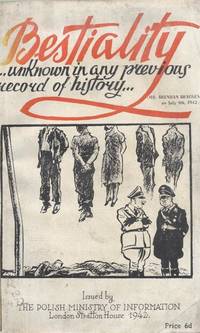
194239727London: Stratton House 1942. First edition. Original illustrated wraps. 12mo. 56 pages. 19 cm. ‘A Record of the German Barbarities in Poland in the First Six Months of 1942.’ <br> With two page map of concentration camps in Germany. <br> Extremely detailed early report concerning Nazi atrocities executions concentration camps the extermination of the Lublin ghetto etc. Contents include: Introduction; Documents from Poland; General Sikorski's protest speech; Resolution of the Polish National Council; Press conference at the Ministry of Information; and Justice will be done: official statements and declarations. <br> Included in in the “<br> Documents from Poland†section is a piece on the “Destruction of the Jewish Population.†<br> “As early as 1940 the Government Delegate alerted London about the persecution of Jews in Poland. Thereupon the Polish government-in-exile sent a note on this subject to allied governments May 3 1941. Also in 1941 the Polish Ministry of Information in London published a booklet on the persecution of Jews in Poland entitled ‘Bestiality Unknown in Any Previous Record of History’ and based on information received from occupied Poland. In January 1942 the Ministry issued another publication ‘The New German Order in Poland. ’ Both publications created a stir throughout the allied world which after 1941 could no longer plead ignorance of the persecution of Jews in Poland. †"The Polish Underground State: A Guide to the Underground 1939-1945" Stefan Korbonski. <br> The US Holocaust Museum keeps their copy in their Rare Book Room. Subjects: World War 1939-1945 - Poland. World War 1939-1945 - Atrocities. <br> OCLC: 8022841. <br> Staples show rust as generally found light rubbing to covers attractive and dramatic about Very Good Condition.B HOLO2-104-27C-MMACCBBE-I-'. London: Stratton House unknown
197252067Warsaw: Miejskie Zaklady Komunikacyjne ca. 1972. Oblong 8vo. 10 x 7 in. 4; 2 38 pp. on thick gray paper stock. With 37 tipped-in black & white photographs each w/ clear mylar sheet tissue guard. Red cloth gilt lettering & decoration on front cover rounded corners yapp edges NF copy hand numbered in white ink w/ printed explanatory sheet of all the photographs. First edition of this exceedingly scarce Communist-era photo album detailing Poland’s mass transit system including their electric streetcars buses and the great advances made after World War II. The Municipal Offices Transport was a Communist government public transit agency which was in charge of electric light rail lines tracks bus lines along with the MZK resorts and operated from 1964 to 1994. These photos show the City offices the tremendous damage in Warsaw after liberation rebuilding track in 1945 piles of rubble & debris in 1945 the rebuilt bus & transit systems in 1972 the modern light rail systems and tram stops and the dispatching of buses. In addition the album includes a birds-eye view of the Repair Department facilities and warehouses the bus depot the cavernous repair garages and the technicians repairing and mounting tires washing the buses as well as the machine shops for repairing the light rail cars. In addition there are photos of road construction electric line repair for the trolleys offices medical clinic and the staff holiday resort on the Vistula. No copies located in Worldcat. Miejskie Zaklady Komunikacyjne, hardcover
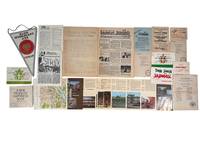
1980221631980. Solidarity movement ephemera archive. 1980s-1989. This archive documents opposition organizing and political communication in eastern Poland during the final phase of Communist rule with particular emphasis on labor unrest student activism and the 1989 electoral campaign that led to partial democratic reform. The material records how Solidarność operated through underground print culture and regional coordination including strike reporting candidate promotion and direct appeals to voters. It provides primary evidence of political messaging grassroots mobilization and the emergence of open electoral discourse in the months preceding the June 1989 elections.<br /> <br /> Archive of over 30 pieces of printed ephemera and underground publications produced in the Lublin and Zamość regions primarily in Polish in varying formats including newspapers broadsheets flyers tickets brochures and a pennant. Key items include Biuletyn Solidarność Nos. 2 and 3 15 and 22 May 1989 issued by the Regional Committee for Lublin-Zamość containing articles such as "Protest płacowy na uczelniach lubelskich" documenting wage protests at Lublin universities and an interview with candidate Adam Kozaczyński titled "Mogę pracować dla ludzi i dla kraju." Additional coverage includes "Wyborcy o kandydatach" presenting voter responses to candidates. Student activism appears in Gazeta Strajkowa Lublin Nr. 3 a hectograph-printed publication of the Independent Students' Association NZS criticizing state education policy with statements including "Nie narusza w żadnym stopniu postulatów studentów" and "Odradza nadal Ministerstwo Oświaty i Wychowania." A 13 May 1989 issue of Przegląd Wiadomości Agencyjnych features a mining strike in Lubin under the headline "STRAJK" accompanied by an image of workers holding a protest banner. Election materials include flyers and cards bearing the slogan "Twoja Szansa Solidarność: Wybory 1989" promoting candidates such as Tadeusz Mańka Adam Stanowski and Henryk Janusz Stępniak along with a facsimile-signed letter from Lech Wałęsa dated May 1989 urging coordinated political participation.<br /> <br /> These materials were produced during the rapid political transformation of 1989 when negotiations between the Communist government and opposition groups led to partially free elections and the eventual formation of a non-Communist government. Underground and semi-legal print media played a central role in disseminating information coordinating protest and legitimizing opposition candidates particularly in regional centers such as Lublin. Light toning and minor wear consistent with ephemeral use; overall very good. A concentrated archive of Solidarity print culture preserving the language organization and visual strategies of political mobilization at the end of Communist rule in Poland. unknown
156 leaves. Probably lacks the colophon. A few other leaves are defective, including the title page. Yiddish text in Hebrew lettering. 4to. 220 mm. Original full leather binding, worn and broken; with the boards tooled in a crude, but interesting, geometric pattern. The festival liturgy according to the German-Polish rite, translated into Yiddish by Asher Anshel ben Joseph Mordecai in the 16th century for the use of Ashkenazi Jews living in Germany and Holland. The Mahzor is the prayer book used by Jews on the High Holidays of Rosh Hashanah and Yom Kippur. Many Jews also make use of specialized mahzorim on the three "pilgrimage festivals" of Passover, Shavuot, and Sukkot. The prayer book is a specialized form of the siddur, which is generally intended for use in weekday and Shabbat services. The word mahzor means 'cycle' ("to return"). It is applied to the festival prayer book because the festivals recur /return annually. SAWF. Hardbound. Rare. Apparently only two examples of this edition are held in U.S. Libraries. Roest 706; Mehlman (Ginzei) 327; Vinograd, Amsterdam 1166. SCARCE. CHEST 2 /4 $ 500.00
In 12° (15×7,2 cm); (12) pp. Brossura marmorizzata ottocentesca. All’interno esemplare in buone-ottime condizioni di conservazione. Bellissima scena xilografica al frontespizio con veduta dell’Assedio di Vienna da parte dei turchi. Rarissima placchetta che racconta la storia dell’Assedio di Vienna da parte delle armate turche nel 1683 e la successiva liberazione della città grazie all’arrivo della celebre Cavalleria alata polacca, guidata dal re di Polonia, Jan III° Sobieski. L’opera segue poi a descrivere gli avvenimenti seguiti alla rottura dell’assedio con l’armata turca in fuga e quella polacca e cristiana unificata che la insegue. Le operazioni belliche proseguirono fino a raggiungere Budapest dove il Gran Visir, venne fatto giustiziare per ordine dello stesso capo militare turco e la città abbandonata alle truppe cristiana. Rarissimo resoconto di una delle battaglie più famose della storia dell’occidente che sancì definitivamente, l’espansione dell’Impero Ottomano verso l’Europa. La battaglia rimase celebre per il ruolo salvifico avuto dalla Cavalleria Polacca alata (le truppe polacche portavano sulle spalle delle ali con piume di aquila che durante la carica producevano un rumore impressionante) che piombò sull’impreparato accampamento ottomano che nel caos più totale fu costretto ad una ritirata veloce e disordinata. Rarissimo. Very rare.
11596Paris, Jean-Thomas Hérissant, 1750 ; 5 vol. in-12 ; 8pp.-LVI-388pp. - XII-403pp. - XII-413pp. - XXIV-430pp. - XXII-493pp.-2ff. Basane marbrée, dos à nerfs ornés, pièces de titre et de tomaison brunes, roulette dorée sur les coupes, tranches mouchetées. Coiffes frottées sur le tome 1, quelques coins émoussés. Bon exemplaire, intérieur frais quasi exempt de rousseurs.
176494399Varsovie, Imprimerie de Psombka 1764 In-12 veau marbré ép., dos lisse richement orné, p. de titre en mar. havane, tr. marbrées, 240 pp.. Petit manque en coiffe sup., un coin inf. légt usé sinon très bon exemplaire.
Varsha [i. E. Warsaw] & Paris: Tsukunft, 1946-49. Paper Wrappers, 4to (tabloid format) , 24 pages each issue. Many issues include photos or illustrations on cover. This Yiddish Socialist bi-monthly newspaper for Young people ran from Dec. 1, 1922 until sometime in 1949, in various formats at different times. Very interesting vision of a postwar world of Jewish Socialism by the surviving rememnant in Poland, clearly expressing the Bund position of Dokeit ("thereness") , remaining to build Jewish life within a socialist framework with other nationalities, rather than Zionism; this even on Polish soil in the immediate of the aftermath of the Shoah. SUBJECT(S) : Jewish socialists -- Poland -- Periodicals. Jewish youth -- Poland -- Periodicals. Jews -- Poland -- Periodicals. OCLC lists only 1 holding (NYPL) . Newsprint, so paper is brown, but for the most part very solid. What wear there is is at the extreme margins, with, no text loss (Y-28A)
1807015321H. Nicolle/Desenne, Paris 1807. Première Edition, First Edition, 1. Ausg Hartkarton/Leder Einwandfrei
1798014463Paris Chez Hyacinthe Langlois, libraire 1798 Demi-reliure à coins
1731151801731 basane mouchetée, dos à n., tr. rouges. 5 vol. in-12, titres noir et rouge, P. Vve Pierre Ribou 1731
191026050München, Verlag R. Wagner, s.d. [circa 1918]. Dimensions (cuvette) : 372 x 298 mm + marges + cadre.
39092aafFribourg, L.J. Schmid, 1831, gr. in-4°, 4 p., texte sur 2 colonnes par fasc. quelques légères rousseurs, le tout en bon état. cartonnage muet original.
17468516Lausanne & Genève, Marc-Michel Bousquet, 1746. In-4 de X-480 pages (y compris le frontispice), pleine basane marron, dos à nerfs orné de filets et fleurons dorés. Quelques épidermures, coins frottés, un petit choc au centre du second plat, avec un léger manque d'épiderme. Papier un peu sali, quelques taches d'humidité et annotation du temps à l'encre. Ancien nom de propriétaire à la plume sur la page de titre.
139342aafBerlin, Realschul-Buchhandlung, 1813, in-8vo, (19.5x12 cm), 2 Bl. (Titelbl. (mit Stempeln) + Widmungsbl.) + VI + 2 Bl. (Inhalt) + 91 S. + 1 S. + 1 gr. gef. kol. Karte „Geognostische Skizze von einem Theile des schlesischen, böhmischen, und lausitzer Gebirges (entw. v. Carl von Raumer), Exlibris Peter E. Obergfell, einf. Hlwd.
1999__3110157152De Gruyter 1999. Hardcover. New. reprint 2012 edition. 1185 pages. 9.75x6.25x2.75 inches. De Gruyter hardcover
1st edition. Stiff Wrappers, 4to, 8-36 pages each issue. In Yiddish. Daily writeups from the Workmens Circle Annual convention, here bound together with the annual joke issue, "Der Bezem, " a kind of April Fools Day-like response to the convention. This is not a kind of post-convention wrap-up, but rather daily news for the delegates as it unfolds. Most issues include numerous cartoons, photos, etc. Important Depression-era volume. "Aroysgegebn fun der konvenshon arandzshments komite; redagirt fun F. Gelibter un L. Ratman." Presume given only to delegates and not published and distributed further afield. We were unable to locate a single holding of this volumes anywhere, and only 3 holdings of any other volumes of it (Harvard, Brandeis, Illinois). SUBJECT(S) Jews -- United States - Congresses. Workmen's Circle (U. S. ) -- Congresses. Very Good Condition. Rare. (Y-4)
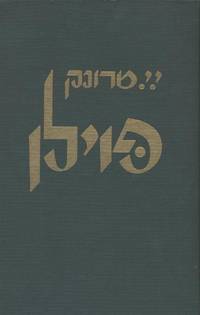
195331692Nyu-York; Farlag “unzer Tsayt†1953. 1st edition. Publishers cloth. 8vo. 252; 318; 288; 304; 308; 244; 275 pages. 23 cm. First edition. In Yiddish. “Poland; Memoirs and Picturesâ€. The grand epic memoir of Yekhiel Yeshaye Trunk 1887–1961 ; which he began as soon as arriving in New York in 1941 it took a decade to complete. “Trunk’s broad political social and cultural experiences informed his autobiographical epic Poyln a study of the decline of the upper strata of Polish Jewish society and the rise of a new secular Jewishness embodied in folklore Yiddish literature and the Bund. This work his crowning achievement focused almost entirely on the multifaceted collectivity of Polish Jewry while relegating his personal story and inner struggle to the sideline. †YIVO Encyclopedia . Trunk was the chief archivist of YIVO at the time of his death and was considered in an obituary published in the New York Times “one of the leading historians in the United States on the destruction of European Jewry during the Nazi era. †Seven volume set bound in green cloth with gilt title. Subjects: Authors Yiddish - Poland - Biography. Jews - Poland - History. First volume cloth heavily worn with previous owners bookstamp otherwise very clean. All other volumes have minor shelf wear to cloth otherwise clean and fresh. Very good condition. YIZ-15-9. Nyu-York; Farlag “unzer Tsayt†unknown
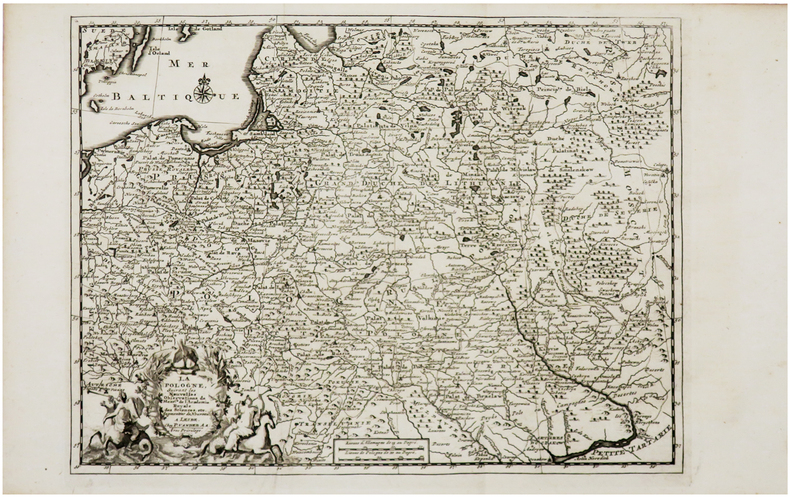
13188DBo.J. [2 Warenabbildungen] Tobias Conrad Lotter, geboren 1717, gestorben am 14. Juli 1777. Kupferstecher, Kartograph und Verleger in Augsburg.
Original Paper Wrappers, 8vo, ca. 100 pages. Monthly Bundist periodical ran from Vol. I, Nr, 1 (Oct. 1927) to 1932. 23 cm. In Yiddish. Unobtrusive Bund rubber stamp. Levin (1977) reports that it was in UNZER TSAYT that the very first reports of the Bund's split over the National Question with the Russian Social Democrats were published (in 1927). The Bund in Poland, here providing its unique Polish Jewish Socialist anti-Zionist perspective. The General Jewish Labour Bund in Lithuania, Poland and Russia (Yiddish: algemeyner yidisher arbeter-bund in lite, poyln un rusland), generally called The Bund or the Jewish Labour Bund, was a secular Jewish socialist party.... founded in Vilnius on October 7, 1897 ..In 1917 the Polish part of the Bund, which dated to the times when Poland was a Russian territory, seceded from the Russian Bund and created a new Polish General Labor Bund which continued to operate in Poland in the years between the two world wars .The Bund sought to unite all Jewish workers in the Russian Empire into a united socialist party, and also to ally itself with the wider Russian social democratic movement to achieve a democratic and socialist Russia. The Russian Empire then included Lithuania, Latvia, Belarus, Ukraine and most of present-day Poland, areas where the majority of the world's Jews then lived. They hoped to see the Jews achieve a legal minority status in Russia. Of all Jewish political parties of the time, the Bund was the most progressive regarding gender equality, with women making up more than one-third of all members. The Bund actively campaigned against anti-Semitism. It defended Jewish civil and cultural rights and rejected assimilation. However, the close promotion of Jewish sectional interests and support for the concept of Jewish national unity (klal yisrael) was prevented by the socialist universalism of the Bund. The Bund avoided any automatic solidarity with Jews of the middle and upper classes and generally rejected political cooperation with Jewish groups that held religious, Zionist or conservative views. Even the anthem of the Bund, known as "the oath" (di shvue in Yiddish), written in 1902 by Sh. An-ski, contained no explicit reference to Jews or Jewish suffering. At the heart of the vision of the future of the Bund was the idea that there is no contradiction between the national aspect on the one hand and the socialist aspect on the other. As a strictly secular organization, the Bund renounced the Holy Land and the sacred language (Hebrew) and chose to speak Yiddish .In its early years the Bund had remarkable success, gaining an estimated 30,000 members in 1903 and an estimated 40,000 supporters in 1906, making it the largest socialist group in the Russian Empire . the Bund was a founding collective member at the RSDLP's first congress in Minsk in March 1898. For the next 5 years, the Bund was recognized as the sole representative of the Jewish workers in the RSDLP, although many Russian socialists of Jewish descent, especially outside of the Pale of Settlement, joined the RSDLP directly .The Bund generally sided with the party's Menshevik faction led by Julius Martov and against the Bolshevik faction led by Vladimir Lenin during the factional struggles in the run-up to the Russian Revolution of 1917 .In the Polish areas of the [Russian] empire, the Bund was a leading force in the 1905 revolution. At that time the organization probably reached the height of its influence. It called for an improvement in living standards, a more democratic political system and the introduction of equal rights for Jews. At least in the early stages of the first Russian Revolution, the armed groups of the "Bund" were likely the strongest revolutionary force in Western Russia. During the following years, the Bund went into a period of decay .The Bund eventually came to strongly oppose Zionism, arguing that emigration to Palestine was a form of escapism. The Bund did not advocate separatism. Instead, it focused on culture, rather than a state or a place, as the glue of Jewish nationalism. . The Bund also promoted the use of Yiddish as a Jewish national language and to some extent opposed the Zionist project of reviving Hebrew. The Bund won converts mainly among Jewish artisans and workers, but also among the growing Jewish intelligentsia. It led a trade union movement of its own. It joined with the Poalei Zion (Labour Zionists) and other groups to form self-defense organisations to protect Jewish communities against pogroms and government troops. During the Russian Revolution of 1905 the Bund headed the revolutionary movement in the Jewish towns, particularly in Belarus and Ukraine ..In 1921, the Communist Bund [in the USSR] dissolved itself and its members sought admission to the Communist Party....Many former Bundists, like Mikhail Liber and David Petrovsky, perished during Stalin's purges in the 1930s. The Polish Bundists continued their activities until 1948. During the latter half of the 20th century the Bundist legacy was represented through the International Jewish Labor Bund, a federation of local Bundist groups around the world .Among the exiled Bundists who went on with Socialist politics in America was Baruch Charney Vladeck (18861938), elected to the New York Board of Aldermen as a Socialist in 1917 [and] 1937 [and] manager of The Jewish Daily Forward Moishe Lewis (18881950)....the father of David Lewis (19091981), a leader of the New Democratic Party in Canada .David Dubinsky (18921982), though never formally a member of the party, had joined the bakers' union, which was controlled by the Bund, and was elected assistant secretary within the union by 1906 ..He later became a member of the Socialist Party of America, helped found the American Labor Party in 1936 and was from 1932 till 1966 the leader of the International Ladies' Garment Workers' Union ..under the name Max Goldfarb, David Petrovsky (18861937) was a member of the Central Committee of the Jewish Socialist Federation of America, a member of the Socialist Party of America, and the labor editor of The Forward (Wikipedia). SUBJECT(S) : Jews -- Poland -- Periodicals. Jewish labor unions -- Periodicals. Socialism and Judaism -- Periodicals. Yiddish literature -- Poland -- Periodicals. OCLC Number: 642969688. OCLC lists only 4 runs (Arizona State, Stanford, LOC, U of Washington), all of which appear to be incomplete. Use wear, paper brwoning but not fragile. Good Condition. (y-1-11)
Cologne, chez les Heritiers de Pierre Marteau, 1720, 4 parti in 2 volumi, in-8, legatura coeva in tutta pelle, con dorso a 5 nervi, doppio tassello (uno mancante al vol. I), titolo e fregi oro, sguardie in carta marmorizzata, tagli spruzzati e nastrino, pp. (10), 538, (26) - (2), 516, (26). Con 11 ritratti incisi in rame da Harrewyn, 2 tavole f.t., marca tipografica ripetuta ai frontespizi, testate e finalini. Spellature ai dorsi, mancanze alle cuffie; carta di qualità non uniforme: alcuni quaderni lievemente bruniti. (Barbier, II, n. 9009).
203730Paris, Desenne, 1796 5 vol. in-8, [4]-viij-391 pp., viij-556 pp., viij-372 pp., [4]-400 pp. et [4]-299 pp., avec 5 (sur 6) tableaux dépliants, demi-basane havane, dos lisses ornés de guirlandes et fleurons dorés, tranches mouchetées de rouge (reliure de l'époque). Plusieurs charnières fendues, coiffes rognées.
223835A Paris, chez Plancher, 1818 in-8, LX-166 pp., tableau et plan dépliants, bradel demi-basane brune à coins, dos orné (reliure postérieure). Rousseurs. Restauration au tableau avec légère perte d'une lettre.
1729LBW-6195Leide, Pierre Vander Aa, [1729]. 222 x 296 mm.
242693Paris, Dentu, 1864 in-12, XXVIII-436 pp., demi-veau bleu, dos à faux-nerfs, filets dorés et à froid (rel. de l'époque).