"ATLAS DEUTSCHLAND - ATLAS GERMANY - ATLAS ALLEMAGNE.Livre Rare Book
79 565 résultats
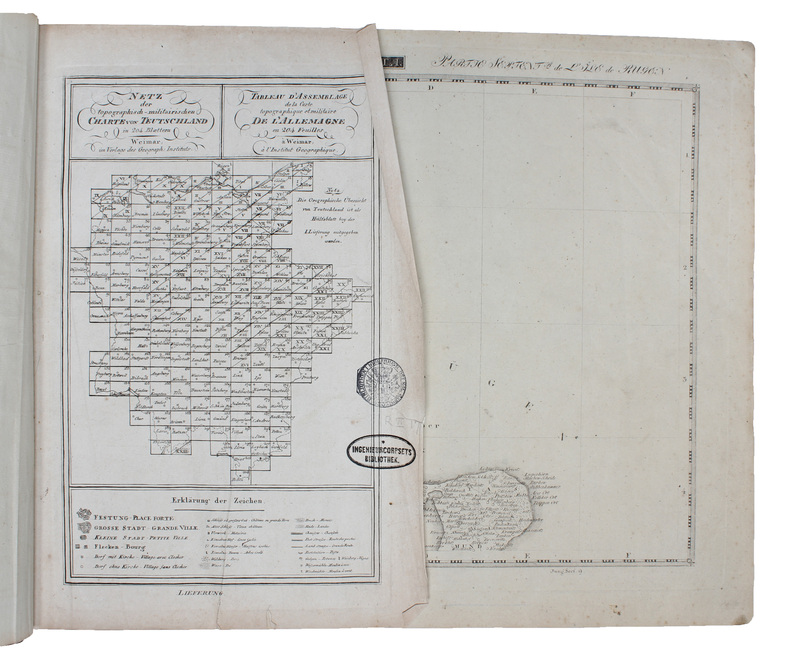
180755735Weimar, Geographischen Instituts, 1807-13. Folio-oblong. (38 x 48 cm.). Contemp hcalf. Spine a little rubbed. A paperlabel pasted on upper part of spine. Corners bumped. Stamp on ""Netz-Karte""/ ""Tableau"". With 3 other ""Netz-Karte"" on verso of Sect. 3,11 a. 14. The engraved title-page (in French) present as Sect. 10. With all 204 engraved plates (203 maps). The maps clean and fine throughout.
180755735Weimar Geographischen Instituts 1807-13. Folio-oblong. 38 x 48 cm. Contemp hcalf. Spine a little rubbed. A paperlabel pasted on upper part of spine. Corners bumped. Stamp on "Netz-Karte"/ "Tableau". With 3 other "Netz-Karte" on verso of Sect. 311 a. 14. The engraved title-page in French present as Sect. 10. With all 204 engraved plates 203 maps. The maps clean and fine throughout. unknown
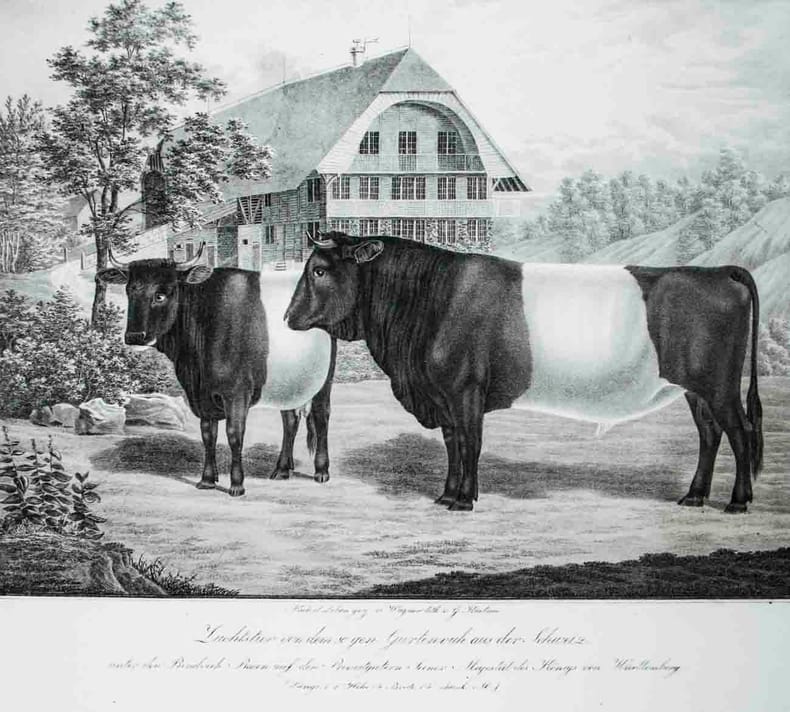
138307aafStuttgart, F. G. Löflund und Sohn, 1827- [1834], Quer-Folio, (37,5 x 46,5 cm). 24 S., mit 2 lithographierten Titeln und 36 getönten lithographierten Tafeln nach L. Ekeman Alleson und Friedrich Wagner. Halbleder gebunden um 1900 mit Rückentitel.
186938404Wiesbaden : Königl. Regierung, ca. 1869 - ca. 1927. Wohl über 500 Bde ges. Gr. 8°. HLwd. d. Zt. mit verstärkten Ecken u. marmoriertem Einbd. mit marmorierten Schnitten.
1927613396Berlin, Mittler, 1927/32. OHlwd/OKart.
191378875ABBerlin, Vlg. Reimer, 1913. 32x27 cm. XXVIII, 387 S. mit vielen Figuren (Textband) und LXXX Tafeln in Lichtdruck, 1 Bl. (Tafelband). OLn. Text u. Tafelband in 2 Bänden.
197166348ABStuttgart. Köln. London. Reykjavik., Seimannsverlag - Vormals Edition Hansjörg Mayer., 1971. 23 x 17 cm. 2 Blatt, 114 Karton-Tafeln, 2 Blatt. OKarton in leinenbespanntem, lackierten Papp-Umschlag mit montierten, eingefärbtem Gebäck., 66348AB Auflage 1000 Exemplare. Einband am Rücken etwas gebräunt und gering fleckig, leicht angestaubt. Beide Hörnchen mit reichlich Wurmgängen, ein Hörnchen mit etwas Substanzverlust in der linken Hälfte, teils etwas bröselig aber insgesamt noch gut erhalten. Gesammelte Werke Band 6.
66823ABo.J. 66823A
197166618ABDüsseldorf., Hartmut Kaminski., 1971. 66618AB Gutes bis sehr gutes Exemplar.
155316672(Am Ende): Ingolstadt, (Alexander und Samuel Weissenhorn), 1553. 9 Bll., XVIII Bll., 1 Bl., Bll. XIX - CXXV, 1 Bl., Bll. CXXVI - CXCVII , 19 Bll. (Register) mit 1 ganzseit. Titel-Holzschnitt und 1 ganzseit. Textholzschnitt. 10 Holzschnitte auf 3 gefalt. Tafeln. 4°. Blindgeprägtes SchweinsLdr. der Zeit auf Holzdeckeln mit 2 intakten Schließen (etw. bestoßen und beschabt, Rücken mit aufgeklebtem hs. Rückentitel).
183661042München, Joseph Lindauer?sche Buchhandlung (C. T. F. Sauer), 1836. Qu.-4°. Mit 24 lithogr. Tafeln von Gustav Kraus. 21 (1) S., 1 Bl., Beids. illustr. OKart.
1827STLB0051Hamburg, Hoffmann und Campe 1827. Kl.-8°. Schmutztit., Titel m. kl. Vignette (Lyra), 372 S., 1 Bl. (Verlagsanz.). Restaur. Leinenbd. der Zeit m. goldgepr. Rü.titel u. -verzierungen sowie blindgepr. Deckelrahmen. Einbd. abgewetzt, bestoßen u. fleckig, Rü. neu aufgezogen, Vorsätze erneuert, ges. Buchblock wasserrandig, braunfl. u. z. Tl. stärker abgegriffen, m. mehreren hs. Anmerk. auf Titelbll. u. im Text. Goed. VIII, 555, 26. Borst 1526. Erste Ausgabe von Heines Lyrikband mit romantischen Liebesgedichten, der den Ruhm des Schriftstellers begründete und bis heute zu den bedeutendsten Gedichtsammlungen zählt. Mit den vier Widmungsblättern, die in späteren Auflagen wegfielen, an Friedrich Merckel (2), Salomon Heine und Friederike Varnhagen von Ense sowie den häufig fehlenden Vortitelblatt und Verlagsanzeigen. - Das Buch der Lieder umfasst mit Gedichten zwischen 1817 und 1826 Heines Frühwerk. Von den insgesamt 237 enthaltenen Gedichten, waren viele zuvor schon in Zeitschriften veröffentlicht worden. Hier noch in der unzensierten Form, weil viele Formulierungen, die für zu obszön angesehen wurden, in den späteren Auflagen geändert werden mußten. So wurde beispielsweise aus einem Gedichtanfang, der in der vorliegenden, ersten Auflage noch 'Auf deinen schneeweißen Busen, Hab? ich mein Haupt gelegt' (S. 246) hieß, später 'An deine schneeweiße Schulter. Hab? ich mein Haupt gelehnt'.
63657ABo.J. 63657AB
17630102-12o.O:,Vlg. u. J. [Dresden nach 1763]. Gesamtgröße ca. 221 x 163 cm, vielfach gefaltete, teilkolorierte Kupferstichkarte mit Titelkartusche oben Mitte und reich illustr. Erläuterungskartusche links unten, in 15 Blättern, die einzelnen Kartenblätter unzerschnitten vollständig auf Ln. aufgezogen, Kartenränder jeweils an den anliegenden Rändern zur Nachbarkarte beschnitten (wodurch die Blätter nahtlos aneinandergelegt werden können), nur sehr leicht und vereinzelt stockfleckig, Reißnägelspuren an den Kartenblattecken, sonst ungewöhnlich gut erhalten.
19691000FBStuttgart. Köln. London. Reykjavik., Edition Hansjörg Mayer., 1969 - 1987. 23,2 x 17,2 / 23,2 x 23,6 / 26,7 x 23,6. OKarton mit illustriertem OUmschlag / OPapp-Box., 58038AB 20 Bände. 1. Auflage. Drei Bände auf dem Kopfschnitt etwas stockfleckig, teils geringe Bereibungen an den Umschlägen, sonst sehr gutes Exemplar.
1995156FBParis., Yvon Lambert., 1995. 156F Sehr gutes Exemplar.
1981658FBKassel., Orangerie., 1981. 658F Sehr gutes Exemplar.
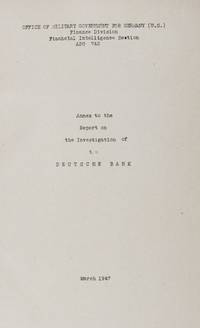
194737284US Zone: Office of Military Government for Germany U.S. 1947. First and only edition. Hardcover. g. Folio. 2 51 leafs 2pp. index of names 7 leafs exhibit list and certification of reproduction with facsimile signature of Charles E. Bancroft 293 leafs with facsimile reproductions of 137 exhibits. Original half black binder tape over paper covered boards with title pasted on spine and front cover. This rare document is based on a great number of important records which became accessible at the Deutsche Bank's Hamburg branch only after the end of WWII. For the first time information is revealed on some rather unusual transactions which tend to incriminate the bank even further for its participation in spoliation and aryanization from 1933 to 1945. Of particular interest is the description of the manner in which the Deutsche Bank following the Munich agreement of 1938 grasped control of two outstanding Czech banking institutions: the Boehmische Unionbank and the Deutsche Agrar- und Industriebank. This work recounts the Deutsche Bank's participation in the "aryanization" of the German economy from 1932 to 1940 drawing on internal Deutsche Bank records as well as material seized by Allied troops after World War II. It shows how as the Nazis began to rise to power the bank reluctantly purged itself of Jewish directors followed by Jewish employees in response to state pressure. Later the regime enlisted the bank employees' professional skills domestic and foreign relationships and financial muscle to eliminate Jewish control and ownership of German companies. The expropriation was conducted gradually since many hastily seized companies proved worthless without the management of their Jewish former owners and also because this method muted foreign criticism and preserved a veneer of legality. This stands in stark contrast to the brutally simple methods used by the Nazis in occupied countries and after 1941 in Germany as well. The numerous incriminating documents retrieved at the end of the hostilities are reproduced in facsimile. The index of names includes institutions as well as names of high level Nazis and their supporters. Rare! No listing in KVK. Sporadic and minor damp-staining on covers and at upper margin of pages not affecting text. Text in English documents in German. Binding and interior in overall good condition. "After Adolf Hitler came to power instituting the Third Reich Deutsche Bank dismissed its three Jewish board members in 1933. In subsequent years Deutsche Bank took part in the aryanization of Jewish-owned businesses; according to its own historians the bank was involved in 363 such confiscations by November 1938. During the war Deutsche Bank incorporated other banks that fell into German hands during the occupation of Eastern Europe. Deutsche provided banking facilities for the Gestapo and loaned the funds used to build the Auschwitz camp and the nearby IG Farben facilities. Deutsche Bank revealed its involvement in Auschwitz in February 1999. In December 1999 Deutsche Bank along with other major German companies contributed to a US$5.2 billion compensation fund following lawsuits brought by Holocaust survivors.2526 The history of Deutsche Bank during the Second World War has been documented by independent historians commissioned by the Bank. During World War II Deutsche Bank became responsible for managing the Bohemian Union Bank in Prague with branches in the Protectorate and in Slovakia the Bankverein in Yugoslavia which has now been divided into two financial corporations one in Serbia and one in Croatia the Albert de Barry Bank in Amsterdam the National Bank of Greece in Athens the Creditanstalt-Bankverein in Austria and Hungary the Deutsch-Bulgarische Kreditbank in Bulgaria and Banca Commercial Romana in Bucharest. It also maintained a branch in Istanbul Turkey" from Wikipedia. Office of Military Government for Germany (U.S.) hardcover
18287-3-616London, , 1828. 4°(28x22cm), Band 1: 2 nn.S., 14 S., 16 S., 16 S., 16 S., 16 S., 14 S., Band 2: 16 S., 12 S., 16 S., 16 S., 16 S., 28 S., dazugehörige Stahlstiche komplett, Ledereinband
77919aafHannover, Carl Kümpler, 1843, in-4to, 4 Bl. + insges. 140 kolorierte lithogr. Tafeln mit ca. 280 Wappenabbildungen, etwas wasserfleckig am Ende, hs. Ex-Libris ‘Sophie von Einem, geb. Fr. Grote, orig. Lederband. Vorsätze leimschattig,
197062503ABStuttgart. London. Reykjavik., Edition Hansjörg Mayer., 1970. 23 x 17 cm. [256] S. OKarton mit verleimter Papp-Manschette mit Montagen., 62503AB Auflage 1000 Exemplare. Buch am Rücken berieben, am oberen Kapital 1 cm Abrieb des Bezugspapier. Sonst sehr gutes Exemmplar. Gesammelte Werke Band 11.
19300002-23Berlin, Bauwelt-Verlag Ullstein-Haus (1930). quadr.-4°. 64 S. Mit zahlr. tlw. farb. Taf. auf schwarzem Papier. OKart. m. farb. Einbandill. Einbd. staubfl., berieb., Ecke geknickt. Fehlstellen am Rü. restaur. - (Der wirtschaftliche Baubetrieb III) EA.
209829S.l., s.d. (1813) in-12, [13] ff. n. ch., couverts d'une écriture moyenne et lisible (environ 20/25 lignes par page), 2 ff. vierges, en feuilles.
In-4°; cc (4), 55, 1 cb, cc (4), 39, al primo front. nota di possesso manoscritta; legatura coeva in piena pergamena, tagli in azzurro. Ampi margini. Traduzione in lingua italiana delle istituzioni dell’impero contenute nella Bolla d’oro del 1356. Nei capitoli si tratta di: gli elettori, l’elezione del re, la Dieta di Treviri Mugunzia e Colonia, l’autorità del conte palatino e del duca di Sassonia, la successione dei principi; ma anche delle miniere d’oro e d’argento, della moneta; delle congiure. Segue il capitolo “Come e quando furono ordinati gli elettori dell’Imperio”, in cui si parla di Carlo Magno e dei Carolingi, e dei re fino a Carlo V . Con una dedica degli Accademici veneziani a Carlo d’Austria
Berlin verlag von Gebrüder Gropius 1829, In-plano oblong cartonnage éditeur, page de titre lithographiée, 13 pages de texte en allemand, 2 lithos de Gaertner sur papier de Chine contrecollées "Ansicht des neuen Palais in Potsdam am 13 July 1829" et "Ansicht der Commun Gebäude in Potsdam am 13 July 1829". 9 planches de dessins allégoriques en noir et blanc "Die lebenden Bilder" dessinées par H.G.R. Schinkel lithographiées par Julius Schoppe -12 planches en couleurs à la main de Heinrich Sturmer lithographiées par Julius Schoppe : Roi héraldique et hérauts, Corps des trompettistes, 1° quadrille : Prusse, 2° quadrille : Pays Bas, 3° quadrille : Kurbrandenburg, 4° quadrille : Silésie, 5° quadrille : Brandebourg, 6° quadrille : Tourner, 7° quadrille Hohenzollern, 8° quadrille : Mecklembourg, 9° quadrille : Burggraftum Nüremberg, 10° quadrille : Brunswick - 1 planche couleur par Theodor Hosemann "Der Zug der Prinzen und Ritter". Les planches du défilé héraldique mises en couleurs à la main sont en bel état, couleurs bien fraiches, les autres planches présentent des rousseurs. Cet ouvrage ne semble pas avoir été commercialisé, probablement délivré uniquement sur souscription et semble t'il tiré à 270 exemplaires seulement, la liste des souscripteurs figurant en début. Réalisé à la faveur de "la magie de la rose blanche" à l'occasion du 31e anniversaire de la tsarine russe Alexandra Feodorowna née Charlotte de Prusse. Spectaculaire cérémonieavec jeux médiévaux, défilés chevaleresques des maisons nobles. Ensemble bien complet.