REUCHLIN (Johannes)Livre Rare Book

79 565 résultats
1519PHO-1100Haguenau, apud Thomas Anshelm, 1519 (M.D.XIX Mense Maio). Pet. in-4, cartonnage postérieur ,titre encadré , LXXIX f.,3ff.n.ch. (R 6),( table et marque d’imprimeur) .Exemplaire très frais, écriture sur le titre .
1840141651Leipzig, Wigand, o. J., [1840]. 240, 237, 183, 291, 236, 244, 303, 235, 480, 488 und 128 Seiten. 24,5*16,5 cm. Halblederbände der Zeit.
310 pages. Utley was posted to Germany as a Reader's Digest correspondent in 1948. Here she relates her controversial observations of that devastated post-war nation. "An excellent, readable, well-documented account of the cruelties, and of the disasters, to victors and vanquished alike, which resulted from the application of the slightly modified Stalin-White-Morgenthau Plan to conquered Germany after 1945." - STIMELY p.61. Joseph Halow, an American court reporter at the Dachau War Crimes Trials, cites this book in his work, Innocent at Dachau. Average overall wear. Binding intact. Prior owner's name and date pencilled atop front free endpaper. Dust jacket now preserved in archival-grade Brodart. A sound first edition copy of this important historical account. Book
1880006743Frankfurt Main Germany: Bockelmann"s Kunstverlag 1880. Published in 1880's this beautiful collection contains all 150 single-sided loose engravings showing various cities and major buildings/cathedrals of Germany just prior to the turn of the century. Beautiful set covering most of Germany. Engraved title page and two page index. Engravings are clean. Sides of case are torn/worn. Overall very unique and rare collection of engravings. Individual pages may retail for as much as $50 or more each. Decorative Cloth. Very Good/Slipcase. 4to - over 9¾" - 12" tall. Bockelmann"s Kunstverlag hardcover
156665749Frankfurt a. M., (Georg Rab, Sigmund Feyerabend u. Weygand Hahn Erben), 1566. Fol. Mit Holzschn.-Portrait a. Titel, 2 Holzschn.-Druckermarken, 12 Holzschn.-Portraits u. 7 Textholzschnitten von Jost Amman. 22 nn. (das letzte weiß), 532 num., 26 nn. Bll. (Stammtafeln u. Register), Blindgepr. Schweinsldr.-Bd. d. Zt. über Holzdeckeln a. 5 Bünden m. 2 Schließen.
1686007514Nürnberg, Johann Michael Spörlin für Johann Zieger, 1686. 6 Blatt, 334 S., 6 Blatt Register. Pappband der Zeit, der Rücken im 19. Jahrhundert zur Stabilisierung mit Marmorpapier überzogen. (Fortsetzung des Titels:)... danebenst einem woluntersuchten Unterschied vielerley Völcker / deren Religionen / Sprach-Arten / Kleidung / Leibs- und Gemüths-Beschaffenheit: Fremder Thiere / Früchte etc. auf das eigentichst- deutlichst- und lebhaffteste vorgestellet werden. Auf eine recht ungemeine / gelährte / in andern deßfalls ausgegebenen Schrifften nicht-befindliche Weise / mit durch und durch beygebrachten hochvernünftigen Anmerckungen anfangs in Englischer nachgehends in Holländischer Sprach beschrieben / Nunmehr aber aus der letzern in die Hoch-Teutsche übersetzet / und dem gemeinen Besten zu Nutz / auch denen sonst Neuigkeits-Lieb-Gesinnten zu verhoffentlich mercklichem Gefallen / als ein stattliches mit einigen netten Kupfferblatten ausgeziertes / auch einem nöthigen Register erläutertes Werck / auf vieler Verlangen / durch offentlichen Druck gemein gemacht. Der englische Arzt E. Brown (1644-1708) war Leibarzt Charles II. und seit 1682 Leiter des St. Bartholomäus Hospitals. Sein "Account of serveral travels" erschien im Original London 1673 (Graesse I, 548 gibt 1686 für die Originalausgabe an und erwähnt eine deutsche Übersetzung, Nürnberg 1711; diese auch in der Bibliotheca Walleriana 19460). Catalogue of German Books 1601-1700 now in the British Museum B2155. Die hübschen Kupfer von Johann Franz Wussim zeigen einen Triumphzug zu Antwerpen, Kaiser Trajans Brücke über die Donau, den Ausritt des türkischen Kaisers zu Larissa, ein ungarisches Goldbergwerk, den Stephansdom und die Kaiserliche Bibliothek zu Wien, den Bärenzwinger in Dresden, die warmen Quellen sowie den Liebfrauendom zu Aachen und die dortigen Reliquien. Eingangs mit geringen Wurmgängen, insgesamt handelt es sich jedoch um ein ordentliches, gut erhaltenes und vollständiges Exemplar.
181961831ABWiesbaden, Schellenberg, 1819 u. 1821. 4°. XII S., 2 Bl., 66 S., 1 Bl. Mit einem lithogr. Frontispiz, 21 lithogr. Tafeln und 1 mehrfach gefalt. lithograph. Karte von Wiesbaden (44x36 cm) mit einer kleinen Ansicht in der re. unteren Ecke; X, 92 S., 1 Bl. Mit einer lithograph. Frontispiz und 18 lithograph. Tafeln. Moderne braune HLdr.-Bde. im Stil der Zeit mit Rückenschildern, Textband mit Ganzgoldschnitt. 2 Hefte in 2 Bänden (alles Erschienene).
101213aaf1869, gr. in-4to, oblong, titre manuscrit + 2 ff. (poême) + 216 ff. (432 p.) manuscrits dans une belle écriture (dont 34 ff. de poèmes) + 1 f. de table + 56 images (dont 2 cartes ou plans, 22 photographies originales en petit format, 8 publicités ill. d’hôtels et 5 panoramas gravés de Lucerne, du Rigi et du Lac des Quatre-Cantons), exlibris Peter E. Obergfell, reliure d’époque en demi cuir vert, dos à nerfs avec titre et ornements en or, 1er plat avec titre en or, tranches marbrées. Charnière devant affaiblie.
47363Berlin, Paul Parey 1899-1931, 460x330mm, Halbperkalin. Pas d’envois à chercher sur place, poids trop lourd.
111421aafBruxelles, Chez J.B. Petit Libr.-Éditeur pour l’Art Militaire, 1840, gr. in-4°, oblong, Feuille de titre lithogr. avec vignette + 36 p. à double col. + 1 ff. ‘désignation des cartes’ + 37 cartes, num. de I à XXXVI (avec une carte II BIS, VI & VII sur 1 f. et la carte générale de l’Allemagne sans n° ), dont 19 doubles et 17 simples, traces d’eau au milieu des qqs cartes, reliure en d.-cuir originale plats en papier marbré, pièce de titre en cuir brun au milieu du premier plat. Mouillures.
140237aafFrankfurt am Mayn, bey Gebhard und Körber, 1789-1790, in-4to, (21x26 cm, Blattgr.), 1. Theil: Oestliche Rhein-Seite, 278 S. + 6 gef. Kupfer + 2 Kupf-Vign. / 2. Theil: Westliche Rhein-Seite, 438 S. + 2 Bl. + 6 Bl. Verzeichnis + 2 gef. Kupfertafeln + 1 Kupfer.-Vign., Exlibris Peter E. Obergfell, Schmuckvorsätze, Halbleder d. Zeit, gebunden (21x27) , Rücken goldgeprägt.
180016103(Wien), Artaria, um 1800. Ca. 41 x 44 cm (Bild); 48 x 76 cm (ganze Blatt).
1725393Augsburg, Seutter, (1725). Altkolorierte Kupferstichkarte bestehend aus 15 Blättern mit je 4 auf Lwd. aufgezogenen Segmenten, zusammen ca. 145 cm x 159 cm. Kl.-4°. Pp.-Schuber der Zeit mit hs. Deckelschild (bestoßen). [3 Warenabbildungen]
elala2755Ghent: la Veuve Pierre De Goesin 1744. First Edition. Fête book celebrating the inauguration at Ghent on April 27 1744 of Maria Theresa as Countess of Flanders. The Archduchess of Austria and Queen of Hungary and Bohemia was presented on the occasion with a magnificent Ghent-made gown with a garniture of Flemish lace. She is shown wearing the gown in an oil painting by Martin Van Meytens which hangs in the city town hall. Cohen-De Ricci 868. Landwehr Splendid Ceremonies 209. Vinet 685. folio. pp. 43. title & head of dedication in red & black. woodcut arms on title. engraved frontis. portrait of Maria Theresa by Frans Pilsen after a painting by Philips Karel Marissal & large folding double-page engraved plate of the inauguration ceremony by Pilsen after David ‘t Kindt. contemporary calf imperial arms on upper cover arms of Flanders on lower cover covers with surface abrasions spine repaired at head & foot wormholes in outer margin – those in first few leaves neatly filled in the folding plate with half a dozen unobtrusive wormholes & some reinforcements of the folds but in very good condition nonetheless Ghent: la Veuve Pierre De Goesin, 1744 unknown
197366417ABReykjavik., Dieter Roth., 1973. 47 x 33 cm. Ca. 1200 S. OKarton mit Gazeverleimten Rücken., 66417AB Auflage 150 Exemplare. Sehr gutes Exemplar. [Tränen 2].
139294aafHalle, Bey Johann Christian Hendel, 1777 / 1779, kl. in-8vo, 4 Bl. (Titel + 2 Bl. Widmung + 1 Bl. Vorrede des Uebersetzers) + 489 S. (+ 1: Verbesserungen) + 360 S., Exlibris Peter E. Obergfell, einf. Pappbände d. Zeit, grünes Titelschild am Rücken, Ecken etwas bestossen.
182644632ABLondon, Jennings, 1826. Small folio. With 62 engraved plates, in two states (together 124 plates). Contemp. full brown calf with 2 col. labels, richly gilt, a.e.g.
198269452AB1982. 61 x 69,8 cm., 69452A Keilrahmen leicht verzogen, Leinwand minimal gelockert, sonst noch guter Zustand, wie vom Künstler intendiert.
1919009981München, Kurt Wolff 1919-1921, 1919. VIII, 319; 332; 356 S. Großformatiger Orig.-Halbpergamentband (Jg. 1) sowie 2 großformatige Orig.-Leinenbände. Von der repräsentativen Kunstzeitschrift des Expressionismus erschienen insgesamt drei Jahrgänge, die hier vollständig gebunden mit allen16 ganzseitigen Original-Graphiken vorliegen: 1919/1: Karl Schmidt-Rottluff: Kopf (Original-Holzschnitt); Karl Caspar: Johannes auf Patmos (Original-Lithographie); Richard Seewald: Der Hirte (kolorierter Original-Holzschnitt): 1919/2: Franz Marc: Aus der Tierlegende (Original-Holzschnitt); Heinrich Nauen: Mutter und Kind (Original-Radierung); Ignaz Epper: Mädchenkopf (Original-Lithographie); 1920/1: Erich Heckel: Mädchenkopf (Original-Holzschnitt); Georg Ehrlich: Tröstung (Original-Lithographie); Frans Masereel: Business-man (Original-Holzschnitt); 1920/2: Max Kaus: Kopf (Original-Holzschnitt); André Rouveyre: Kopf (Original-Holzschnitt); 1921/1: Edwin Scharff: Die Brüder (Original-Lithographie); Alexander Archipenko: Figürliche Komposition (Original-Lithographie); Carl Hofer: Das Nest (Original-Lithographie); 1921/2: K. Schmidt-Rottluff: Lesender Mann (Original-Holzschnitt); Alexander Kanoldt: Klausen (Original-Lithographie). Mit dichterischen, philosophischen und literaturkritischen Erstdrucken u. a. von J. R. Becher, Ernst Bloch, Max Brod, E. R. Curtius, Alfred Döblin, Hermann Hesse, Georg Heym, Kurt Hiller, Franz Kafka ("Erstes Leid", Dietz 61), Kurt Pinthus, René Schickele, Ernst Weiß, Alfred Wolfenstein. Jentsch: Illustrierte Bücher des deutschen Expressionismus, Nr. 72; Söhn: HDO 12001-1 bis 12006-2. Die Bände 2 und 3 jeweils mit kleinem, zeitgenössischem Besitzvermerk in Tinte, sonst handelt es sich jedoch um ein schönes, wohlerhaltenes Exemplar in Originaleinbänden mit sämtlichen Originalgraphiken und nur leichten Gebrauchsspuren.
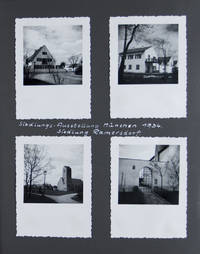
45183NP: NP. Hardcover. vg. Quarto 9 1/2 x 9 1/4". 53 leaves with tissue guards. Original three-quarter bolted brown and red cloth photo-album with gilt ruling on spine. Collection of ca. 300 original b/w photographs in variant sizes depicting architectural motives in Nuremberg Munich Stuttgart Berlin Potzdam Warsaw Odessa and France spanning the 1930s 1940s and 1950s. The photographs vary in sizes from 2 1/4 x 2 1/4" to 9 1/4 x 6 3/4" - the striking photographs are taken and captioned by Adolf Emilius. The collection contains three photographs with Adolf Hitler. One with Albert Speer and Franz Struff another with Hitler in the Nuremberg opera house in 1937 and one showing Hitler at the construction site of the Zeppelinwiese.<br /> <br /> Starting with a section depicting buildings in Nuremberg and Stuttgart the album shows the German Garden Show the VW factory the German Toy Fair 1953 various city institutions and businesses from the 1950s. Professional settings like the Settlement Exhibition in Munich Ramersdorf 1934 one and two family homes in Nuremberg and surrounding areas by architects Fritz Mayer and Hans Kern including details like entrance lighting and flower windows. Siemenshaus in Nuremberg a border police station in Vorarlberg the Catholic church in Bludenz City Hall Nuremberg the Cathedral and the Arc de Germanicus of Saints the opera house and the dome in Aachen. <br /> <br /> A section of photographs of Berlin show the Shell headquarters the sculpture of the group of runners at the Olympia Stadion the Ufa Palace in 1938 decorated for the main event Riefenstahl's Olympia film. There is the iron construction of the ship draw works at Niederfinnow the Arcs de Triomphe in Brandenburg and Munich the Berlin Dome and the Charlottenburg Castle the broadcasting center the Haus der Deutschen Kunst and the State Opera in Munich the Sanssoucie castle in Potsdam and the Brandenburg Gate.<br /> <br /> Contains a group of four sepia-toned photographs of wooden buildings designed by the architect Julius Schulte -Frohlinde for the Olympic Games 1936 in Berlin. Some of these buildings Rheinlandhalle Berliner und Hamburger Halle depicted here were transported to Nürnberg after the Olympic Games and reassembled on the Nazi Rally Grounds in the northeast part of the city called the KdF-Stadt Kraft durch Freude City. They were used by the organization to entertain the attendants of the NSDAP Rallies in 1937 and 1938. The center of this city was a bell tower also depicted here playing the key note of the KdF every thirty minutes: "Freut Euch des Lebesn Enjoy Life." <br /> <br /> The second half of the photo-album contains some 120 b/w photographs incl. few photographic postcards depicting exteriors and interiors of buildings associated with Nazi institutions or events e.g. three photographs of models including of the Haus der Kunst München the Soldier Hall and High Command of the Army Dresden design W. Kreis and the Advanced School of the NSDAP at the Chiemsee design Hermann Giesler. It includes photographs of the exhibition "Siedlungsausstellung" in Munich showing the sample settlement Ramersdorf the epitomization of the National Socialist settlement idea. In short order 192 single family homes were built in the Munich district of Ramersdorf under the direction of the architect Guido Harbers. However the propaganda effect the officials had hoped for didn't materialize and the homes were sold after the exhibition. <br /> <br /> In addition there are photographs of the interior of the Nuremberg Congress Hall design by Lauterbach 5 1/2 x 7 1/2" the old Kongreßhalle the Luitpold arena a plaster model of the Kongreßhalle 1937 one of them with Hitler Speer and the architect Ruff the side arcade of the stadium at the Zeppelin Field the entrance of the Palais of the Reich President design Speer the Gau-building in Nuremberg design Ruff the Reich Chancellery various interior and exterior views the office of the Führer a sculpture by Arno Breker the entrance to the Reich Chancellery a series of 12 photographs of showing the construction of the new Reich Chancellery in 1938 the construction of the Zeppelin Field one of them with Adolf Hitler 1936 the grandstand of the Zeppelin Lawn a fatigue duty muster a lighting rehearsal a demonstration of the Wehrmacht various government buildings in Breslau Minsk and Nuremberg 21 photographs showing the construction of the Zeppelin Lawn concluding with eight photographs 4 1/4 x 6 1/2" of the construction of the Zeis Factory in Jena.<br /> <br /> Text in German. Starting after the first leaf with the second leaf loose. Some creasing of tissue guards. Overall in very good condition. NP hardcover
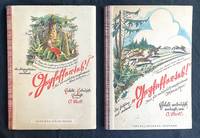
194143392Neudamm & Berlin: Munz & Co Försterbuben; and J. Neumann Frühling 1941. No Date 1940-1941 Both 1st edition. Original color illustrated boards 4to 70 68 pages. Filled with color illustrations over 20 of them stereotyped Antsemitic cartoon images. 25 cm. In German in Sütterlin script. The titles translate loosely as "The Spring and Other 'Spicy' Stories-- Only for People Sensitive to Nature" and "The Forest Boys and Other 'Spicy' Stories-- Only for People Sensitive to Nature." Text printed in red and black.<br> Both volumes were printed in Neudamm by Neumann but interestingly Försterbuben the first volume shows an overlay of the new publisher/distributer "Munz & Co. Verlag Berlin" on the front cover and title page. Complicated issues around distribution of Försterbuben may be reflected in its present scarcity OCLC locates only two copies worldwide. <br> OCLC suggests consecutive dates of 1940 and 1941 for both titles which makes sense given the use of Sütterlin script see below and the presence of the date 1938 or 1939 under the artist's printed signature in several of the drawings.<br> <br> Most scholars of Nazi-era Antisemitic imagery are familiar with the horribly Antisemitic children' s books Der Giftpilz The Poison Mushroom and Trau keinem Fuchs auf grüner Heid und keinem Jud auf seinem Eid! Don't Trust a Fox in a Green Pasture Or a Jew Upon His Oath! published by Julius Streicher's Stürmer Verlag. These Nazi propaganda books were intended for young people and were published in large printing runs in Nazi Germany.<br> Lesser known but at least as offensive are these illustrated Nazi-era book for adults by Otto Stoll. Printed and distributed by a far smaller publisher than the Stürmer Verlag they received smaller press run and appeared in only one edition. Indeed OCLC locates only 2 holdings worldwide for the first volume Die Försterbuben.<br> H. Heyne illustrated both works with colorful comic illustrations which are distributed throughout the text rendered in with what appear to be the highest quality printing techniques of the day. <br> Each book includes eight hunting or outdoors stories in verse two of them in Der Frühling the second volume extremely Antisemitic. Intended as humorous they contain typically ribald German hunting humor with immediately recognizable tropes from German culture. <br> <br> Interestingly these stories were published just in the final two years of official use of period Sütterlin cursive script which was popular during the early Nazi period and was used for example in Der Giftpilz and Trau keinem Fuchs. Indeed "In 1935 the Sütterlin style officially became the only German script taught in schools."<br> Then however "In 1941 the probable year of publication of the second work the Nazi Party banned all 'broken' fraktur 'blackletter' typefaces including Sütterlin and replaced them with Italian-style lettering such as the Antiqua typeface class. From the academic year 1941/42 onwards only the so-called Normalschrift 'normal script' which had hitherto been taught alongside Sütterlin under the name of 'Latin script' was allowed to be used and taught" Wikipedia.<br> Der Frühling. includes first the virulently Antisemitic illustrated tale of Max Isidor Veilchenblau the last name means the color violet in German implying strangeness and perhaps effeminacy a wealthy Jewish businessman who wanted to be a hunter. Max Isidor owns a big house on the edge of a forest where he lives with his wife Rosalinda. <br> <br> Under Heyne's colorful drawing of a synagogue with big flashy sports cars coming and going and stereotyped Jewish men greeting each other we are told that Veilchenblau has told his wife that he has hunting plans but he instead takes a beautiful blond Aryan girl out to dinner. A romantic encounter in a secluded cabin in the forest after dinner does not turn out as Max Isidor had planned and he has to flee stark naked into the woods where is found by his wife and a policeman. <br> According to the moral of the rhyming text Jews can never be hunters with a German hunter's soul a mythical German masculine ideal and no amount of money can make them hunters as their Jewish race just doesn't have "hunters' blood."<br> <br> Then the second illustrated antisemitic story tells of "War-Profiteer Meyer in Crisis" the tale of a Jew who grew wealthy during World War I another well-worn Nazi Antisemitic trope and then has difficulties on a hunting outing with his neighbor a count and the count's lovely blond escort.<br> Both these tales play on an imagined sexual threat of Jewish men to naive but pure Aryan maidens and also reinforce Jewish stereotypes of greed gluttony ugliness and cosmopolitanism.<br> The wider variety of stories in the books have titles such as: Spring; Hunter Latin; Quiet Retreat; and Hunter Hans and his Dog Kosimar. All are are accompanied by cartoon-like color illustrations of animals romantic encounters in the woods hunters in trouble with the tax authorities and of course hunters who are drinking experiencing hunting mishaps encountering misdeeds with chimneys and fireplaces getting in trouble while hunting farting etc. <br> Since these are otherwise low-brow humorous stories they illustrate how ethnic stereotyping and insinuations of racialized moral and physical inferiority-in this case Antisemitic-can be so easily integrated into the standard literature of a culture. The centering of the Jewish characters into two of these stories turns them into the kinds of standard racist jokes that teach and reinforce important racial ideas and hierarchies in the society. <br> At the rear is advertising for other humorous books published by Neumann Publishing company.<br> <br> OCLC listings match the author with an Otto Stoll who was a Swiss ethnographer and Mayanist who died in 1922 20 years before this book was first published which we find unlikely. <br> A copy of Der Frühling by itself sold at auction in 2018 for over $900 with the description noting "The very high production standard of this book belies its vile content." The US Holocaust Memorial Museum keeps their copy in their Rare Book Collection. The much rarer Die Försterbuben has never appeared at any major book auction. <br> SUBJECTS: German wit and humor. Jews -- Germany -- Caricatures and cartoons. Humour allemand. Juifs -- Allemagne -- Caricatures et dessins humoristiques. Anti-Jewish propaganda.<br> <br> Der Frühling. is OCLC: 843226193/72649783/250322204 with OCLC locating only 9 copies worldwide the majority in Germany none at NLI and only 3 in North America UFlorida USHMM UUtah none at any Ivy League institution. <br> Die Försterbuben. is OCLC 700497520 with OCLC locating only 2 copies anywhere worldwide Sachsische Landesbibliothek & LBI. It is extremely rare.<br> <br> Both volumes show only very slight wear an excellent set of this rare and important example of Nazi-era German mass-culture Antisemitism. B holo2-163-26A-XX. Neudamm & Berlin: Munz & Co [Försterbuben]; and J. Neumann [Frühling] unknown
1925054372Mittler. nice set; volumes 1-14 plus vol. 14 Beilagen plus two-volume Kriegsrustung und Kriegswirtschaft Total 17 volumes; does not include Das deutsche Feldeisenbahnwesen volume . Very Good. Hardcover. 1925. Mittler hardcover
81819aaf1901, gr. in-8vo, 70 Bl. eng mit Tinte beschrieben (ca. 30 Linien/Bl.) in gut lesbarer säuberlicher deutscher Kurrentschrift, reich illustriert mit vielen teils ganzseitigen Bleistift- u. Tuschezeichnungen, guter Zustand, Einband neu in Leinen gebunden, goldgepr. Titel mit Autorenname auf Vorderdeckel u. Rücken, sehr guter Zustand. Miteingebunden: Abgegriffener Original-Pappband. mitsamt seiner illustration.
Very Good French Original wrappers. Demy 8vo. (22 x 14 cm). In French. 33, [1] p., tables, and plates. First and only edition of this extremely rare treatise on How Kufic script is applied to print, a brief history of Kufic script, its use in ancient and modern times, examples of writing accompanied by illustrations, typesetting on the keyboard for linotype printing, its use on typewriters, its use in telegraphy (with Arab and international typesettings), etc. Ali Kenan (?-1962), married Emine Nemika Sultan (1888-1969) in 191 and became a groom to the Ottoman palace and the royal family. Only one copy can be traced in OCLC 1065045158, in The British Library, St. Pancras.
196664879ABBerlin., edition et im Verlag Christian Grützmacher., 1966. 23 x 23 cm. Bd-1 -4 OKarton-Flügelmappen in OPapp-Schubern; Bd. 13-15 OKarton-Flügelmappen., 64879AB 7 Bände. 1. Auflage. Band 1 - 4 nahezu druckfrisch mit dem eigentlich immer fehlenden Blatt 28 von Konrad Lueg. Bei Band 14 ist an der unteren Lasche der Mappe der Steg etwas eingerissen, sonst ebenfalls sehr gutes, frisches Exemplar. In dieser Erhaltung und Vollständigkeit s