10 874 résultats
19128845London: no printer stated 1912. CLR passenger map January 1912 edition 28.5 x 35 cm printed in colours text on the verso which includes places of interest connections and ticket information advertising the expected opening of the extension to Liverpool Street in June it opened in July; refolded and with left hand margin tabbed and trimmed for inclusion in a guide book. Similar in style to the UERL common design which had been in circulation since 1908 although with a chocolate rather than a green border. The UERL map gave all lines equal weighting regardless of who owned them to make it easier for passengers to use the network. The CLR on the other hand leaves the viewer in no doubt as to who made the map. Map [no printer stated] unknown
1912118402Grand Trunk Pacific Railway / Allan Royal Mail 1912. Poster. very good. Original un-mounted Royal Mail Service Sailings Poster. 22" X 36". Slight trimming to top border. Some buckling with very light staining at edges but overall in good condition. Poster shows sailing dates of various steamers from St. John - Halifax - Liverpool and Boston - Portland - Glasgow as well as ticket rates. The Allan Shipping Line was started in 1819 and in 1917 sold to the Canadian Pacific Ocean Services LTD CPOS now CP Ships 1912 Grand Trunk Pacific Railway / Allan Royal Mail unknown
1851406078New York: Wm. C. Locke & Co 1851. Wrappers chipped at edges professionally rebacked some unobtrusive offsetting on map. 8vo. 50 pages. Large folding map on three joined sheets 21 x 1788 cm; 8.25 x 61.75 inches. 11 woodblock illustrations in text and with 2 more not recorded in the index but always present. Original printed wrappers with woodblock vignette. SCARCE Hudson River Railroad travel guide published the first year in which the full line was completed. It covers points of interest along the route with woodblocks illustrating the text. Topics include: the history of the Hudson River the history of the construction of the Hudson River Railroad and the cities towns and villages along the Hudson from New York City all the way to Troy. <br /> <br /> Concerning the West Point Foundry at Cold Spring the guide states: "the iron foundry was established here by Gouverneur Kemble. The works are situated about a mile west of the village upon a small stream which tumbles rapidly down the mountains affording considerable water power. It is the largest establishment of its kind in the country employing nearly five hundred hands constantly."<br /> <br /> The building of the Hudson River Railroad is another topic in the guide. The project was considered highly impractical since much of the route had to be cut through extremely difficult rock and terrain. This section includes a description of the tunnels which had to be constructed. <br /> <br /> The railroad was opened in three stages. In September 1849 it allowed passengers to travel from New York to Peekskill. By that December 6 twenty-three additional miles were opened extending to New Hamburg. By the 31st of the month it was open the remaining distance of nine miles to Poughkeepsie. <br /> <br /> The Hudson River Railroad was an extension of the Troy and Greenbush Railroad which was chartered in 1845 connecting Troy South to Greenbush now Rensselaer on the east side of the Hudson. The Hudson River Railroad was chartered on May 12 1846 to extend this line south to New York City. The full line opened on October 3 1851 the same year in which this travel guide was published. WorldCat/OCLC records 25 copies but it is scarcely found complete with the map and the map is also excluded from the digitized versions available online. Wm. C. Locke & Co unknown
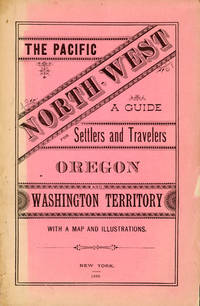
188250958New York: Land Dept. Northern Pacific Railroad Co. 1882. 1882. PACIFIC NORTHWEST. First edition. 8vo. Printed wrappers 81 pp. introductory illustrated large folding map at the rear. Scarce Western promotional travel guide to the Pacific North-West. Addressed to prospective settlers and travelers alike this guide consists of historical geographical and agricultural information and discusses at length matters such as commerce climate education taxes prices and the regions of the Pacific North-West. Each county is described and suggestions are provided to prospective emigrants such as "In mercantile pursuits the opening is good for men of enterprise and capital; but the chances for mere clerks are not good." Farm labor wages in these parts are recorded as being between $25 and $30 per month and lumber mills wages between $60 and $90 per month for first-class hands. It is also noted that "Chinamen work for the railroads and boards themselves at $1.00 a day and in winter take contracts for grubbing brush land." There are ten full-page illustrations which include a two-page "Bird's Eye View of Portland Oregon" "Saw Mill on Puget Sound W.T." "Astoria Oregon Entrance to Columbia River" "First Street Portland Oregon" and "Commercial Street Seattle W.T." with folding map of the region Unfolded 28 1/2 x 18 inches in the back. Spine and outer edges of wrappers sunned else very good copy. Land Dept., Northern Pacific Railroad Co., 1882. hardcover
1940WRCAM55587Various places in the American West as described below below 1940. Sixty-nine photographs 8 x 10 inches each mounted on linen and bound in two volumes. Oblong small folios. Black pebbled vinyl secured by brads. Moderate wear to covers a few photos creased at edge and most starting to curl linen backing fraying on some photos but overall very good. A collection of striking promotional photographs created to enhance Union Pacific Railroad travel brochures. This collection is focused almost exclusively on the Western United States. The first volume consists primarily of campus photos of western universities with captions in pencil on the verso. Photographs portray the Universities of Nebraska Oregon Wyoming Colorado Denver Kansas Idaho and Montana; Oregon Washington Montana and Kansas State Universities; and finally Stanford University College of Idaho Midland College Nebraska Doane College and Creighton University. The last five photos are images of entrees perhaps for dinner menus on western routes. A number of these photos are stamped "Please Credit Union Pacific Railroad Photo" on the verso. <br> <br> The second volume is composed exclusively of scenes from Colorado with typed captions on the verso. There are images from Rocky Mountain National Park more broadly including Alberta Falls Pike's Peak Railway and the Hidden Inn but the majority are in and around Colorado Springs. There are shots of the Broadmoor and Antlers Hotels downtown Colorado Springs Seven Falls Garden of the Gods Cheyenne Mountain Zoo Cheyenne Mountain Lodge and Will Rogers Shrine. The album then moves to southwestern Colorado with images of Ridgway scenes along the Million Dollar Highway Steamboat Springs San Juan Mountains and Silverton and Molas Lake. A number of these photos are also stamped on the verso with Union Pacific stamps these specifically mentioning the Public Relations Department in Los Angeles and including the identification number of the negative. unknown books
1844GD012817okBC1S5Manchester: Wetmore & Wallace 1844. Manchester: Wetmore & Wallace Rare Americana 1844 First Printing. 8vo. 16 pages with folding map at rear of wrappers. The folding map titled :Plan and Profile of the Route Surveyed for the Northern Railroad from Concord to Lebanon N.H." measuring approxinately 28" long and 9" wide. The map is in extremely nice condition. The spine shows some wear but remains a very nice copy. A signature of S.Chase" appears on the front wrapper. There is an institional rubber stamp on the margin of page 3. Vermont Historical Society Montpelier Vermont. This report printed by Wetmore & Wallace Printers in Manchester New Hampshire presents the findings of an engineer's survey for the Northern Railroad route. It covers the planned railroad connections between Concord Franklin and complete with Lebanon along the Connecticut River. Published in 1844 this document provides historical insight into the development of New Hampshire early railroad infrastructure and the engineering challenges faced in the region at that time. Scarce copy last auction records 1930. First Printing. Paperback. Good/No Jacket. 8vo - over 7¾" - 9¾" tall. Manchester: Wetmore & Wallace
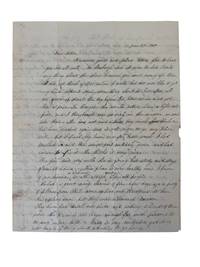
1850235001850. Slavery & Abolition Underground Railroad Fugitive Slave Signed letter mentioning threats of arson against an abolitionist community in Pennsylvania 1850. Lancaster stood on a volatile antislavery route in 1850 with fugitives moving west toward Columbia and the Susquehanna River while pro slavery men targeted communities accused of sheltering escapees. Mary Louisa Harbaugh the young wife of Rev. Henry Harbaugh of the German Reformed Church wrote to her mother that "a party of fellows from Phil. came up here and threatened to burn this place down" and that residents had kept watch after "a great many alarms of fire." Lancaster was the home of Thaddeus Stevens the lawyer and future Radical Republican congressman who defended fugitives and attacked slavery in public life. Columbia eleven miles west had a large free Black population and served as a crossing point for people escaping slavery before and after the Fugitive Slave Act of 1850. <br /> <br /> Harbaugh M. L. Autograph Letter Signed. Lancaster Pennsylvania June 15 1850. Three manuscript pages plus stampless address leaf addressed to her mother Mrs. Margaret A. Linn Lewisburg Pennsylvania. Harbaugh reports household matters children's clothing local health and the arson threat in one domestic letter writing that the city was "very healthy" except for "a few old people" before describing the men from Philadelphia who threatened to burn Lancaster. The address leaf preserves the Lewisburg destination manuscript postal markings and remains of the original red wax seal. The part concerning the arsonists reads as follows:<br /> <br /> "Dear Mother .This place is very healthy now. I know of no disease or sickness at all except among a few old people. We had a great many alarms of fire a few days ago a party of fellows from Phil. came up here and threatened to burn this place down but they were discovered too soon. They have had a watch out since and nothing is heard of them now. The place is not large enough for such persons to do any injury to it."<br /> <br /> Mary Louisa Harbaugh's husband Rev. Henry Harbaugh was a prominent German Reformed minister and writer who avoided public antislavery controversy while her family in Lewisburg was connected to abolitionist politics through her father's break with the Democratic Party for James G. Birney's Free Soil candidacy. Local newspapers such as the June 19 1850 issue of The Lancaster Examiner and Herald reportedly attributed the fire as "no doubt the work of incendiaries as two men were seen running from the Cooper Shop just as the alarm was given" in which they made their escape. It was reported that a young black man by the name of "Gilmore" was arrested and imprisoned on suspicion but was released the next day for insufficient evidence. Other newspapers reportedly minimized the incident without attribution to racial tension all while Columbia suffered a fire that destroyed nine houses and the offices of the Columbia Spy. Folded as mailed with light toning minor edge wear one small seal tear and clean legible manuscript throughout. Overall very good condition. unknown
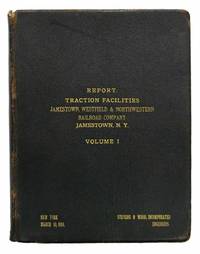
192644099New York: Stevens & Wood Incorporated 1926. 1st Edition. Leather binding with title gilt stamped to front cover. Brown marbled paper eps. Edgewear. Minor chipping at spine ends. Very Good. 83 numbered leaves. Typed text recto only on onionskin paper with red rule border. Leaves 71 through 83 with 26 b/w captioned photographs 2 per leaf on recto. Of the 26 photographs 3 show rolling stock e.g. 'Class "B" Passenger Car No. 310' with the remainder showing divers buildings etc e.g. 'Passenger Station - Village of Westfield' & 'Signal Tower at Pennsylvania R.R. Crossing in Mayville'. 11" x 8-3/8" <br/><br/>This report 1 volume of 3 submitted on March 10 1926 in New York by Stevens & Wood to George L. Maltby General Manager of the Jamestown Westfield & Northwestern Railroad Company is an inventory and appraisal of the property of the railroad including: 1 the electric railway line located in the County of Chautauqua NY owned and operated by the railroad including roadways tracts paving bridges culverts fences signs signals telephone lines poles and fixtures distribution and transmission system; 2 railroad lines located in Chautauqua County NY known as the Chautauqua and Falconer Branches of the railroad which have not been electrified and have been abandoned including roadways tracks bridges and culverts; 3 cars and their electrical equipment; 4 substation buildings and equipment in Westfield and Mayfield; 5 feeder lines interconnecting the distribution system along the right of way of the railroad with the Chautauqua Traction Company’s substation at Stow and in Mayville; 6 all stations waiting rooms and miscellaneous buildings and structures identified as the property of the railroad; 7 Midway Park owned by the railway company. Not present are Volumes II & III with "inventory summaries showing quantities prices and extensions grouped according to Tax Districts and by accounts and the Cost References." An excellent source of New York local history for the mid-1920s. Stevens & Wood, Incorporated hardcover books
85665aaf1901-1902, in-Folio, Dossier mit handschriftl. Rechnung der Bauausgaben 1901(Heft, 20 Bl.), 7 Briefe (teils maschinengeschrieben), und 2 gedr. Publikationen: 1) Schweizer. Centralbahn, Fünfzigster Bericht über das Geschäftsjahr 1901, erstattet von der Kreisdirektion II der Schweizer. Bundesbahnen in Basel..., Basel 1902, 143 S., Orig.-Broschüre; 2) Nachweis über die Bau-Ausgaben pro 1901, 4 Bl. Originalmappe d. Z., mit 2 Leinenbändeln geschlossen, guter Zustand
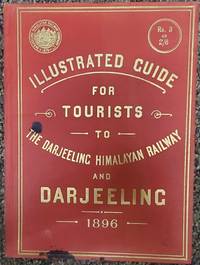
189675179London: McCorquodale & Co. Limited 1896. First edition of this elusive yet important publication. Quarto 7 x 9 7/8 inches. 46 2 ad for the photographer of the book Fred. Ahrle and printer's slug. pp. including 15 full page photographic illustrations by Ahrle and 5 double page plates the first one is a map printed in gold of the railway route used as a frontispiece and one is an gradient diagram and the remainder are plans. Publisher's flexible scarlet cloth with large gilt cover lettering along with the device of the railway. Aside from a couple of ink drops on the corner an exemplary copy. Only a handful of copies located by OCLC. and no copies have appeared at auction according to RBH.The Darjeeling Himalayan Railway is the first and foremost instance of a mountain passenger railway. Opened in 1881 it introduced bold and imaginative engineering approaches to the challenge of rail links on a hilly terrain of excellent beauty this is the first guide book to this fabled railway.The settlement at Darjeeling really began in 1828 with British interest. By 1835 it was separated from Sikkim for establishing a Sanatorium for the invalid servants of the East India Company. It then consisted of a monastery on observatory hill clustered with about 20 huts and a population of about 100 people. Planning began in 1839 to lay out the Darjeeling town and construct a hill road connecting Siliguri Pankhabari Kurseong and Darjeeling. At the same time evolution of hotels began the first being The Darjeeling Family Hotel’s followed by other hotels. By 1840 Darjeeling town had about 30 buildings and a few respectable houses.I n the year 1878 Franklin Prestage Agent of the Eastern Bengal Railway foresaw the utility of a rail link between the hills of Darjeeling and the plains. His scheme was mainly driven by hard economic considerations viz. the huge difference in the cost of essential commodities between Darjeeling and Siliguri the need to carry out tea for export and the inability of the existing road to handle the growing traffic. He submitted a scheme for the construction of a two feet gauge railway line from Siliguri to Darjeeling.In a detailed scheme submitted to the Government of Bengal and approved by the Lt. Governor Sir Ashley Eden he pointed out how a railway could substantially reduce the cost of transport between Darjeeling and the plains. Rice which sold at 98 a ton at Siliguri Cost 238 at Darjeeling! He was also convinced that the cost of construction of the 2 feet gauge rail-line would not be prohibitive and locomotives small but powerful enough to climb steep gradients could be designed Prestage received final sanction for his project on April 8 1879 and formed the Darjeeling Steam Tramway Co. However the idea of operating the line as a steam tramway was soon abandoned and on September 15 1881 the company adopted the designation of Darjeeling Himalayan Railway Co. DHR which remained effective until it was taken over by the Government of free India on October 20 1948. Throughout that period Gillanders Artbuthnot & Co. one of the oldest managing houses in Calcutta handled its financial legal and purchasing interests.abaa-ny-2022 McCorquodale & Co., Limited hardcover
1970151354N.p.: N.p. 1970. Archive of 32 vintage photographs documenting the October 20 1970 collision of two trains along the Chicago Rock Island and Pacific Railroad line in Raytown Missouri. Also included in the archive is a single broadside reward poster offering $5000 for information pertaining to the accident. <br /> <br /> According to a contemporary newspaper article which appeared in nearby Jackson County's Independence Examiner the accident was believed to have been caused by juvenile vandalism to a nearby track switch. The collision and subsequent derailment resulted in the death of one engineer whose partial body is visible in several photographs. <br /> <br /> The photographs in the archive range from close-up shots of the mangled train cars and tracks to distance views of the surrounding woods. Frequently displayed in the images is a small handwritten police chalkboard noting the date location and case numbers. A vivid and interesting look at investigative photography and railway disasters in the late twentieth century. <br /> <br /> Photographs 10 x 8 inches housed in a manila envelope with the logo of Chicago Rock Island and Pacific Railroad Co. on the top left corner. Reward poster 9 x 12 inches. Poster and photographs Near Fine overall envelope Very Good plus. N.p. unknown
190942908Albany NY: State of New York 1909. First edition. Very good clean copy with long tear repaired on th verso and tiny chips at one fold on map inch tear to fore edge of certificate and along bottom margin. Ink on drafting vellum with colored outlines. 15 x 24 inches. Docket sheet mounted to verso. In 1874 the Hudson Tunnel Railroad Company soon named the Hudson River Railway Company was formed to construct tunnels between Jersey City and Greenwich Village the route originally to be about two miles commencing at a point under the Hudson River in the westerly boundaryline of the state of New York opposite the foot of Clarkson street at the termination of the Hudson Tunnel Railroad Company of New Jersey and thence running by a feasible route under the bed of the river and beneath the surface of the city of New York to a point at or near the westerly side of Broadway between Prince and Eighth streets; from whence the line proceeds via Sixth avenue to Thirty-third street New York but stopped construction well before completion. The assets land partially-constructed tunnels trackage etc. were eventually sold to the newly-organized New York & Jersey Railroad incorporated on February 12 1902 under the leadership of William G. McAdoo who was later U.S. Treasury Secretary and which then became the Hudson and Manhattan Railroad 1906. The original of this profile was drafted in 1891 before the railroad collapsed and the present certified copy was prepared by the Secretary of State's office on February 25 1909 almost exactly one year after the official opening of the tunnel the Pennsylvania Railroad's North River Tunnels the second to burrow under the Hudson did not open until late 1910. The reason that a copy of the map was requested is not known but what is known is that the railroad was seeking to extend the Sixth Avenue line later as well as other related projects. Perhaps the map was needed to settle some land issue or in some legal negotiations as the pencilled word "referee" appears after two sets of initials. The tunnels still carry a heavy load of PATH train commuters between Jersey City and Manhattan. Similar maps are difficult to locate. The closest a printed "Map of Hudson & Manhattan Railroad Hudson tunnel system January 1908" is located at the University of Chicago and the Jersey City Historical Society. Provenance: Collection of Gerald J. Levy. State of New York hardcover
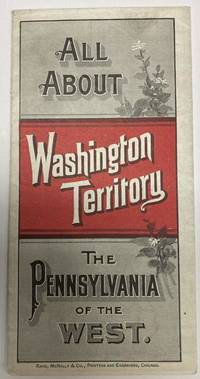
188853587Chicago: Rand McNally & Co. 1888. 1888. 20 3/4" x 13 1/2" sheet folded to 24 panels. Map. One cover panel; one panel showing N.P.R.R. route from Minneapolis to Washington Territory; and 10 panels of information to include information on the area's location and physical features climate agriculture stock raising manufacturing mining public schools cities and towns etc. Opposite 12 panels offer a map of Washington Territory printed in red and black. A rare promotional piece to encourage sales of Northern Pacific Railroad lands in Washington Territory. Light soling a few small splits to creases and with minor wear to the extremities. Very good. Rand, McNally & Co., 1888. unknown
194138417Chicago 1941. 8vo 27.4 cm 10.75". 8 1 blank ff. <br><br>Gorgeously rendered manuscript tribute to a prominent lawyer financial advisor and railroad executive remembered fondly for "his public spirit his high personal character his urbanity and his loyalty as a friend." Follansbee was a Harvard graduate and notably active alumnus serving as president of the Associated Clubs of Harvard who studied law at Northwestern University prior to becoming a board member and director of the Erie Railroad Company.<br>Â Â Â Â This admiring hand-accomplished homage to Follansbee's life and career was commissioned by his fellow directors and => beautifully calligraphed and illuminated on vellum by the Harris Engrossing Studio of Chicago. The capitals are accomplished in whitework gilt purple and green and the text in an even handsome modern Gothic hand with a gilt border surrounding the text on each page. Each leaf is protected by a moiré-patterned tissue guard. The final page was signed by the chairman and the secretary of the board and pressure-stamped with the Erie Railroad Company's seal.<br>Â Â Â Â Binding: Dark blue morocco framed in gilt double fillets and panelled in a dotted gilt roll with gilt-tooled corner fleurons; spine with gilt-ruled raised bands and gilt-framed compartments. Turn-ins tooled to echo covers cream moiré silk endpapers all edges gilt. Binding as above edges and extremities showing slight sunning and wear. Vellum expectably cockled. => Lovely unique beautifully bound and an impressive showcase both of modern calligraphy and of Follansbee's impact. hardcover books
1970151354N.p.: N.p. 1970. Archive of 32 vintage photographs documenting the October 20 1970 collision of two trains along the Chicago Rock Island and Pacific Railroad line in Raytown Missouri. Also included in the archive is a single broadside reward poster offering $5000 for information pertaining to the accident. <br/><br/>According to a contemporary newspaper article which appeared in nearby Jackson County's Independence Examiner the accident was believed to have been caused by juvenile vandalism to a nearby track switch. The collision and subsequent derailment resulted in the death of one engineer whose partial body is visible in several photographs. <br/><br/>The photographs in the archive range from close-up shots of the mangled train cars and tracks to distance views of the surrounding woods. Frequently displayed in the images is a small handwritten police chalkboard noting the date location and case numbers. A vivid and interesting look at investigative photography and railway disasters in the late twentieth century. <br/><br/>Photographs 10 x 8 inches housed in a manila envelope with the logo of Chicago Rock Island and Pacific Railroad Co. on the top left corner. Reward poster 9 x 12 inches. Poster and photographs generally Near Fine envelope Very Good plus. N.p. unknown books
190942908Albany NY: State of New York 1909. First edition. Very good clean copy with long tear repaired on th verso and tiny chips at one fold on map inch tear to fore edge of certificate and along bottom margin. Ink on drafting vellum with colored outlines. 15 x 24 inches. Docket sheet mounted to verso. In 1874 the Hudson Tunnel Railroad Company soon named the Hudson River Railway Company was formed to construct tunnels between Jersey City and Greenwich Village the route originally to be about two miles commencing at a point under the Hudson River in the westerly boundaryline of the state of New York opposite the foot of Clarkson street at the termination of the Hudson Tunnel Railroad Company of New Jersey and thence running by a feasible route under the bed of the river and beneath the surface of the city of New York to a point at or near the westerly side of Broadway between Prince and Eighth streets; from whence the line proceeds via Sixth avenue to Thirty-third street New York but stopped construction well before completion. The assets land partially-constructed tunnels trackage etc. were eventually sold to the newly-organized New York & Jersey Railroad incorporated on February 12 1902 under the leadership of William G. McAdoo who was later U.S. Treasury Secretary and which then became the Hudson and Manhattan Railroad 1906. The original of this profile was drafted in 1891 before the railroad collapsed and the present certified copy was prepared by the Secretary of State's office on February 25 1909 almost exactly one year after the official opening of the tunnel the Pennsylvania Railroad's North River Tunnels the second to burrow under the Hudson did not open until late 1910. The reason that a copy of the map was requested is not known but what is known is that the railroad was seeking to extend the Sixth Avenue line later as well as other related projects. Perhaps the map was needed to settle some land issue or in some legal negotiations as the pencilled word "referee" appears after two sets of initials. The tunnels still carry a heavy load of PATH train commuters between Jersey City and Manhattan. Similar maps are difficult to locate. The closest a printed "Map of Hudson & Manhattan Railroad Hudson tunnel system January 1908" is located at the University of Chicago and the Jersey City Historical Society. Provenance: Collection of Gerald J. Levy. State of New York hardcover books
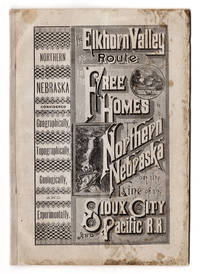
7236Battle Creek Mich.: Review & Herald Steam Printing house 1883. 8vo 8.5" x 5.75" printed wrappers. 46 pp. Folding map 12.75" x 18.25" plus margins. CONDITION: Good dampstaining at covers and the top of the second half of the pamphlet. Light vertical crease at middle throughout. Map good one minor tear at margin. <p>A promotional pamphlet for land along the Sioux City and Pacific Railroad including former Indian reservation lands with an appealing map of the rail line and its spurs.</p> <br /> <p>The text begins with a message to the public advertising the Elkhorn Valley Route on the Sioux City and Pacific Railroad the railroad having recently extended to Fort Niobrara Nebraska and thereby placing within reach of home-seekers millions of acres of free government lands. This is followed by an exhaustive overview of Northern Nebraska and its attractions geographical outlines physical geography topography and neighboring areas including Indian camps and more. A good portion of the text is devoted to Northern Nebraska's geology covering the Old Forest Bed Epoch the origins of "modern Nebraska" "How Came that Grand Old Forest" and so forth. Also included are testimonials from dozens of farmers who settled in Northern Nebraska including "exceptional cases" and highlighted is a large buffalo flat "8 miles long by 3 miles wide". The prospective settler is advised on how to reach these lands how to make a profitable investment in Nebraska lands and Omaha Reserve lands formerly home to the Omaha tribe and how to acquire them. A letter from the U.S. Land Office in Nebraska to the General Passenger Agent of the Sioux City & Pacific R.R. is printed here as well. Ads are included for the Land Agency of I. N. Taylor of Oakdale and Neligh Nebraska and real estate dealers Richards & Keene of Nebraska. The text concludes with a price list of commodities in Northern Nebraska.</p> <br /> <p>The map entitled "Sioux City & Pacific R.R. and connections to the Free Homes for the Million" by Rand McNally & Co. of Chicago spans from Council Bluffs Omaha in the east to the Black Hills in the west and from Pierre South Dakota in the north to a portion of Colorado in the south. The Sioux City and Pacific Railroad and its connections are shown in bold connecting with other railroad routes across the midwest. </p> Battle Creek, Mich.: Review & Herald Steam Printing house, 1883 unknown
19021511San Francisco 1902. Very good. 120pp. including twenty plates many folding. 12mo. Original limp calf front cover gilt lettered. Light wear to spine and extremities. Internally quite clean. A very interesting early 20th-century manual and rule book for personnel in the Maintenance and Way Department of the Southern Pacific Railroad. Contained here are rules and instructions for a wide array of railroad employees including roadmasters bridge superintendants trackmen bridgemen and other watchmen. The principal portion of the text comprises nearly 270 general rules and regulations such as those governing the adjustment of woodtruss bridges lining and surfacing track keeping clear rights of way and establishing standards for numerous other basic repairs on track ties signals and other critical infrastructure. A short appendix contains laws from the several states in which Southern Pacific operated regarding the accidental killing of livestock by trains and railroad employees. At the rear are twenty plates many folding with reference diagrams for track and other maintenance projects.<br /><br />This edition is revised from the first edition of 1898 with a substantially different pagination. Several plates have been excised from the rear of this copy; however the only other copy that we locate of this work at UC Santa Barbara also is lacking a number of plates. books
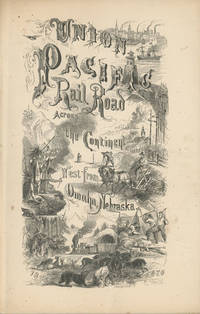
186849559New York: Published by the Union Pacific Railroad Company 1868. 1868. RAILROAD. First edition. 8vo. Original pictorial printed wrappers 32 pp. frontispiece Map of the Union Pacific Rail Road and its Connections introduction. Details the formation of the company and the progress of the work including the topography character of the country and distances along the line. Much information is provided regarding agricultural resources timber minerals etc. Branches and connecting roads along with the needed resources for construction are discussed as is information on actual earnings anticipated earnings and the issuance of the company's first mortgage bonds. A wonderful advertisement on the rear cover panel offers First Mortgage Bonds at par principal and interest Payable In Gold. A faint vertical crease and very lightly toned at the cover edges else a near fine bright copy. Published by the Union Pacific Railroad Company, 1868. unknown
1896WRCAM56242Chicago: Poole Bros. 1896. Chromolithographic broadside 24 x 9 inches. Old horizontal folds. Small tear at upper margin likely from posting no text affected. Very good. Rare and colorful broadside advertising "the Shortest and Quickest Route" to "all points West" on the Wabash Line connecting through St. Louis. The sheet features a full-color image of the famous Wabash flag as well as the seals of Colorado and California. Customers are promised that all trains feature "Free Reclining Chair Cars and Pullman Buffet Sleeping Cars" and are provided a name and address to acquire maps and timetables. <br> <br> At the time this broadside was issued Charles M. Hays was general manager and the Wabash railroad was under the control of financier Jay Gould who was working feverishly to establish a full coast-to-coast system. He had merged the St. Louis Kansas City & Northern Railroad with Wabash creating the Wabash St. Louis & Pacific Railroad. Then as with many other Eastern and Midwest railroads Wabash partnered with Union Pacific to provide service further west. By 1896 Gould's son George had taken over the railroad and proceeded to expand it further swallowing up the Missouri Pacific Western Pacific Denver & Rio Grande Western Western Maryland and Wheeling & Lake Erie railroads. Hays left in 1896 to become general manager and later president of the Grand Trunk Railway in Canada which helped extend the Wabash network north. <br> <br> An attractive artifact from one of the great American railroads. We could find no copies recorded in OCLC. Poole Bros. unknown books
244913Paris, Librairie de Charles Gosselin, 1840-1841; 2 vol. in-4, XIII-(1)-542-(1) pp. et XV-582-XV pp., demi-basane brune, dos lisse orné, tranches rouges Mors frottés, coiffes usées.
1855EEzz81941KParis, 1840-1855. gr.-4°, mit zahlr. gestochenen, teils lith. Abb. im Text, schwarze HLdrbde. d. Zt., 4 Blindbünde, Rückenkanten leicht beschabt, Deckel etw. berieb., insges. sehr gutes Expl. In Französisch. - In dieser überaus wichtigen Architekturzeitschrift werden die verschiedendsten Themen bearbeitet, u.a. über Eisenbahnbau (Bahnhöfe, Bahngebäude etc. ), Aeronautik, Archäologie, Kunsthandwerk, Technik, Elektrizität, Gartenbau etc.
18514405), Olpe, Siegen, Wittgenstein, Biedenkopf, auf die Main-Weserbahn bei Marburg; als direckte (!) Verbindung Englands, Belgiens und Hollands, mit dem südlichen und mittleren Deutschland. Mit 2 gefalt. streckenkolorierten lithogr. Karten. Gummersbach, Druck von Fr. Luyken, 1851. 8vo. (21,8 x 13,5 cm). Titel, 42 S. Orig.-Umschlag.
906117Chez Dunod, Editeur Paris 1873 2 volumes in-8 ( 280 X 185 mm ), demi-chagrin vert mousse, dos à nerfs ornés de palettes et fleurons dorés ( Reliure de l'époque ). Edition originale. Le volume de texte comprend IV-604 pages, l'atlas est constitué de 50 planches doubles montées sur onglet. Nerfs frottés, bel exemplaire, très rare.
Telephone Talk was the glossy bimonthly publication of the British Columbia Telephone Company. It was written by employees for employees to present information of interest to those engaged in the plant, traffic, commercial, operating, accounting and other departments of the service. Each issue is replete with black and white photos and information on topics such as: company, industry and technological news, traffic levels, expansion plans, personnel announcements, publicity and social events, deaths, weddings, lists of exchanges, and more. As such, these issues serve as a vital preserve of rare and fascinating British Columbia history. This volume covers topics including: Greatest growth of company was during past year; Sound - a non-technical talk on a technical subject; Accidents which a careless workman may cause; Graph of the number of phones in service from 1903 through 1920; Table listing the exchanges in order of percent good toll calls; Statement of development - a table listing the number of phones in service per exchange across the province; Photo montage of three of the Agents of lower mainland offices; Proposed central office extensions indicate a busy year; Snow and wind storms seriously damage toll leads on Vancouver Island; Repairing submarine cable near Friday Harbor was trying experience; Preparing to lay a third cable between the mainland and Vancouver Island; Magnets - non-technical talk on a technical subject; Statistical Review of the province's industries; Nice photo montage of 5 lady Vancouver Island company representatives; Planned additions; Start of Export Trade in Bulk Wheat - nice photos; Naming a telephone office; Fourty Years of the Telephone; Photo montage of 4 lady company representatives on southern Vancouver Island; The Gathering of Material for Use of Telephone Men - 5-page illustrated article; Application for increased rates before Railway Board; Shipping railway ties to Egypt; Plant activities; Excellent 10-page article describes the laying of the second submarine cable to Vancouver Island (Point Grey to Nanaimo) - many great photos; Photo montage of four lovely ladies who serve as supervising officials in the traffic department; Railway board accedes to request for rate increase; Repair job on North Vancouver Submarine Cable - photos and map; First Convention of Canadian telephone companies very successful - 10 page article with photos; Convention Delegates tour Capilano Timber Company operations - photo montage; Photo montage of chief operators of mainland two-number offices; new Kerrisdale exchange opens; New P.B.X at Spencers (Department Store); Current phone directory is an improvement; 2 pages of samples of past phone directories; Construction of switchboard cords; laying conduit along Georgia St., Vancouver (2 photos); Emergency reveals bravery of B.C. telephone operators; photos of Port Coquitlam flood; amazing photo of washed out bridge over Capilano River; Pioneer line construction - telegraph line between Toronto and Buffalo, NY in 1846; Good Qualities of Loud Speakers; photo of timber cutting to clear a right-of-way to give service to the Broadview district; photo of underground conduit being laid in downtown Nanaimo, with horses and wagon in picture; What constitutes Central's activities at the Capital City Exchange - 4 pages with photos; Rubber covered wires and cables - 3 page article with photos; and more. Half-leather binding. Average wear. Backstrip loose along front edge. Ink stamp of company executive E.P. LaBelle upon top edge else unmarked. Binding intact. Aside from backstrip, a sound copy. Book