Philippe SOUPAULTBiblio.com
48 390 résultats
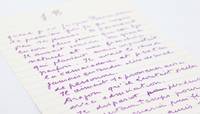
198086763s. l.: S. n. 1980. Fine. S. n. s. l. s. d. ca 1980 14.50 x 21 cm 1 page Autograph manuscript note by Philippe Soupault 20 lines in purple ink on a leaf bearing at the head this inscription: ""J.B."" drawing the portrait of Jacques Baron. The co-author with André Breton of the surrealist manifesto ""Les champs magnétiques"" shares with us all his sympathy for Jacques Baron one of the most unrecognized figures of surrealism: ""Quand je vis Jacques Baron pour la première fois je fus surpris par sa jeunesse. Il aimait sourire. Un grand naturel et une franchise qui plaisait mais inquiétait parfois. Il avait le sens de la camaraderie et je ne l'ai jamais entendu dire du mal de personne."" When I saw Jacques Baron for the first time I was surprised by his youth. He liked to smile. A great naturalness and frankness that pleased but sometimes worried. He had a sense of camaraderie and I never heard him speak ill of anyone. Philippe Soupault also seems to appreciate Jacques Baron for his detachment and free spirit unlike certain orthodox surrealists who followed the movement unwaveringly: ""Il disparut pendant un certain temps pour devenir marin puis fidèlement retrouva ses amis surréalistes et la poésie."" He disappeared for a certain time to become a sailor then faithfully found his surrealist friends and poetry again. Interesting memories from the last living historical surrealist for once gracious with one of his former companions. S. n. unknown
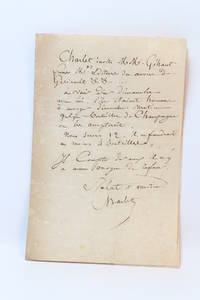
182071464Paris 1820. Fine. Paris s. d. 12 x 18 cm une feuille Amusing autograph letter signed by the engraver Nicolas Toussaint Charlet to the Gihaut brothers engravers inviting them to dinner and asking them to bring Champagne wine. ""Charlet invite M.M. Gihaut frères éditeurs de l'oeuvre de Géricault etc. à venir dîner dimanche avec lui s'ils étaient hommes à envoyer dimanche matin quelques bouteilles de Champagne ou les acompterait. Nous serons 12. Il faudrait au moins 4 bouteilles Il compte sur eux il n'y a aucun moyen de refuser Salut et amitié Charlet"" ""Charlet invites MM. Gihaut brothers publishers of Géricault's works etc. to come dine with him on Sunday if they were men to send some bottles of Champagne on Sunday morning or would advance payment for them. We will be 12. At least 4 bottles would be needed He counts on them there is no way to refuse Greetings and friendship Charlet"" unknown
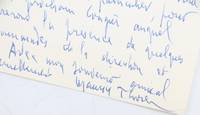
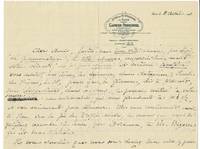
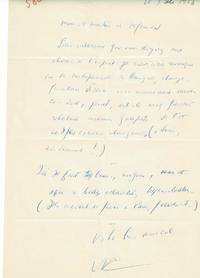
196386520Paris: S. n. 1963. Fine. S. n. Paris 19 Septembre 1963 13.50 x 21 cm une page une enveloppe Autograph letter signed by Maurice Thorez 20 lines in blue ink on French Communist Party letterhead addressed to his physician Pierre Frumusan. Fold mark inherent to being placed in envelope. Envelope included. Maurice Thorez thanks his comrade and doctor Pierre Frumensan for sending works concerning them and for the practitioner's beneficial action: ""On y voit que les Congrès Nationaux des Médecins des dispensaires et centres de santé tenus sous votre présidence ont fait une oeuvre grandement utile."" ""One can see that the National Congresses of Physicians of dispensaries and health centers held under your presidency have done tremendously useful work."" The communist leader is full of praise regarding the activity accomplished by his comrade: ""Recevez mes voeux les plus chaleureux pour votre travail et en particulier pour le succès du prochain congrès auquel nous assurerons la présence de quelques uns des camarades de la direction et de nos élus."" ""Please accept my warmest wishes for your work and in particular for the success of the next congress at which we will ensure the presence of some of the comrades from the leadership and our elected officials."" On January 23 1953 Pierre frumusan signed with nine other communist physicians: Yves Cachin Jean Dalsace Hector Descomps Henri Chrétien dit Baussary Paul Hertzog H.F. Klotz Victor Lafitte Raymond Leibovici and Jeanne Lévy a declaration against ""A group of terrorist physicians"" who had just ""been discovered in the Soviet Union. . They have been unmasked as American intelligence agents; some of them had been recruited through the Joint an international Zionist organization."" This text appeared on January 27 in l'Humanité. On March 6 1953 l'Humanité announced ""Stalin is dead"" then on April 6 1953 on page one ""The accused physicians were arrested wrongly. They are fully rehabilitated. Prosecution against those responsible for irregularities in the investigation."" Pierre Frumusan was also one of the 5 physicians who treated Maurice Thorez. S. n. unknown
192786715Miramar Saint-Raphaël: S. n. 1927. Fine. S. n. Miramar Saint-Raphaël s. d. ca 1927 13 x 20.50 cm 1 page Autograph letter signed and dated by Henri Barbusse addressed to a friend 23 lines written in blue ink very probably addressed to his wife Hélyonne Mendès. Fold marks inherent to being placed in an envelope. Letter entirely imbued with the admiration that Henri Barbusse professed for his wife Hélyonne Mendès daughter of writer Catulle Mendès and musician and composer Augusta Holmès: ""J'ai lu avec joie ta lettre rayonnante de vie comme toi. Je t'entends aussi donnant du souffle à l'américaine pacifiste et aux corprs paralys de la Ligue. Mais quel grand effort infatigable il faut pour refouler toujours toutes les espèces de morts."" ""I read with joy your letter radiant with life like you. I also hear you breathing life into the American pacifist and the paralyzed bodies of the League. But what a great untiring effort is needed to always push back all kinds of death."" His enthusiasm for his wife matches that which he generally has for women: ""Pourtant je crois aux femmes : en principe elles te ressemblent un peu."" ""Yet I believe in women: in principle they resemble you a little."" The 1916 Goncourt Prize winner reveals his program for the coming days: ""J'ai bouclé ce matin les épreuves de mon livre de nouvelles. Je vais me remettre au livre sur les Balkans qu'il me faut unifier avec les morceaux que j'ai et dont j'extrais de temps en temps un article pour l'envoyer de ci de là."" ""I finished the proofs of my book of short stories this morning. I'm going to get back to the book on the Balkans which I need to unify with the pieces I have and from which I extract an article from time to time to send here and there."" and ends his missive with this cutting remark: ""Tu fais bien de ne pas aller à Genève ville froide à tous les égards."" ""You do well not to go to Geneva a city cold in every respect."" S. n. unknown
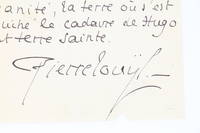
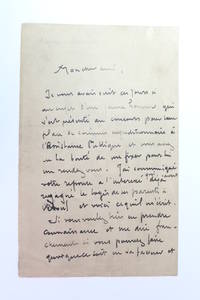
192078161Paris 1920. Fine. Paris s. d. novembre 1920 13.50 x 18 cm 4 pages sur 4 feuillets Autograph letter signed by Pierre Louÿs addressed to Georges Louis. Four pages written in blue ink on four sheets. Handsome letter addressed to his brother Georges Louis with whom Pierre Louÿs maintained a very intimate relationship and whom he considered as his own father. The question of Pierre Louÿs's real father's identity still fascinates biographers today: ""His father Pierre Philippe Louis . had married in 1842 Jeanne Constance Blanchin who died ten years later after having given him two children Lucie and Georges. In 1855 he remarried Claire Céline Maldan and from this union was born in 1857 a son Paul; then in 1870 our writer who received the first names Pierre Félix. This late birth the differences in character between father and son the former's disaffection toward the latter the profound intimacy that always reigned between Louÿs and his brother Georges all this has led certain biographers and critics to suspect that the latter was in reality the writer's father. The exceptionally intimate and constant relationship that Pierre and Georges maintained between them throughout their lives could be an argument in this sense. Of course no irrefutable proof has been discovered and probably never will be. Nevertheless certain letters . are quite troubling. In 1895 for example Louÿs writes gravely to his brother that he knows the answer to 'the most poignant question' he could ask him a question he has had 'on his lips for ten years.' The following year at the height of Aphrodite's triumph he thanks Georges effusively and ends his letter with this sentence: 'Not one of my friends has a FATHER who is to him what you are to me.' Arguing from the close intimacy between Georges and Claire Céline during the year 1870 and from the jealousy that the father never ceased to show toward his younger son Claude Farrère did not hesitate to conclude in favor of Georges Louis. And what to think of this dedication by Louÿs to his brother on a deluxe copy of the first edition of Pausole: To Georges his eldest son / Pierre."" Jean-Paul Goujon Pierre Louÿs This letter was written after the First World War: ""The project to open the Panthéon to heroes who offered everything to the Fatherland even losing their name for her is excellent. And it would be for the archbishopric of Paris an unhoped-for opportunity to spontaneously render to our great dead of the crypt the respects that it alone in the world denies them. It would thus repair an error that has lasted too long for its glory. Cemeteries are deconsecrated. No theological reason can attribute to them a more religious character than to the basement of a monument surmounted by a colossal cross and sanctified by ashes."" Indeed in November 1920 Charles Dumont the general budget reporter expressed his wish to bring the unknown soldier into the Panthéon. Finally only the ceremony took place there and the remains of the most famous of the combatants remained as everyone knows under the Arc de Triomphe. The only soldier to join the Panthéon Maurice Genevoix would not enter until a hundred years later on November 11 2020. Louÿs concludes his letter with a very handsome tribute to the writer he has always admired: ""One is ill-advised to forbid the faithful such a pilgrimage. They do it. For immense humanity the earth where Hugo's corpse lay down is holy ground."" unknown
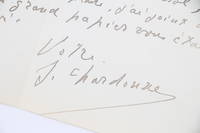
195784396Paris 1957. Fine. Paris 29 Avril 1957 21 x 27 cm une feuille une enveloppe Autograph letter dated and signed by Jacques Chardonne addressed to his friend Roger Nimier 54 lines in blue ink regarding Paul Morand's style spiritual father of the Hussards Roger Nimier and Antoine Blondin being considered much against their will as leaders of this literary movement. Fold marks inherent to the letter's mailing envelope included. Jacques Chardonne intends to challenge two false ideas concerning Paul Morand the first being stylistic in nature: ""There is a double misunderstanding regarding Morand. He has been seen as a 'modern'. but he is essentially a 'naturalist'; his artistic doctrine is exactly that of Maupassant and Flaubert."" holding the latter as a major writer: ""But he has infinitely more talent and intelligence than the writers of the naturalist school."" ; the second of a psychological nature: ""He is hygiene and wisdom incarnate in his person. But through his work he has debased the youth who came after him. It is he who nearly killed Sagan."" Jacques Chardonne then ironizes about Françoise Sagan's talents while exalting the predominance and mastery of his friend Paul Morand in everything he undertakes: ""It is Morand who bought Sagan's terrible cars. But he knows how to drive."" while recalling the cautious advice that Bernard Frank gave to the author of Bonjour tristesse : ""Bernard Frank says: your car doesn't hold the road. Sagan vexed accelerates. And everything capsizes."" As a literary elder brother Jacques Chardonne reassures Roger Nimier about his own talent: ""Morand is very pleased with you. I say that Gaston Gallimard seems to have much friendship for you."" and congratulates his correspondent on the quality of Artaban a review to which Roger Nimier contributes Jacques Chardonne being honored in a recent issue: "". surprised to see myself on the front page; the text fills me with pride. I have scorned honors in order to be honored. I could not have been better served than in this little text."" and attributes the authorship of the text concerning him to one of his Hussard disciples: "". I tell myself: it's Nimier or Hecquet or Milliau. Truth be told I don't know. And I thank the Lord."" Overwhelmed by so many tributes paid to him Jacques Chardonne lucid prefers to avoid being too much in the spotlight: ""That is why I no longer want to publish anything. As soon as one applauds you you must leave."" Very handsome letter from Jacques Chardonne praising his friend Paul Morand spiritual father of the Hussards and evoking Françoise Sagan's terrible car accident in an Aston Martin on April 13 1957. A premonitory evocation: Roger Nimier would kill himself five years later on the western highway on September 28 1962 also at the wheel of an Aston Martin. unknown
1901715351901. Fine. 28 octobre 1901 11.30 x 18 cm une feuille rempliée Autograph letter from the painter Pascal Dagnan-Bouveret requesting his correspondent's assistance for a young man from Vesoul. One folded sheet. unknown
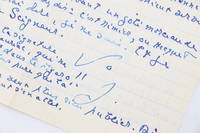
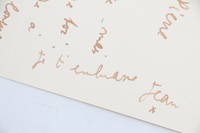
195584466Capri 1955. Fine. Capri s. d. circa 1955 15 x 10.50 cm une carte postale Autograph postcard signed by Jean Paulhan 30 lines written in blue ink on the verso of a photographic reproduction showing a view of Capri addressed to publisher Felia Leal notably of the work ""Paroles transparentes"" a work by Jean Paulhan illustrated by Georges Braque. She also wrote children's tales. Jean Paulhan shares his mixed impressions of Italy its landscapes and monuments: ""Il faut renoncer aux paysages trop beaux.Pour les églises et les monuments la meilleure solution je crois serait d'y jeter un coup d'oeil de bien recevoir le choc et puis s'en aller. L'attention affaiblit tout."" ""One must give up landscapes that are too beautiful.For churches and monuments the best solution I believe would be to glance at them receive the shock properly and then leave. Attention weakens everything."" unknown
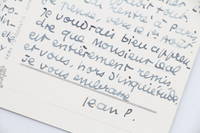
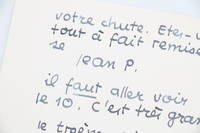
195585261Paris 1955. Fine. Paris s. d. circa 1955 13 x 9 cm une feuille Autograph letter signed by Jean Paulhan 16 lines in black ink addressed to Felia Leal publisher of ""Paroles transparentes"" a work by Jean Paulhan illustrated with 14 original lithographs by Georges Braque. ""Chère Felia mais que c'est bon de revoir votre écriture ! Votre lettre m'a même gentiment couru après mais me voici rentré elle aussi. Ah je n'ai plus du tout songé à mon texte. Mais je suis tout prêt à m'y remettre. Je pensais un peu que vous aviez changé de projets. Comme je suis peiné de votre chute. Etes-vous maintenant tout à fait remise Je vous embrasse. Jean P. Il faut aller voir Germaine Richier le 10. C'est très grand. Le troène n'était pas gelé il repousse."" ""Dear Felia how wonderful it is to see your handwriting again! Your letter even kindly chased after me but here I am back and so is it. Ah I haven't thought about my text at all. But I'm quite ready to get back to it. I was thinking a bit that you had changed your plans. How sorry I am about your fall. Are you now fully recovered I embrace you. Jean P. We must go see Germaine Richier on the 10th. It's very grand. The privet wasn't frozen it's growing back."" unknown
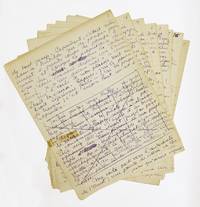
1953727771953. Fine. The Saint-Germain snob flexes his muscles at the wheel of his Torpedo s. d. 1953 21 x 27 cm 14 feuillets 14 leaves written in purple ink on perforated graph paper sheets. Thirteen of them are numbered in the top right corner in the author's hand 3 4 5 7 8 10 11 12th unnumbered but where the text continues normally 13 14 15 16 19 and 22. The beginning of the text is missing as well as certain leaves between nos. 5 and 7 as well as between nos. 8 and 10 and nos. 11 and unknown
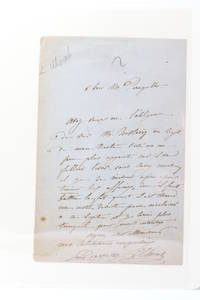
185971493Paris 1859. Fine. Paris 19 décembre 1859 13.40 x 20.60 cm une feuille Autograph letter signed by the painter specialized in Empire scenes Nicolas Toussaint Charlet to his publisher: ""Avez vous eu l'obligeance de voir avec M. Bostein au sujet de mon traité c'est on ne peut plus urgent car il va falloir livrer. Vous savez combien il y a de raisons de traîner ces affaires ; donc il faut battre le fer tant qu'il est chaud. ."" ""Have you had the kindness to see M. Bostein about my treatise it is most urgent as we will have to deliver. You know how many reasons there are to drag out these affairs; therefore we must strike while the iron is hot. ."" unknown
193188331s. l. 1931. Fine. s. l. 25 Octobre1931 21 x 27 cm une feuille une enveloppe Autograph letter dated and signed by Jacques Chardonne to literary critic and novelist Frédéric Lefèvre 23 lines in black ink on a single leaf with letterhead of his address at La Frette notably regarding members of the Prix Goncourt jury. Mailing fold as expected. Envelope included. Jacques Chardonne advises and recommends to Frédéric Lefèvre the attitude to adopt toward members of the Goncourt jury after the publication of his latest work. He also wants to help his friend and bring all his literary weight to bear in order to make his work favorably known: ""When you send the deluxe copies signed by you I will write again and I will go see those I can reach directly."" Jacques Chardonne also mentions the distribution of his recently published Claire: ""I sent a copy of Claire my pleasure to Madame Arnoux at Nouvelles. As well as a copy to you M. du Gard and Charensol last Thursday. In your copy I included a note telling you that a deluxe copy was naturally reserved for you."" unknown
196386003Fréjus 1963. Fine. Fréjus 17 Avril 1963 21.50 x 27.50 cm une page Autograph letter dated and signed by Jean Cocteau 20 lines in black ink on letterhead of the committee for the edification of the chapel of Notre-Dame de Jérusalem de Fréjus. Fold marks inherent to postal dispatch one tear in left margin of the letter at the level of the fold. Jean Cocteau offers profuse apologies while acknowledging mitigating circumstances regarding the emotional burden overwhelming him: ""J'accepte vos reproches avec beaucoup de honte. Mais si je pouvais vous raconter la période que je traverse votre coeur me comprendrait et m'absoudrait."" ""I accept your reproaches with great shame. But if I could tell you about the period I am going through your heart would understand and absolve me."" due to a recently deceased friendship about which he does not wish to reveal more: ""N'en parlons plus et priez pour moi."" ""Let us speak no more of it and pray for me."" Jean Cocteau prefers to discuss his projects: ""Actuellement je me consacre à mon travail de la chapelle du Saint-Sépulcre. Quand je l'aurai construite peinte et rendue digne des chevaliers de Jérusalem je me remettrait sic peut-être à écrire."" ""Currently I am devoting myself to my work on the chapel of the Holy Sepulchre. When I have built it painted it and made it worthy of the knights of Jerusalem I will perhaps start writing again."" and the prospects that delight him: ""Il est probable que je resterais après Pâques à Fréjus où les organisateurs m'offrent une petite villa."" ""It is likely that I will remain after Easter in Fréjus where the organizers are offering me a small villa."" unknown
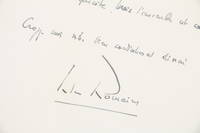
195488343Paris: s. n. 1954. Fine. s. n. Paris 30 Juillet 1954 21 x 27 cm une feuille Autograph letter dated and signed one page from Jules Romains addressed to Thierry Maulnier 9 lines in black ink on one sheet thanking him for his laudatory critique. Central folds inherent to postal folding. Jules Romains is grateful for Thierry Maulnier's benevolence and suggests some advice: ""J'aimerais voir ce texte difusé sous forme de tract. A peine souhaiterais-je que la réponse à l'objection tirée de l'attitude anglaise restât implicite."" I would like to see this text distributed as a leaflet. I would scarcely wish that the response to the objection drawn from the English attitude remain implicit. s. n. unknown
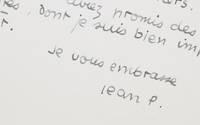
195584544Paris 1955. Fine. Paris s. d. circa 1955 13.50 x 20.50 cm une feuille Autograph letter signed by Jean Paulhan 16 lines written in black ink on NRF letterhead addressed to Felia Leal the publisher of ""Paroles transparentes"" a work by Jean Paulhan decorated with 14 original lithographs by Georges Braque. Jean Paulhan hears nothing but praise for his work which has just appeared and of which Felia Leal is the publisher: ""Il me semble qu'il n'est pas un ami des livres qui n'admire sans réserve vos 'Paroles transparentes'."" ""It seems to me that there is not a friend of books who does not admire your 'Paroles transparentes' without reservation."" The author indicates that he is prepared for a signing session and asks Felia Leal for the suites of Georges Braque's lithographs to enrich his own copy: ""vous m'aviez promis une série de suites dont je suis bien impatient."" ""you had promised me a series of suites which I am quite impatient for."" unknown
191174318s. l.: S. n. 1911. Fine. S. n. s. l. 8 Avril 1911 27 x 21.50 cm deux pages sur une feuille Autograph letter dated April 8 1911 and signed by the dandy count of two pages on one recto-verso sheet 19 lines written in black ink inviting his friend Henri Lapauze and his wife for an Easter luncheon on the 18th of the current month at his property in the Landes near Vic-Bigorre. Robert de Montesquiou in order to secure his invited friend's decision and to facilitate his travel offers to put a vehicle at his disposal. But before this proposed Easter meal the poet plans to visit his friend very soon. Henry Lapauze 1867-1925 was a journalist art critic then in 1905 curator of the Petit Palais converted four years earlier into a museum and whose collections he considerably enriched by acquiring notably the Courbet Henner Falguière collections with at the twilight of his life a clear predilection for the Decorative Arts of which he was one of the ardent promoters. S. n. unknown
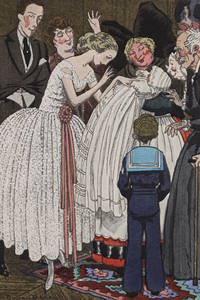
192054806Paris: Lucien Vogel éditeur 1920. Fine. Lucien Vogel éditeur Paris 1920 18 x 24 cm une feuille Original color print printed on vergé paper signed in the plate. An original print used to illustrate the Gazette du bon ton one of the most attractive and influential 20th century fashion magazines featuring the talents of French artists and other contributors from the burgeoning Art Deco movement. A celebrated fashion magazine established in 1912 by Lucien Vogel La Gazette du bon ton appeared until 1925 with a hiatus from 1915 to 1920 due to the war the editor-in-chief having been called up for service. It consisted of 69 issues printed in only 2000 copies each and notably illustrated with 573 color plates and 148 sketches of the models of the great designers. Right from the start this sumptuous publication was aimed at bibliophiles and fashionable society Françoise Tétart-Vittu La Gazette du bon ton in Dictionnaire de la mode 2016 and was printed on fine vergé paper using a type cut specially for the magazine by Georges Peignot known as Cochin later used in 1946 by Christian Dior. The prints were made using stencils heightened in colors some highlighted in gold or palladium. The story began in 1912 when Lucien Vogel a man of the world involved in fashion he had already been part of the fashion magazine Femina decided with his wife Cosette de Brunhoff the sister of Jean creator of Babar to set up the Gazette du bon ton subtitled at the time: Art fashion frivolities. Georges Charensol noted the reasoning of the editor-in-chief: In 1910 he observed there was no really artistic fashion magazine nothing representative of the spirit of the time. My dream was therefore to make a luxury magazine with truly modern artists I was assured of success because when it comes to fashion no country on earth can compete with France. Un grand éditeur dart. Lucien Vogel in Les Nouvelles littéraires no. 133 May 1925. The magazine was immediately successful not only in France but also in the United States and Latin America. At first Vogel put together a team of seven artists: André-Édouard Marty and Pierre Brissaud followed by Georges Lepape and Dammicourt as well as eventually his friends from school and the School of Fine Arts like George Barbier Bernard Boutet de Monvel and Charles Martin. Other talented people soon came flocking to join the team: Guy Arnoux Léon Bakst Benito Boutet de Monvel Umberto Brunelleschi Chas Laborde Jean-Gabriel Domergue Raoul Dufy Édouard Halouze Alexandre Iacovleff Jean Émile Laboureur Charles Loupot Chalres Martin Maggie Salcedo. These artist mostly unknown when Lucien Vogel sought them out later became emblematic and sought-after artistic figures. It was also they who worked on the advertising drawings for the Gazette. The plates put the spotlight on and celebrate dresses by seven designers of the age: Lanvin Doeuillet Paquin Poiret Worth Vionnet and Doucet. The designers provided exclusive models for each issue. Nonetheless some of the illustrations are not based on real models but simply on the illustrators conception of the fashion of the day. The Gazette du bon ton was an important step in the history of fashion. Combining aesthetic demands with the physical whole it brought together for the first time the great talents of the artistic literary and fashion worlds; and imposed through this alchemy a completely new image of women: slender independent and daring which was shared by the new generation of designers including Coco Chanel Jean Patou Marcel Rochas and so on Taken over in 1920 by Condé Montrose Nast the Gazette du bon ton was an important influence on the new layout and aesthetics of that little dying paper that Nast had bought a few years earlier: Vogue. Lucien Vogel éditeur unknown
197684669Paris 1976. Fine. Paris 12 Octobre 1976 21 x 29.50 cm une page recto verso Autograph letter dated and signed by Jacques Mesrine dated Tuesday October 12 1976 70 lines in blue ink on one recto-verso page addressed to his love of the time Jeanne Schneider thanks to whom the manuscript of Instinct de mort was discreetly smuggled out of prison. Jacques Mesrine then incarcerated at La Santé shows great tenderness and reveals himself in another light that of the affectionate and attentive lover: ""Bonsoir petite fille. tu aimes bien jouer ""au St Bernard"" tu ne changeras jamais à ce sujet. C'est toi qui a 7 ans 1/2 de taule et tu dois remonter le moral des ""gamines"" qui ont joué du calibre !"" ""Good evening little girl. you like to play 'the St Bernard' you'll never change about that. You're the one who has 7 and a half years of jail and you have to cheer up the 'girls' who played with guns!"" He praises and is somewhat amazed by his companion's devotion to a couple of young criminals: ""Tu me parles d'une sentence de 20 ans pour elle ! tu rigoles ou quoi. elle ne peut pas prendre plus de 8 ans je la vois plutôt avec 5 ou 6 si les choses s'arrangent. Son mari avec 20 ans au maximum."" ""You talk to me about a 20-year sentence for her! are you kidding or what. she can't get more than 8 years I see her more with 5 or 6 if things work out. Her husband with 20 years maximum."" and tries to transmit all his optimism his pugnacity and to cheer her up: ""Tu sais ma puce; quand tu m'écris que la cause de Michou est une cause perdue d'avance je ne te comprends plus. Il n'y a pas de cause perdue d'avance. Dans la vie il faut se battre jusqu'au bout. tu sais pourtant ce que cela représente. Tu vois moi je vais au maximum ! et pourtant je vais me défendre toutes dents dehors. Car ma liberté il faudra me la prendre. Je ne la donnerai pas faute de combat !"" ""You know my darling; when you write to me that Michou's cause is a lost cause from the start I don't understand you anymore. There is no lost cause from the start. In life you have to fight to the end. you know what that represents though. You see I'm going for the maximum! and yet I'm going to defend myself tooth and nail. Because my freedom will have to be taken from me. I won't give it up for lack of fighting!"" Jacques Mesrine also evokes his love of horse racing while boasting of being a betting specialist: ""Oui j'avais joué ""Dernier tango"" mais seulement à la place. J'avais 2000frs dessus je gagne donc 6000frs. Ce n'est pas de la chance mais un savant calcul. Il m'arrive de perdre mais avec ma méthode je suis obligé d'être gagnant. Forécement pour la suivre il faut un certain capital. J'ai mis plus d'un an à faire tous les calculs de probabilité. Cela doit me rapporter à peu près 7000frs par mois. Net d'impots sic."" ""Yes I had bet on 'Dernier tango' but only for place. I had 2000frs on it so I win 6000frs. It's not luck but a scientific calculation. I sometimes lose but with my method I have to be a winner. Obviously to follow it you need a certain capital. I spent more than a year doing all the probability calculations. It should bring me about 7000frs per month. Net of taxes sic."" He ironizes about his situation as a prisoner having plenty of time to devise his financial gain strategies: ""J'ai aussi mis au point une méthode pour le jeu de baccara. Que veux-tu. j'ai le temps de calculer un tac de choses sic ! Tu me comprends . L'administration aussi ! resic. "" ""I also developed a method for baccarat. What do you want. I have time to calculate a bunch of things sic! You understand me . The administration too! resic."" but deplores his impossibility to continue writing Instinct de mort: "". je suis actuellement incapable d'écrire une page de mon bouquin. je ne sais pas comment tourner ce passage-là. enfin je vais bien trouver la solution."" "". I am currently unable to write a page of my book. I don't know how to phrase this passag unknown
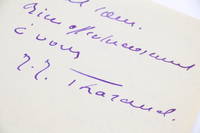
193887921Versailles 1938. Fine. Versailles 7 Janvier 1938 13.50 x 18 cm une page et demi sur un bifeuillet Autograph letter dated and signed by one of the Tharaud brothers addressed from his Versailles residence 14 lines in violet ink on a double sheet to a literary critic for his favorable review of their latest work: ""Mon cher ami quel ravissant article et qu'il nous fait plaisir. Il n'était pas possible de parler de notre volume avec plus d'intelligence et de grâce. Nous vous en remercions de tout coeur."" My dear friend what a delightful article and how it pleases us. It would not have been possible to speak of our volume with more intelligence and grace. We thank you with all our heart. unknown
190478907s. l. Paris 1904. Fine. s. l. Paris s. d. ca. 1904 11.50 x 15.90 cm 4 pages sur un double feuillet Autograph letter from Renée Vivien addressed to Natalie Clifford Barney and written in black ink on a double sheet bordered with a violet trim. Transverse fold inherent to mailing. A beautiful love letter marking the reconciliation of the Muse of Violets and the Amazon after a two-year separation: ""Your letter was cruelly sweet to me I wept reading it and something within me rejoiced despite everything to think that between us the bond was so powerful and subtle that only death could entirely untie it if death is definitive."" Weary and very jealous of Natalie's infidelities Renée had made the radical decision to leave her. The Amazon had then by every means attempted to win her back sending emissaries as well as numerous letters: ""My tears have flowed over all the letters you have sent me since the silence that had settled between us."" Renée seems this time to have broken her promise never to see Natalie again and addresses this beautiful declaration to her full of hope for the future: ""Forget you! But my lips which are the soul of my soul have kept your reflection and your imprint. . Something in me has been broken since then from having loved too blindly. But if it is true that there remain within us unknown tenderness and ignored sweetness that we can still lavish upon each other in a better future let us not hesitate to discover them in the depths of our souls. I would like to take you in my arms my Little One like a sick child and rock you and console you and heal you and see the smiles of yesteryear bloom again on your lips. You must no longer suffer for me my Blonde Sweetness I love you I will heal you."" These reunions would not last however: torn between Baroness Hélène de Zuylen and Natalie Renée would embark on a series of travels; in turn to Holland Germany Switzerland and Venice she would confide her hesitations to Kérimé Turkhan-Pacha her epistolary companion from the Bosphorus whom she would meet in the summer of 1905 during her last journey with Natalie Clifford Barney to Mytilene. A moving letter from Renée Vivien addressed to the great love of her life. It was at the end of 1899 and through Violette Shillito that Renée Vivien - then Pauline Tarn - made the acquaintance of Natalie Clifford Barney ""cette Américaine plus souple qu'une écharpe dont l'étincelant visage brille de cheveux d'or de prunelles bleu de mer de dents implacables"" ""this American more supple than a scarf whose sparkling face shines with golden hair sea-blue eyes implacable teeth"" Colette Claudine à Paris. Natalie who had just experienced a summer idyll with the scandalous Liane de Pougy who had initiated her into sapphism paid only discreet attention to this new acquaintance. Renée on the other hand was completely captivated by the young American and would relate this love at first sight in her autobiographical novel Une Femme m'apparut: « J'évoquai l'heure déjà lointaine où je la vis pour la première fois et le frisson qui me parcourut lorsque mes yeux rencontrèrent ses yeux d'acier mortel ses yeux aigus et bleus comme une lame. J'eus l'obscur prescience que cette femme m'intimait l'ordre du destin que son visage était le visage redouté de mon avenir. Je sentis près d'elle les vertiges lumineux qui montent de l'abîme et l'appel de l'eau très profonde. Le charme du péril émanait d'elle et m'attirait inexorablement. Je n'essayai point de la fuir car j'aurais échappé plus aisément à la mort. » ""I evoked the already distant hour when I saw her for the first time and the shiver that ran through me when my eyes met her mortal steel eyes her sharp blue eyes like a blade. I had the obscure prescience that this woman was giving me fate's order that her face was the dreaded face of my future. I felt near her the luminous vertigo that rises from the abyss and the call of very deep water. The charm of peril emanat unknown
195076186s. l. Klarskovgaard 1950. Fine. s. l. Klarskovgaard 7 octobre 1950 21 x 34 cm 2 pages sur 2 feuillets Partly unpublished autograph letter signed by Louis-Ferdinand Céline addressed to his ""dear Master and defender"" Maître Thorvald Mikkelsen. Two pages written in blue ink on two large sheets of white paper; numbers ""580"" and ""581"" in Céline's hand in the upper left corner in red pencil. Transverse folds inherent to the mailing. This letter was very partially transcribed in the Année Céline 2005. Autograph letter signed by Louis-Ferdinand Céline addressed to his ""dear Master and defender"" Maître Thorvald Mikkelsen. Two pages written in blue ink on two large sheets of white paper; numbers ""580"" and ""581"" in Céline's hand in the upper left corner in red pencil. Transverse folds inherent to the mailing. Céline sends Mikkelsen an article: ""Pour intéressé que vous soyez aux choses de l'esprit je crois avoir remarqué que les turlupinades des banques changes fricoteries diverses vous amusaient aussi. Ci-donc joint article assez farceur relatant certaines galipettes de l'or et ses escrocs changeurs à Paris évidemment !"" ""However interested you may be in matters of the mind I believe I have noticed that the buffooneries of banks exchanges and various swindles also amuse you. Here therefore attached is a rather farcical article relating certain antics of gold and its swindling money-changers in Paris obviously!"" The writer attached to his letter another sheet whose numerous underlinings bear witness to the persecution he felt victim to: ""Maintenant qu'on remonte la Ligne Maginot qu'on recrée une Légion Anti Bolchéviques une armée franco-allemande il paraît qu'il est question de me poursuivre à nouveau d'après les Beaux Draps mais cette fois pour antigermanisme et sabotage de l'Europe Nouvelle et irrespect pour Hitler ! Oh je n'en mène pas large !"" ""Now that they're rebuilding the Maginot Line recreating an Anti-Bolshevik Legion a Franco-German army it seems they're planning to prosecute me again based on Les Beaux Draps but this time for anti-Germanism and sabotage of the New Europe and disrespect for Hitler! Oh I'm not feeling very confident!"" In 1947 Céline pursued by French justice for his collaborationist involvement was confined in Denmark. It was in May 1948 accompanied by Lucette and Bébert that he arrived at his lawyer Maître Thorvald Mikkelsen's home in Klarskovgaard. The latter owned a large property by the Baltic Sea and invited the exile to stay there. On February 21 1950 as part of the purge the writer was definitively condemned in absentia by the civic chamber of the Paris Court of Justice for collaboration to one year of imprisonment which he had already served in Denmark. The Swedish Consul General in Paris Raoul Nordling intervened on his behalf with Gustav Rasmussen the Danish Foreign Minister and managed to delay his extradition. On April 20 1951 Jean-Louis Tixier-Vignancour his lawyer since 1948 obtained Céline's amnesty as a ""severely disabled veteran of the Great War"" by presenting his file under the name of Louis-Ferdinand Destouches without any magistrate making the connection. Céline would leave Denmark the following summer after three years spent at his lawyer's home. In 1947 Céline pursued by French justice for his collaborationist involvement was confined in Denmark. It was in May 1948 accompanied by Lucette and Bébert that he arrived at his lawyer Maître Thorvald Mikkelsen's home in Klarskovgaard. The latter owned a large property by the Baltic Sea and invited the exile to stay there. On February 21 1950 as part of the purge the writer was definitively condemned in absentia by the civic chamber of the Paris Court of Justice for collaboration to one year of imprisonment which he had already served in Denmark. The Swedish Consul General in Paris Raoul Nordling intervened on his behalf with Gustav Rasmussen the Danish Foreign Minister and managed to delay his extradition. On unknown
195486537Saint-Jean-Cap-Ferrat 1954. Fine. Saint-Jean-Cap-Ferrat 10 Mai 1954 13.50 x 21 cm une page Autograph letter dated and signed by Jean Cocteau 17 lines in black ink to a friend describing his Sevillian sojourn. Fold marks inherent to being placed in an envelope. Jean Cocteau explains his silence: his patron and very close friend Francine Weisweiller had been ill: ""Excuse ce long silence. mais on parle souvent de toi. Francine a été très très malade à Kitzbühel en Autriche et longue à reprendre des forces."" Excuse this long silence but we often speak of you. Francine was very very ill in Kitzbühel in Austria and slow to regain her strength. But to cut short his bad news he prefers to recount the enchantment of Seville: ""Nous revenons de Séville. Il pleuvait sur les calèches et les gitanes - mais dans le vieux Séville pareil à Pompéi les orangers embaument."" We are returning from Seville. It was raining on the carriages and the gypsies - but in old Seville like Pompeii the orange trees are fragrant. unknown
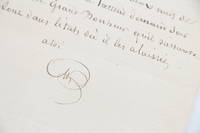
1866866021866. Fine. lundi soir 1866 13.30 x 20.90 cm une page sur un bifeuillet Autograph letter signed by Alexandre Dumas to his mistress Marie Richon. 6 lines on one page of a bifolium of laid paper with the writer's crowned initials. « Chère amoi sic Ton ami arrivé moulu brisé de deux nuits de voitures et de chemins de fer. Il t'attend demain soir mardi. Oh ce sera avec grand bonheur qu'il s'assurera que toutes choses sont dans l'état où il les a laissées a toi » Nothing is known of this affair with Marie Richon addressed to this mistress evidently sensitive to literature ""Fais-moi de bons vers pour mon retour"" he requests of her in another note. Actress society woman or woman of learning the mystery remains complete around this character who inspires in the insatiable Dumas a torrid correspondence. He notably arranged meetings with his mysterious conquest at his residence on Boulevard Haussmann where he had settled from 1865 onwards. A sentence from Dumas in another note tells us that she even met Dumas's daughter who lived with her father and endured the visits of his mistresses ""elle t'adore - ou plutôt nous t'adorons"" he would write to her. This missive can probably be situated during 1866 when the writer was preparing the theatrical adaptation of his novel Gabriel Lambert and mentions in a letter a reading of the play created at the Ambigu-Comique on March 16 1866. The last years of his life did not belie his immeasurable love of women; during this period rich in adventures he also shared his nights with the feminist and gerontophile Olympe Audouard as well as the famous Adah Isaacs Menken whose portraits alongside the writer were divulged by their indiscreet photographer. Handsome letter filled with anticipation from the hand of the great writer and addressed to a mysterious mistress still unknown to biographers. unknown
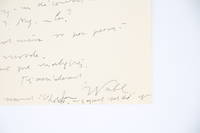
193877518Paris 1938. Fine. Paris 10 février 1938 13 x 21.20 cm 2 pages sur un feuillet enveloppe jointe Autograph letter signed by Jean Wahl addressed to Marc Barbezat one and a half pages written in black ink on a sheet. Envelope included. Transversal fold inherent to the mailing. Jean Wahl was Marc Barbezat's examiner for the philosophy examination at the baccalauréat it was then that the two men became friends. In 1940 shortly after writing this letter Barbezat would found the magazine L'Arbalète to which the philosopher would contribute by entrusting his very first poems to his young protégé. This magazine would later become a publishing house that would notably publish the first and scandalous texts of Jean Genet. The philosopher having had no news from his former student wonders: ""Je n'ai plus de vos nouvelles. Que devenez-vous Quitterez-vous Lyon à Pâques Je le pense. . Avez-vous découvert de nouvelles choses Avez-vous lu "" ""I have no more news from you. What are you becoming Will you leave Lyon at Easter I think so. . Have you discovered new things Have you been reading"" He concludes his letter sententiously: ""Il vaut mieux ne pas penser à l'état du monde."" ""It is better not to think about the state of the world."" unknown
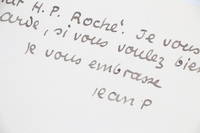
195585167Paris 1955. Fine. Paris s. d. circa 1955 13.50 x 20.50 cm deux feuilles Autograph letter signed by Jean Paulhan 20 lines written in black ink on NRF letterhead addressed to Felia Leal publisher of ""Paroles transparentes"" a work by Jean Paulhan decorated with 14 original lithographs by Georges Braque. Two sheets held together by a paper clip which has left slight rust stains and creases. Jean Paulhan asks his publisher Felia Leal for money and feels he will encounter difficulties with new projects notably for writing a preface: "". la ""mescaline"" n'est pas encore montrable. Je dois y ajouter des tas de choses. Mais je ne l'oublie pas."" "".the 'mescaline' is not yet ready to show. I must add loads of things to it. But I haven't forgotten it."" The author mentions an article in a magazine retracing Georges Braque's beginnings: ""Il y a dans la Parisienne de très amusants croquis de Braque dans sa jeunesse par H.P. Roché. Je vous les garde"" ""There are in La Parisienne some very amusing sketches of Braque in his youth by H.P. Roché. I'm keeping them for you"" unknown