Stephane MALLARMEBiblio.com
48 402 résultats
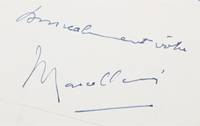
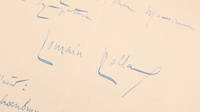
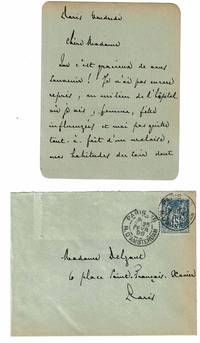
189876332Paris 1898. Fine. Paris 25 février 1898 11.40 x 8.80 cm une carte recto-verso et une enveloppe Autograph signed postcard by Stéphane Mallarmé addressed to Gabrielle Delzant wife of his friend Alidor written on both sides in black ink. Envelope included. Alidor Delzant was a lawyer collector and bibliophile. Friend of the Goncourts he devoted a work to them and was secretary and testamentary legatee of Edmond. ""Que c'est gracieux de vous souvenir ! Je n'ai pas encore repris au milieu de l'hôpital où je vis femme fille influenzées et moi pas quitte tout-à-fait d'un malaise mes habitudes du soir."" ""How gracious of you to remember! I have not yet resumed in the midst of the hospital where I live with wife and daughter suffering from influenza and myself not entirely free of discomfort my evening habits."" unknown
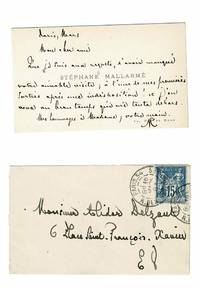
189376340Paris: S. n. 1893. Fine. S. n. Paris 16 mars 1893 10.40 x 6.30 cm une carte de visite et son enveloppe Visiting card with autograph signature by Stéphane Mallarmé addressed to Alidor Delzant. With envelope. Alidor Delzant was a lawyer collector and bibliophile. Friend of the Goncourts he devoted a work to them and was Edmond's secretary and testamentary legatee. ""Que je suis aux regrets d'avoir manqué votre aimable visite ; à l'une de mes premières sorties après une indisposition ! et j'en veux au beau temps qui me tenta dehors."" ""How I regret having missed your kind visit; during one of my first outings after an indisposition! and I blame the fine weather that tempted me outside."" S. n. unknown
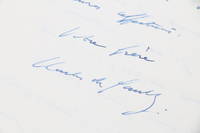
196584424Paris 1965. Fine. Paris 13 Août 1965 13.50 x 21 cm une page Autograph letter dated and signed by Charles De Gaulle 17 lines in blue ink sending his good wishes for the feast of August 15th with his wife Yvonne to a friend his sister-in-law Marie Vendroux nicknamed Cada. Fold mark inherent to envelope insertion. ""C'est de toute ma fraternelle et vive affection que je vous adresse mes voeux de fête auxquels Yvonne joint tous les siens."" ""It is with all my fraternal and heartfelt affection that I send you my holiday wishes to which Yvonne adds all of hers."" unknown
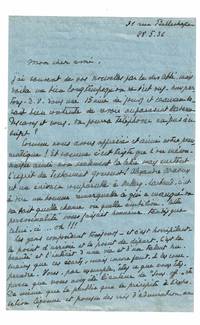
193676136Paris 1936. Fine. Paris 28 mai 1936 13.40 x 21 cm 2 pages sur un feuillet Autograph letter signed by Lucien Daudet addressed to Lucien Descaves; two pages written in black ink on a sheet of blue paper. Folds inherent to mailing. Fine letter discussing Alexandre Arnoux talent and the Prix Goncourt: ""Alexandre Arnoux est un écrivain comparable a Vallery sic Larbaud c'est-à-dire un homme remarquable à qui a manqué on ne sait quelle chance ou quelle ambition. . Quelquefois je m'imagine ce que devrait être l'Académie Goncourt dans son véritable esprit Goncourt et son prestige ici et en Europe si les Dix étaient vous mon frère Claudel Gide Max Jacob Cendrars Malraux Neveux etc."" ""Alexandre Arnoux is a writer comparable to Vallery sic Larbaud that is to say a remarkable man who lacked we know not what chance or what ambition. . Sometimes I imagine what the Goncourt Academy should be in its true Goncourt spirit and its prestige here and in Europe if the Ten were you my brother Claudel Gide Max Jacob Cendrars Malraux Neveux etc.""Alphonse Daudet Lucien's father was the first president of the Goncourt Academy in 1897. unknown
197788358Paris: s. n. 1977. Fine. s. n. Paris s.d. 1977 15 x 21 cm une page recto-verso Autograph letter signed addressed to Thierry Maulnier 28 lines in blue ink on a recto-verso sheet with letterhead from éditions de La table ronde. Central folds inherent to postal handling. The publisher inquires about Thierry Maulnier and his wife the theater actress Marcelle Tassencourt: ""Are you preparing beautiful things What advice are you giving François Mitterrand"" Roland Laudenbach also discusses literary current events and awarded prizes: "". some of your colleagues are seem terrible. . but you may have another candidate. . Ah! We are going to publish François Sentein's journal. Courageous no"" s. n. unknown
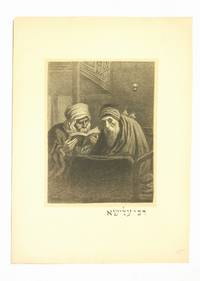
189773991Paris: Imprimerie Champenoispour CH. MassonH. Piazza 1897. Fine. Imprimerie Champenois pour CH. Masson H. Piazza Paris Novembre 1897 24 x 31 cm une feuille et une serpente Rare original lithograph executed by Alphonse Levy for L'Estampe Moderne series number 7 published in November 1897. One of 50 deluxe proofs printed on Japan paper with wide margins artist's signature in the plate Hebrew characters at the foot publisher's dry stamp depicting a child's profile in the lower margin numbered stamp of the deluxe printing on the verso minimal corner damage of no consequence; engraving preceded by a tissue guard captioned with the artist's name title and a text by the artist; blank tissue guard. Magnificent French monthly publication issued between May 1897 and April 1899 L'Estampe moderne consists of original chromolithographs which unlike other magazines such as Les Maîtres de l'Affiche and as stipulated on the tissue guards were created specially by each artist for the magazine. Thus 100 prints appeared in total covering the major artistic movements of the late 19th century: Symbolism Art Nouveau Pre-Raphaelites Orientalists and Belle Époque. Each issue of four prints was printed in 2000 copies sold for 3.50F and 100 on Japan paper offered at 10F. Henri Piazza also planned a confidential deluxe printing: 50 copies on Japan paper with wide margins and 50 in black on China paper at the considerable price of 30F. This print in a handsome format is superbly printed on the most prestigious of papers: Japan. Thick silky satin and pearlescent it contributes to making each page a work in its own right. Its quality of ink absorption and its affinity with colors also make it the ideal support for these very fine lithographs. French collectors' interest in artistic posters intensified in the early 1890s. Octave Uzanne to describe this fever invented the term ""affichomanie."" The poster originally popular and plastered on the streets of the capital then became an art object and its ephemeral medium became precious and destined for preservation. Piazza decided to remove the poster from its advertising vocation and elevate it to the rank of a complete work of art on the same level as the luxury illustrated book. He thus composed a prestigious collection of entirely original works by the most prominent European artists of the moment: Georges de Feure Eugène Grasset Henri Detouche Emile Berchmans Louis Rhead Gaston de Latenay Lucien Lévy-Dhurmer Gustave-Max Stevens Charles Doudelet Hans Christiansen Henri Fantin-Latour Steinlen Ibels Engels Willette Henri Meunier Evenepoël Bellery-Desfontaines Charles Léandre etc. Handsome copy. Imprimerie Champenoispour CH. MassonH. Piazza unknown
196683035s. l. 1966. Fine. s. l. 27 juin 1966 21 x 27 cm une feuille Autograph letter signed by Marcel Carné addressed to Carlo Rim 25 lines in blue ink thanking him for the speech he delivered concerning notably the work of Marcel Carné but also the laws governing the cinema milieu. Marcel Carné praises the clairvoyance and moral elevation of Carlo Rim's speech: "". indépendamment des éloges trop flatteurs que vous avez bien voulu me décerner j'ai admiré son courage tranquille sa fermeté dans sa concision et par-dessus tout son grand désir que les lois régissant la profession accordent enfin à chacun ce que devrait logiquement leur valeur leur travail."" "". independently of the praise too flattering that you were kind enough to bestow upon me I admired its quiet courage its firmness in its concision and above all its great desire that the laws governing the profession finally grant to each what their worth and their work should logically earn them."" The director of ""Quai des brumes"" and ""Les Enfants du paradis"" equally appreciates this salutary corporatism that Carlo Rim demonstrated during his address: "" Quelqu'un a parlé de ""chaleur humaine"" je crois que c'est le mot qui convenait. Rarement en effet je n'ai senti comme ce jour-là un tel esprit de solidarité une telle estime affectueuse. Bref un tel soutien moral. Je vous remercie encore une fois d'y avoir contribué pour une très large part. Amicalement et vôtre. Marcel Carné."" ""Someone spoke of 'human warmth' I believe that was the right word. Rarely indeed have I felt as I did that day such a spirit of solidarity such affectionate esteem. In short such moral support. I thank you once again for having contributed to it in very large part. Cordially yours. Marcel Carné."" Central folds inherent to postal folding Carlo Rim added Marcel Carné's name in green ink in the upper left corner of the letter. Carlo Rim was a Provençal writer author notably of ""Ma belle Marseille"" a caricaturist a filmmaker: ""Justin de Marseille"" ""L'armoire volante"" ""La maison Bonnadieu"" and was notably the friend of Fernandel Raimu and Marcel Pagnol but also of Max Jacob and André Salmon whom he met in Sanary. unknown
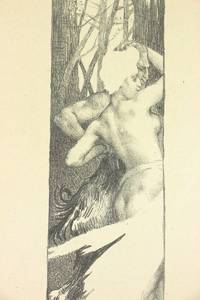
189773913Paris: Imprimerie Champenoispour CH. MassonH. Piazza 1897. Fine. Imprimerie Champenois pour CH. Masson H. Piazza Paris Juin 1897 8.50 x 30 cm une feuille Rare original lithograph executed by Emile Berchmans for L'Estampe Moderne series number 2 published in June 1897. One of 50 deluxe proofs printed on China paper with wide margins artist's signature and date in the plate publisher's dry stamp depicting a child's profile in the lower margin mounted on a sheet of laid paper with the numbered luxury edition stamp on the verso occasional marginal foxing. ""E. Berchmans is one of the most gifted artists of the young Belgian school; he has particularly distinguished himself among collectors through his posters of ingenious symbolism and delicate coloration. In Renouveau where a satyr and faun go entwined through the greening forests we find the qualities of the skillful draftsman and painter enamored with poetry"". Magnificent French monthly publication issued between May 1897 and April 1899 L'Estampe moderne consists of original chromolithographs which unlike other magazines such as Les Maîtres de l'Affiche and as stipulated on the tissue guards were created specifically by each artist for the magazine. Thus 100 prints appeared in total covering the major artistic movements of the late 19th century: Symbolism Art Nouveau Pre-Raphaelites Orientalists and Belle Epoque. Each issue of four prints was printed in 2000 copies sold for 3.50F and 100 on Japan paper offered at 10F. Henri Piazza also planned a confidential deluxe printing: 50 copies on Japan paper with wide margins and 50 in black on China paper at the considerable price of 30F. This print in a handsome format is superbly printed on one of the most prestigious papers: China paper. ""Despite all its qualities China paper too insubstantial owes its reputation not to its own beauty but to its particular affinities with printing ink. Its texture smooth and soft at once is more apt than any other to receive a fine printing. This property makes China paper sought after for printing engravings."" Anatole France. French collectors' interest in artistic posters intensified in the early 1890s. Octave Uzanne to describe this fever invented the term ""affichomania"". The poster originally popular and posted in the streets of the capital then became an art object and its ephemeral medium became precious and destined for preservation. Piazza decided to remove the poster from its advertising purpose and elevate it to the rank of a complete work of art on par with the luxury illustrated book. He thus composed a prestigious collection of entirely original works by the most prominent European artists of the moment: Georges de Feure Eugène Grasset Henri Detouche Emile Berchmans Louis Rhead Gaston de Latenay Lucien Lévy-Dhurmer Gustave-Max Stevens Charles Doudelet Hans Christiansen Henri Fantin-Latour Steinlen Ibels Engels Willette Henri Meunier Evenepoël Bellery-Desfontaines Charles Léandre etc. Fine copy in the symbolist style of the artist. Imprimerie Champenoispour CH. MassonH. Piazza unknown
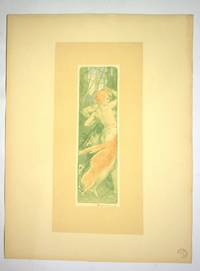
189773912Paris: Imprimerie Champenoispour CH. MassonH. Piazza 1897. Fine. Imprimerie Champenois pour CH. Masson H. Piazza Paris s. d. Juin 1897 8.50 x 30 cm une feuille et une serpente Rare original color lithograph executed by Emile Berchmans for L'Estampe Moderne series number 2 published in June 1897. One of 50 deluxe proofs printed on Japan paper with wide margins artist's signature in the plate publisher's dry stamp depicting a child's profile in the lower margin numbered luxury edition stamp on verso; engraving preceded by a tissue guard captioned with the artist's name title and presentation of the artist and another blank tissue guard. ""E. Berchmans is one of the most gifted artists of the young Belgian school; he has particularly distinguished himself among collectors through his posters of ingenious symbolism and delicate coloration. In Renouveau where a satyr and faun go entwined through the greening forests we find the qualities of the skillful draftsman and painter enamored with poetry"". Magnificent French monthly publication issued between May 1897 and April 1899 L'Estampe moderne consists of original chromolithographs which unlike other magazines such as Les Maîtres de l'Affiche and as stipulated on the tissue guards were created specifically by each artist for the magazine. Thus 100 prints appeared in total covering the major artistic movements of the late 19th century: Symbolism Art Nouveau Pre-Raphaelites Orientalists and Belle Epoque. Each issue of four prints was printed in 2000 copies sold for 3.50F and 100 on Japan paper offered at 10F. Henri Piazza also planned a confidential deluxe printing: 50 copies on Japan paper with wide margins and 50 in black on China paper at the considerable price of 30F. This print in a handsome format is superbly printed in color on the most prestigious of papers: Japan paper. Thick silky satiny and pearlescent it contributes to making each page a work in its own right. Its quality of ink absorption and its affinity with colors also make it the ideal medium for these very fine lithographs. French collectors' interest in artistic posters intensified in the early 1890s. Octave Uzanne to describe this fever invented the term ""affichomania"". The poster originally popular and posted in the streets of the capital then became an art object and its ephemeral medium became precious and destined for preservation. Piazza decided to remove the poster from its advertising purpose and elevate it to the rank of a complete work of art on par with the luxury illustrated book. He thus composed a prestigious collection of entirely original works by the most prominent European artists of the moment: Georges de Feure Eugène Grasset Henri Detouche Emile Berchmans Louis Rhead Gaston de Latenay Lucien Lévy-Dhurmer Gustave-Max Stevens Charles Doudelet Hans Christiansen Henri Fantin-Latour Steinlen Ibels Engels Willette Henri Meunier Evenepoël Bellery-Desfontaines Charles Léandre etc. Fine copy in the symbolist style of the artist. Imprimerie Champenoispour CH. MassonH. Piazza unknown
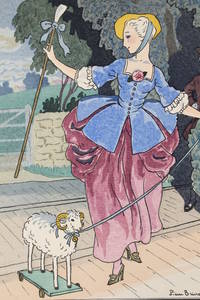
191354507Paris: Lucien Vogel éditeur 1913. Fine. Lucien Vogel éditeur Paris Février 1913 19 x 24.50 cm une feuille Original color print printed on vergé paper signed in the plate. An original print used to illustrate the Gazette du bon ton one of the most attractive and influential 20th century fashion magazines featuring the talents of French artists and other contributors from the burgeoning Art Deco movement. A celebrated fashion magazine established in 1912 by Lucien Vogel La Gazette du bon ton appeared until 1925 with a hiatus from 1915 to 1920 due to the war the editor-in-chief having been called up for service. It consisted of 69 issues printed in only 2000 copies each and notably illustrated with 573 color plates and 148 sketches of the models of the great designers. Right from the start this sumptuous publication was aimed at bibliophiles and fashionable society Françoise Tétart-Vittu La Gazette du bon ton in Dictionnaire de la mode 2016 and was printed on fine vergé paper using a type cut specially for the magazine by Georges Peignot known as Cochin later used in 1946 by Christian Dior. The prints were made using stencils heightened in colors some highlighted in gold or palladium. The story began in 1912 when Lucien Vogel a man of the world involved in fashion he had already been part of the fashion magazine Femina decided with his wife Cosette de Brunhoff the sister of Jean creator of Babar to set up the Gazette du bon ton subtitled at the time: Art fashion frivolities. Georges Charensol noted the reasoning of the editor-in-chief: In 1910 he observed there was no really artistic fashion magazine nothing representative of the spirit of the time. My dream was therefore to make a luxury magazine with truly modern artists I was assured of success because when it comes to fashion no country on earth can compete with France. Un grand éditeur dart. Lucien Vogel in Les Nouvelles littéraires no. 133 May 1925. The magazine was immediately successful not only in France but also in the United States and Latin America. At first Vogel put together a team of seven artists: André-Édouard Marty and Pierre Brissaud followed by Georges Lepape and Dammicourt as well as eventually his friends from school and the School of Fine Arts like George Barbier Bernard Boutet de Monvel and Charles Martin. Other talented people soon came flocking to join the team: Guy Arnoux Léon Bakst Benito Boutet de Monvel Umberto Brunelleschi Chas Laborde Jean-Gabriel Domergue Raoul Dufy Édouard Halouze Alexandre Iacovleff Jean Émile Laboureur Charles Loupot Chalres Martin Maggie Salcedo. These artist mostly unknown when Lucien Vogel sought them out later became emblematic and sought-after artistic figures. It was also they who worked on the advertising drawings for the Gazette. The plates put the spotlight on and celebrate dresses by seven designers of the age: Lanvin Doeuillet Paquin Poiret Worth Vionnet and Doucet. The designers provided exclusive models for each issue. Nonetheless some of the illustrations are not based on real models but simply on the illustrators conception of the fashion of the day. The Gazette du bon ton was an important step in the history of fashion. Combining aesthetic demands with the physical whole it brought together for the first time the great talents of the artistic literary and fashion worlds; and imposed through this alchemy a completely new image of women: slender independent and daring which was shared by the new generation of designers including Coco Chanel Jean Patou Marcel Rochas and so on Taken over in 1920 by Condé Montrose Nast the Gazette du bon ton was an important influence on the new layout and aesthetics of that little dying paper that Nast had bought a few years earlier: Vogue. Lucien Vogel éditeur unknown
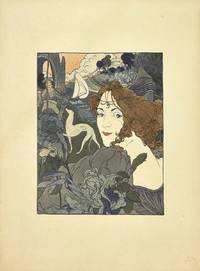
189774132Paris: Imprimerie Champenoispour CH. MassonH. Piazza 1897. Fine. Imprimerie Champenois pour CH. Masson H. Piazza Paris Juin 1897 25.50 x 33 cm une feuille Retour Original lithograph on Japan paper L'Estampe Moderne L'Estampe Moderne Imprimerie Champenois pour C.H. Masson & H. Piazza Paris Juin 1897 subject: 25.5 x 33 cm plate: 40.8 x 55 cm one leaf Rare original color lithograph by Georges de Feure for L'Estampe Moderne series no. 3 published in July 1897. One of 50 grand luxe proofs printed on Japan paper with wide margins signed by the artist in the stone publisher's embossed stamp showing a child in profile to lower margin numbered stamp of the de luxe printing to verso upper margin of proof slightly sunned; the print itself preceded by a silk paper guard with the name of the artist the title of the work and an introduction to the artist as well as a blank guard leaf. A magnificent monthly French publication that appeared between May 1897 and April 1899 L'Estampe moderne comprised unpublished chromolithographs that unlike those in other magazines like Les Maîtres de l'Affiche and as is stipulated on the guard sheets were specially made by each artist for the magazine. There are thus 100 prints that appeared in total covering the major artistic currents of the late 19th Century: Symbolism Art Nouveau the Pre-Raphaelites Orientalists and the Belle époque. Each fascicule of four prints was printed in 2000 copies and sold for 3.50F with 100 on Japan paper sold at 10F. Henri Piazza also planned a very luxurious secret printing of 50 copies on Japan paper with wide margins and 50 in black and white on China paper at the considerable price of 30F. This well-sized print is superbly printed in colors on the most prestigious of papers: Japan. Thick creamy satin and with a nice sheen it contributes to making each page a work of art in itself. Its absorptive qualities for ink and its affinity for colors make it the ideal support for these lovely lithographs. The interest of French collectors for artistic posters grew from the beginning of the 1890s. Octave Uzanne invented a term for this growing interest: affichomanie or poster mania. The poster originally not rare and posted up in the streets of the capital thus became a work of art and its ephemeral background became precious and essential for conservation. Piazza decided to extract the poster from its advertising role and to elevate it to a form of art similarly to luxury illustrated artists' books. He thus put together a prestigious collection of entirely original works by the most fashionable European artists of the age: Georges de Feure Eugène Grasset Henri Detouche Emile Berchmans Louis Rhead Gaston de Latenay Lucien Lévy-Dhurmer Gustave-Max Stevens Charles Doudelet Hans Christiansen Henri Fantin-Latour Steinlen Ibels Engels Willette Henri Meunier Evenepoël Bellery-Desfontaines Charles Léandre etc. A fine copy of this Art Nouveau style poster. Imprimerie Champenoispour CH. MassonH. Piazza unknown
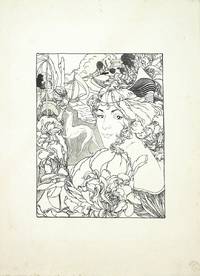
189774126Paris: Imprimerie Champenoispour CH. MassonH. Piazza 1897. Fine. Imprimerie Champenois pour CH. Masson H. Piazza Paris Juin 1897 25.50 x 33 cm une feuille Rare original lithograph executed by Georges de Feure for L'Estampe Moderne series number 2 published in May 1897. One of 50 deluxe proofs printed on China paper with wide margins artist's signature in the plate publisher's dry stamp representing a child's profile in the lower margin mounted on a sheet of laid paper with the numbered stamp of the deluxe edition on the verso pale marginal foxing. Magnificent French monthly publication edited between May 1897 and April 1899 L'Estampe moderne consists of unpublished chromolithographs which unlike other magazines such as Les Maîtres de l'Affiche and as stipulated on the tissue guards were created specially by each artist for the magazine. Thus 100 prints appeared in total covering the major artistic movements of the late 19th century: Symbolism Art Nouveau Pre-Raphaelites Orientalists and Belle Epoque. Each delivery of four prints was printed in 2000 copies sold at 3.50F and 100 on Japan paper offered at 10F. Henri Piazza also provided for a confidential deluxe edition: 50 copies on Japan paper with wide margins and 50 in black on China paper at the considerable price of 30F. This print of beautiful format is superbly printed on one of the most prestigious papers: China paper. ""Despite all its qualities China paper too inconsistent owes its reputation not to its own beauty but indeed to its particular affinities with printing ink. Its texture smooth and soft at the same time is more apt than any other to receive a beautiful impression. This property makes China paper sought after for printing engravings."" Anatole France. French collectors' interest in artistic posters grew in the early 1890s. Octave Uzanne to qualify this fever invented the term ""affichomanie"". The poster originally popular and plastered on the streets of the capital then became an art object and its ephemeral medium became precious and destined for preservation. Piazza decided to remove the poster from its advertising vocation and elevate it to the rank of a complete work of art in the same way as the deluxe illustrated book. He thus composed a prestigious collection of entirely original works by the most prominent European artists of the moment: Georges de Feure Eugène Grasset Henri Detouche Emile Berchmans Louis Rhead Gaston de Latenay Lucien Lévy-Dhurmer Gustave-Max Stevens Charles Doudelet Hans Christiansen Henri Fantin-Latour Steinlen Ibels Engels Willette Henri Meunier Evenepoël Bellery-Desfontaines Charles Léandre etc. Superb copy of this Art Nouveau poster. Imprimerie Champenoispour CH. MassonH. Piazza unknown
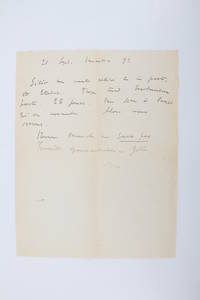
189380761Vaucottes Vattetot-sur-mer 1893. Fine. Vaucottes Vattetot-sur-mer 21 septembre 1893 15.60 x 20.10 cm quelques lignes sur un feuillet Autograph letter signed by Maurice Leblanc to an unknown recipient; a few lines written in black ink on a sheet. Transverse folds inherent to mailing. ""Sitôt ton mot retiré de la poste été Etretat. Trop tard. Natanson parti. 28 jours. Ne sera à Paris qu'en novembre. Alors nous verrons. Revue Blanche ne paie pas. Tempête épouvantable - grêle."" ""As soon as your note was collected from the post office went to Etretat. Too late. Natanson left. 28 days. Won't be in Paris until November. Then we'll see. Revue Blanche doesn't pay. Terrible storm - hail."" unknown
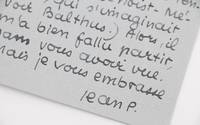
195585252Paris 1955. Fine. Paris s. d. circa 1955 13 x 9 cm une feuille Autograph letter signed by Jean Paulhan 16 lines written in blue ink addressed to Felia Leal publisher of ""Paroles transparentes"" a work by Jean Paulhan decorated with 14 original lithographs by Georges Braque. Jean Paulhan regrets their missed appointment at an exhibition: ""Votre jolie carte portait : cocktail à 4 heures. J'étais là à 4h. Je suis revenu à 4h 1/2 à 4h 3/4. Alors il m'a bien fallu partir sans vous avoir vue."" Your lovely card read: cocktail at 4 o'clock. I was there at 4. I came back at 4:30 at 4:45. So I had to leave without having seen you. and mentions an incongruous encounter: ""Rien et la porte était bouclée. J'ai même rencontré M. Benoist-Méchin qui s'imaginait voir Balthus"" Nothing and the door was locked. I even met Mr. Benoist-Méchin who thought he was going to see Balthus. unknown
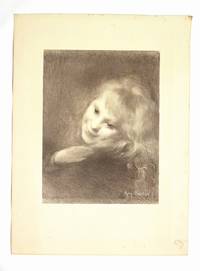
189773915Paris: Imprimerie Champenoispour CH. MassonH. Piazza 1897. Fine. Imprimerie Champenois pour CH. Masson H. Piazza Paris Juin 1897 27 x 35 cm une feuille Rare original lithograph executed by Emile Berchmans for L'Estampe Moderne series number 2 published in June 1897. One of 50 deluxe proofs printed on China paper with wide margins printed in brown ink in the manner of sanguine artist's signature and date in the plate publisher's dry stamp representing a child's profile in the lower margin mounted on a sheet of laid paper with on the verso the numbered stamp of the deluxe edition occasional marginal foxing. Magnificent French monthly publication edited between May 1897 and April 1899 L'Estampe moderne consists of unpublished chromolithographs which unlike other magazines such as Les Maîtres de l'Affiche and as stipulated on the tissue guards were specially created by each artist for the magazine. Thus 100 prints appeared in total covering the major artistic movements of the late 19th century: Symbolism Art Nouveau Pre-Raphaelites Orientalists and Belle Epoque. Each issue of four prints was printed in 2000 copies sold for 3.50F and 100 on Japan paper offered at 10F. Henri Piazza also provided a confidential deluxe printing: 50 copies on Japan paper with wide margins and 50 in black on China paper at the considerable price of 30F. This print in a beautiful format is superbly printed on one of the most prestigious papers: China paper. ""Despite all its qualities China paper too insubstantial owes its reputation not to its own beauty but to its particular affinities with printing ink. Its texture smooth and soft together is more apt than any other to receive a beautiful printing. This property makes China paper sought after for printing engravings."" Anatole France. French collectors' interest in artistic posters intensified at the beginning of the 1890s. Octave Uzanne to describe this fever invented the term ""affichomanie"". The poster originally popular and posted in the streets of the capital then became an art object and its ephemeral medium became precious and destined for preservation. Piazza decided to remove the poster from its advertising vocation and elevate it to the rank of a work of art in its own right on the same level as the illustrated deluxe book. He thus composed a prestigious collection of entirely original works by the most prominent European artists of the moment: Georges de Feure Eugène Grasset Henri Detouche Emile Berchmans Louis Rhead Gaston de Latenay Lucien Lévy-Dhurmer Gustave-Max Stevens Charles Doudelet Hans Christiansen Henri Fantin-Latour Steinlen Ibels Engels Willette Henri Meunier Evenepoël Bellery-Desfontaines Charles Léandre etc. Handsome copy in the artist's academic style. Imprimerie Champenoispour CH. MassonH. Piazza unknown
189773914Paris: Imprimerie Champenoispour CH. MassonH. Piazza 1897. Fine. Imprimerie Champenois pour CH. Masson H. Piazza Paris s. d. Juin 1897 27 x 35 cm une feuille et une serpente Rare original color lithograph executed by Armand Berton for L'Estampe Moderne series number 2 published in June 1897. One of 50 deluxe proofs printed on Japan paper with wide margins artist's signature in the plate publisher's dry stamp representing a child's profile in the lower margin numbered stamp of the deluxe edition on verso; engraving preceded by a tissue guard inscribed with the artist's name title and presentation of the artist traces of folds and another blank tissue guard. A small angular lack in the upper right margin filled with a strip of paper. Magnificent French monthly publication edited between May 1897 and April 1899 L'Estampe moderne consists of unpublished chromolithographs which unlike other magazines such as Les Maîtres de l'Affiche and as stipulated on the tissue guards were specially created by each artist for the magazine. Thus 100 prints appeared in total covering the major artistic movements of the late 19th century: Symbolism Art Nouveau Pre-Raphaelites Orientalists and Belle Epoque. Each issue of four prints was printed in 2000 copies sold for 3.50F and 100 on Japan paper offered at 10F. Henri Piazza also provided a confidential deluxe printing: 50 copies on Japan paper with wide margins and 50 in black on China paper at the considerable price of 30F. This print in a beautiful format is superbly printed in colors on the most prestigious of papers: Japan paper. Thick silky satined and pearlescent it contributes to making each page a work in its own right. Its quality of ink absorption and its affinity with colors also make it the ideal medium for these very beautiful lithographs. French collectors' interest in artistic posters intensified at the beginning of the 1890s. Octave Uzanne to describe this fever invented the term ""affichomanie"". The poster originally popular and posted in the streets of the capital then became an art object and its ephemeral medium became precious and destined for preservation. Piazza decided to remove the poster from its advertising vocation and elevate it to the rank of a work of art in its own right on the same level as the illustrated deluxe book. He thus composed a prestigious collection of entirely original works by the most prominent European artists of the moment: Georges de Feure Eugène Grasset Henri Detouche Emile Berchmans Louis Rhead Gaston de Latenay Lucien Lévy-Dhurmer Gustave-Max Stevens Charles Doudelet Hans Christiansen Henri Fantin-Latour Steinlen Ibels Engels Willette Henri Meunier Evenepoël Bellery-Desfontaines Charles Léandre etc. Handsome copy in the artist's academic style. Imprimerie Champenoispour CH. MassonH. Piazza unknown
190574262s. l.: S. n. 1905. Fine. S. n. s. l. s. d. circa 1905 15 x 19 cm trois pages sur une double feuille Autograph letter signed by the dandy count three pages 27 lines written in black ink to his friends the Lapauzes that he is delighted to see them again soon even if they impose upon him the presence of a certain Sarah who is not among the people the poet seems to appreciate: ""Dear friends I will not do you the affront of not telling you that I would have preferred just the two of you alone"" words underlined but as the beautiful verse says: You do what you do / What you do is right."" For this meeting arranged at the Petit Palais of which Henry Lapauze becomes curator in 1905 after having been assistant director for the four preceding years Robert de Montesquiou ""a late riser who has the cowardice - or if you prefer the wisdom to choose the afternoon"" timidly expresses in a surge of wounded pride and revenge that he already regrets the possibility of his absence: "".only a throat irritation carelessly treated and unexpectedly could keep me away at the last moment. But I don't want to believe it. Let us arrange ourselves around Sarah!"" Henry Lapauze 1867-1925 was a journalist art critic then in 1905 curator of the Petit Palais converted four years earlier into a museum and whose collections he considerably enriched by acquiring notably the Courbet Henner Falguière collections with at the twilight of his life a marked predilection for the Decorative Arts of which he was one of the ardent promoters. S. n. unknown
191986824s. l.: S. n. 1919. Fine. S. n. s. l. 6 Août 1919 15 x 18.50 cm 3 pages sur un double feuillet Autograph letter dated and signed by Romain Rolland to his friend the British writer and linguist Charles Kay Ogden 35 lines in blue ink notably concerning the great interest he professes for the German physiologist Georg Friedrich Nicolaï whose work is too unjustly unrecognized in his eyes. Fold inherent to postal mailing. A small tear in the right margin of the bifolium. Romain Rolland addresses to Charles Kay Ogden his opuscule dedicated to a scientist he considers very important: ""Je vous envoie sous pli recommandé une étude que j'ai publiée en Suisse sur le professeur G.F. Nicolaï et sur son oeuvre ""La biologie de la guerre"" - étude qui a été traduite en anglais par madame Hélène van Brugh."" ""I am sending you by registered mail a study I published in Switzerland on Professor G.F. Nicolaï and on his work 'The Biology of War' - a study which has been translated into English by Mrs. Hélène van Brugh."" and of which he also praises his action during the Great War: ""Vous connaissez sans aucun doute le rôle que le dr Nicolaï professeur de biologie à l'université de Berlin a joué pendant la guerre sa courageuse attitude son indépendance irréductible et son évasion retentissante en aéroplane d'une forteresse de Brandebourg."" ""You undoubtedly know the role that Dr. Nicolaï professor of biology at the University of Berlin played during the war his courageous attitude his irreducible independence and his resounding escape by airplane from a Brandenburg fortress."" As an ardent admirer of the scientist but also as an indefatigable advocate of Franco-German friendship the Nobel Prize for Literature for 1915 campaigns for the recognition of the German physiologist's work: ""J'ai essayé de faire reconnaître au public des autres pays son caractère et sa pensée. Je serais heureux qu'elle pût intéresser les lecteurs du Cambridge magazine"" ""I have tried to make his character and his thought recognized by the public of other countries. I would be happy if it could interest the readers of the Cambridge magazine"" and for his translator of his writings into English as well: ""Madame H. van Brugh dont j'estime le talent devrait être rémunérée pour son travail qui a été fait avec grand soin. Si vous acceptez l'article je vous prierais d'en adresser le shonoraires à Mme H. van Brugh."" ""Mrs. H. van Brugh whose talent I esteem should be remunerated for her work which has been done with great care. If you accept the article I would ask you to send the fees to Mrs. H. van Brugh."" S. n. unknown
189874371Paris: Imprimerie Champenoispour CH. MassonH. Piazza 1898. Fine. Imprimerie Champenois pour CH. Masson H. Piazza Paris Mars 1898 16 x 26 cm une feuille Rare original lithograph executed by Jeanne Jacquemin for L'Estampe Moderne series number 11 published in March 1898. One of 50 deluxe proofs printed on China paper with wide margins artist's signature in the plate publisher's dry stamp showing a child's profile in the lower margin mounted on a sheet of laid paper with the numbered stamp of the deluxe edition on verso pale marginal foxing. Lithograph inspired by a poem by Edmond Pilon. Magnificent French monthly publication issued between May 1897 and April 1899 L'Estampe moderne consists of original chromolithographs which unlike other magazines such as Les Maîtres de l'Affiche and as stipulated on the tissue guards were created specially by each artist for the magazine. Thus 100 prints appeared in total covering the major artistic movements of the late 19th century: Symbolism Art Nouveau Pre-Raphaelites Orientalists and Belle Époque. Each delivery of four prints was issued in 2000 copies sold for 3.50F and 100 on Japan paper offered at 10F. Henri Piazza also planned a confidential deluxe edition: 50 copies on Japan paper with wide margins and 50 in black on China paper at the considerable price of 30F. This print in a handsome format is superbly printed on one of the most prestigious papers: China. ""Despite all its qualities China paper too inconsistent owes its reputation not to its own beauty but to its particular affinities with printing ink. Its texture smooth and soft together is more apt than any other to receive a beautiful impression. This property makes China paper sought after for printing engravings."" Anatole France. The interest of French collectors in artistic posters intensified at the beginning of the 1890s. Octave Uzanne to describe this fever invented the term ""affichomanie."" The poster originally popular and pasted on the streets of the capital then became an art object and its ephemeral support became precious and devoted to preservation. Piazza decided to remove the poster from its advertising vocation and elevate it to the rank of a complete work of art on the same level as the luxury illustrated book. He thus composed a prestigious collection of entirely original works by the most prominent European artists of the moment: Georges de Feure Eugène Grasset Henri Detouche Emile Berchmans Louis Rhead Gaston de Latenay Lucien Lévy-Dhurmer Gustave-Max Stevens Charles Doudelet Hans Christiansen Henri Fantin-Latour Steinlen Ibels Engels Willette Henri Meunier Evenepoël Bellery-Desfontaines Charles Léandre etc. Handsome copy in the Symbolist style. Imprimerie Champenoispour CH. MassonH. Piazza unknown
197685081Fleury-Mérogis 1976. Fine. ""She's an exceptional woman . I considered her like a mother . Woe to anyone who would touch a single hair on her head."" Fleury-Mérogis 22 Septembre1976 21 x 29.50 cm une page recto verso Autograph letter dated and signed by Jacques Mesrine dated Saturday September 22 1976 67 lines in blue ink on one page recto verso addressed to his love of the time Jeanne Schneider thanks to whom the manuscript of Instinct de mort was discreetly smuggled out of prison. Jacques Mesrine then incarcerated at Fleury-Mérogis prison and deprived of human warmth is enthusiastic about all the visits he receives in the visiting room thus dispelling the myth of the antisocial bandit devoid of human feelings: ""And after that they'll say I'm a savage! No quite the contrary and people who have had contact with me want to see me again. This gave me immense pleasure and do you know what happened next. she's also going to ask to see you. Apparently I'm missed by the nurses 'mister smile' that's the secret."" He particularly appreciated the visit from the nurse at La Santé prison who would also be their wedding witness with Jeanne Schneider and whom he praises: "". an enormous surprise! You'll never guess who came to see me! My nurse from La Santé. yes my darling. that charming lady with white hair whom you had seen in the visiting room at La Santé and who is to be our witness at our wedding . She's an exceptional woman a former military nurse and quite well-placed in the ministry. During my 2 and a half years at La Santé I considered her like a mother this woman is so devoted it's unthinkable. Woe to anyone who would touch a single hair on her head."" Public enemy No. 1 takes the opportunity again to break this reputation as a bloodthirsty beast that sticks to him: ""If journalists knew that all the nurses entered my cell alone and with complete confidence we'd be far from the 'beast' and hostage-taking à la Buffet. Nurses have always been sacred to me. They are untouchable like quite a few other people but those journalist faggots don't know that; because they're not in my thoughts and that's regrettable sometimes."" Jacques Mesrine the rebel is surprised to find himself appreciating his prison solitude: ""Do you know that I'm beginning to like it here. What calm you know manou my isolation I bear it insofar as I have peace. In detention it's not proven that I would have it. It's my reactions I'm afraid of. and the mentality of so-called crooks is increasingly disgusting! . in my isolation there's good and bad. but personally I don't want to complain. because there's no reason to do so."" and ends his letter with paternal considerations for his daughter who is not very assiduous at school and for whom he worries: ""I'm going to find out if Sabrina has been regularly attending her classes. I hope so because if the opposite were the case. no mercy this time. But what worry this kid can represent and what powerlessness I have to control her being here!"" Rare and very fine letter from Jacques Mesrine overflowing with reverence for the nursing profession and regrettable detestation for that of journalists. unknown
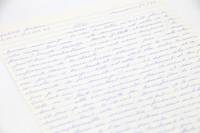
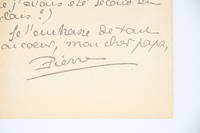
188977511Paris 1889. Fine. Paris jeudi 4 avril 1889 12.50 x 20 cm 4 pages sur un double feuillet Autograph letter signed by Pierre Louÿs addressed to his father four pages written in black ink on a double sheet of white paper. Transverse folds inherent to folding for mailing. This letter was sent by the young Pierre Louÿs while he was studying at the Janson-de-Sailly lycée Paris - 16th arrondissement. This is very likely one of Pierre Louÿs's last letters to his father ten days before the latter's death: ""Do you know that in less than two weeks I will be beside you . May I hope that by then you will have regained some strength"" The question of Pierre Louÿs's real paternal identity still fascinates biographers today: ""His father Pierre Philippe Louis . had married in 1842 Jeanne Constance Blanchin who died ten years later after giving him two children Lucie and Georges. In 1855 he remarried Claire Céline Maldan and from this union was born in 1857 a son Paul; then in 1870 our writer who received the first names Pierre Félix. This late birth the differences in character between father and son the first's disaffection toward the second the profound intimacy that always reigned between Louÿs and his brother Georges all this has led certain biographers and critics to suspect that the latter was in reality the writer's father. The exceptionally intimate and constant relationship that Pierre and Georges maintained between them throughout their lives could be an argument in this sense. Of course no irrefutable proof has been discovered and none will probably ever be discovered. Nevertheless certain letters . are quite troubling. In 1895 for example Louÿs writes seriously to his brother that he knows the answer to 'the most poignant question' he could ask him a question he has had 'on his lips for ten years.' The following year in the midst of Aphrodite's triumph he thanks Georges effusively and ends his letter with this sentence: 'Not one of my friends has a FATHER who is to him what you are to me.' Arguing from the close intimacy of Georges and Claire Céline during the year 1870 and from the jealousy that the father never ceased to show toward his younger son Claude Farrère did not hesitate to conclude in favor of Georges Louis. And what to think of this dedication by Louÿs to his brother on a Japan paper copy of the first edition of Pausole: To Georges his eldest son / Pierre."" Jean-Paul Goujon Pierre Louÿs Pierre Louÿs was only nine years old when his mother died suddenly. The father from then on entrusted his education to his brother Georges twenty years his senior and Pierre then joined him in Paris where he attended the École Alsacienne then the Janson-de-Sailly lycée. Despite the little affection shown to him the young man writes every week to his ""dear papa"" residing at Dizy-Magenta near Épernay. The young man inquires about his poor health: ""May I hope that by then you will have regained some strength No doubt. Your eczema we hope will not have worsened; and the green leaves that are beginning to appear will perhaps give you hope yourself for improvement next summer."" The ""improvement"" would sadly never come and Pierre Philippe Louis would breathe his last on April 14 1889. In the meantime Pierre Louÿs gives family news more precisely about Germaine his sister Lucie's daughter: ""Today I went to rue de la Santé to get news of Germaine. I found the little one who had been operated on in very good condition very cheerful and in good health. She was up and playing on the floor. . Finally I ended my day by going to my aunt Marie's and to Elisabeth's. Everyone is well in both houses."" As usual always anxious not to disappoint his father he finally transmits his school results: ""I return to the lycée tomorrow did Georges tell you that I was second in English"" unknown
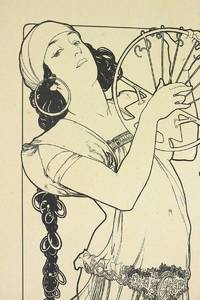
189773919Paris: Imprimerie Champenoispour CH. MassonH. Piazza 1897. Fine. Imprimerie Champenois pour CH. Masson H. Piazza Paris Juin 1897 23.50 x 33 cm une feuille ""Salomé"" - Original lithograph on China paper - L'Estampe Moderne L'Estampe Moderne Imprimerie Champenois for C H Masson & H Piazza Paris june 1897 subject: 23.5 x 33 cm plate: 40.8 x 55 cm one leaf and one guard Rare original black and white lithograph by Alphonse Mucha for L'Estampe Moderne series number 2 published in June 1897. One of the 50 grand luxe proofs printed on China paper with wide margins signed and dated by the artist in the plate. Embossed stamp of the publisher showing a child in profile to lower margin laid down on a leaf of vélin paper with the numbered stamp of the tirage de luxe to verso occasional spotting to margins not touching image blank guard. A magnificent monthly French publication that appeared between May 1897 and April 1899 L'Estampe moderne comprised unpublished chromolithographs that unlike those in other magazines like Les Maîtres de l'Affiche and as is stipulated on the guard sheets were specially made by each artist for the magazine. There are thus 100 prints that appeared in total covering the major artistic currents of the late 19th Century: Symbolism Art Nouveau the Pre-Raphaelites Orientalists and the Belle époque. Each fascicule of four prints was printed in 2000 copies and sold for 3.50F with 100 on Japan paper sold at 10F. Henri Piazza also planned a very luxurious secret printing of 50 copies on Japan paper with wide margins and 50 in black and white on China paper at the considerable price of 30F. This well-sized print is superbly printed in colors on the most prestigious of papers: Japan. Thick creamy satin and with a nice sheen it contributes to making each page a work of art in itself. Its absorptive qualities for ink and its affinity for colors make it the ideal support for these lovely lithographs. The interest of French collectors for artistic posters grew from the beginning of the 1890s. Octave Uzanne invented a term for this growing interest: affichomanie or poster mania. The poster originally not rare and posted up in the streets of the capital thus became a work of art and its ephemeral background became precious and essential for conservation. Piazza decided to extract the poster from its advertising role and to elevate it to a form of art similarly to luxury illustrated artists' books. He thus put together a prestigious collection of entirely original works by the most fashionable European artists of the age: Georges de Feure Eugène Grasset Henri Detouche Emile Berchmans Louis Rhead Gaston de Latenay Lucien Lévy-Dhurmer Gustave-Max Stevens Charles Doudelet Hans Christiansen Henri Fantin-Latour Steinlen Ibels Engels Willette Henri Meunier Evenepoël Bellery-Desfontaines Charles Léandre etc. He also included in this project a Czech artist freshly arrived in Paris Alfonse Mucha who has only recently become active in France but who has immediately carved out for himself the affection of the public. Like in his posters which everyone knows and covets he shows us here the varied resources of his multifaceted talents as accomplished draughstman decorator and colorist from the notes printed on the guard for Salomé. The two first special numbers of the review were in fact dedicated to him and were given to all the subscribers for all twelve annual numbers of L'Estampe moderne as well as the famous illustration of the covers. A fine signed plate by the master of Art nouveau. Imprimerie Champenoispour CH. MassonH. Piazza unknown
189773918Paris: Imprimerie Champenoispour CH. MassonH. Piazza 1897. Fine. Imprimerie Champenois pour CH. Masson H. Piazza Paris s. d. Juin 1897 23.50 x 33 cm une feuille et une serpente Salomé Original lithograph on papier japon L'Estampe ModerneL'Estampe Moderne Imprimerie Champenois for C. H. Masson & H. Piazza Paris June 1897 subject: 23.5 x 33 cm plate: 40.8 x 55 cm one leaf and one captioned silk tissue Rare Alphonse Mucha color lithograph heightened with gold for L'Estampe Moderne series number 2 published in June 1897. One of 50 grand luxe proofs printed on papier japon with wide margins signed by the artist in the plate publisher's stamp to lower margin de luxe printing numbered stamp to verso upper margin slightly sunned; the plate itself preceded by a silk tissue with the name of the artist title a poem and a caption. L'Estampe moderne was a magnificent monthly French publication published between May 1897 and April 1899. It included unpublished chromolithographs specially made by each artist for the magazine as mentioned on the protective silk tissue over each plate unlike other publications such as Les Maîtres de l'Affiche. 100 prints were published in total covering major artistic movements of the late 19th-century: Symbolism Art Nouveau Pre-Raphaelites Orientalists and Belle époque'. 2000 copies were printed of each fascicule containing four prints and sold for 3.50F. 100 copies were printed on papier japon for 10F. Henri Piazza also planned a very luxurious secret printing of 50 copies on papier japon with wide margins and 50 in black and white on papier chine at the considerable price of 30F. This well-sized print is superbly printed in colors on the most prestigious of papers: japon. Thick creamy satin and with a nice sheen it contributes to making each page a work of art in itself. Its qualities of absorption and its affinity for colors make it the ideal support for these lovely lithographs. The interest of French collectors for artistic posters grew from the beginning of the 1890s. Octave Uzanne invented a term for this new form of collection: affichomanie' or poster mania. The initially common poster displayed in the streets of Paris became a work of art and its ephemeral material became precious and made to last. Piazza decided to separate the poster from its advertising role and to elevate it to a form of art similarly to luxury illustrated artists' books. He put together a prestigious collection of entirely original artworks by the most fashionable European artists: Georges de Feure Eugène Grasset Henri Detouche Emile Berchmans Louis Rhead Gaston de Latenay Lucien Lévy-Dhurmer Gustave-Max Stevens Charles Doudelet Hans Christiansen Henri Fantin-Latour Steinlen Ibels Engels Willette Henri Meunier Evenepoël Bellery-Desfontaines Charles Léandre etc. He also included in this project a Czech artist freshly arrived in Paris Alfonse Mucha who has only recently become active in France but immediately carved out for himself the affection of the public. Like his posters which everyone knows and covets he shows us here the varied resources of his multifaceted talents as accomplished draughstman decorator and colorist from the notes printed on the silk protective paper of Salomé. The two first special numbers of the journal were in fact dedicated to him and were given to all the subscribers for all twelve annual numbers of L'Estampe moderne as well as the famous illustration of the covers. A fine signed plate by the master of Art nouveau. Imprimerie Champenoispour CH. MassonH. Piazza unknown
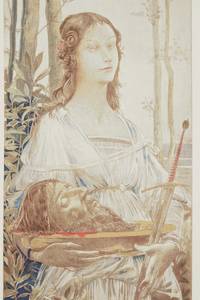
189974838Paris: Imprimerie Champenoispour CH. MassonH. Piazza 1899. Fine. Imprimerie Champenois pour CH. Masson H. Piazza Paris Avril 1899 19.50 x 35 cm une feuille et une serpente Rare original color lithograph executed by Luc Olivier Merson for L'Estampe Moderne ""Second complimentary premium reserved for one-year subscribers to L'Estampe Moderne"". One of 50 deluxe proofs printed on Japan paper with wide margins artist's signature in the plate publisher's dry stamp representing a child's profile in the lower margin numbered stamp of the deluxe edition on verso; engraving preceded by a tissue guard inscribed with the artist's name title and text. Lithograph inspired by an extract from Hérodias by Gustave Flaubert reproduced on the print's tissue guard. Magnificent French monthly publication issued between May 1897 and April 1899 L'Estampe moderne consists of original chromolithographs which unlike other magazines such as Les Maîtres de l'Affiche and as stipulated on the tissue guards were created specially by each artist for the magazine. Thus 100 prints appeared in total covering the major artistic movements of the late 19th century: Symbolism Art Nouveau Pre-Raphaelites Orientalists and Belle Époque. Each delivery of four prints was issued in 2000 copies sold for 3.50F and 100 on Japan paper offered at 10F. Henri Piazza also planned a confidential very deluxe printing: 50 copies on Japan paper with wide margins and 50 in black on China paper at the considerable price of 30F. This beautifully formatted print is superbly printed on the most prestigious of papers: Japan paper. Thick silky satiny and pearlescent it contributes to making each page a work in its own right. Its ink absorption quality and affinity with colors also make it the ideal support for these very beautiful lithographs. French collectors' interest in artistic posters grew in the early 1890s. Octave Uzanne to describe this fever invented the term ""affichomanie"". The poster originally popular and displayed on the streets of the capital then became an art object and its ephemeral support became precious and destined for preservation. Piazza decided to remove the poster from its advertising vocation and elevate it to the rank of a complete work of art on the same level as the deluxe illustrated book. He thus composed a prestigious collection of entirely original works by the most prominent European artists of the moment: Georges de Feure Eugène Grasset Henri Detouche Emile Berchmans Louis Rhead Gaston de Latenay Lucien Lévy-Dhurmer Gustave-Max Stevens Charles Doudelet Hans Christiansen Henri Fantin-Latour Steinlen Ibels Engels Willette Henri Meunier Evenepoël Bellery-Desfontaines Charles Léandre etc. Handsome copy. Imprimerie Champenoispour CH. MassonH. Piazza unknown
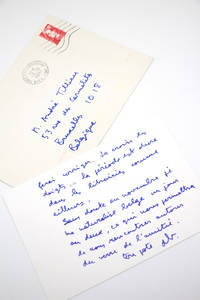
199376659Paris: S. n. 1993. Fine. S. n. Paris 18 Octobre 1993 14.50 x 10.50 cm une feuille une enveloppe Signed manuscript card of 19 lines from Alphonse Boudard to his great friend and companion of well-watered lunches the Brussels journalist André Tillieu who was like Alphonse Boudard a great friend of Georges Brassens but also of Jean Giono. A date 18.10.93 and the mention ""Saint Frédo"" ""Saint Frédo"" a book by Alphonse Boudard recently published inscribed in pencil and blue pen on the card by André Tillieu. Envelope included. ""Vieux Merci cent mille fois pour cet admirable papier qui complète celui de Louis Nucéra dans le journal du dimanche. Les fautes Les éditeurs ne nous donnent plus un second jeu d'épreuves. d'où ces bavures ! Si j'épuise le 1er tirage je ferai corriger. Je croise les doigts. la période est dure dans les librairies comme ailleurs. Sans doute en novembre je me naturalise belge un jour ou deux ce qui nous permettra de nous rencontrer autour du verre de l'amitié. Ton pote Al."" ""Old friend Thank you a hundred thousand times for this admirable article which complements that of Louis Nucéra in the Sunday paper. The errors Publishers no longer give us a second set of proofs. hence these blunders! If I exhaust the first printing I'll have them corrected. I'm crossing my fingers. times are hard in bookshops as elsewhere. No doubt in November I'll become Belgian for a day or two which will allow us to meet over the glass of friendship. Your mate Al."" André Tillieu from Brussels very close friend and biographer of Georges Brassens maintained an epistolary correspondence with Alphonse Boudard for almost thirty years from 1972 until the latter's death in 2000. The irreverent Parisian writer quickly showed him his friendship considering him one of the rare critics to understand him perfectly to the point of clearly explaining in his reviews what he himself expressed only incompletely and sometimes confusedly in his books. André Tillieu thus became part of the small circle of Alphonse Boudard's true friends alongside le Gros Georges Georges Brassens le Niçois Louis Nucéra and René Fallet with whom he loved to share hearty well-watered meals and cycling trips. As death gradually took away his best friends André Tillieu remained one of Alphonse's very last mates. S. n. unknown