48 402 résultats
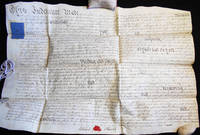
1700000819Boston Massachusetts MA 1700. On offer is a superb and important piece of Americana specifically a handwritten deed concerning the very important geographic area of Fort Warren which defends the harbor in Boston Massachusetts and has done so from 1861 through the end of World War II. To buffs of the Civil War it was also the location where the famous Union marching anthem 'John Brown' was written using a tune from an old Methodist camp song 'Glory Glory Hallelujah!' and signed by Isaac Addington who served on the Salem Witch Trial Grand Jury and Adam Winthrop the son of John Winthrop First Governor of Massachusetts. John Winthrop 1588-1649 is perhaps best remembered for the famous sermon in which he likened the Massachusetts Bay Colony to a 'city upon a hill' a model to the world of social and religious order." Ref: Wikipedia. This manuscript document is dated Boston 27 Dec 1700. Folded into thirds Calligraphic initials. SIGNED BY ADAM WINTHROP son of John Winthrop First Governor of Massachusetts and ISAAC ADDINGTON clerk of the Grand Jury during the Salem Witch Trials. This is the original deed referenced by Holmes Abiel 1763-1837. Cambridge : Hilliard and Brown 1829. from the Coll. Mass. HiM. Soc. iii. 299. which states: "In 1700 Adam conveyed the island to his son-in-law and daughter to be transmitted to their descendants. The Indenture handsomely written on parchment is now before me. It covenants and grants the island to "John Wainwright and to Ann his wife during the term of their natural lives and afterward to the use and behoof of the heires of their two body. begotten or to be begotten forever." The island was next owned by their son John Winthrop Professor of Mathematics and Natural Philosophy In Harvard College; and next by his sons Hines and William of Cambridge lately deceased. James purchased of William his share and a few years since sold to the United States about five acres in two parcels at the east and west end of the island with a passage way rota the one to the other for the purpose of fortifications. On the west end has been erected Fort Warren which defends the entrance of the harbour." CONDITION: signatures are strong and legible majority of the deed legible though with age-wear sometimes serious rubbing and fading discoloration some holes; certainly not in the presumed fine condition when Abiel Holmes held the document in 1829 but certainly very presentable with the red wax seal still intact. This document is a wonderful tapestry comprised of the strands of early Colonial history. Inherited by his son Adam it links the famous Winthrop name from his namesake Grandfather Adam Winthrop 1548-1623 an English lawyer and famous Puritan reformer in the Elizabethan and Jacobean periods through his great grandson Professor John Winthrop who was intimately connected to Harvard University's early history. The document is also witnessed and signed by Isaac Addington the first Secretary of the Mass. Bay Colony from 1692 to 1714 who additionally served on the grand jury in the Salem witch trials. The trials famously resulted in the executions of 20 people 14 women 6 men. PROVENANCE: Most recently from a private collector the present condition suggests this deed has long been in private hands and not an institutional archive. While in the 1820s the deed was possibly present in the archives of the Mass Historical Society it did not remain in the archives long thereafter and entered less protected private circulation. That stated Mr. Jeremy B. Dibbell of the Massachusetts Historical Society has kindly confirmed that this document like others that have entered private hands is not the property of the Massachusetts Historical Society. . Good. Atlas Folio - over 23" - 25" tall. Manuscript. unknown
1706000676AMSTERDAM NETHERLANDS: Pierre Petrus Schenck. Good. 1706. Full-Leather. On offer is a remarkable testament to the art of calligraphy. An awesome manuscript book 'published' by the renowned engraver Schenck of Atlas Sanson fame. There are two 2 title pages French and Dutch the first being: "Tablettes Chronologiques contenant la suite des Papes Empereurs et Roys qui ont règné depuis la naiss. de J. Chr. jusqu'à présent. Pour servir de Plan à Ceux qui lisent l'histoire profane. Présentées au Roy par G. Marcel avocat au Parlement. Amsterdam Pierre Schenk 1706. In Dutch: Chronologische tafelen behelzende d'achtervolging der pausen keizers en koningen welke geregeerd hebben federt de geboorte van I. Christus tot nu toe dienende tot een grondbewerp aan de geenen die de wereldlijke hystorian. A chronological atlas of the Popes and Royals from the birth of Jesus Christ. Previous owner on the fep has made a notation: Groningen J.H. De Vrier . Simply sensational manuscript work of very detailed miniaturized writing. Beautiful detailed vignette showing a crowned coat of Arms with two ramping lions. Dutch/Latin language. Lovely full 3-band leather binding with gold decoration with a very small loss to some extremities and some scuffing. 7cm x 10cm - 45 pages. Good.; French Dutch Latin; 48mo - over 3" - 4" tall; HANDWRITTEN MANUSCRIPT DOCUMENT LETTER AUTOGRAPH WRITER HAND WRITTEN DOCUMENTS SIGNED LETTERS MANUSCRIPTS HISTORICAL HOLOGRAPH WRITERS AUTOGRAPHS PERSONAL PERSONAL HISTORY RELIGION ROYALTY NOBILITY CALLIGRAPHY PAPAL VATICAN CATHOLIC ROMAN CATHOLIC ECCLESIASTICantiquité contrat vélin document manuscrit papier Antike Brief Pergament Dokument Manuskript Papier oggetto d'antiquariato atto velina documento manoscritto carta antigüedad hecho vitela documento Manuscrito atlas Engraver . Pierre [Petrus] Schenck hardcover
17220002210SCHLOSS ZEIL WALDBURG-ZEIL LEUTKIRCH IM ALLGÄU GDR. Good. 1722. On offer is a super original 18th Century manuscript relic related to the physical art of war. Thirty hand drawn pages many with copious meticulous notes detailing what in 1772 would have been the state of the critical art of moving and parading masses of armed men into and during battle. Napoleon would likely have been trained to the standards or the like in this very handsome German volume. There is a rubber stamped inscription 'Archivrat Dr. R. Rauh Schloss Zeil Wrtrag' identifying the book as having been part of the Library of the famed residence of the Princes of Waldburg-Zeil in Leutkirch im Allgäu in southern Germany. The 7 x 5 inch book still has some of the gilt filigree over the leather and marbleized free endpapers attest to the value of this manuscript and was likely a ranking officers though we can only speculate. The binding is rubbed some damage to the tips but the internal is very good and overall G.; Manuscript; 12mo - over 6¾" - 7¾" tall; KEYWORDS: HISTORY OF WARFARE WAR GLOBAL CONFLICTS COMBAT COMBATANTS MILITARY MILITARIES ARMIES MILITARY PARADE TROOP FORMATIONS MARCHING SQUARE BASHING FORMATION OR MILITARY REVIEW DRILLING CLOSE ORDER FORMATION COMBAT WEAPONS SALUTING ARMED FORCES PROCEDURES ARCHIVRAT DR. R. RAUH SCHLOSS ZEIL WALDBURG-ZEIL LEUTKIRCH IM ALLGÄU GERMANYHANDWRITTEN MANUSCRIPT AUTOGRAPHED AUTHORS DOCUMENT LETTER AUTOGRAPH KEEPSAKE WRITER HAND WRITTEN DOCUMENTS SIGNED LETTERS MANUSCRIPTS HISTORICAL HOLOGRAPH WRITERS AUTOGRAPHS PERSONAL MEMOIR MEMORIAL PERSONAL HISTORY ARCHIVE DIARY DIARIES JOURNAL LOG PRIMARY SOURCE FIRST HAND ACCOUNT SOCIAL HISTORY PERSONAL STORIES LIVING HISTORY ANTIQUITÉ CONTRAT VÉLIN DOCUMENT MANUSCRIT PAPIER ANTIKE BRIEF PERGAMENT DOKUMENT MANUSKRIPT PAPIER OGGETTO D'ANTIQUARIATO ATTO VELINA DOCUMENTO MANOSCRITTO CARTA ANTIGÜEDAD HECHO VITELA DOCUMENTO MANUSCRITO PAPELBIOGRAPHY BIOGRAPHICAL AUTOBIOGRAPHICAL AUTOBIOGRAPHY PERSONAL NARRATIVES . hardcover
1734000477Fremersheim Germany 1734. On offer: ORIGINAL CONTRACT TO BORROW MONEY FROM A JEWISH MONEYLENDER IN 1734 as such VERY RARE loan agreement debt-letter for money provided by a Jew "David von Büdesheim" in 1734. Very Fine Judaica manuscript in ink on thick paper from Germany. Folio double leaf all 4 pages written: Page 1: loan contract between Christoph Schröder and wife and "Schutz Juden David von Büdesheim" Page 2: condition and terms for repayment Page 3: court confirmation with witnesses-repayment has to be made until 1735 page 4: hebrew notes probably made by the lender. Manuscript is dated on March 26 1734 at Fremersheim Germany. Condition: clear cuts no text lost in center because of devaluation loan repayment. Some spots and darkening folded otherwise good. Thick Paper has huge watermark. David von Büdesheim lent 21 Reichthaler to Christoph Schröder and his wife. As security Schröder provided 4 parts of his land. An extremely scarce example very few manuscripts have survived of very early Jewish banking and lending business. . Very Good. Manuscript. unknown
17390009149Very Good. 1739. On offer is a fascinating document of the Europes Scientific Revolution a long and detailed notebook on Physics written entirely in Latin and dated 1739. Simply titled Physica the book is many hundreds of pages in length. It contains undoubtedly an extraordinary and immense amount of knowledge pertaining to the study of Physics and much much more in the first half of the 18th century. This includes lengthy sections on: mathematics; geometry; atmospheric and meteorological elements; navigation and sailing science; the discoveries of Newton including his Three Laws of Motion and Law of Universal Gravitation; Energy motion speed and acceleration; early theories of thermodynamics; the physics of light reflection and refraction; fluid dynamics; human anatomy; cosmography the science that deals with the general features of the universe including the earth including various signs and attributes of the Zodiac and constellations and features of earth sea and air; the theories discoveries and systems of Copernicus and Descartes and Galileo; animal taxonomy; and many numerous other sections. Contained within these pages are an incredible amount of information that comprise an almost comprehensive portrait of science in at the time. This is truly a remarkable work surmising an incredible amount of scientific knowledge in the 18th century. The book is approximately 800 pages long with every single page written in fully front and back. At the end of the book there are 12 intaglio prints of various geometric and astronomical charts and diagrams some have titles such as Systema Copernicanum and Systema Tychonicum but most have just numbers denoting various figures and illustrations. The books binding is vellum and the covers and spine are in fair shape showing a some discoloration and a good deal of tearing. Despite being 800 pages long and almost 300 years old the structure of the book is still very good and all pages are well connected to the spine. The pages within show some signs of age-toning but really only in the beginning and end. Almost all the pages are free of rips and tears. The handwriting is in Latin and written in black ink throughout. The writing can occasionally be cramped and hard to make out but once the writers particular style is realized the words become much easier to read. The name found in the book is J. Ponthault and I was unable to find anything about the writer. For those interested in the Scientific Revolution of the 17th and 18th century or just general history of science this notebook is a remarkable document. OVERALL: VG; Manuscript; 8vo - over 7¾" - 9¾" tall; KEYWORDS: HISTORY OF PHYSICS SCIENTIFIC REVOLUTION ISAAC NEWTON NICOLAUS COPERNICUS GALILEO GALILEI RENE DESCARTES SCIENTIFIC METHOD EMPIRICISM SCIENCE AND REASON THREE LAWS OF MOTION UNIVERSAL GRAVITATION CALORIC THEORY BIOLOGY AND MEDICINE COMPENDIUM OF SCIENTIFIC KNOWLEDGE 18TH CENTURY SCIENCE POST-RENAISSANCE EUROPE TOMES OF KNOWLEDGE LATIN IN THE SCIENTIFIC REVOLUTION EUROPEANA HANDWRITTEN MANUSCRIPT DOCUMENT LETTER AUTOGRAPH WRITER HAND WRITTEN DOCUMENTS SIGNED LETTERS MANUSCRIPTS HISTORICAL HOLOGRAPH KEEPSAKE WRITERS AUTOGRAPHS PERSONAL MEMOIR MEMORIAL ARCHIVE DIARY DIARIES JOURNAL LOG ANTIQUITÉ CONTRAT VÉLIN DOCUMENT MANUSCRIT PAPIER ANTIKE BRIEF PERGAMENT DOKUMENT MANUSKRIPT PAPIER OGGETTO DANTIQUARIATO ATTO VELINA DOCUMENTO MANUSCRITTO CARTA ANTIGÜEDAD HECHO VITELA DOCUMENTO MANUSCRITO PAPEL . hardcover
17390002104HOLLAND THE NETHERLANDS GERMANY. Very Good. 1739. Leather Spine. On offer is a superb original historical early 18th Century travel journal of three 3 Dutch men Daniel van Alphen P. van Dorp and the writer of the journal Hendrik van Alphen 1708-1764 who travel from Holland to Germany from April 9th 1739 through late summer. Hendrik is listed on Dutch genealogical sites as a 'koopman' or in English a merchant and given the many references that include numbers the approximately 8 x 10 inch very full 133 hand numbered page book is unlike diaries there is little detail of the daily doings but rather Hendrik described landscape and the community where they were how long the journey from one city to another city took and why in some cases the trip took longer than planned. The influence of Daniel van Alphen whom was probably a registrar during the journey is very clear in the journal. On every location that the authors arrived a specific attention is paid to the religious situation in that city or village. Matters such as the number of churches in the city and the friction between the different groups of the church were described. The landscape of the cities are also described with detail and some background information which makes the journal very enigmatic and interesting to wonder the true intent of their visit if one is driven to whimsy! The trip lasted at least from Vollenhove The Netherlands to Hanau Germany. The author even mentions being in Heinheim a few times but this is now most likely known as Heidenheim. That means that they at least covered a distance of 500 kilometers which was travelled over water or by foot. And if the Heidenheim is meant by Heinheim the trip covered at least 750 kilometers. Other places visited include Groningen Friesland Berlin Leipzig Coburg Frankfurt etc. The pages are bound in a somewhat later half leather binding. ONLINE BIO NOTES: Hij is geboren op 21 april 1708 in Hanau. Hij is overleden op 18 mei 1764 in Amsterdam hij was toen 56 jaar oud. Beroep: Amsterdam koopman. BIO NOTES2: Daniel van Alphen born on 7 November 1713 and died 16 July 1797 was a well known individual in Leiden the Netherlands. In the year that the journal was written his family was established for more than 200 years in Leiden. His grandfather was even the mayor of Leiden. Van Alpen started studying Literature but he made progress and was assigned as a teacher in Law Leeraar in de Rechten. Shortly afterwards he was promoted to registrar someone supporting the lawyer and preparing the court. Daniel van Alphen also made a contribution to the Dutch literature. In 1755 he published the book Recht der Overheden over kerkelijke persoonen en zaken which discussed the authority of the government over religious figures and matters in the community. Between 1770 and 1784 he published three books describing the city Leiden. Overall VG.; Manuscript; 4to - over 9¾" - 12" tall; KEYWORDS: HISTORY OF DANIEL VAN ALPHEN P. VAN DORP HENDRIK VAN ALPHEN EARLY 18TH CENTURY TRAVEL GERMANY HOLLAND NETHERLANDS DEUTSCHLAND FAHREN AUSFLUG MACHEN TOUR AUSFLUG FAHRT COMMERCE TRADE ECONOMY POLITICS THE LOW COUNTRIES LEIDEN VOLLENHOVE HANAU HEINHEIM HANDWRITTEN MANUSCRIPT AUTOGRAPHED AUTHORS AMERICANA MANUSCRIPT DOCUMENT LETTER AUTOGRAPH KEEPSAKE WRITER HAND WRITTEN DOCUMENTS SIGNED LETTERS MANUSCRIPTS HISTORICAL HOLOGRAPH WRITERS AUTOGRAPHS PERSONAL MEMOIR MEMORIAL PERSONAL HISTORY ARCHIVE DIARY DIARIES ANTIQUITÉ CONTRAT VÉLIN DOCUMENT MANUSCRIT PAPIER ANTIKE BRIEF PERGAMENT DOKUMENT MANUSKRIPT PAPIER OGGETTO D'ANTIQUARIATO ATTO VELINA DOCUMENTO MANOSCRITTO CARTA ANTIGÜEDAD HECHO VITELA DOCUMENTO MANUSCRITO PAPEL HANDSKRIFT AUTOGRAFER EGENHÄNDIGT HANDSKRIVET HANDSKRIVEN MANUSKRIPT BREV SIGNERAD SIGNERAT SIGNATUR NAMNTECKNING AUTOGRAF HANDSKRIFTER . hardcover
17440001412NAPLES ITALY. Good. 1744. Original Vellum. On offer is a super manuscript relic of 18th Century religious devotion being a vellum covered notebook titled 'Memoria' handwritten by Carlo Antonio Di Cesare a Jesuit in Naples between 1744 and 1764. Superbly intimate look into the life of this Catholic man using the book as a 'vade mecum' or catchall thusly a diary of notes detailing the life of this Jesuit scholar: it begins with his graduation into the Congregazione de' studenti sotto la protezzione dell'Annunciata of the Jesuit College Gesù Vecchio in Naples to study 'Logic' under Professore Giuseppe Guidone. On 24 November 1744 he passes his exam Confessione generale di tutta la vita and joins a Rosicrucian Brotherhood. What follows are his notes comprised of various lists: financials such as receipts and expenditures; what appears to be an inventory of a Library "Nota de' libri che tengo in Napoli 30. lugl. 1749" or a reading list with the last entries dated November 1764. Italian language manuscript notebook on paper 16mo 80 x 110 mm approximately 100 pages bound in original vellum overall G.; 64mo - up to 3" tall; KEYWORDS: JESUIT NAPLES ITALY VATICAN DI CESARE VADE MECUM ROSICRUCIAN ROSECRUCIAN ROMISH ROME GIUSEPPE GUIDONE LOGICA CATHOLICISM ECCLESIASTICAL BROTHERHOOD OF JESUS ROMAN CATHOLIC CATHOLICISM CHRISTIANITY RELIGION PAPAL POPE HANDWRITTEN MANUSCRIPT DOCUMENT LETTER AUTOGRAPH WRITER HAND WRITTEN DOCUMENTS SIGNED LETTERS MANUSCRIPTS HISTORICAL HOLOGRAPH WRITERS AUTOGRAPHS PERSONAL antiquité contrat vélin document manuscrit papier Antike Brief Pergament Dokument Manuskript Papier oggetto d'antiquariato atto velina documento manoscritto carta antigüedad hecho vitela documento manuscrito Papel; Signed by Autograph . hardcover
1745000649Toulon France. Good. 1745. Hardcover. On offer is a stunning look into the the mind finances and economy of Rudelle Dalzon a landlord caterer and food supplier in pre Revolutionary France on the French Riviera. Many layered very thick elephant folio list many many hundreds of transactions for rents properties listed supplies purchased traded sums loaned and paid plus many pieces of ephemera stuffed inside. Unpaginated in original boards on thick paper there are at least 200 pages at two inches thick. Rudelle begins in 1745 and writes well into 1780s. There are at least two businesses running and ancilliary loans with corresponding notes. Mentions of trade with members of the King's staff. Many years of research in this ancient ledger. Rudelle diarizes his thoughts regarding most years in a special middle section of the book. Truly fascinating pre-Revolution manuscript and a delight for historians of the French Riviera. This journal boasts a very discreet Ex Libris HPK label identifying it from the library of the famed book collector Hans Peter Kraus.; French; Elephant Folio - over 15" - 23" tall; ANCIENT MANUSCRIPT COMMERCE HANDWRITTEN HAND WRITTEN JOURNAL LEDGER MEMOIR PERSONAL LOG HOLOGRAPH AUTOGRAPH DIARY DIARIES ANCIENT ANTIQUE TOULON LANDLORD APARTMENT REAL ESTATE CATERING PRE FRENCH REVOLUTION FRENCH RIVIERA MONACO . hardcover
17490001067HINTERWALDT - BRAUBACH GERMANY. Very Good. 1749. On offer is a printed for the most part German language manumission document with manuscript entries and signed dated May 30th 1749. This document is addressed to the honourable Deputy at Braubach regarding "Our dear and trusted Georg Wilhelm Schenk" and his release from the servitude of Johann Heinrich Broder at Hinterwaldt. Signed by K.V.S. Schwartzenaw. Research suggests that Mr. Schenk went on to a position writing reports of some import as they are still listed. Save for some light soiling and some chips to the left side this super document is overall VG.; Manuscript; Folio - over 12" - 15" tall; MANUMISSIONBRIEF MANUMISSION SLAVERY FREEDOM LIBERATION HANDWRITTEN MANUSCRIPT DOCUMENT LETTER AUTOGRAPH WRITER HAND WRITTEN DOCUMENTS SIGNED LETTERS MANUSCRIPTS HISTORICAL HOLOGRAPH WRITERS AUTOGRAPHS PERSONAL PERSONAL HISTORY MEMOIR MEMORIAL DIARY JOURNAL DIARIES JOURNALS antiquité contrat vélin document manuscrit papier Antike Brief Pergament Dokument Manuskript Papier oggetto d'antiquariato atto velina documento manoscritto carta antigüedad hecho vitela documento Manuscrito . unknown
17500001563Good. 1750. On offer is an absolutely sensational ancient original 1750s manuscript sailor's vade mecum or reference manual handwritten by and or for a mariner over 260 years ago. The name William Wine appears on the rear inside cover dated March 4th 1788. The handwriting is similar throughout to the signature but it is inconclusive if Mr. Wine is the author original owner or a later owner. The first page detached but present is dated November 1750. There are many many tables of information illustrations charts drawings etc. that are indexed and with over 420 pages written in a small meticulous hand there are within these pages everything that a mid-18th Century senior officer or mate would require being filled with geographical mathematical financial navigational and geometric information and there are also sections detailing carpenter's work joiners painters glaziers lavers masons plus foreign exchange and monetary info and conversions in foreign countries. There are sections for algebra calculus trigonometry all manners of measurement whether liquid or dry and even how to calculate the contents of a globe with many of the mathematical sections deal with measuring heights and distance from afar measuring and surveying dealing with casks all information that a Lieutenant 1st mate or Ship's Master or even a Captain would need. We conclude that the information and the quality of the manuscript book vellum which double folds and creates an envelope that would protect the pages from the elements plus a metal clasp broken give further credence that this book was owned by a senior officer and most certainly of English origin as evidenced by the section regarding Oxford and Cambridge terms plus a chart that helps one establish the dates of the Easter season leap years tides . The volume begins with a few pages of indices and in the first section one finds pages of geographical place names and distances from one to another: "the coast of Carolina Virginia etc. to Newfoundland" and the "Bohema Islands" and another "The Coast of y.e main Continent in y.e West Indies" and the degrees of longitude and latitude are listed alongside each listed place. The standard depth and sheer volume of information also leads us to conclude that the seaman was likely an officer of a merchantman as opposed to a casual traveler. This is an absolutely unique manuscript relic of ancient seafaring and the age of sail. The 7 x 4.5 x 1.5 inch book is generally soiled on the covers but the interiors are good save for the loose page and the odd stains to the inner pages. The cover is stiff somewhat fragile and has some cracks/tears but overall the book is G. ; 12mo - over 6¾" - 7¾" tall; KEYWORDS: HISTORY OF GREAT BRITAIN ENGLAND BRITANNIA RULES THE WAVES NELSON HORNBLOWER AUBREY RAMAGE REFERENCE MANUAL HANDBOOK NAVIGATION MARINE NAUTICAL NAVAL TIDES VADE MECUM SAILOR SAILING AGE OF SAIL SEVEN YEARS WAR TRAVEL ASEA SURVEYING LONGITUDE LATITUDE MATHEMATICS GEOMETRY GEOGRAPHY PORT OF CALL HARBORS SEAFARING SEAFARERS HANDWRITTEN MANUSCRIPT DOCUMENT LETTER AUTOGRAPH DIARY JOURNAL LOG KEEPSAKE WRITER HAND WRITTEN DOCUMENTS SIGNED LETTERS MANUSCRIPTS HISTORICAL HOLOGRAPH WRITERS DIARIES JOURNALS LOGS AUTOGRAPHS PERSONAL MEMOIR MEMORIAL PERSONAL HISTORYantiquité contrat vélin document manuscrit papier Antike Brief Pergament Dokument Manuskript Papier oggetto d'antiquariato atto velina documento manoscritto carta antigüedad hecho vitela documento manuscrito papel. . hardcover
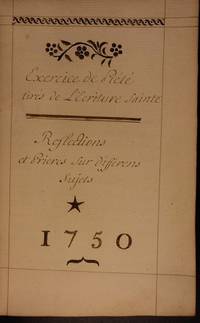
17500002378France. Very Good. 1750. On offer is a superb ancient original French Roman Catholic manuscript relic being a handwritten book titled: Exercise de Piete tires de l'Ecriture Sainte - Reflexions et Prieres sur Differens Sujets. A testament to the art of the scribe the book is dated 1750 the 543 page book of exercises in piety and prayers and meditations on different subjects is beautifully done in a fine calligraphic hand and beautiful embellishments in gold and gilt throughout. Stunning and very well kept with hardly a blemish save for some rubbing to the leather cover and some small splits to the foot of the spine. Overall VG.; French Manuscript; 8vo - over 7¾" - 9¾" tall; KEYWORDS: HISTORY OF ROMAN CATHOLIC CATHOLICISM CATHOLIC FAITH PAPAL FRENCH ROMAN CATHOLIC JESUIT CALLIGRAPHIC ECCLESIASTIC ECCLESIASTICAL PRAYER BOOK THEOLOGY THEOLOGIANS CHRISTIAN CHRISTIANITY CATHOLIC CHURCH SACREMENT SACREMENTAL RELIGION SPECULATIVE RELIGION HANDWRITTEN HANDWRITTEN MANUSCRIPT HAND WRITTEN DOCUMENTS SIGNED LETTERS MANUSCRIPTS HISTORICAL HOLOGRAPH WRITERS AUTOGRAPHS ANTIQUITÉ CONTRAT VÉLIN DOCUMENT MANUSCRIT PAPIER ANTIKE BRIEF PERGAMENT DOKUMENT MANUSKRIPT PAPIER OGGETTO D'ANTIQUARIATO ATTO VELINA DOCUMENTO MANOSCRITTO CARTA ANTIGÜEDAD HECHO VITELA DOCUMENTO MANUSCRITO PAPEL . hardcover
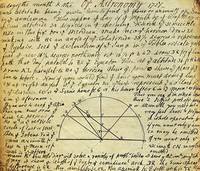
17510002563England. Good. 1751. On offer is a superb original ancient manuscript book of English origins titled "Some Memorandums Relating to Geography and Astronomy. Of the Figure and Extent of the Earth." Dated 1751 even casual reading finds the book filled with what was then cutting edge information being a mere 23 years after Newton's Principia appeared in English. The Age of Sail Britain's dominance of the waves spurred science in the areas of navigation astronomy and the mathematics of Geometry all related and discussed herein. Historians and researchers of the era will undoubtedly recall this was written at the time John Harrison the English clockmaker perfected his marine chronometer. Handwritten by 'W.B.' we surmise a professor or other academic or even perhaps someone with the Admiralty or even an active command along with a student or assistant as evidenced by a different hand. Sometimes WB offers a notation of the other's writings. Here are some examples: time calculation based on the known hour of day at another location on the globe: "The hour being given in any place as at London to find what hour it is in any other part of the world. Rectify ye globe for London. fix ye index of ye dial plate to the hour given suppose 4 oclock in the afternoon this being done turn the globe & bring any places successively to ye Meridien then ye index or hour point will shew ye true hour at ye place required. Rome. Constantinople. Fort St. George in East Indies. Pekin in China. Jamaica. Barbadoes." "On the Longitude and how to find it. This is call'd the Longitude because the earth was supposed longer East to West than from North to South. to find the true distance from E. to W. see Gordon's table pa 9. By this longitude here is not meant that wch is so much sought for and desir'd the Eastening & Westening of Vessels in their Voyages call'd by Gordon the Opprobrium Navigatorum pa 15 but only the distance between the given place and the first Meridian inscrib'd on the Surface of the Globe by Bringing the given Degree of Longitude to the Brazen Meridian and reckoning upon the same meridian. To find the Longitude of any given place bring it to the East side of the Meridien and observe what degree of the Equator is cutt by the Meridien for that is the Longitude of the given place. reckoning upon the same Meridien the degree of Latitude given make a mark with chalk on the point where the Long. & Lat. meet for that is the place desired." "The terrestrial Globe represents the true shape of the Earth or very near it. 1st by the Eclipses of the moon. 2ndly by the roundness of all other planetary bodyes as the Moon Jupiter etc. it may be inferred. 3dly the Earth is demonstratively round because many persons keeping constantly from England in a Western Course of sailing have pass'd the Magellan Straits gone on to the Philippine Islands coasted down by Cochin China. Cape of Good Hope keeping still to a Western Longitude till they make the Canary Isles made their return into the North of England." Other data required for navigators explorers horologists clock-makers cartographers geographers meteorologists and other academics of the time would all have interest in the exercises examples and adding further depth are a number of illustrations hand drawn making for an instructional guide of geographical and celestial problems with solutions. Other subjects include: measurements of the earth its geographic coordinate system the significance of the earth's poles and axis finding longitude or latitude calculating the placement of the sun in respect to the earth at a certain time planetary movement celestial topics such as the rational horizon and the zodiac circle eclipses equinoxes and solstices the oblique descension of the sun the "brazen meridian" calculation of time including earth's seasons and lunar years the origin and methodology of the Julian calendar discerning distances around the world and some geographical features of earth including equatorial islands. The subject of navigation appears on the first page with proof that the earth is spherical setting the tone for the next 44 pages or so. We also note that in a few areas are side notes or addendums. For example one area contains Kingdoms of the World: Britain France Germany Persia and Israel just to name a few. Another note shows the capital cities of the great nations and interestingly Jerusalem is specified as the capital of Israel. 18 x 16 cm. Some age toning and rubbing to the edges one leaf split at hinge but overall G.; Manuscript; 8vo - over 7¾" - 9¾" tall; KEYWORDS: HISTORY OF LONGITUDE COMPLEX MATHEMATICS COMPLEX MARITIME NAVIGATION MARINE MARINERS MATHEMATICAL GEOGRAPHY ASTRONOMY NAVIGATORS EXPLORERS CLOCK-MAKERS CARTOGRAPHERS GEOGRAPHERS METEOROLOGISTS TEACHERS LONGITUDE HOROLOGY NAUTICAL NAVAL 18TH CENTURY CARTOGRAPHY CHRONOMETER ASTRONOMICAL THE AGE OF SAIL JOHN HARRISON D'HORLOGERIE HANDWRITTEN HANDWRITTEN MANUSCRIPT AUTOGRAPHED AUTHORS DOCUMENT AUTOGRAPH WRITER HAND WRITTEN DOCUMENTS MANUSCRIPTS HISTORICAL HOLOGRAPH WRITERS AUTOGRAPHS PERSONAL JOURNAL LOG PRIMARY SOURCE NATURAL HISTORY ANTIQUITÉ CONTRAT VÉLIN DOCUMENT MANUSCRIT PAPIER ANTIKE BRIEF PERGAMENT DOKUMENT MANUSKRIPT PAPIER OGGETTO D'ANTIQUARIATO ATTO VELINA DOCUMENTO MANOSCRITTO CARTA ANTIGÜEDAD HECHO VITELA DOCUMENTO MANUSCRITO PAPELBIOGRAPHY BIOGRAPHICAL AUTOBIOGRAPHICAL AUTOBIOGRAPHY PERSONAL NARRATIVES . unknown
175400TP128Paris FRANCE 1754. On offer is an accounting report for l'Hopital des Incurables in Paris France covering the years 1754 to 1763. This folio of two 23" x 19" folded sheets is a complete and detailed accounting of expenses receivables etc for a ten year period. Beautiful penned final audit of the hospital's accounting. Folded twice into a quarter size the documents are in good shape with some framing to the facing pages and some minor splits to some of the folds. Interior pages are super. Provenance: The collection of SIR THOMAS PHILLIPPS 1792-1872. Born in 1792 Sir Thomas Phillipps from childhood was obsessed with the idea of obtaining virtually anything written or printed on paper including cartloads of documents from wastepaper merchants and the entire inventories of booksellers. "I wish to have one copy of every book in the world" he declared to a friend. He very nearly succeeded. His collection ultimately grew to more than 100000 books and at least 60000 manuscripts. As a result of his extravagant purchases Sir Thomas was permanently on the verge of bankruptcy and was constantly pursued by creditors. So many books arrived at his house that it was impossible to unpack his acquisitions much less keep pace with them. Visiting scholars driven to distraction would spend days hunting for an elusive text in the dusty heaps that filled every room. Because Sir Thomas has a morbid dread of fire most of his collection was housed in coffinlike boxes that could be carted away quickly. Visitors to Middle Hill were struck too by the presence of numerous logs a ploy he used to lure beetles away from his books. As Sir Thomas relentlessly pursued his passion the house itself began to crumble and its floors started to sag under the cast weight of hundreds of tons of paper. His neglect of Middle Hill was partly deliberate however. Sir Thomas's chief enemy in life James Halliwell had married his daughter against his wishes. It appears that Halliwell was in Sir Thomas' eyes the worst kind of criminal a book thief who had stolen valuable works from university libraries and even from his father-in-law. Having no sons Sir Thomas was unable to prevent Halliwell from inheriting his estate. To ensure that his detested heir would never receive anything of value Sir Thomas's solution was to allow Middle Hill to fall unto complete disrepair. He even went so far as to chop down and sell for lumber the centuries-old oak trees that lined the majestic mile-long drive to his home. In 1863 Sir Thomas decided to move - in order to accommodate his books. With the aid of 160 men 103 wagonloads of books and papers drawn by 230 horses the books were lumbered from Middle Hill top their new estate in nearby Cheltenham. It is said that for years afterwards the countryside was littered with the remains of carts that had collapsed under the sheer weight of the Phillipps collection. Sir Thomas continues to add to his library until his death in 1872. After Sir Thomas's death his immediate family had no room for his collection. So vast was the library that although individual items and large sections were sold privately or through numerous auction sales the Phillipps collection is still being sold more than a century after the death of its owner. In the course of its sales many treasures have come to light. As late as 1964 part of the long-lost and unique medieval manuscript of the Roman poet Ovid's Metamorphoses appeared and was subsequently reunited with its other half at Magdalen College Oxford. Once destined for destruction as worthless wastepaper this and many other priceless works were saved by the single-minded obsession of the greatest bibliomaniac of all time. Manuscript. Good. Double Elephant - over 25" - 50" tall. French. Paperback
17590001173BOURISP FRANCE PYRENEES. Good. 1759. Manuscript. On offer is a super relic of French Catholic devotion being a manuscript book of the famed story "Saint Alexis" or "L'illustre Olympie" by Nicolas Mary Desfontaines b. circa 1610 in Rouen d. 4 February 1652 in Angers; actor playwright and novelist and noted French poet see BIO NOTES. Over 80 pages handwritten by a young Pyrenees student in very nice steady calligraphic hand and as stated on the title page: "Tragédie copiée par moy Jean Baratgin habitant du lieu de Bourisp le 24 May mil Sept Cent cinquante neuf 1759". A separate title page at the rear identifies the Teacher M. Jure and the Ecole Bourisp. One online source provides: "The best known of the early Old French saints' lives is the Vie de Saint Alexis the life of Saint Alexis a translation/rewriting of a Latin legend. Saint Alexis fled from his family's home in Rome on his wedding night and dwelled as a hermit in Syria until a mystical voice began telling people of his holiness. In order to avoid the earthly honor that came with such fame he left Syria and was driven back to Rome where he lived as a beggar at his family's house unrecognized by all until his death. He was only identified later when the pope read his name in a letter held in the dead saint's hand. Although the saint left his family in order to devote his life more fully to God the poem makes clear that his father mother and wife are saved by the Alexis' intercession and join him in Paradise. The earliest and best surviving text is in St. Albans Psalter written probably at St Albans England in the second or third decade of the twelfth century. Saint Alexius or Alexis of Rome was an Eastern saint whose veneration was later transplanted to Rome a process facilitated by the fact that according to the earlier Syriac legend that a "Man of God" of Edessa Mesopotamia who during the episcopate of Bishop Rabula 412-435 lived by begging and shared the alms he received with other poor people was after his death there found to be a native of Rome. The Greek version of his legend made Alexius the only son of Euphemianus a wealthy Christian Roman of the senatorial class. Alexius fled his arranged marriage to follow his holy vocation. Disguised as a beggar he lived near Edessa in Syria accepting alms even from his own household slaves who had been sent to look for him but did not recognize him until a miraculous vision of the Blessed Virgin Mary singled him out as a "Man of God." Fleeing the resultant notoriety he returned to Rome so changed that his parents did not recognize him but as good Christians took him in and sheltered him for seventeen years which he spent in a dark cubbyhole beneath the stairs praying and teaching catechism to children. After his death his family found writings on his body which told them who he was and how he had lived his life of penance from the day of his wedding for the love of God. St Alexius' cult developed in Syria and spread throughout the Eastern Roman Empire by the 9th century. Only from the end of the 10th century did his name begin to appear in any liturgical books in the West. Since before the eighth century there was on the Aventine in Rome a church that was dedicated to St Boniface. In 972 Pope Benedict VII transferred this almost abandoned church to the exiled Greek metropolitan Sergius of Damascus. The latter erected beside the church a monastery for Greek and Latin monks soon made famous for the austere life of its inmates. To the name of St Boniface was now added that of St Alexius as titular saint of the church and monastery known as Santi Bonifacio e Alessio. It is evidently Sergius and his monks who brought to Rome the veneration of St Alexius. The Eastern saint according to his legend a native of Rome was soon very popular with the folk of that city and this church being associated with the legend was considered to be built on the site of the home that Alexius returned to from Edessa. St Alexius is mentioned in the Roman Martyrology under 17 July in the following terms: "At Rome in a church on the Aventine Hill a man of God is celebrated under the name of Alexius who as reported by tradition abandoned his wealthy home for the sake of becoming poor and to beg for alms unrecognized." While the Roman Catholic Church continues to recognize St Alexius as a saint his feast was removed from the Roman Catholic Calendar of Saints in 1969 which lists the saints to be celebrated everywhere at Mass and in the Liturgy of the Hours of the Roman Rite. The reason given was the legendary character of the written life of the saint. The Catholic Encyclopedia article regarding St. Alexius remarked: "Perhaps the only basis for the story is the fact that a certain pious ascetic at Edessa lived the life of a beggar and was later venerated as a saint." The Tridentine Calendar gave his feast day the rank of "Simple" but by 1862 it had become a "Semidouble" and in Rome itself a "Double". It was reduced again to the rank of "Simple" in 1955 and in 1962 became a "Commemoration". According to the rules in the present-day Roman Missal the saint may now be celebrated everywhere on his feast day with a "Memorial" unless in some locality an obligatory celebration is assigned to that day. The Eastern Orthodox Church venerates St Alexius on 17 March. Five Byzantine Emperors four Emperors of Trebizond and numerous other eastern European and Russian personalities have borne his name. The tale of St Alexius has parallels with that of The Prodigal Son as told in the biblical Book of Luke. As it appears in Legenda aurea later retold in the Gesta Romanorum it is almost identical with a tale told of the Tathagata Buddha in the famous Lotus Sutra. Dimensions : 24 cm X 19 cm. 81 hand numbered pages. Front cover torn away back cover generally soiled and has some writings as if used as a blotter. Interior G.; 8vo - over 7¾" - 9¾" tall; ST. ALEXIS SAINT ALEXIS NICOLAS MARY DESFONTAINES BARATGIN HAUTE PYRENEES BOURISP ROMAN CATHOLIC FRANCE FRENCH PRE FRENCH REVOLUTION CATHOLICISM CHRISTIANITY RELIGION PAPAL POPE HANDWRITTEN MANUSCRIPT DOCUMENT LETTER AUTOGRAPH WRITER HAND WRITTEN DOCUMENTS SIGNED LETTERS MANUSCRIPTS HISTORICAL HOLOGRAPH WRITERS AUTOGRAPHS PERSONAL antiquité contrat vélin document manuscrit papier Antike Brief Pergament Dokument Manuskript Papier oggetto d'antiquariato atto velina documento manoscritto carta antigüedad hecho vitela documento manuscrito Papel; Signed by Autograph . unknown
17590009049MANSFIELD WINDHAM COUNTY CONNECTICUT COLONY 1759. On offer is an extraordinary historical document of pre-Independence America and the French and Indian War which pitted the colonies of British America against those of New France with both sides supported by military units from their parent countries and American Indian allies. The document in question is two and a half pages dated 1759 concerning the legal case of a man named Jesse Dimmick of Mansfield Windham County Connecticut a member of the 10th Company Connecticut Militia who refused to accompany the combined Expedition of British Regular and American Militia for the purpose of invading Canada during the French and Indian War. The letter is sent from attorney to our Svrn Lord the King for sd Country named Jedediah Elderkin to Samuel Gray Esq. one of his majestys justices for ye peace for Windham County Conn. The letter begins with some background to the desertion General Assembly of ye Coloney of Connecticut at their Sessions held in New Haven in March last did resolve and order to Raise five thousand troops in sd Colony to Joyne his majestys Regular troops in North America & in junction with them to invade Canada and Carry war into the hart of the Enemies Country in pursuance to his majestys orders and Instructions.Col. Dyar having recd sd orders did then immediately grant his proper warrant under his hand to Joseph Stors of Mansfield Capt of the 10th military Companey in sd 5th Regiment him ordering to Impress or Detach of the Soldiers under his command or those that ware with in the Limits of sd Companey to able bodied effective men to go in sd expedition. The letter than discusses the case of Mr. Dimmick. .but sd Jesse Dimmick not regarding the Laws and Constitution of sd Coloney to sd detachment & order did neglect and refuse to joyne sd company under sd Major Glass or in any wise to go in sd expedition which neglect and refusal of sd Dimmick is against the peace of ye King his crown & dignity and contrary to the Laws of this Coloney in such case made & provided given under my hand in Windham County February 27th day anno domine 1759 & in the 32 year of his majestys raign Jedediah Elderkin The next page contain more details of the case. .you are hereby Commanded forthwith to arrest sd body of the with named Jesse Dimmick and him have forth with before Amon Babcock Esq one of his majestys justices of sd peace for sd County of Windham. this part is dated March 29th 1759 by Samuel Gray Justice of sd peace. The last part of the document dated the 17th day of April 1759 concerns the trail of Mr. Dimmick who has been arrested and brought before the justice of the peace where Dimmick pleads not guilty to the charges against him. Dimmick appeard in sundry Guidances all which were thoroughly examinned by this court & Dimmick way heard in his defense & this court having examined sd J. Dimmick & sd guidances summoned their in of sd openion that their in cours of action.that Dimmick becom bound with loyalty in a recognized bond to sd ___ of sd County of Windham of twenty pounds lawful money. This is signed the above is & with in are true copys of Record as in life. Amos Babcock justice of sd Peace. The very last page contains a list of costs associated in pounds shillings and pence Costs abound to Mr. Nebon £1-6-0; Court fees £0-2-0; the total cost of the trail for Dimmick appears to be £2 1 shilling and six pence before his court appointed penalty of 20 pounds for refusing to join the service. The document is in folio format measuring 13 x 8 inches dated 1759 in very good clean and legible condition. The script can at times be difficult to decipher due to the dated language and spelling of the era but rewards a close look both the for the interesting facts of the case as well as the wider military and historical significance of these report in the decades prior to American Independence when it was still a British colony. There is no description of why Dimmick chooses not to join the militia but it could be because of a belief in an independent America. This could be why he pleads not guilty to charges he is clearly guilty of. Background: The French and Indian War 175463 comprised the North American theater of the worldwide Seven Years' War of 175463. The war pitted the colonies of British America against those of New France with both sides supported by military units from their parent countries of Great Britain and France as well as by American Indian allies. Jesse Dimmick was born between 1725 and 1726 and died on the 10th of January 1771. He married Rachel Kidder on May 19 1751 in Dudley Massachusetts. Jedediah Elderkin was born in Norwich Connecticut in 1717. Col. Elderkin and Col. Dyer were the leading lawyers in Eastern Connecticut. Jedidiah Elderkin was appointed Justice of the Peace in 1756 and chosen a member of the General Assembly from Windham in the spring of 1751 and repeatedly afterwards until 1785. In March 1775 Jedidiah Elderkin Esq. was commissioned a Colonel of the Fifth Regiment of the Connecticut Militia. Good. Folio - over 12" - 15" tall. Manuscript. unknown
17590007025LOWER CANADA QUEBEC NEW ENGLAND. Good. 1759. On offer is a superb original historic manuscript relic and American colonial document about one of the pivotal events in North American history. Measuring about 8 inches by 6 inches this 2 page document is made of hand laid paper and bears a mid 18th Century British watermark. The paper has some light stains but otherwise is in very good condition. The handwriting is clear and legible. Both sheets are completely filled. Written as a poem no later than 1809 the manuscript is entitled The Battle of Quebec 1759. It was found among the colonial papers of Eliphelet Coffin. Coffin was born in Dover NH in 1742 and farmed there all of his life. He died in 1808. He may or may not be the author of the poem. The Battle of Quebec 1759 is also known as the Battle of the Plains of Abraham. This was a pivotal battle in the Seven Years War between Britain and France the history of North America and the history of Canada. For seven years Britain and France fought essentially the first world war in history. The war was driven by the commercial and imperial rivalry between Britain and France Although British armies supported their European allies against France and her allies Britain deliberately targeted France's overseas colonies in a determined drive to destroy France as a commercial rival. In North America the British victory over France established British hegemony in North America. The removal of France as a North American power increased the confidence of British colonies such as New York Pennsylvania and Massachusetts the backlash of which likely seeded the desire and drive for greater independence from Great Britain from those ever increasingly disgruntled 'Americans'. The Battle of the Plains of Abraham therefore led indirectly to the American Revolution and the creation of the United States. For Canada the sounds of the guns on the Plains of Abraham echo down to this day. It marked a crucial turning point in Canadian history. The Seven Years war in North America laid the bi-cultural foundations of modern Canada. As it also led indirectly to the American Revolution it further influenced Canadian identity and boundaries including the influx of Loyalists and the creation of Upper Canada and New Brunswick. Here is a snippet: "King George and Luwis could not agree ref to Louis XV of France Where there Divided line should be Til they had fought by land and sea They seemed in all a flame from Stanza 1 Bold Sandler comes with fifty ships ref to Vice-Admiral Charles Saunders The sea looks red what doth the mail With a loud triumph and a pleasant gale Right up to Quebec we did go from Stanza 2.; Manuscript; 8vo - over 7¾" - 9¾" tall; KEYWORDS: HISTORY OF COLONIAL CANADA BATTLE OF THE PLAINS OF ABRAHAM; SEVEN YEARS WAR; FRENCH INDIAN WARS; ELIPHELET COFFIN; GENERAL JAMES WOLFE; VICE-ADMIRAL CHARLES SAUNDERS; LOUIS-JOSEPH DE MONTCALM UPPER CANADA LOWER CANADA PRE REVOLUTIONARY WARS FRANCE VERSUS ENGLAND NORTH AMERICA PRE CONFEDERATION CANADIANA QUEBEC AMERICANA HANDWRITTEN MANUSCRIPT DOCUMENT LETTER AUTOGRAPH WRITER HAND WRITTEN DOCUMENTS SIGNED LETTERS MANUSCRIPTS DIARY DIARIES JOURNALS PERSONAL HISTORY SOCIAL HISTORY HISTORICAL HOLOGRAPH WRITERS AUTOGRAPHS PERSONAL MEMOIR MEMORIAL ANTIQUITÉ CONTRAT VÉLIN DOCUMENT MANUSCRIT PAPIER ANTIKE BRIEF PERGAMENT DOKUMENT MANUSKRIPT PAPIER OGGETTO D'ANTIQUARIATO ATTO VELINA DOCUMENTO MANOSCRITTO CARTA ANTIGÜEDAD HECHO VITELA DOCUMENTO MANUSCRITO PAPEL . unknown
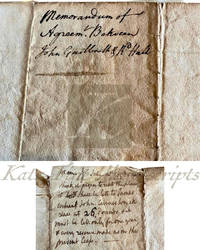
17630001650<p>On offer is a pre-Revolutionary plantation rental agreement between a Philadelphia shopkeeper and a Springfield millwright featuring notes that connect multiple family and business ties in late 18th-century Philadelphia and Chester counties.</p><p>The rental memorandum is the work of Philadelphia-based lawyer Paul Isaac Voto whose office was located at <em>"the corner of Black Horse Alley in Second Street." </em></p><p>The agreement was drafted between Mr. John Gailbreath often spelled Galbreath or Gilbreath in other historical documentation c. 1717–1766 a shopkeeper whose store was located <em>"in Second Street between Market and Chestnut streets" </em>and the prospective renter millwright Richard Hall of Springfield Chester County. Historical documents show that Hall also owned property in the region.</p><p>Dated May 1763 the rental memorandum indicates that John Gailbreath <em>".letts his house and plantation in Springfield… for one year from the date hereof to… Richard Hall paying the rent of twenty seven pounds…"</em></p><p>The agreement lays out several rules of tenancy including the following examples:</p><ul><li><p><em>"The Tenant is to have Liberty to reap his Corn and Thrash it in the Barn after the time is over leaving the Thaw and Chatt…"</em></p></li><li><p><em>".the Tenant agrees not to take any Hay Straw or Dung off the Premises…"</em></p></li><li><p><em>".the Tenant agrees to… keep the House… and Premises in repair as good as now… shall not keep more fires in the House but only one in the kitchen and one in another room and… not to cut any timber or wood But in the Back Field joining to Crosiers Croziers Plantation…"</em></p></li></ul><p>A caveat on the verso of the lease agreement states that <em>".If John McCoy do not think it proper to rent the place it shall be lett to James Cochran John Cairnes son in law at 26 pounds…" </em>According to historical news documents Galbreath was traveling in 1763 and appears to have entrusted a Chester County contact with the final decision on the rental in his absence.</p><p>The document is signed by Hall but not Galbreath. Its delivery was witnessed by Paul Isaac Voto and Elyha Taylor and the original seal is present.</p><p>This document provides not only insight into property rights legal agreements and plantation rentals in pre-Revolutionary Pennsylvania but it also offers genealogical data to support research on the still-incomplete history of early Pennsylvania families. These include the Cairnes Voto Hall Cochran and Crozier or Crosier families among others.</p><p>While some 18th-century newspaper data exists digitally to assist with ongoing research these being the sources used to find the location of the subjects' businesses this document remains an invaluable primary source for those interested in 18th-century life movement and genealogical links.</p><p><strong>Condition:</strong> Significant age toning folding and micro-tears with significant tearing in one corner. The document is written in ink with a clear legible hand and remains in good condition for its age. Overall: Fair to Good.</p>
17650073961765. Near Fine. 1 handwritten parchment document 39 x 55 cm. stamped sealed. Lady Frances Arundell d. 1769of Allerton Mauleverer York Co. widow gives to Edward Pearce of Truro burough Cornmall Co. surgeon Penpolwartha in Cornwall for 57 pounds and annual rent as a life interest during the life of Edward Pearce his sister Grace Pearce and Richard Johns son of Stephen Johns age 3. Witnessed by James Willyams and James Willyams Jr. In Near Fine Condition: exterior is lightly soiled; otherwise clean and crisp. unknown
1771000962St. Pierre L'Ebeaques St. Pierre les Beckets Que 1771. On offer is an original November 7th 1771 handwritten manuscript document from St. Pierre L'Ebeaques St. Pierre les Beckets Quebec Lower Canada "Inventaire de la Commonauté des biens qui etat entre pour Genevieve Brisson and Joseph Mailliot" being an early Bas Quebec marital communion of assets where we can find many great descriptions of furniture and house objects plus commentary. Research suggests that the author was most certainly a Jesuit priest acting as justice of the peace. Some old damp-staining in two spots and some separation at the folds but otherwise in fair condition. Autograph. Fair. 4to - over 9¾" - 12" tall. unknown
17740MV567France. Very Good. 1774. Manuscript. Fascinating pair of handwritten documents. On January 30 1774 de Fondeville writes from Marignac to Monsieur de Langentiere. Very detailed very extensive 3 page letter discussing business dealings with Baron de Gaillac. On February 22 a mere 24 days later de Fondeville re-writes the exact same letter to Madam de Langentiere with even more details as he has learned of her husband's passing. One can assume Madam wrote de Fondeville explaining the circumstances. Written a mere 2 and a half months before the King's death ending the rule of one of France's worst kings and assuredly the beginning of the French Revolution due to Louis XV failure as a leader and his personal scandals.; 8vo - over 7¾" - 9¾" tall; KEYWORDS: HISTORY OF FRANCE MANUSCRIPT HANDWRITTEN KING OF FRANCE LOUIS XV HOLOGRAPH ARCHIVE DOCUMENT LETTERS AUTHOR AUTOGRAPH ; Signed by Autograph . unknown
1775000861France. Good. 1775. On offer is an original 1775 folded map titled 'Cartes des Postes de France'. The map opens into a fullsize 25.5 x 25.5 inch map of France comprised of sixteen 16 panels. The panels have been glued to what appears to be linen. This was a craftsman item not something 'homemade' as evidenced by the quality work in cutting the panels and affixing to the canvas backing and the edging. It is easy to assume that this was made for travel because of its ease of use. From the lower right bottom edge: LE ST. JAILLOT DONNE AVIS QUE L'ON CORRIGE CETTE CARTE CHAQUEFOIS QU'IL EN RECOIT LES ORDRES POUR LE LIVRE DES POSTES AFIN QUELLE SE TROUVE CONFORME AUD LIVRE ET QU'ELLE A ETE CORRIEGE LE PREMIER JANVIER 1775 ET DEPUIS JUSQU'A CEJOUR. This would be G save for some moderate splitting.; French; 16mo - over 5¾" - 6¾" tall; MAP FRANCE POSTES STATIONS HAND COLORED HAND COLOURED MANUSCRIPT DOCUMENT LETTER AUTOGRAPH DIARY JOURNAL LOG KEEPSAKE WRITER HAND WRITTEN DOCUMENTS SIGNED LETTERS MANUSCRIPTS HISTORICAL HOLOGRAPH WRITERS DIARIES JOURNALS LOGS AUTOGRAPHS PERSONAL MEMOIR MEMORIAL PERSONAL HISTORY antiquité contrat vélin document manuscrit papier Antike Brief Pergament Dokument Manuskript Papier oggetto d'antiquariato atto velina documento manoscritto carta antigüedad hecho vitela documento manuscrito Papel . unknown
1876030005Cambridge: Hurd & Houighton 1876. 1st Edition 1st Printing. Hardcover. Very Good . 226 Pp Index At Rear. Original Brown Cloth Gilt And Stamped In Blind 9 1/8" Tall Dark Slate Endpapers. First American Edition In French. Light Wear At Corners Slight Wear At Edges A Few Small Discolorations To Covers All Gilt Brilliant Hinges Tight No Names Or Marks. <br/> <br/> Hurd & Houighton hardcover
1776000493<p>On offer is an extraordinary Revolutionary War and early American maritime artifact: the personal copy of The General Gazetteer: or Compendious Geographical Dictionary fourth edition 1776 owned and annotated with phenomenal Revolutionary War content by John Prince 1762-1848 of Marblehead Massachusetts. Prince was a Revolutionary War privateer ship master selectman and Justice of the Peace.</p><p>Across the blank front and rear endpapers and pastedowns Prince filled eight manuscript pages with notes spanning roughly 48 years from 1779 to at least 1827. The book itself is significant to the manuscript content. The General Gazetteer was a practical eighteenth-century reference work identifying countries ports cities rivers harbors distances political divisions and historical facts. This content would have been useful to a young mariner and Prince used the blank leaves to record his work memory education and thought.</p><p>These notes are not casual marginalia but personal working record that fills in a large gap in the existing knowledge of Prince and the famed Revolutionary ship the Pilgrim captained by Hugh Hill 1740-1828. </p><p>The most important entry is Prince's firsthand retrospective account of his first voyage to sea during the American Revolution. On one page he writes <em>"1779 Pilgrim Sail'd April the 13 1779"</em> and signs the book in Latinized form <em>"Johannes Prince Ejus Liber July the 9 1779" </em><em>"John Prince his book."</em>. In the surrounding manuscript he gives a narrative of this voyage beginning<em> "The first of my going to Sea was in the Pilgrim" identifying the famous Beverly privateer as "a ship of 16 9 pounders 140 Men"</em> under <em>"Hugh Hill Commd'r."</em></p><p>This is an exceptional Revolutionary War naval passage. Prince records that during this cruise they took eleven British prizes including a bark from Liverpool England armed with fourteen guns. He describes the vessel as a Letter of Marque loaded with goods taken by boarding after a tense encounter in fog. The opposing vessel flew American colors claimed to be from Charlestown and then hauled down the American colors and raised British. Prince records that the British captain and sailing master were killed and that several men were wounded. He further notes that prisoners were landed on the coast of Ireland.</p><p>The language is unusually vivid and unusually reflective. Prince does not simply glorify the action. Writing from the perspective of one who had been only seventeen years old he adds: <em>"War is a Calamity — privateering & Pirateering are about the Same." </em>He then explains the practical necessity of his choice: <em>"At this period Æ 17 I so thought but with me it was of necessity there was no other Employ" </em>adding that he did not have his father's approval.</p><p>This passage gives the manuscript unusual emotional and historical force: a Revolutionary War privateer looking back on the violence and moral ambiguity of privateering while also explaining the economic pressure that drove a Marblehead teenager to sea.</p><p>The entry is important in relation to Prince's later documented Revolutionary War statement. In June 1839 Prince swore that he had taken an active part in the Revolution had served in Rhode Island in 1778 under Col. William R. Lee and had gone on nine cruises during the war aboard privateers and Letters of Marque. He also stated that he had been one of the prisoners aboard the British sloop of war Lively and the <em>"leader and adviser" </em>of the prisoners who rose up in November 1782 captured the vessel carried her safely into Havana and sold her for $22000 Lindsey 1915.</p><p>That affidavit gives the broad outline of Prince's Revolutionary service but this manuscript appears to preserve something different and rarer: <em>Prince's earliest known firsthand account of his first voyage as a seventeen-year-old privateer.</em></p><p> According to the Peabody Essex Museum finding aid the institutional holdings of the John Prince Papers begin with Prince's writing in 1784 while earlier papers in that archive relate to Joseph Hooper and family. If so the 1779 material contained within this book fills a significant gap in the surviving documentary record of Prince's early wartime life while also providing rich firsthand content about the Revolutionary wartime activities of the famed privateer ship Pilgrim.</p><p>The manuscript also documents Prince's development from teenage privateer to experienced ship master. A later entry refers to the schooner Philanthropist and reads in part: <em>"Philanthropist. John Prince Commander in Bilboa. Wrote & copied by Mr John Cross - Mate - 1795." </em>This corroborates published Marblehead maritime records identifying Prince with the schooner Philanthropist in 1795 and the brigantine Philanthropist in 1800 strengthening the chain of identity between the manuscript writer the Revolutionary War privateer and the later Marblehead ship master. The note is also valuable because it names his mate and situates Prince within the postwar Atlantic maritime world.</p><p>Another manuscript page preserves navigational mathematics including longitude and latitude calculations conversions into minutes logarithmic values and what appears to be a calculation involving meridional miles. These calculations help show that this gazetteer was a working maritime object not simply a household book. Prince was using its blank leaves for the kinds of geographical and mathematical work directly connected to navigation and transatlantic travel.</p><p>The remaining manuscript notes reveal Prince's intellectual world over many decades. He copied or composed historical notes on Sigismund the Council of Constance John Wycliffe Jan Hus Jerome of Prague Martin Luther the Council of Nicaea the Council of Trent the Synod of Dort Sir Walter Raleigh Masaniello and the Insurrection at Naples the Cinque Ports Oxford and Cambridge and the lack of parliamentary representation for Manchester in 1827. These notes show a sustained interest in geography institutions religious reform rebellion representation and the relationship between authority and resistance.</p><p>That pattern matters. In the same book that preserves his account of privateering during the American Revolution Prince was also curating a personal history of reform conscience insurrection and civic rights. The manuscript therefore has a much broader significance than a naval memorandum alone. It preserves the lifelong working mind of a New England ship master whose experiences moved from Revolutionary privateering to Atlantic trade civic office and historical reflection.</p><p>There is also a visible large cursive name<em> "Nancy Prince"</em> written vertically through one of the manuscript pages and later smudged or obscured but still visible. This is likely Anna Nancy Prince 1766–1841 John Prince's younger sister adding to the evidence of family provenance.</p><p><strong>Biographical Notes:</strong></p><p><strong>John Prince</strong> was born in Marblehead Massachusetts on January 4 1762. Published Marblehead records identify him as a seaman and ship master associated with the ship St. Helena the schooners Hope Catherine Betsy and Philanthropist and the brigantine Philanthropist. He later served Marblehead as selectman during multiple terms between 1803 and 1825 and was also a Justice of the Peace. He married Elizabeth Wendall in 1787 and they had at least one child. He died on January 29 1848.</p><p><strong>Hugh Hill </strong>August 1 1740 – February 17 1829 was an Irish-born Massachusetts sea captain and Revolutionary War privateer commander. After coming to Massachusetts he first settled in Marblehead before making his home in Beverly. During the Revolution he became one of Beverly's best-known privateering figures commanding the ship Pilgrim and later the privateering vessel Cicero. His appearance in Prince's manuscript gives the account a direct connection to one of the major maritime figures of Revolutionary Beverly.</p><p>This is a highly desirable manuscript-bearing volume for an institution collecting in early American maritime history Revolutionary War privateering Marblehead and Essex County history Atlantic world studies the history of navigation or the intellectual life of early American seamen. It is both a Revolutionary War naval document and a rare material witness to the lifelong working mind of a documented Massachusetts captain.</p><p><strong>Condition:</strong></p><p>1776 printed volume with manuscript notes to the front and rear endpapers and pastedowns. The manuscript pages show age toning wear smudging scattered staining edge wear and some losses or tears affecting portions of text. Some writing is faint crossed out or partially obscured. The printed book should be considered a working eighteenth-century volume rather than a fine copy. The binding is structurally fragile with a pronounced split along the spine. The text block remains tenuously attached by only a small amount of surviving sewing and further separation may occur with handling or transit despite careful packing. Careful shipping will be ensured but the binding should be treated as vulnerable and at risk of further detachment. The manuscript content remains substantial legible in important passages and historically significant.</p><p><strong>References:</strong></p><p>Ancestry.com. n.d. Ancestry. Ancestry.com Operations Inc. Retrieved June 15 2026</p><p>Colonial Society of Massachusetts. 1922. January meeting 1922.</p><p>Lindsey B. J. 1915. Old Marblehead sea captains and the ships in which they sailed. Published for the Benefit of the Marblehead Historical Society.</p><p>Phillips Library Peabody Essex Museum. n.d. John Prince papers Archival collection. Peabody Essex Museum ArchivesSpace. Repository 2 resource 415.</p><p>Scully T. F. n.d. Interesting burials in Beverly cemeteries. City of Beverly.</p><p>Three Decks. n.d. American privateer ship "Pilgrim" 1778. Retrieved June 15 2026</p> hardcover
17840001768ROCHESTER NEW HAMPSHIRE NH 1784. On offer is an original 1784 manuscript cypher and mathematics book handwritten by John McDuffee of Rochester Vermont. There are 52 pages of arithmetic and mathematical tables equations and principles: compound multiplication compound division reduction for farthings shillings etc. calculation the minutes since the birth of the Savior to 1784 tons of wine hogsheads of wine The Golden Rule provisions measurements interest Rules of Practice gallons of rum table of money weights and measures some business principles . Measuring 7.25 x 11.75" it is bound in together without covers; the first and last leaf a bit more darkened as a result of wear. Remaining all bound the leaves are very clear and easily read with minimal edgewear and rounding for their age and use. McDuffee has written his name and place of residence in many places with dates starting at 1784 and some references to 1801 such as someone owing him money etc. BIO NOTES: His stepfather was Lt Col. John McDuffe son of an Irish immigrant that fought valiantly in both the French and Indian War and the Revolution and was a Congressman. John Jr whose real father was Capt Daniel McDuffee was adopted by Lt Col John Sr. McDuffee went on only a few years after his schooling and the creation of this cypher book to become a successful farmer and important part of Rochester's history as noted below so this gives added charm to this fantastic post Revolutionary War cypher book. Overall Fair. Fair. 4to - over 9¾" - 12" tall. Manuscript. unknown
1786000814Louvain Belgium Belge. Very Good. 1786. Leather Spine. On offer is a superb fine and unique handwritten manuscript book representative of top tier 18th century European education and study of astronomy including theory problems corollaries and observations and with relation to map making geography and philosophy. This elegant book would have served as a course 'text' at the Catholic University of Louvain as evidenced by the engraved title page vignette of a major building at Louvain straddled by portraits of Plato and Aristotle while overhead the Latin motto "Porcus Alit Doctos" features Mary Joseph and the baby Jesus on one side and a caped shepherd on the other and then inscribed by hand in the central panel by or for philosophy student Jacobus Van Asten Leendanus ANNO 1786. One online source provides a succinct explanation as to the importance of astronomy at this time in history: "During the course of the eighteenth century the combination of theoretical and practical advances allowed astronomy to solve most of the outstanding problems that had been raised by the work of Newton and the earlier astronomers. New instruments such as the micrometer reflecting telescope and achromatic telescope allowed the cataloging of stars with increasing precision and the discovery of new phenomena such as aberration nutation nebulae and a new planet - by the end of the century astronomy seemed to have become the most perfect science and astronomers were beginning to speculate concerning the origins and shape of the universe." In handsome cursive handwriting 20 x 16.5 cm 8vo original calf raised bands and mottled paper boards there is some wear to the hinges but is otherwise sturdy; features nine engraved plates many fold out and a number other graphics throughout a previous bookdealer's notes identify the engraver as Charles Becker who worked at Louvain University at the time of the birth of Louis XVII Benezit I pp.563. Approx. 150 pages. Complete. The manuscript has especially interesting section on the problems of map-making with latitude and longitude. VG.; Latin; 8vo - over 7¾" - 9¾" tall; KEYWORDS: HISTORY OF ASTRONOMY ASTRONOMICAL CARTOGRAPHY MAP MAKING GEOGRAPHY RARE ANCIENT PHILOSOPHY LATIN HANDWRITTEN MANUSCRIPT DOCUMENT LETTER AUTOGRAPH KEEPSAKE WRITER HAND WRITTEN DOCUMENTS SIGNED LETTERS MANUSCRIPTS HISTORICAL HOLOGRAPH WRITERS AUTOGRAPHS antiquité contrat vélin document manuscrit papier Antike Brief Pergament Dokument Manuskript Papier oggetto d'antiquariato atto velina documento manoscritto carta antigüedad hecho vitela documento manuscrito Papel Catholic Catholicism Jesuits orreries Planetary Longitude Latitude Orrery Astronomie . hardcover