PINI ErmenegildoMareMagnum

41 775 résultats
In-8 (mm. 235x170), 2 volumi, p. pelle bazzana coeva, sottili cornici dorate ai piatti, dorso a cordoni con decoraz. e tit. oro su due tasselli, tagli rossi, pp. (8),275; (12),335 (mal num. 235); molto ben illustrati f.t. da complessive 36 tavole, inc. in rame e più volte ripieg., che contengono 145 figure relative a utensili, macchinari, forni, lavori metallurgici, ecc. Nel 1° volume: “Quo in V. Libros tributo. Explicantur, quae ad eam rem generatim faciunt” - Nel 2°: “Quo in VI. Libros tributo. Artificia metallorum ex singulis venarum generibus conficiendorum explicantur”. "Edizione originale", raro. Dopo l'uscita del secondo volume (1780) fu stampata un'ulteriore errata che si trova aggiunta in alcuni esemplari. Cfr. Brunet,IV,667: “cet ouvrage a eu beaucoup de succès” - Poggendorff, p. 455. "Il milanese Ermenegildo Pini (1739-1825), barnabita, professore di matematica quindi di storia naturale alle Scuole arcimboldiche in Milano, fu Membro dell'Istituto del Regno Lombardo-Veneto e della Società Italiana. Nel 1773 si dedicò a visitare, con il confratello p. Luigi Francesco Fontana, diversi istituti scientifici e musei di Vienna, e anche le più importanti miniere d’Ungheria: nel 1778 fu nominato delegato alle Miniere della Lombardia austriaca e, nel 1779, soprintendente alla Metallurgia (fra tutti i suoi studi, si vedano: Osservazioni mineralogiche su la miniera di ferro di Rio ed altre parti dell’isola d’Elba, Milano 1777 - De venarum metallicarum excoctione, Milano 1779-80). Da allora in poi si occupò di mineralogia e geologia naturale, dando lustro anche ai musei di Pavia – coadiuvando l’abate Lazzaro Spallanzani – e di Mantova, provvedendoli di nuovi e preziosi minerali. Con il decreto napoleonico di soppressione delle congregazioni religiose del 25 aprile 1810, egli poté comunque continuare a dimorare a S. Alessandro, insegnando chimica e storia naturale fino al 1812. Entrò così di diritto nella storia della cultura scientifica lombarda che vide eccellere particolarmente i barnabiti nel Settecento”. Così Diz. Biografico degli Italiani, vol. LXXXIII. Bello e fresco esemplare, stampato su carta azzurrina.
In-4 p. (mm. 320x220), mz. pelle settecentesca (risg. rifatti), dorso a cordoni con filetti e tit. oro, 4 cc.nn., 288 pp.num., testo su due colonne, marca tipografica al frontespizio, ornato da testate e grandi iniziali figurate a vignetta inc. su legno, con 9 tavole f.t. inc. in rame. Queste interessanti e famose tavole, su disegno di Angelo Carlesco da Pordenone, raffigurano strumenti chirurgici. L'opera è divisa in due parti: "Nella prima si tratta delli Tumori, Ferite, Ulceri, Rotture e Slocature - Nella seconda delle Operationi principali di Chirurgia. Tradotte in lingua Italiana. Et in questa seconda impressione aggiuntovi un Compendio della Chirurgia di Marco Aurelio Severino, diviso in Libri Sei, tradotto nell'Italiano utilissimo ai Professori di Chirurgia". Cfr. De Renzi,III, pp. 647-652 - Premuda, p. 144 e segg. - Cat. Piantanida,II,1905 - Wellcome Library,III, p. 4. Leggerm. corto di margine; con lievi uniformi arross. e tracce d’uso interc. nel t.; la p. 47 restaur. per piccolo strappo, ma certamente un buon esemplare. Gerolamo Fabrizio d'Acquapendente (1537-1619) fu uno dei più grandi anatomici e chirurghi del suo tempo.. Nei lavori di Fabrizio si trovano indicate macchine costruite a scopi ortopedici, come ad es. per la cura del collotorto, delle deviazioni della colonna vertebrale, ecc. Inventore ingegnoso di nuovi apparati, fu senza dubbio il chirurgo più in voga nell'Italia del Rinascimento, cosi' Castiglioni, p. 475.
28 durchlaufend numerierte Radierungen (62:118 mm bei einem Blattmaß von 220:345 mm) auf 14 Bll. (jeweils recto u. verso bedruckt; die letzte in der Platte signiert). In losen Bogen ineinandergelegt, die Blätter jeweils von zeitgenössischer Hand mit ausführlicher dt. Beschreibung der Dargestellten versehen. Bemerkenswertes Beispiel naiver Tiroler Volkskunst des Hochbarock. Die Radierungen dokumentieren das Skulpturenprogramm am Grabmal Kaiser Maximilians in der Innsbrucker Hofkirche und zeigen alle 28 um den Kenotaph des Kaisers wachenden "Schwarz-Mander". Die Bilder der hier komplett vorliegenden Folge wurden mit Sicherheit in der Innsbrucker Hofkirche auch einzeln als Wallfahrtsbilder ausgegeben. Während der handschriftliche Text dem Werk Mildorfers folgt, sind die Radierung völlig unabhängig von den dort veröffentlichten Abbildungen und wohl auch etwas früher als diese entstanden. - Der aus einer Innsbrucker Goldschmied- und Medailleurfamilie stammende Jakob Jezl (1677-1748) lernte das Radierhandwerk unter seinem gleichnamigen Vater, der der Regierung und den Ständen von Innsbruck wiederholt "kleinere Arbeiten lieferte" (Thieme/B.). Wie schon sein Vater verfertigte auch er "eine Reihe von Gelegenheitsbildern mit Darstellungen von Ehrenpforten, Wallfahrtsandenken, Exlibris u. dgl., doch alles ohne jegliche Kenntnis von Anatomie oder Perspektive. Besonders kläglich fiel der Stich der Bronzestatuen der Innsbrucker Hofkirche aus" (ebenda). Nur das erste und letzte Blatt etwas angestaubt bzw. im Rand leicht knittrig. Die ersten drei Radierungen zeitgenössisch koloriert. Die vollständige Serie in einem außergewöhnlich breitrandigen Exemplar und durchwegs klaren Abzügen auf gänzlich unbeschnittenen Bögen. Aus der Sammlung Josef Ringer. Thieme/Becker XVIII, 549.
In-4 p. (mm. 280x215) e in folio max. (mm. 610x470), 2 volumi di cui 1 di Atlante. Il vol. di testo è rilegato in mz. pelle coeva (ben restaur.), fregi e titolo oro su tassello al dorso, pp. (4),290,(2). “Précédé du Rapport fait à l’Institut sur ce Mémoire, par MM. Sané, Biot, Poisson et C. Dupin. Imprimé par ordre de Son Excellence le Ministre de la Marine et des Colonies”. L’Atlante, in mz. pelle mod. con ang. (abras.), conserv. bross. muta orig., contiene 17 tavole litografate da Langlumé (di cui 1 a doppia pag.), con complessive 182 figure (sono disegni tecnici di scafi, intelaiature, superstrutture, dettagli delle macchine, ecc.). Nell’opera: “De l’application des machines à vapeur à la navigation (en France, en Angleterre, en Amérique) - De la forme et des dimensions des bateaux à vapeur - Description particulière de quelques bateaux - Des machines à vapeur établies sur les bateaux - Appendice sur divers objets relatifs à la Marine”. E’ questo il più accurato studio sui primi battelli a vapore americani, mezzi di trasporto di vitale importanza per il commercio interno lungo il Missisipi. "Edizione originale". Cfr. Brunet,VI,8509. L’Autore “J.-B. Marestier visita pendant deux ans des chantiers navals aux Etats-Unis et en Angleterre. A’ son retour il exposa de manière précise les avantages de la navigation à la vapeur et fut chargé de construire le premier batiment à vapeur et le premier appareil à basse pression de la marine militaire française”. Estremamente raro trovare l’opera completa dell’Atlante. Esemplare ben conservato.
5 parts in Japanese (5 oblong folio volumes, 390 x 275 mm) with 90 lithographed plates, all but one hand-coloured. Original blue wrappers, sewn in Japanese style, paper labels on upper covers. Includes French translations (5 large octavo volumes in the publisher's printed wrappers). Together in original blue cloth folder with toggles. The "Kwan-Ko-Dzu-Setsu" (illustrated catalogue of archaeological objects) constitutes an interesting and rare early example of Japanese lithography, illustrating Japanese ceramic art, with highly unusual examples from the treasury of Todaiji Temple. It was opened only once or twice each century by an imperial commission of which the editor, the renowned antiquarian Noritané Ninagawa (1835-83), was a member. - Occasional light staining. Bindings rubbed, some stitching broken, hinges of folder weakened, but altogether very well preserved. OCLC 29078824.
In-4 gr. (mm.350x232), 2 volumi in 1, p. pelle bazana coeva (rifatti il dorso a cordoni con tit. oro e i risg.), pp. (4),250; 266; grande marca tipografica ai due frontespizi. Il volume è molto ben illustrato da 64 xilografie a piena pag. nel t. che raffigurano il cavallo dal punto di vista anatomico. Il primo "in cinque Libri copiosamente dichiara tutte le cose appartenenti alla detta Anatomia" - il secondo "in sei Libri tratta pienamente di tutte l'infermità del Cavallo & suoi rimedi". Magnifica opera, una delle pietre miliari della moderna medicina veterinaria, pubblicata per la prima volta a Bologna nel 1598: raggiunse le 15 ristampe nel 1769. Cfr. De Renzi "Storia della medicina in Italia",III,137: "Il Senatore bolognese Carlo Ruini diede la migliore monografia anatomica di quel tempo, e la sua "Anatomia del Cavallo" è stata, al dire di Cuvier, spogliata da tutti quei che hanno scritto sullo stesso argomento nei secoli XVII e XVIII" - Morton,285: "First book devoted exclusively to the structure of a single species other than man. Besides being one of the foundation-stones of modern veterinary medicine, it contains a description of the lesser circulation. The admirable plates are by some authorities attributed to Leonardo" - Mennessier,II, p. 465 - Nissen,I,3514 - Brunet,IV,1458 - Graesse,VI,191. Timbro di appartenenza al frontespizio, con qualche fiorit. o alone o uniformi arross., ma complessivam. un buon esemplare con barbe.
18686343Stockholm., 1868-(72). Atlas alene. Tvær-folio. 3 orig.helshirtmapper. Med 63+28+15 litograferede plancher. (15 plancher med lokomotiver og vogne). Ialt 106 plancher litograferede af Generalstaben, C.G.Höglind,Schlechter & Seedorff. Planchernes størrelse: 44 x 55 cm.
Stockholm., 1868-(72). Atlas alene. Tvær-folio. 3 orig.helshirtmapper. Med 63+28+15 litograferede plancher. (15 plancher med lokomotiver og vogne). Ialt 106 plancher litograferede af Generalstaben, C.G.Höglind,Schlechter & Seedorff. Planchernes størrelse: 44 x 55 cm.
1951015647New York: Bell Telephone Laboratories Inc. / Western Electric Co. Inc. 1951. First Edition . Soft cover. Very Good. 10 15/16" Tall. 792 Pp. Grey Card Covers Printed In Black. First Printing. "The Material Included Herein Covers The Same Ground And Supplements The Talks Given At A Symposium On Transistors Which Was Held At The Bell Telephone Laboratories During The Week Beginning September 17 1951. Includes Reprints Of Important Shockley Papers Including The "The Theory Of P-N Junctions In Semiconductors And P-N Junction Transistors" From The 1949 Bell System Telephone Journal And 33 Other Articles By Shockley And Others Most Of Which Are First Published Here Representing A Comprehensive Overview Of The Latest Developments In This Important Milestone In Electronics. Includes A Joint Article By Shockley And Sparks On P - N Transistor Junctions; The Junction Transistor First Announced By Bell Labs In 1951 Was More Efficient And Consumed Far Less Power Than The Original 1947 Type And Led To The Electronics Revolution In Small Devices; Sparks Was Later Directore Of Sandia Labs 1972-1981 And Was Involved In Plasma Research. Note: No Articles Credited To Bardeen Or Brattain. Some Wear And Light Soiling To Covers But All Lettering Clear On Front Cover And All Lettering Worn But Present On Spine. Internally A Clean Copy. Laid In Loosely Are Signed First Day Covers Commemorating Their Achievements One Each Signed By Shockley Brattain And Bardeen. <br/> <br/> Bell Telephone Laboratories, Inc. / Western Electric Co., Inc. paperback
In-8 (mm. 245x175), 9 volumi, p. pergamena coeva, fregi e titolo oro su due tasselli al dorso. 1° vol.: pp. XXXVI,420 con X tavv.; 2°: pp. IV,563 con XIX tavv.; 3°: pp. IV,516 con IX tavv.; 4°: pp. VI,530 + 1 carta di spiegaz. della tav. IV (in fine), con IV tavv.; 5°: pp. III,563 con III tavv.; 6°: pp. IV,552 con VI tavv.; 7°: pp. IV,580 con VI tavv. di cui 1 tabella; 8°: pp. XXXII + 1 carta di titolo fra le pp. IV e V,476,LIX con XII tavv.; 9°: pp. III,443,58 + 1 carta nn. di annotaz. alla tav. IV del vol., con VII tavv. (la II ha un bis “Livellazione o Profillo”); su ogni frontespizio è inc. in rame una deliziosa vignetta figurata. L’opera è completa, illustrata da 76 tavv. complessive f.t., più volte ripieg. ed inc. in rame, ciascuna on numerose figure. Tra le tante segnaliamo le seguenti di particolare interesse: Pianta della Fattoria di Bellavista, e altre dimostrazioni fatte nel Padule di Fucecchio, di grande formato, con figure di pescatori ed animali // Topografia del Corso del Po' e delle Acque adiacenti da Piacenza fino al Mare fatta l'anno 1716, con i territori di Parma, Modena, Mantova, Venezia, Bologna, Polesine // Mappa della Diversione dei due Fiumi Ronco, e Montone.., per allontanarli da Ravenna // Pianta delle Paludi Pontine con profilo dimostrante lo scavo da farsi si del nuovo taglio che degli Alvei antichi per deviar l’acque al mare // Disegno d'avviso dell'Adige dalla Chiesa di San Giorgio sino al Ponte delle Navi // Disegno d’avviso dell'Adige da Verona, sino alle Chiaviche Sagramose. "Seconda edizione" di questa importantissima raccolta di opere e memorie sul moto delle acque, molto più ampia della prima edizione del 1723, in 3 volumi (uscita sempre in Firenze per Tartini e Franchi). Vi sono contenute numerosissime scritture di valenti scienziati circa le colmate, arginatura di fiumi, disseccamento di paludi. drenaggi, ingegneria idraulica. Gli autori compresi in questa raccolta sono: Archimede, G. Albizi, Galilei, Castelli, Michelini, Borelli, Montanari, Viviani, Cassini, Guglielmini, Manfredi, etc. Cfr. Riccardi,I,330-331: “Le memorie ed opere dei diversi autori inserite in queste pregevoli compilazioni sono riportate sotto i rispettivi loro nomi”. Tutta la raccolta è ben conservata.
26 pp. With 256 well preserved wool and fabric samples in fresh anilin dyes, solidly mounted on thick cardboard. Original black calico binding with pictorial cover incorporating gilt title and spine. A well-preserved 1930s collection of fabric swatches dyed in various colours: wool, shajak (a fine Bulgarian wool fabric), demi-wool, sulan, and imitation silk (rayon). - Bulgaria and other allies of Nazi Germany played a major role in supporting the German economical expansion during the 1930s and 1940s. The catchword "Großraumplanung" stood for the German industries' aim to expand throughout the Balkans and Turkey as far as Iran. A major sector of National Socialist business interests, the chemical industry in particular grew rapidly. Its leading players such as I.G. Farben promoted their anilin dyes by establishing local subsidiaries in the East who would then distribute bilingual swatchbooks such as the present specimen. - The tipped-in sample pages are captioned in German and Bulgarian throughout. Prefixed is a manual in both languages on how to dye the fabrics (several of which, such as sulan and shajak, are traditional Bulgarian cloths). - Covers very slightly worn at extremeties; light duststaining to cards. Some strands of dyed wool loosened, but generally in good condition. A rare document of National Socialist industrial imperialism in Eastern Europe. Cf. Arbeitskreis I.G. Farben der Bundesfachtagung der Chemiefachschaften (Hg.), "…von Anilin bis Zwangsarbeit". Der Weg eines Monopols durch die Geschichte. Zur Entstehung und Entwicklung der deutschen chemischen Industrie (Aachen 1994), p. 59.
Antonio Magini Ephemerides Coelestium Motuum Io. Antonii Magini patavini ad annos XL. Ab anno domini 1581. usque ad annum1620: secundum Copernici hypotheses, prutenicasq[ue] canones, atque iuxta Gregoriam correctionem accuratissime supputatae. ad longitudinem Gr 32.30 sub qua inclyta urbs Venetiarum sita est.. Padova, Damianum Zenarium 1582, Copertina in pelle, tracce del tempo caratteristiche, qualche segno di stanchezza sul dorso. Taglio tinto in marron scuro, brunito, con tipiche fioriture. Interno in buono stato, sul primo e sull'ultimo risguardo doppio timbro sovrapposto, scritta sul margine interno del frontespizio, sulle pagine tipico colore del tempo, ma mai invasivo, e varie fioriture ma sempre ininfluenti, piccola parte mancante nel margine inferiore dell'ultima pagina. Innumerevoli tavole di calcoli per ogni oggetto del tema. Mediocre (Poor) . <br> in ottavo <br> artigianale <br> 208<br>
Large 4to. French manuscript on paper. (25) ff. with 36 written pages, including 21 cloth specimens and design patterns in various sizes, 14 hand-drawn clothing designs pasted on cardboard, and 16 hand-drawn illustrations. Original card wrappers in plain cardboard portfolio. An elaborately executed late Art Deco scrapbook developed as an art college assignment by a fashion student at Lyon's La Martinière College. Collin presents her work in three main sections: "veritables dentelles employées en lingerie", "moulages des cours de l'année précédente", subdivided in trimesters, and "Broderie". The first section provides ample historical and technical descriptions of various styles and techniques of bobbin lace, nine of which are exemplified with patterns. Various types of women's fashion such as skirts, pyjamas, blouses, and gowns are presented in the second section with designs on pasted-in cutouts, specimens of details such as cuffs, shoulders, and pockets, as well as technical annotations. Prices, materials, and even ironing techniques are taken into consideration, adding to he relevance of this scrapbook as an artefact of cultural history. Throughout the second section, several careful drawings of "compositions" and "executed pieces" on black cardboard, incorporating a collage technique with fabric, add to the album's charm. The shorter third section comprises two patterns of embroideries with a teacher's (H. Reboux?) signature on the last page. - The external cover of the portfolio is in a fragile state with several deep tears. The pages are slightly loose and spotted with damage to some of the tissue guards. The design patterns and illustrations are in good condition, albeit sometimes loosened. One bobbin lace sample is lacking.
18347578BBQuedlinburg und Leipzig, Gottfr. Basse, 1834. 8° und Quer-Folio. Textband: VIII, 376 S.; Tafelbände total 636 num. gest. Tafeln. Textband HLdr. d. Zt., Tafelbände Pappbd. mit handgeschr. Etiketten (Bd. 3 und 4 mit den Original Druck-Etiketten). + Wichtig: Für unsere Kunden in der EU erfolgt der Versand alle 14 Tage verzollt ab Deutschland / Postbank-Konto in Deutschland vorhanden +, A|B|C|D|E 1 Textband (1. Lieferung) und Tafelbände 1-22. [5 Warenabbildungen]
True first edition copy. The first American edition, published by Harper & Brothers, issued in 1938. - Baumgarten p.94. The only children's book written by Haldane, a prominent geneticist credited with coining the term clone. Enigmatic online videographer and purported AI expert Quinn Michaels posits that this book contains vital hidden information conveyed in "spy language", most notably a transistor diagram incorporated into the illustration on page 123, despite the fact that it is commonly held that the transistor was not invented by a Bell Labs team until a decade later. For additional information on Michaels' intriguing analysis enter the title of this book plus the word 'analysis', into the most popular video website. 179 pages. Dust jacket not included. Bookplate and pencilled signature, dated 1937, of Swedish journalist and children's book critic Eva v. Zweigbergk [1906-1984] upon front endpaper. Above-average wear and fading to publisher's green cloth-covered boards. Binding intact with a modest lean. A worthy first edition copy of this fascinating work. Book
First edition of this landmark work in the history of organic agriculture. Intended to "draw attention to the destruction of the earth's capital - the soil; to indicates some of the consequences of this; and to suggest methods by which the lost fertility can be restored and maintained. This ambitious project is founded on the work and experience of forty years, mainly devoted to agricultural research in the West Indies, India, and Great Britain." - Preface. xv, [1], 253 pages. Index. Black and white graphs, diagrams, and photographic plates. Light foxing to endpapers. Unmarked with average wear to publisher's dark green cloth. Gilt lettering clearly legible upon backstrip. Dust jacket not included. A sound copy of this historic treatise which remains of vital importance to the future of human sustainability on this planet. Book
339 SS. Mit zahlreichen, teils farbigen Abbildungen auf Tafeln. Gelber Originalleinenband mit rotem Rückentitel und Deckelinitialen in bedr. Original-Umschlag. Gr.-8vo. Erste Auflage. - Vortitel mit ganzseitigem eigenh. Selbstportrait und Widmung: "dem lieben Adolf mit vielen Grüssen | Oskar Kokoschka | 16. 9. 71". - Innen wie außen tadellos erhalten; der Umschlag etwas lädiert.
In-8 p. (mm. 230x168), mz. pelle ottocentesca, dorso a cordoni con ricca decorazione e tit. oro, tagli rossi, pp. XL,430,(2), frontespizio con titolo in rosso e nero e stemma del dedicatario Benedetto XIV inciso in legno, ornato da grandi capilettera figurati a vignetta pure xilografati. L’opera è illustrata f.t. da un ritratto dell’Autore in ovale e da 8 tavole, numerate e più volte ripieg., sulla struttura del cuore, inc. in rame: alcune da Nicola Oddi su disegni di Niccolò Ricciolini. Le tavole sono tutte dettagliatamente descritte. Da p. 369 alla fine “Joannis Mariae Lancisii dissertationes ‘De vena sine pari, et de gangliis nervorum”. Quarta edizione ma seconda romana. In quest’opera, pubblicata dopo la morte dell’Autore, vengono trattate le varie cause dell’allargamento del cuore e vengono descritti per la prima volta gli aneurismi di origine sifilitica, contribuendo in maniera sostanziale alla conoscenza della patologia. Cfr. Castiglioni, p. 567: "Giovanni Maria Lancisi (1654-1720), medico e cameriere segreto di tre pontefici, consigliere di Luigi XIV di Francia che ne aveva grandissima stima, godette somma autorità fra gli scienziati del suo tempo.. Fra i medici che seguirono il concetto ippocratico merita d’esser nominato in primissima linea il Lancisi, che studiò con acuto criterio diagnostico le malattie del cuore". - Garrison and Morton,2973 per la prima ediz. del 1728: “Lancisi noted the frequency of cardiac aneurysm and showed the importance of syphilis, asthma, palpitation, violent emotions and excess as causes of aneurysm. He was the first to describe cardiac syphilis” - Blake,254. Esemplare ben conservato, con timbri di appartenenza privata; ex libris “Vincenzo Gallucci”, l’illustre cardiochirurgo che eseguì il primo trapianto di cuore in Italia.
170013713A Paris, chez Jean-Baptiste Coignard, 1700. In-4 de (12)-44 pp., 11 planches, veau brun, dos orné à nerfs (reliure de l'époque).
Folio (360 x 226 mm). Title and 12 plates, engraved throughout. Papered spine. First edition of this finely engraved instruction book for drawing flowers, showing the basic shapes of leaves and petals, as well as primroses, saffron, daffodils, hyacinths, tulips, auriculae, and snowflakes. Johann Daniel Preißler (1666-1737), a member of a Nuremberg artists' dynasty of Bohemian origin, published several such pattern books and is also known for his series of ornamental, Biblical and allegorical engravings. - Touches of contemporary colour to border of title engraving. Light waterstaining to about six leaves; title and final leaf show small edge tears (the latter repaired). Kat. Ornamentstichslg. Berlin 4439. Thieme/Becker XXVII, 374. VD 18, 1099145X. OCLC 258151573.
8vo. 2 vols. (4), 226 pp. (4), 242 pp. With 4 folding engr. plates. Contemp. marbled calf with double giltstamped red spine labels, richly gilt spine, giltstamped cover borders and Bavarian Ducal arms; leading edges gilt. First and only edition, very rare. - Art-historical work by Baron Jacques-Antoine de Saint-Cyr (1767-1829), who served in the French army and wrote several plays as well as a few novels. This work, printed in only a small number of copies, has been little noted by bibliographers, although it is revealing for an understanding of contemporary aesthetic ideas. - The engravings show dimensional ratios and anatomical studies for sketching purposes, as well as musical notes which relate musical expressions to cloud formations, waves, and architecture. - Bindings rubbed and with slight worming and defects; spines finely preserved, with handsome shelf appearance. Interior very clean; partly uncut. From the library of Duke Max in Bavaria (1808-88), father of Empress Elizabeth of Austria, with his shelfmark label. Becker 498.
Oblong folio (370 x 295 mm). 2 photographed title pages and 42 albumen prints (245 x 205 mm), all mounted on cardboard. Contemp. red half calf with blindstamped cover borders and giltstamped title to cover and spine. Fine original selection of Sommer's legendary views of Campania which have fascinated tourists of Southern Italy since the late 19th century. "Giorgio Sommer (1834-1914) was one of the pioneers who reintroduced antiquity to the world through his work. A native German, he moved to Naples in 1857 to open a studio where he sold photographs of ancient ruins at Pompeii and other sites, ongoing excavations, recovered artifacts, and other images from the Bay of Naples" (National Gallery of Art, Washington DC). Among the ten views of Pompeii are a panorama, the House of the Faun, the amphitheatre, frescoes and casts of the victims of the Vesuvius eruption in the year 79. 15 views show Naples (panoramas, the chapel of Sansevero, the Teatro San Carlo, Via Partenope, Piazza Vittoria, Posillipo, etc.). Other photographs show Pozzuoli (Serapeion, amphitheatre), Bacoli, Salerno, Castellamare di Stabia, the cliffs of Sorrento, the Neptune temple at Paestum, the 1872 eruption of Mt. Vesuivius, and local Neapolitans. - Spine and corners bumped; binding loosened; some slight interior staining.
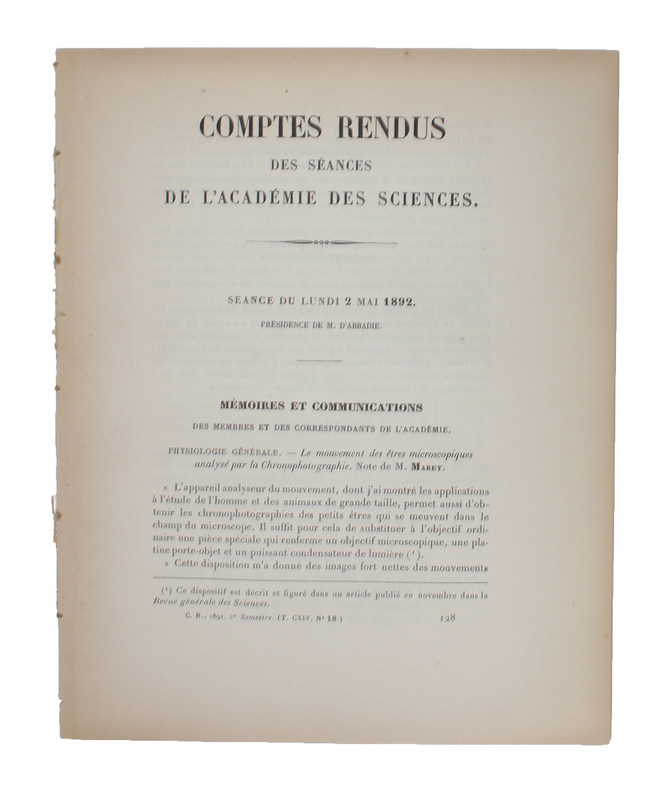
188248088Paris, Gauthier-Villars, 1882, 1888, 1892. 4to. No wrappers. 7 entire issues. In: ""Comptes Rendus Hebdomadaires des Séances de L'Academie des Sciences"", Tome 95, No 1, 6 a. 14. Tome 107, No 16, 17 a. 18, Tome 114, No 18. (7 entire issues offered). With halftitles and titlepages to Vol. 95, 107 a. 114. The papers: pp. 14-16 (No1), 267-270 (no 6), 583-585, 2 textillustr. (no 14) - pp. 607-609 (No 16), 643-645, 1 textillustr. (No 17), 677-678 (No 18) - pp. 989-990 (No. 18). Stamps on verso of titlepages.
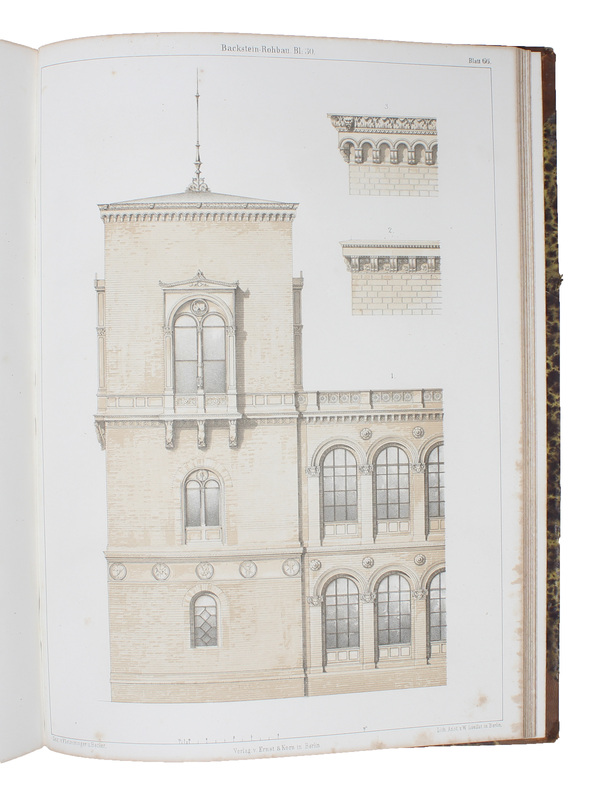
18639171Berlin, 1863. Folio. Cont. hcalf. (108) pp. of text with many woodcut illustrations and 85 fine lithographed plates in colours, depicting details of bricklaying, patterns, houses etc. etc. Some plates slightly brownspotted.
183516136Berlin, 1835-44. Folio. Vol. 1-2 in cont. hcalf. Backs and corners worn, vol. 3 in cont. boards, back worn. 14,24,8 pp. of text and 116 lithographed plates. All plates in vol. 3 stained in upper left corners. Somewhat brownspotted.