108 939 résultats
1861WRCAM49581ACape Town: Saul Solomon 1861. xii180pp. plus photographically illustrated titlepage and sixteen mounted albumen photographs. Quarto. Original publisher's gilt cloth rebacked with most of original spine laid down. Corners lightly worn. Contemporary ownership inscription on front fly leaf. Light foxing and toning heavier in some places. Most images clean though one or two with some light foxing at the edges. Very good. An early photographically illustrated book and the first such book printed on the African continent. The volume was made to commemorate the visit of Alfred Duke of Saxe- Coburg and Gotha one of Queen Victoria's sons. The book was designed to showcase the colony which had hitherto been viewed in a less than positive light by the general British public. Prince Alfred was well- received by the colonists in South Africa and the volume contains many positive facts about the colony's usefulness to the British Empire. <br> <br> The book includes seventeen images by photographer Joseph Kirkman who was active in South Africa from 1859 to 1870. Some of the images in this volume are photographs of drawings or other artwork but others do capture live scenes along the Prince's route including a grand portrait of the African chief Moshesh and his advisors. The chief is pictured seated in the center of the image dressed in a top hat and suit holding a cane. The man seated next to him glowers at the camera and is draped in an animal pelt and holds a spear. Four men all in Western dress stand arrayed behind them. The images taken from life during the Prince's progress are as follows: <br> <br> 1 Untitled image on the titlepage showing several men next to a rail car full of large rocks. In 1860 Kirkman and Frederick York were employed by the government and the Harbour Board to photograph the tilting of the first truck of stone off the Breakwater by Prince Alfred. This is presumably an image from that scene. <br> <br> 2 "Graham's Town from the West" <br> <br> 3 "The Reception of the Prince by a Burgher Escort near Queenstown" <br> <br> 4 "The Prince's Interview with the Tambookies" <br> <br> 5 "Moshesh and His Counsellors" <br> <br> 6 "The Prince and His First Wildebeeste" <br> <br> 7 "The Prince's Travelling Equipage" <br> <br> Not in THE TRUTHFUL LENS. A rare and interesting work and notable for being the first photographically illustrated book produced in Africa. Saul Solomon hardcover books
1861WRCAM49581Cape Town: Saul Solomon 1861. xii180pp. plus photographically illustrated titlepage and sixteen mounted albumen photographs. Quarto. Modern three-quarter calf and marbled boards spine gilt leather label. Light scattered foxing occasional faint offsetting from images. Photographs generally clean. Very good. An early photographically illustrated book and the first such book printed on the African continent. The volume was produced to commemorate the visit of Alfred Duke of Saxe-Coburg and Gotha one of Queen Victoria's sons. It was designed to showcase the colony which had hitherto been viewed in a less than positive light by the general British public. Prince Alfred was well received by the colonists in South Africa and the volume contains many positive facts about the colony's usefulness to the British Empire. <br> <br> The book includes seventeen images by photographer Joseph Kirkman who was active in South Africa from 1859 to 1870. Some of the images in this volume are photographs of drawings or other artwork but others capture live scenes along the Prince's route including a grand portrait of African chief Moshesh and his advisors. The chief is pictured seated in the center dressed in a top hat and suit holding a cane. The man seated next to him glowers at the camera and is draped in an animal pelt and holds a spear. Four men all in Western dress stand arrayed behind them. The images taken from life during the Prince's progress are as follows: <br> <br> Untitled image on the titlepage showing several men next to a rail car full of large rocks. In 1860 Kirkman and Frederick York were employed by the government and the Harbour Board to photograph the tilting of the first truck of stone off the Breakwater by Prince Alfred. This is presumably an image from that scene. <br> <br> "Graham's Town from the West" <br> <br> "The Reception of the Prince by a Burgher Escort near Queenstown" <br> <br> "The Prince's Interview with the Tambookies" <br> <br> "Moshesh and His Counsellors" <br> <br> "The Prince and His First Wildebeeste" <br> <br> "The Prince's Travelling Equipage" <br> <br> Not in THE TRUTHFUL LENS. A rare and interesting work and notable for being the first photographically illustrated book produced in Africa. Saul Solomon hardcover books
18767CB2019. 75 x 100 cm. Digital Photographie. Large format digital photograph. Original Pigment Druck. Archival pigment print on paper (Harman Fine Art Matt Cotton Textured). Die Versandkosten für Kunstwerke und mehrbändige Werke können von den Standard-Versandkosten abweichen. Sehr gut erhalten, gerahmt. Mint condition, framed. Verso signiert, Signed verso.
1930101141BBWien, Anton Schroll & Co., 1930. 4°. 103 S.; 163 S.; 132 S. mit zus. 547 Abb. u. Grundrissen. OKart. u. OLn. (Band II) mit illustr. Orig.-Schutzumschlägen von El Lissitzky. 3 Bände. [12 Warenabbildungen]
19881041191988 New York, Library Fellows of the Whitney Museum of American Art, 1988, 34 folios non numérotés (y compris les pages de garde), demi cuir rouge de l’éditeur, plats en acier brossé, horloge digitale incluse dans le premier plat.Edition originale tirée en tout à 250 exemplaires sur Rives tous signés par l’auteur et l’illustrateur. Conçu par Barbara Kruger et produit par May Castelberry. Impression en rouge et noir pour le texte et l’illustration de Barabara Kruger qui comprend 9 lithographies et 8 sérigraphies réalisées d’après des images photographiques.Reliure réalisée par Booklab à Austin.Riva Castelman, A Century of Artists Books, Moma 1994, p. 216 ; Deborah Wye, Thinking Print , New York Moma 1996 p.22 n°4(104119)
Edizione originale. Ottimo esemplare, fresco e pulito, completo della rarissima sovracoperta originale illustrata integra e senza restauri (volume appena percettibilmente ondulato e accenno di fioritura al bordo interno dell’ultima carta). Libro molto raro, perfettamente stampato da Guido Modiano, uno dei maestri tipografi dell’Italia anni trenta, con la sobria impaginazione dell’architetto Aldo Buzzi, quarta uscita nella raffinatissima collana diretta da Duilio Morosini per le Edizioni della rivista «Corrente», la più importante rivista culturale pubblicata in Italia nei primissimi anni quaranta per iniziativa di Ernesto Treccani. Prefazione dell’autore, l’architetto e fotografo Alberto Lattuada, cui segue una poesia di Treccani («Gli uomini dormono») a introdurre la suite di ventisei tavole fotografiche «che documentano in uno stile diretto e informativo aspetti di marginalità urbana e sociale, tra cui spiccano i senzatetto che vivono in rifugi di fortuna e i mercati cittadini di cose usate». I recentissimi studi di Antonello Frongia (si cita in particolare dall’articolo del 2019) hanno consentito di esaminare fin nei più minuti dettagli il contesto genetico del libro; uno dei dati di più rilevante acquisizione è che dei ventisei scatti solo diciotto sono riferiti al contesto milanese, mentre i rimanenti sono presi a «Venezia (tavv. 10-11, 14-15), Albogasio, sul lago di Lugano (tav. 12), Torino (16-17), nonché [in] una località non identificata, probabilmente nel Lazio (tav. 8)». -- «La semplicità stilistica, la coerenza iconografica del libro, l’autopresentazione sentitamente umanistica e aliena da ogni intellettualismo, l’idea successivamente ribadita da Lattuada di “un vagabondaggio sulla periferia di Milano” esposto al rischio di una possibile censura del regime fascista per l’insistita rappresentazione della miseria, sono tutti fattori che hanno permesso di celebrare “Occhio quadrato” come un’opera di eccezionale portata estetica e politica. A caratterizzare tutta la ricezione del libro ritorna periodicamente l’idea di “Occhio quadrato” come inedito ritratto della periferia milanese, opera primitiva del neorealismo fotografico e pionieristica reinterpretazione di un maestro nobile come Walker Evans» (Frongia 2019: 95-s). Sebastiani, Libri e riviste, p. 94; Frongia 2019 (Occhio quadrato di Alberto Lattuada, in: Rivista di studi di fotografia 8: 94-107); Id. 2021 (Occhio quadrato e il “Quadernetto” di Alberto Lattuada, in: Leggere Corrente a Casa Museo Boschi Di Stefano); Id. 2022 (Fine della città: Occhio quadrato di Alberto Lattuada)
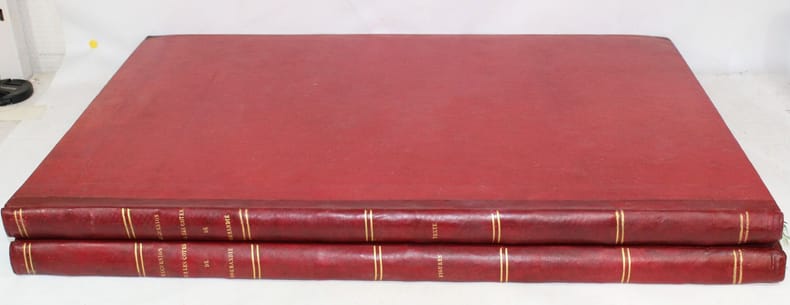
22963Paris, Ostervald, s.d. (1823-1825). Deux volumes in-folio dont l'un des 40 planches sous serpentes en gravure au lavis dite aquatinte précédées d'un titre, et l'autre d'un titre et 54 feuillets de texte. Déchirure réparée à une planche sans atteinte au sujet (Rouen. Vue de la Petite Chaussée). Rares rousseurs, très légères traces de mouillure en haut des volumes. Demi-maroquin rouge à long grain d'époque à coins, dos plats soulignés par des filets dorés (une coiffe restaurée).
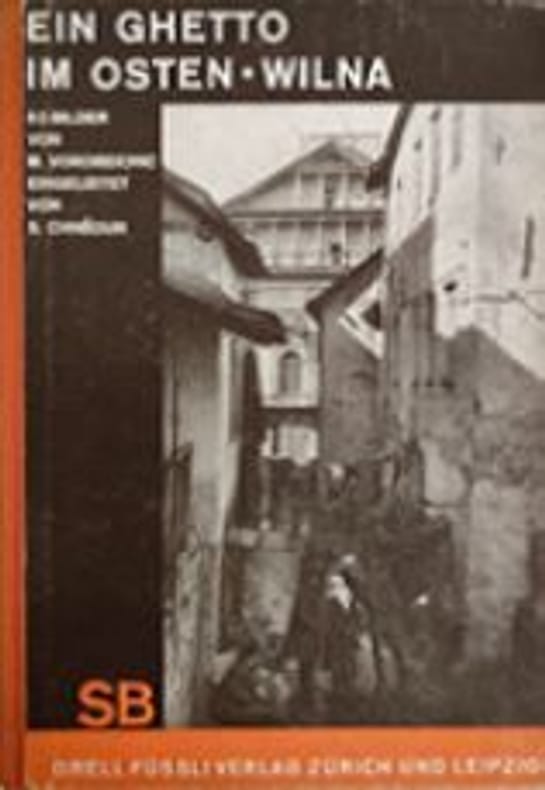
19311049551931 Zurich et Leipzig Orell Füssli Verlag 1931 194x132mm, cartonnage d'éditeur dos toilé, plats photographiques (défauts). Texte en allemand et en hébreu, édition originale. Texte et 65 photographies, photomontages, surimpressions.Ref: Sinibaldi-Couturier 46. Parr & Badger 1, p.130. Autopsie p.326.Moï-Ver, Centre Pompidou, p.34-35;
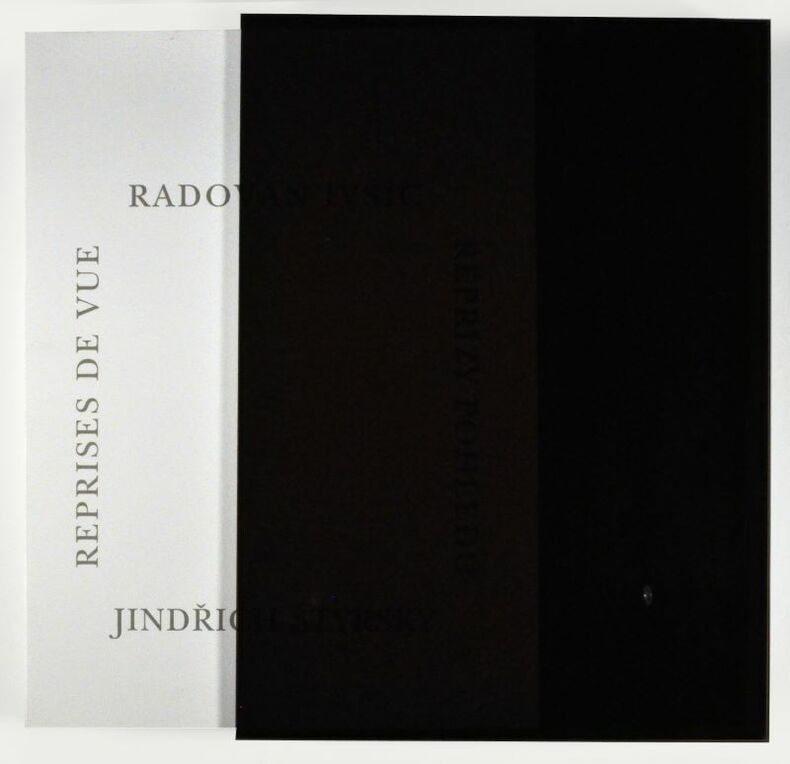
1999100064Prague Edice Strelec 1999 290x212cm Photographies de Jindrich Styrsky. Poèmes de Radovan Ivsic 68 pages avec 13 tirages photographiques originaux. Broché, couverture typographique, boîte en Plexiglas fumé.
104155New York, Sonnabend Sundell Editions, 224 pages, 96 photographies, reliure de l'éditeur, couverture en sérigraphie, boîte en aluminium réservée au tirage de tête.Texte de Hans Belting et 96 photographies en noir et blanc, bibliographie.Tirage de tête limité à 1000 exemplaires numérotés accompagnés d'une photogravure numérotée et signé U.A. Walker, New York 1978, réalisée par la Meridian Printing et contenue dans un coffret en aluminium brossé. Etat neuf. (104155)
Le sessantacinque fotografie (31x24 cm.) sono custodite in una scatola editoriale in legno sulla quale è incisa la scritta: 'Poro| Venezia luglio 76' e sono tutte numerate e firmate al retro da Mario Carrieri Dedica di Mario Carrieri sulla prima carta fotografica bianca Tiratura di IX esemplari Esemplare numero IV / IX Ottimo stato.
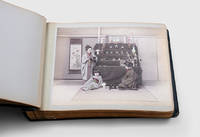
170528Japan: late 19th century. Untraced albumen prints showing vistas from across Japan An album of large hand-coloured albumen prints mainly depicting areas popular with tourists such as Yokohama Nagasaki and Hakone. Many are not listed in Bennett's bibliography. Photography arrived in Japan shortly before the 1867 Meiji Restoration when both Westerners and Japanese started to set up studios. The likes of Tamamura Kozaburo Ogawa Kazumasa Kajima Seibei and Usui Shusaburo became popular domestically and internationally and albums of photographic prints became a popular item among tourists. The present example is made up of 63 prints the majority of which were produced by unidentified studios. Those that can be traced include a shot of three washer women by Adolfo Farsari the owner of one of Yokohama's most profitable photographic firms and whose work was praised by the likes of Rudyard Kipling. They also include a shot of a bamboo garden by Ogawa the pioneer of Japanese collotype printing and two scenic landscapes from Hakone by Kajima the "Millionaire Photographer". The remaining prints show many famous locations from across Japan such as Nagasaki harbour Mukojima in Tokyo the Great Buddha at Kamakura and the main street of Yokohama. There are also many prints of women in traditional Japanese clothing riding rickshaws and admiring the cherry blossoms in spring. Landscape folio album 249 x 350 mm. With 63 hand-coloured albumen prints most landscape 4 portrait of which 48 full-page approximately 220 x 282 mm and 15 smaller approximately 93 x 139 mm 36 featuring human subjects mounted recto on thick grey boards 3 times mounted recto and verso many with captions or glass plate negative numbers. Contemporary blue cloth string recently renewed front board lettered in gilt binder's ticket of Carter's Ink Co. on rear pastedown. Boards lightly soiled tips bumped leaves toned at edges and a little bowed towards rear prints slightly toned: a very good copy. hardcover
1958JC3695San Francisco and Honolulu 1958-1962. Fine. A Collection of 7 Typed Signed Letters from Ansel Adams to Nick Dean presented in three custom boxes as follows: Group of 5 Typed Letters Signed by Ansel Adams in custom box. Hawaii and California 1958. Five typed letters all of them signed by Ansel Adams with his handwritten corrections and asides. And too charming not to mention: Where letters have punch-holes for a 3-ring binder Adams doodles faces around the holes. Most are one page with text on both sides two are one page with text on the recto only. Dated 4 February 1958 to 7 July 1958 some are typed on Memos from Honolulu others on Adams' personal stationery imprinted with his San Francisco address. Adams covers the gamut -- from the personal to the professional from the highly technical to the more philosophical. He remarks on his readings Dylan Thomas and also writes "I am terribly worried about photography and my/our place in it. The MMA business under Steichen is a very depressing and destructive situation" but he also talks excitedly about film different types of cameras and darkroom chemistry and techniques. Includes an interesting list compiled by Adams for Dean of his nominations for an upcoming photography exhibition -- it offers 28 photographers 18 of which have little checkmarks in red ink next to them. Marginalia reveals the checkmarks to mean "AA choice -- Shhh!" Adams' passion for photography as well as the landscape are revealed again and again throughout. One aside: "All Washington is trembling with abject fear! I sent off a telegram in the form of a blast to the Secretaries of the Interior and Commerce and to the Director of the NPS on the Tenaya Lake desecration. The battle is joined! I could not take any more of it. Tell Rosy to get the locals ready for a big fight!" / Typed Letter Signed by Ansel Adams. San Francisco 1961. Three pages typed on the rectos only the first on Adams' personal stationery imprinted with his name San Francisco address and phone number and the last two on plain white paper. Signed by Adams with a few handwritten asides and corrections. A dense wonderful letter addressed "Dear Nick and Zabette." Adams talks about the construction of his house in Carmel "road entrance about 1500 feet down the road from Edward Weston's place." and his rough year "I have been low in imagination and only medium in health" but the tone is overwhelmingly introspective philosophical serious and kind. Adams discusses the state of Modern Photography and Art at length what he feels his early influences and "breaks" were and how to make a living at creative photography while staying enthusiastic and true to oneself. Compelling and touching. In fine condition housed in a lavish custom box cloth backed in green morocco with gilt-stamped lettering on spine. / Typed letter signed by Ansel Adams. California 1962. Two full pages typed letter signed "Ansel" with his handwritten corrections and asides dated March 17 1962. On Adams' personal stationery imprinted with his name address 24th Avenue San Francisco and phone number. Addressed "Dear Nick" Adams congratulates him on an upcoming exhibit discusses a Polaroid book cameras Type 49 Type 55 P/N the completion of his house in Carmel health and injuries or lack thereof a De Cordova exhibit and Nick's critique of it and then goes on to examine the state of photography "commercial photography is getting worse." and other photographers including Minor "Jerry" and Don Worth. Perhaps best of all Adams' thoughts on Art are interspersed throughout including but certainly not limited to "I am beginning to think that the trouble with Art is when it becomes Art!" A wonderful letter revealing both the personal and professional sides of a renowned American photographer. In fine condition housed in a blue cloth chemise with gilt-stamped leather spine label. / Overall a spectacular collection -- all letters are in fine condition housed in 3 lavish custom boxes one for each year 1958 1961 1962. For further details please send us an inquiry. <br /> <br/><br/> hardcover
40974Paris Académie des Sciences 1841-1915. 4to ca. 26 x 21 cm. In a later custom-made blue box 29.5 x 23.5 x 7.0 cm with a printed label on the front top board. = Includes early and original articles by Dominique Arago Louis Daguerre Gaudin Leon Foucault H. Fizeau Lerebours Edmond and Daniel Becquerel A. Poitevin Niepce de St. Victor Elie de Beaumont H. Talbot Chevreul Aimé Civiale J. Girard J. Janssen G. Lippmann L. Boutan Izarn and P. Villard. Several have a library stamp on the title of the Comptes Rendus but not in the text. Amongst the early ones: "Lettre de M. Daguerre à M. Arago avec rectifications essentielles" 1841; "M. Regnault avec des résultats très curieux obtenus par M. Moser sur la formation des images daguerriennes et qui ont été adressés par M. de Humboldt" 1842; "M. Gaudin simplification du procédé pour la préparation des plaques destinées à recevoir des images photographiques" 1842; "Sur un nouveau procédé de polissage des plaques destinées à recevoir les images photographiques etc."; "Lettre de M. Daguerre à Arago and Marey Analyse cinématique de la locomotion du cheval" 1885. We added from the Annales de Chimie et de Physique "Daguerre lettre à Arago sur un nouveau procédé de polissage des plaques destinées à recevoir les images photographiques." 1843 and "Nouveau moyen de préparer la couche sensible des plaques. sur le même sujet" 1844. unknown
190031842ca 1900 1900 Album de 49 photographies 23x17 cm, montées sur un support cartonné un peu gauchi, marges brunies, sous chemise à lacet, la plupart lég. à la main. Certains clichés pâles, quelques rousseurs ou ternissures éparses. Mais bon ensemble.
190844709Biskra, , 1908-1909. Album in-4 manuscrit de (385) pp., 119 photographies sur papier albuminé (environ 110 x 80 mm) montées dans le texte, demi-chagrin prune à coins, dos lisse muet orné de filets dorés, titre et auteur en lettres dorées sur le plat supérieur, étiquette « Imprimerie Barthes Frères, Fabrique de registres » (reliure de l'époque).
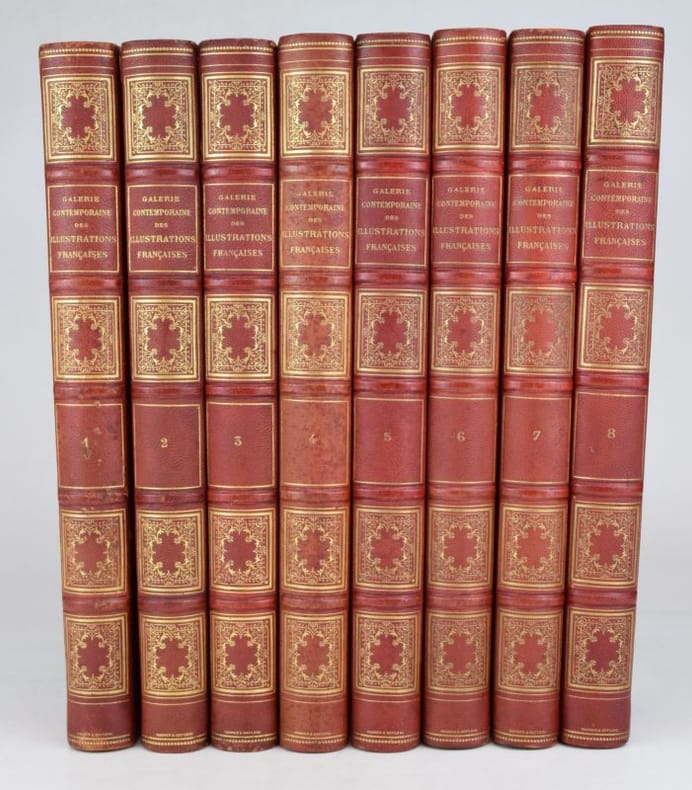
18848224Paris, Paul de Lacroix, (vers 1884). 8 volumes in-4, 200 notices biographiques illustrées de dessins et de 267 photoglypties, collationné complet. Reliure d'éditeur demi-chagrin rouge à coins, dos orné de caissons dorés, tranche supérieure dorée, reliure signée "Magnier & ses Fils".
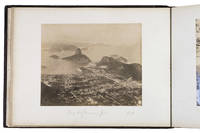
1885ABC_488551885. Contemporary gold-tooled dark purple quarter morocco brownish-purple pebble-grain cloth sides with a paper label "3" mounted on the front. Oblong ca. 38 x 27.5 cm. With 20 albumen prints 43 plates engraved and lithographed and 3 drawings. Remarkable album documenting the travels of HMS Calliope 1837-1883 a British warship in the first few years after her launch. The ship first sailed to Madeira and Tenerife after which she crossed the Atlantic Ocean to visit various harbour cities in Brazil Argentina Uruguay and Chile. Many of the illustrations and photographs include handwritten annotations about the ship's journey with the exact dates of when she arrived where. As such the album was likely compiled by someone who sailed on the ship during these years possibly a crew member. The album contains photographs drawings and plates relating to the places the Calliope visited between 1838-1840. It starts with photographs of Madeira and Tenerife like the Loo Rock in the harbour of Madeira locals carrying a tourist down the Pico Grande the town of Güímar in Tenerife and an age-old Dragon Tree. As the ship's next destination was Brazil the album contains a number of photographs and illustrations of Rio de Janeiro as well as a drawing of a picnic at the summit of the Corcovado. The Calliope then sailed to Buenos Aires and Santa Fe arriving in August 1838. This part of the album contains a drawing of a gaucho and 6 beautiful photographs by Samuel Boote 1844-1921 one of the most important photographers working in Argentina in the 19th century. His work shows the interior and exterior of the St. Felicitas Church in Santa Fe as well as daily life in this city. The ship then carried the British ambassador from Argentina to Montevideo arriving in June 1839 before continuing to Valparaíso. The final pages of the album contain a map of Montevideo views of Valparaíso and the mountains nearby and a drawing of a bridge.The plates in the album were taken from other works such as Journal of a voyage to Brazil 1824 by Maria Graham and A history of the Brazil 1821 by James Henderson. The photographs were taken in the 1880s which means the album must have been compiled several decades after this particular voyage of the Calliope. However as some of the annotations mention that a location looked different on the plate than when the Calliope arrived the album must have been compiled by a crew member.The Calliope sailed to China after the visit to Valparaíso to serve in the First Anglo-Chinese War 1839-1842. After she sailed to New Zealand and primarily operated in that region until she was converted into a floating chapel in 1855 and deconstructed in 1883. With the yellow bookseller's label of "A & N.C.S.Ld Stationery Dept. 105 Victoria St. S.W." mounted on the back pastedown. The leaves and plates are somewhat foxed likely lacking a plate or drawing on the recto of leaf 16. Otherwise in good condition. hardcover
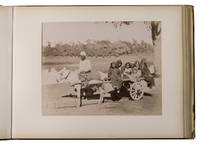
1891ABC_47521Egypt: Zangaki brothers 1891. Original gold-stamped bubble-grained maroon cloth over boards modern maroon cloth spine and leather corners. Gold stamped title and year on the front white watered silk endpapers. Oblong album 31.5 x 41 cm. With 34 large albumen prints mounted on heavy cardstock leaves. Most of the photographs are numbered and captioned in French in the negative and signed 'Zangaki'. The last one is signed Sebah & Joallier. The Zangaki prints measure 22.5 x 28.5 cm; the Sebah & Joallier one is 20.5 x 26.5 cm. A large German album with 34 albumen prints of Egypt. The Greek brothers G. and C. Zangaki were photographers who worked in Egypt in the second half of the 19th century. Due to increased tourism to this region after the opening of the Suez Canal there was a large demand for souvenir photographs. Photographers like the Zangaki brothers as well as Sebah & Joallier catered to this. The Zangakis were among the first commercial photographers to produce large-scale images of Egypt. They travelled through the country with a portable darkroom to capture high-quality images of famous monuments and daily life though the latter were usually posed. These images were then printed and sold to tourists either separately or compiled into albums. According to John Hannavy the brothers "produced some of the finest images of late Victorian Egypt". The 34 photographs include: the great pyramid Cairo and the Nile dervishes and other exotic looking locals Egyptians standing on top of the sphinx obeliscs the Ramesseum Karnak temple the temple of Dendera the Great Pyramid Egyptians climbing the pyramid the mosque and tomb of Muhammad Ali Saqqara and many others.With two small library stamps on the first page not affecting the photograph. The book has been rebacked. The left side of the front board has faded and the corners are worn. Minor browning around the edges of the leaves. Back flyleaf loose. The photos are crisp and clear and the book is otherwise in good condition.l Erdem Views of Egypt by Georgios and Constantinos Zangaki: Examining a late nineteenth-century photographic album at the Art Gallery of Ontario thesis 2006; Hannavy Encyclopedia of Nineteenth Century Photography pp. 1036 1093 & 1521. Zangaki brothers, hardcover
in-folio oblungo (cm 31,4 x 39,5 ), ff. 25 cartonati con applicate al recto e verso 50 stampe fotografiche all'albumina (cm 21,5 x 27,2), nella parte superiore ed in quella inferiore di ciascun foglio il titolo della veduta stampato in litografia in blu con motivi decorativi in oro. Bella legatura in mezzo marocchino rosso, tit. oro e fregi al dorso a nervi ed al piatto superiore, tagli dorati. Le belle fotografie di anonimo paesaggista, ritraggono le principali località della Costa Azzurra, in particolare: Marsiglia, Hyères les Palmiers, Saint Raphael, Grasse, Cannes, Nice, Villefranche, Beaulieu, Monaco, Montecarlo e Menton. In perfetto stato di conservazione.. .
18432973L.A. Bisson Fils, Rue St. Germain l'Auxerrais 65, Prés le Pont à Paris’. 1843 Daguerréotype dans son encadrement d’origine, sous passe partout rectangulaire monogrammé en à froid « L.A.B » dans un cartouche. Très beau daguerréotype représentant un homme accoudé, le visage tourné vers la gauche, les mèches de cheveux rabattues sur les tempes , une fleur à la boutonnière, empruntée au pot de fleur posé sur la table. L’expression volontaire du sujet est particulièrement bien servie par un tirage de grande qualité. Le décor peint en arrière plan ainsi que la table, les trois livres sur lesquels repose la main gauche du personnage, se retrouvent dans plusieurs portraits de Louis Auguste Bisson, réalisés entre 1842 et 1843.
194884920s. l. 1948 | 16 x 21.50 cm | 97 photographies sous une boîte cartonnée
Stampa fotografica vintage. CON DEDICA Didascalia, firma e luogo autografe dell’artista verso. Interventi manuali recto. Ottime condizioni. Proveniente dall’archivio del futurista B.G. Sanzin. Bello scatto in prospettiva, molto contrastato, su fondo nero, del modellino di una vetrina di negozio di «F o T o». Rarissima: probabilmente esemplare unico. Esposta alla mostra «Ugo Carà: Arte architettura design 1926-1963», Trieste: Museo Revoltella, 26 novembre 2003 - 29 febbraio 2004, curata da Maria Masau Dan e Lorenzo Michelli, con didascalia: «Plastico per negozio di fotografia, 1928». Masau Dan & Michelli, Ugo Carà: Arte architettura design 1926-1963, p. 75
188087792Benque & Cie | Paris s.d. (ca 1880) | 10.50 x 16.50 cm | une feuille
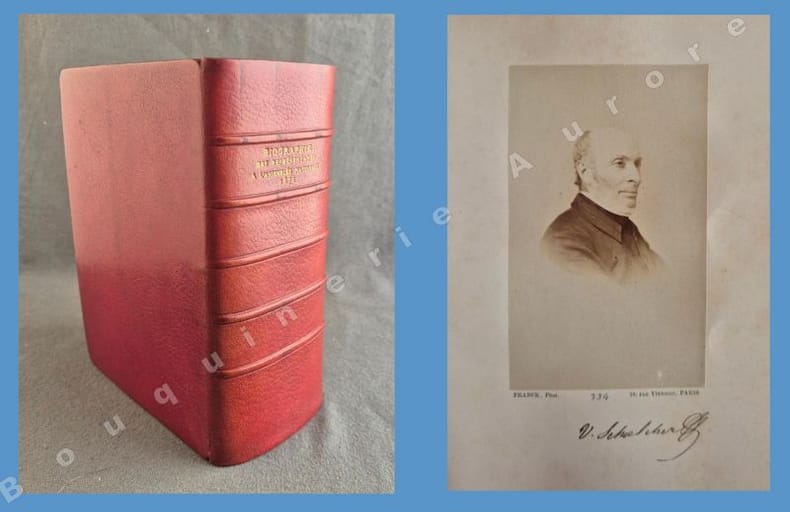
1871145981871 Angers, aux bureaux de la publication, 1871, 1 vol. fort in-8° (187 x 132 mm, épaisseur 85 mm !), relié plein maroquin rouge, dos à 5 nerfs, titre doré, double filet doré sur les coupes, riche guirlande dorée encadrant les plats intérieurs, toutes tranches dorées (BELZ-NIÉDRÉE), de 340 pp.Dos légèrement insolé, rousseurs éparses, quelques épidermures de surface au papier du texte, bel exemplaire luxueusement relié par Belz Niédrée par ailleurs.