Carter, Charles William; amerik. Fotograf (1832-1918)Antiquariat.de

108 940 résultats
188064555Salt Lake City, o. J. (um 1880). Auf Untersatzkarton (16,5 x 10,8 cm) montiert u. rückseitig gestempelt sowie - wohl vom Fotografen selbst - bezeichnet u. nummeriert.
Illustrations by Volz W. Collector's Edition of 1,000 copies. English, French and German Text. Modena, 2010; bound in a case, pp. 700, ill., cm 33x44. (Collector's Edition). deutsch english francaise 3-8365-066 Collector's Edition bound in a case
1997107636BBMünchen, Paris, London, Schirmer/Mosel, (1997). 4°. 216 S. mit 184 Duotone-Tafeln. Orig.-Pappband mit illustr. Schutzumschlag. [43 Warenabbildungen]
1967104321BBNew York, Kulchur, (1967). 4°. [4] leafs and 54 plates Color illustrated card cover.
101213aaf1869, gr. in-4to, oblong, titre manuscrit + 2 ff. (poême) + 216 ff. (432 p.) manuscrits dans une belle écriture (dont 34 ff. de poèmes) + 1 f. de table + 56 images (dont 2 cartes ou plans, 22 photographies originales en petit format, 8 publicités ill. d’hôtels et 5 panoramas gravés de Lucerne, du Rigi et du Lac des Quatre-Cantons), exlibris Peter E. Obergfell, reliure d’époque en demi cuir vert, dos à nerfs avec titre et ornements en or, 1er plat avec titre en or, tranches marbrées. Charnière devant affaiblie.
141150aafWehrli - Kilchberg, ca. 1900-1910, 21.5x15.5 cm. (Photo) - in-4°, album de 100 vues photographiques de la Suisse, la plupart en couleurs et gommées. Avec signatures ‘WK’ (Wehrli A.G. Kilchberg - Zürich (dép) et numerotés. reliure en d.-cuir originale, titre or sur le plat devant. Bel exemplaire en parfait état.
18854425Paris, Charavay frères, 1885. In-4 de LXII-538-[4] pages. Reliure en plein maroquin bleu d’eau, dos à nerfs orné de caissons décorés d’un bouquet de fleurs dorées; filets, roulettes encadrant les plats, décorés du même bouquet doré, oiseaux, fleurons dorés, filets sur les coupes, roulette et filets dorés intérieurs, tranches dorées. Parfaitement établi dans une reliure de Pagnant.
113918aafTimbre ovale ‘Dépot général de Photographies, 35 Boulevard des Capucines et Rue Neuve-Saint-Augustin, 1855, 34x45.5 cm photogr. (47.5x59 cm la feuille de support), photographie originale montée sur support blanc d’origine, 1 feuille.
139751aaf1884, gr. in-8vo, 154 p. + 1 f. (table des chapitres), texte manuscrit (env. 26 lignes/page) avec 14 planches photos n/b originales et 1 reproduction d'un tableau, cachet ' Bibliothèque Maurice Gratiot Paris' et étiquette du même sur la garde / Exlibris Peter E. Obergfell, reliure en d-cuir avec coins originale, lignes dorées délimitants le cuir, titre doré sur le dos, bords léger. frottés, bel exemplaire.
136727aafGenève, Imprimerie de Jules-Guillaume Fick, 1868, in-8vo, 268 p. + 20 photogr. d’après les dessins de MM. G. Liquier et D. (d’après les indications de l’auteur) (10 à plein page de scènes rurales et avec aborigènes + 10 plus petites in-texte (animaux et curiosités (e.a. pyramides de pierres géantes d’Australie), reliure en d.-veau d’époque, dos à cinq nerfs orné or, pièce de titre.
90429aafParis, M. Branger, 1913, in-folio, oblong, avec au total 279 photos en grand format (12.5 x 17 cm), reliure en cuir, légèrement usée.
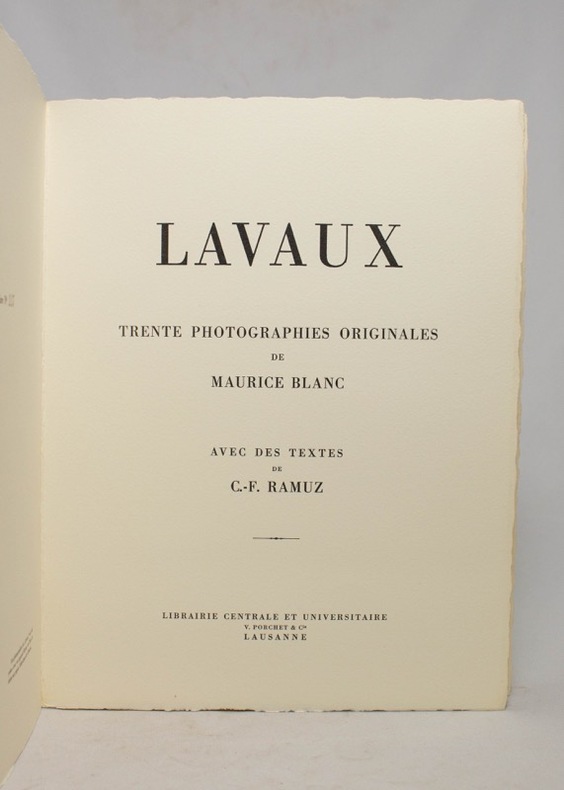
193711784Lausanne, Librairie Centrale et Universitaire, V.Porchet & Cie, 1937. Grand in-4 en feuilles de 33 feuillets numérotés au seul recto, sous chemise blanche à rabats imprimée en noir, ornée d'une vignette contrecollée.
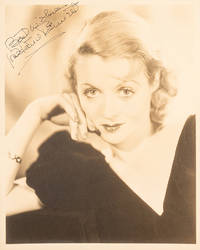
06014Various Places: 1930-2000. A Vivid Gallery of Hollywood History <br /> From Silent-Era Pioneers to Golden Age Stars<br /> <br /> HOLLYWOOD ICONS. A Collection of Twenty-Eight Original Signed and Inscribed Photographs.<br /> Various places various dates ca. 1930s-1970s.<br /> <br /> Twenty-eight black-and-white photographs sizes ranging from 5 x 7 in. to 10 x 8 in. each boldly signed or inscribed by leading actors actresses directors producers and musicians of Hollywood's Golden Age and beyond. All items in near-fine or better condition many with personalized inscriptions.<br /> <br /> A remarkable assembly of signed portraits representing the glamour and breadth of twentieth-century cinema and stage including Academy Award winners legendary directors pioneering producers and iconic performers.<br /> <br /> Together these images form a vivid gallery of Hollywood history: from silent-era pioneers Anna May Wong Raoul Walsh Fay Wray to Golden Age stars Tyrone Power Joan Fontaine Olivia de Havilland Janet Gaynor Rosalind Russell and from influential directors and producers John Ford William Wyler King Vidor Billy Wilder Otto Preminger Hal Wallis Joe Pasternak to cross-disciplinary figures such as Leonard Bernstein. The inscriptions many personalized add a layer of provenance and human connection to these iconic names. <br /> <br /> The Photographs:<br /> Constance Bennett - Signed 10 x 8 in. photograph.<br /> Joan Bennett - Signed 9½ x 8 in. photograph.<br /> Leonard Bernstein - Signed 10 x 8 in. portrait.<br /> Madeleine Carroll - Signed 7 x 5 in. photograph.<br /> Joan Fontaine - Signed 10 x 8 in. portrait.<br /> John Ford - Signed 9 x 8 in. photograph.<br /> Janet Gaynor - Inscribed 7 x 10 in. photograph dated 1937.<br /> Helen Hayes - Signed 10 x 8 in. portrait.<br /> Jennifer Jones - Signed 10 x 8 in. photograph.<br /> Elia Kazan - Signed 10 x 8 in. photograph.<br /> Herbert Marshall - Inscribed 10 x 8 in. photograph dated 1938.<br /> Mike Nichols - Signed 9 x 7 in. photograph.<br /> Olivia de Havilland - Signed 10 x 8 in. portrait dated August 1971.<br /> Joe Pasternak - Inscribed 9½ x 7 in. photograph.<br /> Tyrone Power - Signed 10 x 8 in. portrait.<br /> Otto Preminger - Signed 10 x 7 in. photograph dated 1972.<br /> Dolores del Río - Signed 10 x 8 in. photograph.<br /> Rosalind Russell - Signed 10 x 8 in. portrait.<br /> Budd Schulberg - Inscribed 10 x 8 in. photograph.<br /> Lupe Vélez - Signed 9½ x 7 in. photograph.<br /> Hal B. Wallis - Inscribed 10 x 8 in. portrait.<br /> Raoul Walsh - Inscribed 10 x 8 in. photograph.<br /> Billy Wilder - Signed 9¾ x 7¾ in. photograph.<br /> Anna May Wong - Inscribed 10 x 8 in. portrait with Chinese characters dated 1932.<br /> Fay Wray - Signed 7 x 5 in. photograph.<br /> William Wyler - Inscribed 10 x 8 in. photograph.<br /> King Vidor - Signed 10 x 8 in. photograph dated 1972.<br /> Loretta Young - Inscribed 9½ x 7¾ in. photograph. Various Places: , 1930-2000 unknown
191613969(Ohne Ort und Drucker), 1916. 1 nn. Bl., III, 158 num. Bll. 4°. OLwd. (etw. berieben und bestoßen, Gebrssprn.).
186522792(Venedig, ohne Drucker, um 1865). 32 einzeln auf Karton montierte Original-Photographien (aus dem Umkreis von Carlo Naya). Quer-Fol. Blauer Samt der Zeit mit Deckelgoldprägung (bestoßen und etw. berieben). [5 Warenabbildungen]
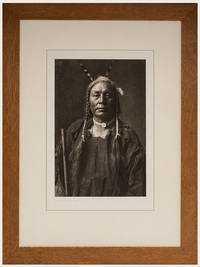
190834720Boston: John Andrew & Son 1908. Plate 168 from the portfolio 'The North American Indian' volume 5 The Mandan. The Arikara. The Atsina. Fewer than 300 sets were printed according to the Curtis Legacy Foundation. A fine photogravure portrait on a large sheet. The image is approximately 15.5 by 10.25 inches printed on larger sheet and now handsomely mounted behind Tru-Vue conservation glass in hardwood frame measuring 30 by 24 inches. An extremely fine example there is no damage to the plate whatsoever and the mounting and frame are also in fine condition. AN IMPRESSIVE PORTRAIT FROM THE FAMOUS NORTH AMERICAN INDIAN PORTFOLIO. Inscribed in plate upper left: Plate 168 titled in plate lower left EAGLE CHILD - ATSINA. Inscribed in plate lower center. From Copyright Photograph 1908 by E.S. Curtis and inscribed in plate lower right. Photogravure John Andrew & Son. A striking image Eagle Child is one of the best-known photographs from the collection.<br> Edward Curtis devoted nearly 30 years of his life to creating one of the masterpieces of 20th-century publishing The North American Indian. The publication has been called “the most gigantic undertaking since the making of the King James Edition of the Bible†and “the most exquisite book art of our time.†Each set contains more than 2200 photos taken by Curtis. A complete set of The North American Indian is comprised of twenty individually bound books each with an average of 250 pages and 75 photogravure images and twenty accompanying portfolios each with an average of 36 large image plates housed in a folding case.<br> Eagle Child was an adult Atsina Gros Ventre man living in Montana when Curtis photographed him in 1908. The image shows him in traditional attire and is one of several individual portraits Curtis made of members of this tribe. Curtis recorded only a small piece of his biography. He was born somewhere east of the Little Rocky Mountains of Montana and as a young man went to war against the Black Feet. John Andrew & Son unknown
192532528Tel-Aviv: Hedim 1925. Limited First edition. Softcover. g. Baruch Agadati oman ha-rikud ha-ivri artist of Hebrew dance: 1/100. Folio. Original blue cloth gilt-lettered boards with Cubist-inspired front paste-down. Illustrated title page. Calligraphic Hebrew introductory text in black and red. The major work on the legendary Russian-born Israeli dancer illustrated with a costumed Agadati in modern dance postures a troupe of dancers with stage scenery and including Agadati's choreographic notation of the Horah. 32 tipped-in prints of elaborately overpainted photographs drawings paintings and illustrated posters advertising dance performances one of which is designed in striking constructivist style artwork presumably by Agadati. Photographs by Avraham Soskin the quintessential "Tel Aviv photographer." No. 50 of a total of 100 published. Moderate age-wear to binding spine and top sunned. Moderate and sporadic foxing in margins. Text in Hebrew. Binding rubbed with fraying at top and bottom of spine both hinges started interior in good condition overall. Plates in very good condition. Agadati the renowned dancer and choreographer known for interpreting Jewish folk dances in a uniquely expressionist style is considered to be the central figure in the development of Israeli dance. He was also a painter early filmmaker and enthusiastic organizer of Purim festivals. Born in Russia in 1895 Agadati emigrated to Palestine in the early 1900s where he studied at the Bezalel Academy. During WWI he studied classical ballet and danced with The Odessa Opera Ballet Theater. After returning to Palestine he often gave solo dance recitals and introduced the Hora originally a folk dance from the Balkans which later became the signature dance of the Jewish people. Hedim unknown
193049764Prague: Nakladatelstvi E. Beaufort A. S. 1930. First edition. Hardcover. Very good condition. Quarto. 14pp. 1 46 1 plates. Original orange cloth with printed paper label affixed to cover in facsimile yellow photo-illustrated dustjacket. Textured endpapers. Title page printed in brown. Rights reserved and printed by E. Beaufort A. S.<br /> <br /> This work is Drtikol's seminal collection of nude studies. "Although influenced early in his career while studying photography in Munich by the decorative trend of Jugendstil or Art Nouveau Drtikol moved with Žena ve Světle into his own modernist style of photography that prefigured and influenced the emerging Bauhaus aesthetic. He built sets and props out of plywood and used an arc lamp to cast strong shadows. The graphic presentation of the book is striking with the gum prints on thin paper one to a page set off by large page numbers. By 1935 Drtikol was creating wholly abstract works in which the nudes were replaced by figurines or geometric shapes made from painted plywood. At age 52 at the peak of his international fame Drtikol abandoned photography altogether to concentrate on painting meditation and oriental philosophy until his death in 1961." Andrew Roth The Book of 101 Books page 64ff. Parr/Badger Vol. 1 page 79<br /> <br /> Text in Czech. Facsimile dustjacket with minor wear and rubbing. Very light wear along edges of binding and lightly rubbed. Nakladatelstvi E. Beaufort A. S. hardcover
50199Tokyo: Shueisha 集英社 1971. New edition. Hardcover. vg- to near fine. Large oblong folio. 15x21". Unpaginated. All content housed inside the publisher's original cardboard shipping box with printed label pasted on the front. Binding protected in original a white cloth portfolio with red lettering on the front cover and lavishly decorated interior flaps. Black suede-covered boards with mutli-colored illustration mounted on the front cover. Decorative endpapers. Engraved stainless-steel plate showing Mishima's face mounted on black paper preceding the title page.<br /> <br /> The deluxe and lavishly printed new bilingual edition of the acclaimed and eroticly-charged work also know as "Killed by Roses" by Japanese photographer Eikoh Hosoe b.1933. It gained notoriety and elicited controversy when it was originally released in 1963 and won the Japan Photo Critics Association's writer award. The main photographic subject of the book the acclaimed and controversial writer Yukio Mishima 1925-1970 wrote the preface to the original edition and also writes the preface for this new edition both are included here. Mishima's acclaimed works include the famous and controversial novels "Confessions of a Mask" 1949 and "The Temple of the Golden Pavilion" 1956. Hosoe's striking high-contrast b/w photographs are all printed in high-quality photogravure retaining all the power and atmosphere of his original images. In comparison with the first version of the work this edition features the content having been noticeably re-edited with one image added a few others removed. The images have been thematically re-organized into five new chapters with the names "Sea & Eyes" "Eyes & Sins" "Sins & Dreams" "Dreams & Death" and "Death" respectively. Influential artist and graphic designer Tadanori Yokoo b. 1936 oversaw all of the design and layout aspects of the book and also created its additional illustrated elements most of which comprise the first chapter of this new edition.<br /> <br /> While Hosoe was still completing work to prepare this new edition of "Ordeal by Roses" the notorious "Mishima Incident" occurred November 25th 1970 which culminated in the ritual suicide of Yukio Mishima by seppuku. The incident shocked the nation and in its wake the photographer was quite unsure of how to proceed regarding the publication of the book. Not wanting to seem like an opportunist taking advantage of the controversy and the publicity surround Mishima's death he contemplated shelving the project but was later persuaded by Mishima's widow Yoko who said that her husband would have wanted it to be released. It was finally release only a few months later on January 30th 1971.<br /> <br /> Text in Japanese and English throughout.<br /> <br /> Portfolio with foxing to the white cloth including the front cover and the interior but the illustrations on the flaps are still clean. Suede binding clean and protected in modern mylar. Light foxing to the edges of the book block. Interior with all pages and images clean and vibrant save for a few sporadic instances of the most minor stains or smudges on the blank versos a few pages. The verso of the final photographic plate and the page opposite have a bit more foxing. Portfolio in very good- binding and interior in very good to near fine condition overall. Alternate title: 細江英公写真作å“. Shueisha (集英社) hardcover
195323230London Ontario: McCormick's Limited ca. 1953-1982. Very good . Collection of 175 C prints in various sizes: 1 One hundred and twenty-seven 3.5'' x 5'' photographs. Of these sixteen are set into posterboard displays in groups of four with the remaining 111 photos loose. The majority have only minor edgewear with a small number of loose photos showing small tears or tape to corners. 2 Twenty-four 8.5'' x 11'' prints. Moderate to heavy scuffing at corners; some foxing. 3 Thirteen 3.25 x 7/25 prints. 4 Eleven 5'' x 7'' prints. Also included: Assorted branded ephemera approximately 40 items including: company correspondence safety & sanitation posters brochures stickers three leaflets placards calendars packaging mailing envelopes inter-office memo pad petty cash slips billing and order forms. Very good plus overall with individual exceptions as noted above. <br/><br/>Vibrant archive of marketing presentation mailing advertising and sales materials for a wide assortment of primarily candy and other confections from McCormick's Limited and affiliated bakeries - consisting mainly of a colorful collection of 175 original photographs of various McCormick products. <br /> <br />The company was established in the 19th century as the McCormick Biscuit and Candy Company and by the years represented in this collection was owned by George Weston Limited producer of Wonder Bread for the Canadian market. Concerned with promotion and publicity from its early years McCormick's was a provider of biscuits to the Dionne Quintuplets a recipient of their youthful endorsements and a donor of sizable royalties to their trust fund. In an included four-page spread from September 1967's THE MERCHANDISER the company proudly notes this connection while advertising its own advertising prowess through the decades: "The brochures are attractive and mouth-watering." <br /> <br />Included brochures verify this claim; pictured products range from familiar vintage confections like cherry cordials and Walnut Shorties "WALNUTS make the difference"! to discontinued exotica like Ceylon Mallows Pie Face &" Fat Emma" candy bars a Minneapolis invention of the 1920s all but disappeared by the 1970s now extinct; Golden Humbugs Canada Lozenges and Sea Kings/Roi de la Mer. McCormick also produced accessories edible and otherwise through the Imperial Cone Company represented here by an illustrated leaflet with photos and dimensions of Torch Cones Buddy Waffles Sweetheart Straws etc. <br /> <br />The small selection of dated items range from 1953 to 1982 though most materials are undated; the majority of the archive consists of product photographs in vibrant glowing color for use in promotional materials catalogs and store displays. Most of these prints date from the 1960s through the early 1970s with several showcasing 1967 Canadian Centennial packaging. Shut down in the 2000s the abandoned McCormick factory has become a tantalizing attraction to urban explorers. <br /> <br />Though a Canadian company there is something of the quintessentially mythic innocent post-war American childhood captured in these indelible primary-color images. Simultaneously a engaging record of this important culinary company and an undeniably nostalgic document. [McCormick's Limited] unknown books
197119543San Diego California 1971-1972. Approximately 1300 color slides with roughly 250 additional color film negatives and 37 individual manuscript real estate listing forms. Slides approximately 2" square; negatives approximately 1 1/4" square. Slides with mild to moderate dusting some with residue from previous rubber band wrappings most with relevent ink notations to margins. Negatives fine in glassine storage wrappers. Overall contents very good. Slides housed in new archival pages and three dust-proof binders. <br/><br/>Before Zillow Trulia and Redfin: this swank archive and others like it of images from the Sessions Realty firm of La Mesa California. Consisting of hundreds of sales display slides and negatives of exteriors and interiors from San Diego-area homes accompanied by more than 3 dozen descriptive forms listing home amenities prices descriptions etc. these images were undoubtedly used for marketing to prosceptive buyers. Shag carpet macrame orange and brown color palettes rec rooms bold wallpapers Formica wood paneling and other Better Homes and Gardens details much in evidence — all exhibiting a strong Southern California flair. A dense thorough and vibrant assembly of period design and architecture offering a rich record of residential real estate in a significantly active market. And while the unknown photographers certainly wanted to simply document the houses what emerges is a rather hauntingly mundane narrative where no real action takes place but yet something nevertheless lingers — like crime scene photographs but without the crime. Vernacular Ruscha; Brady Bunch nostalgia meets California Dreaming. unknown books
191319686Midwest U.S. ca. 1913-1917. Very good. Oblong small 4to. Commercial string-tied album in black textured wraps. 58 cyanotype 11" by 8.25" and 55 gelatin-silver prints most 9.5" by 7.25" some 6" by 3.5" or smaller; four of the latter apparently perished. Adhesive-mounted recto and verso on black paper sheets. Very good. Some glue-bleaching to cyanotypes' edges. Many pages cleanly detatched from from perforated tabs but photos remain clean. <br/><br/>Album of storage tanks agitators and other liquid-related metal machinery photos compiled by the manufacturer which – judging by the locations of most of its clients – was located somewhere in the Midwestern United States. Majority of the photos show a single piece of equipment captioned with its order number destination e.g. "National Ice Cream Co. San Francisco" the product name e.g. "Deep Upright Closed Tank" shipment date dimensions and other relevant notes; several images show the product installed in its destination factory but most appear to have been taken before shipment. Many clients were ice-cream and other dairy processing plants and the majority were American; but a few were international including the Nestle plant in Switzerland and a Cuban brewery. Among the American non-dairy plants were the Coors brewery in Colorado a Perth Amboy chemical plant and a California paint manufacturer. Two images depict a dozen salesmen posing at the tank factory and others show factory workers in motion. Likely assembled as a salesman's book or perhaps company archive with its many cyanotypes a striking vernacular book and an informative record of industrial food preparation at the dawn of the Ford age. paperback books
- Studio Louis, Bucarest 14 juin 1877, 6,7x10cm. - Rare portrait photographique d'Amélie Destouches, tante de Louis-Ferdinand Céline, au format carte cabinet sur papier albuminé contrecollé sur un carton du studio Louis. Légendes manuscrites «?Suzannica 3 ans, Bucarest ce 14 juin 1877?» et «?Zenon Zawirski?» d'une autre main, au dos. Le portrait est réalisé par les studios Louis, au 127 Calea Mosilor à Bucarest. Amélie épouse à vingt-quatre ans le riche roumain Zenon Zawirski, qui pose à ses côtés avec leur fille Zenone Zawirska, alors âgée de trois ans. Céline lui consacre un portrait peu flatteur dans Mort à crédit, et emprunte ses traits pour le personnage de la tante Hélène, dont il transpose les aventures slaves en Russie et non en Roumanie. Encore vivante à l'époque de la rédaction du roman, Céline fait pourtant mourir son personnage dans le déshonneur et la honte?: «?Elle a pris tout le vent dans les voiles. Elle a bourlingué en Russie. À Saint-Pétersbourg, elle est devenue grue. À un moment, elle a eu tout, carrosse, trois traîneaux, un village rien que pour elle, avec son nom dessus. Elle est venue nous voir au Passage, deux fois de suite, frusquée, superbe, comme une princesse et heureuse et tout. Elle a terminé très tragiquement sous les balles d'un officier. Y avait pas de résistance chez elle. C'était tout viande, désir, musique. Il rendait papa, rien que d'y penser. Ma mère a conclu en apprenant son décès?: "Voilà une fin bien horrible?! Mais c'est la fin d'une égoïste?!"?» [ENGLISH DESCRIPTION ON DEMAND]
- Par l'auteur, s.l. 1986, 22x22cm sur papier Ilford 30x40cm, une feuille. - Grand portrait photographique original en noir et blanc réalisé par Marc Trivier. Tirage argentique original non signé, comme la plupart des uvres de Trivier. Précieuse épreuve argentique originale du célèbre photographe belge, un des artistes contemporains les plus secrets, qui malgré un succès international précoce, a préféré limiter sa production pour conserver la cohérence de son uvre. Marc Trivier ne tire pas de nouveaux exemplaires de ses anciens portraits, le papier de tirage qu'il utilisait n'est d'ailleurs plus commercialisé. L'artiste « réalise lui-même ses tirages sur papier baryté Ilford, consacrant plusieurs jours de travail à chacun, avec une concentration particulière pour rendre les blancs, par contraste avec des noirs d'une rare densité. Un tirage de Marc Trivier ne ressemble à aucun autre. Lorsqu'il accepte de les exposer, il les suspend dans des cadres en inox de sa fabrication, laissant libre cours à la vie du papier. » (Xavier-Gilles, « Marc Trivier et la tragédie de la lumière » in Le Monde Libertaire, 2011). Cette « vie du papier » participe de l'uvre au même titre que les diverses altérations que subissent les photographies lorsqu'elles sont exposées : « Dans les boites, les tirages gondolent, mais qu'importe : le photographe affectionne ce genre d'accident. » (Claire Guillot, « Les face à face sans échappatoire du photographe Marc Trivier », Le Monde, 2011). Marc Trivier a une sensibilité particulière pour l'aspect matériel de ses productions. Alors que la photographie relève par essence du multiple, cette intervention de l'artiste dans tout le processus de création confère une aura autographique à ces tirages. Photographies d'artistes, de fous, d'arbres ou d'abattoirs, Marc Trivier aborde tous ces sujets avec un regard aussi précis qu'intense. « Dans sa cosmogonie, chaque chose, chaque être, végétal, animal ou humain, mérite le même respect. Car tous sont confrontés à la même loi d'airain : la solitude. » (Luc Desbenoit). La beauté qui émane de ses photos vient de cette nudité. Il n'y a ni retouches, ni recadrages. On retrouve dans son uvre le même format carré souligné par le carré du négatif que Trivier laisse sur ses tirages. Ce cadre piège notre regard dans des photographies où le fard de la couleur est rejeté pour un noir et blanc incisif. Toute artificialité ayant disparu nous ne faisons pas face à la mise en scène d'un sujet mais à une présence exacerbée par la lumière irradiante et singulière, témoin d'un instant de vie et non de pose. C'est cette lumière, liée au médium photographique, qui unit les séries de Marc Trivier : « Les photographies de Marc Trivier écrivent une tragédie de la lumière, celle-ci n'accueillant les êtres - hommes, arbres ou bêtes - qu'en les brûlant, avant disparition. » (Xavier-Gilles in Le Monde Libertaire). C'est aussi elle, délivrée de tous les artifices, qui donne à ses uvres l'aura qui les rend si présentes. Cette « brûlure » de la lumière nous renvoie à un instant réel, au « ça a été » de Barthes (La Chambre Claire, 1980) : « De trente-cinq ans de pratique photographique, d'obsessions, c'est peut-être ça qui reste : un mode d'enregistrement singulier de la brûlure de la lumière, décliné d'une image à l'autre, en une succession de propositions qui se ressemblent et pourtant chacune est aussi singulière que la fraction de temps auquel elle renvoie. » (Marc Trivier). « La photographie ne dit qu'une chose : « C'était. » On ne fixe que ce qui a été. S'il y a une tragédie, elle est là. » (Marc Trivier) Warhol, Foucault, Beckett, Dubuffet ... les plus grands écrivains et artistes ont posés pour Trivier. Simultanément l'artiste s'intéressent également aux marges de la société, à ce que les hommes ne veulent pas voir. Il photographie alors les aliénés et les abattoirs qu'il place en regard des célébrités. Dès la fin des années 1980 son uvre est unanimement reconnue