66 615 résultats
Oblong small 8vo (140 x 83 mm). On pink paper. Mendelssohn has carefully penned a nine-bar musical quotation, captioned "Canone a 2", corresponding to his work Canon in B minor. - Four corners lightly affixed to a slightly larger page. With small overall age wear, otherwise in good condition.
Large 4to. 2 pp. To an undisclosed recipient: "When I posted the letter to you the day before yesterday, I already half suspected that yours would come yesterday - and it really did, and scolded me, and I deserved it, too. But write me again soon and tell me how you are. Your letter is in a bad mood, and it couldn't very well be otherwise; but tell me, couldn't you undertake some good and proper project of your own, in seclusion, as a comfort and therapeutic? [...] I am sending this letter with Rosen's portrait to Paul in Hamburg, who has just arrived there and will be staying there a few months; he will certainly be able to send it to you soon. I hardly think the sketch will be of any use because it was done so very hastily; but I find the likeness so very good, and I ask particularly to see to it that I get it back undamaged. When you write of the dead season again, and I think again of the despairing foggy days I was amazed to see this time in James Park, and when I then also see the disgusting snow that has been lying here for several days, then I say Germany forever, after all. Small and miserably dead it is here, and yet there is much to live for. If I had enough character to turn down the next Rhinish Music Festival, it could be possible that I would stay entirely, my whole life, sitting here in Leipzig, and I and my art, we would be only the better for it. But I fear I am too vain for them; and yet I must do it sooner or later. We are furnishing our flat - as people say - i.e., there has been constant talk of wallpaper, curtains, and furniture, and in a week we are supposed to be able to move in, although we don't want to until 4 weeks from now; in a new house standing alone, on the third floor, the view to the South over the fields and the forest, to the North on the promenade and the city and towers, to the West on a big water mill with its wheels, then you only have to drop in, your quarters are ready; in a room papered with bouquets of flowers you are to have lodgings, and the white hall and our rooms are completely at your disposal. You shall hear music, half as much as I in the last weeks, i.e., up to your ears - singing, piano, quartets, of whatever kind you want. And better than all that you will find my Rüdesheimer 1834 wine. I picked it out in Bingen, had a cask of it transported here, and am creating a huge furor with it here in Leipzig because they aren't used to things like that. And now even you, who has had to make do with the barbaric [...] things: Hock [Hochheimer is a wine from the Main area], and still have a German heart - you will like it [...]" (transl. from the German original). - Mendelssohn paraphrases the quote from the opening poem of Goethe's collection of poetry, The West Eastern Divan: "North and West and South splinter, thrones burst, kingdoms tremble; fee to taste the air of patriarchs in the pure East". Rosen, to whom he refers, is the Sanskrit scholar Friedrich Rosen, who had died in London on September 12, 1837. Cecile Jeanrenaud is Mendelssohn's wife, who he had married on March 28, 1837. - Crude repair to marginal tears.
4to. 4 pp. on bifolium. To the Committee for this year's Lower Rhenish Music Festival in Dusseldorf. Mendelssohn, the 1839 Director of the Lower Rhenish Music Festival, writes to the festival's committee recommending the works to be included. "I hasten to answer, as the time is indeed approaching and is beginning to press. Against the march and chorus from the Ruins of Athens, which you are adding to the second day, it is only natural that I have nothing to object; I would suggest putting the piece right after the Eroica Symphony, where it would certainly have a good effect. But I wouldn't know what cantata by Bach to suggest for the second day as now programmed; I don't know any which would fit in as regards the time it needs and even more as regards style; if another piece needs to be selected, I would perhaps suggest the chorus by Haydn 'Des Staubes eitle Sorgen' but it seems enough to me, anyway. In 1833 with you and 1834 in Aachen, the program of the 2nd day was shorter than this; last year in Cologne it was at least no longer, and so I think: 1) Eroica Symph[ony], march and chorus by Beeth[oven], new hymn by Spohr. 2) Overture and Psalm -would be quite a sufficient program. To be sure, if Herr Rietz doesn't keep his promise, quite a substantial overture would have to be selected, to make the second part as interesting as possible. But this time the main thing for me would be if you could manage to have Alceste performed in the theater. You write of the difficulties with the chorus; they are indeed the biggest ones that can place themselves in its way, to my knowledge, but even if they couldn't be removed, I would prefer seeing Alceste performed with a very bad chorus a hundred times more than giving up the idea completely. First, in Alceste the main thing is Alceste herself, then Admet, then Hercules, and then only the chorus, and with a performance to be expected from Frl. von Fassmann and Tichatschek or Eichberger or some other outstanding Admet, the chorus recedes in any case into the background. Then there is the second question if it is impossible to improve the chorus? Couldn't 12-20 of the best chorus singers be brought in from Cologne and Aachen? I would with pleasure come a week earlier myself for this and hold separate rehearsals for the chorus every day to make this performance possible. Finally, several passages could and in such a case would have to be deleted, such as the ball in the second act and similar passages in which the chorus plays too much of a main part, and as I said, that would be that much more feasible as Alceste herself and her and Admet's suffering are definitely the main thing in the opera. As several of your members know, I already felt the urgent wish for something new in the course and sequence of the music festival last year, and I said so. My suggestions on this were perhaps not practical, but now, through this coincidence, the opportunity arises this time in Dusseldorf, at least, of giving the festival a new attraction of the kind I had in mind. If this music festival performs the Messiah on the first day, then the Beethoven symphony with a miscellaneous program, and finally a Gluck opera (and even if it is most inferior in execution and even if it has the worst chorus, but beautifully sung in the main roles and beautifully played by the orchestra), this would indeed be something new, as I wished, and because of that this music festival would be outstanding as compared to all the earlier ones. I would therefore very much wish that this plan, even if it be only the hope of it, be mentioned already in your first tentative announcements - how differently would the music festival appear because of it! In the interest of the public, too; in regard to the box office it would also make a palpable difference. Of course I assume that the performance would have to be considered in conjunction with both the others, and only those would receive tickets to the opera who had attended the music festival on the preceding days or had been participants in it. And even if the prices were not raised, the proceeds would be significant. Not to mention the enjoyment all friends of music would derive from it. I ask you to let me know your answer as soon as possible, as I would, as I said, to this end make my departure earlier, if necessary. In any case your speedy answer is now very much desired, as the time is now fast approaching [...]" (transl.). - In a postscript, Mendelssohn has written: "The fine tenor here, Schmidt, just came to ask if he couldn't take part in the music festival; he would try to arrange things so that he could come there at that time and take a solo pan. I told him you had written Tichatschek, but he claims that he is giving guest performances in Berlin at Pentecost and would thus not be able to come to the Rhine. Also, the things that Schmoetzer and Eichberger, whom I mentioned to him, are also detained. So I don't hesitate to let you know about his wish. In a second postscript written in the left margin of the first page Mendelssohn has added; Please have the kindness to hand the enclosed letter over to Director Schadow" (transl.). - The Lower Rhenish Music Festival (Das Niederrheinische Musikfest) was one of the most important festivals of classical music, which happened every year with few exceptions between 1818 and 1958 at Pentecost for 112 times. The Festival was held in various German cities over time and the directors included Robert Schuman, Richard Strauss, Franz Liszt, Otto Goldschmidt, Anton Rubinstein, Hans Richter & Richard Strauss. - Light browning; small clipped section on f. 2.
8vo. Together 4 pp. on 2 bifolia. With 2 autograph envelopes. To the writer Stéphane Mallarmé, thanking for a copy of the "Ten o'clock" manifesto by the American poet and painter James McNeill Whistler, which had appeared in Mallarmé's translation in "La Revue indépendante" in May 1888, and well as in an offprint. On Whistler's behalf Monet requests Mallarmé to mail a copy to the sculptor Jean-Joseph Carriès, and hopes soon to welcome him in Giverny, along with the painter Berthe Morisot and her husband Eugène Manet: - "Merci pour l'envoi du Ten o'clock de Whistler et de l'amicale dédicace. Je voulais justement vous écrire Whistler m'ayant chargé de vous prier d'en adresser une épreuve au sclupteur [!] Carriès [...] Vous savez que je conserve l'espoir de vous avoir une journée ici avec Mr et Mme Manet [...]" (postmark: 5 June 1866). - To the same, glad to hear that he likes his paintings, expressing his anger at the silence and injustice with which his friend Edouard Manet is regarded, and concluding with a request for news of Whistler: "Je suis bien content que mes tableaux vous plaisent les éloges venant d'un artiste comme vous, cela fait plaisir. Oui ce pauvre Manet m'aimait bien, mais nous la lui rendons bien cette amitié et je suis exaspéré du silence et de l'injustice de tous pour sa mémoire et son grand talent [...] Avez vous des nouvelles de Whistler et revient-il bientôt?" (postmark: 19 June 1866). - A few small marginal tears along the folds.
1892734381892 | 20 x 29.50 cm | 4 pages sur un double feuillet
8vo. 66 ff. of entries and 19 blank ff. Contemporary calf with corner fittings and clasp. The present guestbook with more than 230 entries of varying length constitutes a fine document of Rilke's sojourn on Capri, where he had been invited as guest of Mrs. Alice Faehndrich, née Baroness of Nordeck zur Rabenau, sister of Countess Luise Schwerin. The poet spent the winter and following spring of 1906/07 on the island, "from December 4 to May 15 [...] living the life of the House of Roses attentively and gratefully“, as he penned on the day before his departure. His wife Clara, too, was twice a guest at the glamorous villa: on Jan. 14, on her way to Egypt, she pays her thanks "for being honoured with two beautiful days at the Villa Discopoli as an unexpected present on my journey - between Berlin and Egypt", and after her return she spends the last few weeks there with her husband: "returned from Egypt the 20th of April, I was received and indulged until May 15 in the dear Villa Discopoli". Rilke's brief but grateful entry does not reveal that here he composed his "Improvisations from the Capri Winter“, a work that points beyond his "New Poems". Other guests at the Villa whom Rikle must have met during his stay there included Wolfgang von Tirpitz (the son of Alfred von Tirpitz), Ferdinand von Martitz, and Franz von Niebelschütz. The encounter with the with most far-reaching consequences, however, was that with the young Countess Manon zu Solms-Laubach, a niece of the Hereditary Count Friederich (1833-1900). After her departure, a correspondence ensued which by 1913 was to comprise on Rilke's side no less than 19 letters and a calligraphic transcription of what is possibly Rilke's most famous poem, "The Panther". - Rilke and his wife had known the sister of their hostess Alice (called "Alla" in the guestbook), Countess Luise von Schwerin, née Nordeck zu Rabenau, since 1905, when they had met in Dresden. At the beginning of his stay, Rilke had been the only guest, but with the arrival of Alice, Julie von Nordeck ("Nonna"), and Manon zu Solms-Laubach his solitary position ended. "The exploration of Anacapri, the ascent to Monte Solaro, the visit to the grotta of Migliera and to the little church of Sarita Maria a Cetrella unlocked a countryside similar to Greece [...] During the evenings, the ladies were an attentive audience, when they sat doing their needlework or peeling him an apple, ready to hear his day's work [...]“ (cf. Donald A. Prater, Ein klingendes Glas. Das Leben R. M. Rilkes, Hamburg 1989). - Apart from the entries of the Rilkes, the guestbook contains an autograph pencil portrait by Pauline von Kalckreuth, as well as the two-page poem, "Le tombeau du poete" ("d'apres Henry Heine") by Camille du Locle, who was soon to end his life on Capri. Other entries are by Vera Amerongen, Julia and Eugéne Bonnard, Réne and Gilbert Clavel, Emmy and Ernst Gumppenberg, Baroness and Baron Alice and Walther von Falkenhausen, Hanns and Margarethe Floerke, Leonie and Marie Fontaine, Eberhard Hardeck zur Rabenau (Count of Schwerin), Heinrich and Elise Lützow, Richard Mackensen, Ferdinand von Martitz, Julie Baroness Nordeck zu Rabenau (née von Wallenberg), Baron Friedrich von Oppeln-Bronikowski (fine, 1½-page dedication with a 14-line poem), Emmy von Radetzky, Prince Heinrich XXX. zu Reuss, A. von Röder, Auguste Schepp, Leopold von Schlözer (with a half-page, coloured pencil drawing), Luise Schwerin (wife of Count Karl v. Schwerin), Count Friedrich von Schwerin, Countess Manon zu Solms-Laubach, Baroness and Baron Mathilde and Arthur von Stackelberg, Wolfgang von Tirpitz, Baron Jakob and Gabrielle von Uexküll (twice), Hermann Vierordt, Anna von Wallenberg, Wanda von Wallenberg, Elisabeth Wegeli, Baroness Adele Wolff, Count and Countess von Zieten Schwerin, and Ernst Zitelmann (with a fine quote from his "Radierungen und Momentaufnahmen", published the same year). - Wants spine; covers rubbed and with signs of splitting; binding loosened. Interior well-preserved throughout, with occasional penciled notes regarding individual contributors.
12mo. Together 3 pp. Highly interesting correspondence with the young conductor Roger Désormière (1898-1963) concerning a commission for the ballet "Mercure", a possible adaptation of his ballet music "La Belle Excentrique" as a symphonic piece, and Satie's rupture with the Groupe des Six. - On 7 February 1924, Satie criticizes the conductor Paul Paray, and especially his former friends Georges Auric and Francis Poulenc, implying that they make "rotten compromises", while lauding the André Caplet, Vladimir Golschmann, and the recipient as the "only three conductors" that he knows. In spite of a dismissive remark about the soprano Marguertie Bériza, he signals interest in working with her and Désormière: "Pour les spectacles de cette dame, disposez de moi comme vous l'entendrez". - The attack on Auric and Poulenc of the Groupe des Six foreshadows Satie's public rupture with his former friends in an article for the Paris-Journal published on 15 February. In the meantime, Satie had been commissioned to compose ballet music for Étienne de Beaumont's company "Soirées de Paris". The letter from 16 February reflects both events, with Satie first expressing his joy that Désormière was chosen as conductor of the Beaumont "thing", which would become "Mercure". Another project was the symphonic adaptation of his ballet music for "La Belle Excentrique" (1921) for one of Désormière's concerts. Satie concedes that the dancer Élisabeth Toulemont, known as Caryathis, was the owner of the piece, but appears to scold Georges Auric for objecting to the adaptation of the material due to her ownership. He announces he shall "write two little things in collaboration with Tzara" and stresses that he has "the right to turn 'la Belle Excentrique' into a symphonic piece, which Auric knows well but does not say". In closing, Satie advises Désormière to obtain a copy of his piano arrangement of "La Belle Excentrique", published by the famous Éditions de la Sirène in 1922. - The final letter in the collection from 26 February is a reaffirmation of Satie's plans for a rearrangement of "La Belle Excentrique" in order to reassure an impatient Désormière: "I work for you: give me, however, the time to compose what I have to do. Will you be so kind? ... Concerning 'La Belle Excentrique' do not 'worry': as soon as Caryathis will be back from the Midi, I will have the complete material. Yes" (transl.). - Désormière conducted "La Belle Excentrique" on 5 April at Charles Dullin's Théâre de l'Atelier. The premiere of the ballet "Mercure" with Satie's music, stage and costume designs by Pablo Picasso, and a choreography by Léonide Massine on 14 June 1924 resulted in a theatre scandal, as factions of the Parisian avantgarde audience clashed and the Surrealist group led by André Breton and Louis Aragon disrupted the performance. - Traces of folds. Minimally stained. Letter from 16 February somewhat creased. The letter from 16 February is published in the Correspondance presque complète, no. 1049.
4to. 2½ pp. With autograph envelope. Very rare letter to the journalist and critic Paul Chadourne (1898-1981), written in Antibes, where Staël would take his life three months after writing this letter. He describes Antibes as an open-air prison and writes about various exhibitions in the USA and assignments with a museum in Zurich: "Antibes est une prison à ciel ouvert avec une lumière à suplice transparent. Cela me va autant que la vie mais j'y travaille sans relâche. Les nouvelles ne sont pas quelconques. J'ai dix-huit tableaux qui vont se promener à travers toute l'Amérique du Texas à Baltimore durant une année pour meubler les musées. J'ai fait un bond à Ménerbes pour recevoir les reporters de l'Illustration surpris d'ampleur. Le musée de Zürich veut cinquante toiles pour la fin de l'an prochain. Et vos amours ont bien passé leurs examens de je ne sais quel internat ou externat, l'amant en titre s'occupe de la soeur à Paris et des amours à Marseille. Je reste l'homme dangereux. Pourquoi? [...]". - In excellent condition.
8vo. 1 page. On yellow stationery, light creasing and thumbing, matted with pastel portrait of Tchaikovsky and albumen print photo of Mozart portrait and framed. Tchaikovsky discusses his newly-composed Orchestral Suite No. 4 Op. 61, usually referred to as "Mozartiana", composed to celebrate the centennial of Mozart's "Don Giovanni". Tchaikovsky personally conducted the debut performance of "Mozartiana" in Moscow in November of 1887. The composition's title is referred to in the heading and in the body of the manuscript.
187183318Mardi 7 novembre [1871] | 13.30 x 20.80 cm | 2 pages sur un feuillet double
Large 8vo. 4 pp. on bifolium. In German, to an unidentified member of the Wagner Society of Cologne, about a scheduled concert at the Gürzenich concert hall and his participation therein: "[...] I am quite satisfied with its programme, but I prefer to play the prelude to Lohengrin instead of the Ride of the Valkyries, which I really dislike to play, not least because of the enormous orchestra necessary [...]". Moreover, Wagner discusses concerts he refused to give at Leipzig, Dresden, Breslau, Prag, Graz, and Pest, as well as a concert at London which was organized by the British pianist and head of the Wagner Society of London, Edward Dannreuther (1844-1905). WBV 6442.
8vo. Altogether 6 pp. on 5 ff. With one enclosure (s. b.) and an autogr. envelope. To art historian Franz Stadler in Munich, on preparing an art exhibition ("Erster Deutscher Herbstsalon") (Berlin, 15. IX. 1912), sending congratulations on Stadler's betrothal (Sindelsdorf, 1. VI. 1913, a postcard from the press of "Der Sturm", showing Franz Marc's "Affenfries"), on plans for travelling to Berlin (Gendrin, undated), and, finally on Stadler's wedding (n. p., 23. VII. 1913). - Accompanied by an autogr. register in which Marc has put down the address of some galleries and artists in Paris such as Robert Delaunay, Wilhelm Uhde ("has got fine paintings of Rousseau, and cubists", transl. from the German original), and Le Fauconnier.
Oblong 8vo. 1 page. With autograph address. Sending the art dealer André Level his then-current address: "Mon cher ami, je n'ai pas eu un moment pour aller vous dire au revoir avant de partir. Mais voici mon adresse à Biarritz Villa Mimoseraie Route de Bayonne où j'espère que vous me enverrez de temps en temps de vos nouvelles [...]".
- [Paris] 13 [juillet] 1858 (mal datée « juin »), 13,3x20,6cm, 2 pages sur un feuillet remplié. - [Paris] 13 [July] 1858 (wrongly dated "June"), 13.3 x 20.6cm, 2 pages one folded leaf. Signed letter hand-written to his mother: "Tu sais cependant bien que ma destinée est mauvaise," "You know, however, that my destiny is bad." Signed letter hand-written by Charles Baudelaire, written in paper pencil, addressed to his mother. Dry-stamped headed paper from the Grand Hôtel Voltaire, Faubourg Saint-Germain. Madame Aupick's address in Honfleur (Calvados) in the author's hand, as well as several postage stamps dated 13 and 14 July 1858. Some highlighting, crossing out and corrections by the author. Signs of a wax seal with Charles Baudelaire's initials in pencil, likely written by the author. A small section of paper from the second leaf has been removed, without affecting the text. This letter was published for the first time in the Revue de Paris on 15 September 1917. Former collection Armand Godoy, n° 102. Precious document, testimony of a decisive moment in the poet's life?: the reconcilliation with now widowed Aupick, this sacred mother "qui hante le cur et l'esprit de son fils," "who haunts the heart and spirit of her son." The victorious Baudelaire has overcome the obstacle that was his cumbersome step-father, whose death he had even wished for?: he is ready to resume his place next to his mother, from whom he often felt abandoned. After the death of her husband in April 1857, the latter invited her son to come and live with her in her "maison-joujou," "toy house" in Honfleur. This letter shows us a Baudelaire beset by complex feelings?: torn between his aspiration to a live perfectly together and his inexorable attraction to the spleen. For the "bas bohème," "low bohemian," (as the Goncourt call him), harassed by creditors, Honfleur and the exclusive attention of his mother, it is the promises of fulfilling his poetic destiny. It is in these terms that the poet shares this hope with his friends, Antoine Jaquotot in particular (who is also quoted at the end of this letter that we have to offer)?: "Je veux décidément mener cette vie de retraite que mène un de mes amis, [...] qui, par la vie commune qu'il entretient avec sa mère a trouvé un repos d'esprit suffisant pour accomplir récemment une fort belle uvre et devenir célèbre d'un seul coup." (20 février 1858) "I truly want to lead this life of retirement, led by one of my friends, [...] who, by living with his mother has found sufficient peace of mind to accomplish recently a very beautiful piece of work and become famous in one fell swoop." (20 February 1858) "Tu vas, dans peu de jours, recevoir le commencement de mon déménagement [...]. Ce seront d'abord des livres - tu les rangeras proprement dans la chambre que tu me destines. » "In a few days, you will receive the beginning of my move [...]. Firstly, this will be books - you will strictly put them in the room that you have assigned for me." With these books, he entrusts his mother with the task of making him a perfect place in which to be creative. However, on the edge of his promises and hopes for a life that is finally calm and serene, Baudelaire's attachment to his life as a cursed poet betrays him?: "Tu sais cependant bien que ma destinée est mauvaise," "You know only too well that my destiny is bad." Beyond his "nouveaux embarras d'argent," "his new money predicament," it is now his work that keeps him in capital?: "Si mon premier morceau à la Revue contemporaine a été retardé, c'est uniquement parce que je l'ai voulu ; j'ai voulu revoir, relire, recommencer et corriger," "If my first piece for the Revue Contemporaine was delayed, it is only because I wanted it; I wanted to review, reread, restart and correct." The "premier morceau," "first piece," that Baudelaire writes of is non other than "De l'Idéal artificiel, le Haschisch," the first text in the forthcoming Paradis artificiels (1860), which will appear on
- Gallimard, Paris 1958, 11,5x18cm, reliure de l'éditeur. - Later edition of 550 numbered copies on vélin labeur paper. Publisher's paper boards with an original design by Paul Bonet. Precious and beautiful inscription from Albert Camus to René Char : " à vous cher René, ces confidences, et une amitié du même cur, fraternellement. / Albert Camus. / Juin 59" Very nice copy of exceptional provenance. The friendship between Albert Camus and René Char is among the most touching and most fruitful in French literature. There was nothing obvious to bring together the Algerian journalist and author and the Provencal poet, much less to suggest a mutual affinity. Camus had not come across Char's poetry and Char had no taste for novels, apart from those of Maurice Blanchot. Nonetheless, it is through their respective works that the two artists found out about each other and developed a mutual respect. So - before Camus and Char actually met - they had met through Caligula and Hypnos - both illustrating the poet's responsibility in the face of the violent world. "So in our darkness Beauty has no given space. All that space is for Beauty" (Char, Feuillets d'Hypnos). It is this mutual need for Beauty as a political response to the outrageousness of ideologies that united the two artists at the end of the war. Catalyst to their friendship, this first "acknowledgment" inaugurated a twelve-year correspondence, during the course of which their mutual affection grew and revealed an artistic convergence: "I believe that our brotherhood - on all levels - goes even deeper than we think and feel" (Char to Camus, 3 November 1951). "What a great and profound thing it is to detach oneself bit by bit from all that and all those who are worth nothing and to find little by little over the years and across borders a community of spirit. Like with many of us, who all at once feel ourselves finally becoming of 'the few'" (Camus to Char, 26 February 1950). These 'few' are a reference to a quotation from Gide: "I believe in the virtue of small numbers; the world will be saved by a few," whom Char and Camus tried to bring together in establishing the Empédocle review: "It is perhaps time that 'the few' Gide talked about came together," as Camus wrote to Guilloux in January 1949. They published writing by Gracq, Melville, Grenier, Guilloux, Blanchot, Ponge, Rilke, Kafka, and so on. However, internal dissension soon engulfed the review and they abandoned the project together. Their friendship, however, remained unblemished. The two men met regularly in Provence, where Char was from and - thanks to him - Camus' adopted home. They showed each other their manuscripts and confided in each other with their doubts: "The more I produce the less sure I become. Night falls ever thicker on the artist's path, his way. Eventually, he dies completely blind. My only hope is that there is still light inside, somewhere, and though he cannot see it, it continues to shine nonetheless. But how can one be sure? That is why one must rely on a friend, one who knows and understands, one who is walking that same path." They inscribed works to each other (the reprints of Feuillets d'Hypnos and Actuelles) and in each new copy wrote inscriptions in which they both reinforced their comradeship in arms and in spirit. "to René Char who helps me live, awaiting our kingdom, his friend and brother in hope," (manuscript of The Plague). "For Albert Camus, one of the very rare men I admire and love and whose work is the honor of our times. René Char," (Fureur et mystère) "[to RENÉ CHAR], fellow traveler, this guidebook to a mutual voyage into the time of men, waiting for noon. Affectionately, Albert Camus," (Actuelles I) "For Albert Camus, whose friendship and work form a Presence that illuminates and fortifies the eyes," (Art bref). "Oh if only poets would agree to become again what they were before: seers who speak to us of all that is possible...If they only gave us a foretaste o
- Editorial Sudamericana, Buenos Aires 1967, 13,5x20cm, broché. - Cien Años de Soledad [One Hundred Years of Solitude] Editorial Sudamericana | Buenos Aires 1967 | 13,5 x 20 cm | in original wrappers Second edition only one month after the first edition. Spine lightly wrinkled, small signs of folding in the margins of the boards, a light mark on the second board. Rare and precious autograph inscription signed by Gabriel García Márquez on his masterpiece to his friend and translator Claude Couffon: "Para Claude, con un gran abrazo de amigo, Gabriel 1968." "For Claude, with a big hug from your friend, Gabriel 1968." Claude Couffon, a specialist and translator of the major Spanish-speaking writers of the second half of the 20th century, translated Chronicle of a death Foretold a few years later. On the last page, below the colophon, Gabriel García Márquez specified an address in Barcelona, that of his fa mous literary agent for Spain: "c/o Agencia Carmen Ballcells Urgel 241, Barcelona, 11." Rightly considered as one of the most important works op the Spanish language, the novel by García Márquez, however, had difficult beginnings after a first refusal by the avant-garde Barcelona publisher Seix Barral who considered that: "This novel will not be successful [...], this novel is useless." García Márquez sent it from Mexico to the Argentinian publisher Francisco Porrúa who immediately perceived the power of this unknown Colombian writer: "It wasn't a question of getting to the end to find out if the novel could be published. The publication was already decided from the first line, in the first paragraph. I simply understood what any sensible publisher would have understood: that it was an exceptional work." Finished printing in May 1967, One Hundred Years of Solitude appeared in bookshops in June with 8,000 copies selling out in a few days. The second print on 30 June will have the same success, as will the editions that follow week after week. More than half a million copies were sold in three years. Several copies were later inscribed by Gabriel García Márquez who over the years has become one of the most famous South American writers, translated into 25 languages. However, contemporary handwritten inscriptions on the first prints are extremely rare, even more so to one of his French translators who will contribute largely to his international renown. [FRENCH VERSION FOLLOWS] Deuxième édition postérieure de seulement un mois à l'édition originale. Dos légèrement ridé, petites traces de pliures en marges des plats, une légère tache sur le second plat. Rare et précoce envoi autographe signé de Gabriel García Márquez sur son chef-d'uvre à son ami et traducteur Claude Couffon?: «?Para Claude, con un gran abrazo de amigo, Gabriel 1968.?» Spécialiste et traducteur des principaux écrivains hispanophones de la seconde moitié du XXe siècle, Claude Couffon traduira quelques années plus tard, Chronique d'une mort annoncée. Sur la dernière page, en dessous de l'achevé d'imprimer, Gabriel García Márquez a ajouté une note manuscrite précisant une adresse à Barcelone, celle de son célèbre agent littéraire pour l'Espagne?: «?c/o Agencia Carmen Ballcells Urgel 241, Barcelona, 11.?» Considérée comme l'une des plus importantes uvres de langue espagnole, le roman de García Márquez eut pourtant une naissance difficile, après un premier refus de l'éditeur barcelonais d'avant-garde Seix Barral, considérant que?: «?Ce roman ne va pas avoir de succès [...], ce roman est inutile.?» García Márquez l'expédia depuis Mexico à l'éditeur argentin Francisco Porrúa, qui perçut immédiatement la puissance de cet écrivain colombien inconnu?: «?Il ne s'agissait pas d'arriver au bout pour savoir si le roman pouvait être publié. La publication était déjà décidée à la première ligne, au premier paragraphe. J'ai simplement compris ce que n'importe quel éditeur sensé aurait compris à ma place?: qu'il s'agissait d'un ouvrage exceptionnel.?» Achevé d'i
1797761731797. Fine. An exceedingly rare letter from Restif: « Les événemens du 18 fructidor' m'ont rendu la vie . en affligeant mon cur » 30 fructidor 1797 An V 16 septembre 1897 18.50 x 21.30 cm 3 pages sur un double feuillet Extremely rare autograph letter signed « Restif Labretone » addressed to Citoyenne Fontaine. Three pages written in black ink on a double sheet of laid paper. Remains of a wax seal folds inherent to mailing. This letter was published with some inaccuracies in Lettres inédites de Restif de Labretone by V. Forest and É. Grimaud 1883. The Fontaine couple are merchants from Grenoble and Restif de la Bretonne began corresponding with them on March 15 1797. Important letter testifying to the completion of the publication of Restif's great autobiographical work: Monsieur Nicolas ou les Ressorts du Cur Humain dévoilé. « I will have completed the Cur humain Dévoilé within 15 days I will prepare your package immediately to have it ready. » The first eight volumes of this great autobiographical work printed by Restif himself a typesetter by trade in his residence at 11 rue de la Bûcherie were entrusted to the « dishonest » bookseller Nicolas Bonneville who did not honor his debts to the writer. Besides health issues « I exchange my illnesses and do not cure them » Restif also shares with his correspondent his literary setbacks: « The Author of Nature will preserve a sincere friend for me to compensate for the scoundrels of the Institute and the perfidious Mercier ». Indeed the previous year the author learned with bitterness that he was not admitted to the National Institute and Louis-Sébastien Mercier who had praised him in his Tableau de Paris and supported his candidacy then turned away from him. To this sum of misfortunes financial difficulties are added. Penniless and living on meager state pensions he maintains all his support for the Republic: « By what fatality do I never see the views of the rulers who welcome me; or how do they not see at once that I am attached to the Revolution to the point that I still love it even when it beats me. » Restif profoundly anti-royalist wrote several pamphlets to this effect and had just added to the end of Monsieur Nicolas an apology for the coup d'état of 18 Fructidor Year V. However this date marks the end of the allowance granted to him by Lazare Carnot after his failure at the Institute: « You know the events of 18 Fructidor; I will not speak to you about them. They have given me back my life; but by afflicting both my heart and my gratitude. » But Restif's great sorrow is the loss of his daughter Filette born from his adventure with Louise Allan whose paternity was revealed to him only late: « I am writing to you from bed weeping over my Filette who died 11 months and ten days ago . Filette was my daughter and Louise's whose soul and beauty she had. » Autograph letters signed by Restif de La Bretonne that have survived to this day are extremely rare. unknown
- 30 fructidor 1797 An V [16 septembre 1897], 18,5x21,3cm, 3 pages sur un double feuillet. - Rarissime lettre autographe signée «?Restif Labretone?» adressée à la citoyenne Fontaine. Trois pages rédigées à l'encre noire sur un double feuillet de papier vergé. Reste de cachet de cire, pliures inhérentes à l'envoi. Cette lettre a été publiée, avec quelques inexactitudes, dans Lettres inédites de Restif de Labretone de V. Forest et É. Grimaud, 1883. Les époux Fontaine sont des négociants de Grenoble et Restif de la Bretonne entama une correspondance avec eux à partir du 15 mars 1797. Importante lettre témoignant de l'achèvement de la publication du grand uvre autobiographique de Restif?: Monsieur Nicolas ou les Ressorts du Cur Humain dévoilé. «?J'aurai achevé le Cur humain Dévoilé sous 15 jours - je ferai aussitôt votre paquet, pour le tenir prêt...?» Les huit premiers volumes de cette grande somme autobiographique, imprimés par Restif lui-même - ouvrier typographe de formation - dans son logement du 11 rue de la Bûcherie, ont été confiés au «?malhonnête?» libraire Nicolas Bonneville qui n'honore pas ses dettes auprès de l'écrivain. Outre des déconvenues de santé («?J'échange mes maladies, et ne les guérit pas?»), Restif fait également part à sa correspondante de ses déboires littéraires?: «?L'Auteur de la Nature me conservera une amie sincère pour me dédommager des scélérats de l'Institut, et du perfide Mercier?». En effet, l'année précédente, l'auteur apprend avec amertume qu'il n'est pas admis à l'Institut national et Louis-Sébastien Mercier, qui avait pourtant fait son éloge dans son Tableau de Paris et avait soutenu sa candidature, se détourne alors de lui. À cette somme de malheurs, s'ajoutent les finances. Désargenté et vivant de maigres rentes accordées par l'Etat, il maintient tout son soutien à la République?: «?Par quelle fatalité ne vois-je donc jamais les vues des gouvernans qui m'accueillent?; ou comment ne voient-ils pas tout d'un coup, que je suis attaché à la Révolution au point que je l'aime encor, lorsqu'elle me bat.?» Restif, profondément antiroyaliste, a écrit plusieurs pamphlets en ce sens et vient justement d'ajouter à la fin de Monsieur Nicolas une apologie du coup d'État du 18 fructidor an V. Cependant, cette date signe la fin du versement de l'indemnité que lui avait allouée Lazare Carnot après son échec de l'Institut?: «?Vous connaissez les événemens du 18 fructidor' je ne vous en parlerai pas. Ils m'ont rendu la vie?; mais en affligeant et mon cur et ma reconnaissance.?» Mais le grand chagrin de Restif, c'est la perte de sa fille, Filette, née de son aventure avec Louise Allan et dont la paternité ne lui fut révélée que tardivement?: «?Je vous écris au lit, pleurant sur ma Filette morte depuis 11 mois moins dix jours [...] Filette était ma fille, et de Louise, dont elle avait l'âme et la beauté.?» Les lettres autographes signées de Restif de La Bretonne parvenues jusqu'à nous sont rarissimes. [ENGLISH DESCRIPTION ON DEMAND]
1808689671808. Fine. 26 mars 1808 20 x 24.80 cm 3 pages 1/2 sur un double feuillet Long autograph letter by Stendhal addressed to his sister Pauline written in fine handwriting with black ink. Address of Stendhal's father where his sister resides in Grenoble with the stamp ""n°51 Grande Armée."" Red wax seal bearing Stendhal's coat of arms. Several original folds inherent to postal delivery. A paper loss due to the unsealing of the letter has been skillfully restored. Published in his Correspondance ed. Henri Martineau Paris Le Divan 1933 vol. 3 no. 262 A pp. 26-29. A very beautiful letter filled with romantic passion blending childhood nostalgia with sentimental tales and foreshadowing The Red and the Black. This letter is part of the correspondence between twenty-five years old Henri Beyle and his sister Pauline three years his junior. This epistolary relationship which quickly took the form of a ""journal"" as Pauline's responses were rare. It is deemed a crucial milestone in the intellectual development of the future Stendhal: ""Here are my dreams my dear friend; I am almost ashamed of them; but after all you are the only person in the world to whom I dare confess them."" In this letter which attests to the strong bond between brother and sister Stendhal then in Germany expresses his deep nostalgia: ""I revisited in my memory all the time we spent together: how I did not love you in our childhood; how I once hit you at Claix in the kitchen. I hid in the little book cabinet; my father came back a moment later furious and said to me: 'Wicked child! I would eat you!' Then all the woes inflicted upon us by poor Aunt Séraphie; our walks along those paths surrounded by stagnant water towards Saint-Joseph."" These regrets about the past are accompanied by a typically Stendhalian melancholy: ""Alas! That delightful happiness I once imagined I glimpsed it once at Frascati and a few other times in Milan. Since then it has not returned; I marvel at my inability to feel it. The mere memory of it is more powerful than all the present joys I can procure."" This evocation of the Italy he longs for is intertwined with memories of the women he loved: ""I told you that while in Frascati at a charming fireworks display at the moment of the explosion Adèle leaned on my shoulder for an instant; I cannot express how happy I was. For two years whenever I was overwhelmed with sorrow this image gave me courage and made me forget all my troubles. I had long forgotten it; I tried to recall it today. Against my will I see Adèle as she is; but as I am now there is no longer the slightest joy in this memory."" This lengthy account of Adèle Rebuffet his cousin with whom he had a profound romantic relationship before forming a closer bond with her mother reflects Stendhal's sentimentality. He also mentions another of his great passions Angelina Pietragrua the ideal Italian woman and embodiment of his Milanese memories: ""Madame Pietragrua is different: her memory is linked to that of the Italian language; whenever something pleases me in a role for a woman in a work I involuntarily put it into her mouth."" This ""role for a woman"" that Stendhal refers to echoes the central theme of this letter the work Il Matrimonio segreto by composer Cimarosa: ""Do you sometimes play the Matrimonio Its the passage Cara sposa at the beginning between Carolina and Paolino. . But play the Matrimonio for my sake especially Signor deh permettette and the finale Io rival de mia sorella."" This opera by Cimarosa remained a constant throughout the writer's life and work. In his Memoirs of an Egotist 1832 he explains: ""In Milan in 1820 I wanted to have this written on my tomb . I wanted a marble tablet in the shape of a playing card: ""Errico Beyle - Milanese - Visse scrisse amò - Quest'anima adorava Cimarosa Mozart e Shakspeare - Morì di anni. il . 18."" ""Henri Beyle - Milanese - He lived wrote loved - This soul adored Cimarosa Mozar unknown
- 26 mars 1808, 20x24,8cm, 3 pages 1/2 sur un double feuillet. - Longue lettre autographe de Stendhal, adressée à sa sur Pauline, rédigée d'une écriture fine à l'encre noire. Adresse du père de Stendhal chez qui réside sa sur, à Grenoble et tampon «?n°51 Grande Armée?». Cachet de cire rouge aux armes de Stendhal. Plusieurs pliures d'origine, inhérentes à l'envoi postal. Un manque de papier, dû au décachetage de la lettre, habilement comblé. Très belle lettre, empreinte de passion romantique, mêlant nostalgie de l'enfance et histoires sentimentales et préfigurant Le Rouge et le Noir. Cette lettre provient de la correspondance qu'entretint le jeune Henri Beyle - ici âgé de vingt-cinq ans - avec sa sur Pauline de trois ans sa cadette. Cette véritable liaison épistolaire, qui prit bien vite la forme d'un «?journal?» - les réponses de Pauline étaient rares - est un jalon essentiel dans la constitution du parcours intellectuel du futur Stendhal?: «?Voilà mes rêveries, ma chère amie ; j'en ai presque honte ; mais, enfin, tu es la seule personne au monde à qui j'ose les dire.?» Dans cette lettre témoignant du lien fort entre frère et sur, Stendhal, alors en Allemagne, fait part de toute sa nostalgie?: «?J'ai repassé dans ma mémoire tout le temps que nous avons passé ensemble?: comment je ne t'aimais pas dans notre enfance ; comment je te bâtis une fois à Claix, dans la cuisine. Je me réfugiai dans le petit cabinet de livres ; mon père revint un instant après, furieux, et me dit?: «?Vilain enfant?! Je te mangerais?!?». Ensuite, tous les maux que nous fit souffrir cette pauvre tatan Séraphie ; nos promenades dans ces chemins environnés d'eau croupissante, vers Saint-Joseph.?» Ces regrets d'un temps passé s'accompagnent d'une mélancolie toute stendhalienne?: «?Hélas?! Ce bonheur charmant que je me figurais, je l'ai entrevu une fois à Frascati, quelques autres à Milan. Depuis lors, il n'en est plus question ; je m'étonne de n'avoir pu le sentir. Le seul souvenir en est plus fort que tous les bonheurs présents que je puis me procurer.?» Cette évocation de l'Italie regrettée va de pair avec les femmes qu'il a aimées?: «?Je t'ai conté qu'étant à Frascati, à un joli feu d'artifice, au moment de l'explosion, Adèle s'appuya un instant sur mon épaule ; je ne peux t'exprimer combien je fus heureux. Pendant deux ans, quand j'étais accablé de chagrin, cette image me redonnait du courage et me faisait oublier tous mes malheurs. Je l'avais oubliée depuis longtemps ; j'ai voulu y repenser aujourd'hui. Je vois malgré moi Adèle telle qu'elle est ; mais, tel que je suis, il n'y a plus le moindre bonheur dans ce souvenir.?» Ce long passage concernant Adèle Rebuffet, sa cousine avec laquelle il vécut une histoire sentimentale forte avant d'entretenir des relations plus intimes avec sa mère, témoigne du sentimentalisme de Stendhal. Il évoque d'ailleurs une autre de ses brûlantes passions, Angelina Pietragrua, idéal de la femme italienne et incarnation de ses souvenirs milanais?: «?Madame Pietragrua c'est différent?: son souvenir est lié à celui de la langue italienne ; dès que, dans un rôle de femme, quelque chose me plait dans un ouvrage, je le mets involontairement dans sa bouche.?» Ce «?rôle de femme?» que mentionne Stendhal est un écho à l'essentiel de cette lettre, l'uvre Il Matrimonio segreto du compositeur Cimarosa?: «?Joues-tu quelquefois le Matrimonio?? C'est le passage Cara sposa au commencement entre Carolina et Paolino. [...] Mais joue le Matrimonio pour l'amour de moi surtout Signor deh permettette et la finale Io rival de mia sorella.?» Cet opéra de Cimarosa, loin d'être une lubie passagère, jalonnera toute la vie et l'uvre de l'écrivain. Dans ses Souvenirs d'égotisme (1832) il explique?: «?à Milan, en 1820, j'avais envie de mettre cela sur ma tombe [...] Je voulais une tablette de marbre de la forme d'une carte à jouer?: «?Errico Beyle - Milanese - Visse, scrisse, amò - Quest'anima adorava Cimarosa, Mozart e Shakspeare - Morì di anni..
195483743s. l. [Meudon] s. d. [1954] | 10 x 21 cm | 34 feuillets
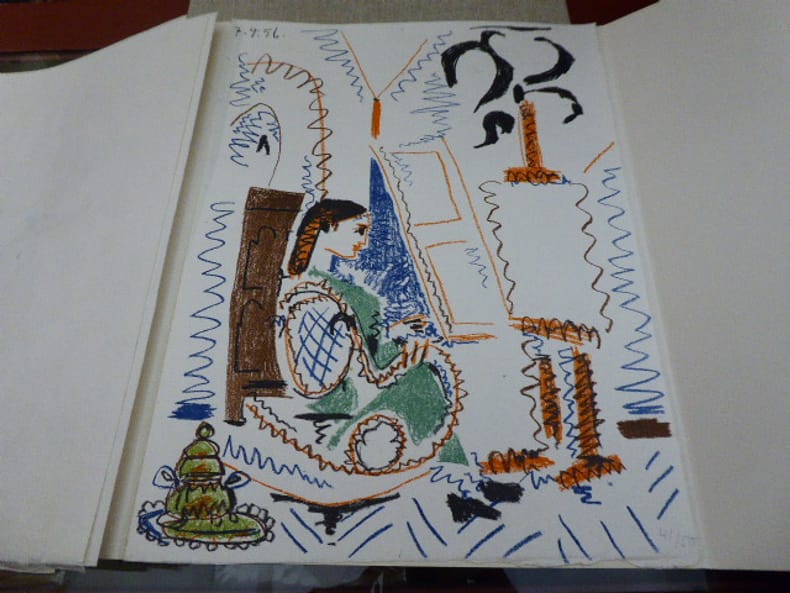
937995Fernand Mourlot Paris 1957 In-folio ( 444 x 334 mm ), en feuilles, sous couverture rempliée illustrée en lithographie couleurs sur les 2 plat, coffret-boite de toile bis imprimé sur le dos. 6 lithographies originales dont 4 en couleurs ( dont couverture ) de Pablo PICASSO et 30 reproductions de dessins, tableaux, collages datant des années 1914 à 1948. EDITION ORIGINALE au tirage limité à 275 exemplaires sur Arches, celui-ci, 1 des 50 exemplaires du tirage de tête sur papier vélin d'Arches ( N°41 ), signé par Pablo PICASSO au crayon rouge et accompagné d'une suite à part de 13 lithographies originales chacune justifiée ( 41/50 ) tirée sur Japon à la forme Hodomura. Très bel exemplaire, en parfait état. Cramer 88. The Artist and the book, 1972, Cat. 240.
The original joint manuscript travel diary, from 1835 to1840, of Mr. and Mrs. Hermann and Adelheid Garlichs, who settled in America and became founders of the Evangelical congregations. 8vo. 50 pages in manuscript. In addition, inversely there are 18 pages in manuscript by the same two writers, the first entry with a date as early as 1796 and possibly made by Adelheid's mother. The center of the volume contains 6 pages of recipes written by a family member in 1873, the year of Adelheid's death. All text is in German. Black paper boards, with floral cameo surrounding Adelheid's initials A.v.B. and the year 1835 tooled in gilt to front. With the stamp of the Steinlacke von Borries family library to front pastedown. Volume measures approximately 20 x 17,5 x 1 cm. Some wear to boards, otherwise in very good condition, an important primary source account of emigration to Missouri. Hermann Garlichs (1807-1865) was a German theologian and pastor, first arriving in America in 1833. He founded the first Protestant congregations west of the Mississippi and was the first president of the "German Evangelical Church Association of the West" in the USA. He was married to Adelheid von Borries. The couple's life became the subject of emigration research. In Anglo-Saxon literature, his name is sometimes seen as to Herman Garlichs, or Garlich. He grew up in Bremen in a wealthy Protestant family home, his father being a merchant. After completing his doctorate in philosophy, he was employed as an educator on the Steinlake estate of the district administrator C. L. Philip of Borries, and fell in love the administrator's daughter of the house, Adelheid von Borries (1815-1873). In 1833, when Garlichs was invited to go to America, miss Borries was only 16. As such, he emigrated there without her, but with Meller and Westerkappelner emigrants. Garlichs was inspired by Gottfried Duden's well-known descriptions of the good conditions in Missouri at that time. Duden was a Prussian lawyer who visited St. Louis, Missouri, in 1824 in search of land tracts for German settlements. Both Duden and his traveling companion, Ludwig Eversmann, purchased farms about fifty miles west of St. Louis. Duden spent nearly three years in the United States, reading, exploring the country, and writing letters while the Americans that he hired cleared his land and ran his farm. Duden returned to Germany in 1827. The result of this experiment was Report on a Journey to the Western States of North America [Bericht u¨ber eine Reise nach den westlichen Staaten Nordamerika's], which was published in Germany in 1829 to convince Germans to immigrate to Missouri. Duden described the advantages of moving to Missouri, and further provided advice on how to successfully create a new life in the United States. Duden's book was one of a large number of German books about America, but his was one of the most widely read. Germans faced many problems at home, including corrupt rulers, high taxes, and a lack of available land, thus Duden's account of the spacious expanse of Missouri plains sound very enticing to his fellow countrymen. Together with a few other missionaries who would become notable in the history in America, he made the voyage and settled in Missouri. Garlichs founded the first Protestant congregations west of the Mississippi in 1833 before he was ordained, i.e. as a lay preacher, in the small towns of Femme Osage and St. Charles. Originally known as the Deutsche Evangelische Kirchegemeinde, it was the first Evangelical congregation west of the Mississippi River. It still stands today, and has two church cemeteries, the first dating back to the 1830's and located next to the present-day school. Femme Osage was the mother-church for six other congregations: Friedens (St. Charles, 1834), Harmonie (Warrenton, 1842), St. Peter (Washington, 1844), Immanuel (Holstein, 1839), St. John (Cappeln, 1857), and Bethany (Schluersburg, 1844). In 1835 Hermann Garlich returned to Westphalia, married Adelheid von Borries, and was ordained a priest in Bielefeld. He subsequently went back to Femme Osage with his new wife. Unlike most immigrants to Missouri at the time, in 1835 the Garlichs travelled to America as privileged passengers. Apart from the expected rough seas now and again, and Adelheid missing her family, the voyage was a pleasant one. The newlywed couple had a first class room, and dined with the captain. The ship carried only 119 passengers. They reported that the ship was supplied with 100 chickens, 2 pigs, 2 geese, pigeons and ducks for fresh meat. Adelheid studied English and discussed theology with her husband. Hermann entertained the other passengers by playing the violin. Their joint diary records a theatrical performance by the steerage passengers. Initially, the couple, like the other settlers, lived in very simple conditions in a wooden hut five miles from the town. The more elaborate Garlichs house, at Femme Osage, St. Charles County, MO, is now listed as a Historic American Building. Hermann Garlichs is buried at Green-Wood Cemetery in Kings County, Brooklyn, New York. He died at the young age of 58. The famed but elusive original volume - this is the joint diary of Hermann Garlichs and his wife Adelheid, made in their original hands, describing the voyage overseas, their arrival in America, settling in the unmissionized wilds of Missouri in hopes of a better life, and glimpses of daily life as it was for their first five years as founding evangelists in this vast land of opportunity and hope.
4 SS. auf Doppelblatt. 8vo. Beiliegend ein eh. Brief mit U. von Eduard Hanslick an Fritz Simrock. (1 S. 8vo). Inhaltsreicher Brief an seinen nicht namentlich genannten Verleger Fritz Simrock ("L. S."), der zusammen mit seinem Mitstreiter Robert Keller ein neues Verzeichnis von Brahms' Werken erstellen wollte und dabei auch Schützenhilfe von Eduard Hanslick erhalten hatte. Wenn Simrock schon etwas für ihn tun wolle, so wären nach Brahms' Ansicht Inserate in den von Barthold Senff herausgegebenen "Signalen" oder in Fritzschens "Musikalischem Wochenblatt" um vieles geeigneter. Was die Debatte zusätzlich anheizt, ist die geplante Anführung von Daten: "Also: ich finde die ganze Geschichte zwar unsinnig u. überflüssig, kann aber doch umso weniger dagegen sagen, als es ja schon 2 Kat. giebt. Gescheiter fände ich es schon, wenn Sie sich begnügten ein Verzeichniß der empfehlenswerthen Werke zu veröffentlichen! Das wäre so eine kleine, hübsche, billige Annonce für Senff u. Fritzsch! Niedlich wäre auch eine Anthologie von Gedichten u. Dichtern nach meiner Auswahl! Nun aber, damit ich auch was Positives sage: ich bin durchaus gegen die historischen Daten, die Sie u. Hr. Keller beabsichtigen. Ich finde sie nicht blos unnöthig sondern auch ungehörig. Es sieht schändlich eitel meinerseits aus u. daß ich nicht dazu mithelfe - u. dies nicht einmal ordentlich kann, glaubt doch Niemand. Also die lassen Sie ja weg. Und dann widersteht mir sehr der Gedanke daß der Katalog mit op. 100 erscheinen soll. Das sieht aus wie ein Jubiläum u. Sie werden auch noch zur Einsicht kommen daß dazu kein Anlaß vorhanden. Also lassen Sie ihn früher erscheinen, bei den nächsten 1, 2 opera die ich vielleicht noch in alten Schubladen finde. Denn daß ich wohlsituirter Mann noch arbeite, glauben Sie doch nicht? Vielleicht zeigen Sie Freund Hanslick diesen Zettel u. lassen sich von ihm sagen daß ich Recht habe". - Den Inhalt "dieses Zettels" missversteht Brahms allerdings und möglicherweise absichtlich, denn Hanslick schreibt unter dem 20. Juni d. J. ausdrücklich: "Ich gestehe, daß ich das Fehlen von Jahreszahlen im Schumann- u. Mendelssohn-Catalog schwer vermisse und Simrocks Idee für eine notwendige, von jedem Musiker ersehnte Reform in den themat[ischen] Catalogen halte […]" (vgl. die Beilage). - Beide Briefe mit unbedeutenden Faltspuren durch zeitgenöss. Kuvertierung, sonst tadellos. Gedruckt in: Deutsche Brahms-Gesellschaft (Hrsg.), Brahms' Briefe an Peter Joseph Simrock und Fritz Simrock, Bd. III (GA Bd. XI), Berlin, 1919, S. 98 ff., Nr. 528.
3 SS. auf Doppelblatt. 8vo. Brief aus Pörtschach am Wörthersee, wo Johannes Brahms viele Sommerurlaube verbrachte: "18 Bände! Und es soll nicht der Mühe wert sein einen Brief zu schreiben? Aber ich armer Mann, wie schwer fühle ich die Verantwortlichkeit die auf mir lastet! Kann ich denn hoffen durch ein paar letzte Bände alle früheren entschuldigen zu können? Wie Sie will ich nun Alles verschweigen was ich erzählen könnte! Aber ich denke wir sehen uns Pfingsten in Düsseldorf? (Ihr 19ter Band kommt auch dran.) Nur eilig sage ich auf Ihre Fragezeichen Einiges. Im Ganzen bin ich aber mehr für das Plaudern und freu mich also auf D[üssel]d[or]f. Die Partitur von Bd 19 war nicht in England aber Pohl, der sanfte Verräther, hat mir gestanden daß er von Engländern verführt worden sei u[nd] heimlich in der Probe nur die Stimmen notirt hat! [...] Wegen neuer Sachen die ich geschrieben habe halten Sie sich nur weiter an Ihren Referenten - er weiß entschieden mehr als ich! Nach England aber komme ich nicht leicht weil ich zu große Abneigung gegen Koncerte u[nd] andre Unruhen habe. Es hat nichts damit zu thun ob mir einmal englische Politik nicht gefällt oder engl. Reisende mißfallen. Letzteren wird übrigens mit bestem Erfolg jetzt von den Norddeutschen (Berlinern) der Rang streitig gemacht! Die Händelschen Arien haben Sie vielleicht in D[üssel]d[or]f im Koffer. Ich habe selbst ihrer ca. Hundert / ich fürchte es wird meinem nicht gerade überschwänglichen Interesse daran nicht gerade förderlich sein wenn ich auch sehe wie Andere - gerade wird der Satz nicht mehr! Aber ich hoffe auf Wiedersehen u[nd] schreibe nur noch m[eine] Adresse her: Pörtschach am See, Kärnten [...]".