66 615 résultats
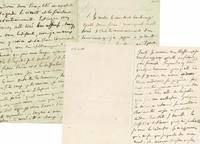
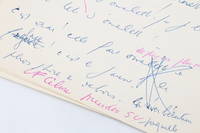
Various formats. Altogether 150½ pages. Large collection of authentic material relating to one of Adolf Hitler's closest associates. Comprising in total: - I: Goebbels's college science notebook. Ca. 1919, in pencil and ink, signed within eight times "Goebbels". 8vo. 52 pp. - II: Goebbels's high school maths workbook. Ca. 1918. 8vo. 60 pp. Goebbels has written his name on the title-page and filled the book with mathematical equations and logarithms, precisely written in pen and pencil. - III: Goebbels's registration book for classes he took at the Julius Maximilians University (Würzburg) in the winter semester of 1918/19. 8vo. 24 pp. Goebbels has signed his full name on the cover, along with his city of residence and his course of study ("German Studies"). Within he lists the classes taken, professors' names, and class fees. - IV: Typed letter signed from his father Fritz Goebbels. Rheydt, 14 Nov. 1918. 1 p. 4to. On the verso of the letter, Goebbels, at the time drinking heavily, has signed his name 28 times as "Goebbels", seven times with his familiar "Ulex Goebbels", and seven times as "Ulex". - V: Manuscript poem. 11 July 1920. 1 p. 205 x 81 mm. Unsigned, titled "Husaren Abschied" ("Hussars' Farewell"). - VI: Autograph poetry manuscript. 23 April 1923. 1 p. 8vo. Unsigned, titled "Bei Nacht" ("By Night"). - VII: Autograph poetry manuscript. Ca. 1920. 1 p. 8vo. Unsigned, titled "In einer Nacht" ("One Night"). - VIII: Autograph poetry manuscript. Ca. 1920. 3 pp. 8vo. Unsigned, titled "Der Mutter Wiegenlied" ("A Mother's Lullaby"). On the verso is a second poem. - IX: Autograph poetry manuscript. Ca. 1920. 1 p. 205 x 73 mm. Unsigned, titled "Abschied" ("Farewell"). - X: "Ins Tagebuch" and "Mahnung" ("For the Journal" and "Admonition"). 2 autograph poetry manuscripts (12 and 15 lines). Heidelberg, 15 May 1920. Small 4to. 1 p. - XI: Autograph poetry manuscript. Ca. 1920. 1 p. 205 x 73 mm. Unsigned, titled "Heimfahrt" ("Journey Home"). - XII: Autograph manuscript signed. N. p. o. d. 8vo. 1½ pp. Signed "Goebbels" (4 times) and "Pflüger" (2 times). - XIII: Autograph poetry manuscript. Ca. 1920. 1 p. 8vo. Unsigned, titled "In vielen Naechten" ("In Many Nights"). On the verso are several lines of personal notes, signed "D. U.", probably also by Goebbels as his familiar "Ulex". - XIV: Library card issued to Goebbels. Ca. 1919. 1 p. 8vo. Signed by a university official. Goebbels has added ten lines of study notes on the verso. - XV: His very early familiar signature and interesting addition: "Ulex Goebbels from the little child". On the 36mo cover of a 1920 calendar cover page. - XVI: Goebbels's senior year report card. Rheydt, 7 April 1916. 1 p. Small folio. Signed by his headmaster and teacher.
4 SS. auf Doppelblatt. 4to. Geschrieben von Goethes Sekretärin Caroline Ulrich und fortgesetzt von seinem wissenschaftlichen Helfer und Mitarbeiter Friedrich Wilhelm Riemer, dem ehemaligen Hauslehrer in der Familie von Wilhelm von Humboldts und dann von Goethes Sohn August. Der Adressat des Briefes ist Friedrich von Schlichtegroll, seit 1807 Generalsekretär der Bayerischen Akademie der Wissenschaften, der sich mit einer Empfehlung für die Schauspielerin und Sängerin Anna Altmutter an ihn gewandt hatte: "Wie gern möchte ich das Gute, was sich auf unserm Theater nach und nach hervorgetan [...] weiter ausbreiten", aber "bey uns kann nur eine kleine Anzahl Talente neben einander bestehen, denn da wir nur dreymal in der Woche spielen, so ist für mehrere nicht Raum, und selbst die schon gegenwärtigen haben sich öfter zu beklagen, daß sie nicht genug beschäftigt sind. Besonders aber ist das Verhältniß, in welchem Ihre Künstlerin zu stehen wünscht, nicht wohl einzuleiten, indem, wenn man ihr auch Rollen zutheilen wollte, man bey Ihrem Abgange sich in der doppelt unangenehmen Lage sähe, dieselben wieder erledigt, und die Schauspielerinnen, die darauf Anspruch machen könnten, übel disponirt zu finden. Von schon besetzten Rollen könnte ohnedies bey dem längeren Aufenthalte eines so werthen Gastes die Rede nicht seyn […]". - Auf S. 4 eine eh. Nachschrift von F. W. Riemer, der im November des Jahres mit Caroline den Bund der Ehe schließen sollte: "Die Absendung des Vorstehenden ist leider sehr lange verzögert worden. Ich werde an meine Pflicht erinnert in dem Augenblick, da ich von Weimar scheide, um nach Frankfurt und Wiesbaden zu gehen". - Stellenweise etwas fleckig; Falteinrisse fachmännisch restauriert.
8vo. 3 pp. on bifolium. Page 4 written by his daughter Una. In Russian, to his third wife, Natalya Andreevna (née Manchenka, 1902-90), about fighting against the AKhRR (Assotsiatsia Khudozhnikov Revolutsionnoi Rossii - Association of Artists of Revolutionary Russia), appointments with Kirill Ivanovich Shutko (with whom he talked about Dziga Vertov), Archangelski, M. P. Kristi, and Aleksei Gan, who wished to publish two essays by him. "A new AKhRR campaign against the new artistic currents has begun here, but it's their bad luck that now my camp is gaining the upper hand, and so they haven't a leg to stand on. I went to the Tretyakovka gallery and saw Kristi; on Friday I will be back there speaking about the new department and possibly about my works [...] I think I have already mentioned everything. I will receive my payment on Monday and then go and buy the tickets; I expect to be in Leningrad on Wednesday [...]". - In her postscript, Malevich's daughter Una (then aged nine) reports how happy she was that her father had come to celebrate Christmas with her. - K. I. Shutko (1884-1941) was editor-in-chief of the magazine "Soviet Cinema". Malewitsch über sich. Zeitgenossen über Malewitsch. Briefe. Dokumente. Erinnerungen. Kritik. Vol. 1 (Moscow 2004), no. 8.
4 SS. auf Doppelblatt. 8vo. Beiliegend eine gedruckte Porträtpostkarte. Sehr detailreicher Brief an seinen Verleger Julius Kistner über die Herausgabe seines "Spanischen Liederspiels": "Sie erhalten hierbei, geehrter Herr, das Spanische Liederspiel, dessen Herausgabe, wie ich wünsche, Ihnen noch in später Zukunft Lohn und Freude bringen möge. Nro. 4 u. 6 bleiben also weg, was Sie dem Stecher bei dem Stich der Inhaltsanzeige, u. der Numerirung der einzelnen Stücke bemerken wollen. Auf dem kleinen Blättchen habe ich angezeigt, wie ich mir die Einrichtung denke. Erst ein Umschlag, dann der Haupttitel, dann die Inhaltsanzeige. Die Gewandung überlasse ich Ihrem guten Geschmack. Aber der Haupttitel! Gern möchte ich dazu, wie zu dem Titel meines Albums, den Zeichner zu Hülfe nehmen. Schuberth hat das Titelblatt, das Sie wohl gesehn, ziemlich billig, Zeichnung und Ausführung des Steines zusammen für 6 Louisdor; dies aber deshalb, weil ich Prof. L. Richter persönlich kenne und sein Sohn Unterricht in der Composition bei mir hat. Ich glaube gewiß, daß er mir zu demselben Preise auch zu dem Liederspiel etwas zeichnet, und wie von ihm zu erwarten, etwas Feines, Anmuthiges. Ist Ihnen aber diese Ausgabe nicht zu groß? Bitte deshalb um Antwort. Den Notenstich des Liederspieles selbst denke ich mir zierlicher, als den gewöhnlichen - wenn nicht ganz so klein, wie den des Albums, so doch in ähnlicher Weise. Eine Umrandung der einzelnen Platten sieht auch sehr hübsch [aus]. Namentlich aber wünschte ich die Textschrift nicht zu kolossal. Am Besten wäre es, Sie ließen mir eine Stichprobe, vielleicht der 1sten Seite, zur Ansicht anfertigen [...]". Schumanns Liedersammlung erschien im November des Jahres. - Provenienz: J. & J. Lubrano, 2002.
- Paris s.d. [1890], 21,3x14cm, 3 pages in-8 au verso de 4 feuillets de l'Assistance publique de Paris. - VERLAINE Paul Complete autograph manuscript signed by Paul Verlaine of one of his Hospital Chronicles: "We poets, as well as they, the workers, our companions in misery" Paris n. d. [1890], 213 x 140 mm (8 3/8 x 5 1/2 "), 3 pages in-8 at the back of 4 leaves of the Assistance publique de Paris Complete autograph manuscript signed by Paul Verlaine of one of his Hospital Chronicles, 90 close lines in black ink on the verso of paper from the Assistance publique de Paris. The chronicle of one of Verlaine's stays in hospital between September 1889 and February 1890. The note "III" has been crossed out in blue printer's pencil. In the definitive collection, this text is, in fact, second. In the version published by Le Chat noir on 5 July 1890, there appear to be no variations with the text of this manuscript. This is thus the final state of the text, the one sent to the printer. Jacques Borel dates the writing of this chronicle to a hospital stay in Cochin in June 1890. Verlaine spent many days in hospital during his life, especially in this period. During these stays, he wrote Hospital Chronicles, prose poems in eight parts. Here, he mixed anecdotes, observations of the lives of the patients, and a delicate poetical analysis of the world of the hospital. Verlaine starts off with a troubling and tired observation: "But certainly, all the same, the Hospital darkens, despite the fine June weather...Yes, the Hospital is dark despite philosophy, insouciance, and pride." Despite the fine weather, the inflexibility of the system, the misery and the sickness give the poet a gloomy take on things: "let us punish all objections under pain of expulsion, still severe, even in this month of flowers and hay, of warming days and clement nights, if you have the devil at your back and debt and hunger at home." Discharge, whether by way of being thrown out or getting cured, and life outside did not offer more comfort than the stay itself: "Clearly, we'll all get out sooner or later, more or less well, more or less happy, more or less sure of the future, at any rate more or less alive. So we will think sadly...of our suffering, emotional and otherwise, of the doctors, good or inhuman". This was a feeling he had already experienced during what he called "my intervals", the times when he was out of hospital. Life outside hospital was a miserable prospect, despite his established fame. Verlaine compares his misery to that of the working classes who share his stays in various hospitals. The poet calls for resignation from his "brothers, artisans of one sort or another, workers without a life's-work and poets...and publishers too, let us accept our fate, let us drink up the cup of tea with (barely any sugar), or this little hot chocolate, and let us be brave whether it be with our medicine, or an enema, or chewing tobacco. Let us follow their prescriptions closely, let us obey all injunctions, so that injections and colonics will seem sweet to us, and let us reprimand all objections...". And along with them, the poet wanted to take advantage of the beauties of June in quoting two verses from the Chanson sentimentale of Xavier Privas: "We are pleased with ourselves in the strong sun. And under the green branches of the oaks, we poets, as well as they, the workers, our companions in misery...". Equal in the face of misfortune, whether active or passive, they might feel nostalgia once they were out: "And perhaps some day we will miss these good times where you workers, you could rest and where we, we poets, worked, and where you artists earned your wine and your cups ...?" Despite this reverie, Verlaine was: "tired of so much poverty (provisionally, believe me, because I have been so used to it these last five years!)" and concludes bitterly with the observation of the lack of humanity in modern medicine: "Hospital with a capital H, an awful idea, ev
4 pp. In-16. To an unknown recipient. Liszt is sick in Madonna del Rosario, he felt "very unwell walking up Monte Mario after having had dinner at the Vatican". He writes to confirm his presence at an important concert by Lippi despite his state of health. "After that [he will] endorse himself to eight days of imprisonment". His sicckness does not keep him from maintaining his social commitments with his correspondent, "Haxthausen and Mme Colban". - Enclosed a framed reproduction of the famous photography by Hanfstaengl that shows the pianist playing. - Provenance: Robert Bory, musicologist.
Une page petit in-4. Suscription. À "mon cher Hérold": "[...] Dites si ce n'est pas bien exigeant de vous demander de reprendre demain soir Mardi le chemin de la rue de Rome, parce que je voudrais prendre votre avis sur un rien tout en causant [...]". - En 1888, le tout jeune poète (Hérold est né en 1865) fait parvenir spontanément au Maître son premier recueil de poésie "L'Exil de Harini" que Dalou venait de publier. L'accueil de Mallarmé lui fut d'emblée favorable et Hérold allait devenir un des plus fervents affidés des célèbres Mardis de la rue de Rome, où se croisèrent entre 1880 et 1898, Verlaine, Gide, Louÿs, Régnier, Whistler, etc. autant de visiteurs illustres ou poètes inconnus qui participèrent à la légende mallarméenne des Mardis, ces réunions hebdomadaires où le Maître improvisait, debout, fumant la pipe, face à des disciples dévots de la génération post-symboliste. - A.-J. Ferdinand Hérold est le petit fils du compositeur Ferdinand Hérold (l'auteur du Pré-aux-Clercs). Entré à l'École des Chartes en 1885, il en sort trois ans plus tard pour se consacrer entièrement à la littérature qu'il servit au cours de sa vie avec beaucoup d'intelligence et de sensibilité poétique. Il s'immisce parmi les auteurs symbolistes, fréquente assidument les Mardis de Mallarmé, et noue une vive amitié avec son coreligionnaire le poète Pierre Louÿs dont il se séparera au moment de l'Affaire Dreyfus. Très lié au cercle des Heredia (les sœurs Heredia), Régnier, Gautier (par Judith Gautier, la fille de Théophile), Louÿs et Valéry, ami des musiciens Fauré et Ravel, il fut un contributeur avisé au Mercure de France d'Alfred Vallette. Poète, mais aussi auteur dramatique, traducteur d'Eschyle et d'Euripide, plusieurs de ses pièces furent représentées sur la scène du théâtre d'avant-garde de Lugné-Poë (L'Anneau de Çacuntala en 1895, ainsi que La Cloche engloutie, tirée du conte de G. Hauptmann, deux ans plus tard).
8vo. 2 pages. Unpublished letter, in German, to his sister Helene Salzer, née Wittgenstein: "Little Helene, my uncle! (What must the censors think!) […] I have not listened to music for a long time. I would like to hear Schumann quartets again. Recently I remembered the beginning of one quartet - the introduction - and was quite delighted. Unfortunately, two floors below my rooms someone is playing the piano & I am much disturbed by the miserable plunking (mostly Beethoven). Oddly, it sometimes almost prevents me from breathing […]" (transl.). - With censorship stamp. Not in: McGuinness, R. Schweizer (ed.), Wittgenstein. Eine Familie in Briefen, Innsbruck and Vienna, 2018.
- s.d. (ca 1823), 12x18,2 cm et 10x15,5cm, Six pages sur deux feuillets rempliés. - Unpublished handwritten letter to "Julie" (Louise de Pron): "Fool me if you want, I'll believe you, I want to believe you so much and I need it" [ca 1823] | 12 x 18,2 cm and 10 x 15,5 cm | six pages on two double leaves Almost entirely unpublished handwritten letter from the painter Eugène Delacroix to the love of his youth, the mysterious "Julie", now identified as being Madame de Pron, by her maiden name Louise du Bois des Cours de La Maisonfort, wife of Louis-Jules Baron Rossignol de Pron and daughter of the Marquis de La Maisonfort, Minister of France in Tuscany, patron of Lamartine and friend of Chateaubriand. 90 lines, 6 pages on two folded leaves. A few deletions and two bibliographical annotations in pencil on the upper part of the first page ("no114"). This letter is one of the last to his lover in private ownership, all of Delacroix's correspondence to Madame de Pron being kept at the Getty Research Institute (Los Angeles). Only nine of the ninety lines of this unpublished letter were transcribed in the Burlington Magazine in September 2009, alongside the long article by Michèle Hanoosh, Bertrand and Lorraine Servois, whose research finally revealed the identity of the famous recipient. Sublime love letter from twenty-four-year-old Eugène Delacroix, addressed to his lover Madame de Pron, twelve years his senior, who unleashed the liveliest passion in him. This episode of the painter's youth, then considered the rising star of Romanticism, for a long time remained a mystery in the biography of Delacroix, who was careful to preserve the anonymity of his lover thanks to various pseudonyms: "Cara", "the Lady of the Italians", and even "Julie", as in this letter, in reference to the famous epistolary novel Julie ou la Nouvelle Héloïse by Rousseau. For obvious reasons, Delacroix did not sign his name on any of the letters in correspondence with the lady. A great figure of the legitimate aristocracy, the recipient of this feverish letter is Madame de Pron, daughter of the Marquis de La Maisonfort, Minister of France in Tuscany, patron of Lamartine, friend of Chateaubriand. Her beauty was immortalized in 1818 by Élisabeth Vigée-Lebrun, who painted her portrait in pastel, with an oriental hairstyle. Delacroix and Madame de Pron met in April 1822 when the portrait of the latter's son, Adrien, was commissioned, a pupil at the Lycée Impérial (now Lycée Louis-le-Grand). Delacroix had been commissioned for the portrait by his close friend Charles Soulier, Madame de Pron's lover, who despite himself, served as an intermediary for Delacroix. In the absence of Soulier, who had gone to Italy, the painter and the young women established an intense romantic relationship. The portrait commission became a pretext for their tender meetings in his studio on rue de Grès, while no trace of the child's painting has been found to this day. Their adventure lasted a little over a year, but it was one of the most intense passions of the artist's life. Our letter undoubtedly corresponds to the last throes of their relationship, in the month of November 1823. After one of their visits at the end of a hiatus of several months, Delacroix writes to her again under the influence of emotion: "I come home with a shaken heart, what a wonderful evening! [...] Sometimes I say to myself: why did I see her again? In the calm sanctuary where I lived, even in the middle of the invisible places that I had formed [...] I managed to silence my heart". Madame de Pron had indeed decided to bring an end to their intimate relationship (see her letter from 10 November 1823: "I want sweet friendship [...] I do not want to torment you", (Getty Research Institute). Losing all discernment and with blind devotion, Delacroix attempts to revive their affair: "Make me lie, prove to me that your soul is indeed that of the Julie that I once knew, since mine has regained its charming
1823759401823. Fine. s. d. ca 1823 12 x 18.20 cm Six pages sur deux feuillets rempliés Almost entirely unpublished handwritten letter from the painter Eugène Delacroix to the love of his youth the mysterious Julie now identified as being Madame de Pron by her maiden name Louise du Bois des Cours de La Maisonfort wife of Louis-Jules Baron Rossignol de Pron and daughter of the Marquis de La Maisonfort Minister of France in Tuscany patron of Lamartine and friend of Chateaubriand. 90 lines 6 pages on two folded leaves. A few deletions and two bibliographical annotations in pencil on the upper part of the first page no114. This letter is one of the last to his lover in private ownership all of Delacroix's correspondence to Madame de Pron being kept at the Getty Research Institute Los Angeles. Only nine of the ninety lines of this unpublished letter were transcribed in the Burlington Magazine in September 2009 alongside the long article by Michèle Hanoosh Bertrand and Lorraine Servois whose research finally revealed the identity of the famous recipient. Sublime love letter from twenty-four-year-old Eugène Delacroix addressed to his lover Madame de Pron twelve years his senior who unleashed the liveliest passion in him. This episode of the painter's youth then considered the rising star of Romanticism for a long time remained a mystery in the biography of Delacroix who was careful to preserve the anonymity of his lover thanks to various pseudonyms: Cara the Lady of the Italians and even Julie as in this letter in reference to the famous epistolary novel Julie ou la Nouvelle Héloïse by Rousseau. For obvious reasons Delacroix did not sign his name on any of the letters in correspondence with the lady. A great figure of the legitimate aristocracy the recipient of this feverish letter is Madame de Pron daughter of the Marquis de La Maisonfort Minister of France in Tuscany patron of Lamartine friend of Chateaubriand. Her beauty was immortalized in 1818 by Élisabeth Vigée-Lebrun who painted her portrait in pastel with an oriental hairstyle. Delacroix and Madame de Pron met in April 1822 when the portrait of the latter's son Adrien was commissioned a pupil at the Lycée Impérial now Lycée Louis-le-Grand. Delacroix had been commissioned for the portrait by his close friend Charles Soulier Madame de Pron's lover who despite himself served as an intermediary for Delacroix. In the absence of Soulier who had gone to Italy the painter and the young women established an intense romantic relationship. The portrait commission became a pretext for their tender meetings in his studio on rue de Grès while no trace of the child's painting has been found to this day. Their adventure lasted a little over a year but it was one of the most intense passions of the artist's life. Our letter undoubtedly corresponds to the last throes of their relationship in the month of November 1823. After one of their visits at the end of a hiatus of several months Delacroix writes to her again under the influence of emotion: I come home with a shaken heart what a wonderful evening! . Sometimes I say to myself: why did I see her again In the calm sanctuary where I lived even in the middle of the invisible places that I had formed . I managed to silence my heart. Madame de Pron had indeed decided to bring an end to their intimate relationship see her letter from 10 November 1823: I want sweet friendship . I do not want to torment you Getty Research Institute. Losing all discernment and with blind devotion Delacroix attempts to revive their affair: Make me lie prove to me that your soul is indeed that of the Julie that I once knew since mine has regained its charming emotions and its worries. But the painter runs into Soulier and General de Coëtlosquet also lovers of Madame de Pron. Delacroix had narrowly avoided a final disagreement with Soulier who had almost seen a letter from Madame de Pron in h unknown
195483744Meudon 1954. Fine. ""What is Normance "" Meudon 1954 20 x 27 cm 16 feuillets 9 pour le premier manuscrit 7 pour le second Two unpublished autograph manuscripts signed by Louis-Ferdinand Céline in blue and red ballpoint pen: the first contains 9 pages numbered in the left-hand corner from 1480 to 1488; the second contains 7 pages numbered from 1498 to 1504. Each text is signed by Céline in red ink at the bottom margin with the words ""Meudon 54"" also in his hand ff. 1485 and 1505. There are numerous variants lines and words crossed out modified and repeated. Traces of pinholes in the upper left-hand margin of every sheet as Céline organized his manuscripts in ""bundles"". Normance was published in 1954 as a sequel to 'Fable for Another Time' published two years earlier. Both parts were written during Céline's years of exile and imprisonment in Denmark. Upon his return to France in 1951 Céline began ""polishing"" his writings and published these two monumental texts initially envisaged as a single book. ""Céline while he was working on it thought of this novel as a second Journey to the End of the Night' twenty years later capable to astonish the public as much as the 1932 novel"" Henri Godard. This set of manuscript pages corresponds to two passages from the second half of the novel Romans Pléiade IV p. 371 to 375 significantly different from the published text. This is an earlier version unknown to scholar Henri Godard as evidenced by a note in the Pléiade edition where he explains the difficulties encountered by Céline's secretary Marie Canavaggia when translating the word ""planqaouzeuze"" - appearing here on one of the manuscript leaves. Her transcription ""plaquouseuze"" eventually remained in the published text. Godard further stated he had no knowledge of this part of the manuscript i.e. our manuscript not appearing in the intermediate versions transcribed and published in the Pléiade edition. The first of the manuscripts recounts the ransacking and looting of psychic Armelle's apartment: ""How many decks did Armelle have Her fortune-telling cards were taking the air! . Ah seeress! Something she hadn't guessed was how her trembles would be tarred! They'd rip open her armchairs crush her fine hiding places! ah Pythonisse! ah the quilt now! the inside of the pillows flies! flies away!"" Céline also evokes Madame Toiselle the building's concierge: ""- It's a mess Madame Toiselle. I yell it at her. she was a maniac! . moron! she's looking now! she's looking good! ah I see her consternation.she's there in front of me on all fours. I can see her head! Her hoe! - Omelette head!"" I shout to her Omelette head'! The second focuses on Raymond in the grip of a delirious crisis thinking he's a donkey: ""Raymond Raymond! but it's your wife you're looking for! it's true he was looking for his wife.! well maybe five minutes ago he was looking for his wife! Denise! . now he's looking for himself. . - Hiian! hiiian! he answers me! There's also a comical settling of scores between Mimi and Rodolphe: ""There goes Mimi then there goes Rodolphe! Rodolphe! they're coming! and how they're treating each other! where were they on the threshold the two of them! they're taking advantage of the lull in the bombs! - Pig! Pimp! - Cabotine! coureuse! and they attack their costumes. "" Remarkable manuscripts bearing witness to Céline's tireless pursuit in finding the right word and his willingness to place himself as a direct witness to events both historical and autobiographical. These unpublished manuscript lines are typical of the Celinian style of this ambitious novel: ""The story style and tone of Normance set it apart from the rest. It is nothing more than the long account of a night of bombing in Montmartre told in his own way by Céline who had been deeply impressed by the spectacle of the bombing of the Renault automobile factories in Boulogne-Billancourt which he had witnessed from the windows of his apart unknown
8vo (ca. 120 x 174 mm). 69 entries on 71 ff. Contemporary boards covered with green coloured paper. An important and highly interesting Italian friendship album assembled between July 1919 and June 1924, realized in Klecksography throughout, by folding in half the signatures while still damp to create symmetrical ink blots, similar to the one used for the Rorschach test. - Among the personalities here represented is Emperor Hirohito, who visited Italy accompanied by his uncle, Prince Kanin Kotohito, during a six-month state visit to Europe before assuming the regency of Japan in November 1921. The album also contains also a series of signatures collected in Fiume (Rijeka) in August 1920, at the height of the Italian Regency of Carnaro, including Gabriele D'Annunzio himself as well as Sante Ceccherini, Viganò, the commander of the defected destroyer Espero, and other legionaries and military heroes. The collection further comprises members of the Italian royal family, represented almost in its entirety, and the ministers of Mussolini's first government, including Costanzo Ciano, Armando Diaz and Giovanni Gentile. - Light marginal dampstaining. Spine and binding professionally restored. Full list of contributors is available upon request.
Oblong 8vo (ca 100 x 160 mm). 181 entries. With an armorial watercolour with motto, title with watercolour decoration, 5 drawings (3 of which full-page), and 1 engraved coat of arms, all on ca 300 ff. Contemporary calf binding with giltstamped cover borders, leading edges gilt, spine elaborately gilt, edges goffered and gilt. Gilstamped initials "MZCT" and date "1680" to upper cover (slightly rubbed). A wonderfully preserved Baroque friendship album giving a fairly precise record of its owner's youth and university years, containing numerous entries by eminent statesmen and scholars, especially at the University of Wittenberg in the 1680s. The first entry by "Ulricus Comtes a Kinsky et Tettau" (dated 12 April 1685; likely count Franz Ulrich Kinsky, 1634-99, Bohemian diplomat) is followed by those of several professors, including Abraham Calovius (1612-86), Johannes Andreas Quenstedt (1617-88), Johannes Deutschmann (1625-1706), Werner Theodor Martini (1626-85), Caspar Ziegler (1621-90), Conrad Samuel Schurzfleisch (1641-1708), Constantinus Ziegra (1617-91), Georg Caspar Kirchmaier (1635-1700), Michael Strauch (1635-1709), and Balthasar Stolberg (1640-84). There are also numerous scholars from Leipzig and Leiden, such as Georg Lehmann (1616-99), Johann Benedict Carpzov (1639-99), Valentin Alberti (1637-87), August Pfeiffer (1640-98), Adam Rechenberg (1642-1721), Gottfried Nicolaus Ittig (1645-1719), Jacob Trigland the younger (1652-1705), Frederik Dekkers (1644-1720), and Jacob Gronovius (1645-1716). Furthermore, there are entries by colleagues as well as by important men from Dresden (Christoph Bernhard, composer and music scholar), Magdeburg (Christian Scriver, hymnwriter), Hamburg (Joachim F. Gerstenbüttel, theologian), Jena (Joachim Andreas Danz, theologian and oriental scholar), Magdeburg (Balthasar Kindermann, theologian and poet), Erfurt (Christoph Klesch, theologian and poet), Kronstadt (Georg Wilhelm Löffelholz von Kolberg), Amsterdam, Bergfestung Königstein, and Buxtehude. - Martin Ziegler, a baker's son (born in Kronstadt [Brasov] in 1660, died in Brenndorf [Bod] in 1716), attended the Kronstadt grammar school before studying at Wittenberg from 1679 onwards. After nearly twelve years abroad he returned home, soon being named director of his old grammar school. He later became a priest at Tartlau but was suspended following a scandal. In 1713 he was elected priest of Brenndorf, but died a few years afterwards. He is remembered as a historian of his native city and of Transylvania (cf. Wurzbach). - Slight browning; occasional offsetting. Complete save for two removed leaves (likely empty, as they have left no trace of offsetting). Cf. Wurzbach LX, 62.
Oblong 8vo (200 x 118 mm). 86 ff. with 93 entries, 5 full-page illustrations (1 washed pencil drawing, 4 gouaches), and a watercolour flower in the text. Contemporary vellum with coloured lacquer decorations to covers and spine. Bronze-varnish paper; edges goffered and gilt. Uncommonly beautiful friendship album belonging to the law student Johann Christoph von Selpert (d. 1817), later councillor and delegate of various cities at the Regensburg Imperial Diet. Among the various contributors are many important scholars of the late 18th century, including Moses Mendelssohn, Johann Bernhard Basedow, Salomon Gessner, A. F. Büsching, and Christian August Clodius. - The earliest contributors are mostly Regensburg relatives of Selpert's, including Johanna Elisabetha née Harrer, wife of the local merchant and freemason Ludwig Leonhard Schkler (1738-1807), but also the 13-year-old Benedikt Friedrich Springer (1756-1803), later a preacher of note. Soon, more important personages are added whom Selpert met during his University years at Leipzig: the Rosicrucian Adam Michael Birkholz (1746-1818), who published under the pen name "AdaMah Booz", the preacher and hymn poet Johann Gottfried Schöner (1749-1818), the later law professor Christian Rau (1744-1818), as well as the historian Johann Gottlob Böhme (1717-80), the law scholar J. H. Wilmerding (1749-1828), later the mayor of Braunschweig, the educator Johann Bernhard Basedow (1724-90), the poet and philosopher Christian August Clodius (1737-84), the theologian and classical scholar Johann August Ernesti (1707-81), director of Leipzig's Thomasschule, and the city captain Johann Christian Krappe (1709-91). In Berlin, Moses Mendelssohn signs himself (in Hebrew) on 25 Iyyar 5532 (i.e., 28 May 1772), as does the geographer Anton Friedrich Büsching (1724-93); a Hamburg contribution is from the Linné student Johann Christoph von Heidenstam (1739-74); others, from Göttingen, are by Johann Heinrich Prieser (1749-1801) and Johann Jakob Besserer (1753-1834), both of whom soon would make their careers in Augsburg as concillors and even as mayor. Further journeys lead Selpert to Dresden, Meissen, and Bremen. Contributions from Lausanne (1773) include the physician and chemist Heinrich Struve (1751-1826), the naturalist Jakob Samuel Wyttenbach (1748-1839), and the jurist Samuel Porta (1716-1790); in Zurich the poet Salomon Gessner (1730-88) signs, as does the physician and writer Johann Kaspar Hirzel (1725-1803). - Selpert's coat of arms (an ink drawing on strong wove paper) is inserted loosely. A title page and some four leaves were removed from the album, apparently at a very early date. Spine somewhat sunned. A complete list of all contributors is available.
Large 4to. Altogether (2+1½ =) 2½ pp. on 2 bifolia. Each with autograph address. Family letters from Friedrich Engels's younger brother Emil (Friedrich was the eldest of nine children) to their mother Elise Engels, née van Haar, in Barmen, reporting on his military service in Berlin (7 Nov) and on the Christmas celebration at his uncle's house (25 Dec.). - I) "[...] Ihr werdet wol gehört haben daß die ganze preuß. Armee mobil gemacht wird; uns trifft das natürlich mit [...] Ich bin auf Alles gefaßt u. guten Muthes dabei [...] Der junge Borsig ist auch in meiner Compagnie, mit ihm war ich auch oft zusammen [...] Ich hoffe wir werden bald avanciren, u. es dann etwas besser haben. Sei aber nur nicht ängstlich um mich, wenn ich merke, daß mir die Sache zu sauer wird, melde ich mich gleich krank, u. lasse es die andern allein besorgen; ich bin durchaus nicht geneigt u. habe noch viel weniger Lust, mir für eine Sache wie die jetzige, nur das geringste Leid zufügen zu lassen [...]" (7 Nov.). - II) "Gestern Abend feierten wir bei Snethlages [i.e. Karl Wilhelm Moritz S., court chaplain in Berlin, an uncle of Engels] sehr heiter u. vergnügt Weihnachten, wobei für mich auch ein Tischchen aufgebaut war [...] Der Ring, den mir Onkel Snethlage ausgesucht, ist sehr hübsch [...] Ich habe mein Daguerotyp beigepackt [...] Ich mußte 1½ Stunden bei dem Manne warten, u. ich sehe deshalb so brummig aus [...] Heute Nachmittag sind wir alle bei der guten Großmutter die Euch aufs Beste grüßen läßt; morgen Mittag bin ich bei Jacobs. Gestern waren bei Onkel 4 Engländer die hier studieren, mit denen wir uns höchlichst amüsiert haben, u. bei denen ich Gelegenheit habe mein Englisch zu vervollkommnen [...]" (25 Dec.). - After fleeing from Germany in November 1850, Friedrich Engels for a while had to work at his father's textile factory at Manchester; their relationship was strained. Emil would marry Charlotte Bredt in 1853 and took over their father's company. - Integral address leaves showing some tears, otherwise fine.
Folio. Italian manuscript on paper. 3½ pp. Rare manuscript of an anonymous report of the martyrdom of the Blessed Baltasar de Torres Arrias (1563-1626), who was burned at the stake in Nagasaki on 20 June 1626 together with eight other Jesuits. The report is largely based on a letter that Baltasar de Torres had managed to write during his imprisonment in Omura. It repeats details from the letter such as description of Torres's diet in prison, which consisted of "rice, a broth with herbs, and a cured sardine". The other "authentic writings" from Japan that are alluded to in the title of the manuscript have not been identified. The earliest known publication of Torres's letter with an extensive description of his martyrdom is in Juan Eusebio Nieremberg's "Vidas exemplares" (vol. 4 [1647], pp. 559-572). The manuscript at hand is not based on Nieremberg's version, as it wrongly states the 21st of June 1626 as the day of the executions. This grave error points to an earlier source, as the date would have certainly been corrected based on Nieremberg's widely read martyrology. - Torres had defied the Japanese ban on all Christian missonaries in 1614 and was among the Jesuits who took refuge in Osaka castle until its capture in 1615. He continued his work as a missionary and provincial of northern and central Japan in secrecy for more than another decade. In 1626, Baltasar de Torres was finally arrested near Nagasaki and imprisoned in nearby Omura. His Japanese catechist, the Blessed Michael Tozó (ca. 1588-1626), soon followed Torres to prison. On 12 June 1626 the governor of Nagasaki returned from the court in Kyoto with a death sentence for all Jesuit prisoners. For their execution in Nagasaki, Baltasar de Torres and Michael Tozó were joined by seven Jesuits who had been imprisoned in Shimbara, including the Blessed Francisco Pacheco (1566-1626), the provincial general for Japan alluded to in the title, and the Blessed Gianbattista Zola. - With a large old waterstain throughout and several deep tears partly affecting the text (without loss).
8vo. German manuscript on paper. 25 inscribed pp. on 16. ff. In dust cover with the handwritten dating "1511". A unique testimony of late medieval building, significant for questions of art history as well as economic and social history. On the one hand, the manuscript proves useful for dating the construction works at St. Michael and provides important information about the persons in charge, being, apart from inscriptions in some of his sacral buildings, the only known written source naming the builder Bartlmä Firtaler. On the other hand, it allows a profound insight into the organisation of a late medieval construction site. While other manuscripts document the building of cathedrals or urban edifices, the one at hand lists the expenses of a small site in the periphery, covering about two months. The booklet was probably composed after the work was completed, drawing from notes constantly taken during the building process. It is arranged in several chapters, stating the weekly expenses for bricklayers and carpenters, for day works, the acquisition and transportation of stones, as well as other more general expenditures (such as the purchase of wood, nails, chains, saws etc.). Expenses for sealing by the town judge, for an errand and for the workmen's wine supply complete the picture. - Bartlmä Firtaler, born aound 1480, built many sacral edifices in Carinthia, Tyrol and Carniola/Slovenia, his debut work being the chapel in Schloss Stein near Oberdrauburg in 1505. The lord of the castle, Lukas von Graben, who also appears in the manuscript, probably acted as the principal and financier of St. Michael, which was to become the future burial place of the lords of Graben. The booklet records the offer of 22 guilders to Firtaler, which he didn't accept ("damit hat er aber nit besteen mügen"), leading to a concession of 32 guilders in the end. This episode illustrates Firtaler's esteem as a builder, as well as his self-confidence. Previous researchers didn't assign St. Michael in Lienz to Firtaler, or merely accredited him works in the nave, dating them around 1530, when he might have already been deceased. The accounting booklet proves the church to be a product of Firtaler's first style period, which might have been inspired by Benedikt Ried's work in the Vladislav Hall in Prague Castle. - The expenses were listed by an unknown scribe, giving the total at the end of each page. The grand total of 83 guilders is given at the end of the booklet (a miscalculation, as the total reached by adding the sums of each page amounts to 84). However, not only financial but also social circumstances connected with the Lienz building site can be reconstructed. The scribe distinguishes between masters and assistants, who are mentioned by name, and unskilled workers, whose names aren't given. Personal names also appear in the expenses for the transportation of stones to Lienz, as well as in the general expenses, indicating sellers and handymen. These names could be a basis for further research, not only defining the roles of the historical players involved in the building of St. Michael in the whole of the city's history, but also placing the accounting booklet in a prominent position compliant with its historical relevance.
4to. (1+2 =) 3 pp., in Arabic throughout. Includes one original addressed airmail envelope (printed Government of Ras-Al-Khaimah stationery). Two early, unique paper items from the Gulf Sheikhdoms: an official document from Sharjah witnessed by the ruler and a piece of private correspondence relating to the founding of a Ras Al-Khaimah government institution six years before independence. - 1) A power of attorney witnessed by the ruler of Sharjah, Sheikh Sultan bin Saqr Al Qasimi (ruled 1924-51). The document certifies that Salim ibn Ibrahim al-Yusuf and Abd al-Rahman ibn Khalifa al-Yusuf appoint Abd Allah ibn Abd al-Rahim and Haji ibn Abd al-Rahim to collect the rent for their properties in Bahrain, replacing their previous agent Muhammad ibn Rashid al-Qassab. The document, signed by Salim al-Yusuf in the month Dhu al-Qa'dah 1362 AH, bears in its upper right corner the seal of the ruler of Sharjah with a handwritten note: "They testified in my presence / Sultan bin Saqr al-Qasimi, Ruler of Sharjah and its Dependencies". With an eight-anna revenue stamp issued by the British Indian government and a stamp of attestation, certifying that the Sheikh's seal is authentic, dated 9 Feb. 1944 and signed by the Political Officer of the Trucial Coast, Maurice Patrick O'Connor Tandy (1912-86). Some browning and stains, edge tears and paper flaws (some with early repairs on verso). - 2) A two-page letter in blue ink, dated 7 March 1966, from Sami Abd al-Rahman Saqr, based at the Municipality in Ras al Khaimah, addressed to his friend Maher in Cairo. Sami Abd al-Rahman Saqr explains that when he returned to Ras al-Khaimah from his recent visit to Maher, the Sheikh [of Ras al-Khaimah, Saqr bin Mohammed Al Qasimi] asked him to help establish the State Audit Institution. He writes that he has therefore now relinquished his position at the Municipality, adding that the institution will start small until the building is ready and discussing the plans for its further development. Sami Abd al-Rahman Saqr further mentions that he will travel to London in April on the first BOAC flight from Dubai to London, marking the launch of this new route. While the airline invited the Sheikh to travel on this inauguration flight, having provided him with a return ticket and expenses for a week's stay in London, the Sheikh is too busy to avail himself of this gift and is therefore sending Sami Abd al-Rahman Saqr on his behalf. He may extend his stay as long as two weeks to discuss business opportunities with British companies and offers to bring Maher anything from London that he may wish. Written on blue airmail stationery with printed letterhead; includes the airmail envelope.
190:427 mm. In roter Leinenkassette (320:455 mm) mit Deckelschildchen. Sehr ansprechendes, großformatiges Albumblatt: Sieben 6/8-Takte Adagio in dreizeiligem System für "Flutes et Clarinettes", "Violons" und "V[iolonc]elli C[ontre]Basses" aus der Liebesszene von "Romeo und Julia": "Phrase de la scène d’amour de Roméo et Juliette Symphonie avec chœurs". - Die Ränder etwas gebräunt und fleckig, sonst tadellos erhalten.
4 SS. auf Doppelblatt. 8vo. An seinen Freund, den Komponisten Julius Otto Grimm, von ihm "Isegrimm" genannt, mit dem er den Sommer 1858 gemeinsam in Göttingen verbrachte. Dort lernte er auch seine Jugendliebe, die Professorentochter und Pianistin Agathe von Siebold (1835-1909) kennen. Bald nach dem Kennenlernen folgte die Verlobung, welche jedoch nicht lange anhielt. Für Agathe komponierte er den im Brief erwähnten "Brautgesang" sowie einige Lieder. Auch sein zweites Streichsextett spielt im 1. Satz mit einem Thema auf sie an; es enthält die Tonabfolge "A-G-A-H-E". Nach Detmold zurückgekehrt schreibt er an seinen Freund: "Nun ist es endlich Abend oder eigentlich Nacht geworden, ich bin allein und ungestört und kann dir, liebstes Kleeblatt [d. s. Agathe von Siebold, Julius Otto Grimm und dessen Ehefrau] schreiben. Viel Neues wird's nicht werden. Es läuft bei mir alles in Gedankenstriche aus. Hier ist wieder was zu rezensieren. Ich muß den Brautgesang gleich wieder haben [...] Philisterei vergesse ich. Gefallen ihm all die Neuigkeiten gar nicht, macht's mir keinen Pfifferling aus. Da wende ich mich an die Damens, die fragen nicht nach Partituren. Auch einige Lieder statt Briefe, wozu ich keine Zeit habe, kommen mit. Jetzt wird's kalt und ich schone des Fürsten Waldungen nicht, gehe aber doch spazieren, was Ihr wohl ganz aufgegeben habt. Göttinger Neuigkeiten muß ich mir hier erzählen lassen, wohin Herr v[on] Meysenbug sie regelmäßig abliefert [...] Grüsset Agathe von mir. Ich lege ein paar Lieder für sie ein [...] Und geniere dich nicht, Ise, über meine Sachen zu schimpfen. Dem Lustigen muß viel verziehen werden. Wir Kleber-Vier gefallen mir, Aber unser Briefschreiben nicht recht. Diese langen Pausen, diese wenigen Noten! Dienstag, Mittwoch hoffe ich, meine Noten wieder zu haben. Gute Nacht tausendmal, und noch einmal". - Faltspuren, Einriss im Mittelfalz (ohne Textverlust).
2 SS. auf Doppelblatt. 8vo. An einen "hochwolgeborenen Herrn Director", d. i. der Komponist und Dirigent Eduard Kremser, der von 1869 bis 1899 als Chormeister des Wiener Männergesangvereins wirkte: "Bauend auf Ihre Güte bitte ich innig, mich wissen lassen zu wollen: Wann und wo findet die letzte Probe von 'Helgoland' statt! Derselben möchte ich doch so gerne beiwohnen, wenn irgend möglich [...]". - "Helgoland", Bruckners weltliche Kantate für Männerchor und großes Orchester in g-Moll, war 1893 als Auftragswerk für die 50-Jahr-Feier des Wiener Männergesang-Vereins komponiert worden. Da Bruckner seine Neunte Sinfonie unvollendet hinterließ, gilt "Helgoland" als das letzte vollendete Werk des Komponisten, das einige Tage nach diesem Brief, am 8. Oktober, unter der Leitung von Eduard Kremser uraufgeführt wurde.
Large 4to and (oblong 8vo). Altogether (2+2+1 =) 5 pp. on 3 ff. With one autogr. envelope. To the German publisher Joseph Melzer, on being distressed by Melzer's fate, which he had to go through during these days. He had spoken to Margarete Susman in Zurich on that case, and recommends the German writer Paul Schallück to whom Melzer should turn to as the only one "who has a hand to help and an ear to listen [...] You see: I have just a word of helplessness to say ... and only a little hope searching for a space in what we have in common [...]" (7. VI. 1963; transl. from the German original). - Each with punched holes (not touching text).
Large 4to. German manuscript in brown ink on paper. 1½ pp. on 1 f. An early version of Celan's poem "Chanson einer Dame im Schatten" that was first published in the 1952 poetry collection "Mohn und Gedächtnis": "Wenn die Schweigsame kommt, die die Tulpen köpft: | Wer gewinnt? | Wer verliert? | Wer tritt an das Fenster? | Wer nennt ihren Namen zuerst? | Es ist einer, der trägt mein Haar. | Er trägts wie man Tote trägt auf den Händen. | Er trägts wie der Himmel mein Haar trug im Jahr da ich liebte. | Er trägt es aus Eitelkeit so. | Der gewinnt. | Der verliert nicht. | Der tritt nicht ans Fenster. | Der nennt ihren Namen nicht [...]". - The only discrepancy between this manuscript and the published version concerns the first line where Celan changed "die die Tulpen köpft" to "und die Tulpen köpft". - Celan presented this manuscript as a gift to Diet Kloos-Barendregt in August 1949. Kloos-Barendregt (1924-2015) was a Dutch singer and resistance fighter whose husband had been executed by the Nazis in 1945. During a brief stay in Paris she met Paul Celan by chance at the Café Dupont in August 1949. They immediately formed a connection over their traumatic experiences and losses and started a romantic relationship. - Traces of folds. Minimally creased and minor browning. With punch holes, a paper clip stain to the upper margin, and insignificant tears. Provenance: from the estate of Diet Kloos-Barendregt, Bubb Kuyper auctions, November 2021. P. Celan, Mohn und Gedächtnis (Stuttgart, DVA, 1952). Cf. Paul Celan, Du mußt versuchen, auch den Schweigenden zu hören. Briefe an Diet Kloos-Barendregt. Handschrift - Edition - Kommentar (ed. by P. Sars, Frankfurt a. M., 2002).
3 SS. auf Doppelblatt. 8vo. An einen Kollegen über die Finanzierung seines Lehrstuhls sowie eines Laboratoriums an der Sorbonne sowie die Option, stattdessen ein Labor am Institut Pasteur zu beziehen - ein Angebot, das er nur auf unbefristete Zeit annehmen möchte: "Je désire vous tenir au courant de ce qui s'est fait relativement à la nouvelle chaire que l'on veut créer pour moi. Le Conseil des ministres propose un crédit annuel de 18000 francs pour la chaire, le traitement d'un préparateur et celui d'un garçon, il propose aussi de voter de suite une somme de 34000 francs pour achat d'appareils et installation intérieure d'un laboratoire. Mais le laboratoire en question n'existe pas [...] On m'a cependant proposé une solution acceptable, c'est de m'installer dans des locaux actuellement innoccupés à l'Institut Pasteur. Cette solution présente des avantages mais aussi des inconvénients (l'un d'eux est d'être chez les autres). Et je suis très hésitant. De toute façon je suis décidé à ne pas m'installer provisoirement quelque part pour un an ou deux, une installation provisoire représente une dépense inutile de temps et d'argent". - Ferner über die Bemühungen des Politikers und Journalisten Alfred-Léon Gérault-Richard, einen Kredit zu bekommen, der für die Ausstattung des Labors, die Herstellung von Radium oder für Studienzwecke eingesetzt werden kann: "J'ai vu hier Mr Gérault-Richard qui a l'intention de demander pour nous un crédit de 150,000 francs à la chambre [...] Je n'ai pas cherché à le dissuader parce que je pense que l'argent qui nous sera confié sera bien employé et servira à créer un mouvement scientifique intéressant et productif. Je lui ai seulement demandé de rédiger sa proposition dans une forme très générale pour que le crédit en question puisse servir soit à la construction d'un laboratoire, soit à tout autre usage tel que achat d'appareils, fabrication de radium, bourse d'études par exemple [...]". - Auf Briefpapier mit gedr. Briefkopf der Faculté des Sciences de Paris.
Folio. 2 pp. on single leaves. Comprehensive letter to the choreographer and ballet dancer Léonide Massine, director of the "Ballets Russes de Monte Carlo", concerning Dalí's ballett "Tristan Fou". Dalí had started arrangements for "Tristan Fou" with Massine designated for the leading role in 1937. In the letter Dalí refers to "Tristan Fou" as "our spectacle", meaning Massine and him, and justifies the title with Tristan's mad love for Isolde: "Très cher ami: ge deja bocoub trabaille a notre espectacle [...] - Elle s'apellera TRISTAN FOU ge crois que cest un titre assez abile pour le public […] ge pense que les deux noms ensemble son d'un assez gran efet poetique - Mon heubre port du moment ou dans la legende Tristan de bien fou d'amour, l'obsesion du souvenir d'Isolde le devore l'entement jusqua la mort […]". For the characterization of Massine's role as a "mad Tristan" who would be hallucinating and depressed Dalí draws an interesting comparison with the comedian Harpo Marx: "Ge vois en vous un Role etonon, ebluisant du 'Tristan fou' allucine, plonge dans un etat de depresion et aneontisements totals […] un peu dans l'estile d'Arpo Marx […]". An important aspect for Dalí are the costume ideas of the french fashion designer Elsa Schiaparelli who also collaborated in the play. She envisaged an overabundance of bobbin lace and rhinestones for Tristan's costume: "vous serez abille entierement dans des grandes dentelles, tres curieusement decoupes une perruque blonde decoife - Schiaparelly trouve tout le temps des idees pour tout magnifiques! Il i aura enormement de bijoux, naturellement des faux bijous!" In the closing paragraphs Dalí announces that he will do the theater placard himself and that he wants to keep the French title in a possible American production, as it would lose "violence and dramatism" in translation: "Ge pense aussi, que [...] ca serai tres importan que ge puisse faire moi meme l'ofiche de Tristan Fou, destine a la publicite - Dans le cas au le titre perdre en 'violonce et dramatisme' une fois traduit en anglais, ge crois que lon pourrai l'aisser le titre en Français meme pour L'amerique […]". - The ballet premiered in 1944 in New York under the title "Mad Tristan". - With some slight tears to the border.