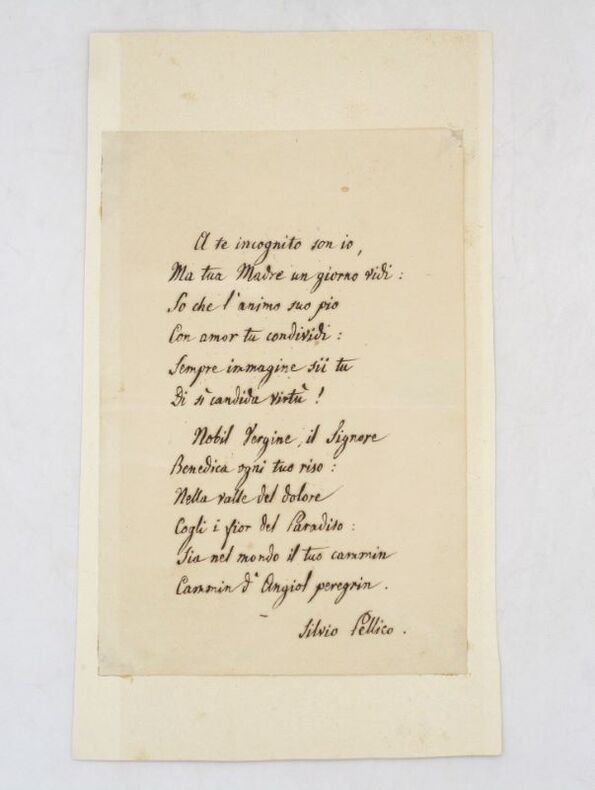
66 618 résultats
1893763781er juin 1893 | 11.30 x 17.70 cm | un feuillet
I: 21½ SS. auf 11 Bll. Gr.-4to. - II: 63 SS. auf 32 Bll. Folio. Stark bearbeitetes, unvollständiges Manuskript eines bibliographisch nicht nachweisbaren Aufsatzes über das Transponieren. Die Fassung Nr. I dürfte hierbei als Grundlage für Fassung Nr. II gedient haben, doch weist diese (wie aus folgender Gegenüberstellung der einzelnen Kapitel ersichtlich) nicht allein vom Umfang sondern auch vom Inhalt her deutliche Unterschiede auf. - I: 1. "Uiber den Bau der diatonischen Scala". 2. "Intervalle". 3. Verwand[t]schaft der Töne". 4. "Accordfolge mancher bekannter Cadenzen". 5. "Schlüssel". 6. "Deren Verhältniß [!] zu einander". 7. "Practische Beyspiele". 8. "Transposition". 9. "Chromatische Vorkommniße [!]". 10. "Andere Vortheile" (alle Zitate von S. 5). - II: "Die Transpositionslehre zerfällt in folgende Abschnitte": I. "Über den Bau der diat. Scala". II. "Intervalle". III. Verwand[t]schaft der Töne". IV. "Accordfolge mancher bekannter Cadenzen". V. "Schlüssel". V.1. "deren Verhältnisse zueinander". V.2. "Populäre Erklärungsmethoden". V.3. "deren Übersicht". VI. "Transponiren". VII. Unterschiede der älteren Schreibart v. der neuen". VIII. "Transposition für andere Instrumente". IX. "Erfahrungssätze, die Erleichterungen bezwecken" (alle Zitate von S. 9). - Der aus Butschowitz (Mähren) gebürtige Musiker und Musikpädagoge, der als "einer der besten Pianisten seiner Zeit" gilt (MGG IV, 276) erfuhr seinen Klavier- und Kompositionsunterricht durch Anton Halm und Ignaz von Seyfried und wurde 1833 Professor am Konservatorium der Gesellschaft der Musikfreunde, wo er bis 1856 als Klavierpädagoge wirkte. Fischhof gilt als "Meister der klassischen Wiener Klavierschule [...] er trat besonders als Interpret Bachs, Beethovens, Mendelssohn Bartholdys und Chopins hervor. Seine umfangreiche Musikbibliothek mit Manuskripten und Autographen war vor allem für die Bach- und Beethovenforschung von Bedeutung" (DBE). Zu Fischhof vgl. (Auswahl) die entspr. Artikel in ADB, NDB, ÖBL, MGG, Riemann, Wininger und Wurzbach.
18 SS. auf 9 Bll. Gr.-4to. Mit einer weiteren Entwurfsfassung (A) und einem separaten Entwurf zu Kapitel 5 ("Uiber die Schlüssel", B). Stark bearbeitetes, vollständiges Manuskript eines bibliographisch nicht nachweisbaren Aufsatzes über das Transponieren: "Ich habe es für nothwendig erachtet, Manches vorzustellen, worüber in den gewöhnlichen Klavierschulen zu wenig oder gar Nichts gesagt ist, und welches doch Jedem, der transponiren will, zu wissen nöthig ist. Hier folgt die Uibersicht der Gegenstände, wie sie der Reihe nach in Folgendem erörtert werden" (S. 3.).Die nun folgenden 10 Kapitel sind mit Ausnahme des siebten (von diesem nur die Überschrift) und zehnten (fehlt ganz) wohl vollständig hier erhalten (das neunte Kapitel wohl nur teilweise): 1. "Uiber den Bau der Scala". 2. "Intervalle". 3. Verwand[t]schaft der Töne". 4. "Accordfolge mancher bekannter Cadenzen". 5. "Schlüssel". 6. "Deren Verhältniß [!] zueinander". 7. "Practische Beyspiele". 8. "Transposition". 9. "Chromatische Angelegenheiten". 10. "Andere Vortheile". - Beiliegend eine unvollständige bzw. auch möglicherweise in sich abgeschlossene frühe Entwurfsfassung des Manuskripts (A; 8 SS. auf 4 Bll. sowie ein 4seitig beschriebenes Doppelblatt mit Notizen und Entwürfen), das diesem gegenüber ein irrtümlich mit "12 [recte: 11] Entwicklung der Transposition" bezeichnetes Kapitel aufweist, sowie eine frühere Fassung von Kapitel 5 (B; 4 SS. auf Doppelblatt). - Der aus Butschowitz (Mähren) gebürtige Musiker und Musikpädagoge, der als "einer der besten Pianisten seiner Zeit" gilt (MGG IV, 276) erfuhr seinen Klavier- und Kompositionsunterricht durch Anton Halm und Ignaz von Seyfried und wurde 1833 Professor am Konservatorium der Gesellschaft der Musikfreunde, wo er bis 1856 als Klavierpädagoge wirkte. Fischhof gilt als "Meister der klassischen Wiener Klavierschule [...] er trat besonders als Interpret Bachs, Beethovens, Mendelssohn Bartholdys und Chopins hervor. Seine umfangreiche Musikbibliothek mit Manuskripten und Autographen war vor allem für die Bach- und Beethovenforschung von Bedeutung" (DBE). Zu Fischhof vgl. (Auswahl) die entspr. Artikel in ADB, NDB, ÖBL, MGG, Riemann, Wininger und Wurzbach.
1½ SS. 8vo. Jäh klafft vor mir der tiefe Abgrund, | Ein Fehltritt und - ich stürz hinab, | Und die geheimnisvolle Tiefe | Ward mir geheimnisvolles Grab. || Das Unglück das mir widerfahren | Erfährt kein Mensch; indes ich tief | Im Abgrund schon seit vielen Jahren | Den Schlaf aller Gerechten schlief. || Ein Geier, der sich aus der Tiefe | Einst einen meiner Knochen stahl, | Faellt von der Kugel todt [!] getroffen, | Den Knochen in der Klau, ins Thal. || Des Drechslers Kind fand meinen Knochen, | Der Vater schnitzt ein Würfelpaar, | Nun trieb' ich meinen Spuck [!] im Spielhaus, | Viele verderbend manches Jahr. || Und ich war doch ein Christ, ein gläub'ger, | Ein frommer Mann mein Lebelang, | Der oft den Leib des Herrn empfangen, | Der nie versäumt den Kirchengang. || In der verfluchten Spielerhöhle | Kam es zu Mord und Todschlag [!] dann; | Ha! eines braven Mannes Knochen | Richtete so viel Unheil an!
4to. 88 pages. Corrected proofs for an article by Dumas, couched as an open letter addressed to the deputy Gustave Rivet, who had proposed legislation requiring investigations into the paternity of illegitimate children. An interesting document about the history of French social legislation at the end of the 19th century, containing substantive corrections and the author's signature; several pages are entirely handwritten. - With his bill, Rivet had pushed for inquiries into paternity and for parents' shared legal responsibility for children born out of wedlock, as the fact that the biological father faced no legal consequences whatever resulted in shockingly high numbers of infant deaths and abandonments. In his article, Dumas reviews the relevant arguments for and against such legislation produced by various figures of society such as the former President of the Court of Appeals, M. Larombière, and derides the suggestion that novelists are to blame for having in their stories aroused an excess of pity for the fates of "seduced women". Dumas goes on to describe the case of a sixteen-year-old housemaid who gave birth to two illegitimate children and sued the father, her relative and guardian, for support. Not only did the court deny any obligation on the father's part to provide for his illegitimate children, but the father was even able to file a counter-suit against the mother for the inconveniences to which the trial had exposed him. - Dumas's article ends with a defence of the women faced with such an ordeal, and of all writers and playwrights who choose to write about these facts and indict this social injustice. He gives examples of various constellations and aspects of relevant cases and discusses serious social wrongs such as incest, endorsing an improvement of the lot of innocent children and their mothers through a law for the investigation of paternity. - Addenda: Two printed speeches at the Académie française by Raymond Poincaré (1909) and Henri-Robert (1924) and three printed poems by Élie Fourès, Fabre des Essarts and Maurice Boniface on the occasion of the inauguration of a monument for Dumas on the Place Malesherbes on 4 November 1883.
Folio. T. p., signed ms. page, and 13 pp. of text on 15 ff., illustrated with pen-and-ink drawings. Contemp. cloth with giltstamped cover title. The "éxemplaire unique" of Henri Maigrot, the important caricaturist and director of the satirical journal "Le Charivari". The album with its witty and well-executed croquis is dedicated to the author's former law professor J. Paget. It probably was compiled in preparation for publication in the "Journal Amusant". - Occasional slight brownstaining, otherwise fine.
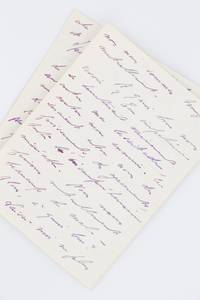
190479022Paris 1904. Fine. Paris s. d. septembre 1904 12.40 x 16.80 cm 8 pages sur 2 doubles feuillets Autograph letter signed ""Pauline"" from Renée Vivien addressed to Natalie Clifford Barney and written in purple ink on two double sheets with violet letterhead and address of 23 avenue du Bois de Boulogne. Transverse folds inherent to posting. A very beautiful and lengthy breakup letter addressed to the Amazon after her impromptu summer 1904 visit to Bayreuth to attempt to win Renée back: "". Les heures passées à Bayreuth étaient de la douceur : et c'est pourquoi je suis revenue."" ""The hours spent in Bayreuth were sweet: and that is why I returned."" The lexical field of death is omnipresent in this missive as if to better emphasize the definitive character of her decision: ""Pourquoi t'acharner à vouloir ranimer vainement les choses mortes Natalie Tu ne l'as point compris : ce que je cherchais auprès de toi c'était le souvenir et rien d'autre. On ne revit point l'autrefois. Tu dois le sentir comme moi-même. . Je souriais à mon passé. Il est doux parce qu'il est mort. Et toi tu veux galvaniser ce cadavre et le rendre odieux."" ""Why persist in trying to vainly revive dead things Natalie You have not understood: what I sought with you was memory and nothing else. One cannot relive the past. You must feel it as I do myself. . I smiled at my past. It is sweet because it is dead. And you you want to galvanize this corpse and make it odious."" The Muse of violets here reveals her suffering and disappointment pleading with Natalie twice: ""Laisse-moi ne plus revenir."" ""Let me not return again."" A veritable funeral oration for extinguished love this letter is very illuminating as to each one's way of loving: ""Nous nous sommes mal comprises. Je voulais un peu de rêve : tu m'offres la réalité."" ""We have misunderstood each other. I wanted a little dream: you offer me reality."" For this is what separates Renée - the dreamy and quasi-platonic poetess - and Natalie - the carnal and fickle lover: ""Ne sens-tu donc pas ne comprends-tu donc pas que je n'ai plus aucun désir d'amour Je suis lasse infiniment ; je ne voulais qu'un peu de douceur. Et tu m'offres la vie et les frissons que sais-je tout dont je ne me soucie point. Les joies charnelles Mais je les possède mon amie me les donne ma chair est satisfaite et au-delà. Je ne cherche point cela : je ne désire point cela. Ces choses m'excèdent venant de toi. J'espérais que assouvie de ton côté tu ne me demanderais que ce que je te demande : un peu de rêve lassé ; un peu de compréhension un peu de regret. Mais nous nous sommes trompées mutuellement. . Cherche un amour de chair chez une autre ."" ""Do you not feel do you not understand that I no longer have any desire for love I am infinitely weary; I wanted only a little sweetness. And you offer me life and thrills what do I know everything I care nothing about. Carnal joys But I possess them my friend gives them to me my flesh is satisfied and beyond. I do not seek that: I do not desire that. These things excess me coming from you. I hoped that satiated on your side you would ask of me only what I ask of you: a little weary dream; a little understanding a little regret. But we have deceived each other mutually. . Seek carnal love with another ."" It was at the end of 1899 and through the intermediary of Violette Shillito that Renée Vivien - then Pauline Tarn - made the acquaintance of Natalie Clifford Barney ""cette Américaine plus souple qu'une écharpe dont l'étincelant visage brille de cheveux d'or de prunelles bleu de mer de dents implacables"" ""this American more supple than a scarf whose sparkling face shines with golden hair sea-blue pupils implacable teeth"" Colette Claudine à Paris. Natalie who had just lived a summer idyll with the scandalous Liane de Pougy who had initiated her into sapphism paid only discrete attention to this new acquaintance. Renée however was totally capt unknown
190479022(Paris) s. d. [septembre ? 1904] | 12.40 x 16.80 cm | 8 pages sur 2 doubles feuillets
23174S.l.n.d. In-12, 1 p. montée sur onglet (quelques petites rousseurs).
52187o.J. Berlin, Schloss Bellevue, 28. I. 1988 und 22. I. 1992, Jeweils Doppelblatt in Pp.-Umschlag mit Bundesadler und schwarz-rot-goldener Kordel.
4to. 3 pp. on bifolium. "Wie könnte kalt ich von hier scheiden, | Wo sich ein Eden mir entdeckt, | Wo Hochgenuß der reinsten Freuden | Des Herzens höchste Ahnung weckt, | Wo ich in Wonne mich verliere, | Wohin mein Auge schwelgend blickt, | Und ich den Zauberkreis berühre, | Mit dem hier die Natur beglückt? [...]". - Slightly browned due to paper.
1 S. Qu.-kl.-4to. "Gestern war mir's, in Eis und Schnee, | Als schmölze das Eis und weichte das Weh. | Und der Blutgeruch, der über der Erde brütet, | Und die weiße Decke, die das Leben hütet, - | Als käme ein warmer Strom da hinein | Und ließe die Menschen - Menschen sein [...]". - Grete Meisel-Hess zählt mit ihren Romanen und Novellen "zu den trefflichsten geistigen Vorkämpferinnen der modernen Frauenbewegung" (Wiener Bilder, Nr. 20, 1901, S. 8). - Mit einigen Randeinrissen.
191675947s. l. 1916. Fine. s. l. s. d. vers 1916-1918 12.40 x 17 cm 2 pages sur un feuillet remplié Autograph letter signed by Georges Auric addressed to Bolette Natanson. Two pages written in black ink on a folded sheet. Folds inherent to mailing. Beautiful poetic letter with Rimbaldian influences: ""Alchimistes Rimbaud ! Eclair ouvre le ciel de mon adolescence ! Je me sens poète et c'est bien le moment de m'arrêter !"" ""Alchemists Rimbaud! Lightning opens the sky of my adolescence! I feel like a poet and this is the right moment to stop!"" Auric mentions a concert he must give at Mme Japy de Beaucourt's who held a salon in honor of the review directed by Ricciotto Canudo Montjoie ! : ""Je dois jouer - encore ! vendredi chez Mme J. de B. non point n'est ce pas Mme Jean de B mais Mme Canudo de Beaucourt"" ""I must play - again! Friday at Mme J. de B.'s not isn't it Mme Jean de B but Mme Canudo de Beaucourt"". He adds: ""Montjoie et Canudo gras et bête italboche."" ""Montjoie and Canudo fat and stupid Italian."" Having moved in artistic circles since her earliest childhood - she was the daughter of Alexandre and niece of Thadée Natanson creators of the famous Revue Blanche - Bolette Natanson 1892-1936 became friends with Jean Cocteau Raymond Radiguet Georges Auric Jean Hugo and Colette. Passionate about fashion she left Paris for the United States with Misia Sert close friend of Coco Chanel and was hired at Goodman. With her husband Jean-Charles Moreux they created the gallery Les Cadres on boulevard Saint-Honoré in 1929 and frequented numerous artists and intellectuals. Their success was immediate and they multiplied projects: creating the fireplace for Winnaretta de Polignac decorating the château de Maulny designing Baron de Rothschild's private mansion creating frames for industrialist Bernard Reichenbach and finally creating the storefront for Colette's beauty institute in 1932. Bolette Natanson also framed works by her prestigious painter friends: Bonnard Braque Picasso Vuillard Man Ray André Dunoyer de Segonzac etc. Despite this meteoric rise she took her own life in December 1936 a few months after her father's death. unknown
191675947s. l. s. d. [vers 1916-1918] | 12.40 x 17 cm | 2 pages sur un feuillet remplié
2 1/3 SS. auf 2 mit "45" bzw. "51" num. Bll. Folio. "Bis zu heil'gen Gangesufern | Zog Gott Bacchos stolz und frei, | Wechselnd mit Evöerufern | Jauchzte der Mänade Schrei | Siegesrufe, Thyrsusstäbe, | Rosenkränze voll und schwer, | Wo der Gott im Schmuck der Rebe | Mit den Parthern kam daher || Lüge ist es, Furcht und Lüge | Dieses Volks, das mich nicht ehrt, | Eines Halbgott's Inderzüge | Sei'n dem Ammonssohn verwehrt. | Meine besten Feldherrn flehen: | Komm zurück nach Griechenland! | Weiter will das Heer nicht gehen, | Als hieher an diesen Strand [...]". - Die Verso-Seite des mit "51" num. Blattes mit eh. Nachschrift: "Daß die beiden Bruchstücke 45 u. 51 des Gedichtes: 'Alexander am Hydaspes' ein Theil meines Manuscripts von E. Tegnérs Sämtlichen Werken sind, abgedruckt im II. B. der Lyrischen Gedichte, S. 56-60, und daß ich dieselben, wie fast alle meine literarischen Arbeiten, mit eigener Hand und mit Bleifeder geschrieben habe, erkläre ich hiemit unter meiner Unterschrift [...]". - Leinburg studierte in Bonn (u. a. bei Ernst Moritz Arndt), Würzburg und München, ehelichte die Jugendschriftstellerin Maria von Andechs und lebte abwechselnd in München und Preßburg, "wo er mit Vorträgen über die deutschen Klassiker ein großes Publikum gewann" (ÖBL V, s. v.). Seit 1860 arbeitete er an der administrativen Bibliothek des Staatsministeriums und war auch als Dolmetscher für Schwedisch tätig. "Durch seine Übertragungen aus Werken skandinavischer Schriftsteller (Öhlenschlägers, Tegnérs u. a.) war Lüttgendorff auch im europäischen Norden bekannt geworden. 1880 wurde er der erste deutsche Dr. phil. h. c. der Universität Lund" (ebd.). Sein lyrisches Werk stand bei den Zeitgenossen hoch in Ansehen, A. W. Schlegl etwa verglich sein "Formtalent in seiner Entwicklungsfähigkeit mit dem Rückerts und Platens" (ebd.).
45399o.J. München, 3. III. 1848, Gr.-8°. 1 1/2 S. Bläuliches Papier.
2 pages (48 lines), 8vo. The first page comprising two leaf fragments stuck together. "Den Kunstschatz schützen sie, den wohlbewußten, | und jeder stöhnt und reißt sich auf die Brust. | Von eines Weltkriegs sämtlichen Verlusten | wär' dieser doch der schmerzlichste Verlust. | Denn die Kultur, sie ist ja doch das Letzte, | was bleibt uns denn, trägt man auch sie davon, | all jenes Köstliche, das uns versetzte | in eine noch weit höhere Region! [...]". - This fine example of Kraus's comic pathos was first published in 1922 in Worte in Versen VI.
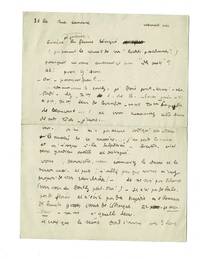
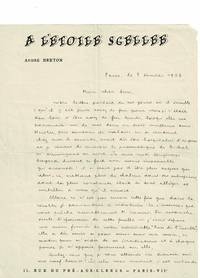
195375729Paris 1953. Fine. Paris 8 janvier 1953 21 x 27 cm 1 pages et quelques lignes sur un feuillet Unpublished handwritten signed letter from André Breton addressed to critic Charles Estienne; one page and a few lines in black ink on a paper from the à l'étoile scellée gallery. Two transverse folds from having been sent a small corner missing in the upper right margin. Very beautiful letter giving an account of the death of one of André Breton's dearest friends and of his quarrel with Albert Camus. Breton tells his friend about the death of the Surrealist Czech artist Jindich Heisler: Your letter spoke of those days where it seemed that there was only just enough fire to live: on Monday there was far from enough fire when it reached me: one of my two or three best friends Heisler taken suddenly unwell on his way to mine on Saturday had to be hospitalised urgently and I had just received the pneumatic from Bichat telling me of his death. The event no less inconceivable than accomplished left me distraught for a long time: there was no-one more exquisite than he putting more warmth into everything he did the most constant of which was to lighten and embellish those whom he loved. The two poets were indeed very close: Heisler participated alongside Breton in the launch of Néon in 1948 and supported him during a period of depression accompanying him with other friends to the Île de Sein. The beginning of 1953 was overshadowed by the death of Jindich Heisler 4 January. Loyal among the faithful he lived entirely for Surrealism according to Breton who pays tribute to his activity as a leader: This is how he was between 1948 and 1950 the soul of Néon and until his last moments the greatest bearer of projects that as if by magic his talent gave him the means to achieve. Henri Béhar André Breton In this letter laden with pain Breton suddenly makes reference to L'Homme révolté by Albert Camus published two years earlier: Come on it is not yet the time in the rebellion that I will succeed in introducing the measure that M. Camus kindly preaches to us. The two writers met in New York at the end of March 1946 when Camus was invited to the United States for a conference tour as a representative of Combat. The two agree on the best way to preserve the testimony of certain men free from ideological distortions. They dream of a kind of pact by which people of their calibre would commit to not join any political party to fight against the death penalty to never claim any credit whatsoever. ibid. With other intellectuals they founded the Rassemblement démocratique révolutionnaire RDR in 1948; but the idyll ended a couple of years later in the autumn of 1951 when Camus published Lautréamont et la banalité an extract from his Homme révolté which was published later. Breton was extremely hurt and responded to him in an article entitled Sucre jaune in Arts: This article . testifies to the part of Camus for the first time for an indefensible moral and intellectual position. . He only wants to see a guilty adolescent in Lautréamont whom he - in his capacity as an adult - must discipline. He goes as far as to find him in the second part of his work: Poésies a deserved punishment. According to Camus Poésies would be but a mass of laborious banalities . It could still be worse if the destitution of these views did not intend to promote the most suspect thesis in the world which is that absolute revolt can generate only the taste for intellectual enslavement. This is a completely gratuitous ultra-defeatist statement which must incur even more contempt than its false demonstration. Thus two years later Breton still holds out against Camus' crime of lese-majesty towards that which Breton constructed as the father of surrealism but even more this allusion to Camus' pacifist philosophy bearing witness to the incompatibility between a thought of moderation and a poetry of revol unknown
195375729Paris 8 janvier 1953 | 21 x 27 cm | 1 pages et quelques lignes sur un feuillet
58712o.J. Ohne Ort (Frankfurt), 23. XII. 1759, 8° (17 x 10 cm). 58 nn. Bl. OKart. mit Kleisterpapier (bestoßen und beschabt).
1 S. (21 Zeilen) auf Doppelblatt. 8vo. Wie am Respektblatt vermerkt an "meinen einzigen Paradiesvogel": "Über Zeit und Raum erhaben / Ist des Herzens inn'res Leben, / Und es weiß, wenn sich zu laben / Augenblicke nur gegeben, / Doppelt diese flücht'gen Gaben / Durch die Innigkeit zu heben! [...]". - Der einer rheinländischen Familie entstammende Kritiker gehörte zum Freundeskreis von Mendelssohn und Grabbe, war Professor für Musikwissenschaft im Haag und in London und kam 1845 nach Wien. "1848 begann er sich politisch zu betätigen, redigierte das Blatt 'Der Radikale' und gehörte zu den führenden Köpfen der Wiener Revolution; nach der Erstürmung Wiens wurde er verhaftet und standrechtlich erschossen" (ÖBL I, 60).
1 S. 4to. "Schlaf sanft nach schönem Tagewerke | So friedlich wie Dein Leben war, | Der Du im Herzen Jugendfreude | Noch fühltest mit ergrautem Haar. || Schlaf süß Du bester aller Väter | Bis wir uns einstens wiedersehn, | Es deucht mir, seit Du starbst - das Sterben | Nur mehr ein frohes Heimwärtsgeh'n. || In Deinem Sinne will ich leben | In Deinem Sinn, in Wort und That - | An Deinem Sterbebette sah ich | Wie mild Dich Gott gerichtet hat. || Ein Lächeln hell wie Sonnenstrahlen | Verklärte sanft Dein Angesicht | Und dieses Lächeln sei im Leben | Für mich fortan ein Himmelslicht. || Es sei mir eine helle Leuchte | In Cummer und in banger Zeit, | Es sei mir auch ein treuer Führer | Dereinstens in die Ewigkeit!" - Die Tochter des Schriftstellers Franz Isidor Proschko war als Erzählerin und Dramatikerin tätig. Von 1901 bis 1903 erschienen ihre "Gesammelten Erzählungen" und "Gedichte in vier Bänden". Seit 1887 war sie Herausgeberin der "Jugendheimat" und seit 1891 der "Jugendlaube". - Mit einigen Randläsuren und kl. -einr. sowie alten Bearbeitungsvermerken.
Folio. Italian manuscript in brown and pink ink on paper. (50) pp. on 30 ff. With calligraphed title and 7 hand-drawn illustrations, comprising a dedication portrait of Marie Louise, Duchess of Parma, her coat of arms on the title-page, 4 scenic designs for the play, and a final vignette with motto. Contemporary giltstamped full calf with pink endpapers. All edges gilt. Beautiful dedication manuscript of Giuseppe dall'Argine's romantic drama that was set to music by count Germano Liberati Tagliaferri (1795-1870) and premiered in 1821 at the Teatro Sanvitale in Parma. Dall'Argine dedicated his play to the ruling Duchess of Parma and second wife of Napoleon, archduchess Marie Louise (1791-1847), who is represented in a fine pen drawing that serves as frontispiece. All illustrations are signed by the author. - This manuscript is probably the only surviving copy of dall'Argine's play. Himself largely forgotten, Giuseppe dall'Argine stems from a leading family of musicians and librettists in Parma, the most prominent members of which were the tenor Luigi dall'Argine (1808-69) and his son Costantino (1842-77), a highly successful composer in his time. Giuseppe dall'Argine is known as the author of another libretto, the comedy "Castello di Valbruno" that was published in Parma in 1825 and again set to music by Germano Liberati Tagliaferri. - Well preserved.
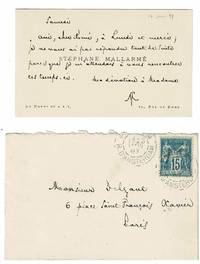
189776333Paris: S. n. 1897. Fine. S. n. Paris 23 janvier 1897 10.20 x 6.30 cm une carte de visite et son enveloppe Signed autograph visiting card from Stéphane Mallarmé addressed to Alidor Delzant. Envelope included. Alidor Delzant was a lawyer collector and bibliophile. Friend of the Goncourts he devoted a work to them and was Edmond's secretary and testamentary legatee. ""Ami cher ami à lundi et merci ; je ne vous ai pas répondu tout de suite parce que je m'attendais à vous rencontrer ces temps-ci."" ""Friend dear friend until Monday and thank you; I did not answer you right away because I expected to meet you these days."" S. n. unknown
189776333S. n. | Paris 23 janvier 1897 | 10.20 x 6.30 cm | une carte de visite et son enveloppe