66 618 résultats
184684820Mâcon 26 Décembre 1846 | 13.50 x 20.50 cm | une page sur un feuillet
Document on vellum, 320 x 192 mm. Counter-signed by Antoine-Jean Amelot, ministre de la maison du roi. Appointment for the Marquise d'Esclignac, designated as companion to "Madame Adélaide" de Bourbon: "Aujourd'huy [...] Le Roy étant à Versailles, mettant en consideration le merite et les [...] qualités de la dame Marquise d'Esclignac, Sa Majesté l'a retenue et retient pour l'une des dames que Sa Majesté a nommées pour accompagner ordinairement Madame Adélaide de France, veut et entend qu'a l'avenir lad. dame Marquise d'Esclignac serve pries cette Princesse en qualité de dame surnumeraire et sans apointements juqsu'a la premiere vacance, et jouisse des honneurs, prerogatives et autres distinctions apartenantes à lad. place en vertu du présent Brevet que bour assurance de sa volonté Sa Majesté a signé de Sa main et fait contresigne poar moi consilla secretaire d'État de de ses commandements et finances [...]". - The Marquise d'Esclignac is an unidentified member of the House of Preissac from the Gascony area. Antoine-Jean Amelot (1732-1795) served as "Secrétaire d'État de la Maison du Roy" until 1783, he died in the Luxembourg prison during the French Revolution. - Old collector's note verso: "Louis XVI et ses ministres - Documents sur la Revolution de 1789". Provenance: Eduard Fischer von Röslerstamm.
4½ SS. auf 5 Bll. 4to. Harscher Verriss von Ferdinand Bruckners 1932 erschienenem Drama 'Timon': "Bruckners 'Timon' läßt jede Hoffnung [auf ein 'besseres Theater'] schwinden. Das ist nicht nur nicht Burgtheater, das ist überhaupt kein Theater. Keine Handlung, sondern nur eine Folge von Gesprächen; und nicht einmal Gespräche, sondern langweilige Monologe mit unerwidert bleibenden Zwischenrufen. Langweile ist überhaupt das Merkmal dieser ‘Dichtung’. Bruckner hat bisher in mehr oder weniger geglückten Sensationen gearbeitet; nun ist das gänzliche Ausbleiben jeder Wirkung die einzige Sensation des Abends. Es steht aber nicht etwa so, daß ein feiner Geist, eine eigenartige Gedankenwelt für die theatralischen Mängel entschädigen und so wenigstens einen kleinen, auserwählten Kreis der Theaterbesucher befriedigen könnte. Der Stoff ließ sich gar nicht ungeschickter und geistloser behandeln [...]". - Max Morold, der Sohn des Schriftstellers Stefan von Millenkovich, studierte in Wien Rechts- und Staatswissenschaft, arbeitete als Beamter in Kärnten und später im Unterrichtsministerium in Wien. "Seit 1915 war er Mitglied der Kunstkommission, 1917/18 Direktor des Wiener Burgtheaters. Danach schrieb Morold Musik- und Theaterkritiken, propagierte als Redner bei völkischen Veranstaltungen sein 'großdeutsches Bekenntnis' und hatte den Vorsitz der deutschnationalen 'Morold-Runde'. Bekanntheit erlangte er durch seine Opernbücher (u. a. 'Klopstock in Zürich', 1893) sowie als Verfasser zahlreicher Musikerbiographien (u. a. 'Cosima Wagner', 1937). Als Herausgeber der Anthologie 'Dichterbuch. Deutscher Glaube, deutsches Sehen und deutsches Fühlen in Österreich' (1933) schuf er erstmals einen Überblick über das Spektrum der konservativ bis nationalsozialistisch gesinnten Autoren" (DBE). Vgl. auch Kosch X, 1338. - Rechts oben numeriert.
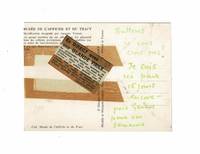
197173355Sommières 1971. Fine. Sommières 12-02-1971 10.50 x 14.50 cm une carte postale et enveloppe Autograph postcard from Lawrence Durrell addressed to Jani Brun written in red felt-tip pen on the reverse of a reproduction of a small poster Mystification conceived by Jacques Yonnet "". Keep your head above water - Prolonged immersion of nose and mouth can cause fatal asphyxia"" with attached press clipping ""direct with a virile gland."" envelope included. The writer informs his young Montpellier lover about his upcoming travels: ""Buttons. Je ne vous crois pas ! je suis ici pour 15 jours encore - puis Genève pour une semaine"" ""Buttons. I don't believe you! I'm here for another 15 days - then Geneva for a week"". After many years spent in Greece Egypt and Rhodes the traveling writer Lawrence Durrell was forced to flee Cyprus following popular uprisings that led the island to independence from the British Crown. Rich only with a shirt and a typewriter but crowned with the success of his novel Bitter Lemons of Cyprus he arrived in France in 1956 and settled in the Languedoc village of Sommières. In the ""Tartès house"" his grand residence surrounded by trees he wrote the second part of his work his monumental Avignon Quintet devoted himself to painting and received his illustrious friends including the couple Henry Miller and Anaïs Nin violinist Yehudi Menuhin London publisher Alan G. Thomas and his two daughters Penelope and Sappho. Among the olive trees and under the Mediterranean sun he met in the mid-1960s the young and sparkling ""Jany"" Janine Brun a woman from Montpellier in her thirties with devastating beauty who worked at the Antiquities department of the Sorbonne in Paris. She was nicknamed ""Buttons"" in memory of their first meeting where the young woman wore a dress covered with buttons. Henry Miller also fell under the charm of ""Buttons"" praising her beauty and eternal youth in exceptional letters that remain unpublished. The three companions spent memorable Parisian evenings of which we retain precious autograph traces through their epistolary exchanges. Recommended by Durrell she made numerous trips particularly to England from where she received extensive correspondence from the writer as well as original works of art signed with his artist pseudonym Oscar Epfs. unknown
197173355Sommières 12-02-1971 | 10.50 x 14.50 cm | une carte postale et enveloppe
16 vierzeilige Strophen auf 2 SS. 8vo. "Der Bär mit der Hyäne | Schwur einen ew'gen Bund; | Er knirschte seine Zähne, | Sie dehnte ihren Schlund. | Wohl können sich vergleichen | Die zwei verständigen; | Hyäne frißt die Leichen | Bär die Lebendigen [...]". - Erstdruck im Deutschen Musenalmanach für das Jahr 1834.
57750o.J. Bayreuth, C. Giessels's Officin, 1901, 33 x 21,5 cm. Doppelblatt.
49336o.J. Berlin, 17. I. 1838, Fol. 1 Seite. Mit papiergedecktem Siegel.
4to. 21 ff. on Arches paper, inscribed on rectos only. Manuscript of a lecture on the powerful influence music wields over people, recounting a conversation with the chansonnier Félix Mayol (1872-1941), whom he describes as wearing a blond toupee, having a charming face, being a little chubby, and talking with a Toulouse accent, as well as a concert of the violinist Nathan Milstein (1904-92), whose youth, sportsmanship, and short hair surprised him: "Je me promenais un jour sur le Boulevard de Strasbourg avec le chanteur de café Concert le plus populaire de l'époque et qui s'appelait Mayol [...] Il parlait un peu drôlement parce qu'il avait été Toulonnais [...] Il avait un volumineux toupet très blond et frisé, un charmant et fin visage a cette époque. Il était un peu dodu de sa personne et chantant la glorification des femmes [...] Et il y a quelques mois, justement, il y avait un grand violoniste qui arrivait d'Amérique pour donner un récital au Théatre des Champs Elysées. Il s'appelait Milstein [...] Un garçon tout à fait moderne. Pas du tout le type du musicien avec les longs cheveux [...] Non, au contraire, jeune, sportif [...]". - Further about a thrilling experience at the legendary Cotton Club in Harlem, where he heard Duke Ellington and Louis Armstrong, concluding with a reference to the stage routine with his pianist Fred Freed (1903-83): "Tenez en 1928 quand nous sommes partis pour faire des films à Hollywood et que nous nous sommes arrêtés quelques jours à New York où des amis nous ont fait visiter la ville et un soir nous ont emmenés à Harlem le quartier des noirs. Oui, il nous ont aussi fait visiter le Cotton Club. C'est un endroit où tous les jeunes de couleur dansent entre eux. Ah, il y avait un orchestre. Duke Ellington qui a çe moment là n'avait encore jamais joué pour les blancs a Broadway. Non, il n'avait joué jusque là que pour ses frères de couleur à Harlem. Il y avait aussi la Trompete, Armstrong. Ah, cet orchestre, non j'avais déjà entendu des orchestres Américains à Paris, mais jamais des dynamites de çe genre [...] Fred! (Fred entre en jouant les premiers mesures d'un blues) [...] Alors, attention, are you ready Fred (Il répond 'yes' d'un air lugubre) [...]". - First and last leaf with small rust stains from a paperclip.
191080833Alger Algiers 1910. Fine. Alger Algiers s. d. ca 1910 16.30 x 10.60 cm une carte Autograph card signed by Judith Gautier addressed to Céleste Chrétien her housekeeper written in black ink on both sides of a card with letterhead from 30 rue Washington in Paris. Judith regrets leaving her house in Dinard: ""It was kind of you to send us flowers from the garden. It gave us pleasure and regrets because there must still be beautiful days there."" She expresses here her passion for horticulture: ""Every evening I burn a eucalyptus leaf from your trees to perfume my room. The terrace is full of chrysanthemums in bloom and there were three tomatoes that are ripening on my wardrobe."" unknown
191080833Alger s. d. [ca 1910] | 16.30 x 10.60 cm | une carte
1778919461778 - 1779 | 15.5 x 13.5 cm | Une feuille
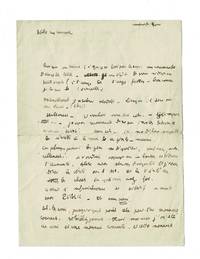
194088841s. d. [juillet 1940] | 21 x 27 cm | Une page sur un feuillet
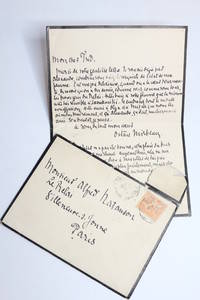
190173686s. l. cachet de Seine-et-Marne 1901. Fine. s. l. cachet de Seine-et-Marne 15 Septembre 1901 12.50 x 17.60 cm une feuille Moving autograph letter signed by Octave Mirbeau addressed to the playwright and founder of the Revue Blanche Alfred Natanson. 15 lines in black ink on a folded sheet mourning paper with black border watermarked ""JDL & cie"" envelope attached. ""Thank you for your kind letter. I already knew from Alexandre Natanson how worried you had been about my wife's condition. It is a delicious joy when one's heart is tormented to know that one has friends like you like all of you the good people of the Relai. Please tell your wife that mine was very touched by her friendship. And embrace everyone with effusion. Also tell Olga Alexandre Natanson's wife and Misia Thadée's wife that we love them tenderly and Alexandre that he is a charming friend."" Long postscript on the poor health of his wife the former actress Alice Régnault: ""Yesterday was not a good day and the wound on her arm presented a nasty appearance. Today it is a little better. But it is something to watch very closely. Movements are made a little more easily but she still suffers extremely at night at the slightest play of the muscles"". Mirbeau had been particularly close to the Revue Blanche group since its launch in Paris in 1891. But it was during the Dreyfus affair that his intimate and lasting friendship with the Natanson brothers Thadée Alexandre and Alfred was strengthened. After aesthetic disagreements over Art Nouveau and the Nabis Mirbeau finally reunited with Thadée around 1900 in a now shared inclination for the young Nabis painters of the Revue Blanche Bonnard Vallotton and Vuillard. The ""Relai"" corresponds to a former coaching inn in Villeneuve-sur-Yonne purchased by Thadée Natanson in 1897 which became a destination for all their writer and artist friends. One could encounter the Nabis painters Vuillard Vallotton Bonnard or Roussel as well as Toulouse-Lautrec. The Revue Blanche played an essential role in France as historian Paul-Henri Bourrelier confirms: ""Most of the most prominent writers painters musicians politicians intellectuals of the late nineteenth and early twentieth centuries collaborated with it or were associated with it. Created financed and directed by the three Natanson brothers young Polish Jews with the enthusiastic complicity of their fellow students from the Condorcet lycée La Revue blanche quickly became a place of debate on all the subjects that stirred France. It led political battles under the impetus of anarchists like Fénéon Mirbeau; socialists such as Blum G. Moch Péguy; Dreyfusards and founders of the League of Human Rights like Reinach and Pressensé."" unknown
190173686s. l. [cachet de Seine-et-Marne] 15 Septembre 1901 | 12.50 x 17.60 cm | une feuille
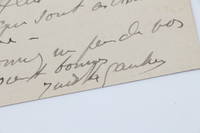
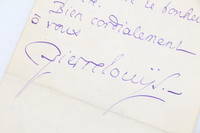
189686610Paris 1896. Fine. Paris 1896 13 x 20.50 cm 3 pages sur un double feuillet Autograph letter signed by Pierre Louÿs addressed to his publisher Alfred Vallette 50 lines written in purple ink on a double sheet. Pierre Louÿs responds to his friend and publisher Alfred Vallette after a controversy launched by a journalist from Comoedia a controversy that could damage their friendship: ""Je ne suis pour rien dans l'écho publié par Comoedia. Mais ce que vous en citez suffit à me montrer que le rédacteur s'est mal informé."" ""I had nothing to do with the piece published by Comoedia. But what you quote from it is enough to show me that the writer was misinformed."" and he intends to remind him that they had not been able to agree on the publishing terms for Aphrodite and that he envisioned only a confidential distribution for his latest book: ""L'histoire de notre édition est très simple. Vous m'avez proposé un traité que je n'ai pas trouvé bon ; j'ai préféré le ""compte d'auteur"" et je ne peux pas vous accuser d'avoir mal prévu le succès du livre puisque moi-même j'avais écrit mon roman pour vingt amis et quelques inconnus."" ""The story of our edition is very simple. You offered me a contract that I did not find good; I preferred the 'author's account' and I cannot accuse you of having poorly predicted the book's success since I myself had written my novel for twenty friends and a few strangers."" This is why the father of Aphrodite is astonished by the triumph achieved by the work: ""Si une diseuse de bonne aventure nous avait prédit alors qu'Aphrodite dépasserait un jour le 300e mille nous l'aurions traitée comme une pauvre folle."" ""If a fortune teller had predicted then that Aphrodite would one day exceed 300000 copies we would have treated her as a poor madwoman.""; the latter consecrating his fame and wealth in the literary world: ""J'ai en outre une seconde raison pour ne pas vous en vouloir du traité que j'ai signé avec vous : c'est qu'en préservant mes droits d'autuer sur ce roman j'ai fait sans le savoir ma fortune. C'est à cela seul que je dois mon indépendance littéraire et cette inestimable liberté du silence qui n'est pas l'idéal de tous mais qui me paraît être le bonheur du poëte."" ""I have furthermore a second reason for not resenting the contract I signed with you: it is that by preserving my author's rights on this novel I made my fortune without knowing it. It is to this alone that I owe my literary independence and this invaluable freedom of silence which is not everyone's ideal but which seems to me to be the poet's happiness."" Very fine autograph on Pierre Louÿs's literary triumph. unknown
189686610Paris 1896 | 13 x 20.50 cm | 3 pages sur un double feuillet
2½ SS. (33 Zeilen) auf Doppelblatt. 4to. "Schwarzumlocktes schlankes Kind, | Mit den wilden Feuerblicken, | Sprich, was eilst du so geschwind | Mir vorbei mit flücht'gem Nicken? | Komm und setze dich zu mir, | Stell' den Krug vom Haupte nieder, | Bist erschöpft vom Laufen schier, | Sieh, wie hebt sich nur dein Mieder. | Calavresella | Acconcia e bella, | Calavresella, | Calavresè [...]". - J. N. Vogl gehörte der Literatengruppe im Wiener "Silbernen Kaffeehaus" an, wurde Mittelpunkt einer Tafelrunde von Künstlern und gab zahlreiche Almanache und Taschenbücher heraus; viele seiner in der Tradition der Wiener Spätromantik stehenden Balladen wurden von Carl Loewe vertont, einige Lieder auch von Franz Schubert. - Gering fleckig und angestaubt; Faltspuren.
191675943s. l. 1916. Fine. s. l. s. d. vers 1916-1918 12.40 x 17 cm 2 pages sur un feuillet remplié Signed autograph letter from Georges Auric addressed to Bolette Natanson. Two pages written in black ink on a folded sheet. Deletions and underlinings. Fold marks inherent to mailing. Very fine letter in which the composer dissertates on friendship: ""I simply wanted to tell you this important thing. I recommend that you not invite Florent Schmitt nor any 'artist'. Otherwise I declare myself incapable of resisting the vision of these evil geniuses. For more than ever people disgust me except you naturally. I would like to press a button and destroy Humanity. Then we will be at peace and I will tell you the truth about Art and the truth about all the things in which you have faith."" Auric also evokes music in this letter: ""Only Ravel's waltzes are noble and sentimental."" Having evolved from her earliest childhood in artistic circles - she is the daughter of Alexandre and the niece of Thadée Natanson the creators of the famous Revue Blanche - Bolette Natanson 1892-1936 befriended Jean Cocteau Raymond Radiguet Georges Auric Jean Hugo and Colette. Passionate about couture she left Paris for the United States with Misia Sert great friend of Coco Chanel and was hired at Goodman. With her husband Jean-Charles Moreux they created in 1929 the gallery Les Cadres on boulevard Saint-Honoré and frequented numerous artists and intellectuals. Their success was immediate and they multiplied projects: the creation of Winnaretta de Polignac's fireplace the decoration of the château de Maulny the layout of baron de Rothschild's private mansion the creation of frames for industrialist Bernard Reichenbach and finally the realization of Colette's beauty institute storefront in 1932. Bolette Natanson also framed the works of her prestigious painter friends: Bonnard Braque Picasso Vuillard Man Ray André Dunoyer de Segonzac etc. Despite this meteoric rise she took her own life in December 1936 a few months after her father's death. unknown
191675943s. l. s. d. [vers 1916-1918] | 12.40 x 17 cm | 2 pages sur un feuillet remplié
Oblong folio. 35 pp. on 37 ff. Brown ink on drawing-paper with some additions and corrections in pencil. Original wrappers. Screw-bound. Illustrated with two original ink drawings, one signed (ca. 53 x 29,5 cm and 19 x 19,6 cm). - Together with an 11-page typed copy of the manuscript with notes and corrections in ink and pencil. Also, a typed description of the manuscript and receipt from the "Librairie Francaise" in London, as well as 3 autograph letters signed with 3 autograph envelopes by Cocteau. Beautiful draft for a lecture given by Cocteau during his four-month stay with his friend, the avant-garde composer Ivor Markevitch, in Vevey, Switzerland in 1938. The French text ranges from apparently incoherent cues to elaborate lines of thought, touching highly diverse subject matters such as surrealism, cubism, jazz, poetry, religion, Orphism, and some of Cocteau's favourite artists and historical figures including Picasso, Max Ernst, Marcel Proust, Baudelaire, and Napoleon. The "Causerie" revolves around an expansive definition of poetry and the idea that poetry is truth itself: "Epoch without sacred monsters. I am one of the last writers whose mythology gradually forms as he exists. Legends, follies, inaccuracies. Advantage of legends; one burns a straw man. Legends surrounding men living in a glass house and recounting everything [...] - We hate the truth. Here we come to the heart of our subject. Poetry is scandalous because it is truth itself. Poets, children (Let [them] come to me, he knew what he did). Quote the Swan in majuscules, very proud. Pure poetry. Nonsense from Minos and Pasiphae. Poetry everywhere. Vinci's time. Believed poet, painter, etc. Alas, we've gone too far. Any photographer is a poet [...] Beware of serious men, laughter rends a man in two, reaching the soul, following the tree, the bird. False grandeur, grandeur laughs. For Max Ernst's admirable photo collages, montages, etc. Poetry of posters, of window displays, of street shops. Music Hall, fun fair for a dime, before, after. Dangerous poetry, poet's room, police raid. Any suspect. Poets come from a country where the language is neither alive nor dead, not yet born, heard. The somnambulist poet exploited by forces, he cannot mingle too much, else he ends up with evil. I do not believe in precursors but loneliness is still loneliness. Even in real poetry [...]". - This beautiful manuscript, complete with two elegant original drawings, is highly illustrative of Jean Cocteau's thinking, influences, and lifelong themes. It was acquired by the literary scholar Bill Chapman in 1954, when he was writing his doctoral thesis on "The Aesthetics of Jean Cocteau". The transcript with extensive notes, explaining Cocteau's allusions and identifying his sources, was prepared by Chapman, who corresponded with Cocteau during his research, as the three enclosed letters show. Referring to the manuscript, Cocteau thanks Chapman for being "the Champollion of his hieroglyphs" and discourages speculative interpretations: "Merci d'essayer d'être le Champollion de mes hieroglyphes. Trop de gens prennent encore des vocables hieroglyphiques des poètes pour de simples figures qu'ils interprètent à leur usage personnel. Soyez l'ami des Nombres et de notre algèbre. Haïssez la Fantaisie et dites vous que nous ne voulons pas être admirés mais être crus. Marco Polo fut appelé le menteur de Venise, parce qu'il témoignait [...]" (Saint-Jean-Cap-Ferret, 22 Feb. 1953). - In a letter from 27 March 1953, Cocteau affirms his position that "artistic and religious audacity are not incompatible", naming the Catholic philosopher Jacques Maritain as an influence. In the final letter of the collection, Cocteau taunts the author Jean-Pierre Millecam as an "adorable egocentric" whose selfhood is the "star that governs his sky" (25 Feb. 1954). Apparently, Chapman had warned Cocteau of Millecam's character. - Deep tears to the spine and abrasions to the cardboard wrappers. The first two pages of the manuscript with the illustrations (on verso) are loose. Some pages show minor tears, two pages have further minor damage. Some browning. Two of the letters to Chapman show some tears and creasing.
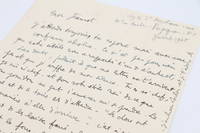
194084633Perpignan 1940. Fine. Perpignan juillet 1940 21 x 27 cm deux pages sur un feuillet Autograph letter by Jean Cocteau signed with his famous star addressed to his great love the actor Jean Marais. Dated by the author July 1940. One and a half pages in black ink on a sheet. Two small marginal tears not affecting the text. Traces of transverse folds inherent to posting. Magnificent love letter from Cocteau to Marais who formed one of the most legendary artistic couples of the 20th century. Against the backdrop of defeat and German Occupation their unbreakable bond is embodied in this letter from the writer with its desperate accents. Published in the Lettres à Jean Marais 1987 p. 157. This missive from a love-stricken Cocteau was written shortly after the Armistice of June 22 1940 marking the end of the French defeat. Marais mobilized had joined the front in May 1940 while Cocteau had taken refuge in Perpignan. Communication in these troubled times proved difficult: ""Mon Jeannot j'attends toujours ta réponse mais avec une confiance absolue. Ce n'est pas pour rien que notre étoile nous a rapprochés l'un de l'autre et sans doute fallait-il que mes lettres ne t'arrivent pas et que je souffre de mon silence"" ""My Jeannot I am still waiting for your response but with absolute confidence. It is not for nothing that our star brought us closer to one another and no doubt it was necessary that my letters not reach you and that I suffer from my silence"" ""Tu es né chef je suis né chef. Et sous notre étoile rien de ce que nous . ne peut s'annexer ni se perdre. Le principal est de se taire et d'attendre. entre guillemets : les choses ont une manière à elles d'arriver."" C'est à nous de le savoir et de les laisser faire ."" ""You were born a leader I was born a leader. And under our star nothing of what we . can be annexed or lost. The main thing is to remain silent and wait. in quotation marks: things have their own way of happening."" It is up to us to know this and let them do so ."" The Cocteau - Marais partnership would soon return to Paris and endure the torments of the German occupation which would ban the revival of their scandalous play Les Parents terribles which had enjoyed great success in 1939. unknown
194084633Perpignan juillet 1940 | 21 x 27 cm | deux pages sur un feuillet
180785018Varsovie 27 novembre [1807] | 18.60 x 23 cm | Trois pages sur une double feuille
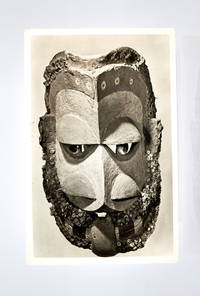
195875712Amsterdam 1958. Fine. Amsterdam 1958 13.90 x 8.90 cm une carte postale Autograph signed postcard addressed to Jean Schuster Amsterdam 1958 13.9 x 8.9 cm a postcard Handwritten postcard signed by André Breton addressed to Jean Schuster written in blue ballpoint pen on the back of a postcard reproducing a black and white photography of a Melanesian mask preserved at the Tropenmuseum in Amsterdam and which André Breton designates under the highly significant qualifier friend responsible for showing his affection to Jean Schuster. This grid pattern of canals and the tulip tiling leaves us in great indecision. . This country is decidedly very beautiful. His wife Elisa Breton added a few lines of a Surrealist tone following the main text: Elisa in Amsterdam comes from a gingerbread tin and a potential twisting from antiquarians. Jean Schuster 1929-1995 joined the Surrealist group in 1947. Close to Benjamin Péret and André Breton he will become Breton's executor. unknown