66 615 résultats
Oblong 4to. 3 pp. With autograph sleeve. In French, containing cues for an introductory lecture on the scientific history of phosphorescence, electromagnetic radiation, and radioactivity held at the museum of the military academy of Saint-Cyr. In his opening remarks Becquerel draws a connection between museums and the research on phosphorescence, also mentioning his father Edmond, who had been a professor at the National Museum of Natural History in Paris. He stresses the importance of the history of ideas in the natural sciences: "There are some phenomenona that seem traditionally to be researched at museums. Phosphorescence is one of them. [Charles François de Cisternay] Du Fay worked on it in 1724. 50 years ago, my father started a series of research projects that have not been interrupted since. If I introduce you to some of these old experiments today it is because the ideas that they brought forward will lead us to the most recent discoveries." Following this historic approach, Becquerel mentions the first description of phosphorescence in 1602, du Fay's experiments with electric charges, the invention of the Crookes tube around 1870 which made Wilhelm Röntgen's discovery of X-rays in 1895 possible, the discovery of polonium and radium by his student Marie Curie and her husband Pierre in 1898, the differentiation of alpha, beta, and gamma rays by Ernest Rutherford between 1899 and 1903, and a variety of other important scientific contributions. Although the cues include a few diagrams and formulae, Becquerel's aim was clearly propaedeutic with a lecture tailored to a young audience. In his closing statement, he offers two vivid metaphors of the recently discovered electron: "Within an atom the electrons are as distant as the planets in the solar system. An electron is much smaller than a microscopic mosquito flying in the nave of a cathedral." - Lightly folded, in very good condition.
8vo. 60 pp. The complete text (setting copy) of his long essay on current political events in Russia, written shortly before the Revolution of 1905: "As the forces of [Russian despotism; stricken out and corrected to:] Czardom are driven back and crippled more and more, both on sea and on land, curious attempts are being made in England to impress public opinion with the idea that, if [inserted: ever] she were [stricken out: to] actively to turn against Russia, she would have to reckon with an armed alliance between Russia and Germany [...]". With numerous revisions in ink and pencil as well as setting instructions ("all minion on this page" etc.); a few leaves assembled from paragraphs clipped from other sheets and glued together. Occasional edge flaws, but very well preserved. - Even as a law student in Heidelberg, the Mannheim-born Blind promoted a political revolution that would produce a unified, democratic German republic; after a brief imprisonment he participated in the failed Baden insurrection of 1848 led by Friedrich Hecker and Gustav Struve. Blind first met Marx at the Karlsruhe Republican Committee in May 1848, where Marx and Engels declared their frustration with the course of the uprising. As Engels remembered, the 21-year-old Blind was one of only two members of the committee who had supported their opinion. Indeed, Blind was taken prisoner and sentenced to eight years’ confinement, but was soon freed by fellow revolutionaries and escaped to France, and later to England. During Marx’s early weeks of refuge in London he even lodged with Blind: in a letter to Freiligrath written on 5 September 1849, he gives Blind’s address as his own. Blind permanently settled in London in 1852 and continued to advance the cause of democracy as a writer. He was well-connected among European republicans and corresponded with Garibaldi, Kossuth, and Louis Blanc. A man of wide education and interests, Blind composed not only political propaganda and journalism but also biography and works on history and mythology, as well as on German and Indian literature. Published in the "North American Review", vol. CLXXIX (October 1904), no. 575, pp. 481-493.
Titel, 6 Zeilen Motto und 30 Strophen zu je 4 Zeilen auf 8 SS. (= 4 Bll.) Kl.-4to. Humorig-besinnliche Verse in oberösterreichischer Mundart: "Nöt Nacht und Tag, / Nöt Winter u. Summe, / Na, Müh u. Plag, / Und Nauth u. Kumma, / Dö gehn mit'n Menschen ins Gricht / Und aichént iehm d'Jahr áfs Gsicht [...]". - Mit kleinen Randläsuren.
197173354Sommières 1971. Fine. Sommières 20-04-1971 10.50 x 14.50 cm une carte postale et enveloppe Autograph postcard by Lawrence Durrell signed ""Dracula"" addressed to Jani Brun written in blue ink reproduction of a drawing by Marcel Vaysse ""Ils sortent.tous les soirs"" ""They go out.every evening"" envelope included. The writer teasingly mocks his young Montpellier mistress with humor: ""Darling Janie - maintenant qu'il fait beau la saison est ouverte et malgré mon age je reçois pas mal des invitations; souvent les filles de dix ans m'envoient des propositions inscrites par télégramme. J'estime que le rôle de papa gâteux me va bien ""le gâtisme c'est le relachment des sphinctères"" Dictionnaire medicale - Pujot"". Je vais en Grèce avec une 2 3 4 filles plus fidé que vous pour faire des reportages appellation contrôlée. D'avoir soixante ans et d'être aimé très mal d'ailleurs par les vampires - n'est pas que c'est splendide Dracula"" ""Darling Janie - now that the weather is fine the season is open and despite my age I receive quite a few invitations; often ten-year-old girls send me proposals written by telegram. I think the role of a doting daddy suits me well 'dotage is the loosening of the sphincters' Medical Dictionary - Pujot. I'm going to Greece with one 2 3 4 girls more faithful than you to do some appellation contrôlée reporting. To be sixty years old and to be loved very badly moreover by vampires - isn't that splendid Dracula"" After many years spent in Greece Egypt and Rhodes the traveling writer Lawrence Durrell was forced to flee Cyprus following popular uprisings that led the island to its independence from the British crown. Rich only with a shirt and a typewriter but crowned with the success of his novel Bitter Lemons of Cyprus he arrived in France in 1956 and settled in the Languedoc village of Sommières. In the ""Tartès house"" his large dwelling surrounded by trees he wrote the second part of his work his monumental Avignon Quintet devoted himself to painting and received his illustrious friends including the couple Henry Miller and Anaïs Nin violinist Yehudi Menuhin London publisher Alan G. Thomas and his two daughters Penelope and Sappho. Among the olive trees and under the Mediterranean sun he met in the mid-1960s the young and sparkling ""Jany"" Janine Brun a woman from Montpellier in her thirties with devastating beauty who worked at the Department of Antiquities at the Sorbonne in Paris. She was nicknamed ""Buttons"" in memory of their first meeting where the young woman wore a dress covered with buttons. Henry Miller also fell under the charm of ""Buttons"" praising her beauty and eternal youth in exceptional unpublished letters. The three companions spent memorable Parisian evenings of which we retain precious autograph traces through their epistolary exchanges. Recommended by Durrell she made numerous trips particularly to England from where she received extensive correspondence from the writer as well as original artworks signed with his artist pseudonym Oscar Epfs. unknown
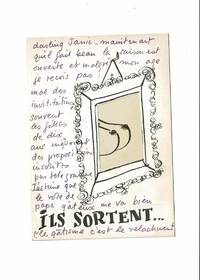
197173354Sommières 20-04-1971 | 10.50 x 14.50 cm | une carte postale et enveloppe
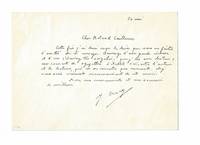
197574311s. l.: S. n. 1975. Fine. S. n. s. l. s. d. circa 1975 15.50 x 11 cm une feuille Autograph card of 11 lines signed by Julien Gracq addressed to Roland Cailleux regarding the sending of his latest work possibly A moi-même inconnu published in 1978 for which Julien Gracq congratulates him: "". ouvrage d'une grande richesse et d'un éclairage très singulier."" expressing an unusual sense of complicity between reader and writer: "". un courant de sympathie s'établit ici entre l'auteur et le lecteur qui ne se rencontre que rarement."" A fine tribute from Julien Gracq acknowledging and appreciating the sensitivity and talent of Roland Cailleux. S. n. unknown
197574311S. n. | s. l. s. d. [circa 1975] | 15.50 x 11 cm | une feuille
2 SS. auf gefalt. Bogen. Tinte auf gedr. Notenpapier. Folio. Lied für Singstimme und Klavierbegleitung ("Ich hab' eine alte Muhme") mit unterlegtem Text nach Anastasius Grün. Der aus Prag gebürtige Rückauf studierte bei Proksch Klavier und trat bereits in jungen Jahren als Komponist hervor, bevor er 1878 nach Wien übersiedelte, wo er seine Ausbildung bei Nottebohm und Leschetizky vervollkommnete. "Von großem Einfluß auf seine weitere künstlerische Entwicklung war die Bekanntschaft mit dem Tenor G. Walter: einerseits hatte Rückauf als dessen ständiger Klavierbegleiter großen Erfolg [...], andererseits wurde er durch ihn zu zahlreichen Liedkompositionen angeregt. Abgesehen von seiner Tätigkeit als Dirigent des Evangelischen Singvereins in Wien (1899-1901) wirkte Rückauf neben seinem kompositorischen Schaffen als Liedbegleiter (zu nennen ist u. a. die Erstaufführung der 'Vier ernsten Gesänge', op. 121, von Brahms) sowie als Privatlehrer. Arthur Schnitzler zählte zu seinen Schülern" (ÖBL IX, 319).
12+12+16 lines on 1¾ pp. 8vo. A fair copy manuscript, written in brown ink, formerly owned by the poet's son Friedrich and presented by him as a memento possibly to the publisher Friedrich Cohn in 1904 "Und es klagen ihre Tränen: | Weit der Himmel, tief die See, | Doch noch weiter geht mein Sehnen, | Und noch tiefer ist mein Weh […]" (from "Das Fischermädchen"). - This exquisitely written leaf was presented by Fontane's youngest son Friedrich (1864-1941) in 1904 apparently to Theodor Friedrich Cohn (1864-1936), a fellow partner in the Berlin publishing house of F. Fontane & Co. Although the date of the present manuscript is uncertain, all three of the present poems were originally written in the 1840s ("Guter Rat": 1849; "Das Fischermädchen": by 1844; "Der erste Schnee": 1841) and published in 1851. The present text of "Das Fischermädchen" and "Der erste Schnee" differs in places from the complete edition: see Theodor Fontane: Sämtliche Werke XX, pp. 7, 15-16).
12 Bll., davon 22½ SS. beschrieben. 4to. Mit mehreren Beilagen (s. u.). Sehr detaillierte physiologische Beschreibung und Analyse der Stimmband-Funktionen; zugleich eine ausführliche und genaue Anleitung zu deren künstlerischer Beherrschung. "Seit ich denken kann, hörte ich von großen u. kleinen Sängern erzählen, wie sie zeitlebens nach dem richtigen Ansatz gesucht, die verrücktesten Experimente gemacht haben, um das Phänomen des Singens zu ergründen [...]". - Geschrieben wohl für Lillis Schülerin Dora Schröder, aus deren Nachlass eine Anzahl wertvoller Drucke von und über Lilli Lehmann hier beigegeben sind: - 1) Das Buch "Meine Gesangskunst" (Berlin, Verlag der Zukunft, 1902. 1 Bl., 45 SS. Mit zahlr. zweifarbigen Tafeln und 1 photogr. Portrait. Orig.-Leinen mit Goldprägung. 4to). Erste Ausgabe. - 2) Das Buch "Mein Weg". (Leipzig, Hirzel, 1913. 2 Teile in 1 Band. 4 Bll., 309, 279 SS. Mit 41 Abb. auf Tafeln und 1 Falttabelle. Halbleinen d. Z. mit Rückenvergoldung. Gr.-8vo.). Erste Ausgabe der bedeutenden Memoiren, die sich durch Klugheit, erzählerisches und schriftstellerisches Talent der Sängerin auszeichnen. - 3) Die Broschüre "Anhang. Vom Ansatz und von den Vokalen." (16 SS. Mit 2 Tafeln und zahlr. Textabb. Folio. Geheftet, ohne Umschlag). Mit eh. Widmung der Verfasserin: "Frl Dora z. frdl. Erinnerung an Lilli Lehmann". - 4) 1 Opern- und 7 Konzertprogramme mit Lilli Lehmann (die Oper "Norma" im "Neuen Königl. Opern-Theater, Gura-Oper", Berlin, und 7 Programme zu Lieder-Abenden in der Berliner Philharmonie, 1906-1910). - 5) 1 Faltblatt "Verzeichnis der Odeon-Aufnahmen von Lilli Lehmann" (ca. 1910). - Die Falttabelle im Buch "Mein Weg" mit repariertem Einriss; die Programme mit Gebrauchsspuren; sonst alles ordentlich erhalten.
I: "Das Gesetz". 60¼ SS. auf 61 Bll. - II: "The Law". 71½ SS. auf 72 Bll. Zwischengebunden (1½+1½ =) 3 SS. auf 2 Bll. ms. Korrekturverzeichnis. Nachgebunden sind eine alternative Version des Schlusses (1½ SS. auf 2 Bll.), 4 (davon 2 eh. adr.) Kuverts von Thomas Mann an George Marek und 6 ms. Durchschläge von Briefen Mareks an Thomas Mann. Dunkelgrüner Kalbslederband mit vergoldetem Deckeltitel, -fileten und -fleurons. 4to. Mit einer Beilage (s. u.). Unikales Ensemble von Thomas Manns einziger Auftragsarbeit im deutschsprachigen Original und in englischer Übersetzung, beide mit zahlreichen eh. Korrekturen von Thomas Mann und einigen wenigen von George Marek, der diesen Band als Erinnerung an die gemeinsame Arbeit zusammengestellt hat und binden ließ. Thomas Mann widmete ihn am 20. Oktober 1942 mit den Worten: "An George Marek / tief gerührt von der Ehre, die er diesen Blättern erwies. Dem glänzenden Uebersetzer herzlich dankbar [...]". - 1941 war der aus Wien stammende Musikverleger, Librettist, Texter und Drehbuchautor Armin L. Robinson zusammen mit seiner Frau in die USA emigriert. Von den amerikanischen Unternehmungen des in Deutschland und Österreich erfolgreichen Librettisten weiß man wenig, gesichert ist jedoch, dass er Thomas Mann zu dessen bis dato erster (und schließlich auch letzter) Auftragsarbeit überreden konnte, nämlich einen Beitrag für die von ihm herausgegebene Anthologie "The Ten Commandments. Ten Short Novels of Hitler's War Against the Moral Code" zu verfassen. Mann, der von Mitte Jänner bis Mitte März mit seinem Beitrag beschäftigt war, war neben Rebecca West, Franz Werfel, John Erskine, Bruno Frank, Hendrik Willem Van Loon, Jules Romains, André Maurois, Sigrid Undset und Louis Bromfield einer von zehn Autoren, die jeweils eine Erzählung zu einem der zehn Gebote schrieben. Da seine reguläre englische Übersetzerin Helen Tracy Lowe-Porter damals mit anderen Arbeiten für ihn beschäftigt gewesen war, war Mann schließlich auf den in Österreich geborenen Musikkritiker und -schriftsteller George Marek (1902-87) gestoßen, der seit 1920 in New York lebte und für eine Werbeagentur tätig war; ab 1950 sollte Marek als Manager für die Plattenfirma RCA Victor arbeiten und schließlich Ende der 1950er Jahr zu deren Vizepräsidenten aufsteigen. Im Frühjahr und Sommer wechselten Mann und Marek mehrere Briefe (die Durchschläge von sechs Briefen Mareks liegen hier vor), in denen Übersetzungsdetails besprochen wurden, und im Spätsommer bzw. Herbst erschien Manns Erzählung schließlich unter dem Titel "Thou Shalt Have No Other Gods Before Me" in der genannten Anthologie bei Simon & Schuster. Im Jahr darauf folgte die deutschsprachige Erstveröffentlichung bei Bermann Fischer in Stockholm, und es entspann sich ein den Dichter enervierender Streit um die Frage nach dem Urheberrecht an der Erzählung. An sich war Mann Bermann Fischer verpflichtet (und durch diesen Alfred A. Knopf für den englischsprachigen Raum), doch hatte er unbedacht das Urheberrecht an Robinson abgetreten und es auch zugelassen, dass Felix Guggenheim eine "Luxusausgabe" in seiner Pacific Press herausbrachte. "As if this weren't enough, Knopf insisted on having the English version of the story done again from scratch by Mann's regular translator, Helen T. Lowe-Porter, a directive Mann described in his diary as 'a terrible blow for Marek', adding, 'I am disgusted by these trivialities' [...]" (Faber/Lehmann, Introduction, S. X). Das eh. Manuskript seiner Erzählung vermachte Mann noch im selben Jahr der Library of Congress, deren Briefpapier er für seine Niederschrift benutzt hatte. - Kleine Gebrauchsspuren, sonst ausgesprochen frisch mit Ausnahme von Mareks Briefdurchschlägen, die auf brüchigem, stark gebräuntem Papier getippt sind; der Einband an Gelenken und stellenweise auch an den Kanten stark berieben, sonst gut erhalten. - Beiliegend: Thomas Mann, Das Gesetz. Erzählung (Stockholm, Bermann Fischer, 1944). 160 SS. Illustrierter OPbd. 8vo. EA (WG², 90). Bindung leicht gelockert, Umschlag gebräunt, innen tadellos erhalten. Thomas Mann, The Tables Of The Law. Translated by Marion Faber and Stephen Lehmann (Philadelphia, Paul Dry Books, 2010).
5 SS. auf Doppelblättern. Fadengeheftet. 4to. Legende in Strophenform mit 14 Strophen zu je acht (= 112) Zeilen: "Ein Hüttchen steht im Alpenthale | Gar abgeschieden, still und klein; Im letzten heitren Abendstrahle | Schwimmt's wie verklärt im Rosenschein. | Ein Mann liegt drinnen auf dem Lager, | Ein Greis- die Wangen bleich und hager, | der schaut - das fühlt er tief und schwer - | das Morgenroth wohl nimmermehr [...]". - Der in Wien geborene Neffe des Schriftstellers Paul Weidmann (1748-1801) war Schauspieler am Wiener Burgtheater und schrieb Kritiken für die 'Zeitschrift für Kunst, Literatur, Theater und Mode' sowie für die 'Theater-Zeitung'. Nach und nach wandte er sich zunehmend der topographischen und heimatkundlichen Forschung zu ('Wiens malerische Umgebung', 1844), veröffentlichte aber auch Bühnenwerke (so etwa 'Clementine von Aubigny', 1816) und Gedichte. - Vorletztes Bl. recto mit hs. Zensurvermerk "Gesehen [...]", Datum ("30/3 1836") und nicht identifizierter Unterschrift. Mit kl. Einr. im rechten Rand (keine Textberührung).
Titel und 2 SS. auf Doppelblatt. Folio. Titel mit eh. Widmung an die "liebe, reizende Frau Persché [?]": "Sollte es dennoch mit dieser Nummer einen Erfolg geben, dann haben Sie, als Sie sich [als] erste Interpretin um dieses kleine Lied [...] annahmen, den grössten Anteil [...]". - Weiner-Dillmann war mehrere Jahrzehnte lang als Kapellmeister und Klavierbegleiter von u. a. Magda Schneider und Hans Moser tätig und komponierte zudem Operetten und Unterhaltungsmusik. "Als einer der ersten musikalischen Mitarbeiter des Rundfunks gestaltete er zahlreiche Sendungen. Nach 1945 arbeitete er für das Salzburger Landestheater. Zu seinen mehr als 500 Kompositionen gehörten Chansons, Tänze, Bühnen- und Filmmusik, vor allem jedoch Wienerlieder ('Draußen in Nußdorf') und Schlager ('Am Strande von Havanna')" (DBE). - Mit zahlr. Ein- und Ausrissen, angestaubt und mit Kartonschirting am linken Rand.
200599296Weinheim, Beltz und Gelberg, 2005. [48] S. Mit zahlr., teils ganzseit. farbigen Illustr. von Sabine Friedrichson. 24 x 26 cm. OPp. mit farb. illustr. SU..
1¾ SS. auf Doppelblatt. Mit einer Beilage (s. u.). "Eines schönen Tages plötzlich finden | Wir uns hier, ohne zu wissen wie? | Eines schönen Tages dann verschwinden | Wir von hier, ohne zu wissen wie [...]". - Mit kleinen Randläsuren; die untere Hälfte von Bl. 2 abgetrennt; beiliegend ein eh. Albumblatt mit U. ("Der giebt nicht viel wer sich erst viel besinnt | Und - stets an's Ende denkend - nie beginnt").
57497o.J. Göttingen, Wallstein, 2001, 8°. 46 S., 1 Bl. OKart. mit Umschlag.
4to. 4 pages on bifolium. A clean copy of his lied after words by Salomon Hermann von Mosenthal, with underlined text. - Dessauer was a friend of many composers of his time, such as Gioachino Rossini, Franz Schubert, Hector Berlioz, Felix Mendelssohn, Franz Liszt and Frédéric Chopin, who dedicated some pieces to him.
53861o.J. Ohne Ort und Jahr [München, ca. 1931], Gr.-4° (28,5 x 22,2 cm). 12 Seiten auf 12 Blättern. Gelb getöntes Papier (Ränder tls. knittrig).
Large 4to. ¾ p. Letterhead of the Villa Mansi at Monsagrati. - Somewhat dusty and strong damage to edges.
Folio (47 x 36 cm). German, Polish, and English manuscript on paper. 11 ff. With calligraphed title, three watercolour vedutas, and numerous signatures and stamps of McGarvey's business partners in Galicia. Bound on cloth tabs and spine and thus stored loosely in an original dark blue full calf portfolio by F. W. Papke of Vienna, with elaborate, partly gilt brass ornaments and giltstamped borders to the upper cover (lacking two central ornaments) and protective brass beams across the lower cover. Inside covers have yellow moirée silk pastedowns within wide giltstamped floral borders. All edges gilt. Unique, luxurious testimony to the late 19th and early 20th century oil boom in Galicia and to one of its central protagonists. Three watercolours on the title-page show a view of Mariiampil (in present-day western Ukraine), where McGarvey had built his first refinery in Galicia, McGarvey’s "first home" in the region, and an oil well in the now Polish village of Wietrzno. This is followed by three pages of a laudatory address in German, Polish, and English, all with floral art-nouveau borders and initials. McGarvey is hailed as a technological innovator whom fate "across the Ocean" to his new home 19 years ago. - Since the album was commissioned by McGarvey's local business partners and competitors, emphasis is placed on his fairness and on his unfailing attention the oil industry: "you never ceased to care for the whole oil industry, and you became a friend and protector of the small, even the smallest oil producers and refiners, you were the adviser and promoter of every single workman, you became the benefactor of our country Galicia". The remainder of the album offers the signatures of more than 150 congratulators (with several business stamps) on five leaves. This is a valuable document of the Galician oil industry in general and of the significant involvement of Jewish businessmen in particular. - William Henry McGarvey (1843-1914) became probably the most successful oilman of Galicia through the introduction (in 1883) of the Canadian "pole tool" drilling system that allowed for oil exploration at previously unheard-of depths and speed. His "Galizische Karpathen-Petroleum-AG", headquartered in Vienna, was among the most lucrative companies in the Austro-Hungarian empire and made multimillionaires of McGarvey and his British partner John Simeon Bergheim. In 1908, McGarvey was knighted by Emperor Franz Joseph for his innovations that had enabled Austria-Hungary to become a net oil exporter. Retreating Russian troops who briefly had occupied Galicia in the first months of the First World War set fire to Galicia's oil wells and blew up the refineries, effectively destroying the oil industry and McGarvey’s business. - The splendid album was designed and executed by the Austrian painter and illustrator Erwin Pendl (1875-1945). Minor foxing to the title-page and the first page of signatures: occasional light stains. Well preserved with only very minor scratches and flaws to the upper cover.
1 S. (37 Zeilen). Gr.-8vo. "Hat Dich Dein Gott geküsst? | Vor seinem Allumfassen | Muss Menschliches erblassen [...]". Vgl. Giebisch/G.
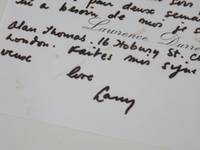
1970703391970. Fine. s. d. circa 1970 12.70 x 8.10 cm une carte de visite Autograph signed calling card addressed to Jani Brun written in black felt-tip pen and bearing some stains. The writer informs his young French mistress of an imminent departure to London where he frequently visited his publisher: ""Je suis chez Alan Thomas. 16 Holbury St. Chelsea. Faites moi signe quand tu veux sic Love Larry"" ""I am at Alan Thomas's. 16 Holbury St. Chelsea. Let me know when you want to meet. Love Larry"". After many years spent in Greece Egypt and Rhodes the travel writer Lawrence Durrell was forced to flee Cyprus following popular uprisings that led the island to its independence from the British crown. Rich only with a shirt and a typewriter but crowned with the success of his novel Bitter Lemons of Cyprus Les citrons acides he arrived in France in 1956 and settled in the Languedoc village of Sommières. In the ""maison Tartès"" his large house surrounded by trees he wrote the second part of his work his monumental Avignon Quintet devoted himself to painting and received his illustrious friends including the couple Henry Miller and Anaïs Nin the violinist Yehudi Menuhin the London publisher Alan G. Thomas and his two daughters Penelope and Sappho. Among the olive trees and under the Mediterranean sun he met in the mid-1960s the young and sparkling ""Jany"" Janine Brun a thirty-something woman from Montpellier of devastating beauty who worked in the Department of Antiquities at the Sorbonne in Paris. She was nicknamed ""Buttons"" in memory of their first meeting where the young woman wore a dress covered with buttons. Henry Miller also fell under the charm of ""Buttons"" praising her beauty and eternal youth in exceptional unpublished letters. The three companions spent memorable Parisian evenings of which we keep precious autograph traces through their epistolary exchanges. Recommended by Durrell she made numerous trips notably to England from where she received extensive correspondence from the writer as well as original works of art signed with his artist pseudonym Oscar Epfs. unknown
197070339s. d. [circa 1970] | 12.70 x 8.10 cm | une carte de visite
Handschrift auf Papier. Qu.-8vo. (191 x 109 mm). Zus. ca. 77 SS. auf 78 Bll. mit 61 Einträgen. Hs. paginiert. (2), 5-46, 49-138, 141-149 (recte 148), 149-150, 150a, 150b, 151-153, (8) SS. Mit 6 Aquarellen (davon 5 ganzseitig), 1 Tuschefeder- und Pinselzeichnung, 1 kleinen Silhouette und 2 Seidenstickereien. Marmorierter Lederband der Zeit mit ornamentalen goldgepr. Rücken und Rückenschildchen "Denckmal der Freundschaft", schmaler goldgepr. Deckelbordüre, ovalem Mittelstück mit kleiner goldgepr. Deckelvase und dreiseitigem Goldschnitt. Freundschaftsalbum mit vielen deutschen und wenigen französischen Einträgen. Zu Beginn einmontiert das Titelaquarell mit U. Börickes, das ein Freundschaftsdenkmal in einer Flusslandschaft zeigt. Einträge von C. Althans aus Mücheln, C. F. Bretschneider, Martin Heinrich Eckardt aus Kolberg, W. Germar aus Glauchau (Naumburg 1804), Carl Hahn, Joseph Keylwerth aus Graslitz in Böhmen (mit dem Spruch "Unzufriedenheit ist das Merkmal eines kranken Hertzens [...]"), Heinrich Klipsch aus Frankenhausen, Karl Kölbel aus Friedberg, Christian Knüpfer "aus Wettwitz bey Neustadt an der Orla", Carl Christian Overweg (Naumburg, 8. I. 1801), Henriette Dorothea Palm aus Hamburg, Friedrich August Seyfert, Johann Baptist Wilhelm Weymann aus Greußen u. v. a., meist von der Hand Naumburger Freunde und Verwandte. - Unter den Illustrationen eine hübsch aquarellierte Rose mit Vergissmeinnicht, zwei Denkmale der Freundschaft (eines monogrammiert "L.R."), eine etwas grobe Seidenstickerei (Deckelvase auf einem Podest) sowie eine feinere Arbeit mit Blick auf eine Windmühle (dazu ein Eintrag von Wilhelmine Döring) und zwei Flusslandschaften mit Brücken und Ruinen. Außerdem eine talentierte Tuschpinselzeichnung mit einem kleinen Tempel in einer Parkanlage, am Gegenblatt der Eintrag von Johann Heinrich Döring (Leipzig, 3. IX. 1801). Die kleine Silhouette gehört zu "Deiner Dich zärtlich liebenden Tante Friederike Ritter geb. Böricke", und ein Eintrag ist mit einem ins Papier eingewobenen Seidenband umgeben. - Die letzten 8 SS. mit alphabetischem Register. Einige Bll. montiert und einige am Bug herausgetrennt. Innen kaum fleckig und frisch. Der Einband leicht berieben und bestoßen, die Gelenke etwas brüchig. Rücken lose.
Mit 1 farbigen Zeichnung und 1 Haararbeit sowie ca. 60 Einträgen. Hldr. mit goldgeprägten Deckelbordüren, Deckelprägung "F. Reppe" und Goldschnitt in Kartonschuber. Qu.-8vo. Die zahlreichen Einträge umspannen ein gesamtes Lebensalter mit Freundschaftsbezeugungen von Mitschülern und -kommunikanten, Freunden und Kollegen (Schriftsetzer, Klempnergesellen und Lazarettgehilfen). "Drum rede du Blatt, wenn die Stimme verhallt!" (Eduard Siemssen, Schriftsetzer aus Thorn, 1838). - Innen etwas finger- bzw. stockfleckig, 6 Bll. herausgetrennt; Rücken unter Verwendung alten Materials erneuert, Vorsätze erneuert, etwas berieben und beschabt.