66 618 résultats
195875712Amsterdam 1958 | 13.90 x 8.90 cm | une carte postale
190990033Asnières-sur-Seine 12 décembre [1909] | 9.1 x 11.6 cm | Une carte
1894755111894. Fine. s. d. 23 janvier 1894 22.60 x 17.50 cm 2 pages sur un double feuillet déplié Autograph letter signed by Paul Signac addressed to Camille Pissarro written in black ink over two pages and signed with the artists monogram. This letter was transcribed in the article by Pierre Michel and Christian Limousin entitled ""Octave Mirbeau et Paul Signac - Une lettre inédite de Signac à Mirbeau"" in Cahiers Octave Mirbeau no. 16 March 2009 pp. 202-210. ""Mon cher Maître Cela vous ennuirait-il sic d'écrire à Mirbeau qu'un Signac à votre avis ne ressemble pas plus à un Seurat qu'un Hokousai à un Hiroshigé. si toutes fois sic le reproche d'imitation dont il cherche à m'accabler vous semble injuste. L'amitié que vous m'avez toujours témoignée et les compliments que vous avez bien voulu faire de mes toiles m'autorisent à vous demander ce service. Cordialement. PS"" A fine letter in which Paul Signac seeks the support of his master Camille Pissarro after a scathing critique published by Octave Mirbeau in L'Echo de Paris. In this article featured on the front page of L'Echo de Paris of 23 January 1894 Octave Mirbeau spares Signac no harshness: « M. Signac a voulu continuer Seurat. Je ne puis me faire à sa peinture. Je ne méconnais pas ses qualités mais elles disparaissent sous l'amoncellement de ses défauts. Ce qu'on admettait de Georges Seurat . on le comprend moins chez M. Signac qui n'en est que l'adepte trop complaisant et trop littéral. Et puis cette continuelle sécheresse me choque. M. Signac fait la nature immobile et figée. Jamais le vent n'a secoué la surface inerte de ses mers ni tordu les branches de ses pins ni animé l'éternelle fixité de ses nuages la raideur cartonnée de ses ciels. Il ignore le mouvement la vie l'âme qui est dans les choses. . Il serait peut-être temps pour notre joie que M. Signac voulût bien nous donner du Signac. Je crois qu'il le peut.» Why this obsession with Seurat « At the beginning of 1894 the position of Mirbeau Geffroy Pissarro and a few others was to consider that Neo-Impressionism had in fact died in 1891 with the passing of Seurat. Their retrospective view of this artistic venture led them to think that it was not a continuation of Impressionism by new scientific means but a reaction against it even a liquidation of the movement.» Cahiers Octave Mirbeau. Pissarros reply to Signac also transcribed by Michel and Limousin was not long in coming: it « l'ennuirait d'écrire ce que vous me demandez à Mirbeau et cela pour plusieurs raisons. . Premièrement parce que je suis en froid avec lui vous le savez bien. Deuxièmement parce que pour vous-même il ne sied pas de discuter l'opinion d'un critique même étant persuadé d'être dans le vrai et si vous voulez franchement ma façon de penser et que je suis heureux d'avoir l'occasion de vous exprimer je trouve que la méthode même est mauvaise. Au lieu de servir l'artiste l'ankylose et le glace. Si je vous ai fait des compliments cette année c'est parce que j'ai trouvé vos dernières toiles mieux que celles que vous aviez exposées aux Indépendants mais je suis loin de trouver que vous êtes dans la voie qui convient à votre tempérament essentiellement peintre et si jusqu'à présent je ne vous ai rien dit à ce sujet c'est parce que j'étais sûr de vous être désagréable et somme toute mes convictions peuvent ne pas être partagées par vous. Réfléchissez mûrement et voyez si le moment n'est pas venu de faire votre évolution vers un art plus de sensation plus libre et qui serait plus conforme à votre nature.» « Disheartened and deprived of the authority of a master revered by the critic Signac was left to devise himself without delay the reply to address to Mirbeau . » ibid. This response took the form of a long letter written the same day as the one offered here and now preserved at the Harry Ransom Center at the University of Austin Texas: « Je reconnais hautement que c'est Seurat qui a insta unknown
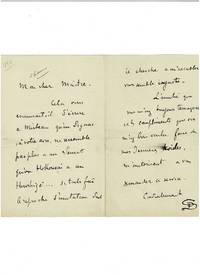
189475511s. d. [23 janvier 1894] | 22.60 x 17.50 cm | 2 pages sur un double feuillet déplié
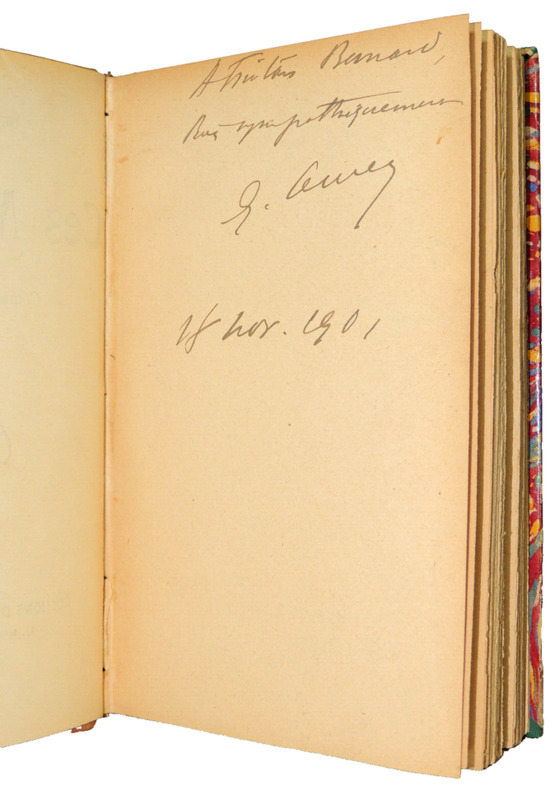
CZC-12681Vol in8, dos veau lisse, 18x11, très bel état intérieur, 304pp. Couvertures conservées. Bibliothèque de Tristan Bernard, belle provenance. Edition de la revue Blanche, Paris, 1902 Tristan Bernard, nom de plume de Paul Bernard, né à Besançon le 7 septembre 1866 et mort à Paris 7ᵉ le 7 décembre 1947, est un romancier et auteur dramatique français. Il est célèbre pour ses mots d'esprit. Georges Ancey, de son vrai nom Georges-Marie-Edmond Mathevon de Curnieu, né le 9 décembre 1860 à Paris 9ᵉ, où il est mort le 18 novembre 1917, est un dramaturge français. ref/17
Large 4to. German manuscript in brown ink on paper. 1½ pp. on 1 f. An early version of Celan's poem "Chanson einer Dame im Schatten" that was first published in the 1952 poetry collection "Mohn und Gedächtnis": "Wenn die Schweigsame kommt, die die Tulpen köpft: | Wer gewinnt? | Wer verliert? | Wer tritt an das Fenster? | Wer nennt ihren Namen zuerst? | Es ist einer, der trägt mein Haar. | Er trägts wie man Tote trägt auf den Händen. | Er trägts wie der Himmel mein Haar trug im Jahr da ich liebte. | Er trägt es aus Eitelkeit so. | Der gewinnt. | Der verliert nicht. | Der tritt nicht ans Fenster. | Der nennt ihren Namen nicht [...]". - The only discrepancy between this manuscript and the published version concerns the first line where Celan changed "die die Tulpen köpft" to "und die Tulpen köpft". - Celan presented this manuscript as a gift to Diet Kloos-Barendregt in August 1949. Kloos-Barendregt (1924-2015) was a Dutch singer and resistance fighter whose husband had been executed by the Nazis in 1945. During a brief stay in Paris she met Paul Celan by chance at the Café Dupont in August 1949. They immediately formed a connection over their traumatic experiences and losses and started a romantic relationship. - Traces of folds. Minimally creased and minor browning. With punch holes, a paper clip stain to the upper margin, and insignificant tears. Provenance: from the estate of Diet Kloos-Barendregt, Bubb Kuyper auctions, November 2021. P. Celan, Mohn und Gedächtnis (Stuttgart, DVA, 1952). Cf. Paul Celan, Du mußt versuchen, auch den Schweigenden zu hören. Briefe an Diet Kloos-Barendregt. Handschrift - Edition - Kommentar (ed. by P. Sars, Frankfurt a. M., 2002).
Large 4to. 1½ pp. on 2 ff. An early version of Celan's poem "Chanson einer Dame im Schatten" that was first published in the 1952 poetry collection "Mohn und Gedächtnis": "Wenn die Schweigsame kommt, die die Tulpen köpft: | Wer gewinnt? | Wer verliert? | Wer tritt an das Fenster? | Wer nennt ihren Namen zuerst? | Es ist einer, der trägt mein Haar. | Er trägts wie man Tote trägt auf den Händen. | Er trägts wie der Himmel mein Haar trug im Jahr da ich liebte. | Er trägt es aus Eitelkeit so. | Der gewinnt. | Der verliert nicht. | Der tritt nicht ans Fenster. | Der nennt ihren Namen nicht [...]". - The only discrepancy between this typescript and the published version concerns the first line where Celan changed "die die Tulpen köpft" to "und die Tulpen köpft". - Celan presented this typescript as a gift to Diet Kloos-Barendregt August 1949. Kloos-Barendregt (1924-2015) was a Dutch singer and resistance fighter whose husband had been executed by the Nazis in 1945. During a brief stay in Paris she met Paul Celan by chance at the Café Dupont in August 1949. They immediately formed a connection over their traumatic experiences and losses and started a romantic relationship. - Traces of folds. Somewhat creased and minimally browned. With paper clip marks to the upper margin, punch holes, insignificant rust stains and tears. Provenance: from the estate of Diet Kloos-Barendregt, Bubb Kuyper auctions, November 2021. P. Celan, Mohn und Gedächtnis (Stuttgart, DVA, 1952). Cf. Paul Celan, Du mußt versuchen, auch den Schweigenden zu hören. Briefe an Diet Kloos-Barendregt. Handschrift - Edition - Kommentar (ed. by P. Sars, Frankfurt a. M., 2002).
1 S. 8vo. Drei Strophen zu je acht Zeilen: "Gar stolz pocht's in des deutschen Brust | Wenn er mein Erstes schaut | Es gilt ihm mehr als Gut und Blut, | des Herzens süße Braut. | Gerne verläßt er Haus und Hof, | der Kindlein zarte Schaar | Wenn durch des Nachbar's kühne Faust | dem Heiligen droht Gefahr [...]".
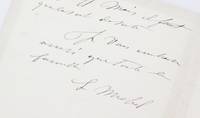
188783960s. l. Paris 1887. Fine. s. l. Paris 19 novembre 1887 11.30 x 17.70 cm 1 pages 1/2 sur un bifeuillet Autograph letter signed by Louise Michel addressed to Lucien Barrois; one and a half pages written in black ink on a bifolium of white paper with black border. Transverse folds inherent to mailing. ""Chauvière et d'autres amis communs vous prient bien de tâcher que Clemenceau recommande au professeur qui a la chaire de Russe au Collège de France et à la Sorbonne notre ami Gregorieff comme aide. Il paraît qu'avec un mot de Rochefort et de Clemenceau il serait immédiatement accepté ."" ""Chauvière and other mutual friends earnestly ask you to try to have Clemenceau recommend our friend Gregorieff as assistant to the professor who holds the Russian chair at the Collège de France and at the Sorbonne. It appears that with a word from Rochefort and Clemenceau he would be immediately accepted ."" The novelist P. Gregorieff had given some Russian lessons to Louise Michel. Moving letter testimony to the unfailing devotion of the former Communard. unknown
188783960s. l. [Paris] 19 novembre 1887 | 11.30 x 17.70 cm | 1 pages 1/2 sur un bifeuillet
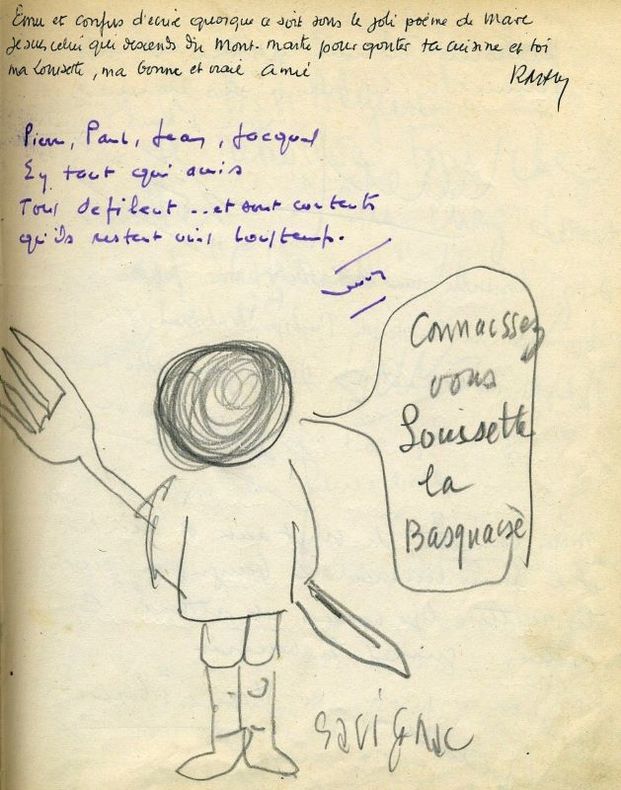
197013081(1970) 1 Livre d'or du restaurant parisien "Chez Louisette" des années 1960-1970, in-12, pleine basane noire, tranches dorées.
56052o.J. St. Ives, Cambs, 1988, Fol. Mit vielen Abb. 28 S. OKart.
Folio. German manuscript on paper. 14 pp. on 8 ff. Sewn. Detailed table of the places, times, and circumstances of the 202 crimes committed by the notorious bandit Johann Georg Grasel, who terrorized Lower Austria's Waldviertel region in the early 19th century. An archival copy for the records prepared by Georg Vinzenz Höllinger, staff auditor with the Lower Austrian General Military Command. - Grasel committed 194 of his crimes "while still a civilian", while "the last 8 thefts were committed in the character of a soldier". The vast majority of his crimes, the first of which was committed in Raabs an der Thaya on 17 March 1806, were thefts, but the list also includes a few robberies and manslaughters. The last entry is dated 10 November 1815: a theft perpetrated in Echsenbach. - Increasingly taking to drink, Grasel was finally captured through a plot in which he was drugged with opium. The principal reason for the death sentence which was finally carried out on 31 January 1818 was the crime listed here as No. 148: "Robbery with manslaughter or respectively with murder", perpetrated in Zwettl on 18 May 1814. - Old record registration "1815-13-81". In excellent state of preservation.
4to. 1 p. (24 lines). An important sociopolitical text (notes for "Terre des Hommes", presumably for an article), in which Saint-Exupéry examines different ways of perceiving civilization: "Ah! Hitler tu as fait une belle decouverte en verite quand tu as decouvert que la civilisation ce n'etait pas [...], quand tu as decouvert [...] que l'on avait pas à qui ca mature [...] et que nous etions le loup et le tigre. Le [...] [...] [...], nous le [...] depuis cent mille ans - Tu confonds la decouverte du persecuteur avec la decouverte du [...] et tu decouvriras demain que [...] de l'homme si les pouvoir ne [...] sa proie, mais, [...] [...] de la manger - Et tu diras, j'ai trouvé le vrai dens de l'honneur? [...]".
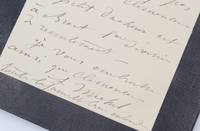
188583964s. l. Paris 1885. Fine. s. l. Paris 6 février 1885 11.10 x 17.60 cm 1 page 1/2 sur un bifeuillet Autograph letter signed by Louise Michel addressed to Lucien Barrois; one and a half pages written in black ink on a bifolium of white paper with black border. Transverse folds inherent to mailing. A trace of glue on the second sheet where Louise Michel had probably pasted a letter from her cousin. News of Louise Michel's little cousin Lucien Dacheux: ""Je reçois une lettre de mon petit cousin Dacheux qui me demande de remercier encore pour lui Clemenceau et lui. Je le fais moi-même de tout coeur. N'oubliez pas de le dire à Clemenceau. Le petit Dacheux est à Brest 1ère division de recrutement. . Clemenceau serait en droit de dire que je suis bien ennuyeuse mais montrez lui la lettre du petit si on pouvait obtenir qu'il ait un peu d'instruction. Je ne sais pas s'ils peuvent avoir des leçons. Y a-t-il une école je ne sais rien de tout cela dans la division où il est."" ""I receive a letter from my little cousin Dacheux who asks me to thank Clemenceau and him again on his behalf. I do so myself wholeheartedly. Don't forget to tell Clemenceau. Little Dacheux is in Brest 1st recruitment division. . Clemenceau would have the right to say that I am quite bothersome but show him the little one's letter if we could obtain that he have a little education. I don't know if they can have lessons. Is there a school I know nothing of all that in the division where he is."" Moving letter testimony to the unfailing devotion of the former communard. unknown
188583964s. l. [Paris] 6 février 1885 | 11.10 x 17.60 cm | 1 page 1/2 sur un bifeuillet
Large 4to. 2 pp on 2 ff. Film scenario, rich in corrections and revisions, and dedicated "pour Monsieur Jacques Fauchene [?] ce scénario de film sur Climats en respectueux hommage | André Maurois". - Adapted from Maurois' novel "Climats", he here gives general themes and details about directing the characters: "[...] Philippe Marcenat est le fils d'un industriel français. Il appartient à une famille travailleur, bourgois, austère […]. Un jour, au cours d'un voyage à Florence, il rencontre une jeune fille d'une extraordinaire aérienne et poétique beauté, Odile Malet […]". - The film appeared in 1962, adapted by Stellio Lorenzi.
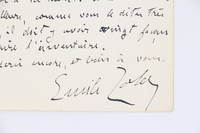
188279111Médan 1882. Fine. Médan 1er décembre 1882 13.60 x 21.40 cm 2 pages sur un double feuillet - enveloppe jointe Autograph letter signed by Emile Zola - apparently unpublished - written in black ink on a double sheet and addressed to Léon Carbonnaux department head at Bon Marché. Folds inherent to mailing. Envelope included. Only two letters from Léon Carbonnaux to Emile Zola are known: they can be consulted in the digitized preparatory file for Au bonheur des dames made available online by the Bibliothèque nationale de France. However we know from this same file which contains a long section entitled ""Notes Carbonnaux"" that this department head at Bon Marché provided Zola with a significant amount of information particularly about employee customs their remuneration and especially inventory techniques. The two men probably met when Emile Zola eager for information about the workings of department stores conducted field research in February and March 1882. Very important unpublished letter shedding new light on the pre-original publication of Au bonheur des dames. In his biography of Emile Zola Henri Mitterrand writes: ""Even before the novel was completed Zola gave an extract to Panurge in November; and on November 23 1882 Gil Blas announced its imminent publication in its columns."" Our letter discussing precisely this alleged pre-publication in Panurge attests that it was simply a joke and thus contradicts Henri Mitterrand: ""But your letter surprises and saddens me somewhat. How could you have been taken in by Panurge's stupid joke Did you not notice that the entire issue is a 'farce' Not one of the articles is authentic they are parodies and very poorly done ones at that."" Indeed reading the said extract cannot fool the assiduous reader of Zola despite the introduction that the journalists wrote: ""After Nana and Pot-Bouille those epics of elegant vice and bourgeois vice M. Emile Zola wanted to create one of honesty: Au bonheur des Dames which will appear shortly is a reassuring painting of innocence and virtue; the greatest success is assured for this new work whose characters move in the setting of a large novelty store; Parisian high commerce will not long await its observer and painter. We thank Emile Zola for having kindly cut out especially for Panurge a few pages from his still unpublished work and we are proud to give the public first an extract from this work of such high morality and such powerful interest."" Panurge no. 4 of October 22 1882 The sentences of this false Zolian text are exaggeratedly long and Panurge took the liberty of endowing the novel with a male main character Denis Mouret an amalgam of Denise the true heroine of the book to appear and Octave Mouret. One can think that it is a text composed from elements of Pot-Bouille the previous volume of Rougon Macquart where Octave - future owner of Bonheur des Dames - exercised the function of clerk before his meteoric social rise: ""For already more than two months he had been attached to the 'silks and furs' department; he arrived in the morning at seven o'clock to return home his day finished only at nine o'clock in the evening when all of Paris buzzed strangely with a feverish animation of pleasure and enjoyment and on his way back he followed gawking the great crowded boulevards where blazed the cafés full of girls and where on the asphalt at theater doors the crowd jostled with here and there in the vague rumor of trampling and pressing the roguish intonation of the cries of program vendors and ticket sellers."" Panurge In his letter of November 30 1882 Léon Carbonnaux - reading the extract from Panurge - had reproached Zola for his errors: ""Nowhere except at the Fabriques de France near Les Halles does one arrive at 7 a.m. It's at the earliest 7:30 but more often 8 a.m. and even then. There is no silk and fur counter at the Louvre. . It is so easy for you to be accurate that errors of this kind especially if t unknown
188279111Médan 1er décembre 1882 | 13.60 x 21.40 cm | 2 pages sur un double feuillet - enveloppe jointe
GF23627Manuscrit autographe signé - 12 pages in4 -
194631737[1946] 1 vol. Broché un feuillet (19 x 27 cm) plié en deux. Texte de présentation par Joë Bousquet sur 4 pages annonçant "L'oeuvre de la nuit" paru en 1946 aux Editions Montbrun. Envoi : "A Georges Bataille, fidèlement, cette "prière de lire" qu'un petit volume suivra, son Joë Bousquet, Carcassonne, 21/2/47". Une correction autographe dans le texte.
4to. 1 p. Signed in pencil. A humorous programme for a concert given for the benefit of the French Society for the Relief of Shipwrecked Sailors, inscribed "Sincerely yours / R. F. Outcault". The programme begins with five pieces of music, followed by "Some True Stories" told by Outcault, then features another four musical items concluded by "Some lies", also told by the artist. The illustration shows his famous cartoon character Buster Brown playing the violin, with his dog Tige holding up the notes. - Light brownstaining. For his creations "The Yellow Kid" and "Buster Brown", Outcault is hailed as a pioneer of the modern comic strip. After achieving financial success he retired to pursue his first love, painting, and became a well-respected figure in American art. The present event's chairman was the American Impressionist painter Edward Simmons (1852-1931), several of whose works reveal a preoccupation with the grandeur and dangers of the sea.
Large 8vo. 36 pp. With 7 illustrations (one fold-out). Original wrappers. Sewn. Together with a letter by Eiffel's secretariat and an original envelope. Rare booklet for the conference on 20 February 1889, beautifully inscribed to a Belgian woman named Marguerite Cruyt, dated Paris, 4 April 1889. The partly lithographed letter from the secretariat of Gustave Eiffel was written in response to a request for Eiffel's signature by Marguerite Cruyt from 26 March 1889. - Stronger browning and several minor tears to the cover with Eiffel's signature.