66 614 résultats
189577509Paris 12 novembre 1895 | 12.50 x 20 cm | 4 page sur un double feuillet
189577509Paris 1895. Fine. Paris 12 novembre 1895 12.50 x 20 cm 4 page sur un double feuillet Autograph letter signed by Pierre Louÿs signed with his initial addressed to Georges Louis. Four pages written in blue ink on a double sheet. Envelope enclosed bearing on the verso the intact wax seal with the writer's cipher. Transverse fold inherent to the mailing. Important letter addressed to his brother Georges Louis with whom Pierre Louÿs maintained a very intimate relationship and whom he considered as his own father. The question of the real identity of Pierre Louÿs' father still fascinates biographers today: ""His father Pierre Philippe Louis . had married in 1842 Jeanne Constance Blanchin who died ten years later after giving him two children Lucie and Georges. In 1855 he remarried Claire Céline Maldan and from this union was born in 1857 a son Paul; then in 1870 our writer who received the first names Pierre Félix. This late birth the differences in character between father and son the former's disaffection towards the latter the profound intimacy that always reigned between Louÿs and his brother Georges all this has led certain biographers and critics to suspect that the latter was in reality the father of the writer. The exceptionally intimate and constant relationship that Pierre and Georges maintained between them all their lives could be an argument in this sense. Of course no irrefutable proof has been discovered and probably never will be. Nevertheless certain letters . are quite troubling. In 1895 for example Louÿs writes seriously to his brother that he knows the answer to 'the most poignant question' he could ask him a question he has had 'on his lips for ten years.' The following year in the midst of Aphrodite's triumph he thanks Georges effusively and ends his letter with this sentence: 'Not one of my friends has a FATHER who is for him what you are for me.' Arguing from the close intimacy of Georges and Claire Céline during 1870 and the jealousy that the father never ceased to show towards his younger son Claude Farrère did not hesitate to conclude in favor of Georges Louis. And what to make of this dedication by Louÿs to his brother on a Japan paper copy of the first edition of Pausole: To Georges his eldest son / Pierre."" Jean-Paul Goujon Pierre Louÿs As attested by the enclosed envelope Pierre Louÿs sends this letter to his brother while the latter is exercising the function of France's delegate to the International Commission of Egyptian Debt and is in Cairo. Like a good socialite Pierre tells his brother about his new encounters: ""I met yesterday at a friend's house one of the sons of your minister Marcellin Berthelot. I have known all four of them for a long time but I see little of them. One of them André is a friend of Henri Mougeot with whom he has rented along with two or three other young men a house in Chevreuse and a mistress in Paris. . The other Daniel is a professor at the School of Pharmacy. A remarkable chemist they say. Philippe does nothing special . Finally René the youngest is Blum's oldest friend and his great rival of former times in the general competition. . It is Philippe who formed five or six years ago with Léon Daudet and Georges Hugo such a famous trinity. He is also known for having written a sonnet containing six rhymes in omphe which stupefied Heredia."" But these worldly matters do not distance Pierre Louÿs from literature. Indeed his first novel entitled Aphrodite is about to appear and he wonders to whom he could dedicate it. He first thought of José Maria de Heredia but. ""H. refuses . the dedication of Aphr. because he still has two daughters to marry. I myself had put a thousand reservations in my offer and his response after all is not unobliging. I know on the other hand that he repeats before strangers and indifferent persons everything he told me about the book and in the same hyperbolic terms. Finally he gave me unknown
198578536(Hamburg), 1985. Zu einer Grußkarte gefalzer Büttenbogen. (10,5 x 15,8 cm), Bildgröße 6 x 12 cm.
Very Good Turkish, Ottoman (1500-1928) Original document partly printed and manuscript. Oblong: 15,5x18 cm. In Ottoman script. A tear to blank outer margin of title-page (no loss and not affecting to the printing area). The tax on war profits was on the agenda already in 1918 but it became effective only in 1919. During World War 1, the revenues procured from taxes covered only 10 percent of the government expenses. [WW I] (1914-1918 Online).
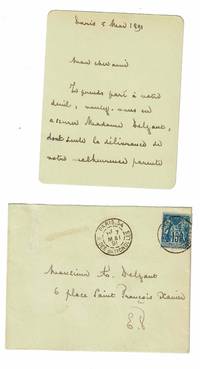
189176346Paris 5 mai 1891 | 11.40 x 8.80 cm | une carte recto-verso et une enveloppe
4to. 3 ff. Eulogy in French for the composer Hector Berlioz (1803-69), whom he considers "the greatest of our musicians", trusting his work to become a rich source of inspiration for young musicians, imagining a bright musical future re-evoking feelings of virtue, noblesse, and infinity, following Berlioz' example: "L'oeuvre de Berlioz, virile, émue, poignante ou chaleureuse, est encore prête à attester de la part qu'elle a prise dans cette métamorphose […] des données traditionnelles de l'art musical. Elle pourrait redevenir pour nos jeunes musiciens […] la source jaillissante où puiser les éléments d'un art accordé de plus près aux évènements démesurés dont ils demeurent encore les témoins curieusement silencieux […] Et one se plaît à imaginer, sous le symbole ‚Berlioz', une musique française de l'avenir, qui dirait à nouveau, à son exemple sinon selon sa formule, la vertu stimulante des puissantes résonances chargées du poids des rythmes altiers, la noblesse émouvante de ces longs déroulements sonores qui, sous sa plume, ont si profondément rêvé l'infini […]". - A few autograph corrections in felt pen. Small marginal flaws.
2 SS. Tinte auf Papier. Qu.-Folio. "Lied für Bariton mit Brummstimmenchor" (Bariton, 2 Tenöre, 2 Bässe): "Heimath! Heimath! Wunderbar tönendes Wort" (nach Otto Inkermann). - Reißiger war - wie sein Zeitgenosse Beethoven - u. a. Schüler von Antonio Salieri in Wien (1821). 1826 sang er bei Zelters Berliner Singakademie, bevor er in Dresden zunächst als Nachfolger Heinrich Marschners zum Musikdirektor berufen wurde, dann aber die Nachfolge Carl Maria von Webers als Hofkapellmeister antrat. Reißiger schuf ein umfangreiches Kompositionswerk; seine Hymnen, Motetten und Lieder sind in vielen Sammlungen erschienen. Ein Teilnachlass mit 65 Musikautographen wird in der Musikabteilung der SLUB Dresden aufbewahrt. - Minimal angestaubt. Am unteren Rand der Versoseite bezeichnet "Reissiger Hofcapellmeister in Dresden. 1854 erhalten".
49337o.J. Berlin, 12. II. 1835, Fol. 1 Seite. Doppelblatt. Mit Wappen am Kopf und papiergedecktem Siegel.
Titel und 2 SS. auf Doppelblatt. Folio. Die Widmung an den Textautor Franz Posch "zur freundlichen Erinnerung". - Ludwig Gruber zählte mit seinen zusammengenommen mehr als 2000 Kompositionen zu den wichtigsten Vermittlern des Wiener Liedes. Zu seinen bekanntesten Werken zählen "Mei Mutterl war a Weanerin" und "Es wird a Wein sein". - Mit Adreßstempel am Titel; etwas gebräunt.
1½ SS. (16 Zeilen). 8vo. "Der Sommer ist im Schwinden | Allwärts und allzumal, | Schon wird zum Spiel den Winden | Das Laub, verwelkt und fahl. | Verstummt schon in den Zweigen | Ist froher Liederschall, | Es klingt aus ödem Schweigen | Kein Ton der Nachtgall [...]". - Nach langjähriger Tätigkeit bei mehreren Zeitschriften (darunter etwa die satirischen "Berliner Wespen", der "Hamburger Telegraph" oder die von ihm gegründete "Deutsche Schaubühne") war Wehl artistischer Direktor des Stuttgarter Hoftheaters, später auch dessen Generalintendant. Sein schriftstellerisches Werk umfaßt neben Novellen, Erzählungen und Gedichten mehrere seinerzeit häufig aufgeführte und äußerst beliebte Lustspiele.
Small folio. 2 pp. Comprehensive transcript of remarks to the central character in Flaubert's "La Tentation de Saint-Antoine" which had appeared in 1874 after twenty years in which Flaubert had dealed with the subject. The detailed notes are relating to the dispute between Arius and Alexander, Bishop of Alexandria, the subsequent exile of Arius and finally his condemnation as a heretic by Emperor Constantine; for instance, Flaubert reflects on there a sons for Arius to beconsidered a heretic: "Hérésie d'Arius. […] Le point fondamental de la doctrine d'Arius etait que le fils etait l'ouvrage et la créature du père. […] Ce fut comme l'on croit vers ce même temps qu'Arius composa sa thalie [?]. C'etait un Cantique sur la même mesure et sur le même air des chansons infames que Sotade [?] avait autrefois composées pr. les festins et pr. les danses, ce qui suffisait pr. rendre ce cantique odieux outre les erreurs qu'il contenait car Arius y avait enfermé la substance de sa doctrine. […]".
189176346Paris 1891. Fine. Paris 5 mai 1891 11.40 x 8.80 cm une carte recto-verso et une enveloppe Signed autograph card from Stéphane Mallarmé addressed to Alidor Delzant written on both sides in black ink. Envelope included. Alidor Delzant was a lawyer collector and bibliophile. Friend of the Goncourts he devoted a work to them and was Edmond's secretary and testamentary legatee. ""Je prends part à votre deuil voulez-vous en assurer Madame Delzant dont seule la délivrance de votre malheureuse parente par elle entourée de soins peut adoucir le chagrin. . Heureusement vous êtes un de ceux avec qui l'on se sent partout et même loin."" ""I share in your grief would you please assure Madame Delzant of this for whom only the deliverance of your unfortunate relative surrounded by her care can soften the sorrow. . Fortunately you are one of those with whom one feels comfortable everywhere and even from afar."" unknown
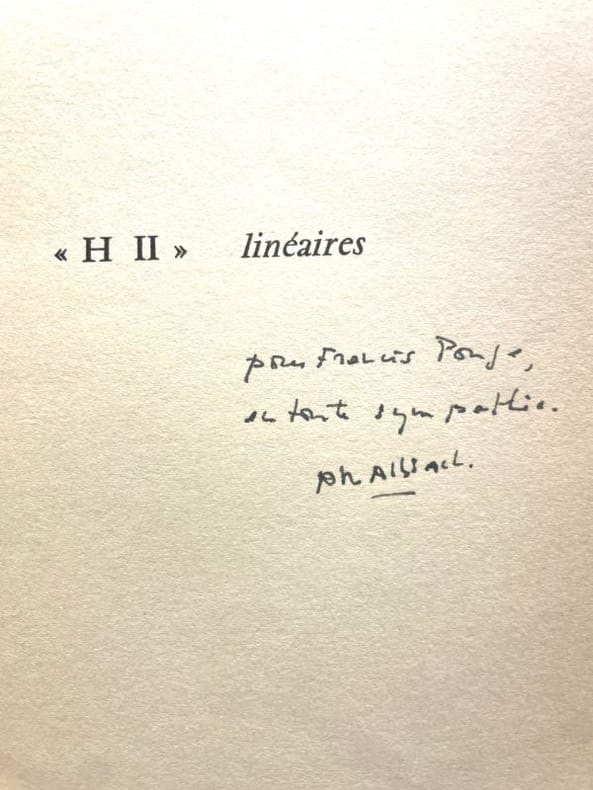
1974122955Paris Le Collet de Buffle 1974 1 vol. broché plaquette in-8, agrafée, 32 pp. Edition originale enrichie d'un envoi de l'autrice à Francis Ponge. En parfait état.
200423821PLON 2004 Paris, Plon, broché in-8 oblong, 2004, couverture illustrée, 152 pages, avec envoi et dessin à l'encre signé, 14 x 21 cm..
6 beschriebene SS. auf 8 Bll. 8vo. Fadenheftung. Titel in rotem und grünem Farbstift, Vortitel und Gedichte in Bleistift. Manuskript der Nummer XVIII von Haringers Zeitschrift "Die Einsiedelei. Ein Stundenblatt". Am Titel ein großes Kreuz in Dunkelgrün, darüber sein Name in Rot und darunter der seiner Freundin Hilda Reyer in Hellgrün. Der Vortitel lautet "Die Einsiedelei / Nr XVIII / wurde als Manuskript in zehn Exemplaren für die Freunde des Dichters geschrieben / Haringer: Hilda", danach folgen die Gedichte "Winter", "Zu Dir", "Erster Schnee" und "Märchen". - Die Gedichte und der Titel nehmen Bezug auf den Tod von Haringers Freundin Hilda Reyer, die 1927 im Alter von 21 Jahren an Tuberkulose verstorben war. Mit ihrem Tod ging auch Haringers letzte Möglichkeit dahin, sich in ein bürgerlich-seßhaftes Leben einzufinden. - Das Manuskript ging vermutlich an "Dr. G. W. Zanker" in Wien, dessen Adresse am letzten Blatt als Durchdruck zu lesen ist. - Beiliegend zwei gedr. Verlagsanzeigen, davon eine mit kleiner eh. Korrektur.
1½ SS. 8vo. "Süsses Knäblein ging in's freie | Voll der reinen Frühlingsfreude, | Staunend über's ewig neue | Aufersteh'n im Blumenkleide [...]". - Die in Neu-Sandec (Galizien) geborene Schriftstellerin, die auch unter den Pseudonymen Paul Andow und A. v. Sandec schrieb, lebte seit 1865 in Brünn und Graz und ließ sich 1890 in Wien nieder. Sie verfaßte zahlreiche Beiträge für österreichische und ausländische Zeitungen und Zeitschriften und veröffentlichte Lyrik und Prosa (u. a. "Holdings Herz. Die Geschichte einer Familie", 1894). Vgl. Kosch VII, 205f. - Mit einem kleinen Randeinriß.
Folio (200 x 312 mm). French manuscript on paper. 8½ pp. on 6 ff. Sewn. Together with a lithographed text in Chinese on rice paper. Folio (168 x 314 mm). 6 pp. on 7 ff. Sewn. Entitled "History of the life of the great Genie of Bac Ninh ong Thanh Dong, commonly known as Thánh Gióng, or in characters as Dông Thiên Vuong", the manuscript describes eight episodes from the Thánh Gióng legend in idiosyncratic French. The first and longest part is a rendering of the core story of the hero's victory over an invading Chinese army as a three-year-old child: "Le Roi de Hung Vuong envoyait ses ambassadeurs d’aller à la recherche à celui qui pourra se rendre maître à ces guerriers belliqueux. Les ambassadeurs du Roi étaient alors arrivés à Phu Dong. Le Dông Thiên Vuong était âgé de 3 ans, étendu sur un lit en bambous disait aux ambassadeurs quand on m’aura procuré d’un cheval de fer et un sabre je me rendrai maître aux guerriers belliqueux" ("The King of Hung Vuong sent his ambassadors to go in search of the one who will be able to make himself master to these warlike warriors. The King's ambassadors arrived at Phu Dong. The Dông Thiên Vuong was 3 years old, lying on a bed of bamboo said to the ambassadors when one will have provided me with an iron horse and a saber I will make myself master to the warlike warriors", transl.). The following seven episodes have a more concrete temporal setting tied to the succeeding Vietnamese dynasties, ranging from the 1st and 2nd Lê dynasties (between 980 and 1788) to the Nguyen dynasty (1802-1945). These are all accounts of miracles performed by the now divine Thánh Gióng against invading armies and other enemies of the Vietnamese kings. In a note on the final page, the French copyist ascribes the original text to an author named Nguyen Hui Thiên from the district ("huyen") of "Tiên Do", probably Tiên Du in the northern Bac Ninh province. - Lower right margin of the final 3 leaves torn without loss to text; upper right corner creased.
11649Cète, 18 mars 1794, 1 petite déchirure dans la marge du haut Lettre autographe, signée, 1 feuillet de 22 x 32 cm, belle en-tête imprimée: "mort aux tyans, paix aux peuples", ornement allégorique, cachet de cire rouge: "général de la 9e division de Cette" ;
10 ff. of ms., with an additional f. of notes. 11 ff. altogether, written in ink on one side only, narrow folio format (c. 35 x 17 cm). Complete manuscript of the famous "Hoplopoiia" section of Kazantzakis's Iliad translation: a pivotal part of the 18th book (rhapsody sigma) of Homer's epic. Kazantzakis and the scholar J. T. Kakridis collaborated on this metrical translation from classical Greek into the modern demotic language over a 14-year period. When it was privately printed in 1955, the controversial effort was hailed as "'living' poetry, through which the modern Greeks will be able to grasp much of the vigour, the passion, and the values of the heroic world of the Iliad" (C. A. Trypanis, The Classical Review 8 [1958], p. 280). The "Hoplopoiia", or the "Making of Armor for Achilles", is one of the most famous parts of Homer's poem: After the death of Patroclus has convinced Achilles to re-enter battle and avenge his friend, his mother Thetis seeks out the smithing god Hephaistus, who fashions a new set of armour for him, among which is a magnificently wrought shield. The detailed description (ekphrasis) of this shield, which takes up most of the present ms., is regarded as one of the paramount passages in Western literature: starting from the center and moving outward, the shield shows first the heavenly bodies (Earth, sky and sea, the sun, the moon and the constellations), then a city at peace (a wedding; a lawsuit; council) and at war (opposing armies; the gods; an ambush); country life (ploughing and reaping; vintage; a herd of cattle attacked by lions; a sheep farm); dancing youths and maidens; and finally, the all-enclosing ocean stream. In essence, the shield offers a physical encapsulation of the entire world: the various layers of this microcosm present a series of contrasts, antitheses that show the basic forms of a civilized, essentially orderly life. Leading up to Achilles's return to battle and one of the bloodiest parts of the Iliad, the Shield Ekphrasis also provides a moment of calm before the storm. - Traces of horizontal folds. Numerous revisions, corrections, and insertions in ink and pencil; caption "Iliada 18 (S. 368-618)" broadly underlined in red crayon. In the final page of notes (written on the reverse of a leaf on which the beginning of the translation has been struck out), Kazantzakis states that this version is not to be considered final and will require revisions as to orthography and accentuation. While the present ms. was probably composed and revised over a period of several years (the variations in pen type and ductus pointing to at least three main stages), the statement that work had been ongoing for three years suggests a time frame around the year 1944. Includes Certificate of Authenticity, issued by Spanos Rare Books, Athens.
1 S. Qu.-4to. Gewidmet der Schauspielerin Amalie Haizinger und deren Tochter Louise Neumann: "O Mutter, du auf des Ruhmes Gipfel | O Tochter du mit des Lorbeers Wipfel; | O theilt auf diese beiden Zipfel | von diesem meinem Huldigungs-Kipfel!". - Etwas knittrig.
29½ SS. auf 16 num. Bll. Kl.-4to. Manuskript von Kriegs- und sonstigen Erinnerungen an einen Claas, den er zu Beginn der 1860er Jahre aus den Augen verloren hatte: "Im nächsten Jahre 1861 schrieb er, er wolle mit Familie nach Amerika auswandern und verabschiedete sich. Wir haben noch zweimal Briefe gewechselt; dann blieben seine Briefe aus. Eine Anfrage bei seinen Eltern und dem Prediger hatten [!] kein Resultat; die Eltern waren nach Amerika, der Prediger verstorben - ich erfuhr Nichts mehr von ihm. Vielleicht lebt er noch und kommt dies Blatt zufällig in seine Hände, so soll es ihm sage, daß ich seiner mit Dankbarkeit und Freundschaft gedenke denn / Ich hatt einen Kameraden, / Einen besseren findst Du nit". - Mit zahlreichen (wohl redaktionellen) Korrekturen in Bleistift; etwas angestaubt und fleckig und mit teils stärkeren Randläsuren.
2 SS. 4to. Wohl für den Verleger seines erstmals 1793 in Hannover erschienenen Buches "Lieder für Volksschulen" bestimmt, das bis 1823 vier weitere Auflagen erlebte. Interessante und umfangreiche Beschreibung einer ihm vorschwebenden Kupfertafel vor dem Liederbuch, aus der Hoppenstedts Persönlichkeit und sein pädagogisches Weltbild erkennbar werden. "Ein Schullehrer, in einfacher Tracht [...] sitzt unter einem Baum, mit einer Flöte, einigen Noten u. dergl. in der Hand. Ein Haufen Knaben, groß u. klein, sitzt zu seiner Linken, - ein gleicher Haufe Mädchen zu s. Rechten; u. diese alle sieht man frö[h]lich und in ungekünstelten Stellungen singen. Andre Kinder stehn schön gruppi[e]rt aufhorchend umher, - doch so, daß jedes Geschlecht für sich bleibt. Alle arbeiten, auch die Singenden. Theils stricken, theils nähen sie, - u. auch die Knaben stricken [...]". - Nach zahlreichen weiteren Details merkt Hoppenstedt an: "Ich darf wohl nicht hinzufügen, daß ich sehr natürlich mich gern bescheide, Manches auf einer einzigen Platte Unausführbare gesagt zu haben. Indeß wollte ich hiedurch auch nur meinen Wunsch zu erkennen geben [...]". - Die 5 Auflagen, die bis 1823 erschienen, enthielten, so weit wir feststellen konnten, keine solche Kupfertafel. Über Hoppenstedts sonstige Lehr- und Kinderbücher vgl. Goedeke VII 325, 25. - Sehr selten.
186686602lundi soir [1866 ?] | 13.30 x 20.90 cm | une page sur un bifeuillet
196788340L'Herne | Paris 27 Février 1967 | 21 x 27 cm | une feuille