66 616 résultats
189676336Valvins 25 novembre 1896 | 11.40 x 8.80 cm | une carte recto-verso et une enveloppe
GF23621Manuscrit autographe signé d'une curieuse scène dialoguée entre la France et un neutre - "La France: 'L'Allemagne, en me provoquant, a fait de la force l'arbitre du droit. Avec mes alliés fidèles, je serai la plus forte"....-
197173367Malibu 1971. Fine. Malibu s. d. 10.50 x 15 cm une carte postale Autograph postcard signed by Lawrence Durrell addressed to Jani Brun written in black felt-tip pen on the verso of a photograph of a Malibu beach. ""Buttons hola ! L'amérique est plein de fric de frustrées et d'ennui. Pourtant on est très bien traités et je joue un peu le rôle de Scott Fitzgerald à Malibu."" ""Buttons hello! America is full of money frustrated women and boredom. Yet we are very well treated and I play a bit the role of Scott Fitzgerald in Malibu."". After many years spent in Greece Egypt and Rhodes the travel writer Lawrence Durrell was forced to flee Cyprus following popular uprisings that led the island to its independence from the British crown. Rich only with a shirt and a typewriter but crowned with the success of his novel Bitter Lemons of Cyprus Les citrons acides he arrived in France in 1956 and settled in the Languedocian village of Sommières. In the ""maison Tartès"" his large house surrounded by trees he wrote the second part of his work his monumental Avignon Quintet devoted himself to painting and received his illustrious friends including the couple Henry Miller and Anaïs Nin violinist Yehudi Menuhin London publisher Alan G. Thomas and his two daughters Penelope and Sappho. Among the olive trees and under the Mediterranean sun he met in the mid-1960s the young and vivacious ""Jany"" Janine Brun a woman from Montpellier in her thirties with devastating beauty who worked at the Department of Antiquities at the Sorbonne in Paris. She was nicknamed ""Buttons"" in memory of their first meeting where the young woman wore a dress covered with buttons. Henry Miller also fell under the charm of ""Buttons"" praising her beauty and eternal youth in exceptional unpublished letters. The three companions spent memorable Parisian evenings of which we keep precious autograph traces through their epistolary exchanges. Recommended by Durrell she made numerous trips notably to England from where she received extensive correspondence from the writer as well as original works of art signed with his artist pseudonym Oscar Epfs. unknown
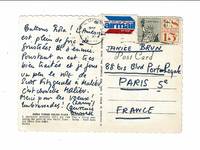
197173367Malibu s. d. | 10.50 x 15 cm | une carte postale
190883324s. l.: S. n. 1908. Fine. S. n. s. l. 14 juin 1908 22.50 x 18 cm une page Autograph letter signed by the dandy count 52 lines written in black ink on tracing paper addressed probably to his friend and bibliographer the critic Henri Lapauze. ""Neuilly Mon cher ami je crains de vous avoir mal dit en hâte et en proie à de cruels mouvements ce que je ressentais fort bien et que par suite je devais exprimer mieux. L'épithète de ""métallique"" appliquée à votre voix sans insister sur la richesse du timbre et la noblesse de la vibration m'apparaît bien loin de ce que me dictaient mon sentiment et ma pensée. Je ne voulais que lui faire figurer l'accent mâle en regard du contralto qu'il me plaisait de lui juxtaposer en plus. Ce que je voulais sous-entendre aussi dans cette supposition d'une résultante en ce carnet du chant alterné de nos causeries c'est l'hommage qu'il nous est toujours agréable de voir rendre aux dignes objets de notre attachement et que j'aimais vous offrir sous la forme du mien désormais double sans cesser d'être un. Robert de M. P.S. : voilà ce que je tenais à vous dire et que des graves préoccupations autour de la santé de mon pauvre Iturri m'ont fait écourter un peu. Je m'occupe mot illisible et vous avertirai vous renseignerai. 14 juin"" ""My dear friend I fear I told you badly hastily and prey to cruel emotions what I felt quite well and which consequently I should have expressed better. The epithet 'metallic' applied to your voice without insisting on the richness of the timbre and the nobility of the vibration appears to me very far from what my feeling and my thought dictated to me. I only wanted it to represent the masculine accent in comparison with the contralto that I was pleased to juxtapose to it in addition. What I also wanted to imply in this supposition of a resultant in this notebook of the alternating song of our conversations is the homage that it is always pleasant for us to see rendered to the worthy objects of our attachment and that I liked to offer you in the form of mine henceforth double without ceasing to be one. Robert de M. P.S.: that is what I wanted to tell you and which serious concerns around the health of my poor Iturri made me cut short a little. I am taking care illegible word and will warn you inform you. June 14"" Traces of folds inherent to postal use. S. n. unknown
190883324S. n. | s. l. 14 juin (1908) | 22.50 x 18 cm | une page
19578458723 janvier 1957 | 16.20 x 23.50 cm | 2 pages sur un feuillet - enveloppe jointe
195483254Paris 21 mai 1954 | 21 x 27 cm | une feuille
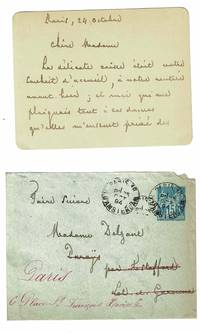
189476348Paris 1894. Fine. Paris 24 octobre 1894 11.40 x 8.80 cm une carte recto-verso et une enveloppe Autograph letter signed by Stéphane Mallarmé addressed to Gabrielle Delzant wife of his friend Alidor written on both sides in black ink. Envelope included. Alidor Delzant was a lawyer collector and bibliophile. A friend of the Goncourts he devoted a work to them and was Edmond's secretary and testamentary legatee. ""La délicate caisse était votre souhait d'accueil à notre rentrée avant-hier ; et moi qui me plaignais tant à ces dames qu'elles m'eussent privé des toutes dernières feuilles mortes voici qu'à un point de vue poétique différent ces pruneaux les remplacèrent aussitôt."" ""The delicate box was your welcoming wish upon our return the day before yesterday; and I who complained so much to these ladies that they had deprived me of the very last dead leaves here from a different poetic point of view these prunes replaced them at once."" unknown
189476348Paris 24 octobre 1894 | 11.40 x 8.80 cm | une carte recto-verso et une enveloppe
4to. 1 page. This wonderful poem was composed in memory of the young deceased French novelist and poet Raymond Radiguet, whose mentor Cocteau was.
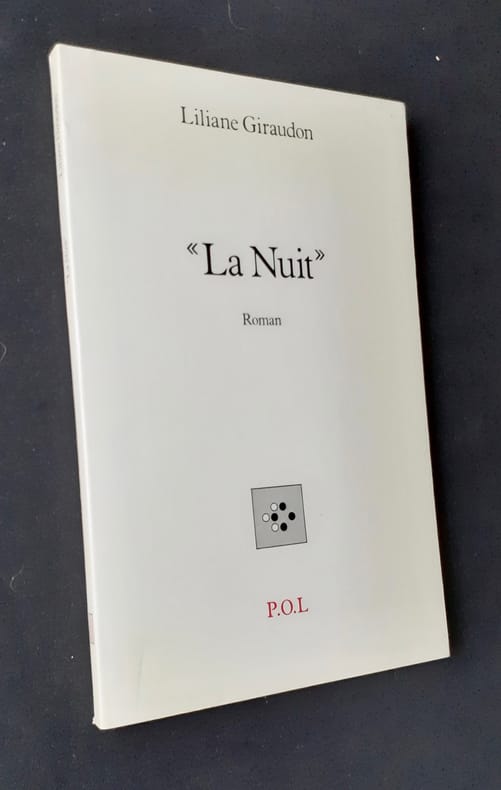
41999Paris : P.O.L., 1986 - un volume broché (12x18,5 cm), 75 pages - Edition originale (sans grand papier annoncé) avec un envoi autographe signé de Liliane Giraudon à l'écrivain Yves Laplace - bon état -
960575J.P. Bordaz Et Cardinaux Paris 1997 Plaquette in-8 ( 210 X 130 mm ) agrafée. Bel exemplaire enrichi d'une carte de visite avec petit mot signée de Jean-Pierre BORDAZ à l'ancienne conservatrice de Musée d'Art Moderne de Marseille.
4to. 4½ pages on 5 ff. In pencil. Charming reflections, in French, on the essence of poetry: "La poësie si j'osais la définir serait l'élégance même. est donc normal qu'elle joue de la plus petite chose à la plus grande - mais grande ou petite la chose devient souvient invisible lorsque la poësie l'habite [...] faut croire que ce monde pris naissance dans un certain désordre qui devint notre ordre et en quelques sorte notre style personnel [...] J'ai remarqué que je prenais le style du personnage que je joue, dans la vie, non pas que je me pousse dans ce sens pour me donner le réalisme qui est à la base de toute poësie. C'est celui qui me permettrait de montrer au jour tous les défauts que j'ai essayé de tirer de moi. J'aimerais presque toujours jouer des rôles qui ne sont pas pour moi... Les êtres anti-poëtiques sont les êtres qui veulent écrire le langage poëtique. Le cinéma permet de dépasser les frontières humaines, comme le prouve 'orphée' parce qu'il nous montre de qui l'écriture ou l'imagination nous offre de nous [...] La poësie est une haute élégance morale. Oui la poësie est lente et nous jugeons parfois trop vite. La lumière des poëtes est aussi longue à vous arriver que celle des étoiles [...] notre époque ou la poësie se cache de plus en plus et se montre sans cesse là où on ne croyait pas l'attendre. Le comble de la poësie c'est de n'avoir pas 'l'air poëtique'. L'artisanat est la poësie même. J'aime rendre réalisable l'irréalisable. Ce qui me donne le plus de courage mais hélas on ne fait pas ce qu'on veut. La définition de moi-même: le travail et le désir de plaire aux quelques personnes qui comptent à mes yeux" (transl.: "Poetry, if I dared to define it, would be elegance itself. It is therefore normal that it plays from the smallest to the largest thing - but large or small the thing becomes invisible memory when poetry inhabits it [...] I have noticed that I take the style of the character I play in life, not that I push myself in that direction to give myself the realism that is the basis of all poetry. It's the one that would allow me to show in the daylight all the flaws I tried to draw from myself. I would almost always like to play roles that are not for me [...] Anti-poetic beings are those who want to write the language of poetry. Cinema makes it possible to transcend human limits, as 'Orpheus' attests, showing us what writing and imagination have to offer us. [...] Poetry is a high moral elegance. Yes, poetry is slow and we sometimes judge too quickly. The light of the poets is as long to come to you as the light of the stars [...] our age in which poetry is increasingly hidden and is constantly showing itself where we thought it was not expected. The height of poetry is not to 'look poetic'. Craftsmanship is poetry itself. I like to make the unattainable realizable. That gives me the most courage, but alas, we do not do what we want. The definition of myself: work and the desire to please the few people that matter to me").
4to. 1 page. The present poem is a tribute to Mallarmé, and shows some some deviations in comparison to the published text in "Poèmes épars (1945-1963)", including the full title "La Pénultième est morte/Tombeau de Mallarmé".
Titel, 2 SS. auf gefalt. Bogen. Qu.-Folio. Vorhanden ist nur noch der äußere Bogen einer ursprünglich umfangreicheren Sammlung, betitelt: "Sammlung italienischer Volkslieder, mit treuer Beibehaltung der Originalweisen bearbeitet und ergänzt von J. P. Lyser". Das Gegenblatt enthält das letzte Stück daraus, "Die Samariterin" (Lied für Singstimme und Klavierbegleitung, Text in deutscher und italienischer Sprache unterlegt; zwei weitere deutsche Verse hinzugesetzt. - Kl. Randläsuren. Lyser stammte aus einer Schauspielerfamilie und führte ein Wanderleben als Buchdrucker, Dekorationsmaler, Zeichenlehrer und als Musikkritiker bei der von Robert Schumann herausgegebenen "Neuen Zeitschrift für Musik". Das Musizieren musste er von seinem 18. Lebensjahr an wegen Taubheit aufgeben. Er geriet in Schulden und wurde von Felix Mendelssohn Bartholdy aus der Schuldhaft befreit. Er war mit Heinrich Heine befreundet, der sich für ihn einsetzte; Clara Schumann vertonte seine "Lieder eines wandernden Malers". Er illustrierte u. a. "Des Knaben Wunderhorn" und schuf eines der bekanntesten Beethoven-Portraits.
Oblong 8vo. 1 p. "La Viola" ("Odorosa foriera d'aprile [...]"), comprising eight stanzas with four lines each, and three stanzas entitled "Alla Signorina Teresa Martini", from whose album the present sheet was removed: "Alla giovane musa un fior dimanda [...]". Maffei's poem was set to music by Anton Rubinstein under the title "La prima viola" (op. 83/7). - Slightly spotty and waterstained; left edge trimmed closely.
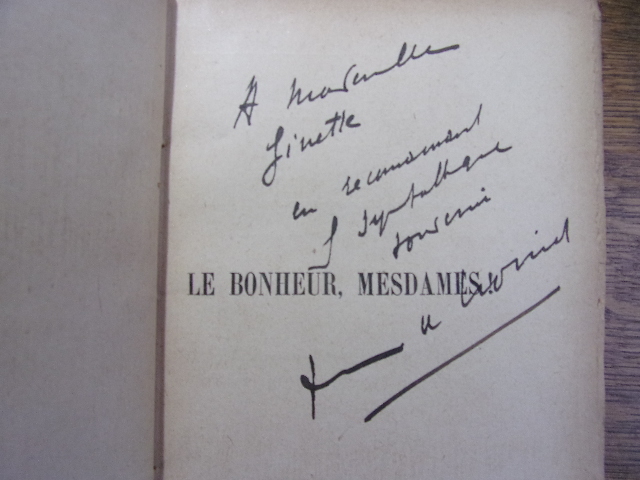
CZC-6504Bel envoi de l'auteur pour cette œuvre qui fut représentée sous forme d'opérette pour la première fois en 1905. "A Mademoiselle Ginette en re[...] sympathique souvenir. De Croisset". Vol in8, 180x140 demi-reliure de l'époque, dos lisse, tranche de tête dorée, bords et coins frottés d'usage. Bel état intérieur. 265 pp. A Paris, chez Charpentier, 1906 ref/143
5p In-4 (150 lignes environ) et 5p In-4. "A monsieur le Duc d'En-face": Très bel article de 5 pages manuscrites, avec corrections auquel on joint les épreuves, 5 pages avec de très nombreuses corrections. Dans cet article, il semble qu'il s'adresse au (3e) duc de Blacas (En-face rimant avec Blacas est peut-être aussi une manière de le nommer), Guy-Pierre de Blacas d'Aulps. C'est le seul personnage qui peut correspondre à ces lignes. Clémenceau s'adresse à ce député qui eut "le comte de Chambord, Mac Mahon, le duc de Broglie, Batbie, la duchesse d'Uzès et ses millions, Boulanger et sa revue, Briand, consul à pied, Poincaré votre dernière union". - Très bel article, d'un ton légèrement moqueur sur les attitudes, paroles et amitiés du duc d'En-face. Il avait prévu que le duc, qui avait soutenu Poincaré, le critiquerait et lui avait dit "Qui sait? Je le défendrai peut-être, un jour, contre vous". - Exceptionnel document. Une page manuscrite coupée anciennement en 2 entre des paragraphes. Nombreuses phrases modifiées dans les epreuves.
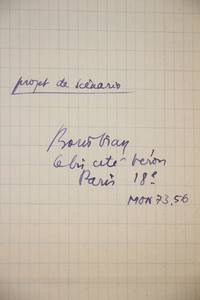
195376370Paris 1953. Fine. Paris 23 octobre 1953 21 x 27 cm 14 pages tapuscrites sous chemise 1 enveloppe Complete typescript of a draft film script entitled Le Cow-boy de Normandie. Fourteen typed pages bound in a squared paper cover inscribed in Boris Vians hand: Projet de scénario Boris Vian 6 bis Cité Véron Paris 18e. Accompanied by the original envelope from the S.A.C.D. This script was later reproduced in the collection Rue des ravissantes and adapted as a short film by Clémence Madeleine-Perdrillat in 2015. This parody of a western tells the story of Jim Lacy a disillusioned cowboy who leaves Nevada in search of a more genuine land: Fleurville in Normandy. Provenance: Fondation Vian. unknown
195376370Paris 23 octobre 1953 | 21 x 27 cm | 14 pages tapuscrites sous chemise + 1 enveloppe
- Paris 23 octobre 1953, 21x27cm, 14 pages tapuscrites sous chemise + 1 enveloppe. - Tapuscrit complet d'un projet de scénario de film intitulé «?Le Cow-boy de Normandie?». Quatorze pages tapuscrites sous une couverture de papier quadrillé sur laquelle est inscrite, de la main de Boris Vian?: «?Projet de scénario - Boris Vian 6 bis Cité Véron Paris 18e?». On joint l'enveloppe de la S.A.C.D. Ce scénario a été retranscrit dans le recueil Rue des ravissantes et réalisé sous la forme d'un court métrage par Clémence Madeleine-Perdrillat en 2015. Cette parodie de western narre l'histoire de Jim Lacy, un cowboy désabusé quittant son Nevada pour une terre plus authentique?: Fleurville en Normandie. Provenance : Fondation Vian. [ENGLISH DESCRIPTION ON DEMAND]
Small 4to. 4 pp. on bifolium. This beautiful manuscript corresponds with pages 17 (3rd paragraph) to 24 (1st line) of the 1777 publication of Mirabeau's defence of instrumental music, "Le lecteur y mettra le titre". Published anonymously and giving London as a fictitious place of printing, Mirabeau was previously identified as the author of the text based on two letters. The manuscript in Mirabeau's hand confirms his authorship beyond any doubt. - The text was written in Amsterdam, just before Mirabeau's arrest and four-year imprisonment in Vincennes, under the impression of a performance of Ignazio Raimondi's symphony "Les aventures de Télémaque dans l'isle de Calypso". The manuscript contains several revisions and changes that were adopted for the publication, while small discrepancies remain unaccounted for. It comprises Mirabeau's central questions, a general definition of music as "the art of combining sounds in a manner that is pleasing to the ear", and parts of his historical argument. - Mirabeau, who had no musical education, adopts the rhetorics of the paragone, opposing vocal music and instrumental music in order to determine which is superior in expressing emotions. While the development of the argument and Mirabeau's historical references are quite traditional, the defence of instrumental music and his assertion that it is more expressive in terms of conveying emotions, even if vocal music can offer a narrative based on texts, is unique in its time and appears to anticipate the Romantic predilection for programme music. The Neapolitan violonist and composer Ignazio Raimondi (ca. 1735-1813) was a student of Emanuele Barbella and member of the orchestra of the Teatro di San Carlo before moving to Amsterdam in 1762, where he was a successful soloist and impresario. From 1785, Raimondi was mostly active in London, where he died in 1813. - Some browning and some damage due to ink corrosion, several tears partly affecting the text (one professionally restored). Le lecteur y mettra le titre, Londres [i.e., Paris, s.n.], 1777. Cf. Bellinda Cannone, Le lecteur y mettra le titre. Un pamphlet de Mirabeau en faveur de la musique instrumentale, in: Dix-Huitième Siècle 20 (1988), pp. 403-414.
Large 4to. 1 p. "Est-ce dit | Le regard de torture | Le regard plus inquiet qu'un rat chez les bêtes | Inquier d'une femme cachée | Refusée | Qui ressemble à ce que je n'écris pas." - Éluard's poem was first published in "La vie immèdiate" in 1932. - Formerly framed and strongly browned.