66 616 résultats
Titel, 2 SS. Qu.-Folio. Der Text, von anderer Hand, 3½ SS. auf gefalt. Doppelblatt. 8vo. Notendruck: Lithogr. Titel (von Mendouze), 2 SS. gest. Noten und Text auf gefalt. Bogen (Paris, Aulagnier, o. J.). Folio. Noten für Singstimme und Klavierbegleitung ("Un paladin de riche armure laissait aller à l'aventure"), unterlegt mit dem Text der ersten Strophe. Der vollständige Text von Adolphe Michel auf separat beiliegendem Faltblatt (von der Hand des Dichters?). Der Notendruck wasserrandig und braunfleckig. - Frühe Liedkomposition des aus Moulins (Allier) gebürtigen Komponisten, der sich 1826 als Beamter in Paris niederließ; jahrelang schrieb er für die "Revue musicale". Zu seinen Werken zählen u. a. ein "Stabat mater" für vier Stimmen und Orchester, die lyrische Szene "La Grèce" für Chor und Orchester, eine Sinfonie, Streichquartette.
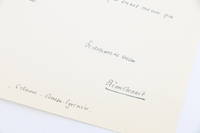
195075963s. l. Klarskovgaard 1950. Fine. s. l. Klarskovgaard 12 octobre 1950 21 x 34 cm 2 pages sur un feuillet Partly unpublished autograph letter signed by Louis-Ferdinand Céline ""ami tenace et obligé"" addressed to his lawyer Maître Thorvald Mikkelsen. Two pages written in blue ink on a large sheet of white paper; number ""579"" in Céline's hand in red pencil at top left. Transverse folds inherent to posting. This letter was very partially transcribed in the Année Céline 2005. Very enigmatic letter: ""Aladin avait déjà une très jolie lampe - avec celle là vous allez voir un peu les trésors que je vais découvrir. Vous avez raison du reste - Carpe Diem ! Mais vous savez la moitié au moins du destin : c'est le PASSEPORT. Le passeport français est moche et moch. mais il vaut mieux que rien."" ""Aladdin already had a very pretty lamp - with this one you're going to see the treasures I'm going to discover. You're right besides - Carpe Diem! But you know at least half of destiny: it's the PASSPORT. The French passport is ugly and ugly. but it's better than nothing."" Note in passing the play on words with the name of Jules Moch vice-president of the council from 1949 to 1950. He informs Mikkelsen: ""J'ai aussi merde ! un cadeau à vous offrir et que vous accepterez nom de dieu ! parce que c'est un livre en Suédois ! donc scandinave ! donc divin ! donc touchable acceptable recevable non puant."" ""I also have damn! a gift to offer you and which you will accept by God! because it's a book in Swedish! therefore Scandinavian! therefore divine! therefore touchable acceptable receivable non-stinking."" In 1947 Céline pursued by French justice for his collaborationist involvement is confined in Denmark. It is in May 1948 accompanied by Lucette and Bébert that he arrives at his lawyer Maître Thorvald Mikkelsen's home in Klarskovgaard. The latter owns a large property by the Baltic Sea and invites the exile to stay there. On February 21 1950 as part of the purification process the writer is definitively sentenced in absentia by the civic chamber of the Paris Court of Justice for collaboration to one year's imprisonment which he had already served in Denmark. The Swedish consul general in Paris Raoul Nordling intervenes on his behalf with Gustav Rasmussen Danish Minister of Foreign Affairs and manages to delay his extradition. On April 20 1951 Jean-Louis Tixier-Vignancour his lawyer since 1948 obtains Céline's amnesty as a ""severely disabled veteran of the Great War"" by presenting his file under the name Louis-Ferdinand Destouches without any magistrate making the connection. Céline would leave Denmark the following summer after three years spent at his lawyer's home. unknown
195075963s. l. [Klarskovgaard] 12 octobre 1950 | 21 x 34 cm | 2 pages sur un feuillet
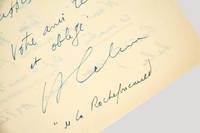
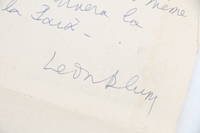
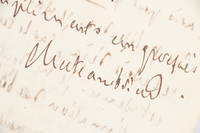
1948873581948. Fine. « A Londres pour la première fois des possibilités d'accord sont apparues pour les problèmes allemands même sur les Réparations. » In London for the first time possibilities for agreement have appeared on German problems even on Reparations. s. d. 1948 21 x 27 cm quatre feuillets Signed autograph manuscript entitled ""A Compiègne et au Palais Bourbon"" by Léon Blum 3 and a half pages in blue ink on the verso of four sheets with letterhead from the newspaper Le Populaire Central Organ of the Socialist Party S.F.I.O. Numerous passages crossed out and rewritten in black ink. Horizontal fold mark on each sheet notes from a previous bibliographer in pencil at the head of the first sheet. The article appeared in the daily newspaper Le Populaire on March 9 1948. Fine and virulent diatribe by Léon Blum following General De Gaulle's Compiègne speech denouncing his maneuvers toward a ""strong State."" He paints a hopeful picture of German reconciliation European construction as well as the Marshall Plan soon to be ratified - of which he had been the great negotiator. On March 7 1948 the general who had just founded the Rally of the French People was invited by the new mayor Jean Legendre who had rallied to the RPF. At a pivotal moment of international tensions before several tens of thousands of people gathered at the château square De Gaulle called on the French to unite to refound the Fourth Republic and free countries to unite against communism following the ""Prague coup."" Remaining excluded from power he then began his crossing of the desert until his return in 1958 thanks to the Algerian crisis which brought down the weak Fourth Republic. Having established the foundations of this same Republic Blum disapproves in these pages of De Gaulle's challenge to parliamentary institutions - even as his own Gaullists deputies obstruct debates in the assembly. He opposes the general's catastrophist discourse with an optimistic vision of European and international reconstruction convinced of the great resilience of the French nation and confident in its institutions. « Chose curieuse c'est la presse gaulliste qui attendait le discours de Compiègne avec la curiosité et l'impatience la plus marquées. . En fin de compte le discours de Compiègne n'a apporté rien de neuf. Il a fait entendre que toutes ses mesures étaient arrêtées et que sans doute aussi ses hommes étaient choisis. Il a déclaré que la situation était trop critique en France en Europe et dans le monde pour permettre qu'on différât davantage. Mais il a persisté cependant à affirmer - c'est du moins ainsi que j'interprète un texte volontairement obscur biffé : ambigu - qu'il ne gouvernerait pas dans le cadre des institutions présentes biffé : anciennes et qu'il n'accepterait qu'un pouvoir taillé à sa mesure . Rien de bon ne peut en sortir a-t-il conclu ; il n'est que temps de tirer la France de ce marécage pour l'installer sur le sol ferme et salubre de l'Etat fort. Tout cela va fort bien. Seulement à l'heure même où le général prononçait contre les partis et les institutions parlementaires le réquisitoire altier l'Assemblée nationale siégeait au Palais Bourbon. Elle promouvait l'examen des propositions relatives au prélèvement René Mayer. Et là on voyait la coalition du parti gaulliste avec ces mêmes « séparatistes » que le discours de Compiègne dénonçait comme des traîtres s'étaler avec une impudence plus scandaleuse de jamais . Dénoncer l'impuissance parlementaire tout en l'organisant stigmatiser la malfaisance et l'immoralité des partis tout en en fournissant l'exemple éhonté c'est une attitude commode mais qui brave par trop violemment le bon sens et l'honnêteté. . Certes la situation intérieure est sérieuse et la situation internationale ne l'est pas moins. Mais le redoutable hiver s'achève le ravitaillement s'améliore. La tendance s'améliore vers la baisse des produits alimentaires s'accentue et s'acce unknown
194887358s. d. [1948] | 21 x 27 cm | quatre feuillets
11 SS. auf 6 Bll. Qu.-4to. Zeitgenössischer Pappband mit rautenförmigem Deckelschildchen aus Leder. Die Notation seiner "Elégie (pour voix de Tenor)" mit Klavier in 33 dreizeiligen Systemen mit unterlegtem Text auf Deutsch und Französisch. Meyerbeer schrieb sein Lied in Anlehnung an ein Gedicht des französischer Dichters Charles Hubert Millevoye (1782-1816). - Durchgehend etwas fleckig und gebräunt; unbeschnitten. Stellenweise Notationszeichen in braunem Farbstift von anderer Hand. Deckel und Kanten etwas berieben, die Kapitale angeplatzt; am Vorderdeckel ein rechteckiger Fleck von einem entfernten Schildchen, insgesamt jedoch sehr gut erhalten.
N01Editions Mornay, Paris, 1924 In-8 broché sous couverture illustrée rempliée, grand papier, toutes marges - Un des 8 exemplaires hors-commerce sur Japon impérial - Illustrations couleurs de OBERLE - Joints une lettre autographe (1 p. 1/2 in 8) de Octave UZANNE adressée à l'Auteur + 1 page in-4° manuscrite d'un roman inédit de Renée Dunan qui devait s'appeler "Le Prix des Ames Pures"
42 num (recte 43) Bll. 4to. Beiliegend eine ms. Übertragung ins Deutsche sowie zwei weitere Gedichtübertragungen bzw. entsprechende Ansätze und Notizen. Ms. und Ts. Zusammen 16 Bll. 4to. “Ou foule, coeur qui vit de l’irréelle Icone | comme les créations de l’homme Artiste-né | projection dans l’espace d’etres imaginaires | et parfois plus réels que la réalite, | comme tout oeuvre d’art fulguration intime | se révélant tout en restant inaccessible, | qui percevra jamais ce rayon de lumière? | il ne nous est connu que par ce qu’il éclaire | s’il ne rencontrait rien nous serions dans la nuit [...]”. - Das Ts. mit eigenh. Namsenzug J. Gunerts am Titel; tls. mit eh. Übertragungsversuchen bzw. Anmerkungen von J. Gunert.
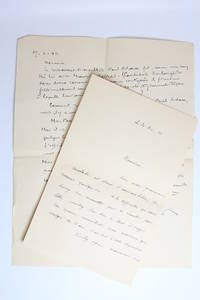
194273853s. l. 1942. Fine. s. l. 17 février 1942 21 x 27 cm 2 feuilles Autograph letter signed by Félix Fénéon to Gabriel Mourey 18 lines in black ink folds from mailing. A key witness and actor of his time the art critic and collector Félix Fénéon assists the writer Gabriel Mourey in his search for the correspondence between Paul Adam and Maurice Barrès: ""Le romancier et occultiste Paul Adam fut comme vous savez très lié à Maurice Barrès. Candidats boulangistes dans deux circonscriptions lorraines contiguës il firent fraternellement une campagne électorale et journalistique à laquelle leur amitié ne survécut guère. Comment retrouver tous les papiers de Paul Adam mort il y a une vingtaine d'années Mme Paul Adam vit-elle encore. - je n'en sais rien. Mais il est probable que vive une de ses soeurs veuve depuis quelques trois ans de ce L. Cappiello auteur de tant d'affiches - peintre elle aussi et de plus fort sourde. Leur demeure était 8 rue Lechatelier XVIIe. Par Mme L. Cappiello vous retrouverez peut-être des papiers barrésiens laissés par Paul Adam. Pour le cas où vous chercheriez dans cette direction je note que que j'ai été en excellents termes avec toute la famille et que vous pouvez donc user de mon nom à votre gré."" A leading figure of the avant-garde Fénéon possessed a singular gift for discovering major artists. A deliberately discreet and eccentric dandy he devoted himself almost religiously to all that contributed to a new artistic sensibility. A staunch defender of the Neo-Impressionists Seurat and Signac and a friend of Mallarmé Camille Pissarro Paul Adam and Gustave Kahn Fénéon was successively an anarchist and a communist and directed a dozen small reviews. He published groundbreaking works such as Rimbauds Illuminations André Gides Paludes and James Joyces Dedalus. A prolific journalist he wrote for numerous publications often unsigned or under fanciful pseudonyms such as Gil de Bache Porphyre Kalouguine and even Thérèse or Louise. A rare letter from Félix Fénéon discussing his contemporaries. Also included is an autograph letter signed by Fanny Fénéon wife of Félix Fénéon dated 30 December 1941 written while her husband was ill and bedridden; 10 lines in black ink with folds from mailing. ""Mon mari gravement malade est dans l'impossibilité de recevoir quelqu'un. Si la difficulté que vous désirez lui remettre peut se résoudre par lettre veuillez lui dire ce dont il s'agit. Une réponse immédiate vous montrera que malgré ses 80 ans il est tout à votre disposition. ."" unknown
194273853s. l. 17 février 1942 | 21 x 27 cm | 2 feuilles
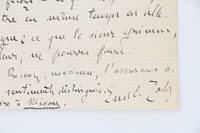
188379106Bénodet 1883. Fine. Bénodet 10 septembre 1883 13.20 x 20.30 cm 2 pages sur un double feuillet Signed autograph letter by Emile Zola - apparently unpublished - addressed to an unknown correspondent written in black ink on a double sheet. Folds inherent to mailing. Interesting letter relating the translation of Emile Zola's works and the legal disputes inherent to their clandestine distribution. This missive is visibly addressed to a correspondent considered for the German translation of La Joie de vivre: ""I would ask you to give me the promptest possible response regarding the translation of La Joie de vivre; for I am already receiving proposals from Germany and I would like to know where I stand."" In this autumn of 1883 Zola - though vacationing in Brittany - is very occupied with managing the translation of his works which he handles directly with publishers. We see here the determination with which he conducts negotiations: ""I repeat that I will only accept a fixed sum paid in advance. It is simpler and without possible surprises."" But things are not simple and Zola whose works already enjoy great success must fight against the clandestine publication of his novels. Completely overlooked by biographers the disputes with Hungarian publisher Gustav Grimm are nonetheless a leitmotif of Zolian correspondence: ""Monsieur Grimm of Budapest is a simple thief who has my novels translated as they are published in French newspapers without any authorization. Already the Neue Freie Presse of Vienna has sued him in my name. But it appears we have no treaty with Hungary. I await the signing of a treaty which they say is imminent."" Indeed Grimm had already published without Zola's authorization German translations of two novels: Nana 1881 and Pot-Bouille Der häusliche Herd 1882. These illegal publications discouraged German publishers Curt Busch and George Kuhr who very interested in distributing the novel to German-speaking readers declared forfeit. Gustav Grimm who finally agreed to respect commercial treaties won the battle and published the very first German translation of La Joie de vivre in 1889 under the title Die Lebensfreude. The man whom Zola here calls a ""simple thief"" would finally obtain authorization to distribute the German translation of the entirety of the twenty volumes of the Rougon-Macquart between 1892 and 1899. Interesting letter revealing the editorial mechanisms of the Rougon-Macquart and testifying to the ardor with which Zola conducted negotiations inherent to the translation of his great hereditary fresco. unknown
188379106Bénodet 10 septembre 1883 | 13.20 x 20.30 cm | 2 pages sur un double feuillet
195285249Ciboure 1952. Fine. Ciboure 30 Janvier 1952 13.50 x 21 cm deux pages sur un double feuillet Autograph letter signed by Pierre Benoit sent from his priority in Ciboure 22 lines in blue ink. The letter is on Académie française letterhead. Central fold marks perforations from filing in a binder causing no losses. ""30 January 1952 My dear friend Here I am back. The need for a little peace to put correspondence in order makes me delay by a few days the pleasure of seeing you. I retain that of writing to you and of telling you - something a bit ridiculous on my part since the said issue contains an article by your servant - that I found the November-December issue of the Courrier de la Compagnie truly very successful. Deberly's successor has truly outdone himself. I feel as much pride as if I had something to do with it. . As I will certainly not be back for a week could you honor me here with a few words in response which would be more than welcome Sincerely yours. Pierre Benoit. Ciboure - Basses-Pyrénées."" unknown
195285249Ciboure 30 Janvier 1952 | 13.50 x 21 cm | deux pages sur un double feuillet
182787771Paris 1827. Fine. ""the time for planting has come"" Paris 14 mars 1827 16.20 x 19.30 cm trois pages et demi sur un bifeuillet ""the time for planting has come"" Autograph letter signed by François-René de Chateaubriand dated March 14 1827. 3 1/2 pages in black ink on a bifolium addressed to Michel-Augustin Varcollier. Chateaubriand writes to the husband of his goddaughter Atala Stamaty-Varcollier the first to bear the name of the heroine of his famous novel that propelled him onto the literary scene in 1801. Head of the Fine Arts Division of the Seine Prefecture Michel-Augustin Varcollier acted as Chateaubriand's intermediary in the development of the grounds of l'Infirmerie Marie-Thérèse his wife Céleste's grand project to house elderly priests and nobles widowed by the French Revolution. Here Monsieur is a bill from Madame de Chateaubriand to M. de Chabrol inviting him to attend Marie-Thérèse's council meeting which will take place next Wednesday the 21st at 2 a.m."". M. de Chabrol was kind enough to suggest Friday of this week but it has been impossible to gather MM. the Counselors for that day. Kindly explain this to Monsieur de Chabrol. . I have obtained permission from the Prefect of Police to place palisades along the walls. Now I need permission from M. le Préfet de Paris to plant within these palisades. I'm going to pretend I've already got it because the time for planting has come. I have no doubt that Mr. Préfet will continue his gestures of kindness. There is still to complete the work on the trellis on my little boulevart sic to give two coats of paint to the barriers. I recommend myself to M. de Fresnes for the completion of this great work. I must thank him and you Monsieur for all the kindness you have shown me.""  unknown
Folio (ca. 267 x 407 mm). 1 p. (17 lines). Framed and glazed (457 x 599 mm). Spectacular manuscript written on paper with a gilt-stamped border and illustrated with a photograph pasted and captioned by Paul Éluard. The poem "Le temps d'un éclair" was published in Éluard's anthology "La Vie immédiate" (1932): "Elle n'est pas là. / La femme au tablier guette la pluie aux vitres / En spectacle tous les nuages jouent au plus fin / Une fillette de peu de poids / Passée au bleu / Joue sur un canapé crevé / Le silence a des remords [...]". - The small photograph (60 x 42 mm), pasted to the left of the first verse, shows the head and torso of a nude young woman. Éluard quotes his poem in the caption: "Une fillette de peu de poids / Passée au bleu" ("A young girl of little weight / Vanished into the blue"). The slight fading of the photograph even underscores its appropriateness as a congenial illustration of Éluard's poem: the allegory of a young girl's disappearance. - Traces of folds. With minor stains due to abrasions. Formerly in the collection of André Breton. P. Éluard, La Vie immédiate (Paris, Éditions des Cahiers libres, 1932).
182787771Paris 14 mars 1827 | 16.20 x 19.30 cm | trois pages et demi sur un bifeuillet
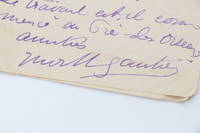
191080834Alger Algiers 1910. Fine. Alger Algiers s. d. ca 1910 10.50 x 16.50 cm 1 page sur un double feuillet Autograph letter signed by Judith Gautier addressed to Céleste Chrétien her housekeeper. One page written in violet ink on a double sheet. Transverse folds inherent to the mailing. ""I receive this letter from Mr Lemoine and I don't know what to reply to him not knowing your reasons. Tell me what I should do. Has the work begun at Pré aux Oiseaux"" unknown
191080834Alger s. d. [ca 1910] | 10.50 x 16.50 cm | 1 page sur un double feuillet
2 SS. auf Doppelblatt. Gr.-8vo. "An Fräulein Friederike v. Bertitsch": "Wie ich Dich liebe, soll mein Mund Dir klagen, | Bis mir im Tode bricht mein treues Herz; | Und selbst die bleiche Lippe wird Dir sagen: | Mein letzter Seufzer war ein Liebesschmerz [...]". - Josef Belohlawek-Morgan, ehedem Schüler von Gustave Ricard in Paris, war als Bildnismaler in Wien tätig und malte etwa "Charlotte Wolter als Adelheid in Götz von Berlichingen".
4to. French manuscript on paper. (2) pp. on 2 ff. Interesting early manuscript of chapter I/2 of his series of articles entitled "Les communistes et la paix" that was first published in Sartre's journal "Les Temps modernes" (July 1952 - April 1954) and later in its entirety and thoroughly revised as part of the collection Situations VI (1964). The original title of the chapter, "Moscou veut la guerre", sets the cynical tone of the text that was first conceived in reaction to the deadly suppression of the Paris protests against General Ridgway on 28 May 1952 and the subsequent wrongful arrest of the French communist leader Jacques Duclos. Sartre accuses Western, particularly U.S. politicians of hypocrisy as, in the name of peace, they employ the violent and belligerent means that theye ascribe to the Soviet Union, polemically asking, in a deleted section: "Do you not also pretend to desire peace? I look for your olive twigs and I see atomic bombs, I look for your doves and I see rocket planes. You say that you show your force so as not to have to make use of it. But to show force is already violence: let your tanks defile, cover the African sky with your bombers [...]". - With "Les communistes et la paix" Sartre publicly affirmed his support of the French Communist Party, despite its loyalty to Stalin, which would cause his rupture with Maurice Merleau-Ponty. In 1956, appalled by the Soviet invasion of Hungary, Sartre definitely broke with the party. Unsurprisingly, the corresponding pages in the 1964 publication Situations VI (96-97) are very different from the manuscript and the article. - Some browning and bent corners.
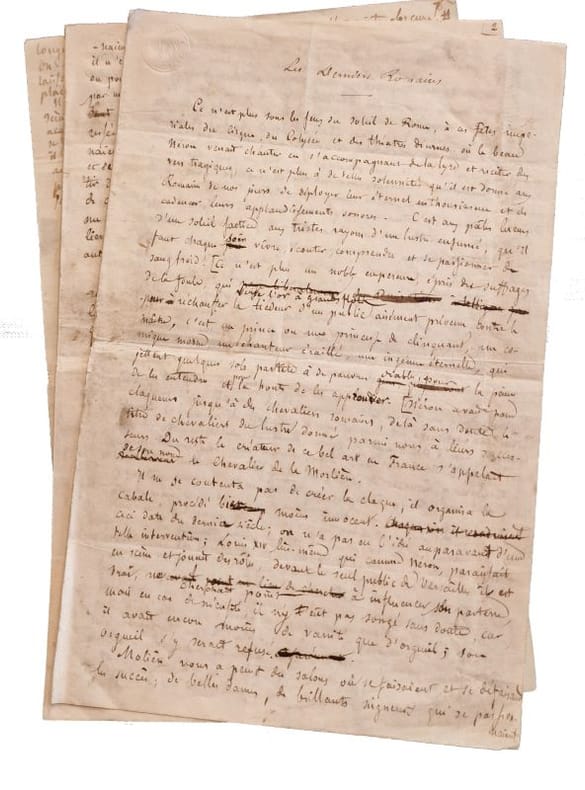
1844888601844 8 pages in-8 à l'encre brune (21 x 13,8 cm) sur 4 double feuillets, adresse autographe et marques postales au dos du dernier feuillet (avec petit manque de papier amputant la fin de deux mots), sous chemise demi-maroquin noir.Manuscrit complet, seul connu, de cette fantaisie sur les théâtres parisiens rédigée pour Le Diable à Paris. Nerval y esquisse une sorte de physiologie des claqueurs, ceux qu'on appelle "Romains" dans l'argot du théâtre : ces faux spectateurs recrutés pour ovationner ou bien huer les spectacles et dépeints notamment par Balzac dans ses Illusions perdues. Après un rappel des origines de cette tradition, Nerval constate sa généralisation dans le théâtre de son temps, et il s'amuse à détailler l'influence et la hiérarchie des claqueurs à partir de sa propre expérience de critique dramatique.Ce beau manuscrit de premier jet surchargé de corrections fut adressé à Pierre Jules Hetzel par courrier depuis Amsterdam le 23 septembre 1844 avec une amusante apostille signée "Gérard" in-fine et les cachets de la poste faisant foi. L'éditeur fit tirer un jeu d'épreuves conservé à la bibliothèque Spoelberch de Lovenjoul, mais le texte ne parut finalement pas dans Le Diable à Paris. Il est resté inédit jusqu'en 1948 où la "Revue d'histoire du théâtre" en publie une version fautive, avant d'être repris en Pléiade dans les Œuvres complètes (tome I, p. 848-854) avec cette note des éditeurs J. Guillaume et Cl. Pichois : "On ne sait pour quelle raison cet article fut exclu : par le pittoresque du sujet et la vivacité de l'expression, c'est un bel exemple de l'article de genre" (p. 1819).Les manuscrits littéraires de Nerval sont rares et très recherchés.
1844888601844 8 pages in-8 à l'encre brune (21 x 13,8 cm) sur 4 double feuillets, adresse autographe et marques postales au dos du dernier feuillet (avec petit manque de papier amputant la fin de deux mots), sous chemise demi-maroquin noir.Manuscrit complet, seul connu, de cette fantaisie sur les théâtres parisiens rédigée pour Le Diable à Paris. Nerval y esquisse une sorte de physiologie des claqueurs, ceux qu'on appelle "Romains" dans l'argot du théâtre : ces faux spectateurs recrutés pour ovationner ou bien huer les spectacles et dépeints notamment par Balzac dans ses Illusions perdues. Après un rappel des origines de cette tradition, Nerval constate sa généralisation dans le théâtre de son temps, et il s'amuse à détailler l'influence et la hiérarchie des claqueurs à partir de sa propre expérience de critique dramatique.Ce beau manuscrit de premier jet surchargé de corrections fut adressé à Pierre Jules Hetzel par courrier depuis Amsterdam le 23 septembre 1844 avec une amusante apostille signée "Gérard" in-fine et les cachets de la poste faisant foi. L'éditeur fit tirer un jeu d'épreuves conservé à la bibliothèque Spoelberch de Lovenjoul, mais le texte ne parut finalement pas dans Le Diable à Paris. Il est resté inédit jusqu'en 1948 où la "Revue d'histoire du théâtre" en publie une version fautive, avant d'être repris en Pléiade dans les Œuvres complètes (tome I, p. 848-854) avec cette note des éditeurs J. Guillaume et Cl. Pichois : "On ne sait pour quelle raison cet article fut exclu : par le pittoresque du sujet et la vivacité de l'expression, c'est un bel exemple de l'article de genre" (p. 1819).Les manuscrits littéraires de Nerval sont rares et très recherchés.
190078982s. l. Londres London 1900. Fine. s. l. Londres London Le 16 octobre 1900 11.30 x 17.50 cm 10 pages sur 2 doubles feuillets et 1 feuillet simple Very long autograph manuscript letter by Renée Vivien signed ""Ton fervent Paul"" written in black ink on two double sheets and one single sheet. Transverse creases inherent to the mailing envelope included. Moving letter recounting Renée Vivien's first encounters with suffering and death. Having returned to her family in London the Violet Muse watches over her dying cousin : ""Mon pauvre cousin va de plus en plus mal. Je crains horriblement que ce ne soit la fin. Il est la plupart du temps en proie à la fièvre et au délire. Ou bien il dort d'un mauvais sommeil de prostration et de faiblesse à la suite des piqûres de morphine. . Cela me fait mal de voir le pauvre squelette qui me sourit si faiblement ce visage est marqué déjà par la mort il y a la trace de sa serre qui ne relâche pas."" ""My poor cousin is getting worse and worse. I am horribly afraid this may be the end. He is most of the time prey to fever and delirium. Or else he sleeps a bad sleep of prostration and weakness following morphine injections. . It pains me to see the poor skeleton who smiles at me so weakly this face is already marked by death there is the trace of its grip that does not let go."" Pain is omnipresent in this letter-torrent: ""J'ai vu une chose horrible aujourd'hui à l'hôpital en allant voir mon cousin. On a apporté sur un brancard une chose épouvantable - un corps couvert d'un drap et une tête d'homme aux joues brûlées - et de cela sortait des gémissements et des hurlements et des râles. Il me semble que je ne pourrai jamais oublier l'affreuse chose inerte qui m'a frôlée de si près cette après-midi. Il paraît que c'était un ouvrier terriblement blessé par une explosion de gaz qui a eu lieu dans une fabrique à une heure cette après-midi. Ah ! la sinistre chose qu'on portait là-bas ! On entend parler d'accidents et de blessures et de mort et on n'y fait pas attention jusqu'à ce qu'on voie ce que c'est. L'horreur de tout cela m'obsède ce soir et s'ajoute à mon abattement et à ma mélancolie."" ""I saw a horrible thing today at the hospital while going to see my cousin. They brought on a stretcher a dreadful thing - a body covered with a sheet and a man's head with burned cheeks - and from this came moans and howls and death rattles. It seems to me I will never be able to forget the awful inert thing that brushed so close to me this afternoon. It appears it was a worker terribly injured by a gas explosion that occurred in a factory at one o'clock this afternoon. Ah! the sinister thing they were carrying there! One hears talk of accidents and injuries and death and pays no attention to it until one sees what it is. The horror of all this obsesses me tonight and adds to my dejection and my melancholy."" At this time Renée Vivien had not yet published anything and even devalued her verses in favor of those of the Amazon: ""Ce matin Chère la joie que m'a causée ta lettre et l'émotion profonde de ton beau sonnet - ce vers « Is there no touch beyond the touch of hands » et ces deux autres : « Is there no love that burns an unseen fire » « Beyond the finish of expressed desire » sont de toute splendeur poétique. . C'est toi qui portes au front la grande lumière c'est dans ton cur que chante la musique sublime parler de mes vers à moi Ils sont pauvres à faire pleurer."" ""This morning Dear the joy your letter caused me and the profound emotion of your beautiful sonnet - this verse 'Is there no touch beyond the touch of hands' and these two others: 'Is there no love that burns an unseen fire' 'Beyond the finish of expressed desire' are of all poetic splendor. . It is you who bears the great light on your brow it is in your heart that the sublime music sings speak of my verses me They are poor enough to make one weep."" Written in a period preceding the sentimental storms this ve unknown
190078982s. l. [Londres] Le 16 octobre [1900] | 11.30 x 17.50 cm | 10 pages sur 2 doubles feuillets et 1 feuillet simple