66 614 résultats
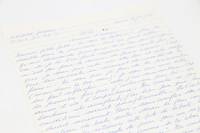
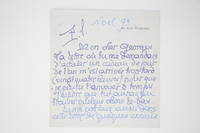
189377475Paris [18]93 | 13.50 x 14.50 cm | quatre pages sur un feuillet remplié
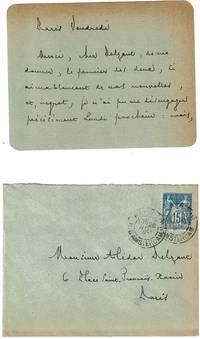
189676326Paris 12 avril 1896 | 11.40 x 8.80 cm | une carte recto-verso et une enveloppe
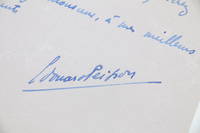
193686641Aix-en-Provence 2 Avril 1936 | 13 x 21 cm | une page + une enveloppe
1 S. 8vo. 2-strophiges Gedicht: "Ich klag' die Frist nicht an, die mir gegeben, / die Bahn, in Staub geschmiegt -; / Wie oft vor seinem Ziel hat jedes Leben / den eig'nen Tod besiegt! […]". - Hango stand seit 1879 als Kanzleibeamter im Dienst der Stadt Wien und arbeitete im Städtischen Archiv, das er von 1911 bis 1923 auch leitete. Daneben war er als Lyriker und Erzähler tätig und schrieb u. a. "Faust und Prometheus. Eine Dichtung" (1895). 1900-20 redigierte er den "Kalender des deutschen Schulvereins" und war Mitherausgeber verschiedener Quellenwerke zur Geschichte Wiens. Vgl. Kosch I, 822.
193686641Aix-en-Provence 1936. Fine. Aix-en-Provence 2 Avril 1936 13 x 21 cm une page une enveloppe Autograph letter dated and signed addressed to the writer and literary critic Noël B. de La Mort pen name of Noël Bayon 15 lines in blue ink. Crease marks inherent to folding for mailing envelope included. Noël B. de La Mort wishes to meet Edouard Peisson but the latter is seldom in Paris: ""Mais je vis la plus grande partie de l'année dans le midi."" But I live most of the year in the south. but he remains at his correspondent's disposal: ""Je suis disposé toutefois à répondre toutes les questions que vous me poserez par lettre."" I am willing however to answer any questions you may ask me by letter. unknown
197685089Fleury-Mérogis 1976. Fine. Fleury-Mérogis 18 Octobre 1976 21 x 29.50 cm une page recto verso Autograph letter dated and signed by Jacques Mesrine dated Monday October 18 1976 68 lines in blue ink on one recto-verso page addressed to his love of the time Jeanne Schneider thanks to whom the manuscript of theInstinct de mort was discreetly smuggled out of prison. Jacques Mesrine then incarcerated at Fleury-Mérogis prison seeks to reassure his love whom he is helping through his lawyers so that she might obtain provisional freedom: ""C'est que je sens que cela va être bon et cela malgré que les avocates m'avaient déconseillé de le faire. tu sais que je fais de la prémonition mais dans le bon sens. Je sais que ma lettre les fait réfléchir. cela j'en suis certain. C'est la première fois que j'interviens pour toi. Ca aussi a de l'importance."" ""It's that I feel this is going to be good despite my lawyers having advised me against doing it. you know I have premonitions but in a good way. I know my letter makes them think. of this I am certain. This is the first time I'm intervening for you. That too is important."" and thanks to whom she should regain freedom: ""Mais le plus important est que tu retrouves cette pute de liberté. Après ce sera aux avocates de jouer pour un régime plus souple. Je te parle comme si tu étais déjà libre.Que ""veux-tu"" j'y crois."" ""But the most important thing is that you regain this damn freedom. After that it will be up to the lawyers to work for a more lenient regime. I'm talking to you as if you were already free. What can I say I believe in it."" Overflowing with enthusiasm and certainty for the success of these proceedings regarding Jeanne's provisional freedom and sure of the weight of his intervention the indomitable Mesrine fumes at the idea of a hypothetical refusal by the prison authorities: ""Quel affreux pirate qui te donne de l'espoir. Non mon ange je ne sais absolument rien. Sauf que le Président a dit que je le menaçais sur ma lettre. J'ai été très dur et à juste raison car la plaisanterie a assez durée. Toi tu supporteras ton refus. moi je ne l'accepterai plus. C'est pas plus compliqué que cela. Car tu as assez payé. même trop."" ""What a terrible pirate giving you hope. No my angel I know absolutely nothing. Except that the President said I was threatening him in my letter. I was very harsh and rightly so because the joke has gone on long enough. You will endure your refusal. I will no longer accept it. It's no more complicated than that. Because you have paid enough. even too much."" Public enemy No. 1 takes the opportunity again to shatter this reputation as a bloodthirsty beast that sticks to his skin: ""Si les journalistes savaient que toutes les infirmières entraient seules dans ma cellule et en toute confiance on serait loin du ""fauve"" et de la prise d'otages à la Buffet. Les infirmières ont toujours été sacrées pour moi. Elles sont intouchables comme pas mal d'autres personnes mais cela les pédés de journalistes l'ignorent ; car ils ne sont pas dans mes pensées et c'est regrettable parfois."" ""If journalists knew that all the nurses entered my cell alone and in complete confidence we would be far from the 'beast' and the hostage-taking like Buffet. Nurses have always been sacred to me. They are untouchable like many other people but those journalist faggots don't know this; because they are not in my thoughts and that's sometimes regrettable."" Jacques Mesrine speaks of the creation of his work L'instinct de mort and his health in a fatalistic manner: ""Autrement tout est ok sauf mes douleurs au coeur qui me reprennent. mais je laisse faire car je n'aime pas prendre de médicaments. Et puis le mécanisme s'arrêtera le jour ""J"" du destin. Peut-être dans tes bras. qui sait ""Otherwise everything is ok except my heart pains that are returning. but I let it be because I don't like taking medication. And then the mechanism will stop on the 'D' day of d unknown
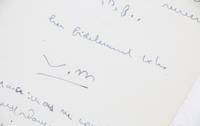
193086491Paris: S. n. 1930. Fine. S. n. Paris s. d. ca 1930 14 x 21.50 cm une page recto verso Autograph letter by François Mauriac signed with his initials 28 lines in blue ink on letterhead from his Parisian residence on avenue Théophile Gautier addressed to Abbé Casy Rivière. Fold mark inherent to envelope insertion. François Mauriac discusses his upcoming summer travels: "". je pars le 20 en auto pour les Pyrénées et ne serai à Malagar que vers le 1 sept. Regrets ! ."" "". I leave on the 20th by car for the Pyrenees and will only be at Malagar around September 1st. Regrets! ."" but also literary activity and certain religious allegiances attributed to the magazine La Table ronde: ""Le Léautaud a paru pendant mon séjour à Florence et je l'ai beaucoup regretté. Cela ne se renouvellera plus. Mais n'allez pas croire que le T.R. soit une revue catholique. Je suis à peu près le seul à l'être dans la rédaction. Et c'est bien pourquoi je ne souhaite nullement qu'un vicaire la lise."" ""Léautaud was published during my stay in Florence and I greatly regretted it. This will not happen again. But don't think that T.R. is a Catholic magazine. I am about the only one to be so on the editorial staff. And that's exactly why I do not wish at all for a vicar to read it."" He ends the missive with this revelation concerning his productivity as a vacationer: ""Je lutte désespérément pour mon travail personnel contre tout ce qui m'en détourne surtout lorsque je suis loin de Paris."" ""I desperately struggle for my personal work against everything that distracts me from it especially when I am away from Paris."" S. n. unknown
189676326Paris 1896. Fine. Paris 12 avril 1896 11.40 x 8.80 cm une carte recto-verso et une enveloppe Autograph postcard signed by Stéphane Mallarmé addressed to Alidor Delzant written on both sides in black ink. Envelope included. Alidor Delzant was a lawyer collector and bibliophile. Friend of the Goncourts he devoted a work to them and was Edmond's secretary and testamentary legatee. ""Here I am not having gone to London warned late that the reason for my journey was no longer necessary: I replaced this with a trip to the countryside from which I do not return in time to warn you. But would you like me to invite myself for today in eight . "" unknown
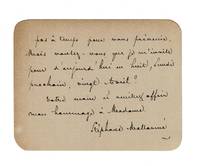
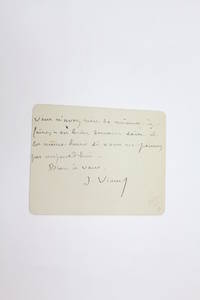
191073229Hendaye 1910. Fine. Hendaye s. d. 11.30 x 9 cm une feuille Autograph note by Pierre Loti signed Julien Viaud. 8 lines in black ink on a card. ""Malade depuis hier matin je ne puis aller jusqu'à vous. J'aurais grand plaisir à vous voir ce soir entre 5 et 6h si vous n'avez rien de mieux à faire - où bien demain soir à la même heure si vous ne pouvez pas aujourd'hui"". ""Ill since yesterday morning I cannot come to you. I would have great pleasure in seeing you this evening between 5 and 6 o'clock if you have nothing better to do - or tomorrow evening at the same time if you cannot today"". unknown
20 Zeilen auf 1 S. 8vo. "Und wogt es einmal wild und mild | In uns, daß vor Entzücken | Auf jede Stirn wir mild und wild | Die Lippen möchten drücken, | Daß wir an die berauschte Brust | Das Weltall möchten pressen, | Zu trinken aus dem Kelch der Lust | Ein seliges Vergessen [...]". - Seit 1845 Mitarbeiter von Adolf Bäuerles "Theaterzeitung", die auch Cerris erste Gedichte veröffentlichte, trat Cerri 1848 in den österreichischen Staatsdienst ein, lehrte daneben Italienisch und Literatur und veröffentlichte lyrische und dramatische Arbeiten. In den 50er Jahren redigierte Cerri die Grazer Damenzeitung "Iris" und schrieb 1852-56 unter den Pseudonymen "Veritas" und "Bayard" Wiener Briefe über das Burgtheater für die "Leipziger Theaterchronik". - Mit kleinem Randeinriß.
189377475Paris 1893. Fine. Paris 1893 13.50 x 14.50 cm quatre pages sur un feuillet remplié Autograph letter signed by Pierre Louÿs dated Christmas 1893 addressed to Georges Louis. Four pages written in blue ink on a double blue sheet bearing the writers initials and headed 49 rue Vineuse. A fine letter addressed to his brother Georges Louis with whom Pierre Louÿs maintained a deeply intimate relationship and whom he regarded as his own father. The question of Pierre Louÿss true parentage continues to fascinate biographers: His father Pierre Philippe Louis . married Jeanne Constance Blanchin in 1842; she died ten years later having borne him two children Lucie and Georges. In 1855 he married Claire Céline Maldan and from this union was born in 1857 a son Paul; then in 1870 our writer who received the given names Pierre Félix. This late birth the differences in temperament between father and son the fathers indifference toward the latter and the profound intimacy that always united Louÿs and his brother Georgesall of this has led some biographers and critics to suspect that Georges was in fact the writers father. The exceptionally close and lifelong bond between Pierre and Georges might well support such an argument. Of course no conclusive proof has ever been found and doubtless never will be. Still certain letters . are quite troubling. In 1895 for example Louÿs gravely wrote to his brother that he knew the answer to the most painful question he could ever put to him a question that had been on his lips for ten years. The following year at the height of Aphrodites success he thanked Georges effusively and closed his letter with these words: Pas un de mes amis n'a un PERE qui soit pour lui comme tu es pour moi. Arguing from the close relationship between Georges and Claire Céline in 1870 and from the jealousy the father continually displayed toward his younger son Claude Farrère did not hesitate to side with Georges Louis. And what are we to make of this dedication by Louÿs to his brother in a copy on japon of the original Pausole: Pour Georges son fils aîné / Pierre. Jean-Paul Goujon Pierre Louÿs Pierre Louÿs sent this letter to his brother when the latter had just taken up his post as Frances delegate to the International Commission of the Egyptian Debt and was in Cairo: La lettre où tu me demandais d'acheter un cadeau de jour de l'an m'est arrivée trop tard vingt quatre heures pour que je puisse l'envoyer à temps. J'espère que tu auras pu trouver quelque chose là-bas. Lacking a gift Pierre sent his brother a portrait of himself: En même temps que ma dernière lettre j'ai mis à la poste pour toi une photo du photographe ordinaire de Jane Hading et qui représente un Pierre posthume et sentimental assez ressemblant tout de même. L'épreuve n'était pas très propre mais c'était la seule que j'eusse encore reçue. Only a handful of photographic portraits of the writer are known today and we have been unable to identify the photograph mentioned here. The year 1893 marked several literary successes for Pierre Louÿs who until then had published only Astarté at his own expense in 1891 and together with his friend from the École Alsacienne André Gide and Paul Valéry had founded La Conque an anthology of the youngest poets whose first issue appeared on 15 March 1891. In quick succession came Chrysis ou la cérémonie matinale the translation of the Poésies de Méléagre and finally Lêda ou la louange des bienheureux ténèbres. The latter work is even mentioned in this letter: Mallarmé m'a écrit des choses pompeuses sur Lêda; mais de sa part cela ne signifie rien. Louÿs had been acquainted with Mallarmé since the early 1890s and met many leading figures at his celebrated Tuesdays among them Henri de Régnier. Deeply admiring the verses of the Symbolist master whom he considered the supreme incarnation of the artist one who has sacrificed everything to his ideal Ibid. Louÿs se unknown
Sechs vierzeilige Strophen auf 1½ SS. auf Doppelblatt. 8vo. "Fragt bei'm Altar d'Muater Gottes, | Wia's ihr so g'fallt auf der Welt; - | 'Is a politische Zeit', sagt's - | "Waast und des is net mei Feld' [...]". - Moriz Schadek studierte an der Universität Wien, legte 1865 seine Richteramtsprüfung ab, kam 1875 ans Wiener Handelsgericht und wurde 1895 dem Oberlandesgericht zugewiesen. Schon ab seiner Studienzeit schrieb er für das Wiener Witzblatt "Der Zeitgeist" und für die "Fliegenden Blätter", wurde dann aber vom damaligen Trend der "Mundartwelle" erfasst und schrieb zahlreiche Gedichte. - Gefaltet.
2 SS. 8vo. "Aus der Dichtung: 'Wolfram' (Regensburg 1854 Verl. von Pustet)": "Schöner ist kein Frühlingsmorgen, | Als der Jungfrau süsser Blick | Wenn in ihrer Brust verborgen | Dämmert erster Liebe Glück. || Aber sanfter, als der Schimmer, | Der um solche Seelen webt, | Mild, wie selbst das Frührot nimmer | Auf der klarsten Woche bebt, || War im Fischerhaus, im schlichten, | Aufgeblüht das holde Kind, | Mit dem Blick, dem himmellichten, | Lieblich wie die Veilchen sind [...]". - Franz Bonn, von 1862 bis 1865 Staatsanwalt, anschließend Richter in Ansbach, Bayreuth und München und später im Dienst des Fürsten von Thurn und Taxis in Regensburg, war zuletzt Präsident der Domänenkammer und Direktor des Zivilkollegialgerichts; von 1881 bis 86 gehörte er dem bayerischen Landtag an. Sein literarisches Werk umfaßt humoristische Gedichte, Schauspiele und Jugendliteratur. Sein Sohn war der Schauspieler und Schriftsteller Ferdinand Bonn (1861-1933). - Mit einigen von nicht identifizierter Hand stammenden Registraturvermerken in Farbstift.
Mit farbig kalligraphiertem Titel und Gebet verso sowie Haar-Applikationen und Trockenblumen. 38 hs. und zahlreiche weiße Bll. Lederband der Zeit mit Schließen. In Kartonschuber. Kl.-8vo. Tagebuch der Else von Ledebur mit Einträgen zur Geburt, Taufe und weiteren Entwicklung der kleinen Tochter Marie Elisabeth. Der Vater, Karl Eberhard Frhr. von Ledebur (1864-1922), wird in seiner Profession als Maler erwähnt: "Papa ist in Bückeburg und malt den Fürsten", ebenso die Großeltern mütterlicherseits, Rudolf und Elisabeth von Kyaw, geb. v. Miltitz. "September 1894. Marie-Elisabeth läuft ganz selbständig. Sehr gerne schüttelt sie ganz energisch das blonde Köpfchen u. sagt 'Nei'(n) wie überhaupt der eigene kleine Wille sehr ausgeprägt ist. Bitterlich weinen, ja sogar mit den Beinchen strampeln kann sie wenn ihr was weggenommen wird oder überhaupt ihr was gegen den Strich geht [...]". - Else von Ledebur wurde lt. Gotha (Freiherrl. Häuser 1916, S. 452) am 20. Februar 1868 in Klein-Zschachwitz bei Dresden geboren, nach frdl. Auskunft der Familie bereits am 20. Februar 1866.
2 SS. 12zeilig. Großes Hochformat. Mit stärkeren Randläsuren.
Madrid, Instituto de Estudios Políticos, 1957. 4to. mayor; 296 pp. Ejemplar con envío autógrafo de Juan Beneyto. Cubiertas originales. Juan Beneyto, nacido en 1907, es uno de los personajes más destacados del franquismo, en múltiples puestos relacionados con la prensa, la información, la educación y la censura. Un ideólogo omnipresente en sus días.
189883371S. n. | s. l. 1898 | 11 x 14 cm | une feuille
189776331Paris 26 novembre 1897 | 11.40 x 8.80 cm | une carte recto-verso et une enveloppe
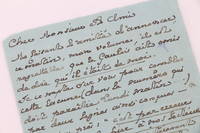
189883371s. l.: S. n. 1898. Fine. S. n. s. l. 1898 11 x 14 cm une feuille Autograph letter signed by the dandy count on a closed pneumatic card of 18 lines written in black ink addressed to his friend and journalist Henri Lapauze in which stung to the quick in his pride Robert de Montesquiou asks the latter imposing this correction upon him to kindly rectify the almost unforgivable error of the Gaulois: ""Cher monsieur et ami me faisant l'amitié d'annoncer ce matin mon volume il est regrettable que le Gaulois ait omis de dire qu'il était de moi. Je compte sur vous pour combler cette lacune dans le numéro qui doit paraître lundi matin par deux lignes ainsi conçues - ou à peu près : ""c'est par erreur que signalant hier à nos lecteurs l'apparition d'un intéressant volume de critique intitulé Autels priviliégés nous avons omis de dire que l'auteur était le Cte Robert de Montesquiou. Merci cher monsieur et à bientôt. Robert de M."" ""Dear sir and friend doing me the kindness of announcing my volume this morning it is regrettable that the Gaulois omitted to say that it was by me. I count on you to fill this gap in the issue that is to appear Monday morning with two lines conceived thus - or thereabouts: 'it is by error that signaling yesterday to our readers the appearance of an interesting volume of criticism entitled Privileged Altars we omitted to say that the author was Count Robert de Montesquiou. Thank you dear sir and see you soon. Robert de M.'"" S. n. unknown
(1+1 =) 2 SS. auf 1 Bl. 8vo. "A guat's Weib, a brav's Weib, / A Kindl an der Brust, / A Zither die hell klingt, / Das is halt mein Lust [...]" (aus "Mein Erdenglück"). - "So süaß a die Lieb is, so is do a Leid / Es heilt' a koan Dokter in Allewigkeit [...]" (aus "D'Heilsamen Kräut'ln"). - Der aus Trient stammende Maler war Wohnungsnachbar von Mozart im Figarohaus in Wien und Professor an der Akademie. Später von Stanislaus August II. nach Warschau berufen und anschließend nach St. Petersburg, wo er die Familie Katharinas der Großen portraitierte, kehrte er 1797 wieder nach Wien zurück und machte sich bei der Besetzung Wiens durch Napoleon als Führer des akademischen Korps bei der Rettung von Kunstgegenständen verdient (1809). Er gilt als der besten Portraitmaler seiner Zeit.
53084o.J. Ohne Ort (Karlsruhe), am Schluß datiert 26. III. 1931, 8°. 91 nn. Seiten, einige lose Blätter. Roter Strukturleinenband mit Deckelprägung "Poesie" und Messingschließe.
Large 4to. 1 p. "Weil ihr den Büchern | die verbrannt wurden jenseits der Grenze | und denen die sie schrieben | Zuflucht gewährt habt [...] Und weil ihr jetzt wieder zögert, | den Wahnsinn der Europa ergriffen hat | von beiden Seiten | ganz so sehr mitzumachen | wie manche jenseits der Grenzen | darum fühle ich mich | immer beinahe ein wenig | ruhig und sicher | wenn ich in eurem Land bin." - With correction in red ink and inscribed at the end: "mit guten Wünschen | Erich Fried". Typed note at lower edge (added by recipient), stating that Fried read the poem in "De Doelen" in Rotterdam on 12 June 1984, the first day of the Dutch parliamentary debate over the stationing of new medium-range missiles. - Two slight paper defects to top left corner.
Tall 4to (156 x 246 mm). French ms. on paper. 47 pp. (including autograph title-page). Near-contemporary giltstamped full calf with giltstamped title in English to upper cover and author's last name to spine. Leading edges gilt. An exceptional report and a fine example of the observational and analytical skills that marked Humboldt's work on his celebrated expedition to Spanish America, authorized by the Spanish monarchy in 1799. Accompanied by Aimé Bonpland he arrived in Colombia, after having spent three months in Cuba, in July 1801. In September he visited the vast salt mines of Zipaquirá in the Cundinamarca Department, thirty miles north of Bogotá, resulting in the report at hand. These salt deposits were formed 250 million years ago and had been exploited by the pre-Columbian Muisca people since the 5th century B.C. Humboldt's description, written in French in his diminutive hand, covers 46 tightly-packed pages. After three pages of introductory remarks, he divides his work into sections titled "Vues géologique. Exploitation de la mine", "Sources salées et leur Concentration", and "Cuite de Sel et Transport du Produit". - In his account Humboldt notes that the mine was bigger than those found in Spain, Switzerland, Poland, and the Tyrol, with a calculated resource estimation of one million cubic meters. He also describes the traditional halite mining at the site and recommends a switch to drift mining, following the principle used at Berchtesgaden, Hallein and Aussee, where the conditions are similar: "Voici la methode de laquelle on s'y prendrait, d'après l'analogie de Berchtesgaden, Hallein, Aussee dont le local est absolument semblable à celui de Zipaquira". He proposes driving corridors through the mountain towards the South and Southwest, thus reaching deeper levels where the purest salt is located. Once this fertile level is reached, large areas of 90,000-150,000 square feet need to be excavated, as far as the rock's solidity permits, creating 15-20 chambers on different levels, their number depending on the amount of salt produced and the richness of the mine. In these chambers, or "Wöhre", the miner will encounter fresh water running down the walls nibbling at the salt they contain, enriching itself up to a salinity of 25%. The water then merely needs to be channeled away and heated: "On percera la montagne de Sel par des galleries (Socabones) que l'on poussera en avant au Sud et Sudouest vers les points ou le Sel gemme est le plus riche. On fait, par ce qui a été dit antérieurement que le sel le plus pure est a une profondeur a laquelle la fouille actuelle n'att[e]int pas [...] Arrivé dans une partie de la mine bien abondontée on fera de grandes excavations de plus de 90,000 à 150,000 piés quarrés de superficie selon que la solidité de la Roche, (de Sel gemme) le permet. Ces excavations qu'en langue de mineur en nomme Wöhre ou Sinkwerke, sont de grandes Sal[l]es souterraines de 2-3 toises de haut [...] On a, selon la quantité de Sel que l'on produit et la richesse de la mine 15-20 de ces Chambres dans une Montagne de Sel, a differentes hauteurs [...] C'est dans ces Wöhre que par des puits ou des galleries superieurs selon que l'on rencontre les eaux douces [...] Elles y dissolvent, en rongeant, le Sel gemme contenu dans les parois [...] Lorsque l'Arcometre annonce au mineur que les eaux douces se sont enrichis à 24-25 p. C. [...] on fait découler ces pour ces artificielles qui ne necessite, plus que d'être cuites [...]". - Title-page and final page lightly duststained, minor ink stains in places. Spine and hinges professionally repaired.
189776331Paris 1897. Fine. Paris 26 novembre 1897 11.40 x 8.80 cm une carte recto-verso et une enveloppe Autograph signed postcard by Stéphane Mallarmé addressed to Alidor Delzant written on both sides in black ink. Envelope included. Alidor Delzant was a lawyer collector and bibliophile. Friend of the Goncourts he devoted a work to them and was secretary and testamentary legatee of Edmond. ""Merci cher Delzant de me donner le premier des deux si aimablement de vos nouvelles ; et ingrat je n'ai pu me désengager précisément lundi prochain : mais ici je mets les pieds dans le plat que diriez vous du suivant 6 décembre où je serais des vôtres "" ""Thank you dear Delzant for giving me first of the two so kindly your news; and ungrateful as I am I could not free myself precisely next Monday: but here I put my foot in it what would you say to the following December 6th when I could join you"" unknown
192487768Le Clos-Marie (Roscoff) 30 Août 1924 | 21 x 27.50 cm | 1 page recto verso