66 618 résultats
2 SS. auf Doppelblatt. 8vo. Aquarell ca. 75 x 90 mm. Der Titel "Sommerhöhe" und die Widmung "für Adis zum 15. VIII. 33" für seine Schwester Adele Gundert zu ihrem Geburtstag auf der ersten Seite des Doppelblatts unter der aquarellierten Federzeichnung. Auf der zweiten Seite das Typoskript seines Gedichts: "Das Blau der Ferne klärt sich schon | Vergeistigt und gelichtet | In jenen Lila-Zauberton, | Den nur September dichtet [...]". - Gefaltet.
1 S. (16 Zeilen) auf Doppelblatt. 4to. "Schwül ist's. Leise rauscht die Weide | träumend schläft der See, | silbern ruht auf kühlen Wellen | Sonnenschein wie Schnee. | Doch ein Wölkchen schwebt vorüber, | trübt den Silberschein, | luftig hüllt ein dunkler Schleier | Flut und Weiden ein [...]". - Tls. unter dem Pseudonym Han(n)s Weber-Lutkow war Johann Pokorny Mitarbeiter des "Deutschen Volksblattes für Galizien" und des "Ostdeutschen Volksblattes", davor auch des "Kyffhäuser". "Seine Gedichte, Erzählungen, Feuilletons, Skizzen etc. erschienen in den bedeutendsten deutschsprachigen literarischen und schöngeistigen Zeitschriften, nur wenige jedoch in Buchform gesammelt. Pokornys schriftstellerische Bedeutung liegt auf dem Gebiet der Erzählung. Er formt packende Charaktere aus dem ruthenischen Milieu, dessen Darstellung ihn in die Nähe Sacher-Masochs rückt, ohne ihn jedoch dessen künstlerische Höhe erreichen zu lassen. Seine Gestalten, triebhafte Naturmenschen, gehorchen eigenen, ihnen innewohnenden Naturgesetzen, die sie außerhalb des üblichen Moral[-] und Sittenkodex stellen" (ÖBL VIII, 162).
1 S. (24 Zeilen) 8vo. "Stillfriedlich ruft in Waldes Hut | Ein Schlößlein fein und traulich, | Ein Türmlein drauf neigt seinen Knauf | Vorüber gar beschaulich, | Die Mauern rauh und wettergrau, | Umspielt von grünen Ranken - | Das alte Haus blickt ernst hinaus, | Als wär' es voll Gedanken [...]". - Wengraf war ein bedeutender sozialliberaler Kulturpublizist der Jahrhundertwende. Er war als Redakteur der "Arbeiterzeitung" tätig, 1893-98 Herausgeber der "Neuen Revue" (ehemals "Wiener Literatur Zeitung"), Mitarbeiter des "Neuen Wiener Journals" und Chefredakteur des "Extrablatts" sowie der Zeitung "Die Zeit". - Mit kleinen Randläsuren.
Folio (ca. 275 x 327 mm). 12, 5, 13-37, 15 pp. Ink on staved paper by Néocopie Musicale with 3 systems of 4 staves, as well as 10 staves respectively. In contemporary red wrappers with handwritten cover-title. One of Jolivet's first major works, which remained unpublished until 1989 (Salabert), described by the French violinist and leading interpreter of Jolivet's works, Devy Elrih (1928-2012), as "embracing a new musical language, and a reinvention of notation for violin and piano, as well as the relation of the two". Elrih goes on to characterize the composer's intention to "express himself free of any references to earlier works in this domain [...] as a 27-year-old man, full of life, lyricism and determination". - The sonata, with a duration of 13 to 15 minutes (as noted by Jolivet at the head of the manuscript), comprises three movements: "Ramassé", "Librement", and "Bousculé". The first movement also appears in the prelude of the 1930 work "Prélude et Grave pour violon et piano", revised in 1932 (K 44). Following the first movement (pp. 1-12), the second movement (pp. 13-17) was crossed out in crayon, page 13 bearing the note: "Refait: voir ondes, no. 1 des 3 poèmes pour ondes", referring to the 1935 composition "Trois Poèmes pour ondes Martenot et piano". The revised version of the second movement (paginated 1-5) is inserted between the first movement and the crossed-out second movement. The third movement comprises pp. 18-37. In the 15-page part for violin adjacent to the piano score, the second movment (pp. 6-7) is also crossed out. The violin part includes fingerings added in a different hand. - Analyzing the piece, the musicologist Lucie Kayas concludes that "the whole sonata produces a feeling of heterogeneity of the consecutive tonal, modal and dodecaphonic keys, as if, in contrast with the manner shown by the polytonal works of Jolivet's early youth, an idea of collage prevailed, now through juxtaposition rather than mere simultaneity". - The first movement was performed at the Société Nationale on 2 December 1933 by Gisèle Kuhn and Raoul Visa, while the complete sonata premiered at the Société Nationale on 9 February 1935 with André Huot (violin) and Olivier Messiaen (piano). - With three stamps of the "Societé des auteurs, compositeurs & éditeurs de musique", dated 26 June 1934 (one rather faded), as well as one stamp of the "Commission d'examen des bulletins". Several corrections and annotations in crayon and pencil. Wrappers with several small flaws; spine rebacked with tape. Kayas, André Jolivet (Paris, 2005), pp. 115-117.
Titel und 1 S. auf Doppelblatt. Gr.-8vo. "Du gabst Dein Bild; ich danke Dir im Liede! | Und dieses Lied las ich aus Deinen Zügen; | Hätt' auch der Freund in seiner Lust geschwiegen, | Es ist die Muse - gilt es Dir - nicht müde [...]". - Nachdem Prechtler in Wien und Linz studiert hatte, arbeitete er durch Fürsprache Grillparzers als Direktor des Hofkammerarchivs, wurde 1856 seines Förderers Nachfolger, trat aber eines Augenleidens wegen 1866 in den Ruhestand. Prechtler hatte seit 1883 Gedichte im "Linzer Bürgerblatt" und Novellen und Reisebilder in verschiedenen Almanachen und Zeitungen veröffentlicht; 1849 hatte er die Zeitung "Der Patriot" redigiert. Nach seinem Austritt aus dem Staatsdienst war er ein Jahr lang als Theaterdichter in München tätig; einige seiner Dramen (darunter "Die Kronenwächter", 1844) wurden am Burgtheater gegeben, von seinen insgesamt 38 Opernlibretti wurde wohl das Textbuch zu Johann Joseph Netzers Oper "Mara" (1842) am bekanntesten.
2 SS. Qu.-Folio. Vertonung von Emanuel Geibels "Spielmanns Lied" ("Und legt ihr zwischen mich und sie"): Noten für Singstimme und Klavierbegleitung mit vier Strophen unterlegtem Text (die zweite mit Bleistift gestrichen). - "Nessler ist eine charakteristische Erscheinung der deutschen 'Butzenscheiben'-Romantik. Der leicht produzierende, wenig wählerische Eklektiker widmete sich nahezu ausschließlich der Vokal-Komposition. Obgleich er durch seine Opern bekannt geworden ist, sind die kleinen Formen des Sololiedes und des Männerchors seinem Streben nach gefühlsseliger Volkstümlichkeit entsprechender als die dramatische Großform" (MGG IX, 1383). - Im Rand minimal angestaubt. Selten.
Schmal-gr.-4to. 1 S. Drei Strophen. "Der Baum | größer als die Nacht | mit dem Atem der Talseen | mit dem Geflüster über der Stille [...]". - Aus der Sammlung des Theologen Hermann Dembowski (1928-2012); in der Mitte des Blattes mittels Tesafilmstreifen zusammengesetzt.
1 S. (40 Zeilen). 4to. "Weißt Du es noch? Du bist ein Dichter, | Du mußt das ganze Glück verstehn | Von Tagen, die wie Sonnenschein, | Auch durch das trübste Leben gehn [...]". - Mautner "bethätigte [...] sich als Poet und veröffentlichte mehrere Gedichte [...]" (Eisenberg, Das geistige Wien; zit. n. DBA I, 816, 9), lebte nach 1847 ununterbrochen in Wien und “arbeitete im Laufe der Jahre als Feuilletonist und Theaterkritiker fast aller Wiener und mehrerer ausländischer Blätter. Als Bühnenschriftsteller wurde sein Name besonders durch den Erfolg seines Lustspiels 'Das Preislustspiel' (1852) bekannt" (ebd.). Vgl. auch Kosch X, 600. - Etwas fleckig und mit Randläsuren.
Titel und 6 SS. auf 4 (= 2 Doppel-)Bll. 4to. Brief: 1 S. auf Doppelbll. Mit eh. Adresse verso (Faltbrief). Der Brief an G. Ritter von Franck in Wien einen Wechsel betreffend.
20½ SS. auf 7 Doppelbll. 4to. Broschiert und geheftet. Lewinsky wirkte am 16. XI. 1866 bei einer Aufführung von Meyerbeers Bühnenmusik zu "Struensee" mit, die im Rahmen eines gesellschaftlichen Abends in der Akademie des Hofoperntheaters zugunsten des Privat-Pensionsfonds stattfand ("Die Presse. Abendblatt", Nr. 315, 17. XI. 1866, S. 10). Lewinsky sprach dabei das "verbindende Gedicht" von Johann Gabriel Seidl. Meyerbeer hatte 1846 die Musik zu dem Trauerspiel seines verstorbenen Bruders, des Dramatikers Michael Beer, verfaßt. "Obwohl das Programm [...] etwas wahrhaft Interessantes bot, war dennoch der Saal nur schwach besetzt [...] Herr Lewinsky sprach das verbindende Gedicht von Seidl mit bewährter Meisterschaft" (ebd.). - Teilweise mit Paginierung (S. 1-9) in Bleistift. Mit einem Wasserfleck (ca. 30:40 mm), zahlreichen Unterstreichungen, Eintragungen und einer Streichung in Blei- sowie einer Markierung in Blaustift.
52829o.J. Los Angeles, "Christmas 1959", 4° (25 x 19 cm). Auf 43 Karton-Blättern (diese etw. gebräunt). Pp. d. Zt. (Vordergelenk schadhaft) mit Deckelbordüre, im hinteren Innendeckel "The American Binder Company, Inc. New York Ciry".
92 SS. auf 23 losen Doppelbll. Kl.-4to. Vollständiges Manuskript der Novelle "Tantalus", 1901 bei Carl Krabbe in Stuttgart erschienen. Auf dem Titelblatt der Vermerk des Verlegers in roter Tinte: "Mspt an den Autor zurückgegeben". - Tinte auf festem Papier, zahlreiche Korrekturen und Streichungen im Text und auf den breiten linken Rändern; unbeschnitten; das Doppelblatt mit den Seiten 41 bis 44 durchtrennt.
1 S. Folio. "Wie der Genuß an uns vorüberschäumt! | Beglückt und glücklos leuchten uns die Tage | und Nächte, die wir bilderreich durchträumt. | Was wacht doch jedes Morgens glühende Frage | über den hingenommenen Träumen auf, | daß wir sie wartend bis zum Abend tragen? | Mit Sternen kommt es antwortkühl herauf. | Wir schaun dem Tage nach, der längst versäumt, | wie eines Wagens staubverhüllten Lauf, | wir Schweigenden, die vieles schon geträumt". - Am oberen bzw. unteren Rand etwas gestaucht.
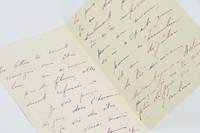
190579002s. l. Paris 1905. Fine. s. l. Paris s. d. 1905-1906 11.50 x 15.90 cm 3 pages sur un double feuillet Autograph letter signed ""Pauline"" by Renée Vivien addressed to Natalie Clifford Barney and written in violet ink on a double sheet bordered with violets. Transverse creases inherent to the mailing. Icy and a fresh attempt at rupture or at the very least a rebuff this letter is completely devoid of courtesy and tenderness: ""Je ne suis pas pareille à toi - j'ai de l'orgueil et de la fierté - cet orgueil tu l'as blessé cette fierté tu l'as froissée - je ne m'exposerai plus à des dégoûts de ce genre. Tes lettres te seront renvoyées sans être lues - ne m'envoie pas de fleurs elles seront refusées. Je vois peu de gens dans l'horreur où je vis des êtres j'en verrai moins encore - cela me procurera peut-être la paix. Je me demande seulement pourquoi tu m'as importunée pour me revoir si ce n'était pour m'humilier et me dégoûter de toi encore davantage. Adieu puisque je ne te reverrai plus de ma vie. Pauline"" ""I am not like you - I have pride and dignity - you have wounded that pride you have bruised that dignity - I will no longer expose myself to such disgust. Your letters will be returned unread - do not send me flowers they will be refused. I see few people in the horror I feel for human beings I will see even fewer - that will perhaps bring me peace. I only wonder why you bothered me to see me again if it was not to humiliate me and disgust me with you even more. Farewell since I will never see you again in my life. Pauline"" Moving letter revealing the suffering and isolation of the Muse of violets sliding inexorably toward her tragic end. It was at the end of 1899 and through the intermediary of Violette Shillito that Renée Vivien - then Pauline Tarn - made the acquaintance of Natalie Clifford Barney ""cette Américaine plus souple qu'une écharpe dont l'étincelant visage brille de cheveux d'or de prunelles bleu de mer de dents implacables"" ""this American more supple than a scarf whose sparkling face shines with golden hair sea-blue eyes implacable teeth"" Colette Claudine à Paris. Natalie who had just experienced a summer idyll with the scandalous Liane de Pougy who had initiated her into Sapphism paid only discrete attention to this new acquaintance. Renée however was completely subjugated by the young American and would relate this coup de foudre in her autobiographical novel Une Femme m'apparut: ""J'évoquai l'heure déjà lointaine où je la vis pour la première fois et le frisson qui me parcourut lorsque mes yeux rencontrèrent ses yeux d'acier mortel ses yeux aigus et bleus comme une lame. J'eus l'obscur prescience que cette femme m'intimait l'ordre du destin que son visage était le visage redouté de mon avenir. Je sentis près d'elle les vertiges lumineux qui montent de l'abîme et l'appel de l'eau très profonde. Le charme du péril émanait d'elle et m'attirait inexorablement. Je n'essayai point de la fuir car j'aurais échappé plus aisément à la mort."" ""I evoked the already distant hour when I saw her for the first time and the shiver that ran through me when my eyes met her mortal steel eyes her sharp blue eyes like a blade. I had the obscure prescience that this woman was giving me destiny's orders that her face was the dreaded face of my future. I felt near her the luminous vertigo that rises from the abyss and the call of very deep water. The charm of peril emanated from her and attracted me inexorably. I did not try to flee her for I would have escaped death more easily."" ""Hiver 1899-1900. Débuts de l'idylle. Un soir Vivien est invitée par sa nouvelle amie dans l'atelier de Mme Barney mère de Natalie 153 avenue Victor-Hugo à l'angle de la rue de Longchamp. Natalie s'enhardit à lire des vers de sa composition. Comme Vivien lui dit aimer ces vers elle lui répond qu'il vaut mieux aimer le poète. Réponse bien digne de l'Amazone."" ""Winter 1899-1900. Beginning of the idyll. One evening Vivie unknown
190579002s. l. [Paris] s. d. [1905-1906] | 11.50 x 15.90 cm | 3 pages sur un double feuillet
¾ S. Folio. "Marx und Engels lebten in den finstersten und grausamsten Zeiten. Sie waren die heitersten und zuversichtlichsten Menschen". - Darunter der Vierzeiler "Du der du sitzend im Buge des Bootes […]" aus den "Svendborger Gedichten" (Berliner und Frankfurter Ausgabe, Bd. 12, S. 81): "Du, der du sitzest im Buge des Bootes | Siehst du am unteren Ende das Leck | Wende lieber den Blick nicht weg | Denn du bist nicht aus dem Auge des Todes". - Der daran anschließende (1950 entstandene) Vierzeiler ist unter der Überschrift "Rätsel" ebendort (Bd. 15, S. 220) zu finden: "Was ist das: es ist weiss | Wie die Wolke dort am Himmel. | Und sieht hinten grad so gut wie vorn? | Toter Schimmel". - Auf Durchschlagpapier; etwas gebräunt und mit kleinen Randläsuren; die Überschrift mit rotem Farbband, die zwei Korrekturen mit rotem Kugelschreiber verändert aus: "Und sieht vorn so gut wie hinten?".
Oblong 8vo. 1 p. With typed envelope. To Josef Wesely.
4to. 5 double-spaced typed leaves (watermarked "Millers Falls Ezerase"). With a manual correction on the first leaf. Manuscript for Mailer's monthly Esquire column "The Big Bite", signed by the author on the last leaf. Incipit: "The rite of spring is in the odor of the air." Mailer depicts the doomsday atmosphere of New York during the Cuban Missile Crisis of October 1962. Esquire published Mailer's column from November 1962 through December 1963, when the writer began devoting the space to the serialization of his novel "The American Dream". According to his secretary at the time, Anne Berry, Mailer handed her the first draft of a column, which she typed triple-spaced, gave it back for editing, and then typed it again double-spaced (cf. Mills, Mailer. A Biography, p. 263). This manuscript thus belongs to the second, edited version of the column. - Folded twice. Adams p. 10.
4to (161 x 202 mm). 27 pp. Ink on lined paper, numbered in pencil in another hand. Fastened with brass tack at upper left corner. Stored in a quarter morocco clamshell case. (With:) The Strand Magazine. London, George Newnes, November 1921 issue (No. 371, Vol. 62), story published on pp. 380-388. The complete autograph manuscript of a work widely considered one of Doyle's best ghost stories. The macabre tale unites two of the author's great passions, boxing and Spiritualism, to create the tale of a sinister prize fighter whose physical brutality does not die. The present manuscript contains mostly minor edits, though a handful of pages include more substantial excisions and additions: on page nine, for example, "the man who accosted them" has been replaced with simply "him", and the description of "a surly red face" has been expanded to include "with an ill-fitting lower lip". On page 13, nearly twenty words have been crossed out. Includes a fine, bright copy of the "Strand Magazine" issue in which the story was first published. - Some spotting and soiling, most visible on first and final pages. Centre crease throughout. Ink a little faded in some places; final page with a little creasing and a couple short closed tears. Provenance: Sotheby’s New York, 10 Dec. 1993, lot 320. Latterly in the collection of the U.S. lawyer Edward R. Leahy (b. 1947).
Folio (321 x 200 mm). 3½ pp. on 4 ff. Autograph emendations and cancellations in black ink, editorial annotations in pencil and pink ink in another hand (each of the first three leaves in two pieces and repaired with thick tape). An intriguing autograph manuscript by Kipling for a satirical short story. Written to be published in the Pall Mall Gazette, "Things As They Are" never appeared there and is not published in any of the collected editions of Kipling's work. Kipling recounts the details of a conversation between "That very terrible deity The God of things as They are" and the British public, imagined here as a teething kitten, on the failure of most artists to truly grasp the beauty of the world around them. - The manuscript was written by Kipling for the Pall Mall Gazette under the condition that his name not be attached to it; the editor, Harry Cust, refused to grant this anonymity, so Kipling declined to have it published. Rudyard Kipling was just one of the literary luminaries enticed to join the ranks of contributors to William Waldorf Astor's Gazette under the editorship of Harry Cust, who transformed the publication into one of the best respected evening journals of the time after his appointment in 1892; alongside Kipling, it featured work from H. G. Wells, Algernon Swinburne, Jack London, and Joseph Conrad. The manuscript was probably written between 1892 and 1896: Kipling writes on the same theme in an article published by The Times on 20 August 1892 entitled "Half-a-Dozen Pictures", and by 1896 Cust had ceased to edit the Gazette.
6 ff., notated in black ink on 12-stave Cameo Music Papers No. 5-3124, rectos only. Folio. Signed at the foot of each page and dated "Cairo 1960" on first and last pages. With copyright notices to foot of page 1: "2016 by Halim El-Dabh Music LLC", signed, and "1960 by C.F. Peters Corp 373 Park Ave. South New York, N.Y. 10016". A fair copy, including autograph note to page 3: "In whichever order, try to include as many notes within the time limits, including some in chords if so desired. Start and end with one of the heavy shaded notes". - "Conceived in 1954, 'Thulathia' was composed in 1960 and first performed at the Brookline Public Library in Brookline, Massachusetts. 'Thulathia' means 'a cello unification of three into one', i. e., 'a trio in one'. Grape clusters of the vine connect the energy. The concept is extended to include a cluster of grapes in a united grape vine. Instructions for playing the grapes is explained at the bottom of page 3" (notes provided by the composer). - The Egyptian-born American composer, performer, ethnomusicologist, and educator El-Dabh came to the U.S. in 1950, becoming a part of the New York music scene that included Cage, Varèse, and Hovhaness. He went on to study composition with Krenek, Copland, Dallapiccola, and others. An early pioneer of electronic music, El-Dabh composed one of the earliest known works of tape music, or "musique concrète", in 1944, 'The Expression of Zaar'. He also scored four ballets for Martha Graham: 'Clytemnestra' (1958), 'One More Gaudy Night' (1961), 'A Look at Lightning' (1962), and 'Lucifer' (1975). "El-Dabh is probably the best known composer of Arabic descent and his works are highly regarded in Egypt, where he is considered the foremost living composer among that nation's 'second generation' of contemporary composers" (Wikipedia). - Slightly worn and creased; light red stain to upper left margin of pages 1 and 5.
20 Zeilen auf 1¾ SS. auf Doppelblatt. 8vo. "Bitter ist das Wasser in der Fremde, | Bitter in der Fremde ist das Brot! | Säh' mich meine Mutter in der Fremde, | Meine Mutter weinte sich zu Tod [...]". - Die aus Hamburg stammende Schriftstellerin lebte seit 1887 in München, trat dort als Autorin volkstümlicher Prosa und Schauspiele an die Öffentlichkeit, ging 1892 nach Zürich und war neben dem dort begonnenen Studium der Naturwissenschaften freie Mitarbeiterin verschiedener Zeitschriften. "Frapan lebte seit 1901 mit dem armenischen Schriftsteller Akunian in Genf, bereiste mit ihm den Kaukasus und setzte sich öffentlich für das unterdrückte armenische Volk ein. Neben Novellen und Romanen über die Emanzipation der Frauen ('Wir Frauen haben kein Vaterland. Monologe einer Fledermaus', 1899) veröffentlichte sie bis zu ihrem mit Hilfe Emma Mandelbaums vollzogenen Freitod populäre Unterhaltungsliteratur" (DBE).
12 num. [recte: 11] Bll. 8vo. Enthält eine ausführliche (und, wie aus einer eh. Randnotiz hervorgeht, für die 'Südtiroler Ärztezeitung' vom 1.I. 1923 bestimmte) Darstellung von Leben und Werk des 1571 in Trient geborenen Mediziners und Schriftstellers Hippolytus Guarinonius (gest. 1654 in Hall i. Tirol), "der sich in zahlreichen, zum Teil nur handschriftlich überlieferten medizinischen Werken um die volksnahe Vermittlung medizinischen Fachwissens bemühte" und "als Vorkämpfer der Volksgesundheit" gilt (DBE). - Der in Brünn geborene Otto Rudl studierte in Wien Medizin und war bis zu seinem Tode als Stadtarzt in Bozen tätig. Vgl. Kosch III, 2329, Giebisch-G. 342 (mit Todesjahr 1951) sowie DBA II 1104, 259-261 (lt. DBE mit Todesjahr 1948). - Bl. 2 verso mit gestempeltem Eigentumsvermerk des Verfassers.
196970624Paris 1969. Fine. Paris 18 juillet 1969 21.60 x 28 cm 1 page sur un feuillet enveloppe jointe Autograph letter signed by Lawrence Durrell addressed to his lover Jani Brun dating from the beginning of their relationship. One page in blue ballpoint pen. Envelope included. The writer addresses here one of the first letters of his correspondence with his young friend from Montpellier which extended over more than two decades. Still unaccustomed to the French language he asked for help translating his letter: ""J'espère bien mieux te connaître . Gérard a traduit ceci de l'anglais pour moi. Comprendrais-tu si la prochaine fois j'écrivais en anglais . "" ""I hope to get to know you much better . Gérard translated this from English for me. Would you understand if next time I wrote in English . "" After many years spent in Greece Egypt and Rhodes the traveling writer Lawrence Durrell was forced to flee Cyprus following popular uprisings that led the island to its independence from the British crown. Rich only with a shirt and a typewriter but crowned with the success of his novel Bitter Lemons of Cyprus Les citrons acides he arrived in France in 1956 and settled in the Languedoc village of Sommières. In the ""Tartès house"" his large residence surrounded by trees he wrote the second part of his work his monumental Avignon Quintet devoted himself to painting and received his illustrious friends including the couple Henry Miller and Anaïs Nin violinist Yehudi Menuhin London publisher Alan G. Thomas and his two daughters Penelope and Sappho. Among the olive trees and under the Mediterranean sun he met in the mid-1960s the young and vivacious ""Jany"" Janine Brun a woman from Montpellier in her thirties with devastating beauty who worked in the Antiquities department of the Sorbonne in Paris. She was nicknamed ""Buttons"" in memory of their first meeting where the young woman wore a dress covered with buttons. Henry Miller also fell under the charm of ""Buttons"" praising her beauty and eternal youth in exceptional unpublished letters. The three companions spent memorable Parisian evenings of which we retain precious autograph traces through their epistolary exchanges. Recommended by Durrell she made numerous trips notably to England from where she received vast correspondence from the writer as well as original works of art signed with his artist pseudonym Oscar Epfs. unknown
196970624Paris 18 juillet 1969 | 21.60 x 28 cm | 1 page sur un feuillet, enveloppe jointe