858 328 résultats
Large 4to. 1½ pp. on 2 ff. An early version of Celan's poem "Chanson einer Dame im Schatten" that was first published in the 1952 poetry collection "Mohn und Gedächtnis": "Wenn die Schweigsame kommt, die die Tulpen köpft: | Wer gewinnt? | Wer verliert? | Wer tritt an das Fenster? | Wer nennt ihren Namen zuerst? | Es ist einer, der trägt mein Haar. | Er trägts wie man Tote trägt auf den Händen. | Er trägts wie der Himmel mein Haar trug im Jahr da ich liebte. | Er trägt es aus Eitelkeit so. | Der gewinnt. | Der verliert nicht. | Der tritt nicht ans Fenster. | Der nennt ihren Namen nicht [...]". - The only discrepancy between this typescript and the published version concerns the first line where Celan changed "die die Tulpen köpft" to "und die Tulpen köpft". - Celan presented this typescript as a gift to Diet Kloos-Barendregt August 1949. Kloos-Barendregt (1924-2015) was a Dutch singer and resistance fighter whose husband had been executed by the Nazis in 1945. During a brief stay in Paris she met Paul Celan by chance at the Café Dupont in August 1949. They immediately formed a connection over their traumatic experiences and losses and started a romantic relationship. - Traces of folds. Somewhat creased and minimally browned. With paper clip marks to the upper margin, punch holes, insignificant rust stains and tears. Provenance: from the estate of Diet Kloos-Barendregt, Bubb Kuyper auctions, November 2021. P. Celan, Mohn und Gedächtnis (Stuttgart, DVA, 1952). Cf. Paul Celan, Du mußt versuchen, auch den Schweigenden zu hören. Briefe an Diet Kloos-Barendregt. Handschrift - Edition - Kommentar (ed. by P. Sars, Frankfurt a. M., 2002).
1665YTB-13Paris, Thomas Jolly, 1665. In-12 de (2) ff., 78 pp., (1) f. Maroquin bleu nuit janséniste, dos à nerfs, titre doré au dos, double filet or sur les coupes, dentelle intérieure dorée, tranches dorées. Reliure par E. Carayon. 140 X 83 mm. EDITION ORIGINALE DE LA PIECE PREFEREE DE CORNEILLE. Picot, n°84 ; Tchemerzine, II, 574 ; Le Petit, 185. « « Si mes amis ne me trompent, cette Pièce égale ou passe la meilleure des miennes, dit Corneille dans la préface qu’il a placée en tête de la tragédie d’Othon. Quantité de suffrages illustres et solides se sont déclarés pour elle, et si j’ose y mêler le mien, je vous dirai que vous y trouverez quelque justesse dans la conduite et un peu de bons sens dans le raisonnement, quant aux vers, on n’en a vu de moi que j’aie travaillé avec plus de soin » (Picot). Le sujet de la pièce est tiré des Histoires de Tacite, mais corneille a mis également à contribution Plutarque et Suetone dans leurs Vies de Galba et d’Othon. S’il faut en croire les Anecdotes dramatiques, le maréchal de Gramont aurait dit, à l’occasion d’Othon, que Corneille devrait être le « Bréviaire des Rois » et M. de Louvois qu’ « il faudrait, pour juger cette pièce, un parterre de ministres d’Etat ». Ce qui est certain, c’est qu’Othon resta au répertoire. « Corneille, dans sa préface, parle de cette tragédie comme l’une de ses meilleures. Mais elle eut peu de succès. Il a fallu attendre trois siècles pour s’aviser que les amis de Corneille avaient raison et qu’Othon est l’une de ses meilleures pièces » (Georges Forestier, Dictionnaire des œuvres). Othon est l’exacte peinture de la politique romaine et ce sont ces mérites historiques qui lui ont valu un accueil bien plus favorable de la part des critiques modernes que de la part des critiques du XVIIe siècle. EXEMPLAIRE CONSERVE DANS SA FINE RELIURE EN MAROQUIN BLEU NUIT REALISEE PAR E. Carayon.
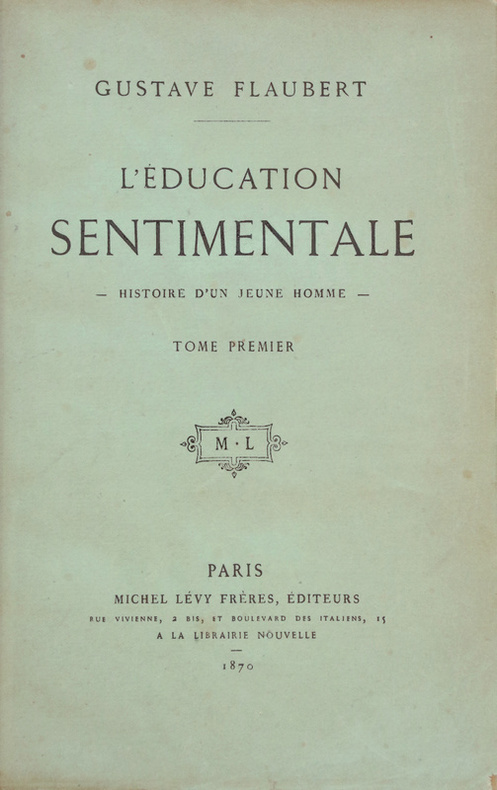
LCS-18074Bel exemplaire à grandes marges, partiellement non rogné, conservé dans ses élégantes reliures de l’époque avec les couvertures bleues conservées. Paris, Michel Lévy, 1870. 2 volumes grand in-8 de : I/ (2) ff., 427 pp.; II/ (2) ff., 331 pp., 32 pp. (catalogue de l’éditeur). Qq. discrètes rousseurs. Demi-maroquin fauve de l’époque à coins, dos à nerfs ornés, tête dorée sur témoins, couvertures bleues et dos conservés. Reliure de l’époque signée de Marius Magnin. 227 x 149 mm.
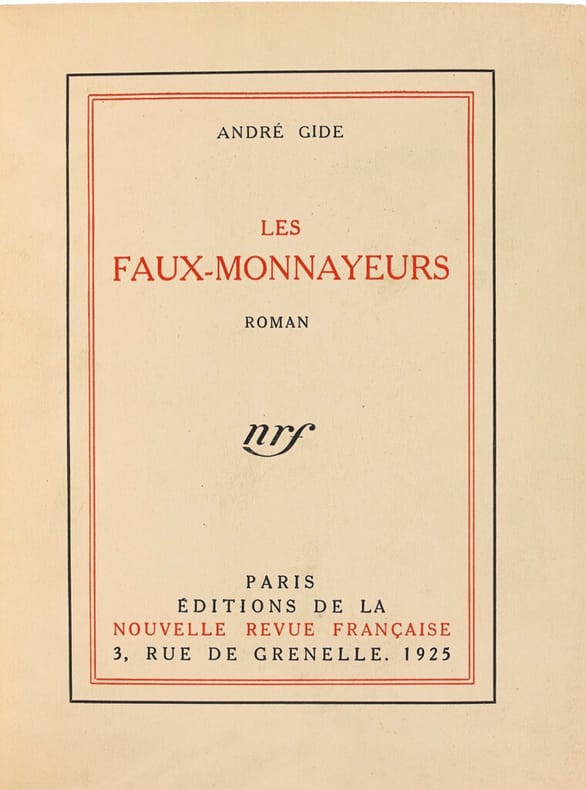
LCS-17949Exemplaire de tête, l’un des 112 réservés aux bibliophiles de la NRF. Paris, N.R.F., 1925. In-4 tellière de 503 pp., (1) f. d’achevé d’imprimer, (1) f. bl. Relié en maroquin brun janséniste, dos lisse avec le titre frappé or, doublures de maroquin crème ornées d’un liseré de maroquin brun mosaïqué en encadrement, gardes de soie bordeaux, tranches dorées sur témoins, couvertures et dos conservés, chemise et étui. (Knoderer). 212 x 161 mm.
4to (277 x 213 mm). 1 p. on squared paper. In Russian. A furious letter to the Russian journalist Solomon Gitmanovich [Kaplun], complaining of Kaplun's failure to write to him: "Sending you two more sonnets of Vyacheslav Ivanov; you have to place these according to the instructions of the author - these are included. Please send the proofs to V.I. [i.e. Ivanov], do not forget! In conformity with your unpleasant habits, you are not replying to my letters, and having sent manuscripts to you I find myself constantly in a state of dismal unawareness, whether you have received them or not. The very least you could do is to ask someone to put one word on a postcard and send it to me: one word: 'received' or two words: 'everything arrived'. If Maria Ignatievna [Budberg] has not yet left for the border states, ask her not to forget about me. How are things with the 6th and 7th issues [i.e. of Beseda]? You are not deaf-mute, are you? (Quotation from Mayakovsky) [...]". - The recipient, S. G. Kaplun (1891-1940), was a journalist and publisher, owner of the Berlin publishing house "Epoch", and publisher of Gorky's literary and scientific journal Beseda from 1922 to 1925. Maria Ignatievna ("Moura") Budberg (1892-1974) was Gorky's secretary and lover, and later became a notorious double-agent. - Left margin with punched holes (not touching text). Provenance: Hermitage Auction, Monaco, 6 July 2019, lot 370.
8vo. 2 pp. on bifolium. Comprehensive letter to E. A. Schröder in Frankfurt, speaking frankly about Schröder's literary ambitions and the inner voice a poet has to follow.
Large 4to. Altogether (2+1¼+½ =) 3¾ pp. on 3 ff. With 3 (2 autogr.) envelopes. Accompanied by an autograph letter signed by his wife (Bad Aussee, 24. IX. 1928; with typed envelope). To the German poet Hermann Serz, on a poem Serz had sent him (17. XI.1925), and probably on a book which was also sent by Serz.
4 SS. auf Doppelblatt. 8vo. Unveröffentlichtes Briefgedicht an die Schriftstellerkollegin Susanne von Bandemer (1751-1828), geschrieben während eines Aufenthalts auf dem von Markgraf Friedrich Heinrich von Brandenburg-Schwedt zur Theaterresidenz ausgebauten Schloß Schwedt in der Uckermark: "Liebe Bandemer, ich ward / überrascht zum Schnelentschluße / meiner Fahrt, / wie ein Mädchen spröder Art / übereilet wird zum Kuße - - / Meine Lieblingssänngerrin / schrieb so herzig, daß ich reisen muste / daß ich Ihr so wahr ich binn / nicht zu wiederstehen wuste / und nun will ihr Eigensinn / mich noch lannge nicht entlaßen / und mir gehts auch hier so gut / daß ich Vorsaz könntte faßen / hier zu sein mit frohen Muth / all mein Lebelang, wenn Kinnder / und die Freunde nach Berlin / mich nicht mächttig könntten ziehn, / wenn mein Hauß nicht ein Gehinder / ann dem großen Vorsaz wär / wenn ich vierzig Sommer zähltte / dann ergäb ich mich hieher / und zu meiner Wohnung wähltte / ich ein Hauß fünf Fennster breit / auf dem Plaze der nicht weit / vom Pallast ist abgelegen / und durch Linden breit und schön / jedem Wanndrer lacht entgegen / auf dem Grase sannft zu gehn / aber daß wird nicht erlaubet / weils dem Grase Schönheit raubet / darum geht man neben bey - / Doch was schwaz ich von den Dingen, / meinen Augen sind sie neu / Dir kanns wenig Freude bringen / daß mir Schwed anmutig sey - / Namen will ich lieber schreiben / die du den Registerlein / deines Buchs solst einverleiben / und alsdann, und alsdann / eile zu dem Odensännger / sage meinen Gruß ihn ann / meinen Wunsch, daß ihm nie bänger / auf der Erde sey als mir / inn des Marggraf Heinrichs Laube / daß er seine Freundschaft dir / Zeit und Neid nicht laße rauben / daß er noch mit Ruhmbegier / neue Hymnen soltte sinngen / wenn ich aufgehört zu sein / aufgehört durch Reimerreyn / Herzen zum Gefhühl zu schwingen" (Federwechsel nach "Heinrichs", Groß- und Kleinschreibung normalisiert). Auf der letzten Seite eine Liste von 14 Personen: neben dem Hausherrn und seiner Frau ("Sr. königliche Hoheit der Marggraf von Schwed" und "Frau Baronesse von Stolzenberg") u. a. "der Herr Hof und Forstraht Lauer", "Frau Generalin und Gräfin von Lottum", "die Frau Gräfin von Dyhren", "der Herr Cammerdirector Solger", "Demoisel Sophia Niclas" etc. (wahrscheinlich weitere Gäste auf Schloß Schwedt). "Schreiben Sie vor der Hand diese dreyzen Namen ein, jedem mit einem Exemplar und leben Sie wohl". - Spuren alter Faltung; sauber und wohlerhalten.
8vo (215 x 135 mm). 2 pp. on a bifolium with Ostrovsky's printed monogram. In Russian. To Ivan Maximovich Kondratiev on his struggles with ill health. Ostrovsky excuses himself for writing only a shorter letter, having "no stomach" for writing more. He had caught a bad cold on coming to his country estate at Shchelykovo, "and the consequences turned out to be just awful. I was overcome with a fierce malignant pyrexia [i.e. fever] and despite the tropical heat of this year's summer, it resumed up to seven times. The paroxysms lasted no more than one or two days but were absolutely awful [...] the tongue was bursting and the inside of the mouth was cracking. / Now I am recovering bit by bit; as soon as I have grown stronger I will write a longer letter; there are plenty of things to write about [...]". - A leading proponent of realism, Alexander Ostrovsky is considered the founder of the Russian national theatre repertoire, and was the author of 47 original plays, in spite of his lifelong struggles against official censorship. His last years were beset by struggles with money and, as here, health problems: he died almost exactly a year after the present letter. No records for autographs by Ostrovsky at international auction.
In-4°; pp. (8), XVI, pp. 26, cc. 27-30, pp. 31-304, (5), 306- 505, (1), cc (20), 1 cb; edizione originale completa (una prima parziale si registra nel 1585). Girolamo Colonna (Napoli 1534-1586) “a questo lavoro, infatti, è legato il ricordo del C. perché molti studiosi di Ennio, almeno fino all'Ottocento, lo hanno tenuto in gran conto apprezzando e lodando sempre le capacità critiche del curatore” (DBI ad vocem). L’opera di grande erudizione pubblicata postuma dal figlio Giovanni fu l’unica che ci rimane di questo coltissimo erudito, padre anche del linceo Fabio. Con una lettera dell’autore al figlio, e i frammenti divisi in quattro libri, tra cui gli annali, le commedie, le tragedie, Evemero o storia sacra e una biografia del poeta latino. Leggera marginale gora di umidità alle prime e ultime carte.
2¾ SS. auf 2 Bll. 8vo. An den Ophthalmologen, Okkultisten und Schriftsteller Rudolf Tischner (1879-1961): "Alle diese Abende habe ich über dem Buch Flournoy's zugebracht ('Esprits et Médiums') - es ist verdrießlich, das Ergebnis jener Enquete zu lesen, in der sich eben so wenig 'Erleben' und 'Natur' ausspricht, sondern immer schon der Erscheinung Entgegengebrachtes, ja Aufgedrängtes. Ich gestehe, daß mich, au bout de compte, im Augenblick die Begebenheiten der Psychoskopie (Gottseidank, daß wir die 'metrie' los sind, dank Ihrer Einführung!) am Meisten interessieren würden: es war ja auch dieses Gebiet, auf dem ich Merkwürdigstes - seinerzeit - miterleben durfte! [...]". - Im Wunsch, den Nachkriegswirren zu entkommen und die so lange unterbrochene Arbeit an den "Duineser Elegien" wieder aufzunehmen, war Rilke im Juni 1919 von München in die Schweiz gereist, wo er in Zürich die der Winterthurer Unternehmerfamilie entstammende Nanny Wunderly-Volkart (1878-1962) kennenlernte, die ihn bis zu seinem Tod finanziell unterstützte und die für Rilke angenehme Aufenthaltsorte mit der gewünschten Bedienung bereitstellte. Nach knapp zweijährigem Aufenthalt in wechselnden Unterkünften in Soglio, Locarno und Berg am Irchel fand Rilke im Sommer 1921 im Château de Muzot, einem Schlößchen oberhalb von Siders im Kanton Wallis, eine dauerhafte Wohnstätte. - Stellenweise gering fleckig und mit kleinen Randläsuren, sonst gut erhalten.
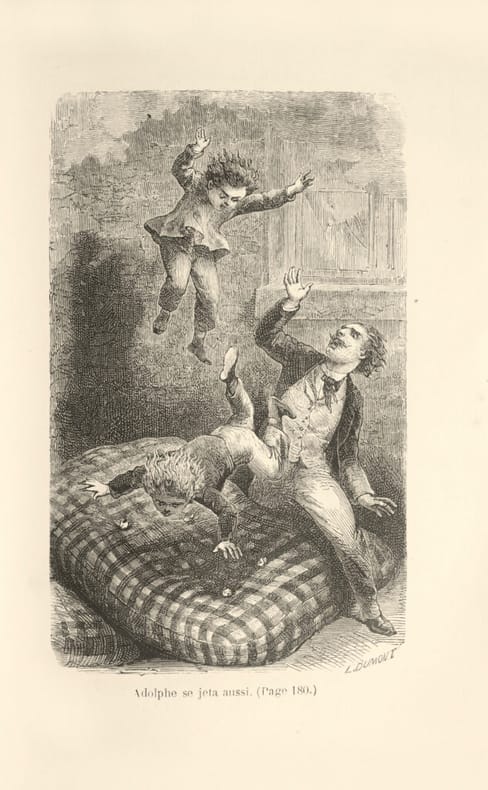
LCS-18435L’illustration se compose de 28 planches à pleine page et de nombreuses vignettes dans le texte par E. Bayard. Paris, Hachette et Cie, 1864. In-12 de (6) pp., 406 pp. dont 28 planches à pleine page, (2), rousseurs habituelles. Demi-percaline rouge, dos lisse, tranches mouchetées. Reliure de l’époque. 178 x 112 mm.
8vo. 2¾ pp. on bifolium. A fine letter to the art collector and art dealer Johann Friedrich Frauenholz (1758-1822), written during Tischbein's curatorship as head of the Accademia di Belle Arti at Naples. Tischbein discusses a painting which Frauenhold had sent him, and writes about the publication of his works on Red-figure vase painting. - Edges slightly frayed.
1 S. Gr.-4to. Die Verso-Seite mit gedr. Briefkopf "Die Weltbühne [...] Paris". Typischer Scherzbrief, möglicherweise an Hermann Budzislawski (1901-1978): "Sehr verehrter Herr Leidensgenosse, höre soehmt, dass Ihnen Ihre werte Frau Frau durchgegangen ist und gratuliere I[h]nen herzlichst. Möchte gleichzeitig mal anfragen, ob Sie gewillt sind, unserm | Reichsbund deutscher Hahnreie | beizutreten, (Ehrenprotektorat: Seine Majestät Wilhelm II) - Jahresbeitrag 69 M. Der RDH hat es sich zum Ziele gesetzt, die Belange der deutschen Reie und Hahnreie im Reichstag zu vertreten und für ihre standesgemässe Behandlung den erbitterten Kampf zu führen, der uns schon immer gefehlt hat. Wir sind ein armes Volk und müssen uns eben nach dem Dawes-Plan strecken - die alte, deutsche Tüchtigkeit hats aber noch immer geschafft, und da[r]um bitten wir auch Sie, sehr geehrter Herr Professor, ihre Rei-schaft auf uns übertragen zu wollen. Unserer Klubdiener putzt den Mitgliedern jeden Morgen die Hörner. Mit deutschem Hussa-Hoho! [...]". - Tucholsky lebte vom Frühjahr 1924 bis 1930 als Auslandskorrespondent in Frankreich, zunächst in Paris. Dort schrieb er im Herbst 1925 auch über das Wort "Hahnrei": "'Hahnrei' ist ein Wort, für das selbst der alles wissende Doktor Wasserzieher in seinem 'Ableitenden Wörterbuch der deutschen Sprache' keine Erklärung gibt und das ein gesunder Mensch wohl nur ausspricht, wenn man ihn fragt, was 'cocu' auf deutsch heißt" (Peter Panter, Noch einmal französische Witze, in: Vossische Zeitung, 10. 9. 1925; wieder in: Lerne Lachen [...]). - "Der Brief ist von Tucholsky. Es passt einfach zu seinem Stil, von diesen Scherzbriefen haben wir bereits etliche" (frdl. Mitteilung von U. von Bülow, DLA Marbach, Handschriftenabt.). - In der neuen Tucholsky-Gesamtausgabe offenbar nur in den Anmerkungen gedruckt.
LCS-17571Édition originale, tirée à 500 exemplaires, du « dernier ouvrage important du ‘pauvre Lélian’ ». Paris, Léon Vanier, 1889. In-8 de (2) ff.bl., (3) ff., 116 pp., (1) f.bl. Cahier volant comprenant le recueil de vers « Chasteté », exemplaire truffé d’un billet autographe signé de Paul Verlaine au crayon. Conservé dans sa couverture beige clair imprimée d’origine, non rogné, sur témoins. Etui-chemise en demi-maroquin signé Pierre-Lucien Martin. 187 x 122 mm.
8vo. ¾ p. With autogr. address. Sending some greetings from the "Ratskeller" at Munich to Clara Gerlach, the wife of the German-Austrian photographer and publisher Martin Gerlach. Weisgerber's sketch (in pencil) depicting a woman looking down on a small town. - Corner with stamp removed; somewhat browned due to paper.
177253544Frankfurt/Main: Burgerlicher Ausschuss und Burgerl. Neuner 1772. First edition. Hardcover. Good to very good condition. Small Folio. 168pp. Rebound in decorative paper-covered boards with manuscript title on tan spine protected by modern mylar. Red edges. Marginalia. Decorative headpiece and historiated initial. <br /> <br /> ".latam nec non concedendo facultatem concipiendae vovae originariae Judaeorum Francosurtensium conditioni praefentique eorum statui accommodatae ordinationis & c. Anwälde beeder Kayserlichen verordnet und bestättigter Collegien des Burgerlichen Ausschusses und Burger. Neuner in Frankfurt Intervenientenby der Sache Gemeiner Judenschaft zu Frankfurt contra den Magistrat daselbst die Cramläden und Gewölber außer der Judengasse betreffend. Mit beylagen." continuation of title page<br /> <br /> Holy Roman Emperor Leopold II King of Hungary Croatia and Bohemia's 1771 ordinance regarding Jewish storefronts and houses in Frankfurt with reviews by officials of the city and attachments. The address to the emperor includes passages showing uninhibited disdain for the Jews: ". that the Jews in Frankfurt since their first admission and up until now have been detrimental and onerous for the Christian Frankfurt merchants." <br /> <br /> The extensive report respectfully requests confirmation of the ordinance providing several attachments making their case. The attachments include A B C1 C2 C3 and C4 plus D and the text of previous ordinances providing a historical outline and details regarding the treatment of Jews historically with secondary attachments concluding with an ordinance from 1616. Contains a list of houses and occupants for both sides of the Judengasse at rear closing with the emperor's confirmation. Signed in print by Hans Ludwig von Ulm for the emperor and Johann Rudolph Bucher for the city.<br /> <br /> Text in German Gothic script. Some light wear along edges of binding with spine showing several small to medium chips at head middle including label and tail of spine. A couple of small chips at front joint of spine. Printed label "Ex bibliotheca Johannis Augusti Speltz J.U.D etc. with manuscript number 113 on inside front cover. Block in very good condition. Burgerlicher Ausschuss und Burgerl. Neuner hardcover
81169Edinburgh: Payback Press 1996. First U.K. Edition. First Impression a trade paperback original. Octavo 19.5cm; original pictorial card wrappers; xii2377pp. Inscribed by the author on the half-title page to Pulitzer Prize-winning poet Gwendolyn Brooks: "Miss Brooks - Forgive the N. word this was written a long time ago. But I'd say it again / Gil Scott-Heron A Chicago Native 4/97." Trivial wear to extremities hint of foxing to text edges; very Near Fine.<br /> <br /> UK edition of Scott-Heron's second novel originally published by Dial Press in 1972. Inspired largely by his own experiences as a student during the late 1960s-early 1970s the book is a satirical look at campus life during that turbulent era. "Earl Thomas student body president at Sutton University is in a difficult position: struggling with the fact that even a historically black college could be part of a system that still priviliges whites he's also threatened by his fellow students members of the radical activist group MJUMBE. Claiming the time has come for revolution not reform the leaders of MJUMBE are poised not only to bring Earl down personally but also to instigate large scale acts of violence" from the Grove/Atlantic reissue. This copy bears a particularly poignant inscription to fellow Chicago poet Gwendolyn Brooks whose involvement in the Black Arts Movement was a key influence on Scott-Heron's work. Brooks's regard for Scott-Heron is evident in her poem titled "Gil Scott-Heron":<br /> <br /> "Chance-taker<br /> Emotion voyager<br /> Street-strutter<br /> Contemporary Spirit<br /> Untamed Proud Poet<br /> Rough Healer<br /> He is His"<br /> <br /> An exceedingly good association copy of a key title. Scott-Heron's autograph material has always been uncommon; this is only the third inscribed book we have seen over many years with no signed or inscribed books appearing in the auction record. BLOCKSON 5986 for the Dial Press edition. Payback Press unknown
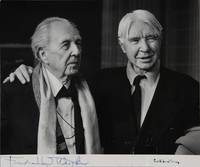
11339Used; Like New/Used; Like New. Oblong 1957 photograph of the renowned American architect and the renowned American poet both ex-Chicagoans and old friends boldly signed by each in the lower blank margin. Original photograph by Art Siegel 7 1/2 x 9". On verso notations record the place each autograph was obtained: Sandburg's in Flat Rock North Carolina and Wright's in Scottsdale Arizona January 1958. A few areas of surface loss to the image which have been in-painted with dye and an area of evident creasing or tearing repaired by a clumsily affixed small adhesive light paper skinning on the lower edge none of these faults affecting either of the signatures. Simply matted and framed under plexiglass. Signed photographs of Wright are very rare.<br><br><br />The image depicts these two great American originals as they met to appear together in 1957 on television's Omnibus hosted by Alistair Cooke. They were old friends by this point having met as young men in Oak Park Illinois and had been close for nearly half a century. Around this time they also participated together in a lively discussion eventually published in Long Island's 'Newsday' under the headline "Meeting of the Titans." That encounter concluded when the interviewer Alicia Patterson asked "What do you think of each other" Wright spoke first: "I wouldn't have any one of my friends improved.I like Carl as he is." Sandburg answered: "I think I will write a Frankl Lloyd Wright poem and it will have music and it will have dimensions in it." When Wright asked: "Third dimensions" Sandburg replied: "I will even suggest a fourth one." unknown books
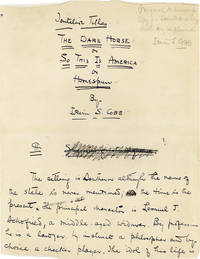
193446764N.p.: S.i. 1934. Holograph manuscript composed in dark blue ink on 152 numbered leaves rectos and housed in a bespoke chemise and slipcase by Barrieri. With presentation inscription from Cobb to MGM film produced and screenwriter Samuel Marx in pencil at upper right corner of title leaf: "Original manuscript copy for Sam Marx Esq / with my compliments / Irvin S. Cobb." A heavily-revised draft with extensive holograph additions and elisions in pencil and in pen throughout marking substantial textual differences between this and the final draft of the screenplay. Mild wear and handling; preliminary leaves with faint creasing to extremities with subtle toning to title leaf; Very Good or better. Slipcase with some light wear and minute board exposure to points around opening else Near Fine. Early unpublished manuscript treatment of the 1939 Paramount Studios film Our Leading Citizen directed by Alfred Santell with a screenplay by Jack Moffitt. A "Capital vs. Labor" story set in a once-small town that has evolved into an industrial city and centered around Lem Schofield an attorney and homespun philosopher and Clay Clinton son of Schofield's deceased partner. Clinton in love with Schofield's daughter and anxious for quick success joins the employ of J.T. Tapley the town's corrupt and influential industrialist. "When Tapley imposes a ten percent wage cut at his factory the workers walk out on strike precipitating a labor war. Lem immediately withdraws as Tapley's attorney but Clay ignorant of the nefarious tactics that Tapley is planning stays on. To crush the strike Tapley calls in a gang of strikebreakers led by Shep Muir. While pacifist union leader Jim Hanna struggles to end the strike peacefully communist agitator Jerry Perkins arrives in town to advocate radicalism and violence. Riots break out and amid an atmosphere of fear and suffering Lem steps in to quell the unrest. After insuring the arrest of agitators Peters and Muir Lem works to institute a labor settlement and Clay finally recognizing Lem's virtues nominates him for the position of United States Senator" TCM. While the final script faulted greedy capitalists and violent revolutionaries alike the film was blacklisted by V.J. Jerome head of the communist cultural commission who got an early look at the script and together with film critic Howard Rushmore deemed it potentially anti-communist. S.i. unknown books
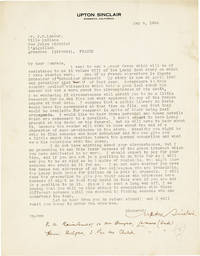
46769V.p.: 1946-47. Archive of six TNS typed notes signed five TLS typed letters signed and one Western Union telegram from Upton Sinclair to the Paris literary agent and translator Jean-Robert Lamour better known by his pseudonym Yves Malartic. Together with ten of Lamour's retained carbons of communications to Sinclair and others. Correspondence spans the period January 1946 to December 1947 and deals with Lamour's efforts to secure publishing contracts for French-language translations of Sinclair's works including The Jungle They Call Me Carpenter Our Lady and others as well as Sinclair's ongoing work on the Lanny Budd series. Sinclair's letters range from notes of as few as four lines to letters of two pages the entirety comprising approximately 2500 words with numerous hand-corrections and signatures in blue or black ink. Lamour's letters to Sinclair comprise nine pieces of correspondence of which three are partial and one draft contract with a total of approximately 3000 words. Three of Lamour's letters are in French addressed to French correspondents all on matters concerning the translation and publication of Sinclair's works. Occasional toning; old folds; onion-skin carbons creased at margins; Very Good. Excellent archive of original correspondence dating from Sinclair's productive wartime and post-War period during which he produced the monumental eleven-volume Lanny Budd series of novels including the Pulitzer Prize-winning Dragon's Teeth. <br/><br/>The correspondence appears to have been struck up by Lamour in late 1945 those letters not present here seeking rights to translate and publish a number of Sinclair's early proletarian novels including The Jungle They Call Me Carpenter Samuel the Seeker as well as such shorter works as No Pasaran! The Flivver King Depression Island and others. Lamour born ca. 1911 at this date in the early stages of his literary career would go on to translate numerous works by American authors in particular Chester Himes and Alex Haley under the pseudonym "Yves Malartic." In his letters to Sinclair Lamour/Malartic shows careful reading and textual analysis of the novels under consideration expresses admiration for Sinclair's body of work and is clearly excited about exercising a newly-available liberty to publish leftist works after the long occupation of Paris stating in one undated letter: "France is groping for a notion of human socialism and french sic people are very interested in everything that refers to U.S.A." At another point Lamour dismisses the publisher Bernard Grasset who had turned down several of Sinclair's works for translation during war-time: "In 1944 Grasset has been deprived of his ownership for collaboration and a manager has been appointed by the government." indeed following the dismissal of its principal the firm of Grasset would become the primary publisher for many of Sinclair's works in France. <br/><br/>Sinclair's replies range from long admiring letters to brief acknowledgments and notes of transmittal. Throughout he shows concern not only for his own legacy among French readers but for the wellbeing of his putative translator - Lamour who does in fact appear to have been driven by a somewhat altruistic impulse at one point appears to suggest that he is willing to translate and edit Sinclair's works without compensation to which Sinclair replies: "." Sinclair's ongoing consuming work on Presidential Mission and One Clear Call the eighth and ninth installments in his Lanny Budd series forms a backdrop to the entire correspondence; at one point he attempts to engage Lamour's assistance with background research on One Clear Call; at several others he begs off new writing assignments because of the all-consuming nature of his work even declining to read a recently-published short story by Lamour claiming that all his energies are consumed by the Lanny Budd project. Indeed Sinclair's output during this period was phenomenal: in the two-year span in which these letters were written Sinclair well into his sixties produced three massive novels - A World to Win Presidential Mission and One Clear Call - and was well along on a fourth O Shepherd Speak! published in 1949. <br/><br/>While Sinclair letters are hardly an oddity in commerce the current archive of correspondence is noteworthy for providing real insight not only into Sinclair's working methods but also into the post-war literary climate in France where it is clear that writers on the left who had been radically disenfranchized during the long Occupation were eager to take on any project that might re-establish their careers while also hopefully putting food on the table. unknown books
189544165New York December 8th 1895. Autograph letter signed on recto and verso of single cream laid sheet 22x14.5cm.; approx. 85 words; dated 26 West 61st N.Y. Dec 8th and simply addressed to "Parker" presumably Stanton's friend and fellow-suffragist Parker Pillsbury 1809-1898 who with Stanton had co-edited the women's rights newsletter "The Revolution" twenty years earlier. Faint mail folds small unobtrusive archival paper remnants to two corners from having been previously mounted else Near Fine and still quite fresh. Brief contemporary 1897 pencil note at bottom edge "Mrs. Stanton - born Nov. 12 1815 Now past 82 - C.E.R." though based on contents we would place this letter as having been written around 1895. Brief but significant missive addressed to Parker Pillsbury the American minister and women's suffrage advocate regarding a copy of Stanton's "Woman's Bible" she had just sent him. "I wonder if I could interest them a "Mrs. White" and one other sufficiently in the Woman's Bible to sell ten or twenty copies in there sic respective woman's clubs It is published at my expense hence I am trying to push its circulation." The controversial "Woman's Bible" a series of commentaries pertaining to the portions of the Bible relating to women was published in two parts in 1895 and 1898 and composed almost entirely by Stanton alone her committee of Bible revisors finding the project too controversial and harmful to the cause of women's suffrage. Clearly at the time of writing this letter the book was still meeting with resistance thus our placing the date at around 1895 Stanton turning to Pillsbury as a potential source of influential and wealthy patrons she inquires "Is Mrs. White still living & working Is that rich woman that Mr. illegible used to visit in Maine living". But by 1897 the book had become a best seller though many of the members of the women's suffrage movement would continue to distance themselves from it. This letter quite significant as a testimony to the aging Stanton organizer of the historical 1848 Seneca Falls Convention and her continuing indefatigable efforts and initial lack of support in getting this work circulated. See Tracy A. Thomas "Elizabeth Cady Stanton and the Feminist Foundation of Family Law" 2016 pp. 15 & 223. unknown books
20172081502111907915Kaikyo Literary Publishing Company 2017. Soft Cover. Fine. The book is in fine condition. Kaikyo Literary Publishing Company paperback
Paris, Buisson, (1796/97) - An Cinquième De La République. 8vo. Very nice contemporary half calf with gilt spine. Minor, barely noticeable repair to upper capital and slight bumping to corners. A very nice and clean copy, with only very minor brownspotting. Printed on good paper. With the half-title (bearing the ""Décret concernant les Contrefacteurs"" on verso). Book plate of Guy de Portuales to inside of front board. (4), 411, (1) pp.
- Plon, Paris 1937, 13,5x19,5cm, relié. - First edition, one of 20 numbered copies on Japan, head print. Binding half morocco anthracite corners, smooth back adorned with cold boxes, golden date tail, guards and contreplats of marbled paper, guards and eggplant paper tidbits, covers and back preserved, gilded head witnesses, elegant binding signed Honnelitre . Rare and beautiful copy of all perfectly established margins of this novel which was adapted to the cinema, in 1967, by Robert Bresson. [FRENCH VERSION FOLLOWS] Edition originale, un des 20 exemplaires numérotés sur Japon, tirage de tête. Reliure en demi maroquin gris anthracite à coins, dos lisse orné de caissons à froid, date dorée en queue, gardes et contreplats de papier marbré, gardes et conteplats de papier aubergine, couvertures et dos conservés, tête dorée sur témoins, élégante reliure signée Honnelaître. Rare et bel exemplaire à toutes marges parfaitement établi de ce roman qui fut adapté au cinéma, en 1967, par Robert Bresson.