858 328 résultats
8vo. 34 pp. Printed blue original wrappers. German-Italian libretto for Legouvé's "Medea" adaptation which premiered on 18 February 1858 at the Carl-Theater in Vienna's Leopoldstadt district, where Nestroy served as director from 1854 to 1860. The actors' names are corrected by hand, and Nestroy signed the secretary's presentation note for the board of censorship. The censor passed the text without any changes; his handwritten endorsement is at the end of the text. The performance with Adelaide Ristori in the title role marked the beginning of a series of twelve shows staged by the Italian theatrical company of Luigi Bellotti-Bon (1820-83). Nestroy's contribution to the play's success was noted in the press (cf. Die Presse no. 40, 19 Feb. 1858, p. 2). - Corners of upper cover carefully repaired.
44078Genève Chez Jean-Léonard Pellet 1780 in 4 (17,5x22,5) 5 volumes reliures plein veau fauve granité de l'époque, dos à nerfs ornés, pièces de titre et de tomaison de maroquin rouge. Tome 1: portrait en frontispice gravé par De Launay d'après Cochin, XVI, 1 planche hors-texte (petite restauration marginale ancienne), 741 pages. Tome 2: 1 frontispice gravé [Moreau le Jeune], VIII et 485 pages. Tome 3: 1 frontipice gravé,.XV et 629 pages. Tome 4: 1 frontispice gravé, VIII et 770 pages, et 1 feuillet non chiffré d'errata. Tome 5: ATLAS renfermant 24 pages manuscrites à l'époque à la plume: liste des cartes, et Analise succincte de cet atlas. et 50 cartes gravées hors texte [N°1 à 17-17 bis à 49], dont 1 mappemonde, 1 planisphère, 10 cartes de l'Europe, 8 cartes de l'Asie, 7 cartes de l'Afrique et 23 cartes de l'Amérique tracées par l'ingénieur-hydrographe de la Marine Rigobert Bonne, et gravées par Dien, suivies de 23 tableaux hors texte repliés, petite usure et trace de mouillure sur le pli inférieur de la carte N°17. Guillaume Thomas François Raynal, 1713-1796. Bon exemplaire, les 5 volumes en reliures uniformes de l'époque ( Photographies sur demande / We can send pictures of this book on simple request )
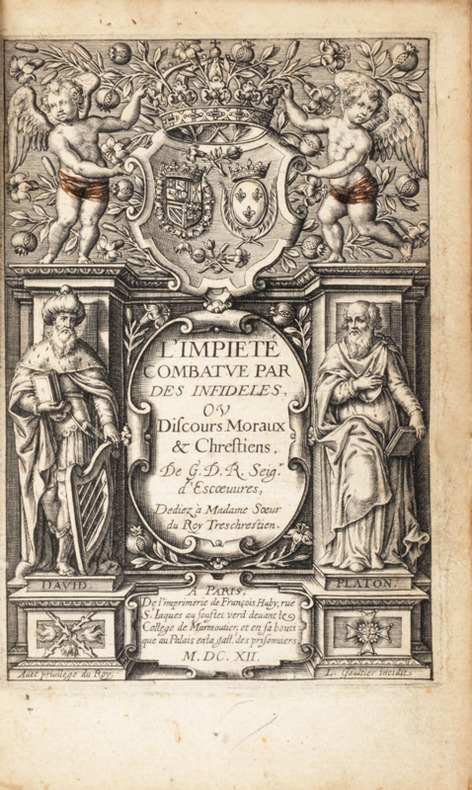
161240372Paris, François Huby, 1612. Petit in-8 (11 x 17 cm) de (24)-391-(1) pp., frontispisce, veau fauve, dos à nerfs, écoinçons à fond azuré, cartouche central losangé à fond doré de style oriental réservant un oval uni, semis de fleurs de lis couvrant les plats et le dos, tranches dorées (reliure de l'époque).
189514853Paris Chamerot et Renouard 1895 2 albums petit in-4 "à la japonaise", couverture de papier moiré, l’un noir, l’autre blanc, revêtu chacun d’une bande de papier gris décoré d'une composition de Pitcairn-Knowles (Petites macules).
169038016PRIMERA Y UNICA EDICION.- S.l.: s.n. s.a. ca. 1690 o 1691.- 4 h. 528 p. 4 h.; 4º menor 205 x 16 cm: Con 2 viñetas xilográficas de fin de capítulo; Buena impresión sobre papel verjurado fuerte y limpio; Cinta separadora de lectura; Enc. en Plena Piel pasta época lomo liso con dorados y tejuelo rojo con el título cortes jaspeados. Según Salvá en su Catálogo ficha Nº 3595 este libro debió imprimiese para ser regalado o distribuirlo privadamente pues no consta por ninguna parte ni el nombre del librero que lo publicó ni aún el del pueblo donde salió a luz. Por todo esto la rareza de este libro se debe a su escasísima difusión y corta tirada. Catalina asevera que la impresión debe ser de Madrid."y casi tengo la seguridad de que no se imprimió en Alcalá". No obstante es de señalar que al principio del libro justo al final de la carta impresa en que se dedica el libro al Excmo. Sr. Marqués de Mondejar el autor escribe: Mondejar y Julio 20 de 1690. Por esto deduzco que debió de imprimirse en ese año o a más tardar al siguiente de 1691.- RARISIMA OBRA. Palau nº 276605 Salva nº 3595. Las 14 hojas comprendidas entre las pags. 133 a 161 tienen en la esquina superior externa una máncha de óxido que toca un poco al texto y va disminuyendo hasta desaparecer pero no afecta ni a su lectura ni a la textura del papel. También falta un trocito de papel en la esquina inferior externa de la hoja que corresponde a las pags. 275-76 que toca mínimamente al texto de una apostilla marginal impresa. Con 7 notitas de la época manuscritas a tinta en los márgenes externos. El plano posterior restaurado de dos pequeñas faltas de piel que apenas se notan. A PESAR DE LO DICHO QUE ES PRECEPTIVO EL LIBRO SE ENCUENTRA EN MUY BUEN ESTADO. CASTILLA-LEÓN Libro en español Sin editorial hardcover
AN AUTOGRAPH MANUSCRIPT BY MICHEL BUTOR (10 leaves, with writing on rectos), ACCOMPANIED BY 19 LARGE MARKER DRAWINGS BY STEPHANE BASTIN. This is the actual manuscript used for publication of the book, of which 530 copies were printed (a copy of this book is included with the manuscript.) 4to. Loose sheets. FINE AND BRIGHT, WITH NO DEFECTS. A UNIQUE ITEM OF GREAT LITERARY AND ARTISTIC INTEREST.
Ausnehmend seltene Autographie einer unmittelbar vom Original getätigten Abschrift des »Prologs und Epilogs für die lebenden Bilder« von Hugo von Hofmannsthal, den dieser als Begleittext für eine Aufführung von Tableaux Vivants im Wiener Palais Todesco, an der er auch selbst teilnahm, verfasst hatte. – Entstehung, Inhalt: Am 28. Februar und am 2. März 1893 wurde im Festsaal des von Theophil Hansen gestalteten Palais der Wiener Bankiers Todesco unter Mitwirkung der Wiener Jeunesse dorée ein Abend mit „Lebenden Bildern“ veranstaltet. Das Programm bestand aus 10 Tableaux Vivants, die von der Pianistin und Opernsängerin Caroline von Gomperz-Bettelheim am Klavier mit Gesang begleitet wurden. Nachgestellt wurden u.a. »Die Braut« aus dem Aquarell-Zyklus »Die schöne Melusine« (1869) von Moritz von Schwind und Hans Makarts Ölgemälde »Romeo und Julia« (1863-64). Hofmannsthal, bekannt mit der Tochter des Hauses Yella Oppenheimer, schrieb für diese Aufführung einen Prolog und einen Epilog, und trat er auch im letzten Bild, jenem nach dem »Hochzeitszug« von Frederik Hendrik Kaemmerer, auf. Sowohl Prolog als auch Epilog, während letzterem noch einmal „im Reigen Gestalten aus den aufgeführten Bildern vorüber“ zogen (KA, S. 199), wurden von einer als Muse verkleideten Mitwirkenden rezitiert. „An die Bilder schloß sich ein glänzendes, von über zweihundert Gästen besuchtes Ballfest, auf dem die Mitwirkenden zum Teil in ihren prächtigen Kostümen erschienen.“ (Winter, S. 68). – Vorliegende Blätter wurden als Umdrucklithographie einer in musterhafter deutscher Kurrentschrift unmittelbar von fremder Hand getätigten Abschrift der originalen Handschrift Hofmannsthals abgezogen. Die Autographie muss noch während der Proben in einer Kleinstauflage gefertigt worden sein, und war sie wohl den Besuchern der beiden Aufführungen vorbehalten. – Erhaltung: Die Blätter mit alter Längs- und Querfaltung, an den Rändern und Faltstellen teils mit kleinen Einrissen. – Seltenheit: Außerordentlich rar. Außer dem vorliegenden sind lediglich zwei weitere Bestände mit Exemplaren der Umdrucklithographie bekannt: Ein Exemplar liegt im Hofmannsthal-Nachlass des Freien Deutschen Hochstiftes, Frankfurt am Main (Sigle "6 D1" der Kritischen Ausgabe), ein Satz mit 4 weiteren Exemplaren im Teilnachlass betitelt „Hugo von Hofmannsthal papers“ in der Houghton Library, Harvard. Eines dieser Exemplare ist von Hofmannsthal mit eigenhändiger Notiz gewidmet "Meiner lieben Großmama / 12 III 93." JBP, JAP/APO und RBH weisen kein einziges Auktionsergebnis aus. – Literatur: Jacoby 29i; Hugo von Hofmannsthal: Sämtliche Werke. Kritische Ausgabe. Bd. I. FfM.: 1984, Ss. 38-41 (Text, wie hier) u. Ss. 199-208; zu Ex. Sigle 6 D1 sh. S. 201 u. 2. 207; Josephine Winter: Fünfzig Jahre eines Wiener Hauses [Todesco/Oppenheimer, Anm. DJ]. Wien und Leipzig: 1927.
LCS-17620Précieux exemplaire relié en beau maroquin rouge de l’époque orné d’un décor à la Duseuil. Paris, Denys Thierry, 1674. In-4 de 1 frontispice, (2) ff., pp. 1 à 142, (4) ff., pp. 143 à 178, 1 second frontispice, (1) f. de privilège, (4) ff. de préface, 102 pp., (5) ff. Relié en plein maroquin rouge, plats ornés d’un décor à la Duseuil, dos à nerfs orné de fleurons dorés, coupes décorées, roulette intérieure, tranches dorées. Reliure de l’époque. 242 x 175 mm.
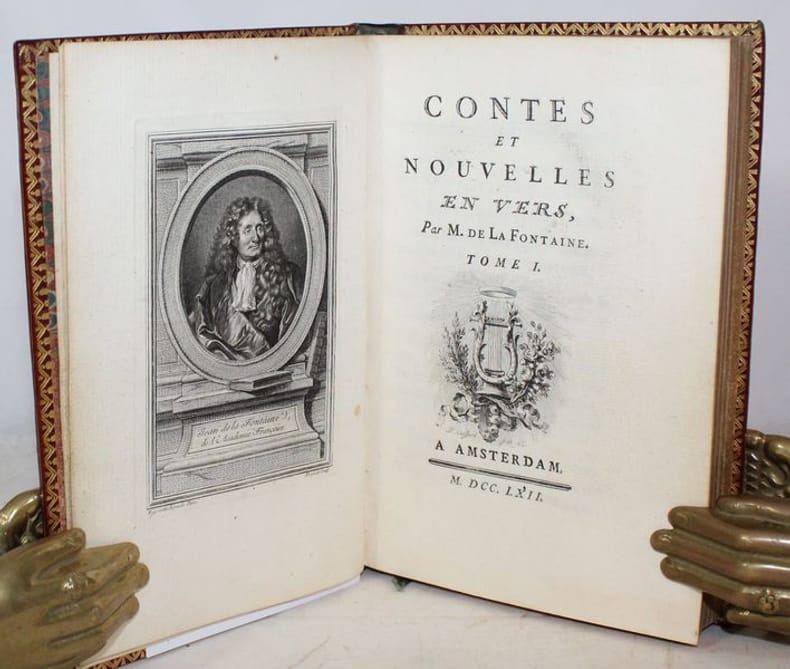
23143Amsterdam (Paris), 1762. Deux volumes in-8. Tome I: XIV pp. dont Vie de La Fontaine par Diderot, (1)f., 268 pp, (1)f., 8 pp. d'Avis au relieur, 1 portrait d'après Rigaud gravé par Ricquet et 39 figures par Eisen. Tome II: (1)f., VIII pp., (1)f., 306 pp., (2)ff. de table et Avis au relieur paginé 9 à 16, un portrait d'après Eisen et 41 figures par Eisen (conforme à Rochambeau). Intérieur très frais malgré de fines brunissures pp.177 à 204 sans gravité au T.II. Maroquin rouge, triple filet doré sur les plats, dos lisse orné, filet sur les coupes, roulette intérieure, tranches dorées. Reliure d'époque en très bel état.
8vo. ½ page. Unpublished letter to his new publisher: "Je reconnais avoir à M. Werdet la facture par laquelle M. Gosselin déclare ne conserver aucun exemplaire des ouvrages qu'il avait eu à vendre et la joindre aux pièces qui me libèrent, et je la lui communiquerai toutes les fois qu'il en aura besoin" (transl.: "I acknowledge to have with Mr. Werdet the invoice by which Mr. Gosselin declares not to keep any copy of the works which he had to sell and join it to the documents which release me, and I will communicate it to him whenever he will need it").
8vo. 2 ½ pp. on bifolium. To a "dear professor": "Hier kommen die verlangten 30 Exemplaar [probably vol. 5 of his "Asmus omnia sua secum portans, oder Sämtliche Werke des Wandsbecker Bothen", published the previous year]. Wenn etwa eins auf der lange[n] Reise beschädiget würde, habe ich ein 31stes beygelegt. Ihr Herr Zettele hat bezahlt, und ich danke für gute Zahlung. Dieser Herr Zettele gefällt uns nicht übel, und wir spiegeln uns an seiner Bescheidenheit, Mäßigkeit pp Gott erhalte ihn dabey - denn es ist viel oft schwerer dergleichen zu bleiben als zu seyn - so kann ein guter Erzieher aus ihm werden. Aber wir haben lachen müßen, daß seine Eleven zum Theil erst gebohren werden sollen. Der Graf Tupper macht es sans Comparaison wie der liebe Gott, der seine Kinder liebt und sorgt schon ehe sie sind. Grüßen Sie die Ruesche samt und sonders herzlich von uns, und den guten alten Beeke, und sich selbst; Wir lieben und achten Euch unbekannter Weise, und wünschen Euch alles Gutes. [I]ch danke auch vielmahl für die Bücher. Gott sey mit Ihnen [...]". - The "Ruesch" mentioned is probably Johann Baptist von Ruoesch (1744-1832), "Beeke" is probably the composer and pianist Ignaz von Beecke (1733-1803), who kept company with Gluck and Mozart and enjoyed their esteem. - Not in Hans Jessen, Matthias Claudius. Briefe an Freunde, Berlin 1938. - Reverse of fol. 2 with insignificant traces of mounting.
289, (3); 33 SS. (Einschub nach S. 64: "Tractat vom Steppenwolf" in gelber Originalbroschur). Blauer Originallederband mit goldgepr. Rücken, Rückenschildchen, Deckelfileten, Hesse-Monogramm am Vorderdeckel und Kopfgoldschnitt. 8vo. Vorzugsausgabe der Erstausgabe (1. bis 15. Auflage). - "Die sehr nette Dame ist Frl. Martha Ringier, eine in Basel lebende Lenzburgerin. Bei ihr habe ich einen Winter lang in Basel als Mieter gewohnt [11. XI. 1924 - 20. III. 1925] und dort in einer sehr lieben kleinen Mansardenwohnung von 2 Stuben, die erste Hälfte des Steppenwolf geschrieben. Wenn ich heimkam und die Treppe hinauf stieg, stand auf dem Vorplätzchen vor der Glastür im 2. Stock die schöne Araukarie" (aus einem Brief von 1948, Michels "Materialien zu Herman Hesses 'Der Steppenwolf'" [1972], S. 154). - Rücken und Einband etwas berieben, sonst tadellos. Mileck II, 50. WG² 155.
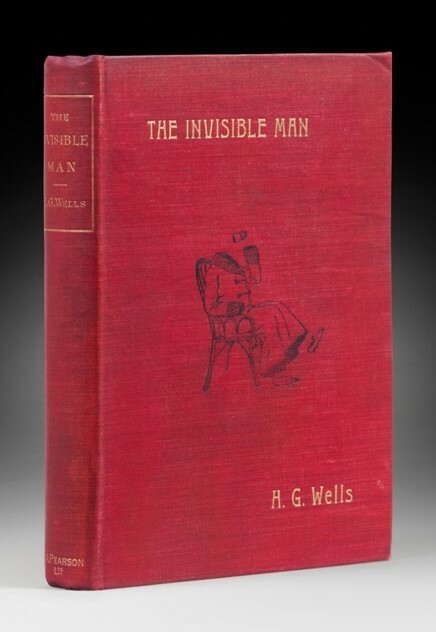
YTB-70London, Arthur Pearson, 1897. In-8 de VIII et 245 pp., (1) f. Toile rouge de l’éditeur ornée sur le plat supérieur du titre et du nom de l’auteur frappés en lettres dorées ainsi que d’une représentation de l’Homme Invisible frappé à froid, dos lisse. 185 x 123 mm. First edition, first issue, with the title page printed in orange and black, page 1 misnumbered and pages 247 and 248 being publisher's ads. ÉDITION ORIGINALE ET PREMIER TIRAGE DE CE GRAND ROMAN DE SCIENCE-FICTION DE H. G. WELLS. Reginald, 15039 ; Currey, p. 520 ; Hammond, B4 ; Wells, 11 ; Anatomy of Wonder, II-1227. "The Invisible Man remains not only an inescapable influence on modern science fiction but also a "classic study of scientific hubris brought to destruction" (Clute & Nicholls, 1313). « Roman de l’écrivain anglais Herbert George Wells (1866-1946), publié en 1897. Le jeune Griffin fait des études de physique ; fort intelligent, mais très pauvre, il a découvert un moyen de rendre transparents tous les tissus, y compris les cellules vivantes et il expérimente son procédé sur lui-même [...]. Ce roman appartient à la série des récits merveilleux par lequel Wells commença sa carrière d’écrivain. Ils lui furent inspirés par les conquêtes de la science moderne. La question sociale occupait alors une place prépondérante dans l’esprit de l’auteur. Bien que ‘l’homme invisible’ se rende coupable de plusieurs crimes, il est le prolétaire génial qui, en fin de compte, est plus sympathique que le ‘gentilhomme’ Kemp, timide, secrètement envieux de la supériorité scientifique de son ancien camarade, et offensé de son manque d’éducation. Une assez terrible amertume se fait jour dans ce roman : si tu es pauvre, ne sois pas différent des autres, ne sois pas plus intelligent que la moyenne, ne te fi e pas aux riches ; ils essaieront de te détruire par tous les moyens. Le roman a eu un grand succès » (Dictionnaire des Œuvres, III, 592). « On ne connait guère Wells en France que comme l’auteur de ‘l’Homme invisible’, des ‘Premiers hommes dans la Lune’, de ‘L’Ile du docteur Moreau’, de ‘la Guerre des Mondes’ et de ‘la Machine à explorer le temps’, comme une sorte de Jules Verne beaucoup moins didactique, singulièrement habile à tirer de la physique et de la biologie les éléments d’une poésie fantastique. Mais H.G. Wells est aussi l’un des hommes qui dominent la pensée britannique dans le premier tiers du XXè siècle : il est, avec Kipling, et peut-être Galsworthy, l’une des images que l’Angleterre propose au monde de sa vie intellectuelle » (P. Nizan, Pour une nouvelle culture). BEL EXEMPLAIRE CONSERVE DANS LA RELIURE EN TOILE ROUGE DE L’EDITEUR, TEL QUE PARU. First edition of The Invisible Man, an attractive copy, clean with no writing or marks or inside, preserved in the publisher’s original red cloth, rare in this condition.
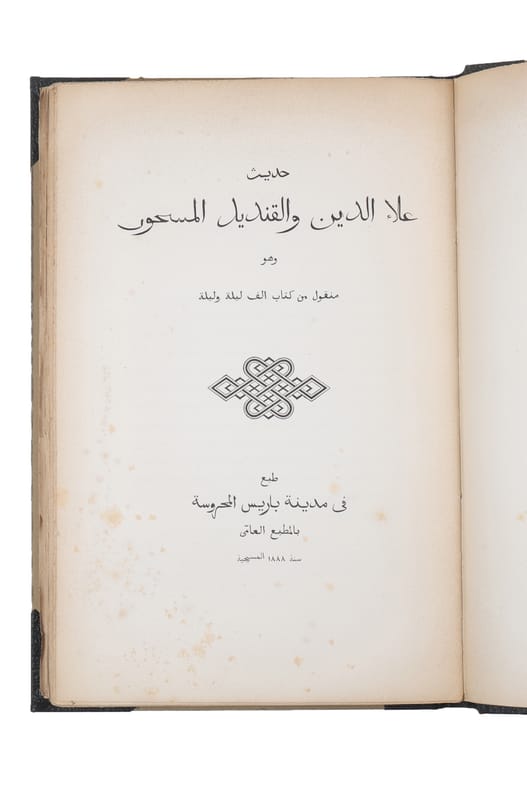
188863250Paris, Imprimerie Nationale, 1888. Large 8vo. (185 x 276 mm). Uncut in a recent black half cloth with paper covered boards (same colour as the original wrappers) with the original wrappers (blank part to top and bottom cropped, so smaller format, but no loss of imprint) pasted on to front and back board respectively. Paper labels to spine. A bit of spotting and browning to the wrappers. Also internally some brownspotting and a few pencil underlinings in the text (a couple in red crayon). A few marginal pencil annotations in the Arabic text. (4), 70 (French text)" (4), 86 (with Arabic numbering) pp.
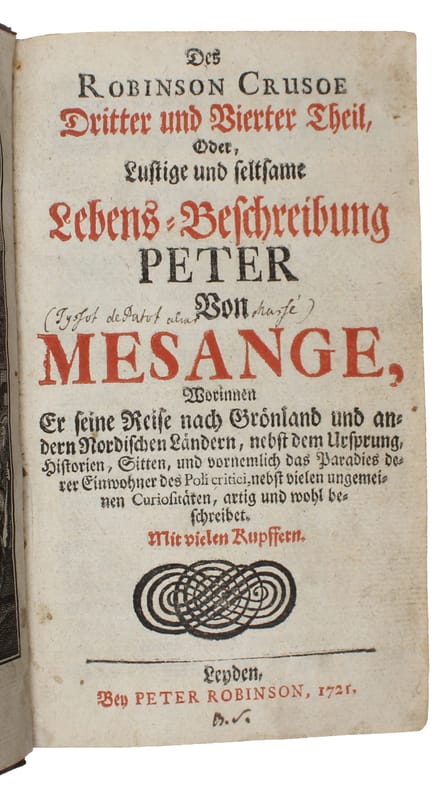
172160981Hamburg, Wierings Erben, 1721 (Part 1) Leipzig, Weidmann, 1721 (part 2) Leyden, Peter Robinson, 1721 (part III & IV). 8vo. Four parts uniformly bound in two contemporary full calf with four raised bands and gilt lettering to spine. Small paper-label to upper part of spines. Wear to extremities. Leather on spine cracked and scratches and soiling to bords. Front board on vol. 3/4 bended with outer margin partly broken off. Annotation in contemporary hand to front free end-paper in both volumes. Title-page and first leaves in vol. 1 soiled and with reapir. Folded plate closely trimmed with loss to lower margin, several tears, with some loss. Internally generally a good copy. [Vol. 1 & 2:] (14), 463, (1), (14), 448 pp. + frontispiece, 1 folded plate, 1 map and 5 plates (wanting 1)." [Vol. 3 & 4:] (6), 624 pp. + frontispiece and 2 plates.
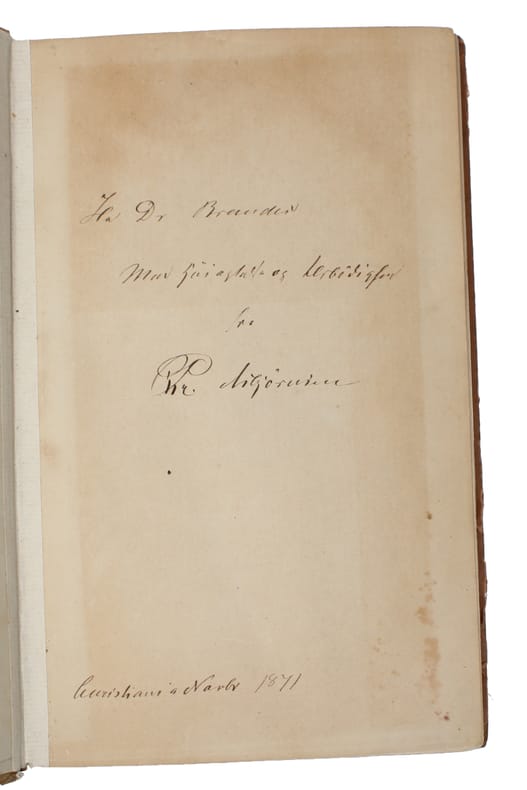
187161028Christiania, 1871. In the original paper binding with printed paper boards. Renewed blank spine-strip. Inner hinges re-enforced. Large book-plate of Gereda Philipp to inside of front board. Presentation-inscription to front free end-paper. Last leaf evenly browned to verso, but otherwise internally very clean and fresh. Binding with minor wear to extremities, and paper over boards a bit bevelled. A splendid copy in the original printed boards. Housed in an exquisite orange half morocco box with marbled boards and gilt lettering to spine (Henning Jensen).
88454Ibadan Nigeria: New Culture Studios 1978-1979. First Printing. 11 Issues running from November 1978 to October 1979 with no December 1978 production as issued. Small Quarto. 24.5cm. Publisher's original vibrantly decorated thin card wraps. Approx. 68-80pp. per issue. Clean bright and sharp; internally clean printed on various colors of paper some light spotting and offsetting in places due to the necessarily cheap paper stock with the "Dark Pages" complete and unopened. A very good clean bright set indeed.<br /> <br /> A full run of Demas Nwoko's visually striking and culturally ground-breaking "New Culture" magazine. Ulli Beier the driving force behind the equally impressive and influential "Black Orpheus" described new Culture as "Easily one of the most meticulously structured and planned magazines I have ever seen." Nwoko a visionary architect and now counted as a leading pioneer of Nigeria's 20th century art movement was one of the members of the inflammatory Zaria Art Society popularly called "Zaria Rebels" during the 1950's and later on a prominent member of the legendary creative collective known as the Mbari Club of Ibadan in the years prior to his creation and editorship of New Culture. The drive of the Zaria Rebels was to take their heavily western-influenced art education Nwoko for example studied in Paris and turn its methodology into a uniquely African themed art movement eradicating the concept of African art as subject to Western art critique and interpretation and rendering it its own liberated entity. New Culture was the logical extension of that mission providing a platform for the celebration of pan-African art architecture and literature and most importantly offering a place for cross-generational education on African history folklore and culture to younger Africans with specially curated sections for children's education. The design ethic behind New Culture is not only clear from the layout and general content but also in a sort of considered uniqueness that manifested itself in things like the famous "Dark Pages"; unopened sections of the magazine that contained unknown "surprise" features. Perhaps indicative of Nwoko's theatrical background these pages rendered each issue of New Culture an exercise in surprise revelation and audience participation. The magazine was short lived as most publishing efforts out of Ibadan tended to be a second volume was planned for early 1980 but never came to fruition. This brief vivid run of issues remains however as an indicator of the energy and vibrancy of the definitively African art scene of the period. New Culture Studios unknown
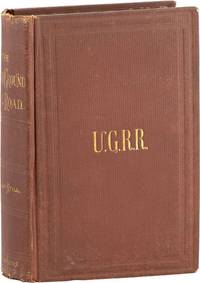
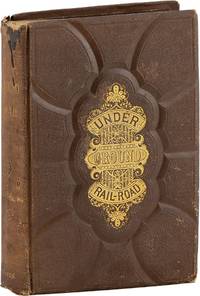
187284883Philadelphia: Porter & Coates Publishers 1872. First Edition. Thick octavo 24.5cm; variant in the publisher's terracotta fine English cloth binding with titles stamped in gilt on spine and front cover; dark brown clay-coated endpapers; 4pp.ads iv7802pp with an engraved frontispiece portrait of Still and 43 plates of illustrations. Gently spine-sunned spine ends pushed and a bit worn minute board exposure to corners some light surface wear and dust-soil to cloth with some partial cracks to front hinge and a small one to lower rear hinge; some light foxing and occasional finger-soil to margins of plates with some staining to lower third of pp.50-51 and the plate in between; a solidly Very Good unrepaired copy.<br /> <br /> A historically significant document by Still a free-born Black man who became an author and abolitionist movement leader in Philadelphia PA. The volume documented the stories of escaped slaves and remains "the only first-person account of Black activities on the Underground Railroad written and self-published by an African-American.William Still was a major contributor to the success of the Underground Railroad activities in Philadelphia and a part of Philadelphia's free Black community that played an essential role in the Underground Railroad. He personally provided room and board for many African Americans who escaped slavery and stopped in Philadelphia on their way to Canada. Through his work with the Pennsylvania Society for the Abolition of Slavery's Vigilance Committee he raised funds to assist runaways and arrange their passage to the North. He was instrumental in financing several of Harriet Tubman's trips to the South to liberate enslaved Africans" Turner Diane D. "William Still's National Significance." Web blog post. William Still: African American Abolitionist. Temple University n.d. 18 August 2016. <br /> <br /> Still kept meticulous notes concerning the many escaped slaves who passed through the Philadelphia "station;" he took pains to record names brief biographies and the destination for each individual along with any adopted aliases in hopes of reuniting family members who were separated by slavery. He kept his notes secret hidden in diaries he kept during those years and published them after the Civil War. The Underground Rail Road went through three editions and was displayed at the Philadelphia Centennial Exhibition in 1876. SCHOMBURG p.7 394; WORK p.338. Porter & Coates, Publishers unknown
187284792Philadelphia: Porter & Coates Publishers 1872. First Edition. Thick octavo 24.5cm; variant bound in the publisher's paneled-style brown pebbled cloth with titling and decorations stamped in gilt on spine and covers; dark brown clay-coated endpapers; all edges gilt; 4pp.ads iv7802pp with an engraved frontispiece portrait of Still and 43 plates of illustrations. Modest rubbing to the binding wear and shallow loss to heel with gentle sunning and biopredation to spine resulting in some erosion to the cloth; a few thin partial cracks to hinges two of them showing evidence of being re-glued with textblock starting to sag very slightly; early owner's small label and neatly rubber-stamped name John D. Harrison on preliminary blank and pp.101 400 and 780 with a small loss to margin at pp.45-46 and two pages with small marginal tears; Very Good.<br /> <br /> A historically significant document by Still a free-born Black man who became an author and abolitionist movement leader in Philadelphia PA. The volume documented the stories of escaped slaves and remains "the only first-person account of Black activities on the Underground Railroad written and self-published by an African-American.William Still was a major contributor to the success of the Underground Railroad activities in Philadelphia and a part of Philadelphia's free Black community that played an essential role in the Underground Railroad. He personally provided room and board for many African Americans who escaped slavery and stopped in Philadelphia on their way to Canada. Through his work with the Pennsylvania Society for the Abolition of Slavery's Vigilance Committee he raised funds to assist runaways and arrange their passage to the North. He was instrumental in financing several of Harriet Tubman's trips to the South to liberate enslaved Africans" Turner Diane D. "William Still's National Significance." Web blog post. William Still: African American Abolitionist. Temple University n.d. 18 August 2016. <br /> <br /> Still kept meticulous notes concerning the many escaped slaves who passed through the Philadelphia "station;" he took pains to record names brief biographies and the destination for each individual along with any adopted aliases in hopes of reuniting family members who were separated by slavery. He kept his notes secret hidden in diaries he kept during those years and published them after the Civil War. The Underground Rail Road went through three editions and was displayed at the Philadelphia Centennial Exhibition in 1876. SCHOMBURG p.7 394; WORK p.338. Porter & Coates, Publishers unknown
- Grasset, Paris 1950, 12x18,5cm, relié sous chemise et étui. - Édition originale, un des 75 exemplaires numérotés sur Montval, tirage de tête avec 20 vélin de Rives reservés à la librairie Jean Loize. Reliure en plein maroquin fauve, dos lisse, date dorée en queue, plats agrémentés de plaques incurvées de maroquin noir représentant des fers à cheval à l'intérieur desquels ont été appliquées des pièces de peau évoquant la robe d'un cheval pie bai tobiano (mélange de marron et de blanc crème), gardes et contreplats de papier marron, toutes tranches dorées, couvertures et dos conservés, chemise en demi maroquin marron chocolat à bandes, plats de papier marron-gris, pièce de titre de maroquin fauve, étui bordé de maroquin marron chocolat, plats de papier marron-gris, élégante et spectaculaire reliure signée D. H. Mercher. Très rare et bel exemplaire parfaitement établi. [ENGLISH DESCRIPTION ON DEMAND]
- La table ronde, Paris 1977, 14x19,5cm, broché. - First edition, one of 15 numbered copies on Hollande, the tirage de tête. Spine very slightly sunned, not serious. Rare and nice copy. [FRENCH VERSION FOLLOWS] Edition originale, un des 15 exemplaires numérotés sur Hollande, tirage de tête. Dos très légèrement insolé sans gravité. Rare et agréable exemplaire.
- La table ronde, Paris 1975, 14x19,5cm, broché. - First edition, one of 15 numbered copies on Hollande, the tirage de tête. Spine very lightly sunned at head and foot. Rare and nice copy. [FRENCH VERSION FOLLOWS] Edition originale, un des 15 exemplaires numérotés sur Hollande, tirage de tête. Dos très légèrement insolé en tête et en pied. Rare et agréable exemplaire.
- Macmillan and co, Londres 1889, 12,5x19cm, reliure de l'éditeur. - Sylvie and Bruno Macmillan and Co | Londres 1889 | 12.5 x 19 cm | publisher's binding First edition with 46 illustrations by Harry Furniss. Publisher's binding over flexible paper boards, discreet and light repairs on the joints, all edges gilt. Autograph inscription dated and signed by Lewis Carroll to Mrs Cole. [FRENCH VERSION FOLLOWS] Edition originale ornée de 46 illustrations d'Harry Furniss. Reliure de l'éditeur en plein cartonnage rouge, dos lisse, discrètes et légères restaurations sur les mors, médaillons dorés sur les plats, gardes et contreplats de papier noir, tranches dorées. Envoi autographe daté et signé de Lewis Carroll à Mrs Cole.
- Denoël & Steele, Paris 1932, 12x19cm, relié. - First edition on ordinary paper with all the characteristics of the first print. Binding in half red morocco, preserved covers and spine (first cover plate and lined spine with restorations), top edge gilt, binding signed by Laurenchet. Nice copy with the publisher's catalog in fine. [FRENCH VERSION FOLLOWS] Edition originale sur papier courant comportant bien toutes les caractéristiques du premier tirage. Reliure en demi maroquin rouge, dos à cinq nerfs sertis de filets noirs, date dorée en queue, plats, gardes et contreplats de papier marbré, couvertures et dos conservés (premier plat de couverture et dos doublés comportant des restaurations), tête dorée, reliure signée Laurenchet. Agréable exemplaire complet du catalogue de l'éditeur in-fine.
- Charpentier, Paris & Nantes 1863, 33x49cm, 3 volumes reliés. - Edition originale illustrée de 167 planches dessinées d'après nature par Félix Benoist et lithographiées par les premiers artistes de Paris dont Arnout, Bachelier, Benoist, David, Fichot, Tirpenne... Reliures en demi chagrin vert bouteille, dos à quatre nerfs sertis de frises dorées et ornés de doubles caissons dorés décorés de motifs typographiques et d'hermines héraldiques dorés, noms et lieux dorés en queues, plats de percaline vert bouteille, encadrement d'une large dentelle dorée enrichie d'hermines héraldiques et d'armoiries dorées, plats frappés en leurs centres des armoiries dorées de la Bretagne et de la ville de Nantes entourées d'une mandorle dorée, gardes et contreplats de soie moirée blanche, reliures de l'éditeur. Introduction historique par Arthur de La Borderie, épilogue sur la poésie bretonne de De La Villemarqué, textes descriptifs d'Aurélien de Courson, de Pol de Courcy, de Ropartz, d'A. de La Borderie, de De La Villemarqué... Quelques petites rousseurs sans gravité. Agréable exemplaire établi dans une belle reliure de l'éditeur aux armes de Bretagne et de la ville de Nantes. [ENGLISH DESCRIPTION ON DEMAND]