858 463 résultats
8vo. 7 pp. on 4 ff. To the painter Fürst, who had asked him a question concerning theosophy, in particular about the personal circumstances of one Ms. Martha Reif. Morgenstern gives detailed information on that lady, who - he supposes - was born in Wroclaw and was married to a painter. After some years living in Taormina, they are said to have divorced, and at the time of writing she resides in Vienna: "[...] I mention this lady, although one may never fully foresee how a personal acquaintance will work out, and whether or not it is helpful to our cause. There are so many mirrors that reflect the teachings of our occidental theosophists [...]" (transl.). - Slight spotting, with insignificant edge defects.
Small 8vo. 2 vols. (2), 188, (2) pp. 223, (1) pp. Pages 11 and 12 of vol. 1 absent from pagination, as issued. Original green and white wrappers, lettering in black to spine and upper cover. First edition, first issue, with the original price ("Francs: 900") printed on lower cover of each volume. - Nabokov's still-controversial masterpiece was initially rejected by several American and British publishers before being accepted by Maurice Girodias and his Paris-based Olympia Press. Upon publication, Nabokov defended his "serious work of art" to friends and publishers: "I know Lolita is my best book so far." The British Home Office ordered all copies entering the UK to be seized, and lobbied the French government so that, surprisingly, "Lolita" was also banned in France for nearly two years. "Lolita" was not published in the U.S. and the U.K. until 1959. The book is ranked fourth on the Modern Library's list of 100 Best Novels of the 20th Century. - Light wear to spines and extremities of jackets with upper cover of vol. 2 gently creased; white section of the spine of both volumes a little yellowed; page 63/64 shows minor loss to lower corner from imperfect opening. Still a very good set. Field 793. Juliar A28.1.1, issue a. Kearney, The Paris Olympia Press, 24.
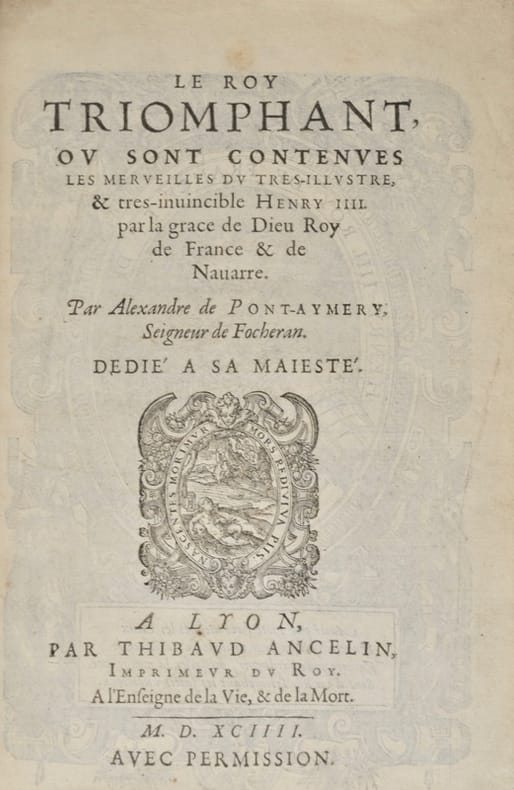
159442198Lyon, Thibaud Ancelin, 1594. In-4 de 120 pp. (sign. (A-P4).Les Piliers d'Estat, dédiez au Roy, par E.D.B. où il est clairement monstré, que la piété & justice sont les vrais fondements des empires, & que sans elles ils ne peuvent longuement subsister. Lyon, Thibaud Ancelin, 1594. In-4 de (8)-44-(2) pp. (sign. A-G4).Les deux pièces reliées en 1 vol. in-4, maroquin brun, décor à la Du Seuil, dos orné à nerfs, dentelle intérieure, tranches dorées (Capé).
LCS-14703« De tous les écrivains de l'Espagne, Quevedo est celui qui s'est le plus rapproché de Voltaire, non par le génie, il est vrai, mais par l'esprit: il avait comme lui cette universalité de connaissances et de facultés, ce talent pour manier la plaisanterie, cette gaieté un peu cynique, lors même qu'elle était appliquée à des objets sérieux, cette ardeur pour tout entreprendre et pour laisser des monuments de son génie dans tous les genres à la fois, cette adresse à manier l'arme du ridicule, et cet art de faire connaître les abus de la société au tribunal de l'opinion. » J. C. L. Simonde de Sismondi. Paris, chez Helie Josset, et se vendent à Bruxelles, Josse de Grieck, 1698. Soit 2 ouvrages en 2 volumes in-12 de : I/ (2) ff. y compris le frontispice gravé, 336 pp., (4) ff. de table et 7 figures à pleine page hors texte; II/ (2) ff. y compris le frontispice gravé, 205 pp. et 9 figures à pleine page hors texte, (1) f. de titre, 272 pp. et 3 figures à pleine page hors texte. Plein vélin ivoire de l’époque, dos lisses, tranches mouchetées. Reliure de l’époque. 146 x 78 mm.
16 vierzeilige Strophen auf 2 SS. 8vo. "Der Bär mit der Hyäne | Schwur einen ew'gen Bund; | Er knirschte seine Zähne, | Sie dehnte ihren Schlund. | Wohl können sich vergleichen | Die zwei verständigen; | Hyäne frißt die Leichen | Bär die Lebendigen [...]". - Erstdruck im Deutschen Musenalmanach für das Jahr 1834.
Large 8vo. 1 p. on bifolium. With autograph address and traces of seal. Urgent letter to François Ripert, the caretaker of de Sade's property in Saumane, sent via Ripert's mother, with bitter complaints about outstanding financial statements. De Sade claims that he has been waiting for six weeks and doubts Ripert's honesty. In closing, the Marquis announces that he will leave for Paris within three weeks, threatening that the process might take years if he leaves the country without verifying the financial statements: "Je ne sais comment et de quelle Manière il faut que je m'y prenne pour faire comprendre à Monsieur Ripert que je ne puis faire ses comptes sans les avoir eu quelques temps auparavant en ma disposition pour les examiner. Voilà 6 semaines que je les demande sans pouvoir les obtenir. Les gens francs et clairs qui n'ont pas de prétentions louches et ridicules à mettre en avant marchent plus à découvert que cela. Je préviens Mr Ripert que sous trois semaines je pars pour Paris et que si je quitte ce païs-ci et sans vérifier ses comptes, il pourra bien s'écouler bon nombre d'années avant que cette opération-là ne s'entreprenne [...]". - Despite de Sade's bitter complaints and insinuations, he held Ripert in high esteem as a faithful employee and ally in countless conflicts within his own family. Ripert even hid de Sade during his flight to Italy, following the 1772 condemnation in the so-called "Affaire de Marseille", which ultimately led to his 12-year incarceration in Paris. In 1796/97, the Marquis was on the verge of bankruptcy and was thus forced to sell large swathes of his remaining property, against the will of his wife and children. De Sade's short conflict with his caretaker arose in the context of these extreme financial difficulties. - Traces of folds. With some stains to the address-side. Dated to 1797 by contemporary hand.
1 page ½ in-8, papier vélin, timbre sec G S. Amusante esquisse de poème mettant en scène la fauvette et le roitelet au sortir de l'hiver: "[...] te voila bien grassouillette | - te voila tout guilleret | - L'hiver ne fut point rude I au grenier du laboureur | - Quant à moi j'ai lhabitude | d'hiverner chez le fendeur [...]". - En vis-à-vis de cette page se trouve l'ébauche du début de ce dialogue en argot paysan. "Au renouveau la fauvette | rencontre le roitelet | -- te voila bien grassouillette | -- te voila tout guilleret | -- L'hiver ne fut point rude | -- au grenier du laboureur | -- Quant à moi j'ai lhabitude | d'hiverner chez le fendeu.r | Ces bûcherons sont honnetes | je my chauffe comme un roi | on y brûle des bûchettes | quasi grosses comme moi. | -- moi je mangeais à plein ventre | dans l'orge et dans le millet | mon hôte à des tas où j'entre | jusqu'au dessus du mollet | | Ces paysans ma commère | sont par ma foi bien heureux | -- Ils ont de quoi mon compère | nous engraisser tous les deux | | Environ Pâques, la miche | Le roi Bertrand rencontris | -- D'engraisser tu n'es point chiche | [...] Comme un chebril. | | Moi mon vieux c'est que j'hiverne | dans la sarre au laboureur, | -- moi ma fille, je | dans la maison du fendeur | -- Ces fendeux d'bois son honn [...]". - Quelques ratures.
8vo. 4 pp. To her publisher, returning a proof with corrections: "I beg you to make sure that my punctuation is observed; without it my style (by its very nature) is incomprehensible. Thus, I am very careful in my corrections, but most newspapers couldn't care less. I admit that I am extremely sensitive to a comma which distorts an idea […]".
8vo. 1 p. Accompanied by an autograph poetical manuscript signed by Clément, being a gift for Sand on the death of her grand-daughter. In French, to Abbé S. Clément: "Thank you so much, dear Sir; you are the good shepherd, both sympathetic and consoling. Your poem is sincere, and that is what makes it good, since form only is nothing when the idea is not there. Yes, yes, it is true love is stronger than death, and I am sure that my child and I will be together again. The other night, I dreamed that she was returned to me, and I regard this dream as a gift sent to me. I do not have superstitions about dreams, but when they are sweet, I think we must be grateful. They are a consolation that night brings to our days. Again, thank you. With much love from the bottom of my heart".
6 pp. 8vo. To an unnamed addressee: a letter of recommendation about a young acquaintance who, according to George Sand, is a talented naturalist illustrator but of poor origins, which is why she asks the addressee to support him: "Combien j'ai éprouvé de regrets, Monsieur, lorsque j'étais à Paris, enfermée un matin avec un avocat et deux avoués (quelle aimable société !) d'apprendre que vous étiez venu me voir et qu'on n'avait pas osé, par respect pour les affaires, m'avertir de votre visite ! On m'avait fait espérer que vous reporteriez, et pourtant j'ai quitté Paris sans vous revoir, sans trouver moi-même un instant pour courir jusqu'au jardin des plantes. Car j'étais entre deux feux, d'un côté un procès avec monsieur mon mari, de l'autre, la mauvaise santé de mon fils que j'avais laissé à la campagne, et que je brûlais de rejoindre, à la première journée de répit qu'on me laisserait. - Je devais retourner à Paris ces jours-ci, et me dédommager de ces contritions. Mais les affaires [2] traînent en longueur, et mon voyage est retardé. Je viens donc vous écrire ce que je voulais vous dire de vive voix, et je vous envoie même un ambassadeur. C'est un jeune homme très distingué […] qui d'ordinaire réside à la campagne avec nous. […] Mais ce n'est pas de lui qu'il s'agit. Il n'est ici que commissionnaire, et chargé de vous remettre quelques dessins à la plume faits par un enfant que vous connaissez déjà. Cet enfant pour qui vous avez eu mille bontés et que je vous avais présenté sous le titre de mon jeune frère, est le fils d'un homme extrêmement respectable et recommandable qui veut bien m'appeler sa fille adoptée et qui […] a été pour moi en vérité comme un père. Il s'appelle (le jeune homme) [3] Gustave Lourangin [?]. Vous l'avez reçu avec une bonté dont il a été tout fier et profondément touché. Il a quelque chose comme vingt un ou 22 ans. Il dessine comme vous voyez ; il empaille des oiseaux et prépare des insectes, non pas seulement aussi bien, mais mieux qu'aucun de vos dessinateurs [ ?], parce qu'il le fait en artiste avec un sentiment de la vérité, et une observation intelligente qui n'est pas le fait d'un manœuvre. - […] Il est arrivé tout seul à s'instruire […], et un beau matin, sa famille qui le traitait un peu de paresseux, d'inutile et de fou, s'est aperçu qu'il les servait plus long que tous les autres. Mais toute cette science ne donne pas de quoi vivre. Le père a fait de grandes pertes d'argent, il a [4] cinq enfants. Il faut que chacun se soutienne par con travail. Gustave n'a pas assez de santé pour se faire soldat, pas assez de [illegible] pour se faire clerc de notaire. Il est venu me trouver. Il a de la dignité, une grande force de caractère, aucune mauvaise passion, aucune passion même, autre que sa science. […] Je me sui dit (et je lui ai dit) que vous seriez sa providence. Voici ce que vous ferez pour lui, si la chose est […] possible, parce que vous êtes bon, parce que vous avez pour moi une amitié dont je suis orgueilleuse, parce que enfin, notre [5] jeune homme est digne par sa haute intelligence, la noblesse et la persévérance […] de son caractère, de tout votre intérêt, de toute votre confiance et de toute votre amitié. Ses désirs sont modestes. Il voudrait vivre, simplement vivre près de vous, à la source de la vérité dans la science. Voilà, monsieur et noble ami, l'objet de cette longue lettre. C'est une [6] instante prière que je vous fais et que vous voudrez excuser car vous m'avez habituée à compter sur votre bonté pour moi, comme je dois compter sur votre toute puissance au sanctuaire scientifique dont vous êtes le prêtre et l'oracle. […]".
116 SS. Orig.-Pappband mit Illustration von Karl Staudinger. Mit Bauchbinde und Cellophanumschlag. 8vo. Widmungsexemplar der Erstausgabe von Schmidts erster Buchveröffentlichung. Mit der seltenen Bauchbinde "Ein neuer junger deutscher Autor". Am Vorsatz eigenh. Widmung mit U. in Kopierstift für die Rowohlt-Mitarbeiterin Ulrike Kallenrode: "Fräulein Ulrike Kallenrode - dem [getilgt: einzigen] ersten guten Herzen, das ich beim Verlage antraf. Als Dank und zur Erinnerung. / Hamburg, den 12.4.50 / Arno Schmidt". - Arno Schmidts Erstling enthält die drei Erzählungen "Gadir oder Erkenne dich selbst", "Leviathan oder Die beste der Welten" und "Enthymesis oder W.I.E.H". - Papierbedingt gebräunt, Titel mit einem kleinen Randeinriss (5 mm) am Fußsteg; Bauchbinde mit kleinen Läsuren am hinteren Unterrand; Cellophanumschlag mit Randläsuren. Beiliegend eine maschinschriftliche Kurzbiographie des Autors. Bock 1.1.1. OCLC 1186230026.
1 S. Qu.-8vo. Seinem Freund Fritz gewidmet: "Rosen auf den Weg gestreut / Und des Harms vergessen / Eine kleinen Spanne Zeit / Ward uns zugemessen. / Erinnere dich hiebey lieber Fritz, an deinen Freund [...]". - Nach einem Blutsturz im November 1816 erhoffte sich Schulze noch Erholung und wollte im Frühling 1817 eine Lehrtätigkeit an der Universität aufnehmen, doch sein Gesundheitszustand verschlechterte sich zunehmend.
4to. Altogether 3 pp. Correspondence with his editor Robert K. Spencer at Appleton-Century-Crofts concerning several projects. In the earliest letter, Simenon thanks Spencer "for the good news about the successful career of 'Trois Nouvelles de Georges Simenon' [...] and of 'Tournants Dangereux'". The latter title was published as early as 1953, whereas the three novels appeared in 1966, both in French and for an American audience. He expresses his hope that Spencer "will find some suitable material in 'La Rue aux Trois Poussins'" for another anthology but concedes that he has not written any novels in twenty years. - In February 1969, Simenon asks for an author's fee of "10% of the volumes sales price" for "various short stories" appearing in a textbook. Simenon also informs Spencer that he cannot extend his "field of action to all English speaking countries of the world", referring specifically to "the British Empire" and Canada, which shall remain "an open market". - The third letter was sent with a contract "reflecting our recent correspondence", asking Spencer to return it signed. Simenon hopes that "the new anthology will have the success of the previous textbooks". - The two letters from 1969 with recipient's notes in ballpoint pen and pencil; the letter from 20 February 1969 with a minor tear to the upper margin. Well preserved.
3 pp. 8vo. To an unnamed correspondent; address panel on verso of third page: "I have been deeply touched, dear Sir, by the feeling which inspired your article and I can say, without being influenced by my gratitude toward you, that there are some words in it that are remarkable not only for the elevation of thought, but I may add also for the soundness of judgment they indicate when you talk about my father. If you still read Le publiciste you must have seen in it a really touching letter. I may say that all that reaches me from Paris is in harmony with what I have been longing for. In the note on opposite natures, there is a line you wrote which I find extremely witty and true at the same time: there is no doubt that the big difference that exists between some souls, whose cause is unknown from us, makes it impossible for certain persons to understand each other ever and I think I would understand more easily the expression in the eye of some Persian than what some people say, even though they speak French. Thank you very much for giving me the hope that we will see each other in Milan. Your kindness to me makes you feel more attached to me: this is the sure sign of a generous nature. It is in six weeks probably that I will have the pleasure of seeing you again. I have enjoyed the arts and nature in the South of Italy, but my most tender affections were born when I first got to Milan, and returning there gives me a renewed pleasure, since you have shown me so clearly that my friends there have not forgotten me".
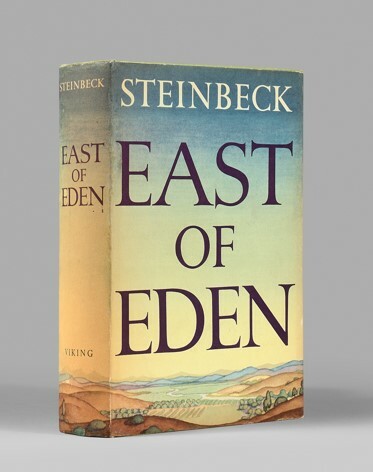
YTB-97New York: The Viking Press, 1952. In-8 de (3) ff., 602 pp. Toile vert pomme de l’éditeur, jaquette illustrée conservée. 212 x 144 mm. First edition, first issue with ''First published by The Viking Press in September 1952'' printed on the copyright page, and ''bite'' instead of ''bight'' on page 281, three lines up from the bottom. Goldstone & Payne A32.b. A masterpiece of Biblical scope, and the magnum opus of one of America’s most enduring authors. In his journal, Nobel Prize winner John Steinbeck called East of Eden "the first book," and indeed it has the primordial power and simplicity of myth. Set in the rich farmland of California's Salinas Valley, this sprawling and often brutal novel follows the intertwined destinies of two families—the Trasks and the Hamiltons—whose generations helplessly reenact the fall of Adam and Eve and the poisonous rivalry of Cain and Abel. East of Eden is a work in which Steinbeck created his most mesmerizing characters and explored his most enduring themes: the mystery of identity, the inexplicability of love, and the murderous consequences of love's absence. Steinbeck began writing ''East of Eden'' in 1951, intending the novel to be the ''big work'' of his career. As he explained to his editor, Steinbeck wrote the book for his sons, to share the direct truth of where he came from and how it was for people in growing up in his place and time. In doing so, Steinbeck planned to share, ''one of the greatest, perhaps the greatest story of all—the story of good and evil, of strength and weakness, of love and hate, of beauty and ugliness... this story against the background of the county I grew up in.'' In this masterful retelling of the biblical tale of Cain and Abel, Steinbeck captures the history of Salinas Valley, Ca. while grappling with the pain of his divorce. After ''East of Eden,'' was published in 1952, Elia Kazan directed the film adaptation of the final portion of the novel, in which James Dean made his debut performance. John Steinbeck decided to become a writer at the age of fourteen. In 1919, he enrolled at Stanford University, but drifted in and out of school and finally dropping out in 1925. After Stanford, he took a job as a caretaker in Lake Tahoe where he wrote his first novel ''Cup of Gold'' (1929). Over the next few years, Steinbeck wrote a couple follow-up novels but did not achieve real success until 1935 with ''Tortilla Flat.'' He won the Nobel Prize for Literature in 1962. An attractive and clean copy preserved in its publisher’s cloth with its first printing dust jacket.
8vo. 2 lines. With blindstamp of the Viennese studio "Magasin Metropol". - From the collection of the Viennese lawyer Max Bettelheim (1912-71).
8vo. With drystamp of the Prague studio Architekt Vanek.
Small 4to. 1 p. To E. J. Evans of Skewen (unnamed), secretary of the Port Talbot Forum, in favour of a pension to be awarded to the Welsh poet Huw Menai (i.e., Huw Owen Williams, 1886-1961): "Dear Sir, Please forgive my not having answered your letter before this. I have just come back to Wales to live, & letters have been misforwarded. I shall be most grateful if you will include my name in the list of those who are supporting the appeal to the Prime Minister for a Civil List Pension to be awarded to Huw Menai. I have the greatest admiration for him - though I do not know him personally - & for his work, & I think the Port Talbot Forum is to be congratulated in its sponsoring of the appeal - which I do most sincerely hope will succeed [...]". - In May 1948 Thomas and his family had moved to his final home, the Boat House at Laugharne purchased for him at a cost of £2,500 in April 1949. - Insignificant foxing; slight traces of mounting at upper corners. Published in: D. Thomas, The collected letters (ed. by Paul Ferris), p. 705.
LCS-192« Un des chefs-d'oeuvres de la prose française moderne ». En Français dans le texte, n° 323. Paris, Bonvalot-Jouve, 1906.Grand in-8 de (1) f. bl. et (9) ff. Conservé dans la couverture rouge imprimée de l’éditeur.251 x 158 mm.
4to. (2), LV, (1) pp. With a woodcut printer's device and an engraved half-page headpiece. Contemporary full calf, spine gilt. Blue marbled endpapers. All edges red. First Italian edition of one of the earliest works on truffles, also published in Latin ("Tubera terrae") in the same year, with fine provenance. Couched as a learned poem, it discusses all aspects of the gathering of truffles (as shown in the engraving), including soil conditions, weather, and conditions for truffle hunting. Giambernardo Vigo (1719-1805) taught Italian, Latin and Greek rhetorics at the University of Torino and was a member of the Royal Academy of Sciences. - Binding somewhat rubbed; interior brownstained. From the collection of the French cuisinier Raymond Oliver (1909-90), long the legendary chef of Maxim's, with his bookplate ("Rouvier de Vaulgran") on front pastedown. Rare; only eight copies in libraries worldwide outside Italy (via OCLC). Westbury (Italian Cookery Books) 223 (this copy cited). Vicaire 864. Paleari Henssler p. 757. ICCU TO0E\000827.
1 S. auf Doppelblatt. 8vo. An einen nicht ermittelten Adressaten: "Mein verehrungswürdigster Freund, Ich höre, daß Sie gern den Hn. von Alxinger in Wien kennen lernen wollen. Ich schicke Ihnen also ein Briefchen an ihn, so wie an einen andren würdigen Gelehrten, den Hn. Stütz, der viel schönes über die Naturgeschichte geschrieben, der der vertraute Freund des berühmten Born war u. itzt dort seine Stelle vertritt. Wollen Sie den Hn. von Birkenstock kennen lernen, so wird er Sie gewiß auch mit einer bloßen Empfehlung von mir mit Freuden aufnehmen. Genießen Sie aller Freuden des Lebens, die Ihnen Ihr gegenwärtiger Aufenthalt u. Ihre gegenwärtige Reise nur gewähren können, u. kommen gesund u. glükl. zurück! In Eil. [...]". - Der Aufklärer Weiße, seit 1761 Leipziger Kreissteuereinnehmer, trat nicht nur als Lyriker und Dramatiker hervor, sondern gilt mit seinem "Kinderfreund", der ersten Kinderzeitschrift Deutschlands, auch als Begründer der deutschen Kinder- und Jugendliteratur. Die im Brief genannten Namen geben einen Einblick in seine literarischen Kontakte nach Wien; insbesondere handelt es sich (obwohl er selbst keiner Loge angehörte) bei den empfohlenen bzw. erwähnten Personen sämtlich um herausragende Wiener Freimaurer. - Faltspuren; die Ränder etwas unregelmäßig, im Bug teils gebrochen. Am Gegenblatt verso Empfängervermerk: "Von C. St. Einnehmer Weiße".
Large 8vo. 3 pp. on 3 ff. Thee pages from his address, "Können wir ohne Gottesglauben leben" ("Can we live without belief in God?"), presented in Vienna on 5 March 1932. Werfel fervently defends belief, which he calls the prerequisite for any form of mental and spiritual life - Published by Zsolnay in 1932 as the title essay in a collection. Fol. 3 bears later note "(aus 'Gottesglauben')", signed "Franz Werfel" and dated "Wien 1933". Several ms. corrections (some in pencil) and deletions; leaves numbered in red crayon. Traces of staples; insignificant smudging.
8vo. 1 page. With autogr. envelope. To Eleonore Maximiliane Ottilie Henckel von Donnersmarck, née Countess von Lepel (1756-1843), widow of the Lieutenant-General and Prussian Governor of Königsberg, Victor Amadeus von Henckel zu Donnersmarck (1727-93), and Grand Mistress of the Court with the Grand Duchess Helena of Russia and from 1804 onwards with the Duchess Maria Paulowna von Sachsen-Weimar. Wieland wishes to visit the Crown Princess and asks that he be informed of the date and time he will be able to appear: "I beg Your Excellency to please be kind enough to obtain permission to stand at the feet of H.A.J. Madame La Princesse Herediaire […]" (transl. from the French original). Her granddaughter Ottilie was to become the wife of August von Goethe in 1817. - Somewhat spotty and browned, some small tears to edges.
8vo. 1 p. In French, to an unidentified artist. Zola advises his correspondent to speak directly with his publisher, M. Charpentier, about his drawings because "I have very little time and prefer not to become involved in this question of illustrations. I have always thought that the best thing to do is to leave an artist free to interpret a book, as he likes. Zola adds that he does not intend to write a novel about the 1870 war for another two years". - The drawings to which Zola refers were probably meant to illustrate his novel Le Rêve, an edition of which was published in 1892 with illustrations by Carlos Schwabe and Lucien Métivet. Zola s novel about the 1870 war, La Débâcle, was also published in 1892.
8vo. 2 pp. on bifolium. To the autograph dealer Charavay, asking to send him auction catalogues dating from 1914 onwards: "Il y a plus d'une année que je m'adressais a vous avec la demande de m'envoyer tous vos catalogues de vente et vos catalogues a prie fixe a partir du aout 1914 [...]". - On headed paper; centerfold slightly torn; fol. 2 somewhat wrinkled at the top.