19 867 résultats
Folio (ca. 210 x 305 mm). Ink manuscript on paper (watermark: eagle and coat-of-arms). 129 written pp. on 72 ff., paginated 5-98 (with lacunae) and 105-147. Numerous inserted leaves and illustrations. Contemporary carta rustica with title inscribed to front cover. An extensive, illustrated manuscript treatise for the instruction of artillerists, couched as a dialogue between an apprentice bombardier and his master, entitled "Discorso fatto in dialogo trà il maestro e lo scollaro bombard[ie]re nel quale si comprende tutto quello che è necessario per saper ben maneggiare l'artiglieria". Written in brown ink in a single large gathering, including 15 pages of ink drawings laid into the manuscript, and a second section beginning on page 105 titled "Prattica del Can[on]e", in three smaller gatherings. Separate indices for the two sections at the end. The omitted pages 99-104 would appear to have been blank (as are pp. 43-47 at the end of the second section), and while the page numbering in the first section is not entirely consecutive, the text appears entirely complete, with no references in the index to unrecorded page numbers. - Browning to the laid-down drawings; some worming and several small holes and dampstains. From the collection of Thomas Fremantle, 3rd Baron Cottesloe (1862-1956), commander of the Territorial Army and president of the Society for Army History Research.
Zusammen (304) SS. Lateinische, französische u. italienische Handschrift auf Papier. Folio (330 x 225 mm), Blattmaß ca. 320 x 210 mm. Wechselnde Schriftspiegel. Flexibler Pergamentband der Zeit mit Goldprägung und hs. Rückentitel sowie hs. Vermerk am Hinterdeckel. Kollektaneenbuch aus den Wirren des Dreißigjährigen Krieges. In bespielloser geographischer, thematischer und nicht zuletzt sprachlicher Vielfalt dokumentieren insgesamt 49 Schriftstücke in zeitgenössischer Abschrift die Ereignisse in Deutschland, Schweden, Frankreich, Spanien und den Niederlanden in den Jahren 1629-34. Unter den Ausstellern finden sich prominente Persönlichkeiten wie Gustav Adolf von Schweden, Ferdinand Fürstbischof von Trier, der französische König Ludwig XIII., der spanische König Philipp IV. und die Infantin Isabella. Ein von Johann Gregor in Liège verfasster Bericht über die Ereignisse des Schwedischen Krieges und den als "Achilles Germanicus" stilisierten Heerführer Tilly, drei Briefe Gustav Adolfs von Schweden an den französischen König sowie den Herzog von Lothringen, ein offener Brief der Infantin Isabella an die Bürger der spanischen Niederlande sowie ein Bericht über die Vertreibung der Jesuiten aus Mainz durch die Schweden im Sommer 1633 sind nur einige Beispiele für den erstaunlichen Themenreichtum. Zu den Ausstellungsorten zählen Alameda, Chantilly, Charmes, Den Haag, Köln, Lüttich, Madrid, Mainz, Maline und Trier. - Die Wasserzeichen des verwendeten Papiers lassen auf eine Entstehung in Frankreich, den Niederlanden und Deutschland schließen. Der aus wiederverwendetem Material gefertigte Einband zeigt eine für Italien typische Goldprägung; die Vorsatzpapiere wurden vermutlich um 1650 in Rom hergestellt. Mit hs. Rückentitel "(V.) Narratio Rerum German. Ann. 1630-1631 M.S". - Fragmentarisch erhaltenes Signaturschildchen am Rücken; hs. Vermerk am Hinterdeckel verblichen. Vorderdeckel gewellt; vorderes Innengelenk gebrochen. Papier unterschiedlich gebräunt, teils mit geringen Randläsuren. - Detaillierte Verlistung auf Anfrage.
Oblong 4to. French ms. on paper. 46 pen-and-ink drawings on plates (numbered 1-48; wants 2, 17, and 18); 2 mounted photo prints. Contemp. half calf with giltstamped cover title "Album". Interesting album containing political caricatures of a high quality, levelled at the state and society of the Third Republic under President Grévy (1879-87). During his term, France underwent strong social and political changes which are immediately reflected in the drawings. Obviously the work of a professional caricaturist, they were probably intended for publication in newspapers and magazines (or may even have been published). Some pictures poke fun at everyday events, others provide a comment on the developments of several months. - Several drawings tipped in; also includes two revised photographs of drawings (a third one is lacking).
Small folio (188 x 292 mm). 50 pp. on 26 leaves. Ottoman Turkish in Arabic script. Ink on western laid paper (watermarked "Victory") written within gilt rules, with two 'unwan headpieces in colours and gilt, a corner endpiece, and fine illustrations showing small watercolour portraits of each ruler before gilt discs. Bound in smooth lacquered boards showing a fine floral motif with central medallions and large flower decoration to inner covers; rounded corners; calf spine. Family tree of the Ottoman Sultans, beginning with their purported descent from Adam and Eve and including the prophets Noah, Hud, Lut, Haroon, Joshua, Ishmael, the Abbasids, and Ghenghiz Khan, also noting the kinship between the Seljuks and Turks of central Asia in the Anatolian Seljuk Sultanate. It continues throughout the Ottoman dynasty founded by Osman I Gazi (The Warrior) in the late 13th century and ends with Mehmed IV (d. 1693), showing him seated on the throne. - Some browning and staining throughout; luxuriously decorated lacquer cover shows slight rubbing to lower cover, but beautifully preserved.
187089636Sans nom d'éditeur | Sans lieu d'édition s. d. [1870] | 40.5 x 27.9 cm | Relié
4to (160 x 220 mm). Illustrated manuscript in Italian (black ink on paper). (74) pp., single column of 16 lines in a fine bookhand, every page bordered with double rules. First text leaf with a silver-edged frame and one large initial decorated with silver penwork. Title page with a fine penwork portrait of the dedicatee in ornamental armour (after the portrait by Sustermans), in rust-coloured ink, all within a wreath edged in gold and silver. Bound in contemporary full black calfskin, elaborately gilt-tooled. A dictionary of Florentine military terms, from "Abbattimento" ("l'abbater per battaglia") to "Zagaglia" ("spezie d'arme in asta"), followed by lists of punishable offences, general military guidelines, and commendable actions. A handsome manuscript of the finest quality, produced as a presentation copy for the "Duca di Guisa", Charles de Lorraine, the 4th Duke of Guise (1571-1640). Charles, who had fallen into disfavor with Cardinal Richelieu for siding with Marie de' Medici, had withdrawn to Italy in 1631. His wife and younger children joined him in Florence, where the family was protected by the House of Medici. After Charles's death at Cuna, in 1640, his widow and children (among them Marie, "Mademoiselle de Guise") were permitted to return to France in 1643. Caciotti, the author, served as secretary to the Grand Duchess of Tuscany, Christina of Lorraine, one of the duke's allies. In the dedication he dates the work's completion to 28 April 1632, and this presentation copy was given to the duke in 1639 (inscription at the foot of the title). - Beneath the dedicatee's realistic portrait, the illustrated title page shows a central banner with the title and presentation inscription, within full borders of humbled and kneeling soldiers, Calvin on the left and Muhammad on the right (representing the armies of the Protestants and Turks). The figures are prostrated beneath their armour and weaponry on either side of the arms of Guise, which are shown beneath a gold and bejewelled crown. - Once water damaged with discolouration to leaves at each end; some areas of the arms on the title page have fallen away due to ink corrosion (the rest is adhered to the next blank leaf so as to stabilise the paper). Ink corrosion has also damaged the frames of the text leaves, frequently loosening the text area on one or more sides. Spine wormed and chipped, a small section lost from top of rear board, otherwise an appealing and presentable dedication manuscript.
AMO-44961812 [Sans lieu, i.e. Seysses, Toulouse] 1 volume in-4 (24,5 x 20,5 cm) de 348 pages chiffrées et 6 pages de table non chiffrées. Reliure pleine basane fauve de l'époque (première reliure). Usures et manques. Important manque de cuir dans la moitié supérieure du dos. Un coin sommairement anciennement réparé, roulette dorée en encadrement des plats, gardes et doublures de papier marbré. Intérieur parfait. Ecriture très lisible. Manuscrit autographe mis au propre contenant le texte définitif qui sera imprimé en 1814 sous le titre : Traité sur l'époque de la fin du monde, et sur les circonstances qui l'accompagneront, par un Solitaire (à Versailles, de l'imprimerie de J. A. Lebel) avec en plus et inédits, de la page 306 à 311, une importante Note de l'auteur, et de la page 313 à la page 348, des Observations sur le manuscrit d'un solitaire, Lettre de Mr B*** à Mr P***.
Folio (ca. 310 x 205 cm with 2 cm plica). Latin manuscript on vellum. First two words written in red ink, remainder in brown ink. Lacks seal. Very early, exceedingly rare archival document relating to the foundation of the "capella sancte marie" (St. Mary’s Chapel) in the parish of Hondschoote, on the duties and rights of the "capellanus", the link with the local parish church, etc. Incipit: "Ego Walterus de hondescote notum esse volo tam presentibus quam futuris presentera paginam inspecturis [...]". Witnesses include "Marcus abbas sancti Winnoci de bergis" [= St. Winoc, Bergues], "Walterus ... decanus sancte Walburgis" (St. Walburga, Veurne/Furnes), and "Henricus abbas sancti Nicholai de furnis [= St. Nicholas, Veurne/Furnes]". - Written only three years after Walter de Hondschoote, together with Herbert de Wulfenghem, had led the insurgent Blavotins ("Blue-feet") against Mathilde de Portugal, countess of Flanders, and the nobility. The rebels even besieged Bergues but were defeated in a battle remembered as the "lundi rouge" ("Bloody Monday") of 1206. It appears that Walter was not severely punished for his role but soon returned to grace. - Hondschoote in the département Nord lies 20 kilometres south-east of Dunkirk, on the Flanders border. It remains known for the battle of Hondschoote in 1793, when the French army defeated the Anglo-Hanoverian troops of the Duke of York. - Legibly written in a scribal hand. A central fold, minor soiling, but generally in good condition.
Large 4to (180 x 270 mm). Italian manuscript on paper. 60 written pages on 35 leaves, textually complete, ca. 30 lines. Contemporary vellum over card. A 17th century working handbook providing sailing instructions from the port city of Genoa, written in two parts: westwards towards southern Spain and to Cadiz, and south through the Liguarian and Tyrrhenian Sea towards Calabria. It contains a description of the city of Genoa (2 pp.), directions along the southern French and eastern Spanish coasts to Sanlúcar de Barrameda via Menton, Monaco, Villefranche, Marseille, Cadaques, Barcelona, Valencia, Cartagena, Marbella, Gibraltar, and Cadiz (39 pp.); and directions from Genoa along the Tyrrhenian coast of Italy to Capo Vaticano in Calabria via Livorno, Fiumicino, Naples, etc. (18 pp.). The invocation of the muses before the text is a quotation from Torquato Tasso's "Gerusalemme Liberata": "O Musa, tu che di caduchi allori / non circondi la fronte in Halicona [...]". - The genesis of the portolan chart as we know it in pictorial form is inextricably linked to the production in the late medieval period of these textual sailing instructions of the Mediterranean Sea, known as "portolani" in Italy, and later as "roteiros" by the Portuguese and "rutters" by the Dutch and English, written by mariners as guides for sailing from port to port in the Mediterranean. - Binding torn and frayed. Lower corner damaged with insignificant loss to letters; edges frayed, marginal thumbing and staining, final leaf loose. Provenance: inscription on first leaf, "Io Fran[ces]co Pinetti della Riva di Taggia", dated 16 Dec, 1689, the hand matching that of the main text. 18th century inscriptions on upper pastedown, one dated 27 March 1705: "Rotta di uno instrumento fatto in Genoa".
8vo. Latin manuscript (brown ink) on paper. Title-page, (3), (1 blank), 115 (not 111), (1 blank) pp., (4 blank leaves), (6) pp. of index. With 8 hand-drawn pen-and-ink, grey wash plates (some folding). Contemporary full calf chipped at extremeties with remains of a giltstamped spine label "...me Pueper". All edges red. Unpublished obstetrics manual, handwritten and fully illustrated by a German physician of the 1740s. The meticulous calligraphy of the headlines, the justified margins and precise paragraph indentations imitate a book printed in a classical Roman typeface, while the text is written in an easily legible, educated and appealingly regular round Latin hand. - The book is arranged in two separate sections, or "treatises": the first, longer one includes all of the illustrations and is more overtly didactic, following a question-answer pattern, while the second one (entitled "De regimine gravidarum, puerperarum, nec non infantum, recens natorum; item, de morbis et affectibus illorum"), provides a more scholarly discussion of specific ailments and treatments of the mother and baby, including medical prescriptions. The various chapters are concerned with signs of pregnancy, how to turn breech babies, caesarean sections, stillbirth, teratology, but also morning sickness, piles, sciatica, and lactation; the fine illustrations include cross-sections of the womb showing the fetus in various positions, the placenta, and the female genital organs as well as a grown-up hermaphrodite displaying ambiguous genitalia, conjoined twins and other freaks of nature. - Franz Adam Wolfgang von Winter was born in Dingolfing, Southern Bavaria, likely some time before 1720. Already equipped with a degree in philosophy, he apparently practised as a physician at Landsberg, some 20 miles distant, before deciding to take the degree of Medical Doctor at the University of Altdorf near Nuremberg. Without previously having studied there, he matriculated on 10 December 1744 as a doctoral candidate and passed his viva five days later (cf. Die Matrikel der Universität Altdorf [Würzburg 1912], p. 582, no. 17465). His inaugural dissertation "De Cautione in Observationibus Physico-Medicis Adhibenda", an investigation of the caution that must apply in medical observations, was printed that same year by J. G. Meyer in Altdorf, with a congratulatory poem by professor Johann Jacob Kirsten. The examination would appear to have been little more than a formality; at least it does not seem to have overly preoccupied the medical student who almost simultaneously found the time to prepare the present manuscript: a long, lovingly illustrated manual abounding with a sort of practical detail quite absent from the same author's very generally worded 17-page dissertation. In the manuscript, Winter calls himself "Phil. & Med. Doct. Phys. t. t. & Practic. in Landsperg, Anno MDCCXLIV", which would date at least the completion of this text within the last two weeks of 1744 following his graduation from Altdorf. Winter's further career must remain the subject of further research: he is not recorded in the biographical dictionaries of noteworthy physicians such as Hirsch & Hübotter and may have died before the middle of the century. - Spine-ends chipped; corners bumped; hinges weak. First gathering loosened; insignificant brownstains to a few leaves, but very well preserved. A charming survival.
- s.d. (circa 1860), 20,6x27,6cm, un feuillet remplié. - DUMAS Alexandre Naïs et Chloé. Unpublished handwritten sapphic poem signed by Alexandre Dumas N. d. (c. 1860), 20,6 x 27,6 cm, one folded leaf Autograph manuscript poem signed by Alexandre Dumas bearing the title "Naïs et Chloé," 84 verses in black ink on a blue folded leaf of paper. A few tiny tears without damage to the text, invariably produced when a leaf of paper is folded. A very rare manuscript of a long unpublished poem depicting the love of Naïs and Chloé, the writing of which is motivated by the admiration and tribute paid by Alexandre Dumas to one of the greatest figures of ancient poetry, Sappho. A prolific novelist, Dumas rarely tried his hand at poetry; "Naïs et Chloé," by its length, constitutes a hapax in the literary production of this writer. The text remains unpublished to this day and is here enhanced by the elegant calligraphy of its author. The poem is made up of 21 quatrains, among which stands a remarkable insertion of the most famous verse by Sappho, "to the beloved woman," the title of which is preserved in the very body of the text. This embedding is part of the verve with which Dumas defends the poetic and evocative force of the writing of Sappho, whom he elevates to the rank of the "star of the world" of Poetry: "Il est au sein des mers s'appuyant à l'Asie Entre l'heureuse Smyrne et la sombre Lemnos Une île aux bois fleuris chers à la Poésie A qui Venus donna le doux nom de Lesbos. Quand du chantre divin la voix fut étouffée Que du nom d'Euridice elle eut frappé l'écho Le flot roula tête et la lyre d'Orphée Sur la rive où plus tard devait naître Sapho Sapho naquit la lyre en ses mains fut remise Les sons qu'elle en tira jusqu'à nous sont venus." Translated with conscientious care by the author, the poem borrowed from Sappho in which that most famous verse emerges ("this one, I say, is equal to the gods"), is found in several places in Dumas' work, particularly in the chapter entitled "les vers saphiques" of San Felice and in a collection of articles dedicated to the great female figures, where she sits alongside Joan of Arc and Margaret of Anjou. For Dumas, it is a matter of remaining faithful to the written verses and rendering their sensuality, often blurred by previous translators: "The translations of these two poets [...] often appear to lack not only ancient color but are inadequate in their lesbian ardor" (Les étoiles du monde, Galerie historique des femmes les plus célèbres de tous les temps et de tous les pays). Above and beyond this translation, Dumas is imbued with the lyricism of Sappho without losing his own romantic vein, and he paints the sapphic love of Naïs and Chloé in an erotic light: "Oh seule palpitante, échevelée et nue Une main sur ma gorge et l'autre... Oh ma Naïs Serre moi dans tes bras et sois la bien venue Car à force d'amour... tiens... tiens je te trahis Et l'on n'entendit plus alors dans la nuit sombre Que le bruit des baisers répétés par l'écho Car Nais et Cloé se taisaient et dans l'ombre Clinias s'enfuyait en maudissant Sapho." The poem testifies to the continuous interest that the authors of the late 19th century showed toward sapphism and to the personage of the reader-voyeur, here embodied by Cleinias, whose most famous occurrence remains Zola's Nana. Exceptional and long autograph sapphic poem by Alexandre Dumas. $ 10 000 [FRENCH VERSION FOLLOWS] Poème manuscrit autographe signé d'Alexandre Dumas portant le titre "Naïs et Chloé", 84 vers à l'encre noire sur feuillet remplié bleu. Quelques infimes déchirures sans manque de texte dues aux pliure inhérentes à la mise sous pli. Le poème autographe est présenté sous une chemise en demi maroquin vert sapin, plats de papier marbré, contreplats doublés d'agneau vert, étui bordé du même maroquin, ensemble signé Goy & Vilaine. Rarissime manuscrit d'un long poème inédit retraçant les amours de Naïs et Chloé et dont l'écriture est régie par l'admiration et
1742204181742-1752. 9 volumes in-4, plein veau brun moucheté, dos à nerfs ornés de filets et fleurons dorés, pièces de titre en maroquin bordeaux et de tomaison en maroquin beige, tranches rouges.
38003aaf1826, gr. 8vo (23 cm), 1 feuille de titre + 125 p. + 25 planches de vues montées, (dont 3 gravures et 22 lithographies), protégées de serpentes, gardes en papier marbré, petit feuillet de 115 x 65 mm avec envoi ms. ‘à mon ami Theodor Bettinger de la part de l’auteur (signé) E. Scribe’ monté sur la première feuille de garde blanche, reliure en demi-maroquin olive à faux-nerfs, dos orné de caissons, de filets et du titre dorés, légers frottements aux bords, un coin du plat derrière lég. brisé. Bel exemplaire.
185468690Paris 25 Juin 1854 | 11.50 x 18.50 cm | une page recto-verso
18657679530 mai 1865 | 13.70 x 21.10 cm | une page sur un feuillet
81050, Milieu du XVIIIe siècle (après 1737), in-folio, [287] feuillets (pagination multiple), 19 planches dépliantes à l'encre et à l'aquarelle, Vélin rigide de l'époque, titre manuscrit sur le plat supérieur et en tête du dos, super ex-libris "À Mr Ferdinand de Gaudemar", lacets de fermeture, [Collation : [2]-69 pp. (pages blanches de 16 à 21, 51 à 54, 65 à 69) ; 21-60 pp. ; [6] ff. bl. ; 117 pp. et 19 pl. depl. ; [2]-22 pp. ; [2]-22 pp.] Ce beau manuscrit, soigneusement rédigé par une main anonyme, réunit des copies de traités d'ingénieurs militaires français des XVIIe et XVIIIe siècles, consacrés à la défense et à l'attaque des places : il contient en particulier la retranscription d'écrits du maréchal de VAUBAN (1633-1707), soit des extraits du Traité de la défense des places et du Mémoire pour servir d'instruction dans la conduite des sièges. Le recueil, en trois parties, forme un vade-mecum représentatif des théories de l'époque en matière de poliorcétique, sans doute à destination d'un fils aîné de la noblesse du milieu du XVIIIe s. Il est illustré de 19 belles planches dépliantes représentant des fortifications et des tranchées, en majorité théoriques ; deux planches figurent un cas concret, le siège de Lille en 1667, conduit par Vauban. Les illustrations sont finement tracées à la plume et délicatement aquarellées. Les ouvrages de Vauban ont circulé sous la forme de manuscrits, pour d'évidentes raisons de secret militaire. Ils ne furent autorisés à la publication qu'à partir de 1737, 30 ans après la mort de l'ingénieur : à cette date, de Hondt publie à la Haye un Traité de l'attaque et de la défense des places, très incorrect. Notre manuscrit est postérieur à cette édition, dont il reproduit l'erreur principale, soit l'attribution du Discours sur la défense des places à Vauban lui-même, alors qu'il s'agit d'un écrit de l'ingénieur Des Houlières (voir plus bas). I. DE LA DÉFENSE DES PLACES. Deux extraits : - VAUBAN. L'Instruction générale pour servir au règlement des garnisons et munitions ([2]-69 pp.). Cet écrit concerne l'approvisionnement de la place et l'estimation de la durée du siège. Sa rédaction remonte en 1703, date à laquelle l'architecte militaire offre son manuscrit au duc de Bourgogne ; il sera intégré par la suite dans son Traité de la défense, rédigé en 1706 au retour des Flandres et édité pour la première fois en 1769 chez Charles-Antoine Jombert (et non en 1737, édition de Hondt). L'auteur y préconise des calculs minutieux des vivres et des munitions, en insistant sur l'idée que la capacité de résistance d'une place assiégée va déterminer la possibilité qu'elle soit secourue par une armée. Il fournit ainsi de longues tables (retranscrites aux pages 22 à 50 du présent manuscrit) qui doivent aider à mettre en place la meilleure logistique possible : vivres, boissons, fourrages, meubles d'hôpital, batterie de cuisine, artillerie, arquebuses, mortiers, bombes et grenades, cordages, ferronnerie, armes à feu et à main, outils de mineurs, etc. Suivent 14 remarques importantes, notamment sur le tabac ("La vérité est que rien ne contribue plus que le tabac à désennuyer de l'oisiveté, & à émousser le grand besoin [que les soldats] ont de manger". P. 55). - [DES HOULIÈRES] Le Discours sur la défense des places (paginé 34 à 60). Ce Discours a été faussement attribué à Vauban par le copiste du manuscrit. Il réitère la faute commise par l'éditeur hollandais Pierre de Hondt, qui prétendit le publier en tant qu'édition originale du Traité de la défense, au sein de son édition du Traité de l'attaque et de la défense des places par le maréchal de Vauban (1737). Il s'agit en fait d'un texte de 1675 rédigé par l'ingénieur ordinaire Guillaume de Lafon de Boisguérin, seigneur des Houlières (ou Deshoulières, 1621-1694), et dont Vauban possédait une copie manuscrite qu'il avait annotée. Couverture rigide
192030011920, En feuilles (232 x 250 mm) sous un portefeuille. 153 feuillets.Sur japon nacre, chaque feuillet manuscrit recto verso est execute sur papier japon nacre a fort grammage et se compose d’un texte manuscrit a l’imitation de l’ancien encadre de compositions art nouveau, bandeaux, culs de lampes et motifs.Les motifs decoratifs a theme animalier ou abstrait, pour certains s’inspirent de l’art roman, d’autres de themes egyptiens et orientaux.Bien qu’uniforme dans l’esprit les themes changent subtilement d’une page a l’autre en changeant de couleurs d’une scene a l’autre. Chaque initiale du texte et le nom des personnages est peint en rouge.Chaque scene (en moyenne toutes les deux et trois pages, parfois moins) s’ouvre par une peinture occupant la moitie de l’espace dans une demi ogive, realisee a la gouache puis vernie.Les ornements etant peints dans une technique mixte gouache et aquarelle.La tonalite de l’ouvrage joue sur les clairs obscurs et privilegie les scenes de nuit ou d’interieurs eclairees par des lanternes et flambeaux.Ces scenes alternent des paysages crepusculaires.Ouvrage date et signe en fin d’ouvrage « Termine le 23 mars 1920, Serge Beaune »
18056697410 Floréal 13 [30 avril 1805] | 18.50 x 23.10 cm | une feuille
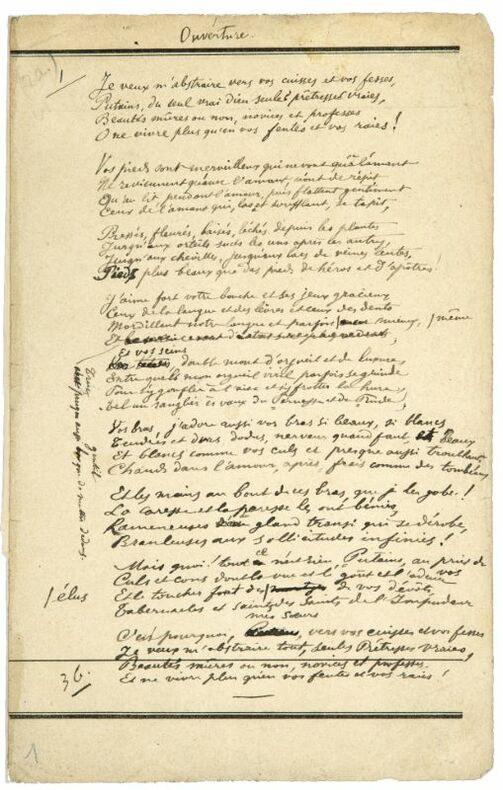
1890888011890 1 page in-8 à l'encre brune (22 x 13.9 cm) sur papier d'hôpital, sous chemise demi-maroquin noir. Trace d'un ancien montage sur onglet. Beau poème libre paru dans le recueil Femmes, imprimé "sous le manteau" en 1890 à Bruxelles chez Kistemaeckers [Dutel, Bibliographie des ouvrages érotiques publiés clandestinement en français entre 1880 et 1920, p.138]. Verlaine rend gloire à la chair féminine et d'abord à ses représentantes, les prostituées (on relèvera la subtilité de cette mise en bouche décrite uniquement en rimes féminines dans le premier quatrain) : "Je veux m’abstraire vers vos cuisses et vos fesses,Putains, du seul vrai dieu seules prêtresses vraies,Beautés mûres ou non, novices et professesO ne vivre plus qu’en vos fentes et vos raies !"Cette ouverture donne le ton, et Verlaine décline en neuf strophes sa passion pour le corps féminin : pieds, bouches, seins, bras, mains, sexes... Les putains sont "soeurs", "seules prêtresses vraies". Il compose une adoration incarnée et pornographique. Verlaine, amant inassouvi, chante la femme non en spectateur attendri, mais en acteur mu par la hantise charnelle :"Et vos seins, double mont d'orgueil et de luxureEntre quels mon orgueil viril parfois se guindePour s'y gonfler à l'aise et s'y frotter la hure :Tel un sanglier ès vaux du Parnasse et du Pinde."Si l'oeuvre de Verlaine est empreinte de volupté, ses derniers productions érotico-pornographiques ont une force brute, nourries d'une spontanéité et d'une urgence flamboyante libérées de tout impératif d'élégance ou moral... une poésie, par la même, profondément humaine. Le manuscrit comporte quelques ratures et une variante : "Prêtresses" au lieu de "compagnes" (vers 34).
- Pacific Palisades (CA) 1976-1978, 23 pages A4. - Henry Miller's complete manuscript correspondence with Béatrice Commengé Pacific Palisades (CA) 1976-1978 | 23 pages 21 x 29.7 cm A superb complete set of 17 autograph letters signed by Henry Miller and addressed to the writer Béatrice Commengé, the author most notably of Henry Miller, ange, clown, voyou [Henry Miller: angel, clown, thug] and translator of a number of works by Anaïs Nin. With an autograph envelope addressed by Henry Miller to Béatrice Commengé and an autograph letter signed by Anaïs Nin to Béatrice Commengé. In 1976, Béatrice Commengé, then a young literature student, began writing a thesis on Anaïs Nin and Henry Miller. From her home village in the Périgord region, she wrote to both. Nin, who was very unwell, apologized for not being able to help her. Miller, though, let himself be seduced at the outset by the idea of exchanging letters with an inhabitant of Domme, the village whose beauty he had lauded in The Colossus of Maroussi. Very quickly, impressed with the student's style and determination, he entered into a correspondence with her that would last until - two years before his death - Miller's eyesight broke down completely, preventing him from reading and writing. At this time, Miller, then 85, was living almost as a recluse in Pacific Palisades in California, rejecting the American way of life and its illusions, and dreading all-too frequent offers and invitations. But the old writer was very quickly charmed by Commengé's outlook on his work: «You are a gem! One of the very few ''fanas'' to understand me. Merci! Merci mille fois!» he writes in his second letter. A true epistolary friendship then develops between the ageing writer and his young muse: «I think of you as some sort of terrestrial angel», and «what a delight to get a letter from you»; «Keep writing me, please!» In passionate letters that are written and re-written, with their English mixed with French, words underlined, copious brackets and exclamation points, and post-scriptums squeezed into the margins, Miller examines his work and his memories. He refuses a purely academic correspondence, «To be honest with you, I don't think either A.N. or I, who are naturally very truthful persons, really succeeded with truth as it is conventionally thought of. We are both confirmed 'fabulators'.» Miller recommends the young woman the books he's been reading recently and his old friends: «[Lawrence] Durrel is the friend to talk to about me, [...] he knows me inside out»; «[he] is wonderful when you get to know him. éblouissant même»; «that great master of the French language - Joseph Delteil»; «Delteil is almost a saint. But a lively one,»; «Alf[red Perlès] is the clown, the buffoon, who made me laugh every day». He goes on to congratulate her on abandoning her didactic project in favor of an «imaginary book about [him]» and launches on a much more intimate correspondence. He confesses his shock, as well: «Did you read about the French prostitutes protesting and demonstrating in Paris against my receiving [the legion of honor]? They say I did not treat them well in my books. And I thought I had!!». He also shares his literary tastes: «I prefer the Welsh. They are the last of the poets». He also warns the future translator of Anaïs Nin against his former mistress' duality: «She is or was a complete enigma, absolutely dual. [...] Actually, I suppose there is always this dichotomy between the person and the writer», and confides to her her secrets: «she is slowly dying (of cancer) she refuses to admit it. (This is entre nous!)». He also discusses his latest loves: «I am in love with a very beautiful Chinese actress [...]. I seem to go from one to another, never totally defeated, never wholly satisfied. But this is near 'eternal' love as I've never been.» Indeed, despite his advanced old age, the author of Sexus has lost nothing of his passion for the fairer sex and his correspondent's being a woman i
- Hauteville House 11 et 13 mai 1856, 14x21,5cm, une feuille. - Lettre autographe signée de Victor Hugo datée du 13 mai 1856 à la suite d'une lettre inédite de Madame Victor Hugo à Madame David d'Angers datée du 11 mai. 4 pages sur un feuillet remplié à filigrane "Barbet Smith Street Guernesey". Publiée dans Correspondance de Victor Hugo, Paris, année 1856, p. 246 Dans cette lettre imprégnée des apparitions et spectres qui hantent les Contemplations récemment publiées, Victor Hugo s'adresse à la veuve de son grand ami le sculpteur David d'Angers, fervent républicain et artiste particulièrement admiré des romantiques. En pleine crise mystique, Hugo parle à l'ombre du sculpteur à qui il dédia de sublimes poèmes dans Les feuilles d'automne ainsi que Les rayons et les ombres et réclame auprès de sa veuve son portrait favori, un buste en marbre jadis sculpté par David d'Angers. Après l'expulsion des proscrits de l'île de Jersey, Victor Hugo fait l'achat d'Hauteville House grâce au succès des Contemplations et apprend avec tristesse la disparition d'un ami cher. Il écrit à la veuve du sculpteur sur le même feuillet que sa femme Adèle, également liée avec la famille de David d'Angers, créateur d'un médaillon à son effigie : « Vous êtes la veuve de notre grand David d'Angers, et vous êtes sa digne veuve comme vous avez été sa digne femme ». Le sculpteur de renom s'était déjà lié au premier salon romantique de Nodier à l'Arsenal et fréquentait presque quotidiennement Hugo à la fin des années 1820 dans l'ambiance bonapartiste et bon enfant de la rue Notre-Dame des Champs, en compagnie des frères Devéria, Sainte-Beuve, Balzac, Nanteuil et Delacroix. En 1828, l'écrivain avait posé avec bonheur dans l'atelier de David d'Angers rue de Fleurus, pour un médaillon puis un buste qui avaient été suivis de deux sublimes poèmes célébrant le talent du sculpteur dans Les Feuilles d'Automne et Les rayons et les ombres. De tous ses portraits pourtant nombreux, il chérissait plus que tout autre son buste de marbre signé David d'Angers et n'hésite pas à le réclamer à sa veuve : « Avant peu, peut-être, madame, ma famille vous demandera de lui rendre ce buste qui est ma figure, ce qui est peu de chose, mais qui est un chef-d'uvre de David, ce qui est tout. C'est lui encore plus que moi, et c'est pour cela que nous voulons l'avoir parmi nous ». De ces séances de pose avec le sculpteur naquirent de fructueuses conversations esthétiques et politiques où s'était affirmée leur aversion commune pour la peine de mort. Ils assistèrent au ferrement des galériens qui rejoignaient Toulon depuis Paris, décrit par Hugo dans deux chapitres du Dernier jour d'un condamné. Victime de l'exil comme Hugo, David d'Angers était rentré à Paris avant de rejoindre le monde des morts : « Mon exil est comme voisin de son tombeau, et je vois distinctement sa grande âme hors de ce monde, comme je vois sa grande vie dans l'histoire sévère de notre temps ». La « grande vie » de David d'Angers fut consacrée à façonner les effigies des hommes illustres, par un subtil équilibre de ressemblance et d'idéalisation. Le sculpteur prend finalement place dans le panthéon personnel de Victor Hugo, lui qui avait orné le fronton du véritable Panthéon des grands hommes où repose aujourd'hui l'écrivain : « David est aujourd'hui une figure de mémoire, une renommée de marbre, un habitant du piédestal après en avoir été l'ouvrier. Aujourd'hui, la mort a sacré l'homme et le statuaire est statue. L'ombre qu'il jette sur vous, madame, donne à votre vie la forme de la gloire ». C'était en effet à l'ombre des grands hommes qu'Hugo vécut son exil à Jersey, loin du tumulte de la capitale et dans le silence ponctué par les embruns frappant les carreaux. Hugo s'était plongé dans l'occulte et parlait aux disparus : « David est une des ombres auxquelles je parle le plus souvent, ombre moi-même », déclare-t-il, rappelant le poème final des Contemplations, « Ce que dit la bouche d'ombre », dicté au poète grâce
Folio (ca. 217 x 321 mm). 2 vols. French manuscript on paper (a few passages in English). 65 pp.; 76-106, (3) pp. Includes a total of 75 blank ff.; several pages blank except for pagination. Contemporary blue full cloth. Marbled endpapers. Anonymous journal of the voyage of the steamer "Archimède" to the Far East between 1844 and 1846 as part of a diplomatic mission to Qing-China led by Théodose de Lagrené (1800-62), aiming to reach a contract similar to the 1842 Treaty of Nankin with the British. The mission was a success: the Treaty of Whampoa, which resulted in the opening of five Chinese ports for trade with the West, was signed aboard the "Archimède" on 24 October 1844. The commercial delegation aboard the ship under the command of admiral François-Edmond Pâris were charged with studying local industries and the potential of selling French goods to the East Asian market, a mission that led them to explore much of Indonesia as well as Calcutta in 1846. - The first volume covers the voyage from Macao to Singapore and Penang, then on to Calcutta in January and February 1846. It opens with several specifications of the ship, including loading and machinery, before going on to describe its voyage in Indonesia, mentioning a bay in the Anambas archipelago named after Pâris, who mapped part of the archipelago as an ensign aboard the corvet "Favorite" in 1830: "Dans la matinée du 19 depuis 5h 30' jusqu'à midi on fait des routes diverses pour entrer et sortir de l'archipel des Anambas que le commandant a la complaisance de nous faire visiter. En 1830 enseigne de Vaisseau sur la corvette La Favorite il a dressé la carte d'une partie de cet archipel en il nous mène jusqu'au fond de la bai nommé d'après lui Pâris" (p. 4). The account of Calcutta evinces a great fascination with the place, as the writer clearly admires its transformation from a small village to a centre of commerce and the capital of an Empire: "Quant à la ville de Calcutta elle même, la ville des Palais, City of Palaces, il me serait difficile d'exprimer convenablement l'antipathie, l'aversion qu'elle m'a inspiré. Certes il est difficile de ne pas admirer l'étonnante fortune de cette place qui n'était pas plus qu'un pauvre village il y a un siècle et qu'est aujourd'hui l'une des grandes places de commerce du monde & et la capitale d'un grand Empire" (p. 55f.). The description of Calcutta includes a bird's-eye pencil sketch of the Raj Bhavan, today the residence of the governor of West Bengal, deeming it "completely lacking in style" (p. 58f., transl.). - The second volume comprises notes on Hindu-Chinese countries, Cochinchina and Siam drawn from local periodicals, namely the "Singapore Chronicle" and the "Calcutta Journal". A separate list gives the composition of the population of Bangkok in 1828, indicating that the 800 Christians living there were mostly descendants from the Portuguese. - Bindings slightly rubbed and a little cockled in places; lightly bumped at extremities. In contrast to Pâris's journals of the Archimède campaign in 1844 and 1845, held at the Musée national de la Marine in Paris, the present set reflects the later, lesser-known part of the expedition in early 1846. Barron, "La corvette à vapeur l'Archimède au bout du monde, allegro ma non troppo", in: Chronique d'histoire maritime (Commission française d'histoire maritime; Société française d'histoire maritime, 2016), pp. 67-83.
Large 4to (211 x 260 mm). English manuscript on paper (watermarked 1797). (2), 86 pp., 1 blank leaf. Text within woodcut margins. With an additional 20 hand-coloured engraved plates (some signed "Merkl", one bound as a frontispiece), many with manuscript captions, and one hand-drawn and uncoloured diagram (numbered "Plate XIV). Contemporary half green morocco over marbled boards. A manuscript from the royal library of the Duke of Clarence; a fair copy in a single hand. "Very interesting qua rifle details, targets etc. (including moving target of a man or deer)" (inserted old collector's note). Neither the author's German manuscript nor the present translation saw publication, but another copy of this manuscript, with the plates, is kept in the Royal Armories Collection (EBEN 1). - Christian Adolph Friedrich Frh. von Eben (1773-1825) was a Silesian nobleman who trained in the Prussian military. He entered the English service in 1800 (where he was styled Frederic, Baron Eben) and composed this manual in 1802, upon receiving a commission in the 10th (Prince of Wales's) Regiment of Light Dragoons. He went on to fight in the Peninsular War in the Portuguese service and became involved in a conspiracy against the government in 1817. Exiled from Portugal, he served in South America under Bolivar in the 1820s. - Binding rubbed at extremeties. Nicks to some plates, some light discolouring. Provenance: 1) William, Duke of Clarence (later King William IV), bookplate (WH within Garter, coronet above); 2) his natural son George FitzClarence, 1st Earl of Munster (1794-1842), book label ("Col. Fitz Clarence"), armorial bookplate, and gilt stamp on spine; 3) Sidney Young, armorial bookplate; acquired in 1930 by 4) Thomas Fremantle, 3rd Baron Cottesloe (1862-1956), commander of the Territorial Army and president of the Society for Army History Research.
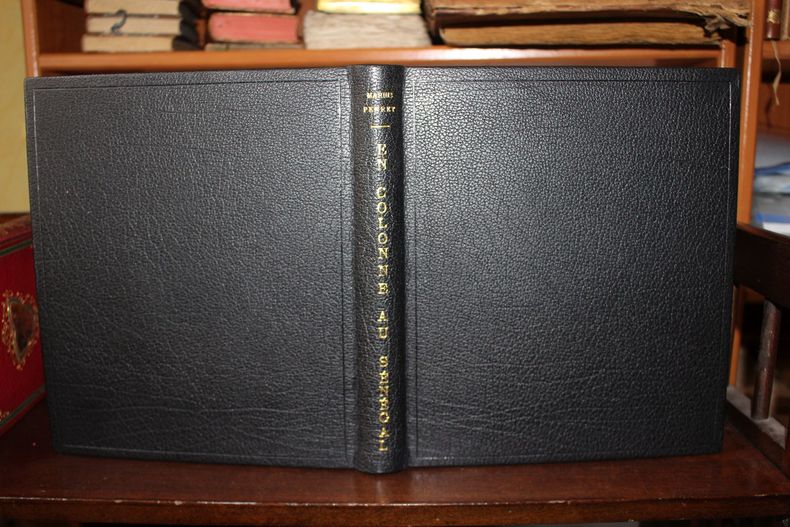
008047[Manuscrit - Afrique] Marius Perret (1851-1900), En Colonne au Sénégal. [ca.1891], in-8, 78-3p. Exceptionnel journal de Marius Perret lors de l'expédition du colonel Dodds (colonne du Fouta). Ce manuscrit semble entièrement inédit bien qu'il fût clairement destiné à être publié, probablement dans Le Tour du Monde, journal auquel il collaborait. Certaines parties ont été supprimées, notamment celle sur les espions. Peut-être y a-t-il eu un véto militaire ou politique à cette publication ? Il s'agit d'une version remise au propre puis corrigée à de nombreuses reprises (plusieurs encres différentes). On remarquera qu'il y a deux versions pour la fin du manuscrit - les 3 pages supplémentaires. La première version a été réécrite quelques mois après la première, probablement pour tenir compte de la mort d'Abdoul Boubakar, tué par des maures quelques mois après l'expédition. Cela permet de dater le manuscrit de 1891. Notons que Perret n'était pas militaire. Il est en fait le premier peintre français à aller au Sénégal et il suivit l'expédition comme médecin. En effet, le médecin militaire était indisposé et Perret l'a donc remplacé (il était médecin de formation). Reliure moderne, plein buffle noir, dos lisse, corps de l'ouvrage composé de pochettes en plastique de conservation dans lesquelles sont glissés les feuillets.