[Manuscrit] Drieu La Rochelle (Pierre) - Berl (Emmanuel) :Livre Rare Book
19 867 résultats
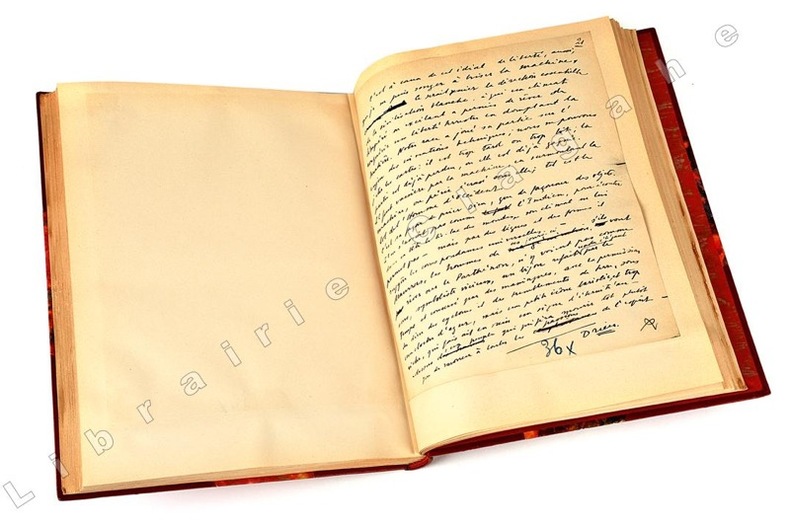
192720903[Revue: cahier politique et littéraire fondé et rédigé par Pierre Drieu La Rochelle et Emmanuel Berl-1927] ; in-4°, demi-chagrin à coins rouge vif, dos à quatre nerfs encadrant les auteurs et le titre.
Small 16mo in 8s (85 x 100 mm; leaf size 75 x 90 mm). [423], [3 blank] pp. plus 3 endleaves at the front and 5 at the back. German manuscript in red and black ink on paper, written in an upright, semi-cursive gothic hand, with Lombardic initials in red (a few 2-line and hundreds of 1-line initials), rubricated throughout. 11 lines per page, written space 55 x 70 mm. Contemporary blind-tooled pigskin over bevelled wooden (beechwood?) boards, sewn on 3 double supports, each board bearing a double rectangular border of multiple rules, inner frame with an oval centrepiece stamp (22 x 32 mm, the front with a female figure [the Virgin Mary or a saint?] within decorative borders; back divided by 2 diagonal double rules and 4 diagonal double arcs into 4 inner and 8 outer compartments, each filled with arabesque decoration; outer compartments coloured, inner compartments thus forming a lighter lozenge with concave sides). An arabesque stamp inside each corner of the inner border and a decorative border between the inner and outer frame composed of at least 2 straight branches with leaves and at least 4 rosettes (5, 6 and 7 petalled); spine and turn-ins rules. In total more than 100 impressions of about 9 stamps. Further with 2 strap fastenings with brass clasps (each with an owner’s [?] stamp: 1.5 mm Roman capital initials "LH" above a 3 mm head in profile, facing right), catchplates and anchor plates, plain headbands, blue edges. With 27 mm Roman capital initials "BR" in brown ink on the lower edge. A charming, pocket-sized Catholic manuscript prayerbook in German, written in red and black, bound in contemporary blind-tooled pigskin, both manuscript and binding probably the work of a monastery in Ravensburg or the surrounding region. - The manuscript begins with prayers to the Virgin Mary on 19 leaves (a1-c3) and continues with three series of rosary prayers on 47 leaves (c3-i1), further prayers to the Virgin Mary on 28 leaves (i1-m4), prayers for various days from Palm Sunday to Easter on 18 leaves (m4-o5), prayers for the 24 hours on 56 leaves (o5-x4), further rosary prayers in five parts on 21 leaves (x4-z8), the litany of all saints on 20 leaves (z8-2c3), and the litany of specific saints, including St Augustine, on 10 leaves (2c3-2d4). - The manuscript is very regular in its structure, only a few blank leaves have been removed: the final quire used for the prayerbook text itself ends with a blank leaf, followed by stubs of 3 leaves that have been torn out. The quires that contain the text of the prayerbook collate: [a]-[2c]8 [2d]8 (- 2d6, 7, 8) = [212], [1 blank] ff. The 17th century binder trimmed most of the quire signatures (quire a probably had none), but on the first leaf of a few quires one can see the top of the letter that was shaved (confirming the collation): i, k, r, s. The top of some letter or mark, also shaved, can be seen in the same position on c3, f2 and 2d1-4, but it is not clear what they are. The endpapers appear to have been a quire of four leaves at the front and a quire of six leaves at the back, probably each with its first leaf removed and the outermost remaining leaf pasted down. - The paper is almost certainly of foolscap size, nearly all watermarked with the Ravensburg coat of arms (a castle represented as a gate between two towers, standing upon a corbel). The gate in the present watermarks probably has a door under a peaked roof, rather than a portcullis, but this and the initial(s) or other sign in the corbel are difficult to make out because each watermark is divided between four leaves with the central parts lost in trimming. The crenellated battlement of each tower is rounded, has three merlons, and sits directly on a rounded slab, the battlement having no narrower neck leading to the slab. Each tower has one window, connected to the wall on the gate side by (in most cases) two diagonal wires that form a triangle with the wall as its base and the point touching the window. We have not found an example in the literature with this triangular link, but otherwise the present watermarks resemble many from the period 1655 to 1675 (Piccard III, group IX, 171-186 & 253-259, plus many scattered throughout group VIII). Those in quires a, f and probably b and g have two initials (probably "HL") flanking the corbel; the literature shows no initials in that position before 1666. This suggests that the manuscript was probably produced in the period ca. 1665 to ca. 1675. One Ravensburg castle mark in WZIS has an HL monogram in the corbel, but not the initials flanking it, and the style of the castle is completely different: it is not clear whether it dates from 1666 or between 1686 and 1700. Not surprisingly, Ravensburg castle watermarks appear most frequently in Ravensburg (in Upper Swabia, just north of Lake Constance), but also in the vicinity (Konstanz, Weingarten, Salem, Überlingen); they are rare elsewhere. - The endpapers were probably made from one of the paper stocks used for the manuscript itself (one leaf shows one side of the foot of the Ravensburg castle watermark, with no initials flanking the corbel), suggesting that the production of the manuscript and its binding were closely tied, perhaps at a monastery in the region. Three bifolia show parts of a different watermark: two bifolia in quire c show a crown, perhaps from a coat of arms or an Imperial double-headed eagle, while one in quire l shows what may be the foot of a coat of arms or possibly the tip of the tail of an eagle, with scroll decorations. - In a 16mo in 8s, one expects each quire to represent a half-sheet, and each sheet would provide one half sheet with a watermark and one without. Here, eight quires show parts of a watermark in four of the eight leaves, and six show no watermark. But even these quires were not consistently made from regularly folded half sheets: some were assembled from separate bifolia, so that some of the watermarks appear at the foot of the fore-edge rather than its head. Most of the quires a-l and a few others show parts of watermarks in 1, 2 or 3 leaves, demonstrating that they contain bifolia from different half-sheets. In quire e, three leaves show one of the two towers from a Ravensburg castle watermark, proving that they come from parts of two different sheets (c and l, which include parts of a different kind of watermark, also mix bifolia from different sheets). - One or more early owners of the present manuscript have written six pages of further prayers on the endpapers (2 at the front and 4 at the back), mostly in a single contemporary hand, including "ein gebeid der Reponsori deß H. Bonaventura"; "So du nun mirackel suchst der Godt"; "Wo man alle nacht mit Jesu schlaffe soll"; "Fünff vögelen singen, daß es in den Rainen" (five songs, numbered 1 to 5). There is also a two-line inscription on the back pastedown. Parts of the front pastedown, which probably contained an owner's inscription, have been removed or obliterated, but bits of an early inscription remain visible. - Some minor and mostly marginal foxing, a hole in l6 and 7, a small marginal tear in l8 and insignificant ones in a few other leaves, but still in good condition. The binding has a hole in the pigskin covering the spine, along one of the supports, is slightly soiled and most of the blue colouring of the edges of the leaves is lost. The centrepiece on the front board does not appear to be worn, but its image (probably the Virgin Mary or a female saint) is nevertheless difficult to make out: perhaps the binder did not impress it strongly. The binding also remains in good condition.
4to. Deutsche Handschrift auf Papier. Zus. ca. 358 beschriebene SS. auf 264 Bll.: (1), (1 weiß), (2), (6 weiß), (1), (1 weiß), 1-344 (davon 5 weiß), (18 weiß), (23), (26 weiß), (1) SS. (davon 32 SS. nachgebunden mit zus. 17 SS. alphabeth. Registereinträge, meist mit Griffregister). Pergamentband der Zeit. Sehr umfangreiche Sammlung von Heilmittelrezepten eines Baders oder Feldschers (wie aus der zweiseitigen gereimten Vorrede hervorgeht). Außerdem richten sich zwischen dem mehr als 500 Rezepte umfassenden ersten Teil (SS. 1-240) und dem zweiten mit etwa 150 weiteren Rezepten (SS. 278-344), in der gleichen Handschrift, zwei Texte an diesen Berufsstand: "Fragen von der Baders Profession" (SS. 241-261) und "Frag Stuckh, wie man sich nach denen Fragen freintlich beantworten soll" (SS. 265-270). Hier werden auch frühneuzeitliche anatomische Fragestellungen erläutert, beispielsweise zur Lage und Beschaffenheit des Gehirns: Dieses bestehe aus drei Teilen und sei in absteigender Größe für Vernunft, Gedächtnis und Vorstellungskraft verantwortlich und in seiner Substanz "weiss und weich". Auf die Arzneimittel folgen Verzeichnisse der Apothekerzeichen (mit einem zusätzlichen Griffregister versehen), Apothekergewichte und Listen unterschiedlicher Wasser und Öle sowie von Pestkräutern und -wurzeln. Am Ende finden sich ein Inhaltsverzeichnis mit alphabetischem Griffregister und ein Verzeichnis lateinischer Pflanzennamen. - Belegt wird der Gebrauchswert des Rezeptbuchs für Bader in einzelnen Überschriften der Rezepte, wie "Ein anders von Joseph Mayr Bader" oder "Wan ein Bader die Aderen nit finden kann". Eine Fülle einfacher Hilfs- und Heilmittel wird vorgestellt, etwa "Wunden zu trukhnen", "Pflaster zu alten Schäden", "Die Milben im Haar zu tödten" oder "Meiß oder Fluigen zu vertreiben". Auch die Behandlung schwerer Erkrankungen wie Gelbsucht, Pest oder Krebs wird diskutiert. Besonders interessant - und giftig - ist eine krebshemmende Salbe mit Bleiweiß "für den Krepss das Er nit umbfresse"; auch jenem, der "das Wasser nit abschlagen khan", soll geholfen werden können. Manche Mittel sind für "Mensch und Vich" geeignet, andere sollen gegen Zauberei helfen, wie etwa das Tragen einer Wurzel von Eisenkraut. - Auf die Herkunft aus Tirol weist neben der mundartlichen Färbung etwa ein Rezept für einen "Wundt Tranckh, so Herzog Sigmund selbsten gebraucht". An einigen Stellen wurden Rezepte von anderen Händen, wohl wenig später, ergänzt. - Oben teilweise mit leichtem Wasserrand, etwas braun- und teilweise leicht fingerfleckig. Der Einband stärker braunfleckig bzw. gebräunt, mit einigen kleineren und einem größeren Wurmloch im Deckel, einem kleinen Wurmloch im Rücken und wenigen größere Einschnitten im Hinterdeckel, bestoßen und berieben.
188589859s. n. | Sans lieu d'édition s. d. [1885] | 23 x 32.5 cm | Relié
8vo. French manuscript on paper. (1), III, 92 (but: 93, pp. 22-23 on 1 f., pp. 83-84 on two ff. each), (3 ff. with notes to pp. 10, 59, 85, 86). Prefixed by an autograph title-page and dedication to Alidor Delzant signed as well as an autograph letter signed (4to, 4 pp.) and autograph envelope bound to the front blank leaves. Contemporary red morocco binding with giltstamped spine. Marbled endpapers. Henri Blaze de Bury's biography of the famous Venetian noblewoman Bianca Cappello, mistress and later consort of Francesco I de' Medici, Grand Duke of Tuscany, was first published over two issues of the "Revue des Deux Mondes" (nos. 63 and 64 of 1884) and again in 1886 as part of his collection "Dames of the Renaissance". The present manuscript with its frequent changes, deletions and corrections as well as occasional excisions constitutes the author's working manuscript as revised for publication; several remaining departures from the published text are probably due to revisions in the galley proofs. - Blaze de Bury inscribed his manuscript to the lawyer, writer and bibliophile Alidor Delzant (1848-1905), executor of the last will of the brothers Goncourt. An autograph letter by Blaze de Bury to Delzant, his "imperfect neighbor" but "most lovely human being", is bound before the manuscript: Blaze de Bury thanks Delzant for his encouraging letter, contrasting it with a negative response to "Bianca Capello“ which had compared the author to Boccaccio, decrying the immorality of the story. - Bianca Cappello (1548-87) was born into one of Venice's foremost noble families. At age 15 she fell in love with a commoner and escaped with him to his native Florence, where they married. Grand Duke Cosimo I granted Bianca protection from her family's attempts to return her to Venice. The marriage was unhappy, and Bianca soon formed an intimate relationship with Grand Prince Francesco, the heir apparent. Francesco, who was married to Joanna of Austria, made Bianca his mistress, and their son Antonio (1576-1621) was born out of wedlock. In 1574 Francesco succeeded to the Grand Duchy and, much to his wife’s discontent, installed Bianca in a palace (Palazzo di Bianca Cappello). Upon Joanna's death in 1578, Francesco secretly married Bianca. The marriage was publicly announced in 1579, and Bianca was subsequently crowned the Grand Duchess of Tuscany. Bianca and Francesco died in 1587 within days of each other, sparking rumours of poisoning. Although Antonio had been legitimized, he was barred from the throne by his uncle Ferdinando, who managed to succeed his elder brother as Grand Duke. - Two pages cut but no loss to text. Paper insignificantly browned and a little fingerstained throughout. Well preserved. H. Blaze de Bury, Bianca Capello, grand-duchesse de Toscane, in: La Revue des Deux Mondes, nos. 63 and 64 (Paris: 1884). H. Blaze de Bury, Dames de la Renaissance (Paris: G. Lévy, 1886).
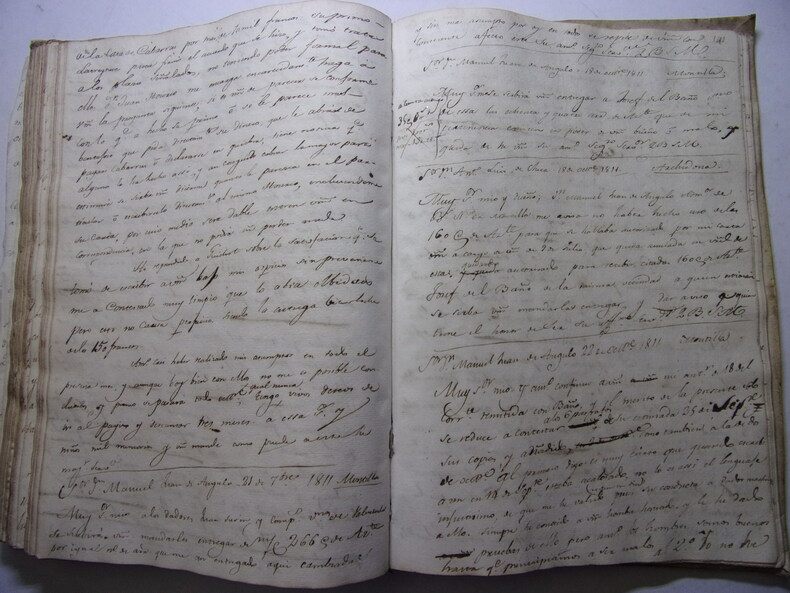
CZC-8828rare manuscrit du Chevalier Colonel Roby couvrant la période 1803 à 1837, avec lettres et correspondance. Jean Roby, né le 18 octobre 1778 à Navarrein, département des Basses- Pyrénées, était Officier de la Légion d'honneur, Chevalier de l'ordre Royal et militaire de Saint Louis. L'ensemble est relié par les ficelles, la couverture en peau est absente sur le premier plat, dimension 30x22cm, en remarquable état de conservation. Environ 600 pages. Joint un ensemble de lettres avec cachet Sello Hispaniarum Rex Carolus IV DG
CZC-8828rare manuscrit du Chevalier Colonel Roby couvrant la période 1803 à 1837, avec lettres et correspondance. Jean Roby, né le 18 octobre 1778 à Navarrein, département des Basses- Pyrénées, était Officier de la Légion d'honneur, Chevalier de l'ordre Royal et militaire de Saint Louis. L'ensemble est relié par les ficelles, la couverture en peau est absente sur le premier plat, dimension 30x22cm, en remarquable état de conservation. Environ 600 pages. Joint un ensemble de lettres avec cachet Sello Hispaniarum Rex Carolus IV DG
184183639s. l. [Passy] « mardi matin » [28 décembre 1841] | 13.50 x 21.60 cm | une page sur un double feuillet, enveloppe jointe
195283726Saint-Jean-Cap-Ferrat août 1952 | 20.80 x 34 cm | 52 pages
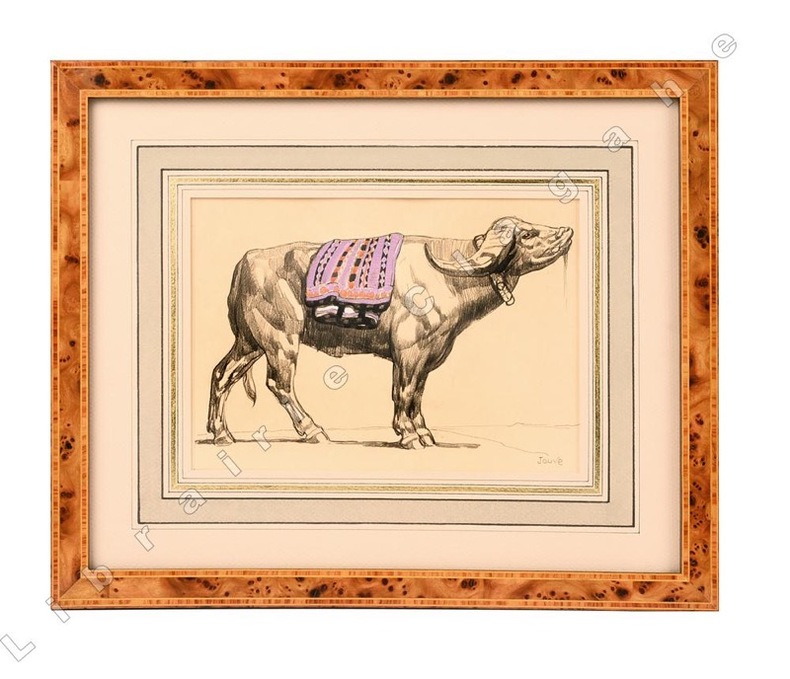
185221442Dessin original au crayon gras, gouache et aquarelle sur papier japon impérial (185 x 217 mm ; recadré 151 x 212), signé au crayon dans le coin inférieur droit ; passe-partout à large encadrement bicolore beige et vert et large filet doré, encadrement de loupe. Format total 295 x 355 mm. Au dos, partie de dessin au crayon et fusin, découpée.
Folio (235 x 360 mm). (248) pp., 53 blank ff. (35) pp., 13 blank ff. Latin, German and Hungarian ink manuscript on paper, with a double-page illustration of a family tree. Contemporary full calf, spine elaborately gilt with two red spine labels "Status Familiae Kormendianae, Cum Deductione Universali" and "Opera Spectabilis Dni. Stepha Ladislai De Körmend"; covers in two shades of brown leather with two giltstamped borders and elaborate ornamentation. Leading edges gilt; marbled endpapers. Edges goffered and gilt with red marbled middle sections. A vast, hitherto untapped collection of document copies spanning some two centuries of the history of the Körmendy family, edited by a descendant as a keepsake and portable archive for his heirs. Important not only for the history of this branch of the Körmendys, but also as evidence of the proliferation of nobility in early modern Europe, especially in Hungary, and of the legal ramifications within the realms of public law (governing the acquisition of noble status and the family's position within the state), civil law (lawsuits fought among noble families), and house law (the self-posited internal rules governing the family's dynastic succession and inheritance). - The manuscript begins with an autobiographical account of the writer, Stephan Ladislaus de Körmend, born on the 25th of July 1700 in Egbell in the Hungarian county of Neutra (today, Gbely in the Trnava Region of Slovakia), to parents Franciscus de Körmend and Zuzanna Zaffiry. It goes on to include an extensive array of copied documents which demonstrate the family's descent and legally tangled history from the mid-16th century onwards, when Martinus "Literatus" de Körmend was granted a title of nobility by King Ferdinand I for gallant military service under Peter Bakics (cf. Siebmacher 33.2, p. 135). A fine, double-page spread illustration shows the family tree growing from Martin Literatus at the bottom. At the end of the volume, a separate section in German provides communications from Imperial commanders in the Austro-Turkish War of 1737-39 that illustrate military operations of the year 1738, in which the writer appears to have been involved in a legal capacity. - Körmendy served as head notary of Bács-Bodrog County near the Serbian border from 1734 to 1739, but the upheavals of the war seem to have necessitated his return to his native northern Hungary. Other than that, he was previously known to Hungarian historians only as a diarist: a journal he kept in 1736 is mentioned in Gyula Dudás's work on the noble families of Bács (cf. below), and Péter László's Encyclopedia of Hungarian Literature published in 1994 records his professional work in Bács-Bodrog as well as his diary. - Hungarian genealogy knows of numerous families named Körmendy, and it is not clear whether or how they are related to each other: Béla Kempelen's dictionary of Hungarian noble families lists no fewer than ten (the present branch being the first), while that of Nagy has a nearly page-long entry on the various families, specifically citing one hailing from Trencsén county (now Trencín in Slovakia, neighbouring Trnava). Indeed, not every family named Körmendy was necessarily a noble one: the name is derived from the city of Körmend in Vas county, and the -y (or -i) at the end of the name (rendered in Latin as the preposition "de") primarily denotes origin and need not be an indication of nobility. It is important to note that the socially highly differentiated Hungarian nobility comprised close to five percent of the total population - some 75,000 families in 1787, compared to a mere 26,000 in France in 1789 - and thus was one of the largest noble classes in Europe both by percentage and in absolute numbers (cf. B. Király, Hungary in the Late 18th Century [1969], p. 38). While many members of the lesser gentry lived in conditions bordering on destitution, they were nonetheless fiercely proud of their aristocratic birth (which in 18th century Hungary still entailed exemption from taxation) and resisted as an intolerable break with tradition every Habsburgian effort to modernize the country. - A different, more sensational perspective on this painstaking collection of documents, possibly not reliable in all respects, is presented by the Viennese-born political journalist Anton Gross-Hoffinger (1808-73): in his popular account of Hungary, "Ungarn, das Reich, Land, und Volk wie es ist" (published under his pseudonym "Hanns Normann" in 1833), he states that Körmendy was an 18th-century Hungarian lawyer who exploited his country's proliferation of nobility and the chaotic legal situation surrounding it by forging not only his own family's title, but also those of many other ambitious, well-to-do individuals. According to Gross-Hoffinger (p. 141-143), he was finally taken to court when sixty years of age and, having managed to draw out the investigation for two decades, was sentenced to life imprisonment at the age of eighty (for no death penalty was pronounced on octogenarians), ultimately dying incarcerated at the age of 104. - Several stamps of the Körmendy family archive, Budapest ("A Körmendy nemzet seg családi levéltára Budapest") in green ink. Some annotations and markings in pencil or red crayon by later hands. A mended tear to the title page, and slight worming to the upper cover near the top edge, otherwise a very well preserved manuscript, elaborately bound as an heirloom. Cf. Péter László, Magyar irodalmi lexikon II, 314. Gyula Dudás, A bácskai nemes családok : adalékul Bács-Bodrogh vármegye történetéhez (Zombor 1893). Siebmacher 33 (Die Wappen des Adels in Ungarn: Bd. IV, 15. Abt., 2. Teil), p. 135 with plate 98. Béla Kempelen, Magyar nemes családok VI (Bp. 1913), p. 246. Iván Nagy, Magyarország családai czimerekkel és nemzékrendi táblákkal VI (Pest 1860), p. 448f.
190886094s. l. s. d. [1908 ou 1919 ?] | 11.60 x 17.80 cm | 4 pages sur un feuillet remplié
4to. (5), 129 ff. German and Latin manuscript on paper, written in a 17th century hand. With 3 heraldic crosses showing the coats of arms of the Teutonic Order (a black cross) and 4 drawings showing costumes of several members of the order, all executed in watercolours with some albumen highlights. 20th century calf, blind-ruled double fillet borders on both boards, spine ruled in blind and lettered in green. Highly interesting 17th century German manuscript of the Order of Brothers of the German House of Saint Mary in Jerusalem, commonly known as the Teutonic or German Order. Founded in 1190, it was primarily founded as a military society with its Teutonic Knights serving crusadings Christians in the Holy Land during the Middle Ages. In time, the Order also developed into a Catholic religious institution, although it would not lose its military function until the 20th century. - The present manuscript opens with a short history of the Order, beginning with the year 1190 and ending in 1606. It continues with the statutes, divided into several chapters, which are interspersed with prayers in Latin. This combination of statutes and prayers gives evidence that the Teutonic Order was not merely a military order, but also had a strong focus on religion. This is also reflected in the liturgical calendar, which is part of a chapter of the statutes, listing the saints and their feast days as celebrated by the Order. The end of the work (fol. 125) states that Maximilian III of Austria approved the statutes. Maximilian (1558-1618) was the Grand Master of the Order from 1585 until his death. The date 1606, as well as his passing in 1618, suggest that the manuscript was written in the first quarter of the 17th century. - The last five leaves of the manuscript appear to contain the names of the Landkomturs who ruled the various bailiwicks of the Holy Roman Empire's commanderies. These Landkomturs, subordinate to the Grand Master, were very often important German noblemen. - Uncommonly for this type of text, this manuscript is illustrated: the first illustrated leaf shows three black crosses, forming the arms of the Teutonic Order, including that of the Grand Master. The Grand Master's coat of arms is a black cross with a golden cross superimposed upon it, with an imperial eagle in the centre. It continues with four illustrations showing the typical costumes of several members of the Order. The second illustration in this series shows the white overcoats bearing a black cross, such as were typically worn by the Knights since 1205. - Only a few very minor spots, overall in very good condition. According to a 21st century inscription in pencil on the first endpaper, the manuscript was formerly part of the collection of the Belgian historian and politician Philippe Kervyn de Volkaersbeke (1815-81). Altogether a rare survival, and a rich source of information on the formal organisation of the most important 17th century German Order, but also on their statutes and their religious customs and habits. The manuscript beautifully reflects the religious as well as the military character of the Teutonic Order.
4to. 21 pp. Autogr. Latin ms. signed in the dedication. Late 18th c. wrappers. Unpublished autograph manuscript by the Friulian poet (1500-1560), bound together with an autograph letter by his son in the late 18th century. The ms. comprises 17 pages and contains 25 fables: "De Coclea", "De Lactuca", "De Duobus Passeribus", "De Asino", "De Sene Amatore", "De Lupo et Vulpe" etc. - "Fu dotto il Paciani i buon poeta, encomiato da' suoi concittadini e dagli storici di que' tempi. Lasciò un Ms. in idioma latino centenente 'XXV Favole', da lui dedicate nel 1526 a Sua Eccellenza Ludovico Michele 'Provisor Civitatis Perfectum', che conservansi presso la sua famiglia" (Di Manzano). Di Manzano 997. GF IV, 310. Cf. also G. Marchetti, Il Friuli. Uomini e tempi (1959), and G. Nazzi, Dizionario biografico friulani (1992).
15400031701540 Portefeuille grand in-quarto (230 X 337 mm) vélin ivoire recouvert de satin bleu (en partie décousu avec petits manques en marge) et bordé d’un fin galon doré, cordons de fermeture brodés de fils couleurs et or (en partie manquants) ; 28 feuillets (dont deux réglés sans inscription et deux autres vierges) sur peau de vélin reliés au portefeuille par un cordon de soie à brins jaune, vert et rouge (Reliure de l'époque).
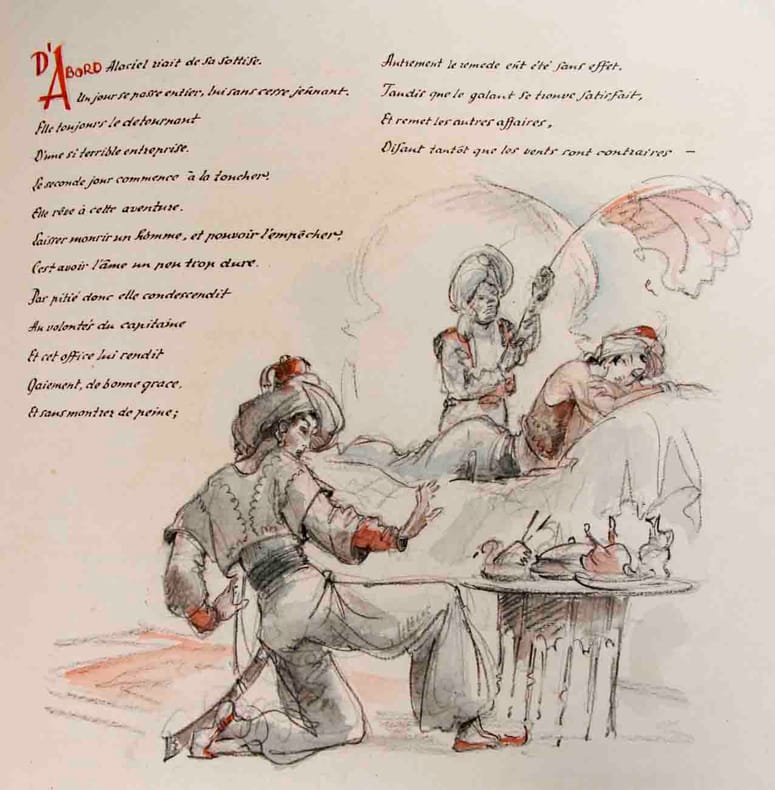
138304aafOhne Ort, Dezember 1934. in-folio, (42,5 x 37 cm). Texts in red and black, illustrated with 29 fine watercolours on 21 leaves / 29 aquarelles sur 21 feuilles / 21 Blatt mit 29 O.-Aquerellen, magnifique reliure en plein maroquin vert, gardes en soie (Charles Lanoë). Chemise + étui.
101284aaf14.5x67.5 cm (leporello - or concertina style), 94 leaves, written and illustrated on recto / verso, each leaf appr. 14.5x 67.5 cm (of a total length of ca. 1363 cm), illustrated with 24 most beautiful double-page miniatures (12 double-pages on each side), contemporary painted black boards.
- Londres 26 décembre 1937, 17,9x22,9cm, une feuille. - Signed autograph letter to Alfred Cortot and his wife about Richard Wagner's manuscript collection: "I was lucky enough to be able to acquire the entire lot one day before Bayreuth sent a trusted buyer". London 26 December 1937, 17.9x22.9cm, one leaf. Autograph letter signed by Stefan Zweig to Alfred Cortot, two pages on one sheet written in violet ink. An outstanding autograph letter in which the avid collector informs his friend Alfred Cortot of his acquisition of unpublished manuscripts of Wagner. Alfred Cortot himself owes his career as a conductor to his early discovery of the German composer. Cortot shared with Zweig his "almost tyrannical bewitchment [suffered] with as much intoxication as fervor" for the composer. Zweig, who spoke of his collection as "more worthy of surviving me than my own works" (The World of Yesterday: Memories of a European, 1942), recounts for his friend the details of this incredible discovery of hundreds of forgotten leaflets, including Wagner's intimate correspondence, handwritten scores and excerpts from opera librettos, including The Flying Dutchman, The Sublime Fiancée (or Bianca and Giuseppe), Die Feen, Das Liebesverbot (The Ban on Love) and a lost orchestral version of Rule Britannia. In December 1937, as he fled the Nazi regime and settled in London, Zweig became fascinated by the archives of a time when intellectual Europe was living in perfect syncretism. The writer takes a nostalgic look at the manuscripts of Wagner, who like him spent his youth travelling through the capitals of Europe: "I was extraordinarily fortunate to be able to get my hands on a whole lot of Richard Wagner's musical and literary manuscripts from his early period (Leipzig, Magdeburg, Riga and Paris) during a short stay in Vienna". Among these precious manuscripts is the extremely rare orchestral arrangement of the patriotic song Rule Britannia, which had been missing for more than sixty years. Sharing his passion for Wagner with his friend, the pianist Cortot, Zweig announced his discovery with the wonder so familiar to collectors when faced with an exceptional find: "[...] the manuscript is the only one of its kind in the world that has been preserved. It contains things that will be of special interest to you, for example the complete translation (60 pages) of the French version (unpublished (I believe) of the text of the "Liebesverbot") entirely in Wagner's hand, as well as the manuscripts of a vaudeville song "Descendons la Courtille" (which he performed in his darkest moments) [...] almost thirty pieces of the highest interest and precisely from the rarest period. All this was hidden for 50 years in a private collection and I was lucky enough to be able to acquire the entire lot one day before Bayreuth sent a buyer". The letter is a fascinating account of Zweig's parallel life, which had earned him a reputation as an accomplished collector. His collection also inspired one of his most beautiful short stories, The Invisible Collection (die Unsichtbare Sammlung) and a pioneering essay in the Deutscher Bibliophilen Kalender (The Autograph Collection as an Art). His hundreds of historical, musical and literary autographs from the Middle Ages to the 20th century were carefully catalogued and collected in the library-museum of his house in Kapuzinerberg: "In this library, a 'place of worship', he also exercises a real activity as an expert in autographs [...]. ...] The library will attract a number of distinguished scholars, sometimes accompanied by their assistants, who will not hesitate to return to work there quietly for days or even weeks at a time" (Stefan Zweig, le voyageur des mondes, Serge Niemetz). With this acquisition, Zweig sees the dream of every collector come true. After two years of exile in England, Zweig returned to Vienna in time to purchase these exceptional documents from Bayreuth's emissaries, who had already built up a large col
6642Émouvante liste des votes des députés au procès de Louis XVI. La liste est établie sur trois colonnes : noms, départements et vote. Ce dernier alterne dramatiquement “la mort, la réclusion, la déportation, la mort en cas d'évasion…" Certains députés sont absents pour cause de maladie ... Le document provient des archives d'un représentant du Gard. 1 cahier broché de 30 pages in-4° sur papier vergé azuré filigrané à l'écu et initiales PG. 29 x 20,5 cm
171043032Sans lieu, , 1710. Manuscrit in-folio (37,5 x 25 cm) de (24) ff. à l'encre noire, texte encadré, maroquin rouge, dos à nerfs orné à petits fers, triple filet doré d'encadrement sur les plats, tranches dorées (reliure de l'époque).
Folio (ca. 224 x 360 mm). German manuscript on paper. (44), 448 (but: 449), (1) pp., per extensum. Early 19th century marbled boards. Extensive, near-contemporary collection of sources on the so-called "Grumbach Feud", a conflict between Wilhelm von Grumbach and the Prince Bishop of Würzburg which came to a head with the 1558 murder of bishop Melchior Zobel von Giebelstadt and then blended into a scheme of Duke John Frederick II of Saxony to transfer the Saxon electorship to his own family's line with Grumbach's help. The extremely brutal quarrel ended with Grumbach's being drawn and quartered in the Gotha marketplace, while the Duke was imprisoned in Austria for the rest of his life. - The present manuscript treats the years 1563 to 1567, from Grumbach's capture of Würzburg to the capture of Gotha by Duke Augustus of Saxony and the subsequent execution of Grumbach and imprisonment in Wiener Neustadt of Duke John Frederick. The well-organized manuscript contains an extensive index at the beginning and boasts a wealth of document and correspondence copies. An important source collection for the history of a 16th century conflict with wide repercussions throughout the Empire. - Spine, edges and corners professionally repaired. Front flyleaf has a handwritten acquisition note by the Austrian nobleman Maximilian Baron Pilati-Thassul (1819-72), recording that he paid 24 guilders and 36 kreuzers for the book.
186064096s. d. [circa 1860] | 20.60 x 27.60 cm | un feuillet remplié
194191043circa 1940-1941 | 18.5 x 27.5 cm | 17 feuillets
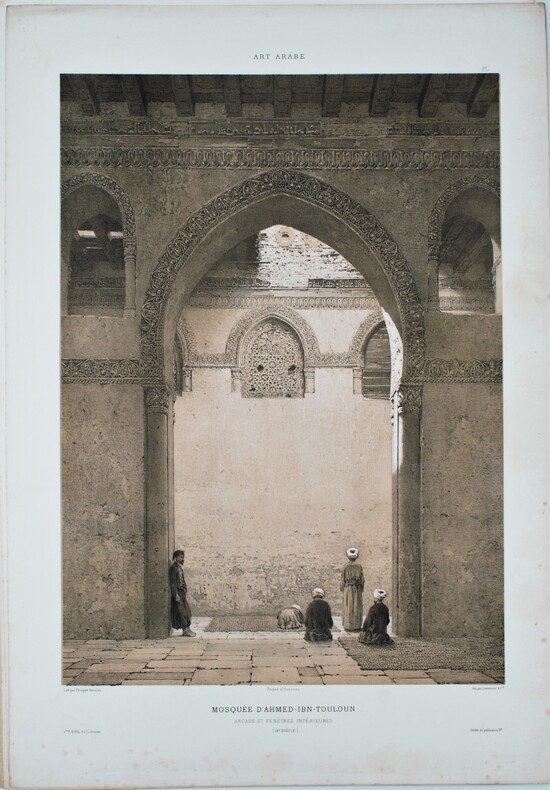
1877PHO-2147Paris, Morel, 1877, 4 volumes, 3 volumes de gravures in-folio et 1 volume de texte in-4 Texte ; VIII-296pp, illustré de 34 gravures h.t. et de nombreuse dans le texte, demi basane époque, dos lisse avec titre, frottements, rousseurs éparses. Atlas ; 3 volumes in-folio en feuilles, sous emboîtages moderne. Comprenant pages de titre et tables des planches, complets des 199 (sur 200) planches (22 gravées et 177 lithographiées dont 39 vues teintées et 130 chromolithographies, plusieurs rehaussées d'or), lithographiées ou gravées, parfois en couleurs et certaines d'après Girault de Prangey, l'un des tout premiers voyageurs français à photographier Le Caire et Jérusalem. Les planches représentent des vues de vestiges, de nombreux détails d'ornementations (portes, heurtoirs, flambeaux, plats, etc.) ainsi que des meubles, des textiles, des céramiques, des boiseries, des carrelages, des armes et des armures, des verres et des émaux, des tapis, des manuscrits et des corans, une planche déchirée sans manque. Édition originale de l'ouvrage le plus important du XIXe siècle entièrement consacré à l'art arabe.