19 870 résultats
184172914Paris 18 novembre [1841] | 13.90 x 20.80 cm | une page sur un feuillet remplié
190783638s. l. s. d. [ca 1907] | 12.60 x 20.40 cm | 3 pages sur un double feuillet
Very Good Arabic Original autograph document/letter sealed by Ahmad I of Tunisia. 54x42 cm. 1 p. 6 long lines. The letter includes full of poetic praise. It must be sent after successful diplomatic intercourse with Naples. Ferdinand II (Ferdinando Carlo) was King of the Two Sicilies from 1830 until his early death in 1859. It starts with 'Thank God alone', and goes on 'From poor Ahmad Pasha to Lord Almighty Field Marshal Amîr [ruler]. Sealed by the seal of Ahmad Basha Beg including an impressive qasidah in Arabic. Ahmed I (ibn Mustafa), born 2 December 1805 in Tunis died May 1855 at La Goulette, was the tenth Husainid Bey of Tunis, ruling from 1837 until his death. He was responsible for the abolition of slavery in Tunisia in 1846. He succeeded his father Mustafa Bey on 10 October 1837. He had grand ambitions - to expand his army and create a modern navy; to build a new royal residence, a mint and modern institutions of education but neither he nor his brother-in-law the young Mustapha Khaznadar who served as his finance minister, had a clear idea of what such initiatives would cost. As a result, many of his projects became expensive failures which damaged the financial health of the country. Soon after his accession, Ahmad Bey received the traditional Firman from the Sublime Porte which formally invested him with authority to rule from the Ottoman Empire and furnished him with the insignia of office. The Ottoman envoy, Osman Bey, arrived in la Goulette on 15 May 1838 onboard a frigate. The following day, Osman Bey made his official entry into Tunis on horseback, preceded by all the ministers of the beylical cabinet who went before him until he was two leagues from the city. Before he were carried the sword of honor and the caftan to be presented to the Bey. He was escorted by spahis and followed by a large contingent of regular troops an Arab cavalry. Three days after his official entry into the city, the envoy presented himself at the Bardo Palace to formally invest Ahmad Bey with his insignia of office and present gifts. Named as a Divisional General in the Ottoman army in May 1838, he was later promoted by the Sultan to the rank of Marshal on 14 August 1840. This was the first time that a Bey of Tunis had held a rank higher than Divisional General. The purpose of these honors was to emphasize the supremacy of the Ottoman Empire over the Regency of Tunis. Under a treaty with France signed in 1830 by Hussein Bey, a piece of land in Carthage had been ceded to allow the erection of a monument to Louis IX of France who had died there during the Eighth Crusade. On 25 August 1840, the first stone was laid in the cathedral of Carthage. Ahmad Bey also permitted the Christian community of Tunis, consisting mainly of European merchants, to enlarge their small church near the Bab el Bhar. In June and July 1846 the Duke of Montpensier, son of King Louis Philippe of France visited Tunis and Carthage. He was received with great solemnity by Ahmad Bey. According to the Tunisian historian Mohamed Bayram V, Bey's reforms were focused on state structures, the army, and education. He established a modern structure of government and gave his high officials the title of 'minister'. His senior ministers were his Grand Vizier Mustafa Sahib at-Taba'a, Mustapha Khaznadar, Minister of Finance and of the Interior, Mustafa Agha as Minister of War, Mahmoud Khodja as Minister of the Navy and Giuseppe Raffo as Foreign Minister. At certain times Mahmoud Ben Ayed also served as Trade Minister, Kuchuk Muhammad in the honorific post of Minister in charge of the security home of Ahmad Bey's reforms wasted money, such as the large frigate built at La Goulette that could not make it through the channel to the sea. of Tunis and Mohamed Lasram IV as Minister of the Pen. The historian Ibn Abi Dhiaf was the Bey's private secretary. Among Ahmad Bey's successes may be counted as the abolition of slavery in January 1846. To this may be added the formation of the military academy at...
- s.d. (ca 1839), 13x8cm, une feuille. - Signed, handwritten letter to Louis Desnoyers [ca 1839] | 13 x 8 cm | one leaf Handwritten letter signed by Honoré de Balzac addressed to Louis Desnoyers written on a white piece of paper in black ink. "My dear Mr Desnoyers, extraordinarily, today I attend a diplomatic dinner of good-natured folk who want to laugh and drink, and as I am in a stupor at work I have not had the courage to refuse this debauchery; I will therefore not be at home. Come early Sunday morning. / Yours / de Balzac". Louis Desnoyers plays an important role in the foundation of the Société des gens de lettres, which aims to protect literary and artistic property and to create a solidarity fund. Balzac supported the creation of this Society, of which Desnoyers was vice-president. Amusing letter, testimony of Balzac's love of good food. [FRENCH VERSION FOLLOWS] Lettre autographe signée d'Honoré de Balzac adressée à Louis Desnoyers rédigée sur un feuillet de papier blanc à l'encre noire. «?Mon cher monsieur Desnoyers, par extraordinaire, j'assiste aujourd'hui à un dîner diplomatique de bons enfants qui veulent rire et boire, et comme je suis hébété de travail je n'ai pas le courage de me refuser cette débauche ; je ne serai donc pas chez moi. Venez dimanche matin de bonne heure. / Tout à vous / de Balzac?» Louis Desnoyers joua un rôle important dans la fondation de la Société des gens de lettres, qui visait à la protection de la propriété littéraire et artistique et la création d'un fonds de solidarité. Honoré de Balzac soutint la création de cette Société dont Desnoyers fut le vice-président. Amusante lettre, témoignage de l'amour de Balzac pour la bonne chère.
- Paris s.d. (avril 1841), 13,5x21cm, une page sur un feuillet. - Lettre autographe signée de Gérard de Nerval adressée à Hippolyte Delaunay rédigée à l'encre noire. Nom du destinataire de la main de Nerval au dos du feuillet. Une pliure centrale inhérente à la mise sous pli. Cette lettre a a été retranscrite dans les Oeuvres complètes de Nerval à la Pléiade. Gérard de Nerval est enfin « libre et sorti de la maison Blanche » après y avoir séjourné des suites de sa crise du début printemps 1841. Il ne s'agit toutefois pas d'une sortie définitive mais probablement d'une permission accordée par le docteur Blanche à son patient, ce dernier ne sortira définitivement qu'en novembre 1841. L'écriture, difficilement lisible par endroits, montre la fébrilité de Gérard de Nerval, qui cherche à renouer avec le milieu littéraire : « J'apporte des masses de copie, pour vous et trois ou quatre autres journaux. » Hippolyte Delaunay fut rédacteur en chef de la revue L'Artiste dans laquelle Nerval publia le 11 avril de la même année un article intitulé « Mémoires d'un Parisien, Sainte-Pélagie 1832 ». [ENGLISH DESCRIPTION ON DEMAND]
- Paris s.d. [circa mars 1841], 10x13,1, un feuillet et son enveloppe dépliée. - Très rare lettre autographe signée "Gérard Labrunie" adressée à "[son] cher papa" le Dr Labrunie. 13 lignes rédigées d'une petite écriture à l'encre noire sur une page. Enveloppe dépliée jointe présentant plusieurs tampons postaux, restaurée au dos à l'aide d'une pièce adhésive. Quelques pliures transversales ainsi que quelques très discrets trous, sans atteinte au texte et inhérents à l'utilisation d'une épingle pour sceller la missive. Belle lettre de Gérard Labrunie à son « cher papa » à propos d'une « affaire très embrouillée » ayant trait à la « qualité de subrogé tuteur » du père de l'écrivain. Très rare signature de Gérard de Nerval sous son véritable patronyme : Gérard Labrunie. [ENGLISH DESCRIPTION ON DEMAND]
- Léon Vanier, Paris 1891, 12,5x19cm, broché sous chemise et étui. - Later edition on Hollande paper Chemise backed in dark green morocco over marbled paper boards, marbled pastedowns and endpapers, slipcase edged with same morocco and with boards of the same paper, lined with apple-green paper Rare inscription from Paul Verlaine to Achille Segard A small marginal lack to pages 15 & 16 due to paper fault, manuscript note "1866" in ink below the date featuring on the upper cover A rare, unsophisticated and uncut copy. [FRENCH VERSION FOLLOWS] Nouvelle édition imprimée sur Hollande. Dos de la chemise de maroquin sapin, plats de papier marbré, gardes et contreplats de papier à la cuve, étui bordé du même maroquin, plats de même papier marbré, intérieur de papier vert pomme. Rare envoi autographe signé de Paul Verlaine à Achille Segard. Un petit manque marginal en pied des pages 15 & 16 en raison d'un défaut de fabrication du papier, mention manuscrite "1866" à la plume en dessous de la date figurant sur le premier plat. Rare exemplaire non rogné et tel que paru.
- Léon Vanier, Paris 1891, 12,5x19cm, relié. - Second edition, first for some parts, one of 100 copies on vergé blanc paper. Contemporary Bradel half dark-green cloth over marbled paper boards, the spine with gilt fleuron, date and double gilt fillets at foot, upper corners rubbed, covers preserved. Handsome autograph inscription from Paul Verlaine to Alice Densmore. An attractive copy in a pleasant binding. [FRENCH VERSION FOLLOWS] Deuxième édition, en partie originale, un des 100 exemplaires d'auteur imprimés sur vergé blanc. Reliure à la bradel en demi percaline sapin, dos lisse orné d'un fleuron doré, date et double filet dorés en queue, plats de papier marbré, coins supérieurs émoussés, couvertures conservées, reliure de l'époque. Précieux envoi autographe signé de Paul Verlaine à Alice Densmore. Bel exemplaire agréablement établi.
174543416S.l.n.d., , 1745 vers . Manuscrit in-8 (15 x 18,5 cm) de (55) ff., maroquin rouge à décor doré, dos orné à nerfs, large dentelle florale dorée en encadrement, composition à petits fers sur les plats, doublure et gardes de papier d'Augsbourg vert et or, ruban de soie vert, tranches dorées (reliure de l'époque).
176439878A Paris, , 1764. Manuscrit in-8 (14 x 22 cm) de (1)-81 pp. à 24 lignes par page, maroquin rouge, dos à nerfs orné de macles, pièce de titre en maroquin vert, triple filet doré d’encadrement sur les plats, gardes de de papier dominoté, tranches dorées (reliure de l’époque).
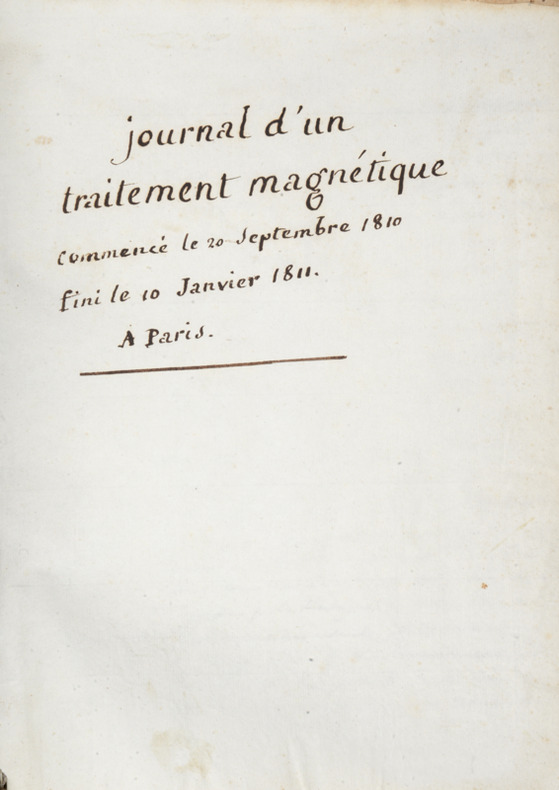
181040662Paris, , 1810-1811. Manuscrit in-4 (19 x 25 cm) de (1)-331 pp. à 23 lignes par page (1 feuillet découpé pages 143/144), demi-vélin vert à petits coins, traces d'étiquette manuscrite sur le dos (reliure de l'époque).
4to. English manuscript on paper. (2), 43, (1) ff. Contemporary full red morocco with giltstamped border and spine. Endpapers marbled. All edges gilt. Pre-printed table filled in by hand, detailing British military forces stationed in Britain and around the world, including the Caribbean, India, Africa, and Australia. Includes the names of regiments as well as the numbers of commissioned and non-commissioned officers, and the enlisted rank troops ("Rank & File"), distinguishing those fit for duty from those on the sick list, with a total of 238,978 regular forces and 91,586 militia. - Binding insignificantly rubbed at the hinges; interior crisp and clean. Heraldic bookplate incorporating a ducal coronet and Bentinck family crest to pastedown, a pencil note on the flyleaf ascribing it to the Duke of Portland's library. Later in the collection of Thomas Fremantle, 3rd Baron Cottesloe (1862-1956), commander of the Territorial Army and president of the Society for Army History Research.
Small oblong folio (ca. 276 x 210 mm). German manuscript on paper (letterpress form). 188 ff. Contemporary brown half cloth over marbled boards with giltstamped red cover label reading "Journal. 12 Monate". Diligently kept naval log of a long China voyage on a Hamburg-based ship undertaken soon after the Second Opium War, at the time of the Tianjin Massacre, during the early years of the rule of the Tongzhi Emperor. The Chinese ports of call range from Hong Kong on the South China Sea and Shanghai on the East China Sea to Tianjin (near Beijing) on the Yellow Sea. - The journal entries begin with the schooner barque Anna weighing anchor in Hamburg on 17 January 1870; they cross the Sunda Strait on 23 April and reach Shanghai on 1 June. After a layover, the course is set for Tamsui, then for Chifoo (Yantai) and Tientsin (Tianjin), and onwards to Hong Kong, Amoy (Xiamen), and Taku, bringing the ship to the island of Penang (George Town) on the Straits of Malacca on 12 March 1872. 14 pages prefixed to the printed form describe how the Anna is taken over at Geestemünde (Bremerhaven) on 20 November 1869, as well as the travel preparations, but also events in the port of Yantai. Apart from precise position readings, weather notes, and other navigational records, the book also contains information in brief regarding disciplinary measures, damage suffered from ice jams, celebrations on board, etc. Until 21 June 1870 the logbook is maintained by the chief helmsman Thomas Brügeman, after which date a different writer takes over. - The Anna (ex Malvina), built and launched in 1859, was a barquentine of 227 register tonnes, sailed by a crew of ten men under captain Carl Eisenmenger, who was also the owner of the ship. - Binding slightly rubbed; paper occasionally browned, but well-preserved altogether.
Miniature painting on vellum, 12.2 cm diameter. Watercolour and gold leaf, pen with black and red ink on verso. Pasted to backing cardboard. Circular miniature initial separated into two parts by a curved S-shape in gilt. The upper section represents three Jewish figures gathering manna falling from the heavens during the Exodus. To the right a horned Moses is seen. The lower section shows a Dominican friar celebrating mass before a monstrance and an altar. The manna scene serves as a prefiguration of the Holy Host in the monstrance below. - The fragment probably belonged to a Dominican antiphonary, and the verso side contains musical staffs and text fragments. The stylistic elements in the illumination point to a workshop in Southern Germany, probably in Swabia. Comparable in style is a copy, dated to ca. 1455, of Johannes Hartlieb's "Buch aller verbotenen Kunst" (Dresden, Landesbibl., Mscr. M 59). The visual idea of conjoining the scenes is also apparent in the "Biblia Deutsch" published by Johann Sensenschmidt in Nuremberg between 1476 and 1478.
2 volumes of hand-drawn and coloured constructional drawings. Small folio (280 x 362 mm each). 4 cloth-backed folding plates (numbered I-IV), calligraphic half-title, 20 pp. of designs on 10 leaves. 5 full-page designs on individual plates (numbered II-VI; lacking the first), calligraphic half-title. Both volumes bound in contemporary quarter leather with green marbled boards; handwritten blue cover labels. A set of two ledgers of construction designs for the building of the new carriageway between Volterra and Capannoli in the Province of Pisa, a project which had been authorized by the government in 1825. The course of the road largely coincides with today's Strada Regionale 439. The first ledger (entitled "4. Disegni della Sezione FG. Comunità di Lajatico") contains a map of the 6th section of the projected road, which reaches from the Foscecchia river to the Sterza river, along the banks of the Era and past Lajatico; two cross-section profiles covering the entire distance of this section (together ca. 280 cm in length, with precise measurements given throughout); a cross-section of the bridge across the Foscia river, and a total of 79 lateral profiles of the road construction throughout the various points of the hilly terrain. The second ledger (entitled "7. Carta del generale andamento, profilo e ponticelli") shows the road design in a lateral section as well as designs for four different types of bridges of various heights. - The construction of the carriageway took place from the late 1820s onwards, and similar technical drawings survive in the Archivio di Stato di Pisa (collected in the "Disegni degli ingegneri della Camera di Sopraintendenza Comunitativa di Pisa"). - A fragmentary survival of the original ensemble, which must have encompassed at least ten volumes; but attractively preserved.
005670Le 16 d'aoust 1717 à 9 heures du soir. In-quarto (275 X 210 mm) veau havane glacé de l'époque, dos à nerfs, caissons dorés ornés aux petits fers, pièce de titre maroquin grenat, coupes et coiffes filetées, chasses ornées d'une roulette dorée, tranches rouges (Reliure de l'époque) ; (1) f. de titre, 732 pages, (1) f. blanc, 68 feuillets, (1) f. blanc. Petit manque et petites restaurations à la coiffe supérieure, quelques taches sur les plats.
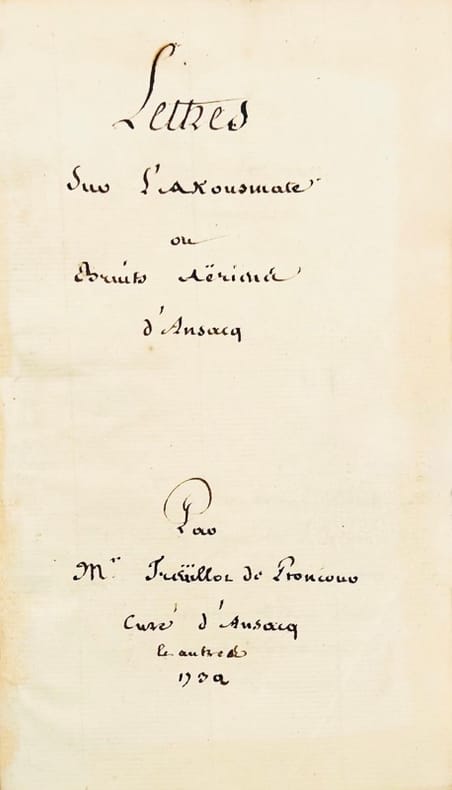
181043257Sans lieu (Londres), , 1810. Manuscrit in-4 broché (20 x 25,5 cm) de (1) f. de titre, 176 pp. (mal chiffrées 166), environ 35 lignes par page à l'encre brune, couverture d'attente, pièce de titre papier manuscrite au premier plat.
173243507, , 1732. In-12 de (1)-215 pp., veau marbré, pièce de titre en maroquin rouge, dos lisse orné à la grotesque, tranches rouges (reliure de l'époque).
Large 4to (ca. 200 x 260 mm). Italian manuscript on paper, 570 written pages, with a few additional blanks, illustrated throughout with more than 200 pen and ink drawings of scientific equipment, machine models, experiments, etc., including a full-page coloured plate showing a balloon and two plates removed from Meyers Conversations-Lexikon. Contemporary half calf over marbled boards (rubbed; spine defective). An encompassing 19th century manual on physics and mechanics, likely a lecture manuscript, profusely illustrated and twice signed "Visconti Achille" on the flyleaf and at the head of the first page of text. Whether or not the writer is to be identified with the like-named physician (rather than physicist) who, serving as prosector at Milan's Ospedale Maggiore, in 1870 first discovered the lung condition silicosis, must remain a matter of further research. The apparent date of composition would be consistent with a possible earlier pursuit of a university training in physics; the inclusion of an 1897 Milanese newspaper clipping, mounted to the pastedown and commemorating the passing of the great physicist Galileo Ferraris, would point both toward the medical man's known area of activity and away from a specialized anatomist with a by-then substantial list of anatomical and pathological publications to his name. The hefty, closely written volume here covers subjects ranging from barometers to the refraction of light, fully illustrated with neat sketches and a particularly charming full-page pen and wash drawing of a hot air balloon. - Binding rubbed; interior sound.
188743098Sans lieu, , 1887. Album in-4 de (2) ff. manuscrits et 49 aquarelles de forme médaillon sur papier Whatman montées sur papier fort, demi-veau fauve glacé à coins, dos orné à nerfs, pièce de titre en maroquin rouge (reliure de l' époque).
154043017Sans lieu, , 1540. Manuscrit sur parchemin in-folio (350 x 260 mm) de (57) ff. à environ 25 lignes par page, vélin souple à recouvrement, titre manuscrit répété sur les plats (reliure de l'époque).
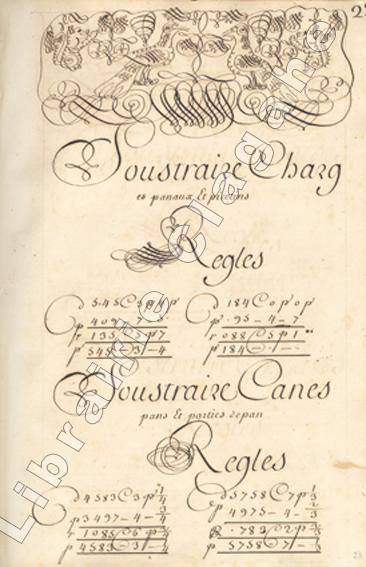
18182Ce traité d’arithmétique est divisé en deux grandes parties, chacune de 9 chapitres : la première traite de la numérotation et des quatre opérations (additions, soustractions, multiplications, divisions) ; règle de trois, règle de monnaies, fractions, réductions, règle de part ; etc. La seconde (p. 103) est une application aux règles de gain et de perte, les “troques”, la tare, les alliages, règles de Compagnie, l’intérêt, les rachats, le change, la règle “d’Esconte”, les règles testamentaires, de fausse position, règle entre marchands et facteur, le livret de trente pour les jours achève le traité. Chaque page est ornée en tête et dans le texte de compositions calligraphiées avec beaucoup de talent, les décors prenant la forme des lettrines et titres ornementaux et d’entrelacs, fleurs, animaux, chiens, oiseaux, volutes, brandebourgs et grotesques.
186491S.l., s.d. (vers 1700) 8 parties en six forts volumes in-folio, couvertes d'une écriture moyenne, cursive, espacée et relativement lisible (environ 20 lignes par page), demi-chevrette fauve à coins, dos à nerfs ornés de guirlandes et fleurons dorés, pièces de titre vertes, tranches rouges [volumes I-V] ; basane brune, dos à nerfs cloisonné et fleuronné, pièce de titre cerise, encadrement de triple filet à froid sur les plats, tranches mouchetées de rouge [volume VI], (rel. de la fin du XVIIIe). Dos frottés, coins et coupes abîmés.
220955S.l., s.d. (vers 1695) 2 parties en un vol. in-folio, [71] ff. n. ch., généralement anopisthographes, dont le titre dans un beau cartouche aquarellé et dans un encadrement de filet rouge, nombreuses armes finement aquarellées, veau fauve granité, dos à nerfs cloisonné et fleuronné, pièce de titre cerise, tranches mouchetées de rouge (reliure de l'époque). Petites restaurations aux coiffes et aux coins.