SAND George & [FLAUBERT Gustave]MareMagnum

19 877 résultats
- Nohant 6 mars 1876, 13,2x20,7cm, deux pages sur un feuillet remplié. - Lettre autographe signée de George Sand adressée à Gustave Flaubert. Deux pages rédigées à l'encre noire sur un double feuillet présentant, en tête de la première page, le timbre à sec de l'expéditrice. Cette lettre a été publiée dans la correspondance complète de George Sand établie par Georges Lubin. Belle lettre rédigée par George Sand quelques mois avant sa mort et adressée à son ami de toujours, Gustave Flaubert. L'écrivaine souhaite offrir à son ami une place pour qu'il assiste à la reprise de sa pièce Le Mariage de Victorine : "Je t'écris en courant ce matin parce que je viens de recevoir de Mr Perrin avis de la 1ère représentation de la reprise du Mariage de Victorine une pièce de moi au théâtre français. Je n'ai ni le temps d'y aller ni l'envie de partir comme cela au pied levé, mais j'aurais voulu y envoyer quelques amis et il ne m'offre pas une seule place. Je lui écris une lettre qu'il recevra demain et je le prie de t'envoyer au moins un orchestre." Les lettres issues de la correspondance entre George Sand et Gustave Flaubert sont fameuses et très recherchées. [ENGLISH DESCRIPTION ON DEMAND]
- Editions Lapina, Paris 1926, In-4 (21x28cm), 186pp., relié. - Edition illustrée en premier tirage de 32 illustrations en couleurs au pochoir par Sureda et gravés par Aubert (hors-texte, en-tête et belles lettrines) dont de nombreuses rehaussées à l'encre dorée ou argentée. Tirage limité à 400 exemplaires. Un des 300 sur Rives B. F. K. numéroté 321. Envoi sur la page de faux-titre des auteurs : "A Madame de Siguera-Feissly, la plus belle chose du monde est une rose dans un verre. Respectueux hommage. Jérôme et Jean Tharaud. Paris. Mars 1937". Reliure en plein maroquin vert doublée et mosaïquée de bleu, camel, signée en bas du contreplat Randeynes et fils. Etui recouvert de papier marbré bordé de chagrin brun. Dos lisse orné d'un fer central mosaïqué, d'une série de fers placés verticalement. Pièces de titre mosaïquées d'un listel d'encadrement. Plats décoré d'un riche décor à l'oriental mosaïqué de bleu, camel et brun, avec losange central et encadrements successifs ornés et mosaïqués. Sur les contreplats de maroquin, Fers répétés et mosaïqués alternant avec d'autres fers dorés. Tranches dorées. Gardes de soie ponceau. Dos insolé devenu camel, les listel bleus ont viré au vert. Couvertures illustrées et dos conservés. Grandes marges, superbe état du papier, à l'état neuf. Ex libris A. de Siqueira-Feissly, eau-forte de Junod représentant un fauteuil dans une bibliothèque. Spectaculaire reliure inspirée des arts de l'Islam, richement dorée et décorée, et parfaitement maîtrisée. La fête arabe est le récit d'un voyage en Algérie. [ENGLISH DESCRIPTION ON DEMAND]
- Editions Lapina, Paris 1926, In-4 (20,5x28cm), 186pp., relié. - Edition illustrée en premier tirage de 32 illustrations en couleurs au pochoir par Sureda et gravés par Aubert (hors-texte, en-tête et belles lettrines) dont de nombreuses rehaussées à l'encre dorée ou argentée. Tirage limité à 400 exemplaires, dont 35 hors commerce. Celui-ci, marqué H. C. V, un des rares en premier papier sur le plus beau Japon (seulement 15 exemplaires), contenant une double suite sur Vieux Japon et Japon Impérial de tous les bois, des couvertures et du dos. Envoi sur la page de faux-titre des auteurs : "Quel plaisir pour vous, ô lecteur, si La fête arabe vous plait !" Jérôme et Jean Tharaud. Décembre 1928. Reliure en plein maroquin doublé bleu nuit mosaïqué de compositions orientalistes polychromes signée Yseux, successeur de Simier en bas du contreplat. Sur le premier plat, sceau de Salomon (ou Sulaymân ; étoile de David entouré d'un cercle avec les branches entrelacées) portant des pointillés dorés et mosaïqué de pièces de maroquin olive, beige, gris, orange et grenat rehaussées, ainsi qu'à chaque pointe, de fleurons dorés. En pied, bandeau horizontal à fond orange et grenat mosaïqué de motifs alternés de maroquin vert, gris et beige, portant des fleurons dorés et encadré de pointillés dorés, ce bandeau surmonté de fleurons dorés. Dos lisse, auteur, titre, lieu et date dorés dans des compositions mosaïquées polychromes avec fleurons dorés, étoile en maroquin gris mosaïqué avec fleuron doré aux pointes. Sur le second plat, composition centrale mosaïquée de maroquin vert, orange et gris dans laquelle s'entrelace un décor doré, avec aux extrémités une étoile reprenant la même exécution que celle ornant le dos. Double filet doré sur les coupes, doublures de maroquin orange agrémentées de 4 triangles délimités d'un fleuron doré et d'un filet à froid avec au centre une composition à froid en noir, en encadrement, filet doré et pointillés dorés venant s'insérer dans les compositions triangulaires. Gardes de moires bleues, doubles gardes de papier à la cuve, coiffes guillochées dorées, tranches dorées, couvertures et dos illustrés conservés. Etui de papier bleu bordé de chagrin bleu. Dos légèrement assombri. Trace brune sur 3 cm au verso blanc d'une planche de la suite, froissure modérée/mauvaise manipulation du papier en marge de pied d'une autre planche de la suite, léger défaut de papier semblant d'origine en marge de gouttière sur 1 ou 2 autres planches, menues et petites salissures pâles sur 2 feuillets blancs. Grandes marges, superbe état du papier. La fête arabe est le récit d'un voyage en Algérie. [ENGLISH DESCRIPTION ON DEMAND]
- s.l. 20 mars 1900, 10x15,7cm, 2 pages sur un double feuillet. - Unpublished handwritten poem to Natalie Clifford Barney « à l'absente » 20 March 1900 | 10 x 15,7 cm | 2 pages on a double leaf Handwritten poem entitled « à l'absente » ("To the absent one") and addressed to Natalie Clifford Barney. Two pages written in black ink on a double leaf, headed 24 Hyde Park Street. To our knowledge, this three-verse, octosyllabic poem is unpublished. It is preceded, on the first section of this double leaf, by a little handwritten message: "These are the verses I have made, - I would rather say the tears which I have shed - for you. Turn the page, you will find them there, in all their melancholy." Oui, c'est toi mon rêve suprême Pendant ces longs, ces mornes jours Où je pleure au fond de moi-même L'exil triste de mes amours! [...] N'as-tu pas entendu, ma blonde, Le bruit d'un sanglot qui revient Dans le cur de la nuit profonde ? C'est mon amour qui se souvient. It is at the end of 1899 and through Violette Shillito that Renée Vivien - then Pauline Tarn - met Natalie Clifford Barney "this American woman softer than a scarf, whose sparkling face shines with golden hair, sea blue eyes, never-ending teeth" (Colette, Claudine à Paris). Natalie, who had just experienced a summer romance with the scandalous Liane de Pougy who introduced her to sapphism, paid little attention to this new acquaintance. Renée, on the other hand, was totally captivated by the young American woman and describes this love at first sight in her autobiographical novel, Une femme m'apparut: "I lived again the hour, already well past, when I saw her for the first time, felt the shiver that ran through me when my eyes met the mortal steel of her look, those eyes blue and piercing as a blade. I had a dim premonition that this woman would determine the pattern of my fate, and that her face was the predestined face of my Future. Near her I felt the luminous dizziness which comes at the edge of an abyss, or the attraction of a very deep water. She radiated the charm of danger, which drew me to her inexorably." "Winter 1899-1900. Beginnings of the idyll. One evening, Vivien is invited by her new friend to Mme Barney's studio [Natalie's mother], 153 avenue Victor-Hugo, on the corner of the rue de Longchamp. Natalie finds the courage to read the verses of her composition. As Vivien tells her to love these verses, she tells her that it is better to love the poet. A response worthy of the Amazon." (J.-P. Goujon, Tes blessures sont plus douces que leurs caresses) Two years of unequal happiness will follow, punctuated by Natalie's recurring infidelities and Renée's sickly jealousy, the letters of which oscillate between inflamed declarations and painful admissions of guilt. "Renée Vivien is the daughter of Sappho and Baudelaire, she is the 1900 flower of evil with fevers, broken-up fights, sad delights." (Jean Chalon, Portrait d'une séductrice) In 1901, a major break-up occurred which lasted almost two years; Renée, despite requests from Natalie and the others she sent to win her back, resisted. "The two friends saw each other again, and in August 1905, went on a pilgrimage to Lesbos, which was a disappointment for Natalie Barney and was short-lived. [...] The spring was broken once and for all. The two former friends stopped seeing each other in 1907, and Vivien died without them seeing each other again." (J.-P. Goujon, ibid.) [FRENCH VERSION FOLLOWS] Poème autographe intitulé "A l'absente" et adressé à Natalie Clifford Barney. Deux pages rédigées à l'encre noire sur un double feuillet à en-tête du 24 Hyde Park Street. Ce poème de trois strophes en octosyllabes est à notre connaissance inédit. Il est précédé, sur le premier volet de ce double feuillet, d'un petit message manuscrit : "Voici des vers que j'ai faits, - je dirais plutôt des larmes que j'ai versées - pour toi. Tourne la page, tu les y trouveras, dans toute leur mélancolie." Oui, c'est toi mon rêve supr
Manuscript record of the unexpected arrival of the British HMS Mariner led by Commander Charles Mitchell Mathison in Japan, in 1849, with interest in making surveys around Edo (Tokyo), four years prior to Commodore Perry's arrival, and during Japan's period of isolation (Sakoku) during which most foreigners were prohibited entry in to the country and locals prohibited exit; containing also a description of Japanese castaway Otokichi who was on the British vessel, disguised as a Chinese to evade capital punishment, who later assisted Admiral James Stirling in establishing the 1854 Anglo-Japanese Friendship Treaty. Text is in Japanese. 8vo. 44 pages in manuscript, plus title page, on 23 unpaginated double leaves. Traditional karitoji binding ("semi-bound" meaning title page and contents without a book cover) string-stitched at spine, fukurotoji style ("bound-pocket" with folded leafs bound into spine), and opening from left to right. Complete in a single volume, measuring approximately 24 x 17 cm. A scant few ink marks to rear leaf margin, indication of some burrowing, unobtrusive to legibility, otherwise in very good condition, beautifully preserved, clean and bright, an exceedingly scarce work. Certainly an assertive manoeuvre, for the British to show up unannounced in the harbour of Edo, Japan was in the state of Sakoku ("locked country"), the isolationist foreign policy of the Tokugawa shogunate under which relations and trade between Japan and other countries were severely limited, and nearly all foreign nationals were barred from entering Japan, while common Japanese people were kept from leaving the country. The long-standing policy had been in place for over two centuries, since 1603, and would last a few more years after the departure of HMS Mariner. It was Commodore Perry in 1853, and his equally brazen arrival with his American Black Ships, that would force the opening of Japan to American trade through a series of treaties called the Convention of Kanagawa, ultimately ending the island's declaration of Sakoku, and facilitating other trade relations with Western nations. On 14 October, 1854, the first limited Anglo-Japanese Friendship Treaty was signed by Admiral Sir James Stirling and representatives of the Tokugawa shogunate (Bakufu). Yamamoto Otokichi (1818-1867), who was onboard HMS Mariner disguised as a Chinese interpreter during the ship's attempted entry in Japan, later played an instrumental role in establishing this treaty, providing Stirling with intel on language and culture during the negotiations. On 26 August 1858, the Anglo-Japanese Treaty of Amity and Commerce was signed by the Scotsman Lord Elgin and representatives of the Tokugawa shogunate for Japan, after the Harris Treaty was concluded. Britain obtained extraterritorial rights on Japanese with the British Supreme Court for China and Japan, in Shanghai. A British iron paddle schooner named Enpiroru was presented to the Tokugawa administration by Bruce as a present for the Emperor from Queen Victoria. A scarce compilation of records from the Japanese perspective on a pre-Perry interaction between Bakufu authorities and a British ship, with references to Otokichi. This manuscript collates four Japanese reports of the British ship the HMS Mariner, which arrived in Japan from Shanghai in May of 1849 to make a topographical survey of the area around Edo (modern-day Tokyo), led by Commander Charles Mitchell Mathison, who had entered the Royal Navy on 5 August 1819. The event marks a very early British appearance at Japan, also pre-dating by four years the imposing arrival of Commodore Perry and his American Black ships also intent on making surveys. The first record briefly describes the layout of the Mariner and the aim of its visit to Japan. It also mentions the considerable Japanese language abilities of the Chinese interpreter on board who explained things in a way that is easy to understand, he in fact being the Japanese castaway Yamamoto Otokichi (1818-1867). The second section records foreign ship sightings from daimyo with guardhouses on the Miura Peninsula. [daimto were the most powerful landholding magnates holding the largest sections of land] The third report describes the meeting of Commander Mathison and the Bakufu intendant Egawa Tarozaemon (1801-1855), a dispute over a map of Japan, and Japanese observations of the ship and the crew. The last report is a copy of Isenokami Abe's (Masahiro Abe: 1819-1857) message to the bugyo (magistrates) and metsuke (censors/inspectors) in which, with HMS Mariner in mind, he expresses concern about the increase in the number of foreign ship arrivals in recent years and the abandoning of the Edict to Repel Foreign Ships. Abe notes that if the edict is enforced again, while there is no illegality on the part of the foreign ships, a dispute could arise, thus cautioning the noble families on the coast to prepare defenses. [Only a few years after the arrival of HMS Mariner, Isenokami would play a major role in the signing of the Convention of Kanagawa, as a result of pressure from the Perry Expedition.]
New York City, Frankfurt, Stockholm, etc., 1961-1966. Substantial archive of documents concerning the publication and production of several notable literary works and theatrical plays by Peter Ulrich Weiss, including correspondence, draft agreements, contracts signed with leading publishers and producers, as well as some programmes and peer reviews, being the working files of his New York agent, Joan Daves. Together with 3 LP record box sets of the first and complete Broadway original cast music recording for the Marat/Sade play. Octavo and Folio documents and letters, ranging in size and number of pages, some signed in the original. Most are in English; some are in German; the lot neatly contained in four ring binders. The vast majority of the documents date to the 1960s, with a scant few being later including a letter regarding a special television production in 1979 with NBC. Occasional wear to extremities, otherwise in very good condition, beautifully preserved, clean and bright. A generous and comprehensive archive chronicling the work and partnership of a leading literary agent in the rise of German-American publishing, and one of her notable German writers. Provenance: From the desk of Weiss' literary agent for the US, Joan Daves. Joan Daves (1919-1997) was a leading literary agent with her own agency in New York, whose client list boasts six Nobel Prize winners including Martin Luther King, Jr. Daves had a profound effect on the very existence of German literature in America. Born Liselotte Davidson in Berlin, she escaped Nazi Germany by fleeing to Paris and England before emigrating to the United States in 1940. Her agency, established in 1948, handled the original works of several American authors. She handled Martin Luther King, Jr.'s literary property from 1957 until her death. Of great emphasis with her firm was the representation of several major German publishers, such as Suhrkamp, Piper, S. Fischer Verlag and others. It was the prime time of German writers such as Peter Weiss, Uwe Johnson, Max Frisch, Heinar Kipphardt, Hans Magnus Enzensberger, and Hermann Hesse. In the mid-1960s, communication with German publishers was quite different from today. A shipment of galleys was prepared with a 'by sea mail' label. When the New York Times printed the date and time the next ship would leave the harbor, delivery of the parcels of documents to that specific ship was requested. Peter Ulrich Weiss (1916-1982) was a German author, playwright, and experimental filmmaker, who gained celebrity fame on Broadway in the 1960s. He is particularly known for his plays "Marat/Sade" of 1963/65 which is largely represented in the present archive and which was enormously successful, for "The Investigation" of 1965, and for his later novel "The Aesthetics of Resistance" (1971-81). In the 1960s Weiss also embraced and promoted politically controversial groups, standing for revolutionary Cuba, standing against US intervention in Vietnam, and joining Sweden's eurocommunist party. Manuscript
21874In-folio de 227 feuillets (chiffrés 222), demi-basane beige, dos lisse, pièce de titre rouge.
174942696Valladolid, , 1749. Manuscrit in-4 (30,5 x 21 cm) à 20 lignes par page de 430 ff., maroquin fauve, dos à nerfs richement orné à petit fer dont deux pièces mosaïquées de maroquin vert, sur les plats inscriptions en lettres capitales, large encadrement doré à petit fer, écoinçons et ornement central doré sur médaillon ovale de maroquin vert mosaïqué, tranches peintes d'un décor de fleurs, dorées et ciselées, fermoirs ciselés en laiton (reliure de l’époque).
180643469Sans lieu ni date, , 1806 vers . Petit in-4 (17 x 22 cm) de (4)-474-XXIV pp., 22 lignes à la page, 7 gravures repliées, demi-basane marbrée, dos lisse orné, pièce de titre noire (reliure fin XIXe).
173011248, , [1730 ca]. In-folio de (4) ff. de table, 112 ff. mal paginés, veau granité, dos orné à nerfs, pièce de titre en maroquin rouge « Airs à boire », tranches marbrées (reliure de l'époque).
13731480 circa 1480, Miniature sur vélin 11,4 x 7,5cm.
4to. Zus. ca. 255 SS. auf 147 Bll. (2), 158, 163-231, (62) SS. (davon 1½ SS. mit Register, S. 148-158, 163-183 und die letzten 4 SS. weiß). Deutsche Handschrift auf Papier. Mit kalligraphierten Überschriften. Halbpergamenteinband der Zeit mit marmorierten Buchdeckeln, Lederbändern und dreiseitigem grün-rot gefärbten Schnitt. Umfangreiche Sammlung von Heilmittel- und Kochrezepten, wohl von der Mitte bis zum Ende des 18. Jahrhunderts von mehreren Händen zusammengetragen. - Unter dem Titel "Arzney Buech" finden sich im ersten Teil des Manuskriptes (SS. 1-148) etwa 120 Heilmittelrezepte für Salben, Pflaster, Pillen, Pulver und Balsam, meist nach der Art der Mittel geordnet. Das Spektrum reicht vom "Salbl zum Schlaff machen" mit Muskatöl über ein "Pulffer des Lebens", das auch einige der schon seit Hildegard von Bingen bewährten Kräuter wie Muskat, Zitwer, Allant, Süßwurzel, Ingwer, Galgant, Zimt und Tausendgüldenkraut würdigt, oder ein "Recept der Pest Pillen von Wienn" bis zu Edelsteinheilmittel (SS. 109-112). Gegen Ende dieses Teiles finden sich auch einige Spirituosen, vom Branntwein bis hin zu Likören wie "Marillen-Roßolly" oder "edlen Schokolati Rosoli". - Die ordentliche breite Kurrentschrift wird auf S. 141 durch eine etwas kleinere und engere Handschrift abgelöst. In diesem Teil findet sich nach dem Rezept für "ein bewehrtes Raicher vor üble und güfftige Kranckhoiten, und Pest" der Hinweis, dass das Mittel 1773 in Zeiten der Pest verwendet wurde. Damit ist zugleich ein Terminus post quem für die Entstehungszeit zumindest dieses Teils des Manuskriptes gegeben. Nach einigen weißen Blättern (SS. 148-183) folgen ca. 130 Koch- und Backrezepte für verschiedene Knödel, "Kräpffl", "Nudl", "Dorten", "Strauben", "Klezenzelten", "Pomeranzen Sulz" oder "Korn Bluemen Saafft" sowie im letzten Teil, von breiterer Hand, mehrere Fischrezepte, meist zu Karpfen und Hecht, sowie einige Teig- und Mehlspeiszubereitungen, ebenfalls in ordentlichen Kurrentschriften von zwei verschiedenen Händen aufgeschrieben. Die mundartlichen Eigenheiten verweisen auf eine Herkunft aus Tirol. - Der Einband etwas fleckig, angestaubt und beschabt. Am Ende und im unbeschriebenen Teil einige Bll. entfernt, daher fehlen die paginierten SS. 159-162, etwas fleckig. Mit Exlibris des Kufsteiner Volksschullehrers Carl Wagner.
4to (19 × 24 cm). 51 double leaves of dried plant specimens, mounted under narrow paper strips, carefully labelled and identified. (Includes:) The same. Autograph letter signed. Magnée, 18 June 1848. 8vo. 2 pp. To Mr. de Kessel. Stored loosely in contemporary marbled portfolio with heart-shaped cover label. This charming, well-preserved herbal, of whose "deux petits volumes" (as mentioned in the accompanying letter) only this present first one has survived, was compiled for the wife of Mr. de Kessel by the priest and amateur naturalist Charles Strail, a founding member of the "Société Royale de Botanique de Belgique". The plants, collected on a trip to Beaufays, are accompanied by detailed taxonomic information, such as Strail's following note on the baneberry specimen: "Le calice de cette plante tombe aussitot que sa fleur s'ouvre". Abbé Strail would later go on to publish a "Florule de Chaudfontaine et de Magnée" (1863) as well as a standard work on mints, for which he corresponded with like-minded scholars and enthusiasts throughout Europe, including members of the "Botanical Exchange Club of the British Isles". - Backing leaves slightly browned with a few short tears. Portfolio somewhat rubbed; letter wrinkled with edge tears (formerly mounted on the inside front cover, where the upper left corner with "Bath" stationery mark remains). Altogether a very well-preserved herbal, and a fine example of the 19th century's physico-theological enthusiasm for naturalism.
Folio. (464) pp. Contemporary half calf over marbled boards with four ties. An interesting manuscript originating from Vienna's St. Elizabeth Hospital, founded in 1710 and operating to the present day. It lists the incoming women patients day by day, stating their names, age, civil status, birthplace, address, place of work and medical condition. At the end of each entry is either the date of their discharge or of their passing. As the hospital admitted female patients only, this MS provides an exceptional insight into the living conditions of women in 18th century Vienna, thus representing an important source for social history, containing information on common diseases and life expectancy, as well as on the patients' occupation and private life. Likely just one of a series, the MS documents the busy operations of a city hospital over a period of six years. - Old pencil shelfmark to lower pastedown. Insignificant traces of worming to spine, a bit of the lower spine end chipped. Light browning to paper, otherwise well preserved. From the library of the Viennese collector Werner Habel, with his signed and stamped ownership, dated 1985, to the pastedown.
17722750NANTES 1772 in-folio demi-vélin janséniste un Manuscrit, reliure demi-velin janséniste in-folio, dos 5 nerfs - titre manuscrit à l'encre brune façon Janséniste au dos à l'encre brune, les 3 premières pages ainsi que les deux dernières ont été habilement restaurées en marge sur un centimètre de large lors d'une restauration ancienne, texte manuscrit à l'encre brune orné de trés nombreuses lettrines calligraphiées réhaussées en couleurs sur toute les pages ainsi que des calligraphies en ornementation du texte, en bandeaux et culs-de-lampes réhaussées en couleurs (Thèmes : oiseaux divers, portraits divers, papillons divers, fleurs diverses, lapins divers etc...), orné d'un dessin à l'encre brune réhaussé en couleurs sur la moitié de la page de titre représentant "la manière de tenir la plume" et d'un dessin à l'encre brune réhaussé en couleurs représentant un portrait en pied d'un NÉGOCIANT dans son intérieur devant une Sphère Armilliaire, dessin prenant toute la dernière page , quelques légères piqûres, Table des Matières et sur les dernières pages : Rêgles d'Arithmétique, 545 pages avec une erreur de pagination (mais complet), Fait à Lourmarin, le huitième octobre 1772,
216041S.l., s.d. (1726) 2 vol. in-4, titre, 155 ff., ff. 47-49 reliés par erreur après 51, avec 12 tableaux dépliants hors texte ; titre, 137 ff. (avec de nombreuses erreurs de chiffrage), avec 29 pièces dépliantes hors texte, manuscrites ou imprimées, écriture moyenne et d'une lisibilité variable (environ 30 lignes par page), basane brune granitée, dos à nerfs cloisonnés et fleuronnés, tranches mouchetées de rouge (reliure de l'époque). Dos légèrement frottés.
Ink on paper, 15 segments mounted on cloth (ca. 138 x 72 cm). Folded. Large-scale genealogy of the House of Medici beginning in the early 13th century and ending with Gian Gastone de' Medici, the seventh and last Medicean Grand Duke of Tuscany. With his death in 1737, nearly 300 years of Medici rule over Florence came to an end. He was survived by his sister Anna Maria Luisa, Electress Palatine, for less than six years, and was succeeded as Grand Duke of Tuscany by Francis Stephen of Lorraine, soon to be Emperor Francis I. The present chart, apparently drawn up shortly after the extinction of the family in 1743, is decorated with several designs of the Medici arms dangling from the family tree's branches, and the names of the last three scions - Ferdinando, Gian Gastone, and Anna Maria - are drawn with their appropriate crowns, as are those of Popes Leo X, Clemens VII, and Leo XI. As the title announces, the genealogy includes the secondary branch of the Medici Family known as the Princes of Ottaiano (near Naples), here ending with Alessandro de' Medici (1560-1606), General of the Papal States. Descendants of this last remaining line, which still flourishes, unsuccessfully claimed the title of Grand Duke of Tuscany in 1737, and the Ottaiani's pretensions to the title would seem to have played a role in the preparation of this chart. - Some brownstaining and ink corrosion; slight edge defects professionally repaired. Residue of the collection of Sir Thomas Phillipps (1792-1872).
Decorated manuscript in Latin, ink on parchment. Four cuttings once re-used to form pastedowns and endleaves for a landscape format volume (measuring 140 by 200 mm). Remains of single column up to 32 lines in a tiny early gothic bookhand. Rubrics in pale red, initials in red or blue with contrasting penwork. Fragments from four leaves from a medical treatise discussing diseases and disorders of the stomach. There are entries here on pleurisy, pain in the stomach, vomiting, and on childbirth, as in the medieval tradition this was often grouped with other stomach disorders. - 17th-century ownership of Michel Bonniel inscribed to one cutting. Some scuffs, small holes and discolouration, otherwise in good condition.
Deutsche Handschrift auf Papier. 94 num. SS. Mit 12 aquarellierten Faltplänen und einigen aquarellierten Federzeichnungen im Text., Lederband der Zeit mit Rückenschildchen und -vergoldung. 8vo. "Wie ein Regiment in 4 Battaillons, und 16 Compagn[ien] eingetheilet, wird der nachfolgende Plan zeigen; und formiret ein Regiment 16 ganze = 32 halbe Divisions, und 64 Züge oder Pelotons; jeder Hauptmann hat seinen Unter Lieutnant hinter sich, ausgenohmen der 9te, 10te, 11te, und 12te Hauptmann nicht, wovon die ober Lieutnants bey denen fahren, mithin die Unter-Lieut[nants] an deren Stelle kommen; die Ober Lieutn[ants] stehen mitten vor der Compag[nie], ausgenohmen der von der Leib und Obristen Compag[nie] nicht. Wann die Staabs Off[iziere] eintretten, woselbe aufwärts hinter ihre Hauptleuthe, neben denen unter-Lieutenants stehen [...]". Ähnlich präzise sind dann die illustrierten Ausführungen, "wann man drey Mann hoch außrücket", "wann man mit 4 Mann hoch ausrücket" und welche Figur etwa bei der Anweisung "Grenadier macht euch fertig, schlagt an, Feur" erwartet wird, nämlich "das Feuer fangt an, und wird hir orths auch alles befolget, wie schon bey 3 Mann hoch angewendet worden, und die Grenadier bleiben alleinig in Reserve". - Innen sehr sauber, der Einband gering berieben.
195421470Paris, Chez Grasset, 1954 ; in-quarto tellière broché, chemise-étui moderne ; 140 pp., [2]ff., couverture granitée jaune rempliée, imprimée en noir et chocolat ; page de titre imprimée en noir et vert printemps.
4to (270 x 220 mm). French manuscript, ink and watercolour on paper. (125) ff. with 10 written pages and (82) pp. with pasted, hand-coloured printed coats of arms. Contemporary full calf. All edges red. Armorial with the coats of arms of 270 Lyonnais city officials from 1595 to 1750, with later additions to 1755. The title-page with the dedication is followed by a 9-page alphabetical index of family names and the years of service of 258 officials, many serving several terms, until 1750. A full-page coat of arms of the dedicatee David Flachat (1708-54), "Écuyer" (Steward) of Lyon in 1749/50, heads the arms section. On all but five of the 81 pages, the coats of arms are organized in tree diagrams with the "prévôt des marchands" (dean of the city guilds, the de facto mayor) on top and his four deputies or "échevins" (jurymen) in a single row below. The five other pages record only two "échevins". The coats of arms include the names, titles, and tenure of office in letterpress printing (with two handwritten exceptions). All coats of arms and captions or empty cartouches, for the few handwritten records, were printed, hand-coloured, cut out, and pasted into the manuscript. Starting with the title-page, all pages are framed within hand-drawn brown and yellow borders. - The offices of the "prévôt des marchands" and "échevin" of Lyon were established by King Henry IV of France in 1595, as stated in the full title of the manuscript, and the men elected for the two-year terms were automatically ennobled. The city-government of Lyon was organized as decreed by Henry IV until 1790, following the example of Paris. - In his office as official chronicler and herald of Lyon, Pierre-François Chaussonet produced a very limited number of almost identical copies of this armorial, dedicated to members of the city government such as Flachat. One copy is in the municipal archive of Lyon (shelfmark 17Fi 129), another was sold in 2011 at Kapandji Morhange in Paris (lot 155, €2600). - Binding rubbed and chafed, edges and spine scuffed. Pages foxed with some staining, several pages wavy from the glue, some minor tears.
186075622s. l. (Paris) s. d. [5 ou 12 janvier 1860] | 13.60 x 21 cm | deux pages sur un feuillet remplié
187762711Paris 9 mai 1877 | 13.50 x 20.50 cm | 2 pages sur un feuillet remplié
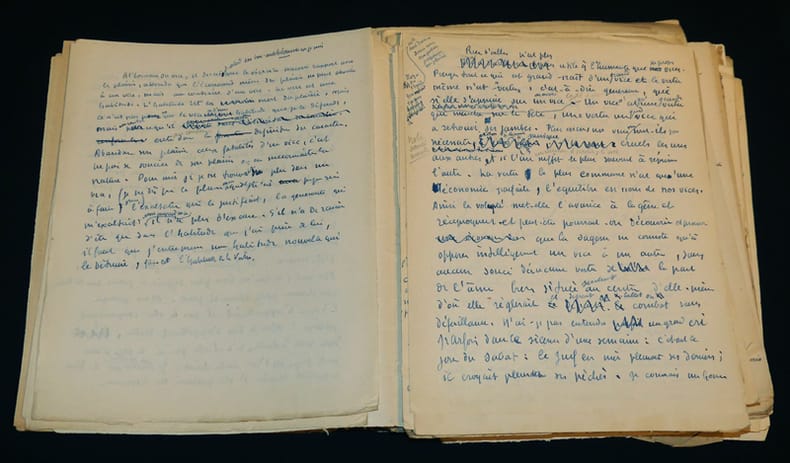
vp537Sélection Le Seanachi, Sélection Abraxas-libris Manuscrit "Notes pour ""L'Amateur d'imprudence"". Ce manuscrit autographe de Marcel Jouhandeau (1888-1979) se compose de feuillets volants formant environ 285 pages.Important ensemble de brouillons et premiers jets --comptant de nombreuses ratures et corrections-- pour ""L'Amateur d'imprudences"" (le titre est paru, au pluriel, à la N.R.F. en 1932), qui demeure un livre à part dans l'oeuvre de Jouhandeau, influencé ici par le surréalisme. Il fréquentait alors des personnalités telles que René Crevel, André Masson et Nancy Cunard, et c'est cette dernière qui inspira à Jouhandeau le personnage de Natalyna, héroïne de ""L'Amateur d'imprudences"" ; feuillets un peu fendillés par endroits, bon état. Livraison a domicile (La Poste) ou en Mondial Relay sur simple demande."
Gr.-4to (250 x 297 mm). Franch manuscript on paper. 37 double leaves. With calligraphic title, 4 watercoloured pen-and-ink maps, and 50 tables, mostly coloured double-page spreads. Contemporary half calf with giltstamped spine title, upper cover monogrammed "M. L." in gilt. Marbled endpapers. All edges red, layered with a gilt semé of crosses pattées. A charming, meticulously drawn, coloured and calligraphed historical atlas created by the young French aristocrat Marie Lichtenstein as a memento of her graduating class at the prestigious Collège Royale in Aix-en-Provence. The historical and genealogical tables are enclosed within red, blue, yellow, and green borders; a small crown is stamped beside the names of rulers . They include the dissolution of the Empire of Charlemagne, the history of the Egyptians, Assyrians, Persians, Macedonians, and Romans, and the genealogies of the European ruling houses, including the "Dynastie Napoléonienne", several of the Byzantine Imperial families, and ultimately, their heirs and successors as Emperor of Constantinople, the Ottoman dynasty. The maps show the "Invasion des Barbares au 5 siècle" (with the "Arabes ou Sarasins" from the "Golfe Arabique" conquering Peria and southern Spain), a map of Europe showing the Empire of Charlemagne, Germany after the Treaty of Westfalia in 1648, and the administrative divisions of contemporary Spain. - Corners bumped, otherwise finely preserved.