1 540 résultats
16703, Academie voor de Streekgebonden Gastronomie, 1992**, PB, kartonomslag, originele titelpagina met vignet, 130 x 190mm., 304pp.pp., z/w illustratie.
17938, Brussel, Belgisch Koffiebureau, z.d., Originele uitgeversomslag, frontispice in kleur, 150 x 240mm., 100pp., mooie, uitgebreide illustratie.
194230882ABKopenhagen, Udgivet Paa Eget Forlag, 1942. 4°. (24) S. Mit farb. Illustrationen von Dahl Mikkelsen. Farb. illustr. Orig.-Halbleinenband mit Klammerheftung.
158140653DBRom, in aedibus populi Romani, 1581 (im Druckevermerk 1582). Folio. 340 S., (12) Bl. (Index). Mit einer Holzschnitt-Druckermarke auf dem letzten Blatt. Etwas späterer Pergamentband mit goldgeprägtem Rückentitel.
15348, Kortenhoef, De Zeven Bokalen, 1944, Gebonden in roomkleurig karton met goudopdruk op rug en front, 165 x 245mm., 130pp., buitenteksttekeningen in kleur.
PB, kartonomslag, originele titelpagina met vignet, 130 x 190mm., 304pp.pp., z/w illustratie. Mededelingenblad en verzamelde opstellen. Driemaandelijks tijdschrift. 10de Jaargang Nr. 40 - December 1992. In prima staat.
1664ABC_50496Amsterdam 1664. Oblong 8vo. Hieronymus Sweerts Contemporary vellum sewn on 2 supports laced through the joints. With an engraved frontispiece and 32 engraved plates 1 folding 31 full-page. 96 pp. Rare first edition of one the finest and most extensively illustrated early works on culinary carving describing and illustrating refined techniques the order of serving and the handling of various foods including poultry hare rabbit pork veal lamb mutton venison ham lobster fish artichokes and both sweet and savoury pastries. The plates illustrate a variety of carving methods and include a large folding plate depicting forks and carving knives. The work predates Joseph Moxons well-known deck of cards with illustrated carving instructions by thirteen years.The frontispiece depicts a gentleman at table attended by a servant carving a fowl in the Italian manner holding it aloft on a fork and carving it in mid-air for display. As noted by the anonymous author in the preface this method was not customary in the Netherlands. Accordingly the work addresses both this practice and the more conventional technique of carving on a platter. Hieronymous Sweerts 1629-1696 was a printer bookseller and poet from Amsterdam who was trained at the printing office of his uncle Paulus Aertsz. van Ravesteyn. He established his own press in 1664 and printed a wide variety of works including Bibles poetry fables and separate prints. The present work was published anonymously but one WorldCat description of the present edition says that Sweerts signed the preface "H. Sw." suggesting he might be the author of the work or at least the preface. However in all copies we have seen including the present the preface is unsigned.The vellum is soiled and somewhat stained with a small split at the spine and at the bottom of the front board. The leaves and plates are somewhat foxed and occasionally stained. Otherwise in good condition.l Bibliotheca Gastronomica 6508 4 copies; Bitting p. 530; Ferro 81a; Horn-Arndt 114; Landwehr Ned. Kookboek 17.2 this issue & 17 1664 issue; STCN 84289344X 4 copies; Van Tol et al. Kookboeken 1991 13 & ill. 10; USTC 1801667 4 copies; Vicaire col. 870; WorldCat 993593983 1170905165 902095689 504084118 8 copies; cf. for Sweerts: Van Eeghen IV pp. 138-140. hardcover
Lione, sumptibus Ludovici Prost haeredis Roville, 1627, tre titoli legati in un volume, in-8, legatura di poco posteriore in piena pergamena, titolo manoscritto al dorso, tagli spruzzati, pp. [16], 394, [14] - [8], 162, [6] - [8], 80, [8], l'ultima carta bianca. Bruniture e fioriture dovute al tipo di carta. Prime edizioni di questi trattati sui banchetti e la gastronomia, sulla pittura e scultura e sui giochi fra i Greci e i Romani.
Linnen, met omslag, in-4?°, 182pp. Met 24 foto's in kleur van Percy Hennell en 2 kaarten.
19651249240(Leiden, Sijthoff, 1965). 56, 214 S. m. Titelillustr., 3 S. erklärende Wortliste. OPpbd m. illustr. OUmschlag (Umschlag gering gebräunt).
Originele uitgeversomslag, frontispice in kleur, 150 x 240mm., 100pp., mooie, uitgebreide illustratie. De wonderbare geschiedenis van de koffie. Koffie verovert de wereld. Rondreis van de koffie. Botanische begrippen. Voornaamste landen die koffie voortbrengen. De koffie in de handel. De koffiehandel. Het proeven. De Kunst van het koffiebranden. De poederkoffie of oploskoffie. Coffeinevrije koffie. De fysiologische uitwerking van koffie. Hoe koffiezetten. In goede staat.
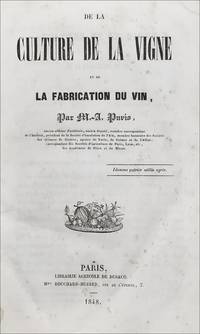
184827<p>Rare collection of treatises on wine making and vine cultivation</p><p>Puvis Marc-Antoine. <em>De la culture de la vigne et de la fabrication du vin / par M.A. Puvis</em>. Paris : Librairie agricole Dusacq Mme Bouchard-Huzard 1848.</p><p>bound with: Puvis Marc-Antoine. <em>Des différens moyens d'amender le sol</em>. Paris : Madame Huzard 1837</p><p>bound with: Thackeray Thomas James<strong>. </strong> <em>Observations sur le fumier de basse-cour les engrais artificiels la construction des granges et le labourage profond<strong>. </strong></em>Paris : A LA LIBRAIRIE AGRICOLE DE Ve BOUCHARD-HUZARD 7 RUE DE L'ÉPRON-ST-ANDRÉ. 1847.</p><p>Extremely rare collection of treatises on wine making and vine cultivation agricultural technique on different ways of fertilizing the soil and on different kinds of natural and artificial fertilizers.</p><p><em>De la culture de la vigne et de la fabrication du vin</em> is the most important opera written by the renowned agronomist and member of parliament Marc-Antoine Puvis 1776-1851 member of the Ain Agricultural Society discussing the importance of wine making and vine cultivation in France the influence of climate and soil different vineyards Côte-d'Or Hermitage influence of the grapes quality on the quality of the wines search for new varieties of vines by the seedlings plantation of the vine size and disbudding proving and uprooting fertilizers and amendments synonymy and variety of grapes.</p><p>The second part pp. 167 to 308 is entirely dedicated to oenology harvesting de-stemming and crushing hydrometer oenometer production of red wines and white wines conservation and clarification of the wines conditioning and improvement bouquet and flavor; comparative analysis of Burgundy wines etc.</p><p>Marc-Antoine Puvis is also the author of the second treatise dealing with different kind of techniques of fertilizing the soil. Among the different techniques an material used to amend the soil he describes liming or treating the soil with lime to reduce acidity and improve fertility or oxygen levels. marling using a friable earthy deposit consisting of clay and calcium carbonate used especially as a fertilizer for soils deficient in lime faluner to amend poor limestone soil with falun a sedimentary rock made up of shells debris the use of ash peat ash kelp sea fertilizer land mix burnt clay or burning the soil</p><p>The third treatise written by Thomas James Thackeray renowned British playwright army officer and agriculturist can be considered a manual on benefits and way of use of different fertilizers as: cattle droppings horse urine cow dung guano peat bran marl salpetre and nitrate of potash sulphate of ammonia etc.</p><p>All the treatise included in the present collection are very rare. In detail:</p><p>Vol 1: Only one copy in Italian Libraries. WoldCat records only 6 other copies; 5 in France and 1 in UK. the copy in Cornell University belongs to a different editio with no date or printing place</p><p>Vol 2: 4 copies worldwide 2 each in France and Switzerland</p><p>Vol 3: 6 copies worldwide 4 in France 1 each in UK and Canada.</p><p>Bibliography: Bourquelot VI. 94. Unkwnown to Vicaire Bitting. Oberlé</p> Bouchard-Huzard
In 8° (18,5x11,5 cm); (10 compresa antiporta figurata), 279 [i. e. 379], (1) pp. Bella legatura coeva in mezza pelle con titolo in oro su fascetta al dorso.Filetti in oro al dorso. Piatti foderati con bella carta marmorizzata (qualche minima strofinatura ai piatti). Tagli leggermente spruzzati. L'incisione in antiporta rappresentante la celebre "bilancia di Santorio" all'antiporta è applicata su una carta diversa rispetto a quella utilizzata per il frontespizio. Bella e rarissima edizione napoletana, un solo esemplare censito in ICCU, che presenta le annotazioni di Lorry di questa celebrerrima opera di medicina. Noto anche come Sanctorius o Santorio Santorii o Sanctorius da Padova o Santorre Santario. Studiò all'Università di Padova dove si laureò in medicina nel 1582. Dopo la laurea esercitò in Croazia e alla corte di Massimiliano re di Polonia. Tornato nella Repubblica Veneta nel 1599, si stabilì a Venezia dove esercitò la medicina pratica con grande consenso e successo e dove fece amicizia con Sarpi, Sagredo e Galileo. Il suo adattamento del pendolo alla pratica medica fu probabilmente ispirato dalle discussioni con Galileo sugli esperimenti di quest'ultimo con i pendoli del 1602; lo strumento fu descritto in un libro pubblicato da Santorio alla fine di quell'anno o agli inizi del 1603. Nel 1611 divenne professore di medicina teorica all'Università di Padova. In quella città pubblicò descrizioni di congegni termometrici che probabilmente avevano tratto ispirazione dal termoscopio di Galileo. Nel 1624 rinunciò alla cattedra per dedicarsi alla pratica privata. Fu un pioniere nell'impiego delle misurazioni fisiche in medicina; il suo dispositivo più famoso fu una grande bilancia usata per studiare le trasformazioni metaboliche in soggetti sperimentali tra i quali vi fu Galileo. Fu seguace del metodo sperimentale di cui comprese l'importanza e la necessità anche per le discipline biologiche. Considerato il fondatore della iatromeccanica, fu autore di importanti studi sul metabolismo e sulla termoregolazione umana dimostrando l'esistenza della perspiratio insensibilis ed introducendo in medicina l'uso del termometro clinico che ideò. Santorio inventò altri strumenti come il pulsilogio o pulsametro capace di tradurre in numero l'apprezzamento individuale della frequenza del battito cardiaco ed altri congegni atti a determinare con esattezza matematica i parametri vitali umani. L'opera qui presentata ebbe traduzioni in numerosissime lingue. L'opera è considerata come una dei primi esempi di medicina speriementale. L'opera rientra anche nella bibliografia gastronomica per l'ampio capitolo "De cibo et Potu". Cfr. Castiglioni (p. 471). FULTON "History of Physiology" p. 161: "Santorio introduced the use of instruments of precision for making his measurements and is regarded as the founder of the modern study of metabolic processes.". Esemplare in buone-ottime condizioni di conservazione.
Paperback, 264pp. ISBN 9789080865556. In De Nieuwe Nederlandse Keuken geeft Albert Kooy zijn visie op koken in Nederland. Het is een basiskookboek dat richtlijnen geeft aan de hedendaagse Nederlandse amateur- en professionele kok. Door de ontwikkeling van de moderne techniek is op het gebied van voeding heel veel mogelijk. Op dit moment kunnen we bijna alles kopen, krijgen of maken, zonder ons af te vragen waar het eigenlijk vandaan komt: uit welke grond, uit welk water, welke afstand het heeft afgelegd voor dat het bij ons in de koelkast, de winkel of het restaurant terecht komt. Maar ook wat voor belasting het heeft of heeft gehad op ons milieu. Nieuw.
Estratto dal n. 5 de "I problemi della pedagogia" (settembre-ottobre 1955). In-8, br., pp. 23. Testo latino a fronte. (Nel 13° dei "Sermones Objurgatorii" del medico umanista bergamasco G.M. Carrara vengono impartiti precetti, in forma di carme, per un corretto "regimen senectutis", come terapeutica e nell'alimentazione).
194230882ABKopenhagen, Udgivet Paa Eget Forlag, 1942. 4°. (24) S. Mit farb. Illustrationen von Dahl Mikkelsen. Farb. illustr. Orig.-Halbleinenband mit Klammerheftung. + Wichtig: Für unsere Kunden in der EU erfolgt der Versand alle 14 Tage verzollt ab Deutschland / Postbank-Konto in Deutschland vorhanden +, A|B [2 Warenabbildungen]
158140653DBRom, in aedibus populi Romani, 1581 (im Druckevermerk 1582). Folio. 340 S., (12) Bl. (Index). Mit einer Holzschnitt-Druckermarke auf dem letzten Blatt. Etwas späterer Pergamentband mit goldgeprägtem Rückentitel. + Wichtig: Für unsere Kunden in der EU erfolgt der Versand alle 14 Tage verzollt ab Deutschland / Postbank-Konto in Deutschland vorhanden +, A|B [2 Warenabbildungen]
33120Antwerpen , De Vries , Paperback, 40pp. ISBN 9789061003175.
Paperback, 40pp. ISBN 9789061003175. Nieuw.
Fine Fine English Original bdg. with original dust wrapper. Oblong large 8vo. 214 p. Color and b/w ills. Recipes from Prinkipo cuisine and food culture. Dedemin sofrasi: Büyükada yemekleri. Büyükada Altinordu 12'de duygularla tatlar birlesince.
[S.l.], [s.n.], 1894, menù manoscritto su cartoncino di mm. 155x105. Titolo entro decorazioni in cromolitografia con stemma Savoia con aquila nera e croce bianca in campo rosso. Traccia di piega centrale.
In Ferrara, per Francesco Suzzi stampator camerale, 1640, in-folio piccolo, legatura coeva in piena pergamena floscia, piatti inquadrati da filetto dorato, singoli ferri floreali agli angoli interni della cornice e al centro dello specchio (macchie alla pergamena), pp. [4], 28, 268. Solo prima parte: l'anno successivo fu pubblicata la seconda (Parte seconda, Il Gualengo): cfr. Westbury p. 138 e Vicaire 549. Haym p. 602, n. 9. Comunque molto raro.
Napoli, Edizioni Libreria Dante & Descartes, 1998, in-32, cart. edit., pp. 46. (Collana: Napoli in trentaduesimo, n. 4).
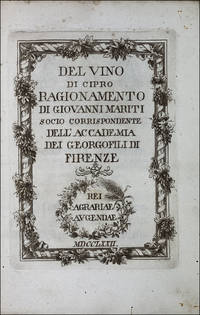
1772117<p>Extraordinary rare first edition of the famous treatise on Cyprus wine by Giovanni Mariti</p><p>A complete analysis on wines grapes vines and production technique</p><p>Mariti Giovanni. <em>Del vino di Cipro ragionamento di Giovanni Mariti socio corrispondente dell'Accademia dei georgofili di Firenze: Rei agrariae avgendae</em>. Firenze : G. Cambiagi MDCCLXXII 1772.</p><p>8vo 220 x 155 mm original printer cardboard pp. 2 XVI 127 1 illustrations along the text engraved title page before the dedicatory letter at leaf a1r a chalcographic vignette with coat of arms of the dedicatee Lord Nassau Clavering signature a⸠πa1 A-Hâ¸.</p><p>xylographic illustrations along the text one full page plate depicting tool for wine production</p><p>In his treatise <em>Del vino di Cipro</em> About the Cyprus Wine published in Florence in 1772 by Cambiagi Mariti dedicates an ample analysis to the wine of Cyprus discussing a lot about the types and varieties of the vines and wines produced in the different regions of the island and reporting its own "observations" made in the countryside around Larnaca where it draws indications and procedures to follow in Italy too to reach the maximus possible efficiency of the crops as Mariti himself well describe in the Preface to the volume:</p><p>"In questo mio Ragionamento ho avuto il riflesso di appagare non solo la curiosità di qualche dilettante de i grati e generosi Vini di Cipro e di dar la norma per qui allignarli ma ancora di poter giovare alla Coltivazione alla Manifattura e alla Conservazione de i nostri Vini Toscani e particolarmente per migliorare alcuna sorta di quegli che oggigiorno sogliono qui farli in scelta maniera il che mi lusingo possa ottenersi dal genio de i nostri Agricoltori Mariti 1772 p. 3. In this reasoning I had the will to satisfy not only the curiosity of some amateur of the grateful and generous Wines of Cyprus giving the rules to list them but also to be able to improve the Cultivation the Manufacture and the Conservation of our Tuscan Wines and particularly to improve the quality of the wines produced there using the support from the genius of our Farmers"</p><p>More in details he starts addressing the issue of the poor resistance of Tuscan wines to navigation deepening the observations already published in the first volume of his "Travels in Cyprus". Mariti studying grapes and winemaking processes in use in Cyprus gives an account of the island's wines distinguishing them by types based on the quality of the grapes the length of the aging process and their conservation and also giving data and figures relating to the sale of the product both in the East and in the West.</p><p>Mariti dedicated this essay on the wines of Cyprus to Lord Clavering whose arms are engraved at the top of the first leaf of the dedication. The preliminary leaves also include an account of the <em>Accademia dei Georgofili</em> devoted to the study of agriculture which was founded in Florence in 1753 and is still active today.</p><p>Giovanni Filippo Mariti 1736 –1806 he was an Italian antiquarian scientist and historian. Intellectual with multiple interests he became famous in Europe mainly for his travels in the East.</p><p>Mariti became interested since his youth in natural sciences cultivating botany and especially agronomy studies and in 1772 he became a corresponding member of the <em>Accademia dei Georgofili</em> founded in Florence on July 4 1753 by Ubaldo Montelatici under the impulse of that renewal of agriculture that the Habsburgs-Lorraine hoped for and promoted to remedy the problems that arose in their lands starting from the first decade of the second half of the century regarding crops and food supplies.</p><p>Mariti lived for seven years at Larnaca in Cyprus becoming honorary British vice-consul and became increasingly familiar with the wine-making process of the island. A shortened version of this treatise was included in the French translation of his "Travels in the Levant".</p><p>Beside <em>Del Vino di Cipro</em> he is remembered for the treatise titled <em>Della Robbia sua coltivazione suoi usi</em> Florence 1776 dedicated by Mariti to the Grand Duke of Tuscany Pietro Leopoldo concerning a plant the <em>Robbia</em> Madder cultivated in the East and used for the colouring of clothes which Mariti hoped to introduce in Europe and for <em>Odeporico o sia itinerario per le colline pisane</em> which was published in Florence in two volumes between 1797 and 1799.</p><p>The first volume of this work which remained partly unpublished deals with the agricultural history of the Tuscan hills the second is dedicated to the history of the water bath today Casciana Terme. The two volumes are divided into chapters that take the form of letters written to an imaginary friend.</p><p>George Clavering-Cowper 3rd Earl Cowper 1739 - 1789 was an English nobleman and politician. In 1780 he purchased Villa Palmieri in Fiesole with a splendid view of Florence. Skilled diplomat and politician he decided to obtain prestige by turning a blind eye on the relationship that his wife had established with the Grand Duke Pietro Leopoldo from which he managed to obtain the title of Prince of Nassau d'Auverquerque.</p><p>The art collection that Count Cowper built during his years in Florence was a great investment of time and money for him. Among the most important works that were part of his collection we mention two paintings by Raphael the first known with the name of <em>Piccola Madonna Cowper</em> and the other as <em>Madonna Niccolini-Cowper</em>.</p><p>Conditions: fine copy untrimmed in its original printer paper board small restoration at spine.</p><p>Provenance: I. Ownership signature dated 1868 at rear inside board. II. Handwritten title at front board and spine.</p><p>References: Lastri p.82; Sormanni p.79; <em>Bibl. </em><em>Vinaria</em> p. 139; Andre Simon Bibliotheca Gastronomica page 97 No 1002</p> G. Cambiagi hardcover
8vo., First Edition, with coloured and monochrome plates; blue cloth, backstrip lettewred in silver, a near fine copy in unclipped dustwrapper.