692 496 résultats
40 photographs (29 in colour and 11 black-and-white). Various sizes (300 x 207 mm to 125 x 125 mm). Stored in large, six-leaf self-adhesive tan leather album (oblong folio, 43 x 34 cm). Includes 51 original colour slides. A privately assembled photo album showing the ruling family of Dubai during a state visit to Pakistan, apparently in the early 1970s. Pakistan was the first country to accord formal recognition to the United Arab Emirates after the state's emergence in 1971. - Nearly half of the images show HH Sheikh Rashid bin Saeed Al Maktoum (1912-90), the father of the modern Emirate of Dubai, in conversation, at dinners, and relaxing in the garden. Other photos show his sons, the crown prince and later ruler HH Sheikh Maktoum bin Rashid Al Maktoum (1943-2006), the present ruler HH Sheikh Mohammed bin Rashid Al Maktoum, and HH Sheikh Ahmed bin Rashid Al Maktoum. The collection was assembled by Azhar Abbas Hashmi, a high-ranking officer of the Pakistani UBL bank (United Bank Limited), founded in 1959 by Agha Hasan Abedi (1922-95), who is seen in seven photographs with HH Sheikh Rashid as well as with his two older sons. While several pictures show the members of the royal family in negotiations with the Karachi banking officials, there are also fascinating images of a falconry tour to the Pakistani countryside (including a fine portrait of HH Sheikh Ahmed with a falcon perched on his arm). The more than fifty original colour slides show other scenes of the same visit; only four of the images are among the prints included in the album. - Some occasional creases and even the odd tear, but in general finely preserved. Three photos printed by Karachi's "Eveready Studio", some inscribed in ballpoint with identification on the reverse ("Mr. S. L. Anwar, HH, Mr. Masood Naqvi, Mr. Iqbal Khateeb / Mr. Hashmi showing the prospect drawings"), one in Arabic, another with ownership stamp: "Azhar Abbas Hashmi, Vice President Gulf Operations, International Division, UBL, HO, Karachi". An unpublished set, entirely unknown and without counterparts in the online Keystone or Hulton/Getty press photo archives, from the estate of Azhar Abbas Hashmi (1940-2016), Pakistani financial manager and eminent literary patron with close ties to Karachi University. Long with UBL, Hashmi would serve as the bank's vice-president before founding several important cultural organisations and becoming known as a man of letters in his own right. It was because of Hashmi’s close connections to the Gulf states that Abu Dhabi provided funds to build the Karachi University’s faculty of Islamic studies, along with Sheikh Zayed Islamic Centre and Jamiya Masjid Ibrahi.
Tall 8vo (150 x 246 mm). Persian manuscript on sturdy cream paper. 254 (instead of 264) ff., 15 lines per extensum, paginated by later hands (lacking pp. 35-42 and 45-46; pp. 43-44 transposed after p. 30). Cursive nasta'liq calligraphy in black ink, catchwords in red. Illustrated with 56 (instead of 77) coloured horse drawings in the text (numbered in pencil by a later hand). Later illustrated binding with black leather spine and lacquered wooden boards with coloured floral designs. A late 18th century Indian manuscript copy of a celebrated treatise on horsemanship, the "Farasnama" ("The Coloured Book of Horses"). Constituting a Persian translation of the Sanskrit "Salihotra", its topics include horse-breeding, grazing, dressage, veterinary advice and horseracing. - The "Salihotra" is attributed to Durgarasi, son of Surgarasi, who is believed to have composed it for Mahmud Ghaznavi (d. 1030). A note on p. 2 of the present manuscript indicates that the text was translated from Sanskrit into Persian during the reign of Shah Jahan (d. 1666); other traditions give credit to 'Abdullah bin Safi, who was active under the earlier reign of Bahmanid ruler Ahmad Shah Wali (d. 1436). The present manuscript contains numerous coloured drawings of thoroughbred horses, along with observations on their salient traits, the illnesses to which they are prone, and prescriptions for their treatment. Their execution is an interesting illustration of the iconoclastic tendencies characterising painting under the later Mughal emperors. - Occasional slight traces of worming; some waterstaining to margins; some leaves remargined by an early owner. In spite of the loss of five leaves that would have contained an additional 21 horse illustrations, a fine manuscript in an attractive illustrated lacquer binding.
LCS-18624L’ornementation comprend également 21 vignettes coloriées à l’époque et enluminées. Paris, Germain Hardouyn, 1518. In-8 imprimé sur peau de vélin de (84) ff. en 11 cahiers signés A-K par 8 et L par 4. Caractères romains, 31 lignes. La marque des Hardouin occupe le f. A1. 17 grandes figures dont l’Homme anatomique. 21 petites vignettes enluminées, 4 bordures originales enluminées. Complet. Plein velours brun du XVIIIe siècle, qq. usures. 171 x 110 mm.
Large 8vo (170 x 274 mm). Arabic manuscript on polished Indian laid paper. 328 leaves, 19 lines per extensum. Naskh script in black and occasional red ink; a few leaves of commentary loosely inserted. Contemporary full leather, spine rebacked, with oriental medaillon stamps to both covers. Expansive Arabic commentary on the "Qanunchah" ("Qanunceh", "Small Canon") of Mahmud al-Jaghmini, the important Persian medical compendium based on Ibn Sina's famous Arabic "Qanun". Al-Jaghmini's handbook of medicine was widely used at Eastern Persian schools as an introductory medical instruction manual for at least three centuries, but also found favour in India early. "One of the first works of medicine compiled in the Indian subcontinent was 'Sharh ul Qanunchah'. It was authored by Syed Abul Fath bin Syed Ismail al-Husaini al-Lahori during the sixteenth century and was a commentary of the well-known 'Qanunchah' of Chaghmini" (Alam, p. 369). The present manuscript was copied by Muhammad Kayyal (?) in Dhul-Qidah 1198 H. - Frequent, early remarginings to edges; some brownstaining and a few waterstains. Binding rubbed and rather bumped at extremeties. 19th century waqf stamps. A prettily written 18th century manuscript specimen of this important 16th century Indian commentary on a principal medical text. Cf. Mumtaz Alam, "Shift to Arabic? Medical Literature and Writing During Medieval India", in: Proceedings of the Indian History Congress 71 (2010/11), pp. 365-376.
107 volumes, many containing multiple articles. 8vo. Some illustrated with plates and maps. Half calf with marbled sides and gilt lettering on spine or cloth with marbled sides and label on spine. Handsomely bound, extraordinary collection of important scientific journal articles by 19th and 20th century Western explorers of Afghanistan, Central Asia, China, the Himalayas, India (including Assam, Bengal, Kashmir, and Punjab), Karakoram, Pakistan (including Sindh), and Tibet, with content covering anthropology, archaeology, exploration, geography, geology, glaciology, history, language and grammar, mountaineering, and politics. At the time these were the far outskirts of the world for Western science, where a lot was yet to be learned. Often the maps in these journals are the first modern maps of such regions and findings were the first to be scientifically published. - Generally in very good condition. Please inquire for a full list of contents.
3 dossiers. Ca. 130 documents, mostly 4to. - I. Ca. 40 typewritten documents. - II. Ca. 60 documents (13 of which autograph letters signed). - III. Ca. 30 typewritten documents. - Includes 5 monochrome photographs (dated "Peking Octobre 1965"), 1 sized 140 x 88 mm, 4 between 203 x 128 mm and 257 x 191 mm (newspaper clipping added, 30 Sept. 1965, publishing one of the photos). This collection focuses on King Norodom Sihanouk's politics, constituted in the circles of power through Charles Meyer, his advisor for communication and public relations. Especially Sihanouk's relations to global political agents become clear during this troubled period, which shows China and Vietnam in the first row with America und France. - I. Cambodia's neighbourly relations with China during the Cultural Revolution. Documents (meetings, negotiations, audiences, protocols, delegation lists, drafts, trade agreements and speeches), some with annotations, mostly concerning diplomatic progress between Prince Sihanouk and President Liu Shaqu with his first minister Zhou Enlai in the years of 1963-65 in Beijing. One document deals with the project of the Khmer-Chinese friendship resolution. Also interesting is an analytical summary of the dialogues held on board a boat transporting the Cambodian delegation on the Yangtze. - Sihanouk's declaration to the Chinese people, with deletions and annotations: "Pour nous, cambodgiens, la Chine est bien notre amie numéro un [...]" ("For us, Cambodians, China is assuredly our best friend [...]"). - II. The privileged, close relationship between Meyer and Sihanouk. These documents illustrate their direct collaboration, as well as Meyer's career, in distinctions and newspaper articles. Included are 13 autograph letters signed by Sihanouk, including a charming note relating to the politics of de Gaulles: "M. Mesmer vient de m’annoncer des cadeaux très très substantiels de la France à notre Education Nationale […] et à notre D[éfense] N[ationale] (chars, avions, GMC, etc…) en quantité extrêmement 'satisfaisante' [...]" ("M. Messmer has informed me this minute of the very substantial gifts of France to our National Education and our National Defence (tanks, aircraft, GMC, etc. ...) of an extremely 'satisfying' quantity [...]"). - III. Foreign affairs and minutes. Documents (interventions, summaries, news paper articles, reports, press releases, telegrams) often annotated, e. g. "Lettre ouverte aux milieux impérialistes" ("Open letter to the imperialist world") annotated and initialled: "Vous avez rencontré des échecs humiliants et la faiblesse de votre politique dans les pays d’Asie, qui sont vos satellites est un fait universellement reconnu [...]" ("You have experienced the humiliating failure and weakness of your politics in the Asian countries, which are your vasalls, this is a world-wide acknowledged fact [...]"). - Meyer lived in Indochina for 25 years, 15 of which were spent in Cambodia in the years 1946-1970. Meyer wrote the books "Derrière le sourire khmer" (Behind the Khmer Smile. Plon, 1971) and "Les Français en Indochine: 1860-1910" (The French in Indochina: 1860-1910. Hachette, 1996). - List of documents on request.
24 vintage photographs (albumen prints) by Ch. Schmid, Reutlingen, mounted on cardboard with printed captions (c. 487 x 320 mm; images c. 270 x 210 mm to 190 x 137 mm). With 4 pp of letterpress text (folio, green papered spine). In custom-made green half morocco solander. Fine set of original photographs showing the Royal Wuerttemberg Stud in Marbach and its famous horses. Owned by Wilhelm, King of Württemberg, Marbach was the first Arabian stud in Europe. From 1852 to 1871 it was directed by Baron Julius von Hügel, who purchased valuable stock from the Egyptian stud of Abbas Pasha, "thus raising it to the highest standard of excellence" (W. R. Brown, The Horse of the Desert, p. 161/166). Hügel was succeeded by Cäsar Paul von Hofacker (1831-96), who issued the present photo series and also composed the accompanying text: the latter discusses the history of the Stud and its horses, including the stallion Sanspareil, son of the Arabian Bajan and bred in 1816; in 1860 another pure-bred Arabian was acquired from the Wuerttemberg Weil Stud. Among the photoportraits are the pure-bred Arabian Zarif, his daughter Zinka, and the stallion Shah. Well-preserved.
4to. 11 volumes. With a folding table in vol. 8. Contemporary vellum, numbered in manuscript on the spine, red sprinkled edges. Complete set of a compilation of all resolutions, ordinances, treaties and other statements and motions by the States General of the Dutch Republic, regarding all maritime matters. The collection starts in 1597 with the establishment of the five admiralties in the Dutch Republic and ends in 1771, although a few resolutions from the period of Habsburg rule (the oldest from 1487) have been included. Most of the resolutions concern trade, including the trade with the Baltic, East and West Indies, North Africa and the Turkish Empire, but also fishery, the equipage of battleships and the administration of the colonies in the West Indies, including slavery. Several tables give interesting information regarding the costs of the building and outfitting of ships and the formation of regiments for the colonies. One very large table presents the tariffs for all sorts of products, including numerous types of wood, glass, porcelain, fish and furs. - A collection of resolutions had been previously published in two volumes in 1689 and 1694. In 1701 an expanded volume 2, present in the current collection, was published, with volume 3 following in 1721. Interestingly, a new and much expanded volume 1 was published in 1730. The present set, published during a course of over 70 years, includes these expanded editions of volumes 1 and 2. All indexes have been bound in the corresponding volume, instead of in a separate index volume. - With the bookplates of the collector Jan Willem Six de Vromade (1874-1936), a descendant of the politically and culturally significant Six family, in the first volume, and of the Dutch politician and historian Leonard de Gou (1916-2000) in all volumes. Bindings slightly smudged. Somewhat browned and stained throughout, most notably volume 8, and with a small tear in the front flyleaf of volume 6. A very good set of an important source for Dutch maritime history. Elliott, Maritime History in the John Carter Brown Library (revised ed.) 1093.
Large 8vo (165 x 240 mm). 40 volumes, prettily gilt to covers and spines. With more than 400 engraved and aquatint plates, maps, charts and portraits (many by Nicholas Pocock). Marbled endpapers. The complete 40-volume run of the "Naval Chronicle", the most influential maritime publication of its time and today a key source for British maritime and military history. Founded by the Royal Navy chaplain James Stanier Clarke and the naval officer James Stanier Clarke, the monthly periodical ran for two full decades from January, 1799 to December, 1818. It contains a wealth of information about the Royal Navy of the United Kingdom, including biographies, histories, anecdotes and news, essays on nautical subjects, as well as poems and ballads on a variety of related topics. - Several volumes include material on events in the Arabian Gulf and Sea, often recounting episodes of "piracy" against British vessels, such as the capture of the East India Company's ships "Shannon" and "Trimmer" on 1 Dec. 1804 (an account is found in vol. XV, pp. 24f.) or the Arab raid on the "Minerva" on 29 May 1809, during which the crew were massacred and the vessel converted into the Al-Qasimi flagship (reported in vol. XXIII, p. 281f.; vol. XXIV, p. 30f.). Such events provoked the British "Persian Gulf" campaign of 1809, in which a large British force was deployed to destroy Al-Qasimi bases and ships. The Battle of Ras al-Khaimah, fought on 11-13 Nov. 1809, is reflected in reports printed in vol. XXIV (pp. 73 and 363), and renewed interest in the region and its history, customs and religion prompted a lengthy article on "The Wahebite Arabs" (vol. XXIV, pp. 293ff.; 371ff.), or "the Wahebbi, whose name is much connected with the Iowassimi pirates". A decade later, the British Navy would return in another massive operation against Ras Al Khaimah, which would lead to the signing of the General Maritime Treaty of 1820 between the British and the Sheikhs of the coast which today comprises the United Arab Emirates. - Bindings variously rubbed and bumped, some quite severely with hinges split and extremeties chipped; some spines rebacked, some labels lost. Occasional brownstaining throughout, but largely confined to tissue guards and opposite pages. In all a worn but still appealingly bound set, often encountered in separate volumes only. Sabin 52076. ZDB-ID 1053834-3.
Ca. 620 original photographs (ca. 460 in black-and-white and ca. 160 in colour), 1 portrait reproduced from a painting, and 2 small portrait drawings. Various sizes (ca. 39 x 40 to 202 x 300 mm). Most photographs with handwritten Arabic captions in ballpoint on versos, some of which with official stamps, some with pasted mimeograph typescript captions in English. Stored in 11 display books. A handsome trove of photographs, apparently assembled by a Middle Eastern political scientist or journalist, illustrating the evolving history of various countries of the Arabian Peninsula and their political leaders during the second half of 20th century, with an emphasis on the Sheikhs of Saudi Arabia, Kuwait, Oman, and Bahrain. - Some volumes focus on one or two politicians, with their portrait photographs and their various official appearances while welcoming foreign dignitaries, attending summits, military parades, celebrations, and competitions or award ceremonies. A large section of the archive shows King Fahd bin Abdul-Aziz Al Saud, including a photograph of him with his brother Turki Bin Abdul-Aziz (vol. 1), depicting him in London on the occasion of a lunch given by Margaret Thatcher, at a diplomatic meeting with Ronald Reagan, and at the "10th Arabian summit" in Tunis (vol. 6). Nayef bin Abdul-Aziz is seen meeting political leaders and ministers (among them Yasuhiro Nakasone and François Mitterrand, vol. 3), and the diplomat and Ambassador to the U.S. Prince Bandar bin Sultan Al Saud meeting Bill Clinton, then Gouverneur of Arkansas, and Vice President George Bush Sr. (Oval Office) for the AWACS plane contract (vol. 10). Another part is dedicated to the OPEC summits under Saudi oil minister Sheikh Ahmed Zaki Yamani, meeting Bruno Kreisky in Vienna, as well as at venues in Algiers, Kuwait, Yugoslavia, Caracas, Geneva, Oslo, and other places (vol. 4). King Abdullah Bin Abdul-Aziz Al Saud is given a splendid state visit in Britain, where he is welcomed by Prince Charles and shares a carriage with Queen Elisabeth (vol. 5). Other photos show Prince Mashour bin Saud bin Abdul-Aziz Al Saud, King Fahd's nephew, in London after being freed on bail for smuggling cocaine, and King Faisal during a stay in Khartoum (vol. 8). Another part of the collection shows Kuwaiti leader Jaber al-Ahmad al-Sabah receiving Yemeni representatives, as well as his successor Saad Al-Abdullah Al-Salim Al-Sabah and his predecessor Sabah III Al-Salim Al-Sabah (vols. 2, 5, 8). Furthermore, Bahrain's royal family is shown: Isa bin Salman Al Khalifa is depicted at a young age practising riding and falconry, and Sheikh Hamad Bin Isa Al Khlaifa (vols. 7, 10, 11) meeting Oman's royals, such as Sultan Qaboos bin Said, the Saudi minister Ghazi al-Gosaibi, and the Libyan ruler Muammar Gaddafi. Dubai's ruler Sheikh Rashid bin Saeed Al Maktoum is depicted at the opening of "Asry dry dock", pouring holy water (vol. 11). - Two original photographs of well-known views of Mecca's Masjid al-Haram with the Kaaba from ca. 1885 and 1920 are added. The photographs are partly stamped and mostly annotated in Arabic (some in English and French), often with mounted labels on the versos for possible use by the press, some with small labels bearing Arabic captions. One photograph has a portion whited out for reproduction, a few photographs with studio imprint ("Zamani"), others with more detailed information, such as the name of the photographer ("Alain Nogue") or agency ("Sygma") on versos. - A wide-ranging, hitherto untapped archive which allows for various perspectives toward an analysis of international, global political diplomacy by Middle Eastern rulers and members of the Arab League, including numerous candid, personal images of the actors involved.
4to (163 x 220 mm). Arabic manuscript on paper. 56 ff. Script in bold black sini, 5 lines within double red rules, punctuation in red, surah heading in red, opening and closing bifolio with red, blue and black and gold illuminated panels around three lines of text. Early full calf with fore-edge flap, elaborately ruled and stamped in gilt. A finely illuminated Qur'an Juz', written in China in the 16th century by Abd Allah bin Yunus al-Sini, in the city of Xi'an. - Xi'an has a long history of Muslim culture, stretching back to the Tang dynasty. Indeed, Arab presence in China dates back as far as the first Caliphate: the Prophet's companion Sa'd ibn Abi Waqqas is traditionally credited with introducing Islam to China as ambassador in 650. Xi'an itself boasts a well-known Muslim quarter; by the time this Juz' was written in the Ming Dynasty, Da Xuexi Street and the Huajue Great Mosque were well-established parts of the thriving Muslim district. Qur'an sections written by Chinese Muslims show the Chinese influence clearly in both the decoration and the script, which is derived from naskh. - This thirtieth and final Juz' is also the most commonly memorized. It begins with surah 78, al-Naba’ (The Tidings), and concludes with the 114th and final surah of the Qu'ran, al-Nas (Mankind). The themes are generally apocalyptic, contrasting the moment of judgment with the beauty of Allah's creation. The Surah al-Nas, a brief six lines, is one of the most famous and best beloved. - Binding professionally rebacked, some subtle paper repairs; altogether a striking manuscript. Provenance: Private UK collection formed in the 1960s and 1970s.
Folio (244 x 345 mm). Arabic manuscript, Bihari script on paper. 287 (instead of 292) ff., foliated 364-655 (lacking 550-551 and 622-624). Surah headings in gilt and colours, verse divisions marked by gold and black ink rosettes, numerous circular and tear-shaped markers in the margins, elaborately ornamented in gold and colours. Bound in modern oriental-style full leather with fore-edge flap and recessed cover decorations. Part four of a pre-Mughal Qur'an commentary, treating the text from Surah XXI, Al-Anbya (The Prophets) to Surah LXXV, Al-Qiyamah (The Resurrection). - Lacks five leaves according to the foliation; some dampstaining; several edge flaws (more severe near the end of the volume), often remargined. Traces of dust in the gutter throughout. In all a fine example of an early Qur'anic manuscript. - Provenance: 1950s private ownership stamp of the "Mohd. Halim Salimi Library", Kandahar, Afghanistan, on fol. 490v. Mohammed Halim Salimi of Kandahar worked in an administrative capacity for the USA's International Cooperation Administration (ICA) Mission to Afghanistan in 1959. In 1960 Salimi applied to the ICA for reimbursement of a lost sum of $123.88; the application was refused on the grounds that Salimi was not in fact an ICA employee but was sub-contracted by the agent Herman Klee (see report B-144148-O.M., 1 Nov 1960). Acquired from Hampel Auctions, Munich. Cf. S. A. Blair, Islamic Calligraphy (Edinburgh 2006), pp. 386-390; Qur‘an, exhibition catalogue (Istanbul 2010), pp. 350f., no. 92.
Oblong folio (310 x 370 mm). 30 engraved sheets, with 30 (of 34) portraits of thoroughbred race-horses (lacking nos. 10, 15, 31 and 34). Old half calf with marbled covers. A spectacular, exceedingly rare album illustrating the starting point of horse racing in England, when native mares were crossbred with imported oriental stallions. W. S. Sparrow notes, in 1922, "rare, no doubt, because so many copies have been broken up in order that the prints might be sold one by one". The integral engraved text surrounding the image of horse and jockey provides the history and breeding of the subjects of the portraits. The first three horses depicted in this charming album are direct descendants of the three foundation stallions of the modern Thoroughbred breed, namely the Godolphin Arabian (Bajazet, plate 2), the Darley Arabian (Childers, plate 3), and the Byerly Turk (Old Partner, plate 1). All of the other 23 race horses described here trace back to these three stallions just imported into England from the Middle East, as well. According to Pickerell, "all 500,000 of the world's thoroughbred racehorses are descended from 28 ancestors, born in the 18th century", of which, according to Peter Willett, about 50% have Arabian bloodlines, with the remainder evenly divided between Turkoman and Barb breeding. - James Seymour is recognized as one of the earliest English sporting artists. He was the son of a wealthy goldsmith and diamond merchant who supplied the plate for racing trophies. Seymour was passionate about racing and, in addition to drawing and painting them, he is believed to have owned racehorses himself; he was considered one of the most eminent horse painters of his age, and this important and rare album of charming engravings offers a true sampling of his work. - With armorial bookplate with cipher of George Simon Harcourt, Earl Harcourt (1736-1809) on front pastedown. Some early ms. annotations at beginning, some tears and repairs extending into text, first plate laid down. Sparrow, p. 77. Cf. Lane British Racing Prints Seymour 2, nos. 1-7, 11-18, 20-24, 26, 28-33. Mellon Sporting and Animal Prints Seymour 13, nos. 1-7, 11-18, 20-24, 26, 28-33. Cf. Siltzer British Sporting Prints, 389.
A total of 86 topographic maps, colour-printed, ca. 58 x 45 cm. Constant ratio linear horizontal scale. In Russian (Cyrillic). Nearly all of the Soviet Union's 1:200,000 General Staff map quadrangles showing the Red Sea coast of the Arabian Peninsula: from the Russian series of maps produced during the Cold War, based on high-quality satellite imagery, but usually also ground reconnaissance. While there are a few lacunae in Yemen near the south-western tip of the Peninsula, most of the area is well-covered. Assembled continuously, the quadrangles would form an enormous map spanning ca. 8 x 4 metres. - Products of a massive, clandestine cartographic project begun under Stalin and ultimately encompassing the entire globe, the Soviet General Staff maps are today noted for their extreme precision. Indeed, even in post-Soviet times they provide the most reliable mapping for many remoter parts of the world: "Soviet-era military maps were so good that when the United States first invaded Afghanistan in late 2001, American pilots relied on old Russian maps of Afghanistan. For almost a month after the United States began a bombing campaign to help oust the Taliban government, American pilots were guided by Russian maps dating back to the Soviet occupation of Afghanistan in the 1980s" (Davies/Kent, p. xi). - Although the details of the cartographic programme evolved over the decades, its overall system and plan remained remarkably constant. "The basic quadrangle is the 1:1,000,000 sheet spanning 4° latitude by 6° longitude [...] Each 1:1,000,000 sheet is [...] subdivided into 36 1:200,000 sheets in a six-by-six grid [... They] normally contain on the reverse side a detailed written description of the districts (towns, communications, topography, geology, hydrology, vegetation, and climate) together with a geological sketch map" (ibid., p. 19-21). "Printing such large-format plans in so many colors with near-perfect print registration itself testifies to the skill of the printers in the military map printing factories across the former Soviet Union. The quality of printing reflects the level of training and the reliability of humidity-control equipment and the electricity supply at the time" (ibid., p. 6f.). - The 1:200,000-scale maps are specifically labelled "For Offical Use". Indeed, all General Staff maps de facto constituted closely guarded military material, none of which became available in the West before the end of the Cold War in the early 1990s. - Light traces of folds, occasional wrinkles and a few odd edge flaws, but altogether in excellent condition. Cf. J. Davies / A. J. Kent, The Red Atlas (Chicago/London, 2017).
Collection of original typescripts in French with occasional contemporary manuscript corrections in pen (A4 size, single-sided, total 74 pp.) divided into 19 separately titled sections: Section 1: 8 pp.; 2: 4 pp.; 3: 4 pp.; 4: 4 pp.; 5: 5 pp.; 6: 9 pp.; 7: 4 pp.; 8: 5 pp.; 9: 3 pp.; 10: 2 pp.; 11: 3 pp.; 12: 3 pp.; 13: 3 pp.; 14: 4 pp.; 15: 3 pp.; 16: 4 pp.; 17: 2 pp.; 18: 2 pp.; 19: 2 pp.; plus 1 mimeographed copy of a type-script in blue, marked 'Copie', 8 pp.; all sections fastened by original paperclips, pins or clasps (some staining, creasing and marginal tears, Section No. 16, first page, upper-right corner torn with loss to text). This historically important and fascinating series of original typescripts contains Boris Bazhanov's firsthand account of the internal workings of Joseph Stalin's Kremlin, being one of the earliest detailed and reliable accounts of the subject ever presented to a Western audience. Importantly, the typescripts predate Bazhanov's celebrated publications on the subject, and were created in Paris, in late 1928 and early 1929, barely six months after the author arrived in France, following his defection from the Soviet Union. From 1923 until the end of 1927, which saw the rise and consolidation of Stalin's leadership, Bazhanov was the personal secretary to the Soviet leader and one of his most trusted assistants. Critically, he was not only privy to Stalin's daily actions and private meetings, he was also the secretary of the Politburo, being tasked with recording the secret deliberations of the Soviet Union's governing body. However, Bazhanov became horrified by the murderous nature of Stalin's regime, and disaffected from Communism in general, and suddenly left his Soviet life behind by defecting across the Persian border, on New Years' Day 1928. - In the typescripts, Bazhanov recounts top secret and arresting information on Stalin, his interactions with his colleagues and rivals, and the operations of the Soviet government, all in a fashion far more detailed and accurate than any analysis recounted to date. Up to Bazhanov's defection, Westerners had virtually no useful intelligence on the internal workings of the Kremlin, their spy networks failing to embrace any insiders with proximity to the Politburo. Many contemporary analysts of the Soviet regime relied on heresay, if not outright fabrication. Bazhanov, while not himself a decisionmaker, was a silent witness at the very heart of the Kremlin. While he had certainly, by the time of his defection, developed an ardent anti-Stalinist and anti-Communist bias, he seems to have made every effort to be truthful in his recollections, and historians have subsequently backed up his acconts. Today Bazhanov remains one of the most authoritative sources on Stalin's leadership style, as well as early Soviet political history in general. - The various sections of the typescripts embrace several critically important topics, including the Russian Civil War and the Red Army; the GPU (the fearsome Soviet State Police); Bazhanov's biography and his place in the Kremlin; Stalin as a person and leader; Stalin's mechanisms of power and action; the Politburo; Stalin's Opposition; a coup supposedly planned against Stalin by Mikhail Frunze (but which was never realized), the opportunity cost of Frunze's coup having never reached fruition; and the Absolute Power of Stalin. - Detailed description available upon request. Cf. Boris Bajanov, 'Avec Staline dans le Kremlin' [serially issues in 4 parts], Revue de France, 10th year, nos. 18, 19, 20 and 21 (1930); Boris Bajanov, Avec Staline dans le Kremlin (Paris: Les Éditions de France, 1930); Boris Bajanov, Bajanov révèle Staline. Souvenirs d'un ancien secrétaire de Staline (Paris: Gallimard, 1979); Boris Bazhanov (ed. David W. Doyle), Bazhanov and the Damnation of Stalin (Athens, OH: Ohio University Press, 1990).
An enormous panoramic view drawn in coloured gouaches on a single, continuous roll of unwatermarked wove paper (70 x 583 cm), the drawing running to the edges of the paper. Rolled and stored in a cardboard tube. A panoramic view of what appears to be a fantasy Middle Eastern landscape, with spectacular mountains in the background, a body of water near each end, and a wide variety of buildings and ruins, some clearly classical Roman and others Middle Eastern. The combination of classical Roman architecture with dromedaries and other Middle Eastern features places it very likely in Palestine, but we have not been able to identify specific buildings. The most distinctive ruin, a round Roman temple with five columns on the viewer's side (perhaps a third of the circle), an entablature above them and a vertical base below them, looks more like the Temple of the Vesta at Tivoli than like any known temple in the Middle East (the columns are not rendered in sufficient detail to determine their order, but they are almost certainly not Ionic and are probably Corinthian). There are also classical Roman aqueducts. The six shepherds with their flocks all wear broad-brimmed hats and have staffs, and two are blowing long, slightly curved horns. Several additional figures with broad-brimmed hats and staffs might be pilgrims, one together with what is presumably his wife. - With a 33 cm tear into the left edge, slightly affecting a mountain and the top of a tree, a few insignificant and much smaller tears and with pin holes about 1 cm from the edges from mounting on a wall, but otherwise in very good condition and with the colours fresh and bright. A spectacular panoramic view of the Middle East, including many classical Roman ruins.
Large 4to (187 x 274 mm). Arabic manuscript on paper. (18) pp., 31 lines per extensum. Written in clear, neat black naskh, emphases picked out or underlined in red; catchwords. Modern brown leather binding with blind rules and stamped central medallions to both covers. A late 14th or early 15th century mathematical manuscript, probably written in Iran or possibly the Eastern Mediterranean. The Persian scholar Nasir al-Din Muhamad ibn Muhamad ibn al-Hasan at-Tusi (1201-74) was known for his extensive work on science, physics, mathematics and theology. He is often credited with the invention and identification of trigonometry as an independent division of mathematics (cf. GAL I, 509), and the lunar crater "Nasireddin" is named after him. As well as compiling many important works in these fields, he is also known for translating the definitive Arabic editions of Euclid, Ptolemy and Archimedes' works, among others. The only other copy of his present work, treating multiplication and division in algebra and arithmetic, survives in the Topkapi Seray in Istanbul (MS 3327: a more extensive version in 3 books and 11 sections, 51 ff.). - Light dampstaining throughout, mostly confined to lower borders; edges frayed. GAL S I, p. 930, no. 36a. B. A. Rosenfeld & E. Thsanoglu, Mathematicians, Astronomers and other Scholars of Islamic Civilisation and their Works (Istanbul 2003), pp. 211-219, M18. Krause, Stambuler Handschriften Islamischer Mathematiker, p. 497, no. 12.
Oblong 4to. 1 p. In Palestinian Arabic, apparently to a Yugoslavian recipient: "My memory of the good Commander Tito stands out boldly in my mind from the shadow, inciting all the perseverance of the excellent men and of those who fight against oppression around the world. So verily the Palestinian people and the revolutionary fighters of the Palestinian Revolution will rise to it successfully, assisted in this noble struggle and supported by the firmness of the champions of our just people. To the spirit of Commander Tito I tribute all the esteem, victorious purity and exaltation; to the people of Tito, I wish the achievement of all prosperity and I pay all our gratitude; to the defenders who fight for the cause of freedom, may be all the support and hope of the fruits of victory. And long live the Revolution until victory!" (transl.). - In fine condition. Autograph letters by Yasser Arafat with such important content are of the utmost rarity; we could not trace an even remotely comparable letter in the trade of the last decades.
Small folio (222 x 296 mm). (12), 407 (but: 411; 316-319 numbered twice), (1) pp. Engraved figurative title (lower border cropped with loss of imprint, as common). 18th century red gilt morocco, boards with richly gilt floral décor, gilt edges of covers, richly gilt spine in seven compartments with raised bands, black title label, speckled edges. Marbled endpapers. In modern custom-made chemise of auburn cloth and a cloth case with spine in red morocco and five raised bands, title in gold. First edition of the author's principal work, very rare, especially with the engraved title. The book mostly discusses the Philippines and the Moluccas, but also deals with China, Java, Sumatra, and Ceylon, with references to "los estrechos Persico y Arabico" (p. 12). The Portuguese naval commander Afonso de Albuquerque had conquered Malacca in the early 16th century, several decades after Arab merchants had introduced Islam to the islands. - "Few narratives are written with so much judgment and elegance [...] One of the most important works for the history of the Philippine islands [...] The book also contains matter relating to Sir Francis Drake and American voyages, and to the history of Spanish and Portuguese exploration in the Indies" (Cox). "Very lucidly and elegantly written" (cf. Ebert). "Copies with the engraved title are rare, and still more difficult to find are copies in which the printer's name and date of printing are preserved at its bottom" (cf. Salvá). "For the compilation of this work, the author had the command of all authentic manuscript relations, which were either in official custody, or in private hands, besides the testimony of such persons then living as had been eyewitnesses to any part of what he delivers" (Griffin). - Boards somewhat worn and rubbed, a few spots, some small cracks in the joints, slight defects at head and foot of spine, but altogether a beautifully preserved copy. Final leaf laid down, some small, inconspicuously repaired wormholes near headlines. Some occasional foxing and browning; pages 65-68 with a remargined flaw at the edge (no loss to text). Provenance: Engraved bookplate of Jeremiah Hill (early 18th century). Later in the famous library of Sir Thomas Phillips (1792-1872, with shelfmark and inscription "MHC" in pencil). Sold at Sotheby's June 23, 1988 for £3,800 (lot 110); latterly in the private collection of the Swedish antiquarian bookdealer Björn Löwendahl (1941-2013). Palau 16089. Cat. Nederl. Scheepv. Mus. 494. Cox I, 284. Brunet I, 419. Ebert 994. Graesse I, 193. Griffin/Ph. 23. Penney 304. Maggs (Spanish Books) 54a. Pardo de Tavera 121. Reiss & Auvermann 40 (Travel & Exploration) 408. Sabin 1946. Salvá 3349.
Folio (548 x 400 mm). Vol. I (all published). Lithographic calligraphic title, portrait of Arif Pasha, drawn on stone by M. Julien, 16 tinted lithographic plates after Arif, coloured and finished by hand. Modern cloth. First edition of this valuable and beautifully illustrated survey of the costumes worn at the court of the Ottoman Empire, published with the text in both French and Turkish. Ministers, state officials and military officers (including intelligence service) are shown in full costume with their functions captioned in Arabic and French below. Although the lithographic title states 'Tome 1er', no further volume was published in either language. - Arif Pasha fought against the Greeks at Athens and at Euboea (1826-28), and in Syria against Mehmet Ali. His career included a number of missions for the Sultan and his appointment, in 1861, as governor of the province of Silistria. - A little marginal soiling, a few closed tears, portrait lacking tip of lower corner, but overall a good, complete copy of the rare coloured issue. Atabey 30. Blackmer 43. Lipperheide 1440m. Colas I, 148.
Large 12mo. 24 vols. With engraved portraits of Barros, Couto, Henry the Navigator, and Afonso de Albuquerque and 5 folding maps. Uniformly bound in contemporary full calf, spines with titles and number of volume on giltstamped red labels. Edges lightly sprinkled red. A fundamental travel work: the best and most complete edition of what is considered the most comprehensive publication on Portuguese exploration and colonial history by João de Barros (decades I-IV) and Diego de Couto; the first edition to include decades X and XI. Books 2 and 3 of the "Decada Segunda" offer a detailed narrative of Afonso de Albuquerque's expedition to the Arabian Gulf and his conquest of Ormuz in 1507; the island remained under Portuguese occupation from 1515 to 1622. As vassals of the Portuguese state, the Kingdom of Ormuz jointly participated in the 1521 invasion of Bahrain that ended Jabrid rule of the Arabian archipelago. - This is "the best edition of this famous work on Portuguese colonial history. The first edition appeared at Lisbon, Madrid and Paris from 1552 to 1645. It consists of 12 "Decadas" (decades), comprising the history of the years 1420-1600. Only Decadas I, II, III and a part of IV are by J. de Barros, the rest is by D. de Couto, who begins his part also with Decada IV, so that there are two Decadas IV" (Laures). De Barros (1496-1570), head agent for the Portuguese overseas trade authority "Casa da Índia", managed to persuade King João III to commission from him a history of the Portuguese in India (including Asia and southeast Africa). The result earned him renown as one of the first great Portuguese historians, and the the title of a "Portuguese Livy". The 'Decades' contain "the early history of the Portuguese in India and Asia and reveal careful study of Eastern historians and geographers, as well as of the records of his own country. They are distinguished by clearness of exposition and orderly arrangement. They are also lively accounts" (Enc. Britannica). - A crisp, uniform set with a contemporary ink note by L. Quesnel on the front pastedown of the index volumes and 19th century collector's blue monogram labels (JCQ?) to flyleaves. Cordier, BJ, 34 and BS, 2309. Innocencio III, 322. Laures 642. Streit IV, 667 (with extensive list of contents) & VI, 630. This edition not in Borba de Moraes. For the maps cf. Gole, India, 8.
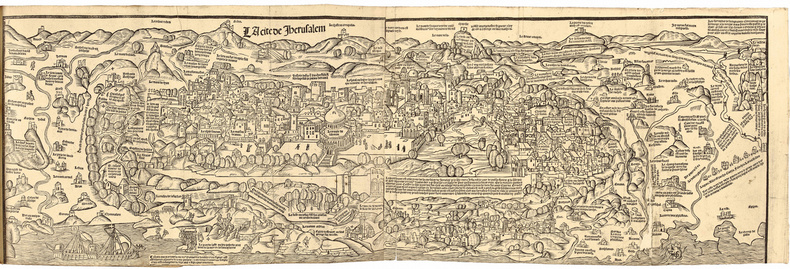
LCS-18114Précieux exemplaire conservé dans sa reliure de l’époque à l’emblème du dauphin, futur François II, roi de France (1544-1560). Paris, Fr. Regnault, 1522. F1 – Titre : (L)e grant voyage de hierusalem diuise en deux parties. En la premiere est traictie des peregrinations de la saincte cite de Hierusalem, du mont saincte Lτatherine [sic] de Sinay et autres lieux sainctz, avec les a, b, c, des lettres grecques, caldees, hebraicques et arabicques, avec aucuns langaiges des turcs trâslatez en frâcois. En la seconde partie est traicte des croisees et entreprinses faictes par les roys et princes chrestiens pour la recouvrance de la terre saincte . . Des guerres des turcz et Tartarins La prinse de Côstantinoble, du siege de Rhodes, la prinse de Grenade, avec lhystoire de Sophie Les guerres et batailles entre le grant turc et le grant souldan faictes depuis na gueres Le chemin et voyaige de Romme avec les stations des eglises ou sont les grans pardons Et plusieurs autres choses singulieres. Imprime a Paris pour Francois regnault libraire demourant en la grant rue sainct Jaques a lymaige sainct Claude. Cum priuilegio. Partie II – Titre sig [q I] : La seconde partie principale de ce present Liure contenant plusieurs voyages, guerres, croisees et expeditions faictes en la Terre saincte : pour la recouvrance dicelle : Par plusieurs princes τ roys chrestiens : Côme Charles martel, Pepin, Charlemaigne, Godeffroy de buillon [sic], et le roy sainct Loys .. Avec lystoire de Sophie, dit ysmael. Et plusieurs guerres et expeditions faictes entre les turcz τ payens. Et pareillement des guerres faictes dernierement En lan mil cinq cens et seize τ dixsept entre le grant turc et le souldam. [sic] Cum privilegio. Sig. L5 vo. (grand caractère) : Cy finist le grant voyage de Hierusalem avec plusieurs autres choses singulieres. Imprime a Paris pour Francoys regnault libraire iure de luniversite. Sig. L 6 : Le chemin de Rôme avec toutes les eglises .. Dernière page : (M3 vo.) : Cy finist le grant voyage de Hierusalem avec plusieurs autres choses singulieres .. Imprime a Paris pour Frâcois regnault libraire iure de luniversite de ladicte ville le. xxe. iour de mars Lan mil cinq cens. xxii. (1522). Collation : (4) ff. ; 209 ff., 2 planches dépliantes, nombreux bois gravés dans le texte ; complet ; sans le dernier blanc. In-4, veau fauve, filets et encadrement de motifs décoratifs à froid sur les plats, fleurons aux angles et dauphin doré au centre, dos à nerfs orné d'un petit motif doré répété, tranches dorées, gardes renouvelées, restauration d’usage mais authentique reliure armoriée de l’époque. 240 x 176 mm.
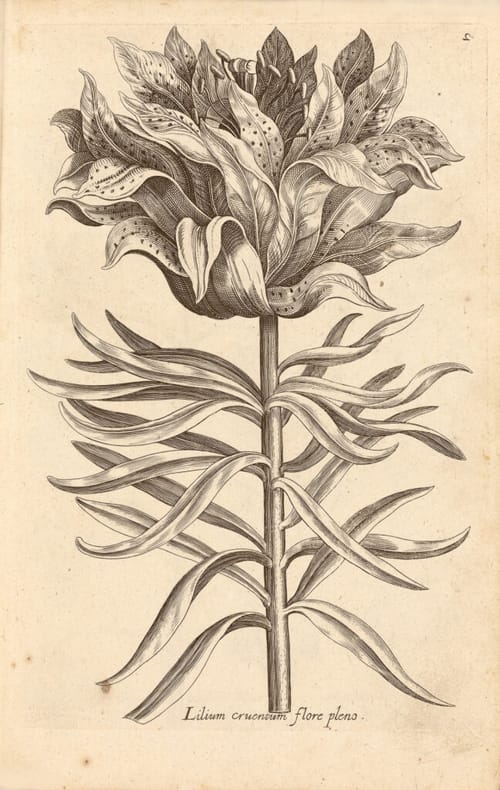
LCS-18313Les exemplaires complets, tel celui-ci, des œuvres florales de Jean-Theodrore de Bry conservés dans leur pure reliure de l’époque sont très rares. Francofurti, in off. Brÿana, 1626. In-folio de (6) ff., titre finement gravé (avec une fontaine au centre, des pots de lys et de cyclamens et des guirlandes de fruits ornent la structure), illustré de 142 planches gravées (dont 5 dépliantes), numérotées de 1 à 23 et de 1 à 116. Les numéros 37 et 50 ont été utilisés deux fois, la dernière planche n'a pas de numéro. De nombreuses plantes non-européennes apparaissent dans le Florilegium novum... D'autres planches montrent des exemples de "monstruosités" qui étaient cultivées dans les jardins baroques. Reliure en vélin de l'époque, taches sur le plat inférieur, titre à l'encre sur le dos. 313 x 195 mm.
Folio (320 x 235 mm). 1 p., with address panel to verso. To secretary of state Nicolas de Neufville, seigneur de Villeroy. Catherine de' Médici was one of the great female letter writers of the Renaissance, drafting many of her political letters (as here) in her own hand. She had been Queen consort of France as wife of Henry II, but rose to political power after his death in 1559. She stood behind the brief reign of her eldest son Francis II and, upon his death only a year later, was appointed regent to her second son Charles IX (then only ten years old). He died in 1574, leaving Catherine to preside over the chaotic reign of her third son Henry III, a period of terrible civil and religious war in France. Despite the turmoil, Catherine was a remarkable administrator in a political landscape in which she could trust almost no one. The present letter, drafted in her own hand (in itself remarkable), is typical of her direct style. She informs the secretary of state, Villeroy, one of the few members of government with whom she was intimate, of her wish to grant the benefice of the Abbey of Chailly (on the edge of the Forest of Fontainebleau) to the marquis de Saint-Sorlin, son of the Duchess de Nemours (and later duc de Nemours and Henry I of Savoy). She also makes provision for the benefice of Martigny-le-Comte (Burgundy) and arranges benefices for the sons of the statesman Pomponne de Bellièvre (who later became chancellor of France). The letter is apparently unpublished. It does not appear in the collected "Lettres de Catherine de Médicis" (1880-1943, 10 vols.), though a letter of 13 November 1581 (vol. VII, p. 415) addressed to the duc d’Épernon, on the same subject, allows us to date ours with some confidence. - Old folds, light browning, loss to blank left-hand margin, just touching a word of text and possibly the date, but avoiding the signature, neatly repaired, three further neat repairs to verso. Provenance: Otto August Schulz, Leipzig.
Folio (245 x 362 mm). 6 vols. (12), LXXII, (4), 668, (1) pp. (4), 743, (1) pp. 793, (1) pp. (2), IV, 5-780 pp. (4), 708 pp. 824, (104) pp. Title printed in red and black. With 187 engraved plates (many folding) and 9 engravings in the text (showing maps, plans, views, costumes, flora, fauna, scenes, portraits etc., including 2 bound as frontispieces), as well as numerous woodcuts in the text (showing arms, seals, devices, coastal views, details, machinery etc.). Uniform full calf with red labels to spine (gilding oxydized). Third and best edition of this important and profusely illustrated collection of travel reports, compiled by the brothers Awnsham and John Churchill, based on Hakluyt and Purchas. It includes the accounts of Martin Baumgarten (Egypt, Arabia, Palestine, Syria), Thomas Roe, Philipp Balde and Johan Nieuhoff (East Indies, including a detailed account of the north-eastern coast of Arabia, with a description of pearl fishing in Bahrain and mentioning Julfar, Qatar, Sir Bani Yas, Dubai, Sharjah, Ajman, Ras al-Khaimah, Amalgavine, and other places of interest along the coastline), J. Gemelli Careri (Turkey, Persia, India), Nicholas Rolamb (Constantinople), John Barbot (West Africa, with a chapter on "Mahomet and his Alcoran"), as well as of Yemen and various journeys to China, Korea, Greenland, Iceland, Africa, North and South America (including Columbus). - "This is a very valuable collection, both for its range of coverage and for the fact that it gives the original accounts [...] The third edition is considered to be best because of its greater inclusiveness and its copious index" (Hill). Two further volumes were issued separately in 1745, republished in 1752. - The count of the illustrations is notoriously complicated: the "List of the Copper Plates" counts 305 illustrations and maps, of which as many as four are placed on a single plate, and some are placed within the text. Compared to this list, the present set lacks 52 illustrations, or ca. 20 plates, whereas the first volume contains 5 additional plates not called for in the List. Three of the maps (Africa, Asia, America) which the List announces for the first volume are in fact bound in volumes IV-VI. The introduction, a "History of Navigation from its Original to this time", is likely one of the final works of the philosopher John Locke, whose publisher and financial manager Awnsham Churchill had been (while the attribution has been called into question, the text was included in Locke's Complete Works). - Provenance: Byrdie McNeill, Mt. Edgecumbe, Alaska (her stamps). Bindings professionally repaired. Some browning; some edge defects, tears and paper flaws, but generally well-preserved. Cox, I, 10. Hill 295. Sabin 13017. Shirley G.CHUR-1d. Alden/L. 744/62. Borba de Moraes I, 158. Landwehr, VOC 260 (note). Cf. National Maritime Museum Cat. I, 33.