692 496 résultats
8vo. (8), 384, (8), 115 [but: 215], (17) pp. With a woodcut on title-page, a woodcut initial and some woodcut tailpieces. 17th century marbled calf with gilt label to richly gilt spine, red edges. First edition of a "history of the kings of Persia compiled from the Persian histories of Mir Khwand and Turan Shah" (Howgego), in the original Spanish, by the Portuguese merchant and adventurer Pedro Teixeira (1563-1645?). It is one of the earliest European sources to mention Qatar, relating to the pearl fishery in the region: "The pearl fishery at Bahren begins some years in June, but generally in July, an lasts all that month and August … They generally go a fishing to Katar, a port on the coast of Arabia, 10 leagues to the southward of the Island Bahren. As soon an oyster is brought up, they open it, and take out the pearl. The pearls of this sea surpass all others in goodness and weight…" (English translation). The work is divided into three parts. The first, which is the largest, deals with the kings of Persia. It is a summarized translation of the voluminous Rawzat al-Safa by the Persian historian Mir Khwand (ca. 1434-1498), and is probably the first translation of the text into an European language. The second part is a translation of the Ayyibud emir Turan Shah's (d. 1180) chronicle of the kings of Hormuz, a text which is today only extant in translations. Though Teixeira's adventures started in 1586, he reached Hormuz in 1593, where he resided for several years to study its history. Both parts contain a chronological account of the kings, but also provide a more general history of the area. The last and third part contains an account of Teixeira's later travels from India to Italy in 1600-01 and 1604-05, visiting China, Mexico and the Middle East. In his preface Teixeira states that he originally wrote the work in Portuguese, but that it was translated into Spanish to appeal to a wider audience. The work appeared in a French translation in 1681, and extracts appeared in an English translation appeared in 1711, followed by a translation of the full text in 1715. - Binding slightly rubbed and with a small defect to upper spine. Slightly browned, otherwise immaculate copy in its first binding. Howgego, to 1800, T19. Maggs Bros., Spanish books 1014a. Not in Blackmer.
Large hand-coloured four-sheet plan. Pen and ink, graphite and watercolour on paper laid on canvas. Framed and glazed. Dimensions: app. 90 x 170 cm (sheet); 105 x 205 cm (frame). Large manuscript plan in beautiful colour; a unique witness to Vanderbilt's passion and ambitions. A member of the prominent American Vanderbilt family, William Kissam (1849-1920) managed railroads and was also a horse breeder. He was one of the founders of The Jockey Club and the owner of a successful racing stable. In 1896, Vanderbilt built the American Horse Exchange at 50th Street (Manhattan). In World War II, the United States liberty ship SS William K. Vanderbilt was named in his honour. - This impressive plan represents the horse-racing stable and track at the chateau, which Vanderbilt built in 1906, with the help of Henri Guillaume and Pierre Sardou, architects. He purchased in 1903 the land in an area of Poissy called Les Gresillons, 20 miles outside Paris. At the time, he ran a breeding operation in Deauville, making the location, also called "Carrieres-sous-Poissy", particularly convenient since it is on the way from Paris to Deauville. The hippodrome comprised three oval tracks, the outer of which measured 2400 metres, as well as a straight track. A long wall separated the racing areas from the Chateau St-Louis where the Vanderbilts lived, called the Chemin Plat, now known as Avenue Vanderbilt. With the beginning of World War I, the racing stables were shut down and eventually sold. The Chateau St. Louis is now the corporate headquarters for a local quarry, which spreads over the land previously occupied by the hippodrome. As of today, only the residential building known as "Chateau Grésillons" still stands and is currently being restored. - Provenance: Ralph Esmerian (New York jeweler).
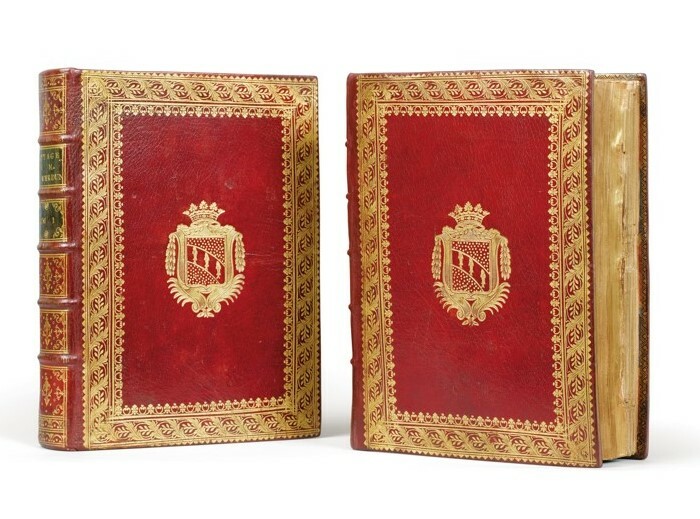
YTB-99Paris, Imprimerie Royale, 1778. 2 volumes in-4 de : I/ (4)-389-(1)-XIX-(3), 28 pl. h.t. dont 26 dépliantes ; II/ (8)-500-XXXI pages, 3 très grandes cartes dépliantes sur vélin fort : Antilles, Mer du Nord, Océan Atlantique. Maroquin rouge, plats ornés de la dentelle du Louvre, d’une roulette fleurdelysée et des armoiries dorées du marquis de Sartine, lieutenant-général de la Ville de Paris, dos à nerfs richement orné, pièces de titre et de tomaison en maroquin vert, filets or sur les coupes, roulette intérieure, tranches dorées. Reliure armoriée de l’époque. 255 x 190 mm. Edition originale de la relation complète de la plus importante expédition scientifique de l’époque relative à l’astronomie nautique et à l’hydrographie. Sabin, 98960 ; Leclerc, Bibliotheca Americana, 598. First edition. PRECIEUX, REMARQUABLE ET SUPERBE EXEMPLAIRE IMPRIME SUR PAPIER DE HOLLANDE ET RELIE EN MAROQUIN ROUGE ORNE DE LA CELEBRE DENTELLE DU LOUVRE ET DES ARMOIRIES DOREES DE GABRIEL DE SARTINE. Antoine-Raymond-Jean-Gualbert-Gabriel de Sartine, comte d'Alby, né le 12 juillet 1729 à Barcelone. Il devint conseiller au Châtelet (1752), puis lieutenant-criminel au même siège (1755), maître des requêtes (1759), lieutenant-général de police (1er décembre 1759). Ce fut un policier remarquable et un administrateur habile qui organisa le service des pompiers, du nettoyage des rues et de leur éclairage. Nommé conseiller d’Etat en 1767, il quitta la police pour devenir secrétaire d'Etat au ministère de la marine le 24 août 1774, puis ministre de la marine de 1775 à 1780. Il mourut le 1er septembre 1801 en Espagne, à Tarragone où il s'était réfugié après la prise de la Bastille. Il avait épousé le 9 Juillet 1757 Marie-Anne Hardy du Plessis. Lettré et bibliophile émérite, il avait rassemblé une très importante collection de livres et de plaquettes sur l'histoire de Paris, qu'il faisait revêtir de magnifiques reliures.
brossura
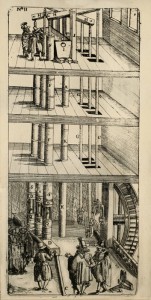
LCS-16737Le théâtre des inventions de Zeising illustré de 152 superbes planches finement gravées. Leipzigk et Altenburg, Grossen – Liegern – Meuschken – Jansonium, 1614-29. Soit 6 parties reliées en 2 volumes in-8 oblong de : I/ (32) ff. y compris le titre frontispice, 159 pp., (1) f. ; (4) ff., 76 pp., (2) ff. ; (4) ff., 91 pp., (2) pp., (1) f.bl. ; (8) ff., 85 pp., (2) pp. ; (6) ff., 102 pp., (1) f. ; (4) ff., 175 pp., (1) f. ; II/ 152 planches numérotées dont 21 dépliantes. Pt. trou de vers dans le titre du premier texte, pte. galerie de vers dans les 10 derniers ff. du volume de texte et dans les 3 dernières planches du volume d’illustrations. Plein vélin ivoire, dos lisses, traces de liens, tranches bleues. Reliure de l’époque. Dimensions du volume de texte : 156 x 185 mm. Dimensions du volume de planches : 146 x 168 mm.
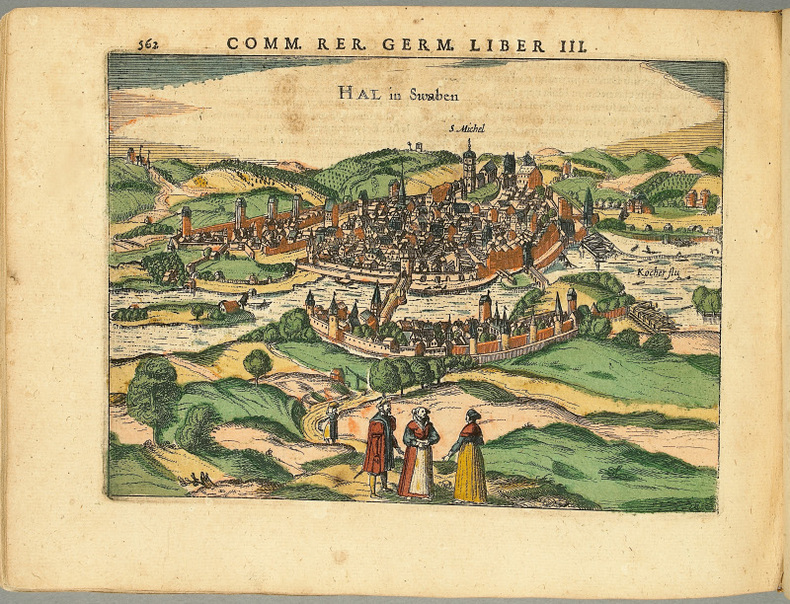
LCS-53Séduisant exemplaire entièrement colorié à l’époque et conservé dans son vélin d’origine. Amsterdam, apud Joannem Janssonium, 1616. In-4 oblong de (10) pp. y compris le titre frontispice et la planche avec le blason, 732, (2). Relié en plein vélin souple de l’époque, dos lisse avec le titre manuscrit. Quelques légères brunissures et rousseurs en début de volume, sans atteinte au texte. Quelques réparations marginales. 238 x 178 mm.
2 vols. Folio (328 x 447 mm). (8) pp.; (4) pp. of text; a total of 76 photographs on plates by Francis Frith (sizes ca. 145-165 x 215-230 mm), each with a separate leaf of text. Contemporary red morocco, spines and covers gilt. Marbled endpapers; all edges gilt. First edition of this important and early photobook on the Near East. During the years 1856-59, Frith (1822-98) made three visits to Egypt and the Holy Land; this selection of his photographs, from wet-collodion 9 x 7 negatives taken with an 8-by-10 inch camera, was published in 25 fascicles of 3 prints each, a work hailed as "one of the most renowned nineteenth-century photobooks" (The Photobook). Most of these images are dated 1857 either in the plate or the printed caption. They include a portrait of the artist in oriental costume and views of Abu Simbel, Aswan, Baalbek, Bethlehem, Damascus, Giza, Hebron, Jerusalem, Karnak, Luxor, Nazareth, Philae, Tiberias, Wadi Kardassy etc. The preliminaries of vol. 1 include title, introduction, table of contents, and subscribers, those of vol. 2 encompass title and contents. Each plate is accompanied by a full-page letterpress description. "Francis Frith is undoubtedly one of the best-known photographers to work in the Near East. His trips to the Levant were a brilliant commercial success as well as an artistic one" (Perez 163). - Some foxing to blank margins, as well as to a few photographs. Modern bookplate of the German anthropologist Jasper Köcke. Bindings very slightly rubbed, but hinges somewhat brittle; unobtrusive chafe-mark to upper cover of vol. 2. Overall a fine, appealingly bound copy. The Photobook I, 28. Blackmer 1942. Hannavy 561. Gernsheim, History 286. Perez, Focus East 165. Van Haaften-White XII & XV.
4to (ca. 160 x 216 mm). Arabic manuscript on polished paper. 8 parts. 93 leaves, final blank leaf. Written in black ink throughout with red chapter headings, 19 lines, two columns and single column. Contemporary brown leather binding with gilt borders and recessed and gilt central ornament, stamped in relief. A fine, complete collected medical manuscript, including pharmacological and alchemical material. The principal section is formed by the "Urjuza fi l-tibb", or "Medical Poem" of Ibn Sina, which can be considered a poetic summary in 1326 verses of the author's great encyclopedic textbook, the Qanun. The verse form made it popular as a mnemonic in the process of transmitting the Canon's medical knowledge from master to student. The second part of the work is more directly concerned with anatomical matters, but also discusses the pulse and urine. - The following section is "Al-Maqala al-Aminiya fi 'l-fasd", a treatise in ten chapters on phlebotomy. It was written by Abul-Hasan Hibatallah ibn Said ibn al-Tilmidi (d. 1165 CE), the Christian physician to the Abbasid caliph Al-Muqtafi, hailed as one of the greatest medical men of his age. - A subsequent essay treats the refinement of chemical substances by burning and washing, also discussing the characteristics of the combustion of various metals, including gold, silver, steel, copper, and lead. Further parts concern the refinement of medicines (by Al-Hasan ibn Bahram al-Mutatabbib) and the treatment of poisonings in general, but also offering an alphabetical pharmacopoeia. - Leather covers professionally restored; modern marbled pastedowns. Internally quite clean; a few leaves show edge tears but without loss to text. Altogether a fine Arabic medical manuscript comprising a wide range of relevant material. GAL I, 457, 81 ("Manzuma fi 't-tibb"); GAL S I, 823. For al-Maqala al-Aminiya see GAL I, 487.
Large folio. Half morocco, retaining the original cloth covers and gilt cover label. 11 (instead of 21) plates. Author's Edition. Landmark collection of Muybridge's revolutionary "instantaneous photography", a self-developed technique that allowed for high-precision series of high shutter speed stop-motion photographs. He began his work with photographing horses, but in time it would also include athletes, birds, lions, and even camels. Muybridge first photographed a horse with all 4 hooves off the ground in 1872, after Leland Stanford (later the Governor of California) hired Muybridge to determine whether a horse leaves the ground completely when running, a hotly debated issue at the time. (Stanford believed they did, and Muybridge won Stanford a $25,000 bet.) By 1885, Muybridge had accumulated over 20,000 photographic negatives, or 781 sequential series of photo-plates, shot from multiple cameras at carefully planned locations and angles, each of which showed a human and/or animal engaged in a continuous motion. This required Muybridge to develop cameras for faster shutter closure. In cases where a human or animal moved any great distance, photographing the movement required a team of photographers, rather than a single photographer. Muybridge and H. Allen, a physiology professor at the University of Pennsylvania, published 37 eleven-volume sets which contained a collotype of every one of the 781 photographic series. This "Author's Edition" consists of a selection of the most important collotypes contained in the full work; the present set includes all the plates to show animals: No. 565. Horse trotting. - 616. Horse and rider, trotting more rapidly. - 626. A third horse and rider, running, including several frames with all 4 hooves off the ground. - 647. A horse jumping a hurdle at high speed, with a bareback jockey. - 659. Mule jumping and kicking with his hind limbs. - 710. Race hound at high speed, including frames with all 4 feet off the ground. - 721. Lion circling along the wall of a small enclosure. - 739. Camel walking. - 755. Bird flying, including swoops down. - 3. Runner. - 152. Runner jumping a hurdle. - The combined illustrated area of any given plate varies, but is typically about 21 x 30 cms. Muybridge had focused his early photographic work on San Francisco and Yosemite, but had later been sent by the Federal Government to photograph Alaska for the High Sierra Survey. (The latter project was in 1868, shortly after the territory was purchased. He was later sent on a second trip to Alaska to photograph the Tlingit tribe and the Modoc War.) During his time as a photographer, Muybridge owned a racetrack. Late in life, he invented the zoopraxiscope, a primitive forerunner of the motion picture camera. Analyses made possible by the technique later had a wide range of implications for sports, podiatry, physical therapy, vertebrate paleontology, and other fields. - Pastedowns and spine renewed, otherwise an excellent, clean copy in the original boards. Grolier, Truthful Lens, 123. Parr/Badger, The Photobook I, 52.
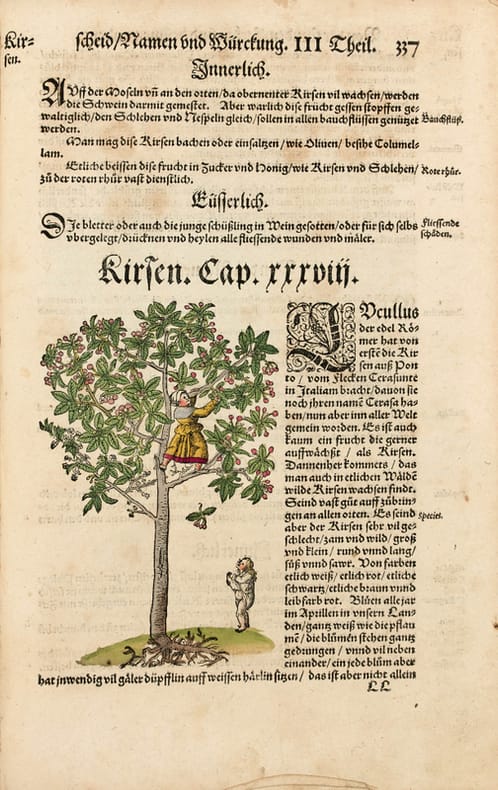
LCS-18265Précieux exemplaire à grandes marges conservé dans sa belle reliure de l’époque. Strasbourg, Josias Rihel, 1572. In-folio de (20) ff., 369 ff., (17) ff. Qq. rousseurs et brunissures, qq. mouillures marginales, dernier f. déchiré sans manque. Peau de truie estampée à froid, trois frises d’encadrement sur les plats, attaches conservées. Reliure estampée à froid de l’époque. 319 x 204 mm.
LCS-18452Très bel exemplaire en maroquin rouge de l’époque aux armes et au chiffre couronné du roi Louis XIV. Paris, Imprimerie Royale, 1670. In-folio de (4) ff., 8 pp. de texte, 11 gravures sur 7 double-pages, pp. numérotées 17 à 67 comportant pour la plupart une grande eau-forte, 9 planches de devises reliée entre les ff. 29 et 30, entre les ff. 35 et 36, 37 et 38, 43 et 44, 45 et 46, 51 et 52, 53 et 54, 60 et 61, 62 et 63, (1) f., pp. 65 à 104. Une seconde version de la planche 58 a été ajoutée au début du volume, coloriée à la main à l’époque et enluminée. Nombreux bandeaux, vignettes, initiales. 4 ff. brunis. Est jointe au volume une table des illustrations manuscrite d’une main contemporaine. Ainsi complet. Maroquin rouge, double encadrement de triple filet doré, armoiries frappées or au centre, chiffre couronné aux angles, dos à nerfs orné de fleurs de lys dorées et de chiffres couronnés dans les entrenerfs, roulette dorée sur les coupes, roulette fleurdelysée intérieure, tranches dorées sur marbrures. Reliure de l’époque. 560 x 410 mm.
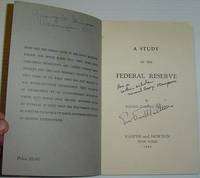
1952327a2087New York: Kasper and Horton. Good. 1952. First Edition. Paperback. Stellar provenance for this signed first printing example inscribed by Mullins 1923-2010 to dedicatee of a subsequent printing George Stimpson upon title page. Also signed by Stimpson inside front cover. In the Foreword to the 1991 printing of this title Mullins paid tribute to Stimpson by saying he and Ezra Pound were "two of the finest scholars of the twentieth century who generously gave of their vast knowledge to a young writer to guide him in this field which he could not have managed alone. The research for this book at the Library of Congress was directed and reviewed daily by George Stimpson whom the New York Times on September 28 1952 called 'A highly regarded reference source in the capital'". The first nationally circulated revelation of the secret meetings of the international bankers at Jekyll Island Georgia 1907-1910 where the draft of the Federal Reserve Act of 1913 was written. "Has the honor of being among the first books burned by the freedom-loving Allies in Germany after World War II had bailed out the bankers once again." - Robert H. Weems in 'A Populist Bibliography'. Average wear and soiling. Binding intact. A truly extraordinary signed first printing example of what is quite possibly the king of conspiracy titles. Singerman 0865. 8.7 x 5.5" ; 8vo - over 7¾" - 9¾" tall; Mullins on the Federal Reserve Bank the Fed Privately Owned Central Bank President Woodrow Wilson Colonel Mandell House Jekyll Island meetings Rothschild Rockefeller Paul Warburg; Signed by Authors . Kasper and Horton paperback
4to (140 x 190 mm). Complete Arabic manuscript on strong Chinese paper. 165 ff. (337 numbered pages), leaf size ca. 132 x 182 mm, written space ca. 82 x 128 mm). 6 lines, per extensum (except 4 lines on pp. 3-4; 11 lines on pp. 11-34). Illustrations of the Kaaba in Mecca and the burial sites of the first three Rashidun Caliphs on pp. 47-48. Text written in "sini" calligraphy typical of Chinese Muslims, in an archaic form oscillating between naskh and muhaqqaq. Black ink, various sections highlighted in red, text within single or double red rules; sporadic notes or corrections on the margins. Contemporary black, red and gold painted and lacquered over paper and cloth. Painted boards show floral designs in black and gold on a red background, all within a black border with red wave designs. With remnants of leather on the brown cloth spine. Extremely rare specimen of the famous Sunni prayerbook "Dala'il al-khayrat": an Arabic manuscript written in what is today Xinjiang, China. - The "Dala'il al-khayrat" ("Waymarks of Benefits" or "Proofs of Good Deeds"), an extensive book of poems in praise of the Prophet Muhammad, was compiled by the Moroccan Sufi scholar Muhammad ibn Sulaiman al-Jazuli (807-870 H / 1405-1465 CE) and was quickly received throughout the Islamic world, functioning as a kind of Muslim catechism. Al-Jazuli's inspiration for the book is said to have come before he left Fez to spend forty years in Mecca, Medina and Jerusalem, but he completed it in Fez during the last years of his life. The present manuscript, written in so distant an Islamic community as that of Eastern Turkestan, a territory dominated throughout by Mongols or Chinese, where Muslims were commonly viewed as strangers, gives striking evidence of the range and scope of a tradition lasting for almost six centuries: the utopia of Islam as the Religion of Oneness, aiming to unite all the Muslim peoples in a single community reaching from Europe to the Far East. - The text begins with an introductory praise of Muhammad, followed by the 99 names of Allah (leaves 1-46) and a compilation of eulogies and prayers divided into seven subsequent chapters (each referred to as "juz", or "section"): 1, pp. 46-113; 2, pp. 113-136; 3, pp. 136-181; 4, pp. 181-217; 5, pp. 217-236; 6, pp. 236-256; 7: pp. 256-end. Interestingly, the double page 47/48 does not show Mecca and Medina, as is typical for manuscripts of this text, but rather presents naive illustrations of the "Ka’ba of Allah" (!) and the burial sites of the first three Caliphs. No date in colophon, written in the form of prayer. Leaves 12 to 19, extraneous to the text proper and containing additional prayers and the 99 Names of Allah, are inserted on contemporary Chinese paper. Edges worn; lower corner rounded and fingerstained from long use, but very well legible and altogether well preserved.
Folio (265 x 420 mm). (4), 3, (1) pp. With 59 etched plates (8 are double-page) by Daniel Mackenzie. Slightly later half calf, marbled sides, gold-tooled monogram AL on spine. First and only edition of one of the rarest books on Japanese flora. Kaempfer (1651-1716) was a professor from Lemgo, Germany, who joined the Dutch East India Company (VOC) as a physician in 1685. After periods in what are now India and Indonesia he travelled in 1690 to Japan to work as a doctor on Dejima (Deshima), the Dutch trading post or factory in Nagasaki. This was one of the rare places where Western and Japanese people were allowed to interact. During his three-year term of duty, Kaempfer was twice allowed to journey to Edo (now Tokyo) in the company of the head of the factory. Upon his return he went into medical practice in his native town, Lemgo. After his return to Europe he wrote a number of works in manuscript, but did publish them, leaving them in manuscript at his death. Sir Hans Sloane acquired these manuscripts, alsong with his drawings and herbarium, and arranged for their translation and publication, the first to appear in translation was The history of Japan in 1727. This English translation established Kaempfer's reputation as the 18th-century authority on Japan and deeply influenced Japan's image in Europe. - Kaempfer's botanical drawings used for the present publication were among the more than 4000 groups of manuscripts from Sloane's collection that formed the core of the Library of the British Museum when it was established in 1753 (Sloane MS 2914). The renowned botanist and companion of the 1768 Cook expedition Sir Joseph Banks (1743-1820) was responsible for the editing and publication of this work and dedicated it to the curators of the Library. In most cases no plates had previously been made from these drawings, so they remained unpublished. In the last years of his life Kaempfer himself had published only a small number of his drawings in his Amoenitatum exoticarum, printed in Lemgo in 1712. Thus the present publication introduces many Japanese plants for the first time to a large audience in the West. Kaempfer's herbarium is now in the Natural History Museum, South Kensington. - Royal Library duplicate stamp in the foot of title page. With some minor foxing, the last few plates stained only in the lower margin, not affecting the illustrations. Otherwise in very good condition. Great Flower Books, p. 62. Henrey 886. Nissen (BBI) 1019. Stafleu/Cowan 3484.
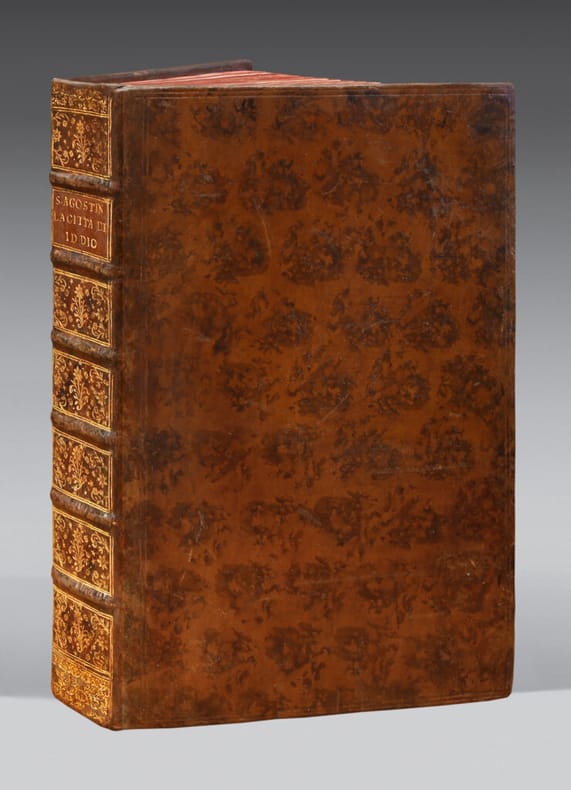
LCS-18473«On n’en connait pas d’exemplaires» (Brunet, I, 560-561). 2a. Tauola et capittoli del primo libro || sācto Augnstino de la cita dio. 13a. Queste illibro di sancto Augustino de || lacita didio ilquale ediuiso ī. xxii libri || Iquali sono īcōfusiōe delrito dilliddii de || pagani... comīcia ilprologo tracto || del secundo libro delere-tractaciōe de Au||gustino:... 333b. COLOPHON : DEO GRATIAS. [P]Armi con laiutorio didio ha||uere renduto il debito di que||sta grande opera. Adcui pare troppo : o || adcui pare poco miperdonino. Ma ad || cui basta non adme: ma adio congratu||landosi meco ne rendano gratie. Glo||ria et honore alpadre et al figliuolo et || allo spirito sancto omnipotente idio in || secula seculorum. Amen. Chancery folio, 322 leaves (of 324, without first and last blank leaves), a12 a-k L m-z10 A-G10 H12, double column, 47 lines, roman type, initial spaces (the first supplied in red, a few others supplied later in brown ink), book number supplied in manuscript at head of each recto (faded), eighteenth-century cat's-paw calf, spine gilt in compartments with red morocco lettering-pieces, red edges. Reliure du XVIIIe siècle. 286 x 198 mm.
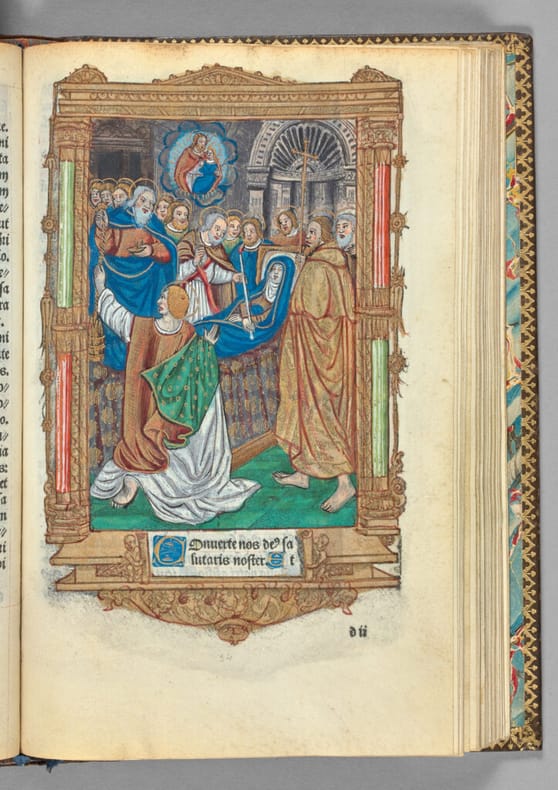
LCS-18474Provenance: Bibliothèque Hulthemiana, n° 604? Paris, Antoine Vérard. s.d. Almanach pour les années 1503 à 1520. In-8 de 98 feuillets imprimés sur peau de vélin. 8 ff, a8, b8, c8, d6, e4, f8, g8, h8, i4, A8, B8, C12. Pt. trou d’épingle ds. le f. de titre. Veau brun, large plaque à la cathédrale dorée insérée dans un encadrement de roulette à froid et double filet or, dos à nerfs orné de même, tranches dorées. Reliure romantique. 221 x 136 mm.
LCS-17980De la bibliothèque Robert Hoe. Paris, Charles l’Angelier, 1548. Petit in-8 de (36) ff., 368 ff. Joli portrait de François Premier. Relié en veau fauve, sur les plats entrelacs de listels à la cire, noirs, gris et rouges, soulignés de filets dorés, dos lisse orné de larges arabesques peintes et à l'or, filet et fleurons dorés sur les coupes, tranches dorées. Reliure de l'époque. Etui de maroquin noir. 124 x 82 mm.
LCS-18039Exécutée par l’atelier au « Pecking Crow » travaillant pour Grolier. Paris, Simon de Colines, 1543. In-4 de 176 ff. (a-y8), 14 planches gravées à pleine page. Texte imprimé en rouge et noir. Almanach pour 1543-1568. Titre imprimé dans un encadrement architectural, toutes les pages bordées d'encadrements composites, 14 bois à pleine page avec bordures architecturales spécialement conçues pour chaque scène, et grandes lettres ornées à fond criblé. Plein veau brun foncé, plats recouverts d'un décor à la Grolier composé de filets dorés, entrelacs géométriques peints en noir et fleurons dorés, dos orné entre chaque nerf d'un petit fleuron doré, coupes décorées, tranches dorées et ciselées, ancienne restauration au bas du plat supérieur. Étui. 233 x 164 mm.
135288Fair. Quarto 12 pages last two blank. A saddle-sewn gathering of blue paper; two holes to each leaf apparently insect damage with some minor loss to the text; some marks and short edge tears; nevertheless an extraordinary relic in decent condition overall. The first nine pages closely written in ink in a single hand which we know to be that of pastoralist Alfred Barker 1812-1880 contain a version of Stuart's journal for the period from 31 March the beginning of the expedition to 17 May 1859 with some significant variation from the published versions. Importantly the final half-page of text is unmistakably in the hand of John McDouall Stuart himself. This passage - an addendum written in pencil and comprising material not included in published versions of the journal - describes the extent of Stuart's claims of pastoral land at Chambers Creek. The journal is accompanied by a loose bifolium containing manuscript directions to Chambers Creek quarto 2 pages also in Barker's hand with a small diagram of Hummock Hill. <p>The journal ends after the entry for 17 May 1859. Published accounts of the expedition indicate that Stuart spent the following three days in camp finalising his report on the survey of Chambers Creek which was sent back to his patrons James and John Chambers and William Finke on 20 May by way of one of the expeditioners Campbell. The specific nature of the variations from the published versions leads us to conclude that Stuart sent with this material an edited version of his field journal to that date the originals of both manuscripts are now lost. Barker brother-in-law and business partner of the Chambers brothers would have copied the present manuscript directly from Stuart's original manuscript. It pays scant attention to the daily happenings of the expedition but records detailed information about the country with a particular regard to its suitability for pastoral use precisely the information most valuable to patrons intent on building a pastoral empire. <p>Stuart's manuscript addendum to Barker's copy of his report must have been written in the short period between his return on 3 July 1859 and the departure in August of the same year of his third expedition into the interior. He had given John Chambers power of attorney in relation to his claims on the runs at Chambers Creek where he had claimed a staggering 1500 square miles of land. The matter had still not been settled at his departure and Stuart's precise description of the extent of his claim were evidently intended to allow his patrons to consolidate it in his absence. <p>The detailed manuscript text on the separate bifolium also supports a date from the middle of 1859. It gives a set of straightforward directions to Chambers Creek via the crucial series of waterholes that Stuart had identified as well as some details of the surrounding country. Barker was soon to follow this route north to stock Stuart's empty cattle runs the explorer lacking the resources to do so himself. While these instructions are in Barker's hand they must have been prepared in consultation with Stuart in preparation for the cattle drive north. <p>Returning from his third expedition Stuart was pleased to find Barker's cattle thriving on the saltbush on his land. After great difficulty and scandal the grant was finally made for an unprecedented area of 1000 square miles but many suspected that the beneficiary of the vast territory would be Chambers and Finke not the explorer Barker's contribution going unremarked in newspaper accounts of the time. This would be borne out in the coming years. <p>The textual history of the journal of Stuart's second expedition makes the survival of this document all the more important. In her introduction to the edition of the journal published by the Friends of the State Library of South Australia 2002 Valmai Hankel writes: 'This expedition is the only one for which no manuscript diary or fair copy survives. As it was regarded as a private venture unlike the five other expeditions its results were not reported to Parliament so its journal was not published as a parliamentary paper. The only known versions are those published in the "Journal" of the Royal Geographical Society RGS vol.31 1861 pp.65-83 and in "Explorations in Australia. The Journals of John McDouall Stuart during the years 1858 1859 1860 1861 & 1862" edited by William Hardman London: Saunders Otley 1864 .'. <p>The RGS and Hardman versions of the text are generally more discursive but both are the result of editing by third parties and would have been based on fair copies of the journals. Hardman in particular was an unsympathetic editor 'Stuart seems to be almost an illiterate person .' and often redrafted Stuart's matter-of-fact observations to fit more closely the mould of a Victorian travel narrative. Our manuscript on the other hand is not only contemporaneous with the expedition but also likely closer in content to the lost field journals before editorial intervention and judicious redaction and revisions for political and commercial considerations. <p>A full transcription of the journal is available as are a list of variations from the published version. One example will suffice to indicate the significance of this manuscript. Hankel's introduction states that 'The expedition's main aims were to survey the Chambers Creek lease and to prospect for gold . Stuart's major discovery was more links in the chain of springs later known as mound springs which Warburton and Babbage had found in 1858. Hergott found the first on 13 April; although Stuart named them after their discoverer he does not say so in either version of his journal' page x. The manuscript states that 'on the 13th Hergott after finding St Stephens Pool dry and no water in the Range - discovered a batch of Springs South of the Pool - abundance of Water - distance from this camp to Hergotts Springs 30 Miles - Native Cucumbers found here'. <p>These documents were purchased together with an important archive relating to Alfred Barker's pastoral properties offered separately and now sold. The archive contains letters that substantiate serious irregularities in the handling of Stuart's pastoral lease at Chambers Creek which when read in conjunction with the above material make the story of his final years even more distressing. Copies of the relevant letters are included with the manuscript. unknown
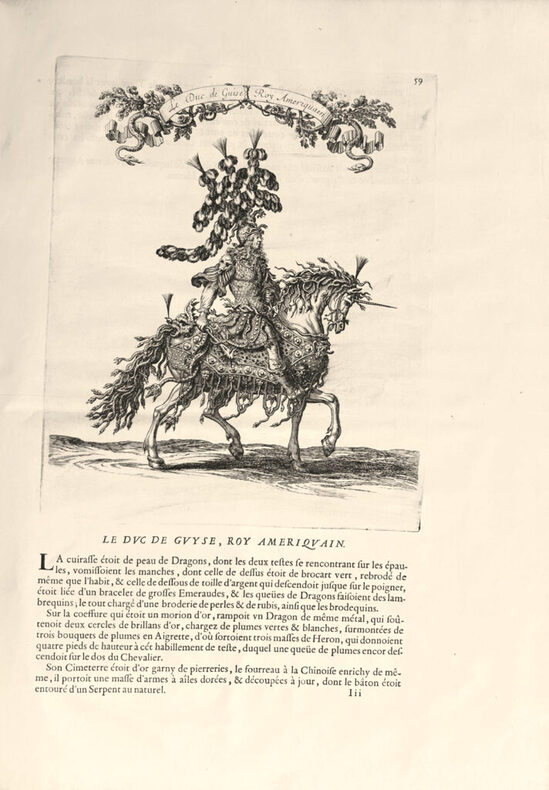
1549YTB-17Paris, Rosset, 1549. [ENTREE DU ROY HENRI II]. C'est l'ordre qui a este tenu a la nouvelle et joyeuse entrée, que le Roy treschretien Henry deuzieme de ce nom. Suivi de : C'est l'ordre et forme qui a este tenu au Sacre & Couronnement de treshaulte & tresillustre Dame Catharine de Medicis, Royne de France. Deux ouvrages en 1 volume in-4 de (38) ff. et 11 gravures, (12) ff., le dernier blanc. Maroquin aubergine, riche décor aux armes et chiffre du roi Henri II frappées or sur les plats avec fleurs de lys et chiffre H couronné, dos à nerfs orné de filets or et à froid, filet or sur les coupes, triple filet or intérieur, tranches dorées. Reliure du XIXè siècle. 227 X 160 mm. EDITION ORIGINALE RARE ET PRECIEUSE DU « plus beau livre d'Entrée des rois de France qui ait été publié » (Ruggieri, 245). EDITION ORIGINALE DU SACRE ET COURONNEMENT DE LA REINE CATHERINE DE MEDICIS. Fairfax Murray French, 150 ; Du Colombier, Jean Goujon, p. 67-71, planche LVI-LVII ; Vinet, 471 ; Picot Rothschild, IV, 3114 ; Mortimer French, 202l ; Watanabe,1602. RELATION DE L'ENTREE SOLENNELLE A PARIS D'HENRI II EN ET DE CATHERINE DE MEDICIS EN 1549, deux ans après l'avènement du roi qui succédait à son père François Ier, mort en 1547. LE PREMIER OUVRAGE DECRIT LA CEREMONIE DE L'ENTREE, LE SECOND RELATE LE SACRE DE LA REINE, SIX JOURS AUPARAVANT, A SAINT-DENIS. En marquant la liquidation de la succession de François Ier, l'événement revêtait une importance politique considérable. LA VILLE DE PARIS LUI DONNA UNE SOLENNITE PARTICULIERE, N'EPARGNANT AUCUN EFFORT POUR EN SOULIGNER LE CARACTERE MAJESTUEUX : LES DECORS ET LES EDIFICES FURENT DESSINES ET CONSTRUITS SOUS LA DIRECTION DES PLUS GRANDS ARTISTES, SANS DOUTE Jean Cousin, Jean Goujon et Philibert de l'Orme. La coutume des entrées solennelles de souverains dans une ville, et principalement dans une capitale, remonte à la plus haute Antiquité et s'est poursuivie pratiquement à toutes les époques. Sauf quelques exceptions, ce n'est qu'à partir de 1515, lors de l'Entrée de Charles-Quint à Bruges, que celles-ci auraient donné lieu à des relations imprimées illustrées (von Arnim, Fünf Jahrhunderte Buchillustration, p. 91). CE BEAU ET RARE LIVRE ILLUSTRE CONSERVE LE SOUVENIR DES PLUS BELLES DECORATIONS ARCHITECTURALES DU SEIZIEME SIECLE ET DECRIT LA MAGNIFICENCE DE CETTE ENTREE ROYALE. Le texte, attribué à Hardouyn Chauveau par une inscription ancienne dans l'exemplaire Soleinne, serait dû, selon V.L. Saulnier, Les Fêtes de la Renaissance, I, pp. 31-59, au traducteur de Serlio, de Vitruve et de l'Hypnerotomachia Poliphili, l'écrivain Jean Martin, assisté, pour les inscriptions sur les monuments, du poète Thomas Sebillet. LES ONZE PLANCHES SUR BOIS, HORS ET DANS LE TEXTE, QUI DECORENT L'OUVRAGE, EN PARTIE SIGNEES D'UNE CROIX DE LORRAINE, ONT ETE ATTRIBUEES AUX PLUS GRANDS ARTISTES. PAR LA PERFECTION DE LEUR GRAVURE ET L'ELEGANCE DE LEUR DESSIN, EXEMPLES PARFAITS DU STYLE HENRI II DANS SON EXPRESSION PARISIENNE LA PLUS RAFFINEE, ELLES PASSENT POUR L'UN DES CHEFS-D’ŒUVRE DE L'ILLUSTRATION FRANÇAISE DU SEIZIEME SIECLE. La question reste évidemment ouverte de savoir si ces gravures traduisent les dessins ayant servi à élever les monuments de la réception ou si elles en restituent seulement l'aspect. La décoration de ces planches comporte à deux endroits au moins, au pont de Notre-Dame et à la construction flanquant le Beautreillis, le monogramme de Diane de Poitiers ; son emblème, le croissant, qui pourrait passer pour un motif décoratif, figure à plusieurs autres endroits, mais sur ces deux constructions son chiffre s'étale complaisamment à côté, voire à la place, de celui du roi ; le texte mentionne les monogrammes au H du roi mais reste muet sur ceux de sa maîtresse, âgée de cinquante ans, qui figurait dans le cortège de la reine sous son nouveau titre de duchesse de Vale.
Tall 8vo (172 x 252 mm). 4 vols. Arabic text throughout apart from titles in English (lacking in second volume) and 4 pp. subscribers' list in vol. 4. Modern half calf over marbled boards with blindstamped spine title. The rare and celebrated first complete edition of the Arabic text, printed in Calcutta at the Baptist Mission Press. Also known as the "Calcutta II" version, this is described on the title as "now, for the first time, published complete in the original Arabic, from an Egyptian manuscript brought to India by the late Major Turner Macan, editor of the Shah-Nameh". - The original scattered Arabic texts were collected in four corpora: the so-called Calcutta I or Shirwanee edition (1814-18, 2 vols.), the Bulaq or Cairo edition (1835, 2 vols.), the Breslau edition (1825-38, 8 vols.), and the present one, the "Calcutta II" or the "MacNaghten" edition. Considered the most comprehensive text of the Arabian Nights, this is also the basis for the best-known translations including the English editions by John Payne and Richard F. Burton. - "Première édition complète du texte arabe [...] Elle a été donnée d'après un manuscrit égyptien pris dans l'Inde par le major Turner Macan, et elle a eu pour éditeur sir W.-H. Macnaghten" (Brunet). "It was only in 1839-1842 that the Arabic text [of the 1001 Nights] was edited in its entirety, by Macnaghten" (cf. Fück). - Browned and brownstained. Intermittent worming throughout, occasionally with extensive loss and stabilized with translucent paper, especially concerning the beginning and end of vol. 2. An extraordinary survival. Chauvin IV, p. 17, 20B. Brunet III, 1715. Graesse IV, 523. Fück, p. 139, n. 365.
Small folio (ca. 215 x 337 mm). 64 pp., interleaved by 30 blank pp., 3 of which with manuscript notes. Contemporary full blue leather with giltstamped spine and red spine-label. One of the founding documents of the 20th century's oil industry: the personal copy of Fuad Rouhani (1907-2004), later the first Secretary General of OPEC, with his autograph annotations and signature. - The historic agreement that provided Western oil companies with 50% ownership in Iranian oil production after its ratification in 1954. It expired in 1979. The agreement, which was heavily pressured by President Dwight D. Eisenhower, gave U.S. oil companies complete control over how much petroleum Iran pumped and the price it could sell for, and obliged Iran to compensate the AIOC with a sum of 25 million pounds - £15 million for the AIOC's loss of oil revenue from 1951 to 1954, and £10 million to transfer ownership to Iran of the Naft-e Shah oil fields, a small refinery in Kermanshah and domestic fuel distribution facilities. - Several marginal notes as well as 3 pp. of handwritten notes by Rouhani, listing the oil companies involved in the consortium, including references to later corporate developments such as the merger of Hancock Oil Company with Signal Oil and Gas Company in 1958. Rouhani, who was involved in the negotiations on behalf of Iran, was one of the founders of OPEC a few years later in 1961, and became OPEC's first Secretary General. - Extremities slightly rubbed, first leaf a little fingersoiled. A very good copy of the historic contract that overturned nationalization and placed control over Iran's oil in the hands of a group of international oil companies. Cf. OCLC 922021728.
8vo (125 x 197 mm). 206 ff. (foliated in pencil 1-204 + 1 endpaper in an early 19th century hand). Ottoman Turkish manuscript on paper (largely polished paper, but including 18 leaves of silhouette paper with a floral pattern in pink and mint green) in several hands. Contemporary limp leather with remant impression of library chain. Handsome manuscript collection of the most important poets of the Ottoman classical period, including but not limited to Bâkî (1526-1600), Isa Necati (d. 1509), Muhammad ibn Sulaiman Fuzuli (1480-1556), Hayâlî (c.1500-57), and Yahya Efendi (1494-1570). The eighteen leaves of silhouetted paper are an important preservation of a popular but rarely preserved mediaeval and early modern book decoration practice. To dye silhouetted paper, Ottoman papermakers used stencils or pads of felt to bleed designs into the paper itself, creating a beautiful, airy impression of colour and pattern on which a scribe would write. These were high-cost, coveted items in both the East and the West. Perhaps consequently, this manuscript, likely produced in Western Anatolia, had by 1596 made its way to Silesian Breslau (Wroclaw), in what is now Poland. An elaborate librarian's inscription, dated and signed "G. Scheidt", identifies its new home as the library of the Church of St Mary Magdalene. - The inscription notes that the text was donated to the library by "Fridrich von Schliwicz und Klein Wandriß zu Zieserwicz". Friedrich von Schliewitz was a Silesian nobleman who gifted a total of five Turkish manuscripts to St Mary Magdalene Library in 1596, all of which received chains of libri catenati (the remnant punched hole of which is visible on the leather covers of this manuscript) and the elaborately painted crest commissioned by the library from Breslau painter Matthias Heintze (d. 1622). Georg Scheidt (d. 1601) was a teacher at the Mary Magdalene grammar school between 1569 and 1575 before becoming a librarian to the local church library (cf. Zeitschrift des Vereins p. 218, and Schönborn, p. 28). After his death he was replaced by Christoph Sarcephalus, who completed the inventory which forms the library's earliest known catalogue (cf. Garber, p. 568). - The present manuscript itself boasts numerous marginal notes in an early hand, as well as marginalia on fol. 109, depicting a horse in red ink. Covers a bit worn, some early paper repairs. In all a well-preserved and well-travelled early modern text. - Provenance: from the collection of the Turkish-German artist Nedim Sönmez (b. 1957), of Izmir, a specialist for decorated paper, to whom it belonged since 1988. Previously the manuscript had been in a private German collection in Bremen. Carl Brockelmann, Verzeichnis der arabischen, persischen, türkischen und hebräischen Handschriften der Stadtbibliothek zu Breslau, no. 31. Cf. Klaus Garber, Bücherhochburg des Ostens, in: Garber (ed.), Kulturgeschichte Schlesiens in der Frühen Neuzeit I, p. 568. Carl Schönborn, Beiträge zur Geschichte der Schule und des Gymnasiums zu St. Maria Magdalena in Breslau, p. 28. Zeitschrift des Vereins für Geschichte und Alterthum Schlesiens 13.13 (1876), p. 218.
Oblong folio (455 x 365 mm). 28 matte photographs (195 x 280 mm or the reverse), individually mounted on cards, recto only. Contemporary sewn red half morocco gilt, flat spine, upper cover titled in gilt and with the photographer's name in gilt. Marbled endpapers. Fine album of 28 black/white mounted photographs showing officials and dignitaries, horse and camel trainers, riders, and races at an unknown celebration or festival during the last days of the Khedivate and Ottoman rule in Egypt. A similar album, comprising merely 24 photographs, is kept at the UC Santa Barbara, Special Research Collections (Bernath Mss 185). - Several mounts loosened or detached. Binding worn at extremeties, some waterstaining to covers.
A suite of 10 erotic scenes, watercolour and gouache on pith paper. Ca. 300 x 190 mm, within silk ribbons, individually matted, framed and glazed (415 x 315 mm). Stored in two custom-made morocco-backed clamshell cases with gilt spines. A collection of paintings depicting pornographic scenes of - frequently acrobatic - intercourse (one, a threesome; another involving a "wheelbarrow" game; yet another showing a sex act performed while a baby is sucking the woman's breast). An intriguing and rare example, likely intended for Western consumption. The imaginative erotic scenes are painted on pith paper, or "rice paper", which came from the inner pith of the tree Trexapanx Papyrifera (in Chinese "Tongacao"). Pith paper was introduced in the workshops of Canton in the early 19th century on the instigation of Westerners: its soft, velvety surface was an excellent base for painting in the western way. Erotic pith paper albums were usually of rather low quality, but the present suite, with its rich colours and softly rendered figures, is a fine exception. - Paper sometimes cracked, occasional loss of pigment. A fine collection.