690 923 résultats
Large 4to (260 x 328 mm). 26 bi-chrome lithographed double-page maps (each 485 x 315 mm), with 48 sheets of interleaved text, all contents unnumbered and entirely in Ottoman Turkish. Original half black cloth over red boards with cover bearing the title and the Tughra of Sultan Mehmed V Reshad in gilt. This is one of the rarest and most extraordinary works of late Ottoman cartography, produced by the Interior Ministry at the behest of the "Young Turks" regime on the eve of World War I. Published with text entirely in Ottoman Turkish, the atlas consists of 26 double-page maps, all of an extraordinary proto-modernist design, accompanied by detailed text explaining all of the road itineraries depicted. All of the maps are original productions, predicated upon the latest official sources supplied by both state engineers and private contractors. Of the maps, eight focus exclusively upon subjects from the Arab world, including a dedicated map of the Hejaz (with the Hejaz Railway and pilgrimage routes), as well as a map focussing upon Mecca and Jeddah. The atlas provides by far and away the most comprehensive and accurate record of the road system throughout the Ottoman Empire, taken in the wake of an unprecedented wave of infrastructure development. Additionally, while not part of the technical remit of the work, the maps also provide a stellar overview of the Ottoman railway system, including the Hejaz Railway and the in-progress Anatolian-Baghdad Railway. The atlas therefore gives the most authoritative historical accounts of the technical nature of the empire’s key corridors of military and commercial movement, as well as the most important routes of the Hajj Pilgrimage, during a critical historical juncture. - Internally remarkably clean and crisp, just some light natural oxidization of the original glue along the gutters of some leaves and light even toning to text pages, plus a few negligible stains, but overall in a very good condition. Özege 22737. Türkiye Diyanet Vakfý - Ýslâm Araþtýrmalarý Merkezi (ÝSAM) [Turkey Diyanet Foundation - Centre for Islamic Studies, Istanbul] 912.95607 VÝL.Y. Dâhiliye Nezareti Umur-i Mahalliye ve Vilayat Müdürlügü Evraki [Archives of the Turkish Interior Ministry, Ankara] DH UMVM 74/31. Istanbul Büyüksehir Belediyesi Atatürk Kitapligi [Istanbul Metropolitan Municipality Atatürk Library] 23589. OCLC 51297423 (listing the work, but not citing the locations of any examples). - Citations in recent academic publications: E. Erol, The Ottoman Crisis in Western Anatolia: Turkey’s Belle Epoque and the and the Transition to a Modern Nation State (London, 2016), pp. 73 & 301. A. Kisa, "II. Mesrutiyet Dönemi’nde Bitlis Vilayeti’nde Karayollari" [Highways in Bitlis Province During the Second Constitutional Era], Tarih ve Gelecek Dergisi, Aralik 2019, Cilt 5, Sayi 3 [Journal of History and the Future, December 2019, Vol. 5, Issue 3], pp. 702-711, esp. pp. 707-708.
LCS-17341Précieux exemplaire aux armes de la Grande Mademoiselle. Paris, P. Rocolet, 1657. 2 volumes in-folio de : I/ (2) ff.bl., (2) ff. y compris un portrait de l’auteur et un frontispice gravé, (14) ff., 654 pp., (1) f. de privilège, (2) ff.bl. ; II/ (2) ff.b l., (1) f., pp. 655 à 1281, 51 pp. de table, (2) ff.bl. Longue note manuscrite concernant Davila collée sur la garde du premier volume. Maroquin rouge, décor à la Duseuil sur les plats avec fleurs-de-lys aux angles, grandes armes frappées or au centre, dos à nerfs orné de fleurs-de-lys dans les caissons, coupes décorées, roulette intérieure dorée, tranches dorées. Reliure de l’époque. 365 x 248 mm.
LCS-16027La grande histoire des Guerres de religion. Précieux exemplaire aux armes de la Grande Mademoiselle. Paris, P. Rocolet, 1657. 2 volumes in-folio de : I/ (2) ff.bl., (2) ff. y compris un portrait de l’auteur et un frontispice gravé, (14) ff., 654 pp., (1) f. de privilège, (2) ff.bl. ; II/ (2) ff.b l., (1) f., pp. 655 à 1281, 51 pp. de table, (2) ff.bl. Longue note manuscrite concernant Davila collée sur la garde du premier volume. Maroquin rouge, décor à la Duseuil sur les plats avec fleurs-de-lys aux angles, grandes armes frappées or au centre, dos à nerfs orné de fleurs-de-lys dans les caissons, coupes décorées, roulette intérieure dorée, tranches dorées. Reliure de l’époque. 365 x 248 mm.
1 f. of dedication, 100 lithogr. plates in splendid original colour raised in silver and gold. Stored loosely in 8 original wrappers as issued. Small oblong 4to (245 x 150 mm). Half calf portfolio with giltstamped title to spine. Complete set of pattern books for coaches; the most beautiful and comprehensive series of its kind ever published. The personal copy of Duke Maximilian of Bavaria, to whom the work was dedicated. Exceedingly rare; only three complete copies are known in libraries and collections worldwide (the copy in the Bavarian State Library is incomplete, containing fascicules I-IV only). The magnificent work by the Munich draughtsman contains one hundred designs for sophisticated state coaches and everyday vehicles. The plates, beautifully coloured and many of them heightened in gold and silver, show open and closed coaches with two or four wheels, transport carriages, omnibuses, company cars, sleighs, railway carriages and a hearse; the plate printed in gold shows a sample of a monogram for coachmen's blankets or coach doors. - "Neueste Wagen" was most probably commissioned by Vinzenz Zanna & Comp. - publishers in Augsburg specialized in the distribution of maps since 1833 - and it is assumed that the careful hand-colouring of the plates was done on their premises. Dinkel's work, known in a few copies only, appeared in eight fascicules, each containing 12 and the last one 16 outline lithographs. Zanna dedicated Dinkel's work to Duke Maximilian of Bavaria (1808-88), father of the famous Empress Sisi. The dedication leaf is known in two versions: the paper embossed with a lozenge-shaped pattern recalling the Bavarian colors (as here) and with coloured lettering but without embossing. - Original wrappers slightly stained near the edges, otherwise a perfect copy from the Library of the Dukes of Bavaria at Tegernsee Castle. Engelmann, Suppl., 23 (mentions only 6 issues of 12 ff. each). Facsimile with commentary: R. H. Wackernagel, Joseph Dinkel, Wagenmoden im Biedermeier. Stadtwagen, Reise- und Sportfahrzeuge zwischen 1830 und 1840. Dortmund, 1981 (= Die bibliophilen Taschenbücher, vol. 239). For Dinkel cf. AKL XXVII, 484.
Small 4to (190 x 140 mm). (36) ff. With the first four lines printed in red and 9 white on black decorated woodcut initials (1 series), plus 1 repeat. Set in roman type, 26 lines to a page, with two words in Greek. Modern blind-tooled calf. A famous description of the antique world, originally written in Greek verse around the beginning of the second century AD by Dionysios Periegetes, also known as Dionysius of Alexandria, including early mentions of China and Arabia. The poem exerted a great influence during the Middle ages and remained popular well into the Renaissance. One of its main appeals are the literary descriptions of faraway countries, which leave more space for imagination than the more scientific geographical descriptions like those of Mela and Solinus. - It was translated into Latin prose by the Veronese humanist Antonio da Beccaria and first published a year earlier by Erhard Ratdolt, the former partner of Franz Renner, two German printers active in Venice. The poem had first appeared in print in a free verse translation in Priscian's Opera in 1470. - "Until the thirteenth century, Asia beyond India was practically unknown in Europe; only vague references to the Serica or Sinica of the Graeco-Romans helped keep alive a sketchy knowledge of China's existence". Mentions here in Dionysius's text referring to "Thina" hark back to the mentions in the Periplus of the 1st century AD, which were the earliest surviving accounts in European literature (Löwendahl). - Dionysius lived in Pharos, an Alexandrian neighbourhood, at the time of Hadrian (117-138). Further information in the poem suggests a date of composition before 130. At that period, geography was not deemed an important component of the school curriculum but rather an ancillary subject to rhetoric. Dionysius composed his poem with these didactic ramifications in mind. In addition to imparting geographical knowledge, he wanted to acquaint the students with the great classical authors, notably Homer. He therefore composed his poem in hexameters, after Homer, and included many mythological place names, for instance from the journey of the Argonauts, but also the borders of the historical empire of the Seleucids. In this manner, the "Description of the inhabited world" became a guided tour through the world of antique geography. - Some minor waterstains in the margins of the second half of the volume, the first and last leaves reattached and some occasional foxing, otherwise in very good condition, washed. Goff D-254. IDL 1556. ISTC id00254000. Proctor 4173. Cf. Löwendahl 1 (1477 ed.). Sarton, Introduction I, p. 258. Tozer, A history of ancient geography (1897), pp. 281-287.
Royal folio (540 x 410 mm). 5 volumes in 1. With engraved title-page, engr. dedication, 5 engr. half-titles and 86 engr. plates (3 folded, 1 map). Contemporary full calf with giltstamped red morocco label to richly gilt spine. All edges red. First edition of this splendid work, which was reprinted five times until 1742 (including an English edition). The first three volumes deal with historical and legendary monuments (among them the seven wonders of the ancient world as well as monuments of the "Arabs and the Turks"). The fourth volume is dedicated to buildings of Fischer von Erlach himself; the fifth volume shows vases and sarcophagi. - Binding slightly rubbed, some dampstaining near end, otherwise a fine, wide-margined and complete copy. Nebehay/Wagner 176. Ornamentstichslg. Berlin 2105. Fowler 121. Schlosser 438. Thieme/B. XII, 48. Millard III, 31. Kruft 205/687. Museum of Islamic Art, Hajj - The journey through art, p. 48f. (illustration).
Text vol. in 8vo and atlas in folio (670 x 503 mm). (4), 460 pp. (4), 65 pp. Half-titles in both vols.; 80 lithographed, sepia aquatint or engraved plates and plans, the 8 fine aquatints by Debucourt after Forbin, the lithographed subjects for G. Engelmann after Lecomte, Deseynes, Castellan, Carle, and Horace Vernet, Fragonard, Thiénon, Legros, Isabey and others, large folding engraved plan at the end of text vol. 19th century marbled half calf with giltstamped title to gilt spine. First edition. Only 325 copies of this work were produced. "Forbin's was one of the first important French books to use lithography on a grand scale, and the standard of production is equal to that of Napoléon's 'Description de l'Egypte' or Denon's 'Voyage'" (Navari, Blackmer). Forbin succeeded Denon as director of museums in 1816 and was authorised to purchase antiquities for the Louvre (his son-in-law, Marcellus, expedited the acquisition of the recently discovered Venus de Milo). In August 1817 he began a year-long journey to the Levant accompanied by the artist Pierre Prévost and the engineer de Bellefonds. His journey took him to Melos, Athens, Constantinople, Smyrna, Ephesus, Acre, Jaffa, Jerusalem, Cairo, Luxor, and Thebes. - This set includes the frequently lacking 8vo text volume: this has the plan of the Church of the Holy Sepulchre bound at the end with a list of plates which were sold separately. The atlas volume repeats the text (entirely reset in-folio, sometimes found in a separate folio volume) and includes the magnificent, highly desirable plates (after Carle Vernet, Fragonard, Isabey, and Forbin himself, as well as Prevost), which show fine views of Greece, the Dead Sea, Jerusalem, Ramla, Gaza, and Egypt. - Occasional slight foxing, still a splendid copy from the library of the ducs de Luynes at the Château de Dampierre: their bookplate reproducing the arms of Charles Marie d'Albert de Luynes (1783-1839), 7th Duc de Luynes, on pastedown. The Aboussouan copy (comprising both the folio and the octavo volume) commanded £20,000 at Sotheby's in 1993, while in 2002 the Atabey copy of the folio volume alone fetched £22,000. Atabey 447f. Blackmer 614. Aboussouan 338. Weber I, 68-70. Röhricht 1660. Tobler 144f. Colas 1089. Hiler 321. Ibrahim-Hilmy I, 163. Brunet II, 1337. Graesse II, 614. Cf. Lipperheide Ma 16 (2nd ed.).
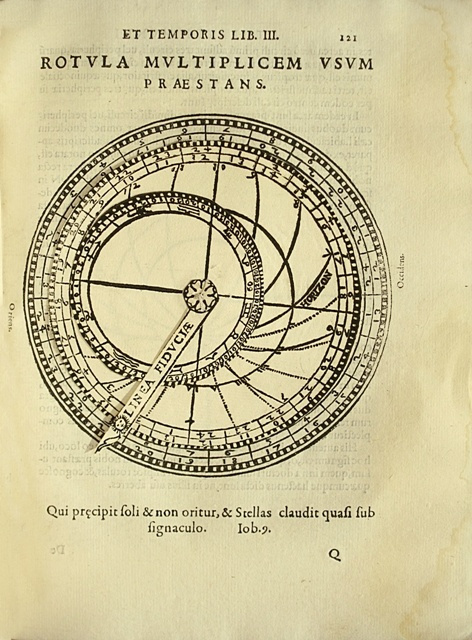
LCS-17325Magnifique exemplaire conservé dans son vélin souple de l’époque. Venise, 1588. Venise, Giovanni Battita Somasco, 1588. In-4 de (8) ff., 478 pp., (1) f. d’errata, plus de 140 figures gravées dans le texte dont 50 possèdent un total de 70 volvelles. La p. 229 est en double. Quelques mouillures. Relié en plein vélin souple de l’époque, restes d’attaches, dos lisse avec le titre manuscrit, titre manuscrit sur la tranche inférieure, gardes postérieures. Reliure de l’époque. 243 x 184 mm.
4to (160 x 202 mm). Arabic manuscript on watermarked paper, 27 pp. plus 57 pp. of tables, 22 lines per extensum, written in black Maghribi script, emphases and section titles in red; extensive tables at the end. - (Bound with) II: Nour al-Din 'Ali bin Abd al-Qadir al-Fardi al-Hasani. Kitab al-Fawa'id al-jalilah fi fi hall majhulat al-wasila. Near East, 18th century CE. Arabic manuscript on watermarked paper, 98 pp., 19 lines per extensum, black naskh with emphases in red. - (Bound with) III: Brain manuscript. Near East, 18th century CE. Arabic manuscript on watermarked paper, 25 pp., 19 lines per extensum, written in black naskh with emphases in red. - All bound together in oriental brown leather with fore-edge flap, a central oval medallion and stamped borders. A collection of three different Arabic treatises bound in one volume, dealing with astronomy, keeping time and mathematics, as well as psychology, written in Northern Africa and Near East. - Bound first is the "Kitab Minhaj al-talib li-ta'dil al-kawakib" by the Marrakesh-born mathematician, astronomer, and Sufi scholar Ibn al-Banna' (also known as Abu'l-Abbas Ahmad ibn Muhammad ibn Uthman al-Azdi, 1251-1321). A long treatise about astronomy, the movements of the planets, and calculating the times of prayer according to location, it was published by Juan Vernet Ginés in 1952. - The "Kitab al-Fawa'id" by the mathematician Nouraddin ‘Ali al-Faradi (d. 870 H / 1465/66 CE) is a commentary on the "Kitab al-wasila fi 'ilm al-hisab" by the Egyptian mathematician Ibn al-Ha'im al-Misri (d. 1412). A copy is stored in the Al-Azhar Library, Cairo (shelfmark 4374). - At the end is a shorter text containing two sections (fasl 4 and fasl 5) excerpted from a treatise on the power of the human brain and how to exercise it. - The treatise of Ibn al-Banna' shows some edge damage from worming and old repairs, otherwise internally quite sound. Binding professionally restored; modern spine and flap hinge. Provenance: from the private collection of the English art dealer Oliver Hoare (1945-2018), who launched the Islamic Art Department at Christie's. I: GAL II, 331, 5. - II: Cf. GAL S II, 1024, 77.
4to. 48 ff., printed in red and black throughout. Contemporary yellow boards with restored calf spine. First edition. "Editio princeps of this popular short syntax of the Arabic language, written in the 13th century. Two centuries later an Oriental printed edition was published in Istanbul (1786), but in the meantime this edition, printed in Arabic (30 point) throughout, could well have passed for a manuscript [...] To some copies a Latin title page was added bearing the legend: 'Grammatica Arabica dicta Caphia auctore filio Alhagiabi'" (Smitskamp). - Composed by the Arabian grammarian Uthman Ibn Umar, known as Ibn al-Hajib (1175-1249), and printed at the Medicean Press, founded in 1584 by Cardinal Ferdinando I de’ Medici and directed by Giambattista Raimondi (1536-1614), an able scholar of Arabic. - Some edge faults (professionally repaired), old repairs to title page, with slight loss to letterpress. A wide-margined copy, generously printed in 13 lines per page. An exceptionally appealing typographical achievement. Edit 16, CNCE 44392. Adams U 102 (both s. v. Uthman). BM-STC Italian 706. GAL I, p. 303. Smitskamp 30. Schnurrer 42.
8vo (127 x 214 mm). Arabic manuscript on polished paper. 80 ff. Part 2 (of 2). Black and occasional red ink, with catchwords and a few marginal notes in a contemporary hand. 19th century limp red morocco. Rare and important 17th century manuscript of the most famous work of Ibn al-Nafis (1210-88), written at only twenty-nine years of age. Unlike the author's two other commentaries on Ibn Sina's Canon of Medicine, the "Sharh Qurashi" is extremely uncommon. The present part includes his most important contributions to medicine and anatomy: in describing the pulmonary blood circulation, he anticipated by many centuries the works of the 17th century scientists Marcello Malpighi and William Harvey. - Ibn al-Nafis "was the first person to challenge the long-held contention of the Galen School that blood could pass through the cardiac interventricular septum, and in keeping with this he believed that all the blood that reached the left ventricle passed through the lung. He also stated that there must be small communications or pores ('manafidh' in Arabic) between the pulmonary artery and vein" (West, 1877). In his commentary, "pulmonary circulation was described, for the first time, in much detail [...] this circulation was not described by Galen, and only Al-Akhawayni had provided some accurate details about it. He contradicted Galen's reports on the presence of a pathway of 'invisible pores' or a visible hole between the right and left cavities, and stated that blood moves to the lung through vena arteriosa (pulmonary arteries). There, it mixes with air and is filtered, then it moves back to the left cavity via the arteria venosa (pulmonary vein)" (Alghamdi, 1001). Many of al-Nafis's statements remain accurate to medical science today, making this work one of the most groundbreaking of its era. - Morocco binding somewhat rubbed and lightly soiled, with a few small closed tears to extremities. A tiny paper flaw in margin of f. 19 and old paper repair to edge of f. 53. Exterior leaves slightly browned and brittle, with some wear and soiling to edges. A well-preserved and highly unusual survival of a major text in the history of medicine during the Islamic Golden Age. GAL I 493, 37, 7. M. Alghamdi et al., "An Untold Story: The Important Contributions of Muslim Scholars for the Understanding of Human Anatomy", The Anatomical Record 300 (2017), pp. 986-1008. J. B. West, "Ibn al-Nafis, the Pulmonary Circulation, and the Islamic Golden Age", in: Journal of Applied Physiology 105 (2008), pp. 1877-1880.
Folio (209 x 318 mm). 459, (2), 14 (but: 13) ff. of index, numerous errors in Arabic pagination, but complete according to catchwords, numbered throughout by a later owner in pencil from left to right, 1-474 ff. Ottoman Turkish manuscript on thin, polished, cream-coloured laid paper. Text is in fine naskh script with black and red ink within a red double-lined border, 31 lines of text within a written area of 232 x 112 mm. Occasional red underlining, sections usually demarcated by a single word of red text on a line with a red border on either side. With 11 full-page colour illustrations of scientific diagrams, 2 full-page coloured world maps, 8 full-page coloured tables, 2 full-page illustrations of Mekka and Jerusalem, 4 coloured half-page diagrams and 1 coloured half-page table, as well as a round, black and red ink diagram on leaf 448v. Contemporary full calf, expertly rebacked with six compartments of raised bands and gilt motifs, gilt red title label, all edges speckled red. A fine 18th century manuscript copy of the famous scholarly encyclopedia, not printed until 1835 (in Bulaq). The "Marifetname", or "Book of Gnosis" is a compilation of astronomical, astrological, mathematical, anatomical, psychological, philosophical as well as mystical religious texts. It is famous for containing the first treatment of post-Copernican astronomy by a Muslim scholar. - Ibrahim Haqqi Erzurumi (1703-80) is considered an outstanding figure of 18th century Ottoman Turkey. Based on an immense knowledge of the Sufi branch of Islam as well as his studies in Western science, he devoted himself to the domains of both religion and science, considering both a means of approaching God. - Occasional smudging of ink; minor offsetting on pages facing illustrations, leaves 7-11 with minor waterstains in the upper corner margins, leaves 12-18 expertly reinforced in the upper margin, with rather severe loss to text in upper half of leaves 14v and 15. Text appears to be lost on 378r (faint traces of text still remain). Leaves 343v-350v have dark pink stain in centre of text toward gutter (no loss), likewise on 443v-463v. Leaves 448-454 have had their margins reinforced. Leaves numbered 449 and 450 must be switched, as well as 453 and 454. Altogether a very appealing copy with the numerous illustrations showing fine detail. Cf. Zenker I, 1709. F. Gülen, "Key Concepts in the Practice of Sufism," p. 106, n. 69. Z. Virk, "Science and Technology in Ottoman Sultanate".
8vo (124 x 192 mm). Arabic manuscript on paper in black (and occasional red) Naskh script. 322 pp., frequently interleaved with extensive comments on later paper, prefixed with 6 ff. (some blank). 13 lines, text enclosed within black and gilt rules, gilt headpiece to first page. Numerous coloured diagrams throughout. Contemporary black calf with fore-edge flap, gilt cover borders and central stamped ornaments. Marbled pastedowns. Illustrated commentary by Qadizade al-Rumi on Al-Jaghmini's famous astronomical treatise "Mulakhas" ("Summary on the Science of the Authority"), completed in 808 AH. Al-Rumi (1364-1436), known under the name of Salah al-Din Musa Pasha, was one of the principal astronomers at the famous Samarkand observatory. - Binding rubbed and chipped along extremeties. A paper flaw to the colophon, repaired with some loss. Some leaves loosed, a few edge defects (more prominent to first leaf) and occasional duststains and fingerstains, but on the whole very well preserved. A valuable copy owned and annotated by Mustafa bin Khalil. Cf. GAL I, 473.
1 p. on bifolium. 4to. To an unidentified "génèral", with a thousand thanks for "impenetrable" boots that serve Kapodistrias on his daily walks, writing that the granite of St. Petersburg is absent from Moscow and mentioning the fine days he spent Carlsbad. The Emperor, he says, favoured him with this holiday and promised Kapodistrias another leave for next year, which he hopes to spend in Carlsbad again. Kapodistrias wishes the "génèral" to join him there and mentions the thermal springs ("Sproudel"): "Mille et Mille graces, Mon Génèral. Les bottes impenetrables me servent tous les jours à la promenade. Nous n'avons pas ici le granit de S. Petersbourg. Ainsi vos bienfaits me sont doublement agréables et salutaires. On me fait payer avec les beaux jours de Carlesbad. [...] c'est que l'Empereur m'a promis une [...] vacance pour l'année prochaine, donc je ne manquerai pas d'en jouir egalement à Carlesbad. Tachez de ne pas vous mettre hors de partie - Et venez encore faire l'amateur au milieu des Aevenues du Sproudel - ces voeux sont très sincères [...]". - In early 1817, Kapodistrias's relationship to the Tsar was put to the test as a Greek adventurer, Nikolaos Galatis, came to St. Petersburg in the name of a leader of the "Filiki Eteria", the revolutionary secret organisation founded in Odessa in 1814, appealing to Kapodistrias to assume leadership of the movement for Greek independence. Although he was a fellow Greek, Kapodistrias declined, as he felt loyal to Czar Alexander, who was still committed to upholding the established order in Europe and had no interest in supporting a revolt against the Ottoman Empire. As the movement progressed, Kapodistrias eventually took leave from his position as Foreign Minister, returned to Greece and took an active role in the Revolution. He went on to serve as the first head of state of independent Greece (1827-31). Kapodistrias is considered the architect of Greek independence and a founder of the modern Greek state. - Very well preserved.
Folio (235 x 335 mm). Engraved title, 3 pp. of dedication, 1 leaf (Privilege du Roy), 12 leaves of text interleaved with 12 engraved plates, woodcut headpieces and initials. The plates, probably by Noel (not Nicolas) Cochin after La Chapelle, show costumes against a scenic background. Contemporary full vellum. First edition, very rare. Georges de la Chappelle, a native of Caen, accompanied the French envoy Le Haye to the Porte and spent several years in the Levant. His work is known to us almost exclusively through these engravings, showing what Thieme/Becker described as "the prettiest ladies in the Imperial Seraglio". In the introductory text included in this first edition, La Chappelle explains that the series was occasioned by a recent French edition of Chalcocondyles, in which (as he complains) the women's costumes were very poorly drawn. La Chappelle clearly had a special interest in female costume: "his own representations are highly detailed, with special attention paid to the fabulous jewels and fine needlework that adorn the garments of Levantine costume. (According to the preface, the accuracy of his drawings could be attested by Le Haye [...], in whose presence the drawings were executed.) To add verisimilitude to the plates, examples of Turkish, Persian, Tartar, Armenian and Greek costume are depicted against topographical backgrounds showing the areas in and around Constantinople in which the models were most likely to reside" (Atabey). Curiously, several of these backgrounds, when placed side by side, form a near-consecutive panorama of Constantinople and its environs. - Occasional light brownstains; wants front flyleaf. Vellum slightly stained and wrinkled; lower cover shows traces of old calculations. An attractive copy in a strictly contemporary binding. Atabey 648. Colas 1697. Thieme/Becker VI, 378f. Cf. Blackmer 935 (2nd edition). Not in Lipperheide or Cohen/de Ricci.
Folio (30 cm). Double-page ink wash drawing of the idealized (Arabian-bred) Spanish horse, [8], 198, [4 blank], [2], 25 pp; with separate 13 pp. of addenda. Bound in contemporary half black calf over marbled boards, gilt titles and ornaments on spine. Binding a little rubbed, contents very good. Manuscript on Spanish watermarked paper "Manuel Serra 1829", written in neat cursive throughout with occasional flourishes. Signed twice by the author, "Francisco De Laiglesia Y Darrac", dated "Madrid 24 Mayo de 1830". Bookplate on pastedown of the noted Spanish collector José Gallart Folch. Highly important manuscript, being the author's autograph copy - possibly for presentation to the dedicatee (the King of Spain). Darrac's groundbreaking treatise on the admixture of Arabian bloodlines to the Spanish horse was subsequently accepted by the King and printed 'by Royal decree' in the following year, 1831. "To assure that Spain would have ready supply of quality horses and mules, the recommendations first purposed by Francisco Laiglesia Y Darrac in his brilliant 1831 book Memoria sobre la cria caballar en Espana - causas del aniquilamiento de nuestros caballos (Thesis on Horse Breading in Spain- Causes of the Annihilation of Our Horses) were finally adopted. Laiglesia might well be called the father of the Arabian horse of Spain, because he was the first to advocate the importation of a large group of desert-bred stallions and mares as the only means of recuperating the lost qualities in Spain's horses. In the same work he also articulated the first detailed plan for the creation of the Cria Caballar, the Stud Book Español, the National Stud" (Steen). - A horse expert with the Royal Army, Laiglesia's treatise is wonderfully detailed and shows a thorough knowledge of Arabians and their bloodlines. His main thesis argues that with the introduction of as few as 20 of the best pure-bred Arabians, the entire country's stock of horses can be 'regenerated' in a few generations. To this end he launches into an in-depth discussion of the logistics of this plan, ranging from discussions of the desert Bedouin origin of the purest Arabians, from the regions surrounding Sanaa and Nedjed-el-Areb in the Arabian Gulf (Section 65) to an intimate familiarity with the different classes of Arabians from these bloodlines (Hatiks or Kadischi & Kochlani). Laiglesia notes with admiration that the practice of recording the bloodlines of these Arabians is extremely meticulous at the court of the Emir. - Laiglesia also addresses the problems of how to select the best pure-bred Arabians based on proportion, etc., as well as the difficulties in procuring them. He insists that they must be purchased 'on-site' in Arabia Felix and then brought to a station in Aleppo for inspection, en route to Spain. Laiglesia even suggests the most comfortable means of transporting the precious horses (by warship, rather than a smaller merchant vessel which doesn't have enough space). Interestingly, one measure for Laiglesia of the superiority of Arabians is their excellence in horse-races: he points out that all the greatest English champions (Flying Childers, High Flyer, Eclipse, etc.) have all been bred from Arabian stock. - The present author's manuscript and its illustration in fact show significant differences compared to the printed book, which is itself extremely rare (just 3 copies worldwide, according to OCLC). For the printed book, cf OCLC 63603570 (U Barcelona, British Library, U Penn); Palau 130186; Fairman Rogers Collection on the Horse, 453. Cf also Andrew K. Steen, El Caballo Arabe en España, 1831 a 1934 (2007).
Small folio. 3 vols. (2 vols. of text and 1 plate vol.). 288 pp. 256 pp. 64 plates. Contemporary half calf on raised bands, red morocco spine labels, black volume numbers. Marbled endpapers. First edition, one of 125 copies. - The learned Italian abbot and orientalist Michele Angelo Lanci (1779-1867) taught Arabic at the Sapienza in Rome. For his "Trattato", Lanci studied Islamic artefacts such as the famous "Vaso Vescovali" (now in the British Museum), of which he provided the first scholarly account. Includes engravings of inscriptions on talismans, amulets, arms and armour, metalwares and textiles. - Some foxing. From the library of the Ducs de Luynes at the Château de Dampierre: their bookplate reproducing the arms of Charles Marie d'Albert de Luynes (1783-1839), 7th Duc de Luynes, on pastedown. - Of the utmost rarity, no copies recorded at auctions since decades. No copy in the US. ICCU UBO\3282249. OCLC 41653985. Cf. Gay 2094. Brunet III, 809. Graesse IV, 93 (1846 ed.).
Oil on wood. Signed and dated. Framed (455 x 258 mm). Museum-quality panoramic painting of Istanbul with steamships and sailboats on the Golden Horn and the Hagia Sophia in the background. The foreground is dominated by the Grand Vezier Hüseyin Avni Pasha in a coach, escorted by horsemen, surrounded by a crowd. - The Regensburg-born Heinrich Lang, noted painter of horses and battles as well as writer and illustrator, studied with Karl Steffek in Berlin, Friedrich Voltz and Franz Adam in Munich and Adolf Schreyer in Paris. He travelled to Greece and Turkey and proved himself a careful observer of Ottoman costume and culture. His colourful paintings of Turkish tradesmen, camel drivers, donkey-drawn wagons and splendidly decorated carriages show his great attention to detail and were greeted by contemporaries as a much-welcomed relief from the grey military scenes that had dominated the previous years (cf. ADB Ll, 551).
Royal folio (380 x 506 mm). Persian manuscript on paper. 140 pp., 9 lines in 2 columns to the page, first leaf and final 3 pp. blank save for the borders. Large Nasta'liq calligraphy in black ink, chapter headings in red. Text enclosed within blue, black, gilt and red borders. Title in red to fol. 2r, large 'unwan headpiece on fol. 2v, column separator decorated with gilt floral designs on fols. 2v-3r, 2 meticulous gilt and coloured colophon decoration on fol. 69r. With a total of 18 coloured illustrations of the Holy Sites (7 full-page, the remainder half-page or larger). Splendidly ornamented embroidered cloth binding with pink morocco edges and pastedowns and fore-edge flap. Monumental manuscript copy of the first Islamic guidebook for the pilgrimage to Mecca and Medina, which Muhi al-Din Lari (d. 1526/27) completed in India in 1505/06. The book provides instructions on the Hajj pilgrimage rituals and descriptions of important sites that Muslim pilgrims can visit, including of the Kaaba in Mecca. Whilst no early illustrated Indian copies are known, the work began to be widely copied with often lavish illustrations from the later 16th century onwards, mostly in in Ottoman Turkey. - The 18 large-scale illuminations in the present manuscript show the holy sites, locations between Medina and Mecca, and the various stages of the Hajj. The illustration of the Masjid al-Haram in Mecca shows the Kaaba, the areas assigned for worship by the various branches of Islam, as well as the doors to the sanctum, minarets, and two rows of colonnades. - In excellent state of preservation throughout.
4to. (3), 78 pp. With an engraved plate bound as a frontispiece. Contemporary marbled boards. Second edition of Leibniz's groundbreaking work on combinatorics. It was first published in 1666 as "Dissertatio de arte combinatoria", expanded from the author's thesis "Disputatio arithmetica de complexionibus", with which he earned the venia legendi. This unauthorized re-release, produced 24 years later, caused Leibniz to respond with corrections in the Acta Eruditorum of 1691. Both editions are extremely rare; NUC lists no more than two copies of the present one. - This is Leibniz's earliest work in combinatorics, the branch of mathematics concerned with the study of finite or countable discrete structures. It thus constitutes an early and important contribution to the scientific foundations of modern computer engineering. "In this treatise, Leibniz undertook that part of his grand plan that aimed at achieving a complete set of possible connections of terms, and the mathematical conception of this problem he named 'ars combinatoria' - a name that would stick" (cf. Cantor). This early work of Leibniz is all the more remarkable for the "very modest specialized knowledge that he then possessed [and which] is reflected in the 'Dissertatio de arte combinatoria'" (DSB). - Somewhat browned throughout as common due to paper. Trimmed rather closely, with some professional remarginings at the top edge near the end of the book and repairs to the gutter of the title page (loss of a few letters at the very left, some unobtrusively supplied). A single copy in auction records (1998: Reiss 65, lot 583: 65,000 DM). Apart from the frontispiece, VD 17 cites 33 numbered plates - in apparent error, for no known copy contains more than this single plate. VD 17, 12:194409W. Poggendorff I, 1413. DSB VIII, 153 & 160. Cantor III, 43-45. NDB XIV, 122. Cf. Ravier 6.
8vo. 134 pp., final blank leaf. Original printed wrappers with printed title enclosed in decorative border. First separate printing: exceptionally rare offprint of this important essay on the foundations of calculus and real analysis by the first inventor of non-Euclidean geometry. "As early as 1835, Lobachevsky showed in [this] memoir the necessity of distinguishing between continuity and differentiability" (Cajori). - Lobachevsky's works in other areas of mathematics were either directly relevant to his geometry (as his calculations on definite integrals and probable errors of observation) or results of his studies of foundations of mathematics (as his works on the theory of finites and the theory of trigonometric series). "The mathematicians of the 18th century did not touch the question of the relation between continuity and differentiability, presuming silently that every continuous function is eo ipso a function having a derivative. Ampère tried to prove this position, but his proof lacked cogency. The question about the relation between continuity and differentiability awoke general attention between 1870 and 1880, when Weierstrass gave an example of a function continuous within a certain interval and at the same time having no definite derivative within this interval (non-differentiable). Meanwhile, Lobachevski already in the thirties showed the necessity of distinguishing the 'changing gradually' (in our terminology: continuity) of a function and its 'unbrokenness' (now: differentiability). With especial precision did he formulate this difference in his Russian Memoir of 1835: 'A method for ascertaining the convergence, etc.'. A function changes gradually when its increment diminishes to zero together with the increment of the independent variable. A function is unbroken if the ratio of these two increments, as they diminish, goes over insensibly into a new function, which consequently will be a differential-coefficient. Integrals must always be so divided into intervals that the elements under each integral sign always change gradually and remain unbroken" (Halsted, p. 242). This work includes an extensive discussion of infinite series, including a new convergence criterion, now known as "Lobachevsky's test". Much space is also devoted in this memoir to definite integrals, prompted by the computation of areas and volumes in Lobachevskian geometry. One year later, Lobachevsky devoted a whole memoir to this subject. - Wrappers wrinkled; some damage to border on lower cover; spine and corners professionally restored with like paper. Chipped corners of title-page remargined; interior shows creasing with occasional light waterstains to margins. Exceptionally rare, as are all of Lobachevsky 's Kazan publications, even in Russian collections: OCLC lists the Harvard copy only. Cajori, History of Mathematics, S. 421. Halsted, "Biology and Mathematics", 12th Annual Report of the Ohio State Academy of Science (1903), S. 239-247. OCLC 84296869.
8vo. 2 pp. on bifolium. With sealed autograph envelope "à mon fils le conte de Toulouse". Framed and glazed (double-sided, 370 x 339 mm). Beautiful letter to his son Louis-Alexandre de Bourbon, Count of Toulouse, during the Nine Years' War: "Jay receu vostre lettre du 19 avec les Cartes qui y estoient jointes continués a men envoier ou tous les camps que larmée ou vous estes soient marqués et travaillés autant que vous pouvés a vous instruire pour estre un jour capable de servir lestat. Mandés moy tout ce qui se passera qui en vaudra la peine. Il ne me reste qua vous assurer de mon amitié qui durera tant que vous la meriterés par la vostre et par vos actions" ("I received your letter of the 19th with the maps that were attached to it. Continue to send [maps] to me, where all the camps of the army of which you are part are marked, and work as much as you can in order to instruct yourself, so that one day you will be able to serve the state. Inform me of every change that is worth noting. I can only assure you of my friendship, which will last as long as you deserve it by yourself and by your actions"). - Louis-Alexandre de Bourbon (1678-1737) was the last legitimate son of Louis XIV. At the age of five he was named Admiral of France, and following his participation in the Nine Years' War on the Spanish Netherlands front, he rose to the honorary rank of lieutenant general of the King’s armies. In his actual military career, Louis-Alexandre de Bourbon successfully commanded the French fleet in the Battle of Málaga (1704). During the regency he served as minister of the Navy. - Minor browning and minimal tears to the folds.
Large 8vo. 1 p. on bifolium. To one "cher Camarade", probably written after the International Socialist Congress, sending the translation "du compte-rendu de la socialdémocratie polonaise, que vous avez si malheureusement omis dans le volume, édité par vous. Les camarades polonais sont très mécontents de cette omission [...]". - Left margin with punched holes (not touching text); on stationery with printed letterhead of "Hotel Polen" at Amsterdam.
3 vols. and 1 vol of plates. (2), II ff., 388 pp. (6), 222, (6) pp. (4), VI, 326 pp. With 14 lithogr. plates (4 in colour). Printed original wrappers. Folio (390 x 295 mm). Atlas: (4) pp., 85 plates (some double-page-sized), including 65 photogravures by Charles Nègre after Louis Vignes. Original half cloth portfolio. Ties. Rare travel report describing the scientific expedition to Palestine undertaken by the French archaeologist de Luynes (1802-67) in 1864. First edition, very rarely encountered complete: only two copies sold at international auctions during the past decades (both incomplete; the last set wanting plate 44: Sotheby's, 15 Oct. 2003, lot 676, GBP 8500; only 40 plates from the set, including glass and collodium negatives, fetched 21,450 EUR at Sotheby's Paris, 22 March 2003, lot 583). - The work is sought for its splendid illustrations based on photos by Henri Sauvaire and the Naval Lieutenant Louis Vignes. Vol. 1 contains the Duke's travel diary; vol. 2 contains the reports "De Petra à Palmyre" by L. Vignes and "Voyage de Jérusalem, à Karak et à Chaubak" by Mauss and Sauvaire; vol. 3 contains the "Géologie" by L. Lartet (with its own set of plates at the end). The atlas is divided into two parts with a total of 85 plates (thus complete): 67 plates pertain to the Duke's report (3 unnumbered and 64 numbered: 1 map and 1 itinerary in colours, 1 engr. double plate, and 64 photogravures by Charles Nègre after photos by Vignes (views of sites, towns, ruins, etc.); Mauss's report is illustrated by 18 numbered plates: 1 double-page-sized itinerary, 3 plans (2 in colour), and 14 lithogr. plates by Cicéri after photos by Vignes and Sauvaire (views of Karak, Zat-Raz, etc.). - Occasional slight foxing (esp. in vol. 3); plates clean and spotless throughout. A fine, complete set in the original printed wrappers as issued; text vols. are uncut and wide-margined. Röhricht (Bibl. Pal.) 515f., no. 2824. Röhricht (Pilgerreisen) 637, no. 872. Henze III, 312. Parr/Badger, The Photobook I, 33.
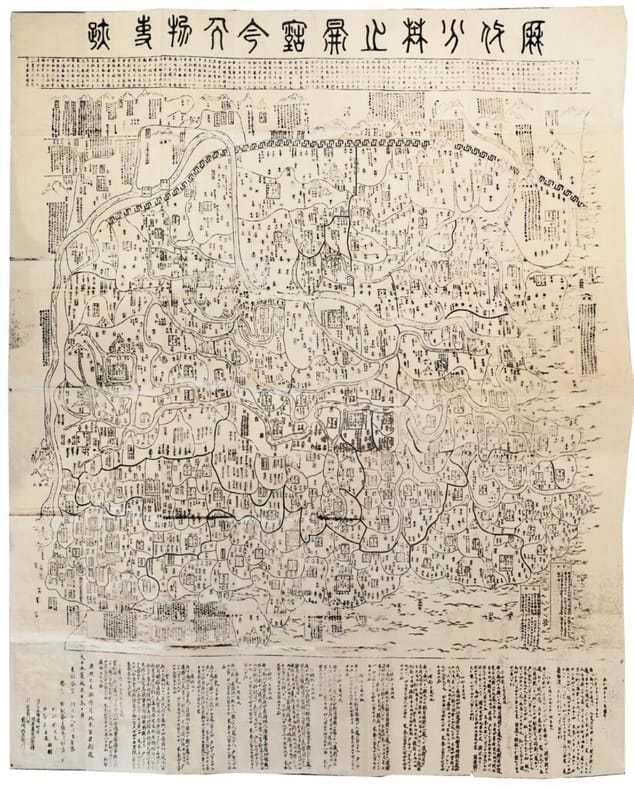
LCS-18417Cette carte murale de la Chine est extrêmement rare. Elle fut exécutée par un maître zen de Shaolin. Datée : 寛延庚午, Kanen, année du cheval = Kanen 3, 1750. Édité par l'érudit de la dynastie Qing Lu Yunhan, 呂君翰, publié par Suwaraya Mohei, 須原屋茂兵, à Edo. Couverture originale en papier bleu, conservée dans un étui à décor floral [21 x 30,5 cm]. 181,5 x 168,5 cm