692 496 résultats
Folio. 3 unnum. leaves, 40 original photographs on albumenized paper (approx. 245 x 180 mm) on stiff cardboard mounted on hinges, and 42 unnum. leaves of explanations. Publisher's half brown hard-grained morocco, blind stamped calico boards, with gilt title and figures, raised bands. Edges gilt. Beautiful photographic album made in Cairo, the first illustrated catalogue of the first Egyptian Museum. While copies dated 1871 exist, both copies preserved in the French National Library bear the date 1872. The photographs by Hippolyte Délié and Émile Béchard show the halls and antiques of the Bulaq Museum, founded in Cairo in 1863 by the great Egyptologist Auguste Mariette (1821-81). The Museum was created by Auguste Mariette, who in 1858, following his appointment as head of the Antiquities Service, moved the banks of the Nile, in Bulaq, where he assigned four rooms in his residence for exhibitions. Mariette obtained permission to settle in Bulaq in the abandoned offices of the River Company. On these dilapidated premises, where he lived with his family, the "Director of the Historical Monuments of Egypt and the Cairo Museum" converted the first four exhibition halls with the assistance of his faithful assistants Bonnefoy and Floris. The period photographs, published in this 'Album du musée de Boulaq', show the low buildings by the river, almost completely devastated during the flood of 1878. In the preface dated November 1, 1871, Mariette explains the origins of this monumental album: "Mr. Hippolyte Délié and Mr. Béchard requested permission from the Directorate of the Bulaq Museum to reproduce by photography some of the monuments on display in our galleries. Not only the application [...] was explicitly welcomed, but the Director of the Museum feels he must promote the work of the great photographers from Cairo, opening up for them the cabinets of the Museum and choosing among the objects it contains those that appeared to him most worthy of inclusion in the proposed Album. Mr. Délié and Mr. Béchard have followed, for the classification and arrangement of their proofs, the order adopted in the Notice sommaire, which is for sale at the entrance of the Museum. The three plates showing the interior and exterior of the Museum serve as an introduction to the Album. The monuments are then classified into religious, funerary, civilians, historical, Greek and Roman sections. The photographic Album [...] is thus an illustrated catalogue of the Museum. The remarkable execution of the plates allows us also to recommend to everyone this album by Mr. Délié and Mr. Béchard. Travelers will indeed use it as a souvenir of their visit to the Bulaq Museum. Scholars will find the hieroglyphic texts reproduced with such clarity as if they were in direct presence of the monuments. Finally artists will not study from any other work on Egyptology as well as from the beautiful proofs delivered from the apparatus used by Mr. Délié and Mr. Béchard, the difficult problems that relate to the history of art in Egypt". The French photographer Émile Béchard was active during the years 1869-90: "Béchard arrived in Egypt probably together with his partner Délié. He collaborated with him in the production of the Album du Musée Boulaq and in the carte de visite photographs of native types and costumes. There is little information on the life of Béchard. It is known that he was awarded a first class gold medal at the Exposition Universelle of 1878 in Paris, and his images appear in many of the travel and topographic albums until almost the end of the century. His major achievement was no doubt his monumental album of photographs of the most important archaeological sites and antiquities of Egypt […]. It is worthy to note that Béchard did have a great deal of talent in picturing architecture. The neatness of the execution and printing of the final image adds tremendously to the monumentality he was able to reflect in them" (cf. Perez, p. 123). "Délié arrived in Egypt the year the Suez Canal was opened and settled in Cairo. Until the mid-1870s he was in partnership with Émile Béchard. The two collaborated on a major photography album on the Boulaq Museum that was very highly praised as one of the most luxurious and finely printed books of the period. […] Délié's photographs were known already in 1869, and some of them were used that early for woodcuts illustrating articles in Le Tour du Monde. In 1876, he became a member of the Société Française de Photographie, and in 1878 he was awarded a bronze medal at the Exposition Universelle in Paris. For some reason, Délié's images, although equal in quality, are much rarer than those by Béchard, even though both continued to work after they dissolved their partnership. His photographs are exclusively of Egypt, mainly ruins, antiquities, and cityscapes, with a few genre studies" (p. 153f.). Perez also devotes a long notice to the archaeological activity of Mariette, a familiar to photography: "Best known as Mariette Bey, this famous Egyptologist became an archaeologist almost by chance. He was a young schoolteacher in the provincial town of Boulogne-sur-Mer, writing bad novels and chairing the local fishing-club, when he happened across the papers of a relative, Nestor L'Hote. L'Hote's writings of Egypt aroused Mariette's interest, and he turned to the study of Coptic writings and hieroglyphs. He published a number of papers that attracted the attention of Charles Lenormant, who sent him to Egypt in 1850 to hunt down Coptic manuscripts, which were at the time actively collected by British scholars. He remained in Egypt four years, during which time he realized the importance of finding and saving the archaeological treasures still buried in Egypt. Mariette shared his conviction with Ferdinand de Lesseps, whom he met in 1857. The latter appealed to the Viceroy of Egypt, and Mariette was appointed head of the department of Antiquities, a post he created and held until his death in Cairo in 1881. During his years there he displayed an unusual instinct in finding excavation sites; his contribution to Egyptology is invaluable. He was also founder of the Boulaq museum. Photography became an inseparable part of his activity. He mainly employed professional photographers such as Délié, Béchard, and Brugsch, but he himself also photographed, using an 8x10'' camera, newly found artefacts and ancient structures in remote parts of the Egyptian desert. It is interesting to note that, although technically not perfect, Mariette's photographs have a certain precision of angle and composition that makes the image 'right' and authentic. This is no doubt the result of his love and understanding of the objects he was photographing" (p. 194). - Spine scuffed, some foxing. Cf. Nissan N. Perez, Focus East, 1988. On Mariette cf. also J.-M. Carré, "Voyageurs et écrivains français en Égypte", p. 223-249.
8 parts in one vol. Titles within wide woodcut borders and numerous woodcut illustrations throughout. Contemporary speckled calf, rebacked preserving original label on spine, 8vo. Second edition of this important manual of riding, breeding, hunting, farriery and veterinary matters (following the first of 1607), by one of the earliest western owners of and dealers in Arabian horses. Markham praises the virtues of Turkish and Barb horses, which are said to be "beyond all horses whatsoever for delicacie of shape and proportion, insomuch that the most curious painter cannot with all his Art amend their naturall lineaments. They are to be knowne before all horses by the finenesse of their proportions, especially their heades and necks, which Nature hath so well shap'd, and plac'd, that they commonly save Art his greatest labour: they are swift beyond other forraigne horses, and to that use in England we only imploy them [...]". With notes on saddles and bits (several illustrated), as well as numerous cures for horse ailments. - "Divided into eight books with separate titles. The 2nd and 3rd books bear the date of 1616" (Huth). The title page itself bears no imprint, but rather has the word "Cavalarice" sandwiched between the dates "16" and "17". - Occasional slight browning or marginal waterstaining; several small wormholes to margins near end. Title with dated 1745 inscription, 17th century ink annotation to title verso (traced by a later hand), 20th century ink annotation and tipped-in auction catalogue description to front free endpaper. From the library of Francis McIlhenny Stifler with his bookplate to front pastedown. Scarce; only three copies of this edition sold at auction in the last 30 years. BM-STC 17335. Poynter 19.2. OCLC 18813278. Cf. Huth 15. Podeschi/Mellon 18. Graesse IV, 403. Mennessier de la Lance II, 156. Not in Wellcome.
Folio (422 x 528 cm). Lithographed title-page and 60 lithographed plates, all in original hand colour, captions often raised in gilt. With 10 leaves of letterpress text. Half calf with giltstamped spine. (Includes): Die Uebergangsländer von Asien und Afrika, begreifend: Arabien nebst Mesopotamien und Syrien und das Nilgebiet. Munich, C. Wenng, 1845. Engraved map with contemporary border colour. 640 x 544 mm. Scale 1:7,000,000. Only edition of the rare variant with all the plates and in their splendid original colour: "Published in ten parts. The plates show costume of the period and also that of earlier times, taken from paintings" (Hiler). The picturesque views, which include Cairo, Alexandria, Jerusalem, La Valletta, Luxor, and Thebes, genre scenes and landscapes, are all framed within a decorative border and arranged as a small painting. The Nuremberg artist Mayr, known especially for his depictions of battle scenes and horses, was personal painter to Duke Maximilian, whom he accompanied on his 1838 journey of the Orient. The group had departed from Munich on January 20 with a small entourage, travelling via Venice, Korfu, Patras, Athens, Alexandria, and Cairo to the Holy Land. They returned to Munich after eight months on 17 September 1838; the following year, Maximilian was made honorary member of the Bavarian Academy of Sciences. - Some foxing, otherwise splendidly preserved. Includes the extremely rare map of the Arabian Peninsula and the Middle East which was published only in 1845, at the instigation of the naturalist Gotthilf Heinrich von Schubert (1780-1860) and the geologist Joseph von Russegger (1802-63), to satisfy this frequently noted lack in Mayr's production (some foxing, but also finely preserved). Ibrahim-Hilmy II, 26. Gay 90 (only 36 plates). Lipperheide Ma 22 (= 1589). Hiler 578. Tobler 161. Graesse IV, 457. Engelmann 124. Kainbacher 265 ("a rarity"). Thieme/Becker XXIV, 477. Nagler VIII, 498f. ("highly memorable drawings"). ADB XXI, 139ff. Not in Blackmer or Abbey (Travel). Not in Colas.
4to. 2 vols. (12), 264 pp. (4), 265-643 pp., final blank. With frontispiece portrait and 8 photographic plates. Contemporary stamped cloth with cover and spine titles. Second printing of the equally scarce 1919 first edition of this notable work of travel literature by the British Army officer S. B. Miles, who served as a diplomat in various Arabic-speaking countries, notably Oman, which he came to know better than any other European of the time. His intent to revise the notes he had "jotted down on odd bits of paper as he rode through the desert on his camel" (Preface) was rendered impossible due to his failing eyesight. Five years after his death his widow decided to publish the manuscript as she found it, enriching it with Miles's travelogue of Mesopotamia as well as an index. The work includes the political and economic history of Oman and the Gulf as well as the history and geography of Dhofar, Arab tribes, and pearl fishing. The plates show the forts at Bahila, Yabreen, and Rostak, as well as the house of Seyyid Hamed Bin Azzar at Rostak, a group of locals, and date palms, while the frontispiece depicts Miles resting in a chair wearing his sunglasses. - Binding slightly rubbed and soiled, cockling to upper cover of vol. 2, rebacked. A good copy of this popular work that saw re-issues in 1966 and 1994. Cf. Ghani 250 (1966 reprint only).
1595YTB-7Paris, Abel L'Angelier, 1595. LA PRECIEUSE EDITION ORIGINALE COMPLETE DES ESSAIS DE MONTAIGNE EDITEE PAR MARIE DE GOURNAY, « FILLE SPIRITUELLE » DE L’AUTEUR. ELLE FIXE LE TEXTE DEFINITIF DE CE MONUMENT DE LA LITTERATURE DE LA RENAISSANCE. L’édition originale, parue en 1580, possédait les deux premiers Livres ; le troisième Livre parut en 1588. Tchemerzine, IV, 876 et III, 460 ; Sayce, 7a ; Philippe Desan, Bibliotheca Desaniana, 21 ; Le Petit, 102-105 ; Picot, Catalogue du Baron J. de Rothschild, I, 141 ; Bulletin Morgand et Fatout, 8961 ; En Français dans le texte, n°73. PRECIEUX EXEMPLAIRE AVANT LES CARTONS POSSEDANT LE FEUILLET D’ERRATA ET BIEN COMPLET DE LA CELEBRE PREFACE DE MONTAIGNE « C’est icy un livre de bonne foi » que l’on ne rencontre que dans les exemplaires édités par Abel L’Angelier.
4to (195 x 165 mm). (191) ff., including paste-downs and about 55 blanks. The journal with an engraved view as frontispiece, 15 full-page, 1 nearly full-page and 1 smaller manuscript maps and coastal profiles, plus a small engraved view mounted on 1 page. The lecture notes with a matching pair of engravings of a scull on and facing the title-page, and 27 pencil and/or ink anatomical drawings (including 2 full-page), some also with red. - Including: [Anatomical manuscript]. Morse, Edward George. Lecture Book [notes on anatomical lectures by Joseph Constantine Carpue]. [London], November-December 1828. Contemp, sheepskin parchment. A manuscript ship's journal kept by Edward George Morse (Bromyard 1805?-Deal post 1850?), who no doubt served, among other functions, as the ship's surgeon. Morse reflects on Arabian navigation and Arabian explorers, including the deservedly famous Ibn Battuta. "The Arabians like the Chinese are said to have employed the compass to guide them through the trackless sands of the desert or to enable them at the hours of prayer to direct their faces with precision towards the city of Mecca and tomb of the prophet. In the sixteenth century moreover when the Portuguese first visited the Indian seas they found that the Arabians are the chief navigators of those seas [...]". - Morse made his earliest dated entries in April 1831 at the island Mauritius in the Indian Ocean and others at Madagascar and its surrounding islands from May to August 1831. Those around Madagascar indicate he was on the barque Manchester, but from at least 11 December 1831 to his arrival back in England on 14 March 1833 he was on the barque Sarah, a 600 ton ship sailing out of London. In it he spent a year in the Seychelles 11 December 1831-15 December 1832, including Make Island, Bird Island, Praslin Island and La Digue. - In very good condition. The binding is soiled and rubbed, and the boards slightly warped, but it remains structurally sound. A fascinating and unusual ship's journal with numerous maps, kept in the unused leaves of the author's illustrated anatomical lecture notes of a few years earlier.
4to. ¾ p. Final page of the broullion of a letter to an unidentified recipient, possibly to M. Perrier, director of the arsenal of Marseille, or Sucy, commissaire des guerres. The letter, which contained extensive instructions on the deployment of artillery, was obviously written at the end of 1793 or in early 1794, immediately after the Fall of Toulon, when the Republicans won an early victory over a Royalist rebellion and Napoleon was "inspecteur des côtes". The fragment preserved here begins with the words "Le fondeur est", which are struck out, then continues: "Roux, fondeur, ést venu me demander que l'on fixe le prix de sa journée. La municipalité doit fixer le maximum sur cet objet, comme sur tant d'autres. Je crois qu'il vaut mieux payer tant par quintal de balles que par jours. Vous pouvez, pour cela, faire fixer la journée qui doit toujours être l'élément de toutes les mesures". - Lower left corner torn off (not touching text); some brownstaining, otherwise a perfect sheet. Once in the collection of André de Coppet (1892-1953), now stored at the Firestone Library, Princeton. J. Arnna, Pages de l’épopée impériale (no. 6, reproduced on pl. XIV). Correspondance générale I, p. 155f., no. 130.
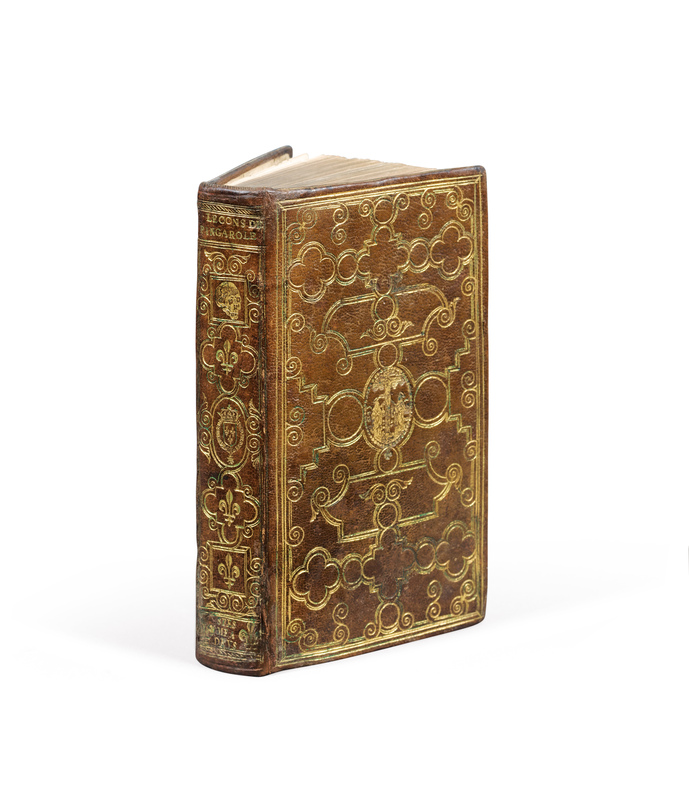
YTB-112Lyon, Jean Stratius, à la Bible d'Or, 1585. In-8 de (24) ff., 605 pp. Maroquin olive, plats et dos lisses entièrement ornés d'un décor à la fanfare, armoiries, symboles, fleurs de lys, tête de mort et mention « Spes Mea Deus » frappés or, filet or sur les coupes, tranches dorées, exemplaire réglé, mouillures. Reliure de l'époque aux armes du roi Henri III. 171 x 100 mm. L’EXEMPLAIRE RELIE POUR LE ROI HENRI III (1574-1589) des œuvres du Cordelier qui prêcha le massacre de la Saint-Barthelemy à la cour du roi Charles IX (1560-1574). Le volume est une violente et hardie diatribe contre Calvin et sa doctrine. « En 1571, François Panigarole alla terminer ses études de théologie à Paris. Il prêcha devant Catherine de Médicis le massacre de la Saint-Barthelemy. Après ces événements dramatiques qu’il avait appelé de ses vœux, il dut quitter la France ». « Après s’être arrêté à Lyon et à Anvers, il retourna en 1573 en Italie et enseigna pendant les années suivantes la théologie dans divers couvents de son ordre. Ses sermons, où au jugement de Tiraboschi se remarquent une imagination des plus riches, une grande force de sentiments, un style énergique, plein de gravité quoique un peu redondant, lui valurent la réputation méritée de l'orateur le plus éloquent de ses contemporains et compatriotes. Après avoir passé 2 ans auprès de Saint-Charles Borromée, qui l'estimait beaucoup, il fut promu en 1587 à l'évêché d'Asti. Deux ans après il fut envoyé à Paris pour y soutenir par son éloquence le parti de la Ligue ». PRECIEUX ET BEL EXEMPLAIRE, REGLE, PROVENANT DE LA BIBLIOTHEQUE Edouard Rahir avec ex-libris, dédicacé à Pierre de Gondy, Evêque de Paris, REVETU D’UNE TRES ELEGANTE RELIURE DE L’EPOQUE ORNEE D’UN DECOR A LA FANFARE AUX ARMES ET EMBLEMES DU ROI HENRI III. Elle a été exécutée pour le roi et offerte par ce dernier à un pénitent, membre de la Cour, appartenant à une confrérie de la bonne mort fondée par le roi. Guigard nous apprend que le roi Henri III (1551-1589) utilisait plusieurs fers héraldiques dont la célèbre tête de mort présente ici sur le dos du volume. Ce lugubre symbole fait allusion à la mort de La princesse de Clèves, dont il était éperdument épris. Henri III en ressentit une telle douleur que pendant longtemps il se tint presque enfermé dans son palais. Précieux volume, l’un des rarissimes exemplaires anti-protestant unissant Catherine de Medicis, Charles IX, Henri III, la Saint-Barthelemy et une remarquable reliure à la fanfare aux armes et emblèmes du roi.
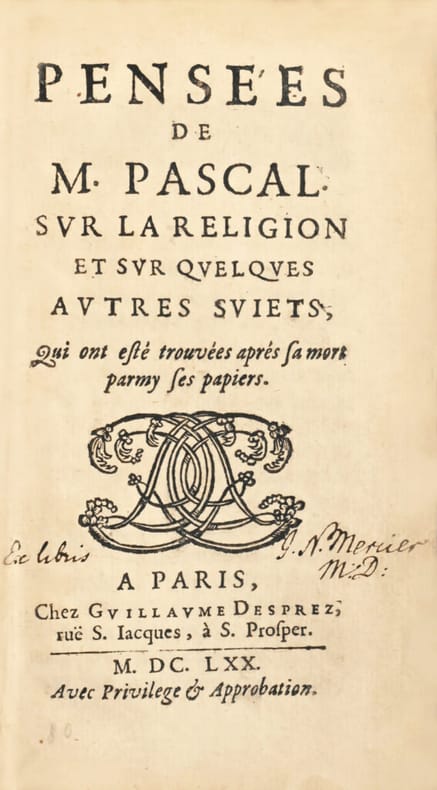
LCS-A1Prestigieux exemplaire provenant de la bibliothèque du maître enseignant du Plessis-Sorbonne l’abbé de Saint-André, enrichi de son ex-libris manuscrit en date du 21 mars 1698. «Labbé de St André. A Paris au collège du Plessis Sorbonne l’an mil six cents nonante huit ce jourduy 21 mars». Paris, Guillaume Desprez, 1670. In-12. Plein maroquin rouge, encadrement de filets à la Duseuil sur les plats, dos à nerfs richement orné, coupes décorées, tranches dorées. Reliure en maroquin de l’époque. 164 x 82 mm. Collation: 41 feuillets liminaires, 365 pages, 10 feuillets de table.
LCS-13401Les 182 Roses de Redouté dessinées par l’artiste et délicatement rehaussées à l’aquarelle sous ses yeux, conservées dans leur reliure de l’époque. Paris, P. Dufart, 1828-1829.3 tomes en 3 volumes grand in-8. Un frontispice gravé colorié à la main et 182 gravures à pleine page. Demi-veau bleu, dos lisses ornés en long de fers rocaille dorés, tranches mouchetées. Reliure de l'époque. 220 x 154 mm.
5 glass positive lantern slides (85 × 100 mm), each with a black paper mask, paper tape around the edges, a letterpress slip at the foot giving the publisher's name and city, and a slip at the head with the manuscript title. Stored in a contemporary purpose-made wooden box with brass fittings, with the word "Mekka" on the top of the hinged lid. Five of the earliest and best photographs of Mecca and Medina, beautifully preserved as silver gelatin glass plates, including the first photograph of the Ka'ba in Mecca's Masjid al-Haram (Great Mosque). Two of the photographs were taken by the first person to photograph Mecca and Medina, the Egyptian Colonel Muhammad Sadiq Bey (1832-1902), who made them in 1880 for the Ottoman Sultan Abdülhamid II. The others were taken by the first European to photograph Mecca, Christiaan Snouck Hurgronje, and Al-Sayyid 'Abd al-Ghaffâr, who worked closely with him. Snouck Hurgronje (1857-1936), one of the greatest pioneering Dutch Arabists, converted to Islam and lived in Mecca from January to about July 1885. The photographs by these three men are best known and most frequently reproduced from the published collotype facsimiles, while the rare surviving early albumen prints are usually faded or otherwise in bad condition. The present five plates, sold as lantern slides for magic lantern presentations, are therefore of the greatest importance as well-preserved high quality specimens of these famous photographs, providing the best early images of the mosques of Mecca and Medina. - All five slides are in very good condition, with only a bit of dust and the occasional smudge on the glass. They show: 1) The Masjid al-Haram in Mecca (the Great Mosque); 2) a closer view of the Ka'ba in Mecca; 3) the portrait of an unidentified Mu'ezzin in Mecca; 4) a portrait of an unidentified East Indian pilgrim; 5) the al-Masjid an-Nabawi in Medina (the Prophet's Mosque). Cf. D. v.d. Wal, Christiaan Snouck Hurgronje (2011); J. J. Witkam, new introduction to the 2007 reprint of the 1931 English translation of Hurgronje, Mekka.
Small folio (212 x 316 mm). Manuscript on paper. 140 ff. Contemporary half calf with giltstamped spine labels. Marbled endpapers. A very rare manuscript copy of this work which its author had not intended for publication (or could not afford to have printed). Fournel, in his "Bibliographie Saint-Simonienne", placed the total number of such manuscript copies prepared at 60 (erroneously giving a date of 1811). The text was first printed in 1858 in a collection with the "Physiologie religieuse d’Enfantin" (Paris & Leipzig, Masson), and then again in the following year within Volume II of the "Œuvres choisies", with a list of some 30 known recipients of the original "Mémoire". - This work was planned as part of a series of studies based on the work of Vicq d'Azyr, Cabanis, Bichat, and Condorcet, the four scholars who had supposedly done most to study the human mind. The author proposes that his "Mémoire" be copied and criticized before being presented to the learned societies. It is an attempt to develop a positive social science which would study man as a species rather than as an individual; physiology would thus be elevated to the rank of the natural sciences. Saint-Simon believed that society could be understood by examining its underlying natural laws, the resulting social science would supposedly be capable of constructing a perfect society. His arguments for the scientific organization of society have been seen as "the first example of pure socialism [...] understood as an economic system in which production is entirely carried on in common and the fruits of labour distributed according to some ideal standard" (R. T. Ely). - Bookplate of the anthropologist and ethnographer Ernest Théodore Hamy (1842-1908), founder of the Musée d’Ethnographie du Trocadéro. Some repairs to the first two leaves, otherwise a very well preserved specimen. Mazzone 29. Walch p. 28 (listing MS 578 at the Museum d'Histoire Naturelle) and no. 82 (mentioning copies in the Bibliothèque de l'Arsenal and the Bibliothèque Thiers). Fournel p. 13 (misdated "1811"). Dolléans & Crozier 6. Stammhammer I, 214, 53. Booth p. 24-30.
4to. (10), 171, (1) pp. William Brodrick's copy with 3 original watercolours by him, heightened with gum arabic. 28 hand-coloured lithographed plates after William Brodrick, some heightened with gum arabic. Contemporary half green morocco, gilt. Second edition, revised and enlarged: the best edition of this handsome work. This copy, with an impeccable provenance, is enriched by the inclusion of three fine original watercolours by the eminent William Brodrick (1814-88), falconer, taxidermist, physician, and artist, whose works of avian portraiture set the standard of their times. - Provenance: "Wm. Brodrick, Little Hill, 1873" (ink inscription to front free endpaper, and a partially erased pencil inscription to title). - Occasional spotting, heavier to endpapers and half-title; spine faded to brown, corners worn, rubbed. Harting 67. Nissen IVB 147. Schwerdt II, 145.
Folio (208 x 289 mm). 3 parts in 1 volume: 4 (instead of 8?) pp. of preliminaries (blank, alif, ba, gim); 131, (1 blank) pp. and 80 pp. (bound alternatingly), with 56 etched plates; 39, (1 blank) pp.; 283, (1 blank) pp. Contemporary half calf with gilt-stamped spine and marbled covers. The first edition of the first illustrated medical book ever printed in the Muslim world: the pioneering Ottoman physician Sanizade's (1771-1826) medical compendium, the first three books (on anatomy, physiology, and internal medicine) of what would later be known as "Sani-zade's Canon of Five", "Kitâb ül-evvel fi t-tesrihât" ("Mir'âtül-ebdân fî tesrih-i a'zâil-insân"), "Kitab üs-sânî fi 't-tabîyat", and "Kitâb üs-sâlis Miyâr ül-etibbâ". This was one of the earliest Turkish medical works to draw thoroughly on western, Paracelsian and Vesalian science: indeed, it is modelled on and partly translated from Italian and German sources, such as Anton Störck, Bartolomeo Eustachi, Gabriele Fallopio, and Costanzo Varolio, reproducing anatomical illustrations from a variety of sources including Vesalius. - "[B]y and large Ottoman medicine remained [...] attached to its Galenic roots. [...] Real paradigmatic change began to appear only with the upheavals of 19th-century reforms, when translations and adaptations of new European knowledge made their way to the core of the medical profession. One of the first books to spark this revolution was Ataullah Sanizade's compendium 'Hamse-i sanizade', a series of five books published in Ottoman Turkish from 1820 onward, incorporating new medical knowledge from Europe. Sanizade was a brilliant and innovative physician and theorist (as well as musician, astronomer, and historian) who did much to integrate new medical knowledge with the old. His views on medicine encountered much opposition, mainly because of his support for surgery-based study of anatomy. As a result his request to dedicate his chef d'oeuvre to Sultan Mahmud II was denied. In time, however, the compendium came to replace the earlier canonic texts, and was fondly named 'kanun-i sanizade' (Sanizade's canon), referring, of course, to the old master's 'Qanun'. Although the compendium formally adhered to the humoral system and other concepts of ancient medicine, it was here that blood circulation was mentioned for the first time as a scientific concept and as part of a different medical theory. Some of the terminology included in this book formed the basis for a new medical profession that was beginning to take shape" (D. Ze'evi, Producing Desire [2006], p. 20f.). A five-volume Arabic edition appeared at Bulaq in 1828 by direct order of Mehmet Ali. - Part 1 bound as follows (agreeing with the copy in the BSB Munich): 4 pp. of prelims (blank, alif, ba, gim); 3, (1) pp., (2 plates), 2 pp. [index], 5-34 pp., (17 plates), 3-22 pp. [index], 35-68 pp., (9 plates), 23-35 pp. [index; pp. 25-28 numbered 3-6 in error], 1 bl. p., 69-94 pp., (12 plates), 37-48 pp. [index], 95-100 pp., (6 plates), 49-55 pp. [index], 1 bl. p., 101-106 pp., (3 plates), 57-60 pp. [index], 107-120 pp., (5 plates), 61-70 pp. [index], 121-128 pp., (2 plates), 71-80 pp. [index], 129-131 pp., 1 bl. p. Some dampstaining throughout, more prominently so in several plates. In all, a good copy of this rare work, the only edition published during the author's lifetime. OCLC 608102180.
Albumen print (vintage), hand-coloured and raised in gilt and opaque white. Matted (ca. 280 x 360 mm) and framed (ca. 530 x 640 mm). Signed "Lafayette" on the mat. His Royal Highness Saud of Saudi Arabia, second son of and immediate successor to Abdulaziz Ibn Saud, the founder of Saudi Arabia, as a young prince. A fine, splendidly hand-coloured portrait by Lafayette Studios, Photographers Royal and among the world's most prestigious studios of the early 20th century. - In immaculate condition.
LCS-18477Précieux exemplaire relié en vélin ivoire vers 1660. Paris, Iamet Metayer 1600. Imprimeur ordinaire du Roi Henri IV. In-folio de (8) ff. dont 1 frontispice gravé, 1004 pp. et (10) ff. Plein vélin ivoire, dos à nerfs orné de fers proches de l’Atelier Pierre Rocolet-Antoine Padeloup, vers 1638-1662 selon Raphaël Esmérian. Exemplaire relié vers 1660.
8vo (154 x 208 mm). Arabic manuscript on paper. 267 ff. (final 6 leaves are supplied in a 19th century hand). Naskh script in black and red, with many numerical charts and calculations in text and margins. Rebacked contemporary red morocco, ruled and stamped in blind. Commentary on a work by the Egyptian mathematician Ahmad ibn Muhammad ibn al-Ha'im (ca. 1352-1412), the "Murshidat al-talib ila asna al-matalib fi ilm al-hisab" ("A student's guide to the summit of learning on the science of mathematics"). Al-Ha'im is famous for his contributions to mathematics, especially in the field of early algebra. The author of the commentary, Baha al-Din Muhammad al-Shinshawri (d. 1590), finished this work in 1587. The present copy was completed by the scribes Abd al-Rahman bin Wali Allah and Shihab al-Din al-Wiqay al-Shinway al-Shafi' on Friday, the 18th of Rabi' al-Thani 1023 AH at Cairo's Al-Azhar Mosque in Ottoman Egypt. - The text incorporates several small mathematical charts as well as marginal calculations, which provide a key insight into the development of mathematical notation and visual organization in the early 17th century. - Covers rebacked and spine replaced, along with final six leaves which were probably completed in Western Asia in the 19th century. Several small waqf stamps. A few paper repairs and marginal wormholes, otherwise well-preserved. Cf. GAL II, 125.
8vo (194 x 130 mm). Arabic manuscript on paper. 90 leaves, 15 lines per page written in more than one hand in cursive script with several words in red; numerous diagrams and tables. Contemporary limp red morocco. The three works comprise: - 1. "Al-Durr al-manthur fi'l-'amal bi-rub' al-dustur". A treatise on calculating time with the aid of the sine quadrant, for any region (GAL II, p. 218, 1, attributed by Brockelmann to Sibt al-Maridini's grandfather, the astronomer Abdallah ibn Khalil ibn Yusuf Jamaladdin al-Maridini al-Qahiri, d. 1406). - 2. "Raqa'iq al-haqa'iq fi hisab al-daraj wa'l daq'iq" ("Subtleties of Truths on Arithmetic of Degrees and Minutes"). Instructions for the calculation of celestial motions with the aid of minute proportions (GAL II, p. 217, 11). A commentary on a work by his teacher, the Egyptian mathematician and astronomer Shihab al-din Abu'l-'Abbas Ahmad ibn Rajab ibn Tibugha 'Ibn al-Majdi' (1365-1447), entitled "Kashf al-haqa'iq fi hisab al-daraj wa'l-daq'iq" ("Opening Truths on Arithmetic of Degrees and Minutes"). - 3. A commentary, "Risalah [al-Fathiyya (al-Shihabiyya)] fi'l-'amal al-jaybiyya" ("Treatise on [Fath al-Din (Shihab al-Din)]". Operations with the sine quadrant (GAL II, p. 216f., 7). - Sibt (Ibn Bint) al-Maridini (the Elder, 1423-1506) lived in Cairo and Damascus. He served as the muwaqqit (time-keeper) of the al-Azhar mosque in Cairo, and was a pupil of Ibn al-Majdi. His works are often conflated with those of his grandfather, and with those of his like-named son, who died in 1527 (GAL II, p. 468). - A few old repairs occasionally affecting letters; altogether very well preserved. Provenance: from the property of Dr. Eugene L. Vigil (b. 1941), of Lynden, Washington, USA. For Sibt al-Maridini see B. A. Rosenfeld & E. Ihsanoglu, Mathematicians, Astronomers & Other Scholars of Islamic Civilisation and their Works, Istanbul 2003, pp. 276f., no. 815, and pp. 293-298, no. 873.
8vo (116 x 180 mm). Arabic manuscript on paper. 52 pp. on 28 ff. of very fine polished paper (8 ff. on pink paper), complete. Meticulous Naskh in black ink with occasional red; numerous diagrams in red in the margins and occasionally within the text itself. Bound with an astronomical treatise in Persian. 50 pp. Black ink with occasional red; several diagrams in red throughout the text. Altogether 59 ff. 18th century red morocco, ruled in gilt and stamped in blind, modern rebacking. A 16th century Arabic manuscript of the "Sphaerics" by the Greek astronomer and mathematician Theodosius of Bithynia (ca. 169-100 BCE). Unknown in the West during the Middle Ages, the "Sphaerics" proved instrumental in the restoration of Euclidean geometry to Western civilization when the book was brought back from the Islamic world during the crusades and translated from Arabic into Latin. - The text is decorated throughout with geometric diagrams drawn in red ink with a delicate and exacting hand. Each is labelled, and many are quite intricately detailed, showing the geometric qualities of the sphere and progress to astronomical diagrams exploring orbits and planetary movement. This present manuscript was copied by Muhammad Taqi bin Aqa Jalal al-Kilani, dated to Sha'ban 1000 H. - Bound with another astronomical treatise, in Persian, written on somewhat coarser paper stock. Covers worn and rebacked, some dampstaining, otherwise very well preserved. A fine piece in the history of mathematics.
Various formats. Altogether 4 pp. on bifolium. Interesting correspondence with his Paris lawyer Gérard Rosenthal. In the first two (autograph) letters - written from his Turkish exile - Trotsky gives an account of his endeavors to relocate to France. The typed letter (dated 8 December 1938) is written in Mexico City, where the exiled Trotsky was coordinating the activities of the Fourth International into opposition to Stalin. In his telegram of 10 April 1939, also written and posted in Mexico City, Trotsky expresses his worry for his first wife Aleksandra Sokolovskaya, who had been arrested in 1935 and taken to a labour camp in Siberia, where all trace of her had been lost in 1938. He is also worried about his grandson Vsevolod (Seva), the son of his daughter Zinaida, who had taken her own life in 1933. After the death of his father Platon Ivanovitch Volkov in Paris in 1936, Seva had been in the care of Jeanne Molinier, the ex-wife of the French Trotskist movement, who had known Volkov well and now claimed the boy for herself. Trotsky sought to have Seva join him in Mexico and ultimately won custody before the Mexican courts: about a year before Trotsky was murdered he finally managed to embrace his beloved grandson in exile.
Zusammen ca. 237¾ SS. auf 58 Doppelbll., 21 Einzelbll. und 3 Bildpostkarten. Beiliegend 2 Kuverts mit eigenh. Adresse, sieben getrocknete Edelweiß, ein Kinderbrief von Ulbrichts Tochter und 3 Bildpostkarten. Umfangreiche, bislang unerschlossene Korrespondenz zwischen Walter Ulbricht und seiner späteren Frau Lotte Kühn, die ungewöhnliche Einblicke in die frühen Jahre der zuerst heimlichen Beziehung des späteren Staatsratspräsidenten zur "Landesmutter" der DDR gestattet. - Der bereits 42-jährige Kommunist und die zehn Jahre jüngere Genossin hatten einander Anfang 1935 in Moskau kennengelernt: Ulbricht, der nach Hitlers Machtergreifung hatte untertauchen müssen und ins Exil gegangen war, lebte zu jener Zeit nach einer gescheiterten Ehe in einer Beziehung mit der polnischen KP-Funktionärin Rosa Michel; Kühn hatte sich soeben von ihrem durch Stalin verfolgten Mann Erich Wendt getrennt. Während gemeinsamer Monate in Russland wurde Lotte Kühn Ulbrichts Sekretärin und Geliebte: Obwohl sie ihn auf manchen seiner Missionen nach Paris und Prag begleiten konnte, war das Paar oft durch ihre jeweiligen Aufgaben in der Exil-KPD voneinander getrennt. - Der größere Teil der vorliegenden Korrespondenz (etwa 46 Briefe) stammt aus dem Jahr 1935 und dokumentiert die immer innigere Verbindung zwischen dem geschickten KP-Strategen und der jungen Funktionärin mit akademischen Aspirationen, deren Lebensweg zunehmend in den Schatten ihres schon damals gut vernetzten Gefährten rücken würde. Die gegenseitige Wahrnehmung des Partners als Alter Ego findet ihren Niederschlag im kuriosen Gebrauch ein und derselben Kosenamen sowohl als Anrede wie auch als Unterschrift durch beide: "Dein Junge" unterschreibt nicht nur Ulbricht, sondern bemerkenswerterweise auch Kühn, die auch ihrerseits als "Mein liebster Junge" angeredet wird; ebenso bezeichnen beide Briefpartner sowohl sich selbst wie auch den anderen liebevoll mit dem Namen des brutalen "Schufterle" aus Schillers "Räubern". Die zahlreichen Kose- und Tarnnamen mögen auch durch konspirative Zwänge bedingt sein: In Prag lässt sich Ulbricht Post an seine anderen Vornamen "Paul" (10. III. 1935) und "Ernst" (31. III. 1935) adressieren; später bittet ihn Lotte, auf seinem Umschlag "für Hänschen" anzugeben (19. II. 1937). Ein enger Vertrauter des Paars war der mehrfach als Mittelsmann erwähnte Wilhelm Pieck. - Etliche Briefe, manche aus Davos, thematisieren das Skifahren - kein bloßer Wintersport, sondern notwendiges Training für die klandestinen Treffen in verschneiten Erzgebirger Hütten, wo die deutschen Exilkommunisten Propagandamaterial und Tarnschriften an Mitstreiter übergaben. Die zahlreichen der Korrespondenz beiliegenden Edelweiß zeugen von Momenten der sentimentalen Innigkeit während dieser Zeit. - Die gegenseitigen Liebesbeteuerungen sind so tiefempfunden wie umfangreich: "Dich umarme ich viel-vielmals mit einem glühenden 100 meterlangen Tunnel-Kuss", schreibt Lotte Kühn am 3. Juni 1935. Die gemeinsam beschworene Liebe wird in den Kontext des politischen Bewusstseins gestellt: "Hier hat jetzt eine grosse Kampagne für die Familie, für die Kinder und für eine komm[unistische] Ethik begonnen [...] Denn die Kader können nicht erzogen, umgebildet werden, wenn man ihnen nicht in ihren persönlichen Nöten hilft. Vor allem aber auch unseren Vereinsmitgliedern wird die Pflege der Familie zur Pflicht gemacht. Mancher Spießer wird jetzt hohnlächelnd an seine Brust schlagen, aber er hat sich geirrt. Denn unsere Sorgen um Familie & Ehe sind ganz anderer Art, als er sie sich vorstellt. So eine reine, schöne Liebe wie z.B. zwischen uns Beiden ist für ihn unvorstellbar" (Kühn, 5. VI. 1935). Vorbehaltlos nimmt Kühn Ulbrichts kleine Tochter Rose (1931-95), liebevoll "Mimi" genannt, als die eigene an und legt einem eigenen Schreiben sogar einen französisch geschriebenen Brief der Fünfjährigen bei, in dem sie sich für einen Magnetspielzeugkasten bedankt (30. I. 1937). - Nicht minder spielen Parteiarbeit, Meinungsbildung, Lottes Studium und gesellschaftspolitische Beobachtungen eine Rolle. Ulbricht äußert sich zu seiner Lektüre (neben politischen und geschichtlichen Werken auch Dichter wie Heine und Puschkin) und zu kinematographischen Erfahrungen wie seinem "Besuch bei Chaplin": "Der Film 'Moderne Zeit' ist eine glänzende Darstellung der kap[italistischen] Ausbeutung wie der Mensch zur Maschine wird. Die Leute lachen zwar bei den tragischsten Stellen wie besessen, es wird ihnen aber doch zum Bewusstsein gebracht wohin der Kap[italismus] den Menschen bringt [...]" (14. IV. 1935). Er rät Lotte, die "neuesten Sowjetfilme" (6. II. 1935) anzusehen, und gibt Lektüreempfehlungen: "Lies doch noch einmal die Rede Gorkis und einige Aufsätze in der 'Internationalen Literatur' in der die Fragen unsrer Haltung zum Erbe der klassischen Literatur u. a. Das wird für die weitern Aufgaben für uns sehr nützlich sein" (6. III. 1937). In den späteren Schreiben, während der Kriegsjahre, tritt die politische Analyse in den Vordergrund: "Deine Bemerkung über die imp[erialistische] Politik D[eutschlands] ist nicht schlecht. Du hast ganz gut aufgepasst […] Wir sind gegen die imperialistische Politik beider Seiten, wenn auch der englische Imperialismus ag[g]ressiver auftritt. Jetzt wird manchen Leuten erst die geniale Bedeutung des Friedenschlusses mit Finnland bewusst. Die SU kann stärker ihre selbständige Politik des Kampfes um den Frieden und für die Erhaltung ihrer Neutralität durchführen" (Ulbricht, 26. IV. 1940). Im letzten hier vorliegenden Schreiben, von Lotte Kühn datiert am 20. Januar 1943, zeichnet sich mit der bevorstehenden Vernichtung der deutschen 6. Armee in Stalingrad der Wendepunkt des Kriegs ab: "[N]achdem ich in der gestrigen Zeitung die zusammenfassende Karte gesehen hatte, war mir vollständig klar, daß Du nicht eher kommst, bis nicht dieser verdammte Kessel liquidiert ist [...]". - Nach ihrer Scheidung von Erich Wendt, dem späteren Leiter des Aufbau-Verlags, war Lotte Kühn 1936 offiziell Ulbrichts Lebensgefährtin geworden. Nach der Rückkehr ins zerstörte Deutschland 1945 war es Ulbrichts Moskauer Emigrantenzirkel, der die KPD neu gründete und mit der SPD zur SED vereinigte; von 1950 an stand Ulbricht an der Spitze des Zentralkomitees der SED und übte somit die höchste politische Gewalt im Land aus. Bis zu seiner Kaltstellung 1971 gelang es ihm, seine zahlreichen Gegner im ZK geschickt auszumanövrieren. Lotte fiel die Rolle der "First Lady" der DDR zu: 1959 schloss sie ein Studium der Gesellschaftswissenschaften ab, ein ersehntes weiteres Promotionsstudium hintertrieb ihr Mann. Aus ihrem später teilweise öffentlich gewordenen Nachlass ging hervor, dass Lotte und Walter Ulbricht bereits 1950 (und nicht wie zuvor angenommen 1953) heirateten und Lotte mit behördlicher Genehmigung schon ab 1946 Ulbrichts Namen führte. Auch stellte sich heraus, dass Lotte schon 1923 eine erste Ehe mit Otto Schultchen eingegangen war, die laut Gerichtsakten erst 1942 geschieden wurde - sechs Jahre nach der Scheidung von Wendt. - Mit gelegentlichen kleinen Einrissen, Ulbrichts Briefe aus dem Jahr 1937 mit etwas brüchigen Faltlinien, ansonsten sehr gut erhalten.
Small 4to (21 x 15 cm). (16), 410, (6) pp. With woodcut arms of the Dominican order (with the IHS and cross covering the centre) on title-page, and a variant version on the last page, and 3 woodcuts in text (2 saints and the Cross). Further with 24 decorated woodcut initials in two series, including 11 repeats. Contemporary gold-tooled mottled calf, each board with the coat of arms of the French Seguier family and with the monogram PSMF (Pierre Seguier and his wife Madeleine Fabry) repeated 6 times on the spine, rebacked (on recessed cords) with original gold-tooled backstrip laid-down, a later spine label (between the 1st and 2nd monogram), the year of publication 1611 at the foot of the spine, later endpapers. First and only edition, in Spanish, of an early work on Ethiopia by the Spanish Dominican monk Luis de Urreta (ca. 1570-1636), who wrote two volumes glorifying his own order's accomplishments in Ethiopia while diminishing those of the Jesuits (his Dominican coat of arms incorporates the IHS with cross, often used by the Jesuits). In the present work, the second of the two, he deals specifically with the Dominican presence in Ethiopia and the history of the Ethiopian saints. Like the first work, the "Historia ecclesiastica" published in 1610, it is a late example of a stream of geographical fantasies where Ethiopia was presented as the wondrous utopian kingdom of Prester John, and Urreta makes the case for an ancient Dominican presence in the country, arguing that they should thus be given precedence over the Jesuits as Catholic missionaries in that country. On pp. 88-90 it gives the information from a report to Pope Gregory XIII (1502-85) on two Dominican monks (Blackfriars) from the Alleluya monastery, who entered Mecca around 1580 and had contact with a Faqih and a Marabout. Everyone who travelled from Africa to Mecca supposedly had to travel by way of the Alleluya monastery as the rest of the region was considered uninhabitable (p. 61). - From the library of Pierre Seguier, Lord Chancellor of France from 1635 to 1672, best known for his appearance in The three musketeers, with his arms and monogram stamped in gold on the binding. And with an owner's inscription of the 17th-century French scholar Etienne Baluze ("Stephanus Baluzius Tutelensis") on title-page. With a faint water stain in the lower margin of four leaves in the introduction, a tiny corner torn from the title-page and two tiny tears in the margins of the main text, otherwise in very good condition. Binding heavily restored, but with the gold-tooled coat of arms still very clear. Olivier, 271(4). Finger & Piccolino, The shocking history of electric fishes, p. 117; Palau 345993; Salva 3417; cf. Gay, Bibl. de l'Afrique et l'Arabe 2690.
LCS-17997Bel exemplaire complet du feuillet blanc final, plus grand de marge que l’exemplaire du roi Georges III (B.M.C., I, 27). Strasbourg, Johann Mentelin, 1469 In-folio de (4) ff. bl., (160) ff. [a-q10] le dernier blanc. 2a : 34 lignes. Type : 112b. Pt. morceau de papier blanc collé dans la marge sup. du 1er f. sans atteinte au texte, qq. pts. trous de vers en marge des derniers ff., coin supérieur du f. 158 légèrement déchiré. Table des matières manuscrite occupant 3 des ff. blancs reliés en début de volume, verso du f. bl. final couvert d’annotations manuscrites de l’époque. Grandes lettrines, petites capitales, débuts des paragraphes et certains passages soulignés à l’encre rouge. Un exemplaire décrit par Panzer possède un colophon manuscrit : Presens Valerii Maximi opus pre-clarissimum, in nobili urbe Argentina Reni terminatum, anno m.cccc.lxx, xvii kalendis Julii, per virum quendam egregium, impressorie artis maiistrum, foeliciter est consummatum. Plein vélin ivoire du XVIIIe siècle, dos lisse. 312 x 214 mm.
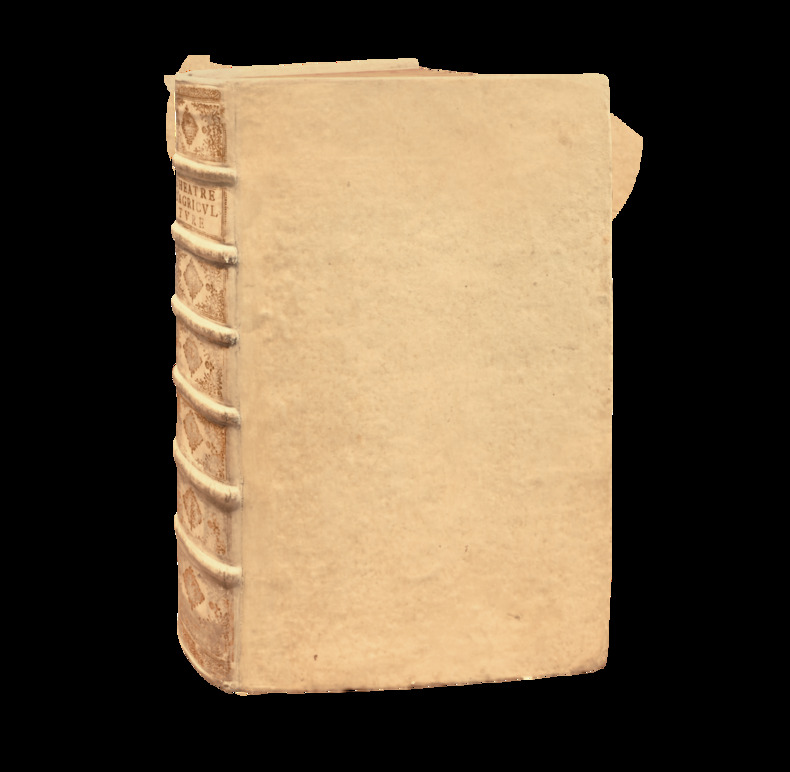
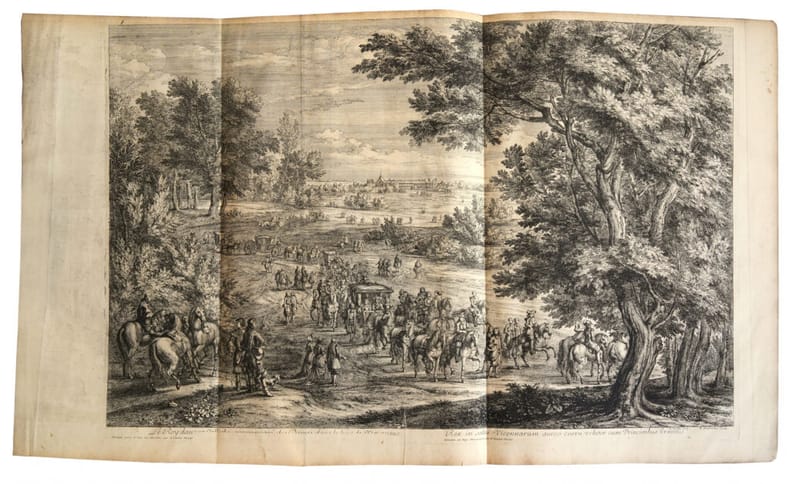
LCS-17953Premier tirage de ce recueil du Cabinet du Roi publié sur ordre de Louis XIV en divers formats et planches séparées. Paris, 1685-1686. Grand in-folio de 34 grandes planches. Petites déchirures aux pliures des vues 8, 9 et 13, restaurations sans manques aux vues 1, 6, 11,19 et 28. Maroquin rouge, double cadre de triple filet doré avec chiffre royal couronné aux angles, armes frappées or au centre, dos à nerfs orné du chiffre royal couronné, répété 7 fois, au sein de fleurs-de-lys et roulette fleurdelysée, filets dorés sur les coupes, roulette intérieure dorée, tranches dorées. Reliure de l’époque. 560 x 420 mm.
Folio (368 x 255 mm). Etched and engraved title and 31 etched plates (numbered 1-30 and one unnumbered). Contemporary French red morocco gilt, arms of Louis-François-Armand de Vignerot du Plessis, duc de Richelieu et de Fronsac on covers (Olivier 407, fer 15), within gilt border of Richelieu’s repeated motif of two crossed batons intertwined with an ornamental “R”, repeated with coronet within arabesques at the corners, spine gilt in compartments with same motif. First edition; a large-paper copy with Richelieu's arms. Vien's charming series of etchings depicts the costumes worn by members of the French Academy in Rome for a "Turkish masquerade" held during the Carnival celebrations of 1748. This masque is an outstanding example of the influence the orient exerted on western style during the late-Baroque era, showcasing the degree to which cultural transfer was possible and even a matter of enthusiastic adoption by the west but little more than half a century after the siege of Vienna. The elaborate masquerades at the French Academy constituted an important fixture in the Roman calendar. As director of the Academy, Vien organised the masque of 1748, the fabulous costumes of which are presented here, designed, drawn and etched by Vien himself. The costumes in the present suite are "a curious mixture of authentic Turkish habits and European invention" (Blackmer), showing the stock figures of the Turkish court liberally enhanced with elements of Vien's own concoction. The fantastical nature of the creations is a far cry from the sober neo-classical style with which Vien is commonly associated (his pupils included some of the foremost artists of the period, notably Jacques-Louis David). Vien's original drawings and oil paintings for the Mascarade are held by the Musée du Petit Palais; they were exhibited in Berlin in 1989. - Some marginal dampstaining and foxing, binding rebacked retaining most of original spine, corners repaired. This copy commanded $26,000 at Christie's New York in 1997. - Provenance: from the library of Louis-François-Armand de Vignerot du Plessis, duc de Richelieu et de Fronsac (1696-1788), a close friend of Louis XV of France, though critical of Madame de Pompadour. He is supposedly the model for the character of Valmont in Choderlos de Laclos' "Les Liaisons dangereuses". Atabey 1288. Lipperheide Sm 10. Colas 3005 (suggesting the plates are un-numbered). Hiler 879. Le Blanc II, 122, 8-39. Cohen/R. 1014f. Brunet V, 1211. Cf. Blackmer 1730. Cf. Gay 3644. Graesse VI/2, 311 (Paris, Bassan et Poignan).