HORTUS, SANITATIS:.MareMagnum

690 923 résultats
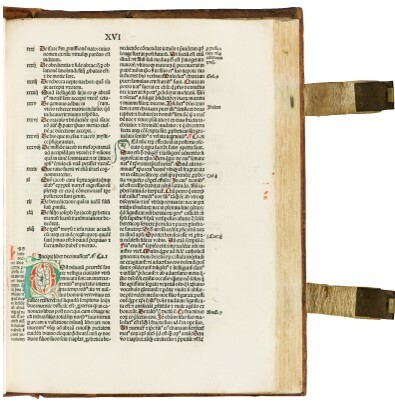
in folio (mm. 350X210), ff. 368 n.n., leg. coeva piena pergamena, titolo ms. al dorso (rifatto). Prima edizione impressa in Italia, e quinta in assoluto, di questa enciclopedia di storia naturale, stampata per la prima volta a Mainz nel 1491. Testo su due colonne, caratt. gotico, titolo entro elaborata bordura vegetale. Copiosamente Illustrato da circa 1000 magnifiche silografie nel testo (di circa mm 95x70 ognuna) raffiguranti piante, animali, figure umane e mostruose, per la maggior parte tratte dall'edizione del Pruss del 1509. Tre silogr. a piena pagina: al verso del tit. Consulto di medici, tratto dalla Chirurgia di Guglielmo da Piacenza del 1504; al f. A verso: Scheletro umano sormontato dalla scritta ''Homo natus de muliere brevi vivens tempore''; al f. aa verso: Consulto di medici, liberamente tratto dalla tavola del Ketham ''Fasciculo de medicina'' 1493. Importante e rara edizione di quest'opera, una sorta di ''musée à peu près compler de la superstition médiévale'' (Sander), ma particolarmente dettagliata nella sezione dedicata alla botanica: per ogni pianta vengono infatti fornite le proprietà medico-curative, le origini geografiche e i sinonimi. Ottimo esemplare, assai fresco.. Essling 1723. Nissen 2368. Sander 3470. Mortimer I, 238..
7 volumi in-folio grande (cm 48x36), eccezionali legature dell'epoca alle grandi armi araldiche dei Turinetti di Priero in ovali al centro dei piatti: cinque volumi sono in pieno marocchino rosso, mentre due in vitello biondo. Tutti sono arricchiti da una raffinata larga bordura a fiori e frutti in oro ai piatti, mentre i dorsi a 8 scomparti riportano il titolo e decorazioni floreali ai piccoli ferri, con. Lo stemma coronato è retto da due leoni controrampanti, con il motto "non degenero". Malaguzzi n.7 lo identifica con certezza con le armi di Ercole III Turinetti di Priero (1717-81). (restauri alle cuffie, qualche lieve spellatura) Di gran lunga la più importante tra le biblioteche piemontesi del Settecento fu quella dei Turinetti di Priero "nobile famiglia chierese le cui fortune, legate alla finanza, raggiunsero il loro apogeo nel XVIII secolo per ridursi progressivamente sino alle confische legate ai moti del 1821. Di loro biblioteche ho trovato notizie di varia natura per il periodo che va dal 1781 al 1806... Nello stato sabaudo non fu così comune come in Francia l'uso con legature con l'arma del proprietario ..." (F. Malaguzzi, Biblioteche storiche disperse, p. 37-52; e Alla mezza aquila bicipite d'argento, interamente dedicato alla biblioteca Turinetti). Questi sette poderosi volumi sono adorni di 6 ritratti di Carlo III, una carta del Golfo di Napoli a doppia pag., oltre 500 tavole, circa 500 iniziali incise e 700 testate e finalini. I) 1757: occhietto, frontespizio con vignett9, 50 tavv. incise in rame nel testo, (7) di indici, (1) bianca. II) 1760: occhietto, frontespizio con vignetta a, (l'antiporta con ritratto di Carlo III in ovale pp. (2), 1 tavola f.t. a doppia pagina del Golfo di Napoli, pp. 27, antiporta con ritratto di Carlo III come al primo vol., pp. (4) di dedicatoria al medesimo Carlo III di Borbone, (5) di prefazione, (1), 339 comprensive di 60 tavole incise in rame, (10) di indici. III) 1762:occhietto, frontespizio e antiporta come al primo e al secondo volume, pp. XVII di dedicatoria e prefazione, 329 di cui 60 tavole, (12) di indice. IV) 1765: occhietto, frontespizio e antiporta come ai primi 3 voll., pp. X di dedica e prefazione, 368 di cui 79 tavole, (12) di indice. V) 1779: occhietto, frontespizio e antiporta come ai primi 4 voll., pp. X di dedica e prefazione, 407 di cui 84 tavole e gli indici, inclusi nella numerazione. Questo è il quinto ed ultimo volume dedicato alle pitture, in realtà il VII dell'opera. VI) 1767: occhietto, frontespizio e antiporta come ai precedenti voll., pp XLV con 5 tavole incise in rame n.t., 280 con 79 tavole, (10) di indici; pp. 35 di Modello di una nave a 3 ordini di remi, con 3 tavole in rame n.t., due delle quali ripiegate, (2) di indici. Questo è il primo dei due volumi dedicati ai bronzi. VII) 1771:occhietto, frontespizio, pp. XI di cui 2 tavole in rame, 423 di cui 99 tavole, (14) di indici. Questo è il secondo ed ultimo volume dedicato ai bronzi, in realtà il VI dell'opera. I sette volumi appartenuti ai Turinetti di Priero furono preceduti dalla pubblicazione di un volume di catalogo delle scoperte non illustrato (nel 1755) e seguiti da uno dedicato a lucerne e candelabri, uscito addirittura nel 1792; entrambi non figurano in questo set eseguito per la biblioteca piemontese. Da notare che la stragrande maggioranza dei volumi di questa poderosa biblioteca privata erano di formato ridotto: dal –sedicesimo al –quarto: Malaguzzi (in Bibl.St.Scomparse, p. 37-49, analizza un elenco di ben 4845 volumi facenti parte dell'eredità di Giovanni Antonio. Di questi, che comunque rappresentano un sostanzioso campione di quella che poteva essere la costituzione della biblioteca, soltanto 171 volumi sono descritti in-folio, di cui 97 "ligati alla capucina" fanno parte della Descrizione delle Arti e Mestieri. Sono quindi da considerarsi molto rari i volumi in-folio rilegati per i pur agiatissimi Turinetti di Priero. Sebbene i volumi non fossero posti in vendita ma concessi in omaggio alle persone gradite alla Corte Napoletana, la Reale Stamperia con quest'opera, alla quale lavorò per oltre 40 anni, diffuse nel mondo della cultura notizia della ricchezza archeologica del sito di Ercolano. Monumento tipografico impresso su carta forte, di eccezionale bellezza ed in superba rilegatura. Rosaria Ciardiello, L'archeologia dei Borbone nella cultura europea : "Il corpo accademico si riuniva con scadenza bisettimanale almeno fino al 1760 ... si rivelò evidente quanto fosse complessa la formula collegiale e la stesura dei testi fu affidata al segretario Carcani, che, praticamente da solo, proseguì il lavoro pubblicando dal III al VII tomo. Egli inizio anche l'VIII che fu poi completato dall'abate Basso Bassi... Il piano dell'opera era colossale, prevedendo ben 40 volumi, ma non si andò verso l'ottavo ... La pubblicazione di sontuosità regale comportò spese notevoli ... I rinvenimenti di Ercolano e Pompei nonché la pubblicazione dei papiri e dei volumi delle Antichità concorsero nella seconda metà del Settecento e spingere fino a Napoli il Grand Tour. Ciascuno dei visitatori, con la propria sensibilità, riportò le impressioni delle grandi scoperte borboniche contribuendo a diffondere il cosiddetto "gusto ercolanese". Al disegno ed all'incisione dei fogli parteciparono oltre 20 noti artisti del tempo, particolarmente di scuola napoletana, quali Rocco Pozzi, Elia Morghen, C.Paderni, Lor. Biondo, F.La Vega, G.Aloja, P.Gaultieri, N.Vanni, P.Campana, L.Vanvitelli, F.Cepparelli, M.Gorello, C.Nolli. Tra 1748 ed il 1749 il re Carlo di Borbone aveva istituto a Portici una scuola d'incisione in rame, chiamando artisti italiani e stranieri a preparare le tavole (le cui matrici si conservano al Museo Archeologico Nazionale) per le opere commissionate alla Stamperia Reale; e lo stesso sovrano, nel 1755, aveva istituito l'Accademia Ercolanese, composta da quindici membri, per curare la pubblicazione e l'illustrazione dei risultati degli scavi. La grandiosa iniziativa editoriale delle Antichità di Ercolano costituì un evento di singolare rilievo nel secolo e nella storia della letteratura archeologica, rendendo pubblico per la prima volta in dettaglio il ricco patrimonio artistico e documentario rinvenuto nel corso degli scavi. In parte in parte già descritti nel 1755 dal parmense Ottavio Antonio Baiardi, ebbero con questa sontuosa opera una diffusione eccezionale.. (KISSNER Sale, 199). BLACKMER 678. CICOGNARA 2645. EBERT 711. BERLIN KAT. 3947. Cfr. catalogo CIVILTà DEL '700 A NAPOLI..
2 parti in un vol. in-4 gr.(mm 291x220), ff. n.n. 131 su 132 mancando il primo f. bianco; 211 su 212 mancando il primo bianco. Attraente legatura d'amatore del XIX sec. in marocchino blu con riquadro a filetti oro sui piatti, dorso a nervi con tit. e fregi oro, tagli dor., dentelle int. I primi fogli di ambedue le parti sono incorniciati dalla prima bordura ornamentale su fondo nero ad apparire in un testo a stampa (cfr. A.M. Hind, An Introduction to a History of Woodcut, New York, 1963, II, p. 458 e sgg.). Con 14 grandi iniziali xilografiche ornate, sempre su fondo nero; testo in nitidissimo car. tondo. Editio princeps della Historia Romana dello storico alessandrino Appiano nella traduzione latina dell'umanista pavese Pier Candido Decembrio. Il ''De bellis civilibus'' era già apparso nel 1472 preso i torchi di Vindelino da Spira; questa è la prima edizione collettiva delle due parti che tuttavia si trovano raramente riunite, come invece nel presente caso. L'opera di Appiano, storico greco vissuto a Roma nel II sec. d.C., ebbe il merito di mutare l'usuale struttura annalistica della storiografia romana, dividendola sistematicamente per argomenti. La Storia Romana, conclusa intorno al 160 d.C., presenta un resoconto basato sulle storie locali dei vari popoli e paesi che componevano l'impero, a partire dalla loro sottomissione e incorporazione nell'impero stesso. Dei ventiquattro libri di cui era composta, ne sono rimasti integri solamente dieci (dal VI all'VIII e dal XI al XVII). La straordinaria produzione del Decembrio (gli sono attribuite centoventisette opere) si divide essenzialmente tra le traduzioni e le opere storiche. Tradusse dal greco in latino parte dell'Iliade, la Ciropedia di Senofonte, alcune Vite di Plutarco, le Storie di Appiano, la Repubblica di Platone; dal latino in italiano i Commentari di Giulio Cesare... Celebre incunabolo, uno dei primi libri che siano apparsi con ornamenti silografici ed il primo in assoluto su fondo nero. Stupendo esempl. a grandissimi margini, immacolato; al contro piatto ex libris "Ex museo Huthii".. BMC V, 244. Goff A-928. IGI 763. GW 2290. Pellechet 915. Polain 284. Essling 221. Sander 482: ''Les deux superbes bordures ornées d'arabesques blanches sur fond noir, sont demeurées comme un modèle de décoration typographique. L'Appianus est un des exemples les plus typiques de l'influence de la tradition de l'enluminure sur les livres imprimés, mais il est aussi la tentative la mieux réussie pour remplacer la miniature par l'ornamentation typographique''..
LCS-18368Exemplaire de dédicace sur très grand papier de Hollande relié à l’époque aux armes et pièces d’armes de l’Empereur Napoléon Ier. Milano, Dalla Regia Stamperia, 1806. In-8 dexi pp., 312 pp. Plein maroquin rouge, roulette dorée autour des plats, armoiries au centre, dos lisse orné de pièces d’armoiries, gardes et doublures de tabis bleu, tranches dorées. Reliure de l’époque portant l’étiquette «n°45 rue de la Harpe Tessier. Relieur Doreur à Paris». Dimensions de la reliure: 194 x 110 mm.
183889310Arthus Bertrand | Paris 1838-1852 | 14.5 x 23.5 cm & 18,8 x 28 cm & 35 x 53 cm | 12 volumes reliés
8vo. 2 pp. With sealed autograph envelope "à mon fils le conte de Toulouse". Framed and glazed (double-sided, 370 x 339 mm). Insightful letter to his son Louis-Alexandre de Bourbon, Count of Toulouse, during the Nine Years' War: "Je suis content de lestat que vous m’avez envoié de la Cav[ale]rie je voy avec plesir la quantité de beaux rég[imen]ts qu il y a il faut travailler a remettre les autres cest ce que vous devés bien mettre dans la teste des officiers. Jay veu avec plesir la petite carte que vous mavés envoiée ou tous les camps d’Aht [!] et de ses environs sont marqués. Continués a faire tout ce que vous devés et a voir tout ce que vous pourrés pour essaier de devenir tel que je vous desire" ("I am happy with the condition that you have sent me of the cavalry. It is with pleasure that I see the quantity of beautiful regiments that there are, work needs to be done in order to fix the others. That is what you must get into the heads of the officers. I saw with pleasure the small map that you sent me, where all the camps of Aht and is surroundings are marked. Continue to do all that you must and see to everything that you can in order to try to become as I want you to be"). - The Siege of Ath in present-day Belgium lasted from 15 May 1697 to 5 June, when the allied garrison capitulated to the French. The French commander Vauban was praised for the efficiency and speed at which his troops captured the eight-bastion fortress that Vauban himself had designed 25 years earlier. This feat put great pressure on the allies to negotiate the treaty of Ryswick that would end the war on 30 October 1697. - Louis-Alexandre de Bourbon (1678-1737) was the last legitimate son of Louis XIV. At the age of five he was named Admiral of France, and following his participation in the Nine Years' War on the Spanish Netherlands front, he rose to the honorary rank of lieutenant general of the King’s armies. In his actual military career, Louis-Alexandre de Bourbon successfully commanded the French fleet in the Battle of Málaga (1704). During the regency he served as minister of the Navy. - With minor browning and tears to the folds.
YTB-1Basel, Johannes Amerbach, Idibus februariis [13 II], 1490. In-folio de 268 ff. sign. a10, b-o8, p-y A-K8.6, L-O6.8, veau rose estampé à froid sur ais de bois, dos à nerfs, tranches lisses, fermoirs. Reliure de l’époque. 318 x 225 mm. PRECIEUSE EDITION INCUNABLE ILLUSTREE DE L’UN DES PLUS GRANDS LIVRES DE LA LITTERATURE DE TOUS LES TEMPS, LA SECONDE SORTIE DES PRESSES D’AMERBACH. Goff A. 1244 ; BMC III ; 752 ; Hain 2066 ; Gesamtkatalog 2888 ; Schreiber 3394. “The idea of international law was partly derived from the book; Grotius cites St Augustine. Both Luther and Calvin took Augustine as the foundation of Protestantism next to the Bible itself” (PMM, 3 (for the 1467 edition)). « La Cité de Dieu est l’apologie du Christianisme, écrite par Saint-Augustin (354-430) vers la fin de sa vie. C’est à la fois une philosophie de la société humaine dans son devenir historique, une métaphysique de la société et une interprétation de la vie individuelle et sociale, à la lumière des principes fondamentaux du Christianisme. La Cité de Dieu est, selon l’opinion universelle, l’œuvre qui exprime le mieux la personnalité multiple d’Augustin, à la fois exégète, métaphysicien, psychologue et théologien. Ce qu’il avait fait dans Les Confessions pour l’individu, Augustin le fait dans La Cité de Dieu pour la société humaine. Cette histoire a exercé une influence profonde sur toutes les époques et sur tous les individus curieux et inquiets de leur propre destin. De Bossuet à Balbo, tous ceux qui se sont à nouveau penchés sur le problème de l’histoire, se sont tournés vers Saint-Augustin ; c’est pourquoi, malgré le développement des sciences théoriques, « la Cité de Dieu » reste encore un livre vivant, qui ne cesse de trouver des lecteurs ». “ His work of the City of God marks the transition of Christianity from adolescence to maturity. It influenced radically the theology and philosophy, the political doctrines and economic precepts of the Middle Ages.” Cette très précieuse édition incunable est imprimée en caractères gothiques, sur double colonnes, le texte sur 54 lignes, encadré des commentaires de Thomas Waleys et Nicolas Trivet sur 65 lignes, avec quelques caractères en grec. Elle reprend l’édition donnée le 13 février 1489 par Amerbach. Une grande et belle figure gravée sur bois (197 x 142 mm) attribuée au maître de Haintz-Narr représente Saint Augustin rédigeant son ouvrage, alors que s’opposent à ses pieds la Cité de Dieu à la Cité de Satan. SUPERBE EXEMPLAIRE, GRAND DE MARGES ET DE PARFAITE FRAICHEUR, DE CET IMPORTANT ET RARE INCUNABLE ILLUSTRE. Le grand bois est peint en coloris chaleureux et chatoyants par une main contemporaine ainsi que la première initiale. De grandes initiales sur 6 ou 9 lignes finement peintes. L’ensemble de l’exemplaire est entièrement rubriqué en rouge et bleu alterné. L’exemplaire décrit dans le catalogue du British Museum (III. 752) et acheté en octobre 1867 était incomplet du premier feuillet de titre, illustré du grand bois. Johann Amerbach (ca 1445-1513) est l’un des principaux imprimeurs bâlois. Formé à Venise, il collabora avec J. Von Pforzheim, J. Petri et J. Froben, ainsi qu’avec A. Koberger. Il publia son premier ouvrage daté en 1478, avec J. Reuchlin. Son De Civitate Dei, avec les commentaires de Thomas Valois (1287-1350) et Nicolas Triveth (1258-1354), a fait l’objet de deux éditions. La première, datée du 13 février 1489, est identique à la seconde de 1490. Le grand bois gravé du maître de Haintz-Narr, est formé de deux parties, il représente Saint Augustin assis à son pupitre et, dans la partie inférieure, Jérusalem et Babylone. CIBN, I, A-688 ; BMC, III, 752 (pour un exemplaire mesurant 309 x 213 mm) ; GW, 2888 ; Lokkös, p. 43, n° 53 ; Arnim (M. Von), Katalog der Bibliothek Otto Schäfer, I, n° 23 ; Schreiber, 3394. Est reliée avec, du même auteur : DE TRINITATE. (Basel), Johannes Amerbach, 1490. In-folio de 86 ff. a-c8, d-l8.6, m6. SECONDE EDITION SORTIE DES PRESSES DE J. Amerbach ; l’originale ayant été publiée à Strasbourg pas après 1474. Exemplaire rubriqué à l’époque en rouge et en bleu. CIBN, I, A-721 ; BMC, III 753 ; GW, 2928 : Lokkös, p. 44, n° 56. INTERESSANTE RELIURE DE L’EPOQUE, SORTANT D’UN ATELIER DU SUD DE L’ALLEMAGNE. Sur la tranche inférieure est portée la mention « Augu° de civi. e De Trini » ; dos restauré.
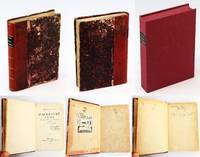
1864564j1976Bruxelles: Imprimerie de A. Mertens et Fils. Fair with No dust jacket as issued. 1864. First Edition. Hardcover. Is this book the plagiarized source of The Protocols of the Learned Elders of Zion "In his 1870 autobiography Maurice Joly 1829-1878 described how he conceived the idea of a dialogue between Montesquieu and Machiavelli. At that time it was forbidden to openly criticize the regime of Napoleon III but in this way it would be possible through the mouth of Machiavelli to expose the Emperor's motives and methods stripped of the usual camouflage. Thus this book was printed in Belgium and smuggled into France but was immediately seized by the police banned and Joly arrested. Thus few copies survive. Joly's reflections on the despotism of Napoleon III provide insights applicable to authoritarian regimes of today. Moreover something of Joly's insights even survived when his book was transformed into The Protocols of the Elders of Zion thus The Protocols often seem to forecast twentieth-century authoritarianism." - pages 73-76 of Warrant for Genocide by Norman Cohn in which he claims over 160 passages in the Protocols are clearly based on passages in Joly. "The Protocols of the Wise Men of Zion were first circulated in Russia in the early years of the twentieth century purportedly an account of a meeting between Jewish leaders in the fall of 1897. A horrible plot to undermine society overthrow governments and destroy Christianity is revealed. The 'minutes' are copied verbatim from A Dialogue in Hades Between Machiavelli and Montesquiou written by Maurice Joly. The 'Protocols' merely substituted the word 'Jew' for Joly's own devils." - Footnotes to pages 423-424 of Mein Kampf Reynal & Hitchcock 1939. Others argue that Joly's work was not the source of The Protocols. We leave it to the reader to decide. 4 i-iii iv 337 1 1 errata p. 18.0 x 12.4 cm. Text in French. Tight maroon quarter leather binding with new leather spine and leather title label. Wear to periphery of older marbled boards which are probably not original. Bookplate of Dr. J.A. Van Praag 1895-1969 inside front board. Van Praag was a lecturer at the University of Amsterdam when he acquired this book in 1931 and wrote his name atop the first blank leaf along with a comment about the purported connection of the book to The Protocols. He also wrote Joly's name on the title page. Pencil notes on pages 47 80 and 94. Evidence of moisture exposure to endpapers and more moderately to contents. Negligible if any waviness to contents. All text clearly legible with pages intact. Includes new custom acid-free clamshell with leather title label upon spine. A rare first edition example of this most contentious work. Provenance: Acquired from an Israeli dealer who purchased it at an Israeli auction which only sells books offered by Israelis. Our research indicates that at least some of Van Praag's books were looted by the Nazis in 1941. Apparently he retired in 1966 and attempted to rebuild his library. However after a fire in his widow's home in 1970 part of the library was destroyed or damaged and she sold the remaining books. We have no definitive way of knowing if this book was looted from Van Praag or if it was if he ever re-acquired it. Perhaps he did re-acquire it only to have it exposed to moisture per our description by firefighting efforts in his widow's home; 12mo . Imprimerie de A. Mertens et Fils hardcover
190660282Madrid, 1906. Folio oblong. Bound in a splendid recent full longgrained burgundy morocco binding in pastiche style, with four raised bands to beautifully gilt spine. Boards with gilt ornamental borders and gilt centre-piece. Gilt line to edges of boards and inner gilt dentelles. Marbled end-papers. All leaves re-hinged. Occasional light brownspotting, but overall very nice. Title-page (the version with the second line (beginning ""Colección de Ochenta...) in lower case), 2 pp. of text (dated 1863) + 80 engraved plates (on fine, laid paper measuring 23,4x32 cm.). Plates 17 and 77 have been misbound (the numbers 1 and 7 look almost the same - Harris II:201: ""In some sets this plate has been bound out of order where the number hs been read as 77"""" II:288: ""In some sets this plate has been bound out of order where the number has been read as 17).
Madrid, 1906. Folio oblong. Bound in a splendid recent full longgrained burgundy morocco binding in pastiche style, with four raised bands to beautifully gilt spine. Boards with gilt ornamental borders and gilt centre-piece. Gilt line to edges of boards and inner gilt dentelles. Marbled end-papers. All leaves re-hinged. Occasional light brownspotting, but overall very nice. Title-page (the version with the second line (beginning ""Colección de Ochenta...) in lower case), 2 pp. of text (dated 1863) + 80 engraved plates (on fine, laid paper measuring 23,4x32 cm.). Plates 17 and 77 have been misbound (the numbers 1 and 7 look almost the same - Harris II:201: ""In some sets this plate has been bound out of order where the number hs been read as 77""" " II:288: ""In some sets this plate has been bound out of order where the number has been read as 17).
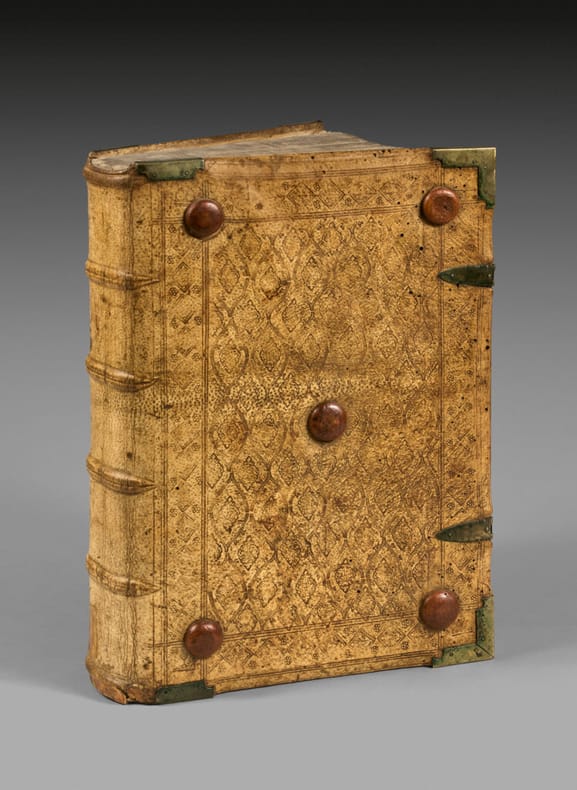
LCS-18204Provenance : Tobias Kleselius, anno 1592. Nuremberg, Anton Koberger, 21 August 1486. Grand in-folio de (328) ff. (les premier et dernier ff. bl. servent de feuilles de garde), qq. espaces laissés pour les initiales ont été remplis par un lecteur de l’époque, trous de vers en marge des 35 premiers ff., 8 ff. plus courts en marge inf. Peau de truie estampée à froid sur ais de bois de l’époque, cinq cabochons de bois sur chacun des plats, coins protégés par des angles en laiton, restes de fermoirs en laiton et en cuir. Reliure de l’époque. 402 x 278 mm.
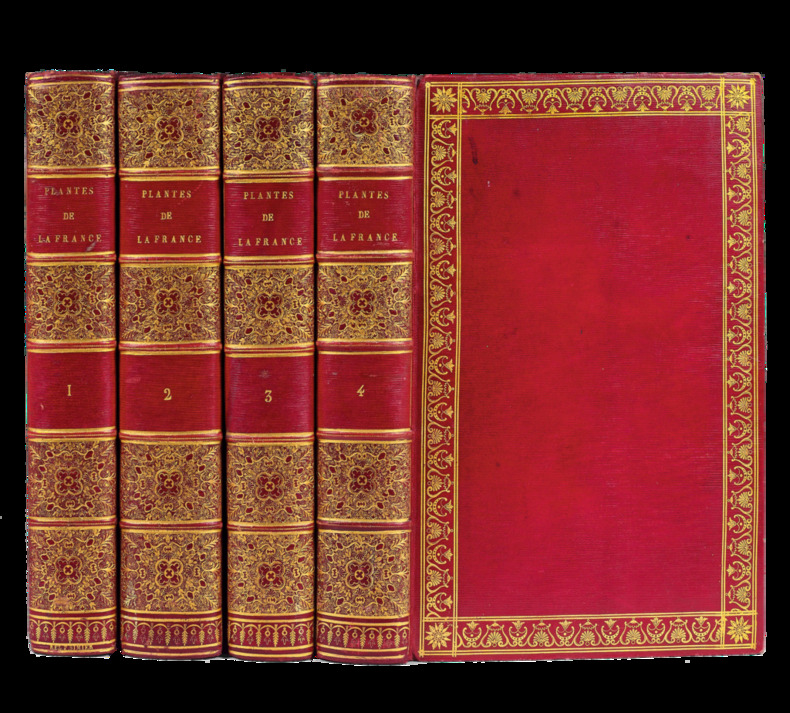
LCS-18361«Il n’existe point de collection dans laquelle se trouvent réunies autant de plantes de France et surtout des figures dont l’exécution soit aussi satisfaisante». Paris, chez l’auteur, 1808-1809. 4 tomes reliés en 4 volumes petit in-4 de: I/(1) f., vi pp., xxviii, (82) ff., 94 planches; II/(1) f., (114) ff., 114 planches; III/(1) f., 93 ff. texte et 92 pl.; IV/(1) f., (99) ff., 99 pl, (6) ff. Soit un total de 399 planches lithographiées (sur 400). La planche «Pervenche grande» qui devait se trouver dans le tome III a été placée dans le tome II et la planche «Narcisse jonquille» (p. 265) n’a jamais été insérée dans le même tome III. Reliés en maroquin rouge à grain long de l’époque, large roulette dorée encadrant les plats, dos à petits nerfs ornés aux mille points, roulette dorée sur les coupes, roulette dorée intérieure, gardes et doublures de tabis bleu, tranches dorées. Reliure de l’époque signée de Simier. 257 x 164 mm.
LCS-18411Précieux exemplaire de cette édition originale recherchée dans une ravissante reliure en maroquin janséniste de Trautz-Bauzonnet. Paris, Claude Barbin, 1665. Avec privilège du Roy. In-12 de (24) ff. préliminaires y compris le frontispice, 150 pp., (5) ff. de table et de privilège. Relié en plein maroquin brun janséniste, dos à nerfs, double filet or sur les coupes, roulette dorée intérieure, tranches dorées sur marbrures. Reliure signée Trautz-Bauzonnet. 147 x 83 mm.
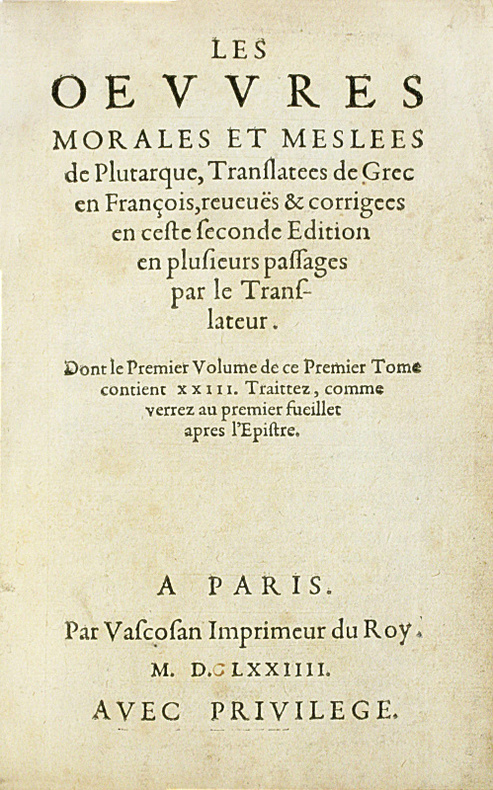
LCS-17362La plus belle édition ancienne des Œuvres de Plutarque traduite par Amyot et imprimée par Vascosan.Paris, 1567-1574.De la bibliothèque Hector de Backer (n° 472). Paris, par Vascosan, imprimeur du roy, 1567.6 volumes petit in-8.Les œuvres morales et meslees de Plutarque, Translatées de Grec en François, reueuës & corrigees en ceste seconde Edition en plusieurs passages par le Translateur.Paris, par Vascosan, 1574.7 volumes petit in-8. Ensemble 13 volumes in-8. Exemplaire réglé. Maroquin vert, triple filet doré encadrant les plats, dos lisses ornés de filets, roulette et volutes dorés, coupes décorées, roulette intérieure, tranches dorées. Reliure de Derôme le jeune. 159 x 101 mm.
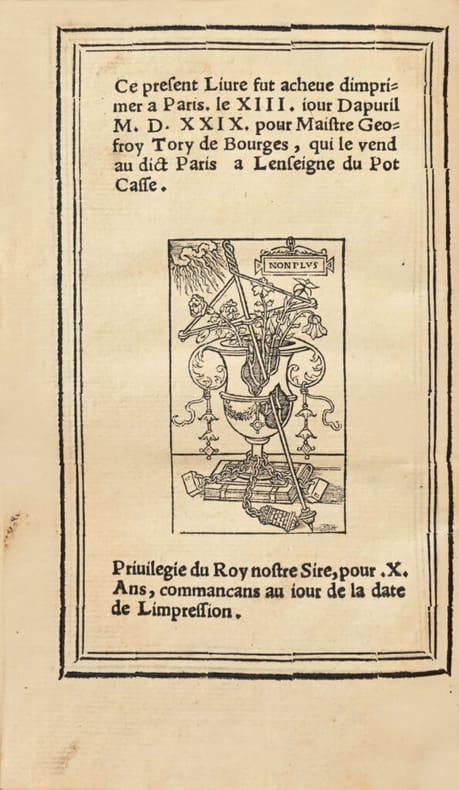
LCS-1864017Précieux exemplaire conservé dans son vélin du XVIIe siècle. On les vend a Paris, a Lenseigne du Pot cassé. (à la fin): Ce present Livre fust acheve dimprimer a Paris le XIII. Iour dapvril M.DXXIX, pour Maistre Geofroy Tory de Bourges, qui le vend au dict Paris a Lenseigne du Pot casse (13 avril 1529). Petit in-8, contenant (16) ff. préliminaires, 99 ff. de texte et (13) ff de table, lettres rondes, marque au pot cassé au dernier feuillet, l’ensemble du texte est imprimé au sein d’un triple encadrement de filets. Plein vélin ivoire, dos lisse, titre et date calligraphiés à l’encre brune, infime galerie de vers en marge intérieure d’une vingtaine de ff. sans atteinte au texte, taches d’encre sur 2 ff., garde finale renouvelée. Reliure du XVIIe siècle. 161 x 103 mm.
- Nrf, Paris 1929, 25,5x33,5cm, relié. - Voyage au Congo suivi de Retour du Tchad Nrf | Paris 1929 | 25,5 x 33,5 cm | full calf & custom slipcase First collective edition of two journeys in Africa by André Gide published successively in 1927 and 1928. First and luxury edition illustrated with 64 original photographs by Marc Allégret printed in sepia and four cards. One of 28 numbered copies on imperial Japan paper, the tirage de tête. Our copy includes the 1928 colophon specific to the copies of the very first print on Japan and which will be corrected in the copies on Arches (Bibliographie des écrits d'André Gide, Arnold Naville). The high ink absorption quality of Japan paper and its affinity with colour make it the ideal medium for Marc Allégret's famous sepia heliographed photographs. Binding lined with rods in white aniline calf, decoration painted in ink with shades of green, yellow and red, colours of the Republic of the Congo-Brazzaville flag, gilt titanium rods, decoration continuing edge-to-edge on the liners, loose endpapers on Japanese paper dyed with Kakishibu by the binder. Title lengthwise on the spine. Rigid decorated chemise, titled on the spine, matching custom slipcase. Binding signed by Julie Auzillon, gilt film title by Geneviève Quarré de Boiry and yellow gold gilt top edge by Jean-Luc Bongrain. (2022) Very scarce tirage de tête on Japan paper of this masterpiece book of photographs and the first account of travel to these very remote territories of central Africa by an intellectual, and outspoken critic of colonialism. Unique copy set in a stunning art binding, in the colours of the Republic of Congo-Brazzaville. [FRENCH VERSION FOLLOWS] Edition originale collective des deux voyages en Afrique d'André Gide parus successivement en 1927 et 1928, première et luxueuse édition illustrée de 64 photographies originales de Marc Allégret, tirées en sépia, et de quatre cartes, un des 28 exemplaires numérotés sur Japon impérial, tirage de tête. Notre exemplaire comporte bien l'achevé d'imprimer de 1928 propre aux exemplaires de tout premier tirage sur Japon et qui sera corrigé dans les exemplaires sur Arches (Bibliographie des écrits d'André Gide, Arnold Naville). La grande qualité d'absorption de l'encre du papier Japon et son affinité avec la couleur en fait le support idéal pour les fameuses photographies de Marc Allégret héliogravées en sépia. Reliure doublée à tiges en plein veau aniline blanc, décor peint à l'encre en nuances de vert, de jaune et de rouge, couleurs du drapeau de la République du Congo-Brazzaville, tiges de titane dorées, décor se poursuivant sur les doublures bords à bords, gardes volantes en papier japonais teinté au Kakishibu par la relieuse. Titrage en long sur le dos. Chemise rigide décorée, titrée sur le dos, étui. Reliure signée de Julie Auzillon, titrage au film doré de Geneviève Quarré de Boiry et tranche de tête dorée à l'or jaune par Jean-Luc Bongrain. (2022) Très rare tirage de tête sur japon de ce chef-d'oeuvre du livre de photographies et première relation de voyage dans ces territoires très reculés de l'Afrique centrale par un intellectuel critique à l'égard du colonialisme. Unique exemplaire établi dans une somptueuse reliure d'art, aux couleurs de la République du Congo-Brazzaville.
4to. (8), 79, (1) pp. With woodcut headpiece on t. p. and initials. 19th century orange-red crushed morocco by Riviere with leading edges gilt and elaborate gilt inner dentelle, rebacked. All edges gilt. The exceedingly rare first edition of one of the earliest English treatises on horsemanship, derived in part from Xenophon, Federico Grisone's "Ordini di cavalcare", and other authors, and in part from Astley's own experience. This is, in fact, the first translation into English of Xenophon's treatise "Peri hippikes" ("On horsemanship"). - The publication of Astley's "Art of Riding", perhaps his single most lasting achievement, came late in his life as an Elizabethan courtier. Here, he relays the doctrine of the Italian riding schools as he and other Gentleman Pensioners understood it, particularly on training the horse to respond to the hand. Astley was on friendly terms with Thomas Blundeville, whose Grisone translation two decades earlier counts as the first treatise on horsemanship to be published in English. - First three leaves slightly browned, with the upper right corner of each leaf imperceptibly restored from another copy; a closed tear to f. A4. Altogether a remarkable clean and crisp copy in an English master binding. The Fitzwilliam-Gloucester copy, bound with a common companion piece, Claudio Corte's "Art of Riding" (also published by Denham in the same year) commanded £14,400 at Christie's in 2006. The catalogue notes that the scarcity of these two work "at auction varies markedly; ABPC records some 5 copies of Corte's work at auction since 1975, but none of Astley's". Huth p. 11. STC 884. Mellon/Podeschi 12. Hoffmann III, 609 (s. v. Xenophon).
Small 4to (146 x 206 mm). 64 pp. With printer's woodcut device on title-page. 19th century red boards. Only edition of this early milestone of Arabic typography from the Roman Medici Press, including a Latin treatise on Arabic script. The Medici Oriental Press, the first printing press in Europe dedicated to printing books in an Arabic typeface, was founded in Rome under the direction of Giovanni Battista Raimondi and the patronage of Pope Gregory XIII. For the Arabic types, Raimondi commissioned the famous typefounder Robert Granjon: "In a few years Granjon had cut a large number of oriental characters, following superb calligraphic designs provided by Raimondi. On September 6, 1586, he completed the small Arabic typeface [...] Because cutting the Arabic typefaces took such a long time, establishment of the Medici Press went slowly. Though the contracts formally setting up the press were signed on March 6, 1584, the first book to bear its imprint did not appear until 1591. Legible and much more 'oriental' in feel than those of de Gregorii, Postel or Spey, this face was not improved upon until the time of Ibrahim Müteferrika in the early 18th century [...] Once underway, however, the Medici Press was very productive. In 1592 it issued a prospectus of its Arabic type faces under the title 'Alphabetum arabicum' - a 64-page masterpiece of design which not only displays Granjon's beautiful types, but contains a careful Latin Essay on the Arabic writing system" (Lunde). Until 1610 Raimondi printed a mere eight works with Granjon's types, "all equally rare" (Smitskamp 29b), before a long hiatus ensued - probably due to the sluggish distribution of the works in the Orient, where everything produced in the West, and especially any printed specimen of Arabic script, was received with the utmost caution (cf. Fück 55). Even Smitskamp cites only four other productions of the Medici Press, but not this exceptionally rare one. One of the only three other copies known to have appeared in the trade was even thought to be incomplete by Sotheby's, since Adams's collation - based on the Trinity College copy - cites a 24-page appendix that is, in fact, an independent Medici Press grammar bound with the Trinity 'Alphabetum'. - Binding worn and rubbed; spine rebacked. Interior somewhat dust-soiled throughout with occasional light dampstaining; a few marginal annotations on the verso of the title cropped by binder. Title-page with minute wormhole affecting one word on verso; a small hole to the last leaf with loss of a few letters; stamp of a monk to margin of final page. Front pastedown has 1880s bookseller ticket by G. A. Young & Co. of Edinburgh pasted in. An entirely complete copy of an important and excessively rare publication. Adams A 780. BM-STC Italian 36. Schnurrer 41. Edit 16, CNCE 1227. OCLC 47816774. Lunde, Paul, "Arabic and the Art of Printing", in: Aramco World 32/2 (1981) (with illustration). J. Balagna, L'imprimerie arabe en occident (Paris 1984), p. 135. Le Livre et le Liban (mentioned on p. 190; no copy in the catalogue). Not in Smitskamp or Fück.
Hand-drawn military map and organizational flowchart, 1.37 x 1.45 m. Coloured ink and watercolour on paper. Accompanied by 9 original photos. Unique hand-drawn chart of Bahrain's naval force as it was projected in the early and mid-1970s, including two large maps: firstly, of the island's location in the Gulf showing the Navy's planned 200-mile range as well as strategic points throughout the Gulf, and secondly, a smaller scale map showing the defensive coastal artillery firing range and radar ranges reaching out to the north and east of Qal'at al-Bahrain, Galali, and East Sitra bases around Manamah. An inset flowchart shows in detail the organization of Bahrain's Navy, to be headed by the Commander of Naval Forces, presiding over the branches of Supplies and Exercises (Engineers, Supplies, Medical Office), of Operations, Planning, and Signals (all commanded by the Chief of Staff), as well as the Naval Armed Forces proper (Fleet, Special Forces, and Coastal Artillery). The extensive annotation describes the maritime theatre of war around Bahrain, identifies vital targets (Port Sulayman, oil terminal, national airport, oil wells and storage tanks, refinery) and crucial points to be observed, and sketches the projected scope of the navy: initially a small fleet of armoured motor vessels with radar-guided automatic ordnance, later to be upgraded with surface-to-surface rocket launchers with a tactical range of ca. 180 nautical miles. The planning stage is to encompass some 2 to 3 months, followed by a development stage of about 3 years and an implementation phase of another year. - The chart is accompanied by a set of nine original mid-1970s photographs of members of the Egyptian General Staff who assumedly were closely involved in advising the government of Bahrain on the structure and implementation of their new Naval Forces, which became fully operational in 1979. - A fine survival, undocumented and at the time undoubtedly a closely guarded military secret.
Folio (214 x 342 mm). 3 vols. bound in one. (4), 120 (instead of 124) pp. (2), 142 pp. 172, (4) pp. Two title pages printed in red and black. With a total of 97 (instead of 98) half-page woodcuts in the text. Period style dark brown calf, elaborately gilt decorated spine and boards, red morocco spine label, raised bands, marbled endpapers. First editions of three separately issued parts of the very scarce "newly-opened amphitheatre", comprising the America, Asia, and Turkey volumes. The exceptional large woodcuts show the native inhabitants of the various parts of the world. Of special interest is the rare volume dedicated only to Ottoman society, as well as that on Asia: together, they cover the Islamic countries of the early modern period, including details on the Arabian Peninsula. Among the illustrations are various Muslim clerics, Northern Arabians and desert Arabians in Bedouin costume, coffee salesmen, sweetmeats salesmen, and a Turkish gentleman carrying the Qur'an on his head, as well as Persians, the Sultan, Janissaries, archers, dancers, etc. The Asia volume, produced later, repeats a single illustration but contains much new matter on Arabia, including a discussion of the Muslim religion, the Qur'an, ablutions performed with sand, and the trade in incense, coffee, and spices, as well as pearl fishing in Bahrain (p. 54). The America volume covers the discovery and exploration of America, with woodcut illustrations including portraits of Columbus, Vespucci, Magellan, and 30 depictions of Native Americans from throughout the New World, including Virginia, California, Pennsylvania, Maryland, etc. - This present set omits the parts on Europe and Africa, which were published first, and thus contains parts 3 (America) and 4 (Asia) of the four-part "Neu-eröffnetes Amphitheatrum" (the final part of which was produced only after a five-year hiatus), along with the "Neu-eröffnetes Amphitheatrum Turcicum", separately issued in 1723, from which the 1728 volume on Asia drew freely. Severely browned throughout due to paper. Title page of "America" vol. remargined; edge-wear to first and last few leaves only; wants quire G (pp. 25-28, including one illustration). Quire K in "Turkey" vol. (pp. 37-40) with expert paper repairs. In a highly appealing modern binding. Lipperheide Ac 5. Colas 2187. Hiler 652. Sabin 52360. Palmer 364. Not in Atabey or Blackmer. Not in Hünersdorff (Coffee).
Album containing ca. 50 autograph and typed letters letters, signed menus, photographs and other ephemera. Oblong folio (365 x 265 mm). 31 leaves, brown calf giltstamped "Penelope Ann Drinkwater / July 26 1929" on upper cover (scuffed and stained, burn marks to spine). With a folder of ca. 100 loose autograph and typed letters, a printed Churchill address, and typed transcripts of letters by Rupert Brooke and others in folder annotated "sold to America" (ca. 160 pp., 8vo and 4to). Also, an original cartoon by David Low (pen, ink and coloured pencil, image 295 x 450 mm / 457 x 610 mm with frame, published in the Evening Standard, 28 April 1930, and in The Best of Low, 1930). An album assembled by John Drinkwater for his daughter Penelope Ann, celebrating the first years of her life from her birth in 1929 to her fifth birthday with a collection of letters and ephemera from literary and political figures of the day, and including an encounter with royalty. Despite being in the running for Poet Laureate, as the Low cartoon included here suggests, the position was taken by John Masefield after the death of Robert Bridges in April 1930. The collection comes from the family of Penelope Drinkwater. - Comprises: notes written by the Prince of Wales (the future Edward VIII) for his speech at the Stage Golfing Society Dinner, Savoy Hotel, 2 Nov. 1930 ("Handicapp / B-DARWIN / Filthy golfer / Filthy speaker / Keep pun clean"), accompanied by an explanatory letter from Drinkwater ("I was the guest of Sir Gerald du Maurier who sat between me and the Prince of Wales [...] The response was made by the Prince, and he put his notes on two sheets of paper. These were pocketed by Sir Gerald, and he gave me one of these for you [...] another scrap of history in a tiny way for you when you are growd up"). Also, some 50 autograph and typed letters by Edward Elgar (thanking him for the "exquisite Penelope's Trees - a beautifully inspired poem"), Arnold Bennett, John Galsworthy (including a poem in her honour), Hugh Walpole, Joan Sutherland, Sybil Thorndike, Harold Nicholson, William Rothenstein, Herbert Hoover (two on White House headed paper), E. G. Robinson, Ramsay Macdonald, and others; a menu from the Savoy Hotel, 24 June 1930, signed by Drinkwater, J. B. Priestley, H. G. Wells, Arnold Bennett, Edgar Wallace, Desmond Macarthy and others, with another from a dinner on 19 September 1930 inscribed by Max Beerbohm ("to dear little Penelope Anne. I know she is little because she is so young. And I know she is a dear because I know her parents"); ephemera including a programme for Drinkwater's play "A Man's House" signed by the cast (with Errol Flynn as 'First Soldier'), telegrams of congratulations (including James Joyce and John Galsworthy), a printed copy of Drinkwater's 1930 poem "Penelope's Trees", inscribed "This copy is darling Penelope's own / John Drinkwater", numerous photographs and press cuttings of the family, etc. - The folder of loose correspondence includes H. G. Wells (postcard, "warmest thanks for the poem. It's a nice habit this poetry" and autograph letter to Miss Jeffreys sending love to Penny, "I think she is a dear"), a pencil drawing annotated "sketch by T[homas] H[ardy] of a hay-knife", Edmund Blunden ("I would like you to leave me out of your anthology"), Vita Sackville West ("She seems to be a fruitful source of inspiration to you"), Eddie Marsh, Shane Leslie, Stefan Zweig, and others; with a printed Churchill address from 25 April 1925 with covering letter, as well as typed transcripts of letters by Rupert Brooke and others. - The David Low cartoon, signed "Low" and titled "Situation Vacant", depicts Drinkwater, Masefield, Kipling, Edith Sitwell and other possible candidates for the post of Poet Laureate lining up to see the Prime Minister ("W. B. Yeats and W. H. Davies arriving by the next bus"), labelled "The Property of Penelope Ann Drinkwater" on reverse.
Mostly folio (315 x 210 mm). A manuscript compilation of loose leaves and bifolia, with about 104 drawings (some in ink; some in coloured gouaches, many including gold, silver and other metallic colours) and about 53 engravings (some black on white; some white on black), each drawing and engraving showing the obverse and reverse of an Islamic coin or medal (except for about 3 that show only one side). Most of the drawings and engravings are on slips attached to leaves with notes in Arabic and French. An extensive study of Islamic coins, medals, and seals prepared on loose leaves and bifolia, with about 104 drawings (in ink or coloured gouaches, many with gold and/or silver and occasionally copper or metallic blue) and about 53 engravings, most drawings and engravings with manuscript notes in Arabic and French. Nearly every drawing and engraving shows both the obverse and the reverse of the coin or medal, some shown at the original size and some enlarged, so the diameter of the coins in the drawings ranges from about 1½ cms to about 10 cms, though even some of the larger ones note that they are drawn at the original size. Some of the ink drawings were made directly on the leaves, but nearly all of the colour drawings and engravings are on separate slips mounted on the leaves (some pasted, some with sealing wax, some with pins). The notes on these leaves usually give the dates of the coins (whether or not the coins themselves are dated) following the Islamic Hijri calendar and sometimes also following the Christian calendar. They often give a transcription of the inscriptions in a naskh Arabic hand (though they appear on the coins in several styles of Arabic script, including Kufic). A few include longer notes in French. The coins come from Egypt, the Ottoman Empire, Morocco, Algeria, Tunesia, Tripoli and elsewhere. - The dates given for the coins range from at least AH 93 to at least AH 1203 and probably to AH 1219 (712-1788 CE and probably to 1804/05 CE). The compilation of these drawings, engravings and notes probably began in the 1790s and may have spanned two or three decades. A few of the leaves (including some with drawings made directly on the leaves) show a paper stock with a watermark date "1791", and many leaves show a distinctive kind of watermark that was used in 1805. They frequently include abbreviated references to Jacob Georg Christian Adler, Museum Cuficum Borgianum velitris, Rome, 1782; Denis Samuel-Bernard, Mémoire sur les monnaies d'Egypte, Paris, 1809; and Description de l'Égypte ... État moderne, plates vol. II, Paris, 1817 (plates h-k show 127, 123 and 178 coins and medals), the last giving the earliest possible date for the completion of the compilation. Many of the engravings in the present compilation are taken from these three sources, and there is even what may be a proof of an unfinished plate from Bernard. One leaf has a mounted letterpress fragment with a biography of Ahmed ben Mohammed Khan, clipped from p. 67 of the 1776 Maastricht edition of Barthelemy d'Herbelot de Molainville, Bibliotheque orientale. - Although the manuscript nowhere names its compiler(s), Jean Joseph Marcel (1776-1854), grandnephew of the Consul Général in Egypt, was a brilliant student at the University of Paris, where he received many prizes in 1790 and 1791 and began his study of oriental languages. He came into contact with the orientalist Louis-Mathieu Langlés, who arranged for him to accompany Napoleon on his 1798 Egyptian Campaign (1798-1801), where he took charge of the Campaign's printing office (printing an Arabic type specimen in 1798), made the first steps toward deciphering the Rosetta Stone, and collected medals, manuscripts and inscriptions. Back in Paris he became director of the Imprimerie Impérial, a post he held until 1815. He wrote, compiled or translated numerous works concerning Arabic and other oriental languages. He may have planned to produce a publication based on the present compilation, but no such publication appeared. The compilation in any case shows Europe's new interest in Islamic studies after Napoleon's Egyptian Campaign, with Paris as its most important centre. - About 3 small drawings appear to have been made on oiled paper, probably in order to trace coins or engravings of coins, and a few are drawn on tissue paper. Many of the larger drawings are in colour, and a few are enlarged copies of the smaller drawings or engravings. Some leaves are tattered along the edges and a few have had their corners cut off, none of this affecting the illustrations or text. In a very small number the ink has corroded in the paper, more severely in 2 leaves, and one of the drawings on oiled paper has been cut up with 3 (of 4?) pieces surviving, but most of the leaves remain in good condition. A remarkable record of Islamic coins and medals, compiled ca. 1791-1817, with about 157 illustrations. For Marcel: Alain Messaoudi, Les Arabisants et la France coloniale (2015), pp. 239-240.
Large folio (620 x 508 mm). A total of 31 albumen prints (of an average size of 390 x 280 mm), individually mounted on card. Contemporary red half morocco and pebbled red cloth, titled in gilt on spine. A fine album of large-format photographs mainly of Egypt and Palestine, including numerous fine and early views of mosques, all by the most famous 19th century photographer of the Arab world, Félix Bonfils (1831-85). Among the famous locations captured in his high-quality albumen prints are the Mosque of Sultan Hassan, the newly-built Great Mosque of Muhammad Ali (one image showing the fountain of ablution), the Sultan Qaytbay Mosque and funerary complex, as well as the Tombs of the Caliphs, the Fountain of the Valide Sultan, and the so-called Chair of Omar (Membar) in the Temple Square. Ancient Egypt is well represented, as well. In Jerusalem, the collection includes views of the Mosque of Omar (that is the Dome of the Rock, or Qubbat al-Sakhrah), the Church of Saint Anne with the Dome of the Rock, as well as Zion Gate and several street scenes in the older districts of the city, but also the Church of the Holy Sepulchre (Kanisatu al-Qiyamah), with Christian priests posing on a balcony, some standing on a ladder which is famously permanent - by rumour due to the Status Quo agreement between the numerous Christian sects which use the church. In Istanbul (Constantinople), the Hagia Sophia Grand Mosque is pictured. A few additional images show the tidewater at Jaffa and two sites in Athens. All photographs are signed and titled in plate by Bonfils. - Some exterior wear; the large-sized photographs are well preserved.
4to. (90), 560 [but p. 255f. repeated], (10) pp. Latin title printed in red and black; one Latin and two Arabic (woodcut) half-titles. Preface in Latin, text in vocalized Arabic throughout. Contemporary half calf with marbled covers and giltstamped label to sparsely gilt spine. The famous "Hamburg Koran": while not actually (as it was long considered) the first printed Qur'an ever, the first accessible printed edition of the Arabic text. Only in 1987 was a unique copy of Paganino de Paganinis's Venetian edition (c. 1538) rediscovered, a work whose press run either was destroyed immediately or was limited to the sole surviving specimen, apparently a proof copy (cf. A. Nuovo, "Il Corano arabo ritrovato", in: Bibliofilia LXXX, IX, 1987). Four years after the present edition, in 1698, Lodovico Marracci produced his own Qur'an, but its two big tomes were anything but easy to consult - hence, the Hamburg Koran remained "the only available and handleable" (Smitskamp) edition until the early 19th century. - Abraham Hinckelmann (1652-95), a Hamburg theologian, studied at Wittenberg and collected many Oriental manuscripts. He compiled a Quranic lexicon in manuscript and planned a Latin translation of the Koran, but this was never realised. - Some browning throughout, as common due to paper; slight waterstaining near end. Ms. ownership of Joseph Venturi in Arabic, Hebrew, and Latin ("emit Romae An. 1789") on Latin title (his quotation from Brunet on first Arabic title), with early 19th c. ownership of Blasius Milani. This is the uncommon variant with two different woodcut Arabic titles. Schnurrer 376. Smitskamp, PO 360. Fück 94. Le Livre et le Liban 135f. Woolworth 279. Hamilton, Europe and the Arab World 33. Brunet III, 1306. H. Bobzin, From Venice to Cairo, in: Middle Eastern Languages and the Print Revolution (2002), p. 151-176, at p.160f., with 2 illustrations (figs. VI and 74). The Heritage Library: Treasures of Islamic and Arabic Heritage (Qatar 2006), s. v. "Religion", with illustration.
Folio (205 x 312 mm). Arabic manuscript on paper. 53 ff., 33 lines to the page written in minute ghubar script in black ink, verse separated by a gold roundel, surah heading in red thuluth on gold background, margins illuminated with gilt discs or lozenges inscribed in red and enclosed within ornamental borders dotted in blue; fols. 1b-2a with a double-page illuminated frontispiece, lavishly coloured and gilt. Contemporary blindstamped and gilt black leather binding; spine rebacked. Marbled pastedowns. A fine, complete Qur'an manuscript, written in meticulous ghubar script and with pretty illumination, originating from the Kashmir region in the late 18th century. The characteristic calligraphy is known as "ghubar", or "dust script", for the minuscule size of its rounded letter forms. Created around the 10th century, it was first used for information and commands conveyed by carrier pigeon. Even the present, more generous form fits the entire Holy Qur'an into a slim folio of only fifty-odd pages. - Edges occasionally very slightly chipped but generally very fine. Binding well preserved with modern spine. The central compartment of the pretty binding shows a Qur'anic verse (Surah 56, verse 79: "to be touched only by the purified") stamped in blind three times on both covers.