690 923 résultats
4to. 1 page. With fly-leaf bearing address in his handwriting, and his seal (head of Lady Hamilton). Fine autograph letter to "Lady Hamilton, 23 Piccadilly, London". An important letter written when Nelson was Commander-in-Chief in the Baltic, six weeks after the Battle of Copenhagen. The political situation was complicated in that the Russians, while not now openly hostile, were definitely unfriendly. The cold air of the northern latitudes disagreed with Nelson, who had a severe cough and chill, and he was depressed at the separation from Lady Hamilton and concerned about their baby daughter Horatia, who had been born in January. The letter is discreet, evidently because of Nelson's fear that it might fall into other hands, and he employs the deception previously arranged with Lady Hamilton of referring to himself as "Thomson". The tone of the letter is melancholic, and Nelson concludes by quoting the last portion of an equally unhappy letter he had written recently to the First Lord of the Admiralty Lord St. Vincent: "My Dearest Friend, | The Harpy Brig sails tomorrow for England, you will not receive this Line for a fortnight after her arrival. I cannot say a word on Politicks. I expect to find a new Admiral on my return which will be in a very few days, poor Thomson is return'd from Petersburgh he desires his kindest affections to his Wife and familiy [i. e. to Emma Hamilton herself and Horatia] - And ever believe me Your Most attach'd & affectionate | Nelson & Bronte. | Most probably you will never receive this letter I have 3 wrote for you now laying by me, firm as a Rock, finish of 8 lines to Lrd. St. V[incent]. I expect to find a new Ad[mira]l when I return off Bornholm, or most probably you will never see again your aff[ectiona]te | N & B".
4to (200 x 264 mm). IX, (3), 187, (1) pp. With 13 folding engraved plans and maps, 3 folding tables. Publisher's original cloth with giltstamped spine title, bound by Edmonds & Remnants with their label to lower pastedown. Author's presentation copy of the third edition, inscribed on the day of publication to the influential London architect and journalist George Godwin (1813-88) on the title-page: "Geo. Godwin Esq. / in gratitude for the services he has / rendered to the cause of good / sanitary construction / Florence Nightingale / London, Dec. 14 1863". - When 'Notes on Hospitals' first appeared in 1859, in much briefer form than here, it was "immediately greeted by George Godwin as essential reading for architects, who were advised to 'obtain the volume and master it'" (Mark Bostridge, Florence Nightingale, p. 337f.). As editor of 'The Builder', Godwin expanded its scope to include sanitation, social issues, and other subjects. He wrote on slums and promoted the use of public baths, wash-houses, charitable housing trusts, and pavilion-styled hospitals. His architectural works, centred around Kensington and Chelsea, include The Boltons, Elm Park Gardens, and St. Luke's Kensington. The 1863 edition of "Notes on Hospitals" was "massively augmented and rewritten that it is effectively a new book" (McDonald). - Spine and joints professionally restored. Old paper label on spine. - Provenance: 1) George Godwin (presentation inscription); 2) front pastedown has bookplate of James O'Byrne (1835-97), the Liverpool-based architect whose library was dispersed at Christie's in 1987. Lynn McDonald, Florence Nightingale and Hospital Reform (2012), p. 79. Cf. Garrison/Morton 1611 (citing the 1859 first edition).
Folio. 268 ff. Contemporary vellum with ms. title to spine. Fine incunabular edition of Pliny's famous encylopedic work, covering the entire field of ancient knowledge. With his "Natural History", Pliny gives a mathematical and physical description of the world, discusses geography, ethnography, anthropology, human physiology, zoology, botany, mineralogy, sculpture and painting. As "a purveyor of information both scientific and nonscientific, Pliny holds a place of exceptional importance in the tradition and diffusion of culture" (DSB). Through the present work Pliny "gives us by far the most detailed account of the coast of the United Arab Emirates that has come down to us. Chapter 32 of Book 6 (§ 149-152), beginning near the Qatar peninsula, proceeds to describe the Emirates islands, tribes, and coast right up to the Musandam peninsula, before continuing on south along the coast of Oman. As such, it is a mine of invaluable information on the UAE in the late pre-Islamic era" (UAE History, online). Pliny "completed his 'Natural History' in 77 AD and, to judge from his account of the peoples and places of south-eastern Arabia [...], the area of the UAE was full of settlements, tribes, and physical features, the names of which he recorded for posterity" (Ghareeb/Al Abed 54). - "This appears to be the first edition of Barbarus' recension, the note of a 1496 edition by the same printer being probably due to a confusion (Hain 13099)" (BMC). Dated 1497 in the colophon, but the dedication is dated the Ides of February in the twelfth year of the Doge Augustinus Barbadicus (30 Aug. 1497 to 29 Aug. 1498). - Numerous contemporary marginalia. Slight worming to gutter and some waterstaining near end; spine restored. Late 19th-c. bookplate of Dr. J. Klauber on front pastedown. HC 13101*. Goff P-799. GW M34321. Klebs 786.14. Proctor 4893A. BMC V 377. ISTC ip00799000.
Ten watercolour coastal profiles in grey and blue, of widely varying sizes (30 to 119 cm long), with contemporary captions and other notes in pencil or black ink. 20th-century brown cloth with the artist's original laid-paper wrappers bound at the end, spine title: "East Indian views by N. Pocock taken on the ship Worcester 1798". A series of ten lovely coastal profiles drawn in watercolour by the English artist Nicholas Pocock (1740-1821), showing coasts and mountains in the East Indies, both coasts of the Indian Ocean, China and the South Atlantic. In the first drawing Mount Agung, an active volcano and the highest mountain on Bali, appears prominently, with its pointed peak reaching above the clouds. - Pocock, son of a Bristol merchant mariner, pursued a career in the merchant marine but had been an amateur painter since childhood. As master mariner of the ship Lloyd, owned by the Quaker merchant Richard Champion, he illustrated his logbooks with fine ink and wash coastal profiles and other drawings (some now in the National Maritime Museum in Greenwich). When Champion went bankrupt in 1778 in the wake of the American Revolution, Pocock devoted himself to painting. His first professional efforts drew praise from Joshua Reynolds, and he exhibited at the Royal Academy beginning in 1782. Pocock soon became a celebrated maritime artist and painter to King George III, moving to London in 1789, where the rate books record him at Great George Street from that year to 1816. He sometimes accompanied naval ships to make sketches and notes that he developed into paintings when back in London. When he painted maritime scenes he had not witnessed live, he interviewed sailors and others to ensure the accuracy of details such as weather conditions, his practical experience as a master mariner aiding him considerably. - The present drawings are not signed individually, but the wrappers (bound at the end) are signed "... Pocock Esqr / Gt George Street". The captions identify the views, some with additional notes about directions, distances, latitudes or soundings. A few topographical names are difficult to read or show irregular spellings (the coordinates help identify some), but they appear to show coasts in Bali, Karimata, Serutu and Lombok (all in the East Indies), Coromandel (the southeast coast of India), Joanna Island (off Madagascar), Macao (across the bay from Hong Kong), Martin Vaz Islands (near Trinidad off the coast of Brazil), Srikakulam (on the east coast of India: 'Frycacoel' may be a misreading of the alternative spelling Ticacoel. The caption gives a latitude of 18° 4' and the ship Worcester stopped in Bengal ten days later: The Asiatic annual register ... for the year 1799, London, 1800, p. 53) and perhaps Burma (Myanmar) and Pondicherry (on the Coromandel coast). The captions identify them as follows (we add numbers giving the order as bound, the probable bibliographical formats and the dimensions): 1. Island of Bally. Oblong agenda 8vo (12 × 30 cm). 2. Caremata & Souroutou nearly in one. 20 fathoms soft ground, oblong agenda. 8vo (12 × 30 cm). 3. Extremes of Lombek ... southward. 3 oblong agenda 8vo leaves pasted together to make a panorama (12 × 87 cm). 4. Caremata & Sourontou. Oblong agenda 8vo (12 × 30 cm). 5. On the coast of Coromandel. 4 oblong 6mo leaves pasted together to make a panorama (16 × 119 cm). 6. Islands Joanna from N to NE. Oblong agenda 8vo (12 × 30 cm). 7. N Macoa. Oblong 4to (19 × 33 cm). 8. View of Martin Vos Rocks distant 7 leagues, Oblong 4to (20.5 × 28.5 cm). 9. The highland on both sides of Chicacul & Frycacoel ... taken on board the ship Worcester August 17th. 1798. Copy N[icholas] P[ocock]. Oblong agenda folio (24 × 59.5 cm). 10. The land of Barma ... The land on both sides - Pondy ... Oblong folio, with the profile rendered in three bands above one another (31.5 × 46 cm). - Only drawing 9 includes a date in the caption, indicating that it is Pocock's copy of a drawing of a scene from 17 August 1798. All the profiles are drawn on wove paper, probably all on pieces from sheets of Royal format made by James Whatman and his successors, who continued to use his name. Only two drawings show watermarks. Drawing 4 is watermarked: "J WHATMAN | 1804" centred along the right half of one long edge of the sheet, the caps and small caps about 19 and 12 mm tall. The other 4 drawings on one or more oblong agenda 8vo leaves are similar in style and may have been made at the same time. Drawing 10 is watermarked: "J WHATMAN", centred along the left half of one short edge of the sheet, the caps and small caps about 20 and 13 mm tall. Nearly all high quality English paper included a year in the watermark for several decades beginning in 1794, and Whatman's successors generally centred the date below the name, but no date appears under the name here. Moreover, the style of the lettering is older than that of the 1804 watermark, resembling Heawood 3458 (London 1784), 3459 (London post-1791), 3461 (n.p. 1781?), including the distinctive M of these marks (the diagonal joining the right vertical well below its top) but with clearer serifs than any of Heawood's (perhaps not very accurate) drawings. This paper seems likely to have been made before 1794. The paper of the ten drawings together contain about the equivalent of three whole sheets, but they would have to have been taken from at least four sheets. The wrappers are made of coarse laid paper and show no watermark. - With a small tear at the head of drawing 9, not approaching the image, drawing 7 spotted and slightly dirty, but further in very good condition. Coastal profiles, mostly in the East Indies and the Indian Ocean, by the maritime painter to King George III. For Pocock: ODNB 22425.
Imperial folio (360 x 490 mm). In the two original, matching decorative portfolios. Half cloth, boards with illustrated lithogr. title, inside covers and flaps with ornamental decoration printed in gold, green and blue. Green ties. I: 12 pp. 36 lithogr. plates in colour (of which 4 are double-page). II: 12 pp. 54 plates in colour (of which 2 are printed in gold on blue paper and 8 double-page sized). First edition of both parts, complete and not listed thus in library catalogues or auction records of the last decades. The first part was considered lost; indeed, its very existence was doubted ("apparently the first part was never published", Atabey Sale, Sotheby's 29 May 2002, lot 990, the second part alone fetching £22,000). Contains a finely chromolithographed selection of plates illustrating Islamic architecture and architectural details drawn from various mosques and numerous examples of ornamental decoration taken from Islamic fayences. - Some staining to upper covers of both portfolios; outer cloth of spines restored; mild foxing to margins of a few plates in part II; otherwise, plates clean and in good condition. Atabey 1015 (part 2 only). Not in Blackmer.
Small 4to (140 x 187 mm). 68 ff. (but title is fragmentary, preserving the letterpress only, laid down to old paper). Near-contemporary full leather binding, spine rebacked. All edges red. Rare edition of this famous and scare refutation of the Qur'an. The Dominican Ricoldus (ca. 1243-1320) was sent to the orient as a missionary in 1288. He visited the Holy Land and travelled to Baghdad via Cilicia, Erzurum, and Tabriz. During his stay in Baghdad, Ricoldus studied the Qur'an and other works of Islamic theology, for controversial purposes, arguing with Nestorian Christians. He is said even to have begun a translation of the Qur'an about 1290, but it is not known whether this work was completed. - Ricoldus returned to his native Florence around the year 1300 to compose or edit several works about the Middle East. While many of his writings praise the Muslims' social behaviour, hospitality and sense of honour, his best-known work, the "Contra legem Sarracenorum", is a notorious refutation of the Islamic doctrines. Largely a compilation from William of Tripolis, Marcus of Toledo and the "Contrarietas alpholica", and probably an early effort written in preparation of Ricoldus's mission, it contends that the Qur'an's self-contradictory passages, confused arrangement and want of miracles prove that Islam cannot be a true revealed religion. Despite Ricoldo's hostility towards Islam his work shows specific knowledge of the Qur'an and overcomes one important prejudicial error common to other medieval criticisms of Islam: the perception that Muhammad introduced a christological heresy. The work was widely received; a Greek translation was prepared as early as 1385 by Demetrius Kydones, which was re-translated into Latin by Bartolomeo Piceno as "Improbatio" or "Confutatio Alcorani". A Spanish version appeared at Toledo in 1502, and Luther translated parts into German in 1530 (his "Verlegung des Alcoran" appeared in 1542). It influenced Pope Pius II, John of Segovia and Nicolaus Cusanus (cf. LMA VII, 808). - Binding worn but professionally repaired; spine rebacked. Some fingerstaining and browning with occasional slight worming to gutter. Trimmed rather closely with printed marginalia cropped in places, title fragment torn out and mounted, preserving some old handwritten annotations. Provenance: Mehmed V (1844-1918), Sultan of the Ottoman Empire from 1909, with his his Arabic bookplate on the pastedown. VD 16, R 2328. BNHCat R 296. This edition not in Panzer.
Large 8vo. XVIII, 200 pp. With half-title, frontispiece portrait, 5 black-and-white plates, folding map and "Genealogical table of members of the Al Bu Said dynasty". Publisher's original blue cloth, title gilt on spine & upper cover, Said bin Sultan name gilt in Arabic on upper cover. Rare first edition: presentation copy from Said-Ruete to Sir Saleh bin Ghalib Al-Qu'aiti, Sultan of Shihr and Makalla (ruled 1936-56), inscribed in green ink: "To / His Highness The Sultan / of Shiher and Makalla / Saleh bin Galib Alcaity / a token of sincere esteem / by the Author. / London, May 7th 1937". Below this is pasted a printed bookplate in Arabic. - The Qu'aiti Sultanate of Shihr and Mukalla, in the Hadhramaut region of the southern Arabian Peninsula (now Yemen), was the third largest kingdom in Arabia after the Kingdom of Saudi Arabia and the Sultanate of Oman. While the monarchy was toppled by communists in 1967 and Sultan Ghalib II was forced to abdicate, the Qu'aiti royal family still thrives in exile. - Said-Ruete was the son of Princess Salma (1844-1924), daughter of Sayyid Sai’id ibn Sultan (1791-1856), ruler of Oman and Zanzibar. The Princess married Friedrich Ruete, a clerk at the German embassy, and lived for 52 years as a widow in Germany. Their son Rudolph produced this remarkable survey of his grandfather’s life and times, considered as important as Vincenzo Maurizi‘s "History of Seyd Said, Sultan of Muscat" (London 1819). Sayyid Said ibn Sultan became the ruler of Oman in 1806, when he was about 15 years of age. After defeating the opposition with British help he determined to reassert Oman's traditional claims in East Africa. He eventually succeeded, and in about 1840 shifted his capital to Zanzibar, where he introduced the cloves that became the foundation of the island's economy. He also controlled the Arab traders that brought back slaves and ivory from the African interior. In this monograph the author highlights the early history of Oman, the rise of Said ibn Sultan to power in Oman and Zanzibar, and his relations with foreign powers (France, England, and the United States). In his foreword to this work, Major General Sir Percy Cox identifies the establishment of an Arab dominion in Zanzibar as Sultan Said's most lasting achievement. - Minimal wear to extremeties; insignificant spotting to first few leaves as common. Upper spine-end professionally repaired. A beautiful copy. Macro 1986. OCLC 5705061.
8vo. 1¾ pp. on bifolium. With an postscript from his mother Franziska, née Luser (1884-1935), to the same recipient (1¾ pp.), and a photograph. Charming German-language letter by the 12-year-old to his cousin Emilie Tyrolt, in the United States, thanking for a "lovely Christmas card" and describing his efforts at school: "Habe Deine liebe Weihnachtskarte erhalten, für der ich Dir bestens danke. Unter einem sende ich Dir ein Bild von meinem Schwesterlein, den 'Pitzbub' wirst Du hoffentlich noch kennen. Wie Du vielleicht schon erfahren haben dürftest, besuche ich die Realschule. Da gibt es viel zu lernen, denn man wird sehr sekiert. Aber das macht nichts, 'Geduld bringt Rosen, 'Herrumrutschen' zerrißne Hosen' […]". - Includes a photograph of Oskar and Elfriede Schindler, taken in February 1920, from the studio of A. Papouschek, Zwittau (145 x 103 mm, mounted on cardboard).
4to. 3 parts in 4 vols.: 780, (34) pp. (12), 492, (24) pp. (2), 546, (24) pp. (20), 508, (18) pp. With engraved portrait of Pietro della Valle, 2 engraved title-vignettes, 3 woodcut title-vignettes, and several woodcut illustrations in the text. Contemporary full vellum with handwritten spine title and shelfmarks. All edges sprinkled red. A complete set of the first edition of Della Valle's "Viaggi", highly sought after as one of the earliest printed sources for the early history of Dibba, the coastal region at the northeastern tip of the United Arab Emirates, today ruled by the Emirates of Fujairah and of Sharjah. - Pietro della Valle (1586-1652) left Venice in 1614 on a pilgrimage to Palestine, proceeding to Baghdad and then into Persia, where he married and sojourned at the court of Shah Abbas. While staying with the Sultan of Bandar Abbas, he "met the son of the ruler of Dibba who was visiting. From this he learned that Dibba had formerly been subject to the kingdom of Hormuz, but was at that time loyal to the Safavids who in 1623 sent troops to Dibba, Khor Fakkan and other ports on the southeast coast of Arabia in order to prepare for a Portuguese counter-attack following their expulsion from Hormuz (Jarun). In fact, the Portuguese under Ruy Freire were so successful that the people of Dibba turned on their Safavid overlords, putting them all to death, whereupon a Portuguese garrison of 50 men was installed at Dibba. More Portuguese forces, however, had to be sent to Dibba in 1627 as a result of an Arab revolt. Curiously, two years later the Portuguese proposed moving part of the Mandaean population of southern Iraq, under pressure from neighbouring Arab tribes, to Dibba" (UAE History: 2000 to 200 years ago - UAEinteract, online). "Della Valle displayed excellent narrative and descriptive skills, powers of acute observation, and a genuinely scholarly breadth of learning. He refused to comment on what he had not witnessed himself or checked against the best authorities" (Gurney). He continued his travels east to the coast of India, Goa and Muscat, and thence back to Aleppo by way of Basra. He reached Rome in 1626, where the original Italian text of his letters written to the Neapolitan physician Mario Schipano was published. Only the first volume, dealing with Turkey, saw print during his lifetime. The two-part volume II on Persia was released in 1658, four years after his death, and the set was concluded in 1663 with the volume on India. Complete sets are usually encountered only with the first volume in its second edition, published in 1662. - Binding somewhat spotted. Some brownstaining throughout with occasional waterstains. Several repairs to p. 344 of vol. II; occasional insignificant marginal tears and small holes. Title page of vol. 2 (La Persia, parte prima) has the title of "parte seconda" with the word "seconda" overpasted with "prima" by the publisher. In all an attractive copy including the frequently missing portrait. Röhricht 946. Henze II, 42. Tobler 95. Gurney, "Della Valle, Pietro", in: Encyclopaedia Iranica (online ed.). Macro 1633. Cox I, 273. Wilson 234.
8vo. (24), 402, (22) pp., final blank f. Title-page printed in red and black. With 21 folding engr. plates and woodcut device at the end. Contemporary vellum with ms. spine title. Traces of ties. Excessively rare first printing of Hieronymus Megiser's German translation: Ludovico di Varthema's famous account of travels to Arabia, Syria, Persia, Ethiopia, India and the East Indies; a highly important and adventurous narrative including the first printed eyewitness account of any place in today's United Arab Emirates. On his return journey from Mecca (which he was the first Westerner to describe), Varthema visited Ras al-Khaimah ("Giulfar") and portrayed the city as "most excellent and abounding in everything", with "a good seaport", and whose inhabitants are "all Muslims". While Montalboddo's famous anthology of discoveries, printed in 1507, contained the first printed reference to the Arabian Gulf region, it was Varthema's work, published only three years later, that offered the first actual report from the region by a Western traveller who had visited the coast. "Varthema's Itinerario, first published in 1510, had an enormous impact at the time, and in some respects determined the course of European expansion towards the Orient" (Howgego). The 1510 edition, published in Italian at Rome, had no illustrations. The illustrations in this early 17th century edition include a map of the Arabian Peninsula as well as a separate one of only the Gulf (both identifying "Catura", i.e., Qatar), a view of Aden, riders on Arabian horses, a view of Damascus and the Arab costume as worn in Syria, an elephant, etc. - Ludovico di Varthema or Barthema (ca. 1468-1517) sailed from Venice to Egypt in 1502 and travelled through Alexandria, Beirut, Tripoli and Aleppo, arriving in Damascus in April 1503. There he enrolled in the Mameluke garrison and proceeded overland to Khaybar, Medina and Mecca, thereby becoming the first European to enter the two holiest cities of Islam. His travels took him further to South Arabia, Persia, India, Goa, Cochin, and supposedly the Malay isthmus, Sumatra, Banda, the Moluccas, the Spice Islands, Borneo, Java and Malacca. It has often been suggested, however, that he never came further east than Ceylon and that the account of the rest of his journey was assembled from stories passed on by others, but even in these regions much of his information appears to be accurate. Thanks to his knowledge of Arabic and of Islam, Varthema was able to appreciate the local culture of the places he visited. Impressed and fascinated, he describes not only rites and rituals, but also social and geographical aspects and details of daily life. He gives a detailed description of Mecca and the Islamic pilgrimage, and his description of the Hejaz (the west coast of Arabia on the Red Sea, including Mecca and Medina) is especially valuable as it pre-dates the Ottoman occupation of 1520. He finally returned to Lisbon in 1508. - Varthema's account became a bestseller as soon as it appeared in 1510 and went through about twenty editions in various languages in the next fifty years. It certainly provided many Europeans with their first glimpse of Islamic culture and of non-European cultures in general. This first edition of this translation is so rare that Röhricht doubted its existence. - Somewhat browned throughout due to paper. Several contemp. underlinings and marginalia in red and black ink. Contemp. ownership "Michael Thomas, Ao. 1635, 1 Octobris" on t.p. and note of acquisition ("const. 8 ggr") on flyleaf (with later ownership "A. U. D. S. 1715" and further provenance note "Aus des Vice Praesid. Fryers Erbschafft" on pastedown). VD 17, 39:129377V. Goedeke I, p. 379, no. 17, item 9 (note). Röhricht 574, p. 165. Cf. Cordier, Indosinica, col. 104 (1610 reprint only). Macro 2239f.; Gay 140; Blackmer 1719; Carter, Sea of Pearls, p. 68; Cox I, p. 260; Howgego, to 1800, V15 (other eds. only). D. F. Lach, Asia in the making of Europe I, pp. 164-166, 503, 593-594 & passim. Not in Atabey.
With a lithographed portrait of the author, 5 lithographed facsimiles of the author's autograph manuscripts and 4 of the letterpress pages printed in gold. Extra-illustrated with 3 lithographed and 4 engraved Royal Folio illustration plates (including 2 portraits of the Ottoman Sultan Abdulmejid I). With: (2) Vernay, Charles. Poésies Turques et Persanes (cent quarante et une pièces) ... Paris, Albert Franck (below frame: lithographed by [Mathieu] Masson), "1858-1859" [= AH 1275]. With a letterpress wrapper-title in French, printed in gold, a lithographed Turkish and Persian wrapper-title (dated "1275" and "1858") and text in Turkish and Persian, lithographed from the autograph manuscript in Arabic script, all printed in gold, and a lithographed portrait of the author (the same as in ad 1). (3) Vernay, Charles. Nouvelles poésies Persanes et Turques ... Paris, Albert Frank, July 1860 (colophon: lithographed by [Mathieu] Masson, r. de Valois 48, Paris). A large 4to bifolium, with a lithographic facsimile of a 4-page autograph manuscript in Arabic script, printed on blue paper. (4-18) Vernay, Charles. [Miscellaneous publications in various formats, some letterpress, others lithographed facsimiles of the author's autograph manuscripts in French, Turkish and Persian, and including a 1-leaf autograph manuscript in Persian]. Paris, Firmin Didot frères and others, 1851-1858. 18 publications in 1 volume. Royal Folio (49.5 × 34.5 cm) with a few items in smaller formats. Contemporary diced, richly gold-tooled calf, each board with a double frame of rolls and stamps, a crescent moon and star inside each corner of the inner frame, blind-tooled turn-ins, green silk brocade endleaves. Unrecorded royal folio issues of two major editions of oriental poetry, bound together and with extensive supplementary material added, probably for presentation to the Ottoman Sultan Abdulmejid I: the first and only edition of the collected oriental poetry (195 pieces) of the French child prodigy orientalist, linguist and poet Charles Vernay; and the earlier lithographic edition of his 141 Turkish and Persian poems. In the former work, the Turkish and Persian poems are rendered both in the Arabic script and in French translation. It also includes a few poems in Italian and German. Even the 8vo issues of these two editions are very rare. The present Royal folio issues of the two main works were clearly never offered for sale. - Charles Vernay (1842-1866?) began publishing his writing at age nine and most of the present publications note the age at which he wrote them, ranging from 9 to 16. When Vernay was in Istanbul in 1861, he wrote a new dedication for the 1860 Poésies nationales et religieuses, addressed to the Ottoman Sultan Abdulmejid I, though Vernay had it printed in Paris. It explicitly notes that he is presenting a copy of "mon volume de Poésies Françaises, Italiennes, Turques et Persanes" to the Sultan. This suggests that the present copy of the two works together, with that dedication and many other additions, is the copy he planned to present. Since the dedication is dated 14 March 1861 and the supplementary Dixième chant mystique (also printed by Lainé and Havard) 20 April 1861 (only 2 months before Sultan's death), it is possible the Sultan died before Vernay had an opportunity to present the book to him. In addition to the extensive additional material inserted in the Poésies nationales et religieuses, and the supplement to the Poésies Turques et Persanes, the present copy has about 15 miscellaneous publications by Vernay bound between the two main works, some letterpress, some lithographic facsimiles of his autograph manuscripts in French, Turkish and Persian, and including a 1-page autograph manuscript in Persian. Some occasional foxing and an occasional marginal tear. The ink in the 5 lithographic facsimiles of very large Arabic script has eaten a few holes in the paper, and it and a few other lithographed leaves have offset onto the facing pages. But the book remains in good condition. The binding is worn at the hinges, shows some superficial damage on the front board near the fore-edge, and the first free endleaves at front and back have been creased and at the front its silk has been torn and repaired, but the binding also remains good and with the tooling clear. Ad 1: cf. Hage Chahine 4995 (8vo issue); WorldCat (7 copies of the 8vo issue); ad 2: cf. Browne, Hand-list ... Turkish (Gibb coll., Cambridge UL), (1906), 169; Hage Chahine 4994 (8vo issue); WorldCat (4 or 5 copies of the 8vo issue); ad 3: not found recorded; none of the 3 in Aboussouan coll.; Atabey; Blackmer; Diba, Persian bibliography; Lambrecht; Coll. Lazard; for Charles Vernay and his poetry, see also: Syed Tanvir Wasti, "On Charles Vernay and his 'Divan'", Middle Eastern studies LI (2015), pp. 789-803.
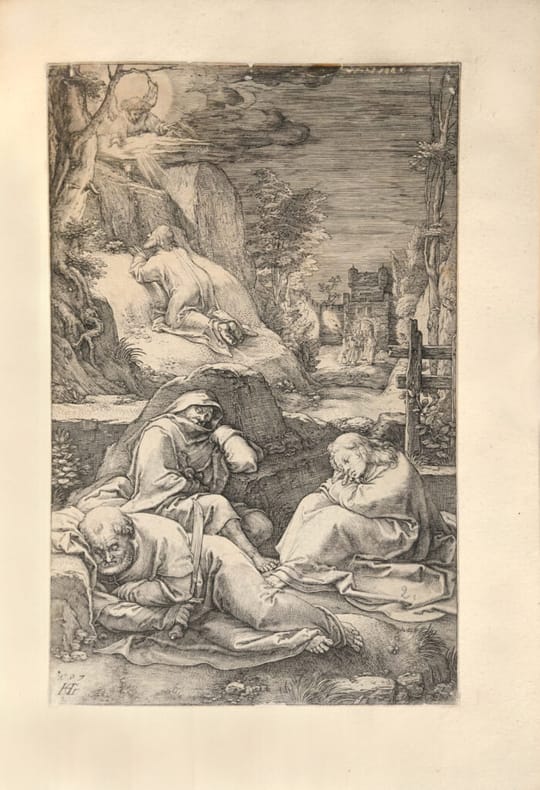
LCS-17950Précieux exemplaire du plus grand graveur au burin de l’histoire de la gravure. S.l., 1596-1598. Suite complète de 12 planches au burin au format in-4. Bords tendus sur une feuille de montage pour chacune. Réunies dans une reliure de vélin ivoire rigide. Dimensions des pages : 249 x 175 mm. Dimensions des gravures : 197 x 130 mm.
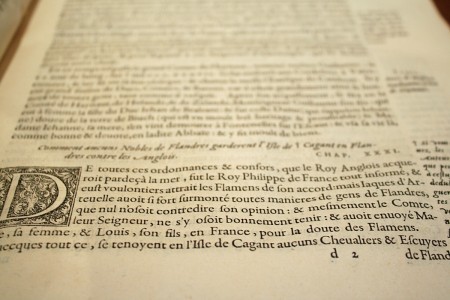
LCS-12126La plus belle édition ancienne des Chroniques de Froissart, « infiniment supérieure aux éditions précédentes » (Brunet). Somptueux exemplaire relié à l’époque aux très rares armes d’Antoine d’Alsace-Hénin-Liétard, baron de Dieuville. Lyon, Jean de Tournes, 1559-1561. 4 tomes en 4 volumes in-folio de : I/ (10) ff., 462 pp., (17) ff.; II/ (6) ff., 314 pp., (3) ff.; III/ (6) ff., 363 pp., (5) pp.; IV/ (6) ff., 350 pp., (3) ff. Reliés en pleine basane fauve de l’époque, double encadrement de triples filets à froid sur les plats avec fleurons d’angles dorés, armes frappées or au centre dans un médaillon avec les lettres H.A.D. et la date 1565 inscrits dans un semé de petites fleurs dorées, traces d’attaches, dos à nerfs ornés de filets à froid et de fleurons dorés. Quelques épidermures. Reliures de l’époque. 330 x 208 mm.
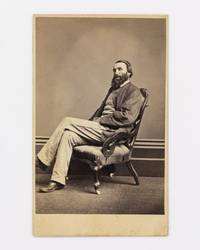
1866135300Adelaide: Townsend Duryea 1866. Adelaide Townsend Duryea printed circa 1866; original negative circa 1863. An albumen paper photograph 90 × 59 mm mounted on the original card 102 × 62 mm with 'T. Duryea Photographer to His Excellency 66 King William St. Adelaide' printed on the verso under the Vice-Regal Coat of Arms. 'Townsend Duryea began making cartes de visite in late 1862 or early 1863 and was advertising his "new" style of carte in May 1863' Bob Noye AGSA website. The portrait taken in Duryea's Adelaide studio shows Stuart after his epic crossing of the continent of Australia: he is visibly depleted - emaciated even - with his injured hand positioned awkwardly in his lap. The accident that caused this permanent injury occurred on 25 October 1861 the day the main party of the successful sixth expedition departed Adelaide. Stuart later described it in a letter to Charles Sturt: 'the accident I received from one of the horses being in a state of strangulation and endeavoured to release him reared up struck me in the temple knocked me senseless and springing again with his hind feet on my right hand has disabled me for life' Ian Mudie: 'The Heroic Journey of John McDouall Stuart' 1968 page 171. It is a most evocative image of the great explorer towards the end of his life. <p>The negative number 18592/3 is inscribed in ink on the verso below Duryea's imprint. This particular imprint dates to around 1866 see Noye and the negative number is consistent with this date. Noye notes that 'A carte with a number belonging to a much earlier number range would be a reprint from an old negative held in storage'; this suggests that this photograph is not printed from the original negative perhaps lost damaged or destroyed. This further suggests that this photograph is printed from a negative produced by rephotographing an existing print of the portrait of Stuart taken earlier by Duryea. This would explain why Stuart has what appears to be his left hand in his lap: the image is printed in reverse. <p>It was likely produced after news of the explorer's death in London on 5 June 1866 had reached Adelaide. A small item of local news 'Mr T. Duryea's Studio' in the 'South Australian Register' on 23 November 1866 lends weight to this possibility: 'A visitor to Adelaide may spend a very pleasant and profitable half-hour in Mr Duryea's photographic studio where a number of elegant photographs in every style of art are displayed. Mr. Duryea also exhibits some superior examples of photographs worked up in water-colours which are soft and some of them exquisitely finished. Amongst these there is a fine portrait of the late J.M. Stuart the explorer'. This carte de visite is clearly not that exhibition piece but it is most definitely a fine portrait. Townsend Duryea unknown
20212081502111902788national library 2021. Soft Cover. Fine. The book is in fine condition. national library paperback
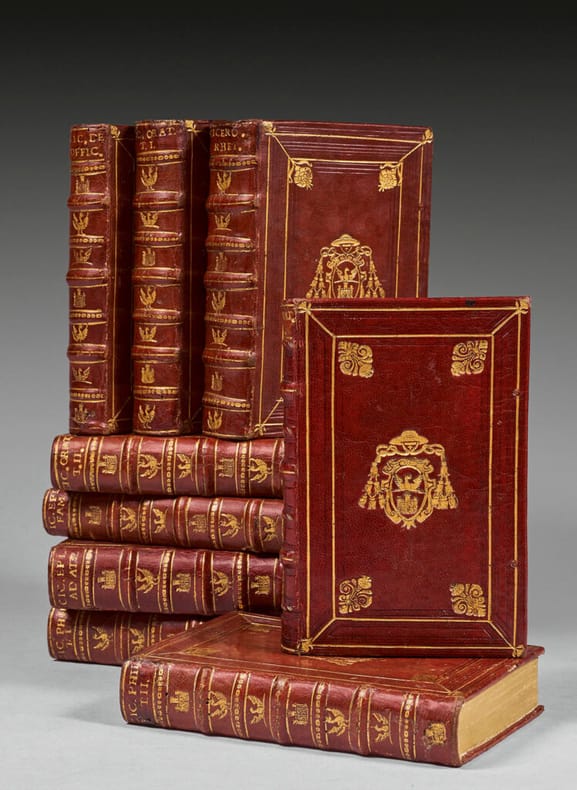
LCS-18533Splendide exemplaire en séduisante condition d’époque. Lyon, Sébastien Gryphe, 1555; Antoine Gryphe, 1574, 1585, 1586; Guillaume Rouillé 1589-1591. Ensemble 9 volumes in-8, maroquin rouge, plats ornés d’un décor de filets dorés et de filets à froid, fleurons dorés aux angles, armoiries dorées au centre du plat supérieur, armoiries différentes au centre du plat inférieur, dos à nerfs ornés de pièces d’armoiries, tranches dorées. Reliure de l’époque. 157 x 101 mm.
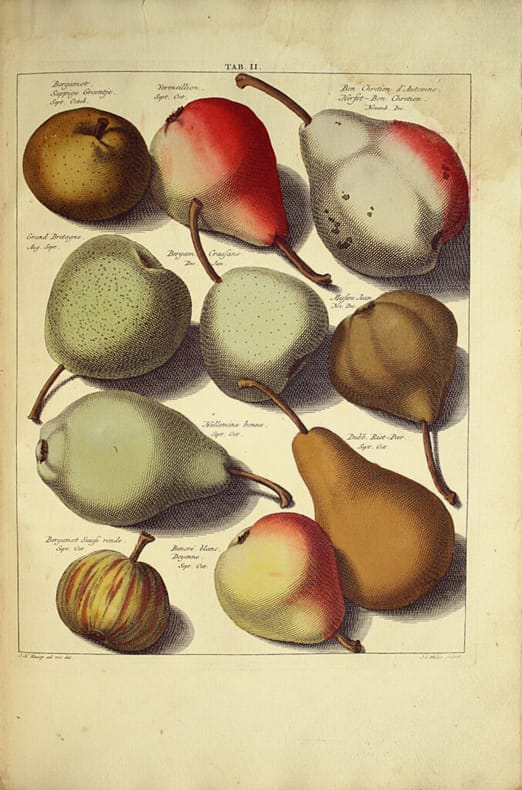
LCS-17474Éditions originales des 3 grands livres de Knoop considérés comme le traité de pomologie de référence du XVIIIe siècle. Leeuwarden, 1758.[Suivi de:] Fructulogia, of beschryving der vrugtbomen en vrugten.Leeuwarden, 1763.[Suivi de :] Dendrologia, of beschryving der plantagie-gewassen.Leeuwarden, 1763.3 ouvrages en 1 volume in-folio de : I/(2) ff., 86 pp. (1) f., 20 estampes hors-texte coloriées à la main, armoiries sur le feuillet de dédicace ; II/ (2) ff., 132 pp., 19 gravures hors-texte coloriées à la main ; III/ (2) ff., 168 pp., saut dans la numérotation p. 146 et 162, (2) ff. Relié en demi-basane à coins, dos à nerfs orné, rares mouillures. Reliure de la fin du XVIIIe siècle.370 x 265 mm.
4to. 1 page. Previously unpublished letter written in triumph three weeks after Che took Havana. His recipient is the Cuban magazine La Revista Bohemia, whom he congratulates and thanks for their work furthering his and Fidel Castro's cause: "las dedico este Fraternal y caluroso mensaje a ese maravilloso colectivo que son ustedes, incansables constructores de las ideas revolucionarias, paradi pura del socialismo y el comunismo, y baluartes y estandartes de la contribución a la edificación de la sociedad proletaria, les ex orto a que siguán trabajando con esmero y dedicación para que si guamos consolidando el triunfo." Over the course of the Cuban Revolution, Che came to understand the importance of media coverage in achieving his goals; La Revista Bohemia was one such media outlet. He signs off with what would become one of his standard closing phrases: "Patria o Muerte. Con fervor revolucionario. Che". - Gently creased, minor chipping.
Oblong 8vo. 179 ff. with 51 entries and Weber's holograph note of ownership on fol. 2r. Contemporary brown calf with richly gilt spine and covers. Brocade endpapers. All edges gilt. Unique scholars' album of the philologist Nikolaus Weber (1699-1751), headmaster of the Nuremberg Holy Ghost school, with entries by scholars mainly based at the Universities of Nuremberg and Altdorf. One of the most important among the contributors to this volume, almost all of which are biographically recorded, is the Swedish astronomer Andreas Celsius (1701-44), who on 22 July 1733 penned these lines: "Problema: Unam eandemq[ue] theologiam et religionem per universum terrarum orbem propagare. - Resolutio: Doceatur ubiq[ue] gentium Philosophia certa et solida" (Problem: How to spread the same theology and religion throughout the entire world? - Solution: Teach all peoples a certain and solid philosophy). On behalf of the Swedish king, Celsius had visited the principal observatories of Europe in 1732/33 to form an opinion of the current developments in astronomy. His scientific "Grand Tour" had also led him to Nuremberg, where he had spent three months at the home of the astronomer Johann Gabriel Doppelmayr (see below) and had regularly participated in the specialist discussions hosted by the physician Christoph Jacob Trew (see below). 1733 is also the year of Celsius's "316 Observationes de Lumine Boreali", the first comprehensive treatise on the Northern Lights, published by Endter in Nuremberg. That year, Celsius also performed the first exact geographical measurement of the town's dimensions. - Celsius's host Johann Gabriel Doppelmayr (1677-1750), known for his 1750 "Atlas coelestis", contributed his entry many years before Celsius: on 17 July 1717, he dedicated a quotation from Seneca ("Animum sursum vocant initia sua", Epist. 79). The two opposite pages by Celsius and Doppelmayr are connected by a caption (by one of the two scientists): "Sic pagina jungit amicos" (thus a page links friends). - Another important entry is that of the physician and botanist Christoph Jakob Trew (1695-1769), who had studied medicine in Altdorf and then undertook a three-year tour through Germany, Switzerland, France, and the Netherlands. In 1720 he settled in Nuremberg as a general practicioner and became a member of the most important scientific academies; his library, encompassing more than 34,000 volumes, was considered the greatest collection of naturalist literature of its time. No less important was Trew's autograph and correspondence collection with its natural-scientific focus, containing more than 19,000 letters by polymaths from the early Renaissance to Enlightenment (including Albrecht von Haller, Conrad Gesner, and Lorenz Heister). Today, Trew is frequently associated with his principal botanical work, "Plantae selectae" (1750-73). - For many entries, Weber later added the date of the contributor's death (if he outlived them), which in several cases offers a more precise date than hitherto available. - Other contributors include Siegmund Jakob Apin (writer, pedagogue, and classical scholar, 1693-1732), Andreas Christian Eschenbach (theologian and classical scholar, 1663-1722), Johann Wilhelm Feuerlein (theologian, 1689-1766), Christoph Fürer von Haimendorf (poet, 1663-1732), Gottfried Engelhart Geiger (pedagogue, 1681-1748), Johann Jakob Hartmann (theologian, 1671-1728), Georg Jeremias Hofmann (teacher of oriental languages and theologian, 1670-1732), Johann David Köhler (historian, 1684-1755), Michael Friedrich Lochner von Hummelstein (physician and polymath, 1662-1720), Bernhard Walther Marperger (theologian and Lutheran poet, 1682-1746), Jonas Meldercreutz (mathematician and bibliophile, 1713-85), Gustav Philipp Mörl (theologian and librarian, 1673-1750), Johann Heinrich Müller (physicist, astronomer, and mathematician, 1671-1731), Joachim Negelein (theologian and classical scholar, 1675-1749), Johann Heinrich Schulze (physician and classical scholar, 1687-1744), Christian Gottlieb Schwarz (classical scholar and historian, 1675-1751), Gottfried Thomasius (polymath and physician, 1660-1746), Johann Siegmund Wernberger von Wernberg (jurist, 1678-1737), Justin Wetzel (preacher and professor of history and politics, 1667-1727), Georg Karl Wölker (jurist, 1660-1723), and Johann Wülfer (classical scholar and professor of church history, 1651-1724). - Decorative binding insignificantly rubbed, otherwise splendidly preserved autograph album of enormous value for the history of science. Autographs by Celsius, Trew, and Doppelmayr are of the utmost rarity. - Detailed list available upon request.
4to. 34 ff., some written on both sides, irregularly counted, containing more than 250 entries (some pasted in). Red morocco with giltstamped borders and cover stampting inspired by the royal arms of Sardinia. Silk endpapers. All edges gilt. Exceptionally plentiful friendship album owned by Comtesse de La Bédoyère, daughter of the senator Henri de La Rochelambert (1789-1863), wife of Georges Huchet de La Bédoyère (1814-67) and court lady to Empress Eugénie, wife of Napoleon III. Indeed, the first entry in the album belongs to the the emperor himself; this is followed on the same page by Eugénie with a quotation from Sophie d'Arbouville's poem "Je crois": "Je crois au Souvenir, au long regret du cœur, / Regret que l'on bénit comme un dernier bonheur, / Crépuscule d'amour, triste après la lumière / Mais plus brillant encore que le jour de la terre!" This is succeeded by the signature of the couple's only son, the eight-year-old Napoléon Eugène Louis; at the bottom of the page is a four-line German quotation from Schiller, which Napoléon III adds in Biarritz on 8 Oct. 1865. Another entry by Eugénie is on fol. 27r, and there are further entries by her son on fol. 21r and 27r (with a little drawing). - Two other noteworthy entries are on pages 21v and 23v: the first is by Bismarck, who signed in Biarritz on the 19th of October 1865, the very month when the secret negotiations between Prussia and France had begun over possibly coalitions before the Austro-Prussian War of 1866. The second, written at about the same time, is by Leopold, Prince of Hohenzollern and his wife Antonia (fol. 23v). Leopold is considered a pawn of the high politics of his age. In 1870 Bismarck would urge him to accept the Spanish Crown, a move fiercely opposed by Napoléon III. Although Leopold quickly yielded, it was this affair that would ultimately spark the Franco-Prussian War. - The numerous other contributors include: Alexander II of Russia (9r); Amadeus I of Spain (16r); Isabella II of Spain and her children Isabella and Alfonso (17r); Sophie Queen of the Netherlands (8r); Emperor Franz Joseph I and his wife Elisabeth (14r), as well as Elisabeth's lady-in-waiting, countess Caroline Hunyady (12v); Frederick Grand Duke of Baden, and his wife Louise (9a); Marie, Princess of Baden and Duchess of Hamilton (10r); Charles, King of Württemberg, and his wife Olga (37r); Frederick, Prince of Denmark (24r); Umberto I of Italy (7r); Marie Clotilde of Savoy (wife of Prince Napoléon, 7r); Grand Duchess Maria Nikolaievna of Russia (27v); Grand Duke Charles Alexander of Saxe-Weimar-Eisenach and his wife Sophie Princess of the Netherlands (22r); Louis I of Portugal and his wife Maria Pia of Savoy (19v); Frederick, Grand Duke of Mecklenburg (13r & 17r); George, Duke of Mecklenburg, and his wife Catherine, Grand Duchess of Russia (18r); Marie, Grand Duchess of Mecklenburg-Strelitz (4v); Adolf, Duke of Nassau (9r & 14v); Pauline, Princess Metternich (2v, 8v, 14v with her daughter Sophie and her aunt Hermine, 31r with her daughters Sophie, Antoinette Pascalina, and Clementine Marie, as well as Rosa, Duchess of Hohenlohe-Sternberg); Richard, Prince Metternich (9r); William I of Prussia and his wife Augusta (10r); Francis, Duke of Harrach (4v); Joseph Joachim Napoleon Murat (2r & 20v); Field Marshal Frederick of Wrangel (7v); the Duchess of Castiglione Colonna (known as a sculptor under the name Marcello, née Adèle d'Affry, 3v); Mélanie Renouard de Bussière Comtesse de Pourtalès (14v); Admiral Edmond Jurien de La Gravière (a four-line poem signed, 9v); Admiral Wilhelm von Tegetthoff (28v); Gustav Prince Blücher von Wahlstatt (9v, born 11 Oct. 1837, knight of the Order of Malta); the Mexican monarchist and ambassador to the court of Napoléon III, José Manuel Hidalgo y Esnaurrízar (3v); the philosopher Elme Marie Caro (a three-line poem, 11r); the politician and economist Félix Esquirou de Parieu (a nearly full-page poem, 10v & 11r); the artist Gustave Doré (with a fine drawing, 11r); the writers Hortense Cornu (7v), Edmond About (28r), and Prosper Mérimée (19r & 20v); Princess Alexandrine Dolgorouky (1834-1913, the mistress of the Tsar, 2v, with two lines from Byron); Ignacio Álvarez de Toledo y Palafox Portocarrero, Conte di Sclafani (son of the 16th Duque de Medina Sidonia, 1812-78, full-page sonnet 22v); Alexandre conte Colonna-Walewski (14v; possibly with his second wife Anna Maria Ricci, daughter of count Zanobi di Ricci and Isabelle née Princess Poniatowska, signing "Maria Walewski(y)". The album's final contribution is a photographic reproduction of F. X. Winterhalter's well-known portrait of Empress Eugénie. - Binding slightly rubbed; interior shows occasional brownstaining, but altogether in excellent state of preservation.
(2) Burton, Richard F. Supplemental Nights. (3) Burton, Richard F. [Autograph manuscript book review of an 1881 Panchatantra edition]. 16 volumes (including 6 supplements). 8vo. With an original manuscript leaf written by Burton (with the manuscript heading: "Proof to Sir R.F.B. Hotel des Bains, Aigle, Canton Vaud, Switzerland" and a note "Long Primer Pressig.") and each volume with a different frontispiece in two states (coloured and uncoloured). Contemporary richly gold-blocked green morocco, boards with Arabic script in gold, spine with raised bands, gold-tooled turn-ins, marbled paste-downs. The so-called "manuscript edition" of Richard Burton's celebrated translation of Alf Laylah Wa Laylah, commonly known in English as the Arabian nights. These Arabic tales, cherished in Europe since the early 18th century, are often erotic in content, and in Burton's unexpurgated translation they outraged Victorian England. Burton included numerous footnotes and a scholarly apparatus, offering a vivid picture of Arabian life, which set his translation apart from earlier English renderings. - The present edition (limited to 99 sets, the present being copy no. 49) includes a manuscript leaf from a text by Burton. In the present copy this is a book review by Burton, of a French translation of Johannis de Capua's Latin translation of a Hebrew translation of the Panchatantra, a Sanskrit frame story written several centuries before the Arabian nights. The notes at the head show that it was used as printer's copy. - The title-page of volume one uses the correct main title, The book of the thousand nights and a night, but confusingly mixes it with part of the subtitle of the Supplemental nights: "to the book of the thousand one nights with notes anthropological and explanatory". To add further confusion it says "volume three", though the content is that of volume one. The volume number is clearly a printer's error, apparently corrected early in the press run. - Ross dates the (regular copies of the) present edition ca. 1940. This later date is supported by the fact that this edition is not included in Penzer's thorough bibliography published in 1923. - Some minor browning to the endpapers, those of the first volume partly detached and with a small pieces torn off, the binding has some very minor wear to the hinges, and a few headbands have been carefully repaired. A fine set. Scheherazade's Web: The 1001 Nights & Comparative Literature, J. Ross 10 & 11. Cf. Penzer, pp. 126-132 (other Burton club editions).
Folio (213 x 442 mm). Black Naskhi on paper, decorated with an illuminated sarlowh in red and blue. Mounted on cloth. Rare 18th century copy of the "Ashtiname" (Covenant), a charter granting protection and other privileges to the followers of Jesus, issued to the Christian monks of St Catherine's Monastery, Sinai, supposedly by the Prophet Muhammad and dated Muharram of the year 2 of the Hegira. - A handwritten copy of a famous document from the early history of Islam: it assures the Christian populations of the protection of their property as well as their places of worship, among other privileges. While the authenticity of the text has been called into question by many scholars, the history of its reception over the centuries remains a fascinating subject. The supposed original document, which was given by the Prophet Muhammad to the monks of St Catherine's Monastery in Sinai, was confiscated by Sultan Selim I (ruled 1512-20) during his campaign in Egypt and Syria in 1516/17. Subsequently, numerous copies were drawn up so as to renew the protection offered to Christians. Their authenticity is assured by the certification of a qadi, our document bearing the signature of the qadi of Egypt, a certain Isma'il, affixed by way of a seal in the right margin of the document. - Minor repairs and dampstaining, but well preserved.
Folio (240 x 352 mm). (56), 1203 (instead of 1207, properly 1205), (1) pp. (p. 623f. blank, wants pp. 231f. & 237f.). - (Includes, as part 2:) Sanudo, Marino. Liber secretorum fidelium crucis super Terrae Sanctae recuperatione et conservatione [...] Orientalis historiae tomus secundus. Ibid., 1611. (12), 361, (3) pp. (283f. printed as a double-page-sized folding table). Both parts with engraved printer's device to title-page. With 3 double-page-sized folding engraved maps and 2 engraved plans as well as a woodcut printer's device at the end. Slightly later full calf, spine elaborately gilt. Only edition of this early, important source book for the history of the crusades and the Kingdom of Jerusalem and its vassal states. The second parts contains the first printing of the much sought-after 14th century maps and plans by the Genoese cartographer Pietro Vesconte, previously available in manuscript copies only. "Four of the maps from Marino Sanudo's early fourteenth-century manuscript atlas were reprinted by Johann Bongars in 1611. Sanudo's planisphere [...] is one of the few examples of medieval maps based on portolano sources in printed form. It is a circular map centered on Jerusalem with the Mediterranean relatively well defined. The ocean surrounds the whole of the known world, the outer parts of which are represented by conjecture. The authorship of Marino Sanudo is not definitely established and the original manuscript has also been attributed to Pietro Vesconte" (Shirley). - One of two title variants differing only in slight changes in the typesetting (here: "Expeditionum" begins between the "O" and the "R" of "Orientalium"). Binding somewhat rubbed, hinges starting. Rather severely browned throughout due to paper stock, some waterstaining to margins, more pronounced near the end, sometimes reaching into the printed text. Stains to first title-page; the second title and its counter-leaf *6 are printed on different paper stock. Some light worming, mainly confined to margins but also touching the text near the end; occasional edge defects. A copy in modern half vellum (severely browned, with some worming, but otherwise complete) commanded 13,000 Euros at Reiss's spring 2009 auction. VD 17, 1:069728C. Atabey 127. Ioannou 49 (variant). Potthast I, 105. Tooley I, 162. Cf. Tobler 12. For the maps: Shirley 276 (with plate 217); Nordenskiöld 51 (with fig. 28); Laor 783 & 1145f. as well as Lex. Kart. 576 & 860f.
Folio (565 x 300 mm). With 9 large double-page hand-painted illustrations. Fan fold binding, crimson silk-covered wooden boards with the manuscript title (gilding faded) on front cover. Unique manuscript album in accordion format showing Chinese military formations and drills. "Five Stars and the Crescent" (moon) may refer to a constellation or pattern of stars imitated by a military manoeuvre. The album was produced by court artists of the Imperial Workshop during a time when the Chinese army was facing rapid decline, both in terms of discipline and in terms of competing with Western military techniques. Early during the Taiping Rebellion, Qing forces suffered a series of disastrous defeats culminating in the loss of the regional capital city of Nanjing in 1853. Shortly thereafter, a Taiping expeditionary force penetrated as far north as the suburbs of Tianjin in what was considered the Imperial heartlands. In desperation the Qing court ordered a Chinese mandarin, Zeng Guofan, to organise regional and village militias into a standing army called 'tuanlian' to contain the rebellion. Zeng Guofan's strategy was to rely on local gentries to raise a new type of military organisation from those provinces directly threatened by the Taiping rebels. This force, called the "Xiang Army", was a hybrid of local militia and standing army. In 1860 British and French forces in the Second Opium War captured Beijing and sacked the Summer Palace. The shaken court sought to modernise its military and industrial institutions by buying European technology. - The hand-written brush pen text for each illustration runs vertically to the top right side of each page as follows: "Drum is played on the general's stage and the bugle calls for the standing in line. Each captain of the five posts sees to the straightness of the line. Rules of the running array are followed. No one should talk and all should listen to the order. The line leader leads the mandarin-duck formation and then changes to a straight line". - Some wear to silk and boards, as commensurate with age. Minor repairs. Overall in very good condition.
Folio (216 x 342 mm). 12 parts in one volume. (4), 23; (2), II, 30; (4), 19, (1); (4), 23, (1); (4), 19, (1); (4), 12; (4), 12; (4), 20; (4), 22; (4), 15, (1); (4), 23, (1); (4), 10 pp. Printed in single columns with blank space left at inner margins for notes. Half sheep over red cloth boards, rebacked, gilt-lettered spine. A full year's worth of confidential memoranda issued by Edward Henry Scamander Clarke (1856-1947), Deputy Secretary to the Government of India, providing a detailed picture of British relations in Arabia and Asia throughout 1911. The memoranda encompass Arabia (including Aden, Baghdad, Kuwait, Muscat, Bahrain, the Gulf, and the Trucial Coast), Tibet, Bhutan, Assam, and Burma. The numerous and frequently extensive paragraphs dedicated to the "Arabian littoral of the Persian Gulf" not only discuss problems of charting and navigating the coastal waters, but also focus on defending British commercial interests in the region at a moment when the international trade was scrambling to access the Arabian pearl banks, while at the same time British authority was taking a dramatic plunge in the aftermath of the notorious "Dubai Incident" of 24 December 1910, a botched gun raid operation that led to rising tensions between Britain and the people of the Trucial Coast. Items include notes on the desire of the "Wahabi Amir of Nejd", Abdulaziz ibn Saud, to "come into closer relations with His Majesty's Government"; proposed hydrographical surveys of possible approaches to Kuwait and Bahrain; a proposed enquiry into the causes of the depletion of the pearl banks in the Gulf, and the possible attitude of the local Arab tribes as well as foreign agents in the area; an investigation into possible business residences of Rosenthal Frères in Dubai and Bahrain, and the question of British firms entering into the local pearling business; a proposal to secure written assurances from the Sheikhs of the Gulf not to extend pearl fishing concessions to foreigners; policy differences between Britain and the ruler of Dubai, Sheikh Butti bin Suhail Al Maktoum; piracy committed on a Dubai boat; the proposed establishment of British banks at certain port town along the Gulf coast; a discussion of the need for a treaty with the Qatar Sheikhs; the "question of the sovereignty over Katar"; the cancellation by the Sheikh of Sharjah of an excavation concession granted on Abu Musa island; the replacement of lost light buoys off the Arabian Gulf coast; negotiations with Turkey over territorial differences; Kuwait and the Baghdad Railway; and the Ottoman occupation of Jazirat az Zakhnuniyah (off the Saudi Arabian coast, between Bahrain and Qatar). - Further sections discuss treaties and trade agreements; expeditions and scientific missions; irrigation, shipping and railways, telegraph and postal networks, trade; arms trafficking; disturbances and risings; and British relations with Turkey and China. Also covered are the murder of Noel Williamson, assistant political officer, Sadiya, and his party in the Panga Hills, Assam, and the subsequent Abor Expedition; the Chinese Revolution of 1911 (Xinhai Revolution) and its impact in Tibet and Burma; and the Italo-Turkish War. - A few marks to text. Binding rubbed and marked at extremeties, spine recently rebacked. Extremely rare: no copy traceable in library catalogues internationally.