690 923 résultats
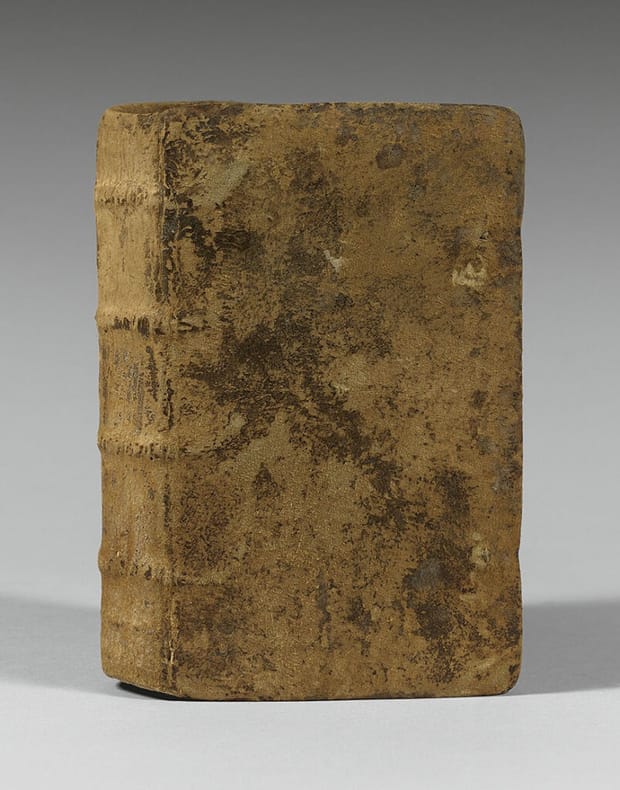
Folio (290 x 450 mm). 9 double-page engraved charts only, each sheet approx. 440 x 550 mm, each mounted on stiff paper with maps back-to-back, with thick red and black ink borderlines. Of the 9 maps, 8 are by Colom, numbered in the plates from "2" to "9"; plate 1 replaced with Johannes de Ram's map of the Mediterranean, "Paskaart vande Middelandsche Zee In twee deelen vertoont". Contemporary stiff paper covers (worn with losses); manuscript label to lower cover pasted upside down: "Carta Marinaresca del Mar Mediterraneo". Unusual working copy of Colom's rare pilot, owned by an Ottoman Turkish mariner with his Osmanli inscriptions transliterating the location names throughout. Colom's charts cover the Straits of Gibraltar, the Barbary Coast, Mallorca, the coastline around Barcelona, Nice, Corsica, Sardinia, Southern Italy, Sicily, and Croatia. Koeman highlights the rarity of all of Colom's pilot books and notes that despite "thousands of copies [having been] circulated [...], only a score have survived". - Significant spotting and browning throughout, some cockling and losses to sheets, old repaired tears, creases and signs of heavy use. A highly uncommon survival. Cf. Phillips III, 53 ff. Koeman IV, 120.
LCS-17576Précieux et bel exemplaire plus grand de marges que l’exemplaire Pottiée-Sperry, provenant de la bibliothèque du grand spécialiste de l’histoire de Paris, Paul Lacombe. Superbe provenance et belle condition d’époque. Paris, Gilles Corrozet, 1550. In-8 de (16) ff., 200 ff. et (2) ff. Pt. trou de vers ds. qq. ff., coin sup. des pp. 56 à 65 usé. Veau retourné, dos à nerfs, traces d’attaches. Reliure de l’époque. (Boite étui de maroquin P. Goy & C. Vilaine). 168 x 103 mm.
4to (185 x 228 mm). (1), (112) pp. Text enclosed within pencil and sanguine rules. Contemporary full calf with giltstamped borders and spine and the arms of Charles Emmanuel III of Sardinia on both covers. Leading endges gilt. Marbled endpapers. All edges red. Green silk band. A fine dedicatory manuscript, pre-dating the noted Hebraist's first published work: an assembly of polyglot odes by the 25-year-old scholar to the royal family of Sardinia, written in Aramaic, Arabic, Coptic, Ethopian, Hebrew, Chaldaic, and Syriac, all with their Latin translation opposite. - De Rossi studied at Ivrea and Turin. In 1769 he was appointed professor of oriental languages at the University of Parma, where he would spend the rest of his life, known as one of his age's greatest Italian scholars of early printing in Hebrew. - Light browning; first and last leaves a little stained. Ink shows various degrees of bleeding to versos, often very light but quite noticeable in the title-page. The volume bears the arms of Charles Emmanuel III, Duke of Savoy, who ruled as King of Sardinia from 1730 until his death in 1773, and must have been presented to him. The otherwise blank first leaf was turned into a half-title in the 19th century by the scholar and priest Natale Martinetti: "Poemi Orientali di Gioanni Derossi di Castelnuovo Canavese, Dottore di Sacra Teologia, in L'ode degli augustissimi Sovrani e Duchi della Real Casa Di Savoja. Manoscritti dal medesimo De-Rossi, appartenenti a me Natale Martinetti di Cigliano".
231 x 171 mm on backing cardboard (376 x 280 mm). The well-known portrait of Freud taken by the Austro-Hungarian photographer László Willinger: a very attractive print in excellent condition. Willinger, who has been barred from any professional activity in Germany in 1933, worked for some time in the Vienna atelier of his father Wilhelm before emigrating in 1939. The present portrait was created in 1935. - Provenance: collection of the granddaughter of the Austro-American psychoanalyst René Spitz; acquired from a Belgian private collection. - Backing cardboard a little stained in two places and traces of old mounting on verso, otherwise clean and crisp.
8vo. 136 pp. Yellow original cloth in modern half calf slipcase with giltstamped spine title. First edition of Freud's famous study known in English as "Civilization and Its Discontents", inscribed and signed by the author to his son Ernst, an architect, and Ernst's wife, the classical scholar Lucie (Lux), née Brasch (the parents of Lucian Freud): "Seinen lieben Kindern Ernst u Lux / vom Verf.". - Provenance: from the collection of the Austro-British photographer and cinematographer Wolfgang Suschitzky, whose family had known the Freuds in Vienna and who later, after his emigration to London, lived near the Freud Museum in Maresfield Gardens. Passed by descent to his son, the cinematographer Peter Suschitzky, whose works include the David Cronenberg film "A Dangerous Method" about the affair between C. G. Jung and Sabina Spielrein. Latterly in a Belgian private collection. - Occasional light duststaining the original cloth binding, interior in excellent condition. The elegant blue and black half calf slipcase is signed by the Franco-American bookbinder Paul Bélard. - Copies of Freud's works inscribed to his children are of the utmost rarity: the Freud Museum London owns just a single specimen, inscribed to his daughter Anna. Meyer-Palmedo/Fichtner 1930 a. Grinstein 10619.
8vo and 4to. 2 vols. and volume of plates. XLVIII, 654 pp. XXVIII, 757 pp. With 17 plates (12 in colour; with the extra plate after no. II). Contemporary half calf with giltstamped Saxon arms on covers. Edges marbled. First edition of Goethe's principal scientific work, the "Farbenlehre", including the quarto-sized "Erklärung der zur Goethe’s Farbenlehre gehörigen Tafeln". "Goethe's first publication on optics culminated in his 'Zur Farbenlehre', his longest and, in his own view, best work, today known principally as a fierce and unsuccessful attack on Newton's demonstration that white light is composite" (DSB V, 445). The plates are of various sizes, showing this to be the earliest impression of the 17-plate set, but do not have the manuscript corrections present in some copies (cf. Hagen, p. 170). - Bindings somewhat rubbed; occasional brownstaining due to paper. A fine, complete copy in its first binding, originally in the library of the Dukes of Saxe-Weimar-Eisenach: gilt Saxon arms on the marbled covers; armorial stamps to all titles. Most famously, Duke Karl August was Goethe's friend, lord, and benefactor. Hagen 347, 347 d. Goedeke IV 3, 583 (46). Kippenberg I, 386, 389. Hirzel A 288. Speck 2289/90. Schmid 55-58. Brieger 733. WG² 79.
Folio (280 x 355 mm). 3 consecutively paginated parts in one vol. 319, (1), VII, (1) pp. With 74 plates after photographs by Sébah. Early 20th century half morocco with giltstamped spine title. First edition. The three sections are devoted to "Turquie d'Europe" (including Greece), "Ilas ottomanes" (including Cyprus), and "Turquie d'Asie" (including Mecca and the Lebanon). The plates are based on studio portrait photographs by Pascal Sébah (1823-86), then at his peak. - Sébah's Istanbul studio catered to the western European interest in the exotic "orient" and the growing numbers of tourists visiting the Muslim world who wished to take home images of the cities, ancient ruins in the surrounding area, portraits, and local people in traditional costumes. "Sebah rose to prominence because of his well-organized compositions, careful lighting, effective posing, attractive models, great attention to detail, and for the excellent print quality" (Gary Saretzky). - Occasional brownstaining, otherwise a good copy. Atabey 551. Blackmer 957. Lipperheide Lb 65. Colas 1374. Hiler 411.
4to. CI, (3) ff. Title-page printed in red and black with Trot's woodcut publisher's device (lion holding arms bearing a globus cruciger with a parochial cross and initials BT). 12 decorated woodcut initials (white-on-black Lombardic capitals with leaf and flower decorations, 3 series) plus 3 repeats. Set in rotunda gothic types (2 sizes) with 3-line "Lombardic" capitals (and a couple 2-line), and 2 spaces with guide letters left to be filled in by hand. 17th-century calf sewn on 5 double supports, gold-tooled spine with titles in the 2nd, 3rd and 4th of 6 compartments and a fleur-de-lis in each of the others, blind fillets on sides. Rebacked with the original backstrip laid down. Rare fourth (?) edition of a collection of ten mediaeval works by seven authors concerning medicine, health, food and wine, several first published in this collection in 1500. They include: Maynus de Maynis (ca. 1295-1368?), Regimen Sanitatis, on health (ff. III-LXIX); a work on phlebotomy attributed to Arnaldus de Villanova (ca. 1295-1368?) (ff. LXIX-LXXII); Astronomia, on astrological influences on health, attributed to Hippocrates (ff. LXXII-LXXIV); Johannes de Zantvliete (fl. 1343-50), De dieta, on food (ff. LXXIV-LXXV); Nicolaus Salernitanus (12th c.), Quid pro quo, a list of medicines for numerous ailments (ff. LXXV-LXXVII); Averroes (1126-1311) on poisons (ff. LXXVII-LXXVIII) and on theriac, a poisonous concoction used as an antidote to other poisons, especially poisoned wounds (ff. LXXVIII-LXXXIV); Secreta, a short piece attributed to Hippocrates (f. LXXXIV); Villanova, Tractatus de vinis, an extensive and important work on wine (LXXXIV-XCI); and Roger Bacon (ca. 1220-92), De regimine senum et seniorum, a treatise on geriatrics, here erroneously attributed to Villanova (ff. XCI-CI). Some incorporate notes taken from the works of Ibn Sina (Avicenna). The book ends with an index and table of contents. This collection was first printed at Paris in 1500, some of the works appearing there for the first time, and was reprinted in Lyon editions of ca. 1501 (anonymous, known from a unique copy) and ca. 1502 (by François Fradin). A few of the pieces had been published earlier: Salernitanus (Pavia 1478/79), De Maynis (Louvain 1482), both Averroes works together with the Secreta, (Bologna ca. 1497/1500). - Occasional underlining and marginal marks by an early hand. Leaves 4 and 5 (originally conjugate) now present as singleton leaves mounted on stubs (though we see no other indication that they are sophisticated): otherwise in very good condition, with only very slight browning. Rebacked as noted, and with the surface of the leather refurbished, but now structurally sound. One of the rare earliest editions of several mediaeval treatises on health, medicine, food and wine. Baudrier VIII, 431. Durling 3044. Gültlingen, Bibl. Lyon II, 127: 47. Simon, Bacchica 421. USTC 144805 (8 copies). Vicaire 549f. Cf. Johnston, Cleveland herbal colls. 24 (ca. 1502 Lyon ed.); Wellcome 13965 (ca. 1502 Lyon ed.).
Small 4to (150 x 195 mm). Part 1 (of 2). (4), 168 pp. With a large woodcut illustration on title-page, hand-coloured by an early hand, and woodcut printer's device on the last leaf verso. 17th century sheepskin vellum over thin boards. Extremely rare edition of this collection of nine alchemical tracts, including "De tinctura metallorum" (On the Colorations of Metals), attributed to the great Arab scientist Ibn Sina, who is known in the Latin tradition as Avicenna. Ibn Sina was one of the most significant thinkers and writers of the Islamic golden age, and his bibliography comprises nearly 270 titles, several of which fall into the category of the arcane sciences (cf. GAL I 458 V and GAL I S, p. 828). "Ibn Sina studied the philosophical and scientific foundations of this subject [alchemy] and even undertook alchemical experiments" (DSB). - The collection further includes two works attributed to Raymond Lull, one of the most interesting scholars of the Middle Ages, another published under the name of Aristotle, and five anonymous ones. A second part was published in the same year, containing only one work: the famous Rosarium philosophorum. It can be regarded as a separate publication and is not included here. Curiously, a late 16th century manuscript copy of only this volume (a folio of 70 leaves) is held by the Wellcome Collection (MS.233, acquired in 1906). - Binding very well preserved. Contemporary handwritten marginal annotations and underscoring throughout, an early owner's inscription (struck through) and some further notes on the title-page. Annotations slightly trimmed by the 17th century binder's knife, somewhat browned throughout and dampstains in the first half of the book, otherwise in fine condition. VD 16, A 1632. BM-STC German 17. Adams A 574. Duveen, p. 11 ("excessively rare"). Ferguson, Bib. chem. I, p. 18. MacPhail I, 20. Schmieder, Geschichte der Alchemie (1832), p. 98, no. 3. For Ibn Sina see DSB XV, pp. 494-500.
8vo. 2 pp. With autogr. envelope. Includes TDS by G. E. B. Bromley-Martin, of the Bank of Liverpool and Martin, London (dated 22 Dec. 1924). To Whitney H. Shepardson of New York, who had inquired as to how he might obtain a copy of the "Seven Pillars of Wisdom" when the book was finally published: "The Prophet has sent me on your letter, with instructions to deal with it: - and I'm puzzled. Really you know you are foolish to want a copy. It's a thirty guinea book, of which so many copies are being sold as will meet the printing bills (about 120 copies perhaps) with some off-prints of the unadorned text for the twenty or thirty fellows who shared the campaign with me. I can't give them 30-guinea presents: they can't buy 30-guinea books. So I want the subscribers to pay for my generosity in giving them free copies. The prime cost lies in the pictures (about 60, many in colour, at 10/- a print!) and the pictures are only an unjustifiable whim of mine. They have been done by British artists whom I liked, + who would work for me. Such a luxury book is for the idle rich. Mrs. Lamont is getting one. Huntingdon [!] + Pierpont Morgan aren't...! ... Do you feel justified in chucking away so much on an amateur production? The writing is pretentious, dull, hysterical, egotistical, + preternaturally long. No human being has ever been to the end of it [the 335,000 word ms.]. They return it, thumbed to about half way, with pretty speeches. So long as I hold it secret, the sight of it is a boast, so long it will be praised. Seriously, it isn't any earthly good. It costs as I have said, may be a year yet in printing, + is horrible in parts. Eleanor (beg her pardon, but that's her only possible name. The proper ones only indicate her wayward choice of parents etc.) would be sick over it. The thing will not be reprinted entire in my life-time: you suggest 'for a long time.' ... but the prospect isn't pleasing. There will be an American Edition, to secure copyright. Doubleday, probably. He has made a reasonable estimate. It would be printed at my expense, two copies for the Library of Congress, or whatever the show is, + eight for sale: + the sale price will be prohibitive, so that they will never sell, + the edition will never be exhausted, + no one may pirate! I suggest 10,000 dollars, but F.N.D. hasn't yet considered what is above-high-water-mark in U.S.A. Tell me, please, if you are knowing! If despite all faults (my most honest dissuasion puts people on sometimes!) you want a copy: then you'll have to send fifteen guineas, half price - E. will know the size of the extinct coin - to: Manager / Bank of Liverpool + Martins / 68 Lombard St. / London, E.C.3, payable to TE Lawrence, + 'Seven Pillars account'. Balance when you get the book. Let me strongly urge you not to. I have 90 subscribers, so there is no urgency - on the point of helping lame dogs! [...]". - When the book finally appeared in 1926, the cost of each copy to Lawrence was triple the selling price, and it was not until the fourth reprint of the 1927 abridgement "Revolt in the Desert" that his debts were paid off. As the included receipt shows, Shepardson was undeterred and duly transferred the £15. 15/- to Liverpool & Martins' (the last copy of the 1926 "Pillars" at auction commanded £30,000 at Sotheby's in 2009). - The U.S. businessman Whitney Hart Shepardson (1890-1966), educated at Colgate, Balliol (as a Rhodes Scholar), and Harvard, had served as aide to the State Department at the 1919 Paris Peace Conference, where he may have met Lawrence. Between 1925 and 1927 he served as director on J. D. Rockefeller's General Education Board. A leading O.S.S. operative in WWII, he was the first London head of Secret Intelligence and remained with the organization soon to become the C.I.A. until 1946.
12mo. 3½ pp. on bifolium. To Alexandre Perrin, the director of Geneva's Évêché prison, asking him to make another prisoner named Klein stop bothering him during his walks, knowing that Klein's sole objective is to drive his co-prisoners to causing trouble or to denigrating the director: "Bien qu'il soit genevois et qu'il se vaute d'avoir de nombreuses reconaissances parmi les magistrats de Genève, veuillez aviser le détenu Klein de me laisser tranquille lorsque je suis à la promenade. Ne lui adressant jamais la parole parce qu'il m'a prouvé à plusieurs reprises - et cela malgrè le titre de Franc-Maçon qu'il se donne - que son sejour ici a l'Évêché semble n'avoir d'autre but que celui de pousser ses codétenus à faire le mal ou à dénigrer votre direction vis-à-vis de vos superieurs [...]". - He hopes the director will advise Klein not to approach him when he has a complaint and mentions another encounter that same morning, in the course of which Klein threatened him, predicting he would soon make enemies and suggesting he complain to Perrin about the matter: "En tout cas, j'espère que vous l'aviserez de me laisser tranquille et lui faire comprendre que Lucheni n'a pas besoin d'être poussé par Klein lorsque il eut de plainte a adresser au Departement. Encore ce matin il s'est arreté près de moi pour me dire: 'vous savez d'ici a quelques jours, vous allez avoir des enemis, car j'ai appris que le grossier Lée vient reprendre son service comme chef du quartier B. Pourquoi vous ne complaignez pas à M. le Président du Departement en le mettant au courant de ce qui s'est passé; car c'est encore lui qui va diriger l'Évêche' [...]". - On delicate paper with a horizontal tear through the second leaf, touching the text but not affecting its legibility; smaller tears along the centrefold.
Folio. (32), 248, (36) pp. With separate engraved title-page, engr. portrait, double-page engraved map and 21 large text engravings by Christian Rothgießer; woodcut initials and head- and tailpieces. - (Bound after) II: Saadi (ed. Adam Olearius). Persianischer Rosenthal. In welchem viel lustige Historien, scharffsinnige Reden, und nützliche Regeln. Ibid., Johann Holwein for Johann Naumann, 1654. (52), 196, (30) pp, final blank f. With separate engraved title-page, engr. portrait and 33 large text engravings by Rothgießer. Contemporary vellum. First edition of this famous travel report, containing "many interesting details of the eternally plentiful oriental world" (cf. Henze). While the engraved maps depict Southeast Asia from Persia to Japan and Java, the remaining engravings mainly illustrate the customs of the Arab world, of Persia and India. "Mandelslo was a German traveller and adventurer (1616-44). Originally a page at the court of the Duke of Holstein-Gottorp, in 1635 Mandelslo was attached to the duke's embassy to Moscow and Persia, a mission intended to open trade negotiations. The Duke's librarian and mathematician, Adam Olearius, accompanied the embassy as its secretary. The ambassadors themselves remained in Persia, but in 1638 Mandelslo, feeling the need for wider travel, obtained permission to travel on to India. Sailing from Hormuz, he landed at Surat in April 1638 then travelled through Gujarat to Agra, Lahore, Goa, Bijapur and Malabar. He sailed for England from Surat in January 1639, calling at Ceylon and Madagascar, but was to die of smallpox five years later. Before his death, Mandelslo had entrusted his rough notes to Olearius, who subsequently published them bound with his numerous official accounts of the embassy" (Howgego I, 677). This first edition is significantly rarer than its later reworkings and translations; ABPC lists a single complete copy at auctions of the last decades (Sotheby's, Oct 11, 2005, lot 177, £3,400). - Bound with this is the first German edition of Saadi's "Gulistan", also edited by Olearius. - Old armorial bookplate (name erased) and bookplate of Eivind Hassler (1939-2009) on front pastedown. I: VD 17, 23:233226D. Lipperheide Ld 1. Adelung II, pp. 306-308. Alt-Japan-Katalog 943. Bircher A 6927f. Cordier, Japonica, cols. 362-368. Cox I, 271f. Dünnhaupt, pp. 293-294, 30.1. V. Gelder, Het Oost-Indisch avontuur, pp. 77, 99, 263. Howgego I M38. Commissariat, "Mandelslo's Travels in Western India", in: The Geographical Journal, 78 (1931), pp. 375ff. - II: VD 17, 23:282436H. Dünnhaupt S. 2991, 24.1. Bircher A 251. Goedeke III, 65, 7.
4to. (100) ff. With several woodcut astronomical diagrams in text. Modern marbled boards with morocco label to gilt spine. Marbled endpapers. A collection of astrological writings in Latin translation first published in 1504 as "De scientia motus orbis". The work provides a comprehensive account of the whole cosmos along Aristotelian lines. The 8th-century Persian Jewish astrologer and astronomer Maša'allah ibn Atari "wrote on virtually every aspect of astrology [...] His brief and rather primitive 'De scientia motus orbis' [or 'De elementis et orbibus coelestibus'] combines Peripatetic physics, Ptolemaic planetary theory, and astrology in such a way that, in conjunction with its use of the Syrian names of the months, one strongly suspects that it is based on the peculiar doctrines of Harran, to which al-Kindi and Abu Masar were also attracted [...] This important Latin translation by Gerard of Cremona of the lost Arabic original of this exposition was published by J. Stabius (Nuremberg, 1504) and by J. Heller (Nuremberg, 1549)" (DSB). - Bookplate of the Marques de Viana, Conde de Urbasa on front pastedown. In excellent condition. VD 16, ZV 10470. DSB IX, 160 & 162. Zinner p. 211, 1962. Lalande, Bibliographie Astronomique, p. 68. Sarton I, 531. Graesse IV, 503.
Folio (141 x 42,5 cm). Five folio leaves, printed in French and Arabic in two columns and pasted together vertically to form a single broadside. A massive broadside intended for wall-mounting, by which the newly appointed commander-in-chief introduced his government (and himself) to the people of Egypt in Arabic and French: "Habitans de l'Egypte, écoutez ce qu j'ai à vous dire au nom de la République Francaise. Vous étiez malheureux; l'armée francaise est venue en Egypte pouir vous porter le bonheur [...]". - Menou, who succeeded Kleber at the head of Egypt as general-in-chief, following Kleber's assassination in June, converted to Islam and took the name of Abdallah. Unlike most announcements published by his predecessor at the same press, the present proclamation is not headed with the motto of the French Republic, but rather with the Shahada ("There is no deity but God, Muhammad is the messenger of God") in both languages. Menou continues to set out his principles for a good government for Egypt, emphasizing his firm stand against abuse and corruption in the local administration of taxation, justice and the police, and finally threatens any attempt at rebellion with severe retaliation. - An important document from the first printing press in Arab world, of the utmost rarity due to its sheer size and ephemeral nature, according to OCLC recorded in four copies only: "The expedition of Napoleon Bonaparte to Egypt from 1798 until 1801 was a prelude to modernity. It was to change permanently the traditional Arab world [...] The French brought Arabic typography to Egypt, where it was practised under the supervision [...] of Jean Joseph Marcel [...]. Only a few days after the French troops landed [...] they set up the Imprimerie Orientale et Française there. It was an extraordinarily important turning point. For, leaving aside the Hebrew printing presses in Egypt of the 16th to the 18th centuries, until this date announcements and news adressed to Arabs there, as well as in other parts of the Arab-Islamic world, had been spread only in hand-writing or orally, by criers, preachers or storytellers" (Glass/Roper). - Traces of folding, but uncut with temoins. A surprisingly fresh survival. Cf. D. Glass/G. Roper, The Printing of Arabic Books in the Arab World, in: Middle Eastern Languages and the Print Revolution (Gutenberg Museum Mainz 2002), p. 177-225, at 182.
2 tomi in un volume in-folio (420x280 mm.), legatura coeva mezza pelle e ang. Terza edizione (prima 1771) di uno dei grandi libri di botanica. Composto da 300 stupende tavole a piena pagina di fiori, incise in rame con brillanti colori di base e ritoccate a mano nel laboratorio dello stampatore. Accompagnate da fogli di testo descrittivo e indici. Le incisioni furono tratte dai disegni di William Houston, George D. Ehret, John Miller, ed altri artisti. Magnifica opera botanica.. Nissen 1378. Great Flower Books p.68. Dunthorn 209. Hunt 566. Stafleu TL2 6059..
2 volumes. Folio. With 4 engraved plates, and 3 woodcut illustrations in the text. Each volume with an engraved headpiece, the first incorporating the coat of arms of Pope Clement XI, and the second that of Jean-Paul Bignon. Contemporary calf, richly gold-tooled spine and binding edges. First edition, second issue, of a monumental collection of Greek voyages, often overlooked in the literature, including the first complete edition of Cosmas of Alexandria's celebrated "Christiana Topographia". Cosmas, a merchant from Alexandria, sailed in the Red Sea and the Arabian Gulf and visited Ethiopia ca. 530. Though he was known as "Indicopleustes", or Indian Voyager, it is doubtful whether he actually visited India. In his "Christiana Topographia" Cosmas aimed to show that the earth was flat and the cosmos shaped like rectangular vaulted box. Several of the engravings in the present volume, reproduced from a manuscript, illustrates this view. In one of them the earth is shown as a rectangle with three notches, one of them representing the Arabian Gulf, and the whole surrounded by a an ocean, with in the east another rectangle representing Paradise, out of which four rivers flow into the inhabited world. Slightly browned, with some occasional minor foxing or thumbing, and some faint stains, otherwise in very good condition. Binding also very good, only slightly rubbed and the spine of the second volume slightly damaged at the top. Howgego, to 1800, C199. Cf. Dilke, “Cartography in the Byzantine Empire”, in: Harley & Woodward (eds.), The history of cartography I, pp. 261-263.
Small 4to. 1/3 page. With address. In this note Napoléon refers to another letter he wrote previously, urging the recipient to pursue matters in his sense and presenting himself as the most suitable person to promote things: "Je ne avais parlé qu'après donner dictat [?] à cette lettre et je vous prie d'elle faire la petition d'écrire que personne n'est destiné autant [...] que moi et non plus noté à pouvoir faire quelque chose que puisse le poursuivre. Si mes occupations me laisse[nt] [...] je ferais moimême avec urgence sa lettre. | Bonaparte". (Translation: "I only spoke after having dictated [?] the letter, and I request you to make a petition of it, writing that nobody is so destined or more respected than I am to do something that could advance it. If my occupations permit me I will treat your letter urgently myself. Bonaparte". - Addressee illegible. Extensive spotting with slight damage to folds, reinforced in parts.
102:103 mm. Mounted on a single page (8vo) together with a contemporary handwritten transcription. Notes on the Battle of Voltri (1796): "Rampon et la Harpe [-] par le Gal en chef lui meme la deroute fut complette tout le corps d'Argenteau fut ecrase dans le tem[p]s queu Beaulieu descendait a Voltri ou il ne trouvait plus personne" (transl.: "Rampon and la Harpe - by the commanding General himself - defeat was complete - all of d'Argenteau's corps was erased while Beaulieu descended to Voltri, where he found nobody left"). - With a certification of authenticity at the bottom: "corrections de la campagne d'Italie écrit par Napoleon à Briars, isle Ste helene en 1815 / Cte. de Las Cases". Emmanuel, comte de Las Cases and his son accompanied the former emperor to Saint Helena. There, he acted informally but very assiduously as his secretary, taking down numerous notes of his conversations which thereafter took form in the famous "Mémorial de Sainte-Hélène".
More than 100 letters and documents by, to and about Franz Xaver Niemetschek and his family. Copious archive aquired from the direct descendants of Mozart's first biographer. While the documents contain no new information on Mozart himself, they do shed new light on Niemetschek's hitherto rather obscure biography and provide a vivid account of the life of the Viennese and Bohemian bourgeoisie during the Biedermeier period. In particular, the present material provides documentation that the musically-minded scholar Niemetschek, a pianist himself, could very well have visited Mozart's concerts in 1787 during his time at the University of Prague, thus once more fuelling the old debate whether the biographer and his subject did in fact meet. The archive comprises material from Niemetschek's lifetime and from that of his two children up to the early 1860s. A detailed catalogue is available upon request.
Mostly 8vo, a few items 4to and folio. 94 autograph letters (signed) by Page, 81 letters addressed to Page. - II: Copy book with 144 letters by Page to the Minister of the Navy and the Colonies, as well as to other officials, in his own handwritten transcript. 4to. Bound in contemporary half calf over marbled boards. - III: Protocol of a hearing of the Suez Canal Company. 4to. (230) ff., numbered 190-425. Extensive correspondence archive kept by the prominent French naval commander during his voyages across the globe, from the Arabian Gulf to Madagascar, Rio de Janeiro, French Polynesia, China, Vietnam, and Japan. Crucially, the archive includes detailed official instructions for the first French diplomatic mission ever made to the Gulf, carried out under Page's command by the frigate La Favorite, which departed from Brest on 3 June 1841. The mission's importance is shown in perspective by a letter to Guy-Victor Duperré (1775-1846), Ministre de la Marine et des Colonies, wherein the French officials admit to their hitherto fruitless efforts to establish a relationship with the Gulf states: the writer discusses the difficulties experienced in installing a French consulate at Bushehr, while British efforts to establish themselves in the Gulf region have proved so successful. The letter emphasizes that the French interests in the region lie mainly in monitoring British advances: "Quant à nous, les tentatives que nous avons faites, à différentes reprises, pour établir des relations avec la Perse par le golfe, ont toujours été infructueuses. Le gouvernement du Roi [...] créa, l'année dernière, une agence consulaire à Buschir; mais les difficultés que ce projet a rencontrées de la part du gouvernement persan n'en ont pas permis l'execution, et les choses restent ce qu'elles ont été jusqu'à ce jour [...] Mais il ne saurait nous être indifférent d'y surveiller la marche et les agrandissements de l'Angleterre, et tel est le principal objet de l'apparition que doit y faire la corvette la Favorite sous le commandement de Mr. Page [...]". - Among other destinations, La Favorite is to visit Muscat, with which France has enjoyed previous relations, as they have managed to establish a consulate in the Sultanate of Zanzibar, which has proved useful in extending commercial relations with the Imam: "Il est, sur la route du golfe Persique, un point de la côte d'Arabie que la corvette la Favorite aura également à visiter. Je veux parler de Mascate, dont le souverain a entretenu autre fois des relations directes avec la France. L'Etablissement d'un consul à Zanzibar [...] ayant paru propre à favoriser l'extension du peu de rapports commerciaux que nous avons avec les états de l'Iman [...]". Finally, the writer mentions a developing interest in Abyssinia, referring to the 1839 expedition led by Théophile Lefebvre, that involved pearl fishing: "L'attention est eveillée en France, depuis quelques années, sur l'Abyssinie [...] Je n'ai pas besoin de rappeler ici la mission d'exploration confiée [...] à Mr. Lefêbvre [...] dans laquelle il a été accompagné par [...] un agent qu'une maison de commerce envoyait faire des essais sur la pêche des perles [...]". - Page's private correspondence includes 57 letters to his wife from China, Japan, and Vietnam, discussing such matters as his health, political subjects, and the atrocities of the Second Opium War of 1860, mentioning dispossessions and people fleeing their homes: "Ces pauvres gens me font pitié [...] La guerre entraine forcèment des misères sans nombre [...] Les alarmes qu'on répond, les menaces des anciens maîtres, les fuites, les démènagements, les dépossessions forcées [...] Je me sens mal à l'aise à la vue de toutes ces femmes qui pleurent prêt de leurs toits en débris [...]". Page also provides picturesque accounts of the scenery, including a striking comparison of Japan to Tierra del Fuego: "Ainsi que la terre de feu à l'extrémité méridianale de l'Amérique, le Japon semble avoir été jêté sur la flanc orientale du grand continent d'Asie sur le Pacifique par une dernière convulsion de notre globe". - Furthermore, the archive includes 23 amicable autograph letters by the naval officer and pilot of the "Artémise", Joseph-Eugène de Poucques d'Herbinghem (1807-1900), to Page, most of them written at Cherbourg: "Il faut un chirurgien pour l'artemise qui part pour trois ans. Les cinq ou six pelerins de la confrèrie [...] s'evaporent comme une volée d'etourneaux [...]". - The collection is topped off by 144 transcript letters, the bulk issued in Papeete, as well as a protocol of a hearing of the Suez Canal Company and the French constructor Alphonse Hardon, who had exceeded the costs agreed on, which subsequently led to the termination of his contract in 1862. Finally, a report on Mexico and Buenos Aires, several poems, notes on Henry Bird (born in 1767), who was captured by American natives in 1811, a short travelogue from La Habana, several pages entitled "Notes supplementaires", all in Page's handwriting, as well as a medical certificate, Page's death certificate, some pencil sketches, and a few more brief documents are loosely enclosed. - Extremities of the copy book somewhat rubbed; letters very well preserved. An impressive collection, containing rich material reflecting a high-ranking naval officer's private throughts on French foreign affairs and on his own role therein.
Folio. 7 in 6 vols. All title pages printed in red and black. Numerous engr. head- and tailpieces and initials, and 243 plates. Contemporary calf, spine elaborately gilt with double giltstamped red labels. A perfectly preserved tall paper copy of this beautifully illustrated ethnographic work on the world's religions. Despite condemnation by the Catholic church, the publication was a resounding success. "'Ceremonies and customs' prepared the ground for religious toleration amid seemingly unending religious conflict, and demonstrated the impact of the global on Western consciousness [...] as it shaped the development of a modern, secular understanding of religion" (Hunt). Based on the author's "Cérémonies et coutumes religieuses de tous les peuples du monde" (Amsterdam, 1723-43). - Bindings a little rubbed, otherwise an excellent and unusually wide-margined complete copy in uniform bindings with elaborately gilt spines. Cf. L. Hunt, The Book That Changed Europe: Picart & Bernard's Religious Ceremonies of the World (Harvard UP, 2010).
Oblong folio (498 x 370 mm). Lithographed title-page, 29 chromolithographed plates, protected by tissue guards. Original green cloth with blind-ruled and ornamental borders to both covers and gilt Tughra of Sultan Abdulmejid I to the upper cover. First edition, second issue. - Complete suite comprising 29 chromolithographs with captions in French and English, depicting life scenes and views of Istanbul: a druggist's shop, Turkish ladies walking, a guard house, carriage, silk bazar, sweetmeat shop, water carrier, the Bosporus, a coffee house, whirling dervishes, etc. The Maltese painter Preziosi (1816-82) is known for his watercolours and prints of the Ottoman Empire, the Balkans and Romania. In 1842 he moved to Constantinople, where he remained until his death. - Some foxing, more extensive on title-page. Covers slightly rubbed, but generally in fine condition. - Provenance: The title-page bears a handwritten inscription in French from Catinca Nico de Catargi, a member of the notable Wallachian family Catargiu, to "la Comtesse Han" (i.e., the German writer Ida Countess von Hahn-Hahn, 1805-80), dated 16 April 1865. Atabey 999. OCLC 70296476. Cf. Blackmer 1353 (1865 ed.); Colas 2422 (1858 ed.).
8vo (104), oblong 8vo (2), oblong 12mo (1), 136 x 33 mm (1). A total of 239 pp. on 50 bifolia and 59 single leaves. One letter with autograph address on verso. Remarkable political correspondence from the exile to Maurice Lachâtre. Pyat, sentenced to death by the 3rd War Council on 28 March 1873, took refuge in London. Lachâtre, to be deported to a fortified compound, fled to Spain in December 1873. Following the amnesty (11 July 1880), the two outlaws, returned in France, co-directed "La Commune", a socialist newspaper (45 issues, 21 Sept.-4 Nov. 1880). - 1872: Pyat recounts his flight from Paris to London and deplores France's state of despondency. - He advises against a return from Spain and attests to horrors committed during the fall of the Commune. Pyat notes the desired conditions for publishing a history of the Commune, combining a newspaper, collaborating with the printer Juste Vernouillet, pros and cons of publishing in Paris or Brussels. Under the pseudonym "Solange" he considers the lifting of the state of siege, weighs the interest of a rapid or deferred publication of the history and the newspaper, and underlines risks to the country. He speaks of help for the outlaws, urges Lachâtre to keep away from the rigors of Thiers, shows interest in other Lachâtre authors (including Karl Marx and Eugène Sue), and makes political predictions: the monarchists, he says, would rally around Thiers, and political opinion would become more radical. - 1873: Pyat promises to provide souvenirs for Lachâtre's biography of Sue, is alarmed at Lachâtre's idea of returning home to Thiers' "orgy of blood", and reacts with ironic pride to his condemnation by the Council of War. He worries about Lachâtre due to the conditions in Spain. Pyat mentions how Thiers' fall corresponds to the laws of political science and invokes quarrels among the international (Vésinier, Landeck, Vaillant, Arnault, etc.). - 1874: Pyat sets out his observations on Castelar's fall and the Spanish Bourbon restoration, as well as on Lachâtre's setbacks in Belgium. - 1875: Pyat communicates a letter by Garibaldi (two ms. copies attached) for the press "for French propaganda". He considers a newspaper proposal. The justice of Paris turns out to be the triumph of the murderers. He debates the project of an exile newspaper, mentioning "La Voix du procrit" of Ledru and "Le Nouveau Monde" of Louis Blanc. - 1876: the amnesty was spoiled. He fights Lachâtre's hesitations to invest in a French newspaper, recalls the success of "Le Combat", and comments on the clumsiness of human rights. - 1877: his friend Gambon has told him about Lachâtre's plan of moving to Naples. Pyat would only agree to direct Duportal's "La Marseillaise" under a different title and with an adopted focus, criticizing the paper's unclear policies. - 1878: Pyat discusses their newspaper "La Commune", finances, seizure of the first issues, a guarantee for the citizen Castelnau, a friend and collaborator of Delescluze, summonses by the correctional police for non-payment of a fine, complaints about Dr Lux and the administrator Avenant. Several times he refers to Lachâtre's safe conduct to Paris. - 1879: New reflections on the amnesty. Versailles had no right to punish, no right to pardon; the outlaw's duty is to return only if he can win his cause and make the others return. Pyat urged Lachâtre to return to launch the newspaper; he was not mistaken: no amnesty. Pyat considers "Le Travail", in regard to declaration, title, administration, drafting (Rogeard, Gambon, Cluseret, Reclus, Protot, etc.). He hopes that General de Wimpffen will pardon Lachâtre. He gives advice in case of Lachâtre's reprieve and return, and receives emotionally the portrait of a martyr who redeems mankind. He warns of an agreement with Blanqui, whose "La Patrie" in danger proves that he is not the best journalist, and advises for caution until after the vote of the Senate. - Includes 2 ms. (copy): Pyat's Speech (Faubourg St.-Antoine, 14 Nov. 1869), declaration of the 1869 amnesty, which is sworn to the people, not to the Emperor; "Felix Pyat and the Tuileries" (London, 25 Jan. 1877), addressed to the editor of the "Standard", on Pyat's role in the Commune. Also includes: ALS by André Mellado (from the newspaper "La Igualdad", 27 May 1873), Spanish Republican tribute; ALS by General de Wimpffen (19 Oct. 1877), with comments on the French press.
Folio (ca. 275 x 365 and 370 x 555 mm). Altogether 13 volumes (7 text volumes and 7 issues of plates in 6 volumes). (4), 884, (4) pp. With 70 engraved and lithographed numbered plates, including 1 folded plate, 1 folded map, and 8 plans, 3 of which folded; a few in original hand colour. Contemporary wrappers. Plates stored in two half cloth portfolios. First edition. - A rare complete set of this monumental description of the 1860/61 archaeological expedition to Lebanon and Syria, commissioned by Napoleon III and led by the renowned scholar of Semitic languages, Joseph Ernest Renan. The text volumes give a vivid account of the expedition, its route and findings, and include several illustrations within the text, while the plates provide additional documentation of the visited archaeological sites. Engraved by Jules Penel (b. 1833), Georges Erhard Schièble (1821-80), and others, they include a map of the expedition area, Phoenician monuments at Amrit, Arwad, Byblos, Sidon and other places, as well as a folded plate showing the Kabr Hiram mosaic and 3 folded plans depicting Sidon and the Sidon necropolis. This important work documents the state of the excavations at that time and triggered further research on the Phoenicians. A facsimile edition appeared in 1998. - Text volumes uncut. Some wrappers faded, extremities bumped. Paper somewhat browned as common; plates fresh and clean.
Imperial folio (405 x 474 mm). 2 vols. (10), 12, (2) pp. With 10 colour illustrations in the the text and 100 full-page coloured illustrations mounted on plates. Sumptuous dark brown contemporary full calf, gilt, covers lined in silk, with silk endpapers. First edition of this monumental publication on Islamic pottery, no. 107 of 200 copies printed. All ceramics pictured within the two volumes are described in detail with place and date of origin as well as the current owner (mostly French noble or institutional collections). Includes a bibliography on the subject and list of plates. - Union Club bookplate. Contemporary bindings somewhat rubbed; hinges professionally repaired, otherwise a fine copy, clean throughout. Rare. Not in Arntzen/Rainwater.