690 923 résultats
Folio. (2), XLI pp. With hand-coloured woodcut ornamental title, 41 numbered, almost full-page hand-coloured woodcuts in text by Elias Porcelius and others, mostly after Susanna Maria Sandrart (printed on recto and verso). Contemp. marbled boards. Very rare, interesting children's book on the stages and events of life. Among the professions depicted are the bookbinder (p. XVI), the quack (p. XXIX), acrobats (p. XXX), the baker, carpenter, soldier, etc., events include birth, education, death, etc., as well as fencing (p. XXXIV), sleighing, hunting, etc. First published in 1689, the work was reprinted many times until 1853. Below each plate is a short description in German. - Binding rubbed and restored; later endpapers. Some browning and soiling throughout, with occasional edge defects; tear in t. p. restored. Still a good copy. Cf. Lipperheide Pa 11 (c. 1804). Rammensee 1447 (eds. c. 1690? & 1824). Gumuchian 1974bis (1824 ed.). Thieme/Becker XXVII, 268. Brüggemann/Bruncken I, 804 (earlier ed.).
Housed in a lidded oak case (220 x 556 x 410 mm): a green-painted pitch with carved, yellow-painted grooves terminating in seven recesses, each contested by two plungers actuated by seven finger-pieces at each end; further finger-pieces actuate plungers in the goal mouth; the mechanism underneath. Two brass scoring plaques to each side. Includes ten balls as well as related documentation, including patent letter. An early 20th century patented football game in its original box: the prototype for a design that never went into production, and hence the only specimen in existence. - The game appears to have been developed in 1912 by the west London plumber George Bush. The board which represents the football ground features goal posts at opposite ends between which the ball must be placed to obtain a goal; around the board runs a fencing of posts and horizontal cords which prevent the ball from rolling off the board. The ground is marked by a series of depressions, each of which has a series of grooves which steer the ball towards their centre. At the centre of each of these depressions are two plungers, one of each connected through a hidden lever to a finger piece at opposite ends of the board, operated by the opposing players. Each of these plungers face and operate in a different direction pointing towards the opponent's goal, and by actuating the finger pieces, players may knock the ball from the space until one of them secures a goal by knocking the ball into the recess between the opponent's goal post. - Bush first gave a handwritten description of the game on the back of a Hammersmith property rental agreement dated 12th December 1911 (included). A patent application was filed by Bush and fellow plumbers Henry Booth and John Watson on 31 May 1915, and the patent numbered 8033/1915 (likewise included) was approved. In the immediate aftermath of the Great War, the "Bush Ball Game" was renamed "The Allies Onset or Table Football", and marketing leaflets were produced suggesting that wounded or disabled servicemen would thus be able to "realize the full extent of excitement from their old pastime, when they played on the field". Although in 1922 drawings and the prototype were sent to "The Lord Roberts Memorial Workshops for Disabled Soldiers & Sailors" in Knightsbridge, the intricate mechanical construction (which may be examined by removing the game from its case) proved "rather beyond the powers of the men available", and the system never matured to serial production. Instead, the 1920s saw the development both of the now-familiar table football set using figures mounted on rotating bars and of the not dissimilar "Tipp-Kick" table football game that remains popular in Germany, while the ingenious present design slipped into obscurity. - Documentation includes the patent letter, 2 typed letters from the Lord Roberts Memorial Workshops regretfully declining the game as "[not] suitable for manufacture at these Workshops", typed letter from patent agents, 5 pp. patent specifications No 8033 A.D. 1915, part of 1907 patent description and diagram for another machine, advertising material, 1 p. of written notes dated 1912 on "The Bush Ball Game". - Extremely well preserved, playable unique specimen of one of the earliest extant table football games.
Small folio (ca. 190 x 270 mm). Ottoman manuscript in Arabic on paper. (282) ff. Contemporary 15th-century Ottoman overlapping wallet-type binding, blind-stamped front-board with a blind-tooled frame and a blind-tooled centrepiece. Highly interesting 15th century Hanafite manuscript compendium on Islamic jurisprudence (fiqh), dated 14 Rabi' al-awwal 825 AH, corresponding to 14 March 1422 CE. Although the manuscript contains popular and widespread Hanafite commentaries, a manuscript of this age is a rare survival. It includes the "explanation of hermetic subjects" (Hall al-mawadi' al-mughlaqa) by 'Ubayd Allah ibn Mas'ud Sadr al-Shari'a al-Thani al-Mahbubi (also known as Sadr al-Shari'a al-Asghar; d. 1347 CE) and a commentary by him on "Wiqayat al-riwaya fi masa'il al-Hidaya" by his grandfather Mahmud ibn Sadr al-Shari'a al-Awwal al-Mahbubi (13th century). Also included is a summary of the legal manual "Al-Hidaya" by 'Ali ibn Abi Bakr al-Marghinani (d. 1197), which is considered one of the most influential compendia of the Hanafi jurisprudence (fiqh). "Al-Hidayah" is actually a concise commentary on another work of him titled Bidayat al-Mubtadi'. The work contains many contemporary marginal and interlinear glosses in Arabic, making this 15th-century jurisprudential handbook with influential texts by some of the most important scholars from the Hanafite school of fiqh even more important. - The manuscript contains many marginal and interlinear glosses in Arabic. Binding a little worn around the edges and with a few scratches on the boards, rebacked spine and some other restorations to the binding in the Ottoman style, some inactive moulding and waterstaining in the last approximately third part of the book (without loss of text), paper edges slightly frayed, but an interesting 15th-century manuscript on Islamic law in acceptable condition and still in its contemporary binding.
4to. (16), 194, (6) pp. With a double-page engraved table of Arabic characters. Contemporary full blindstamped calf. First edition of the first book printed with Roman letters in Turkey. Holdermann's "Grammaire turque" is the first French-Turkish grammar, printed on behalf of the French embassy to the Porte, at the first printing press established in 1726 by Zaid Aga Effendi, son of the Turkish ambassador to France, and Ibrahim Müteferrika. The type apparently was sent out from France especially for this work. Words and phrases are given both in Arabic-script Osmanli and in Roman transliteration. The engraved alphabetic table displays the names and shapes of letter forms for French and Turkish alphabets, including the letter forms used in various styles of Turkish writing for different uses: Nesghi for the Qur'an, Divani for business, Tealik for law and poetry, Kyrma for public registers; Sulus, like capitals, is used for book titles and imperial patents, Jakuti, and Rejani. - Since 1719 the French embassy had been calling for improved instruction and grammatical texts, and the present work was compiled by Holdermann "aprés avoir consulté, & conferé avec les plus habils maîtres, sur tout avec le sçavant Ibrahim [Müteferrika] Effendi, sur cet langue" (preface) for the use of the school of the "Enfants des Langues" (the school of the dragomans, or official interpreters) at Constantinople. Holdermann's book was also adopted as a teaching text by the Jesuit College at Paris, which had received a number of copies from the librarian at the Bibliothèque du Roi, abbé Bignon, in 1731 and 1732. - Holdermann, a Jesuit from Strasbourg, spent some four years as a missionary in Constantinople, dying there in 1730. He had projected also a French-Armenian grammar, which was unfinished at the time of his death. - Binding a little rubbed; corners bumped. Insignificant traces of worming to lower gutter near the beginning; dampstain to margin of first quire and diffuse dampstains to pp. 131-138. The first leaf of the index is bound after the title-page, the remaining two at the end. Complete with the final errata leaf. - Provenance: contemporary ownership of a Vlach nobleman in French service on the lower flyleaf ("Mr Pierre Rhetorides Grand Vornike de Valachie et Michmandare de Sa Hautesse le Grand Marechale de Frence"). The principality of Wallachia was then vassal state of the Ottoman Empire supported by France between 1730 and 1769. Blackmer 824. Atabey 586. Zenker 304. De Backer/Sommervogel IV, 431, 1. Toderini III, p. 89, no. VIII. Watson, "Ibrahim Müteferrika and Turkish incunabula", Journal of the American Oriental Society 88.3 (1968), 435-441 at p. 437, no. 8. Brunet II, 1693 ("volume peu commun et assez recherché").
Large 4to (208 x 260 mm). A series of 10 folding engraved plates of horses, all approx. 24 x 25 cm. Includes a board of iron and silver-plated hardware mounted on the front pastedown (34 pieces in all). Early 19th century half calf with marbled covers. The set includes 11 buckles (a twelfth appears to have been lost), 4 square rings, 9 bosses, and 6 ornamental appliqués, all of which are mounted on the inside upper cover with string or metal tongues and have identifying number codes in (faded) pencil. The plates show horses in five different tack kits, each presented for a single horse and for a team of two. A customer choosing from this sample book would first have picked a design from the plates, then selected the buckles and other hardware he wished to see used from the specimens inside the front cover. - Covers rubbed; extremeties bumped. A few ruststained holes and pressure marks to the front flyleaf and first plate; occasional slight staining to plates; lower corner of flyleaf is missing. A unique sample book used by an unidentified early 19th century tack maker.
(2) [Harsdörffer, Georg Philipp]. Germania deplorata, sive relatio, qua pragmatica momenta belli pacisque expenduntur. (3) [Milag, Martin]. Aulaea Romana, contra Peristromata Turcica expansa: sive dissertatio emblematica, concordiae Christianae omen repraesentans. (4) [Anonymous French critic of Cardinal Richelieu]. Gallia deplorata, sive relatio, de luctuoso bello, quod rex Christianissimus contra vicinos populos molitur. 4 editions published together in 1 volume. 4to. With 2 engraved title-plates plus 12 full-page engraved emblematic illustrations, all on integral leaves, each with a small plate nested in a larger plate (7 in the Peristromata with a varying plate black and the same outer plate of a Persian carpet in orange). Gold-tooled light brown calf (ca. 1820?) by Charles Murton in London. Rare first and only Latin editions (probably the first and only early editions in any language) of four closely related polemical pamphlets on European policy toward the Ottoman Empire. The publication was instigated by the prominent Nuremberg poet and jurist Georg Philipp Harsdörffer (1607-58), who somehow found access to the French manuscripts of the pro-Richelieu "Peristromata Turcica" (Turkish carpets), and the anti-Richelieu "Gallia deplorata", translated them into Latin, edited them for publication and added what is believed to be his own anti-French Latin rebuttal of the former, "Germania deplorata". On 26 November 1641 he sent all three to the Calvinist Prince Ludwig of Anhalt-Köthen, founding president of the Fruchtbringende Gesellschaft in Weimar, who found the "Peristromata Turcica" shocking and dangerous, not only for its content but also because its remarkable and "seductive" graphic form. At a spring 1642 meeting of the society Ludwig initiated the writing and production of an emblematic rebuttal, the "Aulaea Romana" (Roman tapestries). Besides the political importance of these pamphlets as records of differing European attitudes toward the Ottoman Empire, they are remarkable graphic and typographic artefacts, early examples of colour printing and important emblemata. In 1536 Francois I had formed an alliance with the Ottoman Emperor Suleiman the Magnificent, and for a century Franco-Ottoman relations swung between extremes. Around 1626 Cardinal Richelieu began to encourage noblemen to strengthen France's economy by expanding its maritime trade in the Middle East, Near East and beyond. But with its great maritime power, the Ottoman Empire was not only a potentially valuable trading partner but also a fierce competitor and even a military threat to Europe's trade in those regions. Richelieu therefore attempted to form a Catholic union with the Holy Roman Empire and others to fight against the Ottomans. With owner's inscription of the lawyer and diplomat Georg Achatz Heher (1601-67) and bookplate of Robert Hoe (1839-1909), one of the greatest book collectors of all time. With the last quires (E-H) of the "Aulaea Romana" misbound following the last quire (G) of Gallia. A small marginal worm hole in the first work and the first leaves of the second, and an occasional small marginal chip or tear, but still in good condition. The binding with cracks in the hinges and some wear at the extremities, but otherwise good. Although these four editions were clearly designed to be published together, only about a dozen complete sets are known to survive, nearly all in Germany, Austria and Poland. Faber de Faur 497-500. Praz 448f. M. Reinhart, "Georg Philipp Harsdörffer and the Emblematic Pamphlets of 1641-42", in: Emblemata XX (2013), pp. 313-376 & XXI (2014), pp. 277-375. Stijnman & Savage, p. 46 (ad 1). Not in Atabey or Blackmer.
Small folio (220 x 273 mm). 4 vols. (2), LXXXIX, (1), XII, 561, (3) pp. VIII, 727, (3) pp. VIII, 609, (3) pp. VIII, 574, (54) pp. Errata leaf in rear of each volume. Expertly bound to style in half calf over period marbled paper covered boards, flat spine divided into six compartments with gilt roll tools, black morocco lettering piece in the second, the others with a repeat arabesque decoration in gilt. First English edition of "al-Hidayah", the authoritative guide to Islamic jurisprudence, printed in a small number of copies only (cf. Brunet). The understanding of Islamic law was critical to the colonial administration of India, and in particular of Bengal with its large Muslim population, and this work was intended to enable English officials to understand local proceedings. - Commonly referred to as al-Hidayah or The Guidance, this work originated as a 12th-century Hanafi work by Sheikh al-Islam Burhan al-Din al-Farghani al-Marghinani (1135-97) and is considered an authoritative guide to Islamic law among Muslims throughout the world. The Hidayah presents a legal tradition developed over many centuries and represents the corpus of Hanafi law in its approved and preferred form. The primary reason for its popularity is the reliability of its statements and the soundness of its legal reasoning. It is arguably the most popular and important work in fiqh literature. - Hamilton's English translation is based on a Persian translation by Ghulam Ya Khan from the original Arabic. Intended for a British audience, chapters relating to rituals were omitted, while his coverage of contracts, torts, and criminal law is more complete. Hamilton explains in his preface: "The permanence of any foreign dominion (and indeed, the justification of holding such a dominion) requires that a strict attention be paid to ease and advantage, not only of the governors, but of the governed; and to this great end nothing can so effectually contribute as preserving to the latter their ancient established practices, civil and religious and protecting them in the exercise in their own institutes [...] they must be infinitely more acceptable than anything we could offer; since they are supported by the accumulated prejudice of ages, and, in the opinion of their followers, derive their origin from the Divinity himself" (Preliminary Discourse). A second edition of Hamilton's translation was published in 1870, though the first edition is rare. - Light browning throughout with occasional brownstains, but generally a very finely preserved copy in an appealing modern binding. Brunet III, 75. OCLC 10111750.
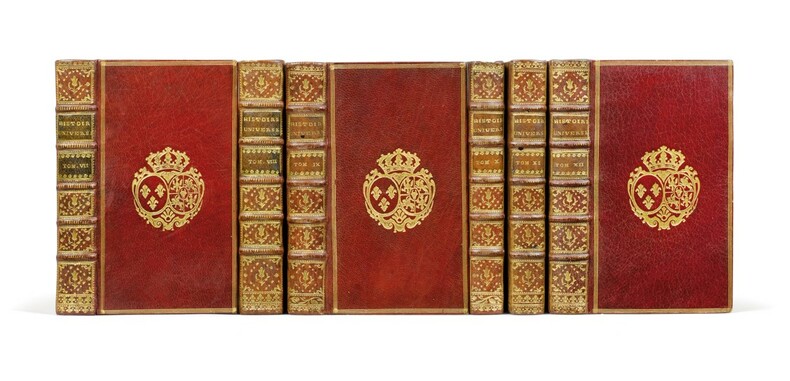
YTB-85Paris 1754-1765. 18 volumes in-12, maroquin rouge, triple filet doré sur les plats, armoiries dorées au centre, dos à nerfs orné, dos des tomes XV et XVI ornés des pièces d’armes de la Reine de France Marie Leczinska, filet or sur les coupes, roulette intérieure, tranches dorées. Reliure royale armoriée de l’époque. 163 x 98 mm. EDITION ORIGINALE FORT RARE DONT L’IMPRESSION REALISEE SUR L’ORDRE DE MESDAMES DE FRANCE FUT ETALEE SUR 25 ANNEES, DE 1754 A 1769. Les deux derniers volumes imprimés en 1769, après la mort de la reine Marie Leczinska survenu à Versailles le 24 juin 768 sont ici évidemment absents. Mesdames de France confièrent à Simon Linguet (1736-1794) et Jacques Hardion la charge de rédiger cette « Histoire Universelle ». Hardion fut le bibliothécaire du roi Louis XV, membre de l’Académie et précepteur des enfants de Louis XV en histoire et littérature. EXEMPLAIRE OFFERT A LA REINE DE FRANCE MARIE LECZINSKA, RELIE EN MAROQUIN ROUGE A SES ARMES. Marie-Charlotte-Sophie-Félicité Leczinska, seconde fille de Stanislas Leczinski roi de Pologne, et de Catherine Opalinska, naquit à Breslau le 23 juin 1703 et partagea pendant son enfance les vicissitudes qui avaient réduit son père, détrôné, à se réfugier en Suède, en Turquie et enfin en France, où il s’était fixé près de Wissembourg en Alsace (1719) ; une intrigue de cour la tira de la médiocrité où elle vivait et lui fit épouser Louis XV à Fontainebleau le 5 septembre 1725. La nouvelle reine, de sept ans plus âgée que son mari, bien que très attachée au roi, ne sut pas le retenir, et tandis que la Pompadour puis la Du Barry prenaient sur lui l’influence que l’on sait, cette reine intelligente vertueuse, et droite se tourna vers la religion et mourut enfin d’une maladie de langueur à Versailles le 24 juin 1768. Elle avait eut dix enfants, deux garçons et huit filles ; trois moururent en bas âge et trois autres avant elle ; seules, quatre de ses filles lui survécurent. La reine, qui cherchait à tromper l’ennui de sa solitude, s’était formé une bibliothèque composée presque uniquement d’ouvrages de piété ou d’histoire dont la plupart furent reliés par Pasdeloup. Deux des volumes portent au dos les chiffres de la reine et plusieurs sont imprimés sur très grand papier de Hollande. Précieux ensemble entré en possession de Madame Sophie après la mort de la reine qui en fit présent à l’une de ses proches qui écrivit cette note en tête des deux premiers volumes : « Ce livre ma été donné par Madame Sophie, 12 mo, 18 vol. Exemplaire de feu la reine » Sophie-Philippine-Elisabeth-Justine de France, huitième enfant de Louis XV, née à Versailles le 27 juillet 1734, fut appelée Madame Cinquième jusqu’en 1745, date à laquelle elle prit le nom de Madame Sophie ; très timide, elle vécut très effacée et mourut à Versailles le 3 mars 1782, léguant une partie de sa bibliothèque à la marquise de La Porte de Riants, sa dame d’honneur.
Large 8vo (245 x 178 mm). 29 volumes bound in 5. Includes 33 folding maps and 5 folding diagrams, a number of which colour-printed. Modern half calf with marbled boards and giltstamped titles to spines. A near-complete run of mandate reports on Palestine and Trans-Jordan from 1921 onwards, mostly published under Britain's mandate from the League of Nations, comprising both the relevant Colonial series and the Command Papers series as presented to parliament. - As early as 1920, when the joint British, French and Arab military administration over the formerly Ottoman Levantine provinces was transformed into a civil authority, Britain's High Commissioner of Palestine was required to file regular reports to the Colonial Office on the operations of this new administration. From 1922 onwards, when Britain was granted the Mandate for Palestine and Trans-Jordan, these reports were adapted for the Council of the League of Nations. They cover the finances and taxation, customs and trade, law and legislation, education, public health, public transport and immigration in Mandatory Palestine, also detailing the various security problems and sectarian strife in the territory and covering the establishment of the Palestine Gendarmerie, its transformation into the Palestine Police Force, the introduction of military units and sources and causes of violence. The reports were discontinued with the advent of the Second World War. - The present set includes: An interim report on the civil administration of Palestine during the period 1st July 1920 - 30th June 1921 [Cmd. 1499]. Palestine. Disturbances in May, 1921. Reports of the Commission of Inquiry ... [Cmd. 1540]. Miscellaneuous No. 4 (1922) [Cmd. 1708]. Correspondence with the Palestine Arab Delegation and the Zionist Organisation [Cmd. 1700]. Mandate for Palestine ... [Cmd. 1785]. Papers relating to the elections [Cmd. 1889]. Proposed formation of an Arab Agency [Cmd. 1989]. Appendices to the Report ... for the year 1924 [Colonial No. 17]. Report ... on the Administration Under Mandate of Palestine and Transjordan for the year 1924 [Colonial No. 12]. Report ... to the Council of the League of Nations ... for the year 1925 [Colonial No. 20]. Report ... to the Council of the League of Nations ... for the year 1926 [Colonial No. 26]. 1927 [Colonial No. 31]. 1928 [Colonial No. 40]. 1929 [Colonial No. 47]. 1930 [Colonial No. 59]. Palestine. Statement of Policy by his Majesty's Government in the United Kingdom [Cmd. 3692]. Palestine. Report on Immigration, Land Settlement and Development [Cmd. 3687]. 1931 [Colonial No. 75]. 1932 [Colonial No. 82]. 1933 [Colonial No. 94]. 1934 [Colonial No. 104]. 1935 [Colonial No. 112]. 1936 [Colonial No. 129]. Statistical Abstract of Palestine 1936, Palestine Royal Commission 1937 [Cmd. 5479]. 1937 [Colonial No. 146]. Palestine Partition Commission Report 1938 [Cmd. 5854]. 1938 [Colonial No. 166]. Miscellaneous No. 3 (1939). Correspondence between Sir Henry McMahon […] and the Sherif Hussein of Mecca July 1915-March 1916. [Cmd. 5957]. Palestine Statement of Policy [Cmd. 6019]. - Extensive sets as ours are extremely rare in the trade; the last set sold at auction did not contain a single volume of the Command Papers series (Christie's 2016, sale 12051, lot 366), as present here. Cf. Khalidi/Khadduri, Palestine and the Arab-Israeli conflict. An annotated bibliography, nos. 1569, 1633, 1641-3 & 1647.
Folio. (12), 125, (1) ff. With woodcut printer's device on title-page, repeated on final page, two pages with decorative woodcut borders (built up from 4 blocks, some with initials I.F.), and woodcut initials throughout. 18th-century half calf, with marbled paper in a tree pattern on sides, gold-tooled spine with the coat of arms of the Russian Tsars. First edition of a collection of four medical works, compiled by the Swiss physician Albanus Torinus (1489-1550). The main part of the work consists of "De re medica", also known as "Medicina Pliniana", a very popular medical text during the Middle Ages. Compiled in the fourth century by an anonymous author, it is generally ascribed to Plinius Valerianus, also called pseudo-Plinius, since it mainly derived from Pliny the Elder's "Historia naturalis". Consisting of five books, it gives various medicines and treatments for different diseases, ailments, wounds, tumours etc. The book also draws heavily from the works of Galen and Dioscorides, all highly esteemed in the Arabic world. - The work also contains three other medical works from different authors. "The contents are all either spurious works or later compilations from genuine works of the authors to whom they are attributed" (Durling). It starts with an introduction to "the art of healing", ascribed to Soranus of Ephesus. The second text is by Oribasius, a Greek medical writer from the fourth century BC. According to Durling, the text is an extract from the first chapter of his "Euporista ad Eunapium". The work closes with a botanical text, "De virtutibus herbarum", ascribed to Lucius Apuleius Madaurensis, but written by an anonymous author from the 4th century, known as Pseudo-Apuleius. In one of the manuscripts Torinus used, the text was ascribed to the famous Italian physician Antonio Musa Brassavola (1500-55), an expert on the works of Galen and heavily influenced by his work. - The editor, Torinus, was appointed professor of practical medicine at the University of Basel after receiving the degree of doctor in medicine in Montpellier. He translated many Greek texts into Latin, or Latin works into the vernacular, including Vesalius' "De humani corporis fabrica". - From the library of the Russian tsars, with its letterpress library label with shelf number on pastedown and the coat of arms on the spine. With the place and date of printing added in manuscript on the title-page. Paper on boards slightly chafed, binding with traces of use along the extremities, corners bumped and spine restored. First five leaves with a minor water stain, but otherwise a very good copy. Adams S 1461. Durling 4351. Parkinson 2410.
Folio (332 x 218 mm). With engraved frontispiece, portrait of the author, and 140 engravings, all but one full-page. Contemporary full vellum with manuscript lettering to spine. First edition of this rare Italian riding school, covering all aspects of horse breeding, training and care, lavishly illustrated with 140 engravings. A second, enlarged edition, also apparently rare, was published in 1723 under the title "Opera". The work is divided into five parts: the first, "Regole di cavalcare" with one plate; the second, "[...] ove si tratta del difficilissimo mestiere dell' imbrigliare"; the third, "[...] dell' istesso", with 95 illustrations of bits, etc.; the fourth, "Disegni de' circoli" with 10 diagrams and "Ritratti d'uomini illustri" with 27 portraits, about half of which show mounted figures; the fifth, "[...] intorno alla preservativa, conservatione, e medicina per cavalli" with 7 plates, also including other animals (such as a rhinoceros). - Errata leaf at beginning, some leaves browned or spotted. No copy in auction records of the last decades. Huth p. 28. Brunet I, 159. Graesse I, 68.
Folio. 3 parts in one volume. (4), 144 (last blank) ff. with 32 woodcut illustrations; 94, (2), 45 (3) (last blank) ff. First title-page printed in red and black; 3 (repeated) printer's devices. Contemporary blindstamped leather over wooden boards with one metal clasp (out of 2). A collection of three works published by Feyerabend, issued jointly with separate title-pages each. The first work contains a translation of the famous travel account of Francisco Alvarez (ca. 1470-1540), who accompanied as a chaplain the 1520-26 Portuguese expedition to Ethiopia under Rodrigo de Lima. The embassy was occasioned by a letter by Helen, Empress of Ethiopia, the grandmother of Lebna Dengel (David II). The journey began in Massaua in 1520, leading the party to Shewa and Dabra Libanos before they reached Lebna Dengel's camp near Taguelat. Alvarez made at least four journeys to Shewa before leaving Ethiopia in 1526, bound for India. According to Ramusio, this was the earliest account of Etiopia, and for at least a century it would remain the principal published source on the country. The first edition appeared in Portuguese in 1540, comprising merely a part of Alvarez's lost five books. Alvarez describes the country's churches, including the rock-hewn churches, and also the towns and the agriculture. Historical geography owes to him the story of the invasion of the Somal and Galla. Alvarez also gives accounts of the countries surrounding the rule of Prester John, such as Danakil and Godjam. It is unfortunate that Alvarez was unable to perform cartographical and topographical localisations, and yet his influence on cartography remained evident until the days of d'Anville and J. Bruce (cf. Henze I, 62ff.). The account is prefixed by two letters by Andrea Corsal, previously published in 1516. The Florentine traveller Corsal describes, on 24 ff., mainly the area of the Red Sea, Southern Arabia (with descriptions of Aden, Hormuz, Bahrein, Socotra, Muscat, and Oman), India, Ethiopia, Persia (the city of Balsera and King Sophi), as well as Malacca. - Binding somewhat rubbed; wants one clasp. Title-page clipped and remargined; old ownerships to title and flyleaf; a small worm-hole to 35 ff. (touching a single line); evenly browned throughout. A very good copy. Kainbacher 15f; Lockot 711, 732; Gay 186; Sabin 974. Cox I, 3 & 22. Gay 3321 (French ed.). The second work is a translation of Orosius's world history; the third work is a translation of the text from Ortelius's 1580 world atlas. - Schweiger 622 (Orosius). Not in Adams.
Folio (212 x 335 mm). (2), 276, IX, (1) pp., final blank, with one folding plate (counted as p. 152). Contemporary half cloth with original printed boards, issued thus. Gertrude Bell's personal copy of this excessively rare manual on the social, political and economic structures of the Arab tribes living in the Baghdad Vilayet (Province) as drawn up in July 1918, only months before the partitioning of the Ottoman Empire ended the old administrative divisions and led to the formation of several new states - indeed, to the creation of the modern Arab world. - Arranged alphabetically by the names of the tribes, this handbook - essentially a carefully compiled and redacted British intelligence file printed for the use of British Political Officers and their assistants in a region then undergoing dramatic upheavals - offers surprisingly detailed information on the tribes' origins, loyalties and internal quarrels, the locations of their settlements, strength of their possessions, economic and bargaining power, as well as their kinships, often including genealogical tables. The names of the tribes' leaders are given in full, frequently also in the original Arabic. - Gertrude Bell (1868-1926), who had firsthand experience among the tribes, signed her name in pencil ("Gertrude Lowthian Bell") on the front free endpaper. Several neatly pencilled additions to some of the entries are likewise in her hand: next to the name Fahad ibn Hadhdal she notes that he died and the name of a "rival" (this underlined), apparently a "bin Dughaiyin" (p. 16). In another entry she notes that Jazza' ibn Mijlad "blockaded Turks in North for allies in 1st war" (p. 17) and that the A'marat prefer to winter near al-Hafan. There are several references to her fellow political officer, St John Philby, and a correction that the Al-Dulaim are "all Sunnis" (p. 265), and none Shi'ahs. - Gertrude Bell was a traveller, political actor, and archaeologist who was a key player in the nation-building after World War I, especially in Iraq. She founded the Iraq Museum, translated Persian poetry, and advised the British government's foreign policy at nearly the highest level. It is little surprise that she would have owned one of the few copies of this important source, containing otherwise nearly unobtainable population statistics as well as details on the political history of a region in which traditional tribal feuds became mingled with international high politics. Considering the limited scope of intended distribution and the sensitive nature of the information contained, it is safe to say that this invaluable compendium never had more than a very limited press-run; indeed; only three copies are known today in libraries worldwide, and none with such unique provenance. - Covers rubbed, title-page brittle and reinforced with two library stamps carefully removed but still faintly visible. A closed tear to the folding map. Later in the collection of the American missionary turned political biographer Harry J. Almond (1918-2007), with his handwritten ownership in ink next to Bell's own. In all very well preserved. No copy in auction records. OCLC: 921927074, 729268761.
Folio (548 x 400 mm). Vol. I (all published). Lithographic portrait of Arif Pasha, on India paper mounted, drawn on stone by M. Julien, 16 tinted lithographic plates after Arif (lacking lithographic title, toning to text). Contemporary black half morocco over black cloth-covered boards with gilt title to spine. First edition of the valuable and beautifully illustrated survey of the costume worn at the court of the Ottoman Empire, published with the text in both French and Turkish. Ministers, state officials and military officers (including intelligence service) are shown in full costume with their functions captioned in Arabic and French below. Although the lithographic title states 'Tome 1er', no further volume was published in either language. - Arif Pasha fought against the Greeks at Athens and at Euboea (1826-28), and in Syria against Mehmet Ali. His career included a number of missions for the Sultan and his appointment in 1861 as governor of the province of Silistria. Atabey 30. Blackmer 43. Lipperheide 1440m. Colas I, 148.
220:160 mm. Mounted on cardboard. An appealing knee-length portrait en face, dedicated to the Sinop Red Cross Society (Sinop Hilali Ahmer Cemiyeti).
8vo. 1 page. In German. To an unnamed addressee: "Please excuse my not coming today, but it was impossible for me, as I was already committed elsewhere. Even tomorrow I will not be able to see you, as I want to take advantage of an extraordinary opportunity to write to Russia. But the day after tomorrow I certainly want to see your home. Your unchanged, albeit older M. Bakunin" (transl.). - The aristocratic Russian anarchist, a figurehead of permanent revolution, had escaped from Siberia to Japan in 1861, made his way from there to San Francisco, and then to London, where he began to renew his associations in revolutionary circles. A compelling if somewhat intemperate figure, Bakunin loathed Karl Marx and vigorously challenged his authority. This enmity led to Bakunin's expulsion from the International in 1872.
Folio (213 x 330 mm). (9) pp. of text with an engraved headpiece, (27) pp. of engraved astrological charts, 80 pp. of text with 4 engravings in the text. Title-page printed in red and black. Contemporary unsophisticated boards. Only edition of this rare treatise on the astronomy, astrology and allied sciences of the Arabs, Persians and Turks. Once "said to be the first book printed with Persian characters" (Anderson, The library of the late George H. Hart of New York City, Part II [1922], no. 471), it remains an impressive achievement, even if the oriental languages are here in fact rendered in Hebrew letters, while the Persian specimens are engraved. (The first book in Persian characters was produced at Leiden more than a half-century earlier.) - The Swabian theologian Beck (1649-1701) studied history and oriental literature at Jena, soon surpassing his teachers. "The principal object of his studies always remained the oriental languages; and his great knowledge of Hebrew, Samaritan, Chaldaic, Syriac, Ethiopian, Persian, Arabic, and Turkish gained him such renown that he even drew a pension from the Prussian crown for them" (ADB II, 218). - Lacks the 12 double-page letterpress tables after the engraved astrological charts (which are bound out of sequence). First and last leaf somewhat browned, otherwise very clean. Stamp "Eigentum der Stadt Augsburg" to title-page. VD 17, 39:125183T. Caillet 901. Lalande p. 330. Gardner II, 102.
4to. (12), 112 pp. With engraved portrait frontispiece of Anne Marie Louise d'Orleans and numerous pretty woodcut initials and tailpieces. Contemporary richly gilt calf, leading edges and spine gilt (tiny defect to upper spine-end and hinge). Marbled pastedowns. First edition of this rare work on precious stones and pearls found in the East and West Indies, written by a Parisian "marchand orphèvre". Dedicated to "La Grande Mademoiselle" Anne Marie Louise d'Orléans, Duchess of Montpensier and niece of Louis XIII, with her finely engraved portrait by L. Boissevin (which, according to Graesse, is frequently lacking). This "very early, and important treatise on gemstones, gold & silver" (Sinkankas) includes a chapter dedicated exclusively to pearls, a subject with which the author was especially familiar (cf. ibid.), and the Gulf is stated as one of the main locations of pearl fishing: "on pesche les perles en divers endroits du monde. Dans le Golfe Persique, principalement aux environs de l'Isle d'Ormus & Bassora: aupres de Baroyn [i.e., Bahrain], Catiffa, Iuffa, Camaron, & autres lieux de ce Golfe [...]" (p. 74). "The first chapter attempts to reconcile differing views of various writers, as cited by Berquen, on the origin of gemstones and precious metals, with following chapters taking up the principal gemstones, and some minor ones, as diamond, sapphire, topaz, ruby, spinel, emerald, amethyst, aquamarine, hyacinth, opal, chrysolite, iris, vermeille, garnets, carnelian, turquoise, quartz varieties, pearl, coral and amber, and lastly, a chapter on gold and silver [...] Both [the first and the second edition] are rare" (Sinkankas, p. 97f.). - Insignificant waterstain and occasional slight worming, mainly confined to upper margin. A good copy in an elaborately decorated contemporary French binding. Sinkankas 592. Sabin 4957. Brunet VI, 4780. Graesse I, 348. Ferguson II, 295 (note). Cf. Duveen 71 (1669 second ed.).
Large folio (260 x 395 mm). (20), 398, (8) pp. With engraved frontispiece, engraved author's portrait, large engraved folding map of the Mediterranean Sea, 103 engraved plates (many double-page and folding, and often containing more than one illustration) and 18 engravings in text (totally containing 218 illustrations, numbered A & 1-210). The engraved plates are all after drawings by De Bruyn and contain 15 plates engraved by Jan Luyken and 1 by Casper Luyken, all but one unsigned. 18th-century, gold-tooled, tanned goatskin, marbled edges; rebacked, with original backstrip laid down and modern endpapers. First edition, large-paper copy, of this beautifully illustrated account of De Bruyn's first journey through Egypt, Syria, the Holy Land, Rhodes, Cyprus, Scio and Turkey. - The Dutch traveller and painter Cornelis De Bruyn (1652-1726/28) left the Netherlands in 1674 to travel through the Levant by way of Italy. He stayed in the Levant for seven years before settling in Italy in 1685 and returning to the Netherlands in 1693. The work is especially valued for its engravings after De Bruyn's own drawings, executed by such well-known artists as Jan and Caper Luyken, including folding panoramas of Alexandria, Sattalia, Constantinople, Bethlehem, Jerusalem, Rhodes and Chios. The publication was soon followed by editions in English and French. - The present copy is printed on large paper from a single stock, watermarked: fleur-de-lys on a crowned shield above 4 and WR = WK, with a trimmed leaf size measuring 396 x 259 mm (not in Heawood or Laurentius). - With some occasional spots, some folds and edges of the plates reinforced or mounted on new stubs; a very good copy. The binding rebacked as noted and with some wear to the tooling. Atabey 159. Howgego, to 1800, B177. Klaversma & Hannema 311. Tiele, Bibl. 207. Cf. Gnirrep, De Levant in een kleur (1997).
Small folio (320 x 246 mm). 3 vols. XXIV, 532, (2) pp. with heliogravure frontispiece, 548 illustrations, 40 plates and maps in the text, and 2 extra maps on 4 ff. XII, 358, (4) pp. with 315 illustrations and 9 plates. XIV, 403, (1) pp. with 257 illustrations and 4 plates. Publisher's original half vellum and green boards. First edition: rare. A remarkably well-illustrated archaeological survey of sites in Syria, Jordan, and Lebanon, particularly valued for its account of Petra and of the palace of Mshatta in Jordan, a great monument of early Islamic art. With over 1100 half tone illustrations, many full-page, and numerous splendidly produced plates (some folding or double-page, a few coloured). The outstanding feature of the Mshatta palace was the intricately carved decoration on its facade. Today the complete facade, built in the mid-eighth century, exists only in Brünnow's photographs (see vol. II). - Bindings slightly rubbed; upper joints of vol. III slightly split; stamp of the Meadville Theological School library to title page. A good, clean copy. NYPL Arabia Coll. 166. OCLC 24223621.
16mo. 4 pp. on bifolium with United Services Club embossed letterhead. In custom quarter morocco folder. To Colonel Montgomery, referencing the success of the "Arabian Nights": "[...] To my great astonishment The Nights has hit the public taste: it has of later years been so stuffed with goody-goody, namby-pamby Maria-Matilda that it wants 'strong meat' and by Jove it has got it. We had the pleasure of seeing my good friend Thayer here and I (unhappily) forgot to put his name down for the Athenaeum Club - London without a club is like a park without games. We are both living well under influence of beef and port (wine) and shudder at the lean flesh pots of Trieste (veal) [...]". - Burton published his famous translation of the "Arabian Nights" ("The Book of the Thousand Nights and a Night") in a private printing for the Kama Shashtra Society in 1885. The private publication, by subscription only, was necessary to avoid Victorian obscenity strictures. - Reinforcement at fold, a little smudging to signatures.
8vo. (16), 107, (1) pp. Tinted lithographed frontispiece and 3 plates, 8 pp. publisher's catalogue at end. Original cloth. First edition, "well written" (Harting). - Half-title inscribed by the author in Arabic: "To the accursed captain from his friend Mirza Abdullah" (as Burton styled himself during his travels). Below the inscription is a pencil drawing (not by Burton) of the author's head imposed onto the body of a cat walking across a roof, captioned beneath in English, in a different hand in ink: "a faithful sketch of the Author". - Spine-ends professionally repaired. Light foxing to plate margins, occasional spotting elsewhere. Harting 66. Schwerdt I, 90. Penzer p. 41.
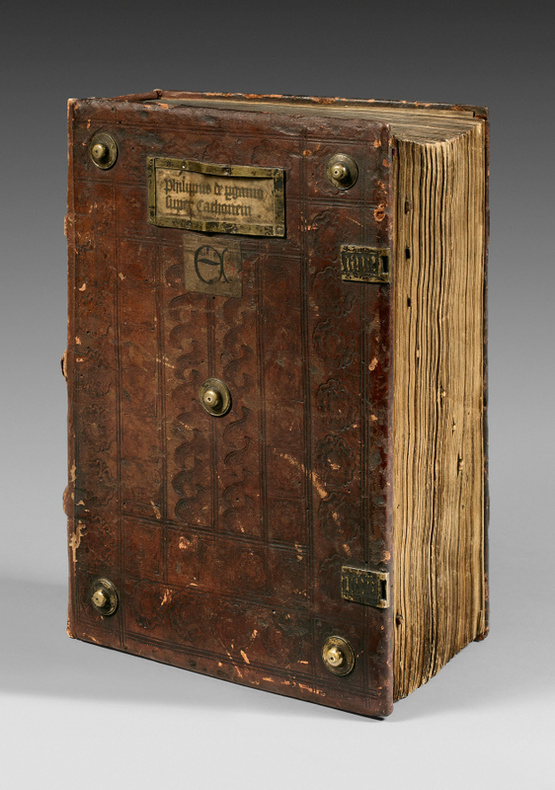
LCS-17927Achevé d’imprimer le 2 novembre 1475. [Auguste Vindelicorum, Ant. Sorg], 1475. In-folio gothique de (1) f.bl., 484 feuillets à 40 lignes par page, ainsi complet, mention manuscrite en bas du titre, qq. mouillures sans gravité, annotations marginales, signets de l’époque. Reliure monastique en veau brun estampé à froid sur ais de bois, dos refait, plats très ornés, écoinçons d’angle et cabochon central en métal, titre de l’œuvre calligraphié d’une main monastique sur le plat supérieur. Reliure réalisée vers 1475. 301 x 212 mm.
Hand-coloured engraved map (scale: 70 miles to 1 inch). 692 x 668 mm, including fold-out section at right edge showing Ras al-Hadd. Matted. Exceedingly rare, large map of the Arabian Peninsula, based on surveys conducted under General F. R. Chesney (1789-1872), the explorer of the Euphrates and founder of the overland route to India. Drawn by W. H. F. Plate. This is a second, improved edition of a map that had previously appeared in 1847 under the simple title "Arabia" (kept at the British Library, referenced as IOR/X/3205 within the Qatar Digital Library). "Mesopotamia and its rivers are laid down from Surveys made during the Euphrates Expedition. The Red Sea, the Persian Gulf and the Southern Coast of Arabia are from those made by the Officers or the Indian Navy. The interior of the peninsula is from various sources, particularly materials furnished for the accompanying work by Aloys Sprenger M.D. and from documents obtained by Dr. Plate" (note). Finely preserved. No copy known outside the British Library. OCLC 556388606. Not in the Al-Qasimi Collection.
Three hand-drawn watercolours showing the "Coromandel" (148 x 225 mm), the "Tigris" (178 x 240 mm), and the "Georgiana" (142 x 240 mm), mounted on backing paper, separately matted. With a presentation leather-cased 1½-inch three-draw leather-covered surveying telescope and compass compendium by Andrew Ross, London, contained in 29 cm leather carry case with lid enclosing a lacquered-brass compass, collapsed length 25 cm, expands to 71 cm. A striking collection of original watercolours drawn by Lieutenant William Collingwood, civil engineer in the Royal Indian Navy, during his surveying mission to the Middle East in the mid-1850s. The three ships, all built for the "Honourable [East India] Company", are the H.C. Screw Troop Ship "Coromandel" ("1112 Tons. Commander C. D. Campbell I.N. London to Madras Aug. to Nov. 1856"), the H.C. Brigantine "Tigris" ("Persian Gulf. Entering "Cheroo" Bay. August 1857"), and the H.C. Schooner "Georgiana" ("Lieut. Collingwood Comd. off 'Karack', Feb. 1858"). While the exact location of the "Coromandel" at the time of sketching is not identified (though Collingwood was undoubtedly in the Arabian area at the time), the other two ships are clearly sailing the Arabian Gulf. The "Tigris" is shown entering Cheroo Bay (Chiruyeh, Bandar-e Chiru), on the south coast of Persia, opposite Inderabi Island; the bay was popular with navigators in the region for offering safe shelter from western and northwestern winds, with regular soundings of up to ten fathoms quite near the shore. The "Georgiana" is pictured farther north off Kharg Island, 16 miles from the coast of Bushehr province. Kharg is mentioned in the 10th-century "Hudud al-'alam" as a good source for pearls and was visited by Jean de Thévenot in 1665, who recorded trade with Isfahan and Basra. After the Dutch Empire established both a trading post and a fort on the island in 1753, the Dutch fort was captured in 1766 by Mir Mahanna, the governor of Bandar Rig. The island was briefly occupied in 1838 by the British to block the 1838 Siege of Herat but was soon returned. - Slight loss to upper left corner of all three sheets; some brownstaining and traces of folds, but well-preserved on the whole. The ensemble is neatly complemented by Collingwood's presentation surveying telescope and compass compendium, the telescope being signed and inscribed: "From Comr. Selby, Surveyor in Mesopotamia, to Lieut. W. Collingwood, Asst. Surveyor, in kind remembrance of Services together in Babylonia & Irak Arabia". Commander W. B. Selby, who dedicated this fine telescope-cum-compass set, began his distinguished surveying career in 1837 when, as a midshipman, he embarked on the expedition first to lay navigation buoys in the mouths of the Indus River and then to chart some coastal areas in the "Horn of Africa". By 1846 he was back working off the mouths of the Indus, having made his reputation in Mesopotamia (in 1840-41), and thereafter achieved considerable acclaim for his numerous other surveys, including those during the military expedition to Persia in 1856, before returning to England at the end of 1862. He was succeeded as Surveyor of Mesopotamia by his protégé, Lt. William Collingwood (a distant cousin of the Admiral), who had already done much valuable work in the region, including the large-scale, though surreptitious, mapping of Baghdad in 1855, described by him as follows: "The survey of the city of Baghdad was completed entirely by myself and under very unpleasant restrictions [...] The Turkish Government were not to know anything about it [...] and I was left to survey the town as best I could, and under such difficulties that at times I had to note bearings and paces all over my white shirt, where best I could get the pencil at the time [...]". During this same expedition, Collingwood also surveyed the Shatt-ul-Arab, the city of Bussorah (also by stealth) and much of the country between the Tigris and Euphrates Rivers, and was undoubtedly one of the most gifted and productive R.I.N. surveyors of his day.