Saint AugustinLivre Rare Book
690 923 résultats
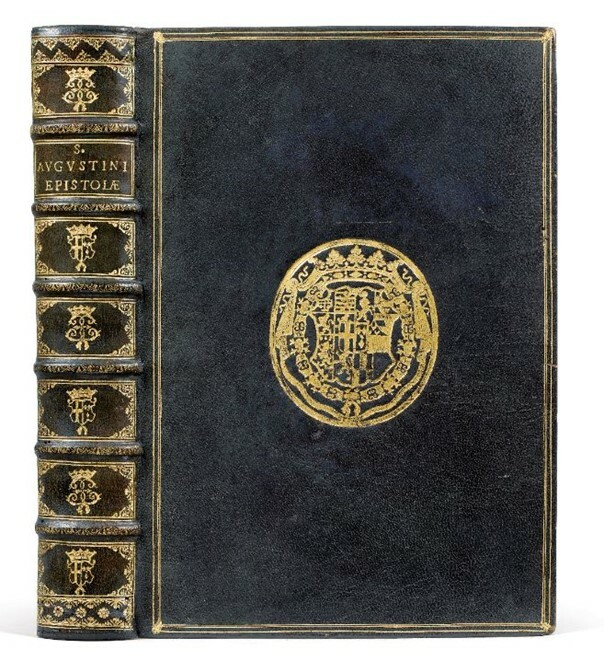
1493YTB-115Les Lettres de Saint Augustin imprimées à Bâle en 1493, reliées pour le prince Eugène de Savoie. (Bâle), Johann Amerbach, 1493. In-folio de 328 ff., complet, 52 lignes + titre courant ; titre remonté ainsi libellé : Liber epistolarum beati Augustini episcopi hipponensis ecclesie ; qq. anciens trous de vers sans conséquence en marge des premiers et derniers feuillets. Maroquin bleu nuit, triple filet doré encadrant les plats, grandes armoiries frappées or au centre, dos à nerfs orné en alternance du chiffre couronné et des armoiries du Prince Eugène de Savoie, coupes décorées, roulette intérieure, tranches dorées sur marbrures. Reliure d’Etienne Boyet vers 1710. 306 x 212 mm. SECONDE EDITION DES LETTRES DE SAINT-AUGUSTIN IMPRIMEE PAR JOHANN AMERBACH A BALE EN 1493. La première édition fut publiée à strasbourg, chez Johann Mentelin en 1471. Goff, A-1268 ; Hain-Copinger, 1969 ; Proctor, 7599 ; BMC, III, 755 ; GKW, 2906 ; Pellechet, 1483 ; Polain (B), 383 ; IGI, 995. De l’énorme correspondance de Saint-Augustin (354-430), il nous reste 206 lettres adressées à 50 correspondants. « Cette correspondance est du plus grand secours pour pénétrer dans les méandres de la vie et de l’esprit de cette haute personnalité ; en outre, elle conforme son influence et ses doctrines. La correspondance purement amicale n’y occupe que peu de place, mais toutes les lettres sont imprégnées de la même ardeur dans la recherche de la vérité et dans l’exhortation à la perfection ; d’autres sont de véritables petits traités. Nulle part ailleurs comme dans ces Lettres, écrit Ebert, n’apparaît l’importance considérable dont jouissait Augustin auprès de ses contemporains. Les évêques et les docteurs le consultent comme un oracle ; il donne des conseils devant l’imminente invasion des vandales. Les théologiens ont classé les lettres en : théologiques, polémiques, exégétiques, ecclésiastiques, morales, philosophiques, historiques et familières. Mais on peut dire que, dans chacune d’entre elles, Augustin réunit tous ces genres littéraires » (T. F. Lesort). Les Lettres de Saint Augustin apportent un éclairage essentiel sur l’œuvre et l’esprit de cette personnalité hors du commun. PRECIEUX EXEMPLAIRE RELIE POUR LE PRINCE EUGENE DE SAVOIE (Paris, 1663 -Vienne, 1736). Ce prince, qui signait Eugenio von Savoie pour rappeler ses trois patries adoptives, avait formé l’un de plus magnifiques cabinets d’objets d’art et de curiosités, de livres rares et de manuscrits précieux. En mourant, le prince Eugène légua sa collection de livres à l’empereur Charles VI. A ce titre, ils firent partie de la Bibliothèque Impériale de Vienne. Plus tard, une sorte de révision eut lieu et, sans respect pour une grande mémoire l’on vendit comme doubles des volumes qui, outre leur mérite propre, offraient l’avantage d’une splendide reliure. Quant aux autres, ils furent dépouillés de leur premier vêtement et recouverts en carton gris. Outre les armoiries et le chiffre du prince Eugène, le volume porte le timbre sec de la Bibliothèque Impériale de Vienne.
8vo. 2 parts in 1 volume. Arabic manuscript on paper. 144 ff., 1 leaf of index. Text in black naskh with important words and phrases in red, occasional marginal notes. 19th century three quarter red boards with red morocco spine, ruled and lettered in gilt. An uncommon epitome of a 13th century medical treatise by 'Abd al-Wahhab ibn Ahmad Sha'rani (1492/3-1565), known primarily for his mystical writings. While Al-Sha'rani famously founded an Egyptian order of Sufism, Sa'rawiyyah, which remained active until the 19th century and wrote extensively on religious law and Sufism; his interest in medicine is less well known. This book, which discusses a treatise by the physician Al-Suwaydi (1204-92), is unique among his works as a scientific text, and is important in forming an idea of Al-Sha'rani as a man of numerous intellectual interests, equally able to debate religious law and explain medical recipes and procedures. Indee, these were not interests at odds with each other: magical and occult remedies are prominent throughout the text. Al-Sha'rani retains some of Al-Suwaydi's stylistic choices as well, most noticeably the organization of the medical recipes by body part to be treated: the work starts with ailments of the head and proceeds down the body to end with the feet. - This specimen was copied on Sunday, the 11th of Safar 1108 AH by the scribe Muhammad Muhyi al-Din Abi al-Anas al-Shafi'i al-Miliji al-Ash'ari al-Sha'rani. Two of the ownership entries are dated 1251 and 1322 H, and annotations and notes at the end with an added index in Maghribi script suggest that it was last owned by a physician in Morocco or elsewhere in North Africa. - Boards somewhat worn, a few minor stains and wormholes. Index has been reinforced. An interesting medical work from a Sufi theologian. GAL II, 335f.
2 vols. of text (4to) and one volume of plates (folio, 284 x 378 mm). Text: XXIII, (1), 228, (2) pp. With 3 genealogical tables and 2 folding maps. XVIII, 397, (1) pp. Atlas: 4 chromolithogr. plates, 5 (of 6) toned lithogr. plates (one folding), and 65 mounted photographs on a total of 39 (of 40) plates; 1 letterpress leaf of contents. Includes original printed upper board cover, loosely inserted. Modern black library cloth with gilt title to spine; atlas portfolio uniform with books. Contemporary black half roan, spines in five compartments with raised bands gilt, original atlas-portfolio of black cloth-backed printed cream boards. First edition, a complete set with both text volumes and the portfolio with all the photographic plates, but lacking one of the lithographs. The Dutch orientalist Snouck spent a year in Mecca and Jeddah during 1884/85 and was married to a Mecca woman. He was the first non-Muslim to visit the city outside the annual pilgrimage. The photographs, taken by himself and an Arabic physician, are among the earliest to show Mecca and its pilgrims. - Spines of both text volumes and portfolio professionally restored. Atlas lacks plate XVII (detail of Kiswah fabric), some light scattered spotting, minor creasing to mounts. Macro 1239 (omitting mention of the Atlas). Henze V, 177. Dinse 443.
8vo. (24), 179, (17) pp. Contemporary full vellum with handwritten title label to spine (faded). First Latin translation of this three-part pharmacological treatise on the nature and effect of medicines gained from animals, vegetables, and minerals (including some quite superstitious material), published under the name of the mediaval Egyptian polymath Abd al-Rahman Al-Suyuti, whose "versatility stands out as unique in the history of Arabic literature" (GAL II, 144), but probably assembled from various Arabic sources. The first part, covering animals, is likely Al-Suyuti's own "Diwan al-Hayawan", translated by Abraham Ecchellensis after a manuscript in Cardinal Mazarin's library; the authors and manuscript sources of the following two parts remain unidentified. Within the notes, this edition uses several Greek, Hebrew, and even Arabic interspersions in the type. - Some browning to paper. 18th century French note on lower flyleaf; handwritten duplicate note and stamp to title-page. Insignificant paper flaws to pp. 103-106, merely affecting the pagination; small edge tear in p. 151f.; loss to lower margin of last leaf but one of the index (not touching text). Krivatsy 11586. Choulant 389. Wellcome II, 2. Ebert I, 9151. Krüger, Bibliographia botanica 35. Catalogue of the Library of the Medical and Chirurgical Society of London 145.
4to. (4), 264, (16) pp. With engraved map of Ethiopia, including part of the Red Sea and the source of the Blue Nile. Modern calf, gold-tooled spine, with red morocco title-label, and the sides blind-tooled in a panel design. Rare first English edition of Tellez's influential historical account of Ethiopia and Arabia. It is a digest of the accounts of all the Jesuit travellers to Ethiopia and Arabia, including Paez, De Montserrat, Almeida, Lobo and Mendes. It includes an account of the travels of the Jesuit missionaries Pédro Paez and Antonio de Montserrate, who were captured off the Kuria Muria islands on a mission from Goa to Ethiopia in 1590 and subsequently taken to Yemen, where they were held captive until 1596. After being sent to San'a by way of Melkis and the Wadi Hadramaut, then after three years taken to Al Mukha (Mocha), where they were forced to serve as galley slaves, they were finally ransomed in 1596 and returned to India. Paez discovered the source of the Blue Nile and is said to have been the first European to have tasted coffee in Al Mukha. - The work further includes a detailed description of Aden (Yemen) as well as of the Ethiopia-Adal War (1529-43), during which Ahmad ibn Ibrahim al-Ghazi led several expeditions against the Ethiopian emperor until most of Ethiopia came under the power of the Muslim Sultanate of Adal. The present English edition is based Almeida's "Historia geral de Ethiopia a alta" (1660), edited by Tellez. - With early owner's inscription ("W. G. Patchell") on title-page. Quires 2D and 2E transposed; a couple of millimetres shaved off the outer border of the map; a faint waterstain throughout; some leaves foxed and some occasional spots. A good copy. ESTC T133244. Paulitschke 1137. Cf. de Backer/Sommervogel VII, 1908-1910. Howgego, to 1800, A65 (Almeida).
Folio. Tinted lithographic additional title by Charles Parsons, printed by Endicott & Co., 20 chromolithographic plates by Parsons after van Lennep, all printed by Endicott & Co. of New York. Expertly bound to style in half dark green morocco over period patterned cloth covered boards, spine lettered and decorated in gilt. A rare and important colour-plate book: one of the relatively few American costume books, and certainly the best such created in 19th-century America. This is a notable and unusual instance of the taste for the Ottoman or "Turkish" which manifested itself in the furniture of the period but seldom in books. In terms of American color-plate books, this is one of the only large projects from the 1860s, when the Civil War seems to have curtailed production of such lavish enterprises. "The one really big chromolithographic book of this decade [...] the art is simple, but [Charles] Parson's hand is obvious in the good lithography, and Endicott's printing is well done for its time" (McGrath). "Endicott achieved a rich variety of color which demonstrated the increased technical ability of American printers in the medium" (Reese). Henry Van Lennep was born in Smyrna, the son of European merchants. Educated, on the advice of American missionaries, in the United States, he returned to Turkey as a missionary in 1840, and spent most of the next twenty years in various parts of the Ottoman Empire. Returning to the United States in 1861, he turned his superb original drawings of Middle Eastern life into the Oriental Album. The plates include two scenes of Jewish life in the Ottoman Empire. Included are plates of "A Turkish Effendi", "Armenian Lady (at home)", "Turkish and Armenian Ladies (abroad)", "Turkish Scribe", "Turkish Lady of Rank (at home)", "Turkish Cavass (police officer)", "Turkish Lady (unveiled)", "Armenian Piper", "Armenian Ladies (at home)", "Armenian Marriage Procession", "Armenian Bride", "Albanian Guard", "Armenian Peasant Woman", "Bagdad Merchant (travelling)", "Jewish Marriage", "Jewish Merchant", "Gypsy Fortune Telling", "Bandit Chief", "Circassian Warrior", "Druse Girl". Bennett, p. 108. Blackmer Catalogue 1715. Blackmer Sale 1500. DAB XIX, 200. McGrath, pp. 38, 115, 162. Reese, Stamped with a National Character 97. Atabey 1274.
Royal 4to (31 x 27 cm). 2 vols. 439; 46, (2 blank) pp. (vol. II, pp. 1-2 blank). With 2 title-pages printed in red and black, each with the author's wood-engraved decorated GAV monogram and motto; vol. 1 with 2 folding lithographed maps (1 printed in black, brown and blue, with the route coloured by hand in red, of the Sinai Peninsula; the other in black and white, of the city of Petra); 40 mounted albumen prints after paintings by Emile Pierre Metzmacher (mainly 11.5 x 16 cm), individually mounted with letterpress captions on the mount; and 2 engraved plates; vol. 2 with 6 numbered engraved plates of molluscs and insects. Set in roman and italic types, with incidental Arabic, and sans-serif Greek and Latin capitals to render ancient inscriptions. The Diario in the original publisher's maroon cloth with the author's crowned monogram gold-blocked on the front board and spine, and blind-blocked on the back board, with the title in gold on the spine. The Atlante in the original publisher's blue cloth, with the author's crowned monogram and the title gold-blocked on the front board, and the monogram in a larger size blind-blocked on back board. Both volumes with gilt edges, orange endpapers and with tissue guard leaves tipped in, protecting the albumen prints and engraved plates. Rare first and only edition of an Italian account of an 1865 expedition through "Arabia Petrea", meaning the Sinai Peninsula and adjoining parts of what are now Israel and Jordan, including the ancient city of Petra, now in Jordan, where parts of "Raiders of the Lost Arc" were filmed (the spectacular ancient buildings are carved into the solid rock walls of the cliffs and probably date from the 5th century BC to the 2nd century AD). - The photographically reproduced paintings show the author on camelback, numerous Bedouins, Arabs, Egyptians and Ethiopians as well as archaeological sites, monuments and topographic views. The plates in the second volume depict molluscs and insects, reflecting the author’s own research interests in the field of natural history, in addition to archaeology. The typography has been designed to suit the antiquarian subject, with Louis Perrin's Augustaux roman capitals on the title-pages, the main text set in what would then have been considered an "antique" style (types influenced by pre-1800 models) and sans-serif capitals used to represent the ancient Greek and Latin inscriptions. The author quite literally put his stamp on the work, with his crowned monogram not only on the title-page and binding, but also embossed in the paper, where it serves as a sort of watermark. - The book does not indicate the size of the edition, but since most of the illustrations are original albumen prints, there cannot have been many copies produced. The present copy may be a more deluxe binding than the Blackmer copy, also inscribed by the author to a woman, for it was in green cloth with only Visconti's single initial "V" on the front board. The volume with the Diario is a presentation copy with the author’s presentation inscription to a woman named Josephine. - Bindings slightly worn, the blue cloth a little stained. First and last leaves of both volumes browned, some foxing, some fly-leaves with a tear (not affecting the plates), the map of Petra stained due to oxidation, with some browning caused by the albumen prints on the facing leaves, but overall in good condition. Blackmer 1742. Gay 3650 bis. Macro 2254 (not noting plates): Not in Howgego, Ibrahim-Hilmy, or Weber.
Folio (285 x 358 mm). 2 volumes. (4), 12, 154, (6) pp. (8) pp. With a total of 3 maps (2 in colour) & 152 mostly full-page plates, several with tinted lithographed backgrounds. Later red half morocco with giltstamped spine titles. First edition of this detailed study of Syrian decorative architectural art. "De Vogüé travelled with William Waddington in 1853 and 1854, exploring the area from Aleppo to Damascus, Palmyra and Basra. It was an important expedition and much new material was uncovered. The author became ambassador to the Porte in 1871" (Blackmer). - Occasional foxing to plates, but a fine set. Blackmer 174. Not in Weber.
Small 4to. (14), 137, (19) pp. With engraved frontispiece and 22 engraved plates by Melchior Haffner. Contemporary calf. First facsimile edition of any oriental manuscript. 16 of the 22 finely engraved plates show a Persian perpetual calendar with Ottoman Turkish "commentarius" and floral borders. Welsch had acquired the ms. from Christoph Weikmann's Kunstkammer in Ulm. The remaining six plates are concerned with Arabian astronomy: astrolabe, orrery, zodiac, circular table of Sundays and names of the months in various languages. - The calculation of this calendar is today attributed to the 9th-c. Persian mathematician Wafâ al Buzjâni (cf. BSB München; Humboldt-Universität Berlin). The predominant attribution to one Turkish Sheikh Wafâ had been disputed by Babinger as early as 1927. Abu'l-Wafâ al Buzjâni is regarded as "the last great representative of the mathematics-astronomy school that arose around the beginning of the ninth century, shortly after the founding of Baghdad" (DSB I, 39). His astronomic oeuvre is preserved merely in fragments. The calligraphic commentary, however, is Turkish and (according to Babinger) was prepared by a 17th-c. magistrate, 'Ajn-i 'Alî Mueddinzâde. - Welsch (1624-77) was a physician and "a researcher of the very first magnitude [...] while the works of this polymath were mainly dedicated to the Arabian and Persian sciences, he also has provided proof of his close study of Ottoman Turkish. In this connexion, his important 'Commentarius in Ruzname Naurus' must be cited" (cf. Babinger 1919). Welsch's "Dissertatio" (with Arabic typeface) is aimed at the usefulness of the calendar for relative oriental chronology: he also compares the works of Schall von Bell and Andreas Müller on Chinese astronomy and chronology. - Bookplate of South Library on front pastedown. Occasionally browned. Zenker, Bibliotheca Orientalis I, 1077. Schnurrer 465. Babinger, Geschichtsschreiber der Osmanen (1927), 116 & 141. Babinger, Die türkischen Studien in Europa, in: Die Welt des Islams VII, 1919, 117. Not in Balagna, L'Imprimerie Arabe en Europe.
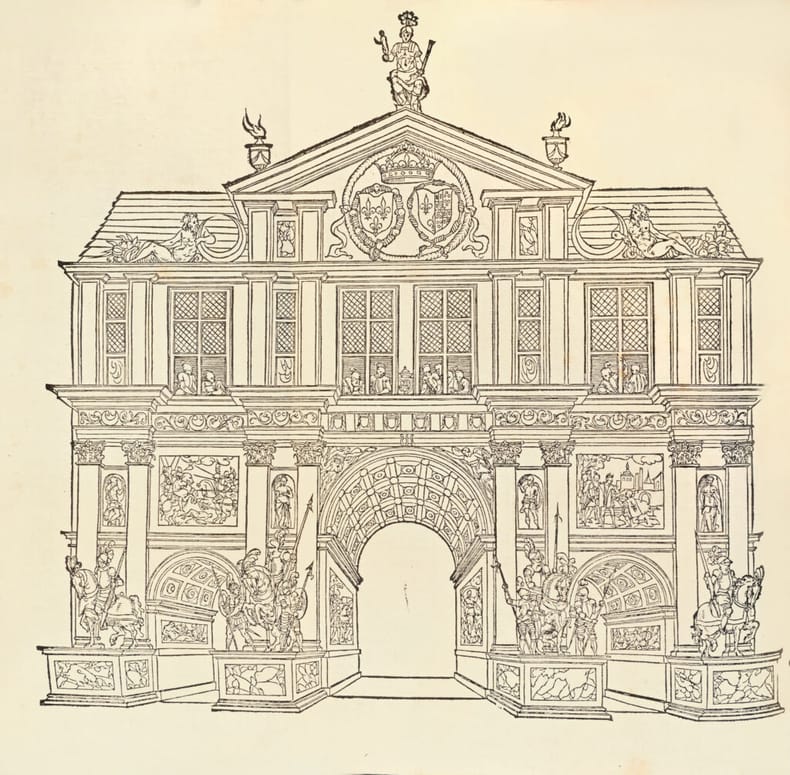
LCS-18628Bel exemplaire, complet, finement relié par Cuzin. Paris, Jehan Dallier, 1549. [Suivi de]: C’est l’ordre et forme qui a este tenue au Sacre & Couronnement de treshaulte & tres illustre Dame, Madame Catharine de Medicis, Royne de France, faict en l’Eglise Monseigneur sainct Denys en France, le X. jour de juin. Paris, Jehan Dallier, 1549. Soit 2 ouvrages reliés en 1 volume in-4 de: I/ 41 ff. (mal numéroté 37) et (1) f.bl. entre les ff. 28 et 29, 9 gravures à pleine page dans le texte dont 1 dépliante et 2 gravures hors texte dont 1 dépliante, (1) f.bl.; II/ 11 ff. Cachet de bibliothèque sur le f. de titre. Relié en plein maroquin rouge janséniste, dos à nerfs, double filet doré sur les coupes, large roulette intérieure dorée, tranches dorées sur marbrures. Reliure signée Cuzin. 225 x 155 mm.
12mo. (10), 180 pp. With engraved additional pictorial title and small woodcut ornament to printed title; woodcut head- and tail-pieces and decorative initials. Contemporary full vellum. Extremely rare first edition of this history of gemstones, corals and pearls, with plentiful references to the Arabian Gulf ("ou Mer d'Elcatif"), and specifically to Bahrain, Al-Qatif, Muscat, and Ormus, including separate chapters on pearls, their valuation, and the process of pearl-fishing. Carter lists Chappuzeau's work, which draws strongly on Tavernier, under the "key European accounts", quoting his mention of the Gulf as a major source of pearls: "The most significant pearl fishing ground is on the coast of Arabia Felix, between the towns of Julfar and Catif" (p. 94). - Chappuzeau's "text is in two parts, the first, of six chapters, describes gemstones beginning with diamond, then those of color, pearls, coral, amber yellow stones, the metals, ambergris, bezoar, indigo and other 'rich productions' of the East and West Indies, and including salts. The second part describes the places referred to in the first part, from Abyssinia to Visapur [...] Chappuzeau provides information on places in India where diamonds are found, how they are mined, and prices demanded for diamonds and other gemstones. The method of pricing pearls is also given along with a table of values [... This chapter] is famous for its perpetuation of the story that pearls generate from dew drops falling into the gaping shells of the pearl oysters" (Sinkankas). Also includes references to mining in Peru and trade from the West Indies and Americas. - Spine somewhat dust-soiled; interior shows some browning throughout. Provenance: Contemporary ink ownership "F. Baker" (?) to title-page. Latterly removed from the Library of the Birmingham Assay Office, one of the four assay offices in the United Kingdom, with their inconspicuous library stamp to the flyleaf. Vastly rarer than the 1671 English edition: no other copy seen in the trade. Sinkankas 1251. Sabin 12010. Cioranescu (17th c.) 18639. OCLC 78250964. Carter, Sea of Pearls, pp. 94 & 106. Cf. Hoover 217; Roller/Goodman I, 222; Macclesfield 512 (for the 1671 English translation).
Folio. ½ p. Addressed during the first months of the Revolution to the Administrator of the Royal Treasury, responsible for the expenditure of the household, M. Marc Antoine Francois Marie Randon de la Tour, ordering him to "pay in cash to our two valets of the wardrobe the sum of seven hundred and thirty two livres, which we granted them as an additional food payment, in consideration of their service during the year" (transl.). - Counter-signed by Pierre Jean Baptiste Beaugeard (1764-1832). Somewhat browned and spotty.
95963The archive comprises nearly 440 pieces each approximately 320 × 510 mm or larger many from the later 1970s when Mitchell was at the height of his powers. A unique commentary on the personalities and events of the times: when Hawke Fraser and Dunstan were in power Nixon went to China the war in Vietnam ended and the first wave of 'boat people' began to arrive here many Indigenous Australians were in a parlous state cricket and cricketers still caused grief . Approximately 440 items. unknown
LCS-13489Édition originale de l'Histoire d'Agrippa d'Aubigné extrêmement rare en séduisante condition du temps. Maillé, Jean Moussat, 1616-1620.3 volumes in-folio de : I/ 365 pp., (14) ff., (1) f.bl. ; II/ 489 pp., (7) ff. ; III/ 549 pp., (7) ff. Veau brun granité, double encadrement de filet doré sur les plats, dos à nerfs orné de fleurons dorés, tranches mouchetées. Petit accroc à un mors. Reliure de l'époque. 310 x 202 mm.
187189766Imprimerie Mourès & Cie | Le Caire 1871 | 34.5 x 50.2 cm | Relié
LCS-18588Superbe exemplaire à marges immenses. Paris, François Regnault, 1528. Petit in-folio gothique de LXXX feuillets à longues lignes, titre compris en rouge et noir. Plein maroquin rouge janséniste, dos à nerfs, double filet or sur les coupes, roulette intérieure dorée, tranches dorées sur marbrures. Reliure signée de Trautz-Bauzonnet. 256 x 188 mm.
LCS-17514Exemplaire personnel de Florimond de Raymond (1540-1601), écrivain catholique, ami personnel de Montaigne et Charron, successeur de l’auteur des Essais au Parlement de Bordeaux, conservé dans sa toute première reliure en vélin à recouvrement de l’époque. A Bourdeaus, par S. Millanges, 1595.In-8 de (12) ff., 176 pp., (4) ff., 775 pp., (1) p. Vélin ivoire, cadre de filets dorés sur les plats, ovale feuillagé doré au centre, dos lisse orné. Reliure de l’époque.156 x 100 mm.
LCS-14172Superbe exemplaire conservé dans sa riche reliure romaine de l’époque. Rome, Ludovici Grignani, 1650. In-folio de (32) ff., 560 pp., (15) ff., 1 grande planche dépliante anciennement restaurée sans manque, 1 portrait, 1 frontispice et 7 planches à pleine page. Relié en maroquin brun de l’époque sur ais de bois, riche décor sur les plats composé d’un double-encadrement de dentelles dorées avec fleuron central, dos à nerfs orné de fleurons dorés en forme de cœurs, fermoirs ciselés, tranches dorées. Coiffe inférieure usée. Reliure romaine de l’époque. 320 x 215 mm.
LCS-18456L’exemplaire conservé dans sa reliure en maroquin de l’époque aux armes du roi Louis XV et de la ville de Strasbourg. Paris, [1745]. Grand in-folio comportant 1 titre gravé, 1 beau portrait de Louis XV à cheval, 11 grandes planches doubles, 20 pages de texte gravé. Maroquin bleu, dentelle fleurdelysée autour des plats, cartouche armorié aux angles, armoiries au centre, dos à nerfs orné du chiffre royal, filet or sur les coupes, large roulette intérieure, tranches dorées. Reliure de l'époque. 624 x 470 mm.
44 pp. ½ in-folio, montées sur onglets, reliées en un volume. Demi-reliure à petit coin en veau glacé noir, dos lisse avec titre argent. "Ainsi qu'il est précise en page de garde, il s'agit du "scénario pour un film, Ballet ou dessin animé". - L'auteur expose rapidement le thème: "[...] Neptune a épousé sur le tard Vénus. - On ne rigole pas tous les jours dans le ménage des Dieux [...]". La sauvagerie des hommes massacre allégrement le peuple de Neptune. Les plus pitoyables victimes sont les malheureux bébés phoques, jusqu'au jour où une petite sirène, Pryntyl, inversera, par tout le poids d'une tragédie, le déroulement de ce "jeu" cruel. - Célèbre pour ses romans, Céline s'essaya tout d'abord au théâtre, notamment avec L'église, pièce écrite en 1926, éditée en 1933 et jouée pour la première fois à Lyon en 1936. Il composa également des scénarios ("Secret dan l'île, 1936; "Arletty, jeune fille dauphinoise", 1948) ainsi que des ballets ("Foudres et flèches", 1948). "Scandal aux Abysses" fut composé entre 1938 et 1944 et publié chez Denoël en novembre 1950. Si le rôle de la sirène Pryntyl fut proposé à Arletty, le projet n'aboutit cependant pas et il fallut attendre 1979 pour qu'un extrait de se texte soit représenté au théâtre du Lucernaire (Paris) sous le titre "Une heur avec L. F. Céline" (spectacle créé par Stéphane Varègues et Catherine Morelle).
4to (19.5 x 15.5 cm). (4), "139" [= 135], (5) pp. With a woodcut ship on the title-page (with a griffin on the sail) and about 60 woodcut illustrations in the text (mostly about 55 x 80 mm) plus about 10 repeats, each with a thick-thin border. Set in textura types with incidental roman and italic. Gold-tooled, red goatskin morocco by Robert Riviere in London (ca. 1875/80), with 5 (false?) bands on the spine, each board with a double frame of double and triple fillets and 2 different sets of 4 corner pieces, author and title in gold in 2nd and 3rd of 6 spine compartments, the others with gold-tooled decorations and the date and place of publication at the foot, gold-tooled turn-ins, gold fillets on board edges, straight-combed endpapers, gilt edges, stamped on the back of the free marbled endleaf in sans-serif capitals: "Bound by Riviere". A rare 17th-century English edition, with about 60 different woodcut illustrations, of a classic and partly fictional 14th-century account of travels presented as voyages of Sir John Mandeville through Turkey, Egypt, Ethiopia, Syria, Persia, Arabia, India and the East Indies. According to the story he set off on his travels in 1322 from Saint Albans in England, returned in 1343, wrote the present account in 1364 and died in 1371. It was originally written in French and is thought to have been compiled from various sources by Jehan d'Outremeuse (1338-1400) of Liege. A 1371 manuscript survives and it first appeared in print under the title Itinerarius in Dutch (ca. 1477), French (1480), German (1480) and other languages, and in English in Richard Pynson's edition of ca. 1497/98. It includes many well-known stories and illustrations of monstrous people and animals in exotic lands: a man with only one enormous foot that he can use as a parasol, a dog-headed man, a man with his face in his chest, a girl who turns into a dragon, griffins, nine-metre giants, ants that gather gold, diamonds that mate and give birth to baby diamonds and much more that spoke to the imagination (though the ox-headed man is presented as an idol that was worshipped, rather than a fantastic beast). The book also includes genuine descriptions of the regions covered and gave many Europeans their first notions of the Near East, Middle East, India and East Indies. It shows carrier pigeons, an elephant and other recognizable or plausible scenes. It also incorporates and illustrates some biblical stories. The part on Arabia includes an account of the birth of Mohammed. Most of the present woodcuts are loosely and indirectly based on those in the 1481 Augsburg edition, partly in mirror image. The book went through dozens of editions in English and other languages. It reached more or less the present form with the 1650 London edition, which may have used the same woodblocks (we have not had an opportunity to compare them). The imprint of the present edition names four London publishers, and one of them (Conyers) also advertises his edition of William Lithgow's Nineteen years travels (1692) at the foot of the last page. The book was registered for these four publishers in the term catalogue for Trinity 1696, issued in June. The printing was probably shared between two different anonymous printers: exactly half way through the book, between quires I and K, the running heads, the textura type used for the main text and the roman drop capitals opening the chapters change. The 1684 edition by four London publishers (none named in the present edition) not only uses the same woodblocks but is also typographically almost identical to the first half of the present edition and no doubt came from the same printer. The drop capitals differ, but those in the present edition have not been recorded before 1688. Samuel Roycroft and James Orme both used them, and Roycroft used at least several of the other types in the first half. The book is printed on coarse laid paper with no watermark. Halliwell, in his 1869 edition of Mandeville, noted the present edition for its woodcuts and reproduced at least many of them from the Grenville copy now at the British Library. Only 5 other copies are known, all in U.S. libraries. Robert Riviere (1808-82) established his famous bindery in Bath and moved it to London in 1840, gaining a reputation as one of England's best binders for the quality of his materials and workmanship. He signed his bindings "Bound by Riviere" from 1860 to 1880 (thereafter Riviere & son). - With an early owner's inscription faded on the title-page and 2 armorial bookplates on the paste-down: Sir Edward Sullivan (1822-85), Lord Chancellor of Ireland, and Allan Heywood Bright (1862-1941) in Liverpool, a member of Parliament, along with a loosely inserted signed autograph letter (ca. 1900) from Bright's brother Hugh Bright (1867-1935) in Leeds, giving him the book and noting that he bought it at Young's "some years ago". With 8 leaves with their margins extended at the fore-edge and foot ( N2-O4, Q1, probably sophisticated from another copy of the same edition), sometimes shaving a catchword or quire signature, the title-page and last page somewhat worn and dirty, but further in good condition, with a few minor marginal chips and tears restored or repaired and 3 leaves with minor water stains in one corner. The spine is slightly faded but the binding is still very good. A rare edition of Mandeville's voyages, illustrated with about 60 woodblocks cut ca. 1650. Arber, Term catalogues II, p. 593, item 8; ESTC R217088 (5 copies); J. O. Halliwell (ed.), Voiage and travaile of Sir John Maundevile (1866), p. xvi (item 2, from the Grenville library); Wing M417 (same 5 copies); for the story in general: Cambridge History of English Literature (1976), pp. 78-87.
Oblong folio (555 x 385 mm). Tinted lithographed title-page and 30 tinted lithographed plates (555 x 385 mm, one slightly smaller: 350 x 505 mm), all in fine contemporary hand colour. Loose in modern clamshell box. Extremely rare first edition of an impressive series of lithographed views showing the zinc mines, foundries and factories in Belgium and Germany owned by the "Société Anonyme de Mines et Fonderies de Zinc de la Vieille Montagne". The series includes views of Moresnet, Welkenraedt, Rabotraedt, Angleur, Saint Léonard (Liège), Valentin-Cocq and Bray, all beautifully rendered by the French landscape painter Adolphe Maugendre (1809-1895). The Vieille Montagne society was founded in 1837. Its history goes back to 1806, when Jean-Jacques Daniel Dony (1759-1819) was granted the sole mining rights to the calamine deposits of Vieille Montagne (or Altenberg), between Liège and Aachen. Dony had invented a new method for extracting zinc and casting it in ingots. In 1809 he established a rolling mill at Saint-Léonard, apparently the first plant for the industrial production of zinc. The series shows the complete process of producing zinc, from the zinc ore extraction to the stoking, pouring and refilling of the crucible, and finally the production of sheets of zinc in a rolling mill. It includes four detailed views of the Saint-Léonard plant (one, surprisingly, featuring a woman and two children). In the 20th century the Vieille Montagne society, together with a number of other mining and smelting companies, evolved into "Umicore", a global materials technology and recycling group still active today. A second edition was published in 1855 as Album des usines et etablissements de la société and is much less rare than the present first edition. - Some light marginal spotting, the title-page more severely, title-page with a tiny tear, otherwise in very good condition. An important visual record of the history of the zinc industry. WorldCat (only a catalogue entry, not listing any copies); no further copies in KVK. For Dony: Biographical Dictionary of the History of Technology, pp. 376-377; for Maugendre: Benezit VII, p. 273.
Folio. (16), 311, (60) ff. Title-page and sub-title to index with ornamental woodcut border. Woodcut initials, head and tail pieces. Calf, gold-tooled ribbed spine with title-label. Sprinkled edges. First edition of the "Natural history" edited by Johannes Caesarius (1468-1550), a humanist and close friend of Erasmus. The original text was by Gaius Plinius Secundus (AD 23 - August 25, AD 79), better known as Pliny the Elder. He was a Roman author, naturalist, and natural philosopher, as well as naval and army commander of the early Roman Empire, and personal friend of the emperor Vespasian. The text in the present edition is decorated with woodcut borders and many woodcut initials. - The "Naturalis Historia" is one of the largest single works to have survived from the Roman empire to the modern day and purports to cover the entire field of ancient knowledge, based on the best authorities available to Pliny. He claims to be the only Roman ever to have undertaken such a work. It comprised 37 books in 10 volumes and covered over 20,000 facts on topics including the fields of botany, zoology, astronomy , geology and mineralogy as well as the exploitation of those resources. It remains a standard work for the Roman period and the advances in technology and understanding of natural phenomena at the time. Some technical advances he discusses are the only sources for those inventions, such as hushing in mining technology or the use of water mills for crushing or grinding corn. Much of what he wrote about has been confirmed by archaeology. ''We know from Pliny that there were important pearl fisheries in the Gulf [...] Pliny identifies Tylos (Bahrain) as a place famous for its pearls [... He] attests that pearls were the most highly rated valuable in Roman society, and that those from the Gulf were specially praised [...] The pearl related finds at the site of El-Dur indicate the site was integrated into the maritime trade routes linking the Roman Empire, the Persian Empire, India and South Arabia'' (Carter). Book 6 holds a chapter that gives the first detailed account of the regions around the Gulf, including what are now Qatar, the Emirates and Oman. - Not only is it virtually the only work which describes the work of artists of the time, and has it become an important reference work for the history of art, due to the wide range of topics, the referencing system and index it became a model for later encyclopaedias. - With manuscript notes of multiple owners on pastedown (including written ex-libris by Antonii Mauritii Seguin 1713 and Mathon de la cour 1744). Some underling in text, and notes in the margins (partly lost due to trimmed edges). A very good copy with bookplate of De Ponsainpierre on pastedown. VD 16, P 3531. Adams P 1556. BM-STC German 704. Durling 3689 (imperfect copy). Hunt 23. USTC (11 copies).
Three parts in one volume. 4to. 220 x 155 mm. Woodcut device on general and parts titles. Early blindstamped calf, rebacked and refurbished retaining most of original spine. First edition, second issue. Guillaume Postel travelled to Constantinople in 1535 as official interpreter to the embassy of Jean de La Fort to the Turkish sultan, Suleiman the Magnificent. He returned there in 1549, and was also the author of the first Arabic grammar in French. "His work is not so much a descriptive account of his travels as a compendium of information gleaned while traveling and from other sources. The third book, 'La Tierce Partie des Orientales Histoires', furnished an usually complete and accurate picture fo the governing system of the Ottoman Empire" (Blackmer). - Without final blank ff6, 2 single wormholes in lower margin of opening few leaves, small repair at inner lower corner of opening 2 leaves, early ownership inscription on first title. Cf. Adams P2015. Atabey 977. Blackmer 1335.
Colour lithograph map, 765 x 495 mm, trimmed to neat line. A rare separately issued official map, with text in Ottoman Turkish throughout, depicting the route of the Hejaz Railway. Following a route proposed by the eminent Turkish engineer Mukhtar Bey and surveyed by the cavalry officers Umar Zaki and Hasan Mu'ayyin, the epic project, funded by subscriptions from the global Islamic faithful, completed a rail link from Damascus to Medina by 1908. Intended to continue to Mecca but never completed, it nevertheless briefly allowed many thousands of pilgrims to make the Hajj in relative comfort. - Old folds and creases, some short closed tears, tiny chips to neat line, some light staining. Some remnants of tape and old private collector's stamps to verso. Still in good condition but for partial loss of lower left corner, subsequently collaged with a contemporary Ottoman colour lithographed map of the Arabian Peninsula.