692 496 résultats
12mo (4), 8vo (20) and 4to (1). 68½ pp. on 6 single leaves and 19 bifolia. All but one to the publisher Maurice Lachâtre (1814-1900), who fled to San Sebastián in Spain after the end of the Paris Commune, many discussing the communards' fate in exile and work on the "Mémorial de la Commune". - 9 letters by Arthur Arnould about his work "Paris et la Commune", several chapters of which he sends to Lachâtre for his "Mémorial": "Je me décide donc à vous envoyer non pas un travail complet, mais seulement quelques chapitres détachés, formant chacun un ensemble [...]" (Luina di Pazzallo près Lugano, 30 Aug. 1875). The others mainly about the proofs for the "Mémorial", but also discussing his state of health, the political situation in France, and his travels. - 2 letters by Armand Adam about the deplorable political situation in France and the journal "Radical": "Si jamais des temps meilleurs nous permettent de reprende à Paris la publication du Radical je serai heureux d'examiner avec vous la proposition que vous avez bien voulu me faire autrefois, et je crois que nous pouvons nous entendre. Mais, ces temps meilleurs, je ne les vois pas proches [...]" (Paris, 14 April 1874). - 2 letters by Eugène Chatelain, one describing his professional situation as a doctor, the other expressing his relief at hearing of Lachâtre's well-being: "J'ai appris à Londres ces jours derniers que vous étiez en Angleterre. Je suis heureux de cette nouvelle, car lorsque je me cachais à Paris après la chute de la Commune [...], on m'avait assuré que vous aviez été fusillé avec quelqu'un de chez vous. Vous êtes vivant, tant mieux! [...]" (Saint Helier, Jersey, 8 Sept. [?] 1872). - 1 by André Alavoine informing him that he is no longer the publisher of the journal "Lanterne", mentioning that he remains in close relations to Henri Rochefort nonetheless: "Je viens de communiquer votre lettre à l'administration de La Lanterne, car il est bon de vous dire que nous ne sommes plus, depuis quelques mois déjà, les éditeurs et imprimeurs de la Lanterne [...] Néanmoins, je suis resté en très-bons rapports avec Rochefort [...]" (Genève, 25 Aug. 1875). On headed stationery of the "Ziegler & Cie" printing house. - 1 by Edmond Adam about the conviction of Gustave Courbet in connection with the destruction of the Colonne Vendôme: "Courbet n'a pas été condamné pour les dommages géneraux commis par la Commune mais pour un dommage particulier, la destruction de la Colonne Vendôme, qui luia été attribué personellement [...]" (Boulevard Poissonnière, 16 July 1874). On stationery with printed address. - 1 by Henri Salles about Lachâtre's offer to Victor Hugo, concerning the employment of amnestied persons: "Vous avez bien voulu offir à Victor Hugo de prendre chez vous quelques amnestiés pour les employer au courtage en librairie [...]" (no place, 17 July 1879). On headed stationery of the "Comité general d'aide aux amnestiés". - 1 by Francis Jourde mentioning Lachâtre's "Mémorial de la Commune", calling it a revolutionary work: "J'ai reçu il y a quelques jours votre Memorial de la Commune; je suis partisan de l'action et du combat, donc, toute oeuvre revolutionnaire est toujours la bienvenue quelles que soient ses tendances et les doctrines qu'elle represente [...]" (Rue du jeu des enfants, 30 June, no year). - 1 by Jean Larocque about his fate after the end of the Commune: "Plus heureux je pus me cacher après le 28 mai, et dans l'hôtel où, peu de jours après, fut arrêté Régère, puis dans une institution des environs de Paris. Manquant de toutes ressources, je me disposais à reparaitre pour chercher du travail [...]" (Leominster, 17 May 1872). - 1 by E. Rajoux about the heavily guarded Swiss border and the articles he can offer for the "Mémorial de la Commune": "La frontière est très surveillée [...] Si je découvre - et je cherche toujours - un moyen de transit quelquonque, je vous en préviendrai. Vous me demandez quelques articles pour le Mémorial de la Commune, j'accède avec plaisir à votre demande [...]" (Yverdon, Sept. 1875). - 1 by Ferdinand Revillon about his fate after the end of the Commune and his former collaboration on Félix Pyat's journal "Le Combat": "J'étais réfugé, le lendemain des derniers massacres de mai 71, chez une personne qui m'offrit asile et chez laquelle je restai pendant plusieurs mois caché [...] j'ai collaboré au journal de Félix Pyat, Le Combat, avant la Commune, tout en exerçant ma carrière de critique musical et de compositeur de musique [...]" (Geneva, 15 April 1876). - 1 by Eugène Protot expressing his dismay at Lachâtre's marriage, which he calls a business union: "A mon avis ce n'est pas un mariage, ce n'est pas même une union libre que vous organisez, mais une espèce de société commerciale [...]" (London, 5 Aug. 1880). - Further letters by Maxime Vuillaume (Altorf, 18 May 1876) and Jules Guesde (Prison de St. Pélagie, 1 Sept. 1889, with two clippings, probably both from his newspaper "L'Égalité"), one each, as well as another letter signed "Georges" (Lyon, 18 May 1876). - 1 letter by Amilcare Cipriani to Henri Oriol (no place, 27 Sept. 1888).
Folio (214 x 334 mm). X, 565, (3) pp. With 1 folding map. Modern half cloth. Includes the first publication of the treaties closed by the British with the Gulf sheikhdoms following General W. Grant Keir's raid on Ras al-Khaimah in 1819/20: the preliminary treaties with Hassan bin Rama (Ras al-Khaimah, 8 Jan. 1820); Sultan bin Sakr (9 Jan. 1820), Sheikh Kameya bin Mahomed bin Jabin al Moyeying, Sheikh of Kishmee, of Dubai (9 Jan. 1820), Sheikh Shakhbool bin Dhyab of Abu Dhabi (11 Jan. 1820), Hassan bin Ali, for Sharjah, Umm al-Quwain, Ajman, and Abu Dhabi (15 Jan. 1830). Also, Sketch of the Articles proposed to H.H. the Imaum of Muscat for the Prevention of the Foreign Slave Trade, in 1822. - Slight waterstaining near beginning, but well-preserved. Rare. OCLC 45474897.
8vo. 156 pp. With one folding map of Japan. Contemporary gilt full red morocco with the giltstamped inscription "A Sa Majesté Impériale Le Sultan. Hommage de l'Auteur" to upper cover, Ottoman crest to lower cover, and giltstamped spine. Leading edges gilt. Marbled endpapers. All edges gilt. First edition of this synopsis of the political and religious history of Japan, by the Belgian diplomat, photographer and writer Eggermont (1844-1923), who was appointed councillor to the legation of Belgium in Japan from 1876 to 1877. Author's presentation copy for the Sultan with the dedication giltstamped to the upper cover. The book's first part discusses Shintoism and Buddhism; the second part presents an overview of Japanese history from the origins of the Japanese people until the 1868 Meji Restoration. - Lacks upper half of the title-page; lower half is transposed before the half-title and glued on top of it, thus omitting the author's name. - From the library of Sultan Abdul Hamid II (1842-1918), the last Sultan of the Ottoman Empire to exert effective contol over the fracturing state and also remembered as a poet, translator and one of the dynasty's greatest bibliophiles. While his passion for books is memorialized by the many precious donations he gave to libraries all over the world and which mostly have remained intact to this day (including the 400-volume "Abdul-Hamid II Collection of Books and Serials" gifted to the Library of Congress), his own library was dispersed in the years following his deposition in 1909: books were removed to other palaces and even sold to Western collectors; the greatest part of his collection is today preserved in the Chester Beatty Library in Dublin. - Extremities insignificantly rubbed; paper somewhat foxed throughout. An appealing copy in a finely gilt presentation binding. OCLC 249076616.
8vo (206 x 162 mm). XVIII, 30 pp. Original printed paper wrappers. Housed in a full black morocco case with cloth chemise. Second edition of FitzGerald's translation, substantially expanded and revised. Omar Khayyám was a Persian mathematician, astronomer, philosopher, and poet, famous in his own country and time chiefly for his scientific achievements. He is known to English-speaking readers mostly due to FitzGerald's translations, which were quite free and liberal in their paraphrasing and would prove to be the "most popular verse translation into English ever made" (Decker, p. xiv). - Five hundred copies of the second edition were printed, with Quaritch selling each at a price of 1s. 6d.; when a copy re-appeared in their catalogue in 1929, it had already reached a price of £52 10s. (Potter, p. 12). Fitzgerald substantially revised the text of the Rubáiyát four times, with none of these five versions seen as truly definitive. The first edition had 75 quatrains, while the present second edition, which has 110 quatrains, is the longest of the five. - Some light foxing throughout. Some soiling and creasing to wrappers; contemporary ownership inscription, dated 1869, to upper cover. Potter 129.
10 volumes, all in original cloth, 5 with original dust jacket. A remarkable private collection of 10 early biographies and works supporting Gandhi, each signed by the author. While Western biographers began to take interest in Gandhi beginning with Romain Roland (1924), this collection includes only association or signed copies of works by Indian authors. Represented here are both those who had followed Gandhi from his earliest political machinations in South Africa, as well as his early followers who subsequently emigrated to America in order to raise public awareness of the Indian Independence movement. In contrast to the author-signed works of Western biographers, which can be encountered in the trade today, works signed by Indian authors of this period are notoriously rare. Includes individually: 1) Muzumdar, Haridas T. Gandhi the Apostle. His Trial and His Message. Chicago: Universal Publishing Co., 1923. Blue cloth. Inscribed "Presented to my good friend Charles E. Sekera by Haridas T. Muzumdar / Evanston, Xmas, 1924". - First edition. An exceptionally early work in support of Gandhi, addressed to American readers to drum up financial and popular support for the Indian Independence movement in the U.S. A close friend and one of the earliest biographers of Gandhi, this was Haridas's first published book, when he was just 24 years old and living in New York City. - 2) Gandhi, Mohandas K. / Muzumdar, Haridas T. (ed.). Sermon on the Sea. Chicago: Universal Publishing Co., 1924. Yellow cloth. Inscribed "To Prof. John E. Kirkpatrick, from his friend Haridas T. Muzumdar / Olivet Conference, Aug. 1925". - First U.S. edition of Gandhi's famous tract, penned in South Africa in 1909 and also known under the title Indian Home Rule or Hind Swaraj. It includes his quotes "One who is free from hatred requires no sword" and "only fair means can produce fair results". This copy was presented by the editor and early Gandhi activist Muzumdar to a fellow American academic, shortly after its publication. - 3) Hossain, Syud. Gandhi. The Saint as Statesman. Los Angeles: Sutton House, 1937. Black cloth, with original dustjacket. Inscribed on flyleaf "With best wishes / Syud Hossain". - First edition. Dr Syud Hossain was instrumental in forging links between American-based Indian nationalists and the Indian National Congress. Co-founder of the National Committee for Indian Independence (headquartered in Washington, DC), Hossain spearheaded the Indian lobby for self-rule from abroad. "Immaculately dressed, polished in manners, brilliant in oratory, Hossain captivated his audiences from coast to coast," said A. K. Mozumdar, a colleague and fellow activist of Hossain. The Los Angeles Times described him as "the most distinguished Indian visitor in America since Tagore" while according to the New York-based Foreign Policy Association, "of the hundreds of speakers who have addressed our conferences during the past five years, none were more brilliant or authoritative than Mr Hossain". In September 1945, Hossain suggested to Jawaharlal Nehru that he return to India to work towards Hindu-Muslim harmony and stand for elections. After consulting Asaf Ali and Gandhi, Nehru cabled back: "Gandhiji thinks you can do more important work in America". Hossain briefly served as India's first ambassador to Egypt, where he died in 1949. - 4) Muzumdar, Haridas T. Gandhi Triumphant! The Inside Story of the Historic Fast. New York: Universal Publishing Co., 1939. Blue cloth. Signed by Muzumdar in Hindi and in English on flyeaf. - First edition. An account of Gandhi's Rajkot Fast to protest the local ruler's refusal to enact administrative reforms in that state. The fast lasted only 3 days, 3-5 March 1939. The work also includes four original articles by Gandhi: "States and the People"; "Rajkot"; "Rajkot and Jaipur"; and "Kicks and Kisses". - 5) Raman, T. A. What does Gandhi Want? New York: Oxford University Press, 1942. Yellow cloth, with original dust-jacket. Inscribed "To Dr. and Mrs. Aldridge, with sincere regard / T. A. Raman", and with a loose letter from Raman dated October, 1942, "Herewith one of the first copies of my book. It is to be published on the 29th. Please let me know what you and Dr. Aldridge think of it. With kindest regards from us both, Sincerely Yours, T. A Raman" on hotel stationery. - First edition. Educated in Madras, Raman was an Indian nationalist who emigrated to become the London editor of the United Press of India. Here, he presents Gandhi's solutions to the World War raging at the time, including remarks on Indian's participation. "Mr. Raman first met Gandhi at Marseilles in 1931 when he joined the Indian leader's staff at the Indian Round Table Conference. Thereafter he was constantly in touch with Gandhi and other Indian leaders, following them to India, where he became a close associate of Gandhi…" (dustjacket). - 6) Prabhu, R. K. & Rao, U. R. The Mind of Mahatma Gandhi. [Madras]: Geoffrey Cumberlege for the Oxford University Press Indian Branch, 1946. Red cloth, with original dustjacket. Inscribed "Mr. Chester Bowles, The American Embassy, New Delhi / With best compliments from U. R. Rao / 30.11.51, Bombay". - Second edition. An outstanding association copy, presented to the American Ambassador to India following Independence. The work is a compilation of select quotations from Gandhi to illustrate his philosophy and thought. Chester Bowles (1901-86) served as ambassador from 1951 to 1953 and enjoyed a privileged relationship with Prime Minister Nehru, who otherwise famously distrusted most U.S. influence. - 7) Shridharani, Krishnalal. The Mahatma and the World. New York: Duell, Sloan & Pearce, 1946. Red cloth with original dustjacket. Inscribed "To Mrs. James B. Pratt, to Edith and to David, my American friends, a parting salute / New York, May 3, 1946" and signed by Shridharani in both English and Hindi. - First edition. Shridharani was arrested and imprisoned in 1930 for protesting the Salt Tax alongside Gandhi, and left India in 1934 to pursue degrees at NYU and then Columbia University. After campaigning for support for Indian Independence in the United States, he returned to India in 1946 where he taught at the Gujarati Sahitya Parishad, and died in 1960 in Delhi. This is an excellent association copy, inscribed to the widow of James Bissett Pratt (1875-1944, an ardent Western admirer of Tagore and an academic advisor of Shridharani), just before Shridharani left New York to return to India. - 8) Imam-ud-Din, S. J. Gandhi and Christianity. Lahore: Northern India Printing & Publishing Co., [1947]. Red cloth. Signed by Imam-Ud-Din on flyleaf. - First edition, rare. The author, aware that much of Gandhi's Western popularity lay in his success appealing to Christian groups, here essentially compares the Mahatma to Jesus Christ. - 9) Murthy, Nadig Krishna. Mahatma Gandhi and other Martyrs of India. Columbia (MO): Journal Press, 1948. Inscribed "With Best Compliments to Mr. H. R. McConnell / Nadig Krishna Murthy / May 29, 1948". Dark blue gilt-embossed cloth, a little stained. - First edition, extremely rare. The only other copy we have traced resides at SOAS in London. Published just following Gandhi's death on January 30th, 1948, the book contains a preface written by Prime Minister Nehru. Briefly resident at the University of Missouri, Murthy returned to India where he made a name for himself as a journalist. - 10) Polak, H. S. L. et al. Mahatma Gandhi. London: Odhams Press, 1949. Blue cloth with original dustjacket. Inscribed "Miss Ruth C. Manchester / With all good wishes & warm appreciation & sincere thanks for your kind hospitality during my short stay in the United States. From Manilal Gandhi, 7/6/49". - First edition, signed by Gandhi's son following his father's assassination. Henry Polak (1882-1959) was Gandhi's closest friend in South Africa, having lived side-by-side with Gandhi and his family from 1903 onwards. Gandhi's second son Manilal (1891-1956) was also close to Polak and succeeded him as editor of Indian Opinion in 1916. Like his father, Manilal was a tireless campaigner and was arrested during the 1930 Salt March. This association copy of Polak's biography was signed by Manilal just a year after his father's death, during Manilal's only visit to the United States - where he sat in at a General Assembly session of the United Nations and met with Albert Einstein. In 1952 Manilal was again arrested in South Africa for protesting Apartheid, spending 38 days in jail at the age of 61.
185372Gaillon, Imprimerie du château archiépiscopal, 1643-1644 24 pièces en un vol. in-4, [6] ff. n. ch. (titre général, et table des pièces, un feuillet vierge), puis pagination multiple, veau fauve marbré, dos à faux-nerfs cloisonné et fleuronné, pièce de titre, encadrement de double filet à froid sur les plats, double filet doré sur les coupes, tranches rouges (reliure du XVIIIe siècle). Légères restaurations.
7 parts in 3 volumes, bound as 1. 4to. 60; 67, [1 blank], 88, 40; [4], 84 (lacking pp. 85-102), 42, [2], 70 pp. Lacking pp. 85-102 in vol. 3. Contemporary stiff paper wrappers covered with paste-paper (calico pattern), with blank paper title-label on front. Rare first and only edition of a catalogue of the plants found on the island of Java, Indonesia. The work was published in three volumes, the first containing descriptions of plants not recorded by Rumphius and Houttuyn and the second and third listing all the plant names in Latin, Dutch and Malay/Javanese, with reference to Linnaeus, the Malay/Javanese set in roman type. The volumes were printed at the presses of the Dutch East India Company (VOC) in Batavia on the island of Java (now Jakarta, Indonesia). - Jacobus Cornelis Matthieu de Radermacher (1741-1783), started as a Dutch merchant in service of the Dutch East India Company (VOC), and rapidly rose in position in the company. By 1781 Radermacher was named Commissioner for the Fleet and the Army, and Common Council of India. He was one of the founding members of Bataviaasch Genootschap van Kunsten en Wetenschappen and a proponent of the establishment of the botanical gardens of Buitenzorg. In 1783 he left for Holland because of his health, but was murdered during a mutiny on his way home. - With a tiny tear in the second leaf and a couple of minor spots, otherwise in very good condition and only slightly trimmed, but lacking pp. 85-102 of volume three. Leaves E1-E2 of the same volume are included twice. The spine of the wrappers is tattered and its foot completely gone. Landwehr & V.d. Krogt, VOC 615. Pritzel 7392. Stafleu & Cowan 8501 (2 copies, both incomplete). STCN (2 copies). WorldCat (3 copies). not in Hunt. Johnston. for the author: NNBW II, cols. 1153-1154.
4to (175 x 235 mm). (8), 38 pp., final blank leaf. Title-page printed in red and black with engraved vignette. Contemporary Italian full auburn calf, spine gilt, both covers ruled and gilt with the arms of the Prince of Morocco. Marbled pastedowns. All edges gilt. Rare single edition of this compilation of documents relating to the conversion of the Muslim Prince Muley Ahmed, who took the Christian name Lorenzo Bartolomeo Luigi Troiano; printed for Pope Clement XII. Prince Muley Ahmed was a member of the Alaouite dynasty, the ruling house of Morocco - a major propaganda coup for the Christian cause at a time when Morocco variously clashed with the French, Spanish, and Venetian merchant navies. This is the Prince's personal copy, bearing on both covers the Moroccan lion's crest with a sceptre and crown. - Light brownstaining throughout. The pretty armorial binding is very slightly rubbed, but altogether attractively preserved. Extremely rare; only five copies known worldwide, all in Italy; none recorded in OCLC. ICCU UBOE\006375.
12mo. (153) pp., final blank f. Marbled half calf (c. 1780) with giltstamped spine labels and floral endpapers. All edges sprinkled in red. Almost unobtainable first edition of the author's most notorious work: "Prima ediz. stamp. colla falsa data di Cambrai nel 1642" (Libr. Vinciana, p. 21). The "libro più pornografico e più aretinesco del '600" (Q. Marini, P. Aretino nel '600, in: P. Aretino nel cinquecentenario della nascita, p. 486). "The Rhetoric of Whores"), a scandalous anti-Jesuit work, "demonstrates why Pallavicino was the only Italian author of his epoch capable of a coherent vision that integrated satire, skepticism, and naturalistic morality" (Muir, Culture Wars [Cambridge: Harvard, 2007], p. 90). The book is written in the form of a dialogue between an aged prostitute and her naive apprentice. The fifteen lessons of the old whore were based on Cipriano Suarez's "De arte rhetorica", the manual used in Jesuit schools. Muir pointedly notes, "By systematically pursuing the parallels between rhetorical persuasion and erotic seduction, Pallavicino demonstrates how the high art of rhetoric has the same instrumental character as the lowly deceptions of the prostitute." - Some browning throughout. Prettily bound; removed from the Nádasdy library with stamp on title page. Exceedingly rare: no copy in auction records internationally; the earliest recorded copy sold in 1960 (another false "Cambrai" imprint, dated 1644). BL (Italian Books) 647. OCLC 65523066. Cf. Libr. Vinciana 75 (1673 Villafranca ed. only). Englisch 605. Brunet IV, 1251.
4to. 160 pp. Ottoman Turkish text set in Arabic characters. Half-title on the upper wrapper and the first page of text are set within a decorative printed frame. With an integral manuscript French translation of the text in the margins. Original publisher's printed paper wrappers. - With: (II) [Shaikhzade Ahmed Misri] / Belleteste, [Henri Nicolas]. Contes Turcs en langue turque, extraits du roman intitulé, les quarante vizirs. [= Kirk vezir hikâyeleri ...]. Ibid., 1812. 4to. (2), 258, (2) pp. The text is entirely in Ottoman Turkish except for an additional title-page in French. Both Arabic and French title-pages include the vignette of the French Imprimerie Impériale. Blue wrappers with a white printed title label on the spine, stored in a custom-made case: half red leather with the title in gold on the spine and white and green decorated sides. Two excellent examples of Arabic type printing by the French Imprimerie Impériale: the 1812 edition of "the history of the forty viziers" in Ottoman Turkish. This collection of Turkish folk tales is a variation of the Thousand and One Nights stories. These frame stories play an important role in the storytelling tradition of the Middle East and often form the basis (Middle) Eastern literature in general. Examples of these stories are found in early Indian, Iranian and Arabic sources, but the exact origin of the stories of the forty viziers is not clear. The stories and/or the first translations of the stories from Arabic were attributed to Ahmed-i Misri and/or Seyhzade (or Sheykh-Zada), about whom nothing is known. These names were possibly pseudonyms of the actual authors-translators who did not want to be associated with stories that were composed in prose, had suggestive or crude passages, and were compiled from other earlier frame stories. - According to extant sources, the entire collection of folk tales concerning the stories of the viziers could contain eighty stories, forty of the viziers during the day and forty of the women during the night. In addition, the stories could also include various advice sections, other small stories, Arabic, Persian and Turkish poems, verses, hadiths, dreams and their interpretations. Different compositions and adaptations would differ in size and would contain varying sets of stories from the complete collection. - I: A unique annotated early 19th century copy of "Kirk vezir hikâyeleri" (The stories of forty queens), known as the "History of the forty viziers", containing an integral and literal translation of the first 160 pages of the Ottoman Turkish work. The translation and further annotations on Ottoman Turkish syntax and vocabulary are written in a (near) contemporary hand in brown ink. The marginal annotations were probably written around the 1820s by a French orientalist. This particular manuscript translation is unique and one of the very first French translation of these stories. Another adaptation of the stories, containing 19 stories and the introduction, was translated into French by François Pétis de la Croix as "L'histoire de la sultane de Perse et des vizirs", published in Paris in 1722. - II: The present copy is a complete example of the 1812 edition. It contains forty stories, including the introduction, the story of (and dedication to) Sultan Mahmud, the frame story, twenty stories of the viziers, and twenty stories of the women. - Both works are compiled by the French orientalist Henri-Nicolas Belleteste (Belletête, ca. 1746-1808) and published posthumously. Belleteste was educated in Oriental languages and in 1798 he was appointed government interpreter. He subsequently served as a military interpreter during the Egyptian Campaign led by Napoleon Bonaparte (1798-1801). He published an Arabic vocabulary for military use and together with French orientalist Jean-Daniel Kieffer (1767-1833), Belleteste translated the Bulletins de la Grande Armée into Turkish for Napoleon's campaigns from 1805 to 1807. He had taken on the project of translating a collection of Turkish stories, entitled in French "Les Quarante Vizirs" (the forty viziers), allegedly from a manuscript found in Egypt. Unfortunately, he died unexpectedly at the age of 30 in 1808, thus leaving the work unfinished. Nevertheless, an edition of the Ottoman Turkish text Belleteste was translating was published in 1812, expertly printed in Arabic characters by the French Imprimerie Impériale, of which the present two works are examples. - I: With the integral manuscript translation of the text into French in a contemporary (ca. 1820s) hand in brown ink in the margins. Front wrapper detached, spine damaged, edges frayed, lacking the back wrapper and the last 96 pages of the work. - II: Without the frequently missing 48 pp. of Belleteste's unfinished French translation. Wrappers are slightly stained and slightly damaged, mainly around the spine and the edges, without affecting the integrity of the binding. The text has generous, uncut margins, thus the edges are slightly frayed. The custom-made case is slightly scuffed around the corners and edges. Otherwise in good condition. - Overall, these works present an extraordinary example of early 19th century Arabic printing by the French Imprimerie Impériale together with a unique manuscript translation of the text of the "history of the forty Viziers", into French by an unidentified early 19th-century orientalist. Atabey 908 (incomplete). Chauvin VIII, p. 18, no. 52. Zenker I, 729. Brunet 17781. Gay/Lemonnier I, 718. Not in Blackmer.
(III)-XV, (1), 478 pp. Modern boards. With a folding map of Africa and the Arabian Peninsula. Edges sprinkled green. Rare, early British parliamentary papers and correspondence with British agents and residents regarding the slave trade. Includes communications relevant to slavery in Africa and India, with reports by the Agent at Muscat on the landing of slaves in that city's harbour (p. 383) and the kidnapping of children by Muslim slave dealers and their conveyance to "Arabia and the Persian Gulf" (p. 426f.), as well as instructions to the Resident in the Persian Gulf "immediately to communicate with the Arab Chiefs" to pursue the objective of suppressing the slave trade in the Arabian seas (p. 382). - Well preserved, with additional page numbers in a contemporary hand. OCLC 25471335.
8vo. (2), 98 pp. Contemporary half cloth; includes printed original wrappers. The first issue of the socialist "Otkliki" from the possession of Leo Trotsky, who was to lead the Russian revolution to victory in 1917, with his pencilled signature on the front wrapper cover. - This present first issue, printed by the "Slovo" press, is much rarer than the following two and is unrecorded in library catalogues internationally. OCLC lists only the issues 2 and 3, published in 1907 (Indiana University; Pittsburgh University holds only no. 3); the Library of Congress also holds only the two following issues printed by I. A. Levenshtein. - From the collection of the well-known Slavicist Hans Halm (1887-1975) with his autograph notes on the inside front wrapper cover. Bibliography of Periodicals of Russia II, 5868.
27 maps, ca. 54 x 84 cm to 104 x 98 cm. Printed in brown tones. Transverse Mercator projection, constant ratio linear horizontal scale 1:250,000 scale (except for OF-02-32 through 02-35, which are on a scale of 1:500,000). All in their original printed orange envelopes. The joint NASA/USGS Landsat Programme started in the early 1970s, providing the longest continuous space-based record of the Earth’s surface. Its "OF" (Open File reports) series was designed to publish urgent interim or preliminary information edited with only a single peer review. As of 1992, 11 sets had been produced, which included a mixture of maps and other documents, prefixed OF-01 through OF-10 and OF-92. The present set comprises 27 maps from the 91 documents that made up the OF-02 set. Comprises individually: - OF-02-12 (IR 325): Halaban Quadrangle, Sheet 23G; OF-02-14 (IR 327): Al Hawtah Quadrangle, Sheet 23I; OF-02-15 (IR 328): Yabrin Quadrangle, Sheet 23J; OF-02-16 (IR 329): Ad Dawadimi Quadrangle, Sheet 24G; OF-02-17 (IR 330): Durma Quadrangle, Sheet 24H; OF-02-19 (IR 335): Harad Quadrangle, Sheet 24J; OF-02-20 (IR 336): Aban Al Ahmar Quadrangle, Sheet 25F; OF-02-21 (IR 339): Al Faydah Quadrangle, Sheet 25G; OF-02-22 (IR 340): Shaqra Quadrangle, Sheet 25H; OF-02-23 (IR 341): Rumah Quadrangle, Sheet 25I; OF-02-24 (IR 419): Jabal Habashi quadrangle, Sheet 26F; OF-02-25 (IR 420): Buraydah Quadrangle, Sheet 26G; OF-02-26 (IR 421): Qiba Quadrangle, Sheet 27G; OF-02-27 (IR 422): Mahd Adh Dhahab Quadrangle, Sheet 23E; OF-02-28 (IR 423): 'Afif Quadrangle, Sheet 23F; OF-02-29 (IR 424): Al Hissu Quadrangle, Sheet 24E; OF-02-31 (IR 426): Baq'A' Quadrangle, Sheet 27F; OF-02-32 (IR 427): Wadi As Sirhan Quadrangle; OF-02-33 (IR 428): Northwestern Hijaz Quadrangle, 104 x 98 cm; OF-02-34 (IR 429): Northeastern Hijaz Quadrangle, 80 x 100cm, OF-02-35 (IR 430): Wadi Ar Rimah Quadrangle, 83 x 100 cm; OF-02-72 (IR 476): Sahl Al Matran Quadrangle, Sheet 26C; OF-02-73 (IR 477): Harrat Ithnayn Quadrangle, Sheet 26D; OF-02-74 (IR 478): Wadi Ash Sha'bah Quadrangle, Sheet 26E; OF-02-75 (IR 479): Al Muwaylih Quadrangle, Sheet 27A; OF-02-76 (IR 480): Shaghab Quadrangle, Sheet 27B; OF-02-79 (IR 483): Ha'il Quadrangle, Sheet 27E. - In excellent condition throughout. G. J. Vranas, List of Interagency Reports submitted by the US Geological Survey Saudi Arabian Mission to the Saudi Arabian Directorate General of Mineral Resources from 1965 to the beginning of 1992 (Open File Report USGS-OF-92-2. Interagency Report 844 (Jiddah: Ministry of Petroleum and Mineral Resources Directorate General of Mineral Resources, 1412 AH/1992 AD), pp. 75f., 28-42.
4to (187 x 234 mm). Arabic manuscript on wove paper. 49 ff., 16 lines per extensum within blue and gilt rules. Written in brown maghribi with headings and emphases in gold, blue and red; numerals written in red; one illuminated headpiece in colours and gold. Pretty contemporary brown leather binding with gilt borders and recessed central medallions and corner pieces, stamped in relief and outlined in gold. Green endpapers. Prettily calligraphed and bound manuscript treatise on mathematics and arithemetics, being a compendium of the author’s larger work entitled "Kashf al-jilb?b 'an 'ilm al-hisab", copied in the late 19th century CE in Northern Africa, very likely in Morocco. - The author Abu'l-Hasan ibn Ali al-Qalasadi (1412-86) was a Muslim Arab mathematician from Al-Andalus; Franz Woepcke singled him out as one of the most influential voices in algebraic notation for having taking "the first steps toward the introduction of algebraic symbolism". Al-Qalasadi was born in Baza, an outpost of the Emirate of Granada. He received his education in Granada, but continued to support his family in Baza. He wrote numerous books on arithmetic and algebra, eventually retiring to his native Baza. His algebraic works provided precise mathematical answers to problems of everyday life, such as the composition of medications, how to calculate the inclination of irrigation canals, and the explanation of frauds linked to measuring instruments. Others belonged to the ancient tradition of judicial and cultural mathematics, including a collection of little arithmetical problems presented in the form of verse riddles. - Occasional insignificant foxing and browning; very well preserved. GAL I, 266, 2.
Small 4to. Lithographed title page and index; 34 photo-lithogr. plates, hightlighted in gilt and red. Original red and gilt cloth. Only edition of this lavishly produced series of portraits showing the Ottoman Sultans from the 14th to the 19th century. Captioned in French and Arabic. The editor, Ahmad Faris al-Shidyaq (1804-87), was born in Lebanon to an Arab Maronite family. He converted to Islam in 1860 and spent much of his later life in Istanbul as the editor of an Arab language newspaper, "El-Jawa’ib". In recent years, scholars seem to have taken a renewed interest in Ahmad Faris al-Shidyaq and his role in the "nahda", or Arab renaissance of the 19th century. Several biographies have been published recognizing his struggle to modernize the Arabic language and educational system, as well as his defence of Arabic culture and language against the Turkization movement across the 19th century Ottoman Empire. As such he is considered one of the founders of modern Arabic literature and journalism. - Minor foxing to reverse of plates, otherwise in perfect condition. OCLC 15623629.
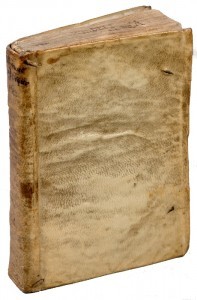
4to. (44), 480 pp. Contemporary limp vellum with ms. spine title. First - and likely only - edition. The first large-scale Syriac grammar, the third ever written (following those of Caninius, 1554, and Widmanstetter, 1555). Composed by the Maronite priest Jiris Ibn Mikha'il ibn 'Amira, it was printed by the Maronite scholar Ya'qub ibn Hilal (Giacomo Luna), who worked at the Medicean Press under Raimondi and was responsible for the Arabic and Syriac publications issued between 1590 and 1594. In 1595 he started printing on his own, and possibly took over some of the types of the Vatican Press. The work is listed as a Propaganda Press imprint ("olim typis nostris impressi") in Amadatius's 1773 "Catalogus", which shows the continuity that was felt to exist between the Medicean Press, the intermediate stage of Luna and Stephanus Paulinus, and the Propaganda Press. In the preface Raimondi is mentioned as the instigator of the work. - The 24 pt Syriac "serto" types were cut in 1590 by Jean Cavaillon for the Medicean Press. In the beginning a Syriac alphabet is presented, in three different scripts: "estrangelo" (this word possibly here used for the first time), "serto", and a Nestorian script possibly in type. This Nestorian script, a cursive form of estrangelo, is introduced here for the first time. In 1633 a slightly different type-face was used for Bellarmino's Catechism. - Some browning and brownstaining throughout, as common; the first few quires loosened. 18th century library stamps to title page; bookplate of Flavio Camillo Borghese, Prince of Sulmona (1902-80), on pastedown. Quite rare; a second edition, supposedly produced in 1645 (cf. Nasrallah, p. 10), is not attested in libraries. Edit 16, CNCE 1541. Adams A 965. BM-STC Italian 356 (s. v. "Jiris"). Brunet I, 231. Zenker, p. 132, no. 1534. Smitskamp, PO 184. Vater/Jülg 388. Nestle 13. Duverdier, Impressions, 198. OCLC 7238840.
LCS-2366« Édition originale extrêmement rare » des Voyages d’Afrique d’Armand (Chadenat). Séduisant exemplaire en vélin de l’époque. Paris, Nicolas Traboulliet, 1632. Petit in-8 de (1) f.bl., (4) ff., 320 pp. et (1) f.bl. Relié en plein vélin ivoire à recouvrement de l’époque, dos lisse avec le titre et la date calligraphiés. Reliure de l’époque. 161 x 102 mm.
Large 4to. 3 vols. (7), 208 ff. (2), 238 ff. (10), 262 ff. Title vignettes (royal arms of Portugal). Without the folding plan present in some copies. Uniform contemporary limp vellum with Iberian handwritten spine titles and traces of ties. All edges red. Second edition of the first three "Decades" on Portugal's Middle Eastern enterprises, all that was published during the lifetime of the author (a fourth volume was produced posthumously in 1615, and the set was continued by other hands). "This is considered by Du Fresnoy as being a good edition of the three first decades" (Clarke, The Progress of Maritime Discovery, p. 132). The writer de Barros (1496-1570), head agent for the Portuguese overseas trade authority "Casa da Índia", managed to persuade King João III to commission from him a history of the Portuguese in India (including Asia and southeast Africa). The result, published between 1552 and 1563, earned him renown as one of the first great Portuguese historians, and the the title of a "Portuguese Livy". The 'Decades' contain "the early history of the Portuguese in India and Asia and reveal careful study of Eastern historians and geographers, as well as of the records of his own country. They are distinguished by clearness of exposition and orderly arrangement. They are also lively accounts" (Enc. Britannica). Books 2 and 3 of the "Decada Segunda" (fols. 21 ff.) offer a detailed narrative of Afonso de Albuquerque's expedition to the Arabian Gulf and his conquest of Ormuz in 1507; the island remained under Portuese occupation from 1515 to 1622. As vassals of the Portuguese state, the Kingdom of Ormuz jointly participated in the 1521 invasion of Bahrain that ended Jabrid rule of the Arabian archipelago. - From the library of the Spanish Dukes of Medinaceli y Santisteban (their engraved armorial bookplate on the pastedowns); olf shelfmark on flyleaves. Occasional slight browning, but a very good set. Palau I.181b. Howgego I, B34, p. 91. Arouca B 56-58. Löwendahl, Sino-Western Cultural Relations I, p. 42, no. 75. OCLC 4507939. Cf. Macro 474.
4to. 3 parts in 1 volume. (12), 212, (1) ff. With title in woodcut border with Cavellet's device and initials at the foot, each part-title with Cavellet's woodcut device, 1 folding woodcut map (315 x 350 mm) showing Mount Sinai, 44 woodcuts in the text (including a portrait of the author by Geoffroy Tory), and numerous fine decorated initials. Main text set in italic, with preface and commentary in roman. Overlapping vellum (ca. 1600?), sewn on 5 cords, laced through the joints. Third edition of Belon's "Observations", the fruit of his extensive travels in Greece, Turkey, Egypt, Palestine, Lebanon and Syria from 1546 to 1549. The naturalist Pierre Belon (c. 1518-64), famous for his works on ornithology, was attached to the French embassy to the Ottoman Empire, led by Gabriel de Luetz (Luez, Luels) d'Aramont, who aimed at convincing Suleiman the Magnificent to join forces against Charles V. The envoy sailed for Venice in December 1546 and proceeded to Croatia. Here Luetz continued overland to Adrianople (Edirne), while Belon sailed for Istanbul by way of Greece, visiting Lemnos, Macedonia, Crete and Kavala en route. He reached Istanbul in August 1547, explored the city and continued to Alexandria, while Luetz accompanied Suleiman to Persia. Belon's journey continued to Cairo, Mount Sinai, Jerusalem, Damascus, Baalbek, Aleppo, and again to Turkey. - Unlike many contemporary travel writers, Belon does not elaborate on extraordinary adventures, but rather limits himself to detailed observations on mammals, fish, snakes, birds, plants and the manners and customs of the peoples he encountered, commenting only on what he himself had witnessed. The fine woodcuts, attributed to Arnold Nicolai and Pierre Goudet (Gourdelle), include a map of the Dardanelles (Hellespont), a folding map of Mount Sinai, a view of Alexandria, coins with Arabic inscriptions, 3 illustrations of Egyptian costumes, a giraffe, chameleon and, surprisingly, a flying dragon and an armadillo. - The first edition was published in 1553, illustrated with 35 woodcuts only, followed by a second, augmented edition in 1554. The present edition was a joint publication of Guillaume Cavellat and Gilles Corrozet, comprising two issues with either Corrozet's or Cavallet's name in the imprint. - With printed description from a sales catalogue on pastedown, slightly browned, some light waterstains, folding plate mounted. Overall in very good condition. Adams B 564. Aboussouan 94. Ibrahim-Hilmy 61. Gay 10. Nissen, ZBI 304. Tobler 72f. USTC 6761. Cf. Macro, Bibliography of the Arabian Peninsula, 505 (1st ed. 1553). Atabey 93 (2nd ed.). Blackmer 115 (same copy). Weber II, 153 (1st ed. 1553). Henze I, 237 (first edition). Hage Chahine 393 (later ed.). For the author: Dictionnaire des orientalistes, 75f.
8vo. (48), 234, (22) pp. With woodcut printer's device to title-page, woodcut initials and headpieces. Contemporary full vellum with handwritten spine title. First Hebrew edition: printed in Latin and Hebrew parallel text, with some passages in the notes in Arabic. "A pretty edition, and the only one to unite the text with a Latin translation" (cf. Brunet). Two duodecimo editions, in Hebrew only and in Latin only, were also published by Elzevier that same year. - Benjamin of Tudela, the "Wandering Jew" or "Wandering Rabbi", made a particular ethnographic study of the Jewish population of the various lands he visited on his travels. Setting out from Spain around 1160, he included Greece and the Aegean Archipelago, Constantinople, Jerusalem, Damascus, Baghdad, and Alexandria in his thirteen-year peregrination. Returned from his travels, he wrote his book in 1178. "One feature of his narrative is its division into what he actually saw and what he heard" (Blackmer). In Cyprus, for instance, he is stinging in his criticism of those who are "nempe Epicurei [...] Sabbathi vesperam profanant". - A clean and well-preserved copy. Willems 377. Pieters 122. Blackmer 120. Weber II, 67. Brunet I, 774 ("Belle édition"). Cf. Cobham-Jeffery p. 4. OCLC 122871307. Not in Atabey.
LCS-A12Seule et unique édition de la plus grande rareté de cette suite d’estampes de sciences naturelles, imprimée à compte d’auteur, par Pierre Joseph Buchoz. Paris, Chez l’auteur, Chez Debure, [1776]. In-folio comportant un titre gravé et 38 planches. Qq. taches. Brochure d’origine. Boite de protection en toile bleue moderne. 455 x 288 mm.
4to. 2 parts in 1 volume. (16), 235, (1), (14), (4), 33, (1). With 111 finely etched anonymous plates, an engraved allegorical title-vignette by Adolf van der Laan (1680/1700-42) dated 1736, a number of woodcut head and tail pieces and without the portrait of Burmann, as usual. Full contemporary gold tooled mottled calf, with mottled edges. First edition of the first illustrated description of the plants of Sri Lanka, based on the famous botanical collections of Paul Hermann and Jan Hartog in The Netherlands. The plants were taken from Sri Lanka, however most of these did not exclusively exist there but grew throughout the entire South Indian Ocean region, making this book relevant for more than just the island of Ceylon. Described and illustrated plants include the Malabar nut, amaranth, cinnamon, different types of jasmin etc. Johannes Burmann (1707-79), Dutch physician and botanist at Amsterdam, was well acquainted with Carl Linnaeus. While Burmann was working on the Thesaurus Zeylanicus he was helped by Linnaeus, who was staying at Burmann's house at the time. In the same period the monumental works of Linnaeus were published that would change science. The plates are referred to as engravings, but they are most likely finely etched. Plate 18 is numbered double, causing much confusion about the number of plates with it often being described as having 110 instead of 111 plates. The dedication on *2 has 2 different states: this one opens with Nicolao Sautyn. - Some annotations in pencil. Hinges worn and some wear to the boards. Plates a bit browned as usual. In very good condition. Hunt 501. Nissen BBI 303. Stafleu & Cowan 928.
10 parts in 1 volume. Large 4to. viii, 106, (2 blank), (4), 109-142, (4), 145-167, (5), 169-193, (5), 195-268, (2) pp. With 100 finely engraved plates probably after Hendrik Claudius (1655-1697), depicting South African plants. With identical engraved vignettes on each of the ten part-titles, by Jan Caspar Philips (1700-1775), showing Cape Town and Table Mountain seen from the water. First title in red & black. Without the frontispiece portrait of Burmann, as usual. Full contemporary mottled calf with gold tooled spine. Rare first and only edition of a primary source on South African flora, especially the Cape of Good Hope area, by Johannes Burmann (1707-79), Dutch physician and botanist at Amsterdam. "The nomenclature is here often in agreement with that of the Hortus Cliffortianus [of Linneaus]; Burmann accepts the Linnaean generic reform as brought about by the Genera plantarum and attempts, though not yet consistently, to coin his phrase names in a purely diagnostic way in the Linnaean manner" (Stafleu, Linnaeus and the Linnaeans, p. 166). The illustrations are drawn from the Codex Simon van der Stel, the Herbarium Witsenianum, and the Codex Witsenii. The artist was most likely the physician Hendrik Claudius of Breslau, who had arrived in Cape Town in 1682 to make watercolours of the local plants, with a medical interest. Simon van der Stel ventured on an expedition to Namaqualand in 1685-86 and had drawings of plants made for him, it is possible that Claudius accompanied him and made the drawings. In Cape town copies of these drawings were made for the burgomaster of Amsterdam, Nikolaas Witsen and via that route they served as the source for the engravings in the Rariorum Africanarum Plantarum. An important work with the first illustrations of many Cape of Good Hope plants. - Bookplate on first end paper of Guy Tinant and ink ownership on the second endpaper by the same, dated 1975. Great Flower Books 53. Hunt 508. Nissen 302. Plesch 165. Stafleu, 929. Stafleu, Linnaeus and the Linnaeans, p. 166. For the watercolours see: Codex Witsenii.
4to (175 x 260 mm). (10), 225, (1) pp. Contemporary French half leather over marbled boards, spine prettily gilt with title "Histoire de Cathérine". Marbled endpapers. Early Bulaq imprint; a translation of the French biography of Catherine the Great by Jean-Henri Castéra (1749-1838), "Vie de Catherine II, Impératrice de Russie", published in two volumes in Paris in 1797. It was exceedingly popular in Europe and saw translations into many languages. This was the first Western historical text translated into Ottoman Turkish and printed by the Bulaq press in Cairo, at the time of volatile relations between the Ottoman Empire, Russia, and Egypt. The first edition, comprising only 160 pages, was published by the Bulaq Press in 1244 (AD 1828). The present, enlarged second edition with annotations by the editor Sadullah Said Amedi was issued two years later. The translator Iakovos Argyropoulos ("Yakovaki Efendi", 1776-1850) was a linguist and official translator of the Sultan, appointed as official dragoman in Vienna. - Binding a little rubbed, extremeties slightly bumped. Interior shows occasional light browning, brownstaining and dampstains, but generally very clean. Several juvenile pencil sketches to final endpapers. - Provenance: ownership of the French diplomat Alphonse Nicolas ("Collège de France, 1887") on the front free endpaper; his stamp on the sarlowh and on several pages. Nicolas (1864-1939) was born in Rasht in northern Persia, where his father served as dragoman at the French consulate. He learned Persian and Russian and was admitted to the École des Jeunes de Langues in 1874. He entered the foreign service and was posted in Persia when he signed his name to this work in 1887. Özege 10359. OCLC 951557955. J. Strauss, "An den Ursprüngen des modernen politischen Wortschatzes des Osmanisch-Türkischen", in: Radoslav Katicic (ed.), "Herrschaft" und "Staat". Untersuchungen zum Zivilisationswortschatz im südosteuropäischen Raum 1840-1870. Eine erste Bilanz (Vienna 2004), pp. 197-256, here at p. 208. Arzu Meral, "A Survey of Translation Activity in the Ottoman Empire", in The Journal of Ottoman Studies XLII (2013), p. 116.
4to. (10), 225, (1) pp. Contemporary black cloth boards over black leather spine with gilt decoration. Early Bulaq imprint; a translation of the French biography of Catherine the Great by Jean-Henri Castéra (1749-1838), "Vie de Catherine II, Impératrice de Russie", published in two volumes in Paris in 1797. It was exceedingly popular in Europe and saw translations into many languages. This was the first Western historical text translated into Ottoman Turkish and printed by the Bulaq press in Cairo, at the time of volatile relations between the Ottoman Empire, Russia, and Egypt. The first edition, comprising only 160 pages, was published by the Bulaq Press in 1244 (AD 1828). The present, enlarged second edition with annotations by the editor Sadullah Said Amedi was issued two years later. There appear to be two versions, differing in the pattern of the headpiece and numbering of the index pages; possibly the headpiece was replaced after the first printing plate broke (our copy seems to show broken lines in the upper part of the headpiece). The translator Iakovos Argyropoulos ("Yakovaki Efendi", 1776-1850) was a linguist and official translator of the Sultan, appointed as official dragoman in Vienna. - Light waterstaining throughout, mostly in the lower half; old tears and repairs to blank margins of first leaf. Old numbers written and stamped in blue ink to front endpaper; minute wormholes to blank inner margins of final leaves; a tear to p. 111. Özege 10359. OCLC 951557955. J. Strauss, "An den Ursprüngen des modernen politischen Wortschatzes des Osmanisch-Türkischen", in: Radoslav Katicic (ed.), "Herrschaft" und "Staat". Untersuchungen zum Zivilisationswortschatz im südosteuropäischen Raum 1840-1870. Eine erste Bilanz (Vienna 2004), pp. 197-256, here at p. 208.