119 846 résultats
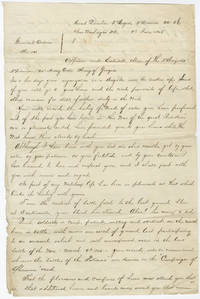
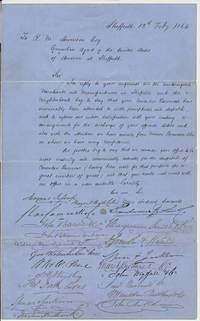
49735Raymond M. Stevenson born 1840 was an American journalist in Pennsylvania who after service in the Union Army during the Civil War was appointed by Abraham Lincoln vice consul to the American Consul in Sheffield England a post he held until 1866 after which he headed west and resumed newspaper work in Colorado. DS 3pp lettersheet 8¼" X 13½" Sheffield Great Britain 12 February 1864. Addressed to R.M. Stevenson. Very good. On blue stationery a large group of makers of renowned "Sheffield steel "sign this letter to the new American consul. "In reply to your enquiries" it begins "we the undersigned Merchants and Manufacturers in Sheffield and the Neighborhood beg to say that your Consular Business has invariably been attended to with promptness and despatch and to express our entire satisfaction with your existing arrangements for the discharge of your official duties and also with the attention we have received from Messrs. Branson & Sonwith whom we have every confidence." It continues "We further beg to say that we consider your office to be most centrally and conveniently situated for the despatch of Consular Business having been used for that purpose for a great number of years and that you could not meet with an office in a more suitable Locality." The bottom this of this page is then signed by twenty persons and/or firm names the second leaf is signed by another twenty-one persons and/or firms and the third leaf is signed by twelve persons and/or firms. The first signer on the first page is Thomas Jessop who adds "Mayor & Master Cutler." Jessop1804-87 serves as mayor of Sheffield 1863-64 and headed the steelmaking firm founded by his father -- on the second leaf he signs the firm's name "Wm Jessop & Sons." Nearby is John Brown 1816-96 who adds "Ex Mayor." Brown was Jessop's predecessor in 1862-63 an important industrialist known as "Father of the South Yorkshire Iron Trade." He signs a second time as "John Brown & Co." on behalf of the firm. Other signers on this page and the subsequent pages in no particular order include: John Martin & Co. major steel manufacturer and iron exporter; Charles Cammell & Co. iron works; Hargreaves Smith & Co. knives of all sorts; Sanderson Brothers steel manufacturers; Spear & Jackson signed twice woodworking tools manufacturers; John Wigfall & Co. butchers' knives; S & C Wardlow knife and razor manufacturers; George Wostenholm & Son cutlery table knives and forks pen and pocket knives; Wilson Hawksworth Ellison & Co. butchers' and skinning knives; Moulson Brothers saws and tool manufacturer; Charles Wild 1823-86 knife manufacturer; William Wild 1810-69 spring-knife manufacturer; Joshpe Rodgers & Sons cutlers and silversmiths; Jackson Newton knife manufacturer; Frederick Reynolds 1814-77 razor manufacturer; Thomas Firth & Sons steelmakers to the field armaments industry; and many more. Scholar Lee Tigner notes in a 2017 essay that "Sheffield Cutlers were in full swing supplying the American demand through the Civil War. Sheffield steel would have been found in most pockets on the battlefield at Gettysburg." David Hay elaborates in a 2005 article that "Geoffrey Tweedale. has shown how the American market was largely responsible for the remarkable expansion of the Sheffield crucible steel industry between the Napoleonic Wars and the American Civil War. In good years a third or more of Sheffield's steel output was sent across the Atlantic in addition to the vast trade in cutlery and edge tools. Large fortunes were made from the American trade by the steel firms of Sanderson Jessop Vickers Greaves Butcher and Cammell." American steel manufacturing was scattered and unreliable in the mod 19th-century and while the federal government made attempts to reduce its heavy reliance on Sheffield steel including an 1861 tariff on imported goods the need remained strong and the North remained anxious that their supply lines remain open. A steady supply of iron and steel knives and edges weapons and material for gun manufactuting and all manner of other military uses was crucial to the federal government; there was concern that Great Britain would side with the Confederacy who was in far greater need for imported goods than was the North -- and indeed at least one Sheffield steel firm had refused to sell materials to the U.S. government. When young consul Stevenson was appointed by Lincoln to the steel-producing center of England one of his main charges would have been to insure the smooth steady supply of materials to the federal government. This intriguing document appears to be the Sheffield steel industry's attempt to assure the American government that they would remain faithful supplies for the Union cause. A pencilled note in unknown hand on the blank fourth leaf "Testament of the Sheffield Manufactories & c to Management of Consular Agent" gives title to this remarkable document. unknown
1883Original with family inscriptions. Wooden Case. Very Good. Original wooden case for a brass set of scales used by Dr. David Townsend during the battle of Bunker Hill and other events requiring medical attention during and after the American Revolutionary War. unknown
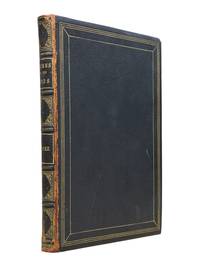
18729402N.p.: Privately Printed 1872. First edition. 8vo 20x14cm 3 98pp with 50pp consisting of 13 separately printed Pike poems and "In Memoriam Albert Pike" from 1898 bound in at rear. Lengthy presentation inscription from Pike to Capt. Fayette Hewitt and dated in 1872 Washington on separate leaf in front; and opposite a lengthy presentation inscription from Hewitt to a J.H. Johnson in 1896 Frankfort KY memorializing his friendship with Pike and gifting the book. Additionally Pike has briefly inscribed 2 of the poems bound in at rear to Hewitt one dated in 1870. Bound for Hewitt in full gilt-ruled black morocco binding spine and turn-ins tooled in gilt gilt lettering on spine marbled endpapers g.e. Spine ends joints and corners rubbed. Few of the poems at rear with light transmittal folds. <br /> <br /> Tremendous presentation copy of this privately printed collection of mythological poems from the Confederate General and architect of the Southern Scottish Rite Albert Pike 1809-1891. This copy presented to his close friend and subordinate Captain Fayette Hewitt 1831-1909 who served under Pike during the Civil War including the period of Pike's treaty negotiations in Indian Territory. Contemporary accounts from Pike on Hewitt illustrate the foundations of their relationship:<br /> <br /> "He daily deserved praise and won the love and admiration of all who knew him. He became as dear to me as my own sons. Brave courteous amiable unassuming obliging and kind to every one firm in the performance of duty—a nobler gentleman or better soldier never lived."<br /> <br /> <br /> This association is further deepened by the volume itself which Pike inscribed to “Capt. Fayette Hewitt†and which Hewitt preserved for over two decades before presenting it onward in 1896. Expanded with a substantial group of privately circulated poems including one inscribed in 1870 the volume documents a longstanding association between the two men later reinforced by Hewitt’s memorial presentation.  L. Boyden in his Bibliography of the Writings of Albert Pike 1921 records many of these bound-in poems as separately issued printings spanning from 1859 through the early 1870s with titles including "Cruiskeen Lan" "The Light of Days Long Past" "After the Midnight Cometh Morn" "The Fine Arkansas Gentleman" and others.  <br /> <br /> In all this volume represents a singular object at the intersection of the Civil War Southern fraternal culture and the personal legacy of Albert Pike preserved through his wartime friend and subordinate Fayette Hewitt.<br /> <br /> <br /> <br /> <br /> <br /> . Privately Printed unknown
192052937Klamath Falls OR: Colonel Boyd Yaden & Myrtle Madison Yaden Public Works Administration United States Army Corps of Engineers ca. 1920-1960. Eight albums. 1st - Oblong 14 x 9.25 in. 80 pp unpaginated. With 244 photos sized from 1 x 1 in. up to 7 x 10 in. many hand-coloured as well as a few Real Photo Postcards. Limp calf stamped & decorated in colour on front & back covers sewn w/ rawhide tie at gutter margin; 2nd - Oblong 4to. 11.25 x 7.25 in. 100 pp unpaginated. With 249 original photos many w/ annotations some w/ markings within the negative sized 2.75 x 3.5 in. up to 6.75 x 10 in. Limp black simulated leather post-binder sewn at gutter margin w/ black silk braid silver lettering stamped on front cover. 3rd - 4to. 96 pp unpaginated on thick toned paper stock w/ 154 original photos tipped-in taped and mounted with corners into album some with ink annotations below or beside images. Black boards post-binder sewn at gutter margin w/ black silk braid scuffing edgwear some rubbing occasional tears. 4th - Thick folio. 12.25 x 14.25 in. 70 pp unpaginated. on thick toned paper stock. With 104 photos sized from 4 x5 in. up to 8 x 10 in. most 7 x 10 in. nearly all with text in lower fore-edge of negative or printed in blank below image on lower fore-edge all mounted either with tape or glue. Tan padded boards post-binder sewn at gutter margin w/ brown silk braid some scuffing edgewear rubbing. 5th - Thick folio. 154 pp unpaginated. With 239 photographs sized 3.75 x 5.75 up to 8 x 10 in. many of them are 9 x 9 in. most with text in lower fore-edge of negative or printed in blank below lower fore-edge all mounted either with tape or glue. Embossed & decorated padded dark brown boards post-binder nickel-plated screwposts rear hinge repaired in black tape scuffing rubbing. 6th - 4to. 32 pp unpaginated. typed sheets attached to portfolio leaves with 17 original photos mounted 1 large folding colour map 4 pp. TLS signed by Governor Paul Fannin on Arizona State letterhead 2 TLS from Harry Wildnauer Federal Works Agency and Guy Kirksey Air Corps tipped-in. contained with padded leather portfolio gilt decorations silk endpapers minor scuffing. 7th - Oblong 4to. 12 x 7.5 in. 96 pp unpaginated. thick black paper stock. With 228 original photos sized 7 x 11 in. with two 4 pp. programs for Pig’n Whistle Evening Concerts in Seattle WA. Limp embossed Arts & Crafts brown cloth post-binder black silk braid rounded corners front inner hinge starting. 8th - Oblong folio. 13 x 10.5 in. 100 pp unpaginated. on thick black paper stock. With 484 original photographs many with annotations on versos some mounted with glue others with corners some loose a few missing sized from 1 x 2 in. up to 8 x 10 in. Limp textured brown calf post-binder rounded corners sewn at gutter margin with brown silk braid some edgewear rubbing weakening to many leaves at gutter margin an excellent archive filled with bright images strong contrast. This immense photo album archive assembled by Lt. Colonel Boyd Yaden 1906-1980 incorporates eight albums. The first of these albums document his career serving with the Provisional Co. No. 2 1st Battalion 55th Coastal Artillery of the U.S. Army serving the batteries at Fort Kamehameha Fort Kam. The 55th CA was equipped with 155 mm. Grande Puissance Filloux guns typically mounted atop concrete Panama Mounts which enabled the pieces to traverse 360 degrees as well as 75 mm. field pieces. These remarkable images show the artillery gun crews test firing the 155 mm. guns loading shells night firing camp drills inspections athletics expanding the tracks for the 41st Coast Artillery Locomotive at Fort Kamehameha and more. Of special interest are three photos documenting the first Navy Pacific Flight by Commander John Rodgers in the PN-9 Seaplane from San Pablo CA non-stop to Honolulu HI which ran out of gas and landed in the Pacific Ocean. The crew fashioned sails from wing fabric and later leeboards to steer the flying boat and finally came within 15 miles of Kauai where it was discovered by the USS R-4 submarine. The second & third albums chronicle Boyd Yaden’s life with his wife Myrtle Yaden 1901-1988 moving from Klamath Falls OR to Alaskan Resident Engineer and Inspector for the Public Works Administration overseeing the installation of the sewer system in Petersburg Alaska with several photos showing street scenes digging up of streets to lay pipe earthmoving equipment steam shovels and finally the finished streets with bustling economic activity. In addition there are photos of building railroad trestles bridges and logging operations on Wrangell Island Alaska with photos showing the construction logging sites totem poles and then his work as supervising engineer for the Public Works Administration during the Depression building a power plant near Anchorage AK followed by the project of rebuilding the power plant in Seward AK with photos showing the phases of construction. The third album includes photos of the couple on the steamship SS Hazel B No. 2 hunting & fishing in Alaska and the Pacific Northwest the Pioneers Home in Sitka as well as documenting trips to visit relatives in Seattle North Dakota and New York. Two very large photo albums are devoted to Colonel Yaden’s activities as Division Engineer for United States Army Corps of Engineers and later for the Air Transport Command in Alaska and Western Canada. The albums open with an extensive group of photos of Hammer Field near Fresno California now Fresno Yosemite International Airport with images showing the laying of foundations training crash of a B-24 Bomber June 27 1942 the theaters bowling alley Sub Exchange NCO Club tennis courts recreational facilities swimming pool sandstorms and more. In addition Yaden oversaw the mineral and strategic materials facilities in Trona CA with images of the nearby Ruth Mine loading operations onto trucks and railcars. In 1943 Yaden began an engineering and photographic survey of the Western Canadian air bases for the ATC and has included large photos of Calgary Air Base aerial views of Edmonton Air Base and the Edmonton Air Base Edmonton Airport Wing Hangars under construction the Edmonton Satellite Airport aerial views and detailed photos of the Namao Airbase Alberta along with others such as the Grand Prairie Airbase Dawson Creek Fort Neslon Airbase Watson Lake Y.T. Whitehorse Y.T. and the ATC engineering post including the sawmill lumber racks and construction equipment in Canada. The last half of the fifth album is devoted to airfields and airbases in Alaska including the Northway Airfield showing aircraft landing hangars under construction engineering and structural detail photos Tanacross Airport AK Ladd Field and a whole series of large aerial views of the Galena Flood. Yaden also oversaw Airfield site surveys in Port Clarence Nome Point Spencer Imuruk Basin even including a dog sled team and Native American guide in the depths of winter. In addition The final two albums are devoted to the life and activities of Myrtle A. “Madison†Yaden 1901-1988 who taught school in Whitefish Montana then moved to Mullan Idaho the Puget Sound region during the 1920s and later Klamath Falls where she would meet Boyd Yaden. This album includes photos of the gold dredges in Mullan Idaho near Wallace North Dakota Agricultural College band members Montana High School basketball champions football teams hijinks with fellow students and teachers the YWCA Camp on Bainbridge Island treks to Seattle Poulsbo and other areas around the Sound. Boyd Yaden was the nephew of Oregon Pioneer George Nurse who founded Linkville attended the Univ. of Oregon served with the 55th Coast Artillery in Hawaii joined Battery D 249th Coast Artillery of the Oregon National Guard was commissioned a 2nd Lieutenant became a licensed civil engineer in Klamath Falls worked in Alaska Canada California and Oregon where he became an engineering expert on building and working on permafrost in the Arctic and later worked with the Flood Control Agency in Phoenix AZ before returning to Klamath Falls OR as basin engineer. See: Laisa Leao Remembering Hammer Field U.S. Department of Veterans Affairs 2015; William Gaines Coast Artillery Organizational History 1917-1950. Part I Coast Artillery Regiments The Coast Defense Journal Vol. 23 Issue 2 pp. 29-31; Siemon Muller Frozen in Time: Permafrost and Engineering Problems 2008. Colonel Boyd Yaden & Myrtle Madison Yaden, Public Works Administration, United States Army Corps of Engineers, hardcover
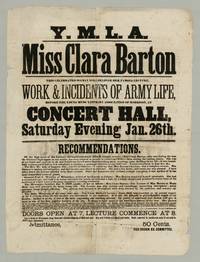
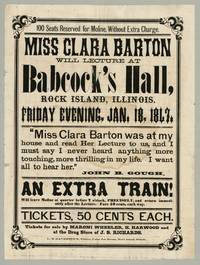
186713090Morrison WI 1867. Broadside 26.75 x 20.25 inches printed on thin paper. Old folds some creasing edges occasionally a bit frayed with a few small nicks or tears a couple of minor losses along folds. Overall very good condition. A striking and seemingly unique surviving broadside advertising a January 26 1867 lecture by Clara Barton entitled "War & Incidents of Army Life" part of a popular post-Civil War lecture series she delivered across the United States. Barton spent two years touring and recounting her battlefield experiences which helped popularize her and fund her subsequent efforts to locate missing soldiers. The present lecture was delivered to the Young Men's Literary Association of Morrison Wisconsin at the local Concert Hall. In addition to the bold title containing the relevant information on the lecture and the information on obtaining tickets at the bottom much of the lower portion of the broadside prints several laudatory "Recommendations" from various entities in Indiana and other locations in Wisconsin including a January 7 1867 review from The Milwaukee Sentinel. Noted temperance lecturer John B. Gough also praises Barton's lecture stating that "I never heard anything more touching more thrilling in my life."<br /> <br /> Typographically the broadside is interesting for employing several sizes of fonts likely wooden type especially near the bottom of the Recommendations section where the printers needed to reduce the size of the font to fit in the entirety of a quote from The Daily Wisconsin as well as a line in the smallest font from the Concert Hall promoter noting that the foregoing group of recommendations is "enough" and praising Barton for her "noble character which she has won by her efforts to ameliorate the sufferings of our sick and disabled soldiers."<br /> <br /> Clara Barton 1821-1912 was a noted educator and humanitarian who helped distribute needed supplies to the Union Army during the Civil War and later founded the American Red Cross. Barton garnered nationwide recognition for her efforts during the war and quickly became known as the "Angel of the Battlefield." After the war Barton's lecture tour brought her in contact with other notables of the day including Susan B. Anthony and Elizabeth Cady Stanton and also Frederick Douglass who involved her in the suffrage and civil rights movements respectively. In the Fall of 1866 Barton began to lecture on her Civil War experiences in lyceum halls churches town halls and schools. Though she never felt comfortable in front of an audience wherever she spoke Barton was well received. Her contemporary biographer Percy Epler wrote that "a tear-stained multitude thronged everywhere to hear her" as she had made it her mission to show not "the glories of conquering armies but the mischief and misery they strew in their tracks; and how while they march on.some one must follow closely in their steps crouching to the earth faces bathed in tears and hands in blood. This is the side which history never shows."<br /> <br /> From 1866 through 1868 Barton delivered over 200 lectures throughout the northeast and midwest regarding her Civil War experiences. She shared platforms with other prominent figures including the aforementioned Douglass as well as Ralph Waldo Emerson William Lloyd Garrison and Mark Twain. She often earned $75 to $100 per lecture. Original broadsides advertising her lectures especially of this size are exceedingly rare to say the least. We could locate just a single result in auction records of a much smaller example and OCLC reports just one institutional holding of any Barton lecture broadside again much smaller for an 1867 event in New Haven located at the Library of Congress. unknown
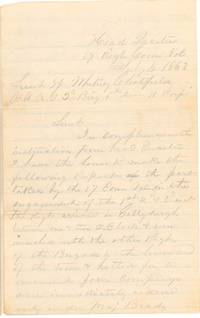
186321808<p>A field report from the Battle of Gettysburg by Major Allen G. Brady commander of the 17th Connecticut Regiment written on the 4th of July 1863 the day after the battle ended in a great victory for the Union.</p><p><i>"We had not more than time to form before the enemy were discovered advancing rapidly upon us on our right & a full Brigade obliquely towards our left….our fire was so destructive it checked their advance the troops on our left giving way the enemy came in behind us but we still remained firmly at the stone wall until the rebels were driven back."</i></p> <b>CIVIL WAR – GETTYSBURG.</b>Allen G. Brady Autograph Manuscript Gettysburg Pennsylvania July 4 1863. 6 pp. in pencil an unsigned draft or retained copy.<p>With: <b>ANDREW JOHNSON.</b> Officer's commission of brevet Lieutenant Colonel to Allen G. Brady <i>"for gallant conduct at the Battle of Chancellorsville Va to date from March 13 1865"</i> March 20 1866 signed with stamp not in ink; and</p><p>With: <b>ALLEN G. BRADY.</b>Autograph Letter Signed to the Adjutant General U.S. Army May 19 1877 seeking a copy of the military record of General Hugh Brady who had fought in the War of 1812; and</p><p>With: <b>WHARTON J. GREEN.</b> Autograph Letter Signed to Allen G. Brady December 13 1885.</p><p><b>Complete Transcript</b></p><p><i>Head Quarters 17 Regt Conn Vol. </i></p><p><i>July 4 1863</i></p><p><i>Lieut. H. Whitney Chatfield </i></p><p><i>A.A.A.G. 2d Brig. 1st Div. 11 Corps</i>.</p><p><i>Lieut.</i></p><p><i> In compliance with instructions from head quarters I have the honor to make the following report the part taken by the 17 Conn Vol in the engagement of the 1st 2d & 3d inst. The Regt. arrived in Gettysburgh between one & two O'Clock & were marched with the other Regt. of the Brigade to the lower end of the town & halted for a moment. Four companies were immediately ordered out under Maj Brady </i>2 <i>two of the four Companys under Maj. Brady were deployed from the bridge to the right as skirmishers the other two held in reserve. The remainder of the Regt under the Command of Lieut Col. Fowler advance with the rest of the Brigade to the front & left of the village. Directly in rear of the 107 Ohio Vol. - who were closed in mass by Division & were ordered to the front Deployed & advanced at Double quick our men held their ground notwithstanding they rushed to the rear of troops directly in advance until ordered by the Brigade Commander to fall back. </i></p><p><i>This order was obeyed the men loading & firing as they were retreating it was <b>about this time Lieut Col. Fowler was killed. Upon reaching the village the four companys</b> </i>3 <b><i>still skirmishing briskley with the enemy </i></b><i>& retiring in good order & ordered by the Comdg Genl to rejoin the Regt. <b>Maj. Brady immediately taking command after deploying & firing in several streets running to the left of the main street of the town on account of the rapid advance of the enemy we were ordered to fall back out of the town & while retreating through the main street the Regt was halted & faced to the rear & poured several destructive vollys into the enemy.</b> We then fell back out of the town & formed in front of the battery <b>pursuant to order from Maj. Genl. </b></i>Oliver Otis <b><i>Howard we then advanced to the stone wall in rear of the village </i></b><i>& remained a few moments there again advanced to a rail fence still further to the front & then remained until </i>4 <i>late in the evening when the whole Regt was sent out on picket & performed that duty <b>until late in the afternoon of 2d when we were relieved & took our old position behind the rail fence w</b></i>h<b><i>ere we remained exposed to fire of the enemy's battery & sharp shooters until about 7 o'clock P.M. were ordered to the extreme right of the Brigade behind a stone wall on each side of the lane below the battery opposite the cemetery entrance one company was advanced to the grain field near the woods we covered the wall on each side of the land by compelling 200 straggling soldiers to fall into our line. We had not more than time to form before the enemy were discovered advancing rapidly upon us on our right & a full Brigade obliquely towards our left. The Regt were ordered to fire obliquely to the left upon the Brigade our fire was so destructive it checked their advance the troops on our left giving way the enemy came in behind us but we still remained firmly at the stone wall until the rebels were driven back.</i></b></p><p><i>It was during this engagement that Maj. Brady was wounded </i>5 <i>by a fragment of shell hitting his right shoulder blade. </i></p><p><i>After the enemy had been driven back & the firing ceased except occasional shots from their sharpshooters. We were relieved by the 4 Ohio Vol. and were ordered to change front to the left behind a wall running at right angles with the fence we had occupied and fronting the town where the rebels entered on our left. During that night & the 3d inst. exposed to a cross fire of the rebel batterys & to the fire of the sharp shooters who were watching our movements. </i></p><p><b><i>When the Regt entered the engagement on the 1st inst it numbered 17 officers & 369 enlisted men. We report at the present time 9 officers & 120 enlisted men. </i></b><i>Capt. Wilson French is the </i>6 <i>only officer known to have been taken prisoner he was wounded in the engagement of the first inst & we are not aware of his being paroled</i>"</p><p><b>Historical Background </b></p><p>The Battle of Gettysburg fought July 1-3 1863 was a major turning point in the Civil War. Over the course of three grueling days Union Major General George G. Meade's Army of the Potomac beat back desperate attacks by Confederate General Robert E. Lee's Army of Northern Virginia including the ill-fated "Pickett's Charge" on July 3. The Union victory ended Lee's short-lived invasion of the North.</p><p>Many soldiers of the 17th Connecticut had been stung by criticisms leveled at their unit after the Battle of Chancellorsville where the corps was surprised and driven from the field with a flank attack by Stonewall Jackson. As Brady reports here events on the first day of the Battle of Gettysburg were eerily similar to Chancellorsville. On July 1 their regiment was again divided outnumbered and outflanked by the same Confederate unit as it had been at Chancellorsville although this time under command of Richard Ewell. As he drove the Connecticut soldiers from the field and through the streets of Gettysburg on the first day of fighting Union Lieutenant Colonel Douglas Fowler was killed. In a disciplined retreat that evening the 17th Connecticut fell back and was posted near the center of the Union line on Cemetery Hill near a stone wall. Their position where the Union lines' "fishhook" curved southeastward toward Culp's Hill exposed them to murderous crossfire from Confederate artillery on three sides. The unit sustained high casualties for the next two days; of the unit's 386 men at Gettysburg 20 were killed 81 wounded and 96 reported missing. Brady himself was wounded by a shell fragment on July 2.</p><p>The regiment performed heroic service on the second day of the battle protecting Cemetery Hill from the attacks of Jubal Early's division specifically Harry Hays's brigade of "Louisiana Tigers." The 17th Connecticut then withstood the Confederate bombardment of July 3 spending much of the day trading shots with sharpshooters in town. Brady's report in slightly revised and expanded form is reprinted in <i>Official Records</i> Series 1 Vol. 27 Chap. 39 Part 1 pp. 716-719. In closing there Brady said "The regiment behaved gallantly. No troops in the world behaved better. Both officers and men are deserving of great credit for their coolness and bravery throughout the entire three days' battle."</p><p><b>Allen G. Brady </b>1822-1905 was from Torrington Connecticut. He enlisted in May 1861 as part of the 3rd Connecticut Infantry Regiment. In August 1862 he was commissioned into the 17thConnecticut Volunteers. Brady was brevetted Lieutenant Colonel for his valor at the Battle of Chancellorsville just two months before Gettysburg. There Brady assumed command after the colonel and lieutenant colonel of his regiment each fell. Brigadier General Charles Devens commended Brady in his official report stating "The Seventeenth Connecticut under command of Major Brady – its colonel having been wounded and lieutenant-colonel killed – was in fact rallied and reformed in their positions." In October 1863 Brady was discharged for disability presumably from his wound suffered at Gettysburg three months previous. He was mustered into the Veteran Reserve Corps and served as Provost-General at the Point Lookout Union Prison Camp in 1864. He was brevetted Colonel in August 1865.</p>
186321808<p>A field report from the Battle of Gettysburg by Major Allen G. Brady commander of the 17th Connecticut Regiment written on the 4th of July 1863 the day after the battle ended in a great victory for the Union.</p><p><i>"We had not more than time to form before the enemy were discovered advancing rapidly upon us on our right & a full Brigade obliquely towards our left….our fire was so destructive it checked their advance the troops on our left giving way the enemy came in behind us but we still remained firmly at the stone wall until the rebels were driven back."</i></p> <b>CIVIL WAR – GETTYSBURG.</b>Allen G. Brady Autograph Manuscript Gettysburg Pennsylvania July 4 1863. 6 pp. in pencil an unsigned draft or retained copy.<p>With: <b>ANDREW JOHNSON.</b> Officer's commission of brevet Lieutenant Colonel to Allen G. Brady <i>"for gallant conduct at the Battle of Chancellorsville Va to date from March 13 1865"</i> March 20 1866 signed with stamp not in ink; and</p><p>With: <b>ALLEN G. BRADY.</b>Autograph Letter Signed to the Adjutant General U.S. Army May 19 1877 seeking a copy of the military record of General Hugh Brady who had fought in the War of 1812; and</p><p>With: <b>WHARTON J. GREEN.</b> Autograph Letter Signed to Allen G. Brady December 13 1885.</p><p><b>Complete Transcript</b></p><p><i>Head Quarters 17 Regt Conn Vol. </i></p><p><i>July 4 1863</i></p><p><i>Lieut. H. Whitney Chatfield </i></p><p><i>A.A.A.G. 2d Brig. 1st Div. 11 Corps</i>.</p><p><i>Lieut.</i></p><p><i> In compliance with instructions from head quarters I have the honor to make the following report the part taken by the 17 Conn Vol in the engagement of the 1st 2d & 3d inst. The Regt. arrived in Gettysburgh between one & two O'Clock & were marched with the other Regt. of the Brigade to the lower end of the town & halted for a moment. Four companies were immediately ordered out under Maj Brady </i>2 <i>two of the four Companys under Maj. Brady were deployed from the bridge to the right as skirmishers the other two held in reserve. The remainder of the Regt under the Command of Lieut Col. Fowler advance with the rest of the Brigade to the front & left of the village. Directly in rear of the 107 Ohio Vol. - who were closed in mass by Division & were ordered to the front Deployed & advanced at Double quick our men held their ground notwithstanding they rushed to the rear of troops directly in advance until ordered by the Brigade Commander to fall back. </i></p><p><i>This order was obeyed the men loading & firing as they were retreating it was <b>about this time Lieut Col. Fowler was killed. Upon reaching the village the four companys</b> </i>3 <b><i>still skirmishing briskley with the enemy </i></b><i>& retiring in good order & ordered by the Comdg Genl to rejoin the Regt. <b>Maj. Brady immediately taking command after deploying & firing in several streets running to the left of the main street of the town on account of the rapid advance of the enemy we were ordered to fall back out of the town & while retreating through the main street the Regt was halted & faced to the rear & poured several destructive vollys into the enemy.</b> We then fell back out of the town & formed in front of the battery <b>pursuant to order from Maj. Genl. </b></i>Oliver Otis <b><i>Howard we then advanced to the stone wall in rear of the village </i></b><i>& remained a few moments there again advanced to a rail fence still further to the front & then remained until </i>4 <i>late in the evening when the whole Regt was sent out on picket & performed that duty <b>until late in the afternoon of 2d when we were relieved & took our old position behind the rail fence w</b></i>h<b><i>ere we remained exposed to fire of the enemy's battery & sharp shooters until about 7 o'clock P.M. were ordered to the extreme right of the Brigade behind a stone wall on each side of the lane below the battery opposite the cemetery entrance one company was advanced to the grain field near the woods we covered the wall on each side of the land by compelling 200 straggling soldiers to fall into our line. We had not more than time to form before the enemy were discovered advancing rapidly upon us on our right & a full Brigade obliquely towards our left. The Regt were ordered to fire obliquely to the left upon the Brigade our fire was so destructive it checked their advance the troops on our left giving way the enemy came in behind us but we still remained firmly at the stone wall until the rebels were driven back.</i></b></p><p><i>It was during this engagement that Maj. Brady was wounded </i>5 <i>by a fragment of shell hitting his right shoulder blade. </i></p><p><i>After the enemy had been driven back & the firing ceased except occasional shots from their sharpshooters. We were relieved by the 4 Ohio Vol. and were ordered to change front to the left behind a wall running at right angles with the fence we had occupied and fronting the town where the rebels entered on our left. During that night & the 3d inst. exposed to a cross fire of the rebel batterys & to the fire of the sharp shooters who were watching our movements. </i></p><p><b><i>When the Regt entered the engagement on the 1st inst it numbered 17 officers & 369 enlisted men. We report at the present time 9 officers & 120 enlisted men. </i></b><i>Capt. Wilson French is the </i>6 <i>only officer known to have been taken prisoner he was wounded in the engagement of the first inst & we are not aware of his being paroled</i>"</p><p><b>Historical Background </b></p><p>The Battle of Gettysburg fought July 1-3 1863 was a major turning point in the Civil War. Over the course of three grueling days Union Major General George G. Meade's Army of the Potomac beat back desperate attacks by Confederate General Robert E. Lee's Army of Northern Virginia including the ill-fated "Pickett's Charge" on July 3. The Union victory ended Lee's short-lived invasion of the North.</p><p>Many soldiers of the 17th Connecticut had been stung by criticisms leveled at their unit after the Battle of Chancellorsville where the corps was surprised and driven from the field with a flank attack by Stonewall Jackson. As Brady reports here events on the first day of the Battle of Gettysburg were eerily similar to Chancellorsville. On July 1 their regiment was again divided outnumbered and outflanked by the same Confederate unit as it had been at Chancellorsville although this time under command of Richard Ewell. As he drove the Connecticut soldiers from the field and through the streets of Gettysburg on the first day of fighting Union Lieutenant Colonel Douglas Fowler was killed. In a disciplined retreat that evening the 17th Connecticut fell back and was posted near the center of the Union line on Cemetery Hill near a stone wall. Their position where the Union lines' "fishhook" curved southeastward toward Culp's Hill exposed them to murderous crossfire from Confederate artillery on three sides. The unit sustained high casualties for the next two days; of the unit's 386 men at Gettysburg 20 were killed 81 wounded and 96 reported missing. Brady himself was wounded by a shell fragment on July 2.</p><p>The regiment performed heroic service on the second day of the battle protecting Cemetery Hill from the attacks of Jubal Early's division specifically Harry Hays's brigade of "Louisiana Tigers." The 17th Connecticut then withstood the Confederate bombardment of July 3 spending much of the day trading shots with sharpshooters in town. Brady's report in slightly revised and expanded form is reprinted in <i>Official Records</i> Series 1 Vol. 27 Chap. 39 Part 1 pp. 716-719. In closing there Brady said "The regiment behaved gallantly. No troops in the world behaved better. Both officers and men are deserving of great credit for their coolness and bravery throughout the entire three days' battle."</p><p><b>Allen G. Brady </b>1822-1905 was from Torrington Connecticut. He enlisted in May 1861 as part of the 3rd Connecticut Infantry Regiment. In August 1862 he was commissioned into the 17thConnecticut Volunteers. Brady was brevetted Lieutenant Colonel for his valor at the Battle of Chancellorsville just two months before Gettysburg. There Brady assumed command after the colonel and lieutenant colonel of his regiment each fell. Brigadier General Charles Devens commended Brady in his official report stating "The Seventeenth Connecticut under command of Major Brady – its colonel having been wounded and lieutenant-colonel killed – was in fact rallied and reformed in their positions." In October 1863 Brady was discharged for disability presumably from his wound suffered at Gettysburg three months previous. He was mustered into the Veteran Reserve Corps and served as Provost-General at the Point Lookout Union Prison Camp in 1864. He was brevetted Colonel in August 1865.</p> books
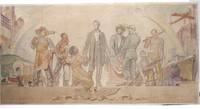
1932W2805<p>Redlands California: Unpublished 1932. Original watercolor and color pencil drawing on artist board. SIGNED. Near Fine. 9 inches by 18 Inches.</p><p>Dean Cornwell 1892-1960 studied under Howard Pyle's student Harvey Dunn and the influence of the Brandywine School in much of Cornwell's work. Nicknamed "The Dean of Illustrators" by his peers Cornwell completed more than 1000 paintings as illustrations for stories and advertisements in books and magazines such as <em>Cosmopolitan Life Redbook</em> and many others.</p><p>Although he was very successful as an illustrator Cornwell decided to become a muralist; so in the late 1920s he spent 3 years in England studying mural painting with Frank Brangwyn. His first commission was to create his now famous murals for the Los Angeles Public Library. In 1932 he completed murals for the Lincoln Memorial Shrine in Redlands California. Although the study offered here was not selected for inclusion it may well have been the inspiration for the 2 allegorical murals he completed for the project because it includes both of the elements that were the focus of each of the selected murals: "He Freed the Slaves" and "He Preserved the Union." Included with the watercolor are 2 vintage postcards picturing the murals. Also the scene in this study is placed atop a plinth that is quite similar to those in the murals. The study also includes the muralist technique of surrounding figures with strong outlines which Cornwell adopted both in his own murals and in his later illustration work.</p><p>Paintings by Cornwell have been exhibited in the Whitney Museum of American Art The Art Institute of Chicago the National Academy of Design and the Pennsylvania Academy of Fine Arts. In 1959 he was inducted into the Society of Illustrators' Hall of Fame.</p> Unpublished
1919WRCAM55901Various locations including Ohio Georgia France Luxembourg Germany and Belgium 1919. Folio manuscript diary 153pp. one printed book and various family papers certificates dog tags photographs and more. In very good condition overall. An important and informative World War I archive belonging to Wilson Kappel of Bolivar Ohio including a phenomenal starkly-written and uncensored diary kept by him throughout his service detailing war deaths mustard gas attacks and the notable Meuse-Argonne offensive near the end of the war. Kappel 1893-1979 served as a mechanic with Company C of the 6th Infantry of the United States Army. He registered for the service on June 5 1917 was drafted in July shipped out to training in October and served until his return from Europe on July 31 1919. Kappel spent significant time in France Luxembourg Belgium and Germany during his service all of which he details here. <br> <br> By far the most significant item in the present archive is Kappel's manuscript diary which covers in amazing detail every aspect of his service from home to Europe and back again. The diary which Kappel titles in manuscript on the first page DIARY OF THE WORLD WAR is large format and closely written for over 150 pages in an eminently readable and uncensored style. It is likely that he either wrote out this diary from notes made during the war or wrote it out from memory shortly after the war. The text conveys a sharpness that immediacy that would likely have been slightly dulled by the passage of time. The diary begins with the line "I registered June 5th 1917" and takes Kappel first to the mobilization camp at Camp Sherman in Chillicothe Ohio and thenceforth to basic training at Camp Forrest in Georgia. Kappel writes in unhurried detail about training on the rifle range in Georgia traveling to Hoboken New Jersey to board a troop ship to Europe and writes extensively about his experiences overseas. <br> <br> Kappel's European diary entries begin with his arrival at the "sorting yards" at Brest France. He continues to various locations in France namely Barsubaube Soulaine Pagny- Sur-Meuse Remiremont and Le Tholy before arriving at the front and the front line trenches near Gerardmer in mid-June of 1918. At the front Kappel and his unit experience their first encounter with enemy shellings and the types of activity faced by soldiers near the front lines: <br> <br> "We all got scared as none of us ever heard a shell before and we thought they were going to hit us but they went way above our heads and went crashing against the hill side we could hear it echo many times. We got orders to lay in the ditch along the road till they stopped shelling. I and Corporal Fox of Massillon was together in the ditch he said to me 'I wish we would be back in Massillon Ohio instead of being in this ditch.' As soon as they stopped shelling we went on again. When we got within about two miles of the front line trenches the Germans must have heard us walk as they had a powerful search light on top of a high hill and they shined that down direct on us for about ten minutes and then it went out again." <br> <br> Kappel spent almost a month at the front where he writes about getting shot at by German snipers cooking clandestinely in the basement of a French church encountering a private who shot off his own finger while on guard duty firing on German patrols encroaching into the American side a strange incident in which a corporal intentionally blew his own hand off with a grenade presumably in order to avoid further service and much more in often astonishing detail. <br> <br> On July 16 Kappel and his unit left the front lines near Gerardmer continuing to St. Die and then arriving again at the front lines this time at St. Claire. On August 15 Kappel and his unit were caught in a mustard gas attack which he recounts in excruciating detail. The Germans in the area "shot over a large number of mustard gas shells all along the front.I and about fifty more soldiers all ran down in a dugout that was gas proof but the gas came in through the cracks of the door and we all had to wear our gas masks for about an hour.The gas was so strong that it got in between our shoes and leggings and many of us got blisters on our ankles." <br> <br> Two days later Kappel participated in the attack on the German border town of Frappell. Kappel writes that "The American barrage started Aug 17th 1918 at three-fifty a.m." and was met with a German response that "killed many Americans." As usual Kappel's recounting of the battle is unusually detailed and affecting ranging over several pages and including meticulous accounts of the horrors of battle. He writes in part: "At one place four American soldiers carried a wounded soldier on a stretcher in a trench. The trench was not wide enough around a corner so they had to lift him up out of the trench. Just as they were doing this a German shell came and killed all five of them." Later he writes: <br> <br> "The first shell that the Germans fired on his headquarters made a direct hit on the closet and was all blown to pieces with several soldiers in it and a few standing out around the building. I was half asleep in my dugout at the time. I had my pack rolled in the morning but I jumped up when the first shell hit. Mechanic White was with me he told me 'It is time to go' we both ran out of our dugout because it was not shell proof and just as we got outside of the door Private Raymond Barmos was rolling his pack. We both jumped over him and that was the last that was ever seen of him. He was blown to pieces a few seconds after we had jumped over him." <br> <br> Kappel's diary continues in much the same manner and with the high level of detail throughout the remainder of the text. He and his unit continue to Pouxeux St. Nicolas St. Christophe Martin Court Saint Mihiel Avirinville Rigny and Verdun. Just north of Verdun Kappel participates in the historic Meuse-Argonne offensive from September to November 1918. Kappel's account of the Meuse-Argonne offensive occupies ten pages of his diary and is typically thorough in relating the specific brutalities heaped upon the young soldiers during the Great War. A few excerpts will relay the flavor of Kappel's narrative of the offensive: <br> <br> "When we started over the top we had to cross a valley this was full of gas. The Captain told us to put on our gas masks. I put my gas mask on quick and started to walk away a German shell came and exploded to the right side of me and a piece of shrapnel went through my gas mask. I pulled my gas mask off quick and walked back a little ways and took a gas mask off a dead American soldier and put that over my face. The Germans were only a few rods away from us. We started to shoot at them they did the same. We killed some and captured a few the rest ran over the hill. We kept going after them the whole day. One German shell came and made a direct hit on Lieutenant Roche of our company. He was blown to little shreds." <br> <br> "The Germans had many barbwire entanglements here. It was a common sight to see from six to ten American soldiers lay on a pile dead. They shot a German spy at this front. He was in the American Artillery and was always shooting short. The Artillery Sergeant killed him with his revolver." <br> <br> "We stayed here for one day and night. We dug our shelter trenches two soldiers for each shelter trench.The bullets were flying thick. We had to stop digging several times and crawl behind the fresh dug grounds for safety. When Private Pike of our company was done digging his little shelter trench he reached up with his hand to tear some weeds off so he could see out better a bullet came and went right through the middle of his hand.From this place when we looked back we could see the canal river railroad and the city of Brieulles. It was nice to watch the German big shells explode. Some would hit right in the river. It would throw the water up about forty feet in the air. Some shells would hit the buildings at Brieulles and tear them all to pieces." <br> <br> "We went past a cabbage patch. We made out that in coming back that we were going to take some cabbage along with us. When we got down into Brandyville the Germans started to bombard the town. I gave the message to an officer. It took him about one hour to write out another message for me to take back. I was looking every minute for the house to get hit by a shell.I finally got my message and we all ran out of town till we got to the cabbage patch. There we stopped. Just as each one of us was going in the patch a big German shell hit right in the center and surely did make the cabbage heads fly. I got one big head and some of the others got two heads a piece. This we took back to our company and at midnight we all had raw cabbage to eat." <br> <br> After the Meuse-Argonne offensive Kappel moved on to Liny Brandeville Louppy Marville and Rehon in France then spent a short time in Luxembourg Belgium and Germany before shipping back to the States. <br> <br> In the final eighteen pages of his diary Kappel records a short history of the USS America; a couple of poems; a detailed list of Army pay with title and monthly pay; a list of Army divisions with enlistments casualties captures wounded and more; a complete roster of Company C from March 1918 "just a few days before we started for France" which includes a list of all the men who were in the unit from March 1918 to March 1919 and what happened to them during the course of the war; a list of divisions to which each unit belonged; and ending with four small color drawings and descriptions of the principal airplane markings belonging to England France the United States and Germany during the war. <br> <br> In addition to his diary the present archive is rounded out with a batch of personal papers and other material kept by Kappel and his family. These additional items include a war-dated letter from Wilson Kappel to his brother Owen sent home from France in September 1918; five early Kappel family photographs showing Wilson and Owen; a printed certificate from President Jimmy Carter honoring Kappel's service sent to Owen after Wilson's death; Kappel's dog tags; twenty-two later small photographic negatives; a Civil War bullet passed down through the family and with a note by William Kappel; a portion of the January 17 1919 issue of STARS AND STRIPES; Kappel's 8th and 9th grade report cards; his address book; Kappel's funeral notice indicating he died on Oct. 22 1979; and a hardcover book entitled THE OFFICIAL HISTORY OF THE FIFTH DIVISION U.S.A. Washington D.C.: The Society of the Fifth Division 1919 with original shipping box addressed to Wilson Kappel. <br> <br> An historically important and uncensored firsthand account of the First World War that reads like an undiscovered classic from the Lost Generation rounded out with a small selection of the soldier's personal war- related material. hardcover books
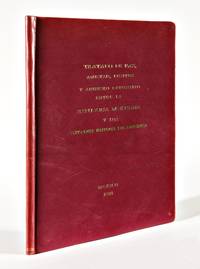
1848319879Mexico: Imprenta de I. Cumplido 1848. 55pp. printed on facing pages in parallel Spanish and English. Original printed green wrappers bound into modern red limp polished Mexican calf gilt. Light toning occasional minimal foxing small tear in upper outer corner of page 19/20 affecting just six words. Overall very good. 55pp. printed on facing pages in parallel Spanish and English. Official Mexican Printing of the Treaty of Guadalupe Hidalgo. The official Mexican printing of the final text of the landmark Treaty of Guadalupe Hidalgo ending the Mexican War and delivering to the United States its current territory in the Southwest. This printing closely follows the Queretaro edition produced just a few months earlier but contains added protocols excluded from that earlier printing. The full text appears here in both English and Spanish on facing pages. Pages 46-49 contain the text of amendments made to the treaty by the United States Senate followed by a statement of Pena y Pena dated May 30 1848 accepting the modifications and concluded by a Protocol dated May 26 attempting to put the best light on the treaty from the Mexican point of view. The Treaty of Guadalupe Hidalgo which ended the war between the United States and Mexico resulted in the formal cession of the entire Southwest and California to the United States. Agreements were reached for the withdrawal of American troops from Mexico the payment of Mexican claims and the formal cession of territory the U.S. had already occupied all of the land. The theoretical boundaries were set out and arrangements for boundary commissioners were made. By this treaty the United States obtained an addition of land equalled in size only by the Louisiana and Alaska purchases. <br/><br/>A fundamental piece of Western Americana here in the official Mexican edition of the complete treaty and scarce on the market. Streeter Sale 282; Palau 339389; Garrett p.91l; Cowan p.252; Howes M565"aa"; Eberstadt 162:847; Malloy p.1107; Reese Best of the West 104 Imprenta de I. Cumplido unknown books
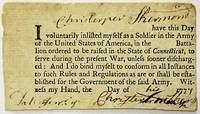
177734560Hartford 1777. Small printed broadside oblong 4" x 2-3/4". "Christopher Sherman" is inserted in manuscript as the name of the volunteer. An "X" for "his mark" is in ink at the end over an attempt to sign his name. For the year "177" is in type and the final "7" in manuscript. "Date" at the bottom is in manuscript along with the month probably "janry". Outer margin closely trimmed but text unaffected. Very Good. <br/><br/> An unrecorded form of Revolutionary War enlistment engagement exceedingly interesting for its reference to "the United States of America." Recorded enlistment engagements from this era-- all of them rare-- refer to the "United Colonies of America" "America" the "Colony of Massachusetts" the "Colony of Massachusetts-Bay". We have handled an unrecorded Massachusetts enlistment engagement from this period which refers to the "United States of America." Enlistment engagements from Connecticut referring to the "United States of America" from this era are unrecorded.<br/> The Continental Congress renamed the Nation "United States of America" on September 9 1776 ordering that "In all continental commissions and other instruments where heretofore the words 'United Colonies' have been used the stile be altered for the future to the 'United States'."<br/> Christopher Sherman was a Private under Captain William Richard's Company in the First Regiment of the State of Connecticut commanded by Lieut. Col. Samuel Prentice Esq. in 1777. A manuscript notation on the payroll sheet for the period January to June 1777 states that he deserted on January 10th or 18th. Revolutionary War Rolls 1775-1783; National Archives Microfilm Publication M246 138 rolls; War Department Collection of Revolutionary War Records Record Group 93; National Archives Washington. D.C. accessed at Ancestry website. <br/>Not located on NAIP ESTC OCLC as of November 2020. unknown books
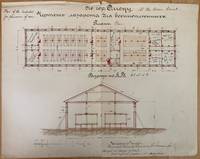
1916List1025Siberia Petrograd et al. 1916. First Edition. Various documents and letters most legal format roughly 200 pages in total with three publications and several newspapers on the subject and thirteen hand drawn architectural plans for a new camp at Omsk measuring between 25 x 17 and 13 x 8 inches. During World War One a staggering number of prisoners - roughly 2.4 of the five million in total who were sent to the Eastern Front - ended up as prisoners of war in Russia. Of that number roughly two million were from Austria-Hungary. Though often neglected by historians due to the attention given to the Russian Civil War and the atrocities of World War Two the subject has drawn increased historical interest with the historian Gerald H. Davis and others calling attention to its importance in the 1980s. Davis and others have written on the relationship between the large prisoner population and the dissolution of their nations as well as the abhorrent conditions many were forced to endure partially due to hierarchical structure of treatment due to differing attitudes by their Russian hosts toward different nations and ethnicities and partially due to the lack of appropriate infrastructure and resources to support such a large prisoner population. <br /> <br /> Offered here are the papers of Herbert H.D. Pierce the Special Aide to Embassador George T. Marye in Petrograd containing a substantial amount of firsthand accounts of prison conditions from the early years of the war as well as a striking series of manuscript architectural plans for a new prison camp that was built in Omsk. Pierce a diplomat who was most famously involved with a case involving seal fishing in the Berings Strait was appointed as a Special Aide out of his retirement and served until his death in 1916. It is possible that he was assigned the task of dealing with the prisoner of war situation as nearly all of his papers that we recovered from his estate from this period deal with the subject. Pierce was involved specifically with the disbursal of relief funds received from the German and Austro-Hungarian governments that were to be disbursed to their citizens. <br /> <br /> The highlight of the collection is a series of hand drawn architectural plans for a series of POW camp structures in Omsk bearing the signature of a N. Alexandrow architect. It is unclear what Pierce's exact relationship was to this project. The plans are translated into English in ink. Of particular interest are the separate officers' barracks plans as one of the violations of POW laws in Russia was the varying levels of treatment given to different prisoners in particular in their recognition of German and Austro-Hungarian ranking officers. There were twenty-eight prison camps in Omsk this one is not identified specifically. The Siberian camps often held up to 35000 prisoners this one shows plans for 10000. There were 128 camps in the Moscow region where camps typically housed 2000-5000 prisoners. The conditions of the camps were generally abysmal with camp capacities routinely exceeded by roughly 50-100%. Frequent disease outbreaks killed thousands of prisoners during the conflict in Omsk Novo-Nikolaevsk Sretensk and Totskoe specifically. <br /> <br /> The group includes letters written to Marye describing conditions in the camps as well as reports of the Americans' own observations in Siberia Moscow and elsewhere. Most are in English though several original documents in German are included. Also included are Pierce's working copies of the Second Hague Convention guidelines of 1907 Order 697 of the War Department that established the regulations regarding prisoners of war in 1914 and a copy of the agreement made between Germany and Russia in August of 1914 which allowed for all women and all men over 45 years and younger than 17 to leave the country unheeded. Some of the letters document violations of this agreement for example a fifty-five year old Austrian man writing to the embassy stating that he had been detained. The authorship of some of the reports is often unclear - one report is credited to "A Russian Lady" another from Krasnaya-Ratchka near Khabaraovsk is an uncredited 18 page description of prisoner conditions. One uncredited report nineteen pages long on the conditions of prisoners in the Moscow Circuit may have been written by Pierce himself and is addressed to Marye. Another 44 page report on Siberian prison conditions is uncredited and likely produced by the embassy itself. A portion - perhaps 25% or so - of the reports are incomplete or unclear in origin though there is much to glean from them regardless. <br /> <br /> Also included are three printed publications. The first is entitled Rapport du Conseiller Prive E.G. Chinkevitch Membre du Comte special de secours aux prisonniers de guerre sur la visite des camps des prissoniers Austro-Hongrois dans l'arrondissement militair d'Omsk printed in 1915. OCLC locates a single copy in France. The report outlines the observed conditions and includes twenty-six photographs of prisoners. The second is a forty-three page report addressed to James Gerard the American ambassador in Berlin by an unidentified author which outlines the prisoner of war conditions in England written in February of 1915. The third is a scarce map of Russian prisoner of war camps printed by L. Friederichsen in Hamburg in 1915 entitled Karte vom Europäischen und Asiatischen Russland mit Angabe der hauptsächlichsten Orte in denen sich Kriegsgefangene und zurückgehaltene Zivilpersonen befinden sowie mit Bestimmungen über den Postverkehr nach diesen Orten. The map shows locations of prison camps throughout the Russian Empire and also shows the mail routes. It is in fine condition overall and we locate six copies in OCLC. <br /> <br /> Overall a scarce survival of primary source material on a somewhat overlooked but important period in Russian history with relevance to diplomatic historians as well worthy of further study. <br /> <br /> Works cited: <br /> <br /> Grekov N. V.: Germanskie i avstriiskie plennye v Sibiri 1914-1917 German and Austrian prisoners in Siberia 1914-1917 in: Vibe P. P. ed.: Nemtsy. Rossiia. Sibir' Germans. Russia. Siberia Omsk 1997 p. 159.<br /> <br /> Nachtigal Reinhard: Seuchen unter militärischer Aufsicht in Rußland. Das Lager Tockoe als Beispiel für die Behandlung der Kriegsgefangenen 1915/16 in: Jahrbücher für Geschichte Osteuropas 48/3 2000 pp. 367-368; Brändström Kriegsgefangenen 1922 pp. 41-48.<br /> <br /> Nachtigal Reinhard; Radauer Lena: Prisoners of War Russian Empire. In: 1914-1918 Online. https://encyclopedia.1914-1918-online.net/article/prisoners_of_war_russian_empire Accessed 5/21. unknown books
193164664Washington DC: United States Government Printing Office 1931. Presumed first editions first printings. Hardcover. Good. 898 71 6 p. Includes index. Three parts bound together in one volume. Folding charts. No dust jacket. Ex-library. Signed by previous owner. Cover has some wear and soiling. Usual library markings. Some marks to text/margins noted. The Message from the President of the United States was transmitting a communication from the Secretary of War Chairman of the War Policies Commission Submitting additonal documents in connection with the study may by the Commission as required by provisions of the Public Resolution creating the Commission March 12 1931 72d Congress First Session House Document No. 271. Also includes is 72d Congress FIrst Session House of Representatives Document No. 264 transmitting in accordance with the provisions of Public Resolution No. 98.the final recommencation of the Commission. The Chairman outlined the purpose of the Commission as follows: "To carry out the task assigned by law there must first be assembled and analyzed such data as well set forth clearly the essential needs of the country in a major emergency. Next there must be determined the reasons why in the GOvernment efforts to supply its needs in all past wars opportunity has been presented to some individuals to reap extraordinary financial profit while others have been called upon to bear more than a proprotionate share of the burdens. Based upon these analyses the commission must develop basic methods and policies whereby the economic burdens of war may be made to fall with equal weight on every element of our citizenship. This is a most difficult and intricate problem and a correct solution of it is of tremendous importance. " The Commission recommended constitutional amendments Presidential power to stabilize prices control natural resources commandeer property to procure without competitive bidding between government agencies for industry products and no use of cost plus percentage contracts. United States Government Printing Office hardcover
186523320<p>Brigadier General William Cogswell offers a dramatic farewell message to the troops under his command in the Army of Georgia. A Salem Massachusetts lawyer Cogswell turned his law office into a recruiting station after learning the 6th Massachusetts had been attacked in Baltimore. He was first in last out in his Civil War service: In 24 hours he raised the first full company of the war Company C 2nd Massachusetts Volunteers and his brigade fought in the final battle of the war in Bentonville North Carolina. Despite his relative obscurity Cogswell's eloquence rivals the great farewell messages in military history.</p> <b>WILLIAM COGSWELL. CIVIL WAR.</b>Manuscript Document Signed. General Orders No. 14. Farewell to the Army of Georgia Near Washington D.C. June 9 1865. 1 p. 7¾ x 12 in.<p><b>Complete Transcript</b></p><p><i> Head Quarters 3rd Brigade 3d Div. 20th Army Corps </i></p><p><i> Near Washington D.C. 9th June 1865</i></p><p><i>General Orders</i></p><p><i>No. 14</i></p><p><i>Officers and Enlisted Men of the 3rd Brigade 3rd Division 20th Army Corps Army of Georgia.</i></p><p><i>In a few days your organization will be broken up. Some of you will go to your homes and the civil pursuit of life while others remain for still further duty in the West. </i></p><p><i>Your noble record the history of the deeds of valor you have performed and of the part you have taken in this "War of the great Rebellion" now so gloriously ended have preceded you to your homes while the West knows them already by heart. </i></p><p><i>Although I have been with you but six short months yet by your valor by your patience by your fortitude and by your courtesies I have learned to love and respect you and I shall part with you with sorrow and regret. </i></p><p><i>No part of my military life has been so pleasant as that which links its history with yours. </i></p><p><i>From the earliest of battle fields to the last grand blow at Bentonville N.C. your blood has stained Alas! too many a sod. </i></p><p><i>Quick soldierly in camp patient willing and obedient on the march brave in battle with never an inch of ground lost participating to an unusual extent and with unsurpassed valor in the last battle of the War – March 19 1865 – your record will be remembered wherever the "battles of the Potomac" are known or the "Campaign of Sherman" read. </i></p><p><i>That the pleasures and comforts of home may attend you that go that additional honor and laurels may await you that remain that an Almighty and good God may forever lead you in ways of pleasantness and paths of peace that industry and virtue may crown you with their rewards that all that good brave men deserve may be yours that those who remain may shortly be sent to home and friends and that the blessings of a kind heaven may always be with you wherever you go is the last best wish of your Brigade Commander.</i></p><p><i> Wm Cogswell</i></p><p><i> Bvt. Brig Gen Commanding</i></p><p><b>Historical Background</b></p><p><b>William Cogswell</b> 1838-1895 was the son of the founder of the Massachusetts Republican party. He left Dartmouth College and spent two years on a square-rigger sailing around the world. When he returned he attended Harvard Law School and became a lawyer in Salem Massachusetts. When word reached Salem that the 6th Massachusetts had been attacked in Baltimore on April 19 1861 Cogswell turned his law office into a recruiting station and raised Company C of the 2nd Massachusetts Volunteer Infantry in 24 hours. He went on to become its commander.</p><p>Though the regiment suffered heavy losses Cogswell's company distinguished themselves well at the Battle of Antietam. Cogswell was promoted from company to regimental commander. During the Battle of Chancellorsville Cogswell was seriously wounded which resulted in his missing the Battle of Gettysburg where the 2nd Massachusetts lost another commander resulting in Cogswell's promotion to colonel. Cogswell was brevetted brigadier general on December 15 1864 and took command of the 3rd brigade 3rd division of the 20th Corps a part of the Army of Georgia that participated in Sherman's Savannah Campaign better known as the March to the Sea.</p><p><b>Condition</b></p><p>Very good. Lower half of left margin somewhat tattered affecting only one word go edge wear at upper right half some toning. Superb for display.</p>
186523320<p>Brigadier General William Cogswell offers a dramatic farewell message to the troops under his command in the Army of Georgia. A Salem Massachusetts lawyer Cogswell turned his law office into a recruiting station after learning the 6th Massachusetts had been attacked in Baltimore. He was first in last out in his Civil War service: In 24 hours he raised the first full company of the war Company C 2nd Massachusetts Volunteers and his brigade fought in the final battle of the war in Bentonville North Carolina. Despite his relative obscurity Cogswell's eloquence rivals the great farewell messages in military history.</p> <b>WILLIAM COGSWELL. CIVIL WAR.</b>Manuscript Document Signed. General Orders No. 14. Farewell to the Army of Georgia Near Washington D.C. June 9 1865. 1 p. 7¾ x 12 in.<p><b>Complete Transcript</b></p><p><i> Head Quarters 3rd Brigade 3d Div. 20th Army Corps </i></p><p><i> Near Washington D.C. 9th June 1865</i></p><p><i>General Orders</i></p><p><i>No. 14</i></p><p><i>Officers and Enlisted Men of the 3rd Brigade 3rd Division 20th Army Corps Army of Georgia.</i></p><p><i>In a few days your organization will be broken up. Some of you will go to your homes and the civil pursuit of life while others remain for still further duty in the West. </i></p><p><i>Your noble record the history of the deeds of valor you have performed and of the part you have taken in this "War of the great Rebellion" now so gloriously ended have preceded you to your homes while the West knows them already by heart. </i></p><p><i>Although I have been with you but six short months yet by your valor by your patience by your fortitude and by your courtesies I have learned to love and respect you and I shall part with you with sorrow and regret. </i></p><p><i>No part of my military life has been so pleasant as that which links its history with yours. </i></p><p><i>From the earliest of battle fields to the last grand blow at Bentonville N.C. your blood has stained Alas! too many a sod. </i></p><p><i>Quick soldierly in camp patient willing and obedient on the march brave in battle with never an inch of ground lost participating to an unusual extent and with unsurpassed valor in the last battle of the War – March 19 1865 – your record will be remembered wherever the "battles of the Potomac" are known or the "Campaign of Sherman" read. </i></p><p><i>That the pleasures and comforts of home may attend you that go that additional honor and laurels may await you that remain that an Almighty and good God may forever lead you in ways of pleasantness and paths of peace that industry and virtue may crown you with their rewards that all that good brave men deserve may be yours that those who remain may shortly be sent to home and friends and that the blessings of a kind heaven may always be with you wherever you go is the last best wish of your Brigade Commander.</i></p><p><i> Wm Cogswell</i></p><p><i> Bvt. Brig Gen Commanding</i></p><p><b>Historical Background</b></p><p><b>William Cogswell</b> 1838-1895 was the son of the founder of the Massachusetts Republican party. He left Dartmouth College and spent two years on a square-rigger sailing around the world. When he returned he attended Harvard Law School and became a lawyer in Salem Massachusetts. When word reached Salem that the 6th Massachusetts had been attacked in Baltimore on April 19 1861 Cogswell turned his law office into a recruiting station and raised Company C of the 2nd Massachusetts Volunteer Infantry in 24 hours. He went on to become its commander.</p><p>Though the regiment suffered heavy losses Cogswell's company distinguished themselves well at the Battle of Antietam. Cogswell was promoted from company to regimental commander. During the Battle of Chancellorsville Cogswell was seriously wounded which resulted in his missing the Battle of Gettysburg where the 2nd Massachusetts lost another commander resulting in Cogswell's promotion to colonel. Cogswell was brevetted brigadier general on December 15 1864 and took command of the 3rd brigade 3rd division of the 20th Corps a part of the Army of Georgia that participated in Sherman's Savannah Campaign better known as the March to the Sea.</p><p><b>Condition</b></p><p>Very good. Lower half of left margin somewhat tattered affecting only one word go edge wear at upper right half some toning. Superb for display.</p> books
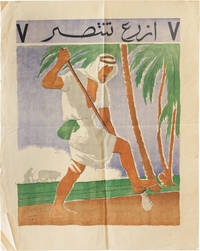
194344248Baghdad: S.i. ca.1943-44. Original illustrated poster offset printed in five colors on beige stock measuring 56.75cm x 72.75cm 22.25" x 28.5". Signed "FAIK H" in plate at lower left corner. Two old folds smoothed out trivial wear to intersection of folds at center with a handful of short marginal tears and attendant creases; unbacked; Very Good. Superb example of this agricultural-themed wartime propaganda poster designed by Iraqi painter Faeq Hassan 1914-1992 widely heralded as "the father of Iraqi modern art." Born poor in Baghdad Hassan showed an early aptitude for art. When he was 12 he visited his uncle a gardener in the royal palace for King Faisal I; when the King saw his drawing of a horse drinking from a river he recognized his talent instantly and offered him a scholarship. Faisal died in 1933 while Hassan was still in high school though his successor King Ghazi carried out his father's will and send him to the École des Beaux-Arts Paris in 1935. After returning from Paris Hassan founded Al-Ruwad The Pioneers Group a group of Iraqi artists who eschewed the traditional studio atmosphere; while engaging with nature and choosing the chronicle the daily realities of Iraqi life through their art the group played a critical role in bridging the gap between heritage and modernity. <br/><br/>Little scholarship exists regarding Hassan's activities or artistic output during World War II though the present example suggests he put his talents to some use creating home front propaganda after the Anglo-Iraqi War. The poster depicts a male laborer in traditional garb digging in a field with a bag of seeds tied at his waist beneath the slogan "If You Plant You Will Win" flanked by twin V's. Despite the traditional Iraqi setting the message is similar in tone to the American propaganda campaign encouraging the populace to plant victory gardens to help the war effort. A notably early work by Hassan and a rare survival with no examples found in the auction record and none found in the holdings of any OCLC member institution. cf."Profile: Faik Hassan." Al Jazeera 30 October 2005. S.i. unknown books
194119803Various Fort Lewis WA and The Pacific Theatre ca. 1941-1944. Four reels of 8mm film stock. Majority color with some black and white. Approximately 800ft. total. Metal reels in two-piece outer cans. Cans with etched titles and dates and mounted labels. Stock clean playback clear. Very good overall. A preliminary digitization of the films is available. <br/><br/>Freshly-discovered 8mm color film footage of World War II service shot by Montana-native Charles W. Hash b. 26 May 1910 d. 26 Feb 1998 of the 41st Infantry Division. Spread across four approximately 200-foot reels of film totaling some 45 mintues the action covers Hash’s stateside training at Fort Lewis and combat duty with the 41st in Australia near Rockhampton Hollandia New Guinea Biak and The Philippines. Highlights include: the immediate aftermath of the Battle of Biak with soldiers walking around the smoldering ruins of bombed villages; ground advancement and rural airstrip scenes of The Philippines with views of period planes nose art and the like; a beach landing and other troop and operations maneuvers; soldiers climbing among the wreckage of several crashed combat planes; intimate and candid footage of fellow soldiers drinking eating cooking bathing and shaving; and extended scenes of Pacific-Island natives. The second of the four reels could be mistaken for more pedestrian tourist scenes of Australia though the remaining three are all of service footage with majority of that in-theater. Throughout Hash displays a strong cinematic eye: filming for example the advance of ships presumably toward action in the Philippines through an unusual vantage point tucked behind a ship’s rope with the sea and ships in a soft focus. He often seems to be constructing scenes and/or directing others to either humorous or in the case of a young Filipino woman alluring effect. And the footage is creatively titled using homemade screens of white pegboard letters laid over a standard G.I. wool blanket to mark dates locations and settings. He was clearly an avid hobbyist with a strong documentarian instinct that belies what must have been his normal day-to-day responsibilities. Hash enlisted in the Army in 1930 served in World War II Korea and Vietnam — earning multiple decorations including the Silver Star for actions in the Papuan Campaign. He was commissioned as a captain during WWII commanding Company H a rifle division of the 163rd Infantry Regiment of the Montana National Guard. He later commanded the entire Army Reserve Forces of Northern California and retired a Colonel in 1965. Despite his clear interest and skill we find no evidence that Hash was officially involved in film at any point in his long and distinguished military career. Therefore the footage here offered represents an unfiltered vernacular look into the daily lives of ordinary combat soldiers. This is especially noteworthy because strict censorship regarding photography was in place during the War. And while many GIs captured snapshots of combat and wartime service only a handful of similar moving picture footage is known. A motion picture camera would have been much more difficult to conceal than a standard film camera though Hash’s advanced rank perhaps made this less of an issue and shooting in color would have been both prohibitively expensive and techincally difficult for most soldiers of the era. Indeed it wasn't until the 1990s when dramatic 16mm European Theatre footage shot by Hollywood director-turned-G.I. George Stevens was discovered that color film of the war by Allied forces was even known to exist this footage was later condensed into a short documentary GEORGE STEVENS: D-DAY TO BERLIN. Since then several troves of official color footage have emerged. The National Archives holds thousands of reels of news and officially captured footage of the War much of it mined for the recent epic documentaries THE SECOND WORLD WAR IN COLOUR 1999 and THE WAR 2007. And in 2016 the Marine Corp unearthed and subsequently donated a large collection of sanctioned color war films to the University of South Carolina for preservation. Nevertheless primary soldier-level film is almost unheard of. Indeed at the time Stevens' was thought to be the only soldier-shot wartime color footage known; and only a handful of later discoveries including a trove of German-shot film seem to have surfaced since. As Stevens' son said in the wake of the discovery of his father's footage: "World War II was a black-and-white war. That's how we see it. That's how we saw it. And suddenly to see it in colour it just took on a whole other dimension." Skillfully and intimately captured Hash's footage vividly documents the ground-level reality of wartime soliders in the tropics. Quite possibly the only entirely amateur WWII color footage by an American soldier extant. Rare important and worthy of preservation prominent institutional placement and further study. unknown books
1619161520Aden: 1916-19. The First World War in south Arabia A fine personal album of unique images of the AFF in the field taken and compiled by Captain A. G. Dyce 1886-1959 deputy assistant director Supply and Transport Corps. It includes photographs of infantry cavalry and artillery units the use of balloons and the signal contribution of ship-launched aircraft under the command of Charles Rumney Samson. On the outbreak of war Ottoman forces advanced into the Western Aden Protectorate from Yemen forcing the British to withdraw from Lahej and part of the Aden settlement. While Turkish encouragement of jihad fell on deaf ears in central Arabia "it found resonance in Yemen. Ali Said Pasha the skilful Turkish commander was so successful in radicalising the tribes for the Ottoman cause that he was able to push British forces into the enclave of Aden. The tactic that defeated Ali Said Pasha was the use of Imam Yahya who argued that Yemen was not for the British or Ottomans but the Arabs. Arab nationalism eroded Said Pasha's influence and saw England supporting a treaty with Imam Yahya as monarch of Yemen which concluded in 1920" Infantry p. 43. Born in India and educated at Wellington College Alan George Dyce 1886-1959 son of Brigadier-General G.H.C. Dyce Indian Staff Corps joined the Indian Army in 1906 serving initially with 22nd Sam Browne's Cavalry. He was a keen photographer appearing in an issue of Amateur Photographer for 1917 and mountaineer being on the committee of the Himalayan Club. Despite being taken in the field while on active service Dyce exhibits a good eye and composes his pictures with care. There are many shots of the combined arms operating with the AFF: No. 13 Kite Balloon Section of the Royal Navy Air Service five images the Mountain Battery of the Malay States Guides lancers of what are presumed to be the 26th King George's Own Light Cavalry and medical facilities including a cavalry field ambulance at Sheikh Othman an advance dressing station a camel ambulance tonga a two-wheel vehicle common in India and camels with cacolets cradle-like structures mounted either side of the camel's hump. One image signed by Dyce in pencil on the verso is captioned: "The GOC Aden F.F. leaving the dais with the Sultan after the installation ceremony" and shows 'Abd al-Karim II ibn al-Fadl al-'Abdali Sultan of Lahej reigned 1915-1947 being handed down from the dais by Brigadier-General William Crawford Walton. There is a sequence of six images covering the "Fight at Jabir" 7 December 1916 described in General Sir Charles Monro's despatch as having had "a demoralising effect on the Turkish Arab auxiliaries and to have produced the intended result viz. preventing the withdrawal towards the Yemen of Turkish troops from Lahej". One panoramic shot shows British officers observing the shelling of Turkish positions and three others the sighting positioning and firing of what appears to be a six-inch naval gun. Three wide-angle shots show the mountain battery and its camel team hauling 15-pounder mountain guns. A trio of crisp sepia-toned prints depict Indian Army troops of the "water column" perhaps the 66th Punjabis who are named elsewhere: "filling water carts with condensed water sent from Aden" "filling canvas tanks" and "water column moving out". Commander Samson 1883-1931 features in one image "Seaplane: Cmdr. Sampson sic" which shows a huddle of figures around the cockpit of what appears to be a Short 184 its wings detached and apparently undergoing repairs. This accompanies "Signalling to plane with lamp and canvas strips" another excellent wide-angle shot taken from a high position that encompasses a rail track steamroller and men laying out a triangular canvas-strip indicator. Most intriguing is a small snapshot of a manned seaplane suspended from a derrick over the side of a ship probably HMS Ben-my-Chree. The pilot may be Samson and the plane a Short 184 that he modified by adjustments to the wings and tail fin and christened the "Short Cut". Captured Turkish prisoners feature in eight images including their commander Said Pasha; two are captioned "Turks marching in to surrender" and "Turks going in by train" while a series of five is titled "Turkish prisoners and guns" including a touching image of two Turkish soldiers under escort their eyes bandaged one holding the other's coat tails. Landscape folio album 240 x 280 mm. 49 ff. some blank. With 92 photographs from 40 x 65 to 170 x 270 mm portrait and landscape format mounted on rectos only on brown leaves including a panorama in two parts joined with tape some images loose one hand-coloured many captioned in pencil on verso or in white on mounts. Commercial Kodak album of black morocco-grain faux leather. Spine ends a little worn many images loose but clean and unfaded: very good. Infantry Volume 97 Number 1 2008. hardcover
1938249421938 Gouache et aquarelle signée en bas à gauche, (1938), 65 x 55 cm. (format à vue), 79 x 69 cm. (format avec le cadre), cadre noir.
1947017554Amsterdam: Uitgeverij Contact 1947 IX 253 pagina's. Eerste druk juni 1947 3 foto's 1x Anne Frank 2 van de Schuilplaats plattegrond van het "Achterhuis" 2 handgeschreven pagina's kopies van het dagboek . Inleiding door Annie Romein-Verschoor. Afmeting 109 x 187 centimeter. Goede staat ondanks de fragiele binding en papierkwaliteit / scheurtje achterzijde rug van 5 centimeter / rug verkleurd. Geen inscripties van de vorige eigenaar geen plakband geen restauraties originele schutpagina's. Scan op verzoek. The true first edition June 1947 of The Diary of a Young Girl a book which continues to hold its place at the top of many literary lists: the most famous diary of modern times the most famous work by a teenager most famous work on the Holocaust most famous 20th Century work by a Jew. Lacks the exceedingly rare dustjacket. 3 photographs 1 Portrait of Anne 2 x photographs of the shelter and a plan of "het achterhuis" and two facsimiles of author's handwriting. This copy is in an good condition inspite the fragile binding and paperquality / small tear of 5 centimeter on the backside of the spine / spine browned. No inscriptions of previous owner no tape no restaurations original endpapers. Size 109 x 187 centimeter.Scans on request. 1ste / 1st. cardboard / karton - hardcover. good / goed/no dust jacket/geen stofomslag. A5 formaat. Uitgeverij Contact hardcover
1784elala979Paris: Ponce & Godefroy c1784. 1784. 4to. 16 engraved plates incl. title. contemporary bds. rebacked in calf. First Edition. An attractive series of sixteen plates and maps of the American Revolution engraved by Nicolas Ponce and François Godefroy after designs by Fauvel Marillier Le Paon and other notable French artists of the period. Recorded here are some of the major events of the War and of the larger global conflict between Great Britain and France including the tarring and feathering of John Malcom at Boston the battle of Lexington the capitulation of Burgoyne at Saratoga the capture of Dominica Senegal Grenada Pensacola and Tobago the surrender of Cornwallis at Yorktown the battle of St. Eustache the siege of Fort S.Philippe and the attack on Brimstomhill. There is also a general map of the United States and a composite map of the Gulf of Mexico Barbary Minorca and Tobago. Below each view forming part of the engraved surface is brief explanatory text by Niquet. The engraved title contains a précis of the War surmounted by five inset views of military and naval engagements while the final plate decorated with four similar insets gives a précis of the Treaty of Versailles in 1783 and a list of the principal officers killed or wounded in the war. Howes describes this as the first French book with a title-page mentioning the United States. Another issue of the book is also recorded with additional title-page Collection d'estampes. and with several of the plates unnumbered. Cohen-De Ricci 862. Howes C-576. Sabin 68421. Winsor VI p. 185. cfJCB II 2997. 1st Edition. Paris: Ponce & Godefroy, [c1784]. unknown
1896RF 818<p><i><b>Collection of 23 original edicts February 1896-September 1898 by the Captain Generals of Cuba 19 by General Valeriano Weyler 4 by General Ramón Blanco the last Spanish Captain General of Cuba. The edicts concern the attempts by the Spanish authorities to control the insurrection. They range from Weyler's efforts to concentrate the population in fortified encampments a measure often considered the precursor of concentration camps to Blanco´s establishing of a ceasefire in 1898.</b></i></p><p>23 ORIGINAL EDICTS; some manuscript annotations and the stamp of the Army of Cuba on some communiqués. The collection includes three items of related ephemera.</p><p>Notable collection of original edicts from Spanish authorities who participated in the Cuban War of Independence and attempted unsuccessfully to end the insurrection. The Cuban War of Independence the War of 1895 is the name given to the final Cuban war against Spanish domination. It is one of the last American wars against the Kingdom of Spain. The war began on 24 February 1895 with a simultaneous insurrection in 35 Cuban localities known as Grito de Oriente formerly known as Grito de Baire and ended in 1898 with the surrender of the Spanish Colonial army to the U.S. military advance with the assistance and support of <i>mambises</i>members of the Independentist Cuban army in the conflict known as the Spanish-American War. </p><p>Details on each of the edicts available on request. G. 11653/ RF 818. X99X001160 </p>
1862WRCAM46982ARichmond: West & Johnston 1862. Lithographed map 25 1/2 x 36 3/4 inches with ornamental border and inset view of Richmond. Sheet trimmed to just outside the ornamental border and mounted on modern linen. Old folds now flattened. Small chip in upper right corner just touching the ornamental border. Separations at a cross-folds with a few instances of small paper loss stabilized by the linen backing. Good plus. This impressive Confederate map of Virginia was originally based on work done by Ludwig von Bucholtz in connection with his updating the famed Herman Boye map of Virginia in 1858. Bucholtz was hired to re-engrave the copperplates for maps of Virginia originally made by Herman Boye in 1826. The ultimate products of his work were the very large maps of Virginia called the Boye-Bucholtz maps. Using knowledge from his work on this project Bucholtz issued his own map in 1858 lithographed and published by Ritchie & Dunnavant in Richmond. This map was vastly superior in detail and accuracy to Bucholtz's revision of the Boye map. <br> <br> In 1862 with Confederate officers in need of good maps of the region Richmond publishers West & Johnson re-issued the Bucholtz-Ludwig 1858 map of Virginia reprinted from the original stone with minor alterations including the removal of the cartographer's name. "There are minor geographic changes from Map 1 the original 1858 Bucholtz map on Map 2 the West & Johnson issue. For example on Map 2 Jerusalem in Southampton Co. has been moved a little to the northwest of its Map 1 location near the Seaboard and Roanoke Railroad and the road between the two points imperfectly erased the remaining shadow is additional evidence that the Map 1 stone was involved. Still for the most part Map 1 and Map 2 are the same map" - Wooldridge "The Bucholtz- Ludwig Map of Virginia and its Successors" in THE PORTOLAN 68 Spring 2007 pp.26-39. A second edition of the West & Johnson issue would be published in 1864. <br> <br> The map shows all of Virginia West Virginia Maryland Delaware and parts of Pennsylvania and New Jersey and includes an inset view of Capitol Square in Richmond. A chart below the view lists all the railroads and the length of each line. <br> <br> "In stark contrast to the large often colored maps pouring out of Northern presses the Confederate imprints are few in number modest in scale and more often than not black and white printed on poor paper. Long before the war was over they weren't being printed at all" - Wooldridge. PARRISH & WILLINGHAM 6204. SWEM 971. Wooldridge "The Bucholtz-Ludwig Map of Virginia and its Successors" in THE PORTOLAN 68 Spring 2007 pp.26-39. STEPHENSON 475.5. WOOLDRIDGE 254. West & Johnston unknown books
19421763761942-43. The Allied triumph in the Western Desert An artfully composed collection centring on preparations for the Second Battle of El Alemein and its aftermath. The photographs document captured and destroyed Axis tanks and artillery the advance eastwards to Tunis and visits by Churchill and senior military figures. 285 Air Reconnaissance Wing was formed in July 1942 to oversee all reconnaissance in the Western Desert. The album opens in September-October 1942 when the Middle East Interpretation unit was operating near RAF Landing Ground 89 an important strip for bombing operations. Images from the battle - abandoned tanks and two eery night-time shots of firing artillery - are followed by evidence of his involvement in mid-November in the recapture of the strategic port of Tobruk which had been surrendered to Rommel in June. Photographs show the advance of British trucks and traces of recent hostilities an abandoned German tank and a destroyed bridge as well as the subsequent Allied push towards Benghazi. Between January and March 1943 he was based out of RAF Castel-Benito photographing the celebratory entrance into Tripoli. Press and snapshot photographs record Churchill's inspection tour at Berg-el-Arab in September 1942 accompanied by air vice-marshals Tedder and Coningham. Others document Coningham's visit to LG 89 on 20 October his address to troops his Fieseler Storch captured from the Germans and a seized Stuka dive bomber. Churchill Montgomery and General Freyberg thank the 8th Army at Castel-Benito in February 1943 General Giraud's visits Monastir in May and Freyberg takes the surrenders of generals Giovanni Messe and Kurt Freiherr von Liebenstein in the same month. Further subjects are a funeral for pilots conducted at LG 89 in August 1942 burial grounds for Axis soldiers "war paint" on American Kitty Hawk fighters and the trailer at Monastir where soldiers developed photographs. Landscape quarto album. With 327 gelatin silver photographs mostly snapshot- to postcard-size c. 50 x 80 mm to 90 x 130 mm a few smaller or larger all mounted on brown card leaves fully captioned in calligraphic hand in white ink or later roller ball pen decoration in colour. Brown card covers tied through holes with light brown cord front cover with manuscript title in yellow and white inks manuscript 8th Army and RAF badges gold highlights. Covers a little worn one photograph now loosely inserted photographs generally bright occasional mirroring: very good indeed. unknown
186713091Rock Island IL: L.M. Haverstick Printer Union Job Rooms 1867. Broadside 24 x 18 inches. Old folds minor creasing a few small chips short closed tear to left edge near the "B" in "Babcock's" faint circular dampstain in center minor scattered foxing. Withal very good condition. A visually appealing and seemingly unique surviving broadside advertising a January 18 1867 lecture by Clara Barton. At the time Barton was touring with her lecture entitled "War & Incidents of Army Life" part of a popular post-Civil War series of talks she delivered across the United States. Barton spent two years touring and recounting her battlefield experiences which helped popularize her and fund her subsequent efforts to locate missing soldiers. The present lecture was delivered at Babcock's Hall in Rock Island Illinois. In addition to the bold title containing the relevant information on the lecture and the information on obtaining tickets at the bottom the middle portion of the broadside prints a quote by noted temperance lecturer John B. Gough praising Barton's lecture: "Miss Clara Barton was at my house and read Her Lecture to us and I must say I never heard anything more touching more thrilling in my life. I want all to hear her." Below this quote is a notice that although Moline and Rock Island are only a few miles apart "An Extra Train" on the famed Rock Island Railroad will be provided to transport attendees of the lecture from Moline for a ten-cent fare. Typographically the broadside is interesting for employing several sizes and types of fonts likely wooden type which provides multiple opportunities for catching the eye of the observer. This includes a rather Gothic-style font when printing the date of the lecture.<br /> <br /> Clara Barton 1821-1912 was a noted educator and humanitarian who helped distribute needed supplies to the Union Army during the Civil War and later founded the American Red Cross. Barton garnered nationwide recognition for her efforts during the war and quickly became known as the "Angel of the Battlefield." After the war Barton's lecture tour brought her in contact with other notables of the day including Susan B. Anthony and Elizabeth Cady Stanton and also Frederick Douglass who involved her in the suffrage and civil rights movements respectively. In the Fall of 1866 Barton began to lecture on her Civil War experiences in lyceum halls churches town halls and schools. Though she never felt comfortable in front of an audience wherever she spoke Barton was well received. Her contemporary biographer Percy Epler wrote that "a tear-stained multitude thronged everywhere to hear her" as she had made it her mission to show not "the glories of conquering armies but the mischief and misery they strew in their tracks; and how while they march on.some one must follow closely in their steps crouching to the earth faces bathed in tears and hands in blood. This is the side which history never shows."<br /> <br /> From 1866 through 1868 Barton delivered over 200 lectures throughout the northeast and midwest regarding her Civil War experiences. She shared platforms with other prominent figures including the aforementioned Douglass as well as Ralph Waldo Emerson William Lloyd Garrison and Mark Twain. She often earned $75 to $100 per lecture. Original broadsides advertising her lectures are exceedingly rare to say the least. We could locate just a single result in auction records of a much smaller example and OCLC reports just one institutional holding of any Barton lecture broadside again much smaller for an 1867 event in New Haven located at the Library of Congress. L.M. Haverstick, Printer, Union Job Rooms unknown