(World War II)Biblio.com
119 846 résultats
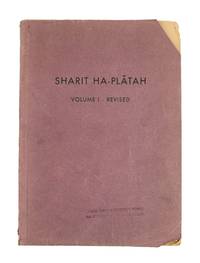
1946365526Munich: Central Committee of Liberated Jews in Bavaria 1946. 4to. Publisher's purple wrappers upper and lower corner of upper wrapper trimmed minor loss to bottom of spine inked stamp of Jewish Family & Children's Services of Pittsburgh on upper wrapper. Text toned and brittle. 4to. A revised and expanded compilation from previously published regional volumes that appeared between May and October 1945 the list includes approximately 85000 names of Holocaust survivors in displaced persons camps. Entries include maiden names where applicable birthplace birth year and then-current location.<br /> <br /> The Hebrew ש×רית הפליטה translates to "surviving remnant" and is a term from the Book of Ezra and 1 Chronicles. Central Committee of Liberated Jews in Bavaria unknown
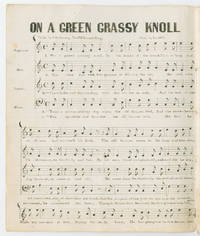
1864248261864. No binding. Condition: Fine. Manuscript Pen and Ink Folk Art Song Book ca. 1864. 24 pp. 6 5/8 x 8 in. This hand-sewn booklet contains eight songs popular during the Civil War era with music and lyrics in calligraphy. Songs include "On a Green Grassy Noll" by J. D. Canning with music by Ira Odell; "The Old Mountain Tree" by James G. Clark; "Harmonian Waltz"; "Year of Jubilee or Kingdom has Come!"; "Squire Jones's Daughter"; "The Sweet Birds Are Singing"; "Lament of the Irish Emigrant"; and "Soon and For Ever" by J. B. Monsell. The last page of the booklet is dated February 21 1864. Partial Transcript: Year of Jubilee or Kingdom has Come! I come up Norf on a little bender Left Missus at home wid no one to tend her Ole Massa's gone I dun-no what to; Sambo pretty sure he don't much care to. Chorus: Den sound de horn beat de drum Sound de horn and beat de drum De year ob jubilee am come Sound de horn and beat de drum De year ob jubilee am come. Met genral Bloaregard on my way here He told me dat I had better stay dere He said up Norf dey would skin and eat me Dat was a yarn dat a little heat me. He said he had just whipp'd Gen-ral Bu-el Grant and Wallace All three in a duel. I axed him den why he was running away Sam-bo says he dat question aint fair play. Oh times down Soth am getting quite rotten He's so berry scarce they have to burn cotton I left dat land ob oppression and gas And roam de free Norf without nary pass. Molasses Junction was a big scarecrow Nigh its wooden guns nobody didn't dare go; But when McClellan got a good ready De Southern Gentry seemed quite unsteady. Abraham Lincoln and Emancipation De two tallest tings in dis tall nation; Hurrah den boys let us still be merry Kingdom has come boys we've good times berry. Historical Background: Music played a prominent role in the American Civil War. On the battlefield and in the camps it boosted morale and released tensions. On the homefront it helped individuals and families express political sentiments grief and longing. Music entertained and often carried political religious and social messages. "The Year of Jubilee or Kingdom has Come!" was written by "Sambo" and first published in 1862 by H. M. Higgins in Chicago. "Squire Jones's Daughter" tells of the virtues of "The prettiest girl in the State of Maine" and was copyrighted by New York publisher Henry De Marsan in 1860. "The Sweet Birds Are Singing" is a cheerful pastoral duet about springtime that dates to at least 1836. "On a Green Grassy Noll" by J. D. Canning was first published in Boston in 1852 and is an elegy for a nameless old farmer who has "ploughed his last furrow." "The Old Mountain Tree" is a ballad in the form of a quartet by James G. Clark first published in 1854. It expresses longing for an old homestead. Clark 1829-1897 enlisted in the 35th New York as a 1st lieutenant and was detailed to remain in the recruiting service. He used music in his efforts to enlist soldiers in the cause and was dubbed "The People's Poet." "Lament of the Irish Emigrant" is a ballad by Helen Blackwood 1807-1867 with music by William R. Dempster 1808-1871 first published in Boston around 1840. It tells the story of an Irish emigrant who has buried his wife Mary and their child. Blackwood Baronness Dufferin and Claneboye was a British songwriter composer poet and author. Dempster a Scottish singer was very popular in the United States. "Soon and For Ever" is a sentimental hymn by J. B. Monsell about the Christian's union with Christ in Heaven. Rev. James Samuel Bewley Monsell 1811-1875 was an Irish Anglican clergyman and poet. He wrote the poem in 1853 or earlier.Condition: Very minor soiling else near fine.<br />
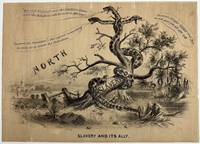
186412816N.p. 1864. Lithograph 14.5 x 20.5 inches. Noticeable toning small areas of light discoloration along top margin short closed tear to left edge minor dust-soiling numerous creases and wrinkles. About very good. A dramatic political cartoon issued during the Civil War and satirizing the dangerous influence of those who argue a compromise on slavery or an easy solution to the war. The work was likely issued in the midst of the 1860 but more likely the 1864 presidential election campaign. The central image of the lithograph involves a three-headed snake -- labeled "The People's Party" and emerging from the American "South" personified by a moss-covered swamp -- which is wrapped around the length of a large tree labeled "Slavery." Each snake vocalizes a different misleading message about the issue of slavery and compromise seemingly aligned with political entities such as the Peace Party and the Copperheads. The messages from each snake head read respectively "Extend Slavery over the Northern States and the Rebellion will be over in 60 days;" "Persevere till after election and then we will give you all you ask;" and "'Support the President' - but oppose everything he may do to crush the Rebellion." This latter message indicates the author of the work supported President Lincoln. The North is personified in the background at left by a depiction of the U.S. Capitol Building. The central image of the lithograph carries echoes of the story of the Book of Genesis with the involvement of a deceptive serpent amid the tree of life.<br /> <br /> The lithograph is signed in the stone at bottom right reading simply "Brooks." Though the work came to us proposing the identify of the artist as Reuben Brooks 1794-1870 we were ultimately unable to confirm this authorship. The lack of an imprint in the lithograph also precludes easy research and identification. In fact the rarity of the lithograph makes it difficult to expound much more about it at all. OCLC reports just a single copy at the Peabody Essex Museum and it is not listed in Weitenkampf or Reilly. Given its rarity and content the present lithograph offers an outstanding opportunity for further research and contextualization. unknown
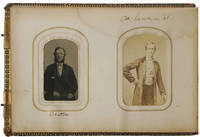
1860CAT0140Massachusetts 1860. 9 x 6 inches. Polished calf decorative covers. Nineteen pages with 55 Carte-de-Visite portraits. Good. A carte-de-visite portrait album kept by Billings during the Civil War. Notation before index reads: "This album was sent me at my order from Philadelphia and was received while our army lay at Brandy Station in the winter of 1863-1864. I think! Many of the pictures I carried with me throughout nearly my whole term of service. This is true of these on the first 17 pages. The others have been inserted since the war." <br /> <br /> A particularly noteworthy artifact. Hardtack and Coffee is one of few books on soldiers' everyday life and this album would have been quite significant for Billings. He discusses photographs twice in the book as being among the dearest objects soldiers kept with them. Per Billings' own note on the endpapers there are seventeen portraits present that he personally kept with him during the first part of the war before adding them to this album in 1863. These include: his parents several cousins and various acquaintances. The remainder of the portraits were added later. Notable subjects include two portraits of Billings himself and two portraits of his future wife Mary Phillips Cotton Whitney. <br /> <br /> Unfortunately portraits of Billings' compatriots are missing. Several portraits of members of the Massachusetts 10th were removed in the 1980s by an unknown person and framed with the subjects' identities and the photos removals noted on the mounts. Several other pages lack portraits though it is unclear whether or not each space in the album was originally filled. The photographs that remain are in very good condition. The album itself is worn with tears and chips to spine and general wear. First leaf repaired with crude tape. Still a significant piece despite the flaws. unknown books
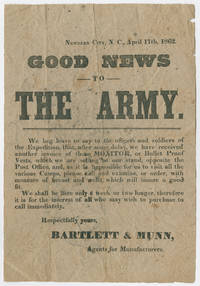
186221777<p>A remarkable broadside advertising the sale of bulletproof vests to Union forces in North Carolina in the wake of the occupation of much of coastal North Carolina by General Ambrose Burnside's Expeditionary Force.</p> <b>CIVIL WAR.</b>Broadside. <i>"Good News to the Army."</i> Bartlett & Munn Agents for Manufacturers. Newbern N.C. April 17 1862. 1 p. 9¾ x 6 ½ in.<p><br /></p><p>"<i>We beg leave to say to the officers and soldiers of the Expedition that after some delay we have received another invoice of those Monitor or Bullet Proof Vests which we are selling at our stand opposite the Post Office and as it is impossible for us to visit all the various Camps please call and examine or order with measure of breast and waist which will insure a good fit. We shall be here only a week or two longer therefore it is for the interest of all who may wish to purchase to call immediately.</i>"</p><p><b>Historical Background</b></p><p>Several firms attempted to sell such bullet proof vests during the war with ads for body armor even appearing in <i>Harper's Weekly</i>. According to historian Byron Farwell "G. & D. Cook & Company of New Haven Connecticut offered to Union soldiers a 'soldier's bullet proof vest' in two models a seven-dollar model for officers and a five-dollar one for enlisted men and for a time early in the war the Atwater Armor Company also in New Haven produced two hundred per day. Although they were nonregulation in both Civil War armies a few volunteer regiments were quipped with them. They proved too heavy to be practical and the increased efficiency of weapons destroyed any value they may have had."</p><p>It is not known which company <i>"Bartlett & Munn"</i> represented. Advertising to Ambrose Burnside's troops who had occupied New Bern N.C. on March 14 1862 they name their vests "Monitors" in obvious reference to the Union ironclad who had stood toe to toe with C.S.S. <i>Virginia</i> in the Battle of Hampton Roads on March 8-9 1862.</p> books
1864248261864. No binding. Condition: Fine. Manuscript Pen and Ink Folk Art Song Book ca. 1864. 24 pp. 6 5/8 x 8 in. This hand-sewn booklet contains eight songs popular during the Civil War era with music and lyrics in calligraphy. Songs include "On a Green Grassy Noll" by J. D. Canning with music by Ira Odell; "The Old Mountain Tree" by James G. Clark; "Harmonian Waltz"; "Year of Jubilee or Kingdom has Come!"; "Squire Jones's Daughter"; "The Sweet Birds Are Singing"; "Lament of the Irish Emigrant"; and "Soon and For Ever" by J. B. Monsell. The last page of the booklet is dated February 21 1864. Partial Transcript: Year of Jubilee or Kingdom has Come! I come up Norf on a little bender Left Missus at home wid no one to tend her Ole Massa's gone I dun-no what to; Sambo pretty sure he don't much care to. Chorus: Den sound de horn beat de drum Sound de horn and beat de drum De year ob jubilee am come Sound de horn and beat de drum De year ob jubilee am come. Met genral Bloaregard on my way here He told me dat I had better stay dere He said up Norf dey would skin and eat me Dat was a yarn dat a little heat me. He said he had just whipp'd Gen-ral Bu-el Grant and Wallace All three in a duel. I axed him den why he was running away Sam-bo says he dat question aint fair play. Oh times down Soth am getting quite rotten He's so berry scarce they have to burn cotton I left dat land ob oppression and gas And roam de free Norf without nary pass. Molasses Junction was a big scarecrow Nigh its wooden guns nobody didn't dare go; But when McClellan got a good ready De Southern Gentry seemed quite unsteady. Abraham Lincoln and Emancipation De two tallest tings in dis tall nation; Hurrah den boys let us still be merry Kingdom has come boys we've good times berry. Historical Background: Music played a prominent role in the American Civil War. On the battlefield and in the camps it boosted morale and released tensions. On the homefront it helped individuals and families express political sentiments grief and longing. Music entertained and often carried political religious and social messages. "The Year of Jubilee or Kingdom has Come!" was written by "Sambo" and first published in 1862 by H. M. Higgins in Chicago. "Squire Jones's Daughter" tells of the virtues of "The prettiest girl in the State of Maine" and was copyrighted by New York publisher Henry De Marsan in 1860. "The Sweet Birds Are Singing" is a cheerful pastoral duet about springtime that dates to at least 1836. "On a Green Grassy Noll" by J. D. Canning was first published in Boston in 1852 and is an elegy for a nameless old farmer who has "ploughed his last furrow." "The Old Mountain Tree" is a ballad in the form of a quartet by James G. Clark first published in 1854. It expresses longing for an old homestead. Clark 1829-1897 enlisted in the 35th New York as a 1st lieutenant and was detailed to remain in the recruiting service. He used music in his efforts to enlist soldiers in the cause and was dubbed "The People's Poet." "Lament of the Irish Emigrant" is a ballad by Helen Blackwood 1807-1867 with music by William R. Dempster 1808-1871 first published in Boston around 1840. It tells the story of an Irish emigrant who has buried his wife Mary and their child. Blackwood Baronness Dufferin and Claneboye was a British songwriter composer poet and author. Dempster a Scottish singer was very popular in the United States. "Soon and For Ever" is a sentimental hymn by J. B. Monsell about the Christian's union with Christ in Heaven. Rev. James Samuel Bewley Monsell 1811-1875 was an Irish Anglican clergyman and poet. He wrote the poem in 1853 or earlier.Condition: Very minor soiling else near fine.<br /> books
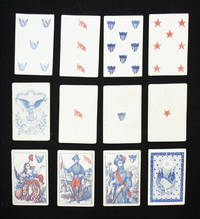
186268782New York: Benjamin W. Hitchcock 1862. CIVIL WAR. New York: Benjamin W. Hitchcock 1862.<br> <br> A complete deck of 52 Civil War playing cards. Each card standard size 3 9/16 x 2 1/2 inches; 91 x 63 mm. The usual suits are replaced with "National Emblems" including blue Federal eagles blue 13-star shields red stars and red American flags. Jacks are replaced by majors Queens by the Goddess of Liberty and Kings are replaced by colonels. The ace of eagles is a large illustration with publisher's imprints as well. Backs of cards are printed in blue with a shield flags a star with the letters "US" an anchor and oak leaves and acorns. Housed together in the original pull-top box. Box embellished on the front with an images of the Goddess of Liberty and the words " National Emblems!! Something New in the Card World! Time for a Change! Foreign Emblems Used Long Enough in the U.S." The back side of the box reads<br> <br> "THE AMERICAN CARD CO. Confident that the introduction of NATIONAL EMBLEMS in place of Foreign in PLAYING CARDS will be hailed with delight by the American People take pleasure in presenting the UNION PLAYING CARDS. As the first and only Genuine American Cards ever produced in the fullest confidence that the time is not far distant when they will be the leading Card in the American market. EXPLANATION. The Union Cards are calculated to play all the Games for which the old style of Playing Cards are used. The suits are EAGLES SHIELDS STARS and FLAGS GODDESS OF LIBERTY in place of Queen COLONEL for King MAJOR for Jack. In playing with these Cards they are to be called by the names the emblems represent and as the Emblems are as familiar as household words everywhere among the American people they can be used as readily the first occasion as Cards bearing Foreign emblems."<br> <br> After this run of cards in 1862 the American Card Company produced another pack of these cards in 1863 but here the backgrounds of the kings and knaves cards had been removed.<br> <br> Cards are in very good to about fine condition with just a mild amount of finger soiling and toning. The 7 of Stars card with a small half-inch closed tear. Box is a bit toned and with some minor chips. With a "2-cent" George Washington stamp affixed to inner lip of the box. Stamp has been canceled with the date "1864." Overall an about fine collection of Civil War playing cards.<br> <br> HBS 68782.<br> <br> $4500. Benjamin W. Hitchcock unknown
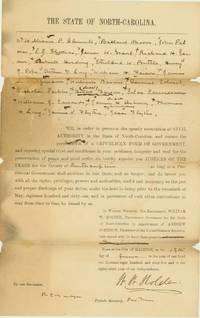
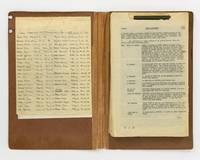
1865218141865. No binding. Fine. Archive of materials relating to the administering of loyalty oaths in North Carolina after the Civil War during presidential Reconstruction. 1865-1866. 21814.01. William H. Bagley Autograph Letter Signed as private secretary of Governor William Holden to William Barrow John Odom and others. Raleigh N.C. July 10 1865 1 p. quarto on State of North Carolina Executive Department lettersheet.Excerpt""Your Memorial . has been received at this office and the Governor directs me to say in reply that the matter therein referred to will be attended to at the earliest possible moment. This however cannot be done until the Enrolling Boards shall have accomplished their work in the different counties in administering the oath of amnesty to the people - separating the loyal from the disloyal. In the meantime the preservations of the Public peace will devolve upon the Justices of the Peace in the several counties who have the right on all occasions to control the Local Police and posses the power to increase the same to such a number as they may deem necessary to meet any emergency which may arise in which they may think is likely to arise .""21814.02 W.W. Holden Printed Letter Signed in Type as Provisional Governor to Col. David A. Barnes with matching cover addressed ""To the Clerk of the County Court of Northampton County Jackson N.C."" Entitled ""Directions for Qualifying Magistrates and Organizing the County Courts."" Raleigh N.C. July 8 1865 1 p. quarto on State of North Carolina Executive Department lettersheet.Excerpt"".If necessary you will call on the officers of the Local Police to notify the Justices to meet at the Courthouse on a day to be appointed by you. And said officers are hereby commanded to aid you in notifying the Justices to attend. When the Justices shall have assembled you will administer to them first the oath of amnesty; secondly the oath to be found in the Revised Code chapter 76 page 434 to maintain the Constitution of the State not inconsistent with the Constitution of the United States; thirdly the oath of office to be found in Revised Code chapter 76 page 441. No Justice or other officer who is included in any of the fourteen excluded classes of the President's amnesty proclamation will be permitted to take the oaths prescribed or enter on the performance of duty until a pardon shall have been received by him from the President. And the oath of amnesty is not to be administered to any one who is not disposed to take it willingly and cheerfully. If any Justice named in the commission hesitates to take the oath it will be your duty to withhold it from him . The Clerk will make a full and complete record on his books of the proceedings of the Justices a copy of which you will at once transmit to this office.""21814.03 W.W. Holden Printed Letter Signed in Type as Provisional Governor. September 15 1865 1 p. quarto on State of North Carolina Executive Department lettersheet.Excerpt""You are hereby directed to retain the Amnesty Oath books until further orders as they will be kept open to allow the people to take said oath up to the time of voting for Governor members of Congress & c.""21814.04 Manuscript Document Oath. Northampton County N.C. August 15 1865. 1 p.21814.05 Printed Document Oath of Allegiance 1865 unissued. 1 p.21814.06 W.W. Holden Partly Printed Document Signed appointing twenty-two men 2 of whom are identified as dead as Justices of the Peace. Raleigh N.C. June 19 1865. 1 p.Excerpt""WE in order to promote the speedy restoration of CIVIL AUTHORITY in the State of North-Carolina and ensure the perpetuation of a REPUBLICAN FORM OF GOVERNMENT and reposing special trust and confidence in your prudence integrity and zeal for the preservation of peace and good order do hereby appoint you JUSTICES OF THE PEACE for the County of Northampton as long as a Provisional Governor shall conti. See website for full description
1865218141865. No binding. Fine. Archive of materials relating to the administering of loyalty oaths in North Carolina after the Civil War during presidential Reconstruction. 1865-1866. 21814.01. William H. Bagley Autograph Letter Signed as private secretary of Governor William Holden to William Barrow John Odom and others. Raleigh N.C. July 10 1865 1 p. quarto on State of North Carolina Executive Department lettersheet.Excerpt""Your Memorial . has been received at this office and the Governor directs me to say in reply that the matter therein referred to will be attended to at the earliest possible moment. This however cannot be done until the Enrolling Boards shall have accomplished their work in the different counties in administering the oath of amnesty to the people - separating the loyal from the disloyal. In the meantime the preservations of the Public peace will devolve upon the Justices of the Peace in the several counties who have the right on all occasions to control the Local Police and posses the power to increase the same to such a number as they may deem necessary to meet any emergency which may arise in which they may think is likely to arise .""21814.02 W.W. Holden Printed Letter Signed in Type as Provisional Governor to Col. David A. Barnes with matching cover addressed ""To the Clerk of the County Court of Northampton County Jackson N.C."" Entitled ""Directions for Qualifying Magistrates and Organizing the County Courts."" Raleigh N.C. July 8 1865 1 p. quarto on State of North Carolina Executive Department lettersheet.Excerpt"".If necessary you will call on the officers of the Local Police to notify the Justices to meet at the Courthouse on a day to be appointed by you. And said officers are hereby commanded to aid you in notifying the Justices to attend. When the Justices shall have assembled you will administer to them first the oath of amnesty; secondly the oath to be found in the Revised Code chapter 76 page 434 to maintain the Constitution of the State not inconsistent with the Constitution of the United States; thirdly the oath of office to be found in Revised Code chapter 76 page 441. No Justice or other officer who is included in any of the fourteen excluded classes of the President's amnesty proclamation will be permitted to take the oaths prescribed or enter on the performance of duty until a pardon shall have been received by him from the President. And the oath of amnesty is not to be administered to any one who is not disposed to take it willingly and cheerfully. If any Justice named in the commission hesitates to take the oath it will be your duty to withhold it from him . The Clerk will make a full and complete record on his books of the proceedings of the Justices a copy of which you will at once transmit to this office.""21814.03 W.W. Holden Printed Letter Signed in Type as Provisional Governor. September 15 1865 1 p. quarto on State of North Carolina Executive Department lettersheet.Excerpt""You are hereby directed to retain the Amnesty Oath books until further orders as they will be kept open to allow the people to take said oath up to the time of voting for Governor members of Congress & c.""21814.04 Manuscript Document Oath. Northampton County N.C. August 15 1865. 1 p.21814.05 Printed Document Oath of Allegiance 1865 unissued. 1 p.21814.06 W.W. Holden Partly Printed Document Signed appointing twenty-two men 2 of whom are identified as dead as Justices of the Peace. Raleigh N.C. June 19 1865. 1 p.Excerpt""WE in order to promote the speedy restoration of CIVIL AUTHORITY in the State of North-Carolina and ensure the perpetuation of a REPUBLICAN FORM OF GOVERNMENT and reposing special trust and confidence in your prudence integrity and zeal for the preservation of peace and good order do hereby appoint you JUSTICES OF THE PEACE for the County of Northampton as long as a Provisional Governor shall conti. See website for full description books
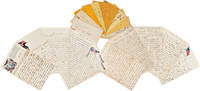
1865WRCAM55678Various locations including Washington D.C.; City Point Va.; Petersburg Va.; Brandy Station Va.; Annapolis Md.; and others 1865. Thirty-two war-date letters totaling approximately 95pp. plus ten retained transmittal covers and assorted post-war family papers. Original folds minor wear creasing and toning. A few letters slightly clipped likely to retain the patriotic letterheads. Overall very good. In mylar sleeves within a modern three-ring binder. An interesting Civil War collection of thirty- two letters spanning the length of the war almost all addressed to Mary H. Winant of Staten Island along with ten original transmittal covers and other documents and family papers. Many of the letters are from Mary's family members serving in the war including her brother James her cousin George F. Rezeau and her uncle James E. Rezeau as well as a few other friends. The letters present the experiences of war from numerous different perspectives showing how the conflict affected extended families and whole communities all of them sent to the same woman back home a beloved sister relative and friend. <br> <br> James Winant writes to his sister on November 10 1861 after his unexpected enlistment. It appears that he had not intended to join the army but was swept up in the fervor after many of the young men from their hometown answered the call. He writes to Mary from Camp Campbell in Washington D.C.: <br> <br> "I was expecting to come down the first of November but Mr. Alfred Dart was getting up a Company of cavalry & quite a number of the Herrick boys put their names to the list & wanted me so I did not mean to back out. I put my name to the list the 15th of October & started for Harrisburg the 23. I had but a little time to get reddy sic to go with that company as I should have come to see.I have been in to the Capital & I saw a site the city is well surrounded by our northern troops we expect to hear of a battle every day on the other side of the Potomac. There was about 20000 soldiers left since Friday." <br> <br> Despite having seemingly joined the Union Army on a whim James Winant took his duty very seriously. Two weeks later James tells his sister in a November 23 letter: "I should like to see you but I do not know when that will be but I shall not leave without orders if I was shure that I would never be found out I never would. I will die in the battlefield before I be a Diserter sic never. I came to Fite sic for my country and I shall if called on and never flinch in that course." However that did not mean that James was thrilled with life in the army. His January 15 1862 letter reads in part: ".I hope you enjoy your new year well although I did not enjoy mine very well for I had to stand on guard and that is the worst part of soldiering we have to be out in all kinds of weather and the weather is very changeable. One day it is almost like summer and the next day it is cold enough to freeze a person.It takes 104 men to guard our camp." Moreover by February 25 James was thoroughly restless and tired of being at Camp Campbell writing: <br> <br> "Our Regiment is No.1 & it is referred for the City Provost Guards. There is two Companys out of our regiment guarding the city now & we expect to go in a week. We expect to get our horses this week. I would rather be in the army acrost sic the Potomac for I am getting tird sic of guarding this old camp. When we get to the city we will have better times. There has been quite a move for the last two weeks. The federal troops has got a strong hold of the rebels & I hope they will keep on crossing it." <br> <br> Interestingly in one of the only letters not addressed to Mary James writes his father with much of the same information he includes in this letter. It reads in part: "Our troops is doing good business in the South they have taken the most important places & a large number of prisoners & they will soon take the rest. I wish our company was in the army acrost the Potomac. I should like to see a fight with the rebels for I am getting tired of guarding this camp." <br> <br> In the only response from Mary retained in the collection she writes back to James trying to offer her brother some comforting words although she was worried about him being sent into battle. In a letter written on April 28 Mary writes to James to beg him to put his faith in God. She included a poem to let him know she was always thinking of him. The letter reads in part: <br> <br> "O James how it cheers my Lonely Heart to hear from you.that you would not be cald sic to the battlefield but since I read your last letter wich sic informs me that you have been ordered to march in pursuit of the Enemy. My hope is well nigh expired though I know Dear Brother that you have Enlysted sic in a noble cause and given your heart and hand to your Country and now there is one step more noble for you to take and that is give your heart and head to God and you will be indeed a brave soldier." <br> <br> Mary also received a couple letters from her cousin George Rezeau in Pennsylvania and a few from her uncle James Rezeau. George does not appear to be serving in the military yet when he first writes to Mary though he would enlist shortly. By November 1862 George writes to check in on Mary from Camp Simmons and Camp McClellan. He signs off the former letter "Your naughty cousin G.F. Rezeau." <br> <br> George's father Uncle James Rezeau is also a Union man. He writes to Mary from Annapolis in August 1862 that he is anxious for his regiment to join the battle and that "if our regiment don't go on soon I will leave it and go into York State and join some other one and go down South for I enlisted to fight for my Country.I want to see the Elephant Old Jeff Davis and feed him some cold lead or else about twelve inches of cold steel." <br> <br> The latest letter in the archive is also from James Rezeau dated March 3 1865 to Mary written from the 67th Regiment Headquarters near Petersburg Virginia. Here a month before the war's end Mary's uncle writes to her check on her as he had heard she was sick. Uncle James also writes about war wages and sending money home to various family members including Mary whom he sends seventy-five cents. He also writes a letter to Mary's parents his own brother- in-law and sister from Brandy Station in early February 1864. He talks about his various health ailments including dysentery and diarrhea "It seems almost as bad as consumption for it reduces a man to almost a Skeleton" how he can't keep down any real food the bitterness of the cold and muddy Virginia winter and how he looks forward to seeing "all of you when this cruel War is over." <br> <br> There are also a handful of letters between family members i.e. a letter to Mary from her mother Eliza and some from friends and other soldiers. One letter dated August 26 1864 is from a friend "M. McPherson" who writes to Mary with news of her wounded cousin George: <br> <br> "G.F. Rezeau started for the Hospital this morning. He was wounded yesterday in a Battle between Shepherds Town and Winchester his wound is through the left hand the ball passed through his hand and spoiled the pocket in his shirt his glasses and his pocket combs beside bruising his side right smart. His wounds were very Lucky ones if there is any such. At the time George was wounded we were just going to charge he went to the Rear the Regt charged and we received a Perfect Shower of Rebel Compliments. There was a whole Brigade of Reb Infantry lying in ambush when we charged upon the Hill. They raised up there position was such they had a cross fire upon us." <br> <br> Included at the end of the archive are a number of documents and forms from after the war and as late as the turn of the century. They appear to be unrelated to Mary Winant although they could have belonged to her family or descendants. There are also ten original transmittal covers addressed to Mary Winant. <br> <br> An informative and research-worthy collection of Civil War and Civil War-era family correspondence. unknown books
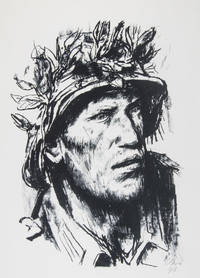
194344673Russland: Frontdruckerei "Panzerfaust 1943. First edition. Loose leaf. g to near fine. 58/100 hand-numbered on title page and signed Joachim Fischer at end of text. All lithographs signed Clevé 43. Elephant Folio 18 x 14". 32 leaves incl. 15 full-page lithographs 17 3/4 x 13 3/4". Original cream portfolio with black lettering on cover protected by modern mylar. Title page with small ochre image of the golden clasp below title and black publisher's device. Additional unsigned lithograph on last printed page below Fischer signature.<br /> <br /> This is an extravagant limited edition produced during the Russia campaign for an elite circle of officers. Laid in a typed letter to Major Zeck site commander at Vitebsk dated November 1 1943 and signed Fischer first lieutenant and company commander "Enclosed a portfolio in the hope you might like it. With obedient recommendations your devoted "Fischer". <br /> <br /> The printed text describes the heroic combat of Staff Sergeant Bergmann from the Tank Division 697. The fighting takes place in the trenches in hand-to-hand combat as well as other combat situations during Bolshevik attacks in 1942 through June of 1943 including an injury of the Staff Sergeant's arm incurred during one of the attacks. At times the enemy seriously outnumbers the German force and the report is highlighting Bergmann's bravery that led to the bestowal of three decorations and eventually the Golden Close Combat Clasp on July 2 1943. The impressive lithographs depict various combat situations.<br /> <br /> Text in German. Portfolio with light wear along edges small chip at bottom of front cover and portfolio flap folds expertly repaired. Lightly sunned along edges. Portfolio in overall good interior in near fine condition. Frontdruckerei "Panzerfaust unknown
19451175131945. WORLD WAR II. Airplane fragment. Japan/Philippines 1945. Painted metal fragment from a World War II Japanese aircraft measuring 3-1/2 by 4-1/4 inches. Housed in a custom chemise and clamshell box. $4500.Original fragment of a Japanese World War II airplane used in the successful kamikaze attack on the USS Salamaua in the Lingayan Gulf on January 13 1945 with its identification scratched into the paint by its owner Lt. Commander Fred R. Salisbury II of the Salamaua.This is a fragment of a Japanese airplane that was flown by a kamikaze pilot into the USS Salamaua on January 13 1945. The ship had participated in the invasion of Lingayen Gulf in the Philippines. It was one of 91 ships damaged or sunk by kamikaze attacks during the war. The aircraft in this case was a Nakajima Ki-84 Hayate single-seat fighter Japan's fastest fighter plane. First produced in the spring of 1942 the Ki-84 did not see major operational use until the Battle of Leyte at the end of 1944. After that point it became a favored airplane and was heavily used.The kamikaze attack carried out by this Ki-84 left a 16-foot by 32-foot hole in the Salamaua's flight deck. It also sparked a number of fires. The plane had carried two 551-pound bombs allowing it to penetrate deeply into the lower decks. One bomb detonated near the tank tops just above the bilge and narrowly missing the bomb stowage compartment. The blast sent debris and fuselage across the flight deck collapsing a number of bulkheads. The second bomb failed to explode and was ejected through the starboard side of the ship at the waterline. The 20-inch hole it left allowed seawater to rush into the ship. As a result the ship lost power communications and steering becoming a sitting duck.While the Salamaua sat immobile two more planes tried to strike it. One crashed into the sea while another detonated in mid-air as it approached. The failure of those pilots meant that the attack killed only 15 of the Salamaua's crew. Another 88 crewmen were injured some seriously.When Rear Admiral Calvin T. Durgin in command of a task force asked for the origin of the smoke he saw coming from the Salamaua he received the reply ""Something just went through our flight deck."" The starboard engine was submerged and the ship listed 8 degrees to starboard. Yet the crew managed to get the ship functional using only the portside engine. Ten long hours after the attack the Salamaua was able to break away to Leyte for repairs. An entire day of pumping failed to alleviate the flooding so the ship merely underwent stabilization repairs before being sent to San Francisco for two rounds of repair. The Salamaua returned to the Philippines in May and eventually was retired from service in 1946 earning the dubious distinction of being the last ship to be successfully attacked by a kamikaze. This fragment belonged to Lt. Commander Fred R. Salisbury II of Minnesota. Salisbury worked in his father's business a furniture manufacturer until the outbreak of World War II Salisbury enlisted in the U.S. Navy in February of 1942 and was assigned to be lieutenant commander of the USS Salamaua a Casablanca-class escort aircraft carrier. Salisbury was released on inactive duty in March 1946 and became vice president of the family business. Salisbury was responsible for etching the inscription""Piece of Jap Kamikazi that hit USS Salamaua of Lingayan Guld Jan 13 1945into the airplane fragment. Accompanied by Salisbury's identification card from the U.S. Naval Reserve dated ""28 NOV. 1945.""A fascinating World War II artifact. unknown
1810PHO-1119Paris, Crapart, 1810. In-8, demi-basane bleu, dos lisse avec titre et date en pied, tranches jaunes (reliure postérieure). 4ff-viii-222pp-2ff
Incisione su rame (2710 x 1110 mm) costituita da 12 fogli uniti al fine di formare un panorama unico. Brunita, restaurata con rimozione di vernice aggiunta nel corso del secolo XIX e rifoderata su tela neutra.
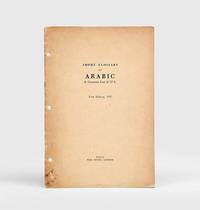
1947184799London: Geographical Section General Staff 1947. Arabic and military cartography Rare first and only edition of this Arabic glossary for use on foreign maps produced by the British War Office. It explains the use of Arabic terms on maps covering territories to the east of the Libyan-Egyptian border and was part of an extensive series published in the 1940s. The spelling and transliteration follow the RGS II System conventions devised by the Royal Geographical Society's Permanent Committee on Geographical Names in 1921 updating those used by the War Office and Admiralty after 1885. The introduction includes a survey of the history of the Arabic language its alphabet pronunciation and dialects in view of instructing soldiers pilots and surveyors on how to read and pronounce names on maps of the Middle East. "An Arabic word may appear on European maps in numerous transliterated forms each depending upon the national authority of the map and the principle of transliteration applied to the names on it" p. 2 due to the "considerable play" between a e and i and other such alternative renditions of specific letters and sounds. The four-column table provides abbreviations transliteration the Arabic-script version and the meaning of Arabic words commonly found on maps. For instance aqra' is rendered as "without vegetation" ashqar as "reddish" ghurd as "sand dune" and zallaq as "slippery place" specifying if a noun is a plural and/or in a different grammatical case. Words originating from other languages Berber Hebrew Greek Latin Turkish and Persian are also identified. Octavo 270 x 185 mm. pp. 28 2. Text in Arabic and English. Original printed brown paper wrappers three punch holes. Wrappers lightly waterstained along lower edge foot of spine rubbed traces of adhesive at foot of front wrapper contents toned but clean: a very good copy. unknown
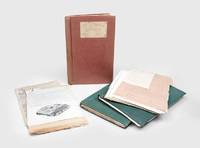
1942176989South-east Asia: 1942-45. The 9-inch gun is believed to have been mounted. in the Japanese Golf Course grounds A far-reaching archive assembled by an artillery officer attached to GHQ India including confidential intelligence and technical summaries and documents as well as material reproduced from War Information Circular issued by Military Intelligence GHQ India and other friendly and enemy sources. Organized into sections the information in these binders is very detailed and concerns the structure of artillery groups tactics and deployment and particular campaigns. For example a section on the attack on Hong Kong notes "The Japs were adept at dragging guns to the tops of hills and siting them in positions very difficult to locate. Ammunition was plentiful and was maintained by forced local Chinese labour. Any coolie failing to work up to Japanese expectations was shot out of hand. The 9-inch gun is believed to have been mounted on a previously and secretly prepared concrete mounting in the Japanese Golf Course grounds or even in the Club House on the mainland" Vol. 1 f. 9. Other material offers technical data and specifications for different guns and shells and included are pages from Periodical Technical Summary a restricted briefing issued by military intelligence in India. Supporting the text are photographs taken from other sources skilled technical drawings of weaponry and diagrams and sketch maps. The collection offers a forensic perspective on the conduct of Japanese artillery offensives in south-east Asia and the channels through which Allied personnel aggregated important strategic and technical information. The compiler may be either Captain J. E. Lee RA GHQ India Counter Battery Pool or Captain David Rogers RA GHQ Counter Battery Team 1 the recipient and addressee of a letter in this collection. Together 3 quarto springback binders and loose material. Original green or brown cloth laid-down title label housing several hundred sheets of bound-in and loose material including notes and documents in typescript letterpress and manuscript sketch maps and diagrams and illustrations. Material actively used and therefore creased marked and annotated a few items split and soiled: a very good working collection. hardcover
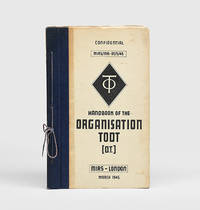
1945184356London: 1945. OT is indispensable in any protracted resistance the Nazis may offer A confidential Anglo-American intelligence report on the Organization Todt produced in the final few months of the war in Europe highlighting its central role in the Nazi war effort and the threat it could pose as a force of last resistance. The Military Intelligence Research Section MIRS was a joint Anglo-American intelligence agency established in 1943 to analyse and exploit captured Axis documents. MIRS produced a series of handbooks on Nazi military and paramilitary organizations for Allied intelligence officers and military officials. This report charts the history of the organization from its founding in 1933 through to the war where it assumed under the control of Albert Speer vast control over engineering and wartime infrastructure. It includes details on the organization's activities uniforms and insignia. There is respect for the organization - "It has carried out in the space of a little over five years the most impressive building programme since Roman times. It has developed methods of standardisation and rationalisation in construction to an extent and on a scale heretofore unattempted". However "OT is indispensable in any protracted resistance the Nazis may offer. Its officials are with few exceptions not only early and ardent Nazis belonging to either the SS or SA but have been leaders of men for many years. Their connections with high officials of the SS and SA are both intimate and of long standing. Above all their standing in the Party combined with their technical qualifications will earn them the confidence of Nazi leaders in any plans for a last-ditch resistance". Provenance: Evgenii Semenovich Mollo 1904-1985 a military historian specializing in uniforms and insignia with his "Mollo Collection" bookplate to the front pastedown. Folio. With 7 plates of which 4 coloured 11 folding plates folding map. Original dark blue quarter cloth cream boards printed in blue string tied. Very minor wear at extremities slight soiling to boards short closed tear to title page contents a little toned. A very good copy. hardcover
121405First Edition. Hardcover. Very Good. Foolscap folio 253 leaves of duplicate typescript printed rectos only containing 118 depositions or interrogation reports of between 1 and 6 pages each with several diagrams some in colour. Post-bound in the original cloth-backed folder now a little creased and worn with three holes punched in the front cover; one leaf detached; a few tears and other signs of age and use; overall in very good condition. These retained duplicate typescripts comprise 51 depositions signed by the deponent interpreter if applicable and Scott as Investigating Officer and 67 interrogation reports signed by Scott alone. The interrogations took place between 13 January 1949 and 27 January 1950 in Tokyo. The investigation focuses on the activities of the Nankai Shitai South Seas Detachment of the Japanese Army and the Kempeitai Military Police in relation to the treatment of prisoners of war and non-combatants in the Madang area of northern New Guinea. <p>Many of the interrogations concern: the capture of VX148 Lieutenant Colonel Arthur Samuel Key commanding officer of 2/14th Australian Infantry Battalion captured near Kokoda in 1942 and presumed dead; the disappearance of missionaries near Alexishafen; the execution and mistreatment of local 'native' people; and the fate of a downed aircrew brought aboard the ship 'Matsue Maru' in the Coral Sea. <p>Several of the depositions give first- or second-hand accounts of the execution of prisoners. One gives an eye-witness account of the massacre of some 300 Australian troops at Laha airfield Ambon with diagrams showing the sites of the executions. Another describes the execution of Australian airmen at Matupi crater near Rabaul also with a diagram. In yet another Colonel Miki professes to be shocked to hear of the maltreatment of prisoners by soldiers under his command: 'I was very surprised to hear about the unhappy event and the circumstances under which an Australian soldier was drowned and the subsequent torture and ill-treatment of witnesses which followed . I never heard any complaints from the prisoners'. <p>Elsewhere there are references to Changi Sandakan prisoners of war sent to Japan Blakang Mati Sentosa and United States Air Force personnel. <p>The files are arranged in reverse chronological order with the most recent at the top and a manuscript index of the files compiled by Scott quarto 3 leaves rectos only is mounted on the inside surface of the front cover. hardcover
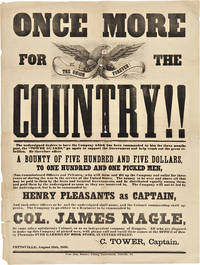
1861WRCAM54027Pottsville Pa 1861. Broadside approximately 24 x 18 inches. Minor separations at crossfolds some edge wear and short closed tears at edges somewhat toned. Good. Framed. A rare Civil War recruitment broadside calling for troops to join the Tower Guards in Pennsylvania during the first year of the conflict. The broadside is illustrated with a large open-winged eagle holding a banner in his beak which reads: "The Union Forever!" The body of the broadside reads in part: <br> <br> "The undersigned desires to have the Company which has been commanded by him for three months past the 'Tower Guards' go again to support the Government and help crush out the great rebellion. He therefore offers A bounty of five hundred and five dollars to one hundred and one picked men." <br> <br> The text explains that the company will be commanded by Henry Pleasants as captain and will be part of a Regiment commanded by Col. James Nagle "Or some other satisfactory Colonel or as an independent company of Rangers." The broadside directs any interested men to call and enroll their names at the Office of Henry Pleasants. Signed in type by "C. Tower Captain." Charlemagne Tower organized a company of Union soldiers from Pottsville in a three-month enlistment during the Civil War. Before the war Tower worked in law specifically moving to Schuylkill County to get involved in claims to large coal and mineral deposits there. Tower was able to build wealth and prominence for himself in the area through his work in land dispute cases most prominently the Munson-Williams case. <br> <br> When the Civil War began at Fort Sumter Tower took notice. Within ten days of that first conflict on April 12 1861 Tower had recruited around 270 men from his county to join the Union Army under a three-month enlistment provision. Tower's unit who became known as the "Tower Guards" entered the Union Army as Company H of the 6th Pennsylvania Regiment part of a brigade commanded by Maj. Gen. Robert Patterson. Tower commissioned captain of his unit provided uniforms and arms for his men at his own expense. The unit saw action most famously in the engagement at Falling Waters in July of 1861 a Union victory in name but with its own failings that led to the defeat at the First Battle of Bull Run. It would seem that Tower's efforts were not exhausted on this first unit because the featured broadside is dated just after his unit mustered out of service and asks for more men to take up the cause and fight for the Union. It would seem that Tower himself funded the bounty offered in the broadside but this is not certain because much less is known about this second attempt to recruit men for the Union Army. <br> <br> After his service in the war Tower was later named U.S. Provost Marshal for Pennsylvania's 10th Congressional District from 1863-64 and continued working at his Pottsville practice until moving to Philadelphia in 1875. A master land negotiator Tower held property in North Dakota and Minnesota that would help develop those states and the United States as a whole. His holdings in North Dakota became Tower City a promising town arranged and planned by George Ellisbury in 1879. Tower's land in the Vermilion Range in Minnesota proved to be rich with iron ore necessitating a mine and a direct railroad line both of which contributed to the local state and inter-state economies. <br> <br> Though Tower died on July 25 1889 his legacy was carried on by the towns across state lines that were named after him his son who became the minister to Austria- Hungary under President William McKinley and the unit of "Tower Guards" who fought for the Union Cause in the Civil War. <br> <br> A visually-striking artifact from the early period of the Civil War with no copies recorded in OCLC. unknown books
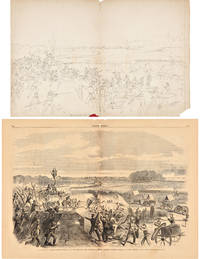
1862WRCAM48438Corinth Ms 1862. Pencil drawing 13 1/2 x 21 inches. Small tears at right and left edges lower right corner torn away. Small red ink stain on lower edge. Central vertical fold. Light soiling and wear. About very good. An original pencil sketch depicting a crucial moment in the Second Battle of Corinth which took place on October 3-4 1862 probably by war correspondent Alexander Simplot. This drawing was engraved for HARPER'S WEEKLY where its caption puts it in context as depicting the battle's key moment. A single three-cannon Union battery led by Lieut. Henry Robinet had been inflicting heavy casualties on the attacking Confederates. Here the Confederates have stormed the battery and are attempting to take it in hand- to-hand combat. The Federals recaptured the battery later that day leading to a Union victory and a Confederate retreat. The engraving from HARPER'S is included which attributes the sketch to Alexander Simplot though the drawing itself is unsigned. Simplot a native of Iowa was a schoolteacher and artist turned war correspondent. Early in 1862 Simplot began traveling with the army of U.S. Grant which in October was stationed in Tennessee near the Mississippi border. unknown books
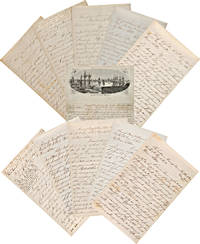
1862WRCAM55290Manchester N.H. Boston Ma. Ship Island off the coast of Mississippi and locations in Louisiana as detailed below 1862. Eleven autograph letters signed ten with envelopes totaling 36pp. Later transcriptions accompany the letters. Old folds occasional light staining and/or tanning one letter with small tears repaired with archival tape. In very good condition. A small but rich collection of early Civil War letters written by Private Aaron A. Smith of Wilton New Hampshire to his sweetheart Adaline "Addie" D. Jones of West Wilton. The letters describe Smith's training at bases in New Hampshire and Massachusetts time spent at Ship Island off the Mississippi Coast and his service in Louisiana as part of the Union occupying force in the summer and fall of 1862. Smith eventually served as a musician with his company giving an interesting perspective on his brief Civil War service. The letters continue until Smith's death in Louisiana from typhoid fever just over a year into his service. Letters from the western theater of the Civil War especially at such an early point in Union advances are uncommon. <br> <br> Smith's letters are especially informative of the conditions at Ship Island describing the poor health conditions there and the Confederate prisoners and escaped slaves he encountered. He also gives valuable information on Louisiana and New Orleans just after the Union retook the region describing the ongoing resistance efforts of Confederate soldiers and civilians. Smith also transmits his love for his hometown sweetheart and his hopes that they will meet again. <br> <br> Aaron Smith 1837-1862 enlisted on October 28 1861 and mustered into Company "B" of the 8th New Hampshire Volunteer Infantry under Col. Hawkes Fearing Jr. The 8th left Camp Currier Manchester N.H. on January 24 1862 en route for Fort Independence in Boston where they trained and drilled until transport south was available. They departed Boston for Ship Island Mississippi on February 15 aboard the E. WILDER FARLEY and finally arrived on March 15. Smith served the entirety of his comparatively brief enlistment in the Department of the Gulf as part of Gen. Benjamin Butler's Expedition. In his letters Smith details his transport to Ship Island and the conditions there and then gives descriptions of New Orleans. Smith remained at Camp Parapet just upriver from New Orleans through September before joining Gen. Godfrey Weitzel's brigade and participating in the Battle at Georgia Landing Labadieville an engagement he describes briefly in his final letter of December 10. Aaron Smith then fell seriously ill and succumbed to typhoid fever on December 22 1862 according to the REGISTERS OF DEATHS OF VOLUNTEERS. The letters are described individually below: <br> <br> Camp Currier: January 22 1862. 2pp. With envelope. Smith writes just days before he leaves for Boston. His tone is light and focuses on the personalities in his and Addie's choir in Wilton. In fact Smith writes that he's just received her letter as "Sargent sic Marshall Abiel Livermore and myself were spending the evening in singing." Smith also asks about which regiment a friend of theirs has joined in hopes that he can locate him later. <br> <br> Fort Independence: February 10 1862. 2pp. Smith is now in Boston waiting to for the ship south and his thoughts have turned more serious. He writes that he hopes his and Addie's feelings for each other will not dim since "when we shall meet again I cannot tell as separations must occur on Earth I must reconcile myself to it." He then veers into a religious vein: "The hand of God can protect us from all harm and guide us safe through many dangers I wish I had more faith in Him and more love for Him. Addie it is my deep desire and has often been my prayer that you may seek and find if not the love of God and I hope live a more consistent christian life than I have." Nevertheless no one seems to know or will tell where they are headed: "where we shall go to I think that no officer under Gen. Butler knows those that put confidence in reports believe we shall go to Ship Isl. but I do not put so much confidence in them as I did by doing so have been obliged to contradict a part of some of my letters." Smith mentions the wreck of a troop ship and marvels that more lives were not lost. Towards the end of the letter perhaps to lighten the tone upon closing Smith seems to allude to a joke between him and Addie and his mother that he was married before he was not: "I am some forgetful perhaps I never was married if I have been and you should see her his mother tell her to be of good cheer.I must close now. I send a kiss for you.As we all are past furloughs I think I shall not try to go home again to see my wife." <br> <br> On Board E. WILDER FARLEY: February 16 1862. 2pp. With envelope. This is a brief letter letting Addie know that they are almost underway to Ship Island: "We are in the greatest state of confusion possible. I am now down on the second deck trying to write a few letters or what I shall have to pass as such. There are scarcely five rays of light that can get to my paper can find a better place in our cellar or in the barn than this to write in." Still Smith is optimistic about this war: "I hope and expect not to stop more than a year as the prospects are that the war will not last long and if spared think will be back within that time." <br> <br> Ship Island: April 22 1862. 4pp. With envelope and three small seashells. Smith has arrived at Ship Island and paints a vivid picture of the pestilent sand the soldiers in camp and the various inhabitants including Confederate prisoners of war: "Our Sothern sic prisoners run about at their leisure appear to enjoy themselves very well.the ladies frequently take their work and sit out on the shady side of a building and talk with the men. Some appear to be quite friendly to the union a lady told a man in our squad.that there are one half in N. Orleans that are union people if they dare to be." But then he heard from a girl who "said she wished she could put out the eyes of the northerners with those guns with bayonets she thought the northerners were not any better than the n__s." Nevertheless illness is already a problem: "Two have died in our Reg. since we have been here it is considerable sickly.last Friday I raised some blood from my stomach but the next day I went on duty feeling as well as usual." Smith attributes this to the sand in the food but Ship Island proved to be a very unhealthy place. By the end of the war 153 Confederate prisoners and 232 Union soldiers had died due to contaminated water and related fevers and infections. Smith closes the letter somberly: "I hope and trust we shall be spared to meet again.I think I realise the danger before me hope I shall be prepar sic to meet it." <br> <br> Ship Island: May 8 1862. 4pp. With envelope. "We are here still on this desert." Things are no better on Ship Island. Smith includes some brief accounts of the Union battles in Mobile and Baton Rouge and continues his descriptions of the heat and the sand. The heat has gotten worse: "It is not very healthy from nine to three o'clock.A great many are having very bad eyes caused by the white sand reflecting to the sun's rays.Some have lost their sight and been discharged." He insists his health is fine but notes that he avoids going outdoors whenever possible. Smith also records some fascinating interactions with escaped slaves. He reports that they "frequently come over here and are quite tickled to get here. I heard one say that their masters represent us to be very cruel and tell them we will cut off an arm starve and whip them if we get them.This one said if they should get him they would hang him for the negroes were planning an insurrection and he was at the head. He said he could not get much to eat and the soldiers do not have much either his master he said was in the army and hoped we will kill him." He closes morosely with a count of the graves in the cemetery 79 as of writing ".brothers husbands sons and fathers killed and buried in such hast sic that no one can tell where they lay this is the result of war and still for one side it is just." <br> <br> Camp Parapet: May 24 1862. 4pp. With envelope. Smith is finally on the move detailing his departure from Ship Island as part of the Union occupation of New Orleans. He notes the defenses in particular the "parapet" built up by the Confederates who anticipated the Union invading from the north rather than coming up river from Fort Jackson. He also describes the efforts of locals to destroy military equipment and foodstuffs that would be of value to Yankee invaders. They even attempt to befoul the waterways by dumping sugar and molasses into the river. Smith writes "When they heard we had taken Ft Jackson and only a few gun boats had got up to N. Orleans the soldiers at this place ran in every direction some even over the parapet into the ditch of water some took off their equipments and burnt them then put on citizens clothes to prevent them being caught with soldiers uniform on.The carriages of the guns were burnt by the women the guns spiked the equipments and every thing that the soldiers left that would fall into our hands were burnt and all done by the women." Smith also includes observations on the poverty he has seen: "The destitution of the people white and black in this state and Miss. is not a fable but a reality there are not but a very few that had money enough to live comfortable.I hardly know where to stop there is so much to write about." Smith closes with some notes for his mother and chaste love for Addie. <br> <br> Camp Parapet: July 9 1862. 4pp. With envelope. This letter is less focused on combat and troop movements and is more conversational with casual thoughts about the civilian world and life in camp. Smith writes that the "4th of July was so rainy here that the Reg.'s could not appear in parade at noon and night while the 'Star Spangled Banner' and 'Hail Columbia' was to be played." in which Smith had prepared to perform. Smith is a Musician now so he has been spared the discomfort of guard duty during the heat and the rain though not the boredom of inaction in camp. He reassures Addie about his health reiterating "The blood I spit on the Isl. was caused by the sand that I had eaten and drank. It came from my stomach and was only what I spit out in three or four times. I guess my lungs are well enough now as I have got over the horid colds I caught." Smith mentions election day but does not mention much about politics focusing instead on Addie's "election cake" and how much of it he would eat if he was there. The main problem for Smith in this letter is the numerous untrustworthy peddlers selling junk at exorbitant rates and giving phony currency in change. Perhaps inspired by these experiences Smith also has some strong language about the locals: "The people here are a mixed set from most every nation in the world but those called Creoles are the most numerous ignorant and degraded.The people have not much good principals sic are much inferior to the Northerners in interlectual sic cultivation." <br> <br> Camp Parapet: August 5 1862. 4pp. Folded with envelope. Curiously Smith wrote this letter on stationery featuring an engraved view of the port of New Orleans produced by Louis Schwarz New Orleans publisher and bookseller. Prussian-born Schwarz 1819- 1893 emigrated to New Orleans and by the 1850s had a monopoly on German-language literature. By the time of Smith's letter Schwarz had helped form the mostly-German Hansa Guards Battalion which was absorbed into the 4th Regiment European Brigade of the Louisiana Militia detailed to defend New Orleans. Schwarz was made captain of Co. "B." Upon the Union victory Gen. Butler used the European Brigade briefly as a police force but then dissolved them in May 1862. For some reason in this letter Smith addresses Addie as "Addia" both in the letter and on the envelope. He begins with pleasantries about home but then shifts to discussing the draft apparently in response to Addie: "I do not care if they do have to draft I hope they will and not be so long getting the Reg.'s ready waiting for them to enlist." He continues putting a brave face on things: "I presume there are many young men now in N. Hamp. with long faces fearing they may be drafted. I should like to see them and I guess I would plague them I would laugh at them any way. The worst part is thinking about it soldiers will feel quite at home when they have been in the army six months or a year Smith has been in about ten months. Some get homesick and it wears and worries them most to death some pine away and get discharged on that account but there are not many such." Smith also reports that there have been Confederate guerrilla attacks and that they have located weapons concealed in houses in Carrollton. Units were dispatched from his regiment to assist in securing the area. Once again his role as a Musician proves to be an advantage: ".if I was not a fifer probably I should had to have gone." <br> <br> Camp Parapet: August 15 1862. 2pp. With envelope. This letter is chiefly camp news with Smith in apparently good spirits. Things are quiet however: "We soldiers are getting to be quite lazy. Particularly I am as I am a musician they cannot detail me to do work which is called policing. I have no guard duty to do so I am not up nights and exposed to the rain and heat daytimes. The musicians have to do what the major says but he very seldom has any thing for us to do out of the regular course of duty." Aside from some rambunctious officers the rest of Smith's update is quite peaceful as he and his comrades spend their days catching up on letters to friends and families baking beans and hoping for more music to sing. <br> <br> Camp Parapet: September 8 1862. 4pp. With envelope. Another quiet letter although there are rumblings of potential combat. Even so Smith muses about Addie traveling down to visit him although he's not quite sure how that could be arranged. He returns to the topic of the draft and how those avoiding the draft make it sound worse than it is: "I think folks are apt to be more scart sic than hurt. But this war is an awful occurrence. I sincerely hope it will soon end in order to have it we must have the men. Sisters must be willing to part with their brothers fathers and mothers with their sons and none try to restrain those whose duty it is to go." Smith closes with several unsettling items including news that "there are quite a large force of guerrillas very near us on the south side of the river.A few Regs. have been sent after them. I do not think we shall stop here all winter but by three or four weeks we shall be on the march after the rebels. The government have neglected to furnish the musicians with swords as the 'Army Regulations' require so I bought me a revolver to protect myself by." <br> <br> Thibodaux Camp Stevens La.: December 10 1862. 4pp. With envelope. Smith wrote this letter approximately ten days before he died. He begins by apologizing profusely for the substantial delay since his last letter; it had been over two months. Smith's regiment has relocated to Thibodaux about 70 miles from New Orleans after fighting in the Battle at Georgia Landing. Smith is definitely sick at this point: "The march was very hard for me and camping out I caught a very bad cold. At the time of the battle I was most sick but the excitement kept me along very well." Smith describes how he assisted in the hospital all night attending to Union as well as Confederate soldiers. He is less sanguine about combat now that he has seen it: "War is awful if anyone don't think so let them be in a battle and try it to have shells exploding about you and grape and canister shot and bullets whistleing about your head makes any one feel most indescribable." <br> <br> From Smith's account he seems to have contracted several of the numerous diseases that plagued soldiers on both sides. In fact two out of three deaths during the Civil War were caused by disease. Every soldier had dysentery at some point and many suffered from one or more of any number of other ailments. He writes "I have the fever and ague some so do most all." "Ague" was malaria and afflicted about 20 percent of troops. Smith would have first developed a high fever along with the "shakes" followed by debilitating weakness that would leave him bedridden for days or even weeks. The symptoms would gradually subside and he could return to duty but the fever periodically returned and the process was repeated. Smith writes that he was sick again during their stop in Tigersville and then notes that "There is a good deal of shaking among the soldiers the shakes this season I have been told by the people are very bad among all." He closes the letter hoping "I can write often now.I have several letters to answer perhaps they will think I am very sick or dead. Changes take place in the army so any one cannot be always prompt in writing." A final page of text in a different hand Addie's is added after Smith's letter. The ink is faint and the hand is difficult to read but it is dated December 27 from West Wilton N.H. and starts by explaining that Smith's mother had been by to see how his health was suggesting that his friends and family did not know yet that he had died. <br> <br> A detailed and intimate account from a soldier in the early days of the Civil War with significant content on life at Ship Island and the early days of the Union occupation of Louisiana. Andrea Mehrländer THE GERMANS OF CHARLESTON RICHMOND AND NEW ORLEANS DURING THE CIVIL WAR PERIOD 1850-1870 Berlin/New York: Walter de Gruyter 2011. REGISTERS OF DEATHS OF VOLUNTEERS 1861-1865. RECORDS OF THE ADJUTANT GENERAL'S OFFICE 1780-1917. Record Group 94. ARC ID: 656639. National Archives. Washington D.C. hardcover books
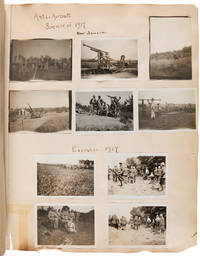
1919WRCAM55818France 1919. Three photograph albums one small framed photograph one small portfolio one book. 1115 photographs most mounted in albums ranging from 1 3/4 x 2 1/2 to 7 1/2 x 5 inches; 162 pieces of ephemera most mounted in albums. Two photograph albums: Folio. Olive green buckram both with burgundy morocco labels on front board and spine with gilt initials "WBO JR" and volume number. Minor wear to extremities some leaves slightly cockled due to photo mounting small chips and closed tears to margins of leaves. Third photograph album: Oblong octavo. Black limp cloth boards with black cord binding. Some wear to extremities some closed tears to leaves a few photographs cut out. Framed photograph: Glass cracked some tarnishing to frame. Portfolio: Tan leather with a snap clasp. Pocket partially torn well worn. Book: Publisher's half red cloth with illustrated paper boards inscription on front free endpaper. Front board and spine starting to detach from text block first few leaves detached but present. The archive in very good condition overall. An engaging and carefully assembled collection of photographs recounting the World War I service of 1st Lt. William B. Olmsted Jr. along with a substantial collection of ephemera and letters described below. The photographs document all aspects of his war service showing the aftermath of important battles American soldiers French soldiers and civilians scenes of the countryside and devastated towns and villages moments of calm and recreation and images in France from the period of the Armistice and in the months after. The ephemera provides a detailed paper record of Olmsted's service in France. <br> <br> William Olmsted Jr. 1893-1948 was born in Southboro Massachusetts. His father the Rev. William B. Olmsted was the Headmaster of Pomfret School in Connecticut. Olmsted was Yale Class of 1915 and also did graduate work at Trinity College. After the war he joined the staff of American Viscose Corporation and was Vice-President in Charge of Sales and a director at the time he died. Olmsted volunteered for the American Field Service formerly the American Ambulance Field Service in France in June 1917 and then enlisted in the American Expeditionary Forces later that year. He attended French Officers' School at Meaux and was commissioned Second Lieutenant in February 1918. Olmsted served in the Réserve Mallet a French army unit made up of American volunteers who transported ammunition and trench equipment and anything else that needed transporting wherever it was most needed. <br> <br> The first olive green album begins with a large page in manuscript recording Olmsted's service in France. The next page has "Volume 1 1917-1919" in manuscript and Olmsted's Registration Certificate i.e. draft card June 1917 affixed below. Photos begin on the following page starting with "Chevigny Farm" in August 1917. Olmsted annotates some photos individually but there are also titles and dates for each section which are grouped geographically but not chronologically. The subjects are wide- ranging - Olmsted's photos feature fellow American and French soldiers including the Army of Africa French civilians scenes of the countryside as well as ruined buildings and landscapes military encampments and cemeteries. There are also photos of airplanes both ready to fly and shot down a gas alarm and a Fourth of July gathering. <br> <br> Many of Olmsted's photos are candid and some can be haunting as well. One set chronicles the devastation following the Battle of Montdidier. Part of the second phase of the larger Battle of Amiens the conclusion of this offensive was later known as "the black day of the German Army" and was a major turning point in the war. Nevertheless hardly a structure is left standing in Olmsted's photos. Happier scenes are featured at La Capelle for the Armistice on November 11 1918 including cars that ferried German delegates there to negotiate the peace. The photos feature German as well as French and American troops. Even after the peace was signed however Olmsted still has much devastation to document. He also includes a series of photos he acquired from German soldiers depicting a funeral for a fallen aviator and German soldiers "at play." At this point Olmsted's combat travels take him to Paris and then this sequence ends. <br> <br> The next series of photos begins with the heading "Trip in Ford. 16 days - Cost of car rent gas oil $137.50." Accompanied by his wife Margaret this is clearly a tourist trip albeit a somber one beginning in Soissons and ending in Argentan. Olmsted includes photos of cathedrals and repairs to cathedrals cafés the American cemetery at Belleau Woods as well as French and German graveyards shots of trenches and forts near Rheims and friends and families he meets along the way. This sequence ends with scenes aboard a ship. <br> <br> The second olive green album "Volume 2 1917-1919" begins with "French Tanks Going into Action." Photos in this album are often annotated but there are fewer locations noted. There are some apparent combat scenes in this album as well as more devastation from shelling and bombing and a short sequence of airplanes including a downed German fighter. A sequence titled "Pictures taken by Capt. F.O. Robinson" finishes the photo section. Robinson's pictures do not vary substantially in form or content but add areas not covered by Olmsted particularly in and around Bazoches. <br> <br> The last two-thirds of this album is titled "Volume 3 1917-1919" and consists of ephemera and letters. It begins with a comic sketch of Olmsted and a cloth insignia of his unit the Réserve Mallet. Then follows all of the official documentation of Olmsted's military service including his commission and promotion and ultimately his discharge papers. Also included are Olmsted's folio sheet-size passport with photograph and a substantial collection of orders leave permissions and other administrative documentation from both French and American forces issued to Olmsted. In the midst of these materials he has mounted his American Field Service Medal and Victory Medal with battle clasps: Somme-Defensive Aisne Montdidier-Noyon Aisne-Marne Somme- Offensive Oise-Aisne Defensive Sector along with an envelope labeled "From Cathedral at Rheims" holding pieces of broken blue glass and a small card wishing him happy new year from the superior and sisters at Crecy-en-Brie. Olmsted also preserved a few watercolors one depicting a soldier possibly Olmsted himself with the sisters at Crecy-en-Brie another of a man in a horse-drawn carriage and a larger one of Olmsted standing next to a monument displaying an American eagle and shield and with a truck in the background. There are several sketches by the same artist included as well. Towards the end Olmsted has mounted his dog tags and two pamphlets about the Réserve Mallet. <br> <br> The smaller black photo album seems to overlap somewhat timewise but features photos primarily in the United States many of which are annotated in white pencil in a hand different from that of Olmsted. It may have been created by his wife Margaret. There are several photos taken in the Bay Area of northern California including the campus of the University of California and Golden Gate Park. Interspersed are photos from an apparent road trip including "Dallas" "New Orleans Docks" "Camp Sheridan" Nebraska and "Montgomery" Alabama. <br> <br> Final material relating to Olmsted's life include a small leather portfolio of clippings of his obituary printed in papers around the country and other ephemera. Among this material is an envelope labeled "Bearers at my funeral." with notes inside from Olmsted on whom he wants to conduct his funeral hymns to be included and so forth; an enveloped labeled "Lily from my Wedding bouquet June 23 1917" and a condolence letter to his widow Margaret. Included loose are a menu from a restaurant in Paris 1917 a portion of a letter on teaching military strategy that begins in code and two documents related to Margaret being named a Chevalier of the Légion d'Honneur by the French government for her work directing overseas activities of the American Aid to France foundation during World War II. Finally there is a well-worn dedication copy of "I WAS THERE": WITH THE YANKS ON THE WESTERN FRONT 1917-1919 by C. Leroy Baldridge New York: G.P. Putnam's Sons 1919 given to the Olmsteds by the commandant of the Réserve Mallet. <br> <br> A truly impressive collection chronicling an American's service in France. hardcover books
186222128<p>Broadside describing the first occupation of Winchester Virginia during the Civil War.</p> <b>CIVIL WAR.</b>Broadside signed in type by Colonel William D. Lewis Winchester Virginia April 17 1862 1 p. 12½ x 11 in.<p><b>Partial Transcript</b></p><p><i>"HEAD QUARTERS </i></p><p><i>Commander of the Post </i></p><p><i>Winchester Va. April 17 1862. </i></p><p><i>CITIZENS OF WINCHESTER: </i></p><p><i>Upon me has devolved the duty of commanding this Post. My wish and my duty is to afford you all the </i>liberty<i> and </i>protection<i> due to </i>fellow citizens<i>. The </i>Government<i> I represent is </i>the same our forefathers established <i>to form a more perfect </i>Union<i>. . . promote the </i>general welfare<i> and secure to </i>us and our posterity<i> the blessing of </i>Liberty<i>. We mean truly to represent its impartial </i>Justice.</p><p><i>But no one can expect the privileges of a </i>citizen<i> and behave as an </i>enemy<i>. No one can expect kindness . . . who does not extend it to others. </i></p><p><i>Citizens are reminded that the troops now stationed here are those of </i>their own Government<i> and are </i>lawfully<i> here on their </i>country's soil<i>. . . they are here for the </i>protection<i>of their fellow citizens and for the prosecution of their Country's Enemies the 'Rebels.' Those persons Male or Female engaged in circulating flying rumors and creating false excitements are particularly warned. </i></p><p><i>Our soldiers are to support the </i>Rights of all<i> and were I to permit flying reports and insulting remarks to be made the means of mischief annoyance and insult to the service or its servants they would provoke retaliations and lead to much useless suffering. </i></p><p><i>I trust Fellow Citizens you will understand and appreciate the justice of these principles and by your conduct obviate the necessity for harsh measures"</i></p><p><b>Historical Background</b></p><p>Colonel William D. Lewis issues a warning to the citizens of Winchester Virginia imploring them to submit to his occupation or face <i>"harsh measures."</i> This was the first official occupation of a town that would change hands nearly seventy times during the war. Union General Nathaniel Banks entered the Shenandoah Valley in March 1862 occupied Winchester on March 12 and defeated the Confederates at the battle of Kernstown on March 23. On May 25 Union forces were defeated by Stonewall Jackson at the first battle of Winchester and forced to withdraw from the town towards Harper's Ferry thus ending the first Federal occupation of Winchester.</p><p><b>Condition</b></p><p>Very good</p>
186222128<p>Broadside describing the first occupation of Winchester Virginia during the Civil War.</p> <b>CIVIL WAR.</b>Broadside signed in type by Colonel William D. Lewis Winchester Virginia April 17 1862 1 p. 12½ x 11 in.<p><b>Partial Transcript</b></p><p><i>"HEAD QUARTERS </i></p><p><i>Commander of the Post </i></p><p><i>Winchester Va. April 17 1862. </i></p><p><i>CITIZENS OF WINCHESTER: </i></p><p><i>Upon me has devolved the duty of commanding this Post. My wish and my duty is to afford you all the </i>liberty<i> and </i>protection<i> due to </i>fellow citizens<i>. The </i>Government<i> I represent is </i>the same our forefathers established <i>to form a more perfect </i>Union<i>. . . promote the </i>general welfare<i> and secure to </i>us and our posterity<i> the blessing of </i>Liberty<i>. We mean truly to represent its impartial </i>Justice.</p><p><i>But no one can expect the privileges of a </i>citizen<i> and behave as an </i>enemy<i>. No one can expect kindness . . . who does not extend it to others. </i></p><p><i>Citizens are reminded that the troops now stationed here are those of </i>their own Government<i> and are </i>lawfully<i> here on their </i>country's soil<i>. . . they are here for the </i>protection<i>of their fellow citizens and for the prosecution of their Country's Enemies the 'Rebels.' Those persons Male or Female engaged in circulating flying rumors and creating false excitements are particularly warned. </i></p><p><i>Our soldiers are to support the </i>Rights of all<i> and were I to permit flying reports and insulting remarks to be made the means of mischief annoyance and insult to the service or its servants they would provoke retaliations and lead to much useless suffering. </i></p><p><i>I trust Fellow Citizens you will understand and appreciate the justice of these principles and by your conduct obviate the necessity for harsh measures"</i></p><p><b>Historical Background</b></p><p>Colonel William D. Lewis issues a warning to the citizens of Winchester Virginia imploring them to submit to his occupation or face <i>"harsh measures."</i> This was the first official occupation of a town that would change hands nearly seventy times during the war. Union General Nathaniel Banks entered the Shenandoah Valley in March 1862 occupied Winchester on March 12 and defeated the Confederates at the battle of Kernstown on March 23. On May 25 Union forces were defeated by Stonewall Jackson at the first battle of Winchester and forced to withdraw from the town towards Harper's Ferry thus ending the first Federal occupation of Winchester.</p><p><b>Condition</b></p><p>Very good</p> books
187344265, , 1873. Cahier petit in-4 manuscrit (20,5 x 17 cm) de (1)-144-(1) pp., titre manuscrit en long « Campagne 1870-1871 (Mémoires) ».