COMMUNIST-NATIONALIST CIVIL WAR IN CHINABiblio.com
119 836 résultats
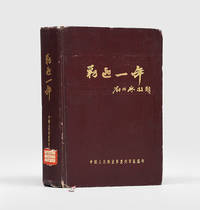
1951173556Guizhou: Junqu zhengzhi bu 1951. Military might. and terror First edition first printing of this internally circulated report on operations undertaken in Guizhou province by the People's Liberation Army. After Chiang Kai-Shek evacuated to Taiwan in early 1949 remnants of his forces in the south-west splintered into different bandit units and mounted a credible threat to the survival of Mao's regime. Of the 1000 copies issued none are located in institutions. In January 1949 Chiang ordered Guizhou's nationalist governor Gu Zhenglun to make the province the final bastion of anti-communist resistance on the mainland. Although Mao proclaimed the founding of a united People's Republic of China in October "the continuing civil war in southwest China pitted ethnic groups local power holders farmers and Nationalist troops against the PLA People's Liberation Army. The occupying army's initial strategy of a rapid military advance leniency and massive grain collection efforts was a recipe for resistance" Brown p. 119. In early 1950 communist cadres and troops withdrew from the majority of the province the party's political control in tatters but a combination of carrot allowing local people to keep more of their agricultural surplus and stick terror eventually brought Guizhou into line. A series of maps demonstrates the oscillating fortunes of anti-communist forces during 1950 Mao's forces being pushed back during the summer months but gaining the decisive upper hand later in the year. Other plans show the grand troop manoeuvres that turned the tide in Beijing's favour. Tables at the end list major battles the names of guerilla organizations and their leaders those leaders killed or captured in the field and those who surrendered. While dated 1950 on the title page the volume was not printed until May 1951. Second and third printings followed in June and July. Octavo. Half-tone portrait photographs of Chairman Mao and Commander-in-Chief Zhu De tipped onto decoratively embossed leaves with tissue guards 5 photographic halftones all with tissue guards showing Liu Bocheng He Long Deng Xiaoping Li Da and Zhang Jichun 15 facsimile calligraphic inscriptions 36 colour maps and battle plans 26 double-page 9 colour bar charts tables in text. Text in Chinese. Original brown cloth spine and front cover lettered in gilt illustrated endpapers green and pink silk bookmarker. Ex-military library with accession stamps on the front free endpaper and title page record card holder on the rear pastedown and "confidential" stamp on the title page; contemporary red pencil marginalia. Extremities rubbed and bumped couple of tips consolidated contents toned as consistent with paper from this period maps plans and graphs well preserved: a very good copy. Jeremy Brown "From Resisting Communists to Resisting America: Civil War and Korean War in Southwest China 1950-51" in Jeremy Brown & Paul G. Pickowicz eds Dilemmas of Victory: The Early Years of the People's Republic of China 2012. hardcover
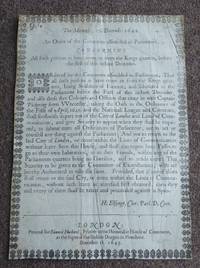
52524<p>London printed for Edward Husband printer to the Honorable House of Commons at the signe of the Golden Dragon in Fleetstreet December 18 1645. BROADSIDE WITH ORNAMENTAL BORDER. Text to recto only 1645 approximately 290 x 205 mm 11½ x 8½ inches 3 small amateur repairs to blank side some folds visible on blank side see attached image old ink hand-numbered "94" to upper lefthand corner zoomable images attached giving the text. Under the text is the printed signature of Henry Elsynge who had spent seven years in foreign travel after which Archbishop William Laud procured him the appointment of Clerk of the House of Commons. His work was significant during the Long Parliament. In December 1648 Elsynge resigned his appointment on a pretext to avoid taking part in the proceedings against Charles I. See: George Thomason Catalogue of the Pamphlets of the Civil War Volume 1 page 410 669.f.9. 48; ESTC R212263 traces 4 copies only world-wide; Wing Short-Title Catalogue 1641-1700 Volume 1 page 555 No. 2643. MORE IMAGES ATTACHED TO THIS LISTING ALL ZOOMABLE FURTHER IMAGES ON REQUEST. POSTAGE AT COST.</p> London, printed for Edward Husband, printer to the Honorable House of Commons, at the signe of the Golden Dragon in Fleetstreet,
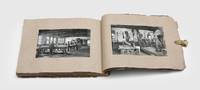
19191881971919. The nuts and bolts of the air war in the desert Superbly detailed visual record of the RAF's central logistical hub for the Middle East theatre serving the region from Egypt to the Hejaz. The depot offered complete servicing from erection out of the crate to scrapping after strike off. Images include personnel groups exteriors and interiors of workshops warehouses hangars and auxiliary buildings: a complete survey of the staffing and facilities of the complex. The prints are of striking quality the images sharply focussed and crisply printed rewarding close examination under a lens with a wealth of detail. Perhaps the most arresting photographically are the shots of the storage spaces unoccupied aisles extending into the distance filled with fastidiously ordered ranks of parts; a touch uncanny but effectively evocative of scale and rigorous organization. Based at RAF Aboukir Abu Qir near Alexandria X AD was the largest such facility in the region part of a complex including an airfield home base for a flight school and several training squadrons - craft where identified Nieuports and SE-5s bear tail numbers assigned to regional trainers - all of which continued in use until the end of WWII. The present copy is uncaptioned but comparison with records of the two copies traced through auction - the only others found - it is possible to identify a number of the images: various groups of personnel HQ staff carpenters fitters stores staff football and gymnastics teams; the headquarters buildings; tool stores; the contents of the parts stores encompassing small fabric pieces aircraft fittings spare wings and planes motor machine-gun engine and balloon spares; the depot's motor transport vehicles mainly Crossley tenders; the base tennis courts; the engine-erecting shop; outdoor engine testing; hangars; the riggers' shop dismantling shop dope shop and salvage hangar. Landscape album 195 x 260 mm containing 66 original official gelatine silver prints including title page 100 x 155 mm some with light sepia toning mounted on 34 leaves of greyish yellow light card. Cord sewn into greyish yellow light card wraps. Covers worn creased and stained with some areas of loss to the extremities; but the contents clean and sound the photographs themselves crisply defined and with great tone; very good. paperback
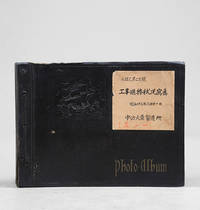
193898082Nanping Manchukuo: Kwantung Army Showa 13 January-October 1938. An historically significant and fascinating album chronicling the progress of the construction of factories at Ningpo near Fuzhou for the manufacture mixing drying and separation of smokeless yellow and brown gunpowder for the Imperial Japanese Kwantung Army during the Second Sino-Japanese War. Following their stunning victory in the Russo-Japanese War Japan obtained control of the Kwantung Leased Area in the Liaodong Peninsula in Manchuria which was occupied by the Kwantung Garrison in 1919 the Kwantung Army. A hotbed of the aggressive expansionist nationalist Imperial Way Faction the Kwantung Army was implicated in a number of attempted coup d'états in Japan and the manipulation of events in Manchuria culminating in the Mukden Incident and invasion of Manchuria in 1931. Presented with a fait accompli on this scale the Japanese Government had little choice but to back up the KA providing reinforcements for the Pacification of Manchuria resulting in the creation of the Japanese province of Manchukuo under the puppet emperor Puyi but in fact ruled over by the local army commander. As over 150000 Japanese settlers surged into Manchuria during the 1930s the Kwantung Army expanded its sphere of operations and by the time of World War II would constitute a force of close to a million and a half men. This remarkable album documents Japanese efforts immensely to increase their munitions production for the Sino-Japanese War 1937-45. The project documented here was a vital part of the second five-year plan drawing on the vast mineral resources of the region. The photographs are without exception clear and sharp evidently the work of a trained photographer who has shot the various buildings from different directions angles and heights - employing the water-tower to offer an over-view - and has carefully docketed captioned and mounted the images in the album in such ways as to produce a comprehensive view of development across the site over time a sort of improvised time-lapse montage. Beginning in February 1938 the photos depict the stages of construction of the bleaching factory the powder pellet factories warehouses military barracks the drying factories fuse construction and storage facilities the mortar shell assembly area as well as the mixing factory with the powder mixing vats. The album follows the progress of the development from the pouring of the foundations through the erection of the scaffolding and the specific construction methods of the full range of brick concrete and timber buildings even down to the creation of the protective earthen berms around the facilities especially the drying factories and storage warehouses. Other parts of the facility shown are the workers' dining hall the silk bag manufacturing plant powder storage areas fire station the power substation hospital and the front gate of the main factory guarded by Japanese soldiers and a military police station. The rapid development of this installation at Ningpo is indicative of the scope of Japan's expansionist ambitions and of the efficiency of her military-industrial complex. The album represents an invaluable historical resource visually compelling heavily documented and comprehensively indexed to this pivotal point in Asian and in world history as this local conflict folded into that which was to envelop the whole globe. Landscape folio 268 x 335 mm. Tipped in at the beginning are 5 leaves of ruled ledger paper with a detailed manuscript index page numbers lettered in red followed by 30 leaves mostly of thick black card stock with a few of lighter black paper interposed with 323 mounted original silver-gelatin photos 115 x 153 mm many mounted on rice-paper hinges as sequential overlays to show the progress of construction work some of these have become detached; almost all have neatly calligraphic captions in Japanese on the page often there are inked annotations and/or date stamps in margins of images themselves or on verso of the hinge-mounted photos; 62 of the photos are mounted side by side or joined together to form double-width panoramic images. Loosely inserted schedule for the Officers for the No. 9 Buntan Division with 18 officers and 23 NCOs overseeing the construction for the Artillery also a small commemorative booklet dated 1931 for Japanese Navy with a few pencil annotations and sketchy diagrams. Contemporary black leather-grain embossed cloth album with cord-tie at spine hand lettered paper title and date label mounted on front cover. Slightly rubbed with some more significant edgewear one leaf neatly cut in half - evidently purposely to use as reference - both parts present and complete a few photos a little dog-eared some detached with occasional minor creasing but remains very good. hardcover
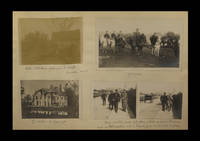
1915273881915. S.l. s.d. 1915. 2 albums au format in-8 oblong 263 x 188 mm rÂŽunissant 345 clichÂŽs originaux. Pleines percalines grÂges fermeture ˆ lacet. Important tout autant qu'ÂŽmouvant tÂŽmoignage photographique rÂŽunissant 345 clichÂŽs originaux en noir et blanc de divers formats 68 x 47 mm ˆ 214 x 163 mm. Tirages argentiques du temps contrecollÂŽs ; lÂŽgendÂŽs ˆ la plume au bas des photos. 13 clichÂŽs volants. L'ensemble donne ˆ voir paysages parfois lunaires scÂnes de ruines portraits de militaires dont Zouaves ainsi que de civils vues d'ensemble ou particuliÂre de villages ÂŽglises ou b‰tisses souvent dÂŽvastÂŽs scÂnes de groupes abris militaires scÂnes prises depuis les tranchÂŽes dont premiÂre ligne de front des gradÂŽs : le GÂŽnÂŽral Joffre le GÂŽnÂŽral Rouquerol le colonel Dechiezelle le Commandant Pruneau le Lieutenant Fournier le Lieutenant Walckemar Raymond PoincarrÂŽ alors PrÂŽsident de la RÂŽpublique Villeneuve Bargemont des engins militaires dont vÂŽhicules blindÂŽs un poste de secours une carriole tractÂŽe par un chien des avions une remise de la Croix de guerre des scÂnes figurant la 1Âre Compagnie du 1er RÂŽgiment de fusillers marins des vues de ports et de littoraux des vues aÂŽriennes un avion accidentÂŽ des piÂces d'artillerie et des munitions une locomotive dans une gare dÂŽvastÂŽe une vue aÂŽrienne d'un bombardement des tombes de soldats des scÂnes de bataille navale un soldat posant le cr‰ne d'un Allemand entre les mains la remise du courrier sur le front l'ÂŽdification d'abris des marins un champ d'aviation un cadavre ''boche'' sic etc. En somme cette exhaustive rÂŽunion offre un ÂŽclairage - unique ! - et trÂs complet sur le quotidien des soldats et les ravages engendrÂŽs par la guerre. En outre : une note manuscrite rÂŽdigÂŽe par un Lieutenant-Colonel contrecollÂŽe avec timbre du ''2Âme RÂŽgiment de zouaves de marches'' et deux tickets de train. Nombre de ces photos - au regard des lÂŽgendes - ont ÂŽtÂŽ prises ˆ Nieuport principalement et YprÂs. Rousseurs affectant les plats. Tirages dans l'ensemble bien prÂŽservÂŽs bien que de rares d'entre-eux prÂŽsentent un ÂŽclat altÂŽrÂŽ. Deux feuillets dÂŽsolidarisÂŽs dont un prÂŽsente un manque angulaire ; sans atteinte ˆ la photo. Blocs feuillets dÂŽsolidarisÂŽs de leur reliure respective. Nonobstant ensemble en belle condition. b42961 unknown
1539006744Lyon Steph Dolet 1539 petit In-folio cuir Bon
1944117208Montrouge Atelier Robert Doisneau 1944 1 vol. en feuilles Tirage argentique d’époque, 24,5 x 17,9 cm, tampon rouge du photographe au verso. Célèbre instantanée de la libération de Paris reproduit p. 41 de l'album "Paris libéré" préfacé par Mauriac (Flammarion, 1944). Titulaire d'une accréditation pour suivre l’insurrection parisienne et l’avancée des troupes alliées, le photographe est au plus près des événements pour en saisir toute la gravité. Epreuve originale, en parfaite condition.
1944117208Montrouge Atelier Robert Doisneau 1944 1 vol. en feuilles Tirage argentique d’époque, 24,5 x 17,9 cm, tampon rouge du photographe au verso. Célèbre instantanée de la libération de Paris reproduit p. 41 de l'album "Paris libéré" préfacé par Mauriac (Flammarion, 1944). Titulaire d'une accréditation pour suivre l’insurrection parisienne et l’avancée des troupes alliées, le photographe est au plus près des événements pour en saisir toute la gravité. Epreuve originale, en parfaite condition.
8vo; 1st edition. Original printed paper wrappers, 4to (large), ca 50 pages per issue. In Yiddish. Title translates as, Existence: A Monthly Journal for Literature, Culture and Societal Problems. Tipped in Woodcut Ex-libris by A. Kolnik on cover of issue of 1949, #2-3; additional tipped in illustration on cover of 1949, # 4. Kiyum was a Yiddish monthly started by survivors in Paris, running 1948-1960; Succeeded by Unzer kiyum. Writing in 1952 about the Jewish periodicals in France over the preceding year, the American Jewish Year Book noted, "Particularly worthy of note was Kiyoum ("Existence"), a Yiddish monthly published by the Federation des Societes Juives de France, under the editorship of Israel Jefroykim. This magazine, which devoted its pages to the problems of continuity and creativity in Jewish life, had become one of the best of the serious magazines in Yiddish." [France," in The American Jewish Year Book, Vol. 52 (1951), p. 283]. SUBJECT(S): Jews -- Periodicals. Yiddish literature -- Juifs -- Pe´riodiques. Litte´rature yiddish. OCLC: 10153490. Some covers, on heavy paper, have become fragile and detached, or show other light edgewear, though most remain quite Good. Text pages are also browning, as expected, but remain generally free of chips and breaks. A very nice set (yid-42-25-L-xcce)
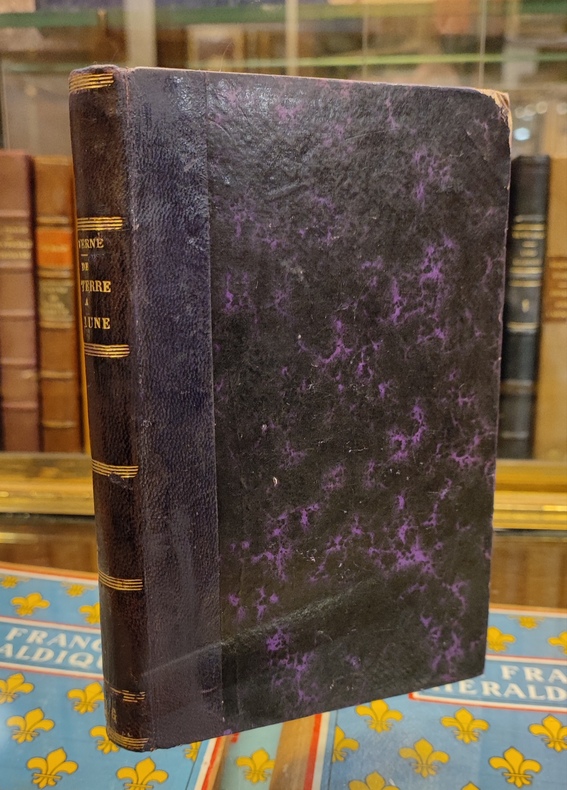
18653468Paris, Bibliothèque d'éducation et de récréation, J. Hetzel in-12 (18,8 cm x 13 cm), 302 pp., feuillet d'errata, titre et 10 pp. "Extrait du catalogue de la Librairie Hetzel". Reliure d'époque demi-veau violet, dos lisse orné d'une septuble rangée de quadruple filets or, avec les initiales E.G. en queue. Edition originale (1865) d'un des premiers romans de Jules Verne. (rousseurs et quelques défauts d'usage, marge plus courte pour trois feuillets). Bottin, p.531.
Paris, Auber, 1806. Prima originale edizione francese con incisioni dai dipinti originali di Carl Vernet. In folio, legatura originale con dorso in pelle marrone a sette nervi, fregi e titolo oro, piatti rivestiti in carta telata azzurra, tagli oro, occhietto, frontespizio, ritratto di Napoleone a cavallo a p. p. (segue il front. e inciso da Simon), pp. X (contenenti l’introduzione a cui fa da testata celebrativa la scena allegorica, finemente incisa, del trionfo di Napoleone Imperatore dei Francesi), pp. 138 (“Tableaux Historiques”), pp. 63 (“Précis Historique de la Campagne d’Allemagne”), testo in lingua francese. Nelle 22 tavole della campagna d’Italia, si illustrano le principali battaglie e gli ingressi trionfali delle truppe francesi. Tra le località rappresentate: Millesimo, Mondovì, il Po’, Lodi, Milano, Pavia, Livorno, Castiglione, Roveredo, San Giorgio, la Corsica, Arcole, Rivoli, la Favorita, il Tagliamento, Venezia, Mantova, Roma, Torino, Napoli, il valico del Monte San Bernardo, Montebello e Casteggio, Marengo; la prima è Millesimo, l’ultima Marengo) + 1 grande carta geografica dell’Italia a doppia pagina (opera del geografo Lorrain, eseguita da Louvet e con legende incise da Dien, e con la quale si conclude il “Tableaux Historiques”); segue il “Prècis Historique de l’expedition d’Égypte” (che contiene 1 tavola con la battaglia di Aboukir in Egitto), segue la “Cérémonies du sacre et du couronnement de sa Majesté Impèr Napolèon Le Grand (una relazione dell’incoronazione di Napoleone imperatore e della sua consorte); segue il “Prècis Historique de la Campagne d’Allemagne (dove la numerazione riparte da 1 fino e si conclude con la pagine 63). Superficiale usura alla legatura, interno marginoso e fresco, alcune pagine più uniformemente ingiallite, marginale foxing alle tavole, assorbito per lo più dalle veline protettive; nell’insieme esemplare in buono lo stato di conservazione.
18652285Petersburg VA: Eden & McCreery 1865. First edition. framed. EXTREMELY RARE FIRST ISSUE OF "GRANT'S PETERSBURG PROGRESS" PRINTED BY UNION SOLDIERS ON A CONFEDERATE PRESS THE DAY PETERSBURG AND RICHMOND WERE SEIZED SIX DAYS BEFORE LEE'S SURRENDER. "When on that famous Monday the third of April 1865 the advance line of attack on Petersburg found the city evacuated by the Confederate troops almost the first Federal soldiers to enter her doors took possession of the office of the Express and before the day was over from its presses there issued number one volume one of Grant's Petersburg Progress. It was a single sheet twelve by twenty inches in size printed on one side of the paper. Its cry was 'We are here!' Major Eden 37th Wisconsin Volunteers was editor assisted by Captain Charles H. McCreery 8th Michigan Veteran Volunteers and Chaplain D. Heagle. They proposed 'to publish a live paper as ling as circumstances will permit; that is as long as we can steal the paper and get men detailed to set the type.' Ten cents was the price. 'We are not particular as to the medium of exchange; and will take Hardtack Greenbacks Cigars postage stamps and in fact most any available currency Confederate Bonds and Contrabands always excepted.'" Nellie P. Dunn "General Lee in Grant's Petersburg Progress" South Atlantic Quarterly vol. 12. This first issue from the day of the fall of Petersburg was followed by only four other issues April 5 7 10. <br /> <br /> The paper is full of joy and wit providing a wonderful window into the mood of the soldiers now that the end of the war was near. <br /> <br /> Some highlights from the text:<br /> <br /> "For nearly six months the army of the United States has kept watch and ward over the City of Petersburg. Since last June the roar of shells and the whistle of bullets have disturbed the silence of the woods in the vicinity and today the old flag waves from the Court House. The United States armies and U.S. Grant have foreclosed and entered in possession and Petersburg is ours. And throughout the length and breadth of the land the joyful tidings will spread that another deadly blow has been struck at the fast dying Southern Confederacy. Slowly and miserably it yet drags on a lingering existence but its days are numbered and the end is at hand. The bright rays of the sun and the pleasant fresh breeze of this fair spring morning kiss the folds of the stars and stripes as it waves from the tower and hill the streets wear a lovely and animated appearance thronged with soldiers and citizens the cause of Liberty and truth is triumphant."<br /> <br /> Under the heading "LATEST NEWS":<br /> <br /> "RICHMOND TAKEN. -Just as we are about going to press we are reliably informed that the city of Richmond came into the possession of the Union forces at a quarter past eight o'clock this morning."<br /> <br /> Under "WE US AND CO":<br /> <br /> "We believe in the UNITED STATES one and indivisible; in Abraham Lincoln our adopted Father; in U.S. GRANT Captain of the Host; and ourselves as the principle sojourners in the Army of the Potomac and the Freedom of the Contraband the speedy extinction of the Rebellion and the perdition of Jeff. Davis here and here after."<br /> <br /> Under "FASHIONABLE ARRIVALS":<br /> <br /> "April 3d Gen. Grant and Staff and the Army of the Potomac generally."<br /> <br /> Under "AUCTION SALES":<br /> <br /> "To be sold very cheap if not badly sold already all the singularly ineligible and worthless property known as THE SOUTHERN CONFEDERACY. For particulars apply to Jefferson Davis Richmond Va. N.B. Liberal terms to agents of Maximillian Louis Napoleon or Victoria."<br /> <br /> Petersburg VA: Eden & McCreery April 3 1865. Broadside printed on recto only approx. 12x19.5 inches. Framed to an overall size of 17x24 inches. Some small holes at folds and edges; a few words of bleed-through from hand-written ink on verso. A wonderfully evocative piece of Civil War history. SCARCE. Eden & McCreery unknown books
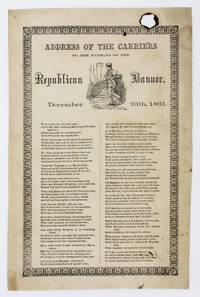
18616140Nashville 1861. Good plus. Small broadside approximately 11 x 7.25 inches. Creased along lower edge; ink burn causing a dime-size paper loss at upper right slightly affecting border plus a few additional stray ink marks. Later faint pencil annotations on blank verso. Moderate tanning and dust soiling. A scarce Confederate carrier's address published on Christmas in Nashville during the first year of the Civil War. The Republican Banner was formed in 1837 from a merger of two other periodicals and was the first permanent daily newspaper to serve the Nashville area as well as the first to operate its presses by steam. Tennessee officially seceded from the Union on June 8 1681 but Nashville surrendered to Gen. Grant's troops on February 23 1862 whereupon the Republican Banner suspended publication for the remainder of the war. As a result the present broadside is only carrier's address issued by the paper that is also a Confederate imprint. The text is printed in two columns with in a decorative border and the title is illustrated with a vignette of a newsboy making a delivery. The verse itself exults in the success of the Confederate rebellion thus far regaling its reader with the progress of secession and naming the recent battles that were Confederate victories including Fort Sumter Bull Run Bethel Lexington Leesburg Springfield Oak Hill and Belmont due to the supposed righteousness of the Southern cause and its superior fighting spirit:<br /> <br /> "'Twas Southern valor won the undying name / Of conqueror o'er the unconquered till that hour. / And when upon Manassas' awful plain / The Federal hordes fled back aghast in woe / Not courage only heaped the field with slain / The majesty of right o'erwhelmed the foe."<br /> <br /> The broadside also mentions somewhat optimistically England’s support of the Confederacy and names specific figures including Generals Lee Beauregard Johnson and President Jefferson Davis among a number of others as emerging Confederate heroes. Parrish & Willingham record a single copy at Vanderbilt and OCLC adds nothing further. A rare example of a Confederate carrier's address. <br /> Parrish & Willingham 6498. unknown
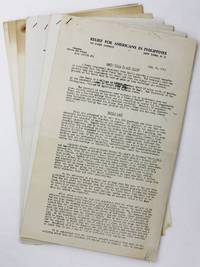
19454668New York 1945. Very good. Sixteen issues totaling 75pp. Legal-size sheets stapled. Previously folded. Light wear and toning. An extensive run of newsletters by a New York-based aid group Relief for Americans in the Philippines. Included here are issues 9 12 14 through 18 and 20 through 28 which were published between 1942 and 1945. The organization was devoted to the support of Americans who were imprisoned at San Tomas Gabuio and other camps after Japan occupied the Philippines during World War II. At the outset of the war the Philippines were a commonwealth of the United States but within three weeks of the attack on Pearl Harbor the Japanese seized control. The 20000 American and 80000 Filipino troops on the ground departed and any remaining American or British citizens were rounded up in Manila and transferred to the University of Santo Tomas where they were left to fend for themselves. The only exceptions were a 7:30 pm roll call each night and the use of room monitors. The background of the captives varied wildly from business executives and retired soldiers to prostitutes. At the end of the war the total number of prisoners liberated was 3785 2870 of which were American.<br />  <br /> Issue 14 remarks on the first anniversary of the non-profit organization: “On May 8th 1942 just a year ago and two days after the fall of Corregidor our organization came into being for furthering plans for the shipment of food medical supplies and other necessities for the internees and also to serve as a clearing house and point of dissemination for information concerning the welfare of these internees.†The monthly newsletter prints news and developments from the camps in the Pacific and documents the efforts of the organization to provide aid to the prisoners there. The issues also print a running list of all those believed to be in the Philippines “solely for the purpose of obtaining names and addresses of the nearest relatives of who we have no record.†A scarce record of this little-known relief effort during World War II. unknown
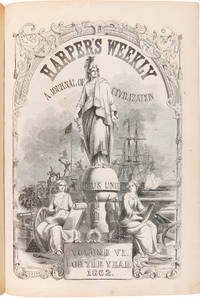
1865WRCAM56383New York 1865. Ten volumes. Volume V No. 210 through Volume IX No. 470. 416; 417-502507-534539- 706711-832; iv230235-416; 417-422427- 438443-832; iv416; 417-502507-832; iv390395-416; 417-848; iv400; iv401- 832pp. Profusely illustrated. Lacks eighteen leaves. Folio. Contemporary three-quarter black morocco and cloth spines gilt. Noticeable wear to spines. Long horizontal closed tear and minor chipping to a few leaves occasional foxing and minor soiling a handful of misbound gatherings and detached leaves. Lacking eighteen leaves and priced accordingly. Overall a fair to good set. The famous Civil War volumes of HARPER'S WEEKLY covering the period from January 5 1861 to December 30 1865 profusely illustrated with engravings after many famous artists of the day most notably Winslow Homer who worked for the magazine in the first years of the war and with a number after photographs by Matthew Brady depicting Civil War scenes important political figures and satirical cartoons. These volumes of HARPER'S WEEKLY. constitute a remarkable illustrated record of the Civil War for the duration of the conflict full of first-hand accounts of battles political news and wonderful engravings and maps some folding nearly all relating to the war. Included is ample reporting of Sherman's march Lincoln's assassination and funeral and all the major battles. "The most popular periodical of its day and valuable for a study of any aspect of the war; the illustrations are unsurpassed" - Nevins. With much on the campaigns in Florida early in the war and so very much more. Though this set is a bit wounded it still holds a wealth of pictorial and textual history on one of the defining events in American history. Also includes a single issue of FRANK LESLIE'S ILLUSTRATED NEWSPAPER November 28 1863 bound into the second volume of HARPER'S WEEKLY for 1863. NEVINS p.15. SERVIES 4601-4615 4696. hardcover books
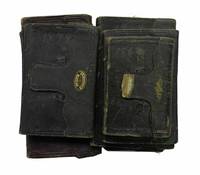
187842992Champion NY 1878. Leather wallet bindings black purple navy and green with gilt or marbled edges year or "Excelsior Diary" in gilt to some wallet flaps. Rubbing and wear to leather of all volumes; cracked hinge or hinges to some volumes; endpaper and one leaf removed from two volumes respectively; occasional light soiling or staining in rare cases minimally affecting readability. Good condition overall. 10 diaries one per year here offered. Smallest volume: ~ 375 unnumbered pages dates printed one entry per page plus front and rear matter. Remaining volumes: ~120 unnumbered pages dates printed 3 entries per page plus a varying number of printed pages at rear for memoranda accounting etc.; ~20 printed pages of yearly calendar tables statistics etc. to beginning of some volumes. Most entries contain writing though occasional blanks; some unused pages of back matter particularly in later diaries. Total manuscript word count conservatively estimated at 55000. Sizes vary. Smallest 4" x 2-3/4"; largest 6-13/16" x 3-1/2". Most ~5" x 3-1/4" <br/><br/>An archive of ten Civil War and Reconstruction era manuscript diaries kept by Myron E. Rose a Democrat from Champion New York whose political views during the war coincided most strongly with those of the Peace Democrats or “Copperheads.” Although Rose never self-identifies as such only as a staunch Democrat he voted for Horatio Seymour in the 1862 election for NY governor makes no secret of his loathing for abolitionists lauds the possibility of Lincoln’s capture by Confederate troops and resents a war fought to “free the n----- — it takes more men than there were negroes what works” July 19 1864. His diaries offer a near-daily if often terse portrayal of the experience of a Northern Democrat during and after the Civil War including not only notes on the progress of the war drafts and draft riots local and national politics and the deaths of friends and fellow townsfolk but also his move to Iowa following the war and efforts to homestead there his life back in Champion after the death of his wife his attendance at Spiritualist meetings and disdain for Adventists readings and his many jobs social life successes and lack thereof with women book purchases accounting and more. The diaries begin in 1859 when Rose was a 25-year-old new schoolteacher still working toward getting his teaching certificate doing a variety of additional odd jobs and seemingly more interested in dating the local women than in national events: “Went home with Cor. Hormer and went in she gave me an introduction to ‘for the cool’ confound her” Oct. 21 1859. He notes the 1860 election the next year — “Election day . . . S. A. Douglas Dem A. Lincoln Rep Bell Union Breakenridge Administration seceders. Morgan Gov Rep Kelly Dem. Quite an exciting day. . . . Lincoln Elected” Nov. 6 - 7 1860 — and mentions that one Mr. Winslow a Democrat was elected School Commissioner suggesting that there was perhaps a small concentration of Democrats in the Champion area. By 1862 the war has started to impact him: “Have been roof-boarding. Some towns will have to draft it is expected. A good many have gone to Canada. The war begins to affect sic us here now” Aug 26 1862. That November Rose notes that there has not been “a great turn out at the polls. Will be a close rub voted for Seymour” Nov 4 1862. The next year he comments: “The war progresses about the same turning out the Generals and putting in new ones &c &c. The rebels will gain their independence I guess and that by d___d Republican mismanagement” Feb 9 1863. Shortly thereafter he learns that his brother Arthur “is proclaimed a deserter”: “Harnessed up my colt single and put him on my cutter drove him down to Tylersville. John went down with me saw quite a number there Arthur also. Willard is dead died in hospital of consumption so his Captain wrote . . . Snows P. M. Arthur feels very bad” March 11 1863. In July 1863 Rose reports on the New York City draft riots : “A great riot in N.Y. City on acct. of drafting no call for men but they are giving orders for drafting by number of men a mean miserable proceeding a good many killed and a good deal of property destroyed” July 18 1863 and the next day that “the draft is postponed for the present. I am most afraid that there will be hard times all over” July 19 1863. Nevertheless he places the cause entirely on the Republican party: “A good deal of excitement in Wtn Washington so Warren says. If there are riots & murder & robbing it is the teachings of the Abolition Republican party for they have trampled the Constitution underfoot in more ways than one” July 21 1863. Rose’s views about the Republicans and “shrieking Abolitionists” never waver though he seems to relish debating politics and feels he’s a good ideological counterbalance. Nevertheless as the following passages indicate he remained strictly antiwar/ anti-Republican: - “News to night Greely & old Lincoln’s sec. have been to see Geo. Sanders & others in Canada all rebels and should go over the falls together.” July 21 1864 - “News that Atlanta is taken. I don’t care how soon they wind up the rebels and then return to something else.” Sept 3 1864 - “Staid to Mr. Knowls’s talked politics. He says that we have a king now and that it is all right — is for it until peace is obtained. He is not fit for a republic.” November 17 1864 In a curious precursor to modern politics Rose even notes that “Ohio Penn & Indiana hold their election today. As they go so goes the election next month” Oct. 11 1864. Rose makes little mention of politics after the war and in 1866 moved with his wife and his brother Arthur and his wife to Iowa where they bought 160 acres of land possibly utilizing provisions of the Homestead Act of 1862 cleared it built a house and farmed for approximately 6 years. Research indicates that Rose’s wife and newborn child died in 1872 and that he moved back to Champion shortly thereafter; aside from 1866 the diaries from these years are absent. Rose seems to have continued teaching school both in Iowa and upon his return to New York and also remarried started a cheesemaking business and attended Spiritualist meetings back in Champion as well. All in all a fascinating glimpse into the life and times of a Northern Democrat during the Civil War. hardcover books
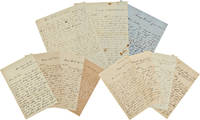
1863WRCAM54557Kentucky; Tennessee; Georgia 1863. Fourteen manuscript letters most on small bifolia two to four pages in length. Previously folded. Light wear at folds. Light tanning; an occasional patch of soiling. Very good. A group of fourteen letters written home by Union Pvt. Henry D. Isbell of the 1st Ohio Light Artillery. The letters addressed to his mother and father as well to his sister and brother-in-law date from just after his enlistment in August 1862 to the eve of the Battle of Chickamauga in September 1863. <br> <br> In August and September 1862 just after Henry Isbell enlisted Battery A of the 1st Ohio Light Artillery was on its way to Louisville Kentucky in pursuit of Confederate General Bragg. Isbell's first letter in this collection is written on September 6 1862 from New Parks Barracks in Louisville to his brother-in-law John Howland. Isbell was very satisfied with his new barracks where he drilled three times per day and averred that his squad "is the best one in the field." Isbell also shared with his brother-in-law the exciting news that Confederate Raider John Hunt Morgan is in the area: <br> <br> "Morgan took a place called Brandon night before last about twenty-five miles south of here on the rail rode so our communications with the boys is cut off for the present.There is a great deal of excitement here Morgan is reported within twenty miles of here and every one thinks he will take the place with in a week. I hope he will. It is full of secesh." <br> <br> After a march to Nashville the 1st Ohio Light Artillery was reviewed by General Rosecrans who Isbell described in a letter of November 15 1862 as "a fine looking man and a fighting one two." Rosecrans and Isbell's 1st LA were just weeks away from a major engagement the Battle of Stones River which was fought December 31 1862 through January 2 1863. It was one of the costliest battles of the Civil War and Isbell experienced fierce fighting. In a letter to his sister from Camp Sill in Murfreesboro on February 15 1863 he described part of the action thus: <br> <br> "Every gun had left the park before we had started our ceysone and then we stopped out in the open field and was going to hitch our horse on but we could not for theywere within six nods of us and we could not hold our horse after my horse was shot I went to the gun but it had gon up for most of the horses was shot and there was no one there but Lieut. C and L. Coe John Whitney and one other canoneer.then I went with Lieut. C. to Dick Rogers brass guns and we went to working it as fast as we could but the horse got shot and the limbe nocked to peaces and we had to leave it." <br> <br> Isbell relocated to Nashville in the summer of 1863 as part of the occupation of middle Tennessee and then moved into Georgia as part of the Chickamauga Campaign. The last letter in this collection was written by Isbell on September 11 1863 to his mother from "Camp between Lookout and Bear Mountain." One week before the Battle of Chickamauga Henry hastily informs her that "We have marched about twenty five miles since I wrote to father and we came twenty of it yesterday the wether is very hot and the dust is about a foot deep. I shall have to write you a short letter this time but I thought you would like to know where we was and that we are all well." <br> <br> A week later during the battle he was mortally wounded and died in another month's time. A small but informative archive of letters from an Ohio artilleryman who saw intense action in the Tennessee campaigns and who was killed after just over one year of service. unknown books
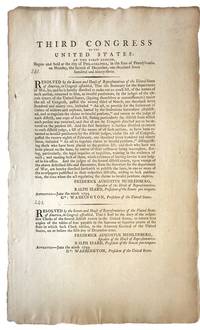
17154United States Congress Third Congress of the United States: At the First Session Begun and held at the city of Philadelphia in the state of Pennsylvania on Monday the second of December one thousand seven hundred and ninety-three. Resolved by the Senate and the House of Representatives. that the Secretary for the Department of War be and he is hereby directed to make out an exact list of the names of each person returned to him . under the Act of Congress. intituled sic "An act to provide for the settlement of claims of widows and orphans. Philadelphia: Printed by Francis Childs and John Swaine 1794. Broadside. Approved June 9th 1794 and signed in type: "Go: Washington President of the United States" "Ralph Izard President of the Senate" and "Frederick Augustus Muhlenberg Speaker the House". One sheet 8" x 13.25" inches. First Edition. Over a quarter of a million Americans served in the Revolutionary War without promise of any benefit after being discharged. General Washington lobbied tirelessly for a pension for military servicemen though it represented an enormous expense to the new nation. The introduction of pensions for disabled veterans and for the widows or children of men killed in combat was an enormous step for the new United States. The statute mandated that the courts determine the monthly payments owed to the veterans based on their degree of disability and states that pension applicants must bring the necessary evidence swear under oath before a judge or other such authorized person and then sent to the Secretary of War who was authorized to reject claims if he suspected "imposition or mistake." In addition to the thousands of soldiers newly eligible two women as well received veteran's pensions for their role in the American Revolution: Margaret Corbin famously called "Molly Pitcher and Deborah Sampson who disguised herself as a man in order to participate in combat. This broadside is very rare-- only two copies of this edition are held at any institutions per OCLC Worldcat. Some toning and wear to edges and small inked consecutive numerals at upper margin of each item likely from a prior collation. In very good condition. unknown books
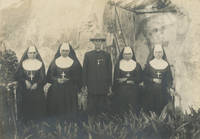
1900List518Most Cuba or Jacksonville 1900. Silver gelatin or albumen photographs various sizes ranging from 3 x 3 to 6 x 8 most captioned to verso. With handwritten manuscript four leaves discussing various diseases. The Spanish-American War was the first war in which nurses formed their own dedicated units as well as the first war in which they were accepted within military hospitals. While no nurses died in battle 153 died during the war from disease. Nurses were responsible for both treating soldiers as well as maintaining sanitary conditions within the camps. Conditions were often poor leading some to work until they were too sick to continue. <br /><br /> The current collection of photographs documents the experiences of a Mrs. Waters who was originally from Groton Massachusetts. The collection begins with a couple early photographs including a portrait as a young woman and a cyanotype of one of Waters' leprosy patients at Johns Hopkins Hospital in Baltimore. The next section shows Waters' training in Jacksonville Florida with either the Fourth or Seventh Army Corps at what was called Camp Cuba Libre both Corps trained there in 1898. The photographs of Jacksonville show life around the military camp and environs with some notable photographs of African-American inhabitants of the region. Three photographs quite notably show the Congregation of American Sisters a small group of American Indian nuns led by Reverend Francis Craft. The photographs taken in Cuba are notable for their portrayal of local life. Several photographs of military installations are taken around the "trocha" or line established by General Valeriana Weyler from Mariel to Majana. Another notable photograph is a cabinet card of a large group of nurses taken by the Havana photographer R. Testar. <br /><br /> The group overall shows very early photographic records of military nurses in training as well as a scarce photographic record from a woman in a combat situation. The photographs are generally well preserved in very good to excellent condition with some light fading. Accompanying the photographs is a four page manuscript essay presumably by Waters discussing leprosy as well as the booklet Spanish Phrase Book for American Soldiers and Sailors published by the National Relief Commission of Philadelphia. <br /><br /> Offered in partnership with Daniel / Oliver Gallery. books
1701AUB-4498A Bruxelles, chez Eugène Henry Frick 1701. 5 volumes reliés, reliures pleine peau d'époque, dos ornés avec titres, petits format, 1428 pages avec planches et notes + avertissement, préface de l'auteur, tables des chapitres et table des matières + 913 pages avec notes et planches + avertissement, approbation, extrait du privilège, lavie de Joseph écrite par lui-même (59 p.), préface de Joseph, tables des chapitres et table des matières. Contient: la réponse de Joseph à ce qu'Appion avait écrit contre son histoire des juifs touchant l'antiquité de leur race. Le martyre des Machabées. La relation faite par Philon de l'ambassade dont il était le chef envoyée par les juifs d'Alexandrie vers l'Empereur Caïus Caligula.
1851STLD0090München, Cotta (1851). Quer-Folio, 1 lithogr. Titel, 24 lithogr. Taf. m. Textblättern, OHLn., stärker berieb., Ecken u. Kanten berieben, vord. Deckel fleckig. Blätter leicht stockfleckig, Textbll. tlw. zerknittert, randrissig u. staubrandig. Die Abbildungen zeigen Szenen aus dem italienischen Aufstand gegen die Habsburger: Reitergefechte, Straßenkämpfe, Belagerungen in norditalienischen Städten. Lipperheide Qc 20.
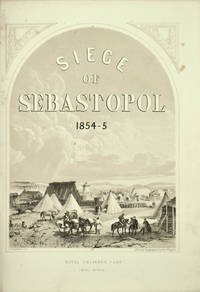
81134George Edward Eyre and William Spottiswoode for the Queen's Stationery Office London 1859. . Three parts in 4 volumes 4to 29.5 x 23.5 cm including a slipcase. Folding lithograph frontispiece by J. Ferguson after Cowell Biddulph and a photograph by Robertson lithographic title by Ferguson after Elphinstone title vi 299 1 pp. 6 lithographed tables by H. James and 6 numbered plates on 5 folding sheets of stronger paper; repeated lithographic title title table of contents 638 pp. 1 l.; vii including title 273 pp. 1 l.; atlas of 16 plates on 12 folding sheets of stronger paper one on thiner -- in all 22 plates plates lithographed by H. James under the direction of Cameron numbered I-XX with XVIa and including a rarer 'Sheet III' on thiner paper some with outline hand-colour; light spotting to text maps with occasional soiling some folds with short tears. Contemporary red cloth covers with blind-stamped panel decoration flat spines lettered in gilt; spines rubbed and faded with shelfmark labels to foot slipcase strengthened.<br /> First edition of this large work: a very good copy complete with the 3 volumes of text and all maps plans and views of Sevastopol - despite the slipcase label showing a somewhat inattentive collation by the H.M. Stationery Office stating "Note.-This Volume is incomplete no perfect copies are available for issue."<br />Sir Elphinstone 1829-90 was born in Livonia now Latvia and was awarded the Victoria Cross in June 1855 for fearless conduct during the Crimean War. At the final assault on Sebastopol on 8 September he was wounded by a splinter on the left side of the head and lost an eye. He later became major-general.<br /> George Edward Eyre and William Spottiswoode for the Queen's Stationery Office, London, 1859. hardcover
1884173626Shanghai: Printed at the "Celestial Empire" office 1884. China is like a large pie. For many years covetous nations have been nibbling at the edge of the crust First edition of this eyewitness account of clashes between French and Chinese naval forces following the collapse of the Li-Fournier Agreement. Two tables show detail each side's ships and their specifications as well as the damage they sustained. The Tonkin War developed out of a tussle between France and China for influence in Vietnam. Following a number of engagements diplomatic exchanges between Li Hongzhang and Captain Ernest François Fournier produced a tentative agreement that China would withdraw from Tonkin and legally recognize a French protectorate. Negotiations however eventually broke down and the French launched an attack on Fuzhou on 23 August 1884. Foreign military observers including the two American authors of this report saw the engagement as a chance to evaluate the success of recent Chinese attempts to modernize the imperial navy. For the Qing empire the Battle of Fuzhou was a disaster the French fleet eight ships outgunning its eleven vessels all of which were eventually sunk. The defeat "paved the way for the dynasty's downfall" Po p. 206. The eight plates are after sketches made during the battle and show several Chinese ships before and after they were sunk. The final sketch is of a dog which drowned while trying to escape from the Yangwoo the Chinese flagship. Octavo. With 8 plates tables in text. Original light orange wrappers front cover lettered in black within ornamental black frame. Wrappers only lightly creased and marked contents sometime neatly consolidated into covers with adhesive text and plates clean: a near-fine copy. Cordier 2500. Ronald C. Po The Blue Frontier: Maritime Vision and Power in the Qing Empire 2018. unknown
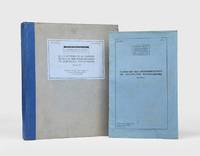
1918166765France: General Staff Intelligence General Headquarters. February 1918. Towards "total knowledge of the battlefield and total control" An impressive exposition of the rarified level reached by fixed-wing aerial reconnaissance and photo interpretation by the last year of the war. Third edition considerably expanded of the slight and fragile text pamphlet first published 1916 paired unusually with the impressive plate volume - both are decidedly uncommon. These were produced in France by Army Printing & Stationery Services and classified "For Official Use Only"; despite a stated print run of 4000 few copies of the pamphlet have survived. The first item contains concise but detailed notes on how to identify various battlefield structures and features - trenches and wire dugouts and mine shafts listening and observation posts batteries concrete structures and so forth - followed by a section on rear organizations - railways dumps billets and aerodromes - noting that from the "enemy's means of supply" and the study of aerial photographs more generally "often his intentions may be deduced". The pamphlet concludes with a brief section of technical notes on the uses of different types of photographs oblique stereoscopic stereoscopic oblique and how these may variously offer enhanced potential for interpreting detail. The substantial atlas contains an exceptionally fine range of high quality photos illustrative of the points made in the accompanying notes. Many of the views are accompanied by maps or sketches to clarify interpretation with locations often identified. Just ten years after the Wright Brothers' epoch-making 12-second flight at Kitty Hawk the aeroplane had become a gun platform duelling in the air and the instrument of accurate distant bombardment; and perhaps most influentially the ultimate mode of reconnaissance profoundly altering the nature of engagement. "At the outbreak of the First World War commanders like British Field-Marshal John French believed that no mechanical platform would ever replace cavalry as a means to conduct reconnaissance. Within months however the horse succumbed to industrial warfare as did traditional methods of cavalry generalship. In the place of cavalry arose the modern military intelligence bureaucracy that employed a Fordist system of photo interpretation in an attempt to achieve total knowledge of the battlefield and total control. The power of photo interpreters in the words of Paul Saint-Amour was 'not in the mere ability to command but in the more rarefied capacity of producing the knowledge that would inform the commanders'" Gettinger. Text foolscap folio. First named with double-folding plate of "Shadow Diagrams" at rear; plate vol. containing around 100 illustrations on 60 silver print photographic plates linen stub-bound on heavy card plate of mark-up symbols and a repeat of the folding plate from the text pamphlet. 11 pp Wire-stitched in light greenish blue printed wrappers: plate vol. folio 360 x 310 mm strong blue cloth-backed greyish-yellow paper-covered boards printed paper label to front board. Touch of foxing to wrappers of text pamphlet and just a little rust to staples top corners of plate volume lightly bumped. Both in very good condition. Dan Gettinger "The Ultimate Way of Seeing: Aerial Photography in WWI" 2014 Center for the Study of the Drone at Bard College online. hardcover
3 vols., 8vo., First Edition thus, on laid paper, free endpapers lightly browned as often; original blue buckram, gilt backs, gilt tops, uncut, backstrips lightly sunned (but all gilt wholly bright and legible), a very good, bright, clean set. EDITIONS LIMITED TO 260/750/300 NUMBERED COPIES RESPECTIVELY, ALL SIGNED BY THE AUTHOR (THESE COPIES NOS. 181, 201, 242 RESPECTIVELY). Sassoon's classic fictional autobiographical trilogy comprises: Memoirs of a Fox-Hunting Man (1928), Memoirs of an Infantry Officer (1930) and Sherston's Progress (1936). COMPLETE SETS ARE VERY SCARCE, ESPECIALLY IN THIS CONDITION. Keynes, A30b, A33b, A40b respectively.