119 832 résultats
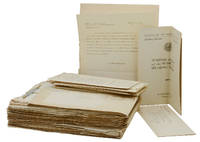
1865List2219Baltimore and Worcester County 1865. Two documents affixed at top edge measuring 9 x 6 ¾ and 14 x 8 ½ inches. Tape repairs at folds some with heavy clear tape else excellent good condition overall. With the embossed stamp of the Board of Claims to first document and two revenue stamps affixed. Good. A pair of documents relating to the emancipation through military service of Thomas Massey of Maryland and compensation to his enslaver Joseph Godrey of Worcester County Virginia. Massey enlisted in the 9th Regiment of the USCT in 1864 and in accordance with Order 329 of the U.S. War Department Godfrey received compensation which was not to exceed $300. The present documents “To facilitate recruiting in the states of Maryland Missouri Tennessee and Kentucky the War Department issued General Order No. 329 on October 3 1863. Section 6 of the order stated that if any citizen should offer his or her slave for enlistment into the military service that person would "if such slave be accepted receive from the recruiting officer a certificate thereof and become entitled to compensation for the service or labor of said slave not exceeding the sum of three hundred dollars upon filing a valid deed of manumission and of release and making satisfactory proof of title." https://www.archives.gov/education/lessons/blacks-civil-war/article.html The order was meant to provide financial incentives to enslavers following the Emancipation Proclamation earlier that year. We find a record of a Thomas Massey from Worcester County born in 1855 which would raise the possibility that he enlisted at age 9 or that the Thomas Massey in question in these documents is not findable in the genealogical references we checked. unknown
186161812New York: W. Schaus; printed by Sarony Major & Knapp 1861. Second Edition. 59 x 76cm open. 19.5x19cm closed. Tinted lithographic map backed in brown silk in black slipcase with printed paper label. Bookseller's ticket of Rev. A. O. Brickman Baltimore. Two ownership inscriptions of "J. M. Deems Maj. 1st MD Cav" and inscribed "Deems" on the slipcase. Trimmed; splits along half of one horizontal fold; minor stains and discoloration to verso not affecting image which is bright and generally Very Good. Hand-made slipcase worn with portion cut out but with manuscript ownership label intact. <br /> <br /> Uncommon Civil War map used by a distinguished Union Army officer. James Monroe Deems 1818-1901 was a composer and music educator from Baltimore who secured a commission as a major in 1861. He was promoted to Lieutenant Colonel in spring 1863; led the First Maryland Cavalry during the Battle of Gettysburg; retired due to rheumatism in November 1863; and was brevetted Brigadier General in 1867. He likely acquired this map in Baltimore near the beginning of his military career and certainly before his promotion in 1863 given the use of "Maj." in his ownership inscriptions. <br /> <br /> The map itself is the second edition of this design by J. Schedler despite the title it is not a bird's-eye view. The more common first edition has two insets showing the Lower Mississippi Valley and the city of Richmond see Stephenson 17.3. This version has only one inset showing the eastern United States. Stephenson describes this edition as having a Washington DC bookseller's ticket; the present copy has a Baltimore bookseller's ticket instead. <br /> <br /> This copy was mounted for use in the field: it was trimmed down to the neatline the captions removed the image cut up into segments and mounted on linen. The printed label on the slipcase appears to be a portion of the original title. This may have been done by the bookseller Brickman possibly at Deems' request. <br /> <br /> Uncommon. OCLC records about 10 similarly titled maps but few listings distinguish between the first and second editions. STEPHENSON LC Civil War Maps 2nd ed 17.35. 61812. [W. Schaus; printed by Sarony, Major & Knapp] unknown
58075Very Good. 417-423; 416pp. 52 numbers averaging 8pp. each. Folio 39 cm Contemporary 1/4 leather binding with limp boards which maintain some of the original marbled paper. Professionally recased. Restoration work to spine ends. Formerly exposed boards skillfully restored with handmade paper at the extremities. Hinges reinforced with Japanese tissue. Missing front front free endpaper. Periodic minor markings to the pages else internally very good. Flake 2822. A complete run of this volume of particular significance due to the historical events embraced by the year 1857-58: the Mormon "War" the Mountain Meadows massacre the incursion of federal troops against Utah the Reformation etc. Included is a major portion of the serialized "History of Joseph Smith" and the beginning of the serialization of Brigham Young's autobiography numerous documents by Young dispatches from the outside press relevant to the situation discourses by Elders etc. Also noteworthy is the printing of Young's December 15 1857 Governor's Message in the Dec. 23 issue; the Memorials to the President of the United States printed in the October 7 issue; and other major items relating to the conflict possibly in their earliest printings as well as much material related to overland travel freighting commerce and more. unknown
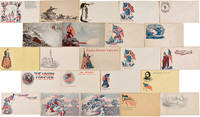
1865WRCAM56082Various locations including Philadelphia New York Salem Cincinnati Baltimore and others 1865. 119 unused postal covers all but one of them illustrated almost all printed in color or hand-colored. Generally minimal wear. Ranging from very good to near fine condition. An interesting and substantial grouping of Civil War-era patriotic covers encompassing a wide variety of themes devoted to the Union cause. A great number of Union officers are celebrated here among them are eight examples depicting General McClellan three of Gen. Fremont and a pair featuring Gen. Rosecrans the "Hero of the West." There are also numerous regimental leaders including Edward Dickinson Baker Commodore Silas H. Stringham Lt. John T Greble Gen. Wool printed with a map of the seat of war in Missouri Col. E.D. Baker Col. H.E. Paine of the Wisconsin Volunteers Col. Max Friedman of the Cameron Dragoons and many others. There are also pictorial covers of Gen. Sherman's Headquarters at Hilton Head; a pair depicting Fort Sumter; four depicting Camp Dennison near Cincinnati; one of the Battle Monument in Baltimore; and one featuring Benton Barracks in St. Louis. Three examples are practically bird's-eye views of Baltimore one a general view another from the perspective of Federal Hill and the third from Fort McHenry. <br> <br> A common visual theme is the use of symbolic iconography of the United States. Numerous examples depict women standing proudly with the American flag and are evocative of Columbia the personification of the United States. One depicts a woman serving with the "Home Guard" and decked out in a dress resembling the flag. Another example shows a "Daughter of the Regiment." Yet another is titled "The Ladies' Envelope" and features Columbia with an American flag-style shield. There are also a plethora of examples featuring the flag itself. One example prints a "History of Our Flag" beginning with its endorsement by Congress on June 14 1777. One prints the flag next to a warning reading "If Any One Attempts to Haul Down the American Flag Shoot Him on the Spot." <br> <br> The American Eagle features prominently here as well. In one example the great bird is tearing apart a Rebel flag with his beak. In another the eagle holds a banner in his mouth reading "Beware" while confronted with a disjointed hand labeled "Jeff. Davis" holding eight snakes labeled with the names of the Confederate states an interesting twist on the famous severed snake image featured in the Revolutionary-era "join or die" illustration. <br> <br> Also a handful of the covers display the type of twisted gallows humor sometimes literally to be expected from patriotic covers. One of these shows Jefferson Davis hanging from a tree; the text around his lifeless body reads "Southern Eagle Jeff. Davis in Suspense Long May He Wave." A similar example shows Davis hanging from a gallows; the caption reads "Jeff. Davis 'President' of Traitors Robbers and Pirates; the Nero of the 19th century. On the Last 'Platform' of the Southern Confeder- ass-y." Yet another cover not gallows humor but featuring Jefferson Davis depicts him as a fox holding two geese one labeled Tennessee and the other Virginia above a caption reading "Jeff. Davis on a Scouting Expedition." <br> <br> A particularly-colorful example depicts a proud Union soldier defending Washington D.C. The soldier holds fast to an American flag as a cannon fires beneath his feet with the Capitol building in the background. Other examples celebrate the New York State Volunteer Militia the Pennsylvania Volunteers the Quartermaster Department of the Anderson Zouaves the Monitor the naval battle between the Monitor and the Merrimack Sherman's Flying Artillery the text of the Army Hymn "Jeff. Davis' Doom" various political cartoon-style illustrations and many more. <br> <br> A significant collection of one of the more ephemeral and visually significant artifacts of life in the North during the Civil War. unknown books
1863WRCAM55392N.p. but likely St. Louis 1863. Broadside 13 3/4 x 4 1/4 inches. Remnants of tape at top edge and ink mark in top margin. Slight tanning and spotting old folds. Very good. A rare Civil War broadside recounting Confederate General John S. Marmaduke's second raid into Missouri. It gives detailed news of battles between Union and Confederate troops in southeast Missouri an area that saw bloody battles between Unionists and Bushwhackers throughout the Civil War. <br> <br> Marmaduke aided by other Confederate units led by Joseph O. Shelby and Sterling Price and others attempted to lay claim to Missouri in 1861; they were unsuccessful but did not acknowledge defeat. Marmaduke planned his return for spring of 1863 confident that secessionist-minded Missourians would rally to his banner and he could make a decisive move on Jefferson City and even St. Louis. He needed the help: at the beginning of the raid Marmaduke had about 5000 troops of which 1200 were unarmed and 900 were unmounted and he hoped to resupply at Patterson and Bloomfield. He divided his forces and sent 2000 against Patterson the furthest south in a string of fortified outposts in southeastern Missouri. Marmaduke's troops had the element of surprise initially approaching Patterson and its small garrison of about 400 troops commanded by Col. Edwin Smart. Marmaduke's men captured Smart's pickets but revealed themselves soon after as over-eager artillery troops started firing before the infantry could get into place. Smart sent out a battalion under Major Wood to hold off the Confederates while he prepared his troops and supply trains for retreat. <br> <br> In the text of this broadside Smart reports that Wood "held them in check and skirmished them into town.Before I left the town I destroyed what stores I could not bring away. Nothing fell into the hands of the enemy." Marmaduke pursued them to Big Creek about eight miles west of Patterson and Smart writes that: "The engagement was severe in the extreme often fighting hand to hand. At Big Creek they got in my front and attempted to cut off my retreat but I forced my way and formed on this side of the Creek. The enemy did not renew the engagement." Smart lost about fifty troops including Major McConnell. Marmaduke failed to obtain any military stores at Patterson or during his subsequent raid at Bloomfield and no sympathetic Missourians joined his cause; the raid was a failure and confirmed that while Missouri was no Union stronghold neither was it interested in furthering the Confederate cause. <br> <br> This broadside bears no imprint and the place of printing is unknown but the tone of the text and the fact that the news arrived so quickly indicates that it might have been printed in St. Louis. No copies of this broadside are listed in OCLC. Such broadsides bearing news of the Civil War in the Trans-Mississippi West are rare and shine an important spotlight on an often- neglected aspect of Civil War history. unknown books
1918140941439Washington D.C.: Committee on Public Information Division of Women's War Work 1918. Approximately 450 mostly mimeographed press releases spanning from February 1918 until July that same year many of which are 8.5" x 11" or 14" others of which are newspaper column-size 3" x 21" or varying lengths. Three groupings of the releases are claspbound the rest are loose. Includes Bulletins Nos. 1 & 2 both printed in January 1918 by the Government Printing Office folded in half vertically with reply card. Includes a TLS from Guy Stanton Ford Director of Civic and Educational Publications later President of the University of Minnesota to the President of Rice University. Very Good overall lightly toned with age a little chipped along edges folded horizontally two or three sheets torn in half.<br /> <br /> <p>A collection of pieces attempting to mobilize domestic support for the US in World War I issued by the women's division of the Creel Committee an independent agency in the Wilson administration. The Creel Committee attempted an unprecedented full court press of propaganda aiming to reach every stratum of American society. Many a budding public relations figure cut his teeth in the agency including Edward Bernays and Carl R. Byoir. The particular division from which all these pieces were issued focused on American women: variously promoting the work of journalist Ida Tarbell and the YWCA soliciting women to become Morse code telegraphers spreading anti-German and pro-Ally stories trying to get women of any number of religious denominations or ethnic groups to directly contribute to the war effort. This archive illuminates how American war propagandists saw women at the twilight of WWI. Specifically it reveals how civic participation technology military service and information theory were gendered in mass society-- or at least as observed and molded in that society by a particular body of elites. Committee on Public Information, Division of Women's War Work unknown books
41587Oblong double-folio 13 x 17 inches seal affixed; docketed on verso. Several small breaks at corner folds corner torn away just touching the docketing. A very good copy. In this document Jonathan Tucker was appointed second lieutenant of a company in the 5th Regiment of Militia in Worcester County. In the following month Lincoln was named Major General of all the Massachusetts state militia; he was given command of the southern department in 1778 and after his capture and exchange was with Washington at Yorktown where he was chosen to receive Cornwallis's sword. Other members of the council who signed this document include Perez Morton James Otis Benjamin Greenleaf Caleb Cushing John Winthrop Joseph Gerrish John Whetcomb Elias Taylor Michael Farley Joseph Palmer Moses Gill Samuel Holton B. White Charles Chauncey and John Taylor. <br/><br/> unknown books
1833List508Mexico 1833. First Edition. Mexico: May 23 1833. Letter and chart on watermarked single folio sheets approx. 13 x 16-½ inches letter: 3 pp.; chart: 2 pp.;. Near Fine. Rare first-hand documentation of the growing trade tensions that eventually led to the French-Mexican "Pastry War" of 1838. Consul Hersant's gossipy report surveys the "commercial movement of the port of Tampico since it's opening in 1824 until the end of 1832." Hersant complains to his superiors that Mexican trade with the US and England far outpaces France; even the Hanseatic League has become a problem. The Consul includes a hand-drawn table tallying foreign ships and the weight of goods by country a visual aid supporting his claim that French trade lags considerably behind other partners. <br /> <br /> Ultimately it is civil disorder that most disturbs the Consul; that is smuggling assisted by the Mexican customs officers themselves: "se fait impunément et avec l'aide des douaniers eux-mêmes et peut porter au double la quantité de marchandises qui entrent du dehors." Indeed the early years of the Mexican Republic were marked by a notable lack of governmental accountability toward foreign governments or private property owners as various internal parties struggled for power. This disregard eventually led King Louis-Philippe's government to sue for damages against Mexico on behalf of French citizens doing business there. The most famous claimant was a pastry chef who claimed his shop had been looted. In 1838 when the amount went unpaid the French invaded Veracruz and blockaded Mexico's Atlantic ports beginning the so-called Pastry War.<br /> <br /> References to Hersant can be found in other histories of the French attempt to gain ground in Mexico e.g. establishing alternative shipping passages inland to compete with North American traders. Overall a scarce pair of documents in excellent condition with minimal normal wear. unknown books
1813WRCAM41998Sackets Harbor N.Y. 1813. 1p. manuscript letter signed docketed on verso. Folio. Old fold lines. Some separation at folds; one tear closed with archival tape. Lightly soiled. Good. An eyewitness account of the second battle of Sackets Harbor on the shores of Lake Ontario from the commander of the American forces there Gen. Jacob Brown to his friend Joshua Hatheway quartermaster general and formerly the commander of the defenses at Sackets Harbor. The town situated near the entrance to the St. Lawrence River at the far eastern end of Lake Ontario and opposite the Canadian town of Kingston was a vital defensive point for the Americans challenging British control of the St. Lawrence and the lake and preventing a British thrust into New York State. If either side could control both sides of the entrance to the St. Lawrence they could control the Upper Great Lakes. Taking advantage of the American action against York which drew troops away to the western end of the Lake the British decided to strike. On May 28 1813 the British Great Lakes squadron under the command of James Yeo appeared off Sackets Harbor carrying troops under the command of the governor-general Lieut. Gen. George Prevost. Having been forewarned by several men who escaped the Battle of Henderson Bay the previous day the Americans had some time to reinforce their defenses before the British could attack. The British landed on the 28th but launched their main attack the next morning. They easily routed the American militia but the regulars under Brown were able to fight off repeated attacks on their fortifications. Prevost fearing the arrival of more American troops ordered a retreat which nearly became a rout. Brown was the hero of the day and was later rewarded with a commission as brigadier general. He must have immediately written this letter describing the action. This appears to be written in a secretarial hand and signed by Brown himself. The letter states: "Dr. Sir I received an order some days since from Genl Dearborn to take comm. at this Post. Comd. Chauncey is up the lake. We were this morning attacked as day dawned by Sir George Prevost in person who made good his landing with at least a thousand picked men. Sir James Yeo commanded the fleet after loosing some distinguished officers and of course some gallant men. Our loss is very severe as to the quality of those who have fallen. The enemy left many of their wounded on the Field - but I have no doubt carried off many more. We shall probably be again attacked as Sir George must feel very sore. All I can say is whatever may be the result we will not be disgraced." A superb battlefield letter reporting on one of the most significant military actions of the War of 1812. unknown books
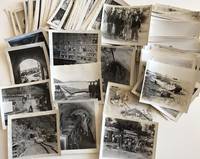
19461299Okinawa 1946. Overall very good. 363 original photographs most 3.25 x 4.5 or 3.75 x 5 inches. Loose photos some curling to approximately half of group. About 200 images neatly removed from previous album or other housing with adhesive remnants on blank versos. Pencil annotations with dates and locations on a substantial minority of photographs. Occasional minor wear some fading to several photos but mostly clean crisp images. A remarkable and large collection of over 360 vernacular photographs taken by an American soldier on Okinawa and several other outlying islands in the Amami and Tokara chains following the final surrender of Japanese forces and the end of World War II. The images present here depict a wide array of subjects including the destruction on Okinawa the building of American military camps cleanup and disarmament of Japanese military installations remnants of local villages and Japanese residents attempting to resume their lives.<br/><br/>One of the most fascinating and extensive series of images present here documents the disarmament and deconstruction of Japanese island military installations carried out by their own soldiers still in uniform. Numerous photographs depict soldiers carrying bombs arms and equipment out of bunkers and other installations being dismantled under the supervision of American forces. Many images incongruously depict American and Japanese officers deep in consultation or mixed groups of enlisted men working or milling about together. Several shots show Japanese soldiers Japanese soldiers posed at stations in the bunkers as if they were still on duty.<br/><br/>A second significant run of images present here depict life such as it was for surviving residents of the islands. Many photographs show rebuilding in progress men and women scavenging materials and farmers working fields and harvesting hay and grasses. Others document aspects of town life -- small gatherings of villagers children playing men returning from a fishing expedition women washing clothes in an irrigation ditch. A few photos show a group of women from the local red light district.<br/><br/>Overall these images give an excellent and detailed view of the situation on the outlying islands of Japan just after the conclusion of the war. The photographer clearly had license or orders to travel fairly widely and his photographs are taken from varied locations on Okinawa and several other islands south of the Japanese mainland including Tokunoshima Amami Oshima and Takarajima. The landscape on these as it appeared in the direct aftermath of the war is extensively documented.<br/><br/>Although the photographer is not identified he is clearly the subject of several portraits posed in front of military airplanes on ships with groups of soldiers and with local Japanese people. The images display a good sense of composition and a keen eye for interesting subject matter and given the access that many of these subjects required it seems clear that the photographer had some training or professional experience and was employed by the military. Nevertheless 170 of the images are clearly his own personal vernacular photography thereby making the scope and extent of this group all the more remarkable. An excellent and sizable group of postwar Pacific photographs and an outstanding visual document of Okinawa soon after one of the bloodiest and most desperate island campaigns of the war. unknown books
,,,auec l'explication de l'article 4XLII du susdit traitté, concernant le Roussillon. Du 31. may 1660... -Un volume in folio (24x37 cm) di (4)-129 pagine ; un foglio bianco nn tra pag 94 e 95; manca il foglio bianco all'inizio. In lingua francese. Festoni e capolettera incisi alle pag. (2) e 1, 100 e 103. Alla pagina di titolo mancanza restaurata al margine superiore che tocca le prime tre lettere della scritta a mano Bibliotheca Colbertina all'angolo superiore; gore e tracce di antica muffa ai primi sei fogli e agli ultimi cinque (compresa l'ultima bianca). Qualche altra gora marginale. Legatura coeva in piena pelle molto USURATA e restaurata (dorso rifatto) con al centro dei piatti lo stemma dorato di Colbert, anch'esso ampiamente toccato dalle erosioni. - Nonostante i DIFETTI esterni ed interni descritti, resta un volume di grande interesse storico per la sua provenienza, la famosa Biblioteca di Jean Baptiste Colbert (1619-1683) l'economista e politico che fu l'uomo delle finanze di Luigi XIV e che fu l'erede di Mazarino, che aveva condotto le trattative di pace con la Spagna e quindi architettato questo trattato di pace dei Pirenei suggellato dal matrimonio tra Luigi e l'Infanta di Spagna sua cugina. - Il volume si trova al n. 2654 (Traité de Paix des Pyrenées et Contrat de Mariage du Roi) della Bibliotheca Colbertina, seu Catalogus librorum,,, Vol. 1, Paris, Gabriel Martin, 1728: catalogo dei libri di Colbert che vennero venduti in quella data, molti acquisiti dalla biblioteca Reale francese, altri acquistati da ricchi privati del tempo e quindi entrati nel circuito commerciale dove sono, oggi, molto rari e ricercati. Questo esemplare del Traitté, peraltro, ha caratteristiche tipografiche che non si ritrovano in alcuna descrizione bibliografica delle edizioni di quella data.
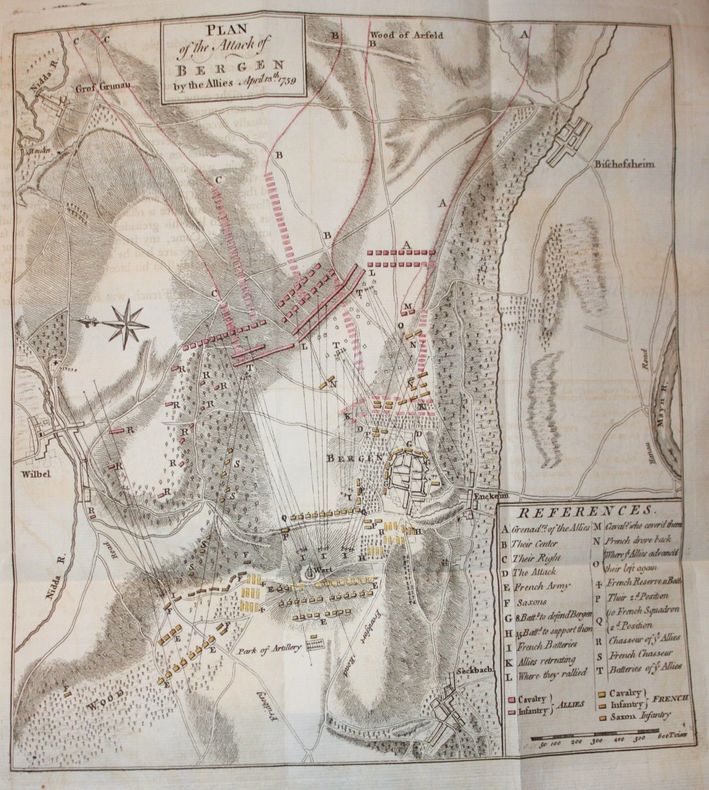
1764AMO-1480THE OPERATIONS OF THE ALLIED ARMY, UNDER THE COMMAND OF HIS SERENE HIGHNESS PRINCE FERDINAND, DUKE OF BRUNSWIC AND LUNEBERG, during the greatest Part of SIX CAMPAIGNS, beginning in the year 1757, and ending in the Year 1762. By an officer, who served in the British Forces. Illustrated with Maps and Plans. London, Printed for T. Jefferys, Geographer to the King, M. DCC.LXIV. [1764] 1 volume in-4 (25,5 x 21 cm) de 2 feuillets non chiffrés (titre et Advertisement by the Publisher placement des cartes et errata), 288 pages chiffrées (erreur de pagination) et 10 feuillets non chiffrés d'index topographique. 12 cartes et plans dépliants (sur 13 - la carte de la bataille de Minden a été arrachée). Une grande carte est déchirée coupée en deux morceaux. Petites déchirures à quelques cartes (plis, bords). La plupart des cartes sont de grande dimension (notamment les 4 cartes reliés à la fin du volume). Reliure de l'époque plein veau brun, dos orné de fleurons dorés (reliure anglaise) usagée. Le premier plat est presque détaché, le deuxième plat se détache, manque aux coiffes et aux coins, l'intérieur du volume est frais avec quelques rousseurs sans gravité. FIRST PRINTING. ÉDITION ORIGINALE. Provenance : George S. Bailey, 1843 et L. George P. Bailey (ex libris manuscrit répété et calligraphié avec note autographe). A noter également 3 petites notes manuscrites en anglais et signées B. H. (écrites par quelqu'un qui a pris part aux batailles). Cet important ouvrage, des plus rares, contient le récit militaire des six campagnes menées par le Duc Ferdinand, de 1758 à 1762. Batailles de Crevelt, Bergen, Minden, Warburg, Vellinghausen, Wilhelmstall, Hesse, etc.
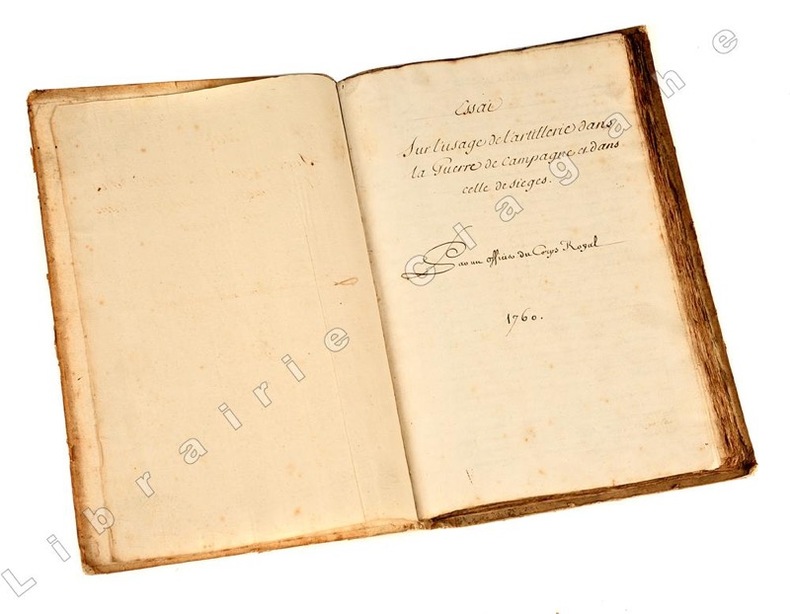
21404In folio (367 mm), demi-vélin de l’époque, 137 pp. d’une belle écriture, bien lisible et 3 plans aquarellés dépliants.
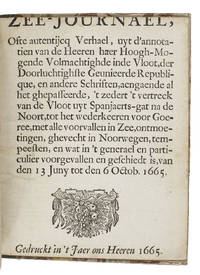
1665ABC_46560Amsterdam 1665. 4to. Jacobus Venckel Contemporary half vellum marbled sides. With an ornamental woodcut title-vignette. 35 1 blank pp. Rare pamphlet written by an anonymous author discussing the fascinating Battle of Vågen the main port area of neutral Bergen in Norway in August 1665 during the Second Anglo-Dutch War 1665-1667 including its background and aftermath. The Second Anglo-Dutch war was a war at sea caused by conflicts in colonial territories of the Dutch Republic and England. This naval war consisted mainly of protecting their own merchant ships capturing enemy ships and trying to sink mutual warships. The Battle of Vågen was an important naval battle between a rich treasure fleet of the Dutch East India Company VOC and an English flotilla of warships. The present pamphlet gives an account of the events before and after the Battle of Vågen and also in broad lines of the battle itself including all kinds of correspondence and notes from high-ranking figures.Since Tiele attributes this anonymous edition to Venckel it seems likely to be the first edition which Venckel first published anonymously. In any case the present edition is rare. We find only two records of it at auction in 2005 and 2015 the other copies are all held institutionally. A highly interesting pamphlet on one of the most important and fascinating 17th-century sea battles in Dutch naval history and in the history of the Dutch VOC.A few spots the margins trimmed with no loss of text except that the words "Zee-Journael" on the title-page are slightly shaved. Otherwise in good condition.l Knuttel 9103; STCN 863290108 6 copies; Tiele 5266; WorldCat 5 copies in 4 entries; for Venckel: H.F. Wijnman De Amsterdamsche boekverkooper Jacob Vinckel 1627-1680 in: Vondel-kroniek 5 1934 p. 192. hardcover
<p>17 cm, rilegatua coeva in cartone alla rustica, dorso con tre nervetti e titolo ben manoscritto, 287 carte. Frontespizio con marca tipografica in xilografia con giglio araldico (stemma di Firenze) e putti su altare con l'niziale: F. ed il motto: Nil candidius. La carta (a4) e la carta (&1) sono state perfettamente reintegrate, due piccole macchiline d'inchiostro al frontespizio. manca l'ultima carta senza testo che replica la sola marca tipografica del frontespizio. Rara seconda edizione Giuntina stampata con carattere corsivo in lingua volgare. Qualche segno del tempo alle copertine, ma assai ben conservato.</p>
First edition. Original red boards with gold font. 4to, 150 pages, 32cm. Loaded with full page graphic anti-Nazi posters advocating American multiculturalism and promoting the US war effort, as well as drawings depicting Nazi atrocities, and photographs of B'nai B'rith leaders and other Jewish organizations, each graphic sponsored by a different Jewish business or family. Includes full page statement with photograph by Humphrey Bogart. Illustrated Diary of Events of the First Five Years of Westchester Lodge. Features quote by and portrait of Franklin Roosevelt, as well as stories, newspaper headlines, articles, and accounts of WWII and the people who fought to save Jews under the Nazi regime. We do not often see locally produced and focused material on Jews from a town or county fighting the Nazis SUBJECT(S) : World War II, American War Efforts, Jews. OCLC lists 4 holdings worldwide (NYPL, Fordham, HUC, Virginia Tech) , none west of Cincinnati. Slight toning to pages. Library stamp, some dust on original cover boards. Very good condition. Page after page of gorgeous Anti-fascist propaganda from the period! Scarce and important (Holo2-133-12)
1944117209Montrouge Atelier Robert Doisneau 1944 1 vol. en feuilles Tirage argentique d’époque, 23,6 x 18,2 cm, tampon rouge du photographe au verso. Célèbre photo reproduite p. 52 de l'album "Paris libéré" préfacé par Mauriac (Flammarion, 1944). Titulaire d'une accréditation pour suivre l’insurrection parisienne et l’avancée des troupes alliées, le photographe est au plus près des événements pour en saisir toute la gravité. Epreuve originale, en parfaite condition.
1944117209Montrouge Atelier Robert Doisneau 1944 1 vol. en feuilles Tirage argentique d’époque, 23,6 x 18,2 cm, tampon rouge du photographe au verso. Célèbre photo reproduite p. 52 de l'album "Paris libéré" préfacé par Mauriac (Flammarion, 1944). Titulaire d'une accréditation pour suivre l’insurrection parisienne et l’avancée des troupes alliées, le photographe est au plus près des événements pour en saisir toute la gravité. Epreuve originale, en parfaite condition.
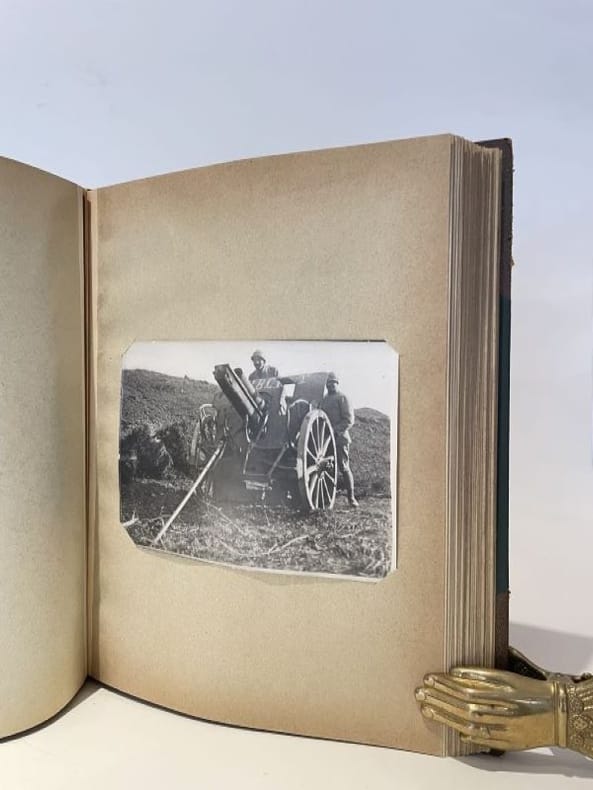
41031Un volume in-4, demi-chagrin bronze à coins, dos à nerfs orné de filets dorés. Album du plus haut intérêt documentaire, réunissant 133 contretypes d'époque au format 175 x 130 mm, tous légendés au verso. Cette exceptionnelle collection de clichés, qui provient des archives d'un diplomate, suit le déplacement de la ligne de front et couvre la plupart des zones de conflits en France (Marne, Artois, Yser, Bataille de Verdun, Chemin des Dames, Argonne, Lorraine et Alsace), mais aussi certaines séquences en Italie et dans les Balkans. Les photographies, qui sont manifestement l'oeuvre d'un professionnel, représentent les manoeuvres de l'armée (notamment une belle série dans les Vosges enneigées), les revues de troupes par Joffre, Pétain et Clemenceau, le renfort des alliés et des régiments coloniaux, les prisonniers allemands, les tranchées et la vie des soldats au quotidien. Beaucoup de points de vue sont réalisés en panorama large et révèlent la géographie des lieux. C'est également un reportage de premier ordre sur l'industrie et l'effort de guerre, les usines d'armement, les réserves d'artillerie (jusqu'aux quais de Seine à Paris), avec des clichés concernant l'aviation et la marine. La vie des civils est représentée à travers quelques scènes domestiques et champêtres (habitants au milieu de villages dévastés, labour et récolte des foins, élevages de chiens pour tirer les brancards). Document unique, parfaitement conservé.
41031Un volume in-4, demi-chagrin bronze à coins, dos à nerfs orné de filets dorés. Album du plus haut intérêt documentaire, réunissant 133 contretypes d'époque au format 175 x 130 mm, tous légendés au verso. Cette exceptionnelle collection de clichés, qui provient des archives d'un diplomate, suit le déplacement de la ligne de front et couvre la plupart des zones de conflits en France (Marne, Artois, Yser, Bataille de Verdun, Chemin des Dames, Argonne, Lorraine et Alsace), mais aussi certaines séquences en Italie et dans les Balkans. Les photographies, qui sont manifestement l'oeuvre d'un professionnel, représentent les manoeuvres de l'armée (notamment une belle série dans les Vosges enneigées), les revues de troupes par Joffre, Pétain et Clemenceau, le renfort des alliés et des régiments coloniaux, les prisonniers allemands, les tranchées et la vie des soldats au quotidien. Beaucoup de points de vue sont réalisés en panorama large et révèlent la géographie des lieux. C'est également un reportage de premier ordre sur l'industrie et l'effort de guerre, les usines d'armement, les réserves d'artillerie (jusqu'aux quais de Seine à Paris), avec des clichés concernant l'aviation et la marine. La vie des civils est représentée à travers quelques scènes domestiques et champêtres (habitants au milieu de villages dévastés, labour et récolte des foins, élevages de chiens pour tirer les brancards). Document unique, parfaitement conservé.
[4]-46 pp. "The governments of England, Russia, and France thought through the publication of the exchange of diplomatic writings of the days before the beginning of [WWI], they could furnish a proof in the eyes of their own peoples and of the entire civilized world that the blame for the most gigantic shedding of blood which the world has ever experienced falls only upon 'war-lusting Germany,' and that they for their part did all in their power to avoid the catastrophe. England has published a 'Blue Book,' Russia an 'Orange Book,' and France a 'Yellow Book.'" - p.5. "Dr. Karl Helfferich, German Secretary of the Treasury, reviews the 'White,' 'Yellow,' and 'Orange' papers, and reaches a different conclusion from that of James M. Beck [author of the 1914 book 'The Evidence in the Case'], holding the Allies responsible for [WWI]". - front cover. "A translation from the semi-official Nord-deutsche Allgemeine Zeitung of Jan. 26 [1914] of an exhaustive comparative study of the diplomatic documents published by the various warring countries concerning the origin of the world war." - p. [3]. "Dr. Helfferich's brilliant analysis of the world situation was published first by George Stilke, Berlin, under the title of 'The Genesis of the Great War.' It appeared in the N.Y. Times under the title under which it is here reprinted." - p. [2]. George Sylvester Viereck's The Fatherland Corporation also published a WWI-era periodical called The Fatherland which endorsed "Fair Play for Germany and Austria-Hungary". Grey card covers fragile with chips from front and back tips. Cover fold mostly open. Contents printed upon glossy stock which is clean, unmarked and gently toned. A worthy copy of this important WWI document. Book
1st edition. Original Boards in dust jacket. 8vo. [4], 104 pages. 19 cm. Fold out map by Kaufman titled, Map Showing Possible Dissection of Germany and Apportionment of Its Territory. This famous polemic outlines a comprehensive plan for the extinction of the German nation and the total eradication from the earth, of all her people. (Back cover) Self-published and at first obscure, this anti-German book became a central strategic piece for infamous Nazi propagandist Joseph Goebbels, who referenced the book throughout World War II claiming it as proof of a Jewish threat to Germany, writing in his diary August 3, [1941], He really could not have done it better and more advantageously for us if he had written the book to order. I will have this book distributed in millions of copies in Germany, above all on the front, and will write a preface and afterword myself. It will be most instructive for every German man and for every German woman to see what would happen to the German people if, as in November 1918, a sign of weakness were given. (Herf, page 112, The Jewish Enemy) However, this mass publication plan never came to fruition, because Goebbels feared copyright problems. The U.S. was still not in the war, and he worried that the U.S. might retaliate by stripping German works in the U.S. of copyright protection. (Bytwerk, 2012) Instead, edited and editorialized selections of the book were published in the widely circulated Nazi pamphlet DAS KRIEGSZIEL DER WELTPLUTOKRATIE alongside claims that Kaufman was a close associate of Franklin D. Roosevelt, a member of his Brain Trust, and that Roosevelt himself had dictated some of Kaufmans words. (Bytwerk, 2012). Theodore Newman Kaufman (1910 -1986; his middle name sometimes given Nathan), was an American Jewish businessman, born to German-Jewish immigrant parents, who became known for his genocidal views on Germans. In 1941, he wrote and published Germany Must Perish! which called for the sterilization of the German people and the distribution of the German lands. The text was used extensively in Nazi propaganda, often as a justification for the persecution of Jews and was specifically cited as a reason to round up the Jews of Hanover, Germany .Kaufman was a radical intent on preventing American involvement in future wars in Europe. In 1939, under the auspices of the American Federation of Peace, an unknown entity of which he was the president and probably only member, Kaufman produced several publications. One pamphlet .read:A possible plea to Congress. ... Have Us All Sterilized! ... If You Plan On Sending Us To A Foreign War ... Spare Us Any Possibility Of Ever Bringing Children Into This World Into This Country Of Ours!It was with his famous fold-out map in Germany Must Perish, that Kaufman Germany and Austria showed how Germany and Austria could be dismembered; In those same pages he also advocated the forced mass-sterilization of all German men under 65 and the sterilization of most German women under 45. This would eliminate 'inbred Germanism,' he proposed, thus solving a great deal of humanity's problems. He also promoted the distribution of Germany's lands among the neighboring countries, illustrated in his famous map in his book. Indeed, His effort was spearheaded by the self-publication of the book Germany Must Perish! 'Since Germans are the perennial disturbers of the world's peace ... they must be dealt with like any homicidal criminals. But it is unnecessary to put the whole German nation to the sword. It is more humane to sterilize them. The army groups, as organized units, would be the easiest and quickest to deal with. ... The population of Germany, excluding conquered and annexed territories, is about 70,000,000, almost equally divided between male and female. To achieve the purpose of German extinction it would be necessary to only sterilize some 48,000,000 -- a figure which excludes, because of their limited power to procreate, males over 60 years of age, and females over 45. ...Complete sterilization of both sexes, and not only one, is to be considered necessary in view of the present German doctrine that so much as one drop of true German blood constitutes a German..... Kaufman's book gained attention in Nazi Germany, where propagandists used it as evidence of an international Jewish plan to destroy the German people. On July 24, 1941, the Nazi Party's newspaper, Völkischer Beobachter, published a front-page article on the book titled: 'The Product of Criminal Jewish Sadism: Roosevelt Demands the Sterilization of the German People.' The newspaper alleged that Kaufman was a close ally of Samuel Irving Rosenman, an advisor to Franklin Delano Roosevelt and that: 'Given the close relationship of the writer to the White House, this monstrous war program can be seen as a synthesis of genuine Talmudic hatred and Roosevelt's views on foreign policy.' At the time, the German leadership was engaged in a propaganda campaign designed to rally popular support for the German invasion of the Soviet Union. Antisemitism in general, and Kaufman's ideas in particular, became a focus of this campaign.Nazi Propaganda Minister Joseph Goebbels read the book in early August and immediately grasped its value, writing in his diary: 'This Jew did a real service for the enemy [German] side. Had he written this book for us, he could not have made it any better.' Under Goebbels' direction, Germany Must Perish! continued to receive significant media attention in Germany. Portions of the book were read on national radio, and Goebbels ordered the printing of five million copies of a pamphlet that summarized Kaufman's ideas.As an example, Kaufman was condemned on the August 1942 edition of the Nazi wall newspaper Parole der Woche [see photo] Nazi propaganda often used Kaufman's pamphlet as a justification for the persecution of Jews. When the Nazis required German Jews to wear a yellow badge on their clothing on September 1, 1941, they published a flyer explaining to the German people that those individuals wearing the star were conspiring to implement Kaufman's plan for the destruction of Germany. When the Jews of Hanover were forced from their homes on September 8, 1941, German authorities cited Kaufman's book as one of the reasons .The Nazi propaganda ministry continued to publish pamphlets, posters and flyers on Kaufman's ideas through the end of the war, and also urged newspapers and public speakers to remind Germans of Kaufman's book. Kaufman's last major appearance in Nazi propaganda occurred in late 1944, when a five-page section on him was included in the widely published booklet Never!, which described a number of alleged plots to destroy Germany. Randall Bytwerk, an historian of communications at Calvin College, concluded that '[a] German at the time could not have missed encountering' propaganda about Kaufman. The Nation Magazine (Nov 14, 1942) noted, Few Americans have ever heard of a prominent fellow-citizen named Kaufmann ... In Germany every child has known of him for a long time. Germans are so well informed about Mr. Kaufmann that the mere mention of his name recalls what he stands for. In one of his recent articles Dr. Goebbels wrote, 'Thanks to the Jew Kaufmann, we Germans know only too well what to expect in case of defeat.' (Wikipedia) "On 1 September 1941 all Jews remaining in Germany were forced to wear the Yellow Star when in public. In late September 1941, the Nazis released a remarkable mass pamphlet based on a book published in the United States titled 'Germany Must Perish!' The book proposed the partitioning of Germany and the sterilization of its population. The author, Theodore N. Kaufman, was an American Jew of no influence. The pamphlet, titled 'The War Aim of World Plutocracy,' [see photo] included excerpts from Kaufmans book. In early November 1941, this four-page flyer was released. It justified the Yellow Star by reminding Germans of Kaufmans pamphlet, which supposedly was the common goal of 'World Jewry.' Howard K. Smiths 1942 book Last Train from Berlin (p. 197) states that every German got copies of the pamphlet along with the monthly ration card" (Calvin College German Propaganda Archive, 2022). Includes bibliographical references on page 104. SUBJECT(S): World War, 1939-1945. Guerre mondiale, 1939-1945. Politics and government National socialism -- Foreign public opinion, American. Pangermanism. National characteristics, German. Germans -- Foreign countries. -- Reparations. Reconstruction (1939-1951) -- Germany. Allemagne -- Politique et gouvernement. In 25 years this is only the 3rd copy of the 1st edition, in hardback, we have ever seen, and only the second in a dust jacket. The 96 page paperback second edition, though scarce, is far more common. Later reprints of American Neo-Nazi groups were distributed to "prove" Goebel's claims about the Jewish conspiracy against Germany. (More at https://research.calvin.edu/german-propaganda-archive/kriegsziel.htm; https://en.wikipedia.org/wiki/Germany_Must_Perish!) OCLC: 3619129. Dust Jacket in about very good condition with light edge wear, protected in mylar cover. Light shelf wear. Some discoloration to end pages Binding is tight. Text block is fresh and clean. Very good + condition in about Very Good Jacket. Rare and important (HOLO2-109-62-AELXCC+)
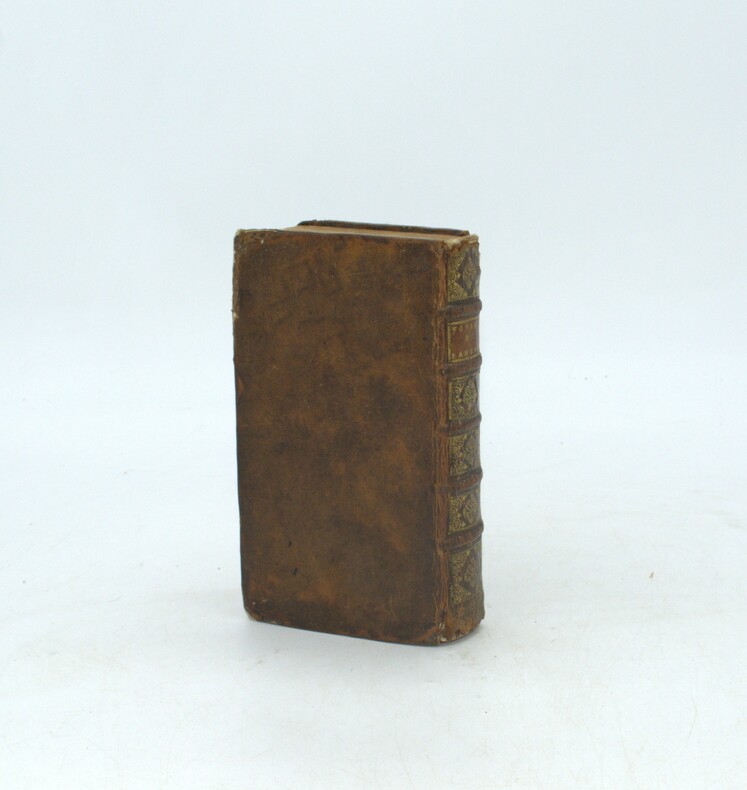
17964831s.l. [Paris], Imprimerie de Patris, M.DCC.XCVI. 1796. 1796 1 vol in-8° (197 x 130 mm.) de: [1] pp. (faux-titre) ; 403 pp. Demi-basane d'époque à coins de parchemin, dos lisse orné, pièce de titre de maroquin rouge, plats recouverts de papier moucheté, tranches jaspées rouges. (Brunissures en marge de quelques ff. in-fine).
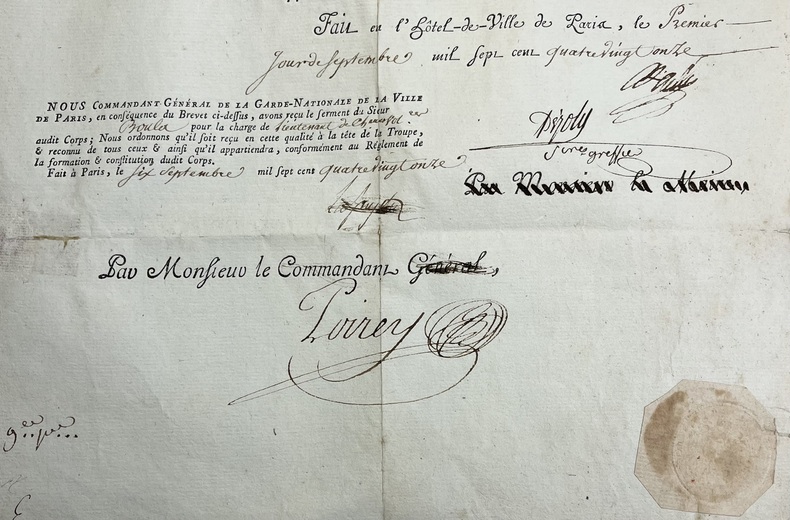
17914503Hotel de ville de Paris, 1er et 6 septembre 1791. 1791 1 feuille in-folio manuscrite à l'encre brune recto-verso (382 X 246 mm.) signée Henry, La Fayette, Bailly, Poirey et Dejoly, cachet en bas à droite (traces de plis avec cassures ancienement restaurées, taches ou traces d'adésif ). Chemise de papier ancien.
1703PHO-2014À La Haye, Chez les Frères L'Honoré, 1703. 2 tomes en un volume in-12, veau, dos à nerfs orné avec pièce de titre (reliure de l'époque) défauts d’usage. Rare édition de l'une des relations de voyage les plus importante pour l'histoire du Canada. - + 279 pp. & -- 220 + 8ff., Un frontispice et 24 planches ou cartes, certaines repliées, dont la « Carte Général de Canada ». Ex-libris manuscrit sur le titre. Première édition, troisième tirage.