Tarbell, Ida; Baker, Ray StannardMareMagnum

119 774 résultats
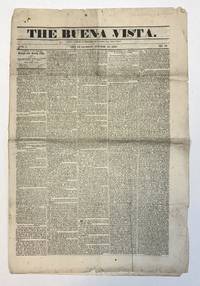
A very rare copy of this, the first appearance of The War on the Rebate, Chapter 1 of Part 2 of Ida Tarbell's ground-breaking History of the Standard Oil Company. This 14-page chapter includes a one-page illustration of J.D. Rockefeller by George Varian, plus photos of William C. Scofield, Daniel Shurmer, John Teagle, George Rice, and Benjamin Butler. This chapter deals with organized espionage, the Scofield-Shurmer-Teagle Case, and related matters. With this work, Tarbell invented what we know today as investigative journalism. She was motivated to expose the methods of J.D. Rockefeller's Standard Oil as she felt he had unfairly damaged her father's oil business. The New York University Department of Journalism ranked this study as the fifth best work of 20th-century American journalism. Also contained in this issue is an intersting article entitled The Lone Fighter, by Ray Stannard Baker, which argues the U.S. is not a free country and Americans are not free, due to labor bosses, and government by and for 'The Bosses". Binding intact. Unmarked. Above-average but not excessive external wear. Moderate moisture exposure. Dozens of pages of glorious illustrated ads. A sound vintage copy. Book
A very rare copy of this, the first appearance of A Modern War For Independence, Chapter 6 of Part 2 of Ida Tarbell's ground-breaking History of the Standard Oil Company. This 18-page chapter deals with the united opposition of producers which developed against J.D. Rockefeller's heavy-handed dominance of their industry. Illustrated with photos of A.D. Wood, Lewis Emery Jr., Thomas W. Phillips, Peter Theobald, E.H. Jennings, David Kirk, Michael Murphy, James W. Lee, Hugh King, and Clarence Walker. With this work, Tarbell invented what is known today as investigative journalism. She was motivated to expose the methods of J.D. Rockefeller's Standard Oil as she felt he had unfairly damaged her father's oil business. The New York University Department of Journalism ranked this study as the fifth best work of 20th-century American journalism. Also included is a fascinating illustrated article by P.T. McGrath entitled The Peril of the Icebergs which discusses the horrors of ships colliding with icebergs, strongly foreshadowing the Titanic disaster eight years later. Dozens of glorious illustrated ads. Binding intact. Unmarked. Average wear. Lacking covers, backstrip, and half of page 85 which contained ads. A worthy vintage copy. Book
75527Versailles, éd. Hautefeuille pour L'Association française Buchenwald-Dora, 16 octobre 1978, expl. n° 575/1000 sur vélin pur chiffon des Papeteries Arjomari, gd. in-4 non relié, en feuillets, sous emboîtage remplié cartonnage pleine toile grise avec 1 dessin de l'auteur collé sur la première de couv et texte en noir éd., le tout fermé par trois rubans toile grise éd., (4) - 12 - 4 pp, ill. par 111 dessins dont 98 au crayon noir de scènes au camps de concentration, 8 portraits en noir de ces amis de camps et 5 dessins rehaussés en coul de scènes au camps, avant-ropos de Marcel Paul, préface de Julien Cain, liste des 111 dessins avec le nom de ceux-ci, bel ENVOI et SIGNATURE du peintre à madame Perriand, épouse de Roger Perriand, un des anciens co-détenus du peintre à Buchenwald, Boris Taslitzky (1911-2005) est né à Paris, de parents russes immigrés après la révolution manquée de 1905, il commence à peindre adolescent et entre à l’école des Beaux-Arts de Paris en 1928. En 1933, il adhère à l’Association des écrivains et artistes révolutionnaires puis entre, en 1935, au PCF. Dès les années 1930, ses peintures et dessins sont portés par le combat pour une société plus juste. Mobilisé lors de la déclaration de guerre, Taslitzky est fait prisonnier en juin 1940. Il parvient à s’évader et s’engage dans la Résistance au sein du Front national de lutte pour la libération et l’indépendance de la France. Il est arrêté en novembre 1941 et condamné à deux ans de prison ; il passe par les prisons de Riom, Mauzac, puis au camp Saint-Sulpice-la-Pointe, où il participe aux activités culturelles clandestines, produisant des peintures et des dessins. En juillet 1944, il est déporté à Buchenwald. Il y réalise plus de deux cent dessins grâce à Pierre Mania, un artiste détenu, qui lui fournit le matériel nécessaire. Ces activités, évidemment interdites, sont couvertes par les organisations clandestines et la solidarité des détenus. L’ensemble rassemble des scènes du quotidien à Buchenwald, de temps de travail, de repos, ainsi que de nombreux portraits, certains esquissés, d’autres particulièrement achevés et d’une présence saisissante, comme ceux de Julien Cain et de Paul Goyard, artiste, conservés dans les collections du mahJ. L’artiste participe à l’insurrection qui mène à la libération du camp en avril 1945. Ces dessins que l’artiste réalise alors, s’attachant à représenter les corps de ses codétenus épuisés, ne parvenant plus à se maintenir debout, ou en proie à un profond désespoir. Leurs visages disparaissent alors cachés derrière les mains, comme tentant de s’extraire de leur environnement immédiat. TRES RARE exemplaire numéroté et surtout agrémenté d'un envoi écrit et signé de sa main, à l'épouse d'un ancien détenu. Très bon état, tant de l'emboîtage que du papier
171217449Paris Raymond Mazieres 1712 in-12 veau brun moucheté, dos à ners (fente sur 1 cm à un mors). frontispice, (6ff. n.c.), 139pp. (2ff.n.c.), 22 pp. de musique notée non comprises dans la pagination.
289 pages. Leather binding. Many dozens of artistically presented black and white photographs. All text in French but for pages 286-288 which are in English. Prior owner's name upon decorated front free endpaper. Small crack along front hinge. Average wear externally. Damp stain to fore-edge of relatively few leaves. Ink stamp to base of half-title page. Sound copy. Book
Approximately 1,000 pages. Very large volume measures over 18" high by over 12" wide and approximately 1.5" thick. Extensive coverage of the final weeks of World War I, its conclusion, and aftermath, plus other news of the day and contemporary advertisements. Each page very densely packed with small type-faced print and occasional maps. Contents appear to be bound original issues rather than reprints. Includes an 8 page illustrated section devoted to "London's Great Peace Celebration Procession" in July, 1919. Small vintage bookseller's sticker inside front board at bottom. Binding sound. Moderate external wear and soiling. Partially rubbed gilt lettering upon front board and backstrip. Contents yellowing at edges. Please note: the April 11, 1919 issue, and possibly others, are not included. A sound copy of this most enthralling, comprehensive and unique reference. Book
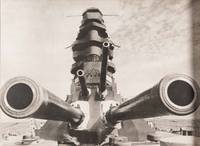
194248810Tokyo: Tokyo Nichinichi Shimbunsha æ±äº¬æ—¥æ—¥æ–°èžç¤¾ 1942. First edition. Hardcover. g to vg. Oblong quarto. Unpaginated. 36 printed double-sided leaves. Housed in a tan cardboard slipcase with black lettering on the front cover and spine. Blue paper boards with embossed silver lettering and geometric decorative designs on the covers. Photo-illustrated title page.<br /> <br /> This scarce work is a striking piece of photographic propaganda displaying the power and glory of the Japanese Imperial Navy during WWII. Illustrated throughout with a total of 74 mostly full-page b/w collotype images including stunning aerial photography.<br /> <br /> The photobook is divided into two parts: the first one is concerned with naval training while the second part deals with the unfolding course of the war being a record of Japanese successes from Pearl Harbor Malaya New Guinea and other parts of South East Asia. <br /> <br /> This is one of the very first publications to have show and extended pictorial account of the bombing of Pearl Harbor including a number powerful and dynamic images two of the images seen to be illustrations. Includes also numerous b/w Soviet-style photographic plates of naval guns battleships submarines and military planes as well as photographs of operations in China Java Borneo Philippines New Guinea and other areas in Southeast Asia. None of the images are credited to a particular photographer but included is work by Matsugi Fujio and possibly Kimura Ihei. The beginning of the section contains a finely detailed illustrated map showing Japanese naval positions and battles across the pacific theater.<br /> <br /> Text and captions throughout in Japanese.<br /> <br /> Slipcase with some light scratches as well as minor age toning and smudges. Corners rubbed and lightly chipped. Binding with minor stains smudges and scratches to the covers. There is a small 1/2" stain on the upper right corner of the front cover. Edges lightly rubbed with the head of the spine lightly chipped. Interior covers and endpaper lightly damp-stained. Gutters of interior covers reinforced. Book block tight. pages throughout very clean. Slipcase in good binding in very good- interior in very good condition overall. Slipcase and binding protected in modern mylar. Tokyo Nichinichi Shimbunsha (æ±äº¬æ—¥æ—¥æ–°èžç¤¾) hardcover
186341236New York: Currier & Ives 1863. Folio lithograph broadside oblong 18" x 13-1/4." A few vertical folds with a closed tear along the end of one fold no loss; expertly repaired on verso with archival tape. Light spotting and wear Good.<br /> <br /> John Bull representing Great Britain holds a large clump of cotton in one hand. He grabs a kneeling slave by the hair i.e. "wool" with his other hand exclaiming "Well yes! it is certain that Cotton is more useful to me than Wool!" Two other black men stand in the back left; one covers his face crying. A man in a wide-brimmed hat with a goatee stands to the back right smiling at the scene. A large bail of cotton stands to the right of Bull.<br /> "Racist cartoon reflecting the Northern fear that Britain's economic ties with Southern cotton growers would cause the British government to relinquish its abolitionist stance in order to support the Confederacy. Depicts a plump John Bull representing Great Britain centered between a kneeling enslaved African American man and a bale of cotton in a storage shed. Bull touches the hair of the African American man with his right hand and holds a piece of the cotton from the bale in the other. He declares 'it is certain that Cotton is more useful to me than Wool!!/ In the left background two African American men stand and cry. In the right background a Southern white man plantation owner looks on and smiles" LCP description on line.<br /> Conningham 3257. Weitenkampf 133. Reilly 1861-40. OCLC 191119968 2 191908779 1 as of August 2025. Currier & Ives unknown
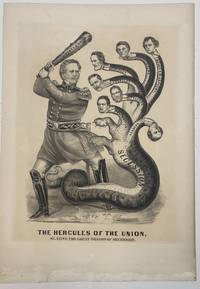
186139672New York: Currier & Ives 1861. Lithograph 12" x 17". Light lower margin wear. This imprint does not have "General Scott" directly beneath the picture and preceding the caption as an almost identical version does. Very Good.<br /> <br /> "A tribute to commander of the Union forces Gen. Winfield Scott shown as the mythical Hercules slaying the many-headed dragon or hydra here symbolizing the secession of the Confederate states. At left stands Scott wielding a great club 'Liberty and Union' about to strike the beast. The hydra has seven heads each representing a prominent Southern leader. The neck of each Southerner depicted is labeled with a vice or crime associated with him" Reilly. <br /> The Southerners are Toombs Stephens Davis Beauregard Twiggs Pickens and Floyd labeled variously as Hatred and Blasphemy Lying Piracy Perjury Treason Extortion Robbery. <br /> This is the variant noted by Weitenkampf omitting the name of Scott in the title.<br /> Reilly 1861-35. Weitenkampf 131. OCLC 191119921 2- Peabody Essex Boston Athenaeum as of November 2023. Not at the AAS online site. Currier & Ives? unknown
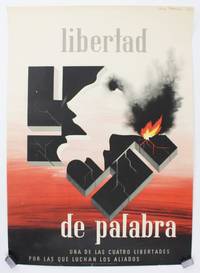
19424754Washington DC: El Coordinador de Asuntos Interamericanos 1942. Very good. Pictorial lithograph 20 x 14.25 inches printed in red gray yellow and black. Minor surface wear mild creasing light dust-soiling a few pinholes. A rare poster issued by the Office of the Coordinator of Inter-American Affairs CIAA during World War II attempting to sway public opinion in Latin America to the Allied side. The CIAA was established by executive order in July 1941 in order to distribute news advertising film reels and more to and from Latin America to counter Italian and German propaganda campaigns in the region. The text of the present poster translates from the Spanish as "Freedom of Speech. One of the four freedoms for which the Allies are fighting." The central image features an open-mouthed face breaking open a large swastika which is itself on fire. A mildly subtle message that free speech destroys fascism. The poster was designed by noted Russian-American graphic designer and photographer Alexey Brodovitch whose printed credit appears at top right; Brodovitch is most well-known for his art direction of Harper's Bazaar from 1934 to 1958. A powerful visual display with only one copy reported in OCLC at MOMA though we also find two other institutional holdings at the United States Holocaust Museum and the Hoover Institute. El Coordinador de Asuntos Interamericanos unknown
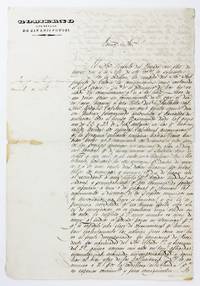
18475172San Luis Potosi: May 8 1847. About very good. 2pp. Previously folded. Short closed tear and minor loss at edges of old horizontal fold. Small area of light staining. Accomplished in a neat secretarial script. A fascinating letter from the governor of San Luis Potosí Ramon Adame that relates reports on the northern front of the Mexican-American War written two months after the Battle of Saltillo and just days after the American invaders had captured Puebla to the south. The letter is addressed to Ignacio de Mora y Villamil the General-in-Chief of Mexico's northern army presumably with the goal of spurring action from his forces with this new information. Adame discusses troop movements and defenses in Real de Catorce and Matehuala to the north and relates reports from Mexican officers that 10000 American reinforcements were approaching Saltillo and Monterrey:<br /> <br /> "Los referidos Capitanes aseguraron que la proxima entrante semana hacian sino habian hecho ya movimiento en direccion a estos puntos las fuerzas enemigas en numero de ocho a die mil hombres: que de Agua Nueva al Saltillo hay de cinco a seis mil y el resto en Monterey. En Matehuala hoy corre la voz unisona que dentro de quince o a los mas veinte dias deben llegarse por estas villas los enemigos."<br /> <br /> He then writes at length concerning the need to improve observation of the nefarious American enemies in order that news might be received quickly and directly and inquires as to how to pay for such agents:<br /> <br /> "Al vecindario a una finita para acordar medidas salvadores y principalmente que por carensia de fondos se espensare a una o dos personas que observase los moviminetos y direccion de los perfidos enemigos norte americanos no logre reuniera y ya la esperienca acreditada que no tienen efecto esta clase de emerciones. Lo que traslado a V.S. para conocimineto del E.S. Gobernador y con el fin de que se sirva decirme de que fondos puede hacerse el gasto para los agentes vigilan los operaciones del enemigo." <br /> <br /> A very interesting snapshot of the lack of resources and organization that led to rapid defeat in the Mexican-American War. May 8 unknown
1833List508Mexico 1833. First Edition. Mexico: May 23 1833. Letter and chart on watermarked single folio sheets approx. 13 x 16-½ inches letter: 3 pp.; chart: 2 pp.;. Near Fine. Rare first-hand documentation of the growing trade tensions that eventually led to the French-Mexican “Pastry War†of 1838. Consul Hersant’s gossipy report surveys the “commercial movement of the port of Tampico since it’s opening in 1824 until the end of 1832.†Hersant complains to his superiors that Mexican trade with the US and England far outpaces France; even the Hanseatic League has become a problem. The Consul includes a hand-drawn table tallying foreign ships and the weight of goods by country a visual aid supporting his claim that French trade lags considerably behind other partners. <br /> <br /> Ultimately it is civil disorder that most disturbs the Consul; that is smuggling assisted by the Mexican customs officers themselves: "se fait impunément et avec l'aide des douaniers eux-mêmes et peut porter au double la quantité de marchandises qui entrent du dehors." Indeed the early years of the Mexican Republic were marked by a notable lack of governmental accountability toward foreign governments or private property owners as various internal parties struggled for power. This disregard eventually led King Louis-Philippe’s government to sue for damages against Mexico on behalf of French citizens doing business there. The most famous claimant was a pastry chef who claimed his shop had been looted. In 1838 when the amount went unpaid the French invaded Veracruz and blockaded Mexico’s Atlantic ports beginning the so-called Pastry War.<br /> <br /> References to Hersant can be found in other histories of the French attempt to gain ground in Mexico e.g. establishing alternative shipping passages inland to compete with North American traders. Overall a scarce pair of documents in excellent condition with minimal normal wear. unknown
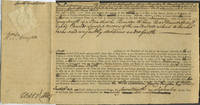
1776105881776. Ephemera. Very good condition. A Revolutionary War period writ issued in Charleston South Carolina signed by William Henry Drayton. A large sum of money is demanded of William Bath pilot of Charleston by James Smyth. Bath is not present in Charleston and somehow the writ is transferred to Sarah Johnson who it is inferred is in possession of Bath's property including a Negro girl named Lucey. The sheriff Thomas Gimbell executes the writ on Sarah Johnson. <br /> <br /> The writ is executed at a transition time for the American colonies from the Colonial to the Revolutionary War period. The form was issued on September 17 1776 just 2 months after the Declaration of Independence. As such all the pre-printed areas that refer to the "Province" South Carolina are crossed out and "State" is inserted. "Year of our Reign is also crossed through. The money demanded is in pounds. Included in the writ is reference to a "negro named Lucey with one Sarah Jones in Union Street" with a long statement by Thomas Gimball Sheriff of Charles Town signed. The writ was served Oct. 17 1776 and filed Jan 10th 1777. The witness is the Hble. William Henry Drayton Chief Justice at Charleston. <br /> <br /> It is not completely clear which William Drayton has signed the writ. It is most likely that of William Henry Drayton Sept. 1742-September 3 1779. He was the son of John Drayton and Charlotta Bull daughter of the colony's Governor William Bull. He was educated in England at Westminster School and Oxford before returning home in 1764. He served as a delegate for South Carolina to the Continental Congress in 1778 and 1779. He died of typhus in Philadelphia while in office. His signature "Wm Hy Drayton" is on the left side of the writ partially obscured by the duty stamp. <br /> <br /> However his cousin was William Drayton Sr. 1732-1790. Also born in Ashley River South Carolina he was the son of Thomas Drayton III & Elizabeth. Drayton was educated in the Middle Temple in London England in 1754. He read law to enter the South Carolina Bar in 1756 and was thereafter a Justice of the peace for Berkeley County South Carolina until 1763. From 1763 to 1780 he was Chief justice for the Province of East Florida. In 1789 he was a judge of the South Carolina Admiralty Court and an associate judge of the South Carolina Supreme Court appointed by George Washington. <br /> <br /> William Bath is included on the Grand Jury List for the "District of George Town" Parish of Prince George in 1778 & 1780. There is a marriage record for a William Bath to Elizabeth Baker widow on 2 Nov 1771. South Carolina Magazine of Ancestral Research Vol 10 #3. Sarah Jones is possibly the widow of Thomas Jones Sr whose will was probated in 1773. In the 1790 census she is listed as the head of the household with 2 boys under 16 and 2 women and no slaves. In 1800 just the mother and daughter comprise the household. In 1806 & 1809 she is listed as a seamstress in two different Charleston directories Negrin's directory and Almanac for the year 1806 and Directory for the District of Charleston 1809 by Richard Hrabowski. There are a series of James Smith's spelled Smyth in the writ. James Smyth is listed in Charleston in 1758; in 1780 he is on the Petit Jury List for the "District of Charles Town Johns Island Colleton County"; in the 1790 Federal Census he is in the parish of St. Phillips and St. Michaels in Charleston with no slaves. <br /> <br /> Alas there is no further reference to "Lucey". <br /> <br /> The heading is trimmed off the top and it appears that this area referred to the King and was hence trimmed off. Written carefully below is "The State of South Carolina to all Singular the Sheriffs of the State aforesaid Greeting. Laid paper 13 x 6 3/4" printed on one side with manuscript additions docketed manuscript notations on the verso. Uniformly tanned. unknown
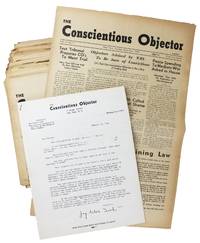
19454497New York: War Resisters League 1945. Very good. Fifty-two issues plus editor's circular letter. Each regular issue 8pp. on newsprint folded as issued. Minor even toning overall occasional minor edge wear or chipping. Significant collection of The Conscientious Objector a monthly newspaper issued throughout the period of the Second World War by the War Resisters League the oldest secular pacifist organization in the United States. A legion of issues are covered in the pages of these newspapers including the military draft reports on the treatment of conscientious objectors around the country legal cases involving pacifists reports on Japanese conscientious objectors articles on women draft resisters and much much more. Many of the articles concern conscientious objectors living at a variety of Civilian Public Service CPS camps established during World War II camps that interned citizens who claimed the right to refuse to perform military service on the grounds of freedom of thought conscience or religion. During these years the League was heavily involved in attempts to achieve the release of all conscientious objectors from works camps and imprisonment and to obtain amnesty for those found guilty of violating the Selective Service Act. One of the more interesting articles in the present collection published in the September 1942 issue is headlined "Indian Movement an Inspiration for Negro Aims in America." The editor's circular which accompanies the issues here details some of the work of the WRL and asks for subscriptions. The following issues are offered here:<br /> <br /> Vol. II Nos. 4 and 5.<br /> Vol. III Nos. 1 2 3 4 and 7.<br /> Vol. IV Nos. 1 3 4 6 7 8 9 10 11 12.<br /> Vol. V Nos. 1 2 5 6 8 9 10 11 and 12 plus a single broadside extra dated August 6 1943.<br /> Vol. VI Nos. 1-12 complete year.<br /> Vol. VII Nos. 1 2 3 7 8 9 10 and 11. <br /> Vol. VIII Nos. 1-5. War Resisters League unknown
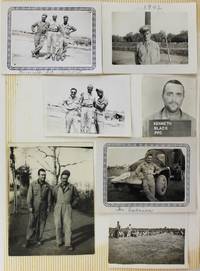
19453142Various locations in Europe mainly Italy but also France and Germany 1945. Very good. Forty-seven album leaves and plastic sleeves illustrated with approximately 350 photographs many with manuscript annotations a handful of personnel documents and numerous ephemeral items. Later black three-ring binder used to re-house original album leaves and sleeves. Moderate soiling to album. Contents largely in nice shape. A unique view of the European region of World War II through the eyes of Kenneth Black a U.S. Army private then later corporal hailing from Lamont Oklahoma where he worked as a farmer. This densely-packed collection of photographs and ephemera documents Black's service as a truck driver for the 527th Fighter Squadron in France Italy and Germany during the conflict. While there Black participated in several battles in Italy southern France and Central Europe earning six commendations including a Good Conduct Medal. Black enlisted in the Army on April 14 1942 and served throughout the war mustering out on October 24 1945.<br /> <br /> The photographs include dozens of portraits of Black posing by himself or with fellow named soldiers and capturing them posed with their vehicles on airfields and in camp walking the streets in various European cities along the Italian coastline at Mount Vesuvius visiting bombed out fields south of Rome and various ruins posed at the Pisa Airfield traveling along the Rhine River and the autobahn in Germany and more. There are also dozens of images of fighter planes a handful showing their nose art taken from the airfield and sometimes from inside the airplanes themselves. A handful of images record crashed aircraft on various airfields or bombed out cities. Identified locations include the French island of Corsica; the Italian cities of Caserta Pisa where he had a particular fascination with the Leaning Tower snapping about ten pictures Salerno Naples Rome where he is obviously enamored of the architecture of the city Grossetto and Pomig; and the German towns of Darmstadt "before the bombs went to work on it" and Mannheim. He also includes images of the 86th Fighter Group Orchestra playing at a hospital in Rome and floods near Pisa and Grossetto.<br /> <br /> The ephemeral items include two different versions of Black's honorable discharge his "Separate Qualification Record" a letter he wrote home while in Europe a mimeographed illustrated roster of the 527th Fighter Squadron various mimeographed newsletters menus and similar publications collected during the war newspaper clippings and later extracts from magazines showing locations Black visited during his service. A large collection of images featuring a humble Oklahoma farmer lumbering through three different European countries during the Second World War. unknown
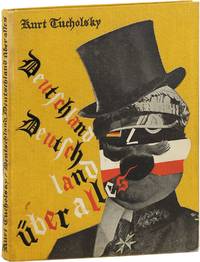
192984810Berlin: Neuer Deutscher Verlag 1929. First German Edition. First Printing cloth issue with 1.-20. Tausend printed on title page. Octavo 24cm; yellow decorative cloth with photomontage by John Heartfield applied to covers and titles stamped in black on spine; yellow topstain; 231pp 5; illus; text is in German. Contemporary October 1929 owner's name penciled to front endpaper; slight forward lean light overall dust-soil to cloth with pictorial elements well-preserved and largely unrubbed; browning to endpapers with mild wear to base of spine; a presentable copy Very Good lacking the rare dustjacket. A powerful piece of social criticism by Tucholsky one of the most prominent German-Jewish authors and journalists of the Weimar Republic. Produced with graphic designer John Heartfield Tucholsky managed to combine vicious attacks on everything he disliked about Germany with a declaration of love for his country. He warned of a government with anti-democratic tendencies and the impending threat of National Socialism - a plea almost to revolutionize a dormant country - though his fears were realized in 1933 when Hitler assumed the position of Chancellor of Germany. Axel Eggebrecht one of Tucholsky's contemporaries said of Deutschland: "If this book were to turn out to be quite a big success it might be realized that the dream of awakening is still very vivid in Germany." Deutschland was listed on the Nazis list of censored books and though it did go through a second printing few enough survived destruction. <br /> <br /> The present example is one of apparently two variant bindings for the first printing with no extablished priority known to us. While the pictorial cloth binding is the variant we have seen and handled most often we note another in yellow cloth without the pictorial elements and titles stamped in black on spine and front cover. A well-preserved example and a high-point of Heartfield's graphic design and layout work. Pachnicke & Honnef 60a-69 p.148-161. Neuer Deutscher Verlag unknown
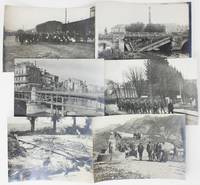
19184184Various locations in Europe mostly France 1918. Very good. 206 original black-and-white photographs between 3.5 x 2.5 inches and 5 x 7 inches. Occasional minor wear light chipping or short tears to images but most are in very good or better condition. An informative collection of contemporary photographs detailing the impact of the First World War in France. The images include numerous images showing the destruction of the war across France some casualties of the war group portraits of military officers and politicians street scenes and parade shots picturing dignitaries and military figures often in motorized vehicles but sometimes on horseback or on foot scenes along railroad lines scenes in factories both functional and bombed out numerous shots featuring the architecture and statuary in France street scenes in numerous French towns and villages and much more. A handful of small groups of images are held within a single sheet of paper identifying a common location or shared subject matter such as a pair of images from Saint-Quentin including a photo of a group of German prisoners at a rail station there seven images of flowers in Toulouse several images in Amiens including street scenes and a few with military content numerous images in Reims and Verdun three images documenting the destruction in Noyon and so forth. In addition to the war content the collection provides a broad view of the urban architecture and variety of landscape in World War I-era France among other research-worthy topics. <br /> <br /> Particularly interesting images feature a group of women busily writing dispatches a larger group of women working in a textile factory the statue of Joan of Arc in Reims soldiers cutting vegetables outside the citadel at Verdun the ruins of Sainte-Genevieve a town scene in the village of St. Martin a large group of men repairing the railroad an elderly woman standing below a bombed-out elevated railroad in Charleville and a crowded street scene and parade in Reichshoffen. Two images feature soldiers and resident of Reims rescuing large framed paintings from the Hôtel de Ville; both images feature men carrying a single large painting down the cobblestoned streets of the city.<br /> <br /> In addition to the images featuring human subjects and scenery four photographs memorialize signage the photographer came across in his time in Europe. One concerns the evacuation of a town in France in April 1916 another informs the French public that German soldiers are only allowed to pay for goods with certain vouchers the third sign lists the officials responsible for railway security in Noyon dated October 8 1916 and the last pictures a British Red Cross poster. The collection is rounded out by a handful of images in Sweden England and Egypt. The photographs are occasionally annotated on the verso in pencil identifying the subject location and/or the setting of the images. Several of the images include a personal stamp on the verso belonging to William H. Tolman Ph.D. of Pawtucket Rhode Island and New York City. According to newspaper records Dr. William H. Tolman 1861-1958 was a "social economist" and "social service expert lecturer and writer" who graduated from Brown University was an active citizen of Pawtucket was decorated by the regent of Hungary for creating a chapter of the YMCA in that country and while in New York City founded and served as the director of the American Museum of Safety and Sanitation from which he resigned in 1916. From about that year to 1920 Tolman engaged in welfare work in Europe and served as director of the YMCA in Bordeaux France spurring his personal interest in France and the First World War. A fascinating group of photographs documenting numerous scenes during the First World War. unknown
186421371<p><i>Report of the Select Committee Relative to the Soldier's National Cemetery Together with the Accompanying Documents as Reported to the House of Representatives of the Commonwealth of Pennsylvania March 31 1864.</i></p> <b>ABRAHAM LINCOLN.</b>Book. Includes a foldout map of the planned cemetery and a copy of Lincoln's dedication. Published in Harrisburg 1864. Fair condition. <br /> hardcover books
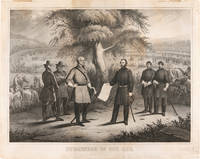
WRCAM55725Philadelphia: John Smith 1865. Lithograph 21 1/4 x 26 1/2 inches. Margins with surface rubbing and soiling. Four-inch closed tear in upper margin descending into the image two-and-one-half- inch closed tear in lower margin ascending into the image no paper loss in either case. Backed by later paper mending tears and a few small chips in edges of sheet. Very nice tone to the image. Good overall. Apparently a rare unrecorded proof of this lithograph commemorating the meeting between Ulysses S. Grant and Robert E. Lee at Appomattox Courthouse on April 9 1865 at which Lee surrendered the Army of Northern Virginia and the Civil War essentially came to an end. This print is not only important as a proof giving evidence of how the image was reworked for final publication but also as part of a series of prints commemorating Lee's surrender that did so much to bolster the image of Grant as the "savior of the Union." "No single event of Ulysses S. Grant's life inspired more prints than the surrender he accepted at Appomattox." - Neely & Holzer. <br> <br> The present image bears the title SURRENDER OF GEN. LEE only with no publication copyright or artist information. In the image Grant and Lee meet in the open air before a large tree not indoors as was actually the case. Grant standing to the right holds the surrender terms in his right hand extended toward Lee. Lee one gloved hand on his hip and the other on the hilt of his sword stares steadily at Grant but makes no move toward the paper. Grant and Lee are each accompanied by a pair of aides who gaze at each other suspiciously. In the receding background thousands of troops are shown formed in long curving lines while a handful of officers ride horses. In the version of this print as finally published by John Smith of Philadelphia the positions of Grant Lee and their aides have been reversed and Lee extends his hand toward Grant ready to accept the terms of surrender. The configuration of the armies in the background has been modified and a prominent scar has been added to the trunk of the tree between the two leaders. In both this proof and the final version of the print Grant's uniform has been improved from what he actually wore - he still does not match the splendor of Lee but he is not shown wearing the uniform of a private with the straps of a Lieutenant General. "Here" as Neely & Holzer observe "the lithographer's notions of creating a picture for posterity do battle with widely reported truth." The title of the final version was modified to THE SURRENDER OF GENERAL LEE AND HIS ENTIRE ARMY TO LIEUT. GENERAL GRANT APRIL 9th 1865 Library of Congress control number 2015647830. NEELY & HOLZER UNION IMAGE pp.169 & 174. John Smith unknown books
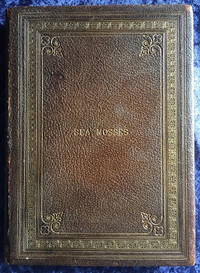
186424170<p><i>"call us not weeds we are flowers of the Sea."</i></p> <b>CIVIL WAR. ANNA BIGELOW.</b>Autograph Manuscript Signed unique calligraphy book with illustrations pressed sea weeds and hand lettered four lines of verse titled 'Sea Weeds.' New York N.Y 1864. 7½ x 10½ on 60-plus pages with 31 moss examples interleaved.<p>Album donated to benefit Union soldiers presented at the New York Metropolitan Fair held on March 28 1864 to raise funds to aid sick and wounded Union soldiers. The Metropolitan Fair was organized to benefit the Sanitary Commission a private relief agency authorized by federal legislation in 1861. The Commission raised an estimated $25 million in revenue more than $386 million today and enlisted thousands of volunteers. A New York Times article on Jan. 1 1864 provided a preview: "Every branch of agriculture trade industry and art will be invited to contribute its choicest and costliest products for exhibition and sale. Musical and dramatic artists will be invited to aid the common cause with their talent and genius. All the material resources of the great City of New-York and of the region directly tributary to it are to be invoked."</p><p>The great success of an earlier Chicago fair inspired many women in the North to become involved. The Metropolitan Fair included everything from "Architectural Ornaments" to "Wines & Liquors" to "Wholesale Millinery Goods." Commemorative and ceremonial objects were often specially designed for the Sanitary fairs. Anna Bigelow's album of sea mosses may have been displayed in the "Arrangements and Decoration" section.</p><p>When Northerners attended fairs donated money or goods or volunteered their time they were aiding the soldiers on the front lines. Autographs of leading Americans were often sold; Lincoln even donated an autograph manuscript of the Gettysburg Address to the New York Fair where it sold for $1000. For Chicago's Great Northwestern Fair Lincoln donated his original signed draft of the Emancipation Proclamation with an accompanying letter stating his "desire to retain the paper but if it shall contribute to the relief or comfort of the soldiers that will be better."</p><p>The elaborately hand lettered and decorated title page of this album bears a small signature "Ellsworth" and "819 Broadway." Henry W. Ellsworth is listed in New York's Manual of the Board of Education as a penmanship instructor at School No. 47 on Twelfth Street between Broadway and University Place p. 295. There is also an inscription "Drawn by E. W. Gandy 1864" at the top of the front free endpaper.</p><p><b>Condition</b></p><p>All edges gilt. Elaborately gilt stamped brown morocco gift binding with white silk linings with gilt title "Sea Mosses" at front board and "Album" at spine. A bit chipped top of spine. Internally a bit marked at the silk linings. The plates in very good condition with the each sea moss plate a delicate floral arrangement. Front cover detached. Some soiling and foxing.</p> hardcover books
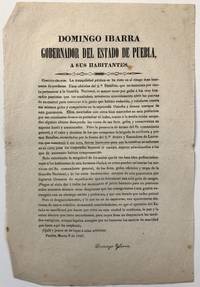
18471729Puebla 1847. Very good. Broadside 12.5 x 8.5 inches. Minor foxing and toning. An unrecorded broadside that prints the thanks and admonitions of the Governor of Puebla Domingo Ibarra following an attempted insurrection there in late February and March 1847 during the Mexican-American War. The uprising was a part of the so-called Polkos Rebellion that followed popular outrage at a January law that allowed the federal government to seize church property in order to pay for the war effort. In Puebla the revolt involved elements of the city's military garrison but was successfully put down by the rest of the guard. Ibarra begins by lamenting the sedition and thanking the loyal portion of the garrison:<br/><br/>"La tranquilidad publica se ha visto en el riesgo mas inminente de perderse. Unos oficiales del 2o Batallon que no merecian por cierto pertenecer á la Guardia Nacional ni menos tener por gefes a los muy honrados patriotas que los mandaban intentaron atrevidamente abrir las puertas de su cuartel para convocar á la gente que habian seducido y rebelarse contra sus mismos gefes y compañeros en la espresada Guardia y demas cuerpos de esta guarnicion. Solo calculando la magnitud de los males que de tan loca idea podian sobrevenir á los habitantes de esta hermosa ciudad es como puden estimarse los servicios del Sr. comandante general de los Sres. gefes oficiales y tropa de la Guardia Nacional y de los otros benémeritos cuerpos de esta guarnicion que lograron librarnos de aquellos sin que derramase una sola gota de sangre."<br/><br/>And he continues by warning the citizens of Puebla against continued foolishness in the face of the enemy and also by asserting his resolve to resist further insurrection:<br/><br/>¡Plegue al cielo dar à todos los mexicanos el juicio bastante para no provocar sobre nostros mismos otras desgracias que las consiguientes à una guerra extrangera con un enemigo astuto y ponderoso y que nos invade por todas partes! Pero si desgaciadamente y lo que no es de esperarse aun aparecieren sìntomas de nueva rebelion descansad conciudadanos en que el ejecutivo del Estado se sacrificará por hacer que reine en esta ciudad la confianza la paz y la union sincera que tanto necesitamos."<br/><br/>A strong statement by a clearly relieved Mexican state official. We locate no copies in OCLC or available sales records. unknown books
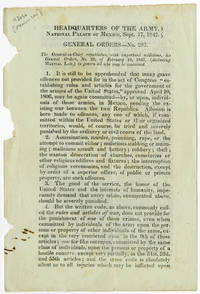
1847WRCAM42040Mexico City 1847. 4pp. printed on a. single folded sheet. Old vertical crease. Three tears along the central fold resulting in loss of paper but no text. Very good. A rare copy of an important order issued by Gen. Winfield Scott just days after his victory at the Battle of Chapultepec and his taking of Mexico City. Chapultepec was the final victory in Scott's march to the Mexican capital following victories at Cerro Gordo Contreras Churubusco and Molino del Rey. Largely outnumbered against Santa Anna's forces Scott produced a series of stunning victories leading to his capture of Mexico City and the issuance of this broadside which seeks to establish order by proclaiming martial law in the capital. <br> <br> A preamble to the General Orders announces that this is a restatement "with important additions" of Scott's order of Feb. 19 1847 issued from Tampico which also declared martial law. In the present order meant to maintain order in the newly conquered city Scott lays out the prohibitions for a wide variety of acts including assassination murder poisoning rape assault robbery theft the desecration of churches and cemeteries and more. Significantly he announces that such rules will apply equally to Americans as to Mexicans. He points out that these laws are important not only to guide his army but "for the protection of the unoffending inhabitants and their property about the theatres of military operations against injuries on the part of the army contrary to the laws of war." Scott further extends martial law to any part of Mexico under the control of U.S. forces. Lastly he announces that the American army will safeguard all of the churches monasteries convents inhabitants and property in Mexico City and announces a "contribution" of $150000 to be imposed on the capital to pay for these services payable in four equal installments. <br> <br> The order is signed in manuscript at the end by Winfield Scott's Assistant Adjutant General H.L. Scott. Garrett locates the copy at the University of Texas at Arlington and OCLC adds copies at the California State Library Sutro copy and the University of North Carolina. GARRETT p.390. OCLC 52501908. unknown books
184724284Mexico City 1847. 4pp. printed on a single folded sheet. Old vertical crease. Three tears along the central fold resulting in loss of paper but no text. Important order establishing martial law in Mexico City.<br/> <br/>A rare copy of an important order issued by General Winfield Scott just days after his victory at the Battle of Chapultepec and his taking of Mexico City. Chapultepec was the final victory in Scott's march to the Mexican capital following victories at Cerro Gordo Contreras Churubusco and Molino del Rey. Largely outnumbered against Santa Anna's forces Scott produced a series of stunning victories leading to the capture of Mexico City and the issuance of this broadside which seeks to establish order by proclaiming martial law. A preamble to the General Orders announces that this is a restatement "with important additions" of Scott's order of February 19 1847 issued from Tampico which also declared martial law. In the present order meant to maintain order in the newly-conquered city Scott lays out the prohibitions for a wide variety of acts including assassination murder poisoning rape assault robbery theft the desecration of churches and cemeteries and more. Significantly he announces that such rules will apply equally to Americans as to Mexicans. He points out that these laws are important not only to guide his army but "for the protection of the unoffending inhabitants and their property about the theatres of military operations against injuries on the part of the army contrary to the laws of war." Scott further extends martial law to any part of Mexico under the control of U.S.forces. Lastly Scott announces that the American army will safeguard all of the churches monasteries convents inhabitants and property in Mexico City and announces a "contribution" of $150000 to be imposed on the capital to pay for these services payable in four equal installments. The order is signed in manuscript at the end by Winfield Scott's Assistant Adjutant General H.L. Scott. Garrett locates a copy at the University of Texas at Arlington and OCLC adds copies at the California State Library Sutro copy and the University of North Carolina.<br/> <br/>Garrett p.390; OCLC 52501908. unknown books
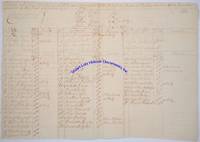
4943MASSACHUSETTS MUSTER ROLL. DS. 2pg. 15 ½†x 10 ½â€. January 1778. No place near Boston. A “Muster Roll of Capt. Ford Company of Militia now in Service of the United States for the Purpose of Guarding the Troops of the Convention Commanded by Col. Eleazer Brooks Taken to Jany 1778â€. The roll of American officers and soldiers lists one captain three lieutenants four sergeants four corporals two drummers and fifty privates. After the British defeat at Saratoga in the fall of 1777 the British prisoners of war were marched to the Boston area; they were later marched to Richmond Virginia. It is signed on the back by Captain Ford Secretary Reed and a Justice of the Peace. Eleazer Brooks 1727-1806 was a farmer and an official in Lincoln Massachusetts. He served as a colonel in the militia and marched on Dorchester Heights. He was later promoted to brigadier general and he represented Lincoln at the Massachusetts ratification of the Articles of Confederation in 1778. The document has the usual aging and wear and dark legible ink. A most unusual Revolutionary War manuscript. unknown books
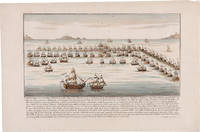
1782WRCAM56168Augsburg 1782. Handcolored engraving 11 1/2 x 17 3/4 inches. Some light soiling and tanning. Near fine. Matted. An attractive and well-preserved contemporary print by German engraver Johann Martin Will with delicate hand-coloring depicting the British and French fleets in combat formation during the Battle of the Saintes also known as the Battle of Dominica/Bataille de la Dominique. Britain's victory over the French navy in April 1782 effectively ended French control of the Caribbean. The engraving depicts over eighty ships which are keyed for identification in captions in German below the image. The upper middle ground depicts Rodney's flag ship "Formidable" and two supporting vessels attacking and breaking the French line. Among the many other ships identified are the flagship of the French admiral Comte de Grasse's "Ville de Paris" here identified as "Stadt Paris" as well as Sir Francis Samuel Drake's division Admiral Samuel Hood's division and the Prince George which according to this account broke its main mast while breaking the line. Also depicted is the French fleet's attempt to reestablish the line in which they have little luck as ships were already starting to flee. <br> <br> The battle was named after the Saintes a group of islands between Guadeloupe and Dominica in the West Indies. The year before the French fleet under de Grasse had decisively defeated the British fleet in the Battle of the Chesapeake and then blockaded the coast until Cornwallis surrendered at Yorktown helping to secure American victory in the Revolution. This time the British fleet soundly defeated the French capturing the flagship and de Grasse the first French admiral in history to be captured by an enemy and inflicting significant causalities. This emboldened the British in the ongoing negotiations with the Americans and French as well as in ongoing conflicts with Spain. The French-American alliance effectively dissolved and Britain reaffirmed its claims on the Newfoundland fisheries and Canada. Further the French and Spanish abandoned their planned invasion of Jamaica focusing instead on protecting their existing holdings. <br> <br> Johann Martin Will 1727-1806 was a prominent engraver and publisher in Augsburg who specialized in producing images for the British and American markets. A most uncommon image of an important naval battle in the West Indies. unknown books