Civil WarABAA
119 774 résultats
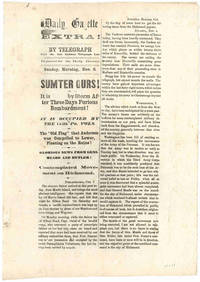
1863WRCAM45995N.p. but possibly Williamsport Pa 1863. Broadside 10 1/4 x 7 1/2 inches. Minor wear and soiling. One small tear in left margin. Very good plus. A vivid Civil War broadside showing the immediacy of the news from the front as well as how garbled or false information was disseminated. The headlines further trumpet: "It is occupied by the 144th Pa. Vols. - The 'Old Flag' that Anderson was compelled to lower floating on the ruins! - Glorious news from Gens. Meade and Butler! - Contemplated movement on Richmond." Despite resumption of a terrific bombardment of Fort Sumter on October 26 the fort did not fall to Federal forces. Thousands of rounds were dropped on the fort but it stayed in Confederate hands another sixteen months until evacuated on February 13 1865. It certainly was not occupied by the 144th Pennsylvania Volunteers and Major Anderson's "Old Flag" did not fly over the fort until two hours before the death of Abraham Lincoln on April 15 1865. The whole second column of text concerns events in the Western Theater Georgia Tennessee and Alabama and the progress of the Army of the Potomac in Virginia: <br> <br> ".General Meade was on the march for the city of Richmond under circumstances which rendered it almost certain that he would capture it. The report of the evacuation of Richmond.is of course all bosh.The details of the great movement now being executed I am not allowed to telegraph you.the objective point of the combined command is the city of Richmond." unknown books
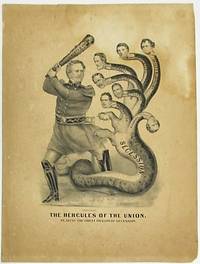
186134445New York: Currier & Ives 1861. Lithograph 13-1/2" x 18". Paper browned but images clear. Short closed tear at top blank margin minor chipping to two corners. Very Good.<br/><br/> "A tribute to commander of the Union forces Gen. Winfield Scott shown as the mythical Hercules slaying the many-headed dragon or hydra here symbolizing the secession of the Confederate states. At left stands Scott wielding a great club 'Liberty and Union' about to strike the beast. The hydra has seven heads each representing a prominent Southern leader. The neck of each Southerner depicted is labeled with a vice or crime associated with him" Reilly. The Southerners are Toombs Stephens Davis Beauregard Twiggs Pickens and Floyd labeled variously as Hatred and Blasphemy Lying Piracy Perjury Treason Extortion Robbery. According to Weitenkampf a variant omits the name of Scott in the title.<br/>Reilly 1861-35. Weitenkampf 131 7 locations. OCLC 191119921 3- AAS Peabody Essex Boston Athenaeum as of December 2017. Currier & Ives? unknown books
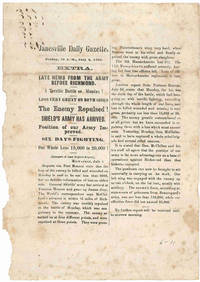
1862WRCAM45999Janesville Wi. 1862. Broadside 8 1/2 x 6 inches. Light wear and foxing. Very good. An unrecorded Civil War broadside publicizing a dispatch from Union Gen. George B. McClellan following The Seven Days' Battles which occurred between June 26 and July 2 1862. In the course of that week Union and Confederate forces fought a series of battles in five different locales. At the end of these engagements the Confederates withdrew to Richmond. This EXTRA provides information about losses and casualties and states: "Gen. McClellan and his big staff all agree that the position of our army is far more advantageous as a base of operations against Richmond than that hitherto occupied." Although most of the battles in the Seven Days can be considered Union victories the overall outcome of the campaign was still not particularly successful for the Union due to McClellan's weaknesses as a commander in the field. Afterwards the Union's Peninsular Campaign was abandoned and the majority of McClellan's men were transferred to John Pope's army in Northern Virginia. unknown books
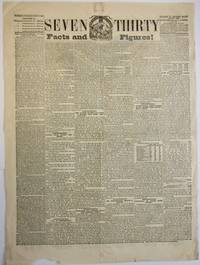
186537449Philadelphia 1865. Elephant folio broadsheet printed in six columns on recto and on verso. 15-3/4" x 21-1/4." Engraving of Screaming Eagle with shield bearing scroll inscribed "Your Sons and your Money on your Country's Altar!" Blank lower margin chip. Very Good.<br/><br/> The words to twenty-one patriotic songs are printed on the recto beginning with "Hail Columbia" followed by "Yankee Doodle" "The Star Spangled Banner" "John Brown's Soul" "Johnny is Gone for a Soldier" and ending with "The Volunteer's Wife to her Husband." The Library Company's entry calls this item "Rare" although OCLC records other institutional holdings.<br/> The verso is titled "SEVEN THIRTY Facts and Figures!" It discusses the Nation's ability to pay the war debt. "The United States Can Carry a Bigger War Debt Than England." It accuses "a formidable body of men hostile to the Government and favorable to the Rebellion" of predicting "the ruin of the country by the weight of the debt." Patriots will purchase the Seven Thirty bonds but "Buying Gold Makes One a Rebel."<br/>Library Company of Philadelphia Record Number 000116607. unknown books
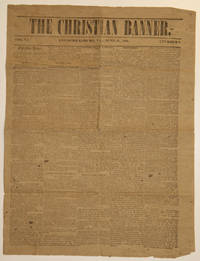
186221798<p><i>"The colored population of Fredericksburg are strolling about town and seem to be perfectly happy our country is ruined and slaughtered worse than beeves all on account of the negroes! Can it be possible that man will sacrifice their country for the negro…"</i></p><p>A fine war-date newspaper published in Fredericksburg Virginia. Articles on the front page describe the destruction of President Jefferson Davis's Mississippi plantation the Battle of Memphis military actions near Richmond and an account of operations near Charleston South Carolina. Several other articles deal with the subject of slavery.</p> <b>CIVIL WAR – CONFEDERACY.</b>Newspaper. June 11 1862. <i>The Christian Banner</i> Fredericksburg Va. J.W. Hunnicutt Vol. 1 Number 6. 4 pp. large folio.<p><b>Excerpts</b></p><p>"<i>We learn that the vandals have come off their boats and battered down and utterly destroyed the residence of Jeff. Davis and also that of Joe Davis. Their acts of destruction and vandalism in that neighborhood were complete leaving nothing behind but a bleak and desolate track behind them</i>."</p><p>"<i>African Slavery. The fact can be no longer disguised; let this war result as it may African Slavery in Virginia is already virtually swept from her territory. If she would lay down her arms and return to the Union her citizens might receive some remuneration for their servants from Government</i>"</p><p>"<i>Submission … This is submission with a tyrant's rod and a vengeance. And all who were opposed to secession have been forced to </i>submit<i> because a Military despotism has been hanging over them ever since. and this is freedom—Independence!"</i></p><p>"<i>The word submission has produced a greater terror over the Southern people than any word in the world. Submission! Submission to what Submission to Old Abe Lincoln Submission to Black Republican rule what power had he Lincoln none whatever! If all the States had remained quietly and peacefully in the Union. Lincoln could not have inaugurated a civil war upon the South</i>"</p>
186221798<p><i>"The colored population of Fredericksburg are strolling about town and seem to be perfectly happy our country is ruined and slaughtered worse than beeves all on account of the negroes! Can it be possible that man will sacrifice their country for the negro…"</i></p><p>A fine war-date newspaper published in Fredericksburg Virginia. Articles on the front page describe the destruction of President Jefferson Davis's Mississippi plantation the Battle of Memphis military actions near Richmond and an account of operations near Charleston South Carolina. Several other articles deal with the subject of slavery.</p> <b>CIVIL WAR – CONFEDERACY.</b>Newspaper. June 11 1862. <i>The Christian Banner</i> Fredericksburg Va. J.W. Hunnicutt Vol. 1 Number 6. 4 pp. large folio.<p><b>Excerpts</b></p><p>"<i>We learn that the vandals have come off their boats and battered down and utterly destroyed the residence of Jeff. Davis and also that of Joe Davis. Their acts of destruction and vandalism in that neighborhood were complete leaving nothing behind but a bleak and desolate track behind them</i>."</p><p>"<i>African Slavery. The fact can be no longer disguised; let this war result as it may African Slavery in Virginia is already virtually swept from her territory. If she would lay down her arms and return to the Union her citizens might receive some remuneration for their servants from Government</i>"</p><p>"<i>Submission … This is submission with a tyrant's rod and a vengeance. And all who were opposed to secession have been forced to </i>submit<i> because a Military despotism has been hanging over them ever since. and this is freedom—Independence!"</i></p><p>"<i>The word submission has produced a greater terror over the Southern people than any word in the world. Submission! Submission to what Submission to Old Abe Lincoln Submission to Black Republican rule what power had he Lincoln none whatever! If all the States had remained quietly and peacefully in the Union. Lincoln could not have inaugurated a civil war upon the South</i>"</p> books
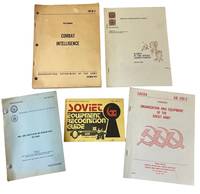
235111973. Cold War U.S. military instruction archive of government-produced manuals and intelligence studies showing how the Army trained soldiers to recognize enemy weapons report battlefield information and classify Soviet military power. The archive includes a U.S. Army field manual which explains how battlefield reports became military intelligence. The Soviet weapons guide was produced to teach soldiers how to identify AKM rifles RPG-7 launchers Sagger missiles SA-7 antiaircraft missiles mortars and antitank guns in the field. Major Mitzi D. Leibst's DIA study Women in the Soviet Armed Forces broadens the archive from weapons to manpower showing how U.S. intelligence counted Soviet women's military service as part of the enemy's total fighting capacity.<br /> <br /> Five U.S. Army and Defense Intelligence Agency manuals and studies on combat intelligence Soviet equipment recognition small arms identification Soviet force organization and women in the Soviet armed forces. Washington D.C.; Fort Monroe Virginia; Charlottesville Virginia; Fort Leavenworth Kansas; Department of the Army Defense Intelligence Agency U.S. Army Training and Doctrine Command U.S. Army Foreign Science and Technology Center and Combined Arms Combat Developments Activity 1973 to 1978.<br /> <br /> 1 United States Department of the Army. FM 30-5 Combat Intelligence. Washington D.C.: Headquarters Department of the Army 30 October 1973. Chapters cover intelligence functions collection processing dissemination order of battle counterintelligence maps and aerial imagery. Approximately 200 pages.<br /> <br /> 2 United States Army Training and Doctrine Command. TC 30-3 Soviet Equipment Recognition Guide. Fort Monroe Virginia: U.S. Army Training and Doctrine Command 11 April 1975. A soldier's pocket-style recognition guide using photographs cartoons role labels and specifications to teach Soviet weapons identification. 50 pages. <br /> <br /> 3 Johnson Harold E. Small Arms Identification and Operation Guide Free World. DST-1110H-163-76. Washington D.C.: Defense Intelligence Agency December 1976. A DIA intelligence product prepared by the U.S. Army Foreign Science and Technology Center and approved for public release with an August 1976 information cutoff. 316 pages.<br /> <br /> 4 Leibst Mitzi D. Women in the Soviet Armed Forces. DDI-1100-109-76. Washington D.C.: Defense Intelligence Agency March 1976. Prepared for the Ground Forces/MBFR Branch Soviet/Warsaw Pact Division the study identifies gaps in data on Soviet women's strength service and quality of service while compiling law history and personnel evidence. 19 Pages.<br /> <br /> 5 United States Army Combined Arms Combat Developments Activity. HB 550-2 Organization and Equipment of the Soviet Army. Fort Leavenworth Kansas: Threats Division Concepts Doctrine and Literature Directorate Combined Arms Combat Developments Activity 31 July 1978. Prepared to assist battle simulations and standardize Soviet-type organizational and equipment data. Approximately 60 pages.<br /> <br /> The archive records the practical underside of Cold War intelligence where enemy knowledge moved into manuals for soldiers analysts and training commands. Its strongest pairing is the DIA women's study and the Soviet Equipment Recognition Guide: one expands Soviet force analysis into gender law and manpower while the other teaches ordinary soldiers to identify enemy weapons in the field. Wrappers show toning handling wear staining creasing staple wear punch holes and light soil; interiors remain legible with tables captions illustrations photographs and institutional markings intact. Overall in good condition. The group preserves how U.S. military institutions taught personnel to recognize report and classify Soviet military power during the Cold War. unknown
1756WRCAM35228London: Printed for S. Bladon 1756. 68pp. Dbd. Very good. "Remonstrance addressed to London merchants against imprisoning of British traders on the Ohio" - Howes. We believe this to be the first edition first issue differentiated by having the price "one-shilling" printed on the bottom of the titlepage. The second issue is from the same setting of type but with "Second edition" on the titlepage. Bladon also published a forty-two-page edition priced six-pence. Such compact cheaper editions are almost invariably later ones. HOWES C668 "aa." SABIN 15207. KRESS 5501. THOMSON 265. Printed for S. Bladon unknown books
1814251150Washington: A. and G. Way 1814. First. hardcover. very good. Folding table. 52 pages. 8vo modern 3/4 black morocco. Washington: A. and G. Way 1814. First Edition. Very good<br/> <br/> Report of the United States House of Representatives Committee ".to inquire into the causes of the success of the enemy in his recent enterprises against this metropolis and the neighboring town of Alexandria; and into the manner in which the public buildings and property were destroyed and the amount thereof." Preface. Shaw and Shoemaker 33404.<br/> <br/> A. and G. Way unknown
1814251150Washington: A. and G. Way 1814. First. hardcover. very good. of the Invasion of the City of Washington by the British Forces in the Month of August 1814. November 29 1814. Folding table. 52pp. 8vo modern 3/4 black morocco. Washington: A. and G. Way 1814. First Edition. Very good<br/><br/> Report of the United States House of Representatives Committee ".to inquire into the causes of the success of the enemy in his recent enterprises against this metropolis and the neighboring town of Alexandria; and into the manner in which the public buildings and property were destroyed and the amount thereof." Preface. Shaw and Shoemaker 33404.<br/><br/> A. and G. Way unknown books
16493World War II Original Departure Document from the closing of the camps. Single page typed representing the difference between interment and freedom for forcibly relocated Japanese-American citizens. Has spaces for the Date Time Name of the Family and a checklist before departure. The fact that entire families were forcibly relocated is reflected in the simple question "Will Individual or Family Depart As Scheduled" <br/><br/>About 120000 people were incarcerated and interned in the camps from 1942-1946 of which 30000 were children. Colonel Karl Bendetsen the architect behind the program went so far as saying anyone with "one drop of Japanese blood" qualified. In 1943 Secretary of the Interior Harold L. Ickes wrote "the situation in at least some of the Japanese internment camps is bad and is becoming worse rapidly." Many camps were built quickly by civilian contractors during the summer of 1942 based on designs for military barracks making the buildings poorly equipped for cramped family living. Throughout many camps twenty-five people were forced to live in space built to contain four. Armed guards were posted at the camps which were all in remote desolate areas far from population centers. Medical conditions and in-camp schooling was similarly poor. The phrase "shikata ga nai" loosely translated as "it cannot be helped" was commonly used to summarize the interned families' resignation to their helplessness throughout these conditions an attitude adopted to shield children from the massive trauma experienced by their parents. Provenance: Emily Brown a general's daughter who worked for the camps and wrote reports on their closing. Toning. Two hole punches presumably from original clipboard at top. Clean. In near-fine condition. unknown books
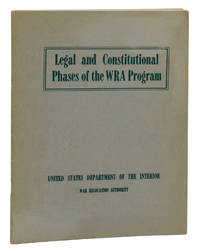
1946140941067Washington D.C.: U.S. Government Printing Office 1946. First Edition. Very Good. First edition. iv 59 pp. Gray stapled wraps. Very Good with light wear crease to final page. A rare legal history of the War Relocation Authority which managed the forced confinement of people of Japanese ancestry in America during World War II as well as their return to civilian life with the commencement of the war. It outlines the government response to the Korematsu case as well as the entire program's overall claims to constitutionality. U.S. Government Printing Office unknown books
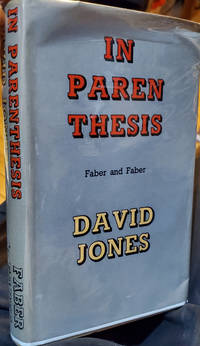
1938012536<p>London: Faber & Faber 1938. 225pp/frontis/map. Third impression.Clean copy with clean unclipped dust jacket. One of the finest and scarcest works from World War I. Called a work of genius it was awarded the Hawthorrden Prize for 1938. RARE. Third Printing. Cloth. Very Good/Very Good. 8vo - over 7¾" - 9¾" tall.</p> Faber & Faber hardcover
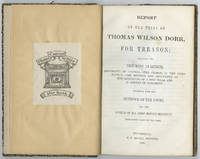
184422542<p><b>JOSEPH S. PITMAN. DORR WAR.</b>Book. <i>Report of the Trial of Thomas Wilson Dorr for Treason; Including the Testimony at Length.Together with the Sentence of the Court and the Speech of Mr. Dorr Before Sentence.</i> Providence R.I. B.F. Moore 1844. 1st ed. 115 pp. 5 1/3 x 8¾ in. </p><p>Based on Rhode Island's colonial charter over half of adult males were disenfranchised. Thomas W. Dorr led the effort to change Rhode Island's political system and expand voting rights. After trying to change the system internally he created the People's Party held an extralegal constitutional convention and set up a competing government. The Rhode Island General Assembly drafted a rival constitution and in 1842 both groups voted on their respective Constitutions. Both Dorr and sitting Governor Samuel Ward King were elected governor but King refused to accept the People's Constitution declared martial law and accused Dorr of treason. While he did not attempt to seize the State House or governmental institutions a few armed clashes did occur. Dorr fled the state but returned and was convicted in 1843 but released for health reasons two years later. Ultimately Rhode Island greatly liberalized voting rights in the aftermath of the rebellion. This trial record prepared by his defense attorneys is especially scarce. R & B 44-2044. Sabin 20649. </p><p><b>Condition</b></p><p>Very good. Original printed front wrapper bound into old boards. Front board loose but holding. Providence Athenaeum Gift of Deborah H. Philbrick bookplate on front pastedown Providence County Sheriff Hunter Carson White's bookplate on verso of half-title. Deaccessioned.</p> hardcover
184422542<p><b>JOSEPH S. PITMAN. DORR WAR.</b>Book. <i>Report of the Trial of Thomas Wilson Dorr for Treason; Including the Testimony at Length.Together with the Sentence of the Court and the Speech of Mr. Dorr Before Sentence.</i> Providence R.I. B.F. Moore 1844. 1st ed. 115 pp. 5 1/3 x 8¾ in. </p><p>Based on Rhode Island's colonial charter over half of adult males were disenfranchised. Thomas W. Dorr led the effort to change Rhode Island's political system and expand voting rights. After trying to change the system internally he created the People's Party held an extralegal constitutional convention and set up a competing government. The Rhode Island General Assembly drafted a rival constitution and in 1842 both groups voted on their respective Constitutions. Both Dorr and sitting Governor Samuel Ward King were elected governor but King refused to accept the People's Constitution declared martial law and accused Dorr of treason. While he did not attempt to seize the State House or governmental institutions a few armed clashes did occur. Dorr fled the state but returned and was convicted in 1843 but released for health reasons two years later. Ultimately Rhode Island greatly liberalized voting rights in the aftermath of the rebellion. This trial record prepared by his defense attorneys is especially scarce. R & B 44-2044. Sabin 20649. </p><p><b>Condition</b></p><p>Very good. Original printed front wrapper bound into old boards. Front board loose but holding. Providence Athenaeum Gift of Deborah H. Philbrick bookplate on front pastedown Providence County Sheriff Hunter Carson White's bookplate on verso of half-title. Deaccessioned.</p> hardcover books
1757WRCAM9300AAnnapolis: Jonas Green 1757. 213pp. Contemporary plain front wrapper rear wrapper renewed. Small ink library stamp on verso of titlepage tape repairs to edges of each leaf mostly small and inconsequential minor foxing. Very good. In a black cloth slipcase. A rare Annapolis imprint comprising the session laws for Maryland in early 1757. In the midst of the French and Indian War naturally there is significant content related to the war. Namely there are three acts: "An Act for his Majesty's Service and the more immediate Defence and Protection of the Frontier Inhabitants of this Province" encompassing the first four-and-a-half pages "An Act for the Relief of sundry Inhabitants of this Province who have had their Servants Enlisted into his Majesty's Servants" and "An Act to prevent the Exportation or Carrying out of this Province Ammunition Warlike Stores or Provisions of any Kind towards supplying the French or their Allies." The first of these acts calls for the raising of 500 men to be organized into companies to protect the frontier and for the manner of their deployment and use. Most of the others laws are continuing acts relating to slaves "languishing Prisoners" debtors and other issues. Rare with ESTC recording only three copies in two institutions AAS has two. EVANS 7935. WROTH 197. ESTC W7081. Jonas Green hardcover books
188258456Fort Laramie WT 1882. 4to. Three pages approximately 275 words in part: "There is not to my mind outside of Divine Writ so convincing an evidence of the immortality of the soul as is furnished by the growth and development of the mind and character of this greatest of American Presidents to meet the exigencies of the direction and control of a great Revolution on the successful issue of which depended the happiness of one fifth of the world . as his career differed from that of the other heroes of history in that he lived and strove for reforms that would benefit mankind though his own life should be the price in so far is Abraham Lincoln the greatest of Reformers the noblest of Patriots the ablest of men." This essay was published along with other tributes to Abraham Lincoln in The Lincoln Memorial NY 1882. Very good. Folded. #6317. Wesley Merritt graduated from West Point in 1860 serving briefly in the West before returning east for Civil War service in the Union cavalry attached to the Army of the Potomac participating in its major campaigns and battles through Appomattox ending the war commanding a division as a Major General. Following the war he commanded the 9th Cavalry in Texas for eight years; promoted to colonel in 1876 he took command of the 5th Cavalry in Wyoming participating in the Custer campaign and other actions against the Indians and serving in that capacity until 1882 when he was appointed to a five-year posting as superintendent of West Point. He commanded the 1898 expedition to the Philippines during the Spanish-American War. <br/><br/> unknown books
179464027Columbia SC 1794. Partly printed document completed in manuscript 11 1/8 x 15 1/2 inches describing the parcel of land; attached to that document with a cloth tie is another partly printed document completed in manuscript and signed by the Surveyor General of South Carolina Francis Bremar September 10 1794 and countersigned by the Deputy Surveyor William Sims and with a manuscript map of the parcel of land on the top half of the document. Accompanying the two documents each of which has docketing on the verso is the original clay state seal though worn cracked and in three pieces. The verso of the land survey document bears the signature "Col. Wade Hampton Jr." Offset from the seal but complete with the manuscript map and clay seal. Both documents folded some breaks along a central fold taking a bit of several letters but not affecting the sense. 10515. Moultrie began his military career in the Anglo-Cherokee War of 1761; as colonel and commander of the 2nd S.C. Regiment in 1776 he successfully defended the fort named for him which was located at the entrance of Charleston Harbor from attack by a British fleet delaying British occupation of that city by four years. Bremar served as Deputy Surveyor General of S.C. in the 1760s and was named Surveyor General in 1788. <br/><br/> hardcover books
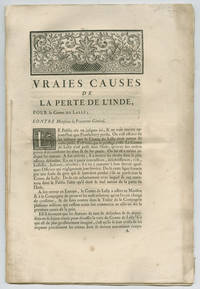
1766WRCAM47802Paris 1766. 2220pp. plus large folding map. Large folio. Stitched. Minor soiling and foxing. Very good. Defense of the Comte de Lally for his actions in India during the Seven Years' War. This is one of two versions authored by him. Lally head of the French expedition to India reached Pondichery in 1758. Though capable he was incredibly unpopular and fell into a series of events which proved fatal to his career and his person. He was unsuccessful in the Siege of Madras beaten at the Battle of Wandiwash and eventually capitulated from the siege of Pondichery. Taken prisoner by the British he returned to France on parole and was imprisoned for two years before being put on trial and executed. This is his last defence published shortly thereafter or perhaps immediately preceding. A publisher's note is dated April 14 and Lally was executed May 6. The map shows the Indian subcontinent and Madagascar. unknown books
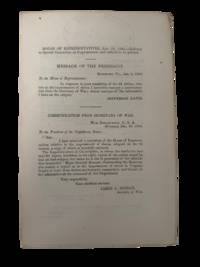
1865231171865. Civil War Black Military Slavery Virginia Confederate government imprint documenting one of the clearest bureaucratic efforts to formalize the use of enslaved labor in direct support of the Confederate war effort at the very moment of institutional collapse. Issued in Richmond Virginia in January 1865 and printed by the Confederate House of Representatives. The document responds to a congressional inquiry into the impressment of enslaved people explicitly acknowledging state-directed seizure of enslaved men for military labor. Within the text the Confederate state attempts to regulate this extraction noting limits such as "no more than one out of five male slaves between the ages specified. from any one owner" while simultaneously confirming large-scale requisitions including "5000 slaves from the State of Virginia for service with the army of Northern Virginia." The language reveals both the administrative reach of the Confederate state and its dependence on enslaved labor as a logistical backbone in the war's final phase.<br /> <br /> Octavo pamphlet measuring 9.5" x 6" 5 pages printed in Richmond Virginia January 1865. The text includes titled sections "Message of the President" "Communication from Secretary of War" "Resolution of House of Representatives" and "Response of Superintendent of Conscription" along with dated correspondence from December 1864 through January 1865. The imprint corresponds to Parrish and Willingham 2298. As a primary source the pamphlet holds substantial institutional value for collections in African American history Civil War studies and the history of slavery particularly for research into the transition from plantation labor systems to militarized coercion and the administrative mechanisms of late Confederate governance.<br /> The pamphlet is especially significant for how it exposes internal contradictions within Confederate ideology. While the Confederacy had long resisted arming or formally incorporating enslaved people in ways that might destabilize slavery this document demonstrates a late-war shift toward coercive mobilization framed as "employment" to "increase the efficiency of the army." Additional correspondence from Brig. Gen. Jno. S. Preston and Major Gen. J. L. Kemper details the mechanics of requisition emphasizing proportional seizure across slaveholders and acknowledging prior errors in impressment including the improper inclusion of enslaved people outside prescribed categories. Condition shows light toning minor spotting and edge wear consistent with age; paper remains stable with clear legible text throughout; faint institutional stamp present on front. Overall very good condition. This document underscores how the Confederate war effort relied on systems of exploitation applied to enslaved African American men. unknown
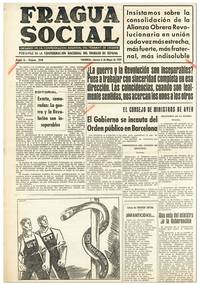
193726237Valencia: CNT 1937. 49 tabloid issues ca.48cm with publication seqence as follows: Año II Nos. 219 224-225 227-228 233-234 241-243 245 327-329 331-332 334-340 342 347-349 351-352 356 358-363 365-378. Printed offset on newsprint ca.8pp per issue; illus. Issues show light overall wear and toning creases and small tears with underlining and marginalia in red and blue colored-pencil to most issues; overall Very Good. Substantial run of this Spanish Civil War newspaper the official organ of the anarcho-syndicalist group Confederación Nacional del Trabajo. Published in Valencia between 1936-1939 the paper provided daily coverage of the Republican struggle with articles by Jesus Muro Felix Paredes Enrique Lopez Alarcon Gaston Leval and Juan Lopez et al. Illustrated with political cartoons and caricatures throughout. Large runs extremely uncommon in the trade; OCLC shows just 5 American institutions holding any issues. [CNT] unknown books
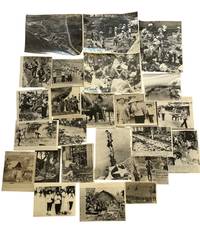
1960210071960. Vietnam War press photographs dating from the 1960s through the 1970s document the impact of prolonged conflict on civilian populations in Vietnam. The war involved sustained military operations by North Vietnamese forces the South Vietnamese government and the United States military producing widespread destruction and displacement throughout the country. Photographs of the period frequently recorded both military activity and the experiences of civilians living amid warfare including refugees religious protest movements and the persistence of daily life within rural communities affected by the conflict.<br /> <br /> Archive contains twenty four silver gelatin photographs measuring approximately 5 × 7 inches to 11 × 14 inches. Many are press photographs retaining original captions or newsprint text printed on the margins or attached to the verso. The images depict a range of wartime scenes including civilians fleeing areas of violence orphaned children and families displaced by fighting. Several photographs document Buddhist religious protests including monks and nuns participating in hunger strikes one image showing a temple interior filled with nuns lying on floor mats during the demonstration. Other images record street confrontations in Saigon with demonstrators throwing stones at South Vietnamese riot police. Military scenes show soldiers from the three principal armed forces involved in the conflict. One photograph depicts a young woman of the People's Army of Vietnam carrying a firearm while dragging wreckage from a United States aircraft along a shoreline. Another image shows a North Vietnamese soldier walking with two women transporting supplies while carrying a sign recruiting volunteers to the People's Army. Additional photographs show American forces arriving in Da Nang and evacuating novice monks from a pagoda near Saigon during nearby air operations.<br /> <br /> Several photographs also record everyday activities in rural regions during wartime. Scenes include a man riding an elephant through a village of thatched houses fishermen casting nets in the Mekong Delta and women wearing rice hats cycling along rural roads. Other images show agricultural or volunteer labor activities associated with wartime mobilization including groups of Vietnamese volunteers working at a military installation while wearing identification badges. Press photographs of this kind circulated widely in newspapers and magazines and played an important role in shaping international public understanding of the Vietnam War and its humanitarian consequences. Minor edge wear and occasional editorial markings appear on some prints while the photographic images remain clear. Very good condition overall and a compelling visual record of civilian and military experiences during the Vietnam War. unknown
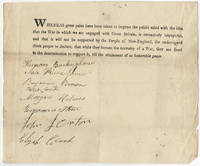
181224163<p><b>WAR OF 1812.</b>Document Signed. Litchfield County Conn. Ca. 1813-1815. docketed "<i>Support of the War 1812</i>" 1p. </p><br />On June 1 1812 the War of 1812 became the first war declared by the United States. New Englanders derisively called it "Mr. Madison's war" and bemoaned its economic impact especially in coastal areas where shipping and fishing had been largely shut down by the British Navy. The conflict was so unpopular in the region that a number of politicians who had supported it were voted out of office in the next election.<p>Nonetheless much of the funding and many of the troops came from the New England and some of the conflict's signal naval battles were fought just off the New England coast.</p><p>This document signed by eight New Englanders is evidence of that support. The traceable names such as Asa Prime Benjamin Stone John J. Orton and Elijah Couch originate in Litchfield County Connecticut hailing from towns such as New Milford Reading and Kent. Their support is both patriotic and pragmatic: the British depredations suffered by coastal New England residents might have seemed distant to these inland farmers in the Northwest Corner of Connecticut largely out of British reach.</p><p><b>Full transcript</b></p><p><i>"Whereas great pains have been taken to impress the public mind with the idea that the War in which we are engaged with Great Britain is extensively unpopular and that it will not be supported by the People of New-England the undersigned think proper to declare that while they lament the necessity of a War they are fixed in the determination to support it till the attainment of an honorable peace</i>.<i>"</i></p><p>Signed by: <i>Hyman Buckingham / Asa Prime Junior / Benjamin Brown / Peter Forwith / Morgan Holmes / Benjamin Stone / John J Orton / Elijah Couch</i></p><p>Docketed Support of the War of 1812</p><p><b>Condition</b></p><p>Oblong 8vo creased faintly toned generally very good.</p> books
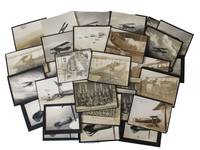
1918177171918. World War I military aviation. Primary-source photographs documenting early United States military aviation training at Henry Post Airfield Fort Sill Oklahoma during the formative period of the U.S. Army Air Service following its establishment in May 1918. The images record the first generation of American military pilots operating within a rapidly developing aviation program built in response to World War I supporting research into the expansion of U.S. airpower pilot training infrastructure and the integration of aircraft into military operations. The presence of DH-4 two-seat biplane bombers the principal American-built combat aircraft of the war situates the archive within the transition from experimental aviation units to operational military squadrons. A dated caption identifying "October 29 1918 Sergeant Schauble" flying at 3700 feet further anchors the material within the final phase of the war.<br /> <br /> Archive of 26 silver gelatin photographs Fort Sill Oklahoma circa 1917-1918 each measuring approximately 7.25 x 5.25 inches. The archive includes many photos of the biplanes in the air one photo shows several DH-4 bombers soaring in the clouds in a Flying-V formation. A handwritten caption on one image "October 29 1918 Sergeant Schauble " is depicted flying in a DH-4 at 3700 feet as well as going on a "parachute trip". One photo shows a serious plane crash with two DH-4s biplanes nose down in the ground. The pilots are also depicted in hot air balloons. Fort Sill was home to several US Army Balloon Companies during this period which were still primarily used for reconnaissance and directing aerial bombardment during World War I. The photo archive includes many shots of biplanes in the clouds or on runways with pilots in goggles including 4 images of pilots or troops in group shots. Most photos show the planes or balloons in mid air. . Army balloon companies stationed at Fort Sill for reconnaissance and artillery observation. Several images capture aircraft at altitude among cloud formations while others document runway activity and pre-flight staging. Versos of many prints retain remnants of black album paper indicating removal from a compiled photographic album.<br /> <br /> The archive documents the early operational environment of American military aviation at a moment when the United States was rapidly expanding its aerial capabilities following limited prewar development including the Army's first acquisition of aircraft from the Wright brothers in 1909. Henry Post Airfield functioned as a central training site for pilots entering service during World War I and the inclusion of both airplane and balloon units reflects the continued reliance on multiple aerial technologies for reconnaissance and combat support. The photographs provide visual evidence of training practices aircraft deployment and the material conditions of early air service operations during a period of institutional formation. Minor edge wear and surface wear are present with album residue on versos; overall very good condition. A cohesive photographic record of early U.S. military aviation training and aircraft use during World War I. unknown
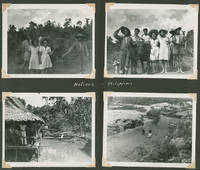
1945WRCAM54321Philippines; Okinawa; San Diego 1945. 133 silver gelatin photographs most 2 1/2 x 4 inches but ranging from 2 1/2 x 2 1/2 to several 10 x 7 inches. Oblong folio. Black leatherette album strong tied. Light wear. Photos in corner mounts with many captions. Very good. A fascinating photographic account of military service in the Philippines compiled by a member of the 142nd U.S. Naval Construction Battalion the Seabees in 1945. Most of the images approximately three- quarters of the album were taken in Guiuan on Samar Island in the central Philippines where the photographer was stationed. Guiuan city square the Seabees' camp numerous portraits of local girls who sometimes pose with American soldiers local families and their activities native architecture and other local scenes. They also show the Immaculate Conception Church with shots of the exterior and detailed views of the silver altar - built in 1595 to 1844 but completely destroyed by Typhoon Haiyan in 2013. Several other photos evidently portray the album's compiler posing next to an American fighter plane while boiling sea shells in front of his tent etc. <br> <br> The final portion of the album contains photos taken during the operations aboard the USS "Monrovia" and "President Harris" in October-November 1945 including views of Okinawa on the way to China and snapshots of soldiers unloading cargo in the Yellow Sea China before returning to Manila. There are also eight clear views of Manila showing destroyed Japanese cranes and boats in the harbor American army headquarters and a warehouse. The album concludes with a few photos of the homeward voyage and shows soldiers discharged in San Pedro California. <br> <br> Overall a very good album depicting local life and the activities of the 142nd U.S. Naval Construction Battalion in the Philippines and Yellow Sea in the last months of the World War II. hardcover books