119 839 résultats
This book is a rare publication by the Rescue Committee, an organization whose goal it was to rescue Jews in Europe from the Holocaust founded in 1939. This book contains numerous b&w photographs that report on the undertakings of the Vaad in Germany. It also includes a few copies of letters. 295x215mm. 262 pages. Illustrated hardcover with brown cloth spine. Page edges dyed red. Cover worn and stained. Cover corners and cover edges somewhat tattered. Both front and covers slightly loose from binding. Spine almost detached from binding, but still partly attached to cover. Pages yellowing. Two first pages detached from bonding and slightly torn on edge. Binding slightly broken. Pen marks on rear inner cover. [SUMMARY]: In spite of the damage described above, this extremely rare and important book is in good reading condition.
176432623London Printed for J. Dodsley 1764 In-8 illustré de 4 cartes repliées dont "The New Map of the British Dominions in North America", 3f. (faux-titre, titre, Preface), 216p., 307p. et 2f. (Contents).
1871126539London: Harrison and Sons 1871. Softcover. very good. 1st Edition. 16 165 96pp. Folio. Modern blue wrappers with printed title. Folding chart 3 large folding maps. Fine clean copies. very good Peel 3 576 568. The second part includes the very scarce maps which were separately issued with a separate title page. Very scarce especially with the the parts complete. 1871 Harrison and Sons paperback
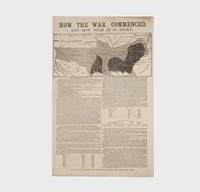
1864377693New York: National Union Executive Committee 1864. Broadside illustrated with a map. 18-1/8x11-1/2 inches. Old folds. Broadside illustrated with a map. 18-1/8x11-1/2 inches. A cartographically illustrated broadside produced in support of Abraham Lincoln in the 1864 election against the claims of the Peace Democrats. The map depicts the southern states with the Confederate regions in black and the Union-held areas in gray. The text of the broadside which refutes the anti-Lincoln claims of the Copperheads concludes: "We have shown unmistakably who commenced the war. It must be apparent to all that the Government has thus far a decided and prepondering advantage. The end cannot be doubtful. They who violated the Divine Law have incurred the penalty and will inevitably meet the allotted punishment. They who took the sword are perishing by the sword.". National Union Executive Committee unknown
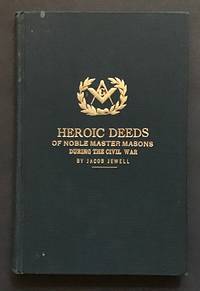
191634332Pueblo CO: The Franklin Press. 1916. First Edition; First Printing. Hardcover. This volume written by Jewella Civil War soldier had started the process of becoming a Mason but was interrupted two weeks later by joining the Union army in 1862. After serving in the winter of 1865/66 he became Master Mason. The book contains the stories of soldiers who when captured by the Confederates or the Federal Army once they were known to be a Mason were treated as brothers and well cared for. Cleary Jewell had solicited these stories as they are mostly signed by the former soldier/Mason who experienced these considerations. The book also contains a brief autobiography of Jewell as well as some thoughts on Masonry war and related subjects. The Masonry scholar Michael A Halleran wrote in the journal "Heredom" suggesting the Masonry affiliation aided prisoners on both sides of the conflict. Jewell's book is considered one of the earliest works addressing the Freemasonry's role in the Civil War though Halleran does criticize it for being "anecdotal." See volume 15 2007 of "Heredom." The book is near fine with a few small spots on the front board. Extremely scarce.; Small 8vo 7½" - 8" tall; 127 pp . The Franklin Press hardcover
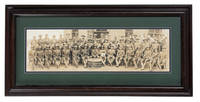
1918List1733Ohio 1918. Silver gelatin photograph in glass-fronted frame image measures 24 ¼ x 6 ⅞ inches. Matted and framed not examined out of frame. The 317th Engineer’s Band was a part of the 317th Engineer Regiment an element of the 92nd Division which was composed of over 15000 African-American soldiers from across the country. The 92nd was one of two African-American regiments to fight in the war the other being the 93rd and was unique in that it was under the command of the United States. The 317th Engineer Regiment was organized in November 1917 at Camp Sherman Ohio several months before this photograph was taken and saw action in Europe as part of the 92nd. Camp Sherman was the third largest training camp in the country at the time with over 2000 buildings capable of housing 40000 men and 12000 horses. As well as being the training site for units of the 92nd also known as the Buffalo Division it served as the training site entire 83rd 84th 95th and 96th divisions. It later became a trade school. <br /> <br /> The 317th Engineer’s Band performed locally around Chillicothe and at other military functions eventually becoming known according to a contemporary newspaper account as one of the best bands in the army. They traveled to Indianapolis to perform in March of 1918. A New York Times article from 1918 mentions them briefly and describes them as ‘famous’ but does not elaborate. They performed at the ‘Colored Club’ in Chillicothe a social club for African-American servicemen in a converted hotel. We find no other record of this image. unknown
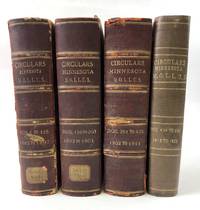
192231861St. Paul: Commandery of the State of Minnesota 1922. First edition. Cloth. Spine ends and joints scuffed one band split else a very good set with the bookplate of the Military Order of the Loyal Legion of the United States Commandery of the State of Illinois on front pastedowns of most volumes shelf sticker on foot of most backstrips most circulars quite fresh binding firm. 8vo. The Military Order of the Loyal Legion of the United States begun in Philadelphia in 1865 was modeled on the Society of the Cincinnati and formed to protect the republic amid rumors of a plot to destroy the government after the assassination of Abraham Lincoln. Among its members were Presidents Ulysses S. Grant Rutherford B. Hayes Benjamin Harrison and William McKinley. By 1899 it had over 8000 members which included nearly every officer of note. <br /> <br /> This is a complete collection of all 433 Minnesota Commandery circulars through 1922 ending with the dedication of the Lincoln Memorial. Contains circulars papers treasurers' reports black-bordered "In Memoriam" notices each with a biography of the deceased annual meeting notices of which most are signed corrected and annotated by the Minnesota Commandery recorders beginning with George Q. White; they include the disposition of each person seeking membership. A few other items such as invitations a special program with a portrait of Lincoln etc bound in. Large "In Memoriam" notice for Rutherford B. Hayes. <br /> <br /> A wealth of information and a very scarce collection which would be nearly impossible to assemble today. Other than the Minnesota Historical Society's Organization Archive of the Commandery OCLC shows only a few scattered documents. [Commandery of the State of Minnesota] hardcover
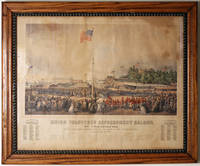
186122953<p>Showing Union troops arriving in Philadelphia from New Jersey via ferry and marching in formation towards the Union Volunteer Refreshment Saloon cheered on by Philadelphians. Text at the bottom lists members of the committee and men willing to accept donations for the saloon. This image became a choice souvenir for soldiers passing through Philadelphia.</p> <b>CIVIL WAR.</b>Print. <i>Union Volunteers Refreshment Saloon of Philadelphia</i>. James Queen delineator and lithographer. Philadelphia: Thomas Sinclair 1861. In period frame 35 x 29 in. <p><b>Historical Background</b></p><p>The Union Volunteer Refreshment Saloon was organized in South Philadelphia in 1861 by grocer Barzilla S. Brown. He began informally distributing food to Union troops traveling through Philadelphia an important rail and steamer hub. The relief effort became official on May 27 1861. The saloon provided soldiers with food drink stamps and paper and offered traveling troops a place to rest. This initial effort differed in some ways from the later Sanitary Fairs that contributed to the care of sick and wounded soldiers. At this point the civilian members were catering to the needs of healthy new recruits.</p><p>In September the Refreshment Saloon added a hospital to aid sick and wounded troops. The saloon supported itself through donations of food clothing cash and later through admission cost to view the Confederate navy vessel <i>Ram</i> which was captured in 1863. After providing social and medical services for four years the saloon closed in late 1865.</p><p><b>James Fuller Queen</b> 1820-1886 apprenticed to learn lithographic draftsmanship. He drew a large variety of lithographs for large printing houses of Wagner & McGuigan Thomas Sinclair and P. S. Duval. He drew views of buildings cities scenic attractions newsworthy events portraits sheet music covers diplomas illustrations for magazines and other images. He also became an outstanding chromolithographer. His view of the "Union Volunteer Refreshment Saloon" is one of Queen's most complex works and perhaps the one for which he is best known. He later drew the United States Sanitary Commission Fair in Philadelphia.</p><p><b>Thomas S. Sinclair</b> c. 1805-1881 was born in the Orkney Islands of Scotland and studied lithography in Edinburgh and other cities. He started his own printing firm in Philadelphia in 1838. He was among the first in Philadelphia to experiment with color lithography. From 1854 to 1859 his brother joined him in the firm of Thomas Sinclair & Co. Later his son worked with him in Thomas Sinclair & Son. He published three different hand-colored lithographs by Queen of Brown's Refreshment Saloon and its friendly rival William M. Cooper's Cooper Shop Volunteer Refreshment Saloon in 1861.</p> Thomas Sinclair
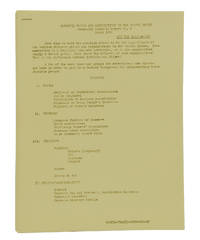
1943140940339Washington D.C: War Relocation Authority 1943. First Edition. Fine. First edition. 7 pp. single-sided. Yellow sheets corner staple bound. A Fine copy with faint rusting to staple and typical faint offsetting around mimeographed text. A very rare document in excellent condition.<br /> <br /> <p>A list of the different types of groups and associations people of Japanese descent might belong to compiled for the War Relocation Authority to aid in their internment of Japanese-Americans living on the West Coast. [War Relocation Authority] unknown
1866IN7327Washington: Government Printing Office 1866-1869. Wraps. Second Third Fourth Fifth Sixth Seventh and Eighth Semi-Annual Reports. Second Semi-Annual Report July 1 1866 printed 1868 14 pp. Third Semi-Annual Report January 1 1867 printed 1868 37 pp. Fourth Semi-Annual Report July 1 1867 printed 1867 96 pp. Fifth Semi-Annual Report January 1 1868 printed 1868 55 pp. Sixth Semi-Annual Report July 1 1868 printed 1868 78 pp. Seventh Semi-Annual Report January 1 1869 printed 1869 62 pp. Eighth Semi-Annual Report July 1 1869 printed 1869 89 pp. All seven volumes in wraps sewned binding except volume 4 and 5 lacking wraps. All volumes 8vo in clean condition with minor soiling to covers bindings solid slight chipping to spines of 3 7 & 8. These reports compiled by Alvord Inspector of Schools and Finances were issued every six months to Major General O. O. Howard Commissioner Bureau Refuges & Freedmen on the progress of the Freedmen schools set up during reconstruction after the Civil War for freed slaves. A wealth of primary information on the operation and funding of the schools set up throughout the south. Contain individual reports from the state superintendents of education. Very scarce. Overall condition VG with #4 and 5 Good. Government Printing Office paperback
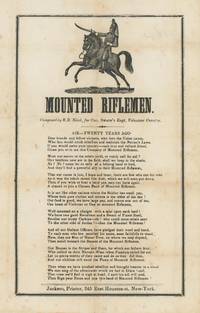
1860LIST026New York: Jackson 1860. First Edition. An unrecorded recruitment broadside for the 11th New York Cavalry. Col. James Swain led the regiment which was first organized on Staten Island in late 1861. Most troops came from New York City the site of robust recruitment in the early years of the conflict largely from Irish and German immigrants. The regiment saw service throughout the South. The verse in small part: "Must our nation to the rebels yield or vainly call for aid / Our brethren now are in the field shall we keep in the shade. that our cause is just I hope and trust there are few who can but own / As if was the rebels raised this dust which we will soon put down. / Then if you wish to bear a hand you might not have again / A chance to join a chosen band of Mounted Riflemen." <br /> <br /> We find no record of the verse's author R.B. Nicol. Curiously though this broadside is unrecorded a broadside with the same song was published in Washington D.C. by G.F. Hardwick in 1864. A very good copy well preserved with some light creasing and hints of foxing. Jackson unknown books
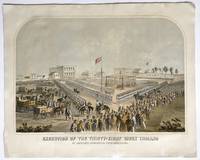
18831295Milwaukee 1883. Good. Chromolithograph 16 x 19.75 inches. Lightly backed repairs to small losses at edges and corners. Lower edge with several closed tears not affecting image; paper a bit crisp. Later color added to flags. Chromolithograph depicting the public execution of thirty-eight Dakota Indians following the end of the Dakota War of 1862. The image shows the city square in Mankato Minnesota with a gallows in the center ringed by soldiers on foot and horseback; large civilian crowds gather around behind to watch the hanging. The Sioux Uprising or Dakota War was a series of attacks on white settlers in western Minnesota in the second half of 1862. Angered by a series of treaty violations and other injustices over the course of the 1850s the Dakota Indians decided to conduct a series of violent raids against white settlers after a small party of Dakota Indians attacked a white settlement on August 17 1862. The result was hundreds of white casualties as well as numerous native dead. By the end of the year the U.S. Army had rounded up more than a thousand Dakota; after a trial in which 300 braves were condemned President Lincoln commuted all but thirty-eight of the sentences resulting in the largest mass execution in U.S. history. This lithograph was issued twenty years later perhaps as an odd commemoration piece. OCLC locates copies at the University of Michigan the American Antiquarian Society and the Newberry Library. unknown books
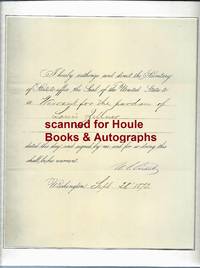
18722221603<p>"U. S. Grant" 1 page Washington D.C. September 28 1872. 11 1/4" x 9" tipped on left to album leaf. A warrant for the pardon of Louis Zellner for an unspecified crime. Fine fresh.</p><p>Grant 1822-85 Ohio-born Civil War general; 18th U.S. President 1869-77 noted for the campaign victories at Vicksburg July 1863 and at Richmond March 1865; conferred general of the armies 1865-67 and secretary of war after Stanton until the Senate restored Stanton; administration noted for corrupt officials and the Credit Mobilier scandal; spent final year sin poverty only to be restored by the success of his "Personal Memoirs."</p> unknown books
1943140940339Washington D.C: War Relocation Authority 1943. First Edition. Fine. First edition. 7 pp. single-sided. Yellow sheets corner staple bound. A Fine copy with faint rusting to staple and typical faint offsetting around mimeographed text. A very rare document in excellent condition. A list of the different types of groups and associations people of Japanese descent might belong to compiled for the War Relocation Authority to aid in their internment of Japanese-Americans living on the West Coast. [War Relocation Authority] unknown books
51-4279Washington DC and Cambridge MA: United States War Department United States Government and Polaroid Corp. 1941-1943. Most material in the Archive is printed in mimeograph form and measures 11x8½" unless otherwise noted. Archive includes: How To Make Polaroid Vectographs. 24 pp. Photographic illustrations charts. Stapled glossy booklet. How To Make Polaroid Vectographs. 1943. 28 pp. Photographic illustrations charts. Stapled glossy booklet. Important Improvements Vectograph. 1942. 2 pp. Wabash Exposure Data. 1941. 4 pp. 11x17 folded sheet printed on both sides. Nitrobenzimidazole Process. 4 pp. typed carbon copy developer chart. Optics Lecture No. 1. 23 of 24 figures. 8x10" glossy photographic prints. Miscellaneous Technical Sheets - Use of filters film characteristics exposure meter settings conversion tables. 10 pp. Check Sheet For Tri-Methogon Printing. 1 pp. Depth of Field of a C-3 Camera. 1 pp. Inspection and Maintenance of 16MM A-6 Magazine. 24 pp. Illustration. Disassembly and Reassembly of Bell & Howell Gun Sight Aiming Point Camera. 1943. 9 pp. Illustrations. Sperry Installation Instructions. 1943. 2 pp. Disassemble and Reassemble Overrun Control for GSAF Camera Fairchild. 1943. 2 pp. 4 pp. illustrations. Disassemble and Reassemble the Gunsight Aiming Point Camera Fairchild. 1943. 3 pp. 5 pp. illustrations. Check Sheet - A-6 Magazine - Taping Procedure. 1943. 3 pp. Check Sheet - Bell & Howell Film Scoring Viewer G.S.A.P. 1943. 3 pp. A-6 Magazine Inspection & Maintenance With riveting fixture & reconditioning tools. 1943. 2 pp. Check Sheet - Ampro Viewer G.S.A.P. Model DL77. 1943. 3 pp. Check Sheet - Loading the A-6 Magazine. 1943. 2 pp. Cycle of Operation and Disassemble Procedure Kalart Model "H" Rangefinder. 1942. 6 pp. Illustration. Job Sheet - Type K-1A Film Developer. 1943. 9 pp. Job Sheet - Loan and Unload a Cut Film Holder. 1943. 3 pp. Illustration. . Job Sheet - Develop Sheet Film in Tray. 1943. 3 pp. Illustration. Job Sheet - Set Up and Operate the Type C-1 Ground Camera Agfa. 1943. 4 pp. Illustration. Job Sheet - Set Up and Operate the Type C-1 Ground Camera Eastman. 1943. 4 pp. Illustration. 2 copies Job Sheet - Mix Photographic Processing Solutions. Illustration. 1943. 5 pp. Filter Action. 4 pp. 8x10" glossy photographic prints.The majority of the military photographers who covered combat were in the Signal Corps. Signal Corps companies consisted of seventy-five men: twenty were still photographers thirty were motion picture cameramen twenty were darkroom technicians two were film recorders and three were maintenance men. Signal Corps units accompanied U.S. troops from the beginning of U.S. operations abroad but they did not have a major presence until later in the war.Some of the Signal Corps photography units were assigned to combat areas others to communications zones. Those photographers stationed in forward areas received two sorts of orders: a general assignment to cover an operation such as an assault on an island or a town and a specific assignment such as to record the effect of enemy tank-destroyer fire on friendly tanks. The photographs these units produced were put to many uses: tactical for immediate use in the theaters; strategic for use in planning; training or the instruction of troops; intelligence for reconnaissance; technical for the improvement of equipment; and historical for future study. Washington, DC and Cambridge, MA: United States War Department, United States Government, and Polaroid Corp., 1941-1943 unknown
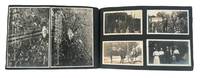
1915200651915. World War I photograph albums created by soldiers and travelers often juxtapose the brutality of industrial warfare with scenes of civilian life and personal travel revealing how participants understood the global conflict unfolding around them. This album of approximately 101 photographs dating from roughly 1915 to 1918 documents both the European theater of World War I and an extraordinary American automobile journey from San Francisco to Washington D.C. The images capture the material culture of early twentieth century mobility the devastation of trench warfare in France and the civilian landscapes through which soldiers and travelers moved during the war years. Together they form a visual narrative of a world simultaneously engaged in modern leisure travel and mechanized global conflict.<br /> <br /> Photograph album containing approximately 101 photographs measuring roughly 3 x 2 inches to 4.5 x 6.5 inches including albumen prints silver gelatin prints and sepia toned photographs many with captions written in white ink directly on the prints. Early images document an automobile expedition labeled "Automobile Camping Trip San Francisco to Washington DC" with the additional caption "Approx. 4000 miles in 27 days" showing touring cars modified for long distance travel with seats folded down and bedding arranged inside the vehicles. Several photographs feature family members identified in French captions including an albumen portrait reading "Suzane et Jeane Vincent 'a leur grand ami" as well as group photographs labeled the "Cateret Family" depicting picnics garden scenes lakeside outings and automobile travel in Europe. Wartime images depict the destructive landscape of the Western Front including a trench scene captioned "After a Yank barrage 1800 Boches deads near Soissons" a photograph labeled "Bombarded house Grandpre 1917" showing a destroyed structure with smoke rising from the rubble and views of Belleau Wood. Additional photographs document military technology and battlefield operations including German artillery German observation balloons anti aircraft guns camouflaged British tanks captured artillery pieces wrecked airplanes and soldiers in formation. One photograph depicts German Field Marshal Paul von Hindenburg pointing toward a soldier. Several images show supply depots in France during 1918 as well as groups of Allied soldiers in camps and on maneuver.<br /> <br /> The album concludes with portraits of children and family members visually contrasting the domestic life of civilians with the devastation of the European battlefields recorded earlier in the volume. The presence of both American and European subjects reflects the international dimension of World War I which drew soldiers civilians and travelers into a shared landscape shaped by mechanized warfare and unprecedented global mobility. Approximately 101 photographs mounted in an album with manuscript captions. Album binding remains tight with minor wear along edges; photographs clear and well preserved with only light handling wear. Overall condition very good. unknown
1558118122Lyon, N. Edoard 1558 In-4 32 x 21,5 cm. Reliure de l’époque veau havane, dos à nerfs encadrés de petits fers dorés, pièce de titre maroquin havane, [24]-718-[62] pp., bandeaux, lettrines, table des chapitres, table des principales matières. Manque page de titre, mouillures angulaires.
1896000536National Encampment G.A.R. Springfield MA Massachu 1896. handwritten diary titled Reminiscences of the National Encampment G.A.R at Saint Paul Minnesota Sept. 1896. It was written by one of twenty members of the Springfield Massachusetts contingent who traveled to the 30th annual encampment. The beginning of the diary details the trip and the men in blue on the trains and the rest tells of events at the encampment but most importantly the talks were recorded of battles that many of theses men engaged in. Here some snippets: The Mass. Dept Headquarters were assigned at the Hotel Windsor and the Wilcox Post of Springfield Mass including the few veterans of other immediate posts membering about 20 occupied 2 rooms at the Commanders High School Building situated at the corner of East 10th and Minnesota streets with convientely located the latter within a stones throw of the great auditorium and but a sling shot from the city Capitol Building. Here we found our meals provided for us and fairly ample accommodations . To give the greater emphasis to the final story he related let me premise by saying that it was General Longstreet whom commanded the 18000 men to whom Pickett and Pettigrew looked for his assenting nod in the final awful charge was made up the fields of Gettysburg and Longstreets men were those who shot off the leg of General Sickles on the eventful July day in the year of our Lord 1863. Well it was not very long since upon the occasion of a convention of the GAR in the south that Sickles was cordially invited to pay him a visit to be the guest of Longstreet at his Georgia home. The commanders learning of his whereabouts sent a messenger inviting him to come to the convention to make them a speech. Sickles declined .It is estimated that fully 200000 visitors witnessed the great procession. The sidewalks were densely packed the steps doors and stairways and windows were over crowded and numerous temporary platforms were filled to overflowing .Another beautiful sight on the route was the so called living Flag consisting of lasses dressed in red white and blue and so arranged in position as to present the Star Spangled Banner .Another Camp Fire was arranged to be held at the Auditorium at 8 oclock and it was in honor of the ex-prisoners of war . There are thirteen handwritten pages each measuring about 5.5 x 8.5. The writing is small as if to get as much onto a page as possible but it is mostly legible. An interesting diary written by a Union veteran of the Civil War. For the most part in good shape One oversize page has a chipped/rough edge but no loss. The original envelope that accompanies the diary sheets is present but in rough shape. Good. 8vo - over 7¾" - 9¾" tall. Manuscript. unknown
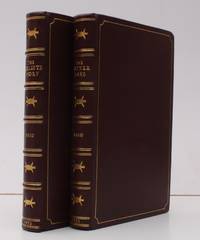
195219972Hodder & Stoughton 1952-53. 2 vols. 8vo. First Edition with frontispieces numerous photographs illustrations and facsimiles several full-page and a double-page plan in the text front endpaper map in second volume; handsomely bound in burgundy full morocco sides with gilt frame border backs gilt with raised bands second and fourth compartments lettered and ruled in gilt all other compartments tooled gilt with a barbed wire motif gilt tops a most attractive set ideal as a gift or for presentation. The first volume culminates with the author's 'home run' in 1942. Reid's two classics of POW life and escape began a virtual sub-industry of astonishingly variable quality including dozens of later books several feature films countless magazine pieces and a long-running TV series. There is however no mistaking the calibre of the original. Now that Colditz is to become in part at least a youth hostel interest in its wartime role will only grow. Enser p. 151. Hodder & Stoughton, hardcover
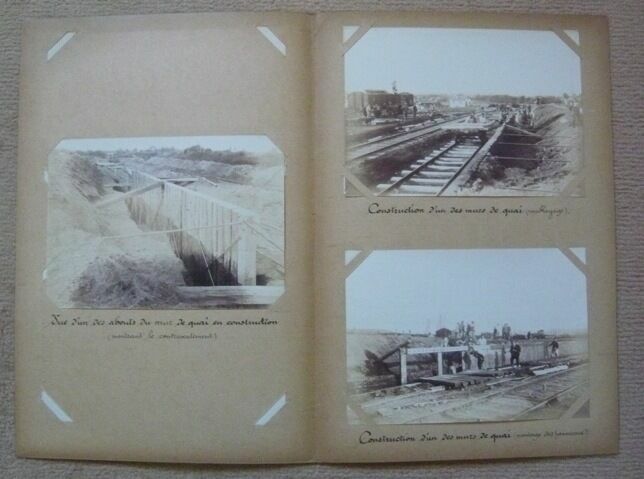
191677991916. Chateaudun 5 ème Régiment du Génie - Cie 5t de Sapeurs de chemins de fer 1916 - Dans une chemise à l'en-tête de 5 ème Régiment du Génie - Chantier du Nouvel entrepot de munitions de Chateaudun - on trouve les documents suivants propres et en bon état - Un plan de 30 5 cm x 41 5 cm sur papier bleu plié légendé du Nouvel Entrepôt Général de Ports Secs au 1/400 et daté du 6/3/16 - Le même plan avec au dos le cachet et la signature du Capitaine Ott capitaine commandant du 5 ème Régt. Un papier y tient avec un trombone sur lequel il est écrit au crayon noir : A joindre au PV qui doit être envoyé par le Lt Lacan - Un Plan Parcellaire des terrains nécessaires pour l'établissement du nouvel Entrepôt de 39 cm x 65 cm sur papier calque légendé à l'échelle de 1/2500 - Un plan de 30 5 cm x 41 5 cm sur papier bleu plié légendé de la Modification de la gare deLa Fourchette à l'échelle de 0.001 p. m. et daté du 22/2/16 - Un Rapport sur la construction des voies et quais du nouvel entrepôt de réserve générale de Bourges sur papier ligné 20 cm x 31 cm manuscrit très lisible 8 pages signé - Un plan général au 1/1000 du Nouvel Entrepôt de Réserve Générale de Bourges de 60 cm x 180 cm plié - Un dossier : Chantier de ravitaillement et de transbordement de Piémont - vues photographiques du chantier comprenant : - Un extrait de la carte au 1/80000 daté et signé de LA Cheppe 12 août 1915 et nommé Chantier de ravitaillement et de transbordement de Piémont au km 196.775 de la ligne de Châlons s/Marne à Ste Menehould - 7 photos légendées de 12 cm x 16 5 cm en très bon état - Un dossier : Chantier de transbordement et d'évacuation de Cuperly - vues photographiques du chantier comprenant 5 photos légendées de 12 cm x 16 5 cm en très bon état - Un dossier : Construction du Nouvel Entrepot de Munitions de Chateaudun - Relevé des dépenses engagées daté du 1er Février 1917 sur papier ligné broché 20 cm x 31 cm manuscrit très lisible 41 pages - Un Plan Parcellaire des terrains soumis à l'occupation temporaire pour l'exploitation d'une ballastière sur la commune de Fréteval... 30 5 cm x 105 cm sur papier bleu plié légendé 1/1000 daté (illisible) et signé - Un Plan Parcellaire du Nouvel Entrepot de Munitions de Chateaudun 67 cm x 255 cm sur papier blanc plié légendé 1/1000 daté (illisible) et signé - une petite déchirure sans manque - 7 photos légendées de 12 cm x 16 5 cm en très bon état qui doivent être aussi de Piémont - Un Procès-Verbal de reconnaissance des travaux de la Ballastière de Golbey gare d'Epinal sur papier blanc 20 cm x 31 cm 8 pages daté du 21 novembre 1915 et signé par le Chef de Bataillon du Génie le Capitaine Commandant et l'Ingénieur Principal Il y est joint un plan de la Ballastière de Golbey en couleur à l'échelle de 0.001 p. m. Un Procès-Verbal d'Etat des Lieux (Chateaudun) de 20 cm x 31 cm 3 pages daté du 21 mai 1916 et annoté par Monsieur Rousseau chef de section à Vendôme - Un plan de 32 5 cm x 56 cm sur papier bleu plié légendé de Muizon et ses environs non daté non signé et sans échelle - Un plan de 31 cm x 50 5 cm sur papier bleu plié légendé nommé : renseignements pour la pose des épis dans le bois de Bougogne non daté signé et sans échelle - Un plan sur papier bleu plié légendé de Muizon et ses environs Avec le nom du Lieutenant Laval et marqué au crayon noir : à faire parvenir au Capitaine Commandant - Un plan de 31 cm x 71 cm sur papier bleu plié légendé de Ligne d'A.L.G.P. de Vaux-Varennes état des travaux à la date du 10 mars 1917 signé par le Capitaine Commandant daté du 11 mars 1917 sans échelle - Un plan de 31 cm x 139 cm sur papier bleu plié légendé de Réseau de circulation au nord de la Vesle état des travaux à la date du 10 mars 1917 signé par le Capitaine Commandant daté du 11 mars 1917 sans échelle - Un plan de 62 cm x 83 cm sur papier bleu plié légendé nommé : Voies ferrées normales exécutées par l'Autorité Militaire au nord de la ligne de Soissons à Reims entre Magneux et Muizon au 1/20000 - Un tableau des distances kilométriques au nord de la ligne de Soissons à Reims entre Magneux et Muizon sur papier calque 43 cm x 105 cm plié légendé plan au au 1/20000 - Un projet de la ligne de Bouvancourt au bois de Gernicourt sur papier calque 30 cm x 32 cm plié légendé plan au au 1/20000 - Un plan parcellaire du Chantier de ravitaillement et de transbordement de Piémont au km 196 770 de la ligne de Châlons sur Marne à Ste Menehould sur papier calque 31 cm x 83 cm plié légendé plan au au 1/1000 daté du 16 août 1915 le capitaine Ott étant commandant - Un plan parcellaire du Chantier de transbordement de Cuperly au km 193 283 de la ligne de Châlons sur Marne à Ste Menehould sur papier calque 31 cm x 78 cm plié légendé daté du 16 août 1915 le capitaine Ott étant commandant - Voies ferrées du Havre - Travaux exécutés par l'Autorité Militaire depuis le 2 août 1914 sur papier calque 60 cm x 107 cm plié légendé au 1/5000 daté du 1 janvier 1917 - Voies ferrées du Havre - Répertoire des travaux exécutés par l'Autorité Militaire depuis le 2 août 1914 sur papier calque 60 cm x 31 cm plié - Chantiers du Havre sur papier calque 47 cm x 120 cm plié légendé au 1/5000 - Port du Havre plan des voies ferrées sur papier 64 cm x 130 cm plié légendé au 1/5000 daté de janvier 1917 - 10 photos légendées de 12 cm x 16 5 cm en très bon état de la gare de La Fouchette certaines animées - Baraque de chantier démontable - ferrures diverses sur papier calque 31 cm x 130 cm plié légendé grandeur nature daté du 2 décembre 1915 à Golbey capitaine Ott commandant
19451556PARIS. LAMBUSIER. (AU PROFIT DES OEUVRES DE LA CROIX ROUGE FRANCAISE POUR LES PRISONNIERS DE GUERRE). 1945. IN-4 EN FEUILLES (28 X 22,5 X 2,5 CENTIMETRES ENVIRON) DE 147 PAGES, COUVERTURE CREME REMPLIEE, TITRE IMPRIME EN ROUGE, SOUS ETUI CARTONNE (29 X 23 X 3 CENTIMETRES ENVIRON). ILLUSTRE D'UN FRONTISPICE GRAVE EN MEZZOTINTE PAR DARAGNES, UNE GRAVURE AU BURIN (PORTRAIT DE FRANCOISE GILLOT) ET DEUX IN-TEXTE DE PICASSO, QUATRE HORS TEXTE GRAVES A L'EAU -FORTE ET DIX-SEPT DESSINS IN-TEXTE DE DIGNIMONT, QUATRE HORS TEXTE GRAVES A L'EAU-FORTE ET VINGT-CINQ DESSINS DANS LE TEXTE DE TOUCHAGUES. PREFACE DU GENERAL KOENIG, TEXTES PAR PAUL ELUARD, PAUL VALERY, COLETTE, ANDRE BILLY, ETC. LE BURIN ET LES DEUX DESSINS DE PICASSO ILLUSTRENT LE POEME «DANS UN MIROIR NOIR» DE PAUL ELUARD. EDITION ORIGINALE. TIRAGE LIMITE A 1070 EXEMPLAIRES NUMEROTES, TOUS SUR VELIN DE LANA, DONT 50 HORS COMMERCE, CELUI-CI PORTANT LE NUMERO 543. DEFAUTS SUR L’ETUI CARTONNE, PETITE DECHIRURE SANS MANQUE AU DOS, QUELQUES ROUSSEURS EPARSES, SINON BON EXEMPLAIRE.
No Date (1941). 1st edition, original wrappers, 8vo. 12 pages. Almost certainly published in 1941, as the Rabbinical Association was founded in 1901 and this booklet is From the presidential message delivered at the 40th Annual Convention of the Rabbinical Assembly of America- Detroit, Michigan. Arzt says, The moral re-awakening of America will be tremendously enhanced by tangible acts of sympathy and succor for the innocent victims of the holocaust across the seas. The Jews of America must, with increasing generosity and self-sacrifice, contribute of their means for the maintenance of the overseas program of relief. Our suffering brethren in war torn Europe will continue to hope against hope, if our thoughts, our prayers and our united efforts will be with them and for them. The religious forces in America should champion legislation for the suspension of all restrictive legislation to make possible the immediate admission of children from Europe for the duration of the war. Millions of Americans will eagerly offer the hospitality of their homes for these unfortunates. The arrival of a huge expeditionary army of little ones to these shores will immediately fortify our spirit and will generate in us a spirit of selflessness and sacrifice which will enable us to face the future with courage and confidence. (page 8) Not listed on OCLC or anywhere else online. Creased down the middle, previous owners name on written on cover, cover rubbed, else Good Condition. Extremely rare, perhaps a unique surviving copy (HOLO2-141-28)
1st edition. Original paper wrappers. 8vo, 4-8 pages each. Conservative Jewish men's group newsletter from the Holocaust period from the the second synagogue founded in New York (1825) and the third-oldest Ashkenazi synagogue in the United States. "The object of the 'Tattler' will be to provide the members with a regular source of information and entertainment....The Pogroms in Russia during the Czarist regime or the activities of the Zionist movement in recent years had no such effect on the consciousness of the average American Jew except to stir a sense of pity and sympathy for the afflicted ones. But the cruel, heartless persecutions of the Jews in Germany by Hitler and his crew, caused a stirring in the blood of Native Americans of Jewish birth that made them turn about and recall the religion of their fathers and the God of Israel. We of The Men's Club of the Congregation B'nai Jeshurun welcome with open arms all those who are returning to the fold." Most issues include commentary on the increasing oppression of the Jews in Germany; other issues discussed include some current Jewish news, some retelling of Jewish history, congregation news, editorials, fun facts, jokes with lessons. OCLC: 944959016, OCLC lists 2 holdings worldwide (JTS & USHMM), though these holdings appear to be incomplete. First issue shows edgewear, other issues show only creases from folding, touch of wear, good quality paper with just the slightest toning. About Very Good Condition Overall. Rare (HOLO2-159-22A)
200505415Berlin W9, Verlaggsanstalt Otto Stollberg, 1940-1943 ; in-8, cartonnage de l'éditeur. Les 30 volumes. (en All.) - lieferung N° 9/14 - 27/28 - 29/30 (usures) - 31/32 -33/34 coiffe abimée - 39/40 - 41/42 - 43/44 - 45/46 - 47/48 - 49/50 - 53/54 - 55/56 - 57/58 - 59/60 - 61/62 - 63/64 (exemplaire abimé mouillé) - 65/66 - 67/68 (usures) - 69/70 - 73/74 - 77/78 - 79/80 - 81/82 (coiffe recollée) - 81/82 (exemplaire abimé mouillé) - 83/84 - 85/86 - 87/88 - 97/100 - 101/104(nov/dec-1943).
13179Shanghai, North-China Daily News & Herald Limited, 1938. 1 volume, oblong in-quarto (23*29 cm), 163 pp., fully illustrated with photographs and cartoons by Sapajou, hard illustrated covers, a very good and clean copy.