ARIAS BERNAL AntonioLivre Rare Book
CÉLINELivre Rare Book
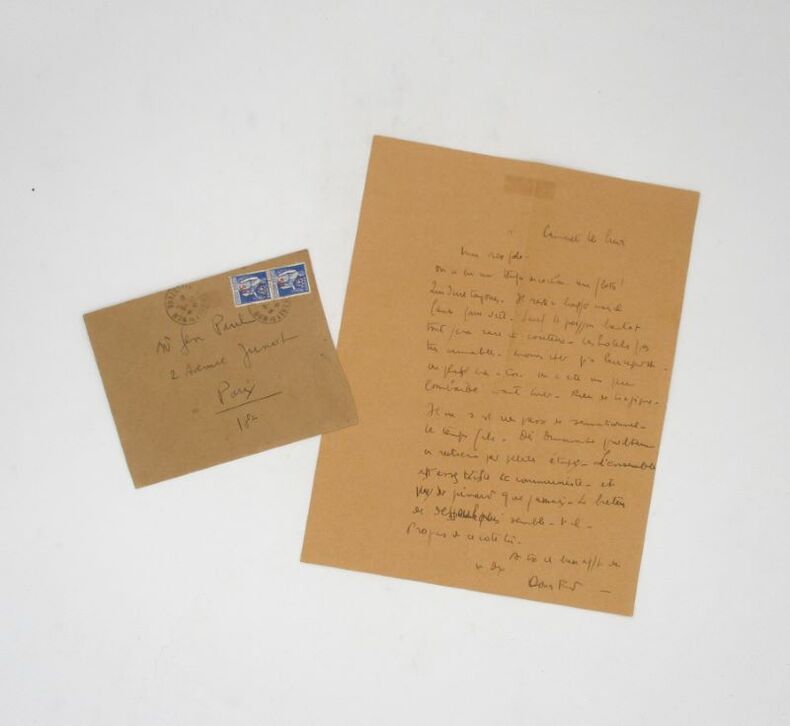
Lettre autographe
171401 p. sur 1 f. in-4
L'Ancienne Librairie · Paris, France1 000,00 €
119 836 résultats
1371967Mexico: Carral y Carral, S. de R. L., s.d. [1944] Album in-folio de 56 caricatures en couleurs figurant des cartes à jouer, sous chemise en carton. Les légendes, en anglais, sont collées sur les pages de garde du cartonnage. Cartonnage avec pet. défauts (plats un peu frottés, coins et dos avec usures, un ruban manquant), sinon bel exemplaire. Très rare. Huit mois avant la signature de la paix, Ignacio Carral Icaza conçut cet album de caricatures et Antonio Arias Bernal en exécuta les dessins. Antonio Arias Bernal était le caricaturiste du magazine mexicain "Manana". (Ex libris). EDITION ORIGINALE.
1946011433Paris Les Editions du Compas 1946 In-4 broché, couverture rempliée, étui éditeur
171401 p. sur 1 f. in-4
1944117205Montrouge Atelier Robert Doisneau 1944 1 vol. en feuilles Tirage argentique d’époque, 22,2 x 18 cm, tampon rouge du photographe au verso. Epreuve originale, en parfaite condition.
1944117205Montrouge Atelier Robert Doisneau 1944 1 vol. en feuilles Tirage argentique d’époque, 22,2 x 18 cm, tampon rouge du photographe au verso. Epreuve originale, en parfaite condition.
LEGATURA IN MEZZA PELLE MARRONE CON TITOLI IN ORO, INTERNO CON TOTALI 76 ILLUSTRAZIONI COSI' SUDDIVISE; 73 TAVOLE IN BIANCO E NERO, DUE A COLORI ED UNA CARTA GEOGRAFICA PIU' VOLTE RIPIEGATA (COLLAZIONATE) numero pagine: CVIII+428 formato: 36.1X28 stato conservazione: MEDIOCRE, VARIE USURE, PRIME QUATTRO PAGINE CON FORI VISTOSI, PIEGHE. DORSO IN PELLE CON PICCOLE MANCANZE E PARTI ABRASE. PIATTI CON USURE
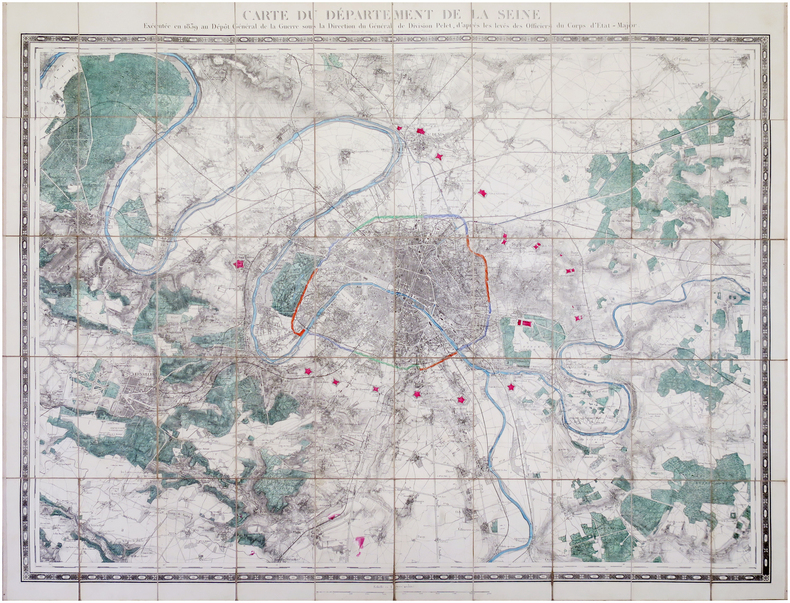
1857LBW-79541857. En 50 sections montées sur toile et repliées, formant une carte de 0,89 x 1,15 m.
A Amsterdam, Chez Pierre de Coup, 1729, volumi 2, in-4, piena pelle bazzana coeva, filetti, fregi e scritte oro sui dorsi, antiporte e frontespizi stampati in rosso e nero, tagli rossi, sguardie in carta marmorizzata. Bel ritratto dell'Autore inciso a piena pagina in antiporta e vignetta incisa all'inizio. Bell'esemplare.
1943117216Paris Pierre Jahan 1943 1 vol. en feuilles Tirage argentique d’époque, 26,5 x 21 cm, tampon du photographe au verso. L'une des photographies de Pierre Jahan (1909-2003) faites en secret, sous l'Occupation, dans "l'entrepôt où l'Allemagne cassait et fondait nos statues". Ces clichés firent l'objet d'une édition en 1946 : "La mort et les statues", avec 20 photos reproduites en héliogravure et un texte de Jean Cocteau. Le titre du cliché correspond à celui mentionné dans l'ouvrage (pl. n° 20). (Cabinet de la photographie du Centre Pompidou réf. AM 2007-114). Epreuve originale, en parfaite condition.
1943117216Paris Pierre Jahan 1943 1 vol. en feuilles Tirage argentique d’époque, 26,5 x 21 cm, tampon du photographe au verso. L'une des photographies de Pierre Jahan (1909-2003) faites en secret, sous l'Occupation, dans "l'entrepôt où l'Allemagne cassait et fondait nos statues". Ces clichés firent l'objet d'une édition en 1946 : "La mort et les statues", avec 20 photos reproduites en héliogravure et un texte de Jean Cocteau. Le titre du cliché correspond à celui mentionné dans l'ouvrage (pl. n° 20). (Cabinet de la photographie du Centre Pompidou réf. AM 2007-114). Epreuve originale, en parfaite condition.
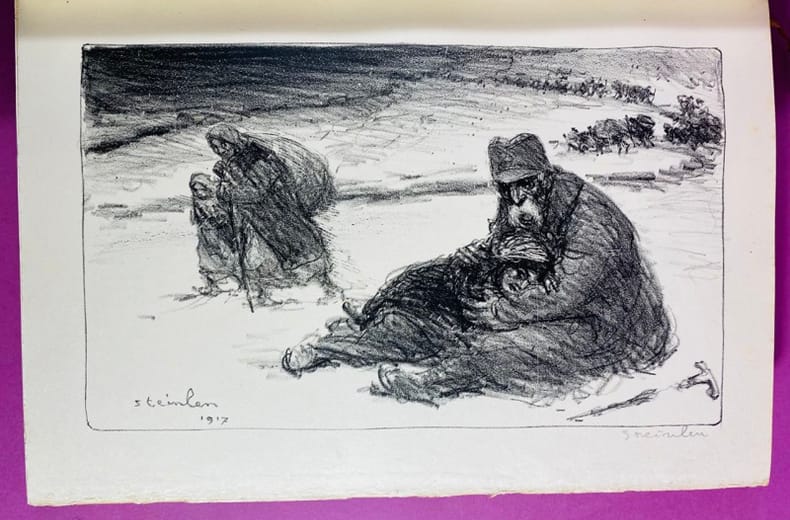
191718551917 Couverture rigide Paris, L'Art et les Artistes, 1917, 1918. 5 numéros spéciaux de la revue regroupés dans un volume in-4 (30 x 21,5 cm), reliure demi-chagrin signée Louis Marchand, dos à 5 nerfs orné de caissons dorés, papier à la cuve aux plats et contreplats, tranche supérieure dorée, dos insolé avec quelques frottements, coins légèrement émoussés. Les 5 numéros grand luxe du volume sont numérotés sur papier de la Manufacture Impériale du Japon (tirage limité à 25 exemplaires). LA SERBIE GLORIEUSE, 67 pages, 2 états sur Japon d'une lithographie originale de Steinlen dont un avant la lettre, "Le martyre de la Serbie" signé à la mine de plomb, 122 illustrations, quelques rousseurs marginales en tête sans atteindre le texte et les illustrations. RUSSIE - ART ANCIEN, 47 pages, 2 états sur Japon d'une gravure de Roublev dont un avant la lettre, "Trinité", textes de Louis Réau, 58 illustrations. LE MAROC ARTISTIQUE, 51 pages, 2 états sur Japon d'un dessin original d'Alfred Dehodencq dont un avant la lettre, "Une fête juive au Maroc", texte du Général Lyautey, 84 illustrations. RUSSIE - ART MODERNE, 47 pages, 2 états sur Japon d'un dessin original de Paul Dardé dont un avant la lettre, "Tolstoï", texte de Camille Mauclair, 77 illustrations. VENISE AVANT ET PENDANT LA GUERRE, 49 pages, 2 états sur Japon d'une gravure d'après un dessin du Titien dont un avant la lettre, "Le jugement de Pâris", texte de Henri de Régnier, 70 illustrations. Fondée en 1905 par Armand Dayot, alors Inspecteur général des Beaux-Arts, la revue L'Art et les Artistes devient pendant la Grande guerre un organe de résistance intellectuelle et de témoignage, invitant auteurs et illustrateurs à s'exprimer sur le conflit en cours. Provenance : Adolphe Thalasso, proche collaborateur de la revue, écrivain et critique d'Art né à Constantinople, figure orientaliste à Paris dans le monde littéraire. Bel état du texte et des planches, bon exemplaire sur grand papier, enrichi d'une puissante lithographie de Steinlen.
First edition. Original illustrated wrappers, 12mo, 43, 10 pages. Text in English and Hebrew. 13 drawings made by a Jewish woman of her fellow inmates while in the concentration camp at Leibitsch which consisted of 1200 Jewish women who had been deported from the Kaunas Ghetto in East Prussia. Lurie was liberated by the Red Army on 21 January 1945. In March 1945 she reached a camp in Italy, where she met Jewish soldiers from Palestine who were serving in the British army. One of them, the artist Menahem Shemi, organized an exhibition of drawings from the camps, which resulted in the publication of a booklet Jewesses in Slavery. This contained drawings by Lurie from Stutthof and Leibitz and was published by the Jewish Soldiers' Club of Rome in 1945. Lurie also created stage sets for the military song and dance group in the camp, which was founded by Eliahu Goldberg and Mordechai Zeira. Lurie reached Israel (Palestine) in July 1945 and was received with great excitement. Her stories were published in the press and her drawings were exhibited in exhibitions. In 1946 she was again awarded the Dizengoff Prize for a sketch Girl with Yellow Badge, which she had made in the Kovno ghetto (World ORT and Beit Lohamei Haghetaot, 2001) . SUBJECT(S) : World War, 1939-1945 -- Personal narratives, Jewish. Women in art. OCLC Worldcat lists 18 copies worldwide. Ex-library copy with small pocket and stamps in Hebrew, wrappers slightly toned with a couple of tiny stains, otherwise Very Good Condition. (holo2-125-38A)
1st edition. Original paper wrappers, tall 12mo, 69 pages. 22 cm. In German. The first separate publication of a demand for Nazi reparations to the Jews. In July 1943, long before the war ended, Siegfried Moses coined the term reparations in relation to claims of Jewish citizens against the German state. He published an article on the restitution demands of Jews in the bulletin of the "Irgun Olej Merkaz Europa", Tel Aviv; they publish here those proposals as a separate work. For the first time, Moses proposed that a State can commit an injustice, for which it must then compensate the civilian population which suffered under that injustice. This legal opinion was later the basis for reparations by the Federal Republic of Germany. Siegfried Moses (1887-1974) was a German-Israeli lawyer and the first state comptroller Israel. After the Nazi seizure of power, he helped German Jews transfer assets to Palestine. From 1933 on he was also chairman of the Zionist Federation of Germany (ZVfD) and Vice President of the Reich Association of German Jews. In 1937 Moses himself fled to Palestine; then in 1941 he wrote (together with fellow German emigre Walter Schwarz) the text of the 1941 Palestinian Income Tax Act. In 1947 Moses was a member of the delegation of the Jewish Agency at the United Nations and in 1949, he became the first state comptroller Israel (Chief of Court) . In 1956-1957, he was also President of the "Council of Jews from Germany", the official association of Israelis of German origin. In 1955 he co-founded the Leo Baeck Institute, serving as its director, and was on the advisory board of the United Restitution Organization in Israel (Wikipedia, 2015) . SUBJECT(S) : Holocaust, Jewish (1939-1945) -- Reparations. World War, 1939-1945 -- Claims. Jews -- Europe. Jewish property -- Germany -- History -- Post war problems -- Reparations for historical injustices. OCLC lists 17 copies worldwide, but only 5 copies in the US (NYPL, Yale, US Holocaust Museum, UChicago, Princeton) . Spine worn, corners bumped through, Good Condition. Very important. (holo2-126-34).
volumes 1 till 41 but vol.24 is missing, together +/- 24000pp. with some ills., in-8, text in german, blue cloth with gilt imprinting (some covers are bit discoloured or have few stains, back of few vols.repaired, some corners bumped or used), foxing on some vols.'edges, good condition (interior/text VG)
193046404983[Paris, Jack Kahane, Obelisk Press], (vers 1930) ; in-4, plein veau noir, décor mosaïqué en maroquin rouge et vert, filets dorés et à froid, et cabochons argent sur les plats, titre en lettres d’argent sur le premier plat et en lettres dorées sur le dos, tête dorée, non rogné, couverture conservée. (Jeanne Huck). 1 f. blanc et 3 ff. non chiffrés (fx-titre, frontispice, titre, portrait), 45 (1) pp., 1 f. blanc.Tirage confidentiel non mis dans le commerce. Frontispice en couleurs (carte du Mexique) et portrait photographique en noir. La page de titre ne porte aucune mention d’éditeur ni de date de publication, seule une note au dos du dernier feuillet mentionne “designed by Jack Kahane, 16 place Vendôme, Paris” qui est l’adresse (fictive) de sa célèbre Obelisk Press. En tête du volume se trouve une notice biographique sur le général Preston (1816 - 1887). Originaire du Kentucky, il fut ambassadeur des États-Unis en Espagne, puis représentant des états confédérés à Mexico durant le règne de Maximilien. Neil Pearson. A History of Jack Kahane and the Obelisk Press. ne mentionne pas cet ouvrage, mais il a depuis complété son travail grâce à un exemplaire qu’il propose à la vente :“In 2007, after four years of what felt like pretty meticulous research, I delivered to my publishers my book about Jack Kahane and his scandalous Paris publishing house of the 1930s, the Obelisk Press. Two months later, this book showed up for the first time. In my defence, the Kahane association is very well hidden. The book is rare in any case, with only a few copies scattered around institutional libraries”. Pearson date l’ouvrage au tout début de l’activité de Kahane en raison de l’absence de la marque Obelisk Press, mais postérieur à sa collaboration avec Herbert Edward Clarke, imprimeur parisien rue du Fbg. S. Honoré, ce qui daterait la parution en 1931. Pearson ne signale toutefois pas la mention (fictive ?) “Imprimé en Belgique” qui figure à la fin du texte de notre exemplaire.Sur la dizaine d’exemplaires de cet ouvrage que nous avons pu localiser, trois sont dans des reliures signées Jeanne Huck, d’autres sont dans des reliures mosaïquées semblables qui peuvent lui être attribuées. La reliure de cette édition semble être le plus important travail de Jeanne Huck qui n’a produit qu’un petit nombre de reliures, toutes à décor, durant les années 1920-1930, sur des éditions de luxe. Ni Féty, ni Vrain. Reliures de femmes ne mentionnent son travail. Petit accroc au cuir sur une coupe, bel exemplaire frais.
1st English Language Edition. Original Wrappers. 8vo. 83, [1] pages ; 19 cm. Contemporary report on one of the the first two war crimes trials against Nazi defendants, held almost 2 years before the Nuremberg Trials. A historic account of the Trial in which three officials of the Kharkov Gestapo (Hans Rietz, Wilhelm Langfeld, and Reinhard Retzlaff) were tried before a Soviet military Court at Kharkov, Ukraine, from December 15, 1943, to December 18, 1943. All were found guilty and sentenced to death. (Jewish Virtual Library, 2017) Includes a transcript from the trial. Published in Moscow by the Soviet Governments Foreign Languages Publishing House, which was publishing reports of ongoing regional atrocities in various languages. SUBJECT(S) : World War, 1939-1945 -- Russiav(Federation) -- Kharkiv. War crimes. Ex-library with Jewish Institutional Stamp and usual markings. Slight paper toning as expected. Institutional bookplate, no other markings, Very Good condition. Important. (holo2-135-8A)
Album oblungo (mm. 420x580), bella legatura in tela edit. (con aloni, risguardi rifatti), cornici a secco con grande stemma della Svizzera in ricca decorazione oro al piatto anteriore. Magnifica raccolta di 15 tavole (al vivo mm. 300x460) disegnate da Eugène Adam e litografate da Jules Adam, introdotte da un bellissimo frontespizio figurato, pure litografato; tutte sono precedute da una pagina di descrizione in tedesco e in francese. Dall’introduzione apprendiamo che l’artista svizzero ha concepito “l’idéé de consacrer ses pinceaux à l’illustration d’une campagne simplement simulée, exécutée au sein de la paix.. en faisant un heureux mélange de scènes guerrières avec les scènes majestueuses de la nature des Alpes.. En 1861 la Suisse se trouve attaquée sur toute sa frontière méridionale..”. Le operazioni di guerra disegnate e descritte sono le seguenti: “Embarquement des troupes à Lucerne, 14 aout - Départ d’Amsteg, 16 aout - Construction du pont au Pfaffensprung (Saut du Moine), 16 aout - Combat du pont de Meidschlingen, 16 aout - Levée du camp de Wasen, 17 aout - Position près de Goeschenen, 17 aout - La batterie n. 27 à la première galerie de la route du St. Gotthard, 17 aout - Service divin du bataillon bernois au camp d’Andermatt, 18 aout - Rapport du soir au camp de Réalp, 19 aout - Marche de la I brigade vers la Furka, 20 aout - La II brigade au col des Nufenen, 20 aout - Halte de la I brigade au glacier du Rhone, 20 aout - Scène de bivouac dans la cour du palais Stockalper à Brigue, 22 aout - Combat du Bois de Finges, 24 aout - Entrée des troupes à Sion, 24 aout”. Cfr. Benezit,I, p. 55: “Eugen Adam (1817-80), allemand, peintre de sujets militaires, paysages, fut élève de son père Albrecht”. Nel ns. esempl.: 4 pagg. di descrizione restaurate per mancanze (non di testo) e altre con aloni; le tavole, tutte ben conservate, portano a volte e solo ai margini, lievi aloni o lievi fioriture.
206201Paris, Michel Lévy frères, 1855 2 vol. in-8, XXVI-[2]-572 pp. ; [2] ff. n. ch., 606 pp., avec un portrait-frontispice lithographié et un fac-similé dépliant, chagrin noir, dos à nerfs ornés de pointillés, filets, guirlandes et caissons dorés, encadrement de triple filet et guirlande dorés sur les plats, pointillé doré sur les coupes, tranches dorées, dentelle intérieure (reliure de l'époque).
1944117211Paris Photo Serge 1944 1 vol. en feuilles Tirage argentique d’époque, 20 x 14,5 cm, tampons du photographe (Photo Serge, 114 Champs Elysées) et "Photo Presse Libération" au verso. Né en Russie en 1915, Serge de Sazo émigre à Paris en 1922 et devient photographe d'agence dès 1933, initié par Gaston Paris. Habitant la rue de Rivoli en 1944, il se trouve aux premières loges lorsque les FFI libèrent l’Hôtel de Ville de Paris. Ce cliché est reproduit dans La Semaine héroïque à la date du 19 août 1944 (Paris, S.E.P.E., 1944, p. 11). Epreuve originale, en parfaite condition.
1944117211Paris Photo Serge 1944 1 vol. en feuilles Tirage argentique d’époque, 20 x 14,5 cm, tampons du photographe (Photo Serge, 114 Champs Elysées) et "Photo Presse Libération" au verso. Né en Russie en 1915, Serge de Sazo émigre à Paris en 1922 et devient photographe d'agence dès 1933, initié par Gaston Paris. Habitant la rue de Rivoli en 1944, il se trouve aux premières loges lorsque les FFI libèrent l’Hôtel de Ville de Paris. Ce cliché est reproduit dans La Semaine héroïque à la date du 19 août 1944 (Paris, S.E.P.E., 1944, p. 11). Epreuve originale, en parfaite condition.
1st Edition. Original Paper Wrappers. 8vo. [16] pages ; 19 cm. In English. In this historic speech, Temple concludes, My chief protest is against procrastination of any kind The Jews are being slaughtered at the rate of tens of thousands a day on many days. We know that what we can do is small compared with the magnitude of the problem, but we cannot rest so long as there is any sense among us that we are not doing all that might be done. We have discussed the matter on the footing we are not responsible for this great evil but it is always true that the obligations of decent men are decided for them by contingencies which they did not themselves create We stand at the bar of history, of humanity, and of God. Holocaust-era speeches by the Archbishop of Canterbury and Lord Rochester made to the House of Lords outlining ongoing atrocities and calling for the British government to approach the problem of resettling Jewish refugees with more urgency. William Temple (18811944) was a bishop in the Church of England. He served as Bishop of Manchester (192129) , Archbishop of York (192942) and Archbishop of Canterbury (194244) . A renowned teacher and preacher, Temple is perhaps best known for his 1942 book Christianity and Social Order, which set out an Anglican social theology and a vision for what would constitute a just post-war society . Against the background of persecution of Jewish people during World War II, Temple jointly founded with Chief Rabbi Joseph Hertz the Council of Christians and Jews (CCJ) to combat anti-Semitism and other forms of prejudice in Britain. In March 1943, Temple addressed the House of Lords, urging action to be taken on the atrocities being carried out by Nazi Germany. (Wikipedia, 2016) SUBJECT(S) : Holocaust, Jewish (1939-1945) . World War, 1939-1945 -- Jews -- Rescue. In the US Holocaust Museum rare book collection. Some edgewear. In about very good condition. (HOLO2-130-9)
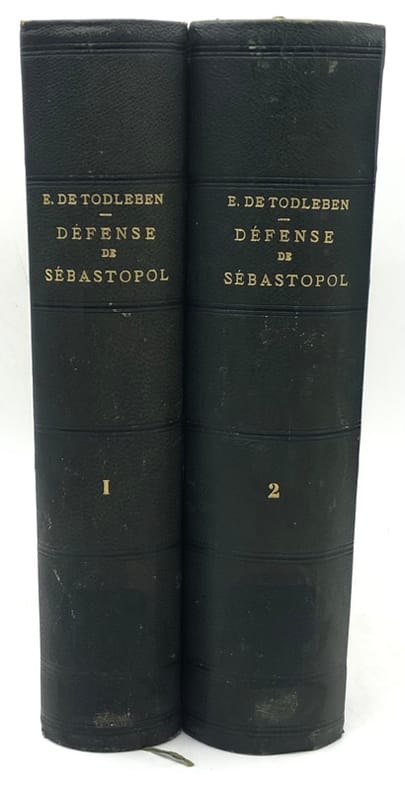
189817Saint-Pétersbourg, Thieblin et Co, 1863-1874 2 vol. in-4, III-VIII-III-XXXVIII-726-125 pp. et 448-356-166 pp., 1 planche et 3 plans dépliants, demi-chagrin vert, dos lisse orné de filets à froid (reliure de l'époque). Rousseurs, cachets (annulés).
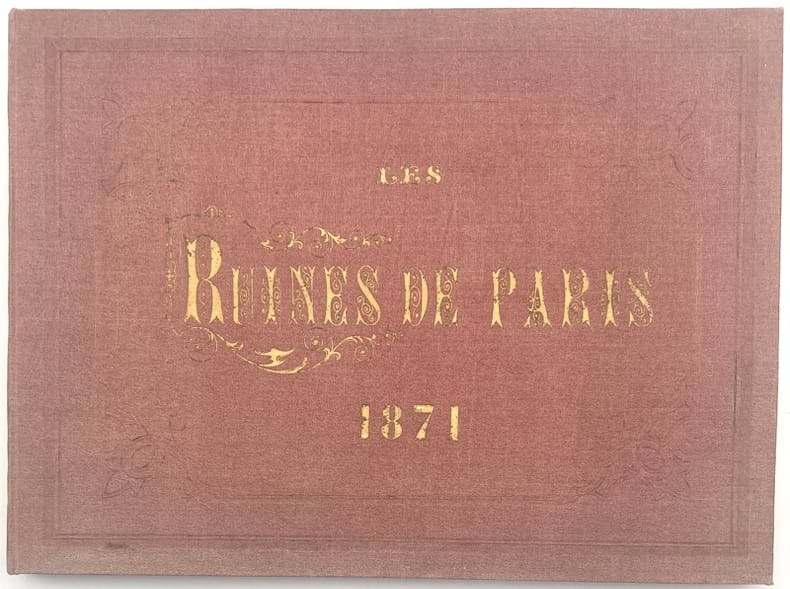
187144394Paris, , 1871. In-4 oblong, 20 photographies (15 x 21 cm) montées sur carton fort, table, toile rouge, titre doré sur le premier plat (reliure de l'éditeur).
73453London: Knapton Hitch and Others 1761. Concordance FINELY BOUND. Octavo 26 x 18cm unpaginated complete. With an engraved frontispiece portrait of the author. Main text in small print over three columns. Elegantly bound in contemporary brown full polished calf with gilt-lettered red morocco title label raised bands and gilt centre ornament to spine. Bookplate of Earn Cornwallis to pastedown contents clean and fresh binding pleasingly aged with light rubbing and handling only. A near fine copy. Charles Cornwallis 2nd Earl Cornwallis 1738-1805 created Marquess Cornwallis in 1792 was an Eton and Cambridge-educated British soldier and noted military commander best known as one of the leading British generals in the American War of Independence; his surrender to George Washington's Franco-American army at Yorktown effectively ended the war. London: Knapton, Hitch and Others, 1761 unknown
Pages 81-96 (16 pages in this issue). Features: What War Teaches Peace, by Frank Koester; India and Ireland - by Ernest P. Horrwitz of Dublin University; Lifting the Mask From England, by Aleister Crowley; Wilson Wants War - Why Henry Ford was Snubbed by the President, by George E. Miller of the Detroit News; Russian Corruption, by Louis Viereck; Behind the Scenes at the Capital; Stupifying the People - A Random Example of How a Harvard Professor Disseminates the Poison of Ignorance and Slander; Thoughts of a "Gently Hazed" American; Various editorial topics; War bond ads; List of contributors to the Emma Duensing Fund; Many interesting ads; and more. Opening along coverfold. Unmarked. Average wear. A worthy copy. Magazine