119 836 résultats
First edition, 4to, [8], some light dust soiling to title and margins slightly chipped. "An "Answer" to an Advice to a Painter in which the loyal members of the Artillery Company of Bristol had been attacked. The author, an ardent Anglican Tory, satirized the non-conformists (Presbyterians, Anabaptists, Antinomians, Brownists, Adamites, Chiliasts, Quakers, Muggletonians, and Independents) and accused them of plotting rebellion against the King." (Osborne). Wing A639 & ESTC (EN, CH; WF only); Osborne, Advice-to-a-Painter Poems 1633-1856. p. 48.
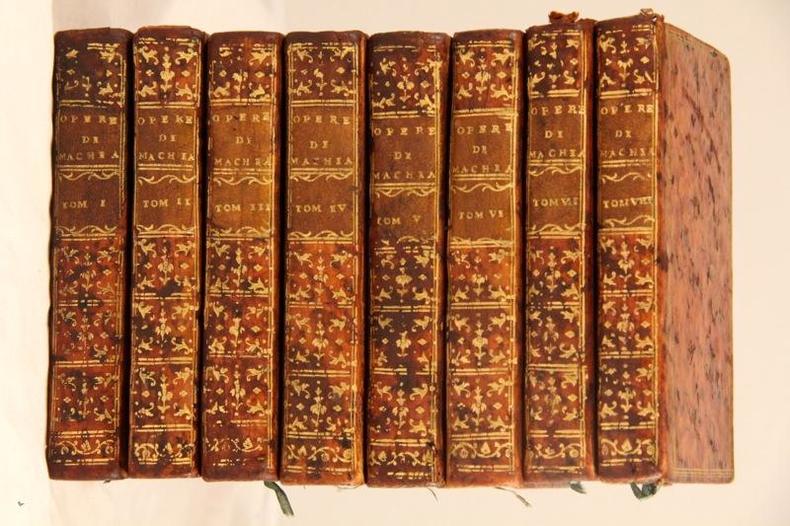
17685685Londra & Parigi, [Marcel Prault], 1768. 8 volumes in-16 de XLVIII, 384p. + 416p., + CLXXX, 256p., + 498p. + 456p. + 412p. + 310p. + 310p. plein veau marbré fauve, dos lisses ornés de filets et fleurons dorés, étiquettes de titre et tomaison veige (vert-beige...), petit accroc à une coiffe, épidermures. Étiquette de la bibliothèque du château de Bessinge, ex-libris H. Tronchin.
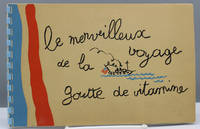
194217301<p> New York: Coordinating Council of French Relief Societies 1942 First edition of this children's book that was sold to raise money for the Coordinating Council of French Relief Societies CCFRS. "It often happens that my American friend say: 'Of course it is terrible to see French children starving. We long to do something about it. But do you really think we can without danger send them Vitamins and milk Can we be sure they will get it' The answer to this question has been given time after time by the American organizations that supervise the distribution; they know that the children and they alone receive the food; and they have many touching letters of thanks from the children themselves. Here is one of them" from the preface. Original wrappers lithographed in blue red and black. Light blue comb binding. . 8 in. x 5 in. . With seven full-page color lithographs. Aside from the printed preface text is reproduced from handwriting with children's handwriting above in French and the translator's handwriting below in English. The signatures of the children are reproduced on the last few pages Some light offsetting from color plates. A very good bright copy of a lovely book produced by French children during World War II. The present work was written and illustrated by a class of French children from five to six years. The story follows a drop of vitamin personified as a friendly American girl who travels across the ocean to aid children in occupied France. She ends her journey when she jumps into the mouth of a hungry child.</p> Coordinating Council of French Relief Societies,
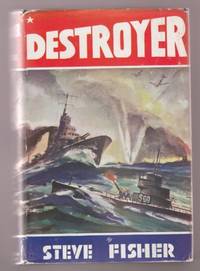
19412117NY: Appleton-Century 1941. First edition first prnt. Inscribed by Fisher on the front free endpage. "For Mark Hellinger - One of America's really great writers - this book is humbly and respectfully dedicated Steve Fisher Aug. 23 1941." Slight spinecocking beginning page toning and faint small stain on the foreedge; dustjacket with a a two inch closed tear on the front panel not immediately apparent chipping at spine ends and corners and light rubbing on the white rear panel. Tight and bright copy of Fisher's first novel. Very Good condition in a Good dustjacket with an archival cover. Fisher was widely read and respected for his short stories which appeared in the popular magazines of the 1930's such as "Cosmopolitan" "Saturday Evening Post" "Colliers" "Liberty" etc. when his first novel was published. The adaptation of his novel I Wake Up Screaming is regarded as the first of Hollywood's film-noir genre. Fisher worked on the screenplays for "Berlin Correspondent" "To the Shores of Tripoli "Destination Tokyo "Lady in the Lake" and "Song of the Thin Man" among others. Mark Hellinger's career in Hollywood included producer credits for "They Drive by Night" "High Sierra" "The Horn Blows at Midnight" and "The Naked City" among others. This copy was inscribed by Fisher during the production of the film version of the novel on which he also worked as screenwriter. Inscribed & Dated by Author. First Edition. Hardcovers. Very Good/Good. 12mo - over 6¾" - 7¾" tall. Association Copy. Appleton-Century Hardcover books
19412117<p>NY: Appleton-Century 1941. First edition first prnt. <em>Inscribed</em> by Fisher on the front free endpage. "For Mark Hellinger - One of America's really great writers - this book is humbly and respectfully dedicated Steve Fisher Aug. 23 1941." Slight spinecocking beginning page toning and faint small stain on the foreedge; dustjacket with a a two inch closed tear on the front panel not immediately apparent chipping at spine ends and corners and light rubbing on the white rear panel. Tight and bright copy of Fisher's first novel. Very Good condition in a Good dustjacket with an archival cover. Fisher was widely read and respected for his short stories which appeared in the popular magazines of the 1930's such as "Cosmopolitan" "Saturday Evening Post" "Colliers" "Liberty" etc. when his first novel was published. The adaptation of his novel <em>I Wake Up Screaming</em> is regarded as the first of Hollywood's film-noir genre. Fisher worked on the screenplays for "Berlin Correspondent" "To the Shores of Tripoli "Destination Tokyo "Lady in the Lake" and "Song of the Thin Man" among others. Mark Hellinger's career in Hollywood included producer credits for "They Drive by Night" "High Sierra" "The Horn Blows at Midnight" and "The Naked City" among others. This copy was inscribed by Fisher during the production of the film version of the novel on which he also worked as screenwriter. Inscribed & Dated by Author. First Edition. Hardcovers. Very Good/Good. 12mo - over 6¾" - 7¾" tall. Association Copy.</p> Appleton-Century hardcover
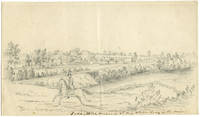
1862WRCAM52146Iuka Ms 1862. Pencil sketch with ink caption 5 1/4 x 9 inches. Old central vertical fold with ink caption at foot of image and twelve-line description on verso. Near fine. Matted. A well-executed pencil sketch of Iuka Mississippi drawn after the capture of the town by Union troops under Gen. William Rosecrans which served as the basis for an engraving that appeared in the Oct. 4 1862 issue of HARPER'S WEEKLY. A Union soldier rides across the foreground with the Tennessee River and a rail bridge on the Memphis & Charlestown Railroad line behind him. In the center background are the building of the Iuka Springs House the waters of which the verso caption claims "possess many medical qualities." <br> <br> The battle of Iuka took place on Sept. 19 1862 in which smaller elements from the Southern forces of both sides sought to prevent one another from reinforcing larger armies to the north in Tennessee under the command of generals Braxton Bragg and Don Carlos Buell. unknown books
19461159631946. Signed. TIBBETS Paul W. Photograph Signed. No place image circa February 1946 signed at a later date. Black-and-white photographic print measuring 10 by 8 inches. $1100.Photographic print of ""Enola Gay"" Pilot Paul Tibbets Bombardier Tom Ferebee and Navigator Theodore Van Kirk signed by each on his image.Paul W. Tibbets was the pilot Thomas W. Ferebee the bombardier and Theodore J. ""Dutch"" Van Kirk the navigator on Enola Gay the B-29 Superfortress that dropped the first atomic bomb over Hiroshima Japan on August 6 1945 hastening the end of World War II. This photograph shows them alongside other unidentified air crew. Fine condition. unknown
MONUMENTALE OPERA, ABBIAMO IL VOLUME EDITO NEL 1916 E QUELLO DEL 1919, LEGATURE EDITORIALI IN MEZZA TELA CON TASSELLI TITOLI AL DORSO DI COLORE ROSSO. TAGLI SUPERIORI IN ORO. BELLISSIME LE 192 TAVOLE A PIENA PAGINA A COLORI RAPPRESENTANTI MILITARI. TIRATURA LIMITATA IN 1050 ESEMPLARI numero pagine: PRIMO VOLUME CON 100 GRANDI TAVOLE. SECONDO CON 92 GRANDI TAVOLE formato: 46X37 stato conservazione: DISCRETO, INTERNO BUONO, COPERTINE CON TRACCE D'USO E LIEVE ABRASIONE traduttore: WITH AN APPRECIATION BY H. PERRY ROBINSON AND DESCRIPTIVE NOTES BY E. GARNETT
Fine German Original typescript letter signed 'Souchon', addressed to Capitan, lieutenant colonel Vasif (Wassif) Muhiddin Bey [Kasimpasali]. Wassif Bey was a ship commander of Hamidiye cruiser before Rauf Orbay. 27x21 cm. In German. 1 p. "Kommando der Flotte" letterhead with bilingual in German and Ottoman Turkish. 8 lines. Signed 'Souchon'. This letter includes an indication that it honors the Kaiser (Wilhelm II) with the Iron Cross medal for Commander of Haamidiye, Wassif Bey. "Seine Majestät der Kaiser und König haben Euer Hochwohlgeboren in Anbetracht Ihrer tatkraftigen Arbeit im Interesse der Kriegsbereitschaft und Kriegsbereitschaft und Kriegsbedürfnisse der Marine das Eiserne Kreuz 2. Klasse zu verleihen geruht.". [i.e. His Majesty the Emperor and King have deigned your High Wellbeing to give the Iron Cross 2nd Class to the Navy in view of your hard work in the interest of readiness for war needs.]. Wilhelm Anton Souchon was a German admiral in World War I. Souchon commanded the Kaiserliche Marine's Mediterranean squadron in the early days of the war. His initiative played a major part in the entry of the Ottoman Empire into World War I. Wilhelm Anton Souchon was born on 2 June 1864 in Germany to a family of Huguenot ancestry. In July 1914, hostilities erupted between the Austro-Hungarian Empire and the Kingdom of Serbia. Rear Admiral Souchon, a native of Leipzig, feared being trapped in the Adriatic Sea in the event of other nations joining in the conflict. Because of this, Souchon took his two ships, the battlecruiser Goeben and the light cruiser Breslau, into the western Mediterranean. When World War I began on 4 August 1914, he bombarded the French-Algerian ports of Bône and Philippeville. He successfully eluded British attempts to corner him (see Pursuit of Goeben and Breslau) and on 10 August 1914, his small squadron arrived at the Dardanelles. After two days of negotiations, he was allowed to take his ships to Istanbul where they were subsequently transferred officially into the Ottoman Navy. Souchon was appointed Commander-in-chief of the Ottoman Navy and served in this position until September 1917. This gesture by Germany had an enormously positive impact with the Turkish population. At the outbreak of the war, Winston Churchill caused outrage when he "requisitioned" without compensation two almost completed Turkish battleships in British shipyards, Sultan Osman I and Reshadieh, that had been financed by public subscription. These ships were commissioned into the Royal Navy as Agincourt and Erin, respectively. On 15 August 1914, in the aftermath of Souchon's daring dash to Constantinople, Turkey cancelled their maritime agreement with Britain and the Royal Navy mission under Admiral Limpus, and left by 15 September. The Dardanelles were fortified with German assistance and the Bosporus was secured by the presence of Goeben (now Yavuz Sultan Selim). On 27 September 1914, the Straits were officially closed to all international shipping. On 29 October 1914, Souchon's fleet launched the Black Sea Raid, a naval attack which brought the Ottoman Empire into World War I. His ships laid several sea minefields and shelled the Russian Black Sea ports of Sevastopol, Odessa, and others, destroying the Russian minesweeper, Prut, in the process. British naval units quickly retaliated on Turkish merchant ships off Izmir (Smyrna). On 2 November 1914, Russia declared war on the Ottoman Empire. On 5 November, Britain followed suit and on 12 November 1914, the Ottoman government officially declared war on the Triple Entente. For the next three years, Souchon attempted to reform the Ottoman Navy while conducting a number of raids on Russian shipping, ports, and coastal installations in the Black Sea. Promoted to vice admiral, Souchon was awarded the Pour le Mérite, Germany's highest military order, on 29 October 1916. In September 1917, Souchon returned to Germany. There he received command of the Fourth Battleship Squadron of the High Seas F
Very Good Turkish, Ottoman (1500-1928) ÖNT14 In aesthetic modern dark black cloth bdg. with Ottoman lettered gilt and embossing. Roy. 8vo. (24 x 17 cm). In Ottoman script. [4], 138 p., 1 folding huge map. Hegira: 1341 = Gregorian: 1925. First and Only Edition. A rare travel book printed in the Ottoman Empire. Antoine Poidebard, (1878-1955) was a French archaeologist and Jesuit missionary. He pioneered aerial archaeology in the Middle East. In 1925, during his flights in the Syrian desert, Poidebard discovered tiny reliefs thanks to the shadows brought to the ground by the evening shining light, which revealed geometric structures. It was on this basis that he became the first known airborne prospector, as he was able to map all the layout of the Roman limes using the technical means of the air force. Aerial archeology was born. The air explorer Raymond Chevallier identifies two periods of study in the works of Antoine Poidebard: A first, from 1925 to 1932, during which the researches of Antoine Poidebard fixed the course of the Imperial Limes of Basrah at Palmyra and the Tigris; A second, from 1932 to 1942, which made it possible to specify the Roman organization of the rear of the Euphrates and the Orontes. The result of his work is 550 hours of flight divided into 250 missions during which were taken thousands of photographs on a zone of 1,000 kilometers over 300 kilometers. Only one copy in OCLC: 949521769; Koray 1779.; Özege: 9312.
Very Good Turkish, Ottoman (1500-1928) Original autograph letter signed as 'Sezai' by Samipasazade Sezai to Türkgeldi family. In Ottoman script. 4 p., last page has Ali Fuat Türkgeldi's autograph note on Samipasazade Sezai's death as: "[Samipasazade] Sezai Bey; 26 Nisan 1936 Pazar aksami saat dokuzu yirmi geçe [21:20] ölmüstür.". Sezai's letter starts as 'Pek muhterem kardesim'. Used blue ink with a fountain pen. Ali Fuat Türkgeldi, (1867-1935) was an Ottoman historian and politician. He is the son of Celâl Bey, the undersecretary of the Ministry of Interior and the son of Cemal Bey in the Reform period (Tanzimat - Westernization) period), the director of Translation Chamber. Sezai Turkish realist storyteller, novelist. He is the author of Sergüzest (Adventure) which is one of the first realistic novels of Turkish literature. Also he was pioneer of the modern short story in Turkish literature with Küçük seyler 'Little things' he wrote in 1892. Between 1885 and 1901 he lived in Istanbul (this letter dated probably in that period) and had a literary period. He was close friends with Abdülhak Hamit and Recaizade Ekrem. He met with Namik Kemal whom he met when he was 17-18. He did not produce many works like other Tanzimat writers; wrote one novel, two small story books, and travel memoirs. In 1888, he published a novel called Sergüzest (A story about a Pasazade and his love story), after which he became one of the first writers of Turkish literature after Semseddin Sami, Namik Kemal and Ahmet Mithat Efendi. He translated Alphonse Daudet's 'Jak' into Turkish. For thinking that he was being held under 'surveillance' for his novel, he went to Paris in 1901 and stayed there until the declaration of the Constitutional Monarchy in 1908. He met the Young Turks in Paris; He joined the Committee of Union and Progress and came to a respected place in the community in a short time. Upon the declaration of the Constitutional Monarchy, he returned to Istanbul and was appointed as ambassador to Madrid. As WW 1 began, he moved from Madrid to Switzerland, where he stayed until the end of the war. His only novel, Serguzest, was the first novel in Turkish literature to deal entirely with captivity; the novel, in which the system of concubinance and slavery was criticized, was his most famous work. It was translated into French by Besim Ömer Pasha. e combined romance and realism in her writings. He combined romanticism and realism in his writings. He gave works with the motto of "l'art pour l'art".
Very Good Turkish, Ottoman (1500-1928) Paperback. Chipped on margins. Some owner notes. Otherwise a good copy. Roy. 8vo. (24 x 18 cm). In Ottoman script. 32 p. This rare book includes the royal travel of Sultan Abdülmecid in 1262 AH [1846 AD] to Roumelia. From Edirne, Abdülmecid proceeded to Eski Zagra (Stara Zagora), Kizanlik (Kazanluk), Gabrova (Gabrovo), Tirnova (Turnovo), Rusçuk (Ruse), Silistre (Silistra), and Varna. The route of the 1846 tour followed closely, except in reverse order, Mahmud II's tour of 1837. According to witness accounts, along the way, the sultan was greeted everywhere with poetic recitations and songs of praise and prayer, both in Ottoman and Bulgarian. The pride of place among welcoming parties invariably fell on students, of all creeds, most clad in white uniforms, some in solemn church-going attire, with flowers and green branches in their hands. At every stop, ceremonial cannon salvos were fired during the day and elaborate firework illuminations were performed at night. In the town of Kizanlik, known then as now for the most fragrant roses and the best rose oil, the sultan's visit coincided, possibly by design, with the rose harvesting season. So the locals sprinkled rose water and poured rose oil before the sultan's cavalcade. According to Hristo Stambolski, in the three days of the sultan's stay in town, no rose harvesting was done so that the whole area would be exquisitely scented in his honor. For his part, the sultan had doctors vaccinate all children against smallpox in public before sending each one off with a small gift of money. Even people with rare diseases were, on occasion, summoned to the sultan's presence so his doctors could cure them. The sublime visit caused the locals, who were unaccustomed to direct contact with the center of power, quite a stir. The most detailed account, albeit from a hostile source, relates the sultan's visit to Rusçuk, which, at four days, may have also been the longest. According to Nayden Gerov, the greeting ceremonies proceeded on a communal basis, with the Jews being placed closest to the town walls, next to them the Armenians, then the Bulgarians, and finally, the Muslims, situated the farthest from town, yet being the first to see and welcome the sultan. As the sultan approached, each group of youngsters would in turn sing for him, everyone else bowing profusely. Based on Gerov's description, it seems that Abdülmecid was dressed in a slightly more luxurious fashion than during state ceremonies in Istanbul. ((Source: Sultan Abdülmecid's Tour of Rumelia and the Trope of Love by Stephanov). The sultan began to travel by the way of the gate of Yedikule in Istanbul in May 6, 1846. He followed the way of Ayastefanos, Silivri, Çorlu, Burgaz, Edirne, Zagra-i Atik, Kizanli, Trnova, Rusçuk, Silistre, Rusçuk, Shumnu, and Varna and came back to Istanbul by way of the sea on June 14, 1846. During this travel, the Sultan listened to people's problems and ordered the authorities to be solved with those problems. He received successful military and administrative authorities in settlements on the way of travel and rewarded them. He also received the governors of Serbia, Eflak and Bogdan, and the representatives of foreign states. With this travel, the Sultan aimed to strengthen the connection to the center of people and administrators in provinces. Özege 17910. First Edition.
First English edition, 4to (260 x 200 mm), [2], x, 195, [1]pp., minor foxing on title, 40 engraved plates by Basire on thirty-four sheets (33 folding), contemporary sprinkled calf, corners rubbed, rebacked, spine gilt, morocco label. Provenance: Armorial bookplate of George Cockburn on front paste-down.
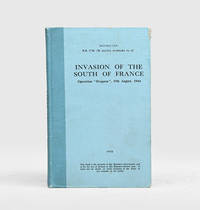
1950186864London: Tactical and Staff Duties Division Historical Section Naval Staff Admiralty 1950. First edition classified restricted. Operation Dragoon marked the first participation by a French army in the liberation of the country. Naval support including amphibious lift minesweeping and aerial bombardment was provided by the US Eighth Fleet and the Royal Navy's Mediterranean Fleet both under the overall command of Vice-Admiral H. Kent Hewitt. "From the tactical point of view there is no doubt that Operation 'Dragoon' was a resounding success. Between 15th August and 25th September a great army consisting of 324069 men with vehicles were disembarked. All this was done with very small loss. The Seventh Army swept aside all opposition. and advanced some 400 miles in 27 days to join forces with General Eisenhower" p. 56. Of the 500 copies printed we have traced only one in the UK National Museum of the Royal Navy and a further four worldwide US Navy Department Library University of Calgary National Library of Israel and the Dutch Defensiebibliotheken. Octavo. With 4 folding plans. Original blue quarter cloth title to spine in black blue sides lettered in black. Binding lightly worn one plan slightly proud: near-fine. hardcover
Vol. 1: fine Vol. 2: light bumping to upper corners. Vol 3: very light soiling to spine. Light wear to one corner; vol. 4: light chip to top of spine else fine. Vol. 5: small chip to base of spine. Else fine. Set appears unread. Volumes range from VG+ to Fine. ; Publishing years 2008-2009. Isbns: 9025612359, 9025612369, 9025612423, 9025612474, & 9789025612528 ; 5 Volume Set COMPLETE. Supplementi Di Lexis; 2439 pages
18624aafLa Haye (Paris), (Daniel Monnier pour) Pierre Gosse junior, 1756, in-folio, XII, titre en rouge et noir avec grande vignette hérald. gravée + 228 p. + 2 ff. n.n., illustré de jolies lettrines de grandes vignettes en-tête (certaines montrant des scènes militaires), et de culs-de-lampe + 40 planches gravées (de Sibelius) et coloriées, dont 21 doubles ou dépliantes, montrant des constructions militaires, des plans de tactique et de batailles, et un cavelier venant du fourage), papier en très bonne condition, exlibris ms. sur le titre, 2 exlibris hérald. à l'intér. du plat devant, reliure en veau, dos refait à nerfs richement orné en or (dans le style de l’époque), pièce de titre (d’origine), tranches rouges, reliure habilement restaurée aux coiffes et charnières. Bel exemplaire.
D18Correspondance de Napoléon 1er publiée par ordre de l'Empereur Napoléon III, 32 tomes Paris, Série de 32 tomes s’intitulant : « Correspondance de Napoléon 1er » publiée par ordre de l’empereur Napoléon III. Henri Plon, éditeur des œuvres de l’empereur. J. Dumaine libraire-éditeur de l’empereur. De 500 à 600 pages par volume. Reliure demi-marocain d’époque dorée sur tranche bon état. Photo supplémentaire sur demande. Un ouvrage "gigantesque" entrepris par Napoléon III et financé par le gouvernement français de l'époque. Toute la correspondances de Napoléon Premier depuis 1793 jusqu'à sa mort en 1821, ses commentaires sur des écrits de stratèges militaires qui l'on précédés et sur les évènements qui ont fait de lui "l'Empereur des français".
Milano, 1944, n. 1/53 annata completa, rilegata con : 1945, da n. 1 (7 gennaio) a n. 16 (22 aprile). Riprese di lì a poco, il 27 maggio, col nuovo nome di "Domenica degli italiani" (n. 1/32) qui uniti: Epurato il vecchio nome per "fascismo", ripartì poi nell'anno successivo con la sua antica testata. Piuttosto rara perchè in quegli ultimi mesi di guerra ben pochi avevano tempo di acquistarla ed ancor meno di conservarla. In eccellente stato di conservazione.
0138050 Reliure Dédicacé par l'auteur
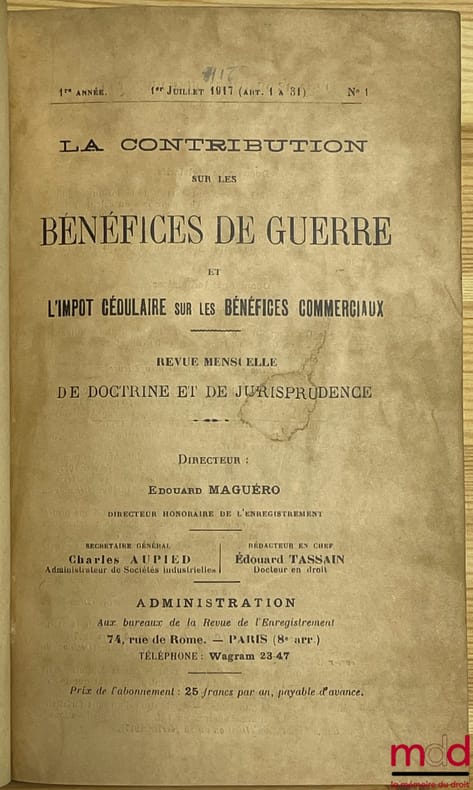
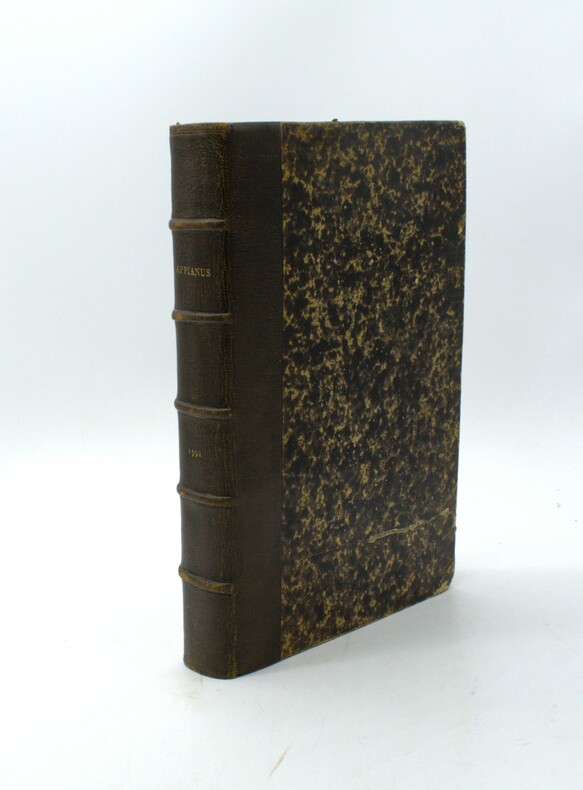
3972, Paris, Administration de la Revue de l’Enregistrement 1917 et s., 44années en 43 vol. in-8, demi-toile enduite marine [1917-1929]/ toile verte [1930-1956], tit. & tom. dorés sur pièce de maroquin fauve avec double filets dorés soulignants, (qq. lég. accrocs ou taches au dos, papier jauni), bon état général.
180021569Lorient 1800 1 feuillet avec en-tête préimprimé en noir : Liberté Egalité- République Française et orné d'une vignette en noir représentant une encre de marine avec une couronne de lauriers, manuscrit à l'encre brune sur papier vergé bleu ligné et filigrané (lettre écriteau recto seul), format 18,3 centimètres de large par 24,2 centimètres de haut, Lettre écrite à LORIENT, le 8 MESSIDOR AN 8 (27 juin 1800) de la République Française une et indivisible, signature manuscrite de BOÛRON, Sous Commissaire De Marine, Chargé de l'Inscription maritime et de la Police des Prisonniers de Guerre de Lorient,
1686bn1529A Paris, chez la veuve C. Blageart, Courtneuve du Palais, au Dauphin. Relié 1686 Très rare ouvrage attribué par Barbier à Vanel (Jean de) qui paru de 1686 à 1687. Il paru 5 volumes, nous ne proposons ici que les 4 premiers qui décrivent les évènements de 1656 à 1685 (le volume 4 est paru en 1686), le volume suivant imprimé en 1687 doit contenir la suite des évènements. 4 volumes in-12° reliés plein veau, volume I : titre, 23 feuillets pour la préface et la table, puis 428 pages suivies par le privilège sur 3 pages, volume II : titre, 9 feuillets pour la table, 455 pages, volume III : titre, 428 pages, 9 feuillets pour les tables, volume IV : titre, 9 feuillets pour la préface, la table et le privilège, 352 pages ; petits défauts aux reliures, bon état. Livraison a domicile (La Poste) ou en Mondial Relay sur simple demande.
1592PHO-1814Paris, Estienne, 1592, folio, relié demi basane (19eme), dos à nerfs avec auteur et date, coins usés, frottements aux plats, petite déchirure au titre, mouillure par intermittence.
1922001510Paris Lapina, Collection Les Images du Temps 1922
192292645Couverture souple. 2 volumes brochés, légèrement défraîchis. 374 et 508 pages. 2 atlas : 9 et 12 cartes (grandes cartes dépliantes). 20 x 26 cm. tome 1 :dos factice, plats tachés. tome 2 : dos réparé, plats tachés. Atlas tome 1, quelques rousseurs à la couverture. Atlas tome 2 : 2 e plat factice.